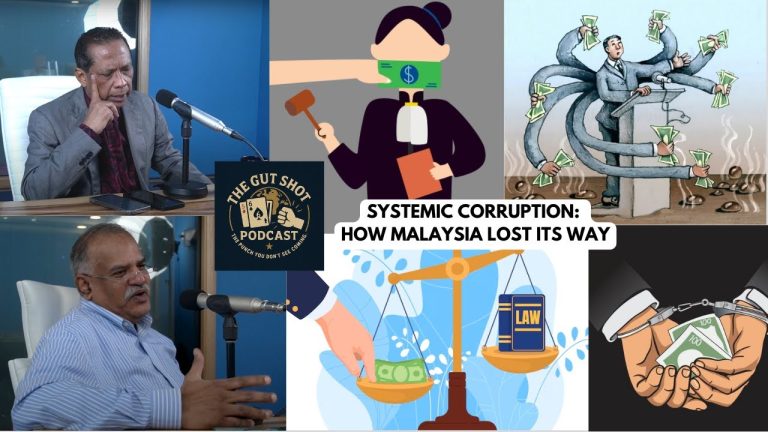
Systemic Corruption: How Malaysia Lost Its Way
Show Notes & Description
Merry Christmas & Happy New Year. A complex discussion on systemic corruption that ails the Nation from the overview since 2008 till today. From the on-the-ground impact to the business community to the political patronage system that feeds this monster. Time to make seismic changes.
In this final episode of the year, we are taking the gloves off. We are stripping away the polite veneer of mainstream media to expose the rot that is eating Malaysia from the inside out: systemic corruption.
We aren't just talking about politicians stuffing cash into envelopes; we are unpacking a disease that has infected everything from our universities to the street cobbler.
Why has Malaysia fallen so far behind while Singapore—a nation with the same people and culture—sits at number 3 in the world rankings?. In this episode, we present data that proves corruption isn’t just a moral failing; it is political suicide. We reveal a chart tracking Malaysia’s Corruption Perception Index against election results, showing exactly how the ruling coalition entered the "dead on arrival" zone.
Drawing from our own decades of experience in business and the gritty reality of the streets, we expose the "Alibaba" culture that inflates costs and kills competency. We tell you the stories you won’t hear in Parliament: how street traders in Masjid India are extorted by enforcement officers, how the "Bazaar Ramadan" system is rigged, and how even a humble cobbler is forced to buy lottery tickets just to keep his spot on the pavement.
We also dismantle the myth of the Bumiputra Commercial and Industrial Community (BCIC). We explain why the patronage system has failed to create resilient entrepreneurs and instead produced a class of "silver platter" millionaires who don't know how to compete. From banking oligopolies that drive the poor to loan sharks, to the academic fraud in our ivory towers, we are laying it all bare.
If you want to understand why your wallet is empty and why the nation is stalled, you need to watch this. We are here to change the way people think and change the nation.
Chapters
• 00:00 – The Reality Mainstream Media Won’t Touch Intro and our mission to change the nation, plus holiday wishes for 2026.
• 02:15 – Corruption is More Than Just Money Defining the abuse of entrusted power, from red tape to nepotism.
• 04:08 – The Ivory Tower’s Dirty Secret Exposing plagiarism and grade-fixing among academics and professors.
• 06:25 – When Affirmative Action Becomes Theft Why helping the disadvantaged is noble, but blocking the qualified is corrupt.
• 08:44 – The Graph That Predicts Government Collapse We analyze the chart proving that when corruption rises, the government falls.
• 19:15 – The Singapore Contrast Same people, same culture, but they are #3 and we are #57. What happened?
• 21:38 – The Hidden Mafia Behind Street Markets How Bazaar Ramadan slots are rigged and sold by corrupt enforcement runners.
• 30:25 – The Cobbler’s Lottery Ticket A heartbreaking true story of how the poor pay bribes just to survive on the street.
• 33:45 – The "Alibaba" Trap & Political Patronage Why fat profit margins in government contracts encourage outsourcing rather than work.
• 42:15 – Why Government-Linked Companies (GLCs) Fail The absurdity of forcing capable entrepreneurs to partner with incompetent cronies.
• 46:05 – The "Silver Platter" Syndrome Why easy money destroys the work ethic of the next generation of business leaders.
• 54:35 – Banking Cartels & The Rise of Loan Sharks How banking consolidation wiped out competition and forced the poor into the hands of the "Ah Long."
• 59:40 – The Consumer Pays the Price From rice monopolies to toll booths: how corruption is a direct tax on your daily life.
Many thanks to CITYPlus for their collaboration with The Gutshot Podcast, in whose studio this conversation was recorded. CITYPlus is Malaysia's first Chinese business radio station, dedicated to delivering in-depth analysis on local and international current affairs, markets, and businesses.
Jump to chapter 9 chapters
- 0:00 Introduction to Systemic Corruption
- 4:20 Academic Rot and Redefining Corruption
- 10:09 The CPI Graph and Political Collapse
- 23:50 The Singapore Contrast and Street Extortion
- 36:52 The Street Cobbler and Low-Level Graft
- 40:42 Political Patronage and the Alibaba System
- 54:33 Why the BCIC Fails Competency
- 1:05:28 Banking Oligopolies and Loan Sharks
- 1:10:16 Digitisation, Consumer Burden, and Conclusion
Auto-generated from YouTube captions. Timestamps link to the video.
Good day. Welcome back to the Gutshot podcast. I'm your host uh Shamsul Sam. I'm here today with uh my good friend and partner Say Akbali. Good morning.
Um this is going to be our last episode uh of the year and uh coming up we want to wish our viewers very happy merry Christmas and also a happy new year.
Can we do that? We can, I think. Are there any Christmas decorations here? I wish I could put a reindeer here, you know. Merry Christmas, happy new year. And hope that we all have a wealthy and prosperous and happy 2026 as well.
Drive safe, don't eat too much. Yeah, there you go. Uh before we start, uh we're going to have a very interesting conversation today. uh uh and uh we're going to Oh, before before we go there, please subscribe to our channel so that uh you get all the uh episodes uh as it drops. This channel, we're going to change the pe the way people think. We're going to change the nation and we're going to change what needs to be changed. Say,
yep. Okay. So, without further ado, uh let's put it this way. Um in my opinion, Malaysians uh of course including Malays seems to be very forgiving of corruption. Today I think say uh let's start to let's unpack this issue that we call that we've identified is as basically a systemic corruption in Malaysia. What we're going to talk about you will not hear uh in the mainstream media, parliament or from the politicians. We will talk about the reality on the ground and and it moves up how it is so systemic. You will you will hear stories the why and what and we also how we can
fix this. But first as always we must point out the devil. Okay. Say, why don't you open and uh start with this uh conversation of ours that maybe with that beautiful chart of yours.
Thank you. Uh we have an interesting chart here but uh we'll come to it. Uh we'll put up this chart on the screen too. uh the as you as you said systemic corruption uh the entire system is uh corrupted and uh uh it's all across the board. If you look at if you look at dictionary definition of corruption uh corruption is not just uh what we read about in the newspapers and politicians taking money uh civil servants or policemen or other enforcement people getting arrested for corruption charged in court. uh corruption is much wider than that. You know, uh the wider definition the wider
definition of corruption is is is just an abuse of of power with with which a person is entrusted. Abuse of entrusted power um or abuse of uh uh something uh influence which you authority which you pro possess for personal gain uh dishonest behavior, fraudulent behavior uh and criminal acts like bribery, extortion, embezzlement, nepotism, fraud. These are all corruptions. But it is basically taking what is not yours. As simple as that. What you don't have a right to seeking benefits beyond one's legitimate right. That is you can also say it's stealing but corruption is
well stealing is more direct but corruption is sometimes it's not visible. It can be under hidden under layers of um red tape, layers of bureaucracy, uh layers of procedure. So it may not be as easily visible but nevertheless it it is still corruption.
Uh just a couple of days back I was listening to another podcast uh where they were inter interviewing um professor Sharifa Monira alas. She has just published a a recent book. She's an academic. It's called ivory tower reform where she speaks a lot about plagiarism, you know, in the academic system. And she talks about plagiarism not only invol involving students but involving academic staff in our universities. Now I personally have known about this for decades for I had a friend more than 25 years ago who was an associate professor and she was saying how that
if too many students fail she'll get called up you know by the university authorities and she'll be given a hearing why are these so many students failing. It was a it was a a sort of a hidden message or a implied message that this should not happen meaning they have to pass. So that is corruption you see because basically you're telling people to abuse the system use the power that you have uh to get this result or that result which should not really happen. So uh uh Monira Alatas also spoke about plagiarism you know in uh in among academics and professors which again I
have heard about decades ago. It's it's an old story when when graduate students do research and write their thesis the professors want their names. Wow. In the thesis
in the thesis itself in order to clear it to get citation points. You see when they did not participate in the research and things like that. It's corruption. It's abuse of your authority which is corruption to to take something that is not yours. You don't you don't have a right but you take it uh you know it's not ethical. So it doesn't involve money. It's not financial monetary corruption. Nevertheless, it is corruption because you will acrew benefit from it.
Yes. Through not legitimate means. So so corruption is very wide and in this country you find this kind of behavior. We just spoke educ education in academia everywhere financial non-financial it is still corruption it is abuse of power gaining benefit that is not yours yours at the expense of someone else say you mentioned uh academia I I it just uh there's another form that I define as well as corruption when bury when when we lower standards in order to bring a certain certain race or uh a certain kind of uh people, you know, of ethnicity into universities
and providing places where they don't actually uh be um in a situation where they're not at the level they are supposed to be, but they are admitted nonetheless in spite of others being more qualified. I think that's a form of corrupt that is corruption as well. I uh well uh if you lower standards, you're basically talking about affirmative action to correct
that's patronage. If you if you correct to correct uh you know in education to correct imbalances and injustices that pre-existed that were already existing there. So your intention was or is to correct imbalance and and injustice long-standing injustices or imbalances and you're trying to rectify the situation. But uh that is to help those who are disadvantaged. To me it becomes corruption. It is not corruption in my in my understanding for affirm affirmative action to help those who are disadvantaged. It becomes corruption when you prevent the next guy from from
getting his spot or getting his opportunity. That becomes corruption because the idea of affirmative action is to help those who are disadvantaged. But in the process, why do you have to obstruct those who who as you say who who have uh acquired the merit
to get a place in university or to get opportunities in life and things like that. So that becomes uh a corrupt practice. you're denying others their their opportunities. Uh it is not wrong to lower standards or to make things easier or to assist people who disadvantage. I think we should do that otherwise who's going to help the disadvantage. So we need affirmative action but not at the cost of going out of the way to trip someone else up. That that's that's the wrong way of doing it. So that's where the corruption comes in. Nobody in this country, no one,
especially the non-Malays, non-buing, no one is going to complain that we have affirm affirmative action to help bohutras move up in life, especially education opportunities. Nobody is going to complain about that. What they cannot understand and cannot accept is why do you have to prevent others the others from getting what they have already earned? For example, they have got the by merit they have got the qualifications to enter university or whatever. uh why are they uh uh prevented from pursuing their opportunities? That's where that's where the abuse comes in. I call it an abuse.
Yeah, it's corruption. So is how we handle it. So I mean that as an opening where let's let's look at overall and then and then bring it down back to uh the issues we want to talk to specifically.
Okay. How how is the P how is uh how how do we look at the overall picture at the moment? Okay, I have a I I prepared a chart here. Um I think we we might as well talk about it right now. This is uh well this chart was generated uh through chat GPT but the data comes from uh uh what do you call this uh this outfield called transparency international
right who come out with this annual global corruption rankings and things like that they call it the CPI corruption perception index. So we are also uh we have also been ranked through the years. So this chart represents so what I did was I got chat GPT to uh to graph to graph from the year 20008 which is a general election year until 2022. These are all general election years. There are five of them. to chart our global corruption ranking. Uh as you can see the the the the our ranking has gone down tremendously from 208 to 2022 versus the number of parliamentary seats worn by AMNO.
The reason I choose AMO is because it was the ruling party AMNO Barisa National. They were the ruling party from 208 in this charge until 218 and then they lost the elections and now they are back in power as a coalition government. So they do represent the government in power the ruling party. So I I picked them because they were the ruling party and also uh because even though they lost the elections
uh all their policies are still continuing very strange uh behavior for a democratic country. The party that lost all their policies have not still remain unchanged.
Not a dot has changed. So, so but but the the people do have uh their views uh people do have their feelings and their what they think of uh of uh AMNO and their policies as captured by the election results the bar chart also captured by the global corruption index prepared by transparency international. So in 208 it was an agile election year that was the year we had a new prime minister Abdullah Badawi after Dr. this 20 world record 22 years as prime minister. So uh Abdullah Badawi came in and uh people were hoping for much change reform and things like that. And
in that year 208 when he came in and had his first general election under him um our our corruption index the global ranking was at its best. We were ranked by 39. The smaller the number the better it is. Top boy in class is number one. So we were 39. 39 not the greatest in the world but we were 39.
All right. And as you can see in this chart amnu they won over 100 parliamentary seats you know in 2008 now very but unfortunately uh very quickly the the Abdullah Badawi government they basically jumped off the window. You know I I don't know what happened to them. They just lost it. Right. So in four years uh between 20 uh 204 here and 208 they lost that that 2/3 majority in parliament which has which was an unchanging feature of politics in Malaysia since I don't know when 19 since Murka they have always held the two/3s they've always held the two/3s majority in parliament they lost it in
208 the people were dissatisfied with this government because of various issues many many issues not all of it is got to do with corruption but the corruption index also kept sliding down. So in this chart to me the important part of the chart this white patches here these white patches you can see the the corruption index keeps falling down. So the elections only come in once in 5 years. The white patches represent four to five years you know where the the dissatisfaction and the unhappiness is increasing. So, so in uh in uh 208 our corruption index dropped to 47
global ranking from 39 went down to 47 and that is the year when the the Barisa National and Amno lost their two/3s majority then Abdullah Bawi was asked to leave replaced by new prime minister Najiv Raza and then Najib Raza had his first giant election in 2013. Okay, AMNO did slightly better. The the coalition government party, the Barisan National did worse. They lost more seats. But our corruption index went further down to 53. That means from from uh 2004, we been on a on a downhill downhill 47 I call it the point where they got the serious heart attack and stroke.
They lost the two-thirds of majority. They never recovered. They were basically in ICU until 2013 the our ranking went down 53 and 5 years later in 2018 this area I call this pronounced dead upon arrival because they lost the elections here they were thrown out and our ranking global ranking was 61. So these numbers are important in the sense that Najib was able to secure a simple majority when our global corruption ranking was 53. Uh before that Abdullah Bawi still he only lost the 2/3 at 47 global ranking. So at so 40s is where you you suffer the stroke they lost the 2/3 even at 53 they
were still in the in the very red zone very sick you know at 62 they 61 they got kicked out now after 2018 we Dr. Mahade took over in 2018 Pakistan Harapan Dr. Mahade 2.0 Dr. Mahade was in office for 22 months then he too got removed okay a couple of things happened under Dr. Mahade under Dr. Mahadea in 2018 to 220 there was an improvement in our corruption index from 61 it actually went up to 51 it's you can't see it on this chart it went up to 51 within about 2 years Dr. Mahade sort of improved 10 positions the corruption index which is quite an achievement uh but the thing
that Dr. Mahade did not do was he did not change any of the policies of Amnu and Barisan National. Nothing was changed. So if you recall there were a series of bi-elections under his tenure. I think there were seven and and they lost Pakatan Harapan lost those seven bi-elections. Huh. Uh and then at the end of 22 months Dr. Made was removed through a internal kuda. So but he did improve the perception index corruption index to 51 and then he was replaced by two prime ministers in quick succession Tansri Mahoudin and Ismile Sabri about over over a year each
and during their time the index slipped again to 61 and when they went into the general elections in 2022 the the our ranking global ranking corruption ranking was at 61. So they are beyond they are still trapped inside the dead upon arrival zone here above 53 if you ask me is this is bad news zone this is where they lose elections 2018 and 2022 when no no one won it was a hung parliament okay we don't have data in this chart beyond 2022 but 23 24 the corruption index has improved a little bit I think it's at 57 now 57 is still the date upon arrival zone. It's not very healthy. 57 and uh
after 2022 uh remember in 23 they had the state elections in six states where the the ruling coalition really got they got their their butts kicked and uh 2023 and most recently a few weeks back
we had the elections in Sabah where again the the ruling coalition from the Putraaya coalition performed uh very poorly. Yeah. So uh they are in the danger zone because uh not only is the corruption index poor uh but the policies have not changed going forward into the next general elections which is a year and a half a year down the road two things will the policies change I do not know can they move this corruption index back to it is let's say is a 57 or something now can they move it to here 53 or better in the next 12 months or 18 months.
I think uh that's what they call a a snowballs chance uh in hell. It's a snowballs chance in hell. It's not going to happen. So there two of the the same things that affected the previous government, the same thing that affected Dr. Mahade 2.0. Policy is unchanging. corruption index is still weak and there is a possibility that over the next year year and a half the corruption index may fall again because you know recently we've had some issues that cropped up in the media you know that one political secretary was arrested and charged in in in court for corruption it was uh it was a what do
you call this uh VVIP somehow they think that that was that was a positive news VVIP uh VVIP issue it's front page media news and then um uh no names but I you know the football thing that happened in the country it has really uh projected our name in the wrong way
that was very that was very embarrassing so I mean it's called a it's called a corruption perception index it's how people look at you perceive so I I think these kind of things are going to have an impact on on our global rankings so what if the next year year and a half we drop back drop back to 58 or 59 or you are dead date on arrival.
I wonder as well you're looking at I I I don't know what the record is like but you are basically looking at probably a historic number of no further action in the legal system uh ever in the history of Malaysian uh judicial uh records that
all these things have an impact. Yeah. Yeah. whether they are legal or they are properly done according to the law by the book. Yes. I mean you know NFAS are what is uh carried out is not a judgment by the court. It's basically you file a case and then you say oh I'm I'm taking it back. They they say they follow procedure but regardless it has an impact on how people look at you not only your own voters but also uh uh these agencies like the the transparency international
and also investors. So it has an impact. Yeah. So, so I mean, okay, I mean, the the everyday person, the everyday Malaysian, the ordinary person, you and me and the voters, we do not know all these numbers. I only prepared this because I'm coming on the podcast and for my blog, but the everyday person doesn't see all this. They may not even know that an index exists, you know. But if you look at all these white patches here, you know, where the the corruption index is dropping, it actually reflects real difficulties and problems people face on the ground with corruption, with abuse
of power. Businessmen suffer corruption. Ordinary citizens have issues with with when they uh when they have to deal with corruption. I my company I that I used to work for we were we built a power plant IP in the north and uh we were caught by the Asian financial crisis. Uh but that was not what really uh affected us killed us. It was uh some people with uh strong connections and in powerful positions who were able to basically uh snatch our project away from us after we had built it after we had completed it. So uh these are the things that go on in the country on on every day every day
until today and that is what is captured by these figures here. You know the thing has to happen first on the ground before they are reflected neatly in charts like this before the information gets on these charts here. The people already feel it and they express their dissatisfaction in all these results that we that we see here. So as long as these politicians and parties do not understand this, do not change the policies, do not do real effort to cut down corruption, they're going to be here. This is called the dead on arrival zone. They will get kicked out. Say um
just for our viewer comp comparison, right, we are at what number now? I mean that is what 2022 is it? 57 57 57 around. Just for comparison, I was looking at 24 uh CPI uh the corruption perception index that place Singapore at number three.
Okay. Right. So that is just across the courseway down the red dot, you know, number three. Number three beneath us. So it's I mean it's that's that used to be part of Malaysia.
Same people, same people. Yeah. um same legal system, same legal system, same culture, same parliamentary system, democracy, same yeah I mean same sensibilities
right um the people have I think the people have approximately the same value system so what happens I mean where does that uh why why do we diverge so much and it's also I mean it it's seen both in the ballot talks is seen both in the economic performance. you're looking at um you're looking at uh Singapore GDP per capita which is almost equal to America and here we are at the bottom um and u you know uh in the uh in ICU and I don't think like you just said we don't have have seem to have a snowballing chance to get out uh snowballing chance in in hell to get out of this particular predic
So I mean before we go into uh where we see how things can move in a better direction right let's bring it to the ground level let's bring it how people at uh that are doing daytoday life and business as uh and and businesses to take care of their income take the take the I always like this this uh you know take the the the the lady, the old lady, the old man, the young kid that want to start their a business um uh during a bazaar uh which normally happens, you know, during Ramadan or even now I mean they have food trucks at, you know, that allows to be parked and doing their business on
the street to lower their cost of doing business and you know we go we stop by we buy we sit down. Tell me a bit how you know at the at the at the street level.
Yeah. The the people suffer uh they are exposed to more of these uh corrupt practices the the figures the amounts might be small but because the numbers are so huge the total amounts of money involved is huge. Since you mentioned Bazar Ramadan, as you know, I did business, my wife and I ran a jewelry business in the Mazjid, India area for about 20 years, you know. So, uh that is a very popular area, you know, for people to open up these roadside stalls selling stuff. So, for which you need a license, but the license issued by the local authority. But the those license
are always in short supply and more importantly, there's not enough space. There's not enough space. Yeah. you know to open all these uh roadside vendors and you know stalls and hawkers. So this is where the the the corruption started the bazaar Ramadan started. This bazaar Ramadan is very well documented in the media at least there arrests were made. It is an old story. So I remember in those days you know it's very simple some of these people who were corrupt the enforcement people what they will do is they have their runners who will engage with the people
who want to do business by the roadside the hawkers and the traders so they allow them to open up their tables and their little hawker outlets you know in and they have to pay for it. So what they will do is there in that area there were a lot of uh uh there were a couple of main roads shopping roads and uh connecting lanes or or alleys lanes what we call lorong in Malay they will they will close down these lanes you know these alleys they'll close them down traffic cannot go through anymore they'll block off both ends of these short alleys using those rubber cones
and once they block it off pretty soon you see that these guys will appear and set up their tables and and uh and uh uh hawker stalls and things like that and start doing business and they'll be there for the whole day. And usually this will happen in a busy weekend. Uh but they have to pay for it. But those are not legitimate rate trading areas. The authority, local authority cannot issue a receipt, cannot issue a contract, you know, for renting that space. It is just it goes straight into the pockets of these dishonest people who allow these traders to come in. So
that was how it began. It was a source of quick money for unscrupulous enforcement people to make money from these traders who are willing to pay to open up their stalls in these uh lanes and alleys. So to help them they closed the they closed the lane. They closed the lane to allow them to do business. Now later this evolved into the bazaar Ramadan. The same principle applied in bazaar Ramadan. It is agreed up front that only a certain stretch of the road would be opened up for this bazaar Ramadan. And during the fasting month, these traders are allowed to open their stalls to sell
things. But there are only x number of spots according to the calculation, the proper calculation because the the road is only so long. But they will close one eye and double the number of uh traders allowed to operate. And those would be illegal. That means they do not have a designated spot on the road which means that for that they had to pay money directly to somebody and there's no record of the transaction no receipts are issued. So that is where the corruption comes in and uh it became quite big money because some of those stalls in the Masid India area they had
to pay like for like thousands of ringit 5,000 ringit 2,000 ringgit depending on location somewhere as high as 10,000 ringit uh for that one month of uh trading in the fasting month. So you multiply that by like 400 uh 400 stalls each paying like 5,000 ringgit 3,000 ringgit 10,000 ringgit that's a lot of money that's a lot of money so that technology bazaar Ramadan technology was perfected in Masjid India and from there I'm telling you from there because I saw it it was exported to all around the country it went around KL first and then now everywhere they have this and
Now I live in Slango. I used to live in KL. Now I live in Slango. There is a bazaar Ramadan in my area. And my Indonesian mate can tell me all these stories. The same thing is happening now. Who collects money, who gets paid, how how early, how you have to book your the slots and everything. And the traders are usually you know as I said Indonesians, Bangladeshies or whatever they they know who to pay and they get their slots. So the same thing is going and then it has been exported multiculturalism in Malaysia the Deepawali bazas. So that too is popular now in especially
in KL there are few sports where deeper valley bazaar the same model applies only so many number of uh license are issued that too there's a lot of um a lot of um uh what do you call this um hanky banky involved in that and then there are there are extra slots allowed where money is paid directly we are thankful that there is no Chinese New Year bazaar although we shouldn't give them any ideas So far it is stuck stuck to it is only limited to bazaar Ramadan for the Muslims and the deepawali bazaar. So it is the it is the poor you know the traders who get taken for right many of
them lose money. I think that's just a start. If you look at it right, once you get into a policy mode, there's money flowing upwards because there are policies that need to be made there. There there are procedures or or um semi-legal requirements that need to be imposed by authorities. So, I don't think that they are unaware of this.
Oh, no. I think they're fully aware because uh you cannot operate these kind of schemes. It's a systemic corruption. You cannot operate these kind of things going on for so many years like the the uh plagiarism in our university system. It's been going on for decadesh. You cannot sustain for so long without a significant number of people vertically from top to bottom knowing about it, closing one eye about it or even they themselves are involved in it and when money is involved you can rest assured that it the vertical integration is quite uh well established when money is
involved. So like the bazaar Ramadan the baza pavali all these things. I think it has been it is in it is well entrenched. So everybody is involved. Uh unfortunately because of the the law the liel laws in this country are so tight we cannot discuss you know we cannot point fingers and name name fingers and point names but uh it is pervasive. It is a systemic corruption. It's a systemic breakdown of the system that has prevailed for decades. This is why I'm pointing to this graph just now. The policies don't change. the corruption index captures it.
When the corruption index keeps going down, it means that the nothing is being done about it. I just want to add one thing. I do I have I I I disagree there is no Chinese uh uh what do you call bazaar corruption because if you go back go to Chinatown today, right? There is no Chinatown uh you know anymore. It's basically but yeah basically an immigrant town, right? And it's like I wonder how tourists feels when they go there and expects Chinatown and everybody is brown.
You're talking about Pataling Street. I'm talking about street. It has improved. Now there I have not been to Pataling Street lately, but I think the the new government has made some changes. But for a long time you know if you walked in Pataling street you would not know that there are buildings shops on left and right of the street because you know all these guys trading in the middle they they build this huge
uh they their hawker outlets how we call it you know with canvas claws and everything and you and you cannot see the shops the the original Pataling street shops and they block them off there's no sunlight because that many of these uh traders were trading on the street and I agree with you there was uh there was a lot of uh it's dubious and debatable
well it's systemic to the point where basically what we're looking at actually how much immigration abuse is involved that was another example the other one is Chaokit exactly cha was a Indonesian town at one time they just took over the whole place I mean I mean what the the local the authorities couldn't see it
how how did these people Um and they are they legals and they are not Malaysians. They they were a lot of them were Indonesians. Yeah. Uh who are here on I don't know what pass you know what kind of visa or pass.
Nobody check whether they are overstaying but you know they're not supposed to do business on the street anyway. It's not right. Yeah. But they were there for decades. Why wasn't anything done? So you see this is what we're discussing today. You know it has been going on for decades. Close one eye for decades. Systemic corruption. But uh as the as the saying goes karma isn't it what goes around come around comes around and 2018 they were kicked out 2022 hung parliament the people have had enough of this
but if they don't change this situation if the corruption in the country the ranking our corruption ranking does not improve the next election is going to be some people are going to get kicked out again there's no change Well, I mean uh
I should I should uh I should also uh tell you how cobblers, you know, cobblers on the street. Oh, how they are roped into this system, you know, cuz I've seen this with my own eyes.
Please do. You know, in our area in Mazin, India, there were a few cobblers. Some of them have passed away now, you know. There were a few cobblers, not many. And they occupy the the the 5-ft way, which is illegal, right? But they are there day in day out. You can you can leave your shoes there for repair and go back next week. The guy is still there. Illegal spot. He's always there. So how is that possible? Because they have to pay money to the enforcement guys who allow them to sit there. So how do they pay? I've seen this with my own eyesh. The enforcement
guy will come and give the cobbler a little chit of paper, you know, chip white paper. And on that paper they write four-digit numbers, you know, the four-digit gambling, right? So the guy, the cobbler will go and buy the ticket, the gambling ticket. I don't know how much they pay for for two ringgit, five ringgit, 10 ringgit or whatever the the fourdigit gambling and then he will uh he will get the the the ticket and then he will and then the the later the the same guys will come around and he'll give it to them. So they get a free they get a free lottery ticket
basically paid for by the cobbler and for doing that he gets to sit in his place and we get our shoes fixed. So this was going on for years. I I knew some of these people. I used to talk to them. One of them has passed away. Guy from the grease in Milan. Uh he was a cobbler and one day he was arrested. The the van came and they picked him up. the enforcement guys something went wrong maybe the number didn't strike or he he didn't pay I don't know what uh he was uh taken away a couple of days later he's back so this has been going on you know for decades this is how the little
people down on the street they get bullied uh so it is it's going on and on nonstop the question is when will this stop so the answer to the question is it's up to us it's up to us we just have to vote for somebody else until the system gets changed because we are democracy. Just vote for somebody else.
Let's look at uh I think let's move it upward. The I mean the money always flows upwards you know we in business we know that I mean there's trickle down economy. I think what we find is actually there's trickle up economy as well and probably the the the trickle up economy is so huge that um sometimes we get raid when the wrong uh when when people from the wrong camp or whatever uh gets their their safe houses raided and billions of ringit are pulled out from uh from from panels of walls you know sounds like a cartel uh situation or a you know you know one of those cartels
in Colombia or whatever like that. I I thought I would never see that happen in this country but apparently this happens with politicians instead of cartels in Malaysia. Um what do you make of that? And I mean it's like we always seems to to to to get this idea uh or always uh people in authority and in political leadership calls it creating um an industrial class of uh uh or entrepreneur of the Bumiutra society and it somehow ends up well 1990 no um 1998 wiped out quite a number of them. 2000 I've never seen any of these guys anymore.
They they uh you're talking about the two things here. You're talking about BCIC which we've mentioned before Bumiputra commercial and industrial communities. Let's talk about that which we still have not really because they still are talking about it and we still doesn't see it see that actually
the success is minimal. Success is minimal. Yeah. Uh what kind of BCIC are we talking about? Well, you are a you are a wing corporate. You're successful but it's not enough. It's minimal. We're talking about the failure to establish a BCIC. There are reasons for that and it is connected to what you also mentioned earlier. Political patronage. Political patronage is not illegal in this country. This is a big problem. It is not wrong for me or you to stuff a few hundred,000 ringit in an envelope and go and hand it over to a politician. It is not illegal because it
is a political contribution. In most other countries, I really like the Singapore model. Political contributions are very tightly controlled. Uh they make they legalize it. You have to follow procedure SOPs. You must declare things. They must have records and their limits how much money political parties will collect, when they can collect. They must keep record of what they collect and how they spend it and their expenditures must be audited because they allow political parties. They know everyone knows common sense without money polit political parties cannot
operate. They need financial support from their supporters, their members, so on so forth. So in Singapore they regulate it. you are able you're allowed to collect money but it's got to be they give you like if you are if you're running for a parliamentary seat in a certain constituency which has x,000 number of voters they calculate for for each voter you're allowed to to spend x amount of money so number of voters multiply by uh amount of money per head this is the maximum you can collect you cannot go beyond that and you have to use it within this time frame you have
to collect it within the time frame after the parliament has dissolved the campaigning starts you know you have to start collecting your money and spend it things like that is very tightly regulated in Malaysia it is not you can give money to the politicians any day of the week any time of the year 24/7 so what is to prevent a situation where I'm a politician I'm a businessman right I'm vying for a for a government contract or a project so I get the project I get the contract and then I make a lot of money and in appreciation you know I hand over a million ringit to the whoever's a
political party that I that I favor, you know, of course they will remember me. So when the next project comes, I call up my politician friend and say, "Hey, I'm vying for this project. Don't you think he will help me out?" Of course he will because he knows I'll make some contribution to him even without having to ask or having without having to offer is it is an implicit understanding there. That's political patronage. Tuna himself once said without the political patronage system uh we need the political patronage system because without the political patronist system
the bumutra policies are difficult to implement they'll face problems because it is so intertwined the politics politics and government expenditure government procurement budget spending taxpayers money and corporate businesses are so closely intertwined that it runs on political patronage. So that is where the corruption comes in. Now again here okay this is a situation it is not illegal. It is not illegal. It is not a crime. We have to regulate it. We have to pass laws which which govern and regulate uh pol making donations political parties collecting money as well as uh
people making donations to to political parties. it has to be regulated. Um, but there's another way of of uh handling this. You know, you see here uh we've heard the Alibaba system
where Bumiutras get government contracts, Bumiutra contracts basically, and then they outsource it or sell it down to the the non-boomies and that's called the Alibaba system. Why does it work? Why does it work? Because the margins are so fat. you got a huge profit margin that even if you sell it down, outsource it to under the Alibaba system, the Alibaba can still make money. So the way out I see is is very simple. It's basically to follow Adam Smith's uh pricing mechanism you know the pricing mechanism the open market pricing system uh which is uh to me it's a it's a fantastic equalizer and
regulator anywhere in the world the price mechanism you know market price if you award bumutra contracts at no higher than market price I would rather they the bumutra contracts are priced below market, let's say 10% below market or 15% below market because if it's at market or below market, you don't have the margin to to outsource to somebody else. There's no margins. How you going to sell? How can you sell a contract when the margins are so thin? So at the end of the day, the Bumiutra businessman or contractor or developer whoever will have to complete the project on his own.
He cannot he cannot sell it down because nobody will buy it from him because the margins are so so thin. He has to complete the project on his own and make his own money. So that will cut down the need for the Alibaba system or it it removes the oxygen from the Alibaba system. The Alibaba system can prevail until today because the profit margins are so high. Government projects can be priced. We've heard the famous submarine deals and helicopter deals
but those are and uh construction deals which which are basically they were overpriced like crazy. I'm I'm wondering actually if you ask me because um I think okay at this point uh you mentioned I've been in business right and uh it's it's very uh it's very from from from my own personal experience bringing up businesses from bottom up you know um it's very difficult u it's a very difficult fight to be honest with you um when it comes to when the system is rigged. Okay. Uh against people who want to be honest. All right. If you if you get um if you get four tender so to speak and it's
made um it's made open tender. Okay. and you find that the rest of your competition has got connections within uh the authority or the procurement system,
the battery system, right? Yeah. Okay. They know they they they know their budget, they know the pricing and sometimes they even manipulate within the system itself. Okay. Um in that sense actually in my first experience what I had to do was uh was be extremely competent to the point where I was lucky enough I think probably in the earlier time of of of my career uh when I started my first business that there was no real technical capability uh in the area that I went in that I could build up the technical capability and had a track record that cannot be denied. But even then, can you believe
this or not? They were people who set up their company, working for uh other uh organizations, touring company, you know, and actually using those um the assets of that organization and actually competing with us smaller companies who has cost and they don't have cost.
This is only possible as you say with cable connections. Correct. So here we go. You're not This is no more open tender. This is no more free open market tender or open competition. No more. This is cable connections. That's it.
So So that's one form. It's already the system is corrupted. Okay. So that is one form of what happened and that even happened as we go along the value chain right as even businesses that that that that go up. I even know one instance that you know we were uh one of the ones recommended uh uh of of of let's say uh three packages and before we know it um all three packages were swung to another party right okay so you know and that's that's very clear-cut political patronage but I got to a certain point where actually when we were building um on the corporate side that I had to look
into businesses outside of Malaysia in order for me to be not dependent on this kind of competition, so-called competition that I have no interest in actually participating in which means that I I don't want to be coming and kissing your ass. Okay? I don't want to be competing. Can you imagine competing with a GLC? Yeah, I think one of the most stupid thing ever did. I'm going to say this name, okay? Because I'm a bit mad about it. All right, which is when he come out and say that he wants to help out GLC's and everybody who wants to compete for government procurement has to work with
GLC. And I can tell you one thing, they don't know about it. And here we are capable people have to team up with them and they cause delays to the work and whatn not and they don't know anything that the the competence level is another issue altogether but as you mentioned this was all part of the political patronage system they they they they need it they needed it they needed it because it means uh benefits for them somebody benefits but the point I'm trying to say is that if we make it a policy that uh uh all government procurement for uh bumutras I mean
bumutra projects if they are priced um at the best at market or below the government is the number one expert in costing projects really because since 1957 trillions of ringits have been spent in developing the country the government knows costing for 1 kilometer of Kong road, 1 kilometer of highway, it they have all the data. If you price it maximum at at a really uh uh as close to the truth as as possible market price or below market price, a lot of the things that you are des which you just described will not happen because it is not lucrative anymore. What it will do
is that if the pricing of uniutra projects is slightly below marketuh it will create people like you lean mean and tough people who can complete the projects and if you want full market profit if you want excess profit you have to go into the private sector in your case you went overseas because you have no choice you have if you want full profits excess profits you have to go out into the private sector or go overseas and things like that you become more uh capable, more fit to compete. You learn to compete. But when we have government procurement which closes one
eye or both eyes and the pricing is we do not know where and it becomes every other mega project is debatable and debated time and again. The highway projects any project that is runs into the hundreds of millions of billions is always debated because the people are not happy. We always feel that it is overpriced but the contracts are still awarded and all the big boys those who have cable connections they are the ones who are fighting uh uh tooth and nail to get these to get these projects because it is so lucrative because the margins are so good. This is the problem. The
margins are fat profit margins. You know this is to me willfully not paying proper attention how a project should be uh costed or priced. It it is not market. It is above market. When you have enough margins then you can share it left right and center and that's where the political patronage comes in. It is too lucrative. We have to me if you ask me use a price mechanism drop it below market price. A lot of this nonsense will stop and it will create really fit, healthy and capable, you know, bumutra entrepreneurs, the BCIC because they have to be really lean and
and learn to compete and and and they cannot downsell their projects. They cannot outsource it. They have to do it on their own. I think part of and and we have we will have a better chance of creating a more successful Bumutra commercial and industrial community BCIC. We have not been able to do that. Let me just finish this point.
Sure. You see, let's say you are a you are a person coming up in life. You got a career. You're a business. You're a bumra. You're coming up in life. Okay. You you go for government procurement jobs. Okay. You get a contract. Let's say a 5 million ringit contract, right? I'm sorry. Let's say let's say a bit smaller 2 million ringit contract. You have a profit margin of uh about 20 25%. So if you do everything right, you can make about about about 400,000 ringgit about there. Maybe after expenses a bit less than that. Okay. But you want to become a millionaire. So you got to do
four of these jobs because every one of these uh projects 2 million, you take back about under 400,000 ringit. Uh you're not a millionaire yet. Let's say it takes let's say it's a supply contract. It takes one year to to complete the job. You have to do three more contracts about four years before you can make enough profit and declare yourself a millionaire. Then the let's say a corruption comes in and through cable connections and whatever the guy bids high uh for a project. If it's 2 million he he puts in a bid at 6 million and then he pays off people right he pays off people and he
gets a contract again. He finishes the job for that under 2 million earlier cuz that's the real price of the of the of the contract but he's getting paid 6 million. So he makes an extra 4 million. He's an instant millionaire. Now if he can do that is he going to go back to work next week or next year? I mean
oh they will continue if you ask me to make more money. But you see there is no real motivation because you've already made your millions you know. Oh that's never enough. So, so to to to to learn no to learn the business, to compete, to work hard, you know, to go to to the office or the factory or the construction site early in the morning, sit there, make sure everything is done on time because that is money. See, you got to learn to do to do the job properly, then you make money. But here, no, they don't have to. They sit at home or they can sit in the office,
have a nice secretary, and the money comes in. So, I'm talking about his son now. The son is growing up. He comes to papa and says, "I want to learn the business." The father says, "I don't know what to teach you."
Well, I I because he gets it free on a silver platter. Which is why we are unable to develop that BCIC. The father does not really learn the business. All the the they call it the ins and outs, you know, we no because they do not have to compete because the money is so easy. So the second generation the the children get to spend a lot of money. They they're wealthy kids children of wealthy kids but they cannot take over the father's business. I'll just finish the example. I know two people they got involved in the steel business. You wouldn't believe it. Steel business
and they got out of it. Uh I think both didn't one didn't do very well. Almost lost his shirt. The other guy was clever. He sold it up. But one of them told me, you know, I know him personally. He said, "Until today, I do not know anything about steel." I I find
no idea about steel. I know. I find that there are a few layers or few permutation of this. Okay. The few permutation is uh I I I know those stories of yours that that that kind of uh so when their children they bring in their children um and actually some of them know quite know bit about their business the the founder of it but they have a very shallow understanding of it and then actually the more time they spend is actually spending the money on their connections. Okay. So their strength in actually building their business is how strong are their political connections.
Exactly. Yes. Right. And that is their uh entrepreneurial skill, their spending of money on the political connection. They're spending of time uh on entertaining their political connections.
Their business card uh collection of polit of politicians and uh and the people uh in enforcement authorities and the minister's schedule. They know they know the minister's schedule on a 24-hour basis,
right? So that's their stock in and they and and you can identify these people very well. If you go and meet uh if you go and meet these guys, you know, everything from top to bottom is all is all branded and it's all, you know, very very transparent. And then you have and then when I say because I've been asked to look at some of these companies and I look at it I said you know because it at the end of the day inevitably when the children is brought in they uh overpay themselves and actually then their company start crumbling you know and
because they don't acquire the street smarts they don't they don't acquire they don't understand they don't understand the business simply because uh they they never get thrown in the in the deep end. They don't have to fully compete.
So it does not build competency. Right? So that's one aspect that I see. The other aspect I see is actually where um that still goes on. This connection thing still goes on, right? Uh but supposedly they try to um they try to be transparent. Here's the funny part of it. Okay, what you just said, you try to be transparent. So now you've got 10 people, 10 contenders, so to speak. I can speak this now very much because I'm soal semi-retired type of situation, right? Um, and I've got all these uh um all all these behind the scenes stories. So you got all these 10 people or 20
people, who the hell knows, right? that actually once you have too many people for a very small pie that you keep making it small because don't forget right now our government procurement uh has got not much money either. So it naturally what you ask for the market forces um or below the market forces now start play coming into play but the people who are getting involved with it either cannot price it right okay so they end up doing do getting the project competing with these people at the same time they have to take care of all these people in authorities right and and their connections
they do not know the cost of corruption no they all end up with very thin margin. The other thing as that's why I always advocate I said you know the I I do agree with you that you know the government ought to have a database of what actually is the is a reasonable gross profit margin because why at the end of the day you want to build an economy I don't even call a company an economy where actually there is uh there is a potential for growth that means that profit can have retain earnings not for you to go and buy a Maserati. Okay, the company can have retained
earnings. The company can pay off the banks and one of the biggest problem why smaller companies have problem is again the banking system that we talked previously. So now you some of them will expect that you put in the cash into uh the FD account to actually cover your trading facilities uh and all that. So you end up more than likely working for the bank rather than actually growing the business and you've got no margin. So there is no growth, there is no expansion, there is no learning. So these are the conundrums that we face when actually policy makers does not
understand how businesses work. They they don't understand the uh riskreward mechanism. You know I mean the basics the basic common sense in business or any any endeavor high risk is if you want high reward you have to assume higher risk. It's it's always like that. If you uh if you want a lower reward then you take a lower risk. If you put money in the fixed deposit in the bank, it's the lowest risk, you know. So, you will get today's rate three over percent or 4% I think it's below 4%. Now, it's the lowest risk. Put your money in the fixed deposit in the
bank. You can go home and sleep soundly because tomorrow your money will be there, but you'll get less than 4% a year. If you want to take a bit of a higher risk, you can instead of putting money in the bank, you take the money and you can go and open your business. uh the chances of survival is I don't I don't know less 50/50 at the best
no very much less than that very much less but you have to you have to take a risk but if you open undertake a business and your business succeeds and it does well your return will be much higher than 4% that for for an absolute certainty it will be much higher than 4% you may make 10% 20% or 30% so if you want a higher reward you have to take a higher amount of risk low reward low risk Conversely, low risk, low reward. High risk, high reward. In our country, what you just described, a lot of this government procurement, when you have cable connections and political
patronage, they get it on a silver platter and it is a it's government procurement and usually it is a monopolistic situation. So, it is low risk and the pay master is a government. Your your payment is assured. Now if you talk about the BCIC the the so-called boomra commercial uh
so so they they they it's they their risk profile is low risk but they get high rewards. So something has to crack in this equation. Somebody something is not right. What is not right is when you have low risk high reward you don't learn to compete. You do not learn the business skills. That's why the BCIC does not does not happen. uh you if you want to get high returns you must take the risk. Here the people are shielded from risk but they get high returns which is an abuse of the system which which falls into the the wider category of corruption which we're discussing today. Just like the
concession agreements given by the government for to various businesses and corporations, the monopolistic concessions, the oligopies. You mentioned banking and we've discussed banking a few times already. Banking is an oligopoly. It is a it is a closed industry, closed business. Entry into banking is almost impossible, you know. So, you deny equal opportunities for other people who can who can participate in the banking and financial industry. Maybe do a better job. Efficiency efficiency will improve. If there's more competition, efficiency will improve. No, they have shut off this banking
industry. It is become an oligopoly almost cartel-like behavior. That is it. It falls into the category of corruption because you are denying other people's rights to also be a participant in the industry so that the consumer enjoys a benefit. So we we we spoke about this last time because this creates a vacuum in the in the economy. We don't have enough banks. The lone sharks have uh stepped up to fill up the vacuum. There is a case you know very recently because it is just recently resolved. I have a friend who is involved in with NOS's. There was a case
NGO that does charity work. There was a case where a woman, you know, uh she was a poor person and she borrowed 6,000 ringgit from the lone sharks five years ago. She's been paying them. In 5 years, she has paid them 10,000 ringgit and she's she's poor and they they are putting a lot of pressure on her to keep paying them because she's lost touch of exactly how much he has to pay.
There's no contract, you see. So, she asked for help from these NGO people. So, they got involved. They raised some money. They called the lone shark and they asked him this is not fair we have let's okay we'll settle this so the lone shark said she's already paid 10,000 yeah it's correct just give me another 6,000 I'll close the case so the amount which she borrowed so at the end of the day in 5 years she's paying 16,000 ringit you know so this is impoverishing the poor why does this happen remember we're talking about systemic corruption because the system is rigged against the
people on the street against the poor they cannot go to a bank the bank banks will not there's no way a bank is going to give her any money anyway. Uh the banking system is so controlled and shut off. We used to have a more dynamic vibrant financial system in the country. We had big banks, small banks, financial finance companies, credit leasing companies, all sorts of institutions. They've all been wiped off. There was one really not clever minister adviser during Abdullah Baravi's time who decided that banking should be consolidated you know and they wiped out
the entire financial industry and now we have these oligopoly banks. So as a result of which the the consumer has got very little choice and they end up going to the lone sharks. The lone sharks are extremely happy with the present situation and uh don't forget lone sharks are always connected to what in Chinese otherwise how do they not get caught
what is known as a tha cause you know this underworld kingpins and whatever who themselves are connected to very powerful people otherwise they cannot last for this long. So this is systemic corruption. Well, the systemic side they like they like to maintain this kind of chaos because only then they make the money you know.
So I think we need to understand that this systemic issue goes beyond today and has always been for a long time beyond um uh the public sector but it reaches right into um the the private sector as well. I think that if we need to make changes say I think uh yes I agree we need to start looking at who we vote in how we vote in what kind of characters that we bring into government right um and people who actually understand how the economy works you know really bankers does not understand per se how actually the economy works they're giving out money Especially these days
with all the consolidation of uh the banking industry, you know, they got large sums of money, I become Santa Claus. They, you know, I mean the days when we have branch managers really coming and sitting with me and really trying to understand the business that I start at 100,000 ringit, how I'm going to plan to build it up does no longer exist. You know, they get addicts from top This is where we are at you know say you want you where do we go in terms of the change
we have we have to I mean that's the I hope this is also one of the objectives of of our podcast we have to educate the public the public has to be more informed about the nittygritty a bit of the details of how the system works people don't know many people don't understand uh people don't understand why they have to keep paying and paying they they may not even understand that that they are victims of corruption. The the the monopoly licenses granted by the government to various companies to operate concessions. I'm particularly in sense with the toll toll concessions
which seem to be never ending. You know it puts such a huge burden on the on the public the consumer. Uh to me this is an abuse abuse of the system. it falls under the the wider definition of it's also it's it's a corruption. Uh it is an adulteration or you're manipulating the system to not for the benefit of the of the consumer or to their detriment to somebody else's benefit a few the benefit of a few those who hold the concessions and monopoly licenses to the at the cost of the of the 34 million people. Let's talk about that monopoly to import rice and other monopolies,
licenses to eat, you know, various monopolies in the country. Somebody has to pay for that. Somebody has to bear the cost of all this. That's a consumer, the public. And somebody benefits, which are very few people. So this is this is an unfair system. It falls under the general category of corruption. So the public has to make their their dissatisfaction known. Okay, we are a democracy. We go to the polls once every 5 years or sometimes a bit earlier. We have state polls and all that. Sometimes those events are like too far apart because in the intervening years like on this graph here, the
public can lose a lot of money. It's all about losing your you can lose your wealth in four years. If you're a business, you can go bust in one year, two years before the next election comes and you go and vote against the government that you don't like. you've already lost your business, you've already lost your money. So, but we have no choice. Uh we we we we live in this uh in a democratic system. So, the public has to be more discerning. They have to know more details to be more more informed to become more informed so that they know what's going on. And once
the people know what's going on, uh I hope the change will be accelerated. So it is in the interest of what you just mentioned just now to suppress discussion uh inquiry questioning because if people know too much then it makes life difficult for the the people on the other side who benefit from this system. You know like in our last podcast we spoke about the the visa on on arrival it has created a lot of issues. There's corruption involved
because the guy comes from some weird country at the airport here and he's stuck. You know the guy across the counter can take advantage of the situation because he can say I'm not going to approve your visa on arrival. Okay. One way to neutralize that is do the online visa application from their own countries. So that that neutralizes the the corruption aspect. We can and now I mean I appreciate certain things which the present government has done you know approvals for for development projects planning approvals and building plan approvals. Now the ministry of
housing and local government has brought it down to 21 days and 42 days and a lot of the applications is now done online. So when you do it online there's less chance for physical interaction, therefore less chance for corrupt practices. So that's good. So we we have to do things like this where if you go if you if you do more things online then there's less chance for corruption. You can pay your police summones now online and even when this police sometimes get they give you a discount you know if you settle your your your your compounds earlier they give you a certain discount
all this is done online so there's no need to go to the police station and look at the policeman and to negotiate about paying your compounds. So all these things helps reduce uh corruption and makes life easier for the public. uh we need more of this uh but but the public is the one at the end of the day which has who who decides you know and who should know what is the best for them and uh we have to become more informed and we have those who can we have to disseminate more information
well here here's the thing I mean to benefit the public you know yeah I mean our podcast actually is very much um for the benefit of uh for our people. All right. Uh we're not here talking in terms of monetizing or whatever. That's not our purpose. Our purpose here is to, as you said, um to bring out issues and discuss things that people don't talk about or understanding things from practitioners
to educate the public. Yeah. And I think for me um especially because we we see things from the top down um because we've been through from the bottom up right and we realize we know that big policy changes and disruption to the system is needed for the country to progress and for its citizens to get its benefit. Right? So this is what we are doing. So I think on that note, you know, on on that note, let's make this podcast something that um that is influential for the country. I hope that our loyal subscribers and viewers keep on subscribing. Let's hit 10,000 subscribers,
you know, and and be a force to be reckoned with um by the time we are done. In the meantime, merry Christmas and happy new year. Say it. Merry Christmas. Happy New Year everybody.
Take care everybody.