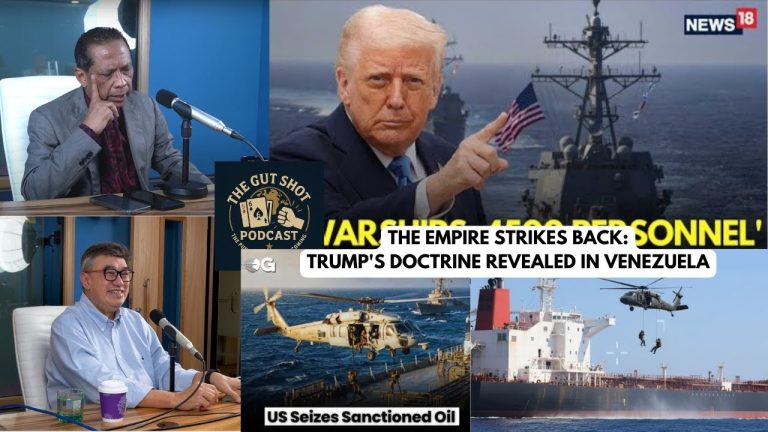
ft Jason Leong. The Empire Strikes Back. The Trump Doctrine Unveiled in Venezeula
Show Notes & Description
Its all about global economics and maintaining THE leading position. We discuss why and what is happening. Trump's policies are transparent if only people listen and read carefully, the US National Security Strategy 2025 (NSS) for one, instead of having derangement syndrome. Why should not the President of America ensures its global leadership? The same is our expectation if it was Malaysia. I want my leader to ensure regional leadership in economics and all other areas. Lets unpack.
Jump to chapter 8 chapters
- 0:00 Introduction: Geopolitics and the 2025 Trump Doctrine
- 2:39 Operation Southern Spill: Venezuela and Black-Market Oil
- 13:15 Unpacking the 2025 US National Security Strategy
- 20:10 Securing Latin America: Panama Canal and Critical Minerals
- 27:39 Supply Chains as National Security and Trusted Trade
- 35:35 Malaysia's Real Export Dynamics: The US vs. China
- 41:12 ASEAN Strategy, India's Counterbalance, and Internal Reform
- 48:54 Johor-Singapore SEZ and Capitalizing on Foreign Investment
Auto-generated from YouTube captions. Timestamps link to the video.
Good day ladies and gentlemen. Welcome back to the Gutshot podcast. I'm Shamsul Sam your host. Uh and with me today our geopolitical expert in Malaysia, Mr. Jason Yong. Thank you. How are you my friend?
Excellent. Excellent. I think um what we we are going to do our uh geopolitics uh segment uh in for for our viewers today especially um now uh with certain uh events happening currently in America
that has impacts both uh in their side of the world and how it influences our side of the world that we've got to think of maybe the best part is actually let's let's let's start off with uh um with what is happening between America and Venezuela.
Yeah. because uh that has been very much in the news today. And that in essence will also unpack the um the 2025 national security
strategy strategy policy that has been issued by the Trump administration. I think not many people realize this and I and that's the thing with the gutshot podcast is we want people to see things very differently and understand what happens. uh in our world and how the strategy is going to impact because if you think about it when we go and talk about Venezuela we'll also be talking about China as China is the biggest uh oil importer from Venezuela and they have I think extended in excess probably of 60 billion US dollar to fund the uh to fund pro programs I think with the Maduro regime.
Yes. Right. So, um Jason, let's start with this question. What is happening uh in Venezuela with the with the strikes is very easy to understand with the strikes on the uh on the drug trafficking that is happening. Uh but uh it goes beyond that with respect to the Venezuelan government. Can you elaborate from your point of view?
Yeah. Well, as you are, you are right to mention the strikes at at sea against the narcotics uh smuggling and all that. Yes.
Uh technically there is an official operation name now for uh for this particular thing in Venezuela is called uh operation southern spill. Southern spill.
Okay. So it's a military operation. Now as you can see all the uh navy ships are all uh parked right in uh Venezuela very close by including the aircraft carrier Gerald Ford is there and so many other things and uh I think Peter Hacket just recently also said that uh from C now we are going into land operations. So there will be some ground operations in uh the coming days. Some people even say that maybe they're looking at a Christmas present, the fall of Maduro by Christmas. So, we don't know. Uh but uh a lot of things is definitely happening. And u I think as far as you
also right to mention the correlation between Venezuela and China uh is very clear. Obviously, China is funding Venezuela in a very very big way and buying a lot of the black market oil under sanction. But Russia is also a key player in that. Uh recently, I think for the first time, Trump's navy actually seized an oil tanker.
Yes, that was last in Venezuela last week. I think last week. Yeah. Yeah. So that was like 1.1 million barrels of oil. Is it a big super tanker? And that is going to be worth how much on the market? 1 million barrel of oil. Right. So the key thing that a lot of people miss is that that particular oil tanker belongs to a Russian. Yes, it is a Russian oligarch. Most Russian oligarch will have their own ships, their own oil tankers and they're involved in all kind of smuggling and one of these happened to be in Venezuela,
right? Uh so so the Russian connection is always there. I mean how does Russia sell its black market oil? Uh same thing you know is provided through cargo ship on board of vessels tankers owned by some Russian very rich Russians and they are sent all over sometime you'll see them parked in international waters whether it's Iranian oil whether it's Russian crude or whether it's Venezuela crude sometimes just off somewhere near our straits on blacker as well. Oh yeah. I mean on on that score
I I'll interject a bit. I mean for those who don't understand the oil business right uh hello oil man here. Yeah you know I mean the a lot of these uh sanctioned oils if you look at it right a lot of shipto- ship transfer is happening on uh international waters. Yes.
Right. And I think if you I were to ask me um I am very sure um the CIA has every pinpoint on all these ships. Y the only question is whether they want to take action or not.
Yeah. You know uh the the Armada that has been assembled around Venezuela I think is probably the biggest amada in the history of South America.
Yes. Right. So I think uh people don't understand the people need to understand the gravity of what is happening at the moment. Well, you look at the Iranian regime. The Iranian regime funds a lot of uh u uh instability
uh around the world um in Africa and uh the Middle East, you know. Um then um obviously Russia uh when it invaded Ukraine was when really uh that particular sanction happens.
Um and you look at Venezuela just to put things into perspective uh you know I mean is where we see not just Venez Venezuela it's just how far um the drug cartels has basically taken over. um the government itself I think this is um it's not propaganda uh from the from from the west
uh I mean you and I we uh travel the world and do business in the world right you know um uh this is a factual thing that I think a lot of people don't understand and uh how it impacts. So now that we've got this situation in Venezuela, what happens next? You think there will be a land war? Do you think there because he he can't go into uh into a land war without Congress approval?
Yeah, I don't think you think so. Yeah, because a declaration of war might need uh approval of Congress and uh it might not be so palatable politically. Yeah. uh US initiating a war. I mean Trump would not want to be seen as a wararmonger. I mean his record is that he has not started any war on the first term and I don't think he wants to change the record. Uh but a land operation is probably is already on the way in the fact in fact that so there will not be an open kind of war. there will be all kind of pressure uh okay intercepting the ship intercepting the
super tankers drugs that's why Trump even begin to paint Maduro as a narot terrorist government narotic terrorist government and uh so that's a a nice picture for him to paint and sell it to the American people here we are we trying to get rid of this guy and um but what is also often not mentioned in a lot of analysis is is that Trump has got some uh ax to grind against Venezuela because of the 2020 presidential election which he lost. Uh because the first country that ever use electronic voting is actually Venezuela in 20204. so early way back uh during Hugo
Chavevest time and uh so there are companies in Venezuela. One of them the big the biggest one that actually provides all those uh hardware and software for the electronic voting in Venezuela is a company called Smartmmetic.
uh they did elections in Chavez and Maduro and in 2020 US started using electronic voting machines and that was provided by a company called Dominion. Dominion voting.
Yeah, I I remember that that issue. Yeah. But many people also do not know that Dominion had a JV with smartmmetic in Venezuela. Uh so of course there is not enough evidence based on whatever was uncovered in 2020 or even up to now. So some of the sources are saying that Trump wants to go into Venezuela and get whatever evidence that he can uh his hands on all those evidence and say that there was water fraud. They actually rigged the vote for his presidential election in 2020. As you can see uh I think you will be aware that it was a rather strange election.
uh Trump was leading all the way and then suddenly everything changed and then Biden became the winner and uh when the votes end up it doesn't really tell you right how many words did Trump I mean when did Biden had more popular than even Obama
I I yeah I mean I brought the subject matter up um somewhere um yeah you're right I mean I had a very strange look at the uh the poll the the the poll numbers it just doesn't make sense to me. It was in excess of 20 million plus votes uh uh compared to Obama and that uh and compared to Hillary.
Yeah. Uh and those are much more popular from the Democratic side. Right. Exactly. Um uh and then when it comes back to 2024 and that is during the uh during the pandemic and then we and then the we have um uh and then we have post pandemic 2024 it comes down back again.
Yes. Right. So it it was an odd it was an odd number. And I don't I'm a band who doesn't believe in coincidences. But say let's say let's say let's say that's one of the one of the peripheral things that he may be interested in. But if you look at uh so so so Venezuela seems to be the starting point if you were to ask me in terms of probably a a regime change uh initiative.
Yeah. I mean that's the first time I I think we've used that term. Yes. Uh for the p for the Trump presidency. I mean he didn't do that with Iran. He didn't do that with um I mean even with Syria actually it was it was organic
not in such open terms. Exactly. This is very openly done. Correct. Yeah. Yeah. So now I mean how does that work? We know with uh maybe it's and and we know that uh who's the Nobel Prize winner
Maria Machado. Maria Machado who is in Norway now actually. Correct. Oh yeah. She smuggled herself out of Venezuela to be able to speak out uh in Norway, right?
Obviously facilitated by American oper operatives operatives CIA or whatever you know. Yeah. So these are these are this is a very
um very interesting development if you are a lover of Tom Clansancy uh Tom Clansancy novels and all that type of thing. Yeah. So how does that how do you see this unfurling?
Um and then how does that tie with the just recently released 2025 national security strategy? Yeah, I mean it is very uh western hemispheric uh focus document.
That's a very clear part of the uh US national um security strategy 2025 uh the playbook that was unveiled by Trump uh and um apparently there were two versions.
Okay. So the classified version and the unclassified version. So what we get in the public media is the unclassified version uh which was about 34 pages long. It's not a very long document uh but it's very interesting uh glimpse into how the Trump administration think very much about what he is and uh it's very clear state clearly stated in that document that u there is a pivot towards is western hemispheric uh in emphasis that means put it in simple terms America wants to be in full control of the western hemisphere and I don't want to see any other rival was
here that technically that refers to Russia and China. Uh so with what is happening in Venezuela now, China's investment for how many billions over the last 20 years uh I think is now coming to an end because now a lot of things is going to change. If there is a regime change, I mean there goes all the belt and road projects uh and all the loans that they have given to Venezuela since the day of Chavez uh to Maduro and not withstand some of the oil that uh they are buying from Venezuela very cheap oil, black market oil and so all that is going to come to an end and China will
be the biggest loser in terms of I mean cash amount dollars that they put in. So what is the return now if Venezuela goes well regime change and now somebody who is pro America comes out. So
well as it is already actually Venezuela is having problem to even repay China. Yeah. They pay they can't pay. They can't pay. Notwithstanding that they have the biggest oil reserve in the world.
Exactly. 300 billion barrel. Yeah. Uh I mean let's do a quick calculation. train a billion barrel $60 per barrel or but I mean it it doesn't matter because at the end of the day if you look at what has been happening with the Venezuelan economy
um the the uh the infrastructure of uh production has um has not been maintained um and and development has almost within the last decade or so at the very least I think has uh has not modernized itself. So productivity is not there.
Um and I think China itself is not seeing the returns on it investment even prior to to sanctions. Yes. You know, so I I don't think China themselves want to extend anymore to uh I think it's a write off if you ask me. But then again, you you know what I mean?
Yeah. To write it off. Yeah. The the only difference then probably would be is uh unlike in Africa when you cannot repay uh then they take over the ports. Yes.
Uh and the train and the railway tracks or or whatever. Right. But in the case of Venezuela, with the sanction imposed and with this uh uh security policy that has been taken up,
you're not going to be able to actually uh take hold into Venezuela itself even if they don't pay you. Yeah. No way. That's right. So it's a right of you are absolutely right. So China has a total right of for Venezuela and things going to change because that's a key plank of Trump's national security policy. uh take Venezuela in fact take as much as possible the whole of Latin America right so the whole western hemisphere so Trump is basically saying US is going to be boss from Arctic to Antarctica as far as the west is concerned is all ours nobody else uh should be in the
neighborhood and uh going to kick out all the interest I mean just the oil itself uh $60 US 300 billion is 18 trillion I mean you ask me today I mean it's it's not I when you talk about geopolitics right Jason
I mean if I were Saudi Arabia for example if I take myself as Saudi Arabia as being the superpower in the Middle East let's call that if that's what MBS wants to be
yes okay I'll call the Middle East is my my hemisphere right in fact China basically is making a claim that uh the Asian region is their hemisphere.
Yes. Okay. Um Russia is making claim over you know uh Eastern Europe. Europe. Yeah. Yeah. And maybe even Western Europe. Right. So this whole geopolitical game
Yes. Um that is uh is being played everywhere. Yes. It's only a question. But I I only wish as a Malaysian that we have the super the the the superpower economy to be able to state I'm that uh you know Southeast Asia is is my uh sphere of influence.
You know unfortunately we don't have the the wherewithal to to build our economy and strength to the point where we can call it that. So going back to our our our uh what what we see as as as this situation. Um do you see that? Um then when you talk about the whole western sphere including South America, we've talked about Venezuela, we've talked about America actually ensuring that um uh Java is uh is is is entrenched in Argentina because they supported
Oh yeah. as a new ally uh very pro America. Correct. Yeah. Right. So we you know um Panama Canal became uh Oh yeah. an issue. Right. Um we haven't heard I don't think we're going to hear the last of it because u
um I think well Panama Canal is very interesting because uh Lea Sheng's uh Hutchinson has already sold the two ports whom they are operating the concessions to Black Rockck Consortium US interest. Uh Kashing Li Kashing is smart. I think he sees he sees what is going on. So why want to hold on? you might as well sell sell out and uh run uh because there's no way you know you can continue to hold it. Uh so Trump is looking at Panama Canal is ours. I want to take it back. And of course uh Black Rockck is also part of the uh his interest to take back the the So you take back the port operators uh
on the Atlantic side and the Pacific side uh Balo and I think Crystal Ball you know. So both of them and then plus eventually the Panama Canal authority will have to approve the deal anyway. So there are bits of infrastructure bridges by China here and there but I think that is not going to matter very much because it is the operators of the canal and the one who actually lock the waterways and the canal ways. Eventually Trump is putting a lot of pressure on the Panama authority that they will have to be aligned to the US strategic interest which I see is just a matter of
time. So that Panama is more or less a done deal. I don't think they will talk too much about it. So uh I thought Lie Kashing had some problems with the Chinese government approving the sale.
It is a private entity. Hutcherson is a listed company in Hong Kong, right? So how does China can even exercise authority over a listed a private I mean even though it's public listed company China uh shareholders do not hold that amount of shares that can veto the sale or anything like that. So it's basically Lashing. So only thing is that they can put some leverage on Likashing, pressure him in terms of his business interest in China
uh to force him sabotage the sale. Mhm. But Lashing has been moving very fast. So he knows what is going on. So he has also pulled out quite a bit of things from China. So it's not going to be so simple because they have entered into an agreement
and then it's an international agreement between Hutcherson and Black Rockck. Mhm. Black Rock International acquisition agreements are at least 700 and to 800 pages long. I've seen those long.
You haven't gone through it. Uh they've got all the best lawyers there. So you don't play with them. So whatever they buy, they are already locked in solid. You want to go to to to court with them? Sorry.
I I don't think it's a court case at all. If you ask me really, I think what we're going to see is it's a done deal. Yeah. It's a done deal. So uh so that is already done. Uh and then of course Argentina and then u Bolivia just elected a new president.
Okay. And quite interesting because this new president cast is also very pro-American. A good friend of mle in Argentina. So he's another MLE number two. He has already said that yes uh we will be pro American. So there's another country uh Bolivia is interesting because Bolivia has got one of the largest uh lithium resources reserves.
M so fits right into America's interest. Yeah, we want lithium and so that's it. We got a lithium mine, big lithium mine in Bolivia. So that's one. And then Colombia, Colombia is also being threatened by Trump. Trump said after Venezuela, Colombia you're next. Colombia is also quite instrumental in part of that drug trafficking thingy. Venezuela, Colombia and uh Cuba. So this kind triumphate.
So I think Colombia will probably also be pressured. So at the end of the day uh all this will be pressure. I don't foresee an open war kinetic kind of war invasion into Venezuela or in these countries but the sanctions the economic suffocation is enough uh to basically cost a regime change. Uh so this is uh what is going to happen. So so more and more of these countries in Latin America and the western hemisphere is going to fall in line uh pro- US. I'm I'm of the opinion that actually when whenever I see any Trump move uh this administration it is so interconnected with economy.
Yes. Their strategy u are very economic driven. Um the milit the mil even the military actions are very economic driven. If you look at uh drug trafficking, right? It destroys the economy of uh uh you know by u I mean we've seen what happened with the opium war. Let's call it that way,
right? Let's call it that way. I think history has taught us a lot of things when the British uh brought in opium into China and how it destroyed China. Yeah. All
right. Um that is a lesson to be learned for everybody. Um so if you were to ask me it's always been fascinating um in essence that why did Biden allow the immigration to happen so blatantly in the southern border uh with Venezuela, Mexico, Colombia being uh and and you know I've never heard of uh gangs like Trans Aragon or MS-13 you know um until uh the Biden administration.
Yeah. Within America territory itself. Um and I think there is a political reason for that. But let's not go into that today. Um however the impact on on on American economy is severe. So you know it's I I always akin that to remember the opium war. Remember what happened then.
Yes. And uh for a nation that uh that has been a superpower, you don't have you you you you should not be allowing that to happen.
Exactly. Yeah. Yeah. So in that sense I I mean strategically that's that's what they are doing. Um so if we look at it that way, if we if if you are saying um the America is taking back control over their sphere of influence
around their region and you've already mentioned Bolivia um as another supply chain uh what do you call uh connection or or within the the new new economy. economy of rare earth uh mining and and and production.
Yeah. Right. Are we looking at at the end of the day um that the if you look at it the US is really looking at decoupling itself from dependency of external supply chain that started out with uh the WTO and I don't know whether it's even started out with WTO but actually even then uh Clinton's NAFTA also um had that impact um of actually hollowing out the supply chain within America or from or to from friendly countries. How do you see that? True because it started from there Clinton uh and even Obama these were the people who were promoting global trade WTO WF and all all those things
and their thinking at that time was that if you increase global trade if everybody is trading with everybody in the world that means there will be peace we won't want to fight with each other
that's one way of of looking at it and they say that is the way to secure peace in the whole and peaceful America as well. But when Trump came in, uh Trump is looking at it that u not exactly because globalization has gone a little bit too far and it has gone overboard. So much so that America now becomes very dependent upon certain countries namely China on certain components and key uh resources. And Trump looks at dependency means vulnerability uh which technically China can weaponize some of this uh supply chain which China has at one time right threatening to
stop the rare earth and all that. So Trump, that was very that was I I thought that was that was pretty uh pretty shortsighted of uh of the government
of of the Chinese government to go out of their way and to try to impose the the uh sanction on rare earth uh export. Go on. Sorry I interrupted.
Yeah, true. I mean that that is why uh it's no longer about trade policy. Neither is it about international trade. Now it is about national security. That's why for the first time in the national security document of US, it actually talks about supply chain. Uh so supply chain is an essential part of national security of US because US now say that okay what we want to do is that we want to ensure that our supply chain is within our control and no longer held hostage by any powers in the world. uh and we want to manufacture things that is uh essentially ours and basically
they he referring to China and even Russia. Uh so there's a new hierarchy of supply chain. So US concept of supply chain is actually very straightforward. Uh first of all as far as key and national security components like military stuff and all that as far as possible domestic that means our supply chain has to be domestic like semiconductors. Uh Taiwan has already TSMC has already built four uh FAPS in uh Arizona and elsewhere in America. So that technically there is already a shift uh from uh Taiwan to the homeland America right and uh military components
are being being uh being manufactured more and more uh in America. So all those things will be domestic. Secondly, things which are maybe secondary importance, we will want it to be manufactured in friendly ally shores. That's why it's called French shoring, right? Maybe like Malaysia, Singapore and many other places which are considered. So it's not about Americanmade but it's about ally made. So we made
interesting way of looking at an ally. So, so the supply chain that's why they he used the term trusted supply chain that mean trusted allies who are our now the new supply chain. uh so obviously as also a b against China because China you may be part of supply chain but you're not trusted not trustworthy you weaponize it from time to time and hold us to ransom right so it's not about free trade anymore it's about trusted trade and then of course the third tier is about any other goods that are not so critical like clothes apparel and all that well it's fine
anybody can manufacture it but at the same time he also has basically imply that China can be one of the suppliers but not the supplier. So if you are not the only supplier, you you can't hold us to ransom. You're one of the many. So the whole thing is now very different. So the national security thing has already said that supply chain is a security issue. Yeah.
So I I'm I'm I mean let's let's take it in in in this. So if if that is a given, no matter how people want to slice the the the whole situation, um the American economy is still the biggest economy in the world by far actually, right? Um I loathe to talk about uh when people talk about uh China uh uh GDP using uh purchasing power parity. I I don't like the purchasing power. Sorry about that. But u I I consider PPP to be the woke version of economics because why you want to make the other guy feel better. The way I don't you know it's almost like telling me um my PPP here in
Koala Lumpuro compared to the PPP in uh in in in Ladu or in in uh in uh uh what do you in Perles right is very different. so-called but then from a national perspective actually you want a comparison between a comparison with on a appleto apple basis.
Yes. All right. So that's why if you guys were to ask me why I keep hopping on GDP per capita, I don't I don't give a I don't care about PPP because to me PPP mask the fact that you are worse off because of other things that you know that you must. So anyway, um uh I I when you talk about therefore the economy and and I'm going back to what you just said with respect to how America has now restrategized its supply chain priorities. Yes.
To become all friendly to become where it's strategically important for them internally uh for their national security. Right. for countries like ours, you know, it's basically to put ourself in a situation where um we can continue to export to the most lucrative consumer market whether we like it or not.
Yes. Yeah. That's that's actually very important because uh few people really understand the economics and the export markets of Malaysia,
right? For too long, Malaysia, a lot of people have been saying China is our biggest export market. That's a fallacy. The latest numbers that came out uh for 2024 uh number one market actually is Singapore.
Singapore takes 16% of our export. So 16% of Malaysia's total export goes to Singapore. Right? 14% goes to America. Number two. Number three, China 13%. Now if you look at Singapore with 16% and 14% America if you add this up it's 30%. Oh
and Singapore is a very small country. Yeah they don't have that kind of consumption. So if they are buying 16% from us more than half of it and they are an entropot right so they will value add repackage the thing and off they sell it to United States of America again right Singapore is also one of the biggest uh exporters uh to America
so assuming half of that export from Malaysia uh to Singapore is repackaged and reexported to America so we are talking about half of 16% 8% goes to America. So de facto American export uh Malaysia export 14% direct to America and 8% indirectly through Singapore to America. So that makes up to 22%. Huge trade. It's almost a quarter of our our exports in the world. China is what 13%. So how can you even say that China is our biggest market? US is our biggest market technically. So that is why uh we need to give PMX and uh Tuzaf or whoever was the MT minister at that time some
leeway uh in the sense that Malaysia had to do that trade deal with America when Trump was here. People say well we were forced to do that trade deal. Yes, of course. But here is your biggest customer.
That's the reality. So that's the reality of the scheme of things. This is it. They just been very pragmatic. you take it right because you want to see that you can see that if we take it this trade is going to only increase is not going to decrease because now we become even more friendly uh to to to America uh and I can see that BMX is on regular phone calls with Trump
uh at least at least handling the Cambodia Thai conflict. Well, that has flat out again. uh but at least that personal relationship will you know he gets to get direct calls straight to Trump and Trump calls him you know so it's good for foreign uh policy bilateral relations personal relations
the economics the way I see it the what I always keep telling people is actually there's so much similarity we can learn from what America does because why their component of economy not really their component of economy but basically basically the they are component of um how the economy is structured and ours in terms of production and consumption. Um somehow for whatever reason um it mirrors quite quite well in a sense that we have a reasonable consumption pattern as well.
Yeah. We are not a society that just fully export everything. Yes. you know uh there is an internal consumption component to us unlike in China. Yes. You know where uh uh uh consumption uh does not really feature much into their economic um it is very much a GDP driven by exports. uh therefore their trade supplies of one trillion you know it's something I want to unpack uh in a later segment okay you know and whatever the uh the impact uh as we see it you know um with respect to the region
but um my main concern when it comes to us and then we'll go back to the uh to the US for before we close out this segment I've always said that corruption is the biggest problem of uh middle inome countries and it is the number one reason for the middle income trap in various ways than one.
Yeah. Uh that is the difference between Malaysia and Singapore. That is the difference between Malaysia and South Korea and also with uh uh and and and Japan. Right? So this is some I mean understanding the external factors is one thing but then taking advantage of it requires us to restructure internally and also then being able to play the chessboard of the geopolitics.
Yeah. Right. Certainly. Yeah. So we have seen maybe you can recap and say where do we go? Um I mean where does America go now? Now now that if if it says that their priority uh is the western hemisphere, how do you see um visav um Southeast Asia?
Well, even though they have said in the national security uh document that um the priority is the the western hemisphere. Mhm. But there are also certain parts of the national security document which talks about actually they have reframed uh China as an economic competitor rather than as a military competitor. So they're looking at things. So geopolitics has actually become mesh with geoeconomics because national security now is about supply chain and economics as well. So it's very important and uh they that particular paper also mentioned uh that there is an importance uh in terms of
securing the the the sea lanes uh the freedom of navigation that actually refers to South China Sea and ASEAN and also uh there was a little bit mention about um the role of India.
All right. Okay. So people thought say that oh India is left out of that or not really true because uh uh Trump actually in that document did mention that India plays an important role in rebalancing the powers that be in Asia technically. Uh so in in a sense I think uh Trump is saying that India can be the one to counterbalance China uh is big enough in terms of the dynamics and uh in terms of the population and in terms of its capacity and uh he and Modi has got a excellent relationship.
uh so India will will increasingly play a uh a bigger role uh in um helping counterbalancing the powers in in uh Asia. So ASEAN is not neglected because uh of course of all the nations in ASEAN America has decided to prioritize two countries Vietnam and Indonesia. Malaysia is not in that list. Uh partly I believe because Indonesia simply has got the numbers in terms of population. I mean, you can't ignore a country with 200 million uh people. So, that's why Indonesia is considered one of those big countries that has been invited to do the Middle East peace deal for Gaza and
all that. So, they they are there. Maybe that's because they they don't host Hamas in uh in in their in their country or outwardly uh you know uh uh uh uh welcoming of uh you know uh Muslim Brotherhood or or Hamas which which America has categorized as a terrorist organization.
Yes. Yes. You know Americanized I think we we we should not forget that as well. Yeah, I mean but Malaysia in terms of population size, we are actually very small, right? So we are uh only thing is that u because we are chairman of ASEAN, therefore there was some traction in terms of that relationship and it's good to see American president visiting Malaysia and this part of the world and giving credit to Malaysia for that wonderful reception that he got dancing around and everything else. So I think uh PMX did a good job in hosting and welcoming Trump. Of course, he attracted
a lot of criticism, but I think on balance, I think that's the right thing to do because if you want to be a player in at least punching above your weight uh in the world global politics, I mean global geopolitics, uh we we need to go I mean like Singapore, Singapore is even smaller than Malaysia, but they do punch above the weight and uh of uh they they uh what Singapore is doing and saying is it does catch their attention. of America sometimes. So uh this is what it is. So uh I think uh not all is not lost. It's not a retreat by America away from Asia. Uh so they want to contain in
a sense economic containment of Russ of China uh in within its borders in Asia but with additional allies like India and maybe even Australia. I mean there are enough allies in Asia that can contain China whether it is economically or militarily. I mean you've got Japan there, you have got South Korea, you have further down Asia, you have Australia who claims to be part of Asia as well.
Well, I I mean I I I look at it this this way. I think on on this note, I mean punching above our weight, I rather see us punching above our weight from an economic standpoint. I mean you talk about 300 million plus people. I mean America was already a superpower at about 200 plus million people. Yeah. Or less at that particular time when they emerge as a superpower in the world. But Malaysia we have 35 36 million people 38 maybe by uh you know I mean obviously as a country develop we tend to actually have a uh low uh lower population number for some reason
because nobody wants to get married and have more kids you know but I think I here is something I've always believed in is that actually we have resources we are in strategic sea lanes Um um and we have a better economy in spite of I mean if America can achieve its position by being uh by by being technologically superior and being able to trade well if Singapore can do it with 6 million people
Yeah. and have an economy and per capita I mean as a developed nation what is stopping us yes I would rather see that happen with our country why we are stuck with this you know 13 we we we are not even reaching 13,000
uh per capita GDP in US dollar terms right it's not acceptable if I was a citizen I I think this is the unacceptable part. U we negotiate as best we can which is at almost at par with our comp comparative trading nations.
Yeah. For the same type of sector but internally we got to punch above our weight with respect to economy. I think we are punching underweight. Yeah. True. because uh our potential is huge uh and uh the sky is the limit.
Our potential is much greater than Singapore. Our potential is you ask me our potential is much greater than Indonesia in spite of our size. But we are we are not exploiting that.
Yeah. And actually trying to learn from how a small country, not a big population, Yeah. can be a superpower. Yes. I think that's the lesson I want to uh uh I mean that that we should be taking from the geopolitics we are talking today that you know I mean whilst Trump and the American administration today is repositioning they they're just doing a recalibration of where they are in the world.
Certainly. Yeah. the but there is a a bright spark on the horizon. U the latest uh move by Malaysia in with Singapore in terms of setting up that special uh Singapore Joho economic zone. uh that's a good step in the right direction because this means Malaysian economy and Singapore economy is now more integrated and uh there are core interests that will benefit both countries if they join together at least for Joo uh it's a good start hopefully from there it can produce something that is really tangible and we see the results uh and then maybe even a better closer
cooperation. I think gone are the days where we we treat uh Singapore as a you know not not so much of a friend but now it is more friendly in terms of PMX and uh the Singapore new PM previously was Senl Long and now Lawrence Wong. So that is actually a bright spot for us and American uh uh investors have also come to Malaysia. Recently there was a big uh announcement of a deal by Google who is building their huge data center here. It's $8 billion investment US and they just decided to go and buy the battery uh systems to be supplied by a Japanese company. I I don't expect them to buy it
from China. Uh so it's American company will buy from Japanese company. So again and setting up the factory in Malaysia. In Malaysia. Well, yes. I think to to wrap up today, um uh Jason, shall we go to the next segment? Um
uh when we do the next segment, shall we do u the supply chain um that uh and the the the US China dynamics? Yes. And how um how that whole thing is going to uh is is is shaping itself up.
Yeah. Yeah. And how it's going to impact uh the the whole globe including the region. Yes. Can we leave it at that for now? Sure. Right. So, thank you so much. Uh join us again. Um I hope this has been illuminating. Uh like, subscribe uh and uh join us again when uh we talk geopolitics with Jason. Thank you so much.
Thank you.