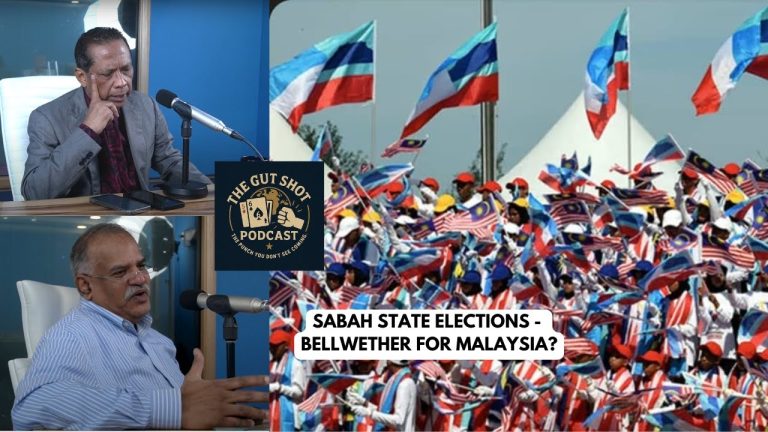
Ft Syed Akbar Ali. Sabah State Elections – Bellwether for Malaysia?
Show Notes & Description
Conversation with Syed of OutSyed the Box on the upcoming Sabah State elections and the now fractious nature of not just Sabah but Malaysian politics in general. How do we make sense of the current and future of political Malaysia and what do voters/citizens should insist from our politics.
You’ve just hit the goldmine of political analysis! We, the experts at The Gut Shot Podcast, are back to deliver an explosive, eye-opening look at the Malaysian political landscape that impacts your future.
We dive deep into the upcoming Sabah State Elections (November 29th), asking the pivotal question: is this crowded contest truly the bellwether for Malaysia’s political future?. As Malaya people, we confess we are strangers to Sabah’s intricate local dynamics, but the policy implications we uncover are staggering.
Chapter Titles & Timestamps:
Timestamp
Chapter Title (Copywriting Hook)
0:00
Bellwether or Bust? Unpacking Malaysia's Next Political Earthquake
1:05
Sabah's Political Chaos: 596 Candidates Fight for 73 Seats
3:45
Why 74 Mavericks Are Ditching the Establishment (It’s a "Headless Chicken" Situation)
7:30
The Weak Government Trap: Why Coalition Cabinets Are Here to Stay
14:30
The 40% Oil Lie: Why Every Party is Selling the Same Empty Dream
18:30
The Shocking Truth About Sabah's Billion-Ringgit Budget (Why the Money Disappears)
24:30
Unmasking Handout Politics: How Leaders Make "Beggars" Out of Citizens
39:30
The One Policy Change That Will Transform Sabah (Politicians Hate This)
Sabah is a political pressure cooker right now. With 73 state seats up for grabs, an incredible 596 candidates are vying for power—a massive jump from 447 in 2020. This means a minimum of six-cornered fights in nearly every seat, sometimes reaching 14 contestants!. We reveal that the largest block contesting are the 74 independent candidates. This reflects a terrifying nationwide trend: established parties lack direction, creating a political landscape akin to a "headless chicken" or a "toss salad" where no one clear leader exists. Voters are not confident in the incumbent or the opposition, driving this desperate free-for-all.
The inevitable result is likely another weak coalition government, composed of "diverse and disagreeable parties forced to work together". This policy paralysis mirrors federal politics since 2008 and 2018; policies have simply not changed despite multiple electoral losses, leaving voters feeling there is no difference between the political blocs.
Politicians are using the promise of the 40% oil revenue and MA63 assertions as "fantastic political capital" and "lowhanging fruit" because elections are imminent. But here’s the kicker: every single party is taking ownership of the 40% issue, making it meaningless to the voter.
Despite being rich in natural resources—oil, gas, and timber—Sabah’s GDP shockingly ranks 12th or 13th out of 15 regions. We pull back the curtain on why the substantial annual allocation of 17 billion Ringgit hasn't filtered down to improve lives or organically distribute wealth. We expose the politicians’ cynical approach: instead of creating organic growth—through essential investments in high-quality schools, road infrastructure, and cheap energy—they offer unworkable "charity" and "handouts," often using the people's own money.
You'll hear our candid discussion on how politicians operate with "no real intention of keeping" manifesto promises (remember the infamous declaration that "it's just a manifesto"?). We argue that excessive government intervention and regulation stifle potential, preventing the maximizing of economic output. The solution? Only deregulation and true free-market policies will unleash the immense capacity of the Sabahan people, potentially transforming the state into the gas capital of Malaysia.
If you are tired of politicians who fail to connect the dots between economic growth and tax revenue, this episode is mandatory viewing! Tune in to understand why the outcome of November 29th will likely be same old, same old unless a genuine policy revolution occurs.
Many thanks to CITYPlus for their collaboration with The Gutshot Podcast, in whose studio this conversation was recorded. CITYPlus is Malaysia's first Chinese business radio station, dedicated to delivering in-depth analysis on local and international current affairs, markets, and businesses.
Jump to chapter 8 chapters
- 0:00 Sabah Elections as a National Bellwether
- 4:46 The Surge of Independent Candidates
- 12:33 The Inevitability of Weak Coalition Cabinets
- 17:28 Deconstructing the 40% Oil Revenue Rhetoric
- 26:18 Accountability and Sabah's Low GDP Ranking
- 34:38 Handout Politics and Unworkable Campaign Pledges
- 42:31 Education, Infrastructure, and Organic Economic Growth
- 49:26 Deregulation, Gas Capital Potential, and Market Forces
Auto-generated from YouTube captions. Timestamps link to the video.
Hi everyone, we are back to the gutshot podcast and with me again today our partner say akali. Good morning. We have uh for this episode we are we are going to go uh even more uh regional domestic considering the elections that are going to come up within the next what two weeksh or something like that
29th of November November where we're going to have uh the Sabah elections uh that will be carried out and it's going to be it's it's a very interesting maybe probably will be the bell weather for Malaysia. Uh I don't I personally do not know much about uh our domestic politics to be frank. Um I am more interested of policies and what we do for the people and uh you know looking at economics of this country. However, it all starts at the ballot box. And in this stance, you know, I'm going to uh hand it over to say to give us uh the quick rundown of maybe we start with so
many parties that are going to be involved and uh how do you see this going to play out? Say okay, take on. All right. I think um no one no one can claim to be expert on the so many parties in Sabah especially the Malaya people like us.
Oh yeah we forgot about that. We are Malaya people. We are total strangers you know we don't understand all the dynamics and what's happening on the ground. But I see um there are major uh similarities, major undercurrens and major uh the the the way how the politics going on in Sabah now has is very similar to what is happening in in on the peninsula
really in Malaya. You you feel that way? Yeah. Let me explain. Okay. Uh okay. First of all, it is a very crowded uh contest which is on the 29th of uh November, 8 days away. Uh I have a list of the parties that are contesting in front of me here, but I'm not going to read them because it's too many. I think it's like over 20 parties and some of them are coalitions. But the there are 73 seats state seats up for grabs
right in this next uh state election and uh the 17th Sabah state election and there are 596 candidates vi vying for the 73 seats that is an average of u uh more than uh six candidates uh per seat actually more than that. Yeah. Um 59 596 candidates in total. Uh the interesting thing is that in some of the seats so so the the average number of contestants per seat is six people six cornered fights in in every seat minimum you have a number of seats where there are 12 contestants 13 contestants I think there's one there's 14 also and the eights and nines there are many you
know so it is a very jumbled up situation everybody is trying to run and try their luck actually trying their luck. There are also theories that some of some of these people are actually you know there are arrangements among various parties and some may be fronting for others and things like that uh election packs and all that
right so but those are conspiracy theories bottom line is there are 596 um candidates so it's a very crowded field um I have some views why it is so crowded why Okay. The other thing is 73 seats only um one party party is fielding candidates in all the 73 seats. Uh there's another party called party Impian Sabah which is fielding 72 candidates. I don't know why they didn't go for the full 73. The rest are all uh you know below they they are contesting like 50 overseas and things like that. However, for the first time, we have 74 independent candidates. That means the
single largest block of uh contestants for the 73 seats are independents. You know, 74 independents are trying their hand at winning uh seats as independents. Why is this happening? My view is that this is where I say this is reflective of the situation on the peninsula.
Okay, in Malaya, right? because because the way politics has evolved in this country over the last um you know how many years we find that um basically a politics in Sabah just like politics on in in the peninsula is is a bit like a headless chicken you know there's no no one can detect any strong force uh any clear-cut direction in the politics of the country and in the politics of Sabah. That is why I feel that so many people feel that they they are better suited to run for elections and to provide leadership to Sabah because they they don't see that leadership coming from the established
or the existing or the incumbent political parties. People are not confident. What about on the opposition side? Same thing. See, see if you have a well- entrenched political parties, government or opposition, would you expect 74 independents to go against them and risk their deposit and you know all their investment in time and energy? They will lose hands down. But so many people are willing to contest the elections as independents as well as the dozens of parties that have uh that have that are putting up candidates. It's a free for all because they honestly feel that
there is no single party or coalition which can shut them out. Let me can I ask you a quick question Jack because you've been uh you are one of the longest uh commentator of domestic uh politics that I know of. That's to be honest I feel the most professional and credible of all. Sorry to uncut my friend. Uhoh.
Uh-oh. Okay. But um if you say like that that uh these guys all these uh various new parties independents uh basically are bubbling up now. Um there have always been independence or many parties in Saba. Saba has been quite unique in that sense. Right. But you've never had 596 uh candidates. Huh? For example, in uh in uh 2020, uh there were 447 candidates. Yeah, that's right. In the 2020 election, there were 447 candidates for 73 seats. Now, we got 596, making it 600. That's uh more than uh 53 about 153 more candidates this this for this election than before.
That's a jump. It's a huge jump. That's why that's why I'm saying people people in Sabah just like people here feel that uh let's let let's try and and do something for ourselves. Let's bring some change by ourselves because all the existing political parties both sides or how many sides they are of the fence in Zaba or just like in peninsula they're not delivering the goods. So they are feeling that and they can read the ground that means that they can also read the ground most importantly they can read the ground that support from the voter from the public in Sabah you
cannot identify you cannot uh with with certainty you cannot say that uh this party has the support of the majority of voters you don't see that anymore it's like toss salad you know you know toss salad
yeah I don't you you you throw in the carrots lettuce the tomato and you just jumble up you know you you just it's a mixed bag you see so they cannot see any one clear cut winner or leader or or decisive political leadership in the state that can swing the elections you know there are some years in the past you know that this party will carry the elections you know you you're quite sure so in that kind of situation I the independents the smaller parties they'll be more more careful whether do they want to go ahead against some juggernaut but That situation does not exist in Sabah
anymore. Everybody now thinks that they are the better person to run for elections because they can see that there is no on the ground level grassroots. The voter has not made up his mind or the voter doesn't have a clear-cut preference. So why not we give it a try? That's why I see this the the field is so crowded. That's that's an interesting observation because one of the things that I thought
uh that permeated in the last general election when there were independence uh coming up at least that's overall general election right was that uh the the the ground was saying like independence cannot form government therefore cannot provide change. Well, in uh on the peninsula at the last elections in 2022, uh no single party or group could win the general elections before the outcome of the elections. People were already saying it was going to be a hung parliament. I was saying it before before but nevertheless there were parties like the DAP the the Pikatan
people even the past we would we we knew that they would win X number of seats like DAP you know uh a lot of people were saying that they would do 40 or or better or they would maintain their position which they did and past also they would maintain their position you know maybe plus or minus which they did but but insufficient to form government but nevertheless Yes, they they are they have strength in those seats which they have traditionally been winning in the past and uh like you know like they have held on to some of those seats for some time but the situation in Sabah now is
uh has changed a lot. I uh there are few people like for example uh Shafi Abdal in uh uh Warisan I think he will he will retain his seat and there are few others the stalwarts of Sabah politics yes they they will even uh what's his name Radin Bang Bang Ba I think he will he will retain his seat in Kinabatang or something like that or in the east but uh other than that the regular run-of-the-mill members of parliament are members of the state assembly. I think they are they are in for a challenge. You know they they they will be facing a serious challenge.
So we have to we have to see what is the outcome. We no one is going to predict who's going to win. It's very difficult really in Sabah. Yeah. Even at the level of cabinet uh or or their I mean their cabinet ministers.
Yeah. Correct. State it's very difficult now. It's a it's a really toss up situation in Sabah. We really do not know what's going to happen on the 29th of of November and that's only the beginning because um well somebody has to form the government no matter what what's the situation someone has to win uh enough seats to be the the single largest party or the single largest coalition.
If they can if uh a party can win there are 73 seats. So if they win 37 seats, of course they can form the the government, right? uh or they may have to form uh coalitions and uh if the wind blows in the in the right direction or wrong direction uh you may you may end up with uh another coalition government made up of diverse and uh disagreeable parties being forced to work together which has happened in the last general elections and uh which will lead to um which will lead to coalition government which will lead to a weak weak uh weak government.
Well, I mean this has been the pattern throughout Malaysia uh especially after BN was taken out in the uh uh Pony uh in the last the last government they held which is uh what how many years ago you know
2018 2018 right they lost they lost 2018 yeah so they were in power for 60 plus 60 years I think Um so the the the fact on the ground seems to be that coalition governments are the one to stay from here on I don't see either from the limited knowledge that I I mean everything is about building coalitions isn't it say what what how how do you see moving forward there
but I think uh the the politicians I've said this in the previous podcast when we spoke about Malaysian politics Right. I honestly feel the politicians uh they are totally cut off from the reality on the ground or they are fully aware but they still do not want to make any uh changes. You see uh the situation in Sabah now
uh is reflective of what has been happening in the politics of the country since 2000. 208 the ruling coalition which was which was ruling for a long time lost their twothirds uh majority which is a major earthquake in Malaysian politics and 208 203 the the ruling coalition at the federal level the Barisa national they uh lost further they lost more seats and finally 2018 they were kicked out they lost the elections and then uh what happened was in 208 um which I have I have I have said this before and I and I will not tire of repeating it because I hope the
politicians are listening. 208 they lost a 2/3 majority. They did not make a dot of a change in the policies which caused them to lose the two/3s majority. It went into 2013. They lost more political power. Again they did not make a single change in how to do things in policym none. They got kicked out in 2018 and the new government that came in led by Dr. Mahade and the PH at that time Pakatan Haraban they too didn't make a single change in policies that had caused the the BN government being kicked out after 63 years and not a single policy was changed and then the prime minister lost
his position. Dr. Mahade replaced by another prime minister also taken out after a year replaced by another prime minister also taken out lost the elections. So none of them made any changes. And then in 2022 the to me the most defining election 2022 everybody lost. Not a single party won because they didn't did not make any change in the policies. The same policies carried through it. We ended up with a hung parliament. So the politics and then now we are we are three years into the new government and uh we can't we cannot say that the government is in a in a in a very solid position
politically. viser support. The same thing has happened in Sabah. Now there's been no change in in the policies in Sabah whether it was the present government or the previous government or the before that was the the ANO government, the Barisan government and all that. Although the governments has changed but the policies have not changed. Well, let me
So, as far as the people are concerned, the people who voted against uh the Barisa national policies in 208, 2018 uh uh 2013, 2018 and 2022 are the same people who also have given a mixed bag of results in Sabah in uh 2020 and 2022 and now we're going to 20 uh 2025, November 29th. The people will not give their their their wholehearted support to any one particular party or coalition. The politicians don't seem to realize that. The people don't see any difference.
Let me ask you this then. I mean, let me let me do a push back. Okay, let me do a push back. I mean the this current government uh at least state government is probably making the uh the 40% oil money as uh their main agenda uh with respect to uh uh Sabah uh uh for Sabahans so to speak or or or you know uh going back to their their their assertions on MA63 does not does that not uh be seen as a change? Well, um the the 40% oil uh oil money. I I don't know. Uh I it's really difficult uh to say because well, first of all, that money has not started
flowing yet. So, of course, they're making uh they're making hay. They're going to town with it because elections are coming up, right? So, of course, it is a very uh fantastic uh political capital. You can hawk this thing up and down the state, left and right. This everybody in Sabah is talking about this uh 40%. Uh so it is uh it is like lowhanging fruit you know if you're if you're if you're if you're running for for a state seat in Sabah now regardless of which party you belong to they're all banging on this uh 40% oil royalty issue you know
so that becomes a factor everyone is taking ownership of the the 40% oil oil revenue issue in Sabah okay the opposition those who are incumbent Everybody is taking ownership like they are the champions of the 40% oil oil revenue issue. Uh it is it is uh lowhanging fruit
but uh they have a way to go. Uh but I it will sell now. this is the best time to to to hawk this this thing this 40% oil revenue whether after the event after it is uh let's say it starts to flow or after the oil revenue start coming in what will happen in the future I think we can discuss a bit more later because we really don't know what how that will really change the plight or the future of the ordinary Sabahan people you know that is yet to be seen but for the time being there's eight more days left. This is it's fantastic uh political capital
but everybody is using it the opposition the the incumbent the the the independents everyone is using 40% oil revenue on their platforms. So when everybody is selling the same thing, how where do the votes go?
Normally normally in elections one party yeah one party would you know will have a certain platform they will they will like for example our religious party they'll always sell religion you know when time for election time comes they will play the religion song. You have the other party who will not play the religion song. They will play like you know we we are promising development progress this kind of stuff. Huh. So it's clearly black and white. So people can decide either this or that, you know. I mean there some people who think like that. Imagine all the parties in Malaysia talk
religion, same religion. They all want to talk about Islam. So how does a voter choose? So in Sabah now all the parties, all the candidates, independent candidates, they all using the 40% oil revenue as it's as though it is it is their proprietary uh platform, political platform, you know. So I think the Sabah hotel will have to decide.
So then the question become actually you're right if if that's the case then okay if that's the case then the question comes to the voter is that what's the differentiator isn't it because everything being equal on that on that side what do you offer that is uh different than the other part than the other candidate or or the other group. Yeah
I hope they're good-looking candidates which does can make a difference. Well, that that goes back to actually how the people on the ground feels, isn't it? Uh in terms of their well-being, in terms of how they see the future um is going to uh be better for them because uh if you ask me, you know what's so interesting that you brought up, you sort of like inserted the religion part. I really hope that Sabas taste this, you know, the way I used to know it when I was working for Shell. Mhm.
You know, I mean uh Sabas Raa uh I was personally uh over there especially for eight years and my first company actually said would you believe that actually when I was doing um uh broadcast engineering that was my first company uh that I did that I started broadcast engineering people don't know that a lot of people don't know that
okay I was doing um uh very Well uh and um and actually uh I think eight out of 10 of my engineers were all Sabahanss right
you know what what I found was they were very hardworking and they were smart and you know and they don't have uh you know all this uh uh you know they were more about the work they have to figure out today. So I hope that stays the same because that's the potential of the people, you know. Um and um and I don't know. I mean I think you're right. What's the per capita GDP right now in Sabah?
What are we looking at? I mean let's look at the the the the people and what they what what would their aspiration be? Okay, let's uh let's look at that. Let's look at that. Uh let let me let's talk some some economics.
Yeah, let's talk some economics. You see um Sabah you see let's go back to this this oil revenue thing. Oil revenue um Sabah Sabah for such a wealthy and uh assetrich uh natural resource endowed state. Mhm.
You know, Sabah out of the 13 states in the country and the two the two federal territories uh if you take KL and puta as one and laban as the second one out of these 15 areas uh 13 states and two federal territories Sabah's GDP is number 12 or 13 you know uh only uh I think ples kada and glantan are poorer than Sabah you know the uh the the hardcore or the Malay belt states the so-called religious belt states
mh uh only piss kada and clantan are poorer than saba you know Sabah is quite low down in the ranking of GDP as well as per capita GDP and this has been a situation in Sabah for for I don't know since forever and uh and uh now there is a promise of uh sharing this 40% oil revenue. Um I I'm a skeptic of this kind of things because
why is that? We do not know if uh okay let's say 40% of oil revenue flows into Sabah the the the per capita GDP of Sabah is about 30,000 ringit now uh four years 5 years ago it was like 24,000 plus ringit
so it has grown a little bit but can we seriously expect that if the oil revenue is increased to 40%. The uh what do you call this? Um the oil royalties that go into Sabah is uh becomes 40%. Will will the Sabahans be 40% uh uh wealthier or the Sab state of Sabah will be 40% richer? Uh which is actually a ridiculous statement to make because first of all it doesn't work that way. The point I'm trying to trying to make is that will the extra oil revenues have that big an impact on the ordinary on the ordinary uh Sabahan? Uh the there's a reason why I I have this
uh I'm very skeptical. Uh we found out that um the uh every year or this for this year the government in the in the budget allocation Sabah's allocation was 17 billion ringit. Sabah's allocation
I think for this year and I think in the previous years they also get the allocations in the in the teens of of billions like it will be 17 16 15 billion whatever I'm sure they get sufficient funds where where where has all that money gone to that's a lot of money you know why is Sabah still at the lower ranks of the GDP ladder in terms of GDP state GDP and especially per capita GDP they are number 13 quite quite low low down the rung. So if you pump in extra 40% of uh oil revenue, is it going to boost up the uh the per capita GDP of the Sabahans on a onetoone basis? I I do not know like
something is yet to be seen. Uh as I said, a lot of money is already been allocated to Sabah every year just like it has for the other states too. And yet the the performance of the economy and the situation of the people in Sabah their per capita GDP is um quite low down the rung in when compared to other states in Malaysia. So I don't see an immediate boost in the uh welfare of the ordinary Sabahan uh is yet to be seen with all this new oil money that is being uh promised. But um I can assure you if you have ex 40% extra oil revenue flowing into into Sabah uh I think over the next few years
we may see new a few new billionaires being created that that that could happen because uh it's a lot of money flowing in but whether it filters down to the people on the ground level is is yet to be seen. you see the GDP figures and there's something else uh that uh that can boost it up easily. They call you know high impact projects.
Yeah. If let's say the government builds some you know huge project somewhere in the state it will immediately boost the GDP of the state as well as the per capita because per capita is an average. But if you if you look at the people on the ground the in the towns and villages left and right of these uh high impact projects their economic situation may be the same or no better than what it was before. You see so whether this all this extra cash that is going in will be will be used in such a manner that it creates more wealth in the state across the state. You get what I'm saying?
Yeah, I got you. across the state and increases the output and the productivity, creates more opportunities, gets people into the economy, you know, at a at a at a higher at a higher level, then you will see improvements and uh a better situation as far as uh incomes per capita, GDP and the state GDP. the GDP will be more organically distributed throughout the state. Not just a high impact project here and a high impact project there. You know the people on the ground must see a change positive improvement in their lives economically in their lives. So this is something that
is yet to be seen. So I I'm skeptical you know you know uh I got some feedback as well. You know, I think what we can do on this just a slight divergent, we should we should do a segment. What would we do if we were prime minister, you know, and and maybe give some ideas for the for the politicians. If you think about what you just said, right? Think about this. Um uh I think Sabah was also the big I don't know whether they were the bigger one or whether it was Ra had which had uh uh a bigger uh timber economy at one point when timber was the thing right it was so much uh
uh wealth that was uh that u that timber gave the state and that was totally plate revenue if I'm not mistaken right that alone at that initial stage should have made Sabah at a certain level way beyond um at least half of the states at least I would say half of the states in Malaysia right and then you add oil and gas um even with the shares in royalty and all that that will put it up a a lot more um and I I think it's the type of uh policies that that are implemented. If you ask me when you talk about organic uh growth, think about this say
Mhm. There are two things or three things uh in Sabah or in any uh vast network of uh hard to reach population sector that one looks at uh if you want to talk about organic for the short term and for the long term that I would implement. Okay. Can you imagine if I allocate the most of my uh uh my my my budget to building of uh highquality schools from primary to secondary highquality teachers from primary to secondary. One I dot everywhere in the state. two, an infrastructure of road networks and u uh uh uh uh that allows for commerce to
be moved around just within the state itself. Okay, I do think actually I do think the government does look at that. I mean from what I've read uh recently but the other thing that I would add is actually energy energy needs to be cheap energy needs to be fully available so you don't have um brownouts and you don't have blackouts you know and energy is available everywhere. Well, you know, this is
there's a lot of money to be spent on the ground that actually your people on the ground could be participating in an organic economy. But you see this the the the reality is no matter what happens at the elections, no matter how the outcome of the elections, no matter what the results of the elections, the politicians seem to be happy regardless of the outcomes. You know they seem to get their benefits no matter what is the outcome even without making any changes in policy or even without doing any of those things that you are saying.
Yeah. They seem to be happy. So for them it is like why go the extra mile when uh our position is uh safeguarded or or well-guarded. You know uh this is the problem. the politicians do not seem to um pay any price you know like uh there's no cost to them even when they don't have you know they they can't move the the the society forward uh they seem to end up being the happy grasshoppers no matter what the outcome I I'll I'll uh there's there's a couple of more points I've been reading up a little bit on I mean following the campaigns in Sabah
yeah It's the heat of the campaigning now. So, as usual, uh all the promises are being made, you know, this promise, that promise. So, I uh I picked up on two. There is one person who one of he's of course he's running in the elections. He said that if his party is returned to power, they will come up with a uh special welfare program for those who are 60 years and above, senior citizens. uh why didn't you do some something like that over the last 3 years or 5 years? Why suddenly? Yeah. And then it's not clear what exactly he meant by this assistance for this those above 60
because uh even now there are various assistance and welfare programs not just for those above 60 for anyone who is the lower income groups. There are quite a few programs they are we have them they've been there for a for for a while. So is he promising something that is already available or because there was no details given. So these are all fishing for votes kind of promises which which which never work. The the other one the second uh promise that I heard this by the politician was even more a bit to me a bit more fantastic. uh he said that if his party u wins the election they will
give special assistance for firsttime home buyers uh financial assistance to pay that 10% deposit when you buy a house you know when you buy a house you got to pay a deposit you see this is a completely unworkable uh suggestion uh first of all if a person cannot afford to pay the 10% deposit to buy a house to buy a car to buy a motorbike, it is most likely they will not be able to afford to pay the monthly installments. So, this is a non-starter. But before that, if a person needs assistance to to pay the 10% deposit to buy a house, he won't qualify for the bank loan because the bank will do a
financial background check. If the bank when the bank finds out that you have you had need assistance to pay that the 10% deposit uh the bank will know there's no way you can pay the monthly installment the bank will not give you that loan. I think any person with with half common sense will will understand this you know yet this person made this promise in the in the campaign you know it's not going to happen but I think the idea is is just to fish for
well I mean to make promises let me let me put it this way that was actually that promise if you ask me I don't know who made that promise for that matter uh but I know that actually the Kamala Harris made that promise uh in her last uh election campaign which he uh and and and I said I I I already said that does it uh uh you know which is uh you know they will uh help out on the let me
so it's a but you know you ask me okay let me let me go ahead let me finish this point finish that point there's a couple of things here you see uh but you see this kind of behavior this is not in Sabah alone is anywhere in Malaysia this is this is quite it's part for the cost for the course part for the course in Malaysia everywhere because do you remember that uh in 2018 when the BN government lost uh the Pakistan Harapan under Dr. Mahadi they came out with this fantastic manifesto you know uh I was involved with them at that time so the manifesto was a big thing and it helped us to win
the elections but then after the elections were won Dr. Mahi became prime minister 2.0 O there was no change in uh in the policies except for the GST was abolished immediately. The sedition act was put in the coal storage for a few weeks and then and then they brought it back. The only thing that they abolished was the GST. Other than that there was no change in policy and none of the promises made in that manifesto were delivered. And then Dr. Mahade made this you know this nuclear explosion earthquake kind of a scale eight on the RTOR kind of a statement he said it's just a manifesto
he actually said that right meaning that you know it's it means nothing so so you see this is the the how do you pronounce this word the mallayas m a l a i
I wonder where that word came from this is the thing that that is buggering politics and politicians in this country. You know, they just make promises and with no real intention of keeping to what they say. Now, there's a reason why I'm going to close my point on this one. Uh there is a there's a bigger picture uh behind this. Uh basically, they want the people to stand in line to receive handouts. That means I will I will you stick out your hand and I'll give you some some money some you know I'll give you something basically I'll give you charity you know you uh because they do
not know how to move the people to stand on their own feet to be you know progressive productive competitive they do not know the politicians do not know so to them how how to what are they going to do for the people. What in their in their worldview? What is good for the people? Okay, here's some charity for you. I'm going to give you some money to pay your deposit, 10% deposit.
I'm going to give you some assistance if you're 60 years old. They have this idea that that is that is what good politics is. To to give charity, to make beggars out of the people, the more people beg, they're happy. And here's the final cut, the the biggest rub. They give money to the people that belongs to the people.
It's our money. It's sad in it. It's taxpayers funds. It's public funds. You give back to the people what is theirs in the first place. And you feel that you've done a good job. So this is a problem in the country in Sabah in in the peninsula. This is why AMNO lost the two/3 majority 2018. They lost uh the elections in 2018. why there was a hung parliament in 2022 and why there's going to be a chaotic outcome of the Saba elections. The politicians just do not know what to do to move the country, the economy, the society, the individual citizens forward. They seem to excel at it's okay. I'll
get some money and I'll give you some in your hand. I'll give you some handouts and uh it is from your own money, public funds. This is what uh seems to be their approach towards governing and administrating our country, our society. Unfortunately, h that's uh why you making me depressed in the morning. I mean, let's I I don't know. I mean, I I I I I'm a policy guy. I mean I've been it's you and I we we uh we've been in the corporate sector multinational we build business and I I I think it's about time you know Elon Musk say one thing I think Elon was the one who said this that uh that the
ultimate business is the government the problem is this if you ask me then to continue his uh his statement is that we really need to have real business way of looking at things in order to run the government. And if you ask and it goes back to what when you when you put how do I make the the people on the ground feel better is to get them jobs. How do I get them jobs? Is to make is to is to have organic growth on things that will impact on the medium-term and the long-term benefit for the people. Now if you set up schools immediately yeah I tell you if I
allocate let's say 10 15% of the budget for capital expenditure uh of building new schools and actually upgrading schools to become top-notch. All right. I mean, I don't understand. I I'll just give you an example, right? I was at uh in uh at uh in form four, form five. I was at uh I was in what we used to call Janan Schola Abdalem. All right. It was the top school in up north. All right. Uh fully boarding school. Teachers were top-notch. Facilities were topnotch. The science lab was unimaginably good. Why can't every school in the country be like that? Imagine if we spend that on
science and mathematics and English education instead of corelling our people to actually hapal uh you know memorize one book on a daily basis. Okay. If we just build this, do you know how many billions you're going to get construction worker? don't like import construction worker from uh India and Pakistan and Bangladesh or Indonesia our people can do the job you know and then if you don't have suppression of immigration I mean not suppression if we don't have suppression of worker wages by importing immigration then they don't mind to work like that and gain skill you know there's skill to
be made in terms of building buildings Right? People get job, people learn a skill, people can move forward, right? And you keep on building. That's just one sub sector.
I think you have to throw in a very big uh inshallah, you know, God willing. Just one. I uh and and 12 years down the road all your children are going to be way smarter, can compete, you know. I uh I if I can if I can share a message with the people of Sabah the voters in Sabah uh as I said I'm very skeptical because I've I've seen the politics of the last 20 30 years there's not going to be much change in Sabah even after this elections it's going to be the same it's going to be the same old
or for that matter for the whole country I don't know I'm not sure same old same so I hope what we talking here will change the politicians will just make promises and they will just want to give you handouts uh from your own money and uh a little of it if 40% of oil revenue flows into Sabah that'll be billions they will take some of it and uh we'll give we'll give handouts to the people a substantial chunk may go into this you know high impact projects and things like that uh some people will get wealthy but I I don't think there will be any real change in Sabah because we
have not seen seen the change in the last how many years in Sabah as I said the government says that the the the allocation for Sabah was 17 billion ringit for this year that's a lot of money you I mean uh you don't have to hop so much about the 40% oil revenue I'm not saying that they should not it's their it's if it's their right it's their right but what I'm saying is what happened to the 17 billion that is being spent every year that is a lot of money if that is well spent And you know and every ringit that is spent is accounted for you know and properly it for for
worthwhile and useful projects that create wealth that that that generate a good return on investment. Perhaps the the Sabahans will be in a much better off position today than than sitting at the number 13 or number 12 or 13 rank in uh GDP in the country compared to the other states. So um I don't see that change coming even after these elections. Um
are you not being overly pessimistic? It's going to be a long shot unless somebody some leader or some politician really can turn things upside down and topsy and move the entire community the Sabahan people there are about 4 million people in Sabah now focus on the people what you are talking about education and all these things is uh what do you call this uh Manower, manpower, manpower, capital, manpower development.
That is critical. You know, they should do that. But also also you need policies, economic policies and other policies in the state which uh introduce growth on on its own organic. If you always depend on the government to be there to to do things then you are limited by so many things. You're limited by the politics, the politicians, the next election is 2 years, 3 years, four years away. And you're also limited by the amount of money you can get because taxpayer funds is very limited. But if you open up economic policy to hook into the free market, open market system, then the sky
is the limit. It's beyond the skies because you don't need as much money. When you let market forces play a bigger role in your economy, the capital will come in by itself. Uh organization will happen by itself because just like water finds its own level, entrepreneurs and capitals will flow where there's opportunity. So you also need good policy, economic policy which is designed not to stifle and uh put up barriers to economic growth but creates opportunities. You see the Sabah is a producer of uh palm oil. They have a vast acreage of oil palm plantation. The
oil palm trees do not care who is the owner. As long as the sun shines, there is rain, the soil is, you know, good or sufficient, there's fertilizer, it'll produce its fruit. That's called economic output. Then if you interfere in that in that in that natural process of the plant by putting regulations by insisting on this on that so many things you are going to affect the output of oil palm trees basically which left alone to itself with some care it will provide this output. The politicians screw this up. This is where the the intervention in their policies,
excessive government intervention, excessive control regulation creates problems. Bottom line is that tree doesn't produce the maximum. I I tell you one thing though that um I think whomever either whomever um and and I mean whatever the government uh there is something that come to my mind uh with respect to Sabah and the evolution of u uh the oil and gas sector
uh in Malaysia, right? with more autonomy especially with the state government uh that the state government has. I think the state government has got an opportunity. Um whilst I would say this one of my biggest concern uh with uh the fragmentation of uh the oil economy in Malaysia that makes uh unit cost production uh higher. Okay, let let me be very frank in terms of how I look at the oil economy. number one. However, that also frees you at state level to actually um make wise decision, quicker decision um in order to actually allocate that uh capital. deregulate or do planning for the
private sector to uh to participate like what you just said make it organic uh in terms of capitalism itself. Um and I think um I've seen actually this government at least I can see what's happening um that that they are attempting to do that. I don't know how far they will get there but I think the opportunity for uh for for the state itself to actually uh become the the the the gas capital of Malaysia is very high.
Uh I Donald Trump's drill baby drill drill baby drill. That's what we need. Just let let just let the players in the industry decide how best to go about doing it and let them take the risk. This is market risk. If as you say the the oil company feels that they can do something that they can drill for oil and gas and they can make some money out of it, let them do it.
Yeah. I think our regulation in Malaysia is too um not just regulation. Um uh a lot of the rules are extremely like you know built one upon another that it makes it very difficult for people to invest. That's that's another thing I've seen over the years. So if you deregulate a lot more and actually you make focus I do not understand for the life of me. All right. I think people should actually read beyond the mainstream and understand the so-cal what has been taught by the mainstream as the science. All right. I I I'll I'll tell you something. Focus on what is free underneath our
ground and our sea. Okay? And actually maximize its utilization. the the the politicians are are messing up are messing things up. You see, for example, affirmative action, affirmative action does not mean that you cannot level the playing field. Affirmative action is lowering the barriers for for certain groups who are disadvantaged so that they can also participate. But you don't tilt the table and everybody slides off,
buddy. That's what is happening now. I I I I do beg to differ on how I see affirmative action. Okay, I see affirmative action at the point of two things. Okay, maybe three at when you get to adulthood, but two things actually is is the real thing that you need to do with affirmative action. One is level the playing field on education, which means that you don't stop other people from getting education. you provide education to everyone at the highest level. Okay? So that they can compete. Second, I and that goes to what I just said about schooling. The second part is actually
to ensure that there are no discrimination at employment and upon employment. It's very different than saying I'm going to lower the the the the uh this one because once I've given you education, you're on your own. I as a country want the best people to actually be in the employment and I believe that actually once you have prepared them they're ready to go you know that to me is what is needed equal opportunity because if you um if you interfere too much if the the playing field is not level and there's too much is overregulation the bottom line is natural resource uh you don't maximize
the output. Uh economic activity, you don't maximize the output. Uh everything is uh there is a barrier. It is doesn't reach its optimum potential or maximum potential and then everybody suffers.
The the government doesn't realize that the government runs on tax collection revenue. Uh the government has a stake in the oil uh revenue, the dividends from the oil company, but that will not last forever. Even now you know that is uh those are it's a dicey situation especially when the oil price drops ultimately government administration and all the government's activities runs on tax collection tax revenue and uh the more economic activity you have in the country the more revenue you collect tax tax especially corporate taxes
so the more taxes that you collect the more you are able to help the people the more you help the people the more votes you get at the elections they don't seem to understand this uh easy they can't connect the dots you know
they cannot connect the dots somehow they feel that I'm going to interfere in this economic activity part I'm going to regulate it oh let's not talk about the monopolies and oligopies even in Sabah some people can get concessions at lightning speed than other people so all these things interfere with economic activity in the country and ultimately It also affects the government's revenue collection, tax collection. When the government cannot collect as much revenue as it should if there were strong market forces operating, of course, the government cannot spend as
much money on doing good things for the people as a result of which they lose elections. They can't seem to connect these dots. The politicians can cannot seem to understand. I I just they'll they'll poke themselves in the eye in both eyes and then expect to be able to walk on a straight line. They're going to walk. They're walking into the wall.
Say I I just I think if you I I I've said this before. I find that we Malaysians actually are very maverick people because we have had to deal with a lot of um a lot of barriers in order to overcome. you know there is the government doesn't provide us cookie cutter solution all right unless you want to be one of uh the network so to speak you know so we've had to overcome all this so you know I looked at even I I when I talk back about uh my experience uh when I was working for eight years I was uh with Sraell and Sabashell uh at that time it was called Sawat
Shell Stroke Saba Shell you know uh company and and uh I had my stint in Laban uh and then as I said you know there must be a reason why you think about it there must be a reason why that uh I end up with eight out of 10 engineers being Sabah okay and I'll tell and the reason is because their education were focused on what matters. Okay? And they were good. And we were competing against Singapore companies. Let me tell you, you know, we were competing against Singapore companies mainly because there were no design uh broadcast companies in Malaysia. I don't
know. I mean, uh these days because the the broadcast industries has completely changed, right? And I'm I have left that industry a long time ago. So people in Sabah has got actually if you ask me have got uh uh uh have got an advantage compared to everybody else in terms of their uh capacity to move forward. So I just hope that you know um
well you know that that become that that that politicians realize this oil and gas I mean oil and gas is is either a blessing and it can be a a curse you know remember in 2014 oil price went below zero the oil markets crashed so all those countries that have a very large oil sector they suffered greatly including Saudi Arabia but I mean those are valid points. We need we need uh to have more engineers. We need to have more technicians, technocrats. We need more educated people. That's that's uh very true. Uh especially for Sabah. Uh it has to be across the board. But uh more
importantly, you know, since we are talking about Sabah and they're going to have an election in 8 days, they need more just like the rest of the country, they need more really multifold multiplied uh multiple times opportunities, economic opportunities to undertake new things and to do new things to expand and their activity and to to create new wealth. The word is to create new wealth and we have to keep creating new wealth. The population is expanding. It's about 4 million people now. So you have to provide employment opportunities and more importantly more important than
employment opportunities you have to provide opportunities for people to to pursue their their entrepreneurial skills their know to to pursue business opportunities because that's what creates employment. uh so I hope you know that in Sabah whichever government comes into power after the 29th they will they will uh look into these things. Okay, on that note, I'm a policy guy, you know. Uh you guys make up your own mind. Um uh I hope that was a good conversation. Thank you so much. Uh say,
thank you very much. Thank you. Okay, I see you all. Um subscribe, like this uh episode, and uh you know, let's let's help us get uh more episodes uh uh to more people. Um so, thank you. See you all again.