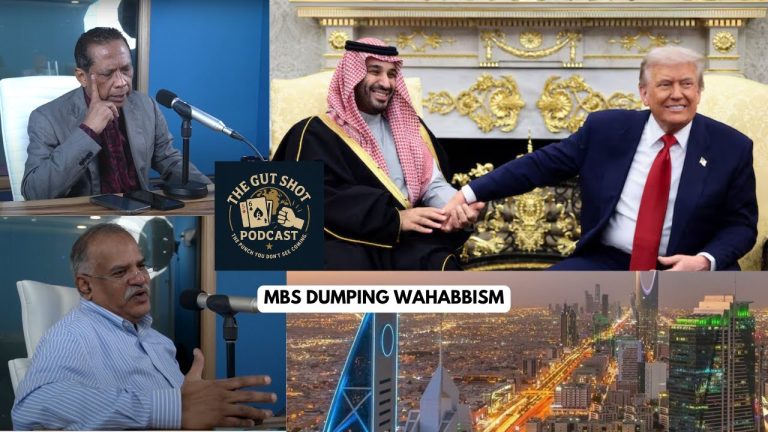
ft Syed Akbar Ali: MBS Dumps Wahhabism
Show Notes & Description
The conversation between Syed Akbar Ali and Sam on the occassion of the Crown Prince Mohammed Bin Salman (MBS) going to the White House. We deep-dive into the changes he is making that will have far reaching impact not just in his Nation but Middle East geopolitics and modernisation of Islamic societies. As usual – we go straight to the gut of the matter.
Welcome back to The Gut Shot Podcast! Shamsul Sam and Syed Akbar Ali of Outside the Box are diving deep into the massive geopolitical earthquake currently centred on Saudi Arabia. You absolutely cannot afford to miss this episode as we analyze Crown Prince Muhammad bin Salman’s (MBS) revolutionary agenda, his powerful meeting with President Trump, and the lasting impact of his reforms on the Middle East and the Islamic society at large.
MBS is driving an irreversible sea change, dramatically moving Saudi Arabia away from its Wahhabi/Salafi religious indoctrination. We reveal how he is successfully dismantling the religious moral police (the Mutawa) and granting unprecedented freedoms: women can now drive, work, and travel overseas without a male companion.
This profound evolution is built on a massive investment in STEM education, ensuring he has a solid support base among the youth and women—making this change permanent. We discuss why separating government and mosque administration is crucial for societal evolution.
The kingdom’s economic reformation is critical because of its dangerous reliance on oil and gas (80-90% of revenue). We examine MBS’s pivot toward diversification, hosting giants like Jensen Wong of Nvidia and Elon Musk at the Saudi US investment forum, strategically focusing on AI. But wait—what about the massive visionary projects?
We reveal the brilliant truth about NEOM: why the reported $40 billion spent is merely "writing a single check" for the kingdom, and how the project serves its primary purpose of changing societal perception, even if it’s permanently postponed. MBS understands that economic success is now the new basis for legitimacy, replacing the old religious pact.
On the global stage, we analyze MBS’s strategic willingness to join the Abrahamic Accords and establish friendly relations with Israel, conditional on the Palestinian issue. We also tackle Trump’s transactional and assertive foreign policy style, noting how he uses symbolism and tariffs to assert dominance, even over leaders like Netanyahu.
Furthermore, we expose Iran as the sole "sore thumb" in the region, criticizing the Ayatollahs for their foolish and wasteful use of limited resources on violence rather than engineering advancements, such as efficient vehicles. Finally, discover why MBS asked Trump to intervene in the devastating Sudan conflict—a necessary fight against the existential threat of the Muslim Brotherhood to Gulf monarchies.
This conversation offers essential insights into how an autocratic society can transition and evolve toward prosperity through necessary economic and cultural reforms. MBS's success is vital for the entire Muslim world. Watch now to understand the new power dynamics shaping the next century!
——————————————————————————–
The Gut Shot Podcast: Episode 31 ft. Syed Akbar Ali: MBS Dumps Wahhabism
Here are the shocking, must-watch segments from our conversation:
0:00 – MBS: The Shockwave That Hit the Oval Office
4:15 – The Secret Saudi Cash Crisis & The $40 Billion 'Lie' (NEOM Exposed)
16:30 – Wahhabism is DEAD: How MBS Killed the Moral Police
33:00 – Trump's Middle East Play: Was He the Real Boss of Netanyahu?
46:45 – The Light at the End of the Tunnel: A Century of Evolution
Experience the future of the Middle East now. Like, subscribe, and drop a comment below!
Many thanks to CITYPlus for their collaboration with The Gutshot Podcast, in whose studio this conversation was recorded. CITYPlus is Malaysia's first Chinese business radio station, dedicated to delivering in-depth analysis on local and international current affairs, markets, and businesses.
Jump to chapter 5 chapters
- 0:00 MBS: The Shockwave That Hit the Oval Office
- 4:15 The Secret Saudi Cash Crisis & The $40 Billion 'Lie' (NEOM Exposed)
- 16:30 Wahhabism is DEAD: How MBS Killed the Moral Police
- 33:00 Trump's Middle East Play: Was He the Real Boss of Netanyahu?
- 46:45 The Light at the End of the Tunnel: A Century of Evolution
Auto-generated from YouTube captions. Timestamps link to the video.
Good day everybody. Welcome back to the guide short podcast. I'm Shamsul Sam. I'm back here again with uh my good friend Sakba Ali of Outside the Box. Hello. Today we're going to talk a bit differently uh geopolitics uh and how much this one affects us. We are going we we're going to analyze uh on what uh on the uh the trip by the crown prince of Saudi Arabia Muhammad bin Salman to the oval office in Washington DC meeting Trump on the 18th I believe uh of this month u in uh 18th of November. I think this is very significant and I think along with it also what we are looking
at is actually the changes that MBS has made in uh Saudi Arabia and how it will impact the region and not just the region but also the Islamic society at large. uh the re the reforms that he has carried out uh with respect to uh uh Saudi and the administration of religion religious practices in Saudi and also the I would say the interestingly uh stronger connecting bond that he is building between himself and uh America say
yep let's uh let's start on that note um history. Uh Muhammad bin Salman. Mhammad bin Salman. Let's go there first. First of all, uh President Trump promoted him to king of Saudi Arabia recently because he said, "I spoke to the king." Uh Muhammad bin Salman is a crown prince. But yeah, a lot of uh a lot of things are happening in the in the Middle East. uh there seems to be there seems to be some coherence that is uh coming that is being formed in in the Middle East despite all the the hostilities and the chaos that is going around in some countries. Perhaps at last they are
getting uh tired. But there is uh getting tired of fighting and wars. But uh uh there is a a larger undercurrent that is developing in the Middle East that they are moving towards finally settling down and moving forward with doing real things like developing their societies, developing their economies on a more real world basis and giving up some of the older not so uh good not so useful uh behavior. fears like you know tribal identities um overzealous religious identity uh and things like that which has held them back. I think now they have come to realize that it is better to
just maintain safe and peaceful uh uh societies and engage in you know economic activity that is profitable for everybody. engage in trade rather than, you know, constant endless hostilities and wars, you know, which has been the the which has been the trademark of the Middle East for too long, you know. So perhaps they're coming out of that and uh Saudi Arabia has over the last MBS has been crown prince now for more than 10 years I think about there
I think. So I think probably they have made Saudi Arabia has made a sea change. They have moved away from this Wahhabi Salafi uh religious indoctrination.
Mhm. Not entirely moved away but they are no more into all this very extremist uh approach towards Wahhabi and Salapi religion. For example, they have disbanded you know the religious moral police. They call them the Motawa.
Mutawa. Yeah. Motawa. They have disbanded them. uh women can drive, women can work, women can travel overseas without having a male companion, you know. So all these uh they have um you know opened up their economy and made their people freer and easier for the people to move around and do everyday normal things which other people do around the world. So that is a sea change for Saudi Arabia and it looks like they want to engage with other countries, other communities, societies and engage in trade, you know, useful interaction including I think they want to be friendly towards Israel
because uh now Saudi Arabia the crown prince he has said it that he would like to be part of the Abrahamic uh accord. Did he say it? I didn't catch that.
They want to be part of the Abrahamic Accords. But of course, he has made it conditional. He wants the solution to the Palestinian issue. But nevertheless, he made a positive statement. I think it is just a matter of time before Saudi Arabia establishes diplomatic relations with Israel, which other countries have already done. other Arab countries uh Egypt, Jordan, Morocco I think UAE, Sudan uh these countries have already established uh diplomatic relations with Israel and recently I think Azarbaijan which is quite far away in Central Asia. They also want to be part of the
Abrahamic Accords meaning that the neighbors in the Middle East are sort of accepting each other and they want to settle down and just be friends and keep moving from there. So that is a major change which will really lower the temperature in the Middle East. That means less hostility, less expenditure on army, military buying weapons and things like that. But having said that, you know, Saudi Arabia is still buying weapons from the US because there are other threats. Iran is still a threat. They are they are Iran is like the only uh sore thumb sticking out in in the
Middle East. But I think that too will will come to a resolution because uh it is always more profitable to engage in business and commerce than you know to be hostile towards your neighbors endlessly. You know there's no profit in that. So uh there is sea change already coming in the Middle East. uh as you mentioned the religious aspect has played a big role in the in the change of direction in Saudi Arabia. They have decided to not they're not moving away from religion but they they do not want to be so ultra and hardcore about it. They want to focus on more bread and butter
and basic issues like developing their economy and their people. So that will hold uh that that should bring a lot of new direction for not just Crown Prince Muhammad bin Salman but for the people of Saudi Arabia and the Middle East.
You know um I I want to break up this conversation to a certain segments now that I think listening to you just now. Number one is the economic part of of this uh reformation. Uh the second part is actually the religious reformation because uh many people don't realize that it is involving a religious reformation. Uh there was u there was um uh I think he gave an interview uh just a few months after he took over as crown prince where he explicitly said uh of how he's going to re uh allow the uh reinterpretation of uh um of uh even hadith and uh Yes, I'm not joking, right? I mean, I invite
anybody uh in the audience to actually go back uh to I'm not saying this. This is Muhammad bin Salman, right? So, uh and and how he believed that uh the religion should really uh portray uh what is uh uh what it's supposed to be intended to. Now that's uh such a situation can only be done if you ask me by somebody who has full control over his over his government's uh uh all the power within the government. A democracy cannot do that if you ask me. Okay. So that's the second part. And the third part uh of then is the geopolitics of then becomes the Middle East and Israel.
Right? So let's go back. This is the three se three uh sub conversations uh I want to deal with. The first uh economically I agree with you. I think I mean uh their complete reliance on uh oil and gas is not healthy. Um we've seen that with uh Brunai and too late if you ask me. Okay. Um, and uh, whether we like it or not, um, or or whether we admit or or not, I've dealt with uh, with the Saudis, right? They are smart people. Here's the thing that people do not understand. Their education system uh in terms of science and technology is actually very strong
and they import a lot of uh uh of of uh teachers and lecturers from the west you know which we should reconsider. Okay, we should really consider that. Okay. Um and um and therefore they have the human capital. The only problem that they have actually to be honest with you from an economic standpoint,
but we taught the Romans how to build ships. Oh, and we can fly. I think if I'm not mistaken, that was that's just a joke. Okay.
Yeah, I know. I know. Let me let me correct myself. I mean, I I I made that comment. I'm sorry. We're digressing. We're laughing a bit. We're digressing because why? I said if that's the kind of people you have and you can accredit that that kind of personality as a professor, you might as well close the whole school. You know, it's a waste of time. So, I I'm not going to even bother commenting more than that. Anyway, going next to uh going back to our issue, um I think um they have the human capital. The only thing that I realize I I saw the problem that they face is actually
their human capital is expensive because they have a small Saudi population actually and because the economy per capita GDP is so high their cost per person is expensive. Okay. But I can see that what he's trying is to open up for tourism. That's one. uh I really am not that close to the Saudi uh economic situation to understand what other sector they will open up but I can see one of the thing that they are trying to do is with AI uh and building uh AI facilities and uh and and therefore they need to have more energy produced within the country. So that's why I think in the uh the evening the
second evening if I'm not mistaken uh they hosted the investment um Saudi US investment yeah Saudi investment forum um and they had Jensen Wong of Nvidia and Elon Musk talking. I think that's the first time Elon walked into the White House for the first time as well. Uh that was that's interesting. Um, so, uh,
after his $1 trillion paycheck. Yeah. Yeah. I think the the here's the funny thing actually. I mean the the mainstream media I I saw New York Times I think or Washington Post was uh making a point that uh uh uh the Saudi Pif I guess the the the
private investment fund or they that their treasury are running out of cash. Okay. Um and and I was I mean God I mean this mainstream media they are so anti-Trump that they cannot get off the boat when they see something good. Okay one trillion to the Saudis are nothing guys. Okay. You know what the NOM city, okay, that they were they that uh uh MBS promoted for investment, if you were to ask me, they're never going to build it.
It's been postponed. Yeah, they're never going to build it. And permanently postponed. You and I think they have actually just spent about I think not more than 40 billion. And that's the high mark of it. Not more than 40 billion. And 40 billion is like writing a single check for us you know at a mama shop. Okay. So and the reason why he's doing that if you ask me it's like it it's pretty brilliant move you know because he needs to change the society. He needs to give the society a different a big crystal ball here to look at. Right. And then he's doing this other
thing in the reformation of economy and actually also their uh their religious authority uh that he needs to dismantle. Okay. And it's worth the 40 billion.
I um I look at Saudi Arabia like other monarchies in the Middle East, the Gulf countries, right? they uh and also Iran uh they suffer a serious legitimacy issue because they're not elected. There's no democracy. So uh what how does the saying go? Uh uneasy sleeps the head that wears the crown, isn't it?
Yeah, something like that. Something like that. U sleeps the head that wears the crown. Because when you are put in place not by democratic means uh there is also there is no democratic means to effect change in leadership. Usually the change comes when the head is very uneasy. You can lose your head.
Absolutely. This is common. That's the that's the issue. It's a big problem in the Middle East with the Arab monarchies and also Iran which is not a monarchy but again it is not legitimate because their democracy is not a real democracy. Uh so uh the you have Saudi Arabia which is a country with people I think over 30 million citizens now. Then you have the ruling autocrats or the oligarchy who are there not by
they have not been elected they are hereditary. They are monarchs. They grab power about 100 years ago and they and they are there now. So every day of their lives they have to justify their legitimacy which they do not have. So one way of to secure their own position. Uh this is their own personal survival of the ruling oligarchy. Then it is of course it is their survival is immediately directly tied to the to the fortunes of the country. So economic development is critical. If they can move the economy and keep the people happy, you know, their incomes keep
improving, there will be less um reason or less cause for insurgencies, rebellions, coups and things like that. So they can sleep a bit easier if the people are also happy. People will be happy if they have good economic growth and uh they don't suffer economic difficulties. But Saudi Arabia is uh like a restaurant with one item on the menu, oil and gas. I think you know more than 80% 90% of their revenue is oil and gas. The whole country runs on oil and gas. They have tried diversifying but it has not been very successful. You know they they used to be self-sufficient in wheat. Okay,
wheat production, but their per bushel or per ton cost to produce wheat is like multiple times the the market prices. So now they have all those experimental wheat farms have closed down, shut down. Uh but nevertheless they are still hopeful of diversifying their economy away from oil and gas. The pilgrimage is uh one which they are they are developing and I don't know whether you have noticed or not but the the cost of performing the
Hajj Hajj and the Umraha to Saudi Arabia has gone up substantially you know. Mhm. Uh so the Saudis are also trying to get some revenue extra revenue from the pilgrimage activities. They're developing other tourism but that's it's going to take some time because uh whether they are fully geared up for tourism and I don't know you've been to Saudi Arabia. I have not been to Saudi Arabia. We don't hear of that many tourist sites other than the religious religious sites in Saudi Arabia.
I was there for business. So I mean I was looking at operation. So uh so I I didn't have enough I I yeah I didn't go. So that's that's going to walk about that's going to take some time I think. So they have to diversify their economy. They have to go into manufacturing, trade, things like that. So if this if they diversify and they move forward in the e- in the right correct economic direction, it creates more prosperity, more growth in the in the economy and it uh safeguards the position of the ruling monarchs, the Saud family uh despite them not having democratic elections, so
they can sleep a bit easier at night. they have sort of they were using religion before for exact same purpose the Salafi Wahhabi uh religious uh doctrine where sometime in the 19th I'm sorry in the 19th century or earlier the Saud family and the Wahab family
made a packact the Saud shall rule and the Wahhabi the Wahaba family shall provide all the religious they in charge of religion and they will make all the fatwas and everything like that. So they had a role to play in Saudi society. That was like more than 100 years before the discovery of oil.
So religion had a had a religion had a role then which oil has now. Religion was the fuel that powered the uh the the the relationship between the al-Sah family and the Wah Wahhabi family. bottom line is to get power in Saudi Arabia which they did. So uh that that equation now has changed because Muhammad bin Salman has realized that uh religion is a bit too risky because you can have it can get out of control quite easily. You know it's easier to manage economic activity. It's more predictable. Religion you can have issues. You can have factions, schisms,
sex, yeah, who may decide to oppose you, go their different direction, things like that. They can cause problems. So he's downplaying uh the Salafi Wahhabi religious sect or religious group that they have in Saudi Arabia and focus the people's you know imagination energies future thinking towards you know economic growth and and more sciencebased uh a science-based outlook towards things in life which you mentioned just now the education system they are spending a lot of money
they have always spent that on education and on STEM. That's the interesting part. I think they're big now in STEM. They are bigger in STEM. Science, scientific, technical, engineering and mathematics. Science uh yeah technology, engineering, mathematics and STEM. They have spending a lot of money there and they are also educating their women to substantial uh you know a number of girls go to university in Saudi Arabia
which is a positive development and now girls can work they can drive on their own. I I was in I was going back to my visit uh I was in Dam uh and I would say 50% of the ladies that was in that convention mingling around uh because that was also you know they were not wearing hijabs.
So talking even the uh uh what do you call the the the nikab they were not even wearing hijabs. So you see this is a new development only happening in the last less than 10 years. Yeah. So it's going to take some time. So if you look forward like 20 years, another 10 years, 20 years down the road, all these women will be fully immersed in the Saudi economy as and a lot of them as entrepreneurs. They will they will be there. So they will be the the support base, the core group which will support Muhammad bin Salman when he eventually becomes king. And I think uh if nothing
bad happens this guy will be a king for for some time. There'll be a sea change. There'll be a sea change and he will have a solid support especially among the young and the women with the women in Saudi Arabia half the population will definitely support him. So this change is irreversible. Even now with 10 years of all this uh change that is going on in Saudi Arabia. uh young people are now being accustomed to uh a way of life which was not available to their not only their parents maybe their older brothers and sisters you know
uh so the younger generation now are already used to certain uh liberties and freedoms which did not exist before. So uh if this is maintained for the next 10 20 years, this will be a permanent psychological change in the Saudi the psyche and the psyche will change will change mindset will change and so the the the agent who brought about this change is none other than Muhammad bin Salman. So this man will go down in history as quite a figure. I hope he becomes a towering figure in the future of Saudi Arabia. Um and then from there hopefully they can move on to being a democracy which is
well you you know a natural consequence. You you think about it right? You think about it uh uh we've seen what how lieu transformed uh Singapore. Okay. It's not a true democracy. The PAP is a UNI is an exclusive club, right? And uh uh Quanu never really tolerate much of descent. Okay. Uh but what did he do? Um one of the things that I admire about what he did was uh the Singapore was a majority Chinese population. He could have easily said um the lingua frana the uh education system will be carried out in Mandarin. He did not. It will be English and it is English. Right?
That one just one thing alone was to me one of the major factor how Singapore became a developed nation. Okay. Um higher education and even secondary education in Saudi Arabia is in English.
Is it English? I mean they learn Arabic of course but uh I think they they use English on a very uh for many subjects on quite a large scale in education they teach in English and all these uh academics and professors from all over the Islamic world who who go to Saudi Arabia to become academics and professors they teach in English
in their universities. So English is assuming a bigger role in the Middle East. Saudi Arabia, UAE, Kuwait, all these countries, you know, English is uh is a language of choice. Um I hope if they keep going on this trajectory, there will be significant uh change in their in their countries in the next in the future. I think on the on the last point on the economics that I want to uh uh I want to throw out is what I see as a possibility uh in terms of uh in terms of Saudi Arabia in its role within the whole region including uh North Africa because we talk about a world that has regional
polarity, right? Um it could be the it could be the the the single superpower in the region and it's very easy because um they are allowed to import the highest technology now they're taking the F-35 from America. All right. Um and if you think about an another an industry that they could be but they could be manufacturing is actually armaments you know and that is high technology and I I think if you've got peace on one side of the region which is within the Israel uh uh uh region and if you've got peace this side of the Gulf okay you stabilize the whole region the commerce
then Iran becomes the lone guy that is going to cause trouble and if you're you're going to get squeezed and the people of Iran the only problem that the people of Iran has is because the power is held at the you know at the at the end of a gun otherwise the ayatah would be gone by today
they have they have executed about a thousand people so far this year the Iranian regime I mean that's what the media says is maybe it can be debatable but
it's even more if you ask me they do it's it's uh it's very sad it's very sad but um Iran uh the long-term um prognosis the long-term prediction for Iran is uh not very good for the ayatollas I don't think they will prevail they having they're having serious problems and uh they they are not able to overcome these issues and the the only thing they seem to be using which they think they have an advantage is the threat of uh hostilities of you know violence of uh shooting missiles and sending their proxy what Islamic revolutionary revolutionary guard corpse to uh to Yemen to Syria to Lebanon to
you know fight wars and all that but now they have taken a major setback they've been they've lost Syria his bullah is gone and even Yemen now it's uh they're not in a very good shape. So that course of action always you live by the sword, you will die by the sword. It's it's a very very um uh very foolish you know very unclear it's it's not foolish when
and wasteful reuse of your resources which are limited dude which are limited when you are g in you know all the way like that right it's very difficult to get oxygen to your brain you know and
they're not they're not thinking right you know they have surely they can do better things I I hope with all their clever cleverness you see Iran now they can make ballistic missiles. I hope with all their cleverness in engineering and missile technology, why not make that 100 m per gallon petrol-driven car, you have petrol in your country. I mean, give the electric vehicles a run for the money. Toyota is doing that. Toyota says, "I'm not going to build electric vehicles. We're going to stick to petrol." And the Toyotas now are so efficient. Yeah.
Why don't use all your cleverness to create something like a, you know, okay, you want to you want to go the electric vehicle way, go ahead. If you only read one book, you you're not that, you know, the only difference is made in Iran Islamic electric vehicle and conquer the world market.
I I'll put it this way. Instead of sending your proxies and soldiers and guns and bombs all over the Middle East, what a waste. What a waste. what they doing is very simple is that if you they are hanging on to power for power's sake and actually uh suppressing their people whereas what MBS is doing is holding to power to actually free his people and making them more wealthy if they are wealthier he's going to get wealthier anyway I think he's he's more wealthy than uh
he has to develop Saudi Arabia's economy that's number one if you if you do well by the economy me people don't care if you're a king or a monarch or whatever like China and and Singapore and Sing. Okay. Yes. Uh Mr. Lee Kwanu and the PAP were they didn't like too much of you know uh this full-blown democratic system. They didn't like it too much but they they stuck to democracy. You cannot deny that they were not democratic.
You know there is always a path. They held elections on time every time. Their elections were all free and fair. But uh Singapore made sure like China now we may be in power for a long time and China is is autocracy but they deliver. You see
they deliver to their people. Bro you ask me. Okay. There is a path there is a path actually that has already been uh uh uh that that's already been shown by one country actually that I that I'm more familiar with which is Great Britain right you've got from a sole monarchy that transition itself of course there were bloody revolutions in between but you you can have a situation where
his name was Oliver Cromwell he cut off the head of the king, right? So, but you know there is a way that the monarchy can transition, okay, to still be in power and yet have a democratic means of governance, right? To give him more legitimacy. But, you know, I mean, but at this moment, I'll transition this this Saudi Arabia is not there yet.
They're not there. They will come. They may not be there yet. Not yet. Not yet. they they will come to that point in the future and I hope they learn to handle that well the transition right now they are not ready for full-blown democracy they are too tribal uh the the the society is not ready this is where I hope Muhammad bin Salman if he's listening to our podcast
that the first thing is he has to move the economy create a good value system among the society and then age his people towards a democratic system you create a you know a legislature, you have elections, you know, they they can't be the ruler, but at least you have a like a legislative assembly where where people's voice is heard and ultimately like just like the British model, you know, when up to Queen Victoria, she was the what the absolute
she was still the absolute monarch. Absolute monarch, but she had prime minister. Yeah. You know, all the prime Israeli Benjamin Israeli and all that, the famous prime ministers, the the monarch was the absolute monarch. But there was a cabinet, there was a prime minister. So over time over course of time this will take like
50 years. No you ask me no it's not even 50 years it's probably going to take a century and uh so over time you you you evolve and you devolve and then you pass power to the state to manage it. So I hope I hope Muhammad bin Salman will will undertake the baby steps towards moving Saudi Arabia towards democracy. You you see my uh then this is a nice segue to go to go into the reformation of the religion in Saudi Arabia. Okay. Because uh it is absolutely in my opinion the economy the uh the cultural mindset that actually spurs economic growth um need to uh needs to be reformed first as
well before you can even attempt because you don't really understand democracy is only good when people are actually well informed and are educated. If you are not educated and you give every person one vote, all you're going to ask for is 80% of the people are going to be idiots. All right? So that's I'm sorry I'm going to say this. Okay? Because why? If you don't educate them properly, okay, that's what you're going to get, right? So, but I think especially in a situation where he has inherited almost a 100 years of uh uh uh
what do we call that? Um Wahhabism. Yeah. Wahhabism. Salafism. Wahhabism. But Muhammad Muhammad with Salman, he has an advantage. He was educated in Saudi Arabia.
Yes. He did not go to school outside the country. But uh to his advantage I think he studied Sharia law. Yeah. I think he's a lawyer. He studied law and he he studied Sharia and so he is quite uh well-versed in uh Islamic theology. So you the point you made about religious reform reformation did you use the word reformation? Well uh that is a very tall order to make reforms in religion any religion not just Islam any religion it's always a very tall order because there is no consensus on which is the perfect model everybody has their interpretations that's why you have sectarianism in the
first place in Islam you have all the major well all the religions have se their own you have sectarianism you have the major sects and you'll have the smaller subsects. You have the Salafi and Wahabi Wahhabies and Salafies in Saudi Arabia. Even the the the Salafism or the Wahhabism of Saudi Arabia has got its broken up into other other subsets. Now they have a new se subset called a mudkali. You know
it's got nothing to do with mud but it sound is mudkali. It's got a different interpretation of uh their version of salafism. And then some people in Saudi Arabia don't like to be used to use the word wahabism anymore because wahhabism is tied to the family.
But salafism goes back earlier. you know it's it's more it's more generic. So they prefer the word salafi. Again what I'm trying to say is that there are all these you know uh different ways of interpreting things. So where are you going to start your reform? One one person's religious reform is another person's deviant act. You see they they will not agree. But the safer the safer uh course of action which uh other societies in the world particularly the west they've learned through much bloodshed and anguish and horrible mistakes is ultimately to uh to keep
religion in within its own compartment and and to separate religion from government. Government. Yeah, government has to be based on science, on logic, on uh practical uh ideas and and delivery. Religion is faith. Religion is faith and faith is best kept in your heart. You see,
so and faith religion, you know, is for individuals to connect with their belief, their uh to connect with God and things like that. So uh so if you want to talk about reforming religion that is a that can be a hornets's nest because who's reformed? What do you mean by reform?
Unfortunately or fortunately say so the easier the easier option is uh let let uh you know the let the cobbler be the fellow who repairs the shoe, the carpenter who makes the furniture and the religious guy teaches religion. you know each is operating in their sphere and uh you that way if everyone functions to to the maximum efficiency then you get the maximum output. If you jumble them all up together then it can create various issues.
Well I think I think what I've seen so far is that he's taken the bull by its horn. Um and as you said he's already dismantled the Mutawa the religious police
that is administration of religion. It's not religion itself it's just administration. Yeah. He has also quite vocally which I was very surprised. I saw this uh the the interview clip and he was uh uh he was mentioning um that you know I don't think this was even the intention of uh one person like uh uh Wahab himself to determine uh what is the doctrine. So I think whether it's going to be an experiment so to speak um that has uh that that is going to play out throughout his reign and so far he is well he was installed what 2017 okay so he's uh less than a decade uh le
he he pointed out uh as you mentioned his his comments on Wahhabism and salabism he pointed out that uh I think he used the word uh problem or issue uh is in the interpretation that's what he said is is in the interpretation how we interpret things. So uh he was playing it from that angle. So because there is there there may not be a resolution to these different interpretations. So his uh approach is let's leave it aside for a while and continue with doing uh activities to improve ourselves, our economy, our society, our young people, job opportunities, future uh growth,
areas for growth in Saudi Arabia, free ourselves from oil and gas, things like that. Let's keep moving forward. So that's why he dismantled the motawa. uh there is no motawa in our in Islam that this name is is a purely Saudi thing. Of course there are religious religious uh what enforcement groups in most Islamic countries but that was an administrative thing. He removed their power that means it was an act of administrative act and just reduce their remove their power. Uh he did not say that uh what they were doing what they did before was wrong. uh he just said that we don't need we don't
need a separate like a religious police to to monitor and control the moral behavior of our people. Our people will they know religion they let them what self uh
self police and self self-regulate. So it was it was an administrative act. Well, here's the thing that is in the actually I mean this this whole change uh is happening in what you know basically we would call the cradle of Islam right and I think whatever that happens over there um is something for the rest of the Muslim world to look at you know and I don't think that at the end of the day if it end up end up like what you say there's going to be a separation of uh uh government and mosque, you know, in the same context. I think it'll be good for the um for the
whole society because then people can go on and live their own lives the way they ought to and and uh and actually focus on making things better in their lives. I see uh I see Saudi Arabia now carrying an extra burden on their shoulders. uh whether whether they pay attention to it or not or whether they are concerned or not because uh yes when you mention the rest of the world Saudi Arabia is a point of focus for Muslims throughout the world. Uh I mean this also can be arguable but nevertheless you know for the Sunni uh Sunni Muslims Saudi Arabia is the site of the Mecca
and Medina and the king is the guardian of Mecca and Medina. So of course they play a very large role larger than life role in uh perception of the religion of Sunni Islam. So now they have decided to go this way of being more modern and some would say liberal and things like that. Uh they have to make a success of it.
Yes, they better they have to improve the society. They have to be more professional. They have to be a better people. They have to be an attractive country for people to want to go there for travel to do business. You know the people must look up to Saudi Arabia as a place uh as as an as a a good a good placeh not just because of their religion but because of their things that go on in the country they must be safe
let's put it this way because of their success success they must have people look at success must have law and order must be fair and just to all people things like that so if and their and their own people must progress at a rapid clip so if they can do that and the Saudi Arabian society and the country successful the next 10 20 years you know then the world will look up at Saudi Arabia's you want to use the word reform I I like to use the word changes the changes that they are making so the rest of the Islamic world will look favorably at what Muhammad bin Salman is doing now if
they make a mistake and they bungle then the whole world is going to say this is what happens when you uh abandon your religious uh beliefs. Well, that's that's the that's
and you and you and you have deviated. Now, this is the wrath of God is falling upon you. Evolution in terms of societal evolution is never a straight line, right? And we can only see and we can only hope, we can only predict as much as we can, right? But at the very least, I can see a a a more positive trajectory. Um because a a monarch, a an autocrat has actually, you know, need to have that's basically it. At the end of the day, you need a benevalent autocrat to actually evolve a society to that has been repressed to
and an an autocratic society. Yeah. The society itself has been autocratic all the way. All the way. They've been tribal. They they they identify with tribal groups. So you want to throw them a democracy doesn't work.
You have to it takes time but you have to change it. Yeah. It has to it have to evolve. The whole word is evolution. Maybe reformation is not the right word. It's a evolution. Right. So you know I mean that if he's successful if you look at that then you look at what is happening you know transporting to the next part of what we want to talk about that that you know I want to talk to you about is uh I that there was one interesting question that was thrown to uh NBS actually uh Trump was not too happy about it but then you know I never heard somebody uh answer it that way before
uh which uh I think it was an ABC reporter that said you know um how do you see or some something like that I'm paraphrasing I'm not too sure that you know 10 of the all basically of the uh 911 uh terrorist
attack attackers yeah were Saudis out of 1911 I think is it okay yeah yeah u and you know what did he say about it what did he say right and so he said he said Well, he said this is what um this is what uh what do you call um what's his name? The the uh the al-Qaeda fell
Osama. Osama bin Laden wanted to uh to achieve which is actually you know why they were all Saudis because he wanted to have a rie between America and Saudi who wanted Osama. Yeah, he I mean that's what NBS answered is basically it's intentionally
I I like the answer that Muhammad Gaddafi gave in a uh interview with Larry that famous Larry King. Larry King Larry King live. Huh? Yeah. I don't know if he's still broadcasting. Larry King.
Larry King passed away already. Oh no. Larry King uh interviewed Muhammad Gaddafi and I asked him his opinion on the the 911 the hijacking right Gaddafi gave an answer which stopped the interview you know Gaddafi said
all those airplanes came from your country which is true while king was well I mean but you know what I think I think that's a funny way to put it but then again what else are they going to do I mean the the the the the the he to a certain extent that's quite an interesting take. It is a very strategic take if you think about it, right? Because his his problem one of uh Osama's uh main grouse was that America had a uh had a had a base in Saudi Arabia. Okay? And he was very against that. Okay? He wanted Americans out of Saudi. Okay? So I mean take it as you may because you don't have the guy to
ask you know right I thought that was a very uh that was a very smart answer if you ask me right but uh then going to where we are at actually if you were following American polit I don't know how much you follow American politics right um uh what I'm seeing today is um I think for the first time an American president is actually uh moving ahead of uh Israeli influence. Okay. Uh I've never seen this happen in my entire adult life uh since I've understood politics in America. Um uh and I see what Trump is doing in terms of his trip out. The first trip he went to Saudi and GCC
right and cutting the investments making the even actually if you ask me step there were two things that was very jarring as far as I look at it. Number one was actually when he announced he was going to do a redevelopment of Gaza during the press conference with BB Netanyahu. I saw I think Netanyahu was taken back. I don't think he expected that. Okay, that's the first thing. The second thing that I saw which was this photo op in the oval office where basically Trump called the Qatari prime minister and then handed with the phone still on his lap and handed the the the phone to BB
to apologize to the Qatari prime minister uh in front of all the press. All right. You can say that it's a uh it's it's it's it's media manipulation. All right. But I believe in symbolism. You know, if you were if you were the CCP, this is big symbolism. Okay. But I have never seen uh an an American uh uh administration that is, you know, they are pro-Israel for sure. Okay. But asserting that I'm the boss. I'm the guy calling the shots first. You guys listen to me. All right. Now you can advise me but I'm calling the last call. Now you know what here's the
other thing that I'm seeing the dynamics change and I hope this happens actually the fact that actually the president of uh Indonesia has already committed 20,000 troops for Gaza and if that happens is a big deal. It totally uh p uh uh uh upended anything else that the whatever the others the right faction within the Israeli uh government uh you know would like to see. What say you? Well, I um this the Gaza the Gaza equation the Gaza equation
uh they cannot ignore the Israelis. You cannot absolutely cannot ignore No, I I never say they ignore. No, I'm the point I'm trying to make uh you cannot ignore the Israelis because regardless of which side of the divide you are, whether you are for or against Israelis, they are on the ground. They are a military power and uh they have militarily they are superior. They have controlled they controlled all access into Gaza. So whether it is uh Turkish troops which they have said no or Indonesian or Pakistani they have said no. Uh at the end of the day it's
there's going to be they need real close cooperation with the Israeli government not just Netanyahu but the entire Israeli uh establishment. So that is something that will it has to work out by itself. Uh but there's something else that uh uh happened the other day at the at the meeting in Washington. Um you see um a lot of the people around the world including the media the legacy media they uh seem to be uh they seem to be distracted by President Trump's style of delivery. He's a bit of a showman. He's a he's a superb showman. This is a guy who ran the what the apprentice successful. It's
a very highly rated uh show on TV. Yeah. And he is a fellow who understands the value of uh optics, photo op, the sound bite. He's really good in sound bites. H
that's why he uses words like crooked Hillary and what he imitates people all the time. He he he appreciates the value of the sound bite because he's been almost like a show business guy for a substantial portion of his life. Especially that that that show The Apprentice. And it was basically it's it's it's Hollywood entertainment. He did it very well. So he appreciates the optics and the media and he's good at that. So he uses it to advantage but he has very clever people working for him in the back office.
You look at the trade agreement between us and America. We didn't know this was coming. All we heard was okay going to be tariffs and this and that and at one time we heard everything is fine and then boom we get hit by this agreement and there are a lot of opinions about it. I I I I have not said anything about our trade agreement with the United States. I've not analyzed it in my blog at all. Right?
But it's a lot of detail. A lot of detail, a lot of thinking has gone into that document, you know. Uh so this is a guy who like you know who who who appears full of hype and you know he can pull in the TV cameras but the real work is being is being done. He does real work. this India Pakistan conflict it came out recently you know that both the Indian prime minister and the Pakistani prime minister did talk to Trump but what is not known is that he told them if this war escalates any of you resorts to nuclear weapons I'm going to hit you with 350% tariff it just came out a few days back
this is what made them uh you know calm down stop it just like the Thailand Cambodia fight He same thing he told them if you if this thing continues I'm going to hit you with tariffs. So in in front of the TV cameras he goes like he's a wonderful guy you know he's a great guy you know beautiful people stuff like that but behind the scenes he's got some very clever people working for him who work out the details and uh so do not look at Trump from his showman appearance on the TV. uh listen carefully to what he's saying and listen very carefully to what they actually do.
So now going back to Middle East, Muhammad bin Salman seems to appreciate this because there's another war going on in Africa in Sudan which is now going out of control. The massacres and the death and destruction is like something like out of during the Genji Khran kind of uh uh era you know the massacres and the nobody seem to care.
Nobody cares. Nobody cares. But Muhammad bin Salman brought it up for a very simple reason. It is actually Muslim Brotherhood on one side versus Gulf monarchies on the other side. So Turkey uh even maybe Iran, Turkey and some people helping out the Muslim Brotherhood and then you have uh Saudi Arabia, UAE helping out the other the other side. Uh but Muhammad bin Salman has asked President Trump to intervene and Trump said this is new to me you know actually he knows about it a lot of people everyone knows about the war in Sudan but it is outside their their sphere
it is not vital to American interest there's not much oil in Sudan you know uh so it's is outside their sphere they outside their out of sight for them but now he says because Muhammad bin Salman has asked for help. He's He says he's going to work on it.
But you can rest assured there will be a quit pro. Absolutely. If I do this for you, he's very transactional. You have Yeah, you have to do this for me. But of course, if they can settle the war in in Sudan, and I think they they should, it solves a much bigger threat in the Middle East, which is the Muslim Brotherhood,
which is a serious existential threat to people like Saudi Arabia, to UAE, to Egypt, because they're all over the place. And uh just recently in Texas, Texas has outlawed the Muslim Brotherhood as a terrorist organization recently, a few days back. M
so uh these are the larger things that are happening in the background where as I said earlier we began our conversation just now the Middle East wants to settle down and get on with doing real things in lifeuh stop all this fighting and endless wars and ridiculous you know destruction and destroying human life over religion sectarian differences you know non-stop you know like like the like Europe did what 600 years ago ago or a thousand years ago, you know, people killing each other between the Catholics and the Protestants and this sect and that sect, you know, finally
they ran away from Europe and founded a new country, United States of America. They call them the pilgrim fathers, you know, because of religion. So, uh I think the Middle East is coming to a situation now. They say, "Okay, let's put this behind us and move forward." So this is where Trump is helping out and I hope he helps to solve the issue in the Sudan because if the Sudan settles down that whole part of North Africa and Egypt and uh even Ethiopia uh should should should calm down should should settle down. So uh which will make Saudi Arabia more beholden to US but it also
make US uh still part of the equation in the Middle East and and North Africa. Uh and uh both sides will reap benefits if peace breaks out. Can you imagine the amount of rebuilding and the amount of infrastructure that needs to be rebuilt and the business trade opportunities that can develop it? It is just good for everybody, you know. So, uh I hope u that Muhammad bin Salman will be able to to work through all this.
I mean, we're looking at good times ahead. That is that is the light at the end of the tunnel. Now, you do things right, you're looking at good times ahead. Instead of fighting wars, let's burn your country down. I don't know what's wrong with these people.
Yeah. Okay. I guess on that note we'll call it a day. Yeah. Say thanks a lot. Thank you very much everybody. We hope you enjoy this conversation. Please have like, subscribe, uh follow us and uh comment anything.
If you have any uh anything you want discussed, put it in the comments as well. Thanks a lot. Take care. Bye.