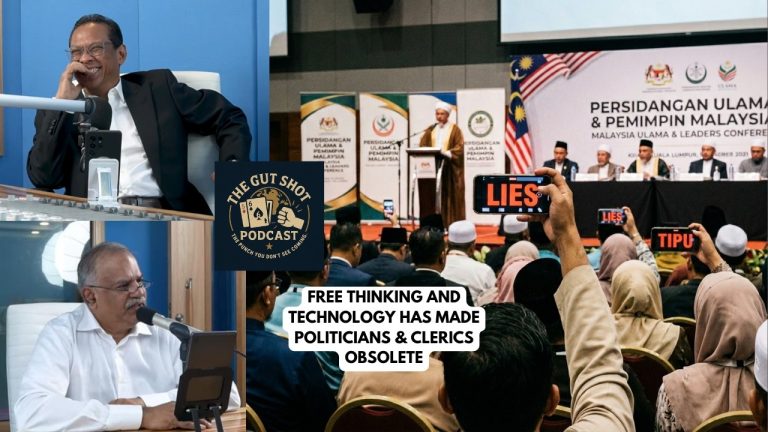
Free Thinking and Technology has Made Politicians & Clerics Obsolete
Show Notes & Description
This is a prologue of upcoming episodes. Thinking. A revolution of citizens taking over the rein of thinking leadership by one question, repeatedly asked – why?
Every citizens now has a space in the market of ideas with the advent of technology at the palm of our hands. Try as they may, the politicians and clerics, will surely lose out sooner than later. Our people need to think deep with real knowledge because the revolution is coming and coming soon. No matter how much censorship the authority may want to impose the time has arrived.
The refusal of especially Islamic countries to evolve are where their trouble lies. Malaysia is ahead with secularism as its main ideology and that maybe our salvation.
Jump to chapter 7 chapters
- 0:00 Technology and the Collapse of Thought Control
- 5:43 Feudal Values Across Generational Divides
- 9:30 Democratization of Media and Free Expression
- 17:13 The Disruption of Religious Gatekeeping
- 23:47 The Samurai Analogy and Feudal Obsolescence
- 30:59 Why Dogmatic Regimes Fear Inquiry
- 35:49 Dismantling Sedition and Criminalized Speech
Auto-generated from YouTube captions. Timestamps link to the video.
Well, I mean actually to be honest with you when we started this conversation I was very pessimistic. But I after talking like this I've gotten more optimistic because why? I realize something the the technology is going to make the current political system the current religious control of thought is going to be obsolete. And whether they like it or they don't like it, it's coming for you.
Nobody nobody remembers who's the last samurai. Yeah. Nobody knows. Right. You know. disappear. Yeah. Welcome back to the got short podcast. I'm Shamsul Sam. Here again to with me my good friend Syed Akbar.
Morning. Today our we want to have a conversation on topic that we consider very important for us moving forward as Malaysians which is uh very simple question. Do we think enough? All right. So when we think about thinking and how we are thinking do we think enough? This is the this this matters a lot because now especially as I said uh after the vote 18 we have brought in a few million more voters into the electorate. Okay. The 18 years old they're younger. I don't want to I mean they have less experience in life, you know. So the thinking capacity is actually very very important for a
country to succeed in terms of just not just uh our workforce but also you know our producing the leaders that will come out from our population. Say it. Um What do you think? I think in this in this episode in this particular segment when we talk about our people thinking and thinking enough when they make their decisions with respect to either the politics of economics of this country. What is your opinion?
I mean the the only 18 lowering the voting age to 18 that's only a portion of the population. There are 34 million people in the country and only only only a certain portion are voters. I think significant number are just ordinary people. But what I mean we have to ask ourselves are we happy with the level of you know, free thinking in the country?
Right. Basically we're talking about discussion and speak free speech also. Right. Those are all inextricably connected to the our thinking processes. Do we think enough? What sort of thinking do we have in our society among our 34 million people? I mean thinking is is critical actually important because everything you do is a result of thought processes. So if you're not thinking right or if you're not thinking enough then you're also going to be doing less. This is this is our our situation. You know, we are a new country. We are still we are we are well third world but we
are gradually you know, we're moving from third world more you know, to middle income and a bit better than that in terms of economic progress now because of modernization industrialization. But then you also have society.
Yeah. And our value systems. Right. You know. Or rather the the overdue or undue influences of old ways of thinking of traditional thinking cultures religious influence. Right. Which maybe is keeping up with uh uh the rest of the world? Is it keeping up with uh being able to put us uh at a position which is uh at par with the rest of the world that is so or everything's moving at a rapid clip now. So uh all this depends on our thinking uh pro- processes. And uh so the question does arise arise, do we do we uh think enough? And then the on the flip side now, the danger
when we don't think enough then others will do the thinking for us. Including the con man and all all those other types, you see? We can get taken for a ride. So uh we have to really go up to scale in being able to to think, to talk, to discuss freely, to question without having to suffer repercussions. Uh Uh so without having to suffer uh persecution, prosecution, whatever, lah, just because you like to ask questions, you like to question things, you like to debate things, you know? Uh which we should we should always encourage discussion and debate uh across the the across society, not just
when it comes to election time and voting, but daily in our lives every day, you know? We should the level of discussion and uh inquiry and critique uh thinking about issues should really be be ramped up. We should make a serious effort doing it because the more we we discuss, we think, and we dissect things and and and include as many people in the conversation as possible, it'll be better for us. It'll move our society forward much faster, much better.
Well, I mean when we take when we take that, I think. There's another generation of us since you're talking about only 18 and younger people. That's the younger generation, right? I I I do think that in order for you to think, you have to have a base knowledge for you to actually a breadth and depth of knowledge because without the breadth and depth, you're really thinking in in a vacuum, okay, or near vacuum, all right? And that's where actually, uh, you know, where con men come in, as they say, you know, because you don't have the facts, you have not exercised your mental
faculties to process these facts as well, and critically think which is right and which is wrong or which is gray, right? Con men come in. You know? Um, I wonder whether, uh, us in the older generation compared to the younger generation, how do you see the difference now between the older and the younger generation?
The The older is always more traditional, Islam. We are We are We can use the word feudal, because we are our country, our society, although we are multiracial, multicultural, nevertheless all of us are traditional, very traditional, you know? And if you're talking about our generation, it means those who were born in the '60s. We are the earlier We are the '60s generation, uh. They They earliest uh, the the generation that was born after Second World War. Uh, to me, that is all still a Victorian age, 19th century, uh. So, we are still stuck with a lot of old
traditional values, you know, where it is it is not encouraged to question the status quo. It is not encouraged to ask too many questions. It is not encouraged to question authority. In fact, it is it is encouraged that you must respect authority. Yeah. You know, these are all traditional kind of thinking.
Well, well, I mean the word is sorry to to bug it but I I just this word pop up in my brain when we were young. The word is you cannot derhaka. Right? Which is going against authority.
Yeah. You know? This I mean the the sociologists and anthropologists I think would debate this until the cows come home. But the way I look at it lah. In those days lah, let's say that when in the decades you were born in the 60s up to 60s or 70s. I mean our country was basic. The whole world was basic. There was no smartphones, no handphones, no internet, nothing, you know? We just turn on the light switch, you know, the yellow color light in your house that's That was it. And you have a car that runs on what? Internal combustion engine. Today your car's running on
electric vehicles and stuff. The world has changed. But at that time, you know, we technological development was still basic. All right, basic. Black and white TVs No TVs. TVs came here in 63 or 65, I can't remember. So we were basic, communities were basic. Economies were agrarian, that kind of stuff. So in that kind of atmosphere, you don't need to question too much. You just You just do what everybody has been doing and things, you know, will be sort of level. Your your boat will not be
You don't rock the boat. You know, you won't rock too much. Agrarian society, not much manufacturing going on, not much technology to worry about. So there's no big deal. You don't You don't want to have You don't need as much You never had access to as as much freedom to express yourself. There was no Twitter, no Facebook, no instant communication. So you just do what your parents did, do what your neighbors do. Everybody does the same thing. Don't rock the boat and you know, everything goes along just fine.
I'm I'm wondering actually. technology has changed now. Now we have like what we are doing now, this podcast. Can you imagine before all these things came up you need a license you know, to to do a broadcast in Malaysia, a lot of countries, you need a TV license to do
to be able to broadcast your voice, your voice, you need radio license, broadcast license a voice and video, of course a TV broadcast license, you need license, most countries even in the US you need a license to to run a TV station and in US it's quite worse worse huh only American citizens can be given a apply for TV license huh so some of the famous billionaires who ended up owning TV stations in the US, they became American citizens just to become to to buy a TV station, I think Rupert
Rupert Murdoch, I was just about to say yeah, yeah yeah yeah so it's always control, but now how are you going to control yeah, when you we are broadcasting from the smartphone you know, we can broadcast to the whole world, yeah, so it becomes ridiculous
we could even do live to the whole world it becomes ridiculous, they impose all these old archaic kind of thinking now we're going to control your your ability to project yourself you know, your messages, we don't we we you know, basically to block and at any Tom, Dick and Harry from what broadcasting to the rest of the world that's
I think those days are over gone so so the thinking has to change now, the technology has made it possible for us ordinary people to discuss anything and everything including the things in our society that we like we do not like that work do not work, we can discuss it openly so this requires our society to reset now this is where you mentioned older generation the older generation may have some issues about this reset, the younger generation no yesterday I was listening to a girl, young girl maybe early 20s huh she was letting fly on some issue about MACC and all that, a young girl with all
the facts and figures you know, and her video went viral. You know, I have I have a bit more information but names are involved. You know, in Malaysia you mention names, you get in trouble, huh? So, but she was going full swing, you know, young girl and the and the people around her, young punks or young people, probably some NGO, lah. So, she was uh complaining about this issue, you know, that it's something was not done right and all that. So, a young girl, female, a girl with very little uh I don't think she belongs to any political party.
Right. But, she is able to reach out to millions of people. So, that is this is the power of technology. Yeah. So, this is what our older generation didn't have. We didn't have before. You know now that you say like that, right? I I have a gut feeling actually because
So, so, yeah. You you talk about the 18-year-olds in Kuala Lumpur, huh? They are impacted by all this information now. Yeah. So, this is going to force them to think at a different level than our generation.
We want to commute to create this community of critical thinkers, I know. So, I think let's spread out this type of thinking, get people to share, uh like, and actually if you are not subscribed yet, subscribe to this channel so that you get episodes like what we do here at Guy Shot, and you get more of this kind of content, yeah?
Correct. So, I know I I I was thinking to myself about, you know, the the dichotomy of all these races that we have, right? In spite of uh uh uh apani the the religious uh uh uh what do you call the the the religization the Islamization of our education system, if you were to to get it very precise, right? Within the Malay community, even if you to ask me, because I do sit around and talk to young Malay Malay boys, especially when I go and buy burgers, I go and buy fried chicken, you know. I I sit with them and I I you know, I just talk to to just to understand them, right?
Here's the funny thing. I would say 50% of them are very rebellious in the way they think. Okay? They're very independent. All right? Then you've got the other portion which uh actually uh become very um uh controlled because of the uh indoctrination that they got involved in the schooling that they go through. However, even then they can be very rebellious in the way they're going to um come about their their discussions. Okay? This is what I find about the young people, okay? And then again, I'm going to emphasize 50% of those young people you can't tell them what you what to do
because they're not going to listen to you. Uh they don't believe you. In fact, if you ask me, they don't have uh beli- they they don't have trust on our politicians, okay? That's the Malay kids that I I've seen, all right? Now, I'm going to have a forgot shot next week, I believe, um uh um a discussion with uh any man researcher on Chinese youth. That's going to be very interesting. But my thoughts has always been our our our Chinese our Chinese community culture um in spite of them being uh basically what we call overseas Chinese, right? They are migrate uh their their their their
their ancestral uh you know, come out from um from a feudal system. But very much actually the culture is still um uh Confucianist in its theology in its ideology, which means that, you know, Confucianism is very much respect of authority, respect of the elder, the fealty to the authority. So, in essence, when you say about feudalism, it it doesn't preclude the the Chinese community, either.
but I think that the Confucian idea is is is closely or very strongly tied to benevolence. That means there must be a respect for authority, a respect for father figure, who in turn has to be benevolent. He takes care of the the home. He takes care of the country. So, as long as he keeps delivering his job, doing his job, delivering justice in the in the society, that society should follow him. That's I mean, that's more more or less the Confucian law.
Yes. That's That's the other part of the deal. That's the social contract. The moment he stops delivering, then of course all the other things go out the window, you see? Yeah. Yeah. That's That's how MCA got thrashed out.
So, so Confucianism is the the people well, it's in They are more ready to actually overthrow the It's easier to govern people who believe in Confucian thought, because they're willing to surrender to discipline and the rules, as long as it delivers social justice. So, the benevolence the benevolent father figure, the benevolent dictator, the benevolent autocrat, the benevolent part is extremely important. A lot of people forget that.
Okay. The religious people forget that. Religious religion is you do what I say, whether I treat you fairly or whether or whatever I do, that's up to me. But you Confucianism is not a religious it's a philosophy.
It's a two-way thing. So, the benevolence is a very important in Confucian thinking, I mean, to my understanding. Yeah. Uh so, that is a equation that has worked for Chinese society.
But here, let's coming back to our thing or thing but but thing is in it. Uh the other victim of of new technology basically is a religion religion. See religion is very strict like that all all over the world. Religion is you know you have to believe without questioning you have to follow without challenging you have to accept it's belief you know either you believe or you don't believe you see. Uh you know you cannot be questioning and things like that but now you see that in in Malaysia Muslim Islam the the Islamic discourse is extremely worse extremely
tightly controlled. Just like you need a license to set up a TV station in Malaysia in America uh to discuss Islam in Malaysia you need some kind of a certification you know. But that is gone out the window because now I I do listen to a lot of religious discourse Malaysian religious discourse on the on online especially YouTube. It's quite unbelievable the number of people religious people who start who go out criticizing each other and cursing each other and saying all kinds of bad things against each other. There's so much disagreement you know between
for example the Salafis you know and and the Sunnah wal Jama'ah and all that. If you go into YouTube you can watch listen to their debates their videos you know just just like going on and on against each other you know basically condemning each other la. They have differences of opinion about religion but before
Mhm. you would not have access to this. Yeah. Because religious discourse is so controlled but now with YouTube and your your smartphone and all that how are you going to control this?
Well that that doesn't preclude yet that doesn't include yet the the theological discussions that are carried out outside of the country. So so that's also our kids have access.
It's no more outside the country it's into your bedroom into your living room because the moment you turn on your you just turn on switch on your your cell phone, you can listen to all these discourse. Right. Uh before they try to control it now by you know, you need the certification. You are not everybody is allowed to discuss religion. That is like uh it has become quite ridiculous cuz uh the amount of discourse, discussion, debates, disagreements, and arguments available online is uh tremendous. It's it's you cannot control it. And then there are comments. You know, there's
always comments at the bottom. And the comments, you see the public taking uh getting involved. They they respond to this uh podcast and stuff like that. And you can read their comments and everybody can read each other's comments. And that is where the look even the local public gets to input into religious discussion. So, you see you can read what they think you know, but so some may agree, some disagree, some may criticize, some may make fun, whatever. Regardless of what they say, the fact is there is now because of technology where the ordinary public is part of the
religious discourse. So, for the religious authorities to say that they they are the owners of the discourse, it's like really past its past its time life.
Yeah, the shelf life is gone already. Jurassic Park life cannot because of technology. So, so this is what uh uh so the so the older generation needs to adjust to this. They may find that a bit difficult to adjust to this because you find that people discussing openly and then even the young generation are getting involved in the discussion expressing their opinions in the comments and things like that, which is very infectious, you know, because people read these comments. So, uh the old way of thinking has to change. Uh in what sense, uh? You you cannot change the the concepts and
precepts of religion. That one is fixed. You know, earlier we were talking about zakat and all that in our our earlier podcast. You cannot change those things, you know. People will Those are If that's what the religion says, that's what the religion says. But, the thing that you would handle now is that the questioning, the debate, the discussion, the discourse about these things, which did not exist before. So, that equation has changed. So, the the older generation may find it difficult to accept that every tongue you can hear now can be part of the discussion.
Well, including the policy makers. Well, here's the here's here's the crux of the the problem, actually, if you ask me. The minute you start questioning, the minute you start debating, okay? At the end of the day, nothing becomes sacred anymore.
Exactly. No more sacred cow. There's no sacred cow. All right? I mean, And if your sacred cow could not deliver the butter and the ghee and the milk in the first place, that sacred cow going to disappear much faster.
sacred cow probably going to sembelih makan jadi daging jadi daging goreng. much quicker. Yeah. They'll probably be steak. Yes. Yeah. much quicker. If you're If you deliver If you can deliver useful things to the society which they find useful, of course, that kind of thinking will last longer. But, when it is not making people's lives easier, sometimes it makes people's lives more
more difficult. Yeah. Those kind of things will disappear faster when people have access to free discussion, debate, and questioning and things like that because of technology, because of technology. In that sense, you remember the the this this way where they like to word it, you know, we we we want to go the Malaysian way. our own What do you call acuan? What What do you call acuan?
Dia ikut acuans kita sendiri. Yeah, our According to our own our own mold. Mold, yes. Our own mold. Not the mold that grows on the Yeah, but who Here's the question I I ask actually when when when politicians talk that way. Who is making that mold? You know?
This is archaic thinking. This is all Jurassic Park. You know? I I don't want to follow your mold. You know, what where is the guarantee that it works? Yeah. If even if you follow your own mold, yeah, where is your success? Show it to me.
Even if I Yeah, exactly that, you know? Then I guess, "Hey, you're a successful guy." So, okay, I'm going to follow you. But, if you if you're not successful, how Okay, let me And even our mold, our own personal mold, we change.
Yeah, we change. You know? I mean, think about Think about even look at I think that I think you the Japanese society, how much they have changed actually from the days of uh you know, thinking of the the the the the the emperor as a living god.
Yeah, that's right. Right? And then you've got your samurai class, you know? You've got your I mean, which is your shogun, which is basically the warlords, right? Your samurai class. And then your your your trading class is at the very bottom, you know? The craftsman is actually even higher than that.
And the hierarchy, you you cannot you cannot change it. You cannot touch it, you know? It is so rigid. Yeah. From the emperor, samurai, vassal, and I mean, the the em- the the down to the samurai.
Yeah. That to the point that if he say if the if the if the lord says you kill yourself, you commit the seppuku, you know? You be You be tearing your your stomach apart, man.
Yeah, blind uh blind obedience. Right? That doesn't exist anymore. No, the Japanese got rid of that. Oh, yeah. I mean Well, it happened. It happened after the Meiji restoration, after the modernization of Japan. There was a reason for that. The the system that they had, the emperor, the shogun, the the warlords, the samurai class at the bottom. There there was a rigid rigid hierarchy. And they could survive because the samurai, for example, they were the martial people, the warrior class, always fighting with swords and things like that. But they played a very big role in
Japan because there was no FBI, there was no there was no police, you know. So every local warlord was in charge of his area maintaining the peace and everything. So the samurai class, everybody had a role to play. It was a rigid system, feudal system. And they needed this kind of
structures. structure and discipline. If one guy messed up, his his superior or the shogun or the daimyo or whatever would tell him, "Okay, now you kill yourself." They have to kill themselves. The famous story is the 47 ronin. You know the 47
I know. I know. I know. The 47 ronin, they all committed suicide because something went wrong and they rebelled all that. Then the shogun said, "Okay, all of you die." Well, they killed themselves. There you go. Fortunately, it doesn't happen anymore.
I think if we if if we look at it then and and and see that evolution and that evolution within our own society um on one hand, I can be quite pessimistic about where our society is heading, but on the other hand, I also see that actually I think the politicians are getting to be dinosaurs where they don't realize that the society has already passed them. Uh you know, has has passed them by.
Correct. Uh let me finish the point on the samurai. All right. Now, why did samurais come to an end? Exactly what you're saying. Why did samurais come to an end? Their history came to an end because of the invention of the firearms, which they got from the West. You know, the rifles and carbines and whatever, the firearms.
Yeah. Which even the peasant farmer with a firearm could shoot and kill a samurai warrior. Yeah. Which is impossible and unheard of before. Yeah. Yeah. The samurai was the highest military machine. That's how you know, the highest war
can can can I make a comparison? Do you know what is the what what is the firearm of today? Yeah. So, you see it was technology. Yes.
Technology wiped out the samurai system. Yeah. Samurais cannot They couldn't even a farmer with a with a given with a rifle or or carbine or whatever, firearm could kill a samurai warrior. His 1,000 years of history and lifetime or training or as a samurai all that just can can be ended in a few seconds. Yeah. So, that brought an end to the samurai system. And the the whole the code Bushido and all that all disappeared. Yeah. And yes, so today's the arrival of technology is our telecommunication system. This is the one that is killing the killing of samurais of today. Yeah.
I I Is there any left? If if you if you ask me, I would I would I would Bushido system, our samurai system is basically you know, is our whole political political feudalism, right? And religious control over society, I think it's going to be destroyed by this equipment.
Yeah, it's already happening. Yeah, it is already happening. So, so the the older generation, the policy makers, some of the older politicians or some of the religious authorities, whatever, they have to factor this into their thinking. This is where they must reinvent how they think. If you hold on to your old methods of thinking, then you're going to have serious There's going to be problems. You're going to create friction. There's going to be head-butting or head-to-head I think it will come to that. So, if you want to avoid going through that kind of problem, heartache, or you know,
unnecessary tension in the society in the country, the older generation, the policy makers, the religious authorities, the government people, they please wake up and pay attention to what is really going on this world. Information technology now has made the complete 100% democratization of access to information and knowledge. It is easily accessible. And now with AI, I mean, the access is unbelievable, you know. So, when when people have so much information at their fingertips, you insist on this is the way it should be. This is my way and this is the only way.
You You stick on to that, you are going to create massive problems for yourself. Very very It's just going to be un- in what? Without stopping, it's going to be like argument, debate, and finally violence and fighting. Which is which is a trademark of the Islamic countries.
Well, I mean, actually, to be honest with you, when we started this conversation, I was very pessimistic. But after talking like this, I've gotten more optimistic because why? I realized something. The The technology is going to make the current political system the current religious control of our thought is going to be obsolete. And whether they like it or they don't like it, it's coming for you.
Nobody Nobody remembers who is the last samurai. Yeah. Nobody knows. Right. You know. They just disappear. Yeah. So, when I I said I think in that sense, I feel a little bit more optimistic than when I started this conversation. I must say for the young people especially.
there's a change. The problem is when the old guard refuse to give up their perch. And because it comes with benefits. Well, there there there two ways in in history that has happened. Okay, this is reality, yeah. This is This is what we see. History always repeats itself because human being are the
predictable. predictable. Right? It's either the old guard die off and then the new people that come in that who who clings to this system that gives them the power and and and wealth does not uh change, then the majority because the usually power is uh
concentrated in very few people. Right? The majority of people who now are free in terms of their mind rather than being controlled by these people. So, if that if these people does not change, I think they're going to get wiped out.
Either either they leave with a handshake and a farewell dinner. Yeah. Or they get pushed out the window. This is what they can choose. I think the best way to look at it is actually look at every uh put it Look Look at Iran, la. Look at Iran. I think Iran 47 years of uh uh since Khomeini, right? 47 years since Khomeini, we know now already the only thing that is holding them back is because the IRGC has got bullets.
Guns. Yeah. Has got bullets, right? And they are willing to actually go out on the streets and die on the streets at this point. So that is very sad.
Exactly. So I think, you know, it's it's uh right now with the with the the notice that that we learn from history that is passing through today, we are watching what could happen to us.
So I I see that, you know, talking since you mentioned Iran and Iran is an Islamic country and uh so many Islamic countries they are in trouble. So many of them uh it seems we never ending and too often the their issues their problems are tied to religion and religion means as usual the old guard versus you know the who are conservative traditionalist don't want to give up the old ways of thinking and stuff like that versus the challenges. Challenges means because technology, modernization, younger generation coming up they will ask questions. They will want to know
why. You know the big question which very difficult which is uh those who are anti-thinking you know those who try to control thinking this three-letter word is a huge it's very toxic radioactive to them. The word is why w h y. If you just ask them why uh they they lose control. They cannot explain why. Just do don't ask why. Don't question why you just do just follow what I say you know. So this is a problem affecting now uh well since you mentioned Iran Islamic countries those Islamic countries that are problem and too many Islamic countries are still having problems uh
which has got nothing to do with technology a smartphone doesn't cause create war. You know your latest electric vehicle does not create revolution. It makes life easier. What creates war creates friction creates unhappiness is this is how we think we should do according to our our understanding of religion. We want to do things like this you know. We basically want to control what you think, what you say. uh So, this is what they are holding on to and so this will not work anymore. It will not work anymore. So, the the older generation in these Islamic countries, their refusal to
to think, to absorb new thinking, and to understand that now people have access to information, they can think and ask questions. Their refusal to accept this continuously changing status quo is causing all these problems in your countries. And if you are not careful you know, we could suffer these kind of problems. But I feel personally that in our country, Malaysia, we are a bit ahead. I hope it stays that way because our young people, they have access to everything. We have access to information. We you know, we can discuss things at least online. You don't need a license to broadcast
this podcast. Yeah. Do you? I don't think so. I don't care. So So, this is the difference. It's going to make a change. So the thinking has to be opened up. There's no such thing as you get the best you can do is these are my thoughts. That's all. This is what I think.
No, I mean here's the thing about it. Again, I mean I think let me let let let's wrap it up in this thing in in in this manner, I think. I like the way you close it out just now is that one should be able to to express their thoughts without being punished. You know, no matter what the thoughts are you agree to disagree at the worst part. You know, let the what what we we call the marketplace of ideas be the judge of that. Not you know, I mean that's where one of your pet things is abolishment of the sedition act, you know.
You criminalize thinking and you're inviting disaster. On that note, I think we we would close today's discussion. We'd like you to join us back again the next time we are here. See you. Thank you. Thank you. Say
Thank you. All right.