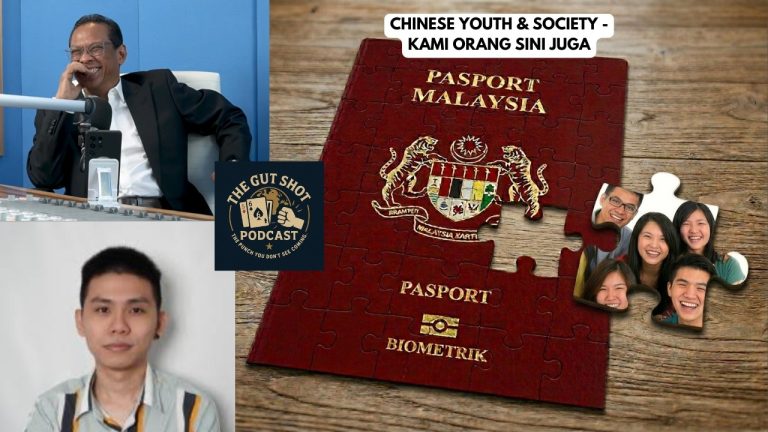
Chinese Youth & Society – Kami Orang Sini Juga
Show Notes & Description
Gutshot take on conversation with Liew Liang Hong, IMAN researcher, on identity, concerns, priorities and aspirations that makes up our ethnic chinese youth and society overall based on IMAN's recently published brief of their work on this subject-matter.
Some interesting surprises awaited Gutshot in the conversation that is revealing for us and our audience to ponder. This episode almost complete our understanding for a future podcast to address Malaysian society as a whole.
Like, subscribe and this is one we truly want your comments.
The link to the research brief:
https://stratsea.com/prologue-to-iman-research-report-kami-orang-sini-juga/
Are we misreading an entire generation? In episode 79 of The Gut Shot Podcast, your host Shamsul Sam sits down with researcher Liew Liang Hong to unpack Iman Research's groundbreaking report, *Kami Orang Sini Juga*. We dive deep into the minds of 120 Malaysian Chinese youth, and the findings are a massive wake-up call for our entire society. If you care about Malaysia's economic and political future, you absolutely cannot miss this episode.
Our conversation completely shatters mainstream narratives. You might think Chinese youth are deeply invested in traditional heritage or racial political issues, but the data shows they are actually heavily detached from partisan politics and feel completely unrepresented by today's leaders. Instead of the tired talking points constantly pushed by politicians, this generation is fiercely pragmatic. Their true priorities? Raw economics, surviving systemic unfairness, and achieving absolute "financial freedom".
We also confront the elephant in the room: the "China Factor". Is China's massive soft power erasing local identity? Surprisingly, no—these youth proudly identify as Malaysians first. Yet, the economic reality of ultra-cheap Chinese imports and cutthroat foreign competitiveness (known as "Jen") is quietly squeezing local businesses nationwide. We conclude with a chilling, honest reflection on whether Malaysia needs a literal "rude awakening" before we finally abandon race-based politics for good.
Stop guessing what the youth want and hear it straight from the data. Watch the full episode now!
**Video Chapters:**
** 00:00 – The Political Shocker: Why Youth Are Tuning Out** – Uncovering the massive disconnect between mainstream parties and the younger generation.
** 08:15 – The "China Factor": A Loss of Identity?** – The surprising truth about where their true loyalties really lie.
** 15:30 – The Unspoken Threat: "Involution" & Cheap Imports** – How foreign dumping and fierce competition are silently killing local businesses.
** 24:45 – The Ultimate Goal: Why Pragmatism Wins** – Discover why "financial freedom" is the only thing that matters to them.
** 33:20 – The Vernacular School Debate: The Hidden Truth** – The purely pragmatic reason parents choose this education system over others.
** 42:00 – Outdated Tactics: Why Politicians Are Failing** – How an obsolete "self-defense mechanism" is actively ignoring what the youth need.
** 51:15 – A "Rude Awakening": The Dark Prediction** – Do we need a total societal collapse before we finally unite as Malaysians?
Jump to chapter 8 chapters
- 0:00 Heritage and Generational Detachment
- 2:55 IMAN Research Findings on Chinese Youth
- 6:54 China Soft Power and Economic Competition
- 10:54 Pragmatism, Survival, and Financial Freedom
- 15:10 The Realities Behind Vernacular Education
- 17:38 National Identity vs. Ethnic Labeling
- 24:27 Political Apathy and Generational Divide
- 40:55 Outdated Party Playbooks and Moving Forward
Auto-generated from YouTube captions. Timestamps link to the video.
So the Chinese youth are actually not that traditional minded already. Okay. Like when we we also tackle this kind of question, we tackle like do you still think that the traditionals and the uh your your your heritage are being very how how important do you think they are to you?
And most of the question are being like 50/50. Okay. It's like oh they still celebrate Chinese New Year. It still celebrates the usual festivals but only if someone were are willing to prepare the the food for them like you know right the the dumpling festivals like but like if you if their mother is not around like will you bother
they would not bother like the chain you know like the prayer to the ancestors okay so uh if your parents are no longer around are you going to go back hometown and go to do a prayer it's too much of a hassle for so you already can see from this perspective what the Chinese you are thinking about the heritage.
It's important. But welcome back to the Guide Shot podcast. I'm Shamso Sam, your host. Uh today we're going to enter into a topic uh with our guest u we'll have a conversation with Mr. Leu Lang Leang Hong. Yes.
Right. Of research. He's a researcher. Researcher at Iman. Yes. Um we we're going to touch on um the uh research brief that was recently published called uh called kami orangi juga which actually uh is a brief on their research conducted uh about what 200 people 200
120 120 uh cohorts of uh uh Chinese youth. No the total amount is 120 cohort is not that many. Oh I see. Okay. Um and uh the the the paper is written by your colleague, you part of the team. Um Violet Lee, I believe was uh is the writer of the paper. I think it's very interesting because uh we've touched actually recently on my previous episodes on Malay youth with your colleague and also with Shalini, your other colleague on the Indian youth. So today um uh we want to touch on the Chinese youth but also also there's also another research brief on Chinese society
uh which is on the um strategic positioning of ethnicity within the Chinese society of some or of that nature. But I think uh to start off with uh I maybe what you can do is uh you know Leo uh let our audience know
uh about this uh research uh on um the Chinese youth basically uh briefly what were the findings that you have uh through your research.
Okay just a a small clarification. So the kami juga is it will be the name of our final report I think and then the brief that was written the title they also have kamiora singa but it's just like a pre-log prelude into it. Yeah.
So the main finding and I would say a surprising finding in this project is that we realized that the Chinese youth are not so being represented by the mainstream politics. And this is a shocker actually because if we look at the uh political arena in Malaysia, we can see that the Chinese uh so-called Chinese based political party they are very local right in many issues. But we uh in in in in that sense we will automatically assume that okay so maybe they know their base or maybe they are doing their job. But in truth if we talk to the normal I mean the usual usual
Chinese youth they are not being heavily involved in uh partisan politics they do not care at all about what's going on at the news. Not at all. And uh we studied heavily on how they uh what kind of news or what kind of content they consume. And if uh only a few of them reported that they read news on regular basis.
I see. And if you look at it from a democracy perspective, this will result into a non-sustainable position. I mean like in order to sustain a democracy we need to have a very uh I would say they know what they they know what they decide to they know what they choose that kind of informed citizens but we are lacking of it for
okay well that's interesting what's the other maybe the the top three four five findings what what other things that you guys uh uh found in your research
okay another is about racial politics okay okay so in our world. I know everyone is kind of fed up or kind of tired with the politics already. And if we look at the narratives, uh there are many finger finger pointings and blamings, right? Like uh the Chinese are not cooperating enough, the Malays are not giving and stuff like that. And for the Chinese youth, they are also kind of tired of it. So I'm not sure if it surprises you, but some of the Chinese youth are yearning for more public space where they can mingle around with other races. But they want it in a sense that it is
comfortable for everyone. It's not forcing like, oh, I want to abolish that. I want to force you to do that. No, they want it to be a natural process where everyone can just integrate together. Okay. And it it might takes time. Yeah, that's another finding. And
one more finding is that about China factor. uh because we can see uh the China influence be it the soft power perspective uh they are gaining more momentum in Southeast Asia and even Malaysia and so before we carry out the uh the field works we assume that there is some sort of uh identity shifting I'm sorry to say that but maybe identity being influenced by it or something but it's not it's not the case at all throughout all our findings we see that the Chinese youth in Malaysia are very rooted rooted in Malaysian identity. Not at all, not at once they think themselves as other
people just Malaysian. But however, we also look into the cultural perspective like uh is your lifestyle being influenced by the China uh culture or China soft power and the answer is yes and is there's many ambiguity in it. Yeah.
Okay. I mean maybe give give us a specific uh when you talk about the influence um let's say the top two influence in terms of uh the China China's uh rise uh in in in geopolitics and it soft power uh what do you call um uh projection?
Mhm. What what would you what would you give as a top two? Okay. uh job politic might not be that much because the youth are just not aware of it. Not aware of it. So they're more into cultural. Exactly. So first the first finding is about consumerism.
Okay. the change of pattern in how they consume, how they how they how they uh how they buy stuff like for the rural areas. I mean maybe not rural means in jungle but but maybe uh not outside of Ko era the online shopping apps has become more and more important for the uh daily life Chinese over there.
Okay. Okay. So, and even though they are aware of the dumping, dumping means that uh the the price is so cheap. Too cheap. Yeah. So cheap. And it might cause some pressure to our local businesses, yet they just think that this benefit them.
Mhm. Because it's cheap. And before that, they have to travel to the big cities to buy groceries and stuff like that. But now they just order it online and it brings enormous uh convenience to them.
All right. But at the same time they also aware of a term is called Jen. Jen means overco competitiveness means that they are aware of the uh they are not able to they might not able to compete with the so-called Chinese money or Chinese businesses face to face like and this phenomena actually spread like I know that the most severe spot might be KL Salango JB but uh Pinang but after after all this while you can also see the same report from Suran there's some project that are tailored for the foreigners for K people and also So for China nationals in Surban and making in
turns making the uh the the prices in Saraman are getting higher and higher the property prices and also uh we are also seeing reports in the east coast the Kalanta and Tranganu and one interview we actually give a very interesting response. He said that she said that uh if you already can see the presence of China shops or China businesses in Gandan, it means that they are already overpacked at other cities. That's why they came here.
Let's return back to that to our um our youth on the local level. Um uh what else? Uh what what other findings that you find interesting? um on the Okay. I think
how about how about on I mean we talk about for example we talk about the you you mentioned um what do you call they're not as represented represented right or acutely even acutely aware
of u or what we call the the um or being so interested with uh um with politics let's per say right and they are not that much following up with the current news of the Okay. Um so that's the concern of an informed uh electorate so so to speak, right?
Then the other thing is um um what about from an economic standpoint? Um how is their do they feel being helped enough? Do they feel what what do what is their feeling whether regardless what is their what is the feeling with respect to um I mean let's put it this way. Let's put it this way. has cut out to right to the gut. Okay. Um our system in Malaysia is uh obviously uh uh what do you call has been structured for unfairness. Okay. Um however you want to cut
uh about it. What is their feeling? Uh does that make them feel that they are uh uh politically sidelineed or what what does that does that come about in your research? Is that part of the top things that come out or something else?
That's a very interesting question and I think uh there's a uh there's a few layer in it. Okay. So from the uh for those who own businesses they they are aware of it. Okay. They're aware of it and that is exactly what they put on top of their list like the things they're concerned and for those who are not uh those who are not working for themselves or they do not own a business maybe they just employed they are not so aware of it even though they aware of the systemic inequality like but that is more on metriculation education system because maybe they want to have children or
maybe they because they went through that phase so they are more aware of the education system but the the uh the sim similarity between all groups are uh is that they they feel that in order to succeed in Malaysia
Mhm. the most important thing is to rely on themsel. Okay. And then dare not to think of otherwise. All right. That is the it's a very pragmatic uh uh practical thinking anyway. Pragmatism is one of the main theme
that my colleague Wy she looks into and maybe it will become a a chapter itself like the ch the Chinese pragmatism has always been culturally anyway
what we we want to take this opportunity to study into it like is there any shifting like for example we we go back into the uh Chinese youth being so-called being not represented so the let's put it this way there are some topics that the Chinese politic party likes to play and they are something that the Chinese youth truly cares okay like these are the classic traditional issues like UEC you know UC right
and the vernacular schools and stuff and the Chinese association so-called the Chinese power and something like that okay what the youth really care is that not these okay it's not that these are not important no these are important but it's not the most important thing to the Chinese youth correct
what the Chinese youth think is exactly what you just say the economy perspective the econom economic stuff like about their well-being, about their livelihood and also they they just want to have a shot at this country. They they just want to have a fair a fairer uh a fairer platform. Okay.
Say so. Yeah. And this when we ask when we ask about UAC vernacular school uh with the uh so-called interviewees uh they will not give so much or they will not repeat the narrative uttered by the political parties. They have their own perspective and maybe they do not have perspective means that they do not care and but this
that doesn't come up into their priority list. Correct. Yeah. Correct. And imagine that imagine a gap. Imagine what is being you know being put pushed to mainstream and what the youth really cares.
So would am I correct to say then would I if if my instincts tells me right probably the most important priority for the Chinese youth is economics.
Econ is one of them. Yes. Yeah. I mean economics your fin your your own personal financial future right. Um very interestingly because in the process of writing
right go ahead. So I see I see a few interviewers actually said financial freedom. Financial freedom. What what do they mean by that? They want to do whatever they want. They just want to work less. They they want to suffer less because you know the the the mindset right? They uh people people like to enjoy their life and want to work less. And so I I I I I see that a few of my interviewers actually utter the word financial freedom as their ultimate goal
in this nation. Okay. And that's very interesting economy. All right. Okay. So the what about from a cultural perspective? I mean how much do they think about being um the I mean let's let's take the Chinese schools, okay? The vernacular schools. um the preservation of the Chinese culture or I mean let's say there have been talk about um abolishing the vernacular schools what what are their thoughts about it okay you see we have 120s 120 interviews so some of them uh must be saying some very uh different opinion like they agree that maybe when school should be abolished but uh I I'm also
fully aware of it but what from the bigger picture. I think that uh the other interviewees they are not going for abolishing it but they are not also fully supporting the vernacular school because is uh of racial issues or something like that. It's just because self-preservation is a part of human nature. Okay. It's not it's not a to 100% rational thing. I I would say that I will put it in this way. It's like self-preservation. It's just because they already get used to it like because they speak Mandarin. So maybe they just hope for the Mandarin for being you know
uh their children will also speak Mandarin. That's all. And also for from a pragmatic reason like maybe they think that the vernacular schools are you know the curriculum and also the teaching methods are a bit better and also the infrastructure are a bit better than the national school. Okay. So uh let's uh when we look into the vernacular school we need to also see there are many layers in it like pragmatist and also for uh better education and stuff like that. But if you look into what they said when what what they mean when they want to abolish a veracular school is that
uh for they hope for a more harmonized uh environment like they do not wish that the Chinese only mix with the Chinese kid and the Malayo only mix with the Malay kids. So uh go back to our main topic. Economy is definitely on top of the list. But it's not everything about the Malaysian Chinese. They also they are also aware of in order to make the economy good, in order to have institutional reform, the races should also have a good relationship.
Okay. Uh I think we we've we've basically done quite a bit of exposure on the on the research findings. So I as as everybody I think aware by now
uh this podcast is very much a conversation right and we want to I mean I it's very interesting that you point out um I mean all this stuff I
give an idea then what is their sense of belonging as Malaysians you know um where what what do you see in your research? Okay. Our hypothesis is that we try to do a hypothesis test.
Correct. Okay. Good. So we ask them a question. That's very scientific social science. Okay. So we try we try to uh test the baseline, right? We ask them a question. So your selfidentification, do you think you are more
Malaysian? Mhm. Malaysian, Chinese or Chinese? Mhm. So you see the nuances like uh uh uh you see the nuances like if you if you say you're Chinese then there must be you means that you are prior prioritizing your Chinese identity and we must know why
but throughout our interviews I'm maybe I should say is uh it's good to hear this most of them identify first as Malaysian or Malaysian Chinese first. So we at least see the Malaysian perspective in their identity.
Mhm. And and this uh I'm I'm not sure um I would say I'm sorry like uh I'm I'm not sure if this question is kind of weird to some of the some of the audience because when I first came up with this interview question uh we I actually had a bit debate a bit discussion with my colleagues and I explained the rational that this is actually a a very important question for the Chinese community and if you if you can read Mandarin you can still see the debate in the Chinese community like
which ident identity should we prioritize or which title should we put up front first when we identify ourself. So like if you call yourself Malaysian maybe uh it means that you prioritize the common public value first instead of your ethnical ethnical history or ethnical past. But if you call yourself as Malaysian Chinese means that you think that uh it it doesn't it it has no conflict between the so-called public life and your private life.
Means that being Malaysian is also being uh uh I mean is it's not contract it's not uh contradicting contradicting with the Chinese identity. Okay. I I find that very interesting because uh having heard from you, having heard from Shalini
um and uh Pney um and and looking at the research that you guys uh did uh on um on the on on Malay youth uh I think uh it's it's it's very interesting that actually if you ask me
um I find that um the the identity of a Malaysian seems to be more in tune uh within the other races as compared to even Malay.
Malays the the identity of the religion has come and and and and race has intertwined so much that it became even um quite ahead of uh being Malaysian. your first Muslim Malay first before you are Malaysian. Whereas I find for the other races, it tend to be the other way around and the identity of the uh of of of your race actually intertwine together with the nationality, you know. Um that's that's um I mean I don't know how involved are you with uh the other research but uh uh do you find that to be the case or not?
You mean for in your opinion? Okay. In my opinion, we we also try Yeah. We also try to ask this our interviews, right? Very interestingly even for those who are religious which we all know that the Chinese community they are not as religious as
Malay community right even if you try to test this question on those who are religious. Mhm. Uh okay we we understand that they are Buddhists they are Christian and but when we go back to the identity question like uh do you think that this religion affects your uh selfidentification or selfidentity they say uh not too much
which uh fascinates me so I think that uh there is u there's something special about uh the Chinese community itself like they able to separate it from their identity
but this is just a very preliminary thinking, we still need to look into look back into the interviews and stuff. I find that I think u in my own personal life cuz I mix around a lot, right? And that's that's that's what I gauge. U so I'm just interested to see from yours because I know I don't have that many young people that I integrate with. Most of my colleagues or or my friends are, you know, maybe 10 years younger. You're like what? 32.
I'm 32. Yeah. 32, right? So we got a 30 year gap, right? So it's it's interesting to figure out how the youngsters think. Um I think um education. I mean they've gone through a certain education. they gone through a certain period of development when in their youth in this environment which is uh
you know uh which shaped them right compared to when I I was growing up you know with my friends um so if we look at that the concern well I I don't know whether I should say the concern but uh uh uh you you've already pointed out one is u um The it looks like the interest in youth normally youth are more interested in politics than older people if you ask me.
Really? Yeah. That is not the case at all from our interviews. Not at all. I mean uh not that I mean when you are young you're very idealistic right? When you're young you are you know what I mean? When you're young you're very idealistic. more hotaded perhaps
more well no I mean you're you're more you you you're figuring out a lot in your life okay uh but also I mean it it t depends on how you look at how how you look at it how involved you get in politics right but at least I think young people are more politically aware to be honest if I was not doing this podcast and talking to so many people
I don't think I'm not that much aware of uh of of the political development the political developments at all I'm not interested Personally in terms of partisan politics I'm not interested because I find it's pretty dumb but that is the exactly opposite of our findings because we realize that the older generations are more uh politically uh
semi. Yes. Yes. It's like because they have the sense of past we bring up this concept sense of ownership like they maybe they think that they can do something and they they they are aware and they feel that uh they have something to do with the politics. they can they can they can change a little bit or a bit a bit at least a little something in the politics. Meanwhile, the Chinese youth they are very detached. Detached be it from uh the so-called the nation building uh the concept of nation building and also the concept of being a citizen. Being a citizen means that we have to we have
everyone has a fair share of their responsible towards the nation. But I think they are kind of detached from these two perspective. Are they detached because of uh apathy or are they detached because they feel they can't change things?
I think a bit of two and I think two of these are the result is they are not the cause but maybe they are the result from something even more profound. What would that be?
Like the you see I I'm from a generation where the uh 2008 was a political tsunami. Okay. You remember March 8th March. Okay. And so that is the environment that shaped us, shaped me at least,
right? And then we went through the B and stuff like that. And we, if you look at the Gen Z, okay, sorry to say that, but Gen Z, uh, they might not experience what we have been through.
Uhhuh. And so we have a very different growing up environment. And that's the one thing. And another is that maybe this is my hypothesis maybe because the political environment has become more competitive more competit more competitive in the sense that u it's not in a means that they are competent it means that there are more choices. So people would think that uh at least the situation is not as dire as before. we have a sense of relief like okay so uh maybe everyone has a shot maybe there's a lot of political parties for up up for up for contest now so it's not it's unlike what
we experienced before like we we have a one partisan rule for like 60 years so maybe this is what makes people uh makes the youth feel that uh the environment has changed and they do they no longer have to put in so much effort to uh read news and to be political savvy as their previous generation. But this is just my thought.
Okay. All right. That's that's that's that's not a bad hypothesis. Um I mean they Okay, that's fair. I think that's quite fair. Um uh because we've seen that changes. They are more um and to be honest, I think there's also a reflection on the pragmatism.
True. Yeah. I mean when I was young also I I mean it's but I I I was more in tune on the politics uh but I was very much u more focused on actually building a career building a business and and you know it's economics was my number one priority so it depends on how you look at your own life right so if pragmatism is the priority
then the the focus this is going to be um true financial. Yeah. Even though we say that uh we say that the Chinese community are very pragmatic but you can see I I think it's a bit of mix. It's like you can see very pragmatic businessmen also talking about politics
and complaining it's non-stop but but u maybe that is also due to some pol policy issues. I don't know maybe they are affected by some policy shifting and stuff especially for the businessmen right okay um now let's let's let's look at it and I think that's where I want to bring you in now that I mean we've sort of established
I mean you're part of that generation you're the you're basically the the Chinese youth right um I would like to see myself as it but I already feel kind of detached also means feel older Yeah, I mean the but I mean your your your uh your surrounding the people around you, your friends and all that, your peers, right? So that gives a sense of feedback better for my generation and hopefully you know between the two of us cuz I have uh uh I have my own uh uh
peer group, right? And unfortunately unfortunately depending how one looks at it, my peer group are mainly Chinese businessmen. M right cuz I've been in business for a long time now. Um and uh uh and and and we gone up together in the in in the business world. Um I find that Yeah, you're right. They're more politically attuned. They you know, but they're busy about
their own business. Their own business. Exactly. Right. Uh but not having the youth to be as engaged is a concern. you know
um because like you say you need an informed electorate right what what I worry about is actually we become uh apathetic we had uh we had the um uh discussion recently on the Indian community of how they be
how in essence the thesis that we we had was uh there's empathy a feeling of you know do normal care cannot cannot cannot do anything right um whereas in in our situation here I think um I mean the Chinese community is a lot larger
right and it has a lot more uh economic sway if you ask me right let's let's be very clear about it very frank about it right um and yet I think our system um does not allow meritocracy to actually rise from all the races. If you ask me what we've done uh is actually create a class system a class system that in spite of the political talk the political talk is race religion uh from the majority
but actually what it has created as far as I'm concerned is is a is a is a political and a crony class privileged class. Yes, there's a privileged class, you know, um that is separating itself out from our day-to-day society and everybody is falling behind,
you know, and that includes, you know, whether our majority Malay realize that or not, it actually hits everybody, right? Um and uh I think this is the part that that I I want to ask the other thing is how much is uh how much concern does let's say youth right education
education is is another point that I look at it is you're right you say that uh the the concern for the vernacular school is is because they have a better system
than the public schools, you know. Um, and that's basically has been my personal uh argument for the vernacular school is that how do you integrate when you have actually a better education system in place in the vernacular system,
right? You you have to retain that uh system the when the other system is not as good, you know, right? So and and that's actually more Malay uh families are sending their children to uh vernacular schools you know there must be a reason for that. So, but from the perspective of like say yourself,
right? Um you were telling me before the podcast um you had like four or five choices your top choices top three choices you were not you you could not get into
uh uh when you were studying in M right or when you were you know can we actually say this? Huh? Why not, right? Why not? Okay. You know, I mean, uh I I don't understand that actually if you you guys were to ask me. I I don't understand that. How much of that has impacted actually our when I talk about youth, I think it's you know those who are probably below 40.
That's that's as far as I can see. As far as youth, that's everybody below 40, right? How much has the the unfairness in the education system impacted their thinking in the way you look at it?
Okay. Uh can I give a bit more prelude before I answer your question? It's like I want to give a more complete story of how the Chinese are actually thinking. Right. Good. So when we comes into this kind of question is very easily being straight into a racial questions but in in fact is just a social is just an e economy or political uh political I maybe it's more economy problem that is being packaged as a racial problem but it's not
so I want to give a shot for the Chinese to explain themsel so the Chinese youth are actually not that traditional minded already okay like when we we also tackle this kind of question we tackle like uh do you still think that the traditionals and the uh your your your your heritage are being very how how important do you think they are to you?
And most of the question are being like 50/50 it's like oh they still celebrate Chinese New Year they still celebrates the usual festivals but only if someone were are willing to prepare the the food for them like you know right the the dumpling festivals like but like if you if their mother is not around like will you bother
they would not bother like the chain you know like the prayer to the ancestors okay so uh if your parents are no longer around are you going to go back hometown and go to do a prayer it's too much of a hassle for
so you already can see from this perspective what the Chinese you are thinking about the heritage it's important but actually it's quite global this this phenomena it's not a a domestic phenomena actually
yes you're right okay yeah so so oh let's go back to uh education thing they uh if if we are focusing on vernacular Chinese you're talking a different language from us Malay they will see from a very racial racial lens and it will makes the it will makes the conversation becomes more difficult and impossible right but if you look into like what you say the prematism and also uh terms called utilitarianism means that we look at the common good of it we uh the Chinese are not trying to like force Chinese culture into it but rather they are pursuing uh some sort of excellency and some sort of
meritocracy. Mhm. Because they also need to survive as a as a community itself. They also want to survive and like like I say the self-preservation um uh cannot be entirely explained by rational. It's like it's like it's like a human nature like if if you're born Malay your mother tongue is Malay then you are inclined to speak into some language they are familiar and the reason also goes the same for the Indian and also goes the same for the Chinese community but it doesn't mean that we we cannot learn more language of course the Chinese wants to of course in our education
system we already automatically have to learn Malay and English Mhm. And so um I'm sorry I went too long so what was No go ahead go ahead. So what was your question your main question just now? No, I mean just uh you
Oh, inequality. Um not really. I mean uh you have bring it back to the point of economics actually uh now that we we talk about the the the identity of Malaysian.
Okay. The Malaysian identity as being uh the pragmatic uh framework in which um the Chinese youth are working under. Okay, I can see that very clearly actually both research um from your uh what do you call uh your your publications um uh for the Indian group and for the Indian community and the Chinese community shows that very clearly.
Okay. um the pragmatism in the Malay community um on the uh is is also on economics I find in terms of the Malay youth right however in terms of identity it seems to be very uh it seems to be much much more emphasized um in terms of being uh uh uh the connection to Islam as being uh uh uh
Malaysian identity common identity the common the the the foremost in their identity ident as an identity and as a as a Malay that doesn't quite happen not to say in in that extent all right within the uh within the Chinese or Indian community that's my sense
I I I I don't know how uh the Chinese how I no I I I don't know how correct I am in terms of that uh that impression that I'm getting based on the
uh on the tree research right so it's it's it's something that I think as a society then we need to understand that in essence um the Malaysian identity need to be strengthened if you were to ask me right from all corners of uh our society uh in order for us to come with pragmatic solution for economics. This is where I'm coming from, right? You know, I I'm a businessman, right? Uh and uh and economics is the primary goal of every human being at the end of the day, you know, cuz you need to feed yourself, you need to feed your family, you need to you need to have be able to
get them into uh uh for education, change your life condition. Yeah. Yeah. So I mean to me the whole idea of uh of a of uh uh of the society they are better off when actually
a national identity is is the is the is the top priority to to then bring up the economy. You know cuz at the end of the day that's what's important. everything else I don't care. Hello.
Okay. So I try not to be too not not I mean uh from my personal stand I almost agree everything with what you just say except that nuances is that uh I think that the economy is the main driver of all uh main driver for all other goods in a society like if you want a cultural if you want a so-called the humanities value being implemented in a society uh that is also important but the main driver uh will be economy if you talk about realistic sense however I try not to be too confrontational when we go into the racial perspective because I don't want to die.
So I try not to do the fingerpointing stuff. Okay. I I just I let's put it this way right even for the Chinese community itself we also have something that we needs to be corrected especially from the from our own mindset.
Okay. Not only the other races should uh reflect upon. Can you tell us can you tell us kind of thing right what uh give give me uh uh one or uh two examples of where do you think that uh in terms from the community the mindset need to change?
You mean Chinese community? Yeah. Okay. Yeah, great. This is actually a very good point uh being framed by Violet, my colleague. It's like the Chinese community as a whole are using an already outdated or already a malfunction self-defense mechanism to push forward their political agenda. But uh this is not what the Chinese youth needs and the Chinese youth are thinking uh they deserve an alternative. For example, let's go back to what uh we said in the beginning. Uh the the the agendas being carried by the so-called mainstream political party. Even though some party some
Chinese wave party they frame themselves as a multi-racial party but you can still see they are very Chinesecentric in terms of the issues being bring up by them. M I mean their tactics, their strategies are still very Chinesecentric and I can understand because as a as an ex expolitical aid I can understand why they are doing so because of uh the electoral concern because they want to win in the election so they want to appeal to those who are mostly going to work for them like means the Chinese voters. But however is this going to are this being helpful in our political
situation? Are this going to make any breakthrough at all? Like are this going to bring uh the Chinese community into a newer paradigm which is to mix better to mix better in the national politics. This is the main question and this is the thing that we should reflect upon. Okay. I mean uh I think I think what you have uh it's very interesting the the so you what we are looking at basically is a gap between the the the political uh class
and the people on the ground. Yes. Right. So the the the political class is not reflecting what the ground is actually really concerned about. I I would uh
is that is that where we are going at maybe for the youth for the you younger generation? Yes. Right. Okay. All right. Um I think whereas on the other hand I think when Azif presented his uh the the the discussion we had on the uh on youth right. Um what I find is actually the political party or the polit political political class is trying to shape
the society um in order to get their their votes. Okay. So it's like a feedback loop that that that actually is whether we like it or not it seems to be working from the majority part. Okay. Um and maybe because it's also included in that is the is the education that is under the purview of uh of both uh government and they just uh playing the same u same cards and same policies all along. But then um the ones that are supposedly looking after minority interest are actually detach from the minority interest itself. It seems okay I wouldn't say they entirely detach but maybe outdated maybe
outdated outdated manual like yeah maybe the the so-called the traditional issues they are important. I'm not saying that the UC and vernacular and the Chinese associations are not important but they are not the most important I would say
maybe we have other things to concern with. Yeah. And also uh even not from my perspective even from our interviewers that is what they say. Yeah. Yeah. Yeah. Yeah. Fair enough. I I I think if we look at it in that way, I mean that's where actually the more I think about it, you know, the more the the the issue becomes okay, do we have the right political leaderships, you know, uh
this is a question. That's right. Isn't it right? Um are they really looking at the um I mean if you at the end of the day everything is integrated, right? Mhm. The
political, the political, the economic, the education, everything is integrated. You know, you cannot change society without changing all of them at the same time. You know, it may take time, but they there must there must be a change, right? So,
so I want to put in a perspective for you, please. Like, yeah, because you obviously are very economiccentric. you you like to prioritize the economy which I also think that is the mo that is the most rational thing to do in a perfect world but however uh if we look at the political examples like the political manual being played by the politicians they some of them also try to play the economic card but uh we we we we see it ends up in two scenarios like the first one is that nobody cares okay the the his his voice or her voice will be covered by other uh pamics or narratives
And the second second scenario will be uh it will eventually being linked back to racial issues like okay let's say uh uh this subsidy okay then they will say oh this is for the rich this subsidy is uh they should cut it for the rich uh they should cut the rich subsidies and prioritize the poor and then rich I'm sorry to say but many of the Chinese community are M40 T20 and stuff like that they will see this being person very personal like this is being targeted at Chinese community. Okay, this is off topic but I mean
no I see it as actually class welfare but the is a class issue. This is the thing. This is the thing. Um that's why I say about um a a paradigm shift in terms of uh politics and leadership
because um what I can see talking to you guys you know AF Shallini yourself uh what you guys have done um I think putting this all together I probably have for the audience another episode in mind usually where now that we've got your basis of uh uh where we are at right it's easier for us to actually now have a have a discussion how do we move forward you know because understanding the society the young people that are coming up what are their challenges you know so that is uh that is one thing um the other thing in terms of economic that you pointed out I think
maybe we we we try to wrap up a bit on on this on that point I think people don't realize from uh financial standpoint when you when you talk about I think um the dumping of prices coming out of China
um I always say this to my friends um China is not Malaysian Chinese you know they're not they they are different kind yeah they are different people they are different culture um and even in within their society Right? If you understand them and you've been there, um people coming from other uh other uh from from even from rural area to the cities, they called migrants.
Yeah. In cities conflict. Yeah. You know, very severe. Very severe. People don't get it. and the the competitiveness it's actually almost not compat I I call it that's going to take another hour of uh you know yeah but you know the the the and and what is a threat to our economic survival
is actually the their the economic model is also not about the people it's it's about the it's yeah It's about production.
Yes. Right. So, you know, they they and they have the ability. I mean, we are already making a lot of noises when our GLC lose money and being bailed out there. They can't even speak up, right? You know, so
reasons everyone know. Yeah. Yeah. I mean the if people really understand the EV business for example or why have a grant collapse you know you will understand how much the state actually subsidize all these companies
heavily subsidized I mean very heavily subsidized imagine if we were to do that not imagine we are doing that and that's why we are stuck in the middle income trap you know because the allocation of capital is not correct
we're bailing out the same way they are bailing out and that's why the per capita GDP is still the same as ours. Oh, okay. You know, um and and actually if you look at it, probably even the the the the income itself actually is even lower than ours. That's right. That's that's that's the way I I see You know their ex- premer who already passed away,
Li Chang, he once said in a conference that the uh the the majority or the 50% means the half of their population the in the monthly income is still like beneath 1,000 1,000 or 2,000 I think 1,000
R&B. Yeah. Yeah. So it's uh I mean it's you can take the propaganda from the CCP or you can take the reality and say hey what do we learn from this and how do we also look at because why I can do like like we do right let's say you are you have four five businesses that are competing
okay if the bigger businesses start dumping prices because they want market share everybody die You know Misha, right? Misha, the chain store Misha, they they sell the the ice cream and also sell the le lemonade. Store the
I I don't quite know. Sorry, I don't drink lemonade. So it's everywhere. It's everywhere. It's a Chinese brand. I think it's a biggest brand. Okay. It's a big biggest brand in in in in Southeast Asia. It's from China. Imagine how the local businesses
survive. So you die. So, so I mean I you the other once other businesses die then you can control the pricing. Correct. You know I mean the uh more than half of my career is in oil and gas.
Okay. I can tell you they there are huge multinational companies in certain very specialized area right that will actually buy asset
that are limited and then just uh uh even um uh uh what do you call localize it even no no they they will buy uh uh very expensive asset like ships you know for for construction ction and from their competitor through a third party
and then actually demolish it. Why? Why? Cuz I want market share. I'm interested in market share. Yeah, you understand that, right? And I will dump my price. Okay? Even if I make a loss, I'm still okay because why? I have my a lot of uh surplus uh that I retained before or I'm huge enough that I can make losses on this until you die. When you die, I got less competition. I can reject my price,
you know. And this is what the world is facing. Mhm. But people don't don't see this. I mean our uh our economic planners are also not talking about it, you know. And this actually to me is a bigger threat for uh small nation states you know
and then also therefore what industries do we pick so that you know we can our people got jobs you know and this impact this impact
everybody and that's where I think after talking to all three of you guys um that's the emphasis that should I think, you know, which is Malaysian putting the Malaysian Malaysians
as a community without looking at our race anymore at all. Race or religion. Okay. I think we're going to have this episode, another episode, another episode on this, you know, but that was very illuminating. Uh Leo, um do you have any other before we wrap up? Do you have any um any last uh conclusion or thesis you want to you want to share with our audience?
Yeah, just now you because your last question was uh do I have any thoughts on how we going to move forward as action? Yeah. So do you want to hear the positive version or you want to hear the version? Doesn't matter. Give both. So the positive one will be the policy planning and also uh to to implement the civil education like because only with educ education we can do a proper nation building project when our kids are younger like we need to imagine the country as a whole as one like Malaysian. Okay. Like go going back to what you say like we do not think about
our race but we think more about the nation. I think even after 50 years from today on we I think Malaysian will still know that what race they are but maybe the the bright side of it is that uh they put they emphasize the Malaysian identity over their Malaysia identity.
That's why I mean on that can I I just interject a bit that's why that that's why I've been saying in this podcast we need to kick out all the politician who talk about race and religion. Continue. Okay. So the darker perspective which is from my own perspective and do not represent my company at all.
I think that uh it's very hard to prevent the racial politics from keeping on. Yeah. Unless we can reach a point of a point a breaking point
where uh the people start to suffer. I'm sorry to say. Yeah. But people are already suffering those but not enough. I agree with you with that part. It's not enough. Yeah. I think as a as a as a nation together, we still requires a root awakening to realize that this is not going anywhere.
Okay. On that step on on that note, I I will I will I think we wrap up. Thank you very much for coming. Road awakening is his last thesis. Uh we I I think this is a um this has been very illuminating. Um thank you so much for coming.
Thank you for inviting. So we'll see you again on the next uh episode. Thank you very much.