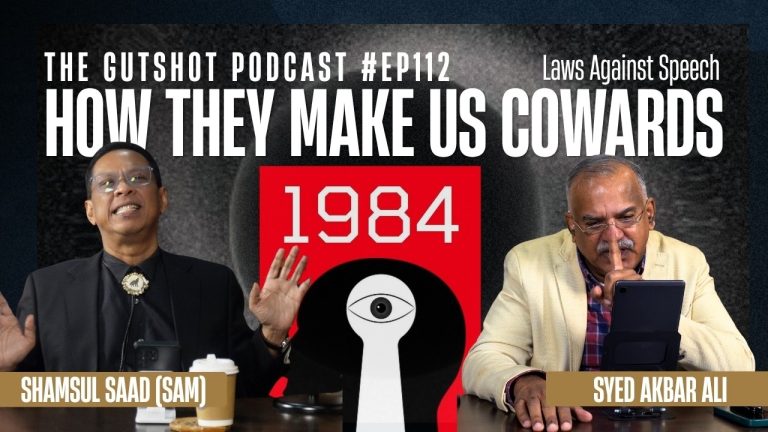
How They Make Us Cowards – Laws Against Speech

Show Notes & Description
Lets talk free speech. Let’s unleash that demon the authorities are so scared of. The proverbially “It’s sensitive”. Sensitive to whom?
This group of wannabe reformers were born at BERSIH and Pakatan Rakyat rallies shouting slogans for abolishing the ISA, the Sedition Act, the Printing Press Act and many other Acts which constrained free speech. At least that is what they said then.
Today those all powerful laws such as the Sedition Act have not only been retained but are routinely applied many more times than the previous governments. The MCMC Act is a digital age tool to keep strayers in check in quite a frightening manner.
But how do they determine the breach of the required decorum to enable slapping them with the Act? The great Malcolm X said, "If you're not careful, the newspapers will have you hating the people who are being oppressed, and loving the people who are doing the oppressing." Do we also have a Malcolm X situation?
We Have A Country to Save
Jump to chapter 8 chapters
- 0:00 Monitoring Speech and the Sedition Legacy
- 6:17 Colonial Laws Surviving Independence
- 12:38 Smartphones, Social Media, and Everyday Speech
- 23:49 CMA Section 233 and Digital Crackdowns
- 32:36 Criminal Defamation and the Chilling Effect
- 40:46 Comparing Free Speech Standards with the West
- 48:59 State Sharia Enactments and Religious Discourse
- 54:40 The Electoral Cost of Feudal Censorship
Auto-generated from YouTube captions. Timestamps link to the video.
Somebody's doing it. Yeah. What a waste of time. I used What do these people who are working and doing all this job, you're wasting your life listening to Syed Akbar, listening to Shamsul.
We just to find whether something we say Oh. He breached or not. He breached section Boss. Yes. He has breached section 233. Let's get them, you know. Yeah. What a What a lousy, miserable life you're leading. You won't get another job. Do something better in life.
Do something productive. Useful. Ladies and gentlemen, welcome back to the Got Shot Podcast. I'm Shamsul Sam. I'm back with my friend Syed Akbar Ali.
Morning. Good morning to everyone. As you can see today, I'm in all black and I have my talisman of a wolf shouting that I got from Nevada. Because we are going to talk about a very serious subject that affects all of us in terms of how we continue living in a free country. This is about freedom of speech in Malaysia, our press freedom, and our right of expression. Okay? The constitutional freedom of speech, Article 101 Sorry, Article 10 1A is a heavily qualified legislation. In reality, speech can trigger sedition act, Communication and Multimedia Act, the CMA, Penal Code,
defamation, and state sharia laws. These are very serious matters that we all have to take into grave consideration as citizens of the nation. Because when you cannot speak freely, you cannot change things for the better. There is a very famous saying that says, "If you want to know who your oppressors are, find out who you cannot criticize. Those are your oppressors." So, ladies and gentlemen, I want to start with Syed, okay, with respect to the Sedition Act 1948. This is a colonial era law enacted in 1948 during the British emergency period. It should have no place in modern democracy. Syed,
can you expound on this? So, so, you are guaranteed freedom of speech, huh? Mhm. Before you speak. Because after you speak, Mhm. as you said, lah, uh you can trigger Sedition Act, Communication Multimedia Act, Penal Code, defamation, state Sharia laws, you know.
Right. So, the freedom of speech is before you speak, you're you're guaranteed the freedom, lah. After you speak, uh it can be a different story, depending on what you said, you know. So, um to me, lah, to me, um you know, Dr. Mahathir last time he set up this Wawasan 2020.
Mhm. So, the thing was that we would become a developed nation by 2020. Uh in many respects, yeah, we we have achieved certain milestones, the infrastructural development, physical development of the country,
uh you know, our performance as an economy. We're We're not We're not exactly a third world economy. We're pretty advanced, lah. But there are other indexes in our advancement, the social indexes, uh you know, the the what do you call this? The the software, huh? Uh all those indexes that measure freedoms, uh free speech, uh you know, this uh exchange of information and discourse over so-called sensitive topics. The whole idea of sensitive issues, uh the this one we have not progressed enough. We are still stuck. We are still stuck in the third world, we are actually very far behind in this
our the development of the social development itself, lah. The software of our culture The the steel mills are doing well, the auto industry is doing well, now the what? The data centers, AI, you know, all doing fine, uh. But the basic ingredient lah of our society, you know, it's it's own the society's own freedoms, norms, the capacity to discuss its future, discuss issues that are relevant in the society is still governed or regulated by legislation, basically by the politicians, lah. And the whole idea is to keep the people from saying what they should say or what they can say.
That this part is to we have not we have not left we have not left this part of our history behind. Like you mentioned, the Sedition Act is 1948, you know. When the British enacted the Sedition Act 1948, I've read the original Sedition Act. Not all of it, parts of it. It starts with the king, you know. It says sedition against the king. The 1948 the king was the father of Queen Elizabeth, isn't it? I don't know his name. It was against um the the British royal the monarch, lah, because at that at that time we were we were a colony, we were colonial possession of uh
of a Great Britain. So they enacted the Sedition Act to safeguard their colonial interest. Right. So this is what in those days, you know, our our people, our forefathers who were beginning to agitate for independence and things like that, huh? They used to call this undang-undang penjajah.
Yes. You know, the laws made by the colonials, meaning that to keep us down, to oppress us, huh? To put a yoke on our necks. That's how they control. If you're a colonizer, these are things you do.
This is how you control your your your colonial subjects. You create things like sedition act, and you label every other thing sedition. If you question this, it's sedition. Meaning you can go to jail, huh? Yeah.
So, that kind of thing, huh? So, we This was set up by the colonials, the penjajah. 31st August, 1957, we became independent, right? At the stroke of midnight, huh? And 1963, don't forget, we became Malaysia with Sabah, Sarawak, and Singapore.
At the stroke of midnight, huh, 31st August, 1957, we became independent. The Sedition Act, instead of being a a undang-undang penjajah, now it became our uh part of our laws, you know? Part of our kedaulatan, huh? We took it upon our shoulders, and suddenly we say that this is a good law.
And we have maintained it since then. From 1957 until now, what, 69 years, huh? We have maintained the Sedition Act. There have been some modifications, huh, but not for the better, for the worse. So, before it was undang-undang penjajah, oppressive, menekan orang, huh? Pijak atas kepala kita, pijak kaki atas kepala kita, all that, huh? Now, it is for the last 69 years, it has become part of the the good laws.
Part of part of how our government colonize our own people. You know, it's part of the laws of the land which we label as undang-undang penjajah. The purpose of the Sedition Act before, that's it, was to safeguard the colonial interest, was to keep people down.
So, now who does it This this law should have been repealed on 31st of August 1957. got our I have to say this now. When Ho Chi Minh Uncle Ho, Ho Chi Minh declared independence of Vietnam in about that time in the 40s I remember. The first thing he did he said the Republic of Vietnam repudiates now all laws, any law, any treaty, anything that had been
enacted enacted by the French colonial power. He said we totally disown, disregard and cancel, abolish and they start from scratch. And they started from scratch and rewrote their laws again, everything again. They just abolished anything and everything that was put in place by the colonials and the French. We should have done the same. Why do you Why do you I mean okay, not everything they did is bad. You drive on the on the street we we drive on the left lane equal kiri. There are speed limits. Those are fine. But we have to we have to enact it all over again and make sure that it is our
laws. Correct. You know. You know I I did a segment on the world according to Sam. I I last week or the before. And I titled it we are colonized by our own people. And this is exactly what we are talking about when we talk about this particular subject matter. All right. Your freedom of expression, your freedom of speech in my opinion as I our people need to embrace and actually demand that it should be absolute. There is no nothing that actually should be untouchable. This whole us that cannot be spoken of because it is sensitive is making us not as a nation.
You see, yeah? The other thing these people don't understand is I I I don't know this they just like they're real duds, you know? They can't They can't position themselves in the in the timeline of of history of where we are now. Okay, you see this sedition act MCMC act all these pertain with freedom of speech talking saying things. Uh And lately now we have some numbers here. You have this RS and investigations. Under these various acts these are I think these are approximate figures. For example, uh this I did some checking did some Googling between January 2020 to October 2025
they're about over a thousand. Okay, this one I'm not going to say exact figures, but they're over a thousand. Let's just say they're many. Investigations under the MCMC act for example. Uh And then the the actual prosecutions were tiny portion of that very small portion below 100. And then you also have RS and investigations under the sedition act. Again, there are certain numbers in 2025 below 100. So there are RS and cases being investigated not all result in investigation. But what is relevant is what these people don't understand. They're real I want to say it again
they're duds. Uh what they don't understand is that you see the people who get arrested there's a blogger there's this fellow a graphic artist and activist activist who repeat was repeatedly investigated over satirical social media artwork. Uh so in 2022 2022 he was arrested and remanded and things like that. Uh there was another blogger and then uh there was uh I think it was a lady, yeah. Another blogger, she was fined 10,000 ringgit. This is in uh 2021. And then uh another guy sentenced in 2023 to 6 months over Facebook post. Uh another person 2024 uh 6 months over Facebook. And then uh
the famous Papa former also Facebook. And there are others now. Okay, listen to this now. Bloggers, Facebookers, uh people who may have sent uh TikTok, uh Twitter, things like that. What what What are these now? These are products of technology, product of today's our present situation uh uh com- ICT now, information communications technology. Now it's artificial intelligence, podcasting, product of the internet. All right? So, and then we have this our smartphones, which it is so easy now to to project anything that you want to say.
Mhm. With your smartphone, you can become a one-man TV station, you know. Well, I exactly actually also here's the point that they don't seem to understand that anything that happened today, let's say we do this podcast, right? And it comes under uh attack. All right, you MCMC want to shut it down, but I guarantee you one thing, the rest of the world, including our trading partners, including our uh Bernie uh our so-called allies or non-allies, whichever you want to put it, okay? The story will go viral all around the world. So, you cannot stop it anymore.
Anymore. So, this is what This is what they don't understand. All this technology, which the government encourages, all governments encourage, we have the latest developments in communication technology. We want We have it in our hands, huh? AI now is here. What these technologies do is that your everyday kedai kopi conversation
Mhm. the chit-chat with your neighbor across the fence, huh? Mhm. Dulu nobody hears it, lah. It's between you and your neighbor. You met your friends for teh tarik, you know? You You curse this or you kutuk that, that kind of stuff, huh? Mhm.
This regular conversation, lah. Now, people do it in WhatsApp groups, right? They are Facebook posting. Yeah, because the technology allows them the gives them the the the room to express what they want to say. Actually, this is just their own personal private conversations, but it does go out.
Well, actually also the other thing. So, you are going to be arresting more and more people basically for having this for talking chit-chat conversations with your friends and neighbors or whatever, but they put it into social media, lah.
Yeah. And you're arresting them for it. So, my point is that's why the government is going to this the governments, lah, since 2018 especially, they're going to be losing more elections because you don't understand that the technology affords the public all over the world which you mentioned to communicate so easily with each other. We can express our views with each other. We do not all of us are qualified with a PhD in diplomacy. With a master's degree and how to communicate properly without breaching the Sedition Act. No, we just say what we want to say. And it is not really
harmful. It is just conversation. You catch them, prosecute them, whatever. Bottom line, you're going to lose elections. You're going to get kicked out because, huh, these people are politicians, they are totally cut off from understanding reality.
Why did you introduce the smartphone into Malaysia? Yeah. Why do we have the internet in Malaysia? you remain with the rotary phone. Why did you introduce the internet into Malaysia? Why do you create the multimedia super corridor? So you create all these things which allows people to speak freely to exchange information. Everybody likes to make a picture and share information make fun whatever this is normal human instinct then you go after them. Oh, you said this you posted this on Facebook. I'm going to arrest you and then the same you you you say one line which they don't like
they can throw the sedition act against you for that one line. They can throw the multimedia act against you. They can even throw the part of the penal code against you all over the same line by line just because you communicate. So my my suggestion is Okay, my suggestion is if you want to maintain the sedition act if you want to maintain the MCM CX section 233 yeah, let's abolish the internet. You know
you know why? Because it's going to get worse. No, no it's going to okay, it's a silly suggestion but I want to open people's brain mind to see it's going to get worse. We do not know 5 years from now what super duper technology you going to have in your smartphone. Maybe you know, you can read our minds. We do not know. You know what? Then you going to have you better start building massive jails and prisons to arrest and prosecute and lock up all these people
for thinking for for saying things that you know they put it in the social media something and then you tell them oh this is seditious. Right. You know what you know what? I want to talk about what I I've always called the the market of ideas in public. All right. I want to I want to see things about people like that has become so controversial and how this all come about and that I want to talk about the what do you call the section 233 of the CMA, which is you know, got to do with the MCMC. Let's go there, but before that I have a message for you all.
If you guys like to continue and enjoy the conversation that we have, please subscribe so we can keep getting this podcast for free for you guys and keep liking so that we can we can spread our intelligent conversation to all the thinkers in Malaysia. We have a country to save, ladies and gentlemen.
Okay, let let me let me go let me go back to what I mentioned just now. Okay, when I mentioned those names at just now is because why? Because these are public the people who has become public figures that are only on the internet and making their pronouncements. I have no problem whatsoever. Actually, whatever they say, I don't care. I don't like the idea of people shutting down speech. For me, all the people I mentioned, they can say whatever they want to say under the sky. But what is important is you must then also allow other people to counter their points without fear or favor.
Instead, what has have been happening is actually those people who speak against are persecuted, but these people remain untouched. This is the problem because who decide what is sensitive, who decide what is seditious, that should never be a power or authority on earth that should be deciding those things. That should be decided by the public opinion in terms of who is right and who is wrong. Let the public decide for themselves because we are a modern 21st century society that can think for ourselves.
You don't criminalize it lah. You don't criminalize it, right? If Salleh Yaacob want to think that actually the I mean the Kedah is full of besi what do you call besi? Iron. Iron ore from the meteorites, let her say.
Who? The lady? Okay. Yeah, I don't care. Let her say. And we, the rakyat, or we, the people who are on the internet, will tell them, "Look, yes, there are meteors that that that contain metal, right? But do you really understand how the formation of iron ore in totality came about? Learn your science lah, lady."
I can I say something? Please. I want to be more more concise lah. Right. Uh this is 2026 lah. Mhm. Uh go ahead lah. If these people feel that they want to arrest people for sedition act under MCMC act for posting comments on social media, on the blogs, the podcasts, whatever, go ahead. We are going to kick you out. Yeah? That's it. Bottom line, yeah? You are going to get kicked out. We're going to vote you out. You can get lost because 2018, same things happened 2018. Finally UMNO got kicked out. 2022, everybody got kicked out. They couldn't form a government. Now the
next election we're going to kick them out again. You keep up this crap. Mhm. We're going to kick you out. This one I can guarantee because I'm telling you the young especially All the people who got you know charged all these quite young people you know and they have they have a huge following and friends among themselves who know what's going on. They don't like all this. We are the oldies and we are now 60 plus but the young people are the ones who you know who get what they are more active in things like that so they've been arrested. This is like going really going against
the flow of the river. You're going against the you're going upstream like going against the current huh? Yeah. And when you go against the current you you're going to drown. So my my final word to all these people in power you're going to get kicked out because you totally don't understand our situation in in the timeline of history how things have changed.
Yes. As I said we have to we brought in the internet multimedia super corridor ICT smartphones AIs we brought everything because this is it. I mean you don't have to bring it in it's it's a condition of the world now. This is the present day modern world and then you go and arrest people for using all these modern day tools for things before they would have said among their friends they remain in private but now because of all this technology that we have it goes out and then somebody reads it and they take action against people. It shows that you are you are stone age
Jurassic Park. You you belong in the cave. But actually that's what our politicians are they are stone age Said. They don't belong in our modern society. Correct. We should kick them out. They belong in the in the in the caves and they're going to get kicked out. This one I can guarantee. They're going to get kicked out.
I want to say something actually here's a interesting thing I wanted to do, you know. Um actually, my recent incident of being called out by the police because of the podcast that I did. Okay? I was determined, actually. I was actually determined to do a hunger strike for as long as I was held. I've got no problem with it. I can tell you I was willing to die for it. I guarantee I was going to do a hunger strike and I was talked out of it. My lawyer talked me out of it. Otherwise, I would have made it a worldwide news. And actually s- really make a change.
Because I'm sick and tired of all these uh oppression of human dignity and speech of reasonable people. Okay. Say say Say let's let's let's talk about um a specific one that we sort of skip through here and there, right? Which is the uh section 233 of the CMA, uh which criminalizes online communication deemed obscene, indecent, false, menacing, or offensive, including communication made with intent to annoy, abuse, threaten, or harass. Well, apparently from January 2020 to October 2025, MCMC investigated 1,746 40 40 1,400 plus, la.
Mhm. Uh section 233 complaints. Mhm. Um there were 61 prosecutions, 40 compounds, about 700,000 plus ringgit, and 167 notices.
Mhm. However, in August 2025, the court of appeal struck down the words offensive and annoy as unconstitutional saying that they impermissibly restricted freedom of expression.
You know, this all is is just a silly waste of time. Huh? So, they went to the federal court, it reversed it, then the court of appeal ruled this, ruled that. Complete waste of time. Why do you want to prosecute these kind of cases in the first place? Criminalize this kind of people say I I want to ask a question. Let's say you have a WhatsApp group. Uh what's the maximum number of members in a WhatsApp group? Huh?
Dude, I think you can have more than 100 for sure. The The ones I've been in, I think there's at least Okay, let's say 50 people. 50 people. No, no, no, no, no. I can guarantee you more than 100 for sure.
have a WhatsApp group with 50 people. Let's uh for for for our discussion purposes. Right. And let's say these 50 people are all your family members. Right. Right. Right. all discuss. Every day you got 10, 15 messages. Yeah, somebody don't like it and then they take a snapshot, they make a complaint.
Of course, it is the whatever you say is not fact-checked and all that. I mean, you just people say what they want to say. As you say, somebody takes a snapshot or whatever and then makes a complaint. What do you do you go after them and arrest them? Let's say you are in your family group. Let's say there's a cousin who doesn't like you. You said something and they took a what do you call this? Screenshot. And they went and filed a complaint somewhere. So, should you be arrested, investigated?
A WhatsApp group. Just don't even talk about that. Should the police even bother to investigate? Now, now, you didn't do WhatsApp group, your Facebook. You managed your Facebook and you said the same thing. In your Facebook. Of course, Facebook is accessible to to the public depending on how your settings are, but it's it's open to the public. Huh? Then the the MCMC people read it and they take action against you. What is the difference? Because one was WhatsApp, it's supposed to be a closed closed group. Facebook is open to the world. So because of that. But the the thing
that you said is the same. And if you say it among 50 people or five people or 5,000 people, it's the same, isn't it? Yeah. So So going beyond that, then shouldn't you be monitoring all the conversations in all the coffee and the mama where people gather at night in the coffee shop. They talk politics in all the war rooms, all you know. They're cursing and and condemning whoever they want to condemn. Shouldn't we also, you know, put some microphone in all these war rooms and coffee shops just to see what people are saying and arrest them if they say something that
the authorities don't like to hear. Yeah. So in other words, what I'm trying to say is that we are being penalized according to the technology that we are using. Yes. If you use Facebook because it is, you know, it is it's accessible to to just about anybody, therefore you're considered as broadcasting to the public and they hold you accountable. But if you are inside your WhatsApp group as you said, that is 50 members, 100 members, which is also to me is also public. It's many people. It's okay because it is a closed closed loop closed group. So see, I find that this is all ridiculous
waste of time. We don't need this kind of time wasting laws which just create issues and alienate the people and makes life difficult for everybody, not to mention at the expenses. You have a whole ministry in charge of this thing. You have to employ people. You know, they actually employ people to watch your podcast every day. Shop your podcast. There's somebody listening in and probably transcribing everything that we say now.
Yeah. Have a Have a Horlicks coffee, guys, if you are watching. H O R best. H O R I T O Somebody's doing it. Yeah. What a waste of time. Uh you What do these people who are working and doing all this job, ma? You're wasting your life listening to Syed Akbar, listening to Shamsul.
He has to find whether something we say is true or not. Boss. Yes. Right. Let's get them, you know. Yeah. What a What a lousy, miserable life you're leading. Go and get another job. Do something better in life.
Do something productive. Useful. Huh? Okay. Do you know something? It just come to my mind. In 1940 nine on my birthday, which I was not 1949, okay? But I was born on June 8th, 1949 1964. But in 1949, on the date of my birthday a great book was published by someone by the name of George Orwell. Okay? The book was called 1984. So now in 2026, we have George Orwell's 1984 existing right here in Malaysia. Okay? Can we get rid of all these dumb, stupid, and actually repressive and oppressive laws that does not allow our people to think and express their thoughts and
become productive members of society criticizing any idea and any persons on this planet including in this country. You are not God. Say it.
Long story short lah. Right. These things are way past shelf life. Correct. Jurassic Park, caveman kind of thinking, ah. Whoever still holds down to this kind of thinking, yeah. I'm talking about the government, the authorities, the people in charge, the politicians, ah. In a democracy, you're going to get kicked out because uh the this is just doesn't work anymore. And uh you are confused uh between the functions of technology uh and how easy technology makes communications, ah. When you make communication so much easy and so it's light speed, ah, communications.
People are bound to say whatever comes into their mind. They won't stop and think, oh, you are if I post this on Facebook, is it in breach of section 233 or is it in breach of section 505? They don't think like that. Say say
It's at the speed of light. And then you go after them and you arrest them. Uh you keep doing this, you are going to get kicked out. That's all I have to say. We we yeah. You're going to get kicked out. Let's kick them out.
At the elections, people will vote against you and put you out of work. Yeah. That's simple as that. It's it's it's I I just want to add one thing. Actually, we are both graduates in America. Say what you like. You may not like America. You don't like You like America. You or whatever. But one of the things that make what America is as a very advanced country is actually their laws with respect to freedom of speech. Is the is is I would say the greatest on earth. Because you can say whatever you want to say. You can challenge whatever. And defamation, now I'm going to segue into defamation.
Is very very difficult to file actually in in in American courts. All right? Okay? Especially when you are public figure you can get defamed and yet you almost have no way to defend you the the defamation. Anyway, when we talk about defamation act, right? Let's look into reconsidering law this penal code provision of 499 and 500 with which criminalizes defamation. Section 500 carry imprisonment of up to 2 years, a fine or both. Section 505B criminalizes statements likely to cause fear or alarm to the public or induce an offense against public tranquility with imprisonment of up to 2 years, a
fine or both. You have a comment there. Yeah, this is the problem is because it is very subjective. Right? Right. Ambiguous law.
So if I say if I say about about COVID during the COVID time, you know, and I question why do we have to actually isolate ourselves when herd immunity is something that is very important, I can easily be put into this section, you know.
So it is subjective and somebody somewhere along the line makes a decision. Huh. This is in breach. Okay? Send the troops and go and get this guy and let's investigate question blah blah blah whatever law.
Put him in chain. That is it's subjective subjective. It's not like you know the speed limit is 110 km over you doing 150 km. Obviously you broke the law. Okay, let's pull him over give him a decade. This one is very subjective, huh? So, it doesn't work like it doesn't work this kind of things and more often than not it ends up appearing or rather it is a discriminatory or prejudicial or biased, you know, it doesn't the the the public supposing you hear that so-and-so has been arrested because he posted a certain something on Facebook or Twitter or whatever.
The public there's no sense of relief, you know, like or the bank robber was arrested or the guys who who bank there was a robbery yesterday in a goldsmith shop somewhere. You know, the police arrested this bunch of guys who robbed the the goldsmith shop. The public feels relieved. They've done a good job. They've got these bad guys. There's no sigh of relief when we hear that this blogger has been arrested or that Facebook posting was caused a guy to be caught and charged in court, you know. The public isn't going like we feel so relieved today, you know.
Our our society country has been saved. Our people have been saved from, you know, major some danger or threat to our well-being. Nobody feels that way. So, this is I I do not know why they still want to hold on to this. To me it's a terrible waste of time. They are going to they're going to lose the elections. You see we we have enough laws protecting our people. What is it that's a threat to you and me today? Supposing somebody comes and drops a bomb on the country, that's a threat. Somebody blocks off our, you know, transportation system or whatever, that's a threat. Somebody
creates havoc in our neighborhood that that causes problems to us, threatens our safety, security, those are threats. We have enough laws to handle all that. Actually, Said, I'll tell you what is Those are the real threats.
I I'll tell you what is a real threat as well. The real threats are all these laws that actually stops us from speaking out and then thinking that somebody's going to walk out walk us, put us in gurney, and take us away.
That's That is a threat, actually. It is a threat. It is actually a It is a threat that you do when you are colonialist to our freedom, huh? Yeah. These are These are threats by dictators and by colonialists.
So, this is how I mean, I I consider you although we are broadcasters, right? But, I consider you as a member of the public. I'm also a member of the public. This is like the general feeling in the public Yeah.
towards these things, you know? Mhm. So, which are these people, whoever's in charge and authority, somehow they don't fully grasp it, yeah. They think it's okay. Can Can we go back to this defamation thing? Because I think I mean, not just those sedition act and the MCMC act are a chilling effect. I called it before. It is a way to make our citizens cowards. Really, the purpose of this act is to actually force our citizens to be cowards. They don't dare to say anything because they're scared of getting getting pulled
Well, the law The law provides for it. Right. That's the problem. Uh the law provides The law provides to actually chill the public from speaking. Like, you know, just the public. Take the press, you know?
Yeah. When the You You're talking about libel and defamation, right? Right. Libel and slander libel The defamation acts They in Malaysia, they are very very plaintiff-friendly. It is easy for someone to sue someone else for defamation, libel, slander, things like that.
Right. So, the press, of course, you know, they're always saying things and publishing things every day. They have to be extra careful. So, when the laws are so plaintiff-friendly, automatically, yeah, the press will have to, you know, make sure that they don't say the wrong things at any any any point in time, which means that they really have to be careful with what they say. Meaning that they really cannot say all the things that they want to say as a press, so by by default, you're already controlling speech and the freedom. More importantly, you are putting curbs, curtailing the public's
access to information. Which is what free speech is all about. I know I I know I'm digressing a bit from the defamation act, okay? But there's another part about the press that actually chills and stops them and provides self-censorship, which is because they rely on advertising. Okay? So, advertising is a big revenue, and when it comes to that uh if if the big advertisers are going to be affected by their journalism, they won't say anything about it. If their licenses are going to get yanked because they are they did not follow what the government doesn't want them to cover,
they're going to be in trouble. All right? If you come to got shot, we don't care. All right? We say you come and drink Oreto at Plaza Damas, it's the best because we mean it. All right? And I'll tell you something. You know, when we go to this concern about this as you well said, the defamation act is so easy to be used here, you know? Um and it's it's a chilling effect for independent publishers.
So in uh in okay earlier again I mentioned Dr. Mahathir's Wawasan 2020, yeah? Mhm. So that we will one day will become an advanced society, lah. Advanced not just in our infrastructure development but also as a as a as a masyarakat as a society, yeah?
Mhm. And one of the of course the the hallmarks of advanced society, a modern society is that we have more freedoms, lah. Yeah. Or we don't have silly laws curtailing our freedoms. That's more important, huh?
Right. So if you want to compare ourselves today with the advanced societies around the world, the West, your favorite is America or Europe, whatever, lah, they have amended their laws. They were also in the same situation that we were but decades ago, you know, years ago. The Sedition Act was in the UK until I think after Second World War they abolished it, you know, not too long ago. But they did, huh? But so as far as defamation is concerned, most of these Western countries they have this thing called the a public personality. A public personality is anyone who depends on the public for his
livelihood, which just about anybody, lah. Even the guy who sells pisang goreng by the roadside can be deemed a public personality because he depends on the public to buy his products to buy his pisang goreng, yeah? So if somebody complains somewhere in some Facebook or something saying that hey, this guy is selling pisang goreng, you know, blah blah blah, whatever, lah, plus minus or whatever, and then he hears about it and he says I'm going to sue you, you know. In in most countries in the West, it'll be extremely difficult for them to sue because you are depending on the public
to sell your products to them. The public has a right to say whatever they want to say about you. Yeah. Yeah. The guy who commented about your pisang goreng, he may not be a food technologist. He may not even be a high school graduate. He could be a just a guy, you know, who doesn't know but he knows he there's something not right with your pisang goreng and he spoke his mind. So, you go and sue him. So, in the West, in the US, in your in the in the US, I know this cuz I studied this when I was there. It is very difficult. Uh, so not only do you It is not enough
that you say that, "Okay, Samsul said this, right?" Mhm. Uh, so You must prove it. Malicious intent. Samsul said this, so factually correct. Samsul said this and it is factually it is incorrect. But you have to prove the malicious intent.
Intent. Uh, there's much behind it. So, this is the difficult part. This is the difficult part. So, you So, that's why in the US now, they can make fun of President Trump. You know, the the the talk shows at night, the comedians at talk shows, uh, they can criticize him before they went all out to criticize Biden. People who said Obama had, you know, monkey ears and they all kinds of criticisms, uh.
So, we can't do it here. You cannot Well, here you cannot do it, but over there, let's say if Obama or Biden had sued some of these TV shows that were making fun of them and saying totally untrue things about them, uh. Uh, you you must go the next You can prove, yeah, you said it.
Yes. At 9:00 on channel 12 or whatever, you know, the You said this. They have a recording. It's there, you know. And uh, you call me a monkey, you call me a donkey. It's there. Yeah. You cannot deny it, uh.
Yeah. But then when you go to the in the malicious intention part, that's where it gets difficult. Because when you're a public personality, people have the right to say what they want to say. What is your intent? Do they know you personally? Do they have personal gain by saying something about
know what is so interesting? I just I don't know whether people know this anecdote or not. One of my favorite, uh, comedian, he has a political talk show his name is Bill Maher. Oh, Bill Maher.
Bill Maher, right? And Bill Maher made a joke. Okay, that and and put up because put up a picture of an orangutan and said that um uh Donald Trump
The orange Yeah, orange because orange, right? Donald Trump was born of an orangutan, you know? And and you know what? Guess what happened? No defamation act, no lawsuit. Instead, what happened? He was invited for a dinner with Donald Trump. Okay, he went with Kid Rock. And then, you know what Bill Maher presented to Trump? Approximately, I believe 200 list of insults that he had said on the show to to Donald Trump and he gave it to Trump and Trump signed it. And he framed it in his in his show. This is how relaxed they are about
They are more mature society. Correct. But but why Bill Maher could do that and why Trump invited him and all these things happened because the law does not protect the plaintiff as much in defamation law in the US law. easy to sue somebody for defamation and for libel or whatever when you are a public personality. If you're a quiet housewife sitting in your house minding your own business, then somebody says something nasty about you, you can sue them. I'm talking about the US. It's not an issue.
The bar is actually a lot lower. So uh well, I mean But still difficult. is higher. No, no, for for non-public figure. So, for the but for public personalities, especially politicians, you know, artists, actors, multi-billion multi-millionaires and all that, it's very difficult. Very, very difficult.
Because the public has a right to say what they want to say, but not all members of the public have the same level of finance, expertise, education, literacy, whatever, lah. So, somebody some people might use polite language, some people might, you know, use obscene language, whatever. But, there's a reason why they want to say something. The The intention part, you see?
Yeah. So, if you're going to sue them in the US, if you're going to sue them for defamation, it's not easy. It's very difficult. Mhm. Over here, politicians, you know, politicians send legal notices to each other.
Yeah. Huh? 50 million. The starting figure is about 50 million. Now, I'm suing you for 50 million because you said this about me, which I don't like or I don't agree. So, uh it's a different different uh level, uh different level of thinking in the society, but we have to change it. But, the only way we can change this is if the public, our people, our society, I hope they're listening to us, huh? We have to make an issue out of this.
Yeah. If we don't make an issue out of this, huh, then the laws will not change. Yeah. So, we We need to change the laws. And and when they don't change these laws, this is the problem. Let's say, I mean, I know one of the reason our podcast is actually getting very, very popular is because we tend to actually be uh take positions and say things that practically no one else does, and we're willing to take that risk on behalf of the public to speak their mind. Okay? Um but I would say out there, 95, if not 99% of the others are so scared. So, it's so boring, you know? Because why? You're not
informing the public. And this is the whole issue of this All these laws are to to have a chilling effect on the public to not say things. archaic, way out of date, out of way beyond shelf life. Uh we just have to get rid of them, lah. If they don't, as I said, lah, if you if they don't change these laws, huh, these silly laws, they're going to keep losing the elections. Because the country is a democracy, we go to vote. The young people, especially, you know, they they can see that, you know, we don't need all this. So, it's going to be difficult for these politicians if
they don't change these kinds of laws, plus so many other things that are not right in the country, uh you know, it's going to be difficult for you to to win the elections. Said, do you want to take on uh another untouchable uh subject matter uh with regard to discussion of uh Islam? And the crim- uh and uh
Very thin ice. Yeah, I know this is very thin ice because uh uh the same thing applies uh in the I mean uh for Islam, uh religious Islamic religious affairs, uh there is also criminal enactments, uh the Sharia Penal Code enactments, I think, Sharia enactment. Uh enactment Janayah Sharia, isn't it? Where every state has got uh uh penal enactment, Sharia Penal enactments. That means Sharia laws, lah.
Right. If you breach, it's it's a crime. It's a crime, right? You go to jail. Among them is uh expressing any opinion about Islam uh without proper authorization. You know, you need to be You need to be authorized by the authority.
So, you must be halal first, lah. Well, you need some kind of a certification, which is they the state must agree, lah, or give you then you can speak. Not just anyone can say anything they want about Islam. Uh it can be deemed criminal. All right. The point is it can be deemed it can be criminalized because of this Sharia enactment. Again, it stifles discussion on religious issues. Same as the you know the the other non-religious issues that are caught by Sedition Act, MCMC Act and so on. So, the the discussion or discourse on Islamic religious affairs is also governed.
And you can be in breach. When you're in breach, then you come under these various Sharia criminal enactments which they have in all the states where you can be held responsible, you can be held liable, you can be charged, you can go to jail, you can be fined, all those things. So again, you criminalize discussion, discourse, thinking uh with reference to religion.
people of Muslim religion unthinking except for what the authority want you to think. do we need this kind of laws? I I I really don't think so. And then it's not universal. Not all Islamic countries may have the same kind of laws, but they're still Muslims. Yeah. You know.
They all go to Mecca. They all have different sects. They have different ideologies. they don't Like you see you go across the Strait of Malacca to Indonesia, they're very relaxed. You know, they they don't criminalize religious discourse. They don't Singapore Singapore is not an Islamic country.
I'm I'm even wondering now with what Muhammad bin Salman is doing in Saudi Arabia, if he were to come here, whether this idea of criminalizing religious discourse, you know, you speak without proper certification or authorization by some authority, you can be held criminally liable.
Oh, I remember there was a case of that scholar, a very celebrated scholar that came to Malaysia okay, to talk about What was his name?
I'm trying to remember. Oh, the Turkish guy, was it? Correct. Yeah, and he was held. Yeah. Because he said obviously he must have said something that our local people didn't agree.
Right. So, I think this is like this is another case like this this has to change. We have to really we don't need this kind of over regulation, you know. Criminalize discourse. You see again okay, you have these laws in Malaysia, so we can't talk about I'm talking about religious discourse. You need a certification, you need things like that. But you turn on your your smartphone or your computer, you have access to the whole world. You go into YouTube, yeah. They are about Islam they're discussing anything and everything about Islam. Things that
heretical ideas they have these people are discussing. What are you going to do? Shut down the internet? So, I so I feel I feel it's a bit ridiculous, you know, that this kind of laws you control your own people, but we all have access to YouTube YouTube or whatever.
You can That's a good point, Said. There is a fellow a Malaysian fellow they are a group, you know, because people have been identified before. They say some pretty wild stuff about about Islam about the prophet and things like that. And they're on YouTube. So, here you are controlling your own people, but once you go into social media, it's what open season, you know. Anybody can say anything they want. And then not just Malaysians you can you can listen to what people are saying in the Middle East.
In the Middle East, in the US, in the US, in America. India, Pakistan, whatever, you know, whatever discussion. Some of them are orthodox, some are unorthodox, some are weird, some are almost like
I mean, if you go through comparative religion theological discussion, it's open season, man. So, so, so how, huh? You have all these local enactments to catch your own people for speaking, then you allow us access to the internet where anything and everything goes.
I think I agree with your suggestion. We should we should ban the internet. So, you see, yeah, they are they are not in touch with reality. They've lost touch with reality.
So, we cannot have politicians who are in touch of reality governing the country, ladies and gentlemen. Kick all these people out. All right? Anyway, let's try and wrap up this I think we've talked quite a bit on it. Um, would you like to have a a final say on it before I take mine? Yes. I'm going to take mine.
Yeah, as I said, like, you know, these things they have a the exact they put a cost on the society. That's what it does, like, each time somebody gets arrested or charged in court for breach of some you know, speech-related thing, huh? Uh, some posting on social media or whatever, and they get arrested, they get charged, you know. Uh, there is a cost to it. Uh, of course, the cost is on the society, but there is a bigger cost on the ruling authorities. If you if you if you keep if you stick to these kind of laws and all that, you alienate yourself from the rapid changes
that are happening throughout the world. I'm talking about the communication technologies, the all those platforms, huh? Facebook, Twitter, Instagram, whatever. Now, AI, you don't know we don't know we we really do not know what's going to pop up on the horizon 6 months from now.
Yeah. You know, in terms of new ICT communication technology, maybe other platforms will come up, you know, which will allow people to project their ideas even faster and quicker, like what we're doing now in this podcast.
Right. So, so in the at the end of the day, with more of these new technologies coming, uh, our government, if if you follow this path, they're going to be hiring an army of, uh, people, you know, who will have to sit and listen to all these things and read everything and keep track, you know, in case somebody breaches this section or that act, you know. Um, I I think it is like it is quite feudal, quite feudal.
Let Let me Let me close the, uh, discussion for today, you know. Let Let me say this. Democracy should not make citizen choose, uh, between keeping quiet and risking criminal prosecution or defamation and potentially litigious, ruinous, litigious, uh, situations simply because they criticize someone powerful or something that seemingly is untouchable. I think it's time that we move into the 21st century. Okay? We are currently still living, um, in the days of the Spanish Inquisition. Time out. See you all again on Gut Shot. Thank you, Said.
Thank you.
What viewers are saying
96 comments on YouTubeNo comments yet. Be the first to weigh in.
Join the conversation on YouTube ↗