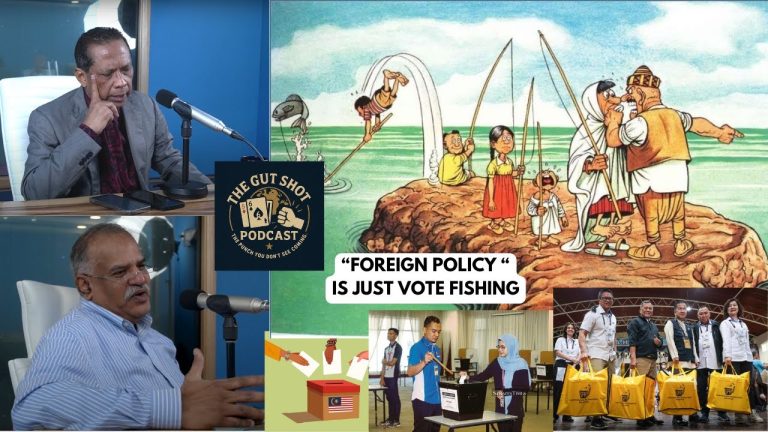
w Syed Akbar Ali. Is Foreign Policy Just Vote Fishing in Murky Waters?
Show Notes & Description
How do we do Foreign Policy in Malaysia? What is its over-arching objective and scheme? Why does it feel so schizophrenic? Does it make any sense to you and me – the average citizen and how should it work for us? We dissect a bit of its historical context, dive into its traps and trappings. As usual a conversation found nowhere else
In this episode, we are pulling no punches on a topic that hits your wallet harder than you think: Malaysian Foreign Policy. Is it actually designed to serve our national interest, or is it just a theatrical tool for politicians to "fish for votes" in murky waters?
We strip away the diplomatic niceties to ask the uncomfortable questions. Why does our policy feel like a "wild horse" with no direction?
We contrast Malaysia’s emotional, tribal approach with Singapore’s ruthless economic pragmatism—a strategy that has kept the PAP in power and their people wealthy.
We dig deep into the hypocrisy of our so-called "neutrality," from the Cold War era to the modern obsession with religious optics that often alienates our biggest trading partners.
We also expose the real cost of political grandstanding. From getting involved in the Yemen conflict for "Sunni solidarity" to the disaster of the "Visa on Arrival" system that opened the floodgates to scammers and terrorists instead of high-value tourists.
We debate the effectiveness of our aid to Gaza versus Singapore’s field hospitals and ask why we are prioritizing foreign optics when we can't even pay our own citizens' tax refunds on time.
If you are tired of policies that serve politicians instead of the Rakyat, this episode is the wake-up call you’ve been waiting for.
It is time to stop the emotional posturing and start treating Malaysia like the economic powerhouse it should be. We are making the case to scrap the old 1950s engine and drive a policy built for the 21st century.
Timestamps & Chapters:
• 00:00 – Foreign Policy or Vote Fishing? Intro to the murky reality of how Malaysia handles international relations.
• 01:45 – The "ZOPFAN" Lie: Why our stance on "Peace, Freedom, and Neutrality" was always a bit hypocritical.
• 04:20 – The Islamic Pivot: How the 1980s shifted our focus from national interest to religious identity.
• 08:50 – Singapore vs. Malaysia: Why the PAP’s obsession with GDP beats our obsession with optics.
• 12:15 – Fighting Wars That Aren't Ours: Why did we send military assets to Saudi Arabia for the Yemen conflict?.
• 15:30 – The Sabah Security Nightmare: Project IC, the Sulu intrusion, and the cost of buying votes with citizenship.
• 19:40 – Insurgency at the Border: The dangerous double standard of supporting rebels in Southern Thailand.
• 25:10 – The "Arabization" of KL: From "Jalan Isfahan" to Arab Souks—policy changes that burdened the locals for zero gain.
• 28:00 – The Gaza Aid Controversy: Cash handouts vs. Singapore's boots-on-the-ground field hospitals.
• 32:50 – Charity Begins at Home: Giving millions away while delaying tax refunds to Malaysians.
• 34:15 – The Failed Refugee Experiment: The untold story of the 200 Gazans brought to Malaysia and why they left.
• 42:00 – Picking Sides: Alienating India to support Pakistan and why "neutrality" is the smarter play.
• 54:00 – The "Visa on Arrival" Trap: How we accidentally rolled out the red carpet for scammers and terrorists.
• 59:00 – Make Airlines Pay: A simple solution to stop illegal entry and save taxpayer money.
• 64:30 – Bureaucratic Chaos: Why the Ministry of Tourism and Foreign Affairs are fighting a turf war.
• 71:00 – The Trump Strategy: Why even America prioritizes economic survival over ideology, and why we must do the same
Like, subscribe and comment. Lets get a community going on intelligent perspectives to always make the right decisions at the right time.
Many thanks to CITYPlus for their collaboration with The Gutshot Podcast, in whose studio this conversation was recorded. CITYPlus is Malaysia's first Chinese business radio station, dedicated to delivering in-depth analysis on local and international current affairs, markets, and businesses.
Jump to chapter 8 chapters
- 0:00 Introduction to Malaysian Foreign Policy
- 1:42 ZOPFAN and Cold War Hypocrisy
- 10:17 Singapore's Pragmatism vs. Malaysia's Optics
- 17:22 Border Security Failures: Sabah and Southern Thailand
- 34:04 Gaza Aid Controversy and Broken Tax Refunds
- 51:39 India-Pakistan Diplomacy and Economic Realities
- 1:06:39 Visa on Arrival and Border Control Risks
- 1:17:48 Ministerial Turf Wars and Rebuilding Foreign Strategy
Auto-generated from YouTube captions. Timestamps link to the video.
Welcome back ladies and gentlemen to the gutshot podcast. I'm your host Shamsul Sam and with me my partner say Akwali. Good morning. Today we are going to make a twist of things. Um we're going to talk foreign policy. Malaysian foreign policy to be exact. In fact sometimes I wonder whether we really do even have a foreign policy. So without further ado say shall we kick it off?
Thank you. Thank you. Let's go with the first thought of that. Yeah. Today, what is our foreign policy? Today, today we are uh slightly different topic. Malaysian foreign policy. What is Malaysian uh foreign policy? Um many people may consider this a boring topic, but actually it is uh quite relevant. It's quite relevant to to all of us. I always like to like to talk about things that are relevant to the everyday person, everybody, the the entire country. But as you said, uh do we have a foreign policy? What is our foreign policy? Uh implying that maybe the foreign foreign policy has got
its own tangent which may not be as uh relevant to the general public. meaning that uh foreign policy may or may not entirely serve national national interest. That is that could be the reason why you are asking the question you do we have a foreign policy. So maybe I can I can just give a bit of background of our the history of our foreign policy going back going back to from the time you know after ma and all that.
Yeah let's do that. So, so there there are certain constants in our foreign policy which which have not changed since 1960s uh and so on. uh ASEAN is a big plays a big role in our foreign policy ever since ASEAN was uh set up I think in the 70s and then uh uh we had this thing called that was during the the time of the Vietnam war when the cold war as was still at its peak you know the cold war between uh the west and uh communism communism mainly being USSR so uh Russia Soviet Union and China and at that time you know suddenly we came up with this thing called zopfan I don't know whether
you you remember this acronym zone of peace freedom and neutrality uh it was actually a bit hypocritical because we try to imply that assean our region should be a zone of peace freedom and neutrality came up at a time when there was concern that nuclear weapons would be uh deployed or passed through our our area. You know, there was a fear that nuclear weapons could be either in transit, in passage or stored in places here because um there was a lot of comp com competition between the eastern block, Soviet Union, China and the western block. But as I said um this did not did
did not fool many people especially in the eastern blockh because as you know in the during the Vietnam war Thailand was a base for American military operations against Vietnam they had the largest American military air base in the world I think in Thailand uh I forget the name Udon or something and then of course the United States 7th Fleet was based in Sububi Bay in in the Philippines. Philippines.
So at that time uh and and then of course our our because we are ex British colony Malaysia, Singapore, we have always been friendly towards the west. So suddenly to declare ourselves a zone of peace, freedom and neutrality when we already we were already you know had such close ties to the US to the west uh I do not know how well it went down with the eastern block but that was our policy at the time. So so that policy uh stuck for a long time in Assean. It helped Assean at that time. A a good thing it helped Asean find its uh footing the early phases of ASEAN where we decided to stick
together. So uh there were no conflicts between the ASEAN nations and later after the Vietnam war of 75 much later Vietnam join has joined the ASEAN. So again showing that we have no animosity you know among ASEAN nations. um we sort of mind our own business and we have it has been quite helpful but always uh in this kind of uh uh uh multi-aterateral agencies, regional agencies and also policies of the countries there is up and down and eb and flow you know things change over time so anyway uh ASEAN and zopf fun were written in stone it was part of our foreign policy and it it it helped us
you know uh and then we also had uh later as time passed after the 70s 80s and '9s the the Islamic identity became prominent in foreign policy. Well, the Islamic identity became very prominent throughout the world after the 80s after the Iranian revolution. Everybody discovered their Islamic roots. All many countries, Islamic countries and the OIC, organization of Islamic countries gained prominence at the time and we were part of that because we are Islamic country. We were part of that and our foreign policies were also tilted some would say skewed towards Islamic uh countries that also
became another uh it's always a given you know a one of the sort of cornerstones in our foreign policy making we would always uh take the side of the Islamic countries in in multilateral issues in whatever that cropped uph
Mhm. So those were the main stays um in our foreign policies but uh often we have to so we we sort of followed we just the the flow of what was happening around the world. So whether that really helped us in our uh national interests uh that is debatable whether it really benefited us. We have always maintained uh cordial uh relations with for example Saudi Arabia because as you know Saudi Arabia controls the kota for the pilgrimage uh every year and they have used the pilgrimage quotas as a political tool against other countries when they have you know hostilities or
problems with other countries in their neighborhood like Iran for example they have restricted kas of pilgrims from that country into Saudi Arabia. So because of that they have this they can you know they have this
they they have a leverage leverage and we have respected that or rather we have always respected that but then again we don't have any issues with Saudi Arabia but nevertheless we have always been careful to maintain good relations with Saudi Arabia because the pilgrimage quotas are a political can become a political issue in Malaysia especially when you're looking at the Malay Muslim votes you know if if the pilgrimage quotas were reduced or in any way impacted it'll have serious repercussions on the local Muslim voters. So uh so we have always maintained good
relations with with uh Saudi Arabia. So these are among the the background to our foreign policy over the last decades unchanging. Um there are also other things which are more uh specific which were not as right or did not serve our interest as well. I think maybe we can discuss this as we go along.
Yeah. my my my thoughts. Uh I think um I guess when I think of foreign policy especially for a uh for a trading nation like ours um what comes to my mind is very simple. the primacy of our foreign policy should be driven by economics. Um because it has to serve the the the the population and our population. Um even if you talk about because you brought up the issue of um I mean the uh being uh put within uh the foundation of the OIC or being fully supportive on of any so-called Islamic interest or Muslim country interest 36 37% of our population at very minimum
that that uh comes from our data are non-Muslims. Um so to put the primacy of so-cal a majority of the uh a certain religious population I think is is a is not just hypocritical is not actually the word. is actually self-s serving towards political advantage more than anything and using religion as a political tool rather than what should be driving our economic uh interest for the people. So that's my my my first thought listening to what you just said. I mean to a certain extent when I look at the differences between how uh country like Singapore has executed their foreign policy it's very
clear uh how Singapore has actually managed its uh foreign affairs. Maybe you want to touch on that say. Yeah. Um perhaps an easy way to to determine what foreign policy should achieve is to look at who are your biggest trading partners, who are your largest investors.
Yes. Uh who are the countries which send the most tourists uh to your country and stuff like that. Of course, today across all three categories, China is a big giant. But that does not mean that immediately we should all become Chinese. But nevertheless to focus on on uh economics and trade as you say we have to focus on uh uh things that benefit our economy. You mentioned Singapore. Singapore is unique because well
Singapore is PAP. Okay let's talk about PAP the political action party which has ruled Singapore for the last since 1965. Okay 60 years they they from day one you know their politics is admirable. uh they have focused on Singaporean national interest. What is good for Singapore's economy? What is good for Singapore's people? Uh they've had their priorities very simply and very well thought out. You know, they just prioritize what is best for the country, what is best for their people and what is best for their country and what is best for their people ultimately became
best for the survival, the fortunes of the political action party. the more they deliver to the Singaporean people, the more the foreign policies brought profit to their country, the more the people supported the political pap and they are in power until today. Like you know the famous saying in the US, General Motors, General Motors was was the largest corporation in the world for a long time, bigger than the oil companies. And at that time there was a saying and an adage whatever is good for General Motors is good for America
which is true because it was such a huge corporation with hundreds of thousands of workers and billions in revenues and production and the the supply chain was a lot of it was entirely American at that time before they moved things to Mexico and Canada. Uh so whatever was good for General Motors was definitely good for the American economy. So that's the same approach the Singaporeans have taken. Now whatever is good for for for the it has become there has been a convergence and whatever is good for the PAP the PE uh people's uh people's action party.
Mhm. Yeah. PA uh it is good for Singapore and vice versa. So there is a convergence of interest between their policy making and what is good for the national interest and what is good for their own political survival. This is the part where I think our local boys have uh lost the plot a little bit or more than a little bit because not everything they do in foreign policy is in the in the national interest or serves our interest to the maximum and very often uh politics comes into play. Uh politics means fishing for votes. Uh I'll give you an example. Uh we've had issues. Not too long ago, one
of our deputy prime ministers, he got up and made a statement in public on TV that the Shia Sakafir uh he made a very blatant uh statement. And this was at a time where after Saddam Hussein where we Malaysia our oil company or companies were were investing in Iran
and Iraq and those that part of the world and so uh a senior official a government official in Iraq Shia Iraq is Shia majority so it's run by the Shia people so he took offense and he made a point he said uh this is a national leader of our country which is labeled the Shia people as kafir and yet they doing business here in our country. So that was some time ago. Uh I do not know what happened to whatever business that they were doing at the time whether it had
oh it has an impact actually. Okay. So you see these are the kind of things. Okay. Why why did that person make that statement? That was a grand standing to impress the local voters to to impress the local Malay Muslim voters fishing for votes. So it was uh uh for the optics for the sound bite to impress the local voters, Muslim voters and perhaps hoping for their vote but at what cost. So you see sometimes they make statements like of course that is not a foreign that was not a foreign policy issue but it did it did affect uh our relations with uh some of the countries
in the Middle East. It it and it also does reflect a mindset which does have an influence on how we do things outside the country. Just to go a little bit further on this, there was or there still is a a war between Saudi Arabia and Yemen, you know, so before the the previous government, five governments ago, the Barisan National Government lost the elections in 2018, uh we actually sent our our military assets to Saudi Arabia to help them uh in the war against uh Yemen. I think we sent some of our aircraft, our transport aircraft. They they flew to Saudi Arabia
and they were helping out in logistics. I I don't know exactly what but but they were there. Why? Because the conflict in Yemen was against the Shia and Saudi Arabia is considered Sunni, you know, Wahhabi Sunni. So again, we we took sides. That conflict has got absolutely nothing to do with us. It is not our beef at all. But we we we went out of the way to send our military assets, our aircraft to Saudi Arabia, a Sunni country to help them prosecute this war against the Shia people in Yemen. Again, the only the only conclusion I can come to on in that episode was for the optics
that we are helping our Sunni brothers, you know, in the struggle to defend the faith and all that religion. It is to impress the local Muslim voters. That's it. Was it in our national interest? I don't think so. It was another attempt to benefit some political party or some political interest here domestic domestic audience. But at what cost? So this is where sometimes our or more than once our foreign policy has not served our interests well. I have a few other examples. Do you remember the famous attack against Lahadatu by the Sulu people?
Oh yeah in from from southern Philippines. Yeah that's right. Yeah. There was there's a lot to that story that has not been told. You know we not the public doesn't know the full picture. Neither do I. But I I have heard um many things and um the Philippine press, the Philippine press especially the tabloid press at that time they were all online. They were they were saying a lot of things. Of course a lot of could be some of it could be conspiracy theories and things like that. But um there was uh there was some issues about the people who came from the southern Philippines to invade Sabah so
to speak. It was not really an invasion. U there was talk that because you know there are people from the Philippines who became beneficiaries of project IC in Sabah.
Yes. They were given uh citizenship so that they could vote for certain political parties at that time. Yep. So these people had not only they they had dual citizenship because they were still moving here and there because these are very uh people who live on the sea, you know, they are they are maritime people and they have boats and they they just travel around the islands there. So they had a foot in the southern Philippines and they had a foot in Sabah. In Saba they were given privileges because they were citizens and things like that. So um it was in the interest of some
politicians to get their votes. you know, project IC was one of them. And uh there was talk at that time that some people uh there were elections due around that time and there some people in the southern Philippines, I mean the the the the the people the the people from the Mindanao people who were in Sabah, they had been promised certain things, land you know and opportunity to develop uh plantation, things like that in return for, you know, support at the polls. Uh so something went sour. Something went s went sour and some people were upset and it was one of the
contributing factors to what happened. So again this is a case where we did not know how to handle our neighbors and uh you know there's an ongoing uh sort of hostilities and insurgency in the southern Philippines until today.
Yeah. I mean we've been I mean we all uh I'm not sure what uh just for the benefit of our viewers if we should not forget the Abu Sai uh exactly wing of uh the insurgency in the in southern Philippines
and we our politicians why the hell do we get involved in that our politicians our politicians have been involved in this thing on the wrong side or or in the wrong way for decadesh in those days in in a long time ago in the 70s there were serious accusations that uh the politicians in Sabah who were actively involved in supporting these uh the moros the
at the time they were called the moros the southern Mindanao people the Muslim insurgents who were fighting against the Philippine government that they got substantial support in terms of uh money you know weapons training and safe havens they could always run to Sabah and and disappear inside Sabah. uh um so so we were getting involved in issues in the southern Philippines not to our national interest or for the benefit of the country but for specific political interests because in Sabah if if you were a Saba politician in that part of the world and you were seen to be
helping the morals the the the the people of the southern Mindanao it was it was believed or it was hoped that they would get votes at the elections from the local people. It's as it's as simple as that. So, uh, of course, things backfired because there has never been real solid peace in the Philippines. It has settled down a bit more now, but it is not 100% peace. And then we have this flare ups like for example the attack in in Lahadatu. Uh, that problem is not fully solved yet. So because our our politicians there and also our overall policy foreign policy towards that part of the world uh
perhaps he has not found a proper footing yet. I believe if we put our national interests first, what benefits us as a as a country, all of us, we may find a better resolution rather than leaving it to the politicians who are looking at fishing for votes by using uh you know uh things like this uh problems like this. The other one is in our in Peninsula, our northern border with Thailand. There's another insurgency going on just across the border with the Muslim people who populate southern Thailand. Uh they are called the the the Thai Malays because many of them speak
uh Malay and uh they have various organizations in southern Thailand which are which have problems with the center with the Thai government. the Pulo the the old Pulo Patani Liberation Organization named after the PLO and then you have now the uh Barisan something Patani all these various groups you know and they've they've had conflict with the Thai government shooting shooting conflict uh bombings assassinations things like that and for for a while you know uh for a substantial for quite a long time. Uh these people from southern Thailand, they they had strong support uh in
Malaysia. We helped them. They used to uh come here. They used to be given safe haven. They could stay here. Uh they went to school here. They attended our universities. They they were aided by our government. So again this is all within ASEAN you know where we are supposed to live in zone of peace, freedom and neutrality with our neighbors and yet uh we were giving uh basically closing one eye and providing safe haven for people who were fighting uh there was an insurgency you know in southern Thailand. Why? Again the politicians are involved because if you
go to the northern states especially clant ples para not so but clant and ples yes they have very close relations across the border. Uh there are people on in these parts of the country who have relations and who may also have dual citizenships and all that. Now it has all this has decreased but at that time I'm talking about decades ago there was very close relationship. So what happened across the border affected people on this side of the border and of course election time if you wanted their votes you had to listen to their grievances and so if their grievances
were across the border with another country another government these our boys also got involved. So you find that in those days uh 80s 90s even early 2000s you find that funds were going from our northern states by the politicians. They were investing money in building moss you know and madrasas and religious schools across the border because again they were fishing for votes on this side of the border by providing welfare to people across the border. So and that was that was also our policy at that time. You know we had uh uh sort of u sympathy when it went beyond sympathy towards uh
the southern Thai situation which did it help our national interest I doubt it. It's debatable but it the politicians thought at that time that it was helping their interest in getting the Malay Muslim vote. So there is a conflict here between what is good for the country, what is good for General Motors and the US, what is good for the country and what is good for the political interest in our foreign policy. I look at Z I I look at um I look at uh comparisons in terms of as I mentioned earlier um Singapore looks after its economic interest and it states very bluntly about um how for example
it does not want um their population um um Muslim population, Malay Muslim population or whatever you want to call it over there um to be influenced by politics and events uh across the causeway. Right? So what you see there is actually a leadership that is willing to go against an emotional appeal. I I call um um uh appeal to things like religion um tribalism as emotional appeal rather than uh pocket check um EQ, isn't it? Is it emotional quotient?
Well, EQ is emot emotional uh quot something like that. Yeah. Instead of IQ is EQ. Yeah. But it's you can have I mean EQ is also about is is also about understanding that what actually delivers for your people which is their economic well-being because at the end of the day your people wants to ensure that their children have a better life than theirs. They want to be able to feed their family. they want to have uh a stability of uh where um they know their next paycheck is going to come from. So they don't want to be I mean I mean Singapore has shown that they say we do
not want this kind of politics uh infecting our populace. So that's to me is leadership right rather than than appealing or fishing for votes like what you just say using this uh emotionalism of tribalism of religion that's that's one thing or even tribalism of um of uh regionality issues right so they've been very strategic about how they go about it um even when I looked at uh American foreign policy. American foreign policy is actually very simple if one looks at it. It is very much economic driven.
National interest national interest. Natural national interest. You cannot blame them. Yeah. I don't and I've been saying that uh for a long time. I mean I I want my prime minister or if he was a president to uh to ensure that Malaysia is number one economically. Right. So going back to that then to me um this I what I see from historical standpoint we've got in from um from the early start of the country and then we have Mahade coming on board and uh trying to uh out Islamize past and then um with that also um uh actually uh because of his colonial uh experience or postc
colonial experience, right? It colors his judgment uh in terms of his anti-western policy. It's not to me um about uh I've always look at things and say uh take what is good from a certain culture of of a certain society and implement within ours you know and don't wholesale reject things or wholesale accept things and I think u what we have done and then subsequently probably after Patlah became prime minister uh then we really started shifting um I mean our education system already were shifting towards Islamism but the minute uh part become prime minister
then you've got this whole idea of uh you know suddenly we see bintang being a s market Arab street yeah you know and and again it comes to that
I I wonder I'm wondering whether and and our people who actually are the ones that is that that generates the theme incomes for our people to to be working. Yeah, this was
being displaced since you mentioned Abdullahi former late prime minister. Uh he was one of those guys who like basically they were short of ideas on uh how to go about you know serving you know ser doing doing good for the country and uh the the foreign policy also reflected this lack of u lack of impetus you know lack of ideas. Uh yes it's true. Uh during the time of Abdul Abuadawi they started introducing this Arab street things all over the place here we had the souks they set set up Arab suks they use the word souk. Uh there was one in Putraaya and then you
mentioned Bukintang. Uh how did it benefit us? The I I think that the the at that time there were issues. These Arab tourists started coming here in numbers. They did but more for the night life in uh Bukiang. How did that have benefit the rest of the country you know uh by having this kind of Arab ccentric kind of uh uh foreign policy and Arab friendly and Islamic country friendly. And then we had all these people coming here you know the black money scams.
Yeah. And then we had this the drug smuggling people from the Middle East who came here and very often we used to read in the press the police will be arresting this fellow from this Middle Eastern country with so much drugs and the black money scammers. All this came because of this of this tilt this our over friendliness towards this Arab and Islamic countries
northern Africa Arab and Islamic countries again to fish for the votes. We we even named this a road in KL. Jalan Isvahan. Have you heard of this name? Jalan Isvahan is off Jalan Tanko Abd Rahman. It's a short street. They even changed the name and declared like Kualalumpo is sister city with Isvahan. Isvahan is a city in Iran. To what benefit? All the people who did business or lived along that part of the Jalan Iswahan which is a very short road. Nevertheless, you had to change your your address on the business card. You had to change your letter head on your on your stationary. You had to
change your address with your bank because now it's called Jalan Swahan. So imagine the the the the difficulties and the extra expenses and the cost. It it it burdened the people with just because somebody said let's you know
it's not their money. It's not their money. Let's change the name of the road to reflect that we are you know we are very we are close to our our Islamic countries our neighbors our Islamic brothers we put in the jalan is swahan but you just put a burden on the ordinary people they have to go and change their letter heads and change their business cards go to the bank fill up the form change their address because no more whatever name it was before so this is short-sighted thinking how does this serve the national interest today when I ask you do you know Jalan is I I
don't know Sorry, I don't even know. Nobody knows. Who cares? So, who does this benefit? You know, these are just uh I call it wild horse policym in Malay is kaliar. Wild horse policym you don't think things through.
Yeah. So, this this has been uh going on and um it it doesn't uh really help them. Neither did it help them get the Muslim vote because they lost the elections in 2018.
Yes. They don't realize that it doesn't help you. Let's talk about Singapore which you mentioned just now. You see Singapore has a very dynamic policy on Palestine now. You know, you know the conflict going on in in Gaza and all that.
We have announced hundreds of millions of ringit in aid. I think this is debatable. Is it 100 million? Oh no. I heard the last I heard was 200 to 300 million. 200 or is it 300? Because
yeah, I'm always asking because I I remember announcements were made about at least three times and each announcement is 100 million. So it's somewhere there 100 200 300. Okay, fine. Regardless of how many 100 million
Yeah, this has been earmarked for Gaza, the Hamas people who are who are in Gaza. What about the the majority of Palestinians who live in the West Bank, you know, under the Mahmud Abbas, the Palestinian Authority? Are they getting any funds from us? Are we helping them? It seems to be that we are focused on Gaza. Of course, Gaza has got the hostilities, the problems are in Gaza, but do we have a program to help the Palestinians in uh the West Bank? So, there seems to be a a dichotomy here and there's politics behind it.
Mhm. because the part of Palestine in the West Bank doesn't agree with the part of the Palestine in Gaza, their politics are different. Uh one part is very hostile and in and has embarked on this militant approach. The other part is has uh they've decided to be not to engage in hostility. So they live they are relatively more peaceful. But whatever it is, we have uh chosen to uh focus on Gaza and we are promising money and this and that. I do not know if the funds have have reached there. But when you mentioned Singapore just now, Singapore they have actually established a a
military a field hospital to help the people in Gaza those who are affected by the conflict. Singapore apparently runs a military hospital uh but they are doing it through Egypt. They have cooperated with Egypt because you know the borders are closed. I believe they have set up their military uh their field hospital on the Egyptian side and they cooperate with the Egyptian government to treat people who are injured in the conflict. So they have a physical presence there. Uh so they are there on the ground and personally involved which also helps them with the
Islamic vote in Singapore which shows that the Singapore government is doing things on the ground to help the Palestinian issue. uh they are directly involved and they are making sure that they they they are helping the Palestinians who need help and uh and uh Singapore is doing this of course it it is to help the Palestinians. is to aid them. But it it is also in their national interest because it paints a good picture of Singapore with a lot of countries, a lot of Islamic countries around the world because they're not really express taking sides or uh showing bias. They are just doing pure
humanitarian work, you know, hospital. There's no um there's there's no religious connotation to what they are doing. And few people know about this. I heard about this from a friend of mine who is a former diplomat. So they do things quietly without any hoo-ha attracting attention. They just go in and get the job done. Uh even not all Singaporeans may be aware of this. So they are doing this purely to help people in need. And uh of course when you help others it always it always comes back and you get some good returns in your in your in your benefit in the long run.
So that's how the Singaporeans are doing it. Let you say let me um let me let me circle back to on on that issue to a uh to a certain extent. Um here goes back to me and my economics uh uh uh uh for the people uh motivation at all times when I look at any policy issues uh including foreign policy. Right. um you're looking at um uh Gaza or even West Bank, we're looking at about what 7,500 km, 7,800 km away. I've I've never seen it. I I don't care. Okay. Uh 200 million, let's say the number is 200 million that we gave away uh for uh for so-called humanitarian. I don't know how it gets delivered.
Okay. Usually even in America from what I know for what I know anytime an NGO or um uh politics is involved there's always a scheming of the money. Okay. We don't know. I don't know. Okay. Um but uh I know it's been uh very clearly seen actually um even with uh US aid uh how much the Democrats were skimming money out of US aid. So that's one thing but here's the thing that I want to point out with respect to uh Singapore Singapore per capita uh GDP per capita GDP is approximately 89 or 90,000 US per perom
their GDP is almost equal GDP per capita is almost equal to Americans okay um so that's a very very developed nation rich nation and they can afford to actually do a little bit of more charity to outsiders. Okay. Uh we've just announced that uh or we know and I've read um recently that uh uh our tax refunds coming from the government
um is staggered. Okay. Within uh a period of about four years I believe. Four years. Four years. 4 years and the first uh the first uh payment is like 5%.
Yeah. U imagine if you do that to your creditor if you're running a business. You and I run businesses. Okay. My uh I think my creditor will sue me to hell. You know, if you and and and imagine if you are slow in paying your taxes, what's going to happen to you? you know. So, here we are. Okay. I called it the Malays have some very nice proverb for this is called okay uh you know uh for for my international or English speaking audience uh our you know it's called you know giving your your tits milk to the uh to the monkey in the forest and uh you know
ignoring ignoring your baby that's on your lap. Okay, this is basically what has been happening and I'm so pissed off about it. I'm truly truly pissed off about it. Yes, but we can afford to give uh 200 million or 300 million
but we can't afford to pay back uh debt to our own citizens. That is not that is not the government's money. We can afford to pay money to the gazins, you know.
Yeah. Yeah. Talk about that. There was there uh on that note what you said hey we brought in some cousins yes remember we brought in about 200 people from from Gaza here we flew them in
um for treatment and things like that uh it didn't work out very well because after a while those people didn't like being here and from what I hear they have all gone they have left the country they have left Malaysia
so where did they go they didn't like being cooped up in wherever ever place that they were kept because I think they were not free to move around as much as they wanted to. So some of them protested and it was reported in the media
they were burning um creating some small fires and creating a ruckus and because they were protesting the conditions that they were kept in here but they were kept in a very nice place. It was a to me it look like five-star accommodation but then again people they were not happy. So from what I hear they have left the country. Uh they may have gone to various places. I heard some of them have even gone back gone back to Gaza. So uh that didn't work out uh too well. This is where when I mentioned Singapore they have done a better job in my viewh because the the the idea was the same to
help people who needed med medical attention. They flew in the 200 people from Gaza mostly for medical attention. But many of them were not injured or in in need of from when we looked at them.
I saw the photos. Yeah. Especially those kids who were who were creating the fires. They were burning boxes and things like that. They look like regular regular people and they were not um they look pretty well fed to me. They know they were not injured or you know sickly or anything. But anyway, this is where the Singaporean model has worked better. They set up a field hospital over there because there is you mentioned 7,800 kilometers. The Singaporeans have set up a field hospital right beside Gaza on the Egyptian side I think where people just come across come across the Rafa
crossing or whatever and they get medical treatment. So that's a better thing to do is you don't have to move them from there to here and then put them up in some building although it's a fivestar and then they don't like it and and they they start misbehaving and they and finally they left the country. So that was uh to me that was uh that policy was quite disastrous. But again why was it done?
Yeah. remember the publicity when those 200 people arrived in Malaysia, it was blasted in our TV. Uh I think day and night, you know, there was this one lady carrying a huge expensive handbag put put on a stretcher and all those things. Uh but it was for the optics. It was for the optics the and the sound bites basically fishing for the Malay Muslim vote here that we are doing this for Gaza and for Palestine. we are defending you know religion, Islam and things like that but it didn't serve our interest at the end of the day. All those 200 people left and it created a
ruckus. It was negative publicity versus the Singaporean guys who went over there and set up a hospital and helped the people there quietly with no fuss. So this is a this is another case of where the question you asked at the beginning. Do we have a foreign a foreign policy? What is our foreign policy? Who does our foreign policy serve? That's that's what we're discussing today. Who does our foreign policy serve? Does it serve our national interest? Does it serve your interest and my interest as individual citizens of the country or is it designed to benefit
uh the politicians to fish for votes the the the Muslim vote? Uh this is where we and even that I think is quite is is more than debatable because as you well said
they've been losing every uh election and eroding their own uh it doesn't help. It doesn't help. It does not help at all. But I can assure you the PAP in Singapore will win the next elections because they do real things.
Yeah. They do things that are what is right and good. what is right may not necessarily be good like sometimes you have to discipline your kids you know it may not be good but it's the right thing to do
but in Singapore they they do things that are right and which also ultimately turn out to be good so that is a focus which they have which we seem to lack we seem to lack so but if we our boys can focus on the national interests what is good for the country as a whole what is good for our econ economy which you said there's a higher chance of crafting foreign policy that is beneficial to everybody and eventually that will translate into votes for the the politicians but somehow our political boys the the the boys are like they cannot connect the dots why don't we I mean talking about
connecting the dots then I think it's a good segue right uh then to talk about how would we be looking at foreign policy because if you if you I mean um if we really think about it the foreign policy is part and parcel of as I said economic policy and it has to actually um gel together so that whatever you do um on a certain part is going to benefit the other part which is going to deliver to the people, right? So, but the thing is we are doing like a hodge podge of things at the whim of um political expediency to fish boats. So, what we need to see happening is actually a clear uh
a clear outline of strategy. This is our foreign policy. Um the objective is such this is the vision this is how we going to implement like any c like any companies that we run or or corporations that we build there is a vision a mission and this is the plan right so you have an overarching uh uh uh concept and then an implementation plan and therefore hence the results. Okay. So that being the case, maybe you know um we should our our our policy makers should lead on how does it benefit our economy in whatever that we do that I would propose to be our our our charter as far as
foreign policy is concerned. it uh it forget about all these other things. Yeah. And then you see it depends it all hinges on you know there 24 hours in a day. Yeah.
I'm talking about the ministry of foreign affairs and the government and whoever whoever is in charge of making policy especially foreign policy everybody has 24 hours in a day. We work uh 9 to5 that's a 8 hour day isn't it? you only have so many hours in a day to work. So you must make sure that the time that we spend in crafting foreign policy in uh in sending ambassadors all over the world, opening up embassies, maintaining them at such high cost. You only have so many hours in a day to do things that are useful to the to the country to the economy. If you are going to focus our foreign
policy based on those tribal issues you mentioned for example the religious identity, we will support Islamic countries uh based on uh uh religion and issues because that purportedly seems to sell well with the local Muslim voters and the fishing for votes part that you mentioned also. Uh does that benefit us? We going to we are spending our resources the time, money, energy of let's say of all our our diplomatic staff overseas uh in countries which do not do not generate as much trade for us. Why don't focus we focus our foreign policy on those countries with whom we
have large trade relationship and try to spend that money in in all the diplomatic staff and the embassies that we have overseas and our our our foreign ministry staff here in in uh uh leveraging on that relationship with our major trade partners so that we increase the trade between our countries. That is the should be the focus. If there are countries that are major foreign investors, you know, in our country and around the world, how do we get them to to more of them to come in here? So that would be a better focus that will serve our interest better than basing our
foreign policy on tribal issues. I would even religious identity. Yeah. I mean to to to expound on that, I would even say it needs a complete overhaul. It's almost like if I were we what we are running is a car that is uh basically a 1950 car u that should actually be retired and um you know put in a not even in a museum just put it in a scrapyard and right
and and uh if I may finish the point and it has real repercussions because recently the Indians you know there was a clash there was a four there was a war four-day war between Pakistan in India.
Yeah, that clash happened for less than 40 uh sorry 4 days. Uh uh so the Indians uh they made an effort to go around the world. They went to a few countries and they also came here to uh explain what happened and well obviously they were looking for sympathy. Okay, that was a clash between India and Pakistan. you know as you say uh Palestine is 7,800 km India Pakistan is about half maybe half the distance but it's still far away from us far away
but the Indians complain uh I I tune in to what these Indian talking heads like us say in the social media and the their analysts were saying that they found Malaysia to be not sympathetic towards India in this conflict. That means we like Malaysia took an attitude where uh we were well we were more on uh the side of uh Pakistan in the sense that uh uh more sympathetic. All right. So the Indians said that Malaysia was not too keen to listen to the Indians trying to give their side of the story. So now this is all arguable, debatable. Uh but first of all, why do we get involved in a
conflict that has nothing to do with us or even take sides or even show sympathies either to this side or that side? It's a it's something between other people thousands of kilometers away. But obviously in this issue, we are on the Pakistan. We have sympathies or some of the people here have sympathies towards Pakistan again because of the tribal issues. That's a religious issue. So the merits of the case seems to take a back seat. Uh what is more important is the religious identity. Now here you can debate who was on the right, who was on the wrong. You can debate you know
but uh to immediately uh make up your mind and take one side of sit on sit on one side of the fence uh it doesn't really serve our interests too well. And don't forget
Mhm. India is a major trading partner with Malaysia. They buy a lot of things from us. They buy our oil palm. They buy a lot of products from us as well as they sell some things too. But they buy a lot from us and we have a long relationship with India. So um why antagonize? To me if you ask me the easiest option is uh maintain uh a balanced uh position neutral. Remember Zop fan? zone of peace, freedom and neutrality, the last letter and neutrality. We just take a neutral stance. Okay, I hear what you're saying, but you know, thank you very much. And that's it. You know, and we don't take
any sides. That to me would be a better option. But the Indians felt that they were they were uh they felt like there was a slight bias against them. So is how it is their perception. But these perceptions do not do not help us as much. So again a policy a foreign policy should be focused on serving our national interest. Forget about all this south south. We will stand by the south at all cost. We will stand by the Muslim countries at all cost. We will stand by the Arab countries at all cost. Uh that is it's risky. It's risky because you do not know what are the merits of
each case. Just because a country is belongs to an organization where where you are also a member therefore it makes them right that that's that is that is totally wrong. So the best option is if you're not sure pick on the on the letter N in ZF fan neutrality just be neutral. Don't poke our noses where it doesn't belong. Serve our national interest first. So this is something that the local boys they're a little bit thick in the head you know in corporate leadership what we do uh even as as a as a parent when your children fight you know uh and you're not sure who
whose story you want to believe what you do is actually you lend a sympathetic ear to each party. Yeah. As sincere as you can make it so that they feel that you are listening to them impartial listener.
That's right. you um you don't just the act of actually being having empathy is more than sufficient in most cases especially when you are talking of a place far far away in a land you know
which has nothing to do with us right I mean uh economically we we export about 11 billion I was just checking quickly just now you 11 billion dollar to uh worth of goods to India. America we export about 43 44 45 billion annually to the US
US dollars. In US dollars it's a lot right. uh in uh for China we export approximately the same uh or slightly higher to China. So you're talking about two elephants that are now looking after their personal national interests that we have to be able to dance a nice dance to ensure that we come out on top in either way it happen uh the the the chess game happens. Right. Um so to me I want to talk about what should we should be doing. Now I've already said maybe you know say I I think if if we can move it a bit to say I've already said I want to chuck away that
particular 1950 car that we have been driving you know that is clunking and go getting us nowhere you know and we need to replace it with a brand new 21st century car. Yeah that is probably drivers driverless you know. So
it's called the national policy car. Exactly. I'm sorry. Uh national interest. National interest. Not the national car. That was a disaster. Exactly. The national interest. And you bring all these issues which is e which is your economic interest into your national policy or foreign uh interests that you have to demonstrate and actually execute. All right. So if you go at that and you understand the the dynamics of uh what your exports are, okay, you've already got through um uh the US is recalibrating um what they consider. I I I I could I I was on another podcast just recently
and uh I said this, what we are seeing is a recalibration of what uh a non-free trade globalization has been. Okay, you've got to be able to adapt to it instead of blaming others. All right, China has got their own uh national interest to look after. Why did they do the brakes? They did the brakes because why? They need to export their production. Their production capacity is 30% of world production capacity. They don't consume. Okay? And their people don't have jobs if they don't do this. Now, we have a challenge then because we are exporting a lot to them, right? What
if they come and ex and export their businesses and take over basically the theme sector and our industry completely our people has got no jobs you know I just went for coffee uh there was a a friend of mine brought me to another coffee downstairs okay um and they only had two workers everything is done on app it's a China company. Okay. So that's I'm just giving an example.
Well, the the the multinationals, the MNC's which were most of them were from the west and also Japanese, they have been here for decades now since the 1960s and '7s.
They basically the large manufacturing corporates in the country for for decades have been MNC driven until today. MNC driven. In fact, you know, our largest exports, manufacturing exports are electronics and I think almost all the electronics exports are done by MC MC.
So, they have contributed uh significantly to our GDP and also created massive employment opportunities and over the years their supply chain local supply chain has expanded. Uh for example, the electronics industry in Pinang has a very strong supply uh uh chain in in Pinang and in Malaysia. where a lot of components are now made here. So there is trickle down the vertical integration inside the country. These things take time but um uh to me like in my view progress technology is progress and the human race at every time they progress it creates more opportunities more wealth you know from
from pushing a horse cart we made automobiles and you know internal combustion engine and then you know we have now we're EV so at every stage of the technological progress of the human race it creates more opportunities more wealth more job. So personally I'm not afraid of technological advancement. It really create it will create more more opportunities.
So if that guy is operating his shop with just what two people and you using apps the four guys who lost their job they they will hopefully they will find a niche somewhere and they will maybe borrow that same app and do other things. So technology to me is a good thing. Uh, of course in anything there is a transition period. During the transition period there will be people who will be fall through the cracks and this and that but ultimately technology will generate more opportunities and more wealth otherwise no point inventing the wheel everyone as well.
But my point actually is I I agree with you completely with respect to technology. I'm I'm I'm uh I'm never afraid of uh technological change because I think that uh humanity will adapt. U that has been the the core uh uh the core upward mobility of civilization, right? Um the thing that I the the the the point that I I want to make with respect to foreign policy is that there are challenges in all that is happening with respect to our trading partners and and that's the core point of where your uh policy making between um economic policy and foreign policy. Okay. and local uh political
interests which is for the people political expediency of the politicians I'm referring to I mean that's the one that I want to junk out yeah that's the problem that's the problem so what we what basically you and I always advocate seems to be is actually you know stop this political think start looking at what our people need and our people need to start thinking the way hopefully what we are saying the way we are thinking which is actually look at what is good for our wallets
for the country for the people right so that exactly actually u you have a better life your children have a better life and then we move ahead in the in the um in in such a comparative world you know um instead of uh I mean look at this very clearly just on the um on this almost uh tribal ask no question as long as they are uh your kind of Muslim
that doesn't work. It's and it's detrimental. It's detrimental is your word on that. I'm going to hook on and that on that word which is the detrimental part of it. The US has already uh branded um Hamas or sorry and and Muslim Brotherhood uh as a terrorist organization.
Exactly. Okay. Think about it in this way. Uh Iranian oil is sanctioned. Russian oil is sanctioned. Okay, that has an impact. That that is a pure direct economic impact. This one
Muslim Brotherhood sanctions. Muslim Brotherhood sanction. Can it affect us? It will affect us. Exactly. These are risks. It's already going to affect us. So So what do we get? What benefit do we get? For example, if you want to stick our necks out, for example, for the Muslim Brotherhood, what do we get? You you are you are assuming a risk.
Yeah. Which uh the with little or no return. There's no return on this taking this kind of risk. There's no return. But actually, you're putting yourself at very high risk, you can suffer consequences, you know. So, so this is where I say that sometimes they're not thinking they're not thinking right. This tribal identity really has to has clouded the vision a lot. You know it and it causes it causes especially when I mean the US is a giant. They are a superpower. They are the largest economy in the world. They are a huge elephant. They're giganto. They're not going to go
away the next I mean even if China competes and and outpace them they will be the two giants that we have to deal with the next century if they decide to flick their tail to chase away the flies. I hope we are not one of those flies you know
we may get we get swatted just because they flicked their tail. So we have to this our local boys have to think a bit carefully. I want to say a little bit about how they go about u making or implementing foreign policy in a Malaysia right
which also is often uh disjointed um like in other countries like in the US you know it's foreign relations foreign relations so for example here in our country this is what I I gathered um you know we have this thing called visa on arrival VA.
Mhm. We have all these mostly third world countries and African countries. They are given this VA facilities. That means people from those countries can come here and they enter Malaysia and they apply for the visa when they arrive here at the airport. Uh this has created a lot of issues in this country. Uh the uh not the least of it is corruption issues because they have been reported in the media that you know immigration officers have been arrested for corruption and uh an immigration officer does not sell uh groceries or you know doesn't sell souvenirs at the at the immigration uh
entry points. They issue visas and they stamp the passports. So if the corruption is involved that is that is a level of that is a type of involvement. So which is uh which is complicated by this visa on arrival policy that we have. Now many countries around the world have VAS. It's not unique to Malaysia but for some reason I mean not for some reason our country because of our our welcoming you know people from the south south cooperation from Islamic countries from the north African countries
you find that a lot of people from these countries uh do come here and they they get in on based on the visa on arrival and Donald Trump had a name for these countries which I don't want to mention here uh that has caused many issues because people who come here on BOA they have ended up uh I mean it has it has transpired they overstay they get involved in undesirable activities and all kinds of things you know so but the thing is the visa on arrival is something that is pushed by the ministry of tourism it is not under Ministry of Home foreign affairs it is tourism that
uh pushes for VA because it also brings in a lot of tourist is from other countries like China for example and India who do spend a lot of money in this country. Tourism is a highly lucrative business for our country and a significant chunk of change for our GDP. So uh so you cannot have VA only for this country because I like them and we don't want to allow VA from other countries. It has to be uh generic across the board which I don't agree with. I think we have to scrutinize our VA and we can put restrictions. We are a free country, sovereign country. We can
do whatever we want inside our country to safeguard our national interest. So if we think that certain regions of the world, certain parts of the world are problematic, restrict them, put extraordinarily high fees on the visa so that only those who are above a certain caliber can enter the country. not every Tom, Dick and Harry or not every you know um other person from those countries I don't know what names to useh so we have to control this uh there are other ways of doing this the British have now imposed some kind of a visa on Malaysians you know on
a lot of commonwealth countries you have to apply for an online uh visa an e visa you have to apply for a visa online do we for for blame I I haven't gone to UK the recent there's a recent announcement but this is a good idea instead of instead of uh giving VA by the way uh these points were given to me by my good friend uh Mr. Norman Fernandez from Joh, he's a well-known commentator. Uh if you if you if you do this e visas, online visas, so they don't come here and ask for the for the visa at the airport which creates a lot of other issues. Uh they have to apply for the
visa online in their countries. So payments are made online. So there's less chance for this, you know, other behavior that we don't like any corruption and all that. It it it gets rid of of that risk. They apply online and they make payments online and then the visa is the visa is issued online before they bought the flight in their countries. You see, so we have to do that.
So that solves a lot of problems. Yeah. Go ahead. Yeah. I mean actually that's the model that's that's uh that is very much what happens with Australia. You apply online and then uh you know uh you get the visa
uh uh online is not even in your passport and and you just go and and take your I think that will solve a lot of problems. The other thing is you know to avoid this problem of all kinds of weird characters entering the country and creating problems later you know or they come here and they get stuck at the airport uh because other countries do this. We have to oblige the airline that brings in such people to take them back. You see now when a fellow comes in from some strange country and and his travel documents are not in order or there are some issues whatever he's immediately
comes under the care of our immigration authorities and they might if he's detained then they must feed him and provide a place for him to sleep and all that. They usually go to that. The immigration has got a few centers where they keep people like this travelers who have problems with their travel documents. You see we should not do that. We should put the focus on the airline that flew them in to take them back because there is a duty on the airline when they sell the ticket and before the the passenger boards their flight to check whether all their documents are uh in order travel
documents because you know when you check in at any airport around the world they check your passport to make sure that you have at least 6 months. M the airline companies do that cuz I've been told that before when I was traveling back from the US. The guy looked at my passport and said you have uh you're almost approaching your 6 months limit. I mean this is the airline official. Meaning that there's a responsibility on that airline. This was in San Francisco for the guy to make sure that the traveler who's boarding their plane has got valid travel documents. You see? So we should make it
the responsibility of the airlines who fly these people here. If they get caught here, they get stuck here for whatever infringement of travel documents, that airline is to fly them back. Why should we waste our money to house them and finally to deport them? So, we should put the responsibility on the airlines to take back these people who have faulty travel documents or no travel documents. I'm going to take it even one step further if you ask me actually. Um I think we underestimate uh the attractiveness of Malaysia as a investment uh uh as an investment destination.
It's very attractive and tourist destination. Extremely attractive, right? Yes. Yeah. Um um and the only reasons that we lack uh or we are behind is more because of our own p foreign policy. Not just our own foreign policy but our own economic uh uh
we mess things up. Yeah. But if you look at the fundamentals of the nation uh the people, the culture, the society, the food, the you know we are safe. We are um uh our people are very welcoming. Uh we are stable. Our people are not the kind that want to have a fight, you know, over stupid things, right? And we have actually among all the commonwealth countries and even the non-commonwealth countries within uh the AEAN region we are one of the most successful probably equivalent or you know of of uh the only two I would say if uh any foreign foreign partners of mine uh talk about I
said our rule of law is very good right which is very important. Okay. So um when you have that premium um a as a destination you should actually I I wouldn't even do a visa on arrival at all. I would abolish visa on arrival and um actually I would even take the position like the United States which is basically if you come from that kind of place that Trump calls it. Okay, I may not even I I may not even accept you. I would I I would have my MC really um uh uh bet out as you rightly put E visa. Okay.
Yeah. you you you apply for the e visa online before you leave your country before you leave and if you look at it if that's your uh trading partner that has no problem okay that has no problem um in terms of their propensity of their population to abuse uh and overstay I wouldn't even do I would do away with with with a visa requirement
no less black money scammers as drug drugs smugglers. Exactly. Right. So that then you have or religious extremist. Correct. They also turned up here. Correct. From some countries.
We This is one concern that um um that I have with our foreign policy is that Malaysia because of the welcoming nature of our society, we become a staging point for terrorists.
It has happened. It has it. And then our police boys went around arresting remember there were a few a few years back they arrested this group of ISIS or al-Qaeda fers in in the north uh and uh the it became a police issue because they these people come in on VA visa on arrival and then they disappear into the countryside and then they end up here and there and these guys were living off taxpayers money because they were living in somewhere which was funded by the taxpayer
and then at last the police went in and arrested them and I think had them deported. So we we just bring all this uh crap on our shoulders for no reason. You know, say let's be very frank. I mean it is public knowledge. It is I mean that uh uh the 911 attackers staging area was here.
Yeah. They had a meeting in K the famous meeting in Koala Lumpur. Right. Yeah. You know I I'm I'm I'm thoroughly ashamed. So we don't want to. So our policemen have said that no we are not a base for terrorist international terrorists. No, we're not a base, but they certainly like to pass through our country. So many of them, they like to pass through our country. They like to come here for their meetings and planning sessions.
Before long, our passport no longer becomes one of the most valuable passport in the world, you know, which we are still, you know, I don't have any problem going anywhere. I uh I just like to to say a few more things on this uh issue of foreign relations, foreign policy. Just now I was talking about the Ministry of Tourism which is the the the the push factor behind the visa on arrival idea for good reasons. They want tourist arrivals. So to them the visa on arrival helps with tourism arrivals in the country BOA. Uh but here's the situation. The point I'm trying to make
is that this is not driven by the ministry of foreign affairs. It is more in the hands of the ministry of tourism. There is another uh part also of I I call it foreign relations miti our minister of international trade and industry. Now recently remember when Donald Trump was here and signed the trade deal with Malaysia. I have not commented much on the trade deal because there are a lot of pros and cons about it but one of the things was the import of vehicles from America especially electric electric vehicles. Now we have unlimited uh there are no quotas on the
import of electric vehicles from the US and I think the duty import duties have been abolished. So you can bring in Tesla at uh whatever is Tesla's uh price but again this uh this thing was driven by me. It is it is foreign policy. It is trade policy with America. But this thing was driven by Ministry of International Trade Industry. Ministry of Foreign Affairs had nothing to do with it. Of course, because they are not the content experts on motor vehicle imports and exports. But nevertheless, it has an effect on on our trade policy, our trade relations with other
countries, with other uh for example, China and trade relations also foreign policy. So when this thing happened uh the Chinese registered a protest because Chinese cars are not exempted, Chinese EVs are not exempted from this uh reduction in tariffs which was given to American American cars under the our recent trade policy with the US. Uh so when the Chinese uh uh protested they they they voiced their concern. They called the Malaysian ambassador to China in Beijing and gave him a a piece of their mind. But the Malaysian ambassador is from the Ministry of Foreign Affairs.
He's not Miti. So So he just listened to what they had to say and I I suppose he came back and filed a report to the Ministry of Foreign Affairs. I don't know what Ministry of Foreign Affairs did. Maybe they pass it higher up. We do not know. But just like the VA is pushed by the Ministry of Tourism, you find issues like uh uh duties and tariffs on imported EVs. American EVs was was uh pushed by the Ministry of International Trade. So Ministry of Foreign Affairs is not involved. Other countries that's not the case. In the US for example, the State Department is a final say on
anything and everything to do with foreign relations. The moment the United States has talks about anything with another country, at some point in time there's a there's a bottleneck. That bottleneck is a state department, their their ministry of foreign affairs. It has to go through the state department. The Chinese the Chinese ambassador in Malaysia handles anything and everything between Malaysia and Beijing. If Beijing has some policy decision which which is has got to do with Malaysia, they do not speak to our ministry of foreign affairs. They speak to their ambassador
here, their ambassador. Their ambassador speaks to our government. when we say something or anything to do with China or whatever uh to do with Chinese issues, the Chinese ambassador in KL, he will he will uh gather or accumulate all the information whatever has happened and then he will pass that to his government in Beijing. So both ways the the the bottleneck the guy in charge is the Chinese ambassador in Malaysia. In this way, US state department and the Chinese their foreign policy is very coherent because it it goes through a one-stop center either state department
for the US or the Chinese ambassador here in K. So the Chinese ambassador here in K is actually the the Chinese foreign center for Chinese foreign policy both ways. So this is where so they are more uh coordinated. There is less
that's the word they are coordinated. There is less working at cross purposes. So here we have an issue because ministry of tourism pushes the visa on arrival. Do you remember the famous case where the minister of tourism our Mr. Tong King is it? He ended up he was called to the K international airport because of some issues. Some tourists were held up and there was a shouting match and things like that. There was a famous shouting match you know between him and the immigration officials and all that. So things like this happen which is not good press because we have
this rather disjointed where uh the policy foreign policy is um uh I mean or things that affect our foreign relations uh are in the hands of not just ministry of foreign affairs but also other ministries. So it's not as well coordinated. This is where I think we need more coordination. you have to centralize uh centralize this to be more uh to be more efficient. So uh because all this at the end of the day affects our foreign relations with other countries. Uh it's policym but we have to streamline this. We have to pay closer attention to this. This is something which uh the local boys
well that goes back to it's not it's not a priority. No, that goes back to leadership having a an overarching strategy because then what you do is actually you uh you place all the silos of different ministerial function. um that will operate in coordination with EV uh with with each other and know how to consultatively ensure that once it goes out it has already been discussed and every aspect has and also it's uh it's
everybody everybody's on the same page you know everybody is on the same page and not just that it's also the efficiency of that particular decision making it's our image right so if if If if if the bottlenecks become a bottleneck where you cannot get anything done, that's a different problem altogether as well. So you have to have both um um a comprehensive strategy and an efficient way of decision making for that strategy to be rolled out. So this is um I think yeah you you want to add anything else? Uh say we it's uh
no I think we we covered quite a bit quite a bit. So, so the bottom line is the bottom line is uh foreign policy it must serve our national interest. Uh I I my view is this part has been lacking in our country the foreign policies of this country especially uh the post Mahadir era you know the last 20 over years Dr. Mahad retired in 203 last over 20 years we have we have well it started during Dr. Mahadeu we have skewed ourselves too much towards re um this uh religious and regional uh identity. Regional identity meaning the the Islamic identity. we tend to
identify too much with uh uh countries OIC countries and things like that which is not a bad thing but but not to the detriment of uh a really uh more pertinent uh issues and uh relationships that are more profitable to us visav countries and societies that benefit us more especially in terms of trade investment uh education and things like that. So uh we seem to have lost a bit of that focus and lately you know we are more on this what you call the tribal identity and especially religious identity. We promote tourism to the Middle East countries and we try to get two-way
tourism but the tourism from the Middle East countries is not as lucrative as from other countries in Asia and Europe. Say the thing is this about that and I I just want to add a small bit I forgot to say just now which is actually when you talk about tourism you want high quality tourism with high spending power
right what we are getting is actually low spending power um and that and that with low spending power also that imports actually problems um with actually people who are coming here to actually uh uh to actually make money out of our population
to extract from us rather than to contribute. Correct. So I would rather build a a German street or Europe street somewhere instead of a a souk. And and this is the thing that I think um what people don't realize why uh when I talk about the the the changes that Trump is making in America is to is is uh is earthshattering in terms of uh revolutionizing and turning around the American uh economic policy and uh and and and the whole concept of it, right? which is uh if you look at his for his his first uh his first uh trip outside uh of America, where did he go?
He went to Saudi Arabia, right? He went to UAE. All right. um comparatively um the other presidents you would either be looking at them um landing in London or in Jerusalem um or uh Tel Aviv you know or Brussels okay not Trump because why he does understand that he needs the oil money in order to resuscitate um investments into uh America. So this tells you already the kind of thinking that is severely needed in he's not looking at that oh that's an Islamic country we are a Christian majority country he doesn't care
like uh the famous Colonel Kuster you ride where the battle is that's the battle front that's where you go yeah so I guess on that note you Let's call it a wrap. Um, thank you everybody for tuning in and um and and listening to us. Hopefully we add to the conversation. Put in your comments, subscribe if you've not done it. Um, more than 90% of our viewers are not subscribed. But we have I want to thank everybody. We have reached a lot more than more than a thousand subscribers now uh within the short period of 6 months or so that the podcast has been on. And we are very thankful for that. J
say thank you. Thank you. So thank you again say uh thank you uh all our viewers. Hope to see you again. Thank you.