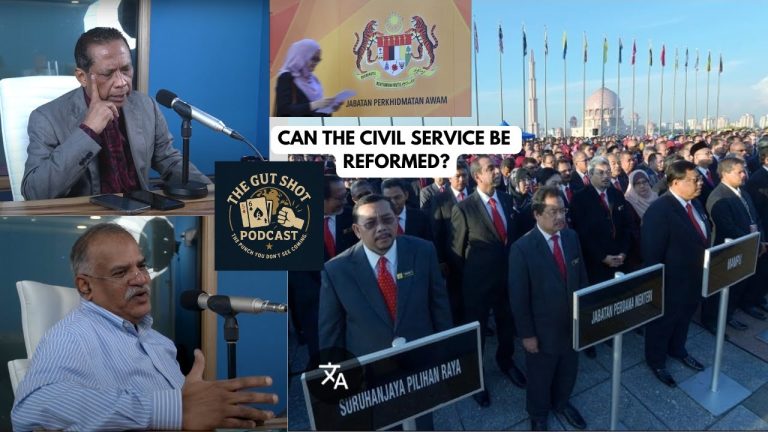
w Syed Akbar – Is it too Much to Ask for the Malaysian Civil Service to be Reformed?
Show Notes & Description
Join us again in a conversation like nowhere else. We talk structural and systemic need for reformation. The need for a re-thinking of taxation, budget management and regulations to catalyse civil service reformation and spur efficiency, and productivity. Doing more with less and incubating human capital for the private sector.
Welcome back to the Gutshot Podcast! We are witnessing an incredible uptrend in our community, and we need your help to hit our target of 5,000 subscribers by the end of March—so please smash that subscribe button so we can keep spreading these crucial conversations nationwide.
In this episode, we tackle a question that every Malaysian taxpayer asks: Is it too much to ask for the Malaysian Civil Service to be reformed?. We kick things off by exposing a shocking new military procurement scandal involving a "26-company cartel" and a toxic "Yay Yay culture" of booze and hookers that proves corruption is still systemic. If you think that’s bad, wait until you hear our debate on the sheer size of the civil service—1.6 million people on the government payroll.
We don’t just complain; we battle over solutions. Sam argues that the government is the "ultimate corporation" and needs to slash regulations, cut the workforce by 30%, and stop acting like a welfare state. Syed pushes back, explaining the political reality of the 2.6 million people dependent on this ecosystem and why a "cold turkey" approach could lead to massive unemployment among Bumiputras.
We also dive deep into the numbers that matter to your wallet. With oil prices dropping below $60 a barrel, we can no longer rely on petroleum revenue to bail us out. We explain why the private sector—not the government—must be the engine of growth, and why businesses need fewer obstacles and more facilitators.
From the absurdity of paying "agents" RM30 for online passport renewals to religious pep talks wasting taxpayer time during office hours, we leave no stone unturned.
If you care about where your tax money goes and the future of Malaysia’s economy, this is a conversation you cannot afford to miss.
Timestamps & Chapters:
• 00:00 – The Gutshot Community is Exploding: We are growing fast, but we need you to help us hit 5,000 subs to drive real change.
• 03:15 – The "Yay Yay" Culture Scandal: A shocking look at the "booze and hookers" corruption scandal rocking the military procurement sector.
• 10:45 – The RM30 "Agent" Mystery: Why has passport renewal become harder? We expose the inefficiency of the "online" system that still requires third-party help.
• 22:00 – 1.6 Million on Payroll: Is our civil service bloated? We break down the massive numbers and the history of Operasi Isi Penuh.
• 35:30 – The Oil Price Reality Check: Petroleum revenue is history. We explain why the government can no longer afford a deficit budget.
• 48:00 – Sam’s Controversial "Cold Turkey" Plan: Sam proposes cutting the workforce by 30% and privatizing GLCs, while Syed argues for a softer "attrition" approach.
• 1:02:15 – Religious Pep Talks on Taxpayer Time: Why are government counters empty at 8:00 AM? We discuss the productivity cost of religious activities during office hours.
• 1:15:00 – Obstacle or Facilitator? The ultimate verdict: Civil servants must help businesses grow to ensure their own salaries get paid.
Many thanks to CITYPlus for their collaboration with The Gutshot Podcast, in whose studio this conversation was recorded. CITYPlus is Malaysia's first Chinese business radio station, dedicated to delivering in-depth analysis on local and international current affairs, markets, and businesses.
Jump to chapter 8 chapters
- 0:00 Community Growth and the Reforming Mandate
- 3:55 Military Procurement Scandals and Systemic Cartels
- 11:37 The Absurdity of Inefficient Online Services
- 18:32 Bloated Payrolls and the History of Operasi Isi Penuh
- 30:12 Fiscal Realities and Shrinking Petroleum Revenue
- 38:45 Downsizing vs. Attrition: Restructuring the Civil Service
- 59:20 Demand for Tax Cuts and Bureaucratic Accountability
- 1:15:14 Workplace Indoctrination and Pension System Reform
Auto-generated from YouTube captions. Timestamps link to the video.
Welcome back to the Gutshot podcast. I'm Shamsul aka Sam uh with my friend Say Akbar. Hi, good morning. Good morning everybody. Today uh I believe we're going to have a cracker of a conversation uh to share with you all. But uh before that uh we want you to know that we have a real uptrend in our gutshot community which has uh truly exploded lately. Uh the comment section has been cracking for a six-month old channel. We are thankful to you our viewers. However, 90% of our viewers are not subscribed. Please uh very much smash that button, subscribe uh so that we can spread this
conversation throughout the nation. Yeah. Um, we have now approximately 1,88 subs uh in 6 months. Let's target for 5,000 subscribers by end of March. Let's try and do that. Uh, get more people to be to be involved in our interesting conversations. Uh, Gutshot, what we want to do is grow it further and be a catalyst for change. That's right.
Yep. Yep. So, uh, let's build this community together around Gutshot with good conversation, intellectual, and hopefully create positive movement. Please promote the channel, uh, get people to subscribe, engage so we keep growing. Let's build it nationwide uh, and make a difference. So, now back to the episode. Here's our plan today. We have a very simple question. How do we reform the Malaysian civil service? Is that too much for us to ask? Um, with that, you know, I think I'm going to throw it to say first. Say, what say you? Let's open it up. Kick it off the conversation on this brother.
Thank you. Um, well, yeah, anything everything uh can be improved. Everything can be done better uh quicker, faster, more efficient. Especially the civil service and uh the civil service is especially important for us at this stage of our development. We're still a young country. You know, 60 over years old. The civil service can often make or break a country. You know, if we have a good strong civil service, efficient civil service, the country can weather a lot of uh storms. meaning the the country can weather a lot of political mistakes. Yeah. in policy
mistakes. If the if the civil service is strong and professional, they can still carry things through and produce results regardless of who is who is the the government in power especially in a situation now in this country where you know political power you know it changes it has changed a few times already and uh you know one-term governments I think are going to become the the norm the way things are going so when there's that much change happening in the country. A lot of newbies, newbies and uh and a lot of uh new wannabes, you know, who become uh come into office as politicians and and
and administrators, then uh they they on the learning curve, right? So this is where a strong and professional civil service is abs absolutely critical to make sure that the country still performs everything still works well regardless of who is learning the ropes
of running the country. So civil service is uh absolutely critical and uh of course anything needs uh to be reformed especially our civil service. This morning when I came in uh for this podcast uh I opened up my email and this this news really uh was a shocker to me. I'd like to share this news a little bit.
Yeah, let's do that. It's it's not a very good start to a Friday. It's a very terrible start to a Friday, but I'd like to show this on my tablet. This is from Asia Sentinel. I hope the camera can uh can catch this. I'll show this for a short while. Okay, it says uh Asia Sentinel, Malaysia weathers another military scandal
very quickly. I'll read it. Procurement bribery allegations and a yay yay culture by John Berthal John Berthlson dated January 16, 2026. Okay, just a couple of short paragraphs. The Malaysian government, which has been riddled with some of Asia's biggest scandals, including the multi-billion dollar 1MDB issue, has been saddled with a new with new one since December, a massive affair dealing with military procurement projects over the period 2023 to 2025, as well as what has become known as the armed forces yay culture. booze and hookers in officers messes
supposedly outlawed nearly three decades ago in a Malay Muslim culture. The Royal Malaysian Air Force has confirmed that 20 officers were directly involved and will face severe disciplinary action. This is the yay part of it. H there's the money part right here. So far that was the air force. So far the army chief I'm not going to mention names. right, has been forced into early retirement. His predecessor, the for the the former army chief and his two wives have been arrested by the Malaysian Anti-Corruption Commission in connection with an alleged cartel that was rigging
military procurement tenders. The investig investigation is said to center on a suspected 26 company cartel. 26 companies. How many companies do you own? 26 company cartel that allegedly bribed senior officers. No, the number of form49s you got to sign.
Yeah. The uh allegedly bribed senior officers to secure high value supply and maintenance uh contracts. The MACC has raided firms frozen bank accounts and seized tens of millions of ringit in cash and luxury items including Rolex watches likely only the tip of the iceberg. The probe is said to cover 158 projects each valued above 500,000 ringgit and more than 4,500 smaller projects. You need a full ministry to do all this.
That's a that's a that's a reasonable size uh public listed company. This has been going on for I don't know for how long. Yeah. This is on an industrial scale. This is systemic.
Ah systemic you see. So okay this is the armed forces very sadly but it's all part of the entire ecosystem of uh civil service that we have here. So uh we need uh drastic reforms. Corruption is corruption is an issue. Corruption is I mean Dr. Mahade once said that corrup what 30 years ago he said corruption is so bad we do not know who to trust anymore. So you know that means we have not really solved the problem of corruption over the past 30 years. But today I suppose we're going to discuss reforming civil service. Uh but this is a bit of background on on on the the
kind of a clutter and the the toxic environment that still exists and within this toxic environment where does a civil service fit in? Are they going to fit in? Are they going to fit out?
You know so maybe we can discuss that today. Well, I uh p it's uh it's interesting um when they talk about procurement tendering. Actually, I started my career when I was in Shell in the procurement section. Okay. So, I know procurement very very well. Um and uh uh here's the here's the interesting lesson that I I learned and I think that uh if you look at industries and you look at running companies you know uh Elon Musk has uh has said this before I don't know whether I've quoted this before that the government is the ultimate corporation you know which which is because they you have to pay
them whether you like their services or even if they don't provide you services. Sure. And uh this whole bureaucracy is government as you well put. But here's the thing about uh whether it's procurement or governance or administration overall in my opinion I said right. Um whenever you hear problem like this the tendency of people is to actually the first part is demoralized. The second part is actually they'll put more rules you know because when they see a problem they say oh we need a rule to put uh to put so that we don't have this problem occur. Well actually the truth is actually
simpler than that. You want to dismantle the rules. You want to have less rules than what you started with because then you can identify the problem and then you can also identify the culprit a lot easier. You want to h you want to have a situation where it is easy to actually achieve things because the harder you make things are the more opportunity for you to have corruption happen. If the environment is toxic, if the if the overall environment is toxic or not conducive and then you put in more rules, you're creating more problems.
It is a natural uh it is a natural tendency uh for I mean of course we can talk about the culture side of it, right? The culture side of it is something that we have to address. Maybe we'll do another episode on the corruption culture. that uh in terms of civil service civil service re reformation we are talking regulatory we are talking administrative uh we are talking administrative structure and how the philosophy of a civil service should be and what I'm trying to say is when I when you brought up that subject the philosophy should be the less regulation the better it is for
a efficient civil service agree 100% yeah well I mean the uh Trump in his first uh administration the ratio he what he said was uh for every two for every one regulation new regulation you introduce you must dismantle two
in 2016 today the rule is for every one regulation you want to introduce you got to dismantle 10 right I think that's uh and this is the thing I think
get the emotion out of it and they did it and they did they're doing that right so I We need to have that kind of philosophy in order to actually make our uh our civil service more efficient. Right? Say I don't know whether you remember I mean uh you remember or not. I I haven't done uh my passport in a while. Uh but I remember um the last time I wear a couple of years ago. I was uh I was shocked that it actually is worse than it was before during Pala's time. Pala time I remember that you can go on the on that day and the same day you can get the passport back.
Well, you still can but it takes a long time or it takes uh and then there's a number system, you know, weird procedures. Yeah. I I don't understand. I I don't understand why we've gone backwards. I can recall uh the well I just renewed my wife and I just renewed the our passport a few months back last year.
Yeah. And then uh we did once again 5 years ago and another one 10 years ago. So we've done it three times in 10 years. And each time uh I recall the the first two times I had spent almost the whole day at the immigration office waiting for the passport to get done. My last visit a few months ago the guy said now everything is online. You you apply everything online. You go online and you you can fill up your details and everything, but you need you get a number.
Okay. But okay, in my case, since I'm a senior citizen now, above uh 60, I'm 66. So, the guy said he could do it for me on the spot and he just took my passport and he processed it on the spot and I got my passport done very quickly.
Now, my wife who's not a senior citizen, he said she had to go online. M uh but then he said we went there in the morning but he said that you know probably the the numbers which you refer to there probably uh there's enough I mean the kota is up for the day or something like that.
Then he made the suggestion that you can go to a shop just outside the immigration office. There was a little corner shop that does you know photocopies and things like that and they can assist you. M.
So we went there and that shop is some sort of a agent of the immigration department and we paid them a service charge. It's like 30 ringgit or something, right? And they got it done. The the the girl went online and for my wife, she got she got the
website and she went in and she did all those uh whatever. she filled in all the information and then uh you just go to the immigration office next door and you pay the money and you pick up your passport after after a certain amount of time.
So my question is how come the girl in the shop can get online and get it done within minutes, right? Uh you know whereas we would have to if you did it at home probably you got to do it you you can't get same day service maybe because all those numbers would have been taken up. Huh? But you can do it online at home of course, but I think maybe like you know I don't know how soon you can do it. We only did this once in 5 years. The point is the point is it's not consistent.
5 years ago and today it's not I don't know what's going to be the what's going to happen 5 years from now. And you've gone online. If you you put something online, it should be the easiest to do. Correct. In fact, you you may not even have to go to the to the immigration department to get your passport. If you can do everything online, you can make payments online. they can always send it by Korea to your house
which is what the British have been doing since I don't know when in Britain you apply for passport through the post um so uh why you said just now we for every regulation new regulation Trump said delete 10 it was one to two okay now we've gone online it's good make things easier but uh my wife ended up paying 30 ringit
service charges that I I don't get The what you call it? The smell. Yeah. Well, that doesn't smell right, does it? Yeah, that doesn't pass the smell test. It doesn't pass the smell test. Why do I have to pay 30?
Correct. You know, if it's online, we just do it. We already paying for the passport. Okay. If I can't get it today online at home, just tell us, okay, you you you'll get it what 3 days from now, you know, or 4 days from now.
Just go to the nearest passport office or you can choose whichever office and pick up your passport. Right. That would solve the problem. Well, he here's here's the I mean the a quick So it's not it's not consistent.
Yeah. So I don't know whether the system going to be there five years from now or what's going to happen. Well, when you talk about when you talk about government changes, the constant is actually our um our administrative branch of governance, right? That one in essence should be uh an infrastructure that actually should be the constant but improving. And if you were to ask me um an efficient government or an efficient corporation, okay, must be slimmer and slimmer if it is going to be um if is going to be efficient. And also going back to the less like like like you say when you had
to do more what happens it opens up opportunity for people to take advantage of the rules that you put in there u that become avenue for corrupt practices. So but okay we've touched on that. Let's let's let's take the our audience uh on a snap of a macro level, right? Because uh because uh we we we need to to look at it, right? How big is our our civil service? Um what size should should we have that uh that that size of a civil service? How much is the government spending on the civil service? obedience.
Are we in uh you know is there is it too much to be able to ask the government can we can we uh can we shrink the civil service and our operating expenditure is that so difficult people are going AI we are going digitalization right I remember actually even when I was running procurement uh in shell actually I shrunk I shrunk my my my department you know the the problem with most uh uh with with uh with entrenched corporate or entrench uh uh entrench bureaucracy is that the bigger your empire, the more money you your you can claim, the more responsibility you can
claim, the bigger your salary package. Bigger office, bigger office, right? Uh bigger bigger manpower, stuffing, you know. I had the other way around. Actually, I shrunk my my my department by 50%. You know because why I instituted before the age of digitalization
because you'll get a higher bonus. Yeah. Because because I think you know the people can be deployed to do other other things that are more value added. Yeah. You save you save money for the company that you're working for. Yeah. Yeah.
Yeah. And you get people to do instead of uh rote rudimentary thing more value added things that actually bring um bring bring more value to the company. multitasking and things like that.
Correct. So I mean what what are we looking at our our civil service budget these days? Well, there's a there's a there's a very long history to our civil service. The question is is our civil service bloated or not? Mhm. Uh for our size population, a country of 34 million people, uh of course you cannot compare with like China where the the ministry of of railways has got 4 million over staff, you know. So we are a small country 34 million people. Uh but I have some figures. I think uh our civil service we have these are these are old numbers. federal government has got 1.3 million
uh civil servants staffing strength in 2025 and uh the states have got another I don't know maybe about 200,000 people in total so you're talking about 1.5 million people about for federal and state uh civil service if you include the police and armed forces uh that's you can throw in another couple hundred thousand so it's about about 1.6 about 1.6 6 million people on government payroll. Government payroll.
Okay, government this is important the classification. Government payroll means they will get pensions. Okay, that is the ultimate uh determinant of a civil servant because there are people who work for government who are not on pension. They could be contract and things like that. So this 1.6 million people are on payroll and they eligible for pensions which means we pay for them.
Oh yeah. Okay. So we'll go into those numbers shortly. Right. And then you also have the GLC's. GLC's are not on the pension scheme. They on the EPF scheme. I think they should all be uh that's about another million million workers in all the GLC's that we have in the country. Uh I think including the state corporations all over a million. So you're talking about what 1.6 and one 2.6 about about 2.5 2.6 million people who are uh dependent on the government uh ecosystem for their employment. That's a lot of people in a country of 34 million people. But there's a history behind this you know
do you remember something called oparasi isipono okay he came out in the 1970s okay Dr. Dr. Mahade was not the prime minister but he was a deputy prime minister. I believe he was behind this thing of Oparasi Eypno where they really filled up the civil service with they just they went on a recruiting drive a really crazy recruitment drive and they increase the civil service numbers of employees sizably and there was a simple reason behind it is to create employment
right because uh mostly for Malay bumutras to create employment take them into the government service so that they'll have income you know So you find that uh the numbers of the civil service also increase at that time that's why it was called opera operas right
normally you would have vacancy then you go look for the person right I think here they they they found the people first and then started looking for what they should do uh so this there's some history to this and our civil service is uh is well you can say it's bloated I can I can give you uh just my own uh what do call this uh own narrative. What I've seen, you go anywhere to the government service and you'll see there's a lot of workers, a lot of staff. You go anywhere in any government department, there's always a humongous number of people there. I have
my personal experience. Uh at one time I was a consultant to the NEAC, the National Economic Action Council, and I had a nice huge office in Putraaya, you know, really big office. And one day they had to change the table, you know, my office table. For some reason they said I they had to change my office table. Nine people came to do it.
Okay. Go on. Including a lady who was a supervisor holding a file and she was, you know, taking in the boxes and this and that cuz she had to make sure that everything was done properly. So I went like wow this is like they really have a lot of stuff just to change a table, you know, that's the nature of the government. And then uh um it's over stuffaffing. It is you have to pay salaries for all these people. So we have to question whether uh is there redundancy or not in the civil service. Uh I think you can argue strongly that the government can do a better job. Uh
but as I say this is political uh because it creates employment otherwise a lot of people might uh not get employment. So the civil service is an avenue for the government to give employment to to people and in in the peninsula especially you know voters Malay Muslim voters. Can we do with less uh less people in the civil service? Uh yes and no. Whatever it is whatever we have done okay we filled up the civil service with all these millions of employees. Uh I feel that they can be useful. They can be useful if you train them and make them a really efficient welloiled machinery like like
you know shock troops you know marching in straight lines you know marching forward not marching backward they can be used to make the country really uh productive and really improve the the economy of the country because the civil service say what you want the civil service is organized they've got a system they actually have very strict uh uh uh rules, procedures in every department has rules and procedures. Good or bad depends on whether they implement it or not, whether they follow it or not, whether corruption comes in or not. If the culture is bad, if the
culture is toxic, then as you mentioned just now, the more rules you have, the more chances for corruption, the more chances for little Napoleon's messing up the place. But if you improve the overall culture, the the commitment to duty, you know, integrity levels, uh always committed doing good, then uh the civil service can be a tremendous boost for the for the country, for the economy. Uh so whether it's 1.6 million federal federal and state civil servants or over 2 million in total, it will be a real asset. It will not be it won't drag you down. It'll push you forward. So
it's how we how we make use of this vast army of people we have in the civil service. I know you don't like to hear that but uh there are ways of doing it. Well say I have a different way of looking at it.
Let me put it that way coming from a business side point of view. Okay. As I as as uh as I've mentioned and quoted you know the government is the ultimate corporation. It's no different. Okay. And the reason is therefore I look at it this way. Actually I want to I want to recall for our audience my my my one my one period in Shell. Uh I was uh one of the small group of people selected by the chairman at that particular time um was uh Magat Zaharuin who was the ch uh who became later chairman of uh he was technical director at that time in Shell and then uh he he
became Maybang Maybank's chairman right so I was in that team and that uh I remember the oil price approximately be just before that was around $10 or $12 a barrel, right? Which means our revenue has really shrunk. Okay. Uh and what is the answer to that from a company like Shell? We need to be more efficient. We need to be more more more lean. Okay. No question asked. We're going to cut 3,000 people. All right. Which means that you straight away your mindset is whoever is left however we're going to conduct the business it's got to be better and much more productive because we've got no
choice because our income is smaller right so the same way I would approach actually government okay now where do people that does that end up not working with the government Like you say, there was an opera which is, you know, fill them up. That's basically what it is, right? Fill them up.
Yeah. And the fill him up actually has got no rhyme or reason except to uh put people under employment, which is basically then you are a welfare state. You're just giving jobs based on the income tax people like you and I pay in the private sector. and I'm giving you uh salaries that you that that then uh becomes a burden uh for uh for the taxpayer. Okay. So if you look at like that the first thing I would say is actually make up your mind how efficient do you want your governance to be. So every year I would look at it especially with digitalization especially with AI coming
there is no reason for government to increase in terms of manpower in fact government need to reduce its manpower drastically. That's the first rule. Okay. The second rule is this. If you are going to then reduce your manpower internally you're not going to hire more people. Correct? You may have to let go of of people. Therefore, your private sector becomes the engine of growth to your economy. That must be the way it is. It is not the government that becomes the engine of growth of the of the economy. It must be private sector. So, you must stimulate the private sector.
So, the people that you say that are working in the government and they are efficient, if they are good and all that, they should be able to be absorbed in a vibrant economy. So if I want a vibrant economy, you know what I would do? One of the first things I would do is have more money in circulation, right? To stimulate the economic activity. And this is the funny thing about uh governance or or you know, one side of the finance, you've been a you've been a banker, you know, if it's 24% corporate tax right now, why don't I cut it to 20% or 18%. Singapore is what 17?
Yeah. 28 I think 24 25 I I'm I'm Singapore Singapore is at uh 17 17 right okay so you cut you let the private sector be more liquid right so that they can invest and hire more people and then if you really have really good people within the civil service that you let go they should be able to find a job because why they uh because they're capable. So that's the that's that's the whole balance of things, right? You stimulate the economy, you reduce your welfare program. That's basically what it is. You reduce your your your your uh your your operating expenditure and
capital expenditure including your GLC's. How much how much bailout have we done? Yeah. Right. I uh what what do you say to that?
Yeah, I agree with what what you're saying. I maybe I can give some numbers. Let's go numbers. It's getting to be very expensive to maintain our civil service. You know, uh you know, we Okay, here are some numbers. Our the last budget that was presented, it's about 420 billion ringits. you know 420 billion ringit of which government revenue is only about 340 over billion ringit. So there's a shortfall of about almost 80 billion ringit. You know that's borrowing deficit is a deficit budget.
That's a lot of money. And of this uh 420 billion uh ringit budget uh the operating expenditure is almost 340 billion ringit. Out of 420 340 is operating budget. And of the operating budget just the the pensions and retirement charges alone is about 43 billion ringit. That's a lot. And uh plus salaries and all that about 26% of the budget goes towards you know taking care of the civil service salaries and payrolls and things like that and the pensions another 10%. So a lot of money is used up to pay civil service salaries and pensions in the tens and tens of
billions of ringit. All this the 2026 budget was planned on on oil at $70 US a barrel. Oil is now at 59. I'm talking about west west Texas. West Texas is about 59 US per barrel. Yeah,
that's way below the 70 US per barrel that it's going to go lower in the budget. It's going to go lower and the long-term view for oil price is not good. This is my view. I think oil prices gone are the days of high oil prices and oil is shooting up everywhere. I think if you dig a hole in the backyard, you get might get oil. Brazil is oil exporter. Israel is a gas exporter. Who would have imagined? So, uh, the oil price of below 60 US per barrel West Texas is not helping our situation at all. There's going to be a bigger deficit.
Yeah. And how we going to pay all these salaries and pensions for a civil service? Again, as I said, which you which I know you don't agree too much if the civil service is super efficient and they boost the country's GDP growth by 1% 2 percentage points, you know, because they work so hard, we can sustain this. We can sustain this. is weaker. That means they are part of the they are part of the of the team. They're part of the team that is increasing the wealth and the productivity of the entire economy. They're really part of it. So they're not a burden or they're an asset. So if
if they can generate that kind of efficiencies in the economy, the economy I'm talking about just money. I'm not talking about my philosophy or your philosophy, just plain money. When you are efficient, you generate income taxes which you don't like. Then it can sustain the civil service. But the fact is now if um our growth is not as great as how it should be and our costs are going up and and our revenue our petrol petroleum revenue is going down because of the lower oil prices then the bloated civil service becomes more and more of a burden on us in terms
of money purely money I'm talking about money alone is going to be unaffordable and then when it becomes unaffordable you find that the government has to cut corners and make cuts here and make cuts there because you have to keep paying paying such high salaries and pension to the civil service, we're going to lose out. This has happened before in many other countries. They're called third world countries and some of them are called failed states where you do not allocate resources properly because of a bloated civil service which which sucks up too much resources and uh there's
less for other other expenditure. Before I just wrap up with this point, you see on the revenue side you which I know you will agree the revenue side the main contributors to government revenue 2026 uh corporate income tax is the largest okay about 103 billion ringit 30%. Okay corporate income tax individual income tax personal is about 4950 billion ringit that's another 14.3%. So 30 + 14 is 44. Sales tax is almost 60 billion ringit sales tax. Another 17%. So what's that? 30 44 17 61% is it? Yeah. 61% is from taxes taxation which is directly related to economic activity. As the
economic activity in the country goes up, this is where you collect your taxes. This is this is the money you use to pay the civil service. This is the money you use to sustain the civil service. The famous petroleum revenue, right, is only 12%, it's it's huge. It's a huge chunk. 12.5% or 43 billion is is a lot of money. But out of a total budget of 420 billion, that petroleum revenue is actually just a portion. It's not it's not major. We're not like Saudi Arabia. It's a portion, but we depend on that petroleum revenue. And now at at oil at below 60 US per barrel, that
revenue is going to get hit. So where is the money going to come from? You see the money can only come from the other three. Corporate income tax, individual income tax and sales sales taxes. So now if you are a civil servant, I hope the civil service is listening. Do you want to assist the economy pay more income tax and uh generate generate more income tax, generate more uh uh corporate tax, individual tax and and sales tax? or do you want to impede them from achieving maximum growth
and then you can send in the income tax department to go and squeeze out as much tax as possible from the people. That's the wrong way of doing it. What you need to do is I want to remind well Dr. Mahade said this many years ago
the more business you have in the country the more taxes the government collects collect. Yeah. So you have to assist and facilitate business. The civil service is a is a job and the task and the sole responsibility of the civil service. I say so responsible because everything runs on the government. If they don't approve your application for your building project, nothing's going to happen. There's going to be no corporate tax, no income tax, no sales tax. They have to understand this. So if the if the civil service is going to be able to sustain itself, especially in a time where oil oil
prices are dropping, oil revenues are going down, you have to go back on there are four legs on this chair. Corporate tax, individual tax, sales tax, petroleum revenue. there the four four four legs that support this this chair. They have to go back and improve the tax collection and you only do that by making the country more efficient. You have to make sure that businesses can do business easily. Do not impede them. Do not put up obstacles for people who want to do business and you know these regulations which you spoke about ridiculous useless regulations. How can
I spend a whole day in the well last time in as a passport office waiting for my passport or giving the runaround and that's not productive time. All that costs money. Yeah. All that costs money. And when it costs money, it means less corporate income tax, less individual income tax for the government, less sales taxes collection by the government. People seem to have this sub some some kind of a uh it's a psychological thinguh that somehow we are a huge oil exporting country and that oil revenue will always save us. You know people have this kind of attitude. No, it's not. Oil revenue
is only about 12% of our budget and oil prices are going down. You're going to have to depend on those people who run businesses, people who you know do trade and those who pay sales taxes. That is where the money is going to come from to pay the salaries of the civil service and keep the country functioning. They cannot impede that. The more they help business, the more they help businessmen do the things that businessmen do and the economy to do things that the economy can do, increase productivity and output, the more healthy you are, the more the government's finances are
depending on on petroleum revenue is uh it's history. you know um my take is this actually um I think I'm I don't know I I you know sometimes when I talk people say I'm not being practical but I've done it so how is it not practical if I've done it in real life okay if I were running the government if I was running a ministry or if I was the KSU of or or the the secretary general
the KSN KSN do you know his name I Neither do I. Right? You know, the the sec secretary general in charge of the uh public services uh department, the civil service, I would go to the prime minister and I say, I want to cut my staff by my my workforce by 30%. Straight away, I don't want to talk. You know why? Very simple. If you have that actually efficiency mindset, what you are thinking is I need to save money for the rayat. I need to save money. When you talk about the government, the government or actually the people so I want to save the people's money.
That's the first thing I would do. Be then I'm forced I'm forced to actually deregulate because I don't have enough people. All right? I have I'm forced to deregulate. I'm forced to make things easier. That means I free that money that you quoted.
You don't need as much money. I don't need as much money. If you if I need a 100 million now, I only need 70 million because you have less Napoleons. Okay. All right. Less Napoleons and less soldiers. Yes. Correct. Right.
So, and then GLC's, I would privatize all the GLC's. I don't want any GLC anymore that is dependent on the government. Okay? And if you cannot perform and you don't you boonkos you shut down because why the bailout is coming from taxpayers as well. No matter how you squeeze it, how you play around with it. Okay. The GLC bailout comes at the end of the day the receipt come at our table.
Okay. I I have some thoughts on this. Can I say it? All right. Go ahead buddy. Yeah. You see the government has got in Malaysia the government unfortunately is involved in a lot of micro issues including running businesses. The government should focus on uh policy macro issues. But today we're talking about civil service. Civil service is the the uh the operating arm of the government. They deliver the government services. Government is a service. Government should not get involved in products. So the civil servants they are good at um carrying out policies
implementing policies they're good at standard operating procedures well the passport office needs to buck up a little bit but overall the civil service has it functions in my view personal view during the time of uh Dr. Mahadei there were parts of the civil service or large parts of it were very efficient because at that time they were developing the country at a break neck speed and the the civil service was really efficient. They were helping the country grow. You mentioned during the time of Abdullah Bavawi the immigration office was very efficient.
It was it was impressive. I remember in the 1970s when I was a school boy in Pinang. Uh there was one uh DG or whatever the postmaster general uh that fellow he got letters delivered within peninsula in one day. If you mail a letter in Pinang it will reach KL the next morning and in Pinang I tested it uh because uh we mail a letter in the morning and there was a evening delivery. M
it's unbelievable you know that was in the 70s so it can be done it can be done you know uh just to digress a little bit sometimes the the efficiency of the civil service depends on who's in charge it depends on a particular DG director general or KSU you know who is super efficient uh I remember that one guy with a bow tie who used to run the road transport department he became a shareholder of our one of our airlines later. He was a very efficient guy, you know. He he I think he also ran the passport office once where he would uh close the doors and don't let the staff
go home until all the passports were processed. Processed. Yeah. So, everybody did work quickly and all the passports were processed by 4:45 or whatever is the government time. So, you have individuals like that. today today 2026 I must mention uh our minister of housing a local governmenting uh in my opinion because I do some property development so I appreciate what he has done he has really speeded up the approval of uh building plan approvals and uh uh building approvals and planning approvals for development projects it is now down to like 21 days and 42 days this is this is like unheard
off you know uh some time ago I uh I was building a a house a bungalow and it took us one year to get approval one year that's that is if you are doing it on a large scale and if you have bank borrowings you'll go bankrupt you know
one year you have to pay interest you have to pay your workers you have to pay for equipment when you can't use it you can't get start start work you can you can lose your business you know now this is down to like 21 days and 42 case and uh why being along is a minister of housing and local government. We also learned that despite land issues and being uh under state but it is a ministry of housing local government which pays the salaries of 151 local governments throughout the country and they use that cloud you know to in enforce u good uh standards you know and
uh SOPs operating procedures and delivery to speed things up. So this is where an individual minister is making has made drastic changes in his ministry to the benefit of the entire country. Uh what we need is we need to project this throughout the civil service and not just depending on this particular minister that particular minister if he's no more around after the next election. What happens then?
Well this is a problem. Well I I think if you remember right one of the biggest revolution that we had in Malaysia in terms of uh work culture actually when Mahade came to power. All right. Remember when he he he instituted that
the punch the punch and the punch punch uh punch cut system. Yeah. So um I mean even simple things like that people didn't like that. People didn't like that at all. There was a lot of resistance. Correct. But this is the thing about change. Yes.
Change is uncomfortable and change actually makes things more difficult for people who are trying to perform what they are used to doing. Yeah. Okay. Um but you know it start from the very top if you ask me. So that's why when we look at governance we have to look at who's at the very top when things don't work the question is at the very top. Now in terms of the civil service the way you talk about that right then is a question of the civil service culture itself the philosophy or the civil service if we institute and we kept that is say okay I'm going to do uh
for a fiveyear program every year I'm going to cut 20% 30% for the next 5 years just make that as a rule because why as you rightly put your income is lower all right uh on on your on your natural resources. Okay. Let's say we you you you fix a target. You fix a target
by by attrition. Yeah. You don't hire as many new staff. You you don't have to fire people. But you know, at the end of the day, uh at the end of the day, say if you want to stimulate the economy and really I think people need to we are so used to being taxed.
I mean you are okay. you know, our mindset I what I I I'm sick about every time I every end of the year when I look at the budget uh budget proposal is there's always talk about new taxes or how to collect taxes
because because the politicians don't don't think like you and me the politicians do not understand how business finance and the economy functions they look when they are in the job where they are in government they they look at government and say Okay, we the government needs revenue to do this that and this and that which we're doing for you. Therefore, we have to collect taxes. They don't understand what you just said. You can you can also make money by reducing your expenses by reducing the size of the civil service
and you reduce your tax so that these people can make more money. Yes. Conversely and then deliver you more absolute cash. They don't seem to understand that reducing taxes actually can grow the economy.
They don't understand the concept. What do you mean by that? How does reducing taxes grow the economy? So you have to explain to them. No, they're scared. They you explain that if I'm a if I'm a businessman, I pay X million ringit taxes a year and you reduce it by 50%. So I'll take the 50% that I save. I'm not going to go to uh New Zealand or Switzerland for a holiday. I'm going to build another factory because I want to become richer.
Therefore, I'll create more employment. They don't understand that. Yeah. They don't understand that. most through when you create a true economy. I mean, you look at people like, you know, we the the the the the
we want to plow back money. Yeah. Into the business so that we can make more money. That's how it works. They don't seem to understand that. They only go like, "Wow, you're going to be rich. You're going to make so much money. You're already rich. You're a rich person. Pay taxes." They do not understand that businessman every every ring that a businessman saves he's not thinking of how to spend it he well he will spend some of it but he's thinking of how to use that that profit to grow his business
and because because he wants to make more money and when the business grow he creates more employment we keep yeah we employ and he'll pay more taxes right he has to pay more sales service taxes he has to corporate tax income tax
don't add regulation cost us more money correct to run our business. Don't impede businesses that it takes nine months before I get regulatory approval
to actually build uh a building or a a a factory or a plan. They think Donald Trump is a guy with orange hair. They don't they don't understand the the other side of what Trump is trying to do basically is to create wealth and increase wealth in the community. But uh going back to this this thing of the number of civil civil servants and reducing them
there are a couple of things you know uh I feel that uh my my view is that one one way of what you mentioned just now you have a program every year you reduce it by x% uh some people suggested more drastic and I uh you know like reduce it by so many percent overnight my suggestion is attrition that means you don't hire as many because every year the civil servants who retire who pension off and they get retired My suggestion is don't do not hire as many new staff but before you can do that because if you don't hire as many new staff is going to increase unemployment
especially among the Malays and the Bumiutras because Malays and Bumi Futras they depend a lot on civil service to uh to I mean for their income just now we mentioned total civil service population is about 2.6 million including army and their military services 2.6 6 million people are directly dependent on the government for their income. You have to multiply that by what? Four. For a family, let's say a family of four or five, you're talking about about 10 million people or more who are directly dependent on the earning a salary from the government to sustain their their
their families and their and their livelihood. So if you reduce the size of the civil service, it's going to it's going to be a political issue because there'll be it'll increase unemployment among the especially the Malaysians and Bumutras who are so dependent on on the government including uh working for the government. So if we're going to do that, we have to grow the economy so that the economy, the private sector economy so that so that the private sector economy will create those jobs to absorb these people who are who are going to lose their jobs in the civil
service or who are not going to be employed by the civil service. So it's got to be a two-handed thing. You know, you reduce the number of civil servants, you have to grow the economy to create more jobs. Otherwise, there's going to be a massive unemployment among Malays especially in the in the states.
I mean I sorry say I the whole idea You don't like it? I don't like it. The whole idea that that I have to create employment for the Malays within the civil service is so abortant to
Well, the numbers are there. You cannot No, no. I I'm I'm with you. There are 2.6 million people working. Here's the thing. the fact that we have artificially created this we've had babies
right so that it becomes an entitlement when in actual fact what we should do is a restructuring if you ask me what we should do is a restructuring of our economy and therefore our civil service as civil service because everything is interconnected
what you said just now cutting taxes and and removing uh useless and silly regulations, it will lead to that growth in the private sector economy. Yeah, it will.
Which the can I say this? I want to get this out. I just cannot anymore. Go ahead. You know the the the thing is I've run companies half of my people are uh bumutras. Okay.
Um that includes Sabahans and Sarawakians. All right. There was no issue about oh I have to take this because they no everybody I expect to be capable. So if I at the private sector can do that, why can't the government? Why does it have to be I have to get them jobs? Because the you know
they like the molly coddling the government the government likes to molly coddle you know because it's patronage patronage it's a votes and it is a wrong concept. They are the politicians really do not understand the consequences of what they're doing or whether what they're doing is good for them votes because don't forget you know which we have reminded our listeners so many times in the previous podcast they lost the elections in 2018
and 2022 was a hung parliament so you lose you don't win anymore you're losing the votesh so you have to think now what all the things that you have done has caused you to lose power you've lost your power because you did the wrong things so change. So, uh I agree you know that uh we well you are suggesting very drastic uh cold turkey kind of treatment. Okay, that's one way of looking at it. But I feel that um you can by attrition is one. The the other way is that while they are there while the 2.6 million strong uh workforce is there in the government ecosystem
extract more out of them. what you said just now reduce the regulations and work harder produce more output so that then the government's revenue goes up not from from petroleum revenue petroleum revenue is going to be history from corporate taxes income taxes and taxes sales and service taxes which can then pay the salaries of the civil servants but at the same time we have to reduce the total numbers of the civil service and at the same time we have to increase the employment in the private sector which again is in the hands of the civil service. You you make things easy for
the economy, the economy grows, your children will get jobs in the private sector, better paying jobs. You mess that equation up, it's your children are going to be unemployed. Hence, my KPI for the civil service would be how to reduce your number. Okay? My KPI for the secretary general is reduce your number, reduce your regulation, okay, and work with less and faster
and produce more and produce more. All right. So if you've got that philosophical mindset and you keep give them that target, it will naturally happen. Yeah. But this is a political issue. It's not in the hands it's not in the hands of the chief secretary of the of the KSN. It is not in the hands of the civil servants. this is in the hands of the politicians. They look at it they look at it as a voter.
I mean I mean from a from a from a from a KSU or or management standpoint uh a natural animal of bureaucracy whether it is in public sector or the private sector um is that the bigger my uh the bigger my empire is the more I get. You know in the civil service from what I hear it is rare or next to impossible to fire someone for negligence or for non-performance.
Yeah. Very difficult. There are stories I hear even in the private sector our rules is very difficult. Very difficult. there I hear stories of you know like certain certain se sections of the civil service people are awol you know they don't go to work they're absent
and uh well they still get paid uh pretty much not not much uh disciplinary action is taken against them they hardly get fired so this is another thing about the culture and the attitude in the civil service that has to change if somebody doesn't perform somebody messes up somebody screws up they have to be punished they have to be let go that will be then there will be a stronger discipline in the in the civil service. Another issue I want to mention frequently you know in this country well frequently means it has made the headlines where basically negligence by civil servants
causes loss uh financial loss or a government preceded often by some kind of injury or physical uh injury or even death to people. uh something happens and uh where where the government is involved or certain departments are involved and uh people suffer loss and then uh the people who suffer loss have sued the government
for damages and then they they they they win the court awards them damages. The most famous case is the one recently the pastor co's wife has been awarded millions of uh ringit. There were cases where people have died uh because of uh you know I think not there were situations were not properly handled. There was some security personnel who lost their lives and I think the government paid some compensation. Basically it was uh some kind of negligence on the part of the the civil servants in that particular department or whatever. Uh as a result of which uh the government
had end up paying compensation. Is there any disciplinary action taken against uh those civil servants? I know in the United States if you're a captain in the Navy and your ship ran a ground or it didn't sink, you just, you know, like ran a ground or scratched a rock or somewhere, the captain will lose his job and that's the end of his career. He will lose his pension. That's it. Uh if you're a pilot in the air force and you damaged your aircraft, you're not going to fly anymore. Uh so they're very strict. And same with their civil service. Whenever some civil servant
messes up and the government is sued and the government ends up paying money for the for the people who sue the government, there is disciplinary action taken against that particular civil servant. You are responsible. You see, because you messed up the government end up paying money.
There must be accountability taxpayers money here. No. Here, you know, you have heard cases come out of the media where certain uniform services and they they somebody says, "I'm going to sue you." They go, "Go ahead. because it's not their money.
They know if they get sued the government will pay. The government is paying for pay not they don't pay and their jobs are secure. So they have this attitude now go ahead. So this is a very bad attitude because because this is the fault of the civil service. This is the fault of the leadership and the civil service. This is the fault of the political leaders in the country that you do not discipline or takes you know strong decisionary action or even fire civil servants who mess up in their job. We have to do this because that means discipline.
May May I say this as well actually it's also the fault in a large part of our own population. Okay. Because we elected these people. All right. Okay guys we elected these people and not just that we don't demand what is right. We bought into this whole idea.
We don't demand. We bought into this whole idea. I'm I'm going to go back to I'm sorry. I got to go back to this because I'm so pissed off every end of the year when the government talk about uh increasing these taxes or uh uh try uh doing uh e invoicing in order to collect more money and costing costing businesses more money and doing all sorts of regulation that cost businesses more money but no productivity. Guys, as citizens, we should demand the government to cut taxes. Why can't we do that one bloody simple thing? Demand the government to cut taxes so that the
businesses that hire us can make more money and actually deliver more money and cut our government expenditure. Two simple things. All right? And then everything follow through. Demand them to deregulate. All right?
So this is the thing I I'm I'm very passionate about this because why to me is a change in mindset. Instead of listening to politician pitting us in a class welfare, oh they are rich people. We need to tax them more. Dude, you tax them more. They have no they they don't have the the surplus money to actually build more businesses to hire your children. Let's stop being stupid. We we cannot we cannot put up obstacles. Now that's that's a problem. It's a attitude. It's a attitude change that we need. And uh it is a it is a confusion. They're confused about their attitude towards business.
No, they we are also confused about their attitude about government. You know what Ronald Reagan said? All right. One of his famous quote is that you know the government is not your solution. The government is your problem. If the government comes to you and say, "I'm going to help you run."
Well, I don't disagree with that. But here, you know, I frequently this is true of a lot of third world countries. Yeah. The people who work in the government, the civil servants sometimes, they look at the at the people that they have to deal with the rest of the country as us and them, you know.
Yeah. It's not like we are all together on the same side of the team. No, it's like you, me against you or you against me. So how can I uh you know make things as difficult for you as I as I can because otherwise you will you will uh you will uh what do you call this outweight me you know or you will try to pull the wool over my eyes so I have to be constantly constantly vigilant they always like it's always like an enemy situation you know they don't see it like let's be partners let's cooperate let's work together win-win situation so that you benefit first because it's like
running a restaurant. You know, a guy walks into a restaurant, you have to you have to serve him the best your best service, quality of service, give him a nice place to sit down, the food must be good, charge him a fair price, that's it. Only then you get paid. If you mess up any of these equations,
then you're not going to get paid. The guy will go to the next shop, then you go like, "Hey, my business, I've gone out of business bankrupt." It's exactly the same with the civil service. you have to serve the people, the the businesses, the economy and the country. Only then your revenue goes up and only then the civil service will remain healthy. Um they don't seem to understand that you know this is a it is a this is a continuing problem in in the civil service. I hope I hope that there are changes for the better. They have to think that they are there to serve the
people. There must be a culture of uh public service where you are People are not coming to you to beg you to get approval. You know, you are there to help them actually. Yeah. To be successful at what they need to to do
to facilitate to facilitate. Yeah. To make their life the reason for you being in existence in a civil service is to make the life of the rayat better. Sometimes they get confused.
I think sometimes they get confused. I I think somehow uh I think just just even the word you know being in government really pisses me off because why? I don't want to be governed. I want you to be an administrator and actually facilitate for the for the people's welfare. I'd like to say something about the uh another role of our civil service in uh in in uh nation building especially especially especially in our country where you have uh there's a need to bring up the bumutras remember earlier we spoke about the BCIC bumutra commercial and industrial community I
mean all this is is uh handin glove you know uh as I mentioned earlier at the start of this conversation the civil service is a very It's a organized it's organized uh unit. It's it's a fantastic uh uh system that has been thought up by human beings modern human beings to have a civil service organized civil service to have bureaucracy uh you compartmentalize departmentalize things to all geared towards achieving a common common purpose uh to produce results. uh to basically run a a society efficiently, run a society, you know, people. So that is the purpose of uh
civil service and such a civil service can also be an incubator to create uh talent pool, experienced and professional talent pool in in an in a in an economy which you mentioned just a few minutes ago. You see, you have countries like uh Japan, Japan, the United States that I can think of, Japan, United States, uh Singapore, and also Israel. The wrong country to mention, but but and there also other countries. But you see, in these countries, especially Japan and Singapore, the civil service is often at par or more efficient than the private sector, especially Japan.
And in Japan, the Ministry of Finance, they are super efficient. and Singapore. Singapore I think all the civil servants are really efficient. I have had personal experience with Singapore civil servants. So the the civil service uh the the civil servants go to work they are more professional they work very hard their output levels are very high and they become very skilled. So from the civil service anytime they can move out and go into the private sector the private sector snaps them up.
Yeah. Including in the United States and in Israel especially United States. In the United States, if you served in any kind of a job in the civil service, especially a little bit senior position, you go out into the industry, the industry will snap you up because the civil service has got two major uh strengths. The first thing is they teach you how to work in a large organization. The standard, the SOPs, you know, the general orders and things like that, how to set up an office, how to have uh your the the what do you call this? the director in charge. Below him, you have
his senior officers. Then below that have the junior officers. Then you got the support staff. They know how to manage the whole thing. How to assign work, how to assign task, you know, working out salaries, uh benefits and things like that. So they're good. The civil service is very good at organizing work number one. Then they become content experts. If you are in the ministry of agriculture, you probably know your stuff about agriculture, about uh plantation agriculture, about fisheries, whatever. If you are in the education ministry or department, you know things about schools, education
systems, you are the you are the content expert. So civil servants have these two great advantages. First of all, they're trained to work to to operate, manage and work in large organizations, which is which itself is a skill. And they are content experts. So if you do this well, the civil service uh people who work in the civil service, the civil service can be an incubator to create talented people like this who then can be absorbed into the private sector. When I started banking in the in late 80s, I met some uh Malays I must mention Malays who were my seniors in banking
which means they were born in the 50s or late 40s 50s old school like us. They went to school, they spoke English and things like that. They could write excellent reports, credit analysis, things like that. And they were senior bankers. But they started their career in the civil service.
From the civil service, they were absorbed into private sector including in in non Bumiutra banks, you know, because these were the people who could speak English. They could write, you know, I was a credit officer. They could structure their points.
Points in the banking basically. I mean, lending money in the banking. I was I was I used to lend money to people. You must write you must write a credit report they call it a credit proposal so that your bosses will approve it. So you must be able to put things down properly you know useful proper sentencing and paragraphing and things like that. So the older generation guys were able to do this very well in English in private sector English uh they were Malays so but they started their careers in the civil service. We have lost that I think. So, so the civil service should be that
incubator for talent pool in a country especially a country like Malaysia where we have we have this thing of trying to move Malays Bumiutras up in the uh social standing and the the economic standing and things like that. the civil service can perform this role where Malays and buutras are trained to compete to be efficient to be well-versed in things so that they can move into the private sector they'll be absorbed.
This is where it's not happening. I I want to throw out one thing about this demographic discussion about uh Bumira and how the civil service is uh to me it's been misused if you ask me it's been misused in terms of uh uh getting employment uh for so-called bumra and putting it up because at the end of the day our demographics is very simple 60% bumutra okay uh if if I were running a company I will have no choice but to hire Bumias at the end of the day because I don't have enough within the demographic pool to say I don't want to hire Malays I don't want to hire uh Sawakian Bumira or
Sabahan Bumra cannot it just demographically impossible so if you take that kind of attitude right that the private sector I've been I I've been in the private sector all my life and I've seen Chinese-owned company uh that I know and and how many bumutras are there and how many non-Malays are there blah blah blah right it's all about the merit and capability that we train when we talk about how we educate the Malay the Malay problems and the Malaysian problem that's the root cause of it that need to be addressed however going back to the civil service situation right to me um to me
the the government need to make a decision that they need to act considering that the revenue pool coming from things like natural resources are not going to be there.
Nope. Right. And we know that actually we are uh we are bloated. So what are we going to do? We have a budget deficit. We know that already, right? cut cost you know. So whilst I uh I I understand the current political situation so to speak in terms of how we have molly codle this particular segment of our demographics right we need a change we need a restructuring of our society in which I don't understand why our leadership cannot be able to say to booies and they can succeed
they have handicapped the people the the point you're making about uh the demographics need not really matter too much. Well, if you have like in the old days and we had 8% 9% growth, you know, that kind of stuff, then the the unemployment will go down drastically. And as long as somebody has two hands and two legs, they'll probably get a job, you know, because when you have 8% 9% high growth rate,
everybody will hire everybody regardless of what is your your ethnic background, you know. But when your when your growth drops and becomes sluggish then people do tend to pick and choose who they want to to employ you know uh there there are a couple of things now in the you know I was talking earlier about how the seniors that I met in banking they were graduates of the civil service they could perform very well in the private sector because they were also very English uh well versed in English English convers meaning that you know they could communicate with any part of
the world we are still the top I don't know number 17 or 18 trading nations in the world we we interact a lot with the outside world and uh things like knowing what's happening outside the country uh language skills all these are very very important in our civil service the last I don't know last couple of decades or more we have sort of built uh cocoons you know in the civil service you know the the English proficiency has really gone down uh I I recall uh five prime ministers ago before which was not very long ago. uh this is what we heard you know that they used to hire consultants to help
write letters in English because the civil servants have can't can't do it in English especially maybe if they were technical subjects or whatever but nevertheless they could they had to hire consultants to write those letters which is a which is a very sad thing because this didn't happen before last time our civil servants were they were competent in English and they could handle issues they could carry themselves well at international forums and this and that and they could handle contracts and things like that in the in for the government. So they were more capable. We have lost
that now because the the traction in English has gone down and uh I mean it's nothing wrong to to focus on the national language but you must also be well versed in the language of international trade and I think English you know you know so uh we have lost that part too. So as a result of which again it impedes the ability of civil servants to function in the real world in the private sector. I call it the real world.
So so they can only function within themselves inside the civil service which means they become more it's a cocoon cocoon they they there's there's walls and barriers and things like that around them in the civil service. They can only function inside that system. They create their own reality, their own ecosystem. Outside it they are like a fish out of water. So how are we going to we're going to make the government an incubator for example of trained manpower our what do you call it manpower human capital human capital. How are we going to make the government
civil service uh incubator for human capital for the rest of the economy when the civil service is is sort of u you know uh restricted by issues like poor language skills and then the other thing is the religious the religious uh here we go again the religious indoctrination in the civil service I've been to government government departments for early morning appointment I went I went uh to a university once you know for early morning appointment to see somebody
and I walked into this office and the entire office was empty empty and there was equipment there was computers and stuff and it's just empty at the appointed time there's no one there then I thought okay I'll wait for a while and I did wait and after about 10 minutes you know a bunch of people came out of a room and they all started taking their positions at their tables what had happened was that early in the morning they have a religious prep talk and pep talk a religious pep talk and this uh fellow religious teacher had come in and he was giving a pep talk you
know so they had disappeared for like 10 15 minutes to listen to this pep talk then they then they start work now I was thinking you know it's on government time you are you're on salary you you're being paid a salary using taxpayers money and then you're not at your desk you know you are listening to religious pep talk number one I mean it's costing time and money our
our money you know the number two is how does that help uh your productivity or how does that help me? It's a big fat zero. Okay. Now, how does that help me? I had to drive there.
Uh I had to pay the toll, park my car, blah blah blah, you know, go there and it's time spent. I go there and I have to wait 15 minutes for them to come out. How does that help me? How does help the other people who go there to get something done? I really can't understand this is to me it is wastage. If they want to show commitment to uh you know if they want to show uh they if they want to have these religious pep talks and this and that be more committed.
If work starts at 8:00 in the in the civil service you come in at 7:45 on your own time. On your own time on your own time and not on salary time. Yes. You know and the the religious teacher also has to come in on his own time. Not on salary time
or maybe he's hired on contract. I don't know how but I don't want any government any taxpayer money to be to be coming out of come in on your 15 minutes earlier show your commitment to the religion come in 15 minutes earlier listen to the religious pep talk I mean if it's something that you
if it's so hard for you you need to learn some more but 8:00 be at your desk at 8:00 your salaries the the salary starts to run which we are paying you know taxpayers money
to me isn't that a higher religious value Yeah, I I used to remember actually my in form one used to say uh uh work is ibad. So, so you see this kind of behavior doesn't make them competitive in the real world economy. Not just in our country, but you're also competing with the rest of the world.
You you you know talking about competing with the rest of the world, right? This is inefficiency, right? So you know the growth rate our economic growth rate when you talk about how it's incubating and how well that's incubating is one thing right but um uh the absorption of the e of of the private sector to be the uh the the engine of growth that's the responsibility of the government
in order to stimulate that yeah right so if we are looking at Malaysia at what let's say let's say the growth rate now our Our leadership feels that now it's up going to be five or 5% 5%. Guess what? The United States which is the biggest economy in the world all right is looking at about 4.8 to uh percent uh the last quarter.
That's a that's a solid growth for America. Correct. They usually do two to 3% because they developed economy. They are a developed economy. So to me it's like dude nothing to be proud of. You should be double their their their growth.
No, we are we should be in the 8% 9% 10%. That's it. We should be there consistently. Consistently which we did a long time ago. Yeah. You know which we did. In in fact I think if you ask me if the corruption was not that bad uh in those days when we were doing 8% we should have been 16%. you know, we should have stronger we should have much stronger uh growth rates because uh then it'll help with uh this budget constraints and things like that. We're running a deficit budget 80 billion 70 billion every year last year also but about but there you know who's going to pay for all this
cut cost and then you see uh the other thing is now talking about money now the government is saying that the cost of maintaining a large civil service and the cost of pensions is very high. So there's some debate now whether should there be a continuous continued uh pension scheme for the civil servants or should they all be put into the EPF kind of a system. I would strongly advocate that we move the civil servants into a EPF kind of a system uh private or dedicated uh provident fund pension scheme which is not dependent on government
revenue revenue meaning that like EPF you know the you take x% of the salary of the civil servant and the government pays a certain percentage and that goes into a pool like the EPF and it's run by by an independent provident fund a pension scheme. Uh I if I'm I would rather don't put the money into EPF create another EPF.
We have a monopoly now in this country only one single large uh employees pension private for for private uh sector we only have the EPF. we should create uh more provident funds and they can manage the the pension funds of the civil servants so that it is out of the government's uh budget when the civil servant retires
then it is right now it is until death isn't it pension yeah it's until death then then it also become incumbent upon the government then to ensure economic growth because why if you don't have people that are working today that is paying forward for their retirement Right. And and actually
it's a zero sum game. Yeah, you're right. It's a zero sum game. We have to pay for the the economy has to pay for the pensions forever and then there's no growth or there's rules, regulations, taxes going up. I think they really got the things screwed on backwards. They don't understand. They really don't understand. So I mean my advocacy of cutting taxes is because it it has multiple impact on uh on on on regulation on civil service efficiency uh on uh actually controlling your budget deficit and actually reducing your uh uh your budget expenditure and forcing you to become
more accountable to what you spend. Yeah, I I mean I'm not against uh cutting taxes, but I really like for the government to reduce regulations, to remove obstacles, to remove ridiculous rules which do not add any value, you know,
uh to economic output, productivity. I don't want I don't want to use the word growth, output and productivity. You stop somebody from doing what they they can should be able to do on their own, you are basically curbing economic growth output and then if you you start thinking, hey, how come our government revenue is slipping, you know,
and then the solution to that, let's tax them more. Let's tighten the screws, you know, on their income tax collection, go after them, chase after them, and then don't uh and then structure their payback or their refunds because the government got no money. So that's totally the wrong way of going around things. The easier way is let the economy go where it should go by itself.
Get out of the way. Talking about get out of the way. Actually I I I just want to have a small anecdote. I wanted to I I wanted to say earlier maybe you know but you know when I first started working actually um uh I was involved with the palm oil industry
uh and there were pilfridge of palm oil uh on transport you know all sorts of rules were put together so that you know nobody steal the palm oil when it's being transported on the tanker right but actually the solution was actually quite simple you look at the point of where you weigh it and You unlock it at that point of uh where it arrives and you the key is only with one person the driver. All right. Any missing is you simple solution, right? Short of you being stopped there and being robbed. Okay. Then you have to make a police report. Right. You are totally responsible that one guy.
See, you don't need regulation. Yeah. Correct. So that that is where I talked about I keep my my the the philosophy I go to when I was working for a big big corporation. Yeah. is to actually when you look at a problem, you actually repurpart the whole system and see how do I make it simple and uh and the professionalism, you know, the civil service has to be the the spearhead of uh professionalism, efficiency, modernization, you know, for the for the whole country because every day the public meets the the the civil service somewhere either at the hospital, in the
school, when you talk to the school teacher, school teacher is a civil servant. When you go to the immigration office for your passport, when you go to the police station, the hospital, everywhere you meet the civil service, they should be professional. I have been to government departments where the staff bring their children to the office because they had some problems you know maybe u there was no ch babysitter or the child care was off on the day I don't know but they brought the children to the office and they with their milk bottles and little blankets and things like that you know so uh
wow that sounds very third world to me very third world very third world you know and I think it was quite a regular occurrence at that place this many years ago but I did notice that this is where the professionalism has gone down. We have to constantly strive to make sure that the civil service is super professional top of the line. They should be the at the forefront of introducing new ideas in the country in the economy which is what happens in other countries especially Singapore. It is a civil service that creates a lot of new thinking in the economy and they
just they're constantly experimenting and China don't forget China. So they are the spearhead of introducing new thoughts, new things, new formats whatever in the country and then and not new regulation and then the the the private sector catches on you know so here uh I I see that role I don't know exactly where that role is but it's it's not it's not too great as I said I've seen uh kids running around the government department
you know I mean to maybe to to to wrap it up right um and that's Why I I I I I keep emphasizing I think both of us coming from the private sector, we must think of the public sector as a uh as a service provider, right? It its customer is the is is the ordinary citizen that they must make their life faster and um uh and and does not burden the citizens. That's the mindset it has to have. Um and therefore I think I think I I really I really come back to this at the end of the day you need to be able to do more with less money.
Yeah. Yeah. I don't know. Say you have any last words? I feel that the the civil service can be a huge asset to the country. Uh they can be a they already there. They have the organization. They have the structure. I mean it's been there for what 60 over years. They know what to do. They just have to be uh super professional about it. They have to be efficient about it. The constant thing that the civil service has to bear in mind is to you are facilitator to make this economy grow. You cannot be a obstacle. You cannot be an impediment. You cannot obstruct people from doing things.
Number one and number two more importantly for them. They are self-interest. If you do the number one well, you collect more money. the government collects more revenue and then you get paid more salary, your pensions are safe, secure and things like that. Huh? So the first thing is you must be facilitator of the economy. Every
every time you say no to somebody or you delay somebody come back tomorrow, come back next month or the approval will be 6 months from now. That's that much less revenue coming into the government somewhere in the in the system. that much less revenue coming to the government to pay your salaries and sustain the civil service. They must understand this.
Okay. Okay. All right. With that uh thank you so much uh say we uh and and everyone who join us uh let's uh subscribe as we said and uh comment please. We we quite love the engagement we are seeing on the channel today these days and uh we get more people to join in into uh watching and commenting and uh uh let's build a community that can change the country. Thank you so much. Thank you.