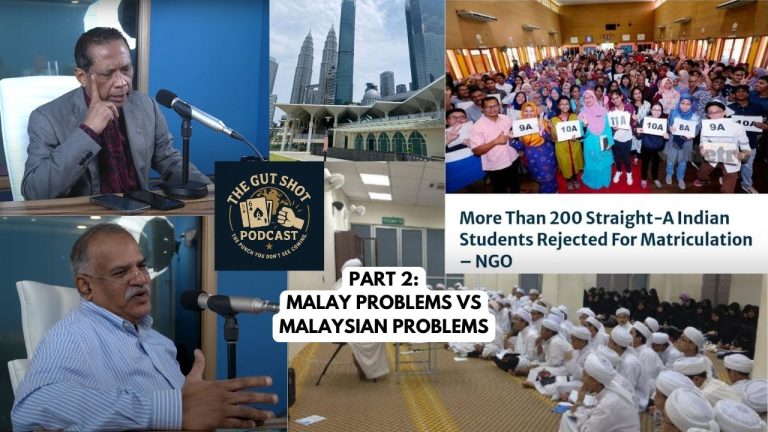
Part 2: Malay Problems vs Malaysian Problems
Show Notes & Description
w Syed Akbar. We do a deep-dive into why there are unique differences with the problems in our Malay society that are alien to other Malaysian communities. And why these problems eventually affect everyone. How do we solve those problems. We venture into what no politicians want to talk about and why that is so. We challenge decades long assumptions. This is the Gut Shot.
In this hard-hitting second part of our discussion on Malay problems versus Malaysian problems, we dive deep into the systemic issues that are holding our nation back from global competitiveness,. We tackle the "elephant in the room": affirmative action has become a permanent "IV drip" that is stifling the very people it was meant to help,. From millionaires receiving housing discounts to a lack of "graduation" from subsidies, we ask whether we are creating a society addicted to freebies rather than one capable of standing on its own feet,. This isn't just a political debate; it is a crisis of survival in a world that is moving at light speed,.
We confront the stark education gap where religious studies now frequently outweigh Science and Maths in our school system—a shift from the one-hour-a-week standard of the 1960s,. While our neighbours in Vietnam and Indonesia pour those same hours into STEM and AI, our children are falling behind in the skills required for the 21st-century economy,,.
We explore why the Malay Muslim community plays such a minimal role in our massive microchip industry, despite Malaysia handling 13% of the world's supply,. Is our culture of unquestioning conformity and feudal mindsets preventing our youth from becoming the critical thinkers and innovators we desperately need?,,.
Stop settling for political rhetoric about "unity" and start looking at the root causes of our decline,. We also highlight the unique, often ignored struggles of the Orang Asli and the indigenous peoples of Sabah and Sarawak, whose land rights are being swept aside by a "one-size-fits-all" policy,. If you want to understand why our graduates are struggling and why the AI revolution might leave us in the dust, this conversation is essential viewing,,. Join us as we demand a different way of thinking to make this country truly thrive.
Podcast Chapters:
• 0:00 – The "IV Drip" Trap: Is Affirmative Action Killing Competitiveness?,
• 3:42 – Why Giving Millionaires a 7% Discount is Sabotaging the Poor
• 7:15 – The 7-Hour Deficit: How Vietnam is Outpacing Our Education System,
• 12:30 – Are Islamic Universities Draining Our Finite Economic Resources?,
• 16:55 – The "Sedition Act" of the Mind: Why We Are Afraid to Think
• 21:10 – AI Wars: Why Chinese Schools are Leading the Tech Revolution,
• 26:45 – The Missing Malays: Why 13% of Global Microchips Aren’t Enough,
• 32:15 – From Debate Hubs to Propaganda Machines: The Death of Boarding Schools,
• 38:50 – Beyond the Peninsula: The Forgotten Land Crisis in Sabah & Sarawak,
• 44:20 – The Mahathir Mirage: Why "Uniting Malays" Won’t Fix Our Highways
Many thanks to CITYPlus for their collaboration with The Gutshot Podcast, in whose studio this conversation was recorded. CITYPlus is Malaysia's first Chinese business radio station, dedicated to delivering in-depth analysis on local and international current affairs, markets, and businesses.
Jump to chapter 8 chapters
- 0:00 The Permanent IV Drip of Affirmative Action
- 8:03 The Hours Deficit: Religion Versus STEM
- 15:51 Critical Thinking and the Culture of Conformity
- 27:33 AI Modules and the Chinese School Advantage
- 32:55 The Microchip Economy and Missing Malay Engineers
- 37:45 The Evolution and Decline of Boarding Schools
- 54:06 Indigenous Land Rights in Sabah and Sarawak
- 58:47 Moving Past Political Calls for Malay Unity
Auto-generated from YouTube captions. Timestamps link to the video.
Welcome back. Uh I'm Sam and uh here we are with my friend S Akbar. We are going to be uh continuing on part two of this discussion on um Malay problems versus uh Malaysian problems. Right. We stopped at part uh when we talked uh about uh this topic uh at a point where we were talking about minority community that did not have um opportunity because of um the uh affirmative action so to speak that has been taken on on a race based uh uh on a race basis uh to favor the uh Malay community especially which you know we expanded it to so-called bumira community. Um this uh I think that will
take us into uh the learning environment the critical thinking um that that is faced by um by our societies. Uh but let's start off uh talking about this imbalance um as a result of this affirmative action. Should we continue with these affirmative actions that or I have my point of view on this? Uh but say let's kick it off with you.
Yeah, I've I mean I we have discussed this in previous broadcast. My view is that yes, we do need we do need the affirmative action. I think we will need it for a long time. But the affirmative action has to be structured uh properly. When we send our kids to school, they go to uh day what do you call this? um kindergarten then they go to primary school. Uh we call it primary school because it is primary education. That education is at the most primary education that any human being needs foundational
foundational learning to read and write. Then only then you go to secondary education and then you go on to university. But at every step along the along in the process in this process there is a graduation. You learn to read and write. You learn to count. You learn to multiply. That's primary school. Then you go on to secondary education. You learn things like arts, sciences, higher mathematics, things like that. And then you graduate from there you go you go into university where if you qualify where you learn uh skill sets you know like you become an engineer, you become
a doctor whatever those are specific skill sets. So at every step of the process there is a graduation there's an improvement. In affirmative action in this country, uh the graduation process is a little bit stunted. We seem to put people on permanent IV drips from birth to death. You know, it's like affirmative action all the way with uh no proper graduation built into the affirmative action system. A simple example, the Bumiutras get 7% discount to buy houses. uh even if you bu even if you're buying a multi-million ringit bungalow house you get a 7% discount I don't think that
is necessary you want to help the bumutras you know the uh medium income the lower income groups who are finding it difficult to save up to buy a house so if you give them a 7% discount a bohutra discount that that's that it makes more sense you see but when a guy can already afford to pay for a high-end condominium in Bangsa car or damsara or buying a Bangalore house you know and he still gets a 7% discount I think that is defeating the purpose because a person who can buy a high-end condominium in Bangsa or Damsara or a Bangalore house he's no more in need of affirmative
action he's already made it so this is where this uh cradle to grave kind of uh holding your hands and giving you freebies freebies uh does not help achieve that that other most desirable commodity in this entire story of affirmative action to make people competitive and to be able to stand on their own feet. That's the purpose of affirmative action. So that the community that is supposedly the beneficiary of affirmative action can compete and stand on their own feet with anybody else. But if you keep uh feeding them freebies and subsidies from cradle to grave, uh you're not going to achieve
that. You're making them permanently addicted to affirmative action, which is what the politicians want, I think, because they want the votes. Yeah. Well, I I mean, I look at affirmative action, I I'm not I don't know uh in terms of uh the needs. Uh I think I I just hate the word affirmative action. I'm sorry. This is my point of view. um because I think that if it's the government's job to actually ensure that um all the citizens are taken care of in terms of their foundational requirements, right? So that means that you don't differentiate uh on skin color, you don't differentiate on race,
you don't differentiate on religion. If you are going if you have um uh a less uh group a less uh uh uh a disadvantaged group of people that's the the best way to put it right and you provide the best for all your citizens. Okay. And if you make a bit of focus especially during the earlier part okay I'll I'll give that affirmative action uh point of view which is you bring them out of poverty put them in an area where they are allowed they are able to think they allowed they have time to actually uh and an environment that allow them to learn you know uh a
proper boarding school for example okay with all the facilities for their reading and science and mathematics and all that for everyone and especially uh if you have limited you you give it to uh uh disadvantaged groups as you you say fine right then you even the playing field so to speak um but I think we've been going on too far as you said the drip has been going on for like what 60 years
the IV yeah the IV is 60 years the patient is dying already. Okay. Um, so that means that your because we don't make them competitive. Yeah, we don't. And if you ask me, I said to me, I'm only concerned until they get to about 17. Okay. Because the minute they finish finish the secondary school, they got to decide or even before that whether they are more apt for uh for vocational work uh more apt to go into um uh just going out and being entrepreneur start as a salesman rather than going to a university or even a uh or even a college uh two-year college. Um I don't
see a necessity for everybody to go to uh tertiary education right I don't see actually if you ask me here's another part that's going to be controversial I don't see a necessity to have Islamic rel uh is uh Islamic universities it does not provide for productive economic activity so why are we spending money on unproductive activities because we need to as you In the part one per capita our children we need to allocate resources and our resources are finite right so we must make sure that they're going to be productive citizen by the time they reach 17
we we discussed in part one about uh uh religious education hours spent per week in religious education in schools as I mentioned when I was in school I think at the same time as as you
uh we we had one hour of religious class a week correct and that was it And religion was not something you would see every day around the school campus or in in government departments. You know, religion was kept at home and in your family and when you go to the mosque and and basically inside your inside you but now uh religious education in schools primary and secondary uh takes up many hours. I think u as you mentioned earlier it is is almost the same or more than the hours spent for science and maths together you know
science and maths together religious education is more than that that means you separate the science and the mathematics is even more you're learning you're spending more time on religion let's say on mathematics I recently saw a news article where we rank uh very lowly in terms compared to other countries in in the number of hours spent on science and maths education per year per year in our school system. Even Myanmar teaches more hours on an annual basis in science and maths than Malaysia and other countries are way ahead of us even Indonesia because we spend a lot of
hours on religious education in our primary school, secondary school and now even university. Now the first thing is I want to ask is what is so difficult about our religion that we have to spend hours teaching the kids in primary school in secondary school and even up to university. I know for a fact that medical students in our government universities they also study religion in medical school. So I is it is a religion that complicated and difficult that you must teach it to these kids? I have an answer for you though. Say
go ahead. Yeah. It's because we have over we have overproduced the so-called graduates of religion and they need a job and they need their jobs. Okay. And the government okay require them to be to be employed and to keep voting for them.
So remember we are still discussing Malay problems Malaysian problems. So when talking about religion Islamic education you are you are basically talking about Malays. So uh is it a problem? Is it not a problem? What is it? Okay, we have to compare. We live the world is so much smaller now. We are in instant communications with the whole world. You know, you can play chess with somebody in Germany online. You know, my kids used to you my kids used to do it 20 years ago, 25 years ago. The world is just so much smaller. We are competing with so many people. our neighboring
countries, neighboring, let's not use the word countries, societies, you know, societies of human beings. We are competing with different societies, you know, how do they spend their time? So let's say if we are teaching 7 hours of religious education in per week in our classrooms primary and secondary and let's say the Vietnamese kids at the same time they are spending that 7 hours in STEM science education subjects that will directly impact on their capacity to be productive. Let's not talk about what they're going to earn or not earn. directly impact their
capacity to be productive. uh producing uh what do you call this scientific and technology based output whatever it is they could be computer programmers they could be furniture manufacturers they could be vegetable farmers whatever
based on science and technology they're getting extra 7 hours of exposure per week that the other kid which our kids are studying religion so multiply that by the semester in the year by the years by six years or five years of primary six years of primary education followed by another five years six years of secondary education followed by maybe four years of university multiply that 7 hours every week that's the distance that they will be ahead
y compared to our kids who are studying religion now the counterargument reply could be that well our kids are ahead in religion by 7 hours a week you can say that and you can say that that is what I want because to me that is important. Fine. Now these are these are arguments. We we can debate that. But does it bring that economic return? Does it help you in in your productivity your tangible productivity in providing or uh your output providing goods and services that will help you that will help feed you and help feed your family? V is a vi the next fellow in say Vietnam or Thailand or
you're competing against all these people you're competing so they are seven hours ahead or have more exposure per week you know because they're learning STEM subjects other things you know which which will add to their productivity their output their real productivity
so you can say that oh you know I have a better chance of going to heaven you can say that uh but that is an event in the future I'm talking about, you know, here the I'm not even sure whether that's an event in the future, but go ahead.
Um, I mean, it depends on how how you behave. I don't want to debate that. But, you know, the here and the now, you're going to fall behind. Remember, let's keep reminding ourselves. We are discussing Malay problems versus Malaysian problems. Malaysian problems means people of other religions and races. It's the same thing.
So, so it accumulate. It's got a cumulative effect like a snowball roll roll roll roll roll roll roll roll roll rolling down the hill it gets bigger as it rolls down and then when it finally hits reaches the bottom it's it's too big and heavy and then it has to crash and it get destroyed cuz you cannot control your movements anymore. You you've accumulated so much of baggage and you really cannot control your future anymore. You get you drown in it. So the other societies in other countries the other societies within our country they do not face the same issues. So after so many years you
know you realize that how come there are still these differences are there the the um the variances uh racial imbalances that still there. Why are they not going away? Why are they not going away? because you're not looking at the other communities and finding out what makes them tick. Well, you have actually um structurally constructed uh a jail uh within your individuality, your children's indiv uh individual capacity uh because they can't they have been restricted from learning because you've taken away 7 hours of their day uh compared to the other community
per week. Yeah. Per week. All right. Sorry. You know, per say like that. So they're way behind already. How are you going to compete? They're only 24 hours in a day. Correct. It's how you spend your 24 hours in a day.
Exactly. If you want to be the best footballer, you better spend extra 7 hours. Yes. To become a good footballer. That's right. So I mean I look at it especially right now in the 21st century. We are in the middle of the 21st century, right? Already
we've got this century has gone by. Yeah. AI boom is come uh is is going on at the moment. We don't know how society is going to be restructured. Okay. Um if you were to ask me what I need from all these uh from from the education is to provide my our children um with critical thinking capacity and that critical and why you know people like ourselves been banging on STEM. It's not so much I want you to be an engineer. STEM makes you think.
Exactly. It teaches you to to have a critical thinking um and and and argue and and be logical in terms of uh how you approach a problem. You you are not afraid to think.
Yes. You're not you're not afraid of the thinking process. You're not afraid to ask questions. uh people who are forced to to conform you know to follow the mold
uh they become afraid of the of the thinking process itself they afraid to think something new just the thought process alone frightens them we we don't want to go into that we don't want to ask it's not a question of whether we can or cannot or or ask those questions it's rather should we ask those questions they are afraid people are ask afraid of asking questions And of course religion religion imposes conformity. Without conformity of course religion I mean religion is all about conformity. You have to follow
it's unquestioning faith. You cannot debate issues. You cannot go and debate your religion. You know is this true? Is this not? That's it's a bit too late. Religion is faith. You just have to accept it and believe it.
Um okay. Religion has got say what you want. Religion has a place in human society in you know for thousands of years and there's so many religions in this world but there is a difference when you overdose yourself with something. This is the problem. Anything anything if you're an exercise freak and you want to exercise 12 hours in a day it's going to impact the rest of your life. Your wife will probably pack up and leave. You know
if you're like into this exercise exercise I know people who do that. The whole life is about this exercise freaks, you know, how they sit, how they stand, what they wear, what they eat, what they drink. It's all about tied into that, you know, and then it's overwhelming. So, it's a question of overdose or not overdose. You have to have some kind of a you need a balance. But I think 7 hours I I think the the acid test is if religious education takes up more time than science and mathematics education, there's something wrong there. I I think I I
I think that in those days when we had one hour of religious education per week to me we did we go wrong? Well, here's the other thing about it. Are we monsters? Here's the other thing about it is that um um actually during our time you could even choose either you want to take art or you want to take religious stud religion as a as a as a class. Okay. There's even a choice provided for you. Okay. So to me I we should go back to the standard of where basically religion or religious study becomes something that is out of public school and taxpayers money but family commitment.
That's my uh point of view. You do it on your own time. You do it on your own money. this I mean we already encroaching into this area of of completely separating religion from state from the state you know which which I think is a good thing we should separate religion from the state in the sense that as you say you don't use taxpayers money to fund uh religion
especially a single religion and uh religious education if parents want to put their children through to religious school or religious education they can do it on their own time they and send them for tuition, extra classes, whatever. Uh but then again, okay, it is part and parcel of the of the uh the landscape in Malaysia. For a long time, religious education in school, but I don't see what is wrong with what we did in the 1960s and '7s. We had 1 hour of religious education per week. Now you know they teach primary school children how to conduct funeral prayers and uh you know the preparing
the body for burial they have courses for that and they encourage even primary school children to attend these kind of things whatever for I mean you don't need to teach young kids these kind of rituals and things there are other people who can do is I rather that they spend that time teaching those kids something that is useful to their immediate welfare you know as we I I mean that our focus of of our discussion obviously is their economic welfare their uh their social well-being in terms of uh you know learning for example ethics learning to respect the environment yeah uh hygiene
those kind of things you know which will help little kids in their I from day one. Well, you only have the children until between 12 to uh sorry uh 12 to 14 years in terms of the period of where you know I mean the Malay has a saying but you know which is uh you know if you went want to bend the bamboo you better do it when they young
right so once you get past that stage they're 15 they're 16 I'm sorry they you you can't do much anymore so so we are they are spending time learning things or being exposed to things which other communities don't use don't bother do not use up their time pursuing you know
and this is a big thing and the other communities are using up that amount of time to do other things which helps their well-being their immediate well-being their economic status and things like that so and then after 15 years 20 years we go like hey how come we've done all this and we are still falling behind
no not just that then what we that then what uh our people or our especially our politician they will say see you know uh you will never get that opportunity because they will never hire you of course they're not going to hire you because you don't come up to the standard
they blame the others it's not our fault it's somebody else's fault I mean so so so you mentioned critical thinking that that is the other thing when you compare the communities in Malaysia different communities the level of critical thinking uh criticism, asking questions varies.
If you look at the Malay Muslim community and other communities, there are significant differences. Um I know the Indian community, they they like to debate and discuss issues, you know, it's in their nature, it's in the language. You know,
a lot of good lawyers in the country come from the Indian community because they can debate, they can argue the point. Yeah, this is all because they are exposed to like you you should be able to think freely and question things and you know debate things which we don't have as much in the Malay community which uh we're talking about critical thinking you know so because you're not allowed to venture into so many of these alleys and lanes because they are mysterious and dark you know they just keep you from going down that road don't ask questions don't don't ask don't question
anything you have the sedition act in this country. You know, if you ask me, the the Malays don't need the sedition act. They they are their own sedition act.
Generally speaking, not just Malaysia. Muslim people. Yeah. It's self-imposed. They don't need the sedition act. They they will self censor themselves because they have this they're not used to like free unfeted open discussion and thinking which impedes. There's a cost to all this which impedes you your progress visa v your neighbor who is not impaired by this kind of behavior. So there is a cost. So we end up discussing things like this today. Malay problem versus Malaysian problem
because there is a difference but we have to overcome these issues. We cannot just say you know I don't care it's not my problem. No cannot. We all as I said we we we are one society. We live together.
We don't want to stick our noses into other people's affairs too much. But nevertheless, we should reach out and help our neighbors uh you know if they have issues maybe share opinions you lend a helping hand things like that to solve the problem. This is a problem with salo the the the the the way our politics work because u um you know the non-Mlay politicians uh does not say all this thing either because why um they are supposed to
sensitive sensitive it it's they they'll get criticized by the Malay community. Oh worse. Yeah. Right. Yeah. Uh and actually you you ask yourself this. So you've got a Malay community that does not uh that self-censor and then you've got a Malaysian community that actually does not want to be to to to broach the subject matter because it's sensitive. So we broach the subject instead of in parliament we talk like this. All right. I mean I I I I tell you why even if I were to start today uh why I'm not scared about the AI revolution because during our time we were well read. Okay. our our
uh we had we don't have that that self-imposed censorship and we venture because we are very fluent in English. So we had a lot of access to all sorts of haram knowledge. All right.
Haram knowledge. Yeah. Okay. So yeah, you could read philosophy, you could read about the communists, you can read whatever you want, right? Just read anything you want. Correct. So now now it's even better for the for for for for uh for society because everything is on this little monkey.
You cannot restrict any you cannot restrict exchange of information and knowledge. It's impossible. So if you if you nurture this way in schools right and what will happen is actually as you get to about 15 16 you come out and it doesn't mean that actually I mean look I come out uh with a chemical engineering I never did any chemical engineering in my life after that but the whole education from my uh STEM uh and and mathematics uh education allow me to think critically how to maneuver the world you know and uh take I started out frankly more of a salesman that's what I
did I came back in ' 86 there were no jobs it was a big recession time I don't know what year you came back 86 86 right okay I got you know so I I started out doing sales you know having doors so you this is instead of waiting for the government to give you a job. You go and figure it out.
You mentioned AI. Yeah. AI. The whole world is spending so much on AI money now on AI. Here in Malaysia recently, the Chinese schools have gone aggressively into AI.
They have uh the Chinese community. They have teamed up. They have uh there are few Chinese secondary schools. they have uh they have uh and they have teamed up with Chinese educationists and Chinese uh well basically Chinese universities private universities utar is one of them where they have crafted specific AI modules for secondary schools and then they've got some of the Chinese business people involved to provide some funding and sponsorship and things like that so they're moving it forward forward they've got specific modules in AI which they already introduced they have
already introduced in their secondary school system. Uh whereas in the government school system, we we are not seeing any AI yet. There was talk about you know introducing AI and this and that but I don't know what exactly they're going to do. Bottom line is so far we have not seen anything and also their approach uh uh it has yet to be seen or what exactly you know how are they going to introduce AI in secondary schools because it it really has to be thought um it's almost like a separate subject by itself uh or you can make it a part of your other teaching of of
everyday subjects like science mathematics and wherever because AI fits in everywhere even in history, geography but you have to focus on it. Uh which I think it is not happening yet whereas the Chinese schools are already spending money and going into it uh quite with some focus. Now so again all this will create different
speed the speed the forward motion the speed of the car will change. one car will start accelerating and going up you know beyond 50 60 70 km 100 km whereas the other uh the other community is still trying to play catch-up. Uh so again this is uh this is the issue it becomes an issue of when you're talking about government school system uh school again you're talking about Malays because it's heavily populated by Malay students heavily populated by Malay teachers versus other other school systems we have in the country and uh versus other education systems around the world.
We cannot just keep looking at ourselves and we cannot just look at Malaysia anymore. We cannot just keep looking at other communities around us. We have to to pace ourselves against the entire world because that's how the the things are now. Everything is you are in direct competition with the rest of the world. The world has come into our living rooms every day. AI you know I mean the here's the funny part actually if you understand the um the Chinese economy in China right actually the per capita GDP and median income uh per capita maybe they're about us or uh
further slightly up or slightly down depending on the data you look at right if you look at median income all right they actually lower than if I'm not mistaken, right? But regardless what let's say they equal to us or slightly more, it doesn't matter. Okay, but the problem is this, right? The thing is that means that if you were to ask me, if you go like that, that means that their cap cap capability should be about the same as ours or our capability should be the same as theirs. But why is it that when we build data center here, okay, the expertise need to come from China?
You see where I'm coming where you see where I'm coming with with what you just said about competing with the rest of the world. That means we are late. They come here for the cheap electricity and the cheap water. That means we are late
and less restrictions. In Singapore, they've made data centers very difficult, you know. Yeah, they have to use renewable energy. They have to have really strict water recycling. They they use water uh for the cooling system and all that and uh energy the renewables it is so much more expensive to set up a data center in Singapore. You're operating
of course. So the that's why they come here. Yeah. But in terms of the knowledge base, in terms of the capability, the import the people, you're looking at the same uh same level of economic uh of economic wealth or so-cal economic wealth per capita. All right? And yet they far ahead of us. Why 50% of our population okay is way behind that we cannot that we are not caught up with what is happening even to yesterday.
We uh we are really not paying attention to uh things that are really happening on the ground. We are totally cut off. You know since you talk about data centers now
there's a lot of a bit of hoo-ha going on or hype in the social media we we are Malaysia plays a critical role in the uh computer chip manufacturing you know we may not be a design powerhouse we may not design Intel does not have a design center here they may do some designing here but definitely we are in the assembly and more importantly the testing phase. You know, all these chips that are manufactured are tested before they are sold into the market. And we have a significant position in in this part of the chip manufacturing.
They say that 13% of all the microchips in the world go through Malaysia. And if there's any breakdown or or problem with the chip industry in Malaysia, America will be affected because a lot of chip manufacturers in Malaysia are Americans. M
so the entire supply chain will be thrown out of whack you know if anything happens to the chip manufacturing in Malaysia. So we we play a significant uh role in uh computer chip manufacturing and our largest exports the largest portion of our exports come from chip uh export of computer chips you're talking about Pinang and parts of Malaca maybe some parts of Slango. So we we this it contributes a significant amount to our export largest export but sad to say the Malay Muslim community plays a very small role in this computer chip manufacturing computer chip export or
working in the industry very very small uh role as you say the import engineers expatriate engineers the the semiconductor industry in Pinang is full of foreign engineer Yes, for a long time. Where are our local boys? So again, we are losing out. We are losing out. Uh this is a problem. This is a problem because our local boys, Malay, Muslim boys do not seem to be able to compete on a on an equal footing with in these industries where there cannot be government assistance. This is computer chip manufacturing. It is completely open to the world to open market forces.
You cannot go and ask for subsidies and work give me a certain number of jobs for Malays. You cannot do that. No way. So when it comes to the real stuff in the real competition, uh we we fall out. We lose out. Uh and for how long has this been going on and for how long will this persist? Our leadership remember in our earlier part one we spoke about leadership. The leadership doesn't seem to focus on all this. the the best they can do is that okay we have x number of uh public universities government universities in the country in in this x number of universities we have a certain number of
engineering faculties and every year we hope to graduate so many engineers and that's it and that will solve the problems you know no it does not you have you can graduate engineers but you have to teach your engineers to compete among other engineers in the field of engineering you Don't just produce an accountant or a lawyer and say I've done my job. No, he should be if you produce an accountant, he should be able to compete as an accountant in the field of accounting with anybody else.
Yeah. So I I I think but if if he keeps but if you keep saying that okay you've graduated as an accountant right okay you you want to buy a house I'll give you a discount you want to start a business I'll give you a subsidy. I I think at the end of the day
you've just created someone who's as you said addicted to the IV you know for their whole life a person who cannot compete maybe that comes to the point of culture that you have created right cuz after about 60 years of this uh plus the the the indigenous culture that we inherit right
are you talking about feudalism yeah why not Right. I I mean because uh culture plays a lot of part in the way we think and this is where to a certain extent I said you know leadership is about changing your muscles not the muscles not for you to actually pate the masses. You are there to lead the masses to um to a new country so to speak you know to where they are going to be successful. But uh what we have what what do we have in our culture for this long now in your opinion that uh you know that that that is different between us in the Malay society and us in the Malaysian society.
Let let me let me talk to you about the school that you went to. You went to a boarding school in Hippo. Can you mention that? No no no it's in uh it's in uh well it's a bit outskirt of alust. Uh I was in Sutan Haleim. They were for is a full boarding school.
Okay. Yeah. Right. Yeah. See the the boarding school system to me in the beginning they did a fantastic job. Uh they produced people like you you know who are pretty much independent say what you want. You can do many things on your own. This is the product of that boarding school system. What the why did the boarding school system come about and why was it so useful for the Malay community? Because we're discussing Malay problems.
Yeah. because uh we realized that I mean our leaders at the time realized that uh the the environment of the home the village environment in a community that was still lagging in many ways you know in those days 60s7s there were villages with no water electricity I mean it's quite common in Malaysia at that time uh there were no schools there were no schools I have heard stories of educationists in Malaysia uh my seniors in government uh they I mean they were in government after the government built a school they would send the education officer to all the houses in their neighborhood and tell
parents there's a school now can you please send your kids to school and there would be children in the house 10 years old 12 years old 13 years old who've never been to school so because there were no schools so we built schools and then we built but there was not enough because the culture of the living in the states in the in the village areas in the small towns It was still a basic culture, basic agrarian agricultural society, not exposed to many things, totally cut off from uh conversing in in in the English language for example, you know, um they it was not conducive to acquire
knowledge on an accelerated basis. So we created the boarding school system and then you take all these kids from their environment and you isolate them from their environment. And you put them in a new environment in a boarding school where you have to get up on time. There's discipline and uh food is served on time and there's a certain behavior expected and then there's an education which is controlled and then you have prep lessons. You have uh what do you call this uh time spent on your studies and then there's a lot of reading. There was debating societies and discussions
you know things like I can tell you. Let me let me add one thing I I'll give you a few uh two anecdotes. All right. Uh about my um my my experience in that particular school, we had a we had a a disciplinary teacher called Khal Ahmed. He teaches uh at math addition uh you know calculus and that kind of thing, right? So he teaches at math. He was the uh he he was he was very uh he was very sturd. So uh already passed away. Um he has a very simple rule. You're allowed to argue your case. If you got caught for something or whatever, you're allowed to argue. Okay? If you can argue your way
out of it, he will let you go. All right? If you fail in your argument, your punishment is double. Okay? So, I mean that I I remember it until today. I thought it was quite fun and it was uh it's a challenge, right? Uh for us kids, it was a challenge. I remember another uh another friend of mine, a Chinese guy, uh Chipan if you're listening to me, okay? Uh we used to argue uh in class, all right, uh you know, when in our free time cuz he's an atheist, all right, and I was uh uh trying to argue with him in terms of the existence of God and free will and how it matches,
right? And we had all these lively arguments. I don't think that will ever happen in our public school today. So the the boarding school system it created a sanitized uh atmosphere.
Yeah. Where it removed uh young Malay kids from their traditional uh kind of environment in the homes and the villages and the small towns and it put them in this uh boarding school environment where they did things like what you just uh described. I knew a friend of mine who went to a boarding school, a very famous one in Kaganga, you know, and uh he used to say that they used to argue things like what you are saying. They would read books on Buddhism.
Yeah. And uh talking about religion. Yeah. And it is a very civil argument. They would read books on Buddhism. They would discuss they would talk about uh issues on religion or anything. They would uh they would even talk about socialism things like that. It was a open discussion which was not available in let's say back home in their villages and towns in regular schools. So the the the board and then religion was very limited. It was 1 hour a week. Uh so uh they had a lot of time and it it framed and most of it was in English. So it created a whole generation of Malays who
bec who not only wellversed in um u I would say unfettered thinking modern thinking they could read and argue in English not glorifying the English language but it is a vehicle isn't it? It is a medium for you to acquire information
and from you can convert it into knowledge because information comes first if you if you get something useful out of it then it becomes knowledge otherwise you could it could be about the love life of Donna the Madona that is information I don't think it is knowledge so so uh this environment in the boarding school system was new sanitized and uh uh away from the the word is actually debilitating environment and culture that that the kids had back home. So as a result of which they were exposed to completely new way of thinking, behavior, new disciplines. From there we got a whole
generation of very capable Malays who have done well in civil service, government in the in the corporates and all that until uh 80s late 80s the the entire education system started going more on the religious uh religious track especially after 2000s you know where religious religions took over a lot of things in uh not only in our entire government education system including the boarding school systems, boarding schools. So today because of the of the extreme focus or the the overwhelming focus on religion, you find that uh even in the boarding school system,
people are becoming more religious conscious and they have lost that age which they had before. Yeah. say I mean just to add to that actually I don't want to send kids to uh boarding school system today because why I feel that it's a propaganda machine uh it's a brainwashing uh operation um it doesn't uh get it doesn't produce the kind of critical thinkers that we used to produce I would rather send them to Chinese schools
I there there there is one there was I don't know if they're still having the program program now because I've criticized it in my blog in my writings a few times uh some years ago, this is before 2018, uh before 210, there was a boarding school uh where first of all it is uh it is part of a larger boarding school system, the science college system,
but this was Islamic. So they call it the Islamic version. And in this particular boarding school, this particular campus, they introduce horse riding and uh shooting bows and arrows.
Okay? Because uh it is something that is recommended by the religion. They should have also introduced wrestling. But you know, wrestling is also recommended by the religion as a manly sport, masculine sport. But they actually bought horses and they had stables and the stables had to be air conditioned because horses you know in this heat and the some of the kids uh took up this horse riding because it was a that particular college was had an Islamic name to it and they wanted to teach the kids horse riding because horse riding is something which is which
religion encourages but who pays for it taxpayers money. I think it was a waste of money but uh okay that's one waste of money but the the thinking behind it that we should teach these kids horse riding okay for the for the sport of riding horses maybe that's a good thing no there was a religious twist to it this is what something the religion encourages so everything becomes has has got a religious angle um it does curb your your creativity and your thought processes because everything is seen from a religious angle and everything is justified from a religious angle. Bottom
line is the boarding school system now does not produce or cannot produce that kind of atmosphere which was there when you were in boarding school. I think uh if you go and check your old school today, I I do not know if it's the same as the time when you were there. I doubt it.
Yes, I can assure you it's very different. It's extremely different. It's not the same as before. I think the other part as well is so if I may finish your point. So last time we sanitized these kids, Malay Muslim children. We sanitize them from their environment in their houses and where they lived in the society because we thought they needed, you know, to be exposed to something new. Yes.
And then we put them in the boarding school. Now that environment which they left has come in to the the education system not just boarding schools but government schools that that entire culture has now followed them through the front door or the side door whatever so that there is no more sanitization from the you know from that kind of a of a system.
The other thing I say about I mean critical thinking is the questioning of authority. Okay. I mean this is where I find that uh you cannot question authority. Yeah. This is a part of the mind uh the the the feudal culture and mindset uh that we inherited for a long time. Now that you now when you talk about it like that actually it reminded me of uh my time then where um somehow or other this feudalistic way of thinking or authority you know not being able when a teacher tells you you can argue I'm going to allow you to argue
you're questioning authority you you're being allowed to question authority definitely All right. To the to the point where actually I was in my six form waiting for my SPM results uh O levels, right? And they sent me to uh science school in Kapila. All right. Um and I was like okay I'll go there to fulfill the time but I'm not going to go to class because I'm going to enjoy my next few months before my result come out because I was so sure I'm not going to do well and I have no time to waste you know I I I want to enjoy my I mean I so you and even the teacher at that
particular time you know who caught me still at why are you not in class and I told the teacher why he was like you know, so this kind of um um rebellion in terms of your mindset, right? That um I think is very very restricted. So how are you going to propel society uh or you know the with a with a culture that is conforming? you you you know you need uh non-conformist to actually propel society. In fact, if you ask me, that's what uh a Malay problem is. The one of the basic Maria problem is that we need to be non-conformist and our leadership need to teach and and and bring a nonconforming uh
uh what do you call path for the people I I I the way I look at it uh to be like other people. Yeah. to be like other communities because don't forget what you're saying is that there's always this you know visav vis or with reference to someone else the other communities in the country who are not impaired by the things that we are talking about now who are freer to do to say what they want to learn what they want
they are less um there is no uh what do you call this uh over over overarch arching overarching uh dominance of of rather
societal control control this stress on not thinking not questioning you know to conform to everything do not question basically uh others may not have as much of this kind of impediment being an obstacle to them. So again as the days, weeks, months and years go by, you find that other people are getting along just fine, you know, happily getting along and doing things and moving along. Whereas the amount of time, money that we have spent and all these programs and whatever that the politicians have have thought up does not produce the results which others are already showing.
No, because others are already achieving. I I guess because I mean you take the the immigrant community so to speak that's what you said by it very nature of being an immigrant you f for yourself uh you don't have to think on your back you have to think on your feet correct
and so and and and you have to actually uh uh you you accept the situation that you are in and work around it right and that does not occur in the Malay community. Um, and
in in an environment where the technology and everything else is changing at light speed. Yes. We, as you said, we you're far behind. You're far behind. We're now in the age of AI, artificial intelligence. I mean, it is so advanced. You really have to completely unfetter your thinking to be able to maximize the opportunities that are that are offered by AI. You know, otherwise, you know, it's like somebody gave you a a computer and you turn it on at night because there's some light illuminating there and you can find your keys and all that. You're not you're not using using
it to any good use. To be able to benefit maximum from AI, you really have to be able to open your mind and just let your thinking go, you know, unfettered. You must be able to say and think and ask anything you want. And then that will maximize the benefits you can gain from the AI. If you don't do it, other people will do it. They're already doing it.
It's all it's a AI is all about I mean it's artificial intelligence. It's all about mind. It's about how you think. So this is where this is going to be another problem and if the Malays don't uh maximize the opportunities being being shown or being opened up by artificial intelligence is going to become another Malay problem visa v Malaysian problems.
It's you know those those differences are going to be there because we're just not paying attention to identifying the root causes of our problems. And this is where we have to go beyond just Malay problems. As I said, there are other communities which also have certain issues, certain problems. We have to find out what are the root causes of their problems and solve it. You have the we have our our Bumira people in Sabah and Sarawa. They have issues. They have issues in Saba and Sarawa which is very unique to them. You see over here in in Peninsula, you have Orurangasi issues which many
people don't care about except for our friend Kasim. Huh. But one of the issues of the Orurangasti is that they don't have title to the land on the they have been living on I don't know for the last how many thousand years. This is especially true in certain states in the east coast where the the the state government has told them under national land code you don't have title to the land that you live in. You you don't belong here but they've been there since time immemorial. Now the same issues uh affect the indigenous people in Saba and Sarawa. this issue of land ownership cuz they've
been there before the country was formed but now they are finding out that they don't have title or land has been sold this and that you know and they are displaced. So uh these are again issues specific to that community and it's very important because these are communities which are very closely linked to the land that they live on not just for their for their livelihood but their entire culture their family system everything revolves around the little piece of land that they live in and the long houses they live in. It is so critical. If you remove them from that
it's like throwing them in the middle of the sea. you know they have no other way of survival. So these are issues that are unique to to the indigenous people in Sabah and Sarawa especially in Sarawa a lot of cases again we have to identify these issues can we reverse this land issue I don't think so land will always have to be developed you we you will always need land to do something with it if one person doesn't use that land to its maximum or optimum benefit somebody else will do it that's that has been the nature of land since I don't know when in any anywhere in the world if you do
not know what to do with land somebody else will come and take it away from you so we have to prepare this our people in Sabah Sarawa to be able to deal with this and overcome this so they need other skills they need other capital they need other capabilities so that they can fend for themselves and so that they can disengage from this dependence on a very traditional way of living. It's I mean it's a traditional way of living. But if you if you live on your own planet, you can maintain your tradition.
At the end of the day, I think the world moves on. You can try and and um that's it. If you don't change, you're going to get left behind, right? Not just left behind, you just got I mean, let's put it this way. It's the nature of human civilization.
That's it. But you can't tell orangi, hey, look man, you don't have the land. You have to find a way. You got to find something. Yeah. So this issue is specific to the orangasi is specific to the indigenous people the buudra and sabasawa just like there are malay problems these are issues with the orangasi problems these are the indigenous people's problems in the east in sabasawa we have to focus on them these need specific treatment specific solutions just for them which it's not one sizefits all right now they're saying one size fits all you're not under the national land code you don't
have title get out you know that's not the solution. So so what I'm trying to say is that uh the biggest community of course is is the Malay community and there are issues many issues with the Malay community problems which ultimately affects all of us. We all live in the same country. So uh we cannot ignore it. uh the Malays have to become more aware of what are the issues that are affecting them that may not affect other people and therefore they need unique solutions you know to solve this pro these problems and it is best if these solutions come from inside the community
the Malays have to step up and realize what are the issues real issues affecting them and demand for solutions to these problems and what is the end result so that you be you stand you come on equal footing with other communities
equal footing in in competition in economic well-being in social status everything you know the there must be a graduation when you solve a problem what is a desired outcome there must be a graduation you must reach a certain place where you are the same as the guy next to you then you say that we have arrived otherwise it's just politicians prolonging the issue because they want vote Every time the election comes around, they like to highlight issues, land issues, Malay rights, Malay agenda. You know, somebody recently was saying Malay agenda. Dr. Mahade says he wants to unite all the Malays.
Okay. I don't know. Hold on. He I have to I have to you have to give due regard. He built the Ka in under four years. I mean, I was a banker then. I've been involved in project project management. Uh it was a miraculous achievement. Build such a huge airport in under four years. No other country can do it. We built power stations in 24 months. In Spain it take it took 10 years to build a power plant. He built the north south highway in 4 years. Huh. Okay. So now he's he's going to unite all the Malays again. Uh did I mean what do you need? I mean you you build these
things, right? So if you're going to unite the Malays and all that now, weren't the Malays were they united when he built the first north south highway or were they not as united? I I don't know what is this issue was uniting the Malays cuz he already did all these things. We need another highway now. We need more highways. Do we have to unite the Malays first before he can build for example North Highway? That airport now it it still is still a worldass airport but now it's like you know
Yeah. because um there are some issues here and there, the train keeps breaking down. Why not build another airport? You know, international class airport. So, do you have to unite the Malays first before you're going to build another airport? He did it once before. So, what is this talk about uniting Malays? Uniting Malaise just go ahead and build. We need another airport. Build it. He did it once. I build more highways. Dr. Mah I, you know, if you ask me, the name of the highway should be changed. Put it under his name. here's the problem. Anyway,
so you know, uh we need to um we're talking about Malay problems. Uh the politicians like the problems. They like to say that no, we're not united, we're under threat, so we have to unite. No, they are more important things uh to do in the in the time that we have. Uh instead of bringing up these kind of issues which don't help the Malays at all. On that note, I think we we address quite systemic issues plus uh you know some a few uh examples that we look at. Uh well this is a huge topic if you ask me personally. I hope uh our uh uh our audience uh has taken you know uh
valuable things from what we talk about and uh we hope policy makers are also listening and our leadership also listens and realize that actually to make the country go um we need a different way of thinking you know
to question and to debate to question yep I mean uh to argue to question debate to have an unfettered unfettered mindset for the uh for for all you know. So on that note uh please uh subscribe. We want to keep going and um and and we'll see uh you again on the next episode. Thank you so much.
Thank you. Thank you very much.