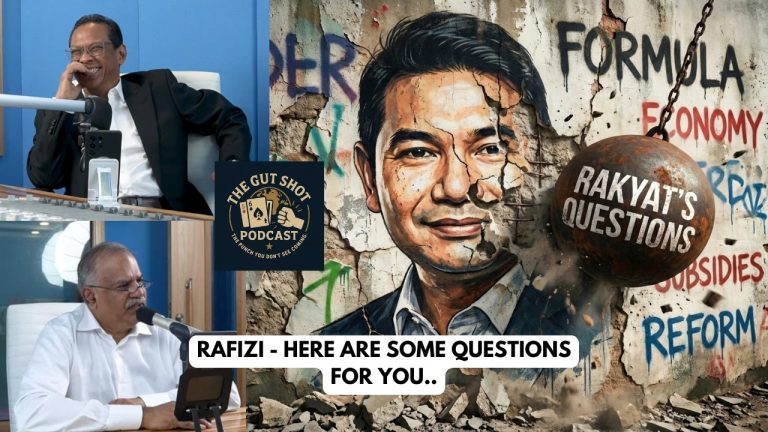
Dear Rafizi – Here are Some Questions for You?
Show Notes & Description
Rafizi Ramli, the Member of Parliament for Pandan has been on the outs with his Party (PKR or "People's Justice Party") and since his resignation as Economy Minister in June 2025 – we have a number of questions we want to ask the sitting member of Parliament.
Starting with why the loud complaints only now? What stopped you from speaking out when you were walking the corridors of power and in Parliament?
Plus we have a host of other questions we want to ask our Wakil Rakyats who we elected to serve us in Parliament. Questions we should ask any of the other Wakil Rakyat we put into OUR House of Representatives.
You do serve us .. yes?
Welcome to Episode 61 of The Gut Shot Podcast! I’m your host Shamsul Sam, alongside Syed Akbar, and today, we are taking off the kid gloves. We are aiming our sights directly at YB Rafizi Ramli—a man who built his entire political brand on the promise of institutional reform.
But after his recent stint in the cabinet as the Minister of Economic Affairs, the rakyat is still waiting for real change.
In this explosive episode, we aren’t accepting any wishy-washy PR statements; we are demanding hard, "Yes or No" answers to the most critical issues suffocating Malaysia's true potential.
While we deeply respect those who brave the system to speak up, it is finally time for accountability.
Will Rafizi finally deliver on the decades-old promise to abolish the unending financial burden of toll roads?
Will he commit to tearing down the archaic Sedition and Defamation Acts that thin-skinned politicians constantly use to criminalize free speech and silence everyday citizens?
We also tear into the brutal economic realities that traditional media completely ignores. We reveal exactly why Rafizi's new RM5 affordable meal initiative, Kasum, is just treating the symptom instead of the disease.
If we want explosive economic growth, we must shatter the banking oligopoly that starves small businesses and forces them into the hands of illegal loan sharks.
We must break the elite monopolies—like the cartel controlling our daily rice supply—and forcefully remove bloated, taxpayer-funded GLCs from competing against the very citizens who fund them.
Finally, we discuss how overregulation is quietly destroying affordable private healthcare in our local communities.
If you want to uncover the hidden forces holding our economy back and discover what genuine, fearless reform actually looks like, you cannot afford to skip this conversation. Hit play, join the Gut Shot movement, and help us crush our 5,000 subscriber goal!
(Rafizi, the invitation is wide open—come on the podcast and prove you're ready to lead.)
Chapters & Topics Covered:
[00:00] The 5K Sub Challenge & Why We're Targeting Rafizi Ramli – Setting the stage and examining the high price of speaking the truth in Malaysia.
[04:30] The Multi-Billion Ringgit Question: Will Tolls EVER Be Abolished? – Demanding a "yes or no" on the ultimate reform promise they’ve dangled since 1998.
[10:15] Sedition & Defamation: Why Are We Still Defending 100-Year-Old Laws? – Exposing how thin-skinned politicians weaponize the legal system against you.
[18:40] Why RM5 Meals Won’t Save Malaysia’s Economy (The Brutal Truth) – A hard look at Rafizi's new ventures and why retail band-aids won't fix structural rot.
[24:50] Exposing the Banking Oligopoly & The Rise of Illegal Loan Sharks – How exclusive banking clubs are starving SMEs and killing our GDP.
[32:15] The Great Rice Disappearance & The Cancer of Monopolies – The shocking truth behind missing local rice and the import cartels bleeding us dry.
[38:20] The Courier Protectionism Scheme – How new mandatory regulations are secretly destroying free-market delivery choices.
[44:10] Why the Government Must STOP Competing Against Its Own Citizens – The illogical and immoral reality of taxpayer-funded GLCs monopolizing private business.
[50:30] How Bureaucracy is Secretly Destroying Cheap Healthcare – Why your local maternity clinics are going bankrupt thanks to the Private Medical Healthcare Act.
[56:45] Our Ultimate Ultimatum & Open Invitation to Rafizi Ramli – Will he take the Gut Shot challenge and face the music?
Jump to chapter 10 chapters
- 0:00 The 5K Sub Challenge & Why We're Targeting Rafizi Ramli – Setting the stage and examining the high price of speaking the truth in Malaysia.
- 4:30 The Multi-Billion Ringgit Question: Will Tolls EVER Be Abolished? – Demanding a "yes or no" on the ultimate reform promise they’ve dangled since 1998.
- 10:15 Sedition & Defamation: Why Are We Still Defending 100-Year-Old Laws? – Exposing how thin-skinned politicians weaponize the legal system against you.
- 18:40 Why RM5 Meals Won’t Save Malaysia’s Economy (The Brutal Truth) – A hard look at Rafizi's new ventures and why retail band-aids won't fix structural rot.
- 24:50 Exposing the Banking Oligopoly & The Rise of Illegal Loan Sharks – How exclusive banking clubs are starving SMEs and killing our GDP.
- 32:15 The Great Rice Disappearance & The Cancer of Monopolies – The shocking truth behind missing local rice and the import cartels bleeding us dry.
- 38:20 The Courier Protectionism Scheme – How new mandatory regulations are secretly destroying free-market delivery choices.
- 44:10 Why the Government Must STOP Competing Against Its Own Citizens – The illogical and immoral reality of taxpayer-funded GLCs monopolizing private business.
- 50:30 How Bureaucracy is Secretly Destroying Cheap Healthcare – Why your local maternity clinics are going bankrupt thanks to the Private Medical Healthcare Act.
- 56:45 Our Ultimate Ultimatum & Open Invitation to Rafizi Ramli – Will he take the Gut Shot challenge and face the music?
Auto-generated from YouTube captions. Timestamps link to the video.
Welcome to the guide short podcast. I am Shamsul Sam, your host. Uh here with me again is uh Syed Akbar. Morning. Morning. Today we're going to go a bit more political. Uh
and very specific to it. Uh hope you all can like and subscribe and get our numbers up to 5,000 subscribers by the end of this month. We're getting there, guys. Now, um our we have a We have a very interesting uh discussion and uh conversation for you all. Uh really what we want to ask is uh what's going on with Rafizi Ramli? And we have a few questions uh on them specifically. I think Syed, you have a few questions you want to pose. This is more right down your alley. I'll join in. Syed, kick the ball. Okay, thank you. Uh again, uh good morning. Uh our discussion today we decided to
ask a few questions now. Pose a few questions to Rafizi Ramli. Uh YB Rafizi Ramli. Um Okay, this is not any kind of uh state of hormones, assault, or naval attack. Uh we just want to uh discuss a few things which I think is relevant. Uh Uh Rafizi is now I mean he's high profile. He's and he's got a a fairly good image, all right? Uh as a reformer, as a politician. So, he's sort of leading the charge to uh to what do you call this? Um try to deliver on the reforms of which he was a part but were not delivered. In fact, he has quit from his cabinet position and things like that.
So, but now he's speaking, you know, he's very vocal. He's saying many things uh I think which is appreciated now. Uh but before I go into any details, I just want to say that um there are people like Rafizi in our country who have to be appreciated because they are willing to speak up. And you know, in this country when you speak up a lot, uh more often than not, you face various kinds of uh you know, you face various kinds of obstacles now. Including uh you know, you might have to face the law. Other than Rafizi, you find that people who speak up are like Cikgu Bard. That
this guy Cikgu Bard. I don't know if they they are on opposite camps or whatever, but nevertheless they speak up. Both Rafizi and Cikgu Bard are well known for exposing various controversial issues and uh some scandals and things like that, huh? So, there are people like Rafizi and Cikgu Bard. All these people who are willing to speak up and be counted now. Siti Kasim is one of them. I also include Zaid Ibrahim. I I would also include you. Okay.
Uh and there is a cost now. There is a cost to doing all this. You're always in this country, yeah? Your thoughts can be criminalized, you know, for speaking up, huh? So, that's always the danger. Uh and Rafizi is a guy I think who's been charged, you know? He's been charged in court. Uh Cikgu Bard has been in and out of lockup and questioning at the police station, huh? My personal experience the last 30 years, yes, the last 30 years or more of my writing, my blogging, writing newspaper columns, I have I've had some brushes with the law now about five times now.
Twice I was called by the authorities. The last one was by this present administration. I was called to meet one of the agencies about 2 years back. Uh in the previous governments, I received two letters of demand from lawyers now. And uh a long time ago, about 20 years ago, I was charged in the court. All for speaking out. My my brain is functioning.
You think of something Yeah. and you write it down or like this podcast, we speak about it. And uh if things go wrong, you can be held criminally liable Mhm. for thinking and speaking and writing. So, there are uh what do you call this? Risks or hazards that come with the with this kind of work. So, I appreciate what is being done by people like Rafizi, Cikgu Bard, and the others who are willing to stand up and sometimes they pay the price, huh? But nevertheless, they are uh stra- what do you call it? They are pejuang now, huh? They are continuing the struggle, which is a good thing.
So, uh they have to be appreciated. In that sense, I I appreciate what Rafizi has done. But I may not agree with all his uh politics, huh? I mean, that's a free country, you know? We have the right
We don't have to agree on everything. problem. Yeah. I I didn't quite agree with the party that he was and still is uh associated with or the people whom he he he worked with, huh? But uh that's the beauty of democratic society. You have freedom of association. You have freedom of speech. I wish we have freedom of speech.
Freedom of thought. So, and we have to defend these things. Yeah. So, although we may not agree, it doesn't matter. We have to defend Rafizi's right to say what he wants to say and uh Cikgu Bard's right to say what he wants to say and also our right. So, that is the mark of democracy and free speech. So, that's important now. So, uh that is my opening remarks on Rafizi. Uh he's had a long career in uh PKR. Uh he's served various positions in the party and he became a member of parliament now in uh 2014 and then uh 2022 again he was returned as a member of parliament for
uh what's that place called? Uh oh, I forget. Anyway, it's in town. It's in KL. Mhm. Pandan. Okay. Yeah. So, now he's still the MP for Pandan. Uh so, now I think he has had some differences with the party that he's in and he's resigned his cabinet positions because I think he lost the He was trying for number two spot in the party but he lost the party elections. So, after that he quit. So, now he he goes around saying a lot of things about what we need to do. Uh but here I'd like to discuss certain things that which we have discussed before in our podcast on what needs to be done in our
country for real reform. I want to put these ideas and questions which we have discussed before to uh Rafizi, yeah? And I hope uh we can get some kind of an answer from him or maybe, you know, he will listen and acknowledge what we are discussing because these issues uh to me now uh the the really relevant issues in the country, yeah? So, like number one on my list now which we have discussed many times before, when you talk about reform, uh when are we going to see the toll roads abolished? You know, this is a I mean, it's a fair question. When can we see the toll roads
abolished, huh? Because before when the reform reformasi movement started late 1998 until they won the election now first time in 2018, all these were part and parcel of the of the reforms that were being uh uh you know, everybody was uh making noise about issues like this, huh? The toll roads were were a big issue. All these years of asking for reform, people against the toll I mean, the unending collection of tolls, huh? So, I want to ask Rafizi, what is his stand on the toll roads? Because uh he became a minister under the the present government now 2022. Is it
yeah, he became Minister of Economic Affairs and all that. My in part of the government, he's part of the part of the ruling coalition, a part of the government. Regardless what what minister he was, he was Minister of Economic Affairs, but he was part of the government now. And now I think he wants to get back in and he provide leadership to the country, fine. Uh you know, I can respect that. But uh on a basic question like this, what is his stand on the toll roads? I want to hear a yes or no answer. Mhm. Uh please don't give wishy-washy answers, huh? That oh, we
we cannot do this or we have to, you know, restructure or it may cause what do you call this? It may cause uh uh disruptions and things like that. No, I think it's it's high time, huh? We just need simple yes or no answers. That's that's my number one issue, you know? I think that's fair enough because why? You promised on abolishment of toll road. All these were part and parcel of the remember the manifesto by Dr. Mahathir, yeah? 200 page or whatever now. All these things were there. Yeah. So, this was this was this was part of the struggle. Mhm. And the JKR is still alive. Right?
Uh So, why are we funding the JKR and we are funding the uh toll road as well for maintenance? there are ways of doing it. We also have the We also have the Lembaga Lebuhraya Malaysian and all that. Those are can those things can be sorted out. But I'm talking about the main idea the cost of the year. Yeah. Because I remember in those days now when the reformasi movement started, you know, they used to what use this word Mahazalim and Mahafiraun. Mhm.
It was targeted against Dr. Mahathir now. Yes. That everything he did was either Mahazalim and Mahafiraun. Okay, fine. But you have arrived. Right. You are now in control. There's no more Mahazalim. Mhm. I know. You know? So, these are the questions I want to ask. Simple one now, the toll roads. What's going to happen?
Especially the intra-city tolls. Mhm. Sometimes my wife and I we drive in town or somewhere and there's a traffic jam. You know the Google Maps? It gives you alternate, huh? Says you go this way, it will save you 6 minutes, huh? So, we go like, "Okay, let's take it." And there's two two extra tolls. So, let's put it this way. So, the first item that you you you you got you you we asking Rafizi is that give us a yes or no answer on are you going to abolish the toll road? Yeah. Okay? The how becomes later. If Trump can promise to do 10 things and he delivers 10 things whether you like it or not
all right? You can definitely do better than Mahathir. So, if you promise an abolishment of toll road please let us know. Yeah. All right? The initial the will must be there. You must say yes, we will do this. How do you go about exactly restructure, you know, bond issue by government as you say calling JKR or whatever, those are the the nitty-gritty clerical stuff. It's clerical stuff, we let the clerical staff take care of those things, huh? It's not our job as the the leaders of the country to go and get involved in all this nitty-gritty clerical stuff. You have to decide yes or no first,
that's very important. Fine. What's your second question? There are many, yeah? So, this this are Let's go to your second question. Okay, these are economic issues, huh? What about the Sedition Act?
My favorite. Huh? I mean Rafizi should know he has been charged in court, I think not not Sedition Act, I can't recall, but he was charged in court. But he knows the dangers of, you know, if you say something and then the the authorities don't like it or they find fault with it. They can come at you under various legal I mean using various laws, huh? Sedition is one of them, the MCMC Act and the other avenues open up legally for the government, huh? So, the government acts legally, they have they follow the law, they go by the book, huh? But my question is do we need some of these laws, huh?
We're not anti the government per se, we are anti this kind of laws because if you don't change these laws, any government will use it you know to their benefit or use it in a way that doesn't seem fair to the people. So, we have to change the law. So, the Sedition Act again, it was in that the reformasi movement. I think it was in in top five in their struggle in those days, you know, that they wanted to abolish the Sedition Act and the MCMC Act. These are things that they didn't like. So, Rafizi was a cabinet minister. He is still part of the ruling coalition. And now he talks about, you
know, doing this, doing that, reform and stuff like that. I want a straightforward yes or no answer from Rafizi. Will you abolish the Sedition Act or no? Yes or no, simple question. If you come into power, you can't say, "Oh, you know, it will cause some waves or it will there is there might be a period of transition." No, no, no, don't give me all this. Just yes or no.
Don't give me all that crap. all this. No, the question is you said, "Oh, I don't have the coalition." That's not what I want to hear. I want to hear you say, "I'm going to work to abolish the Sedition Act and get the the parliamentarians to ensure that we can abolish the Sedition Act." That's all I want to hear. And I want Rafizi to know, huh? We are actually giving him a secret weapon, you know. Mhm. You give a positive response on these questions, huh? Mhm. You will win the election. Yeah. You will become prime minister. Mhm. And you you might even win two-thirds.
You don't deliver this, huh? You do all the other things, these coalitions and whatever it will cause euphoria. You know, sometimes when you attend a course, you go and attend some course overseas or whatever about, you know, some management or motivation course. You come back for two, three days you have this they call it a the post-conference euphoria, you know, huh? You feel great, I learned something new. Then after 1 week is over you you forget about everything, huh? So, the same thing, you know, you can't have this euphoria, you know, I'm going to do this, I'm going to do that. But
when the reality comes, huh? I'm still paying toll. Mhm. Can I say something, Said, about the Sedition Act? Yeah, go ahead. Right? And and you know, I'm still paying toll and you're right, I'm still under the threat of Sedition Act as we speak now in this podcast. Really? I mean, yeah, yeah, we are going public, you know.
Oh, of course. But here's the thing about Sedition Act, all right? Okay, number one I I remember a case not so far back where somebody was charged for trying to topple the government. Okay? Let me put it this way. It is a citizen's right to topple the government. Okay? Because why? We have the power of the vote. Only through the ballot box, huh?
Through the ballot box. We are not suggesting ANYTHING ELSE. NO. I think you better clarify No, I'm here. Look, and here's the problem. Okay? Here's the problem. You can also lobby your members of parliament to pull out from any government coalition. All right? Which will then result in a government not being able to be formed. That is democracy, ladies and gentlemen. Okay? The other part about criticizing your political leaders, even your elected political leaders, your cabinet minister, your prime minister, do you know that in developed countries the bar for defamation
is so much higher for a public servant. Okay? There you must show malicious motive. Do you know that's practically impossible to to to attain? Okay? Why? Because in developed country they know that politicians are a bunch of liars. Okay? So, they allow the rakyat, the small citizens to say what they want to say. That's why you got meme of Donald Trump, of all sorts of thing on him, on Bill Clinton, you know, that in Malaysia would make you go into the lockup. Okay.
So, I think we better become a developed country, Said. Let me let me skate a little bit away from the very thin ice. Okay, please skate the very thin ice. Away from it. Yeah, you're right, you know, that's the other thing. That's the other thing. Our we have discussed this before, our defamation acts the libel laws, the libel and slander laws, the defamation acts, they are archaic, they are I don't know, 100 years old, and the and they seem to benefit the the plaintiffs. It's very easy to sue people Yeah. for defamation, slander, libel, and in I'm talking about real history,
I'm factual, the people who've been doing a lot of these sending legal notices for this libel or defamation I seem to be the politicians, huh? Yeah. They're always suing other people for because they don't like what somebody said about them.
They're so thin-skinned, huh? Thin-skinned. So, so in other countries they have overcome this long time ago. If you're a what you're referring to is a public personality, yeah? If you're a public personality, politician, artist, actor, billionaire, businessman, whatever, and then you want to sue somebody for, you know, defamation or slander and all that, they make it very difficult because you're a public personality, you depend on the public for your livelihood, especially politicians, huh? Yeah. Then people criticize you, they say something you don't like, you can send a legal letter
to them, it doesn't make sense. So, our but in Malaysia this possible because we have not amended our defamation laws. We have we have third world third world since banana republic. Before independence, they've been there, I think before the Second World War, it's it's a leftover from the British days, huh? So, this is another thing, we really have to amend our defamation act and this is reform. So, I want to ask Rafizi, will you amend or not? Give a yes or no answer. You know, just say yes, we will reform it. So, you do things like this, uh you will win the elections. Otherwise, you know,
I don't know whether the politi- politicians realize this or not. Now, as you mentioned this there is a general dislike. There is a very general dislike of politicians. of politicians in the in the country in the society, especially among the young, the young just don't seem to like the politicians, huh? And one of the reasons is this. Every once in a while we hear the politicians suing somebody Mhm. for saying things about what they said in public to basically to get votes. Mhm. So, you say things that you think is is suits you and then when someone criticizes or says
something nasty, you sue them. So, you think you're doing a good thing or or great thing. But it makes you very unpopular. So, today, a lot of young people don't like this kind of behavior among the politicians, huh? So, but we have to put a stop to all this if we amend the defamation act. So, this is another one of those items. So, again, the question goes today, my question since we're talking about a few questions to Rafizi, yeah? Will you will you amend the city the defamation acts in the country? We have to, it's about time we grow up. We are as you say, we're not
third world country, yeah? Yeah. And then along with that the is is one set, is that Sedition we need to abolish. Defamation Act. MCMC Act comes together with the defamation. The MCMC Act, we don't I don't think we need to abolish it. I mean, we need some kind of laws to to regulate and monitor this mass media and all this what do you call this online media which is which is fine. I I I I may not agree with you on that but so go ahead. But but you know there are parts of the MCMC which are seen as very arbitrary. It gives undue what do you call this discretion to the
authorities to decide what in they think is right or wrong good or bad you know so it's a bit subjective. So we need to abolish that portion of the MCMC Act or reword it so that there's no this arbitrariness. There's no ambiguity make it clear cut you know. So that's it. So again we want this amended. I have never heard Rafizi talking about this. Or maybe he has I don't know but these are the things that need to be changed. Make it clear. Make it clear. Yeah. Point blank and put it on your agenda now. You know. He talks about a lot of other things but I think these are the main things
which were promised for the last 20 over years which has not been delivered. Let's let's let's let's that I I want you to I want to steal I want to take advantage of this and steal steal your steal your conversation so your question because he was the Minister of Economics. He was a cabinet member yeah. He was a cabinet member. Yeah. Right. I I am not so sure what exactly he accomplished as the Minister of Economics. I only remember was it him or was it somebody else that officiated this flying uh uh the flying car ex uh that was not Rafizi that was not Rafizi yeah. No that was another guy.
That was another fellow. Okay. Under Dr. Mahathir. Ah okay. So anyway uh Said Yeah. What's the next question that you like to put to Rafizi? Yeah those the the tolls is is main thing on economic issues. Then you know there are many things wrong with the with the economy and Rafizi himself is now involved in in this initiative. It's a couple of businesses or kind of ventures. One is called Kasum. Another one is called FlexiMart. Mhm. Basically Rafizi has set up these ventures uh to get young people involved in business to train them up especially young young Malays and all that. So like
FlexiMart I think is like it's a convenience store. They have one branch I believe at Shah Alam. I got this info from a friend of mine a lawyer who is a fan of Rafizi. And Kasum is they sell affordable meals. You know Latif Nasi Lemak I don't know what exactly for like five five ringgit a meal. So these are some initiatives that he has done. Uh it's it's a good initiative to train young people you know to get involved in business and also to be able to offer affordable meals to the to the public especially the lower income group. So but this is an economic issue so there
are many economic issues in the country which if we reform and do it right uh you may not do things like this. Like sell five ringgit meals and all that you know. You can if you can improve things in the economy. We have discussed this many times in our Got Shot podcast. To me item number one is the reform of the banking industry in Malaysia. The presence of the the Alungs uh the money lenders the loan sharks the illegal loan sharks they have a huge presence in the economy. This business is worth billions of ringgit. They are charging the public 20% 25% or more on their loans. And then
many of them are not registered of course they're illegal so they don't pay tax. So the government is losing losing billions in tax revenue. But why do they exist? Because I think we have messed up our banking and financial system. Our banking and financial system is now basically an oligopoly. Yep. There's a very few players in the in the country in the economy country of 34 million people we just have a handful of local banks who have a presence throughout the country. We have banks in the country who do not have a presence in all the states. Or if they have presence in all the
states only in you know the main towns or one or two main towns. In other words our banking doesn't reach into the smaller towns and areas. We used to have a very developed advanced banking and financial system where we had credit and banking services going all the way to the smallest towns you know. When I say banking and financial services not necessarily commercial banks but you know finance companies leasing companies we had all this you know up to the late 1990s early 2000. Then since the consolidation of the banking industry all these things have disappeared. Now we have all these uh
and rather oligopolistic banking system and the big banks the big boys are GLCs. Yeah. Basically owned by the government. If if you own if if if your capitalization is a few billion right? You won't lend anything less than a few hundred million. So so the little guys
So little guys are put aside. SMEs are what 75 85% of the GDP. Yep. All countries in the world are like that. SMEs form the bulk of the GDP. It's very difficult for them it's not easy for them to get credit and loans because the banking system is has been sort of well it's become it's become a club very very exclusive club you know. I would rather that we we put back the system that we had Yeah. before the 2000s you know in the 80s and 90s. We had a very good system of commercial banks merchant banks finance companies leasing companies factoring companies all over the country even a village
would have a some kind of a small finance company which would be in touch with the local domestic economy. And the branch managers of all these towns and villages have the authority to dish out small loans. Because they know their market.
Correct. They know the customer. They learn the business. All that has been removed now. Gone. If you are in you know Kuala Kangsar or Tanjung Malim or somewhere and you want to open a small business for your own business you want to approach a bank it's going to be a bit of a trudge it's not it's not easy. You know the funny part is um the uh the corruption and the uh misuse of banking funds all happen at the huge upper level. But the one that get punished is actually the SMEs. So so this is a major issue in the country. To me this is uh a fatal wound. It's a mortal wound you
know which has been inflicted on the economy. That's why we don't see all these big growth we don't see any high growth rates. We don't see 8% which we used to have last time. We don't see it anymore and it's a struggle in the economy. You know so this is an issue that has to be addressed. So this is another question which I want to put to Rafizi. Are you going to reform liberalize don't deregulate I'm not saying deregulate. Do not do not deregulate the banking system. The more regulations the better. But liberalize liberalize the banking system. I We need to do this otherwise
it's going to be difficult it's going to be difficult for our economy a growing population that we have we have limited options in looking when we are looking for financing for credit and things like that we have limited options. It limits the maximum potential of the economy. So the thing is this if you do this if you liberalize the banking sector the economy will flourish. People will be able to expand their businesses build new businesses embark on new ventures things will start moving very very fast. We will have high growth rates. And when that happens uh whoever is in power will win the
elections. I I um It's as simple as that. Yeah it's simple as that. I only only only caveat on my side I'm not a big fan of over regulation and I think our economy is over regulated for various reason including um uh Bumiputra quotas I'm talking about regulation of the banking and financial industry.
Yeah I mean Because you're dealing with is also within the banking and financing. No when you deal with public funds if you're a bank you can take deposits you know savings account fixed deposit that's public money. So that has to be really tightly regulated. You If you're playing with your own money that's okay you know you can do what you want. To me what I'm trying to say is that there must be optimal regulation. Yeah. Right? I think the industry need to be actually uh uh liberalized in the sense that we have to return back to the scenario where we used to have uh local banking uh
uh disbursements of banking at at branch level at town level where the discretion is actually at the uh at where the customer is, you know, and and at a value that that matches the micro and the SMEs that are involved without the interference of regional operation or headquarters. Anyway, I think that's the question that we posed to Rafizi. Yeah, but I have a few more. Yeah.
Uh the the the big one I saved it for, you know, Please, please, please, please. I was just tapping on that particular query. I want to hear what other questions you would like to pose to Rafizi. I really need a commitment from Rafizi, yeah. This has to be a yes or no answer, you know. Are you going to abolish the monopolies and oligopolies or not? Yes
Nice. Yes or no? Yep. You see, I'll give you an example. When Rafizi was in the cabinet, uh wait a minute. I got the I got the dates here. 2022, he was appointed Minister of Economy, yeah? 2022, he was in the cabinet, uh we're we're not we're not going to go into portfolio whether you're Minister of Defense or Agriculture or whatever. You're in the government, you're in the cabinet, yeah? 2023, remember we had this issue of the domestic rice not available in the supermarket in the shops. Yep, yep, yep.
the rice went missing. The the the cheap one, I mean the affordable one. It was, I think, uh 26 ringgit for 10 kg. 26 a kilo. Uh it disappeared. There was a controversy, people started complaining they couldn't get rice and all that. And then it took a while, you know, for the situation to stabilize. And then also about the same time, uh there were there were there were stock or rather accusations in the in the uh from people that domestic rice was being repackaged and sold as imported rice. Mhm. That was an issue. So, I think it was in uh September 2023. Yeah, I have it here.
September 2023, the government announced the formation of a special task force or committee to investigate I'm reading from some media reports that I got to investigate claims of local rice being repackaged and sold as imported rice. Special committee involving multiple ministries. That was in September 2023. Uh Rafizi was still in the government at that time, Minister of Economic Affairs. Uh what happened?
Well, he resigned. Rafizi resigned from the government in 2025, uh 2025 last year, June. But what happened to this committee to investigate these claims of local rice being repackaged and sold as imported rice? Okay, that was just one issue. Uh the fact that the local rice didn't appear on the supermarket shelves, that's not the issue. The bigger issue here is there is a monopoly involved here. A monopoly is good. Tell me which textbook in the world economic textbook in the world that promotes monopoly
monopoly is a good thing. Tell me. There's no such thing. But we have these monopolies. And then I can tell you that there is a rice import monopoly and their franchises has been extended until 2031.
So, okay, let's go back to Rafizi's Rafizi's venture which I mentioned earlier where he wants to sell the five ringgit meals, isn't it? Uh what is it called? Kasum, is it? Kasum. Uh they want to sell five ringgit meals, uh affordable meals. Rafizi's undertaking this venture, which is great. But you see, when you sell things cheap, okay? Um the big boys can give major discounts because they have the volume. Uh I was over 20 years my wife and I were over 20 years in the retail business. We you You see, when you lower the price, it's not always a good thing for the business.
It's very difficult to survive. Let's say a quick example. There's two guys standing beside each other. Warung, they're selling something. Uh They both suffer the same amount of cost, maybe same rental, overhead cost, whatever. But one guy sells his product for 10 ringgit. The other guy sells his product for five ringgit. Uh uh Since both of them have about the same cost, uh uh the guy who sells at 10 ringgit, his break-even volume of sales in terms of number of customers will be half the five ringgit guy. The five ringgit guy will need twice as many buyers to reach a break-even than the 10
ringgit guy. You know, assuming they both have the big one the same profit margin. So, when you sell things cheap, your break-even goes up, especially number of customers, not just the amount of the sales, number of physical customers walking in to buy a product. It goes up. You'll need twice the number because you're selling at a lower price. That's a risk. This is well, it's rule of thumb. It's not very scientific. It was rule of thumb. And then, uh you have to if you sell things cheap, your cash flow is less, right? And then you're you're getting a smaller profit. What I'm trying to say
is that this this effort by Rafizi to sell meals at five ringgit and he wants to involve young people in this, train them into business. The risk-return equation in Malay sudah lari. Your your risk is higher, right? Because you're selling cheaper, you need a higher break-even volume, things like that. And your returns are lower. Right? But the guy who's got the import monopoly on rice, I mean, I assume this five ringgit meal has some rice in it. We all Malaysians eat rice. So, the guy who sells the five ringgit rice with some low or nasi lemak, his risk is higher, returns are smaller.
Now, the guy who's got the rice import monopoly, his his returns are very high and it's a monopoly, his risks are lower because he he he gets the benefit of what is called monopoly pricing. Monopoly pricing simply means I tell you what's the price. So, you see the risk-return
where do you see where what's what's your point with respect to his initiative? So, so, so, this initiative like this selling meals at five ringgit may not work because you you have to you have to correct the larger picture in the in the country where the risk-return equation is skewed. It's it's upside down. Those who are the rich, the well-connected, those who are franchises and monopolies, their risk-return equation is very much skewed in their favor. For lower risk, they get higher return. The little guys who going to sell five ringgit meals, affordable meals, their their risk is higher,
you know, of suffering cash flow problems, anything, not enough customers, and the returns are lower. This is why our economy, you can multiply this throughout the economy. This is why the economy is there are so many issues and problems with getting things started in the economy. Life is difficult for the small businessman. You know, you know say it, for me actually with this initiative, I almost want to My take is this. Uh let me I want to finish the point. Please.
So, you see, my question to Rafizi is will you remove the monopolies? Yes or no? Yeah, because that's the most important thing. Just give us a straight yes or no answer. The monopolies, the oligopolies, the government-granted franchises, which are the concessions, so many concessions in the country. Now, there's a latest uh that we just came out a couple of days ago. This is about the courier business, you know. There you go. Uh consumer advocate CCC Malaysia, you know, the the the courier business is um is going to be regulated. Consumer advocate CCC, yeah?
Malaysia's mandatory courier policy is protectionism. You know, the the the parcel delivery is a is a big business now since this online retailers and online food deliveries and all this, it's it's a huge business now, doing extremely well because it is fully open market, free market competition.
they cannot do. You you have to control because how how is the politician going to make money if they don't control this? Apparently now, according to this outfit called the Consumer Choice Center of Malaysia, CCC, yeah? Uh there is a proposal to introduce a mandatory courier selection system, you know? Whereby uh courier courier services are allocated uh on these e-commerce platforms, yeah? Uh nowadays, they they have their software. The software you you call
I Can I Can I just celebrate this for politicians to make more money? Hey, congratulations, politician. You can make more money. think they're going to lose the elections. Oh, that's a that's a different story, okay? You think that's a different story.
Right right now, when you buy something online, you know, whoever answers the phone call with the the courier, then they deliver to your house. Sometimes they deliver at night, you know. They work hard. They come
no. 9:00, 10:00 in Oh, you got to regulate that, otherwise So, now they're going to regulate this. Yeah. And what happens is They will have They will pick The authorities will pick the the the people who provide the courier services regulated. I tell you Despite his name, the so-called buyer choice proposal could actually reduce consumer choice. This is a statement by CCC Malaysia's country associate, a guy called Tarmizi, yeah. And then said And then we wonder If courier selection is dictated by regulation instead of performance, it stops being a choice and
becomes protectionism. They're going to control it. So what you have is you just stop the free market you have a non-tariff barrier and then we're going to get hit. Okay? But let me get back to I just want to say something before I forget on this Kasum thing. Okay? Yeah. On this Kasum thing for Apani Saudara Rafizi right? Um you've been a politician for so long right? You want to get back to being a politician and and actually lead answer all these questions that we are posting on a yes or no and what you want to do. You will win the election. You say yes to
all this, yeah. Nobody wants you to go into business competing with people Machi young other people Jalan young people buat business right now. They know what they're doing lah. Okay? Even the small boys, the young men across my road actually selling burgers, they're better at it than you. It doesn't solve the problem. Let's say okay, Rafizi wants to help young business people start started in business this Kasum and the what the convenience store in Shala. Can I just be nasty? I'm so sorry. Can I just be nasty? Okay, they don't need your help, okay? They don't need your help. All right?
They know what they're doing. They're not stupid lah. Okay, they've been doing business longer than you have. Let's say let's say Rafizi wants to help young entrepreneurs open car showrooms, sell cars lah. But our car prices are among you know, sky-high. There are restrictions now on the minimum price for electric vehicles. There is There is unending government regulation on pricing. The pricing is best left to the market. The government is involved in in determining the selling price of goods and services in the economy. Say This is not This is not This is not in any economics textbook
except in the social socialist Yeah. No, Stalinist regime. Who want to help the young people? You see that you you have the banking system actually where you have the bankers across there are the bank manager can extend 20,000 ringgit loan to that particular two or three young men that are selling burgers or selling nasi lemak and they can see the revenue that is generated by these people that they can expand their business by another 20,000 investment. That's helping. That's liberalizing the financing system. Forget about you try to get into business. The young people don't need your help.
So So, these are the reforms that we really need and these are the reforms that every all these so-called reformists were promising from the late '90s until 2018. What happened? What other question do you have for Rafizi? Please, let's go another question. Before I GET TOO HOT. THIS is it for now, but we have to get this done. These are yes or no answers. You cannot say oh, you know, we have to study it. We have to look at it. We have to see the repercussions. We have to see whether it's going to cause any you know, turmoil or waves in the economy or we have to phase it in. No.
There's no need to phase it in. There's no need to study these things anymore. They have been bleeding the economy dry and preventing people from achieving their maximum potential everybody across the board all races for decades now. And if you want to ask another question, I know we should we should you all agree lah. Get the GLCs out of government. Out of business.
Out of business. Yes. A GLC is run by taxpayers' money. You collect tax You collect taxes from the businesses and the corporations. You use that money to set up these GLCs to compete against those same taxpayers. When you compete means you are successful. That's what you put them out of business lah or they will And then you monopolize the business and they don't have to be efficient. So, you are competing against businesses whose tax payments help you to set up your GLC in the first place. It's It's totally It's a illogical
It's immoral. It's a It's a It's a It's a illogical and crazy circle in a situation. You collect taxes, you use it to set up a GLC to compete against the people who pay taxes. So, our question to you Rafizi is will you eliminate all these GLCs?
have to get out. Government has to get out of business. Get out of business. So, okay. Okay, some of the GLCs are huge, nevertheless the willpower must be there that yes, we we do not need We have to do away with them. And then you put in the schedule of the program how we're going to go about to do it. But right now, the first step has not come yet. They They do not realize that the GLCs are creating so much of havoc in the economy actually, you know. And there are other things, you know, for example, you know this private medical health care. It is so expensive
now. It's sky-high. Insurance Insurance is so sky-high. Now, there's a reason for this, you know, in my opinion lah. There's an act. It's called a private medical health care act or whatever which was has been implemented now, I think quite some time lah, maybe about I don't know, 20 years or there. Uh which really increased the cost. You know, for all those clinics and uh you know, small hospitals and private medical centers which you have all over the country, you know, especially maternity clinics, they were providing a very good service. In In Malaysia is one of those countries.
Any town, any even a village will have a medical clinic, you know, especially maternity which is extremely important. We have always had one of the best the lowest infant mortality rates in the world. Not just in Asia, you know, among not just in third world in the world. Malaysia is always very good. Because not only do we have a a good government medical system and the clinic Kasih Hatana all that, but there are medical facilities available all over the country. There's always even a smallest town, there's a couple of doctors with a clinic, you know, and they
provide medical services especially maternity. So, it helps to lower our infant mortality. But now, you see the since the private medical health care act came into being even setting up a simple clinic is very expensive, you know. You have to meet all so many different standards and all that. For example, the width of your door, you know, and things like that. Uh You have to spend money to renovate your clinic because they created this private medical health care act. Um it's a one-size-fits-all. You know, if you're building a huge hospital with 300 beds or 400 beds, you
know, that kind of standards. Uh And those standards apply throughout uh the the health health providers especially the smaller clinics and smaller uh medical centers. So, the cost of setting up a clinic or small hospital, private hospital has gone up astronomically and because of that, the cost of medical care has also gone up, yeah. Yep. Uh and as also a result of this, many private practitioners, doctors have closed shop. I know personally uh doctors who have run maternity center for like 20 years. Uh they had to close shop. The reason being this one doctor, he applied to uh add
one or two extra beds in his clinic in his in his maternity center. But the new medical uh health act says that uh for every extra bed he has to have X number of nurses, extra nurses and a staff nurse. And he has to hire them today before he submits the application to increase his uh the size of his maternity hospital. Uh And then the approvals take time. They take a few months or that. So, in the meantime, he has to pay the salaries for the nurses and the staff nurse. Staff nurse salary is about 5,000 ringgit in KL. This is a bit old story. Maybe more now lah. So, ultimately he went out of
business. And he closed his business for 20 years. I mean, his practice. And he had to go into what? Teaching or something lah. So, these are the kind of things that are impacting our economy. We have this kind of policy making that seems to benefit the big boys, the large private hospitals and all that. And then it doesn't help the the smaller players. As a result of which the losing end of the the people end up who end up holding the shorter end of the stick is the public. It's always me and the taxpayer. The the people who can't afford even to pay tax and all the money are used
That's it. to go down the drain, not for the benefit of the people. The big boys they they make the big money, the the smaller people do not. But eventually when things are not, you know, as good as as how they should be, the big boys will also be affected. They will also lose business, you know. The entire economy will be affected, which is what is happening now. So these are among the things that Rafizi must look out for and he must say, "Yes, we will reform this." Said, may we as we close this out or this segment, um I think uh I think we have many questions if you want to ask, right?
Uh he's been a long time um in that so-called reformasi movement that uh even the prime minister or the supposed to be uh candidate for prime minister, I remember in the campaign promises that the day uh uh uh they get into power that the oil prices will come down immediately. Uh instead you know, instead what we have today is they are talking about subsidies being pulled and all that. They have already implemented. So you know, cakap tak serupa bikin, you know. And the fact that I still remember it was stated, "We are the net exporter of oil, you know." But the the fact of the matter, ladies
and gentlemen, as an oil man and also a corporate guy, I'll tell you, it's a change in the ledger of our books. That's all. All right? The so-called subsidy is a negative tax for you as a citizen of Malaysia. But because, you know, they cannot contain all the leakages in our fiscal and and and and and and all these ineffective GLC that they have to pump in money. That 13 million or 16 billion they cannot cover. They can't even pay your income tax return refunds. All right? So I would like to my closing points on Rafizi. Yeah. Uh okay, why why questions for Rafizi? Yeah. Well, okay,
he's an opinion leader, definitely. He has a very good presence among the young, especially. I think he's already established himself as a politician. Uh he's got good good traction. So why I'm uh posing these questions to Rafizi is that if he can agree, I hope he will. If he agrees, he will win votes. Otherwise, you're not going to win votes. I I I think let's put it this way. Uh I I the reason why I am posing these questions to Rafizi is that if he can accept these suggestions that we are making, if he can internalize these issues and make a commitment, "Yes, we will reform this."
Others will follow follow him, will copy him. Especially those people who don't know what to do. You know, they are as I mentioned in the previous podcast, they asked one of these future want-to-be prime ministers, "What will you do if you become prime minister?" He said, "I'm going to increase the tax base." These people do not know
Don't know what they're talking about. Rafizi accepts what we are saying here to make to give a firm commitment to these reforms, the other copycats will follow. The other politicians, the other NGOs, the other want-to-bes, they will start repeating this. And then even those legacy the dinosaur political parties, they will also start repeating this. And then if everybody starts saying these things, then the changes will happen. That's how reform it has to be a snowball effect. So I hope Rafizi will appreciate that he is in a position to influence the other, you know,
reformists in the country. And if he can take up what we are saying, I think it'll it'll lead to good things. Let me make another suggestion for Saudara Rafizi. All right? Come up come to our podcast. Come to our podcast. Because why? We are the podcast that talk about issues intelligent intelligently and actually in a probing manner. Now, I'm pretty sure you feel that you're worth the salt to be the leader. So come to this podcast, make your point known, answer what Said has been asking. I I have questions on my own. Don't tell me that you're not capable to actually take up
such a conversation at the gotcha. The the the invitation is open. Ladies and gentlemen, on my behalf, I want to thank you, Said. Thank you very much. See you all again.