The Forgotten Indians
Show Notes & Description
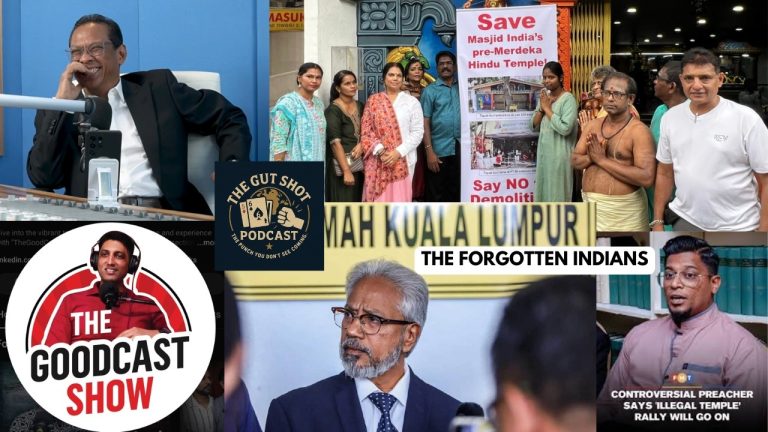
Gutshot goes into a multi-layered conversation about our Indian community with the host of TheGoodCastShow – Vinodh Rajendran. Mostly forgotten by our politicians until election-cycles comes along. Until such time they and their issues are mostly forgotten except when such "political leaders" and "religious-influencers" – especially the recently-converted kinds – wants to one-up others to the malay-majority. No-holds bar and punches to the gut; we get real hard.
Welcome back to the Gutshot Podcast! In Episode 60, I’m joined by the brilliant Vinodh Rajendran to dive deep into one of the most swept-under-the-rug issues in Malaysia today: the systemic marginalization of our Indian community.
Are the founding pillars of our nation being deliberately erased from the history books? We strip away the political correctness to expose the uncomfortable truths about how our society is actively being reshaped.
We break down the deliberate distraction tactics used by the powers that be—using controversial preachers as "rodeo clowns" to enrage and distract the public while the real political cowboys consolidate conservative power.
This isn't just a conversation about temples or history; it's a hard-hitting look at our economic and political reality. We expose the heartbreaking cruelty of the Indira Gandhi case, bust the media-driven stereotypes about Indian gangsterism, and reveal the actual statistics showing the community's massive per-capita economic contributions.
Why are 90% of Indian enterprises stuck as micro-businesses without their own job creators?
Why do 45% of B40 Indian kids lack access to preschool?
And most importantly, why is relying on the current political patronage system a guaranteed path to failure?
We argue that the answer isn't begging politicians for handouts—it's "privatizing the solution" and building independent, bulletproof institutions to insulate the community.
If you’re tired of the toxic racial and religious politics holding Malaysia back, and want to hear real, macro-level solutions for a united future, you cannot afford to miss this. Hit play, subscribe, and join the movement of thinking Malaysians!
📌 Inside This Episode:
00:00 – The "Forgotten Indians": Are They Being Erased from Malaysia's Future?
02:30 – Rubber & Skyscrapers: The Hidden Truth About Who Really Built Malaysia
05:15 – Rewriting History: Exposing the Dangerous Myth of One-Race Supremacy
07:45 – Busting Stereotypes: The Real Wealth & Crime Stats the Media Hides
10:30 – The "Rodeo Clowns": Exposing the Divisive Preachers Paid to Distract You
12:15 – The Indira Gandhi Tragedy: Political Incompetence or Pure Cruelty?
14:50 – The 90% Trap: Why Are Indian Businesses Kept at the Micro Level?
18:20 – Where is the Indian "Dong Zong"? The Urgent Need for Institutional Armor
22:10 – The Failure of MITRA, Sedic, & The Danger of Political Patronage
27:00 – Why Malaysia Needs a Total Political Wipeout (Macro vs. Micro Solutions)
33:40 – The Siti Kasim Problem: Why Political Idealism Fails Without Ground Support
38:15 – Privatizing the Solution: Why the Community Must Save Itself
42:00 – Final Warning to the Youth: Stop Believing the Lies and Reclaim Your Legacy
Jump to chapter 13 chapters
- 0:00 The "Forgotten Indians": Are They Being Erased from Malaysia's Future?
- 2:30 Rubber & Skyscrapers: The Hidden Truth About Who Really Built Malaysia
- 5:15 Rewriting History: Exposing the Dangerous Myth of One-Race Supremacy
- 7:45 Busting Stereotypes: The Real Wealth & Crime Stats the Media Hides
- 10:30 The "Rodeo Clowns": Exposing the Divisive Preachers Paid to Distract You
- 12:15 The Indira Gandhi Tragedy: Political Incompetence or Pure Cruelty?
- 14:50 The 90% Trap: Why Are Indian Businesses Kept at the Micro Level?
- 18:20 Where is the Indian "Dong Zong"? The Urgent Need for Institutional Armor
- 22:10 The Failure of MITRA, Sedic, & The Danger of Political Patronage
- 27:00 Why Malaysia Needs a Total Political Wipeout (Macro vs. Micro Solutions)
- 33:40 The Siti Kasim Problem: Why Political Idealism Fails Without Ground Support
- 38:15 Privatizing the Solution: Why the Community Must Save Itself
- 42:00 Final Warning to the Youth: Stop Believing the Lies and Reclaim Your Legacy
Auto-generated from YouTube captions. Timestamps link to the video.
Ladies and gentlemen, welcome back to the Gut Shot podcast. I'm Shamsul Sam, your host. I have today with me our popular good cast uh show uh Binod Regi Neran. Hi, thank you so much for being for inviting me. I'm the stand-in, I see.
The understudy to the podcast. What what what what we going to talk about today? I think um I we going to switch a bit and uh uh the the the theme is going to be uh on our forgotten uh Indian and society. Mhm. Right? In Malaysia. Uh
and uh we hope we can deep dive on this particular topic considering certain controversies, especially that has been going on lately. Right? Um so uh if you like our podcast, please uh like and subscribe and get a movement of thinking people to come and join us and uh make our conversation louder and louder in Malaysia so that issues that are not talked about or perspectives that are not listened to is uh out there uh in the world. Mhm. Yeah.
Definitely, yeah. Binod, let's start uh for you because this is your expertise, apparently. It's not. By by uh by by default. By default, yeah, because of my yeah.
Because of your skin color. Because of my I see. So, it's my I'm the expert. Yes. Yes, yes. Yeah. And uh on Gut Shot here, we are pretty racist. I can tell. I've seen a few episodes. So, I mean uh yeah, the forgotten Indians is exactly the right word for it. In all these conversations, somehow or rather, the Indian community get left behind until some idiot preachers make a big noise out of it, you you to uh stir up controversies. Yeah. Maybe like maybe you start off and and give me give us and the audience your thoughts of where our Indian community are,
what its aspirations as you can see it. And any thoughts you have, let's let's start the conversation. Yeah, so I think based on what has happened recently in terms of all these temple fiasco and criticisms and the fights and the conflicts, right? I think when you look at social media, what the Indian community in Malaysia want is that they want their way of life preserved. They want their status as Malaysians, they want their way of life, their interest to be protected and the integrity of their faith protected. To be fair, that is exactly what every other community wants, right? So, it's
nothing out of the ordinary. The the problem we see here is that in my personal opinion, is that we are seeing a very active movement to which is subtle, which is behind the curtain, I would say, to augment or reshape the country's history. And unfortunately, because of the large contributions of Indian community when especially after coming from India and even before that, uh because of the influence of greater India at the time, you are seeing a lot of Indian interest being marginalized, being pushed aside because that narrative does not fit into what the new narrative that
that that's the powers that be want to birth. So, for instance, if you look at the temple issue now, uh there is an issue whereby people are using a small group of people within the Indian community, a very tiny group, who have set up shrines in lands that are not theirs, and then people have commented that those shrines have then become temples. Now, yes, that is a wrong thing to do and that is completely unlawful and should be handled based on the law and and the rules and regulations or the parameters set by the law and the constitution. But, they are using that to paint over the larger
picture which is that the reason why you have Indian temples in a lot of places is because of the contributions of the Indians to Malaysia's development. If not for the Malaysian Indian community, our rubber estates at that time would not have been developed. The KL city skyline you see was built on the backs of Indian laborers, was built on the backs of the the the popularity, the demand for rubber at that time. In World War II, that's the reason why Japan came to Malaysia because of rubber. Yes.
Rubber was such a critical element in the war from uh parts or whatever you want to call it. So, that is why Malaysia's economy boomed. So, that is why now you see professors uh coming out on on social media, on TV, or whatever, saying that uh the Malays taught the Romans how to build ships, saying that the Malays were here during the time of the great flood that happened during Prophet uh Noah's time. And the question you have to ask is why is it that this person, this professor, has not been stripped of her titles, has not been told to stop because they want to create this narrative
that the Malay civilization was here so long. They want to create a supremacy of a race. Because that suits what the powers that be want to see happen. And I'm not saying that that's me saying that it is the current government. No, I'm not saying that. I'm saying that the mistake that we do is we look at isolated these incidences of temple conflict and all as isolated incidents. They are not. They are part of a series of events. They are meant to reshape Malaysian society to suit this this supremacy of one race narrative which will benefit the powers that be. So that is why you are pushing the
interest of the Indians and other communities aside and prioritizing here. So yeah, so that that's my thing and I think what Indians want I'll just end on this before you question is that Indians want I think and this is from my personal opinion as an Indian myself, we want our place in the Malaysian economy as well maintained. We don't want to feel like we are not required. We and in terms of economic development, we want our place to be there as well. Our plans for us as well and I would also like the Indian community to now stop looking inward and look outward and
say how can I participate in the Malaysian economy? You know, so that's what I think should happen and that's my two minutes. Your opening statement so to speak. Okay. As I normally say on this podcast, we are got short is a conversation. Yeah. We don't do interviews here gentlemen and ladies. All right. And from what you have opened up as far as the discussion is concerned. Let's let's the government statistics put the Indian population at six and a half percent.
I'm a very skeptical person when it comes to government statistics cuz I've seen too many statistics that I have question on. My feeling is the number is a lot larger than it probably exceeds around 8% if you were to ask me, but that is debatable. Yeah. Right?
Probably. However, I I do I agree with you absolutely that actually the Indian contribution, our Indian society contribution for the development of Malaysia has been absolutely critical at the at the beginning stage and throughout where we are today. Yeah. Yeah? I mean, where would we be without Indian lawyers and Indian doctors?
Exactly. Right? Yet what you hear on social media is often times, now especially in the past few weeks, you hear about Indian gangsters, you hear about this, but that those are elements that exist in every community. But when you talk about Indian doctors, Indian lawyers, come on, Indians despite all of this, why doesn't anyone talk about the fact that Indians are the second uh highest uh have the second uh are the second in terms of average household income in this country. They are they are they are below Chinese and above the Malays. Yeah. So, why aren't we talking about
Indians who have done very well, Indians who have gone abroad and made the country proud? Not just that. So, that means the per capita Mhm. per capita contribution and per capita income of the Indian community is a lot higher than the Malays. All right, yeah. The majority Malays. So, I would say to those professors, those so-called professor, I call them so-called professor because they don't deserve that title. Okay? And what just they don't deserve that title, I think those universities that confer such titles or even higher such uh nut jobs should be closed down because they are worthless
uh pieces of building and taxpayer fund that should be put to ash. I say Okay? Now, Yes. having said that, I think I'm just going to cut short on this issue. I really don't want to dwell on it because I think we have more important things. You know, this so-called illegal temple issue to me is a non-issue. When I was growing up in good old Sugai Patani, which is a bunch of rubber estate, right? We get temples everywhere. Okay? And it crops up everywhere. All right? The only thing the government need to do, if they are sincere, is to tell anyone who made an issue of
this Indian temple to shut up or I'm going to put you in jail. Yeah, that's how it should be. Right? Because why? The government has the authority to actually work out in a reasonable manner in order to actually ensure that fairness is taken care of and if there are relocation required or if there are places where it should not be, it just get done quietly without fanfare. Right? Because the harmony of our society is more important than anything.
Yeah. Right? So, that's one. So, I don't really want to talk about the temple issue anymore. Any bloody idiot who wants to talk about a temple issue, okay, should be slapped and turned upside down. All right? So, that's my point on that. Okay? The other point I want to make before I go back to Vinod is very simple. These mullah preachers, all right? What they do, because they know by the fact that they convert. So, they somehow or rather become this special place. I'm a converted fellow. Okay? So, I go and start selling. You know, in Alor Setar, we used to call these people
what, you know? People who sell us snake oil next to the stadium uh what do you call it? Stadium Alor Setar. Okay? I got no time for these holes. All right? Okay, if you listen to them, I'm sorry to say, you are bloody stupid people. All right? If you want to be stupid, keep on being stupid. All right? We even have one Indian uh one Indian preacher that has been requested to be extradited back to India and we have not done anything about it. Get rid of that MF. Okay? He has no place in this country. on him. All right? There, I've I've I've I've I've said what I want to say on that part. I want
to close that. soft start to the episode, I see. Huh? A very soft and respectful start to the episode. Yeah, this is a very soft and respectful because I am I am I'm actually Vinod. Yeah, yeah. I'm actually disgusted. One of the biggest disgust I have in my adult life.
Mhm. Okay? Is what happened to Indira Gandhi's Indira Gandhi and her children. It is to me the most disgusting thing every government of Malaysia has done. Mhm. You cannot even bring the lady back her children. No, so I think that's a sign of lack of political will. No, no, no. It's not just a sign of lack political will is actually cruelty. Yeah. It is cruelty. It's not lack of political will. Not to get her back. I mean, you know, to get the child back, yeah. Yeah, because we have the ability to do it, but we refuse to do it. Mhm. Let's get it clear. We refuse to do it
because we feel that this majority thing, I am making sure these children are saved somehow. You know, you don't respect other people. You don't give them the right dignity of a human being. So, with that in mind, I return back to my friend Vinod.
No, I think just on this build on that point that you brought up about the mualaf preachers, la. Uh of course, it is fair and it is right for people to be annoyed with them or enraged by them. But I always in in previous uh there was one episode I recently did where we talked about these preachers are actually they are like the rodeo clowns in any rodeo. Mhm. Their their job is to distract the bull Yes.
from which is the Indian people from the fact that there is a cowboy on top of it. Right? And that cowboy is the one that's actually oppressing you. So, you are being distracted by these rodeo clowns, but the real antagonist is actually riding you. So, in this sense, the focus on Zamri Vinoth, Firdaus Wong, and even there's another Hindu guy called Sugu Chandran who's also become quite famous in in this because infamous because of their very sensitive comments that they make towards the Indians, very racially biased, and they use all racial slurs and all that.
also racially inflammatory. That's the word. there's a reason why they're doing it. They are agents of chaos. That's all they are. They are just instigators. They are there as rodeo clowns to distract you from the fact that the real reason why this is happening that you see very systematically across various parts of time at a certain frequency uh issues will prop up in this country. Indira Gandhi was one of it as well that will re-entrench or reinforce, re-emphasize the racial divide in this country. So, in this case, the temple issue, why they use the word quail haram? Number
one is that word was used simply to just enrage. They need the Indians enraged because they need to distract the Indians that the greater thing at play here is just the fact that they are redefining Malaysian society, redefining our history. You know, I think they they thrive on uh animosity between the races. That is basically their main objective because that is how they gain influence and that is how they make money. No, they This is also a way for them to reconstruct society. Now, let's look at Forget about the Indian race. Put aside the Indian race, for example.
Let's look at the bigger picture here. If you look at the Malay water base ever since 2008, you have seen the fragmentation of the Malay voters, right? You have you now see an appearance of conservatives, moderates, liberals, and all that progressives in this one big society, which in during the time of the BN regime under Mahathir and before, you would assume that they were just a monolith, right? So, these incidences are also taking place because if you listen to the words being used they say things like quail haram, India India or Hindu, they say encroaching on masjid land, encroaching
on Malay land. So, what they are essentially doing is yes, the Indians can be enraged. That's that's what they want. That is what they want to distract the society on what they're actually doing, which is to consolidate your Malay water base. So, what you are doing is now you're pushing your moderates and your liberals and your progressives in the Malay community towards becoming conservative. They are pushing them back to this corner and they don't need everyone to do it. They just need 10-20% within these liberals and moderates to do that so that that will inspire others because the Malay
society because of Islam is a very communal society. So in communal societies, social hierarchy is very important. If you look the way the Muslims preach or the Muslims sorry the the Muslims pray, it's done in a group. So when group uh dynamics are uh prioritized, social hierarchies become very important. That is why they say Malays are more of a feudal community. And in in such a situation, you will hard very difficult for you to find individuals who will rise up against the grain because they want to fit in that society. So this will push the moderates to the conservatives and
at the end of the day, it'll be much easier to garner their vote because all I have to do is I have made them fearful, I make them think that their rights are being encroached upon, right? And so now all I have to do is come election time, I just have to come up and say "Oh tanah Melayu tanah tumpah darahku." Uh you know, "Oh hak Melayu." and all this and they will vote for me. So that is the long game here that they are playing. Okay, let let's put a lid on that because we've already in essence actually we've exposed I hope we have exposed their game plan. Okay, which is
very nefarious and not just very nefarious to be honest with you from the Malay perspective in my opinion as a Malay, uh these people and the people behind them are intent on making the Malays more stupid and actually to make the Malays more docile to actually being enraged and actually then uh support people in the Malay community who cannot lead but become leaders of uh disunity and chaos. I think we need to put a stop to that, understand where these people are coming from, and actually call out uh the supporters of these people as being Melayu bodoh. Okay? Can we just do that? Because why?
We Melayu are not bodoh. So, if we got Melayu becoming bodoh like this, can't look them in the eye and say, "Oi, bodoh. Balik kampung tanam jagung lah." No, but you see, that's that's I I I would disagree with that because why I disagree with that is because I would say that you have to consider various factors here. Mhm. Uh it's not so much that they don't know, but the question should be why don't they know? Because the the real culprits, the true culprits are uh people who are in positions of power within uh pockets of these communities that propagate these messages.
So, we you and I can't sit here and tell and and assume that everybody in in society has the same level of intellect. They don't. Yeah. Because they have varying levels of exposure, varying levels of education. So, the true criminals, you cannot blame these communities for for succumbing to that For for instance, if you look at what happened in Penang recently, when there was word that these Melayu characters, these Zamri Vinod and all these were going to uh protest against the temple. Uh-huh. Uh what happened, which was beautiful as an Indian, of course, I was very proud
of it, when the Indian community in that location, even from KL and all, they went there and they sort of uh surrounded the temple. So, it brought people together. So, to see this solidarity in my community is fantastic.
Mhm. But human psychology dictates that when there is an external threat to a community, they will rally together. Indeed. So, so you cannot blame the Malays for behaving the same because if I'm happy the Indians are behaving like this, I cannot say that the Malays are wrong to behave like
let's put it this way. For me, before we we we close out this because I want to go into uh other more to me Okay. other more substantive concerns of the Indian community, right? Because to me I really feel this to be why I call it so bodoh, uh is because obviously if you threaten the other community you will get a pushback. Mhm. Okay? But the instigator of that action is using stupid and that's where I use the word bodoh, okay? And stupidity to bring along with them, okay? And the leaders that do not take action on this stupidity are either equally stupid or actually in uh
in in in support of this stupidity because they see how that gains them power. Yeah. All right? That's politics, huh? So, you know, so we from the Malay community need to realize that actually this kind of stupidity, whether it is coming from instigators or coming from our political leaders need to be wiped out from our society. Second part is we need to educate so that our people does not get to be stupid to follow these stupid idiots. So, that's my case.
Mhm. Okay. Okay? Now having said that as I said early on and I'm saying now, I do think this is a storm in a teacup if you were to ask me. I want to focus on actually the more um the more substantive part of the forgotten society that we have, which is a very productive society, which is our Indian community. Right? And we not Why don't we go there? Yeah, yeah. Let's do and see um uh where uh I give I give for example um gangsterism, as you said it. It it actually exists in every Yeah, every
every sector of our society. Yeah, yeah. Every sector of our society. Come on, guys. Okay? We know of the uh of of of of the Malay gangsters. Okay? We know of the Chinese uh you know
Triads and all that. You know, but somehow the Indian got got uh you know, because it suits their purpose. Okay? Uh but um we also want to see, I think beyond that, actually where do we see What are the aspirations that we want to that that you as a member of this community would like to aspire to for our society, your place in this society, and say whatever even if that doesn't follow the line of what I'm asking. Uh I open the floor completely to you to to make your points.
I think in the current administration that we have uh we see that if you look at the Rancangan Malaysia ke-13 and what was announced in Parliament, we see a approach to go the more universal route, which is certain policies uh were meant to impact every community, which I'm actually for. I'm actually for that. However, having said that I do feel that as an Indian, my aspiration is that if you truly want to elevate the Indian community the answers are already there. You just have to take what is already there, already done by people who come before you, and create
an action plan, have a task force, have a parliamentary committee to oversee it, create a timeline, how long will this take effect, and then carry it out. Like for instance, you you probably have heard this or may not, but there is something called the Malaysian Indian Blueprint, and it's one of the best blueprints I've read. It very clearly isolates the problems, and it provides solutions. Uh it was I think approved or launched by Dato' Seri Najib when he was Prime Minister. Now, the key issues laid out by that document is that the key problems, and this is
what I see as the key problems among the Indian community, is that number one, let's go let's go to business. In business, 90% of Indian businesses are micro businesses. That sounds like Malays. Yeah, perhaps also. So, but okay, but interesting you bring that up because there's one very powerful differentiation point between Indian community and the Malays. I'll get to that. So, when you have 90% of micro SMEs, your community does not have its own job makers. Does not have its job creators, so which means that your community itself does not have the power to change the course
of your own people. Right? That's one. So, of course in the blueprint, there's many solutions suggested, which the government can do, but it just has not, and governments before as well have not, right? Number two is uh 45% of B40 Indian kids do not have access to preschool. Now, when you do not have access to preschool, what happens? You go to school on the back foot. You cannot read properly, you don't have a good grasp on numbers, so that uh uh gap just grows as you carry on. Which is why perhaps some students feel, "Hey, why should I do this? I I don't understand what's in taught me in the
classroom. I'll just drop out." Right? So, these for me, these are the two key issues that we have to address. And to address them, like I said, besides the government of the day, Indian leaders themselves have to really campaign for these things to take effect. And you brought up a point about how uh Malays uh also have that sounds a bit like the Malays. Now, when I talked earlier about how this is a redefining of Malaysian history, this is pushing the Indians to the fringe, this has not this is not unique to Malaysia. It's happened before many times across the world.
Uh we look at the native Indians in the US and Canada, how their race was sort of wiped out, pushed aside in in uh uh in to to create space for the whites, right? You look at Russia, has happened. You look at China, it has happened. And it has happened in in other spots. One of the key thing markers for races that are eradicated or whose place is threatened or who are pushed to the fringe is that they do not have independent institutions within their community to protect them. So, like the Malays, the Malays have uh Mara, you have a lot of ministries and all that created to ensure the
protection and the preservation of your way of life. Indians don't have that. We have no single independent, strong, powerful entity that can protect our way of life. We don't have. The Chinese, if you look at education, they have the Dong Zong. The Dong Zong is very much respected and even some feared when you talk about policies and all that. Dong Zong is so independent that when they suggest history and BM, I think, must be taught in all schools, they can oppose it. They say, "No, we want to know why." and all that. So, do Indians have that? We don't. So,
until we can create these very powerful institutions within our community to address these problems, then our way of life will always be threatened, our space in this economy in this country will always be up to for interpretation. So, for me, the solution here, that's why I have said it before in my podcast as well, I always use this term privatize the solution. We have to do it on our own as an Indian people. When I saw that temple incident in Penang where the Indians gather together, I said, "Wow, this is such a powerful statement that the narrative that Indians are fragmented, Indians are
not united is completely rubbish." And this act throws that out of the window. But having said that, now let's take the next step because it's easy to rally together when you have an external threat. What about when things are normal like now? Right? We need to still focus on the key issues, which is not temples. It is preserving our way of life, ensuring that Indians have jobs within our community, that we are able to provide for jobs within our people, ensuring that Indians have a sizeable share, a a certain share of the Malaysian economy. When it comes to
large enterprises, Indians only own 1 to 1.5% of the shares of large businesses. So we are very much out of the game. So the reason why the Chinese are protected or the Chinese are You don't see Zamry Vinod going towards Chinese temples and all that because the Chinese they have all these institutions. They are well guarded. They have armors that have insulated their community from any external threats. No one's going to attack the the Malays because they are the they are the majority. But when it comes to Indians, we don't have any insulation. So we cannot always look at the
government and say, "Oh, you know, you government don't do this guy." That is what the Indian leaders do and that's That's one of the frustrations I have when it comes to Indian leaders. Indian leaders always point to the government. You are barking up that tree that doesn't care for you because it's simple numbers. And you know, this is the hard truth. Politics is about pandering to the water base. When you are only 6% of the water base, what the is that? That's why when I hear, "Oh, Indians are kingmakers." Yeah, we are only kingmakers in what? I think about 20
consti- MP seats? Not kingmakers, but we are the deciding vote because you have an almost equal share of Malay and Chinese. So, we need to stop barking up the tree and Indian leaders need to come together and look towards us and say, "Okay, what do we need to do?" So, instead of fighting for, you know, the these sort of things, which yes, there is a place for Indian temples or Hinduism. They They Of course, these things must be protected because they are part of our life, our way of life. But, the more important thing is how do we elevate our B40? How do we elevate our M40? For instance,
another fact that is not talked about and there was a study done by IIUM uh that said that found out that compared the Malay, Chinese, Indian, the Indians have the worst intra-ethnic wealth uh distribution. That means the most of the wealth is hoarded by the T20. And and slightly by M40, but the B40 have nothing. Okay. So, and just one more point. There is another study that was done that showed that of all genders and races, the Indian male is the least has the least probability of securing a job. So, these are the things we have to address. As an Indian, this is my
aspiration. I think we should address these points and promote uh and and we we we can talk about our past, which is a great past, great history. As a people, we have done a lot for this world and for this country. That is undeniable. Uh in fact, I just interviewed an Indonesian who was telling that uh Islam was brought to Malaysia by Indian traders, not by Arabs. But, we are told by Arabs because we don't want to We want to ignore that fact. We We started our history from Malacca, not from Kedah. May May I just say something about this?
Yeah. Yeah. Um I think the I think uh Hinduism is the first religion of uh the Malay Archipelago. Yeah, of course. Right? Um and the government and the academia has tried to uh uh pave over this fact, you know, that we are for thousands of years was a Hindu, um, empire. Mhm. Right?
that. Please take note of that. The Hindu empire was brought by Indian and we were all Hindus before Islam came to these shores. And then we were Buddhist and then after that we became Hindu Buddhist.
them became Buddhist, some of them stuck to uh, Hinduism. Society was very hybrid at that time. Right. So, I I I I want to say May I this point, okay? I take your point on, um, the society itself, the Indian society itself being able to band together and
and actually look after its interest. It's the same way like a clan situation with the Chinese, right? The Dong Zhong that actually uh, will speak on behalf of it. But it it is also a fact that, um, the Chinese community is probably a bigger block, which is more than 30% of our 38% maybe of our nation. So, their voice and their, uh, voice and their economic power is also, um, surpasses that percentage as well. Um,
Yeah, the highest earners, highest median income, highest, I mean, highest household income, highest assets, everything. So, that is also an asymmetrical imbalance for comparison, right? Um, this come to the point where I I've always believed and I still believe, moving forward, um, that I really don't care about previous history. I only recognize what made this country what it is.
Mhm. But what's more important is actually how do we move forward as a nation. And if we move forward as a nation, we need to get rid of this whole notion of racial and religious politics. I think that is the biggest uh the the biggest bane in the existence of Malaysia, racial and religious politics. Uh the affirmative action that we have carried out and why it doesn't benefit people who need the most, whether it is the Indian community or the Malay community, because why they end up to be uh remain micro businesses is because the same thing happened. Uh the same politically connected
uh patronage system benefits the same people. Yeah. Um and uh masses does not. Mhm. Okay? So, as long as we allow this kind of political leadership to exist in this country, we will not solve this problem, you know. We we will
you you have private equity? You see, like for example, like like like why can't you We have private equity. No, like like why can't you have uh private uh capital firms, for example? Like for example, like why don't you you you create a a firm, something like PitchIn, something like all these existing crowdfunding platforms that is sole focus is done by the people to invest in these micro businesses with the with the long term
as you think. Not but it's but it's doable. Well, let me put it let me put from a uh uh uh a 40-year-old businessman point of view. Okay? Um Malaysia financial system, right? Is extremely risk averse. Okay? Just the whole ecosystem is extremely risk averse. Number one. Number two, um so, it's not keen on innovation. Mhm. All right? Uh it's not keen on on giving out loans um to to to those without the long track record or the big track record. Especially, you just look at the institutions that we have ever since the um the consolidation of the banking system, it has become worse. Because
what we have created is an oligopoly of uh mainly GLC banks that are actually talking about because if I have tens of billions, right? How am I going to get returns that commensurate my capitalization? I'm only going to give in the forms of hundreds of million. All right? So, those who are in the micro sector just get left out. Our stock exchange, our finance minister is talking about the stock exchange need to go for bigger capitalization. No one is really focusing on how do we build up our small SME except for They say, "We need to help the Bumiputra." Okay? Now, when you help the Bumiputra,
let me put it this way. The code word is, "Let me help my cronies." All right? And that is what happened when you have oligopoly. Same goes with private equity system that we have created. They are few and far between. We are not as robust as in the United States. Especially the United States. Okay, this is a fact of the commercial world. Yeah, but but in in the spirit of of of changing the the the status of micro businesses into the SME sector, what my point is that uh even though it may be tough or it's it's difficult, but I'm saying that we the Indian population has
a very sizable substantial number of T20s within the T20 branch. They're not interested to help you. No, exactly. But this has to be pointed out. Because come together or if not campaign the government and say, "Look, we want X amount to invest in this fund that we're going to use to invest in micro businesses in Malaysia
what then what's going to happen is actually the money goes through a patronize system. Exactly. So, that's where auditing and proper checks are there. For instance, uh if you look at uh Mitra, for example, this is the the sort of Indian
Remember the MIC uh MIC fund? MIC fund, exactly. So, those those problems have have are there. But that doesn't mean that we cannot because there were problems with them that that hinders the development of the future. You can't stop because you made an error last time. Even in the Malay and Chinese communities, there have been embezzlement, there's been mismanagement of funds, but we still go on. I I I May I May I then say actually this is where I come from. And I want to go back to the Indians Indian situation. But actually when I look at the Indian situation, it's no different
than the situation of Malaysians in general if you ask me. Right? And the reason is because the people we put in power are not interested in helping the people. Okay? I'm I'm very clear-eyed about this. Okay? Uh and until such time that the citizens make a change and say, "We're going to bring new faces into the into the ecosystem that is going to start building a new Rome. Right? Then we will see the difference because because until such time happen and it will take at least two cycles, huh? At least two cycles, I believe that. Okay? Because you we can we can we can set up I've
seen companies have great system. All right? But actually when it comes to implementation they collapse. Why? Leadership. Leadership and the management team. Right? So in the situation with countries, it is also leadership and management change and and and and management change. At what level then? It is at parliamentary level and it's also at cabinet and prime minister level. Right? So if you don't have the right uh the actual duty to be civil servants for example, let me go back to the Indian community. Right? If you don't see that the Indian community need
to actually be needs but if if we go on needs base alone it become automatic that the Indian community is going to be taken care of. The Chinese community where they are poor are going to be taken care of. The Malay communities are going to be taken care of. The Kadazans are going to get taken care of. The Ibans are going to get taken care of because we don't care about race. But the the more the people we elect talk about race all they are doing is championing for the sake of getting into power. Okay? I see your point. But the but the but that is the the the How do I say that's politics?
Go on. That's politics because what you are saying is uh people you know new faces and and and and and I would like to counter what you say we just is one example. yeah. So if we look at when Prime Minister Dato Sri Najib was there, he did something at that point which I interviewed the current president of PPP and he was telling me the situation where there was a squatters a squatter lands and where these people living in that because they had to be moved because they wanted to you know rebuild and all that, they were given homes. The homes were built for them. So overnight
you are changing the asset value of this person from nothing now he has a home to his name. Of course they have to pay back the government lah. But no interest nothing, you know, very then homes are given to them. And that can happen because there was political will. Yeah. There was a very strong leader who said this must happen. And it happened, right? Then of course the government changed and then these projects were sort of uh a lot of them got their homes but of course this project was not continued for whatever reason. So I for me it's not just a question about new faces.
I give you another example since you say new faces. Uh I interviewed the president of the Malaysian Action Party MAP which is the Vaidyamurthy who was famous last time because he founded this movement called Hindraf. When he came into government, he's the one who tabled or created the plan for what Mitra was before called SEDIC which is a social economic development of the Indian community SEDIC. When he was there, he was not opposed by the Malay leaders. He was opposed by MIC. This is what he said on my podcast. So because they felt that SEDIC should be under them.
You see because of patronage politics, right? Money buddy money. So now but okay and then uh according to him was what they said was it's okay, give him a since he's a senator now, he's got his driver, he's got his allowance and all that. He will eventually weaken and just not care about, you know, he'll be spoiled by the the the glory of being what he is and he will stop. But he didn't. And then he left government. My point is then after that even if you look at Dan Said was converted to Mitra with the new government, 100 million given for the transformation of the Indian community.
Yet SPRM found that there were mismanagement of funds. There was also false invoices, false POs being put to Mitra to claim for money. And the projects that were done didn't really look like a transformative project. In fact, it looked more welfare-oriented. So, what my point is when you see many attempts and you brought up MyKad, very good example. 100 million raised, but no outcome. When you see all this, then the people should stop barking at that tree. That means that tree does not cater to you. So, what you need to do is rally together, privatize the solution. Privatize. Because if you
rely on public system that is not serving you, then you have no one to blame. For instance, like create your own job placement agencies funded, backed by the T20s, M40s of the Indian community. Create your own institutions that go out there and solve the problems of the B40 Indian community and all that. You know, create public relation narratives that counter the common narrative being put forth by parliamentarians, by by Indian activists or leaders saying that Indians are this bad position, we are this, we are that when we are not. We are actually a very
very successful society. There are many lawyers as you said, many doctors, many successful businessmen among us, but their stories never really take the center stage. What does take center stage is gangsterism. Let me ask you a question. Where's Waytha Murthy now? Uh he's now I think he's on the opposition block. He's with the IPR. Is he uh is he still in parliament? No, no more. He's he he actually resigned. He He was with which party, yeah? He may be He was He He He was very unique because he joined uh politics as an as no party. Uh he was because of Hindraf. At that time Najib wanted the
Indian support. So, he went into the government bringing the Hindraf with him the the support with him uh for for obviously for votes. And then he was given the title senatorship. And then I think he made deputy minister, I think. I remember when Waytha Murthy was appointed, there was a huge uh backlash. Of course. Uh that he was uh extreme uh Hindu uh activist. Um I remember that very very well. Okay. Um and whilst I agree with your passion of um of of of uh being able to look at from internally at a micro level. You have to. Uh of that. To me, I look at both micro and macro. All right? Maybe
um I tend to look at um the macro solution. Uh maybe it's the nature of uh where I come from. Uh which is when you've been CEO for 20 plus years, right? What you want to do is have your your managers or your ministers um handle the micro problem, yeah, right? And you set the macro agenda. Okay? And Waytha Murthy to me is um is a sad case of how somebody who's sincere uh that the political system, which I say the macro level uh actually trashed and put him aside. Yeah. Right? So, we learn from from history, if there is anything to be learned from history, that those who wants to do well
uh are going to get burned. Okay? Yeah. These current system, lah. By the current system. And we currently have the current system. Now, for uh uh I may sound blasphemous, but I thought Najib was a good Prime Minister. He was. If not for 1MDB, I think he would have turned out to be one of the greatest Prime Ministers we had.
and and and and if not for the corruption of 1MDB and those associated with that, um I think that was the sad part of his tenure. Um But just one thing on that, you know, you talked about the macro and micro. I just want to add this one point.
So, So, if if you look at uh Hinduism, for example, right? People always say this, you know, why do Hindu gods uh uh there so many, right? So, one of the things about Hindu gods is that uh one Hindu god can deity can take many forms. Okay? So, but what is the message behind that? Every human being in this world takes many forms. Your form right now is not the same form you are when you wake up, when you're with your child, when you're with your family, when you're at work, when you're turning around a company, I'm not the same man I was 10 years ago.
No, but even then on a daily basis also you take different forms. I'm not like this when I'm with my daughters, right? Obviously. So, the idea here is that at the macro level policy must take different shapes at different rungs of society. So, I give you one good example. Recently, the Prime Minister announced at the RMK13 that he made it compulsory for parents must send their children uh uh grade one, I mean preschool, to I I'm not sure preschool, but standard one to form five, right? This is the must. If you're not, there are consequences, right? Fantastic. Macro level, awesome.
But, this policy does not take shape at the lower rungs of society. So, if I look at the Indian community, because I've been to some Tamil schools, I've spoken to some teachers, one of the uh the things I hear from these schools is that one big complaint is the problem is that when you are uh the the the reason they have told me that the problem is not the Indian students. It's some of the parents. And note I say some, not all, because there are many Indians who put a great emphasis on education. You know, I've seen that myself, it's fantastic. But, they don't want to send their kids to
school. They're not bothered. Then, another problem at the ground level is there is no transport. So, if you want to realize such a policy that every child goes to school, which is fantastic, it sounds amazing. You want an educated, literate society, right? Who can contribute to your economy? Fantastic. But, what But, this policy must now shift shift its shape must be a shape shape shifter when it goes down. So, at the people level, you must have things like subsidized bus service. You must have things like uh a good relationship between the the at the district level, all the
educational facilities there with the teachers, constant and then you must go to the ground and meet have town hall sessions, meet these parents and tell them the importance of sending your child to school. That you can change. Talk about them at the potentials they have, the possibilities they have, what career paths they can have. Then only this policy will come to fruition. You know, when when I was growing up in the '60s and early '70s, right? This kind of this kind of uh reach out to communities was very uh was very apparent.
Yeah, even uh Mahathir was famous for doing that that whole countrywide road show after he became Prime Minister. You have to do things like that. I mean, here goes again where I say if the macro we don't put it right, it doesn't trickle down to the micro level, right? Um and and creating a workable society that actually benefits everybody uh starts at a macro level. Yeah. And then, the most difficult part as well is actually having the right people at the micro level to implement the policies. I think I think I think
It is very difficult. difficult, yes, but I also think when you have an idea as the CEO or as the Prime Minister of a country, your job is to sell that idea to your people. Well, let's put it this way. I don't think we have that. I don't think
mean we don't have what? I don't think we have that political will. I don't think we have currently the the political sincerity to do to make it happen. I think they would rather be supporting what you call a patronized system and a system that emphasizes the supremacy of Islam as a religion in this country at the uh at the disadvantage of all the other beliefs and community. I think that is the political uh the political calculus that we have.
Yeah, but you you you have to That is why I think it is these sort of reforms that we have to fight for. Anyway, so that being the case, why I keep banging on the need to actually bring new character to come into Parliament and actually start talking and not just talking, yeah? Being um a reasonable block that is independent of anybody else. Because we've already got now the beauty of what we have today, yeah? Is a fragmented uh Very fragmented.
Very fragmented, which means that even if we bring in five or 10 people, it's going to make a difference. If you do it, if you bring the right kind of people, right? The time is absolutely right. Because why? Otherwise, this will continue and it not only impact uh I mean I I look at the Indian population the way I remember when I was uh uh when I was in form one and I went to uh boarding schools, right? One of the reason for the boarding school is because you want to take out the children from an unconducive environment for them to learn, right? Um and we were, you know, the B40s. Okay? Um
unfortunately, but we had a good enough population of non-Malays in my boarding school during those days, you know? And we still get together. Uh and and and all of us did very, very well, right? Because why? Every day uh we don't worry about um about you know, the environment we are in. We are among peers who are actually trying to succeed in our studies. We have a set program. We have good teachers, but you can't do that if your corruption level, you know, on a yearly basis, you are throwing away 40 billion a year at least according to the IGP at one time. I think it's probably even, you
know, triple or maybe I wouldn't be surprised if it's 10 times that, right? And here we are, uh the government talking about a subsidy for so-called subsidy for fuel that is, you know, a minuscule of your corruption level, right? So, we we have a resource allocation problem. We have a GLC and oligopoly problem that actually make our economy less, uh less productive for the money to be able to be allocated to the right places. I mean, just think about it when we were talking about the all these Professor Kangkung, they all come from university Kangkung. That is paid for by our
taxpayer money. No, but I I I also think you have to also create a room for the fact that these people are not just saying this because they maybe don't have the intelligence. They are saying this because they are paid to say it. Yeah, but
they they they they are agents in this plan. But imagine this, right? Imagine if this doesn't exist because of very simple policy making, which is close them down, right? And it takes one person to say close them down. It's the prime minister, right? You know? And to hell with, you know, your your your because leadership is actually pulling your people kicking and screaming to a path that they may not want to go to because they don't understand or you make them understand but our politician our way of political thinking is The politicians doesn't take the risk.
They actually are we looking at the ground that they have fertilized. And then they follow the ground so to speak and actually it is a What do you call a vicious cycle? You know, so you need people who's going to break the mold. Yeah, so I don't know what else. And I think to break the mold first you need ground support. Yeah, you need to be a leader that is known or carries the reputation that you have the people behind you. If you if if you take the example of past and I want to just touch on that past. Please please please please. Past one thing that in terms of
mobilization in terms of grassroots support you cannot beat them. You just can't. They just light years ahead from other parties, you know, even like from the parties like pasty and all that they have created a supply chain of waters somewhat. Right from the kindergarten they produce these people, right? Whatever you opinion about that that's a different topic but when you ask people why you vote for past the answer is because they come down to the ground. They meet them whether or not they are effective in solving the problem. Of course that's a different topic, right?
We've seen the issues with and all that and all that everything and most of the past rule states are always among the states of concern in any even 12 I think 12 11 and now 13 same states. But my point is like what I talked about earlier about going on the ground engaging with your voters. If our leaders do that Did the current parties do that then they can do what you say? I think the current parties are not interested. Yeah, they're not interested. Why? Because the easier way is to just social media parliament and
very simple. They're not interested. But the but the answer isn't just new faces. The answer is what The see, the mistake we did when even for me Yeah. uh even when I used to go, you know, rain, sun, rain, shine, I used to go for the talks organized by PKR. I remember in Brickfields all we would go, you know, Anwar talking on the bus, we are there, yeah, change, change, change. I remember 2018, I remember uh 2012, I think, you know, and all that. I remember 2008, you know, these were really monumental elections, you know, we we saw the people's will, right? But one of the mis- but we never now
introspect or not introspect and introspect as well as uh retrospect the mistakes we did. For instance, when you talk about reforms, no Malaysian asked what where will this reform take us? Yes, we talked about reform. Uh okay, we want two-term limit and all that. Where will that take us? I Okay, so my point is let's not repeat that same mistake by saying, "Oh, we want new faces." No, no, hold on. Okay, if you are a new face
The those people that you were cheering for for reformation, they are not new faces. Yeah, they aren't, but they are not. They are not. They are from the same cut like UMNO lah. But what I mean is Not just from the same cut, buddy. Okay? For me, as somebody who grew up from the Muslim community, okay? I saw what was coming. Okay? I saw uh I saw Muslim Brotherhood in Armani suits. That's all. No, but that's fine. But you guys don't see it.
Yes, but the point is not to use that uh viewpoint as a sort of differentiation. The point is now we have to uh educate the voters to say before you throw your support ask the necessary questions. Okay. Let's ask this question. All right? I I I will I have made this thesis before.
Okay. Okay? If I sit with you and you are drunk guy, Mhm. Okay? Whether you are drunk on Guinness or you are drunk on on what do you call
on on Tiger Or whiskey. or on Glenfiddich. No way are we saying that you should consume alcohol. We're giving you a hypothetical. Hypothetical. Yeah. All right? By the way, if you want to have a drink, have a drink, my friend. Don't worry about it. I don't care. Okay.
All right? This is a free country. Okay. You don't have to respect me Puasa. Okay. Okay? I don't have insecurity complex. Fair enough. Okay, back to the I'll be back with you. story. Yeah, yeah. Okay? My thesis is very simple.
Mhm. Okay? You cannot convince a drunk person. You cannot convince a guy who is high on opium to think clearly. Okay. All right? Fair enough. Okay. So, then what we should be choosing are the segment of our society that are not drunk on the opium of religion,
Mhm. that are not high on racial politics. Mhm. These are the people who is going to make a difference that we need to change their mind. Because there are constituencies in this country that we can bring good people in that are going to be able to articulate to the ground. All right? And actually say, "Here's where we are going and what we are going to try to do." Okay? Rome was not built in a day. Okay? But we have to have this this perseverance to say that we are the thinking people who are clear minded. Okay? Because I'm definitely not going to talk to drunkards and people high on opium.
All right? It doesn't work. That's why people who keep saying, "Why are you not talking to the majority?" Blah, blah, blah. I say that doesn't work, buddy. I want to talk to people who can think. Who are interested to protect their way of life. Which is minority that are being pushed down. And actually a lot of our minorities cannot send their children overseas. This is their to put down. Okay? I can tell you I won't be surprised if you are more a Bumi Putra than I am. My grandfather Uh I am probably 1 2 3 third generation from Aceh. Your family probably are here longer than I am.
You know? So, I want to be able to open the eyes and say these are the macro issues we need to uh tackle. And therefore at the at at whoever end up these are the micro that we going to going to do. You know? I've been preaching about we need a manifest to right down. Five points. Okay? That everyone who wants to run must agree on. That's all. Make it simple for the right.
Yes. And but again back to your point about new faces to carry these people's constitution. have they must they must have a conviction. Yes, but also they must also be able to play the game. Politics is a game. You idealism has no room in politics. It It be an inspiration, a driving force, but it's not the main your main weapon. For example, let's talk one person who's we have interviewed together. I mean, both of us have had on our channel and she's come on your channel a lot, is the one and only Siti Kasim, right? Siti Kasim ran for ran in Batu and she lost a deposit,
right? Despite being the person who has so much of online following. In fact, one of the unique things about Siti Kasim as a guest on my podcast was that when I look at the comments, every most people in the comments say Siti Kasim should be Prime Minister, she should be MP. Yet, in reality on the ground she lost a deposit. Why? You cannot and and I've heard her on your podcast blaming the people or we are No, I don't disagree with that. I think when you want to bring a new face, the new face must also hang on to what we know, which is like what you said. How
do you communicate to every level of society? Your plans for them. But, that is not apparent in Siti Kasim. My My My My I think the lesson learned out of that actually for me is actually what what from what I know of, right? When the election was announced, it was pretty fast in terms of being able to do the groundwork. The politics of it actually is identifying for the people who interested to go into this is actually identifying the the local, the constituency so to speak, and actually to connect with the ground people. That is actually very critical. And that's the first step we have to do,
right? So, I think going back, I think let's let's wrap up. Uh, I want because we've sort of like gone from the micro of the Indian community to the macro, right? Let I I want to wrap up with you on the topic of today. Mhm. On on going back to my beloved Indian community. I I have so many friends in the Indian community. Uh, one of my best friends uh, uh, uh, my almost permanent uh, financial consulting investment partners that uh, you know, uh, that has been with me for a long long time. So, I've got long relationships in
Mhm. actually all the communities in Malaysia to be honest. You know, it's just my nature. Mhm. Right? Um, I really hate to see what is happening in terms of uh, the the demonization of our Indian and Hindu community. It disgusts me to the core. Uh, but I wanted to give you your last word on how we as Malaysians and and us uh, and and for your side yourselves as the Indian community on how we should navigate um, what is going on today. So, before that, I just want to just just add a bit more to our previous point which is talking about new faces and Siti Kasim in particular.
I agree with you that we need new faces. Mhm. That I think we are in agreement definitely and I think we need to follow the examples set by Sabah where you have this they call them what the the black wave I think where you have this group of independents who have now won and they are former group, right? It's sort of like a mini team in within the state assembly. What I do hope is that in the next election that we I hope to see more independent candidates and not just independent candidates as a that uh, uh, there on the on uh, with another party behind them. A coalition
behind them to spoil the votes for the enemy right or the opposition, whichever you are. Whether PH or PN doesn't matter. I hope to that independent people take part in it. I hope the same thing too, yeah. Regular everyday Malaysians take part in it because democracy is not just for the elite. It's actually for the masses, right? It's a government of the people for the by the people for the And and I think but what I do hope for voters is also not just blindly vote. You have to ask the tough questions as in what are you going to do for me? You know, how are you going to impact my
children's lives, my future generations, my life, how are you going to increase my income? What are you going to do to my constituency? You must ask these questions and the independent candidates must be able to communicate to them at the language at that they are accustomed to Mhm. That's my thing on that. So, I'm not saying I I think I do I would love to see Siti Kasim in parliament. I think that would make for a fun parliament and I think she would with her history and her activism and I think she would be Why don't you go in? I'M I'M TOO YOUNG.
I leave the youth to Syed Saddiq. He's the one. No, but on your point of the Indians, I just my message is to Malaysians number one is especially Indians is to Indian youths la cuz I'm a parent of course I'm more biased to that. Do not believe the narratives that exist out there about your people. Always do your own research, always do your own digging and find out your legacy. Legacy and history are important because they are the building blocks of your self-identity. And if you do not have a grasp of your history, you will not have a strong self-identity. You will adapt a sort of
mirror syndrome where you just follow the dominant person or group that you hang around with. So, that could be the Chinese, that could be the Malays or whatever. Whoever you're with, you will just replicate them because your mind does not have a strong sense of who it is and what you your existence is all about. Having said that, history is important, but constantly looking to the past will will destroy your future and present. So, when it comes to our issues, I want to be very clear. Whenever a parliamentarian or a leader or an activist says that Indians are this, crime, and all that, just
Google just Google now. Number of the distribution of prisoners in our prison system based on race, and you will find that Indians are the lowest or the second lowest. The They're almost similar to the Chinese. The most are the Bumiputeras, right? That's not a hit at Bumiputeras. No, but I'm saying that that disproves the statement that Indians are all gangsters. You know, so my point is do your research first. Find out for yourself. You know, as as Buddha once said, you know, question everyone, all teachers, even me. So, that that is what we should do and believe that the Indian people are a
great people, a people who have contributed significantly to the development of Malaysia, and that nothing, whether it's Zamry Vinod or Firdaus Wong or Che Gu Chandra, none of these idiots can take away what we have done, what we are, and what we are going to And I would like to end it with this. The same applies for every community in this country, Sabah and community, Sarawakian communities, the the major communities in on on this side. All of us have done our share to contribute to the development of this country and the future. But, let's take a positive stance and contribute. So,
that's my closing. Well, with that, I want to thank uh Vinod very much for very lively conversation. Yeah, as always. And and actually I I I I I'm I'm very pleased with this conversation. I hope all of you are, too. Yeah. Please come again to the God Shot Podcast and uh thank you again, Vinod.
No, man. I I love being on this podcast. So, do I hope you invite me again and again. Thank you. Surely will do. Awesome, buddy. See you. See you.