Malaysia Need The Corazon Aquino Moment.
Show Notes & Description
Our conversation digs into the realities of today compared to what our parents had. We compare economic status, educational opportunities and also the current trends and trajectory of our society. We compare the trajectories of our neigbours including Indonesia and the Phillipines. We ask "where and when is our Corazon Aquino moment” or will we ever have one?
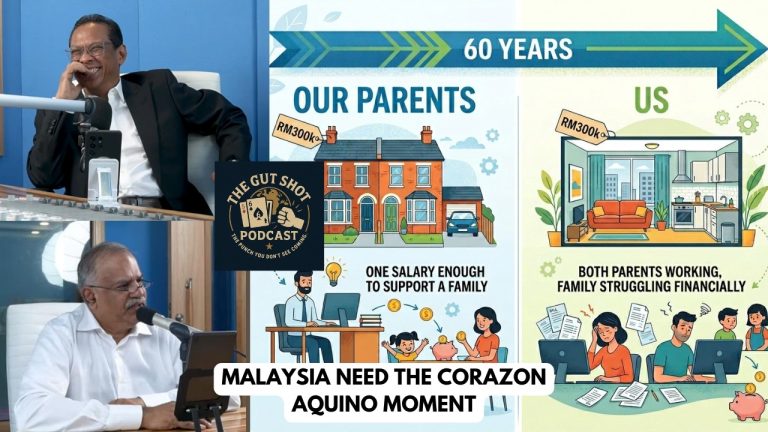
Welcome back to **The Gut Shot Podcast**! I'm Shamo Sam, alongside my partner Syed Akbar, and in this episode, we are asking a very uncomfortable but necessary question: **Are you actually better off as a Malaysian today than your parents or grandparents were?**.
In this deep dive, we explore why Malaysia is still stumbling in the dark despite the historic 2018 government change. Syed introduces a powerful concept that explains our current political chaos: **The Corazon Aquino Moment**. While our neighbors in the Philippines and Indonesia successfully transitioned from long-standing dictatorships into functional democracies with strict term limits and fresh policies, Malaysia is still waiting for its true watershed moment. We changed our politicians in 2018, but we absolutely failed to change our outdated policies.
We hold nothing back as we analyze our economic reality. Looking at the hard numbers, Malaysia is the least dynamic economy in the region, stuck in a stagnant 4% to 5% growth rate and trapped in the dreaded middle-income trap. We reminisce about the solid 7% to 9% growth of the early Mahathir years and dissect how our current leadership has devolved into lackluster, risk-averse politicians who care more about power retention and comfortable GLC board seats than visionary change.
To prove our point, we break down the massive missed opportunities in our rubber industry—how we produce the raw materials and low-end gloves, yet lose out to countries like Japan and the US on high-value engineering products. We also tackle the ultimate roadblocks to progress: direct corruption, taxpayer-funded GLC bailouts, and the massive letdown of politicians failing to deliver on decades of promises after finally securing federal power.
Are we doomed to stagnation? Not if you use your voice. We conclude with a rallying cry for voters to demand accountability and wield the power of the ballot box to force the change we deserve. If you care about Malaysia's future, you need to hear this. **Hit that subscribe button, leave a like, and let's grow this community!**.
**Chapters:**
*(Note: As exact video timestamps were not provided in the transcript, these are estimated chronological timestamps to match the flow of our conversation).*
* **00:00 – The Uncomfortable Question:** Are you really better off today than your grandparents?
* **03:15 – The "Corazon Aquino Moment":** The democratic watershed moment that transformed the Philippines and Indonesia, and why Malaysia missed it.
* **12:30 – The Illusion of 2018:** Why changing the political party meant absolutely nothing for our policies.
* **18:45 – From Roaring Tigers to Stagnation:** The truth about our current sluggish growth compared to the golden era of the 90s.
* **24:20 – "The Pipes Are Clogged":** Inside the minds of lackluster, risk-averse politicians blinded by the trappings of power.
* **30:10 – The Rubber Trap:** How we surrendered the high-value engineering market to foreign nations despite owning the resources.
* **36:40 – The True Cost of Corruption:** Missing billions, massive deficits, and why bailing out GLCs is destroying the private sector.
* **41:15 – The Ultimate Letdown:** Why getting a second crack at federal power is looking like a monumental failure.
* **47:00 – Your Vote, Your Future:** Why a fixed single-term presidency works, and how YOU can force real change at the ballot box.
Jump to chapter 8 chapters
- 0:00 Are Malaysians Really Better Off Today?
- 1:43 The Missing Corazon Aquino Moment
- 9:19 The Illusion of Reformasi and Policy Stagnation
- 12:17 Falling Behind Regional Economic Tigers
- 21:07 Fiscal Deficits, Taxes, and Lackluster Leadership
- 27:33 The Rubber Sector and the Middle-Income Trap
- 33:31 GLC Bailouts, Cronyism, and DAP's Second Chance
- 39:10 Term Limits and Voter Accountability
Auto-generated from YouTube captions. Timestamps link to the video.
Welcome back to the guy's short podcast. I'm Shamsul, Sam. Back with my partner, Syed Akbar. Good morning. Nice to be back and today we're going to discuss another topic which is I think will be interesting. Yeah, I hope so. I think you will going to like this. As usual with Guy's Short, we we going to deep dive on topics and perspectives that rarely talked about and I think uh I think the main theme is actually are you better off? You know, are you better off as Malaysians today than your parents or your grandparents? Let's put it that way, you know? And I hope
everybody that are not yet subscribed, please subscribe and like and let's grow this community of Guy's Short and have all these kind of discussions. Syed, um 60 years on of Malay-led government and now the since 2018 the so-called Reformasi government, are we that better off? Can you start there, please, before I start making my own part of this conversation?
Well, we've discussed this many times before. 60 years about 50 year 55 actually to 922018. Uh such a long time under basically one-party system. Ruled by one political party, ruled by the same political ideologies and uh ideas and for so long. Finally, there was a change. Finally, there was a change in 2018. Um Okay, I prepared some notes for this discussion.
I say or so we thought there was a change. Uh I prepared some notes for this and I had a point that I would actually want to bring in later, but I think I'll bring it in now. Yes, please. I call it the the Corazon Aquino moment. Ah. So, uh we we need Malaysia needs the uh Corazon Aquino moment. We have not got there yet. Let me explain, uh. Uh we have been we had been ruled by the same party from 1955. I say 55 because that's when we had the first federal elections. Uh 1955 until 2018. Uh 45 and 18, 63 years. And then uh we had a change of government in 2018, uh. So, now, just like us,
the our neighbors in uh in Southeast Asia, in ASEAN, uh Philippines and Indonesia also were ruled by a single-party system or in the case of Philippines and Indonesia under one-person, one or some people call them dictator, autocrat. In Philippines, it was President Marcos. Ferdinand Marcos, uh. He held power for a long time, or more than 20 years, you know. He was ruling the Philippines. And the the last years of his life was more of with an iron hand. And then you over in Indonesia also, President Suharto was president from I think mid-60s until 1998. That was a very long time, uh. So, uh
Ferdinand Marcos in the Philippines, finally, he was basically he was thrown out of power. There was a revolution. People's power in Philippines. And then, uh after that, Philippines had their first, let's say, democratically elected uh president. And her name was Corazon Aquino, the first female president of the Philippines, uh. She uh was the wife of Benigno Aquino, I think. Her husband was also a politician who was assassinated by the Marcos people. So, anyway, Corazon Aquino became president of the Philippines in 1986. So, this is the first time that the
Philippines had seen a change in power in such a long time. From from a dictatorship, they moved to basically become a democracy, yeah. Uh but, it was still new, you know, because of the such a long time that the Philippines was under a dictatorship. And this has a lot of relevance to our situation now in Malaysia. Because so long they were in a dictatorship, there were these the Marcos cronies and elitist groups and the vested interests who had been supporting Marcos and who Marcos had supported them. They were both, you know, sustaining each other. They've been there for a long time. So,
when suddenly when there was a change, these elitist groups, the vested interests, the cronies, they couldn't take it. So, although Corazon Aquino was the first female president, the first democratically elected president, there were multiple coup attempts, you know, in during her tenure as president. And but, Philippines has something great going for them. My view is if everything holds is stable in the Philippines and going into the their future, uh since '86 to now is about what, 40 years? 42 years since they they they had a democratic system. Uh they have a very good system in the
sense that their president can only serve for one term, for 6 years. After that, it's bye-bye. Mhm. They're not allowed any second term, yeah. So, Corazon Aquino was a president and then uh she was replaced by a general by the name of Ramos, Fidel Ramos. And Ramos ruled also for 6 years, '92 to '98. So, by the time of Ramos, it was still uh settled down. The politics in Philippines had settled down, but not fully, yeah. So, anyway, Fidel Ramos, who was a general, he he he he did quite okay. He ruled the country quite all right. And then, he was replaced by the actor Joseph Estrada,
the movie star, you know. Joseph Estrada, I think he ruled for for certain reason, he only ruled for like 3 years. And then, he was replaced by another lady, Arroyo, President Gloria Arroyo.
Gloria Arroyo Arroyo Now, under Arroyo, again, you know, this vested interests and the entrenched the groups in the Philippines and from the previous Marcos era, they tried to play their hand again. So, there were coup attempts. There was at least one coup attempt against Gloria Arroyo. But, then that came to pass, then after Arroyo, and she served almost 9 years because she took over from Estrada and then she won her elections. And then, after her was President Aquino, Benigno Aquino, the son of Corazon Aquino. Now, this guy was the best president, in my opinion, for
the Philippines thus far. He was very steady. He brought out changes in Philippines. Economic growth was sound. He averaged 6% economic growth throughout his 6 years. And then, after Benigno Aquino, it was Rodrigo Duterte. Mhm. And after Duterte is the present guy now, Bong Bong Marcos, who is the son of the former dictator, President Ferdinand Marcos, huh? So, now, all the Marcos clique is back in power. So, I do not know if it's really as good for Philippines now, but the thing is, you know, all these names that I mentioned, these all 6 years, you know,
except for Arroyo, they all 6 years and they have had so many changes of president. So, you know, every time there's a change in president, which is good, he brings in a new team, he brings in a new cabinet, there's a change in policy, change in outlook, so many things. And if the previous presidents had done anything wrong, then of course the new guys can go and you know, and clean up what they have done and you know, uh take action against them, whatever. So, this is good. Change is good, especially for a country like Philippines, which was under dictatorship for so long, you know. So,
Philippines has got already had um how many, yeah? Ramos, 1 2 3 4 5 6. Six presidents since the fall of Marcos and the last only one term each. Similar with Indonesia. Uh Indonesia, after Suharto fell in '98, they they it was he was replaced by uh Habibie, but just for about a year. Habibie was a caretaker president, the first caretaker president. And then Abdurrahman Wahid was elected, and then they had Megawati Sukarnoputri, and then they had this guy Susilo Bambang Yudhoyono. Perhaps he did a good job in Indonesia. They served two terms of 5 years each. So, uh Bambang Yudhoyono served two
terms, huh? And under his tenure, the there was good economic growth, 5 to 6% steady, yeah? And then replaced by Jokowi, Joko Widodo. Again, who was a good president, and he also served two terms, huh? And under him, Indonesia's economy did well, a lot of infra- infrastructure development, huh? But they stabilized their system. There was no more threat of a coup and revolutions. Even the students who used to demonstrate in the streets, all everything calmed down. Indonesia was like they were on their way. Now, Jokowi has been replaced by this guy called uh
Prabowo, huh? Prabowo. Prabowo is still new. Uh it's yet to be seen in a lot of things people are saying about him. But again, like Philippines, Indonesia has had this change of government orderly and new president since '98. So, Corazon Aquino became president in '86. Malaysia, we have not have had that that Corazon Aquino moment yet. I'll tell you why. All right, 2018, our government changed after 60 over years, right? Did the policies change? No, nothing has changed. Then we had a bunch of short-term prime ministers, Dr. Mahathir, Tan Sri Muhyiddin, and all
that. They didn't change anything, and there was, you know, basically political turmoil. And nothing has changed now. It's practically more, I call it political chess than actually visionary change of the country. Well, the politics is chaotic, right? 2018, the the the BN lost power, replaced by Dr. Mahathir 2.0 and all that. It didn't last long, but none of the policies changed, and the country's politics has been chaotic and confused since 2018. In other words, the Corazon Aquino instant has not happened yet here. We're still like walking around, stumbling, fumbling in
the dark. Don't know exactly how to organize ourselves. And where we are now, 2026, the politics is more confused than ever. And there's going to be at the next elections, it's going to be, you know, we don't know what's what's going to happen. Because although the faces have changed, the names have changed, the names of the political parties have changed. In power, out of power, those who were in opposition now in in government. Those who were in government, they were out in opposition for a while, now they're back as coalition. All kinds of things have happened,
but the policies have not changed. So, the country itself, despite a change in political power in 2018, on the ground, the country has not seen any change. So, that that Corazon Aquino moment has not hit the ground yet in this country, in Malaysia. That is why things are now all up in the air and the politics is so unsure and the politicians do not know what what is their fate what their fate is going to be in the next next general election because nothing has changed. Uh so we have not had that defining moment in our politics in our country where you can say that
that is what we were before and this is what we are now and we are moving forward. You cannot see that uh watershed. Now you cannot see that differentiation between the past, the present and where we are going. So this is the situation now in our country. So we started off our discussion by saying uh are we Are we better off?
than our parents and grandparents? Uh nothing much has changed. If actually if you remember when uh we had that Zoom podcast in Australia, I put up um I put up a a chart that shows that that basically um gave a conclusion that Malaysia is the least dynamic economy in the region. Um when you compare since 1965 our GDP per capita is only 36.4 times uh in terms of its multiple in dollars, okay?
Yeah. In comparison with South Korea at 331 times, South Korea started out way behind us, okay? Um Singapore 175 times. Let's go back even uh China which was under um which had civil war, uh it went up 134 times. And then even if we take against Thailand or Indonesia, Indonesia 92 times, Thailand 52 times, we are at the bottom rung at 36.4% 36.4 times. So, say let me let me let me put this in another perspective. If you say about a defining moment, right? If I were to look for a defining moment if any, there is one issue or problematic issue compared to Indonesia and um the Philippines.
They have a presidential system which is a direct voting system for the leadership of the executive of the country. We have a first past post parliamentary system. That is a structural issue that somehow need to be overcome in one way or another in order for us to be able to have an Aquino moment. That's one part. But having said that, if you were to ask me between 1980 1982 and 1996, when Mahathir first came to to uh to power, right? We were looking at Well, he was uh until 2000 Uh until Yeah, yeah, but at least '96 prior to the uh crisis the Asian financial crisis
Prior to the Asian financial crisis, we were looking at 7 to 9% growth. solid growth, you know, right? 7 to 9% solid growth and then we got knocked off by the uh financial crisis.
Asian financial crisis, yeah. But credit where credit is due, um we got out of the Asian financial crisis at 2 to 4%, you know, including the contraction in '98, right? 2 to 4% uh and without any debt to the IMF. Huh? Yeah.
Yeah. So, but after that, everything became slower. Right? And if you were to ask our situation, partly why it became slower is because now it was not about visionary leadership. It was now about power retention leadership. The The pipes are all clogged up. Yeah. Or to put it to put it more directly, it's gone stupid.
Well, you know, you know, in the previous podcast I had with Professor Tajuddin, he did We did come up with or he actually mentioned one point which I found very interesting. Um is that if you think about the cabinet that we had in the first era of Mahathir, 7 to 9%, you've got people like Rafidah Aziz, you've got people like Musa Hitam, you've got caliber people at least you can see certain caliber of people. Okay? And actually, the word used by Professor Taj to me was that today, the dilemma that Malaysia faces or the Malay the new Malay dilemma is actually we are all run by Gurkhas of
the same party or of the same ilk. Well, I'll be I'll be frank, they're lackluster. They're lackluster. The present team for a for a for a while, not just this team, for a long time, since even late Mahathir, but after Dr. Mahathir, especially since Abdullah Badawi, it's just lackluster. Remember that guy used Cuz he doesn't want to be challenged anymore by
Remember that minister you you are you tried to identify the guy, the flying car guy? Ah, okay, yeah, yeah, yeah, yeah. He was under under Dr. Mahathir. This kind of people, but okay, that compounds the issue. These strange characters and basically quite incompetent people. They compound the issue. The main issue is we have not made good policies. The main issue is we have not thrown out the bad policies. We have maintained them because these politicians are either they're so afraid or they absolutely they have no idea how to come up with new policies or they are really
comfortable with their old policies. I think that's the real reason. To to be honest with you, my answer to you would be all of the above. They they are very comfortable. So these were the policies that caused the previous government to lose power beginning 2008. They lost two-thirds majority. To me 2008 is the kickoff when these people got kicked out. 2018 they lost power. 2022 hung parliament. It was no more elected, it was selected. And now we're going to the next election, nobody knows what's going to happen. That's the situation now. You're right. During Dr. Mahathir, the first Mahathir,
the first Mahathir period of prime ministership, 7 to 9% was normal. And then the Asian financial crisis we took a hit. And then 203 new prime minister came in, Abdullah Badawi. It was 4 5% GDP growth. I'm talking about GDP growth. And then even Najib's time until 2018, isn't it? 5% 6% it was lacklustre. And then even Dr. Mahathir came back it was down to 4 to 5%, you know. So we have we have we have missed out. We don't have that strong growth anymore. I have said there are many reasons why this has happened. The education system, the poor policies, the consolidation of
the banking system which we started at the end of 1990s and going to early 2000. I always feel that after the consolidation of the banking industry, we have lost our growth because we don't have enough banks. It's oligopoly. We don't have finance companies. Various issues but these are all some of them. But, there are various issues in which which are the reason why we are stuck in this the famous middle-income trap. We are stuck because we although it ages and decades have passed, we have not changed the policies that were put in place decades ago. The same policy we
implemented 50 years ago. Let's take our education policy, yeah? Which we implemented 40 50 years ago. It's still we are carrying it through. If you ask me about the education policy, I think our education policy not just no change. I think our education policy has fallen backwards. So
regressed. So now, despite having changed in the politics political parties change in power, blah blah blah, whatever. The policies haven't changed. Like Corazon Aquino became president of Philippines in 1986 and she say from now onwards call me general or Ferdinand something, you know, Aquino. I'm going to be like him. I'm not going to change anything. It doesn't work. This is This is what This is what has happened in Malaysia. Power has changed, political parties have changed, politicians have changed, policies have not changed. We are stuck. So, the the question is that are we
better than our our our fathers and grandfathers? Why should we be better than our fathers and grandfathers? No, I mean that the truth haven't changed. Yeah, but I mean also if you ask the right if you ask the right question, it's in the numbers. So, basically we are looking at stagnant growth. 4 to 5% at most. We are looking at and then you um uh you you you factor in your inflation rate. Okay? Um you factor in uh the fact that uh the tax base has actually decreased because your GDP has actually relatively stagnated.
Well, okay, you can you can dispute that. You can say that the tax base has decreased. I would like to say that Please. the tax base is not where it should be. I I agree with you. That's where I'm going. Otherwise, the government no need to borrow 80 billion deficit budget. I have to borrow 80 billion or 70 billion every year, 60 billion because budget that you could we don't have enough revenue. Yeah. Because all those factories that should have been built and in operation, all those new industries, new businesses that should have started operation did not happen.
All those thousands and hundreds of thousands of new jobs, high-paying jobs that should have been created in an advanced economy, in an advancing, in a developing economy were not created. So, today we have this deficit because we don't collect enough taxes. All developed economy, all developed economies are driven by the private sector. It's not driven by government-linked companies. It's not driven by uh the public sector. So, this is of course it's linked back to all these policies. But if you ask yourself about the Aquino moment that you mentioned, right?
There is a There is an English saying, "The fish rots from the top. The fish rots at the head." So, when the If you want to see change in policy, the head need to change.
There are enough people who seem to like the status quo. They benefit from it. Absolutely. Otherwise, it would have changed a long time ago. Right. But the maybe but the voters doesn't seem to understand this.
a problem. But well, uh let's give some credit to the voters. Since 2008, they have started uh making their choices, more uh manifesting their choices, making changes. But nevertheless, the voters do not fully understand the picture in the country. But the only way out of this of this situation is the voters have to keep changing their mind or vote whoever they want to vote and you know exercise their option at the at the polling at the ballot box. We are democracy and we're not going to change that. We decide our future by going to the the elections and putting
our votes in the voting in the in the election box in the in the polling box to determine our future. That is the best method of affecting change in in a democracy like our country. The only thing is now our voters have to be a bit more informed. They must know what they should ask for. Some people think that by just by voting for somebody else immediately is going to be there's going to be change because the person whom you vote for the other person will come in with all these fantastic ideas. But what has happened since 2018 is that all these new politicians who got into power not only
did they not come with any new ideas. They came from the old guy as well. They adopted all the old ideas. All the bad habits they adopted it. See so people are now a bit upset. They're very upset, you know, but so the people I hope the people who listen to our podcast, they should exert pressure on their elected representatives. That's how a democracy works. You tell them what you want and you tell them if you don't deliver this I'm not going to vote for you. As simple as that, you know. So people should make their voices heard. I keep coming up with I'm sorry I said I mean
you actually has knocked my head a bit because because of your Aquino moment expression, right? And you've got me going in this direction in a sense that actually one person can actually do make a difference provided you bring in the right person. Oh, definitely. The leader is absolutely critical. Correct. Look at Donald Trump. Yeah, but I mean the problem is every time we talk about that, you know, the heat comes because they only see the establishment heat rather than seeing okay, this is somebody who's going to make a difference whether you like it or not. You know. You need
leader. You need a leader. doesn't care what people say. It doesn't care too much because a leader has clear cut ideas of what should be done. Yeah. And that is a function of a leader. A CEO is free to make decision. The the the the beauty of what that has proven, actually whether you like or you did not vote for him. He has delivered on every one of his election promise.
So I mean that's leadership. That's leadership. You you like you don't like it's up to you. Yeah, but you vote for him because he promised you this and he comes in and he goes. But as a leader you have to do what you have to do. Your your responsibility is to discharge your responsi- to to make decisions and move things forward, but how the outcome will be, you know, well it's anybody's guess, but But you can vote him out if the outcome is not your liking. A leader must make decisions, good decisions, the best decisions that he knows and move things forward. We
don't have that. Imagine Donald Trump saying it's okay, I'll just do all those things that Biden and Kamala Harris did. We will just continue I will just let the migrants come in. So then what is I mean that's what's the point?
of of getting a new leader of changing government. This is what has happened in our country. We change a leader, we change government, we change political party, policies don't change. All the bad habits that were with us for the last decades are still there. Nothing has changed. Sometimes I think it's I I don't know. I mean I'm I'm I'm going to sound like an like a movie nerd now. I mean because I'm waiting for Dune part three.
And um you know, the the the word is the biggest change that is whether it's for the good or the bad is a charismatic leader, right? That make absolute changes. And sometimes uh the the the leadership appear out of nowhere because why? We have a parliamentary system. Imagine if we got an MP that comes in without a political party or even as little political party help, but is able to garner uh support from the public. You imagine the force he's going to put on the he he or she on parliament.
We need uh we need a lot of changes and new thinking. You see the the middle income trap. I I personally I I remember when I was in primary school, we were still a rubber and tin economy. This is 1960s. Yes. Malaysia was a rubber and tin economy.
Yep. That's it. Only two They're only two uh pillars of you know, entire economic system that time. We did not have oil. Well, there was oil in Sarawak, but that was We didn't discover oil in the South China Sea or you know, in in peninsula of our east coast and all that. And there was very little manufacturing. Uh it was And palm oil was new. So, we were rubber and tin, you know. So, uh a lot of things depended on the rubber industry and the tin industry. The tin industry, the bottom because aluminum cans replaced you know, the tin used to make tin cans. And then rubber,
uh you know, rubber we've also lost out. We're no more the largest rubber producer in the world. And rubber has shrunk as a percentage of our GDP. I think rubber it contributed about you know, in the tens of about 10 20% or whatever of our GDP those days, you know. Now, the entire plantation industry in Malaysia, the entire plantation industry, rubber, oil palm, is about 2% of the GDP. Which shows that our economy has advanced. We got manufacturing, we got construction, tourism, which is good. So, we have diversified, huh? But, nevertheless, you know, rubber rubber
talking about the middle-income trap, you know. You know, we have the largest manufacturer of disposable rubber gloves in the world is Malaysia. I can say the name is Top Glove, huh? And then, Malaysia produces about 60-65% of the world's rubber gloves, which especially disposable rubber gloves, which they use in hospitals and all that. During COVID, you know, that the demand went up. And then, we also make the surgical gloves. Surgical gloves are a bit more high-tech, huh? But, nevertheless, uh rubber glove manufacturing, latex manufacturing, is a lower end of the
rubber industry, you know. It's a lower end, yeah. Uh we have never really graduated beyond that. We have the rubber We are the owners of the rubber trees. We are still number second largest or third largest producer of rubber in the world, but we have not. Who are the major producers, manufacturers of high-value rubber products? Engineering rubber, you know, nowadays when you build a bridge or a building a bridge here our buildings I do not know, but bridge yes in Malaysia, you know, the LRT railway that bridges and all that. And in Japan, all buildings in Japan,
they must have these engineering dampers rubber dampers. You know, for the earthquake and the vibration. Yeah. The building on the foundation they put a damper on top rubber damper. It's made of rubber uh uh rubber rubber and steel rubber and steel plates damper in case there's a earthquake it absorbs the movement. Yeah. The biggest manufacturers of these rubber dampers, which is a huge market, they are in the US, in Japan, Yokohama Rubber, you know, this what Bridgestone and these kind of people, maybe in Germany, you know? But where Why aren't we the manufacturers of these dampeners, huh?
We don't We own the rubber. So, you see So, we are We have satisfied No, there's policy involved. Yeah. We have satisfied ourselves to manufacturing rubber gloves, now I mean, not no disrespect or whatever to the rubber glove manufacturers, and they're doing excellent job, huh? I They should be uh they are they have achieved a lot of things for the country. They should be uh respect by I give you credit for that. But it is a lower end of the rubber manufacturing process. You know, uh there are so many other engineering products, rubber which have high value added, huh?
If you go through the list, I did some research, Bridgestone in the US, uh Continental in Germany. These are tire manufacturers, but they also diversify into other high-value rubber engine engineering products, huh? And then the Japanese, now the Chinese, you know? But we own the rubber trees. You know, you know, I'm I'm I'm going to edit at this point because we are talking about
so, we don't our our policy makers uh we don't focus. If you ask me, yeah, you don't need taxpayers' money, and please don't set up another GLC with 1 billion ringgit to go and start rubber industry. No need. You just have to change your policies and give incentives, huh? For everybody, foreign investors as well as our domestic investors, you set up these new rubber industries, and I will we will give you various incentives like like which we have done before. You know, the famous pioneer status, tax exam, I I I apologize.
depreciation allowance. If you do all these, then our local people, our maybe our top glove people, will, you know, diversify and go into all these engineering-based rubber products, huh, which higher value added, more employment, higher value jobs created, higher wages, huh, to get out of that uh middle middle income trap. If you If we If you ask me, all the ones that you just mentioned, all these policies, they are three-legged uh three-legged fundamentals to it. Deregulation, um funding of uh financing capital availability, right? And then, free competition.
Okay? If you create policies that allow for three of these to happen, which in terms of deregulation and free uh uh what do you freedom of the marketplace, the last part as well is actually what you mentioned when you give pioneer status and all that, that includes taxation. It'll take off by itself.
off by itself with the private private sector. You don't need 1 billion ringgit GLC. No, do we? No. In fact, you talk to me about GLC, I always say this, the number one perennial reason for middle income trap is actually corruption. There are two kinds of corruption. One is the direct one, which is, you know, where the money disappears from the economic system because it goes into pockets of politicized parties or cronyism, all right? I mean, the most famous one is actually taking a debt on its own and then it disappears into uh the ether, which is 1MDB, okay? The ones that we know um
uh that the IGP has mentioned, 40 billion at least, and yet here we are, you know, complaining about so-called uh uh uh diesel or or or petrol subsidies when, you know, we allow our money to disappear and then it end up billions in safe houses. All right? That is in the the walls that they found. Okay? So, that is direct corruption. And the indirect type of corruption is actually when you have you you fund GLCs and you bail out you bail out companies with taxpayer funds and tax and and and and public money. Okay? It's nothing wrong with bailing out companies, you know? But, how do you
bail out companies? When you do a restructuring, you get private capital. You get new management. Otherwise No, they use taxpayers funds. Correct. The company they bail out also was set up with taxpayers funds. So And probably operating in a business with a monopoly license or oligopoly license.
There you go. That's corruption. That's you know, that's how the system is set up, you know. So, that's where we are That's why we are stuck. And I think that going back to your Aquino moment is we need we need a leadership that will appear from amongst anyone of the MPs that we Well, it's not It's not one day. Yeah, it's not happening and I want to say something about the
Sure. Please do. Please please please please. I want to say something about the DAP. Oh oh okay. Well, you know, the DAP yeah from 1969, isn't it? 69 from 1969 until 2018 now, they were in the opposition. They still act like they're in the opposition. But, they were saying so many things we have to do this all things like what we are talking about now. We have to we will do this, we have to do that, we have to change this, we have to change that. So many things, you know. Now, they've had two cracks at government, you know. This is the second chance. The first
time DAP I'm talking about federal government. Yeah. They made it to Putrajaya in 2018. Yeah. They had cabinet positions. Finance was under DAP. And then 2020, you know, the the things changed, the Sheraton move and all that. So, okay, they lost power for a while. 2022 they come back. They came back. Now they are in the government for 3 years, huh? This is a second chance, you know? So, this is the second time you're given opportunity to do all those things which you've been harping about since 1969. What are they doing? They have really real They have They are
really messing up their their second chance. Nobody gets a second chance like Donald Trump. This is a They actually having a Donald Trump moment. Donald Trump became president for the second time, huh? DAP got a second chance to be in the federal government. They are in federal government now. Still no changes. All those things they said in all those years, huh? Nada. Might near Gobind Singh all this might as well They're not delivering what they were talking about all these years. Gobind Singh especially Sedition Act. He used to talk a lot about Sedition Act.
Do something, man. So, nothing has changed. So, um it's up to me it's it's a it's a big letdown, huh? I traditionally did not agree with DAP, but over the years I got to know them. I know some of them very well. And at the end of the day actually we all want the same things in this country, you know? We all All of us want the same things because we all share the same environment. And you know, from the time of Merdeka '57 until now, the country has changed. Everybody is now urbanized. You live in an urban environment, you have to suffer with the potholes, garbage collection, traffic jams,
whatever. All the normal things, you know, paying bills, the things that you that affect all Malaysians are common to all. There's no more like, "Oh, these people live in the estates or they live in the paddy fields or those people live in the town." That is That is before Second World War, after Second World War, huh?
Those days are over. Over, you know. Now, we need Everybody faces the same issues, huh? And the politicians have to deliver what they said they will they they will achieve and deliver for us that what they've been saying for the last decades, huh? DAP is now the second crack in power and they are doing so poorly. They are so unpopular now. It's a major letdown, huh? So, I hope I hope that uh the politicians they will grit their teeth and uh do the right things. It is not very difficult, you know. There are so many flaws and mistakes that have been made in this country. You
don't need these futuristic thinkers. You don't need. You just fix the leaks in the roof and fix the holes in the bottom of the boat so it doesn't sink. You've done a good job. I find that actually, I mean like
Which they're not doing. like you uh said. I mean, I've met quite a number of all these politicians from both sides of the fence. Um it's just the nature of uh where we are in society. But, what I have found with uh all these politicians, elected or otherwise, is there is a risk aversion, number one. Um they uh would rather not do anything um than risk saying that I may um uh I may get bad press or bad reaction. That's one thing I find about them. Number two that I find, which is and this goes across the board, I said, um is that they are so they they give the uh impression
that they are very comfortable about where they are sitting in their plush plush chairs in Parliament and in uh GLC board seats uh and statutory bodies. That's this this is very comfortable for them. Uh and the last thing in their mind um is how we voters think. They don't even want us how we voters what we voters want or think. They have been overwhelmed by the trimmings and the trappings of power. Yes. And the wealth that comes with it. The gold trade and the silk trade. Yeah. So it's it's it's You know you know why I say this very easily is because all our life we we we are in the
economic sphere in the private sector, we are sales people at the end of the day. Sales people, you sit with us for a 15 minutes, we we can assess your character already. And this is what I have assessed. They are comfortable, they don't want risk, and they don't care about you. And until the day you make them care about you, which is actually you kick them out, Yeah. They're not going to do
The the power of the voter. The power of the You have to you have to keep changing. You got Okay, the other thing is like I know I keep on going back to Philippines. I like that system. I like the 6 years one term for 6 years. That means you don't have to worry about I'm going to kick you out. They get kicked out. The system kicks them out. Kicks them out. The president only serves for one term. So people can focus on choosing the right person for the next president. And then, you know, he also has only 6 years. So he if you want to prove anything to do something good for the country,
he's got one term to do it. And also his political party. Of course, if he wants someone from his party to win the next presidency, he also has to has to do a good job. But nevertheless, fixing the term at just 6 years, I think it's a it's a good thing for the Philippines. And over time, it is going to have dividends for the Philippines. We have been trying to Now the movement the the motion to fix the tenure of the prime minister to two terms, The hot air balloon went up then it went pop. Yeah, it's just performative. And now they're saying that they're going to
refloat it again in June or whatever. Yet to be seen, but until today not delivered. Another another non-delivery. Another another um The the courier Shh. Now you see it, now you don't. You don't you don't. Now you don't see it. Yeah. Uh it didn't happen. Yeah. So we're still here. Yeah. So Um say I think we've come to almost where we we we have answered the question. You're not better off than where we were.
We can be or we should be better off, but we're not. We are not. We are not. So I think we need to think about this. Uh vote. We have to vote wisely. Yep. Yeah. So with that say Thank you so much.
Thank you. Thank you. Yeah. I will see you guys again um on the next podcast. Thank you so much for joining us today. Thank you.
What viewers are saying
49 comments on YouTubeNo comments yet. Be the first to weigh in.
Join the conversation on YouTube ↗