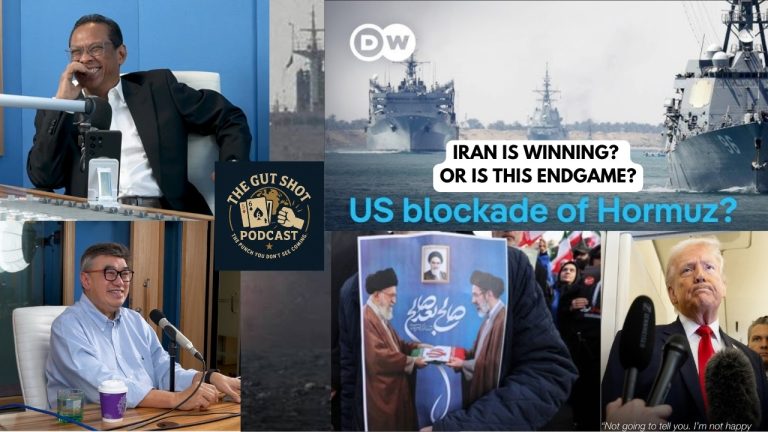
Iran is Winning? Or is this Endgame?
Show Notes & Description
Gutshot provides you with unfiltered unemotional analysis and perspectives of what is going on with the Iranian war and Hormuz blockade. We cut through the bullshit of mainstream media, propaganda, and political biases. Facts and our prediction of what will come to pass.
Jump to chapter 8 chapters
- 0:00 Unemotional Geopolitics and the Iran Crisis
- 4:37 Choke Point Geopolitics in the Strait of Hormuz
- 11:20 The Pakistan Peace Delegation and US Redlines
- 15:51 Debunking the Narrative of Iranian Victory
- 25:12 Global Oil Supply Realignment and China's Shift
- 34:34 Regime Transition Scenarios and the Basij
- 43:48 Malaysia's Missed Economic Opportunities Versus Singapore
- 47:23 Civilizational Realignment and the Post-War Middle East
Auto-generated from YouTube captions. Timestamps link to the video.
I'm I'm sure your host, welcome to Gut Shot. Uh here on Gut Shot, we give you unfiltered perspectives and analysis nowhere else, as you well know. Today, joining me in conversation is we have our popular geopolitical consultant for multinationals, corporations, and multiple governments, Yes. Mr. Jason Leong. Thank you. Thank you for Thanks for coming, my friend. Yeah, happy to do this. Okay. Um our topic today what we going to focus on is going to be on the geopolitical situation in the uh in um in Iran. Um and I think you will find very interesting. Um I'll I'll start this way, lah, Jason,
yeah. During war times, government lies. During war time, mean media lies. Yeah. All media lies. All government lie. Okay? During war times. So, geopolitics for us is an unemotional space. We don't have any votes. We got no say on it. So, we always say we have to really understand what is going on. And actually for us and uh but the public also especially if you are investing and also if you are policy makers, you really need to understand how to maneuver, you know, when uh the elephants are making their moves. Yeah, certainly. I mean Yeah. Yeah, you're right, uh Sam, in the sense that
uh we need to be unemotional. We need to be very uh cold and clinical and objective in analyzing what it is. Uh because we don't have real interest in that because neither partisan one side or the other. But at the same time, geopolitics is such that uh there are in a crisis like like currently, there are always opportunities, right? So, this is where um all the our viewers we hope that they will see the opportunities, especially our policy makers and leaders of this country. And then begin to take advantage of those opportunities as that's presented to us in Malaysia as we
are we are quite fortunate because we we are located in a very nice spot. Uh and uh there's a sweet spot. So, find our sweet spot, find our leverage, make the best of all of it. Okay. I I come with this disease that uh at least I I I would say that this would be the third phase of the war. And it's basically an uh an end game. Uh it's practically coming to an end game. Um the the first news we had of the uh American blockade of the Straits of Hormuz uh was two uh was two of their uh what do you call uh warships entered the Strait of Hormuz. Currently, the last
report I saw was actually there in total 15 warships current I sorry, a dozen uh or at least 15 warships are currently situated into the Straits of Hormuz. Prior to that, they were operating far away we not within the Strait of Hormuz, but with the blockade, they have brought in this uh these warships to uh to a fight where the navy of Iran has been completely obliterated. Right? There is no navy. There is no um what do you call uh uh uh there is no uh uh uh not a what do you call aircraft uh Or drones or
Oh, that that you are too worried about. The only thing I guess is uh is is the remaining missiles. And if unless you put boots on the ground, um is the remnants of the of the of the military in Iran. Yeah. And that's not uh uh that's that's quite a big chunk actually if you got and that that is the challenge if you are talking about total regime change. So, but anyway, uh with the with the situation on the Straits of Hormuz, maybe you can maybe we start our conversation there where what have you seen uh and and how do you analyze the the current uh situation? Well, the blockade by
uh the Hormuz by Trump is actually classic Trump. It came after 21 hours of peace talks that kind of failed. And uh the next thing that he did was you know, Trump is a property man. Yeah. So, when he does a geopolitical or geographical play like this, okay, you block my location, I'm going to block your location also, you know? So, they kind of So, the the blockade of Hormuz is uh a classic play, but it is a brilliant strategy because there is maximum leverage now with minimum uh boots on the ground. Technically, zero boots on the ground. So, so Trump is achieving both aims
um in one particular strategy and it is not an entire blockage or a blockade of the Hormuz. It is a selective blockade. That means there will be freedom of navigation for all other vessels not exiting or going into Iranian ports. So, if you are coming out from non-Iranian ports, you're fine. But it is basically to suffocate Iranian ports. So, if you look at the latest map that is a real-time maritime map about the activity that is going on. So, all the activity now is moving on the other side, away from the Iranian ports. So, which means it is working. So, the Iranians themselves are
crying and say this is piracy, this is uh economic terrorism. Uh Trump calls it economic strangulation. Well, I would suffocate you. I I would call it war. That's as simple as that. It is a war. Um and and that that a naval blockade is for all intents and purposes is a is is in the ancient days, those are what you do with siege of castles. Yeah. Right? You know? So, you choke your your uh but your supply chain uh to your to your adversary. Yes. And um so, if we look at that, I think it's interesting to note as well the impact uh from a uh from an economic standpoint, um
uh Jason, have you seen the la- the the Dow lately? Yeah, this is on the um result The last 9 days, yeah, actually the Dow has been up. Yes, it is up. I think the last time I saw it is up 300 points. Okay? S&P is also up uh uh but the oil prices are actually down. That's the funny part. So, there is no spike in terms of uh geo- geopolitical crisis, tension, and they say that oil is going to hit 150, 200.
How much is Brent now? Brent is 94, right? Brent? Sorry, I think you're talking about WTI. WTI is 91. No, WTI is 91. I got Brent at 88. Well, I don't know. That was just early this morning. It It could be moving down. Uh it will be more uh be less. So, it is moving uh to a favorite position which actually benefits us and the whole the rest of the world. Yeah. Uh the prices are coming down. I I I would reckon I think the way it looks like um the financial market is looking at this as being as as we started out that the game is almost over. The question is only as far as I'm concerned. Actually,
I I I I don't know how the game is going to end. That's all, right? Uh but if you look at it with Brent, uh with WTI uh at a higher price, it tells me that actually there are more ships that are going to US to get oil. And actually benefits the American economy more than anything because of the the the choke point, as you put it. Choke point geopolitics. Exactly. Yeah. So, I mean, uh what else do we do we do we need to be able to see in your in your opinion? Well, the the impact on American economy is certainly positive. The impact on Iranian economy is certainly very negative because the
Iranian Central Bank actually came out with a statement and say that uh inflation is going to hit 120%. And there will be at least another 2 million of Iranians is going to lose their jobs. Uh which is quite true because with this choke point geopolitics and this economic strangulation and suffocation of of Iran, uh where ship cannot enter and exit from Iran. So, that means the oil cannot be sold and cannot be shipped out. And Iran may be a good big producer of oil, but they don't have enough storage facilities. So, you can produce so much oil, but if all your storage facilities
are full, where you going to put the oil? Mhm. Uh you can't drain it into the sea. So, so this is going to be there will come a time where there will be a limit and then that's it. Once you hit that limit, uh your economy is really going to go down because now a lot of people are not not going to be able to buy oil directly from Iran. Well, there's there's also the part that actually uh even the Strait of Hormuz, at the end of the day, it is in the interest of the GCC countries that that that that Americans are in control. Because if you look at it, like it or
not, Saudi Arabia is not great friends of Iran. Uh the GCCs are not great friends of Iran. And uh uh I mean, the only mediator they have is probably I don't Was it Oman or Qatar? Yeah, Oman. More of Oman.
Uh now right? Pakistan. Yeah, and now Pakistan. Right? And uh I think uh the last last night, if I'm not mistaken, the ambassador of Lebanon was with uh the ambassador of uh Israel. And it's been reported that it was quite a laugh fest. So, I think part of the strategy is also expanding the Abrahamic Accords. You know? Um because at the end of the day the whole strategy is an isolation of Iran. Um Kharg Island, when they bomb it. Yeah. I mean, they bombed the military installation. They kept the They kept the oil installations intact. intact. Yeah. Yeah.
So, then So, now we've moved to the last negotiation, the so-called negotiation. Okay? Um apparently, there were 300-man delegation from Iran. From US. Uh sorry sorry, from US. And a 70-man delegation from Iran. Uh what do you think of that particular peace efforts or so-called negotiation? How do you think that's going to play out? Well, I think from American side uh JD Vance, the vice president, has always been seen as the most dovish of all the the people in the cabinet. And he is not so much into the war. And uh a lot of people say that he is more of a peacemaker. And it was a brilliant
strategy for Trump to send uh JD Vance in for this peace talk. Uh because it elevated the talks to a very high level. Now we are talking about uh VP. Technically, it was Air Force Two that sent him in, but the plane they redestinated it the call sign called SM95. I think it stands for special mission 95. Okay. Uh so, 300 people staffers, I believe these are mainly security staff. Because to send in the number two of US into Pakistan uh would have major major security ramifications. So, I think So, these are the people, but the actual people who are at the table were probably less than
six uh from the American side. Whereas the Iranian side of 70 people, most of them represent various factions who seems to be tussling for power. The IRGC faction, the speaker faction, the presidential faction. There's also the Basij faction, which is also the regular army faction. So, each of them have their own interest. Uh so, ultimately, what is being negotiated? But somehow I think the US redline is boils down to two points, I see. Uh Trump has always been saying it is the uranium. Uh I want all the stockpile, the 60% enriched uranium uh which is about 400 K kilograms. And he wants
unconditional opening of the homes. So, these are the two two main conditions. Which apparently Iran did not accept. And they say, "We have a right to uh to nuclear to enrichment and all that." So, that that's why that's why I think the Iranian delegation was kind of caught unaware and caught by surprise when JD Vance said, "That's it, you know, we walk out." After 21 hours. After 31 hours.
No, 21. I mean 21 hours. I mean, just a day or so. My my thoughts are actually there are no negotiation. I mean, I'm quite blind about it when I look at the analysis. I mean, it's all political theater. It's like Kabuki. You know? Um because really, what when you negotiate, each party need to have leverage. Right? What leverage does the Iranian have? It is like It's really true, you know? I I I mean, in spite of how we see the media or the mainstream media wants to talk about in spite of how we see in WhatsApp group talk happening looking at this uh this this opinion
people on YouTube are talking about. I I mean, I'm a realistic guy. I've done business in the in that region. Okay? You've got no leverage. You've got no navy. You've got no uh what do you call? You've got no air power. You have only uh ground military that whenever they pops up, they're going to bomb you with drones. And uh and and strategic missiles. Um What leverage do you have as far as negotiation is concerned? You pop up your your your your ballistic missile or whatever. You know? They're going to bomb the cave or they're going to bomb the the launcher. Yeah. Now they have
the technology that anything that is launched, they can do a back trace and basically a reverse trace right to the location where it was launched. And it's almost immediate, you know? This is the fascinating thing that people seem to not want to admit.
Yes. Uh the this version of 21st century warfare. The electronics and the AI has taken over. Incredible. Yeah. They they they immediately you launch the next minute you're gone. You're gone. Yeah. So, this is this is something that is very new. And then we are we are actually seeing it. And actually, yeah, sometimes it really uh boggles my mind in the sense that why people keep saying that Iran is winning. You know? I mean just flip the whole thing all together. If on day one Yeah. assuming if on day one Iran assassinated Donald Trump. Yeah. Huh? On day two, day three, next
whole week half of his cabinet is gone. The Pentagon is gone. And then Pentagon gone. All the generals are gone. 50 of them gone. Wouldn't the whole world be saying that, "Oh, there you are. Iran has defeated America." Huh? Iran has won. But the real the reality is that on day one the Ayatollah is gone. Um many of his cabinet members are gone. Many of his generals from IRGC and all the more than 50 of them are all gone. All slaughtered, slain, and killed. And yet people are still in denial and say that oh, Iran is winning. I I I think the partisanship of the analysis and the
news media towards the left and towards the Democrat you know, it's just not accepting what is going to happen. And I don't I mean, this is not our job. We don't do that at Gatestone. We talk about what is real. I mean, it reminds me of Muhammad Ali fight against Ernie Shavers. I believe it was Ernie Shavers, you know? Where he just pummeled the guy down. And and and and, you know, every every round you're you're on the ground. And you're saying, "Uh Shavers is winning." You know? I mean Come on, man. Wake up and smell the roses if you can. Right? So, I think the the the you said that uh
I mean, I think from a military standpoint they don't want to see another North Korea in the Gulf. In in in uh in the Middle East. Because then you cannot do anything anymore. Yes. Right? Imagine if I were to say this, right? Let's put it this way. Imagine if uh if PAS in Kelantan has got nuclear power. Okay? So, to all the people who think about it, right? Imagine the mullah having political power and they have no interest in this life. You know, their interest is actually to go to heaven and their 72 virgins. Okay? And they have nuclear power. Everybody is actually in uh uh uh hostage. Yeah.
Right? Cuz you have interest in this life. They don't. So, that's why partly I said there's no negotiation on the table. Because how can you negotiate with a party that wants to die? Mhm. True. Yeah. And then the other party also has got no leverage. So, you as the guy who has the leverage why what am I negotiating except for for political theater? Yeah. You know? So, that's one. The second thing is actually we already know that they've been helped in terms of developing their uh their missile or their their their their ballistics missile uh to strike far beyond their uh in the even the uh
the Middle East. Yes. So, that's that's the two military part that that they're concerned apart from, you know, they fight Hezbollah, they fight they fight Hamas, they fight the Houthis, they fight all this kind of uh destabilizing effect. Yes, I mean this has been Iran's practice and uh this is something actually the neighbors, I mean the the the other power that is in uh in Middle East is Saudi Arabia. I mean Saudi will never stand for a nuclear Iran, right? They wouldn't want Iran to have
Don't even talk about Israel, right? Saudi will not stand for nuclear Iran. And Turkey, another power, would Turkey stand for nuclear Iran? Because Turkey also wants to be the the big brother in that region and definitely right in the center Saudi wants to be the big brother dominant force in it. So, no way that they will want to have see Iran. So, the convergence of and the Arabic states together even with Turkey converges with the US interest that we must ensure that Iran will never have a nuclear weapon. And this is exactly what it's all about. That's why Trump said
90% of the peace deal has to do with the uranium I want those things. So, even Marco Rubio, I mean there are a lot of people who are saying that oh Iran has a right to do the nuclear enrichment for civilian purpose because they want to do for nuclear energy, but for nuclear energy you do not need enrichment after 60%, right? And you don't need a nuclear enrich enrichment underground. Yes, I mean why hide it so deep underground and then you call it is a for civilian nuclear energy. So, a lot of things and actions of of that is actually uh points to some other purpose
and intention. And that 60% enrichment and the 400 grand kilograms actually has already been verified by the IAEA. It's not some some numbers that the US came out. There was independent verification at one time during uh the earlier time uh during Barack Obama's time, but after that the inspections and access were denied by Iran. So, that that was the last verification that Well, I I think I think we have seen now actually uh ships passing through the Hormuz Straits, right? And that tells a lot already that uh I think within the next week we should be able to see um the
effectiveness of the blockade um and the control of the Hormuz Strait by the American Navy. Um I I'm pretty confident of it because why? Not not out of any emotional uh evaluation, but just putting together the number of warships and the lack thereof of Iranian ships, Iranian warships, right? The only question is actually would China do anything about it or Russia would Russia do anything about it? And my gut sense is having seen that um um I I got one report that actually one ship one Chinese ship passed through. Two, if I'm not mistaken, was turned around before entrance to the Strait of
Hormuz. So, as a result of the blockade, so I think this remain to be seen, but I don't think China has got the reach, naval reach, to actually impact anything in the uh uh in the in the Straits of Hormuz. What's your opinion on that?
Those two vessels that actually they did transit and exit the Hormuz. They were ships that have already been sanctioned earlier by US OFAC OFEC, the office of uh asset confiscation. And uh what people missed is that they said oh there you are, the whole blockade has failed because we we see ship China ship exiting. What the blockade was about was ship exiting from Iranian ports. These two China ship exited from Dubai from UAE ports. And uh so, they loaded and unloaded their stuff and they were carrying stuff from Dubai. And so, therefore they are not subject to the
blockade. So, they have freedom of navigation. So, they can exit and China can So, now China is kind of buying oil or whatever things that they need through the other ports, not through Iran ports. So, they will be able to uh basically have freedom of navigation and some of these are shadow fleet or you can call it gray fleet. And this is actually in a way the market has spoken. The fact that the price of oil has come down, it shows that the blockade is already seen as successful. That means the Hormuz is I mean the the basically what you're saying is the
It's no longer blocked. the uh the market is already pricing in that the the blockade has not just been successful, but probably we're looking at an end game to this particular uh war. But I'm also looking at it this interesting part is there more than a hundred ships and including VLCCs that are streaming towards American port in the Gulf of America, you know? And a lot of those ships are coming from China. Yes. So, what we are seeing also is an economic realignment because I would say to people I've been 35 years in the oil and gas industry, right? I know this business very well,
ladies and gentlemen. Okay? This the the market, especially in the 21st century, is very efficient. Okay? The minute they see a problem there, they're going to shift and to where they can get it fastest, even though it's going to take them longer, it's going to cost them more, but the demand got to be fulfilled. So, China is getting a lot of their energy fulfillment at the moment coming from the US itself, both oil and LNG. As you know, and LPG. So, so this is another twist in the whole geopolitics economics that we are talking about. I mean you're right because uh
China of all countries understand supply chain economics. Yeah. Right? So, when they can't get the supply from Iran, and they know how to find the next possible supply and that's America. So, they have no qualms about it. It's basically getting the supply so that the Chinese economy can continue to grow and continue to function. And uh what is interesting is that US has changed the entire world of oil and gas. I mean at one time they were number four in terms of LNG supplier exporter in the world. Now, within a short span of two years America became number one uh LNG
exporter in the world. Right? I think Petronas of Malaysia remained at number five. And suddenly within this year itself America is now the biggest supplier of oil. 171 at the last count I checked. 171 oil tankers are currently around. That is a record number that is and what uh in route to the US Gulf Coast to load American crude. Yeah. Okay? Typically typically it is around 110 on crude exports are expected to rise uh to 5.2 million barrels a day in April up from 3.9 million barrels in March. And uh This is coming from both Europe, Asia and China. And Trump is saying that now we have got
more oil than Saudi and Russia added together, you know? So, they have a lot of oil. So, today I mean with thanks to Trump's uh policy of drill, baby, drill, I mean there are plenty of oil all over. Uh so, they are now the major supplier. Yeah. And they are almost behaving like OPEC if you ask me. They are they are bigger than OPEC in the sense that they are the stabilizing factor for uh global oil at the moment. But if you at this point if you look at it, right? Then then we are looking at an end game that um here's a funny thing. I I think sorry, I digress. I remember in the heights of
let's say before the financial crash when oil was going at 140 bucks a barrel. Okay? We're not This is a war. I there were no wars during that time. And we have a currently a a huge war in the Middle East and oil is not a hundred bucks a barrel even and it's coming down. That's right. So, what is this whole narrative that we're reading in the media? That is why a lot of analysts got it wrong. Uh I I've heard podcasts talking about scenarios of of 150 to 200 dollar oil, you know, which is totally irrelevant. You look at the situation the real situation today is that we are
not going to reach that. So, what is more important is that as far as Malaysia is concerned, yes, we have been affected. How and what Malaysia can do to help to elevate some of our problems in terms of the oil. So, the oil price is kind of now stabilizing. You you have been one person who have been saying that the oil price is not going to spike. It's going to stay low. You are the oil man, you know, and today it is you're right. Is it it has not I mean the 88 bucks per barrel actually at the height at a height of a war is and and and a war that I feel that will end not that that far down the
road, you know. Do you know that the I mean for our viewers, if I were to remind them, by the way, if you are not a subscriber of this podcast yet, I would urge everybody to subscribe and like so that you get more content. We're going to talk more domestic on on the next episode. You're going to like next episode as well. Subscribe, get your friends in. These are intellectual conversations that you go won't find anywhere else, okay? Anyway, going back to where where we were we were talking about. I mean the the the oil price the oil price as it is I think even in Malaysia I think I I don't
understand the alarmist nature of our policy makers. In fact, I mean the the so-called subsidy that were keep on adjusting and all that actually is a pittance to the amount that we've had leakages in in our in our own system of governance as a whole. I think the rakyat deserve better. So, anyway, let me go back to the geopolitics side of it, right? Um You we are also looking at Here let's let's pin the situation in the Gulf. Um the Iraq war. Remember the Iraq war? Yeah. It ended uh actual fighting with boot on the ground. Um that is what year I think what year
was that? I can't remember. I think basically early 20th century. Yes. Right? Yes. Um the second Iraq war. Yeah. Right? Under Bush Jr. It ended in 21 days. Yes. Okay, let let let let's put this in perspective, ladies and gentlemen. The Iraq war the whole war the the whole kinetic action ended in 21 days. The prolonged war took about 60 plus days, if I'm not mistaken. You know, 40 plus or 60 days something around that. Not more than 2 months. Yeah. Okay? When Iraq had their war with Iran it was a stalemate for 8 years. Wow. Okay? Let's put that in perspective. So, for anyone to tell you
that Iran is winning I don't know what kind of morphine or cocaine they are smoking. Okay? Or or or or they're putting up their nose. All right? So, I'm sorry, Jason. How do you see because I think I have this opinion that the regime is controlled by the mullah. The IRGC is controlled by the mullah. Or it is mullah supported. Okay? Probably between 10 to 15% of the 90 million population is extreme towards the mullah. Okay? Without boots on the ground how do you do if let's say the third objective, if we don't know this, yeah? If the third objective is to see a real a regime change.
Can you see that happening? I would agree with you that the war in Iran is drawing towards um the end game. Right. Um today is probably day 44 um since And they've not put any boots on the ground. It's all That's right. It's all naval and and air wife wife war warfare.
Exactly. Uh so, all those analysts who keep harping about Vietnam, Afghanistan saying that wait till you see all the coffins going back to America and uh Trump will be impeached. That has not happened because very few have died. So, they are not going to put boots on the ground and Trump is smart enough not to do that. Okay. So, the the end game as as it is because the Iranian government structure is quite complicated. It is basically a tri-tri kind of structure. Okay. So, one it is the mullah that is the the ayatollahs. And then the second one is the army. Um which is
actually had two components. One is the IRGC, which is closer to the ayatollahs. Uh the other one is the Basij, which is the regular army. And then there is a parliamentary democracy which they elect the president. Mhm. Uh and of course the speaker of the house. Uh and the president Puzeskian did not go was not part of the delegation. They sent uh Galibaf, who was the speaker of the house. And then they sent the IRGC people. The ayatollah group is basically decapitated. Almost very few ayatollahs left. You know, number one, number two, the son, everybody is out. Nobody has seen his
son. Yeah. So, the and then there is the Basij. Now, there was a chart actually showing all those people who have been killed. And uh a chart of about 70 old people. And about 50 of them have been taken out. And there was one distinct section where there were no no red marks empty. And what was I looking at that? And that is actually the Basij army. Right. So, which means uh can we say that Trump on Israel was actually very strategic? They wanted to remove all those really hardcore people and they're all dead already, leaving those who are considered a little bit
less hardcore. You you still need an army, right? But what kind of army do you want? More moderate army. So, perhaps the Basij and the people who are like Puzeskian, I mean he's a president. He's seen as more uh moderate. And so does the the speaker of the house and maybe even the the minister of foreign affairs. And this group of people who are in a way seen as the more acceptable new regime who can do a proper deal. And so, if the regular army is there and who can replace the IRGC, then we will have a functioning um new government in Iran that is basically almost like kind of
like the Venezuela model. You know, there was no major destruction. That there is a possibility for Iran to have a regime change without boots on the ground. Yes, it is possible. Wow. Okay. I mean I personally uh have less probabilistic uh analysis on that, but I mean you probably know the the the terrain better than I do. I'm just going on my gut. I mean it is quite similar to the Venezuela model because they have seen that work in Venezuela. Today basically, you know, Well, but Venezuela is a secular country, but not not not Iran. Yes, but the the Venezuela
army is also now kind of like being co-opted by the current acting president. And everything seems to be going on fine. Oil money from Venezuela is going direct to an account that is controlled by Trump. You know something? The now that you mentioned it, actually the after the fall of Iraq, all the oil money that is transacted for Iraq is actually controlled by the Federal Reserve of US. Yes. Yeah. Uh uh all the oil money went into an account that controlled is controlled by the US. So, if you look at that, you look at Venezuela, you look at all this, the petrodollar is basically
strengthened. The US reserve currency as a global reserve currency is actually stronger than ever. Yes. You know? I mean there's so many multiple of them. And this is where I find that I always tell people I say, "Don't listen to what Trump says. Listen to what Trump do." Yeah. You know? Because these are basically the impact of it. Yes. And all it does is is not just strengthen them I mean now you're looking at a projection of of Remember when we we first started we were saying the the unipolar world? Yeah. This is I mean today uh China and Russia is actually very angry and they
made a statement saying that the US is like a pirate blockading the the Hormuz. Are they acting like a unipolar policeman? It is. They are. Exactly. So, welcome to the real world. Yeah. They are. So, you know, this is no longer basically I mean we are not talking about rules-based international order. That is that one is past. Not just that. Yeah, Trump doesn't bother about that. He will do what he needs to do for America first. Yeah, but Jason, I've always stated this not even before Trump that the UN all the world organization I don't care whether it is the IMF, whether it is the UN the
the the no matter how the facade is given the real people's the real nation that is controlling all these so-called what do you call world organization is America. Yeah. They fund all these you know, including NATO. If they decide tomorrow I'm going to disband NATO Europe you're on your own, babe. Yeah. You know, and I don't think you can survive. Yes. They don't have the army to actually pretty hold on against Russia. Yes. So, this is so if we if we are looking towards what is the the final outcome. Hopefully there will be Trump at the end of the day is first and foremost still a
businessman. He's not going to find a forever war. He knows that. So, he will call the war to an end. Basically what kind of deal that they're going to do. And so if he gets the uranium and the the Hormuz thingy is to him is secondary. US don't need the Hormuz. Well, I think the I I think I think I have a gut feeling and I I this is only gut feeling, guys. I have a gut feeling just like the the Panama Canal just like in Venezuela. I think they're going to take control of the Hormuz one way or another they're going to take control of the Hormuz because it's worth the economics
to actually take control of the Hormuz. Yes. And if you go by what you're saying I'm taking your lead from what you just said. Especially if you're going to leave a regime that not that is slightly more compliant. Yes. Right? Rather than having a complete regime change you will need to be able to actually have a presence at the Hormuz. Yeah. This is this is the only way. Otherwise I would say put boots on the ground because if you can wipe out Iraqi resistance in two months they probably need just one month to wipe out and not just that if they arm the Iranian on the ground including
let's say part of the Basij. Okay? It is probably going to be a lot easier than Iraq itself. Yeah. And that that that's true because then then you don't really need that many boots on the ground.
You don't need that many boots on the ground. They can do the the the thing and it it will be able to actually regularize a lot of things in Iran and it also will be good for the economy. So, all they need to do is to put more money and resources for all this. I think Yeah, I think Jason a lot of people who are emotional about the subject for either they are anti-Western or anti-Israel anti-Trump or whatever may not be too happy with what we are talking. But we are talking facts. We are just analyzing based on unemotional perspective, you know, and reality is this.
If you want to fight Mike Tyson okay? You better actually lie you better look at that. You know? And if you're if you're flat on the ground you know, and twitching you know you lose love. Let's let's be honest with it and that's where actually I I sort of admire what Singapore how Singapore has managed this whole situation. They they they've stayed out from the conflict. They did not make any whereas our government oh Iran is our friend. You've taken a side. Why do you want to take a side when elephants are fighting? You know? I I keep going back to saying look
look at Singapore how smart they are. You know? And then take advantage for your country for your people. Exactly same. Since you raised this there's one point that we have missed out. Singapore is reaping a tremendous bonus in the banking sector today. You know how much cash flow Yeah. and funds are coming out from the Middle East Yes. running and flying into safe heavens because they know that the money will not be safe there. Yeah. So, all and everything is going into Singapore. I got bankers in Singapore, private bankers high net worth private bankers who are
saying that we got so much business. Not just that. Don't talk about that, right? Let's even talk about Chinese money. Right? Private Chinese money are flowing into Singapore and other places. Okay? You have to ask yourself why why are those money not staying in China? Exactly. You know? I always say follow the money. You see the money will walk by itself. They come to Singapore that means they know they're running away from there. You see the strange And the money is also flowing to America. That's why the Dow is going up and up and up. If it comes down it come down for a short
while then it goes up again. So, the tough question that we need to ask ourselves in Malaysia is what is Malaysia doing about this? You know? Why are we so emotional about this? We are Muslim progressive nation. How come we are not getting the Muslim money? Yeah. Why is the why is the Saudi money going to Singapore, the UAE money, the Dubai money going to Singapore? What kind of what what kind of brotherhood are you talking about? So, this is where are we missing something or are we simply not able to up our level our game and do the marketing? Our people should
be on the ground. No, because we are always going on the we always want to be jungle compound. You know? Yeah, so sometimes we make statements without thinking about all the other benefits. They think they think those statements is going to get them votes. Okay? They don't realize that the votes are going to come from actually do our people got jobs or not. Okay? At the end of the day when they go to the voting booth it's how's their pocket going and you are not doing filling up their pocket. You know? I mean to pivot on the last point before we I guess we wrap up. Somehow I have a
thesis a bit on this. You know who was the guy who wrote this book called Samuel Huntington was it? Clash of Civilizations. Samuel Huntington. Yeah, I'm personally never read the book. Okay? I I've never read the book but that particular title actually hung around with me for a long time. And uh I am really looking at a clash of civilization as well when you talk about Iran and its proxies. Because if you look at Saudi, the GCC country, the UAE, the Oman's, the Qatar, they have already evolved. I mean MBS in Saudi Yes. actually getting more progressive than even our own country today. Okay?
Indonesia and it and and the only clash remaining between an ideology that wants to actually be the caliphate of the world versus a progressive modern society. I think the one left is Iran. So, this is the last last pawn or last rook on the chessboard, you know? What's what say you? Samuel Huntington's thesis is quite interesting. The way he is I think he is right to some extent talking about the clash of civilization. So, if you look at Iran war today we are talking about an American interest against Muslim country. Okay? So, in that sense there is a clash of two different
civilization. But at the same time if you examine it deeper within the Iran and the Muslim world there are also internal clashes because Saudi and the other eight countries which are have condemned Iran's indiscriminate bombing. So, they are also Muslims. So, within this civilization, there is also some internal clashes. So, maybe on that level, so Huntington may not be so right. But, Huntington is also right when he say clash of civilization if we look at America and China. Because so here we are the Western civilization versus the Eastern civilization and there there is
great power rivalry even now. So, I I I see that more as as an ideological economic civilizational clash because you've got um um you've got a capitalist free market economy versus a capitalist controlled market economy. Yeah. You know? Um but I mean I think this is probably we'll take it on another day. Yeah. Uh I think we've got quite extensively discussed this. Any last things you want to say on this uh on on on where we are heading with respect to the Iranian uh war at the moment before we close today? I think there are some expectations because if the Iranian war can come to a close and
there is a peace deal uh I'm all for peace. I think Trump also wants a peace deal and if we remove the nuclear weapon threat, I think a lot of countries will sleep more soundly and safer within that region. And then from there, I think the next big thing that Trump wants to do is probably together with the board of peace um they will probably revive whatever Trump's master plan for Gaza. Mhm. So, that will be another massive development in terms of what Saudi and many of the Middle Eastern countries and Israel has already kind of agreed on a certain master plan uh I think Saudi has already
packaged almost a hundred billion for that. Yes, so there is there is a master plan for the redevelopment of Gaza. Yeah. And what is interesting is also based on that, there seems to be a pathway towards a free and independent sovereign Palestine. Yeah. Uh I am a Palestinian activist. A lot of things that I do, but you sometimes I look at this plan and say, for so many years we've been fighting for a free and independent Palestine, but never seem to get anywhere. But, this time round, there is this plan that yes, this plan is very selfish because Trump will probably be Trump and Israel and
Saudis will probably be the biggest beneficiaries because they're building golf courses, they're redeveloping the the whole thing, hotels, tourism sites, everything else. But, what will of Gaza? I think where will the new Palestine state be? I do not know, but it's somewhere there. But, I also had an interesting conversation with one of my friends, Christian friends in America. I say will there be business? How many tourists you're going to attract to this place? He said, you forget, this is Jerusalem we are talking about. So, I said, so what? He said, this is where the Christian
pilgrimage tourists segment. Well, just look at our own country. It's a Muslim country and we've got tourists coming from everywhere. The only thing you need to do to ensure is that people are peaceful and people are welcoming. You know? That's all. Well, but if he's talking about Christian pilgrimage, he's talking about at least 100 million Christians from America who may do an annual pilgrimage to go and visit their own holy land.
No, even even even even even there are a lot of Muslims who went on pilgrimage. Not to say I wouldn't call it pilgrimage because it's supposed to be the second holiest site. So, there's a lot that I quite a number of people I know of that actually went to Jerusalem uh through Jordan. Yeah. Yeah. So, you know, I mean don't be surprised. I do think that there is a big possibility um after the end of this that you're going to have with with a docile Iran or or somehow a a controlled Iran that the Abrahamic Accord is going to expand. I think that is what I I think that is what the world should be
looking at. Yeah. Cuz you know, if really Israel wants to have a greater Israel you know, they could bomb everybody to kingdom come in six days. So, on that note, let's you know, hope for you know, a finality as as early as it can come, right? But, you need to also not just I mean looking at the control, but I do think a regime like that uh just like how we do not want our own country to be run by a theocratic regime. So, do the people most of the people in Iran. I've met quite a few of them when I was in Australia. You know? And uh the stories the horror stories they
tell me is actually quite depressing. Yeah. Those who were raised there, those who ran uh uh but those who were uh you know, the refugees the that that came up after the uh the Mullah regime took over the socialist revolution. Actually, it was a socialist revolution, you know, that was hijacked because France sent down Khomeini. Yeah. So, anyway with uh I I want to thank you for today. Yeah. You're welcome. That was a good conversation. I think I hope so. I hope everybody enjoyed it and we'll be back with uh some domestic uh with a very interesting topic with Said uh on the
next uh episode. Uh come back. Uh get other people to come back to come and subscribe and join our conversations. Thank you so much. See you later. Thank you.