Malaysian Malaysians or Are We Really Polarised?
Show Notes & Description
We want to reflect on the reality of our multi-racial and multi-religious society. Just what does it mean to be Malaysian. Why are we probably the most diverse and yet one of, if not, the safest society on earth.
But then we why do we have the cacophony of noise that tend to push towards schisms amongst the races? We get to the gut of the matter.
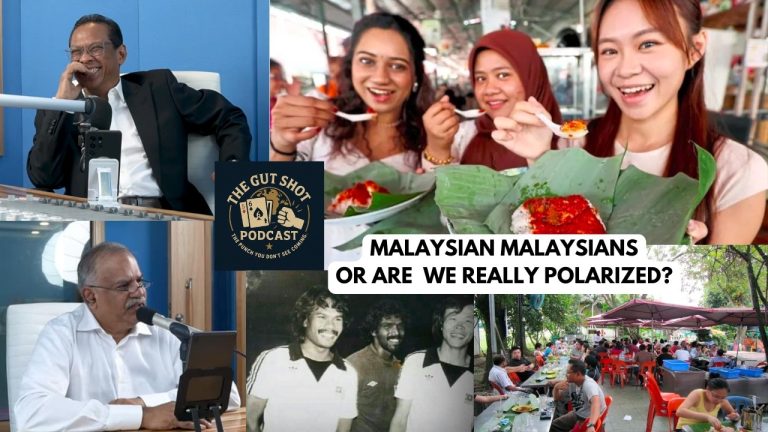
Welcome back to The Gut Shot Podcast! In Episode 69, I am joined by Syed Akbar to tackle one of the most pressing questions facing our nation today: **Are we truly a polarised society, or is the concept of a divided Malaysia just a carefully constructed political illusion?**.
If you are exhausted by the constant racial and religious rhetoric dominating the headlines, this conversation is an absolute must-watch. We dive deep into the fascinating reality that there are actually two versions of Malaysia. The first is the artificial, top-down "nation-building" project pushed by politicians who have completely run out of real ideas. These political actors intentionally weaponise race and religion simply because they lack the vision to offer genuine economic solutions for the people.
But then there is the second Malaysia—**the beautiful, organic, and lived reality of 34 million citizens who have organically learned to accept diversity as the absolute norm**. We explore how our true national identity isn't forged by government mandates or ministries, but by our everyday, peaceful interactions. From the multi-racial harmony found in our vibrant Mamak stalls and the rising popularity of Halal Kopitiams, to the growing "Chindian" demographic and Chinese Muslim communities, **true Malaysian unity happens effortlessly when the politicians just leave us alone**.
We fiercely challenge the narrative that our differences are a threat, arguing instead that our deep-rooted familiarity with one another is actually our greatest, unrecognised strength. By the end of this episode, you will understand exactly why voters are repeatedly rejecting these outdated, divisive political tactics at the ballot box. Join us for this powerful, free-thinking discussion, and let's start building a movement for a genuinely united Malaysia!
*Chapters for YouTube:*
* 00:00 – **The "Polarised" Myth:** Who Actually Benefits from Dividing Us?
* 04:15 – **A Tale of Two Nations:** Why Top-Down "Nation Building" Failed Miserably
* 09:30 – **The Subliminal Malaysian Mindset:** Why Our Incredible Diversity Doesn't Spark Violence
* 14:45 – **From Chindians to Halal Kopitiams:** The Unstoppable Force of Organic Unity
* 21:20 – **The Shah Alam Paradox:** How Political Insularity Secretly Hurts Communities
* 27:10 – **Manufactured Outrage:** The Ugly Truth Behind Religion-Baiting and Fake Controversies
* 33:00 – **Fire the Politicians?** The Ultimate Solution for Real Malaysian Progress
*(Note: The timestamps provided above are formatted as placeholders for your upload, as the exact minute marks were not present in the provided transcript).*
Jump to chapter 8 chapters
- 0:00 The Political Illusion of Polarization
- 3:40 Top-Down Social Engineering vs. Organic Harmony
- 8:54 Childhood Memories and Daily Multiracialism
- 20:30 Urbanization, Chindians, and Demographic Evolution
- 27:01 The Economic Costs of Insularity in Shah Alam
- 33:10 Manufactured Controversies and Temple Protests
- 37:35 Food as a Bridge and Economic Priorities
- 43:27 Electoral Rejection of Race Politics
Auto-generated from YouTube captions. Timestamps link to the video.
There are some foolish people, aka Mhm. Want to guess? Politicians. There are some foolish people because they do not have ideas. They're short of ideas. They do not know what to say or what to do to win the votes. Yeah. So, they pick on this now they and they have named it two hours, three hours. Yeah. They pick on these issues because they are really they don't have any ideas.
can't even criticize them these days. You say something Sedition, eh? Sedition. Shh. Okay, that's all we're going to say about that. Yeah. So, so Welcome back to the Guy Shoddy Podcast. I'm Shamsul Sam. I'm back. Guy Shoddy today is going to be talking back into our domestic and our home-grown situation here. For decades now, decades, I think probably seven decades. The the politics of race, religion, and division, and especially lately, what has been hyped as polarities between the races has been heightened. What we want to What we want to discuss and have a conversation on is whether
how true is this. How much of it is politics and how much of it is reality, and what actually is going on, and how do we move forward as a society. I think this is very important for the health of our nation. I think Syed, let's kick kick it off. And tell me where do we go looking at what we have, especially lately, you know? Where do you see the nation, our society, as Malaysians? Malaysians being in Malaysia today, are we really Malaysians?
Okay. Thank you. Well, Yeah, started off uh hearing words like polarized and politicians. They're both They are P words. Um but anyway, the topic today's this topic Malaysian Malaysians. The second one is easy now. Malaysians is people who live here. The citizens. People who live in this country. There's 34 million of us now. Malaysian, the first one. Malaysian Malaysians, what does it mean? So, what does it mean now to be a Malaysian? What what are what were our aspirations? What were the What was the planning? What was the policy making in the past to create a Malaysian people.
Basically nation building now. A word that I seldom use, but we have to use it. Nation building. Nation building includes identity. Uh identity of the people, the sense of belonging, things like that. Which which all citizens of all countries uh will have now. Of course, I would country has been a process because of our history. And then we are we were we were a colony and then still fairly new independent uh nation in this in this world. 1957. Uh that's 69 years.
Then then we have the inclusion of adapt particular time Sabah, Sarawak and Singapore. And then Singapore left. later, yeah. '63, yeah. Sabah, Sarawak, Singapore came. '65, Singapore left. So, we are still we are still a fairly new nation. And then we have the multiracialism, multiculturalism. So many multis in the country. So, we have been uh chugging along this path of creating a Malaysian
populace, Malaysian people. Uh But now more than 70 years has passed and I I see two major happenings okay as far as being Malaysian Malaysians is concerned, this topic that we're discussing, yeah. You have one that has gone wrong, and you have another one that has found its own level and seems to be going in its own direction at its its own pace, and which is more solid and secure. The first one is the kind of Malaysians that the the the politicians and the planners have been talking about. You know, the policy making, we are going to create an identity, we're going to create an
inclusiveness, blah blah blah. Through policy making. Which has not worked so well, actually has failed. Uh the second one, which I think should be the topic of our discussion today, is, you know, we have been since we were independent in 1957, and even before then, you know, before before the Second World War, for a long time, going back a long time. Our country has been peaceful. We have had no major issues in the country. We have progressed very well, you know, comparatively, yeah. Uh we have institutions that work. For as long as I can remember, you know,
children have been going to school every morning, meaning that we have a system. Uh we can travel anywhere in the country, even before, now we have good highways. Before we did not have highways, but the country was well connected. So, we've had this uh fairly stable and harmonious society for a long time. So, that by itself, uh
creates a lot of uh interlocking or inter- interwoven, interweaving, uh Mhm. among the people who live in the country without us realizing it sometimes, you know. Mhm. Because you live quietly, you live in peace, everybody goes about their business, huh? You You cannot overcome that diversity. You cannot suddenly, like, put it in a blender and come out with one gray or some kind of light brown color where everybody It does That's not going to happen. But, I think the people here, over the over the decades, huh, that we have lived peacefully, lived quite well in this country,
we The differences is the norm. Yeah, that's an interesting point. You know, we know we know Our neighbor is different from us, race, religion, language, blah blah blah, you know? That's the norm. Well, the When you say the differences is the norm, that's a That's a very interesting point.
thing is The thing is that the In other countries which have failed very badly because of multiracialism, multi-religious issues, language issues, and all that, they have failed miserably, and we can I can give you, what, 55 examples. Well, at least 57. That's a number of membership of the OIC.
Okay. Or at least 22 of the Arab countries, and a lot of countries in Asia, Africa, because of issues like this. We have overcome all this. Why, huh? The difference is Uh Your neighbor can be of Our neighbor can be of a different in every way, la. Different language, different race, culture, religion, blah blah blah. But, nobody is a threat to us. Neither are we a threat to our neighbors. So, we have learned to live and let live. Live in peace, la. So, actually, you don't You don't let your neighbor live in peace. You live in peace because nothing bothers you, nothing is threatening you.
And so, everybody just goes on with their lives. That has been going on in our country for a very long time, I think more than a century, yeah. Which has actually created, you know, they call it subliminal programming. Mhm. You know, when know subliminal programming is illegal in some countries in TV advertising. Yeah, yeah, yeah, yeah, yeah.
can flash up a second. Yeah, but this is right behind with the our our our what do you call in our memory that is inherent that we've accepted the differences in our society that they are different communities, different habits, different
no physical threats. Correct. No threats of violence. Yes. Which other countries have. Most recent being Bangladesh and Pakistan, you know, a lot of horror stories, huh? But we don't have. This is the norm in our country. So you know that if you go to here, there, you know, neighborhood or a place or a town or a village, you're going to expect people of different race and culture, but so what? Yeah, you know, that's a funny thing that actually that now that you have mentioned it, it it feels almost like the issue is more where you feel there is a threat is is that and if you walk into an area
that is known to have criminal activity, right? This is where you get scared. But other than that, you can go and walk into any community where there is a majority of a different race, um and you don't feel any threat whatsoever. Um I remember when I was in primary school, I used to be because I was brought up I was growing up in Sungai Petani. That was almost more than 55 years ago. Yeah.
More than half a century ago. Correct. That's highly outdated, my friend. Correct. But here's the thing that is very in the this is the story. I was growing up in Sungai Petani, but because my my grandparents were in Penang, I in Air Itam, my grandpa has a sundry shop in Air Itam, and I used to go back and work over there during holidays. And I would take the weekend when I was working in Air Itam to go to um to go to Simpang Enam in in Tanjung as they call it Georgetown, right? Okay, and you would go to Macalister Street to buy second-hand bookshop books. Okay. Okay, I don't know
whether you you know that or not. All right. Okay. And I I remember you walking by, you're practically the only Malay boy walking through a Chinese neighborhood. Okay. Um I I I Hey, but the second-hand bookshop was all Malay. That's the point. That's the thing. The second-hand bookshop were all Malay. I know. We all know the place.
So So here you are. I remember being early on being quite scared, right? Because you hear stories of Greenland gangsters and whatnot, and I don't know whether it goes there, but after after a couple of times, yeah, it's, you know, it becomes nothing, and that was in the '70s. Right? So, the other thing that I remember in my childhood, I'm thinking whether this particular element for the youngsters are still there, is that we would go and play football. And the And the the the game is truly multiracial. Um whether you go to at your school or you go to the the municipal field, um no single
race actually dominates. It may not be the case anymore. I don't know based on what what been reading because I think even the sports site the the the sports uh uh the sporting um organizations or municipality has been very politicized, you know? But during those days, so this has been baked into our into our society. Maybe people has tried because of politics to uh to actually racialize it, but
they are they are becoming more uh not relevant and uh I'd like to talk a little bit about them later. Yeah, but yeah, so so what I'm saying to That angle is costing them a lot of This is what I'm thinking, too. They're not aware of. Right. So, but but after three after three, four, five decades, right? You know? What we are seeing is exactly what you just say, which is basically for the people here's I'd like I'd like you see assimilate in terms of culture, we don't we don't need to. The we have this the rhythms la rhythms of Malaysian life, you know? Yeah. which have their own
they have their own being and their own existence and their own momentum as you mentioned whether you play football or in the in school or in your workplace with your colleagues, you know? Wherever, these are the everyday interactions that go on between Malaysians la multicultural background and by themselves they have they have a powerful impact. They have made us the diversity the The feels normal. Yeah, that's a good word for it. The diversity feels normal.
The diversity is Malaysian. So, there's no need to put everybody in a blender. Yeah. And come up with one gray or one light brown, I don't know whatever product you're looking for, which which is what some of the policy planners were planning in the in the early days, huh? Mhm. You know, you could actually get that and all these funny kind of things, you know? All that has failed. All that has failed. Uh what is really happening on the ground is what we have just discussed. People have settled in, have accepted. And actually, they seem to like the diversity. I'll tell you more about
this, especially in things like food and music. You know, people look for the diversity, you know? Uh So, this is the reality on the ground. So, as I said, there are two parts to this. One is the policy making, the politicians viewpoint, the the worldview, you know, in in German, Weltanschauung, you know, how they look at the world or how they want the world to to turn out. Has been disastrous, has failed. The other one that is solid and gaining in momentum and has its own force and momentum is what we see on the ground. The the we we the diversity feels normal for us. We
get we are used to it. And there are other things which has happened along the way, which I I would like to discuss with you also. So, the familiarity, yeah, the familiarity between the different multi cultural races in the country as long as there are no threats. There is no physical you know, dangers, huh? Civil war, violence, rioting, which happens in so many countries around us today. This morning's newspaper it's insane the things that are happening in the 21st century in some of these our neighboring countries not too far away from us, you know? So, we don't
have that. So, as long as we have this familiarity, which is unthreatening, which is actually quite We are happy with it, you know, we we are comfortable with it, huh? So, this familiarity overcomes the differences, the distances, or whatever you want to call it, all those negative vocabulary, lah. It overcomes all that. So, as long as we are left alone, the people the 34 million people in this country are left alone to do what they want to do, to be what they want to be what they want to be, society will find its own level. And it'll go on from there. Bottom line
is the peace will be maintained. When you maintain the peace, there's always progress, and there's development. You know, people live in the You're able to do things and pursue the things that you want to do in life. So, it is extremely important we maintain the peace. There are some foolish people, aka Mhm. Want to guess? Politicians.
There are some foolish people because they do not have ideas. They're short of ideas. They do not know what to say or what to do to win the votes. Yeah. So, they pick on this now they And they have named it two hours, three hours.
Yeah. They pick on these issues because they are really they don't have any Well, you can't even criticize them these days. You say something Sedition, eh? Sedition. Okay, that's all we're going to say about that.
Yeah. So, so left alone, the people And, you know, as long as everything is peaceful and people have work to do and things are going on just fine, people are getting along, everything will be fine in the country. And we have to have faith in ourselves. And we cannot have as much faith in the politicians. aka people. Yeah. I think I think here's a very funny interesting part that I I find out that you have put it in such a way. Um You know, you know, there are not many uh countries like ours where actually you don't need to enforce uh rules for the people to stay safe um and not
quarrel when they have differences. Um and then we are so non-homogenized, right? You think of China, you think of Japan, you think of uh I mean, even you think of India, they're all same color, same race, but they have tribes that, you know, that doesn't seem to be able to get along.
The same music. Yeah. Same chapati. You know, and here we are actually we have our Chinese New Year, we have our uh our Hari Raya, we have our Gawai, we have our uh Christmas, and everybody is celebrating all these festivals irrespective of whether uh what race you are, what religion you are, because you are Malaysian. In that sense, I don't know how You know the only country that I can think of that are like this? Actually it's the United States. You think about it, right? Said when we were there, you've got Oktoberfest for the Germans, you've got St. Patrick's Day for the Irish, okay? Uh
you've got uh you've got Easter for the uh for the Catholics. You've got Mardi Gras and all You've got Mardi Gras, you've got Cinco de Mayo, you've got You know, and they retain their culture, and then you've got Chinese New Year, Chinatown is going bang bang bang bang bang bang the same way we do. And actually that diversity um is the one that give them um give them the the the the power and the strength rather than the the enforced uh power of government or of politics that actually tries to assimilate. Case in point is Indonesia. Indonesia tried to assimilate everybody,
right? The Chinese in essence lost their name. Okay, they're trying to come back, you know, um you know, and even um they are forced to be able to to to really speak Bahasa Indonesia, right? I mean, for us it is very organic. There there are a lot of things going on in this country uh which if you are a if you study sociology or or even history, you can which we need to track this because these changes have really happened. Uh for example, uh you see when we first became independent and into the 1960s, even 70s, uh uh you know, the the races were well, they were all really belonged in
the different uh circles, uh the racial divides were there because uh it was just very new after independence, uh and we our economy was very basic agri- agricultural and plantation. And really you could say the And mining. Indians in the estates, Chinese in the mines, the Malays in the villages, and farming and things like that, you know, it was so obvious, uh but now 50 years on, 60 years on, that has uh changed tremendously. The biggest factor is the urbanization. I think now we are what, 70 70% urban.
70% urbanized. Yeah. And it's everybody, you know, across the board. Everybody is urbanized. So now you you're no more, you know, what happens to your land, your your rubber estate, or your mining industry. It's not an issue anymore. Uh plantation We have discussed this before. Plantation agriculture is less than about 2% of the GDP. We tin is no more a factor in the country's economy because aluminum cans have replaced uh tin that was used, you know, for food canning food. So, so the situation has changed tremendously in the country. And uh you find that uh among the races
uh there's been a lot of uh again the the it the inter- inter- interweaving uh interweaving because people uh meet on everyday basis in so many spheres, so many aspects of their lives. There's a lot of interaction, you know. So, uh a couple of examples, for example, there is almost a new race in Malaysia called the Chindians. You know, the Yeah, Indians and Chinese. It's a very big number, a substantial number of people in Malaysia now identified as Chindians of Chinese and Indian parentage. So, this shows a familiarity between Chinese people and Indian people to the extent that there's
there's uh uh multi- what? Inter- interracial marriages, so this is cross-pollination, you know. And that is a huge number by itself. So, it shows that a portion of our population which is not small, they're about maybe 3 or 4 million or 4 million Indians, and you got 9, 10 million Chinese in the country, you know. That's a lot of people. They have There is a new uh dynamics in among part of their population in terms of these intermarriages and multiculturalism. And then now their kids and grandkids will grow up. So, where will that take this these two communities in their
relationships with each other? What box are going to tick? What box are they going to tick? But more importantly, there is a uh like a a melding, merging together. So, the the us uh us against them feelings or whatever if any existed before would have it is much more diluted now. Because it's going to be difficult to to look at us versus them and maybe like your in-law is of a Chinese Indian.
Things like that, you know. And also the the merging of the the two cultures. So, that has created a a subgrouping in the country which is going to have a a bigger impact in in Malaysia. Uh two more people I want to talk about. The second one is Chinese Muslims. A lot of Chinese now are Muslims. So, they are big and now you hear more Chinese Muslims come out and they are they have I mean they can you can hear them or they have see things to say. But you know, they maintain their Chinese character. Only the religion may have changed. And then now you also have
a good number of Chinese Muslims from China who are who are here in Malaysia. And many of them are involved in in business. You know, this Chinese Muslim halal food the meat tarik and things like that. Quite a number of them are operated by Chinese Muslims. So, again that has another uh it is like adding a a bit more susu or or gula manis in your teh tarik. You know, something like that. It it adds to the recipe that we already have in the country positively. All these are positive developments. They're not negatives, they're positives. It adds to the Malaysian experience. So,
where will they will these things take us? Let's say uh another 5 years, 10 years, 20 years down the road. Now, this is outside the Malay community, definitely, but nevertheless, it represents a significant number of the population that lives in this country. So, when you have a sizable chunk of the people in the country who are moving in a certain direction, positive, more stable, familiar with each other, you know, get along better, you know, better cooperation, it definitely there will be spillover effects. So, other people who look at them go like, "Hey, this is a good thing, you know,
it's it's it's a good thing. It's It's not something that we don't like. In fact, it's you know, we like it." Or it doesn't it doesn't bother us, you know, it doesn't it's it's a positive. So, that by itself will carry its own weight and it will lead to other things which even today we cannot predict where it's going to go. As long as it does a positives and they and they they allowed to just exist and move along in the in the along their own their track along the tracks, it will lead to places which will be positive for the country. Well, I think um I mean, that comes to where I think the the
evolution of the the Malay part of the society that concerns me. Um because um unlike in Sabah and Sarawak, especially long time ago in Sabah, I think there was a lot of intermixing and intermarriages between Malays and the other uh part of their population. In Sarawak, um you just can't figure out um because everybody has got uh relative who are of different races. In Sabah? Yeah. Um I You want me to interject? Sure. Is it a positive or a negative? No, it's a very positive thing, but the problem I I find with the with our Malay part of the society is because of the
impact uh of um of uh making religion central in education and making religion central to politics um and making religion as central to race as it is, you know, has made the community uh very insular uh as time goes by. Take for example um Shah Alam. Okay? Shah Alam is very much a uh considered a Malay town. You can't even There There's no alcohol that you can find there uh from what I understand. Okay? So, that makes it very difficult for other races who doesn't see it as a uh uh who sees it as like, "Okay, it's a barrier that you are putting." Um that's one. The other thing, for
example, if you were to ask me the recent hoo-ha um I mean, with you know, with condolences to the victims and their family on the accident that happened because somebody had uh uh was a was heavily influenced uh driving with alcohol, right? But, the thing was blown to the proportion because a very simple thing, the way I see it, is because the politicians and the people who wants to uh gain uh gain uh power and influence are using it from the point of view of uh of religion rather than because their own concern of the accident because DUI as a percentage of of fatal accidents, okay?
Or even drug related are very small relative to other other problems. So, the issue that I make is is this. Like what you say, the problem we face is politicians. Politicians are dividing influencers of power are dividing our society because left to its own organic work the society will gel. As I said earlier, there are two parts of this equation. One is the politicians and the policy making part trying to create some kind of a Malaysian identity which has failed. Shah Alam, there are issues in Shah Alam. And the other one is the people themselves who left when left
alone they find their own level and that is more successful. Okay, Shah Alam yeah, there is it is there's a very distinct Malay identity. But, you know, if you have property in Shah Alam, the values have not appreciated as much as other places.
Yeah. Everybody It doesn't help the Malays. everybody knows that. And then if you have a if you want to sell find a buyer for your house in Shah Alam, it takes time. I had a friend who it took him years to sell his house in Shah Alam because most of the land titles there if not Malay reserve they're restricted to Malay ownership even that. So, there there's a price to pay for that. And then, okay, you talk about there's no alcohol. I think there's no cinemas in Shah Alam also. No.
Really? Now they may have in the beginning I'm I'm not too sure but but there's no alcohol. Now the the thing is you have other towns, cities, and neighborhoods other than Shah Alam where they do sell alcohol. Do the Malays and Muslims in those places, are they under torment or
No. physical threat? Yeah. That that drunk driving case was it happened very unfortunate and very unfortunate. But as you said the what drunk driving accidents you know they are statistically you cannot correlate it directly to the fact that certain race drink alcohol, you know.
I I'd like to know about the drunk driving cases involving Muslims. Because they are they are. So so those are want to make it a point the people yeah they want to make an issue because of that.
is the point is on the ground you may find that there are more people getting killed in road accidents uh you know where the people who are involved are not drunk. Mhm. They could be careless, maybe they didn't have license, you know these motor vehicle cases. Yeah. Uh racing on the bike at 3:00 in the morning, things like that. Mhm. So that may cause more death and injury than drunk driving, huh? I want to go The people will know. I I want I want to go um take it a few bit further than that, but before we do that uh I'd like to uh you know just a quick message.
Hi everybody. Um just a short break. Uh if you would like to hear more of these kind of conversations and perspectives that you don't hear anywhere else please subscribe to God's Show so that we can bring more conversations like this, like, comment and uh let's get more community involved in uh in our God's Show podcast and build a movement to change for a better Malaysia. So Um Said
Um as you just said um so this uh this uh what I was trying to say is that this is the reality the past tense la the lived reality. We have We have been living this for the last decades, you know. So, uh the politicians came out with you know, policies, grand national policies. They want to do this and do that. All that has failed. It has failed. Like if you're in Shah Alam now, your house if you want to sell your house, it's it's it takes time la, and property values don't appreciate as much, so uh the the organic by itself uh development of of a people 34 million people in Malaysia.
You mentioned Malays and Muslims. Yeah, la, Malays and Muslims about half the population, slightly more. What about the other half, you see? And we all have our influence on each other. You have those people who may bring up this contentious issues, but again, this is from the policy side. I'll give you an example. Maybe I'll close this point with this example. You know the recent protest about this Hindu temple Right. being built on illegally being built on private land, government land. Uh it didn't gain much traction traction I I yeah. But there's something I
noticed, you know. They had a protest, right? I'm not going to mention names la. They had a protest, but where was the protest? The protest was in KL, somewhere near that Sogo thing, isn't it? I think so la. Where's the temple, you know? There's no temple in that area. So, you to me la, logically, yeah, if I want to protest a Hindu temple occupying illegally occupying private land and government land, I would find a temple that is
and have my protest there. Yeah. But the fact is they are not it's not an issue. They placed they they had a protest in a place that doesn't have this temple issue, and it didn't gain traction. But my point is my contention is this. Let's say they did find a temple. Let's say they went to Kedah, Taiping, or Terengganu or anywhere that where there is a Hindu temple sitting on illegally on private land or government owned land, state land, and they had a protest there. I think there still won't be any traction because it doesn't really impact, the local Malay.
No Muslim that I know of or Malay in Malaysia has to sleep on the street tonight because of illegally Hindu temple. I mean the Hindu temple took over his land or something like that, which may happen in other countries, I do not know, but there's no such thing here.
Yeah. So, these are basically not really major issues. We have temples all over the country. Yeah, they need to be Everything needs to be properly managed. Everything in this country. We are modern society, progressive society. We have to We have to manage everything. But, you don't have to make such a negative issue, race-based, race-based, and race-baiting. Yeah.
And religious issues out of controversial issues out of these things. We have to deal with them professionally and scientifically. Well, But, the point I'm trying to say is that the it doesn't gain traction because So, so these are the people who make noise. I don't know if some of them were NGOs or just people who make noise. I don't know if there's any politicians involved. Uh but the the reality on the ground, what I call the the organics the organics of our society, yeah, doesn't care for all this too much because we are not threatened. Yeah. All of us, regardless of what race,
religion, language we speak, in Malaysia, we are not physically threatened, we are not under duress, nobody is physically denied, you know, food or place to sleep at night. There's no such thing. In other countries, yes. I put I put it this way. Okay, therefore, if you look at it, that's good that actually you have in essence, to be very frank, you have reframed the whole discussion, if you were to ask me. Uh, in the sense that if I take away the religious and the race baiters, which tends to be either politician or pseudo politicians, I call them, on the
social media circuit, okay, drumming up um support The rebel rebel rousers and some other stirrers, lah, the word I don't want to use, lah. Yeah. To stir the So, I mean, organically, um our community as Malaysians will find its own equilibrium. The same way when we walk into a mamak shop or a Malay shop or a you know, the funny thing is, you know when a Malay shop is serving excellent food. You know why? How? It's going to be plenty of Chinese in there. Okay? You know? I mean, I That is
Food Food is a great a great uh uniting factor. Correct. You the mamak shop is a is a clear the best example, uh. And people eat there 24/7. But uh a mamak shop, you go there, you can find all the especially when the food is good, you find all the races there. And then now I see that, you know, you have this uh halal kopitiam. Uh halal kopitiams are very popular. Uh recently I was in Putrajaya in Alamanda, and there is a halal kopitiam there. Don't want to mention the name, let's be brief.
Then I publicize. But but you know, it is packed. The place was packed. We were there about It was my son and we were about lunchtime or slightly before lunchtime morning. Fully packed. We had to wait for the table in a Alamanda, Putrajaya is Malay, lah. So, again, uh Malay people and they are there having the curry laksa and you know all those copy TM things like the roti kaya and the half boiled egg and the white coffee, you know, the typical copy TM kind of breakfast and and food. So people like it and these are Malays. This is a multiculturalism. And the people who run the business, I
think they were Malay girls working there, but also Chinese. Yeah. It's a mix there. So this is where as I said earlier, these are positive experiences. They are not threats. You go there because you come out happier. You go with your kids to the copy TM. You have a nice breakfast. You come out. It's a happy event, you know, they take selfies and all that, you know. So all these there is there is an impact. This is this is a part of the organics of our of developing our society. It has an impact. The children will grow up always having a positive
I I want memory of a of a copy TM. I I want to I mean, if we were to ever take it to the next level, so to speak, really actually what makes this what makes the nationalism as one would call it real for everybody to be proud of the country is actually
alone. Leave them alone and just focus on the economics that works for everybody. Repair the roads, repair the fix the schools, get more jobs get more jobs available, investment, industrialization, more jobs, liberalize the economy. Those are the things. Which we have been talking non-stop.
Leave these other things alone. The people will decide what they want to be. The people will decide what food they want to eat, what music they want to hear. It's It's up to them. In fact, in fact, I think I think the Ministry of Unity or even the Sports Ministry should be abolished in my opinion. I don't see a reason for government to be involved in all of this, because at the municipal level, okay, and at at the at at at the ground level, we used to organize ourselves. And when we organize ourselves, um all the races come together. And the thing is this, you know, there's nothing
like when when when the races come together on their own without the politicians getting involved, okay, the the single most actually, if you ask me, really patriotic thing that comes about is when you are very successful, you know, in your in your sports achievement, which comes along, obviously, with your economic achievement. But I remember the days of Santokh Singh, uh uh Chin Ann, uh Arumugam, and and Mokhtar Dahari. And then there was James Wong. Come on, man. I mean, don't we miss those days? So so our our identity Yeah.
want to use a word national, national identity, uh it is not going to come from any speeches, you know, fantastic or politicians dancing to Tamil or singing songs.
speeches or policy making by the politician is not going to come from the Yeah, it won't come from the It's going to come in the in the repeated daily interaction between all our peoples. Yeah. And then, you know, as you mentioned, in the workplace, in sports, in the mamak stall, mamak, wherever that where people gather, you know, and they see each other going about their business without any duress, no threats of anything. Just go about their business and positive outcome. You go to mama shop, you're happy with the teh tarik and the nasi biryani or whatever.
Or then we complain where we don't like it. Or you go to coffee shop, you come out with a good breakfast or you get nice nasi lemak place. Positives. Yeah. Your children will have positive impact on them and then when they grow up, and these all memories will carry them forward. So from there, the society will find its own level.
Yeah. So the politicians, the rebel rousers, all these other fellows who are really thick in the head, who do not know who do not know how what to do when they get up in the morning. I think they really do not know what am I going to do today. They have no idea. Uh they have to just leave the people alone and the people will find their own level. So bottom line is the country is peaceful, harmonious. We maintain it. Let people do what they want to do, be what they want to be. And we don't need policy making on these these these issues. All this about you know, I I I advocate Malaysian
identity. We don't need it. Vote for somebody who wants to champion any race or any religion. Don't vote them. that's going to be my closing remarks. Yeah. There's a cost to all this, yes, all right. Uh for the politicians.
Because you see, yeah, the politicians, as I said, they do not know what they do not know what to do. They have no idea. So they harp on these issues. But which I've repeated many times in our previous podcast, 2008, when the Barisan Nasional lost to third majority, it is a rejection of their policies of the previous what, 40, 50 years, huh, by the Malay voter. Mhm. The Malay voter does not like that anymore. They don't want that.
It was it became worse in 2013 and finally in 2018 they were kicked out. So that means the Malay voter, the Muslim Malay Muslim voter had to stop accept these policies anymore. They rejected it. Of course, the non-Malay voter also doesn't doesn't accept it. 2022 was to me the real defining moment where you vote the Barisan Nasional was already out of power since 2018. 2022, the results were actually worse. Nobody won a simple majority. It was a hung parliament. And now we're looking at our next general elections and again we do not know what is going to happen. Meaning that
the politicians have lost it. Let's put it this way before we end. Cap, I'll take that just so they they have lost it. So, but they are harping on the same things like they want to determine, you know, what shall be our national identity, the religious angles and this and that or they, you know, they don't really put a lid on people who talk, you know, in a bit of extremist way on religion. They don't try to stop it or they try to take advantage or that kind of things. They don't realize that these are the things that don't win you any uh what do you call this? Applause or
accolades anymore from the Malay Muslim voter. This is sudah tak laku tak laku They think they think the small ones that is following their their coattails are the real voters. The real voters don't want this anymore.
They don't understand that. So, because of that they are now in the season of of getting kicked out. So, I think let's let's let's put a pin on this podcast. I want to think that Said, shall we look at real economic issues for our next podcast? Because I think this is what the country needs. Let's do that for the next one. This is free consulting for the politicians. Yeah, well, free consulting, yeah. Free Maybe we should be running this place, lah.
Okay, ladies and gentlemen, thank you very much for joining us. Hope you like it, and uh please get other people to come in and and and listen to, you know, uh intelligent conversations rather than those idiots. Bye. Thank you. Thank you.