Orang Kita – What is with Our Malay Youth
Show Notes & Description
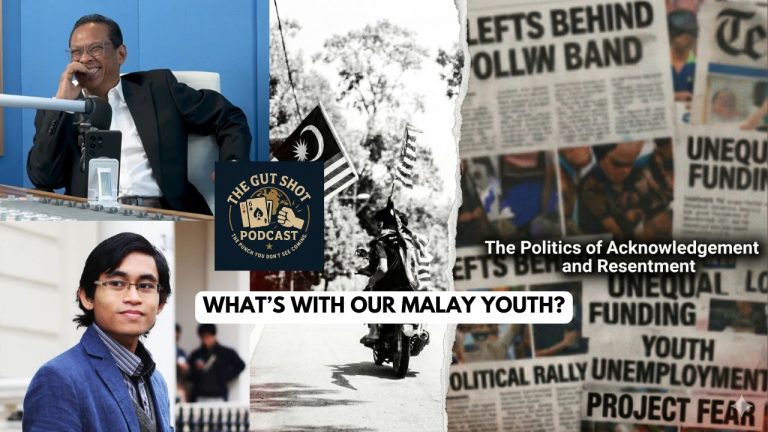
A conversation with IMAN's Research Director on the findings of their recent research on malay youths. What makes them tick and what should we expect for our majority society. Gutshot peels back beyond the data to predict the future for our society.
The research titled "Orang Kita: The Politics of Acknowledgement and Resentment" is an excellent 88 page comprehensive quantitative and qualitative read. We highly recommend.
Link: https://imanresearch.com/uploads/2025%20Report%20Orang%20Kita%20bahasa.pdf
Welcome back to The Gut Shot Podcast! I’m your host, Shamsul Sam, and today we are diving deep into a topic that will completely redefine how you view the future of Malaysia. We sat down with Aziff Azuddin, the brilliant Research Director at Iman Research, to unpack their explosive 88-page study on Malay youth (the 18-35 cohort) titled *Orang Kita*. If you think you already know why the younger generation votes the way they do, prepare to have your assumptions completely shattered.
The mainstream media loves to fearmonger about the so-called "Green Wave" and creeping Islamization, but the raw reality on the ground is far more complex. We discovered that youth voting patterns are driven by crushing economic frustrations and regional inequality, not just religious ideology. We explore exactly why our brightest youths are fleeing their beloved hometowns just to survive, why our declining public education system is actually pushing Malay parents toward Chinese vernacular and private Islamic schools, and why the traditional promise of a university degree is spectacularly failing our kids.
Aziff travelled across the country—far beyond the comfortable Klang Valley bubble—to capture the unfiltered voices of our youth. Their daily struggles with stagnant wages, gatekept opportunities, and a massive disconnect between high-level macro-policies and ground-level reality are a serious wake-up call. Are we raising a generation stripped of global competitiveness due to over-regulation and the injection of religion into public governance? Or are they simply pragmatic survivors forced into the gig economy and TikTok entrepreneurship because the traditional system abandoned them?
This isn’t just a conversation about youth politics; it’s a critical diagnosis of our nation's economic survival. If you care about where Malaysia is heading, you cannot afford to miss this episode. Hit play, subscribe to help the algorithm, and join the conversation!
*Chapter Marks:*
*00:00 – The "Green Wave" Myth: What the Media Got Completely Wrong*
*06:20 – Beyond Religion: The Crushing Economic Reality Behind the Youth Vote*
*15:45 – The Sharia Spectrum: Do Malay Youths Actually Want an Islamic State?*
*27:10 – The Great Education Crisis: Why Public Schools Are Failing Our Kids*
*34:30 – The Surprising Reason Malay Parents Are Flocking to Chinese Vernacular Schools*
*46:15 – The Influencer Epidemic: Why University Degrees Don't Matter Anymore*
*56:40 – The Big Government Trap: Do We Need Less State Intervention to Survive?*
*01:05:20 – The Nostalgia Effect: Why the Youth Miss the Tangible Policies of the Najib Era*
*01:13:00 – The Macro Disconnect: Why Billion-Dollar FDIs Aren't Helping the Working Class*
Jump to chapter 8 chapters
- 0:00 Unpacking the IMAN Research Malay Youth Study
- 9:15 The Sharia Spectrum: Governance vs Identity
- 19:33 Youth Agency, Funding Cuts, and Grassroots Support
- 27:33 The Education Dilemma: Vernacular vs Public Schools
- 41:11 Degree Devaluation and the Influencer Economy
- 48:08 Small Government, Patronage, and State Intervention
- 58:47 Regional Inequality and the Brain Drain to Urban Hubs
- 1:17:00 The Disconnect Between Macro FDI and Ground-Level Reality
Auto-generated from YouTube captions. Timestamps link to the video.
Welcome to the Guy Shot Podcast. I'm Shamsul, Sam, your host. Um today we have a very interesting topic um that is based on research done by Iman Research in uh which is an institutional uh the research house on the Malay youth, their aspirations, uh their frustrations, um and some of the conclusions is going to be interesting for us. And we have with us today uh Azif Yes. uh Azif Azuddin, who's the research director at Iman Research. Yeah. Uh welcome him. Thank you, Sam. Okay. So, um let let me get quickly so that uh a quick synopsis from you uh on the research done. Um I will put the link
for our uh for our audience. Uh on the details very long, um but I think it has quite a dense uh amount of data and uh analysis on the Malay youth, which is 18 to 35 cohorts we're looking at. 18 to 35, that's correct.
Yeah, 18 to 35, and you've done uh quite an extensive even in terms of uh qualitatively. Yep. Yeah. Um So, is i- is it possible that uh we give our audience um a let's say a 2-minute summary or less of uh your uh research uh your your your research uh fundamentals and uh a- and and some of the conclusions that you find before we go into a conversation on uh your uh analysis cuz that's how we want to take this. We're going to have a conversation on your conclusions, and where do we go from there because unlike other research, I find Iman very interesting in the sense that you gave uh
recommendations. So, please. Right. So, thank you, Sam, for the introduction. So, the study was actually sparked by the fact that majority of youth statistically voted for Perikatan Nasional in the last election. So, I think that was the 15th GE15, wasn't it? So, I think if you look at the data, 30 about roughly approximately 30% of youth voted for PN. And I think what that led to was a lot of people saying that oh, is Malaysia becoming Islamized? Are youth becoming Are youth becoming Islamized? You're talking about the majority Malay youth. Yes.
But specifically. Yeah. Uh voting for Sorry, voting for Perikatan Nasional in the last elections, right? So, the people came up with the term green wave after that. Um speaking to it as though there was a sort of a cultural movement or religious movement. But I think when we saw the report, when we saw the data, we were like I For me, I'm a person who's I'm a materialist. So, for me, I see people making political choices, any choice in their life, shaped a lot by their environment. It's shaped a lot by what they consume, what their environment is, and how that that leads into their
politics, right? So, who they voted for is an accumulation of the things they experienced. So, the study walked The study began with that sort of idea. So, that's why we went and interviewed 100 plus over youth all over Peninsular Malaysia. So, we went up to Kelantan, Terengganu, Kedah, Perlis, Negeri Sembilan. We spoke to youth in these areas to find out why they chose to vote the way they did in the last elections. I think you included urban youth as well, right?
Right. Urban youth is also Klang Valley. We also have Penang as well. But I think for us it was more Penang and Klang Valley when it comes to studies are usually overrepresented overrepresented. People talk to Klang Valley youth a lot. I think they're also quite politically open to discuss their ideas, but we don't tend to listen We don't tend to hear from youth outside, say, the West Coast belt. Okay. Uh and I think this is where we wanted to drive the study, uh which is to be more to give voice to to the youth to Malay youth in parts of the country that we don't typically listen to.
Um So, we went all over the country and what we found I think was interesting in terms of how they view democracy, how they view governance, what was good governance to them, right? What were their aspirations? They I think when we look at statistical studies, we tend to see numbers and we don't tend to see what are the story behind these numbers and we wanted to one demystify that but two to also make it that policymakers, NGOs, people like ourselves, you know, you and me can see these can see these stories and see that there is an aspiration for a sort of a
Malaysia that we can build towards to because I think for me the one troubling thing that I found throughout this study was that youths felt like in the current political environment they had no future. Whether it was the job market, whether it was in terms of where they saw the country as a unit and I'm talking about not just Malays but Malays and non-Malays, right? Where are we positioning ourselves in the global environment, the global world, right? Are we investing in the right industries? Are we having a good workforce? Can I live to see the next month for example with the salary that I
have? So, there's a lot of resentment that we found that built towards the vote you saw in the last election. So, the vote for Pakatan Nasional was not because they believed necessarily in Islamization but because the economic social conditions they felt in places like Arau or Kuala Terengganu or even in places like Negeri Sembilan, Seremban made them feel like there was no point voting in incumbents like Barisan Nasional or even to some extent Pakatan Harapan. Okay. So, yeah. I would So, for me there are multiple factors here like as to what I think the youths
needed at that point of time, right? Which is what the recommendation is about was that one is that we actually have to give actual genuine representation to youths, right? So, right now youths are being spaced out of political spaces. They don't have any form to form they don't have any space to form genuine communities. So, I'm talking not just about persatuan-persatuan, you know, that is under KBS, right? Um Belia, you know, the the Youth Ministry, but I'm talking about actual youth gathering in spaces, having spaces to gather to to practice art, to express themselves, to
be able to to be part of the community, to give back. There is no space for that. In terms of economy, in term where they feel like a lot of these youth feel like the only place that they can find economic socioeconomic growth or where they can better them where they can do better in life like is where they is going down to Johor, Klang Valley, dengan Penang. Which means that their hometowns that they grew up and loved do not see any growth. Places like Kedah, Perlis, Kelantan, Terengganu to some extent, they feel like these are places that we want to give back to us because we care so much
about the community. We care about the home and the environment and the places that we grew up in, but because there is governance is not great in terms of economy, we end up having to contribute to the West Coast states or the or the southern state lah, essentially, right? So, there's a lot of resentment that also comes out from what they see as regional inequality. Um and the third is this idea that and I think on a positive note, youths do see Malaysia in its DNA as multicultural. So, there's an acceptance towards actually wanting a multicultural Malaysia to have friends from the from
other races, but there is no space to allow for that to happen genuinely except for public universities, which to me was one a bit sad because if only after 18 years you're able to have a genuine space to actually make friends if somebody from the other race, then 18 years is 18 years too late lah, essentially, right? Especially if these youths are youths that grew up not in the Klang Valley or Johor on the West Coast lah where it's a bit more multicultural kind in terms of demographics. But that also means that you grew up with an environment that is very much
Malay dominant. So, that also colors your political view, right? How you view policies, how you view how certain races should behave. And if the only time where you can change those views is at 18 years old, then it it begs the question like what sort of policies can we build around designing spaces where we can have more interactions with each other from other races. So, yeah, I would kind of summarize it as that line and we can move from there. All right. Okay, good. I think um we have a pretty good idea on on that. One thing that stands out to me in the in the research was that uh uh
was the the uh the question on the um uh the need of the youth, some of the youth, um about Islamizing our uh governance and uh uh and even judicial uh system. Mhm. Um how many percent do you reckon? What is your uh analysis in terms of the the the percentages of this cut this this way of thinking um compared to uh those who are more towards uh what you call uh putting religion as a private matter and governance as a you know, as a separate uh uh scope in in lives of citizens. Okay. Um So, you can look at it regionally. Right.
And then we can also look at it in terms of socioeconomic class. Right. Uh so, if you look at it regionally, of course, in the northern states, places like Kedah, um Kelantan and Terengganu, tend to, of course, have more youth that would lean towards Islam should be part of actual governance structure, right? So, we're talking about economy, not just uh we're not know talking about politics, also talking about talking about the economy in terms of administration that this policy should be guided by Sharia by by Sharia principles, right? Or even in fact be in some instances uh
maybe very few of them, but there are some instances where youths would tell us that, you know, because the current system that we operate under, right? The democratic system that we have is inherited from the British. So, there are a lot of also problems in terms of how they see how politics realizes certain sort of worldviews and perhaps we should replace that with a Sharia system that is more Islamic in claim because the context is as such. So, you do have maybe 10% I'll call them Islamists. So, we have voter profiles. You have Islamists about forming about 20% of our respondents
that do believe in that spectrum that another spectrum, but if you talk to people on the broader spectrum, so I'm talking about the rest of the 80% maybe 60% to be more fair. You have youths who I think because of years and decades of Islamization. So, we're talking about how since even a little bit before the '80s and the Islamization of the '80s and '90s under Mahathir and ABIM a little bit before that. You have youths who I think who have internalized and see Islam as very integral to who they are as persons. Um especially if you think about how there is this gap kind I think there is
a sort of bridge that I feel like during the NEP years post um post 1970s you had uh a government that was trying to uplift the Malays, right? The Bumiputras and saying that the identity your form your core political identity is as orang Melayu, orang Bumiputra, but in the '80s you saw a shift moving from Bumiputra to prioritizing being a Muslim. So, you saw that being you saw that happening in the corporate class kind of in the corporate class in the sense where you saw um Sharia industries, right? We're talking about financial like we're talking about the financialization. We're talking
about how the corporatization of Islam You You saw JAKIM formalizing itself as a Sharia industry, Shah Halal Halal industry. So, these are things that built over time and where let's say my parents' generation have taught their children, my generation and the generation after that, Islam is kind of like a core worldview that you should have. You But, it doesn't mean that you need Sharia law to be part of government, but it does mean that Islam has been put first in terms of how you see the world, right? In terms of your values. So, the rest of the 60% would say that yes,
Islam is very important to us as part of identity, as part of how we see the world and understand understand it, but it doesn't mean that we want Sharia law. It means perhaps that we can have the existing system, but it should be guided by Islamic values, right? It should be guided by uh by principles of justice, principles of equity, principles of um of care, empathy. So, to me there's a spectrum there. There are those who want So, how many percent you reckon out of this uh 100 Mhm. um actually see uh religion and uh state to be separate and uh religion as being just a private matter.
Hm. The reason I'm asking this question It It'll come up to afterwards. I just want to ask you first. Yeah. Pure separation? Yes. Oh. Less than 10%. Less than And you will find that mainly I think in the Klang Valley. Okay. Yeah. Pure separation Klang Valley very Klang Valley focused or very urban focused. We're talking maybe Georgetown. Um but definitely more towards Klang Valley. So, that to me that that cohort would then say religion and religion and public life are two very separate matters. But I think for a majority of people When you say less than 10%
Yeah. Closer to 10% or lower than 5%? Closer to 10. I'll be fair. So I'll be fair in the sense that not everyone I mean So we've got a spectrum of about 15-20% Islamists. We've got a broad spectrum of about That operates in between. That operate on you know Yeah. On on on they see Islam as part of their Um of their their
Identity. Their identity. That's the right word, yeah. I was looking for. As their identity but how much it influences governance is a spectrum. Yes. Yeah. Yeah. And then we go probably less than 10% um that uh rather as you know what has become a dirty word today. Secularist. Secularists or you know uh secularists or liberal in in that sense. Okay. I find that here Okay, here's what style Let's go into this conversation because I read the whole 88 pages. Okay. Yeah, it's it's a feat I I imagine to read it, yeah. Yeah, I read the whole 88 pages because uh
I thought that actually that was uh I I like that you guys did this research. Um 100 respondents in my opinion is still low. You know, this is uh that's the only thing that I have criticism on it. So I will respond to that. Yes. Um This one's where I become a little bit academic. Please. Please. Please. So 100 respondents looks low if we are doing quantitative studies. So you're talking if you're talking about surveys and statistical statistics, yes, 100% definitely is low. Um but if you're talking about qualitative study and this is where the difference is.
Um I'll use this podcast as an as an example. In a survey, you ask 10 questions but you don't get to be behind you don't get behind what forms those 10 questions are. What what what forms the decision making behind why you answer those 10 questions the way you did. But as with this podcast, you have the privilege of 1 hour to really dig deep behind
Which is what you guys did. Which is what we did. Yeah. I I think that is commendable. Not just is commendable, I think that um the way you guys structure it Mhm. is very qualitative. Yes, it is qualitative that is. Yeah, it is it is very qualitative. So I can understand 100, right? 100 is a lot by quantity by qualitative standards.
Qualitative standard, yes. Because there's this thing where we call data saturation, right? You once and I think we we both know this as part of our practice. When you speak to enough people, you roughly get a sort of the I get I I've heard this before. And and for us around the 60 70% we start seeing a pattern a strong pattern already. Which for us at the point as a qualitative researcher, right? For me it's like, "Okay, there's a trend here that cuts across background, cuts across region, cuts across basically everything. So we can in some ways confidently say like that there is
a similarity between wherever you are in Malaysia you mainly use belief in these sort of things, yeah. Right. Okay. Here's the thing that I find the other thing. Okay, maybe we go into the analysis of this, yeah.
You know, before that I just want to remind our audience. Please you know, if you're not subscribers, subscribe. You'll get more interesting conversations like this. Um and like so that the algorithm help you to to to to get our podcast. Anyhow, um continuing the the there is something that stands out to me and I I have I have to admit um being so long in so-called leadership role in business and management. Right? Um we are at the small end of the spectrum. Mhm. Okay, so the mindset is uh is is a bit different. Okay? Um and you try to actually have as much
as your people as you, you know, to to to follow a certain mindset. Yeah. And you When you build an organization, you build a culture. Yes. Okay, that's what leadership is all about. So, what stood out to me when I look at the Malay youth uh is I felt that there is one um a need of having the government to do things for them. Okay?
Mhm. All right? Okay. Okay? All right. There is I do understand that there is a certain uh uh what do you call uh uh uh a certain demand that we should have the government uh provide Mhm. for us. Okay? Because that's our certain principle. We are the one voting for you. You are working for us. So, therefore, we expect you to at least be have integrity. Correct. Do the right policies. Okay? Those are fine for me. Those Those are fine for me. But, um what I found in the tonality of it, all right? Is that uh some areas, like youth development, for example, public spaces, like you
mentioned, okay? It's just It just cries out a few things. And And even in the political arena. Mhm. Right? Uh or how they want to get involved. Yeah. There's a certain mindset uh compared to I don't know whether I'm I'm right or not. I think what I noticed uh uh just uh handling with uh uh non-Malay youth, mhm, the difference being is that they have given up on the government helping them. Okay? And therefore, uh for them, it's like uh I got to do it myself. Right. So, it's interesting you bring that up.
really Yeah. So, there's a few things. I'll address that. One, incidentally, Mhm. we are actually also currently studying non-Malay youths. All right. So, we are currently studying Chinese and Indian youths, and that's we are actually going to publish that report at the end of this year. Uh and it it runs on a similar vein and narrative as the Malay youth study last year. So, expect it to be a long report to read also at the end of it. But, what I'm trying But, the interesting part I want to address the non-Malay youths first because I think there is a conception that because non-Malays do
not get I use the dirty word, lah. They don't get handouts or tongkat, kind of thing. The worst The worst term I've seen, lah, the tongkat kind because they don't get it. They are forced to be pragmatic, and then they are forced to find their own way around. That is partially true, but I don't think if you If you do speak to the brother So, similar to the Malay youth study, we actually went all over the country to speak to Indian and Chinese youths everywhere else.
Right. Um And I think this is where you need to separate, lah. Um asking for government intervention is not the same as expecting the government to do everything for you. But, it doesn't mean that you don't have agency, lah. That's what I was trying to say.
Yeah, okay. Yeah, yeah. So, for me, two are something very different things. You can expect the government to meet certain needs or that you have that you need to have, like public uh public goods and so by and yeah. But, at the same time, that's not the same as saying that you don't have agency to do to make the change that you want to see in the world, lah, so to speak. And this is what we found in Malay youths. With Malay youths, yes, they they say that the government wasn't meeting the needs in terms of creating spaces or that they weren't doing uh economic development in
certain parts of their hometowns. Certainly they will complain about that. I think most people will complain about that and there is an expectation that that because government has the resources to do such things, they have the resources, they have the pool, they have the infrastructure to do those to meet those needs, they by right should be doing it. Taxpayers' money and all, can? But that doesn't mean that youths feel like because it's not happening, we're just going to sit on our laurels and not do anything. For them, this is where I think this is where it's interesting
because for them that's where they try to push back and say, "Let's try to get involved in certain things." And I think this is where parties like PAS, especially outside the West Coast belt, PAS excels in meeting those needs, right? So you're talking about say for example, we talk about um youth belonging, right? Let's talk about community belonging first and foremost, can? Because under the Barisan era, m- back then, KBS would fund would give funds to uh to local chapters, to local KBS state level, and local councils and give money in order to run youth programs. So at that point of time,
prior to this, maybe there's a the patronage system, right? Barisan Nasional would trickle money down and then that money would be used to kind of do programs and in some ways buy loyalty, right? And hope that you will vote them in the next election. But after 2018, when the government was changed to a Pakatan Harapan 1.0, and I think we need to distinguish between 1.0 and what we have now, the Madani government, uh what we were told was that that funding dried up. So if they used to get say for example, 50,000 for a program that they could do in um in Kedah, um
in Alor Setar for example, Right. now they are given 5,000 between 7,000 to 5,000 and they have to still produce the same output. So, for them there's a feeling that okay, you've reduced a lot of what you used to be able to do. Fine. These used would actually do fundraising. They would actually go in their communities. They ask, "Hey, like is anyone willing to donate?" And what not. And I think this is something that PAS does spectacularly well. So, I know with PAS we always joke about the tin Milo thing, right? It's like, "Oh, we donate something gets into a legal
case." Pass around the Milo tin can and then people would donate, donate, donate. But, I think there's a very interesting aspect where you can read that as agency. You can read that as PAS and by extension the communities they're in saying that okay, the government doesn't care for you. The government isn't doing anything for you. But, you know what we can do? We can start out our own schools. So, look at we we just examine PAS infrastructure la, for example, right? PAS has um Tadika, which is preschool. PAS has preschool and you know to some extent schools that are funded entirely by
their own budget, right? They don't ask money from government because then obviously government I think because there's political friction will not give money to PAS party, for example. So, the money is funded by PAS and the community alone. And that to me is Is that not agency, right? So, if you talk about how non-Malays Okay. Yeah, yeah. So, I I get your point on that. Um I think um I think then uh we are looking at what concerns me when I I I read the report. I think fair enough what you say. There's I mean the the the thought process on that is something that needs to be quite nuanced
actually if you ask. Um but, when we come to um uh the the biggest frustration I would say, the biggest frustration is actually economics. Oh, yes. Yeah.
100%. Um meaning their their concern for their future, the sustainability of their livelihood uh where uh where uh I've been you know and and and the instability of the job and I think you did mention as well uh that the drifting into the deep gig economy Yes.
as as being a big chunk of uh where in essence what you meant what you say is they are uh the agency Mhm. of of having to look after I mean at at the end of the day you you have to Yeah. you have to look after your your your your wallet, right? Or or put your food on the table. Um and this is where if I when I look at the uh the analysis the report I saw so many layers. That's why it's so difficult to have this conversation. It is. Because yeah, because it's not one aspect or two aspect but actually almost every aspects
Mhm. it is interrelated. You know, you don't talk about economy, you got to talk about education. Correct. Yeah. cuz that's how you start. Mhm. Right? And then when you talk about uh and and then allocation of capital by the government.
Mhm. Um I've always had this problem with where our country is. You know? And uh I saw your your recommendation. Um I almost the first thought that I agree with you which is you know, this youth they are smart. Oh, yes, they are. Right?
Yeah. Yeah, but smart doesn't equal wise. You you know what I mean? Wise comes with experience. Correct. Yeah. That's the problem I think. And that's the thing is actually also as you said your actions is shaped by your environment.
Correct. And if you've been educated by past Mhm. Okay, or by a government uh from a public system that actually pushes away non-Malays and Malays from mixing. Mhm. You know? For me, um it's not the vernacular problem. Oh, no. It is It is not.
It's not. It's It's more about the mindset problem Yeah. and people searching for better education. You know, compared to what the public school system Yes. can provide or is providing. Yeah. So, it is so uh it is so interlayered. You know, even when you're sectioned on the mixing of uh Malay non-Malay
Yes. uh you It's very complex, right? I'm And I'm going to say something that's going to surprise you. All right. When we were interviewing the Chinese youths, Uh-huh. there's a sizable number of the Chinese youths who actually do want vernacular schools to be abolished. Which is, to me, mind-blowing. But when you read Who Sorry, say that? Chinese youths. Uh-huh. A sizable number of them want vernacular schools to be abolished. They believe that Chinese school And the reason why, to be more than honest about this, the reason why is because they see vernacular schools
as limiting the ability of them, again, to intermix with other people. Mhm. Right? So, if you're talking about you Chinese youths now we we focus on Chinese Yeah, yeah. Sure, sure, sure. But if you're talking about Chinese youths who grew up in the Chinese education system, so they went to AGKC's, they went to Chinese independent schools. Their entire life was shaped also similarly to the Malays in a bubble, uh linguistically, culturally, and so forth. Yeah. So, a lot of these youths that our other research team that we were speaking to was saying that, "Yeah,
actually I do want to have friends who are Malays or Indians from other races, but after 17 years of being in the system, I feel like And I think to me this is maybe this may be the smart but not wise, right? Is that they see vernacular schools as a problem in allowing them to mix. Whereas to me, I see vernacular schools as just one small part of the intermixing problem, right? Because you can if the community so desires, you can actually create your own spaces. I'm thinking about I'm thinking about certain communities that I've met in places like Terengganu or in
places like Perlis where they don't wait for the government to get things done. These youths for example one for example one of them during COVID they were very passionate about mental health. But every door that they knocked on whether it's PAS or UMNO or local state government, some of the name of what they're saying oh yeah you don't have the papers, you don't have experience what not. So these youths actually mobilize themselves got together a bunch of friends and actually went and found people who could help them build up their mental health punya NGO. And to me that's great because it
shows that if you're talking about the reliance of government earlier again there is a sense of agency where I cannot rely on government anymore. I want to do my own things. Um which then I'll go back now to the Chinese youths which is there is this belief that if the government cannot provide they if you're talking about vernacular schools and the mixing yeah Chinese youths do feel like vernacular schools are stopper. And
I I I I think I come from a macro policy standpoint, okay? Um because if the public schools are not providing the standard of education that is needed another whether it's vernacular, international or upper or a private school that is going to focus on the things that is going to make your child uh competitive when they become a young adult.
Yes. That's the choice that you have to make, you know, as a parent. Betul. Right? Yeah. That's the first thing. And also for youth I would say whether they are Chinese or Malay, uh that's the same thing I tell them because the number one factor is not the intermixing. I can tell you for sure.
Oh yeah, it's not intermixing. Yeah, it's it's not. I I don't put that as a priority. Um uh even uh as a Malaysian who sees things as uh you know, because all those come naturally Mhm. if you create the right environment.
Correct. You know? So, that's interesting. So, we're talking about the We're talking about a person's economic future, right? The economic future is the first priority that should be from parent, the child that is being groomed when they are young. You know?
Yeah. So, I think the very fact that we are starting to see a trend among Malay Malay families sending their youths sending their children to Chinese schools, right? Chinese vernacular schools because there's a perception one perception There's two perceptions for public schools, huh? Which is one is that the standards of quality have dropped. Two is that it's become pseudo-Islamic. Mhm. And even from personal experience, I can see the trajectory of it becoming those two things, right? If I compare myself my time to let's say somebody who just graduated So, how old are you? 25. 20
Sorry, 36 this year. Sorry, my brain went to 10 years ago, right? But yeah, yeah. I mean, I'm 36 this year. Yeah, yeah. But so, I graduated 2007. Uh Um I keep in touch with some of my teachers from my old school and they I mean, they would say that yeah, the the standard of education has dropped, right? And a lot of it boils down to policy, right?
imagine this? Uh I'm uh what do you call I'm 62. Okay. Okay? Yeah. And I am see I I've seen actually the uh the dropping of the standard, the quality of what we are producing. Um and the biggest uh uh challenge I find uh in terms of talking to the masses or listening. Because why? We do cut shots on TikTok and all this as well. And we see comments, right? I I don't want to say uh comments on social media to be that representative because it's not real life, you know? Um but what is very concerning um is um the inability of uh of us to be self-critical. Yeah, I I can Yeah, I definitely agree
with that. I think it's a lot of it is because our education system doesn't allow us to be reflective. Or do you think that we are living in a bubble? It's both. The bubble argument um so my PhD actually is on urban id- urban spaces and identity, right? Um and recently I just published a piece of research on um how we are building communities and we are building we're basically developers, like our urban planning is really silo-ing us. It's creating bubbles. So if you think of townships macam Bangi, which is predominantly Malay Muslim, or if you think about Shah Alam, very Malay,
and compare that against maybe places like macam Puchong or Kepong or maybe uh Southern Cheras, which is very Chinese concentrated, right? In a way, our urban planning a little bit of market choice as well because we we live with where we live where we want to be comfortable. So there's a bit of urban planning that is also creating bubbles. But there is Is the education not creating its own bubble? Because if you bring in so much religiosity into the education sphere that you push out the uh the the non uh Malays Mhm. uh who wants to seek economic strength,
right? They won't go there. They would rather go you know, to to where that is. But yeah, but I think that's why that's that's why I bring back earlier what I said, right? Which is where you have a lot of Malay families now wanting to send their children to private schools, sending their children to where is it? To Chinese vernacular schools because they understand that it's not really about the race, right? It's really about the standard of education you find in the different streams. In fact, if I'm thinking about just standards of education alone, international Islamic schools are a
thing. They have been a thing for the past 10 years. And their standards of education are actually quite high, right? Because one, they follow international syllabus. So you're talking about syllabus that follows UK, US, Australia. But just that the difference here is that they inject Islam, they inject Islam into into the education system, which is depending on who you ask, if you're secularist, not a good thing. If you're a person who is sits along that other 90% of spectrum, that's a good thing because you have a child you have your child who is who grew up with Islamic values, but is still
but has an education which is considered of an international standard. So these are So these are youths who These are children who can get scholarships to maybe go to study in the UK, can study in Australia, study in America, come back with good degrees, go and go work in a very good job in corporate sector. And we have already seen this happen. So for me, you're totally right in saying that when we make our economic choices for our children, it's always thinking about what system is able to give them the best advantage in life. So it's not so much about the race, it's about
the The choices you make at the young age. Yeah, but then that's where my nuance is coming in. for you by your parents. Yeah, made for us by parents, right? Um but that's where my nuance is is that I'm also saying that public school aside Yeah. Public school aside. But and I and I grew up in public I I went to public school my entire life, right? So standard satu sampai form five national school system. I think I came out okay. But I don't know whether I can say that for the for the generations after me, la. But the fact that we are seeing Islamic schools, Islamic
international schools mushrooming, Islamic private schools mushrooming but are also producing good graduates then tells me that is it really about the identity of I mean part of it is if you send your kid to an to an Islamic school certainly then you want to prioritize the Islamic religious aspect, la. But they're also producing graduates that are top performing. They also they also still performing uh producing graduates that are going to very good schools, very good jobs. In fact, if you think about um if you think about organizations like ABIM IKRAM, ISMA these are three different Islamist
organizations. So Islam is core to their politics, right? And their worldview. These are individuals, for example, I'm just thinking our service the former cybersecurity CEO Dato' Wahab Tan Sri I'm not sure if it's Tan Sri, but Wahab um he's actually an ISMA member. But he climbed up the upper echelons of being uh of being guided by Islamic an Islamic worldview that is say a bit more international la in flavor, but still having a very good education standard. So for me the distinction between does does being So maybe you're I think you're referring more to madrasahs.
I think you're referring more to madrasahs. uh there is um there is there is uh a spectrum like what you say. Um there is the madrasahs and then there's the the the the the what I call either Islamization or um uh apani To me, I I wouldn't even call it Islamization. I just call it the religionization of public schooling. Okay.
You know, the reason being I don't care whether it's um it's Christianity or Buddhism or Islam, right? Because a child has only a certain amount of hours in a day to be educated. Um so, if you are spending uh half of your time um uh on subjects or matters that are not making you competitive, all right, compared to the other races, you're going to be left behind. Yeah, you're going to produce a product. I mean, let's take it very simple. You want to be a good footballer. You know, um you better spend uh your youth in the on the field training your muscle, your muscle memory,
training against people, blah blah blah. But if half of your time or more you are asked to go and play badminton, you're not going to be a good footballer. I don't care how talented you are. So, then the question is how many of our youths do not have the privilege or their parents do not have the capital to bring them out of public schools and putting them into our system?
that that is what crossed my mind just now as we were talking. Because it is also not just the parents' choice. Because that is something that we tax our our citizens and that was this is what the government has provided in terms of public schooling, right? So, they have no choice. That is the choice they have, you know? So, um so, we are then it goes back to the economic questions that the youth are are struggling. Because if they are not prepared, I mean, I saw some of them I mean the the the analysis which says that the Malay youth also want to see us being globally competitive.
Correct. Yeah. Right? So, these are youths I mean if we want to think about how plugged in youths are to social media, they're incredibly plugged in. But plugged in is can be multiple different things. It can be a good way of plugging in so you're aware about the world, you're aware about what's going on in other parts of the of the world and then you're able to make comparisons. Malaysia can do better. Look at Singapore. Look at how South Korea or Japan is industrializing, we can learn from them, right? So, there's a good aspect of being plugged in social media because
you see what the good things happening elsewhere, you want it for yourself and your country. The negative part of course is the propaganda is the part where you know they they consume fake news for example. They consume misinformation, disinformation as bagainya. But also I mean the social media aspect of it is not something that is very healthy if you ask me.
No, it's not. Because it silos people. Correct. Right? Yeah. And and and and and it shapes I mean, that's why they are called influencers, right? Like what you say, you see that they Which brings it which brings me to the interesting stat, right? I mean, there there was a UCSI study that was published two three years ago I think roughly 2021 or 2022. I I I didn't I didn't remember the year exactly, but this study found that half of Malaysian youths this one is not ethnic based couple, but half of half of Malaysian youths don't feel like the economy or their
their education certificate serves them anymore because the job market is mismatched with the education. So, they can have a better financial future if they become influencers. Because why? You go on social media uh you ask not for donations blah, but you ask for okay like um subscribe to my subscribe to my channel for example and then you get money from YouTube, right? You get revenue from YouTube, you get revenue from TikTok. Uh I don't know whether you get revenue from Instagram, but then you're able to sell. So, actually the one interesting thing I see, and this is what I found I found it
quite entrepreneurial when I went to the northern states and in some parts of the East Coast, we have youths who despite having degrees in maybe medicine, engineering, STEM, that's what we speak of. STEM is supposed to be what drives our country. These are youths because they feel like the job market is rather limited in those areas or they can't find good opportunities. Or maybe it's not paying them well wherever they are. In the end going to entrepreneurship. So, you have someone who tells us that yeah, you know what? My degree has become useless. So, you know what? Now
I'm just doing entrepreneurship and I'm using TikTok to sell my my to sell uh, to sell my product. Uh, and I'm doing making I'm making more money I can make more money than if I say did a housemanship with MOH, right? I think Khairul Amin Yeah, but Khairul Amin is proof of that. Well, engineering background, but perhaps either out of interest or maybe for some people who I know who are engineers maybe the the night the the sort of environment that an engineer has to be in in terms of working maybe it's not it's not conducive to them but maybe that I think that they could try as it were to put
it. He moved to doing entrepreneurship. He moved to doing He started with uh, he started with showing people how to make recipes, right? And then he had his right his recipes, but now you can but now he has his own supply chain of sambal. He's doing very well in as a Kelantanese. Um, and that to me is proof that I think when traditional pass pathways don't work people, individuals maybe youths, will try to find ways to to be innovative, right? To find other ways. But the problem then that is is that my question why didn't why isn't the engineering field why wasn't engineering field
actually attractive enough to a graduate like Khairul Amin who clearly is very brilliant. Well, I think there's um, there's a there's an 80/20 problem. Mhm. If you ask me, um you graduate in engineering doesn't mean that you're going to be an engineer. Correct?
Correct. Yeah. You, you know, or even if you graduate as a lawyer, you may not end up with a career in the legal field. Yes. It doesn't matter to me when I look at it, right? It's more important actually is preparation in really strong critical thinking and and being able to actually shape the the the the the child and the young person to come out of the system and be agile. Yes.
All right, and using whatever he or she has been trained to to maneuver the world. Transferable skills, right? Yeah, transferable skills, exactly. And then you start out one thing and you end up another, it doesn't matter. Yeah. But from a policy making standpoint, you cannot devise a policy based on the 1% or the 10%. Correct.
You base your policy on the 80%. Yeah. Right? So, this is where it's interesting, right? Because when we when I spoke to these different youths, all of them grew up being told by their parents, um and their parents maybe learned it different from, you know, from experience. Maybe the environment back then was a bit more different, but they grew up being told that in order to be successful, you have to enter certain fields, huh? And the traditional ones are always, you know, lawyer, medicine, engineer. Um I don't think the engineer stands true anymore. I have I have
family members who are engineers and who do not want to be engineers anymore. But these top three, right, are what has always been told to our children and even to myself. I mean, even for my generation that these are where you go into if you want to be successful. Uh success can be many different things, huh, whether financially or socially. But because youths don't have the wisdom of thinking about transferable skills and there's no policy that implements transferable skills. Um the youths after graduating from SPM, okay, then they take PTPTN loan, they go into public university or private
university, they learn a course which they feel they they like or can align themselves to but still make a bit of money and then graduate suddenly realizing the entire education system was actually a lie. In the sense where I was told a lie that if I if I followed A to Z correctly according to the path I did my I I I went to the education system, I got my A's, I did my degree, I I I graduated with honors, then I'll be able to find a good job. But that model youths quickly realize is not something that me is maybe something that worked for their parents but no longer works for them anymore. So
we're talking also about maybe a policy environment that has not changed with how agile the entire world is right now, right? Because I'm just thinking about AI. So I I I adopted AI last year. The change of how AI has moved in the past one is is let's talk about in the past few months is tremendous. How do we catch up with it, right? Now I'm at a situation where I'm using agents. But last year I was using the chat LLM kind of but if if real life moves faster than policy, yes, how can policy help future-proof, right?
I think that's where uh That's the I think I think being someone who has about 40 years of working life you know, uh when you stack up again um I've seen all these changes uh throughout my career. Yeah. All right. To me AI is just one of the change that you have to manage. But more importantly is I think the the thing that stood out to me from your research is um uh is if I were to recommend anything, I mean, cuz yours had the recommendation.
few, yeah. Right? Which is uh I think um we have to educate uh our youth, whether Malay or Malays, whatever, that they they want a small government. Okay? Because I don't think that uh a big government or the thing that come out to me uh as a businessman um is I don't want the government to have uh so much influence over private life. Yeah. Uh and that include education, uh that include uh business or how you are able to even like what it was also mentioned, I think one of the things they were saying is the space in terms of what can be talked about, right? So, um
I think that's one recommendation I would come maybe from my own analysis of your own research, right? Is that we need to emphasize um a small government mentality where we should demand from the government um very fundamental things. Okay. You know? Which is an education that will make you agile. Yeah. Okay? Then on the economic sphere, I think from uh business person standpoint, I think we have failed spectacularly in terms of policies. Mhm. Right? Um uh the fact that we are funding GLCs, we are funding um uh even NGOs, you know, is a problem to me. Mhm. Um because uh
uh want if you want to talk about Islam Islamic, right? Mhm. Um you this is not your money Correct. doing patronage. Yep. You know? Um so it is better because my attitude is is better not to trust the government.
Mhm. So it's very interesting that you bring that up. If you look at the Islamic history, there's a book written by Ahmet Kuru. Um the book focuses a little bit more on the role of um us- not ustaz. The role of um knowledge making knowledge makers in society. But the point is there was a chapter that I read that was so interesting to me because it told us it is is exactly this small government idea that you're that you're talking about, right? Back then, uh this is after Prophet Muhammad in your passing lah. Back then, it was the merchant class they would actually fund the
intellectual and arts class, right? Uh the arts punya the arts punya space space, right? So you're thinking about So the idea of philanthropy was actually very big as part of Islamic tradition. So that's why you have things like waqf, right? Waqf is essentially your own capital that you invest into the community for the community's benefit. So you had back then a merchant class that would fund the education of the arts of the artist arts class of the of the intellectual class. So back then, you had I don't know what to call ustaz lah. I don't know what what was the Okay lah. The
the The contemporary term that we use now this is ustaz kind. So ustaz actually used to be independent. Mhm. Because they were not funded by the state. Right. They used to be just be funded by the merchant class. And the merchant class is like, "Okay, we we'll fund your education. We'll fund you in studying about Islam about studying about Islam and the world." And that's important, right? Because if you think about the great Islamic thinkers, all of them were polymaths. They were not just people who care about religion. They also care about mathematics. They care
about astronomy. They care about engineering. So they were polymaths. We don't have that tradition now, unfortunately. But yeah, the merchant class would actually fund what they see as a society good. It's just that because the government of that time the governments of that time felt like they didn't have control over Islamic discourse because obviously when you're not bound by a certain idea of what authority wants you to do, you would then maybe have counter you have counter you would you would talk about Islam in a way that is not pro to authority lah. And I think that
became a problem for that Yeah, it become a controlling problem. You you have to stamp your authority upon the thinking. Yes. So what happened was the government of that time instead implemented policies and laws to limit the merchant class control over the economy over the over the market and started funding the started funding the intellectual class. So by funding the intellectual class they control how they control the narrative about how Islam should be thought about what certain discourses can happen. And to me I I agree in principle what you said lah is that we
should be funding ourselves, right? Because if funding ourselves is a way of independence, it's also it also allows us a framework to operate with agency because if government funds you uh let's say if the government funds education uh or if the government funds how you should think about Islam for example. If you think about places like Indonesia, places like Turkey, the government doesn't get itself too involved in how religious how religion is discussed, right? So a lot of the dynamics a lot of this discourse in places like Indonesia if you have if you go to Indonesia and
you study Islam is there, the range is so wide. You have Islam you have Muslims who are on the liberal end, you have Muslims who are progressive, but also you have Muslims who are right-wing. Let's let's let's I mean here yeah that can only happen if the government doesn't get involved. I find that and this is again goes back to actually how much the government has uh religion into public governance, into civil service, into uh public education. Our discourse, uh uh and a certain sort of Islam. I think if you need to have this that's Yeah, and also a certain type of Islam. It's
like It's a shackle on the mind, if you ask me, right? You think about this, right? Uh I mean uh I One Uh how many Muslims are there in the world? 1.4 billion? 1.6 billion?
to say yeah. How many human beings are on Earth? How much more than that? 8 billion. Yeah. Right? We are actually a minority, a small minority of humans on Earth. Mhm. Okay? Uh but the way our discourse is in Malaysia tends to be central with everything is injected with this religiosity. Right? If you want to be a global player, right? You got to be able to actually uh not just I mean compete. In order for you to compete, you must understand the character of the world. Yeah.
You and the the basically the 80% of the character of the world and also if you go per capita, right? The most successful uh uh cultures or society are not Islamic. Okay. So, that
So, yeah. My point is is is that is is this is the shackle I see when I read your uh your report that we have produced our youth, you know. Um in spite of their ability on social media, they are siloed, Yeah. you know, apart from there's a small uh uh, segment uh saying that yeah, it's not a small I mean they want us to be competitive. But how? And that's where the whiteness come about. So, I would say, I mean if I'm to be fair to my to my study, it's not a small percentage that want to be competitive. I think everyone that I spoke No, no, I I don't mean that way. I
don't mean that way. When I mean that I mean globally competitive. Yeah, if if if you want to be I mean there is uh But see, that's to me I That's interesting, right? Because actually if we just look at our graduates alone, I'll focus on the Malay Muslims, especially the Islamist ones that I know and study personally, it's these are graduates that have went to UK, US, Australia. They've learned the best from those systems. Some of them choose to stay there and make things better there. Some of them choose to come back and implement better systems. If you think about um
again, I think it's worth studying Abim, Ikram, and Isma to see just how global their view actually is. If you I mean How do I put it this way? In in the perspective of these Islamists having a global worldview is not incompatible with being competitive. I I don't disagree with you on that. I don't disagree with you on that. In the sense that because why? The I mean the I've had conversations with my good friend Tajuddin Tajuddin Rasheed. Yeah, Prof Prof Tajuddin. Yeah, yeah, I know him. Yeah, yeah, yeah. Tajuddin. Um, uh, um, he comes from that angle. Yes. Right? Yeah. Um
and then the people like myself who comes from actually a very secular angle. You get that. I mean the fact that it becomes such a dirty word in Malaysia Yeah. it confounds me. Yeah. You know? Secularism and liberalism. Yeah.
Yeah, it confounds me. All right? I don't care about on the personal side, which is for me, okay, I can I can agree to disagree with you however you look at that, right? But I think the most important side in my thinking is about two things, economics and education. Mhm. And how those two interrelate. Uh because if you pro- produce over three to four decades of 80% less competitive uh economic thinkers, Yeah. um that are not a dial. Yeah. They end up in policy making as well. Yeah.
Okay. them would stream out the policy making, yeah. Yeah. I mean Yeah. And in politics. Correct. And that's basically what I see, which is why we have the system and then it does not provide the results that actually cater for the youth that are coming out today. Mhm. Because of the mismatch between economic reality and what the policies Correct. has uh has formulated and implemented. Uh-huh. So, it's not so much to me I look at it, it's not so much about it's uh about about one or the other, it's both. Yeah. So, that's the tension that the youths I speak to express, right? In the sense
where they feel like we want a better economic future for ourselves, but the policies in place limit our ability to be our best economic selves, right? So, you're talking about if if a majority to me la, there's there's one youth that I spoke to in Alor Setar. Like to this very day I still remember his one of the his quote that is in is one of the beginning of the chapters, but he was basically explaining to me how at every economic turn it was very difficult for him to be able to realize his economic opportunity, right? So, he did his degree, he got his he he did well for himself,
but he wanted to contribute back to his hometown in Kedah. So, he went back to Kedah. But in Kedah, because of I think because of the economic landscape, socioeconomic landscape in that and governance like in in in Kedah is very limiting. One, he cannot grab a job in in local council or the state government. Why? Because is very gate-kept. So, we need to talk about patronage here, right? This is very gate-kept. You cannot enter into local state government if you don't know someone. Okay, fine. So, that door is closed. So, he applies to the private sector. But the private sector is not
well developed in the area. It does It cannot meet It cannot meet the requirements of his Basically, his degree is far far removed from the Far removed from the location. Yeah. But even if he found one firm or two firms that okay, can make use of his degree lah. They will underpay him. So, he gets he gets offered 1,003, 1,002 like and the market rate compared to what he can get in KL or Penang is much much higher. 2,005 for example, 2,007 kan? Okay, fine. Maybe then he can explore entrepreneurship. Okay. But in order to start entrepreneurship And I think as a businessman you know
this, right? Capital is not easy to get. If you go to a bank asking for let's see even orang kata 5,000 to 10,000, the bank will ask you, "Where's your credit score? What's your credit history, right?" "Okay, we can't give you a loan." Okay, fine. Maybe then he'll go to MARA because he's a Bumiputra and you know, he's been to like maybe MARA can help Bumiputras. He goes to MARA, he has many forms to sign. And again, patronage. He doesn't know anybody on the inside. He cannot get
Yeah. This person couldn't get any form of loan. So, then he he's left with the last He's left with the option, "Should I borrow from my friends and family?" But then the idea of being owing them to people who you know. And I think that is a very dirty word. I mean, that There's good debt and bad debt, right? But that is bad debt for him, right? To be borrowing money from friends and family with no guarantee that the business his entrepreneur business will do well. So, what does he do?
Mhm. He ends up going down to Penang. He ends up going down to KL where prices are higher. cost of living is higher, rent is high, and basically there is this feeling that to me like when he was telling me that, right? It feels like ah at every turn, every problem you face is actually a policy problem. If you ask me, Yeah. here's where I come from with respect to say salary or wages, okay? The the com- the commercial world will pay you what it can afford. Yep, correct. Correct?
Yeah. And if if the economic situation is such that they're competing for talent, you know? Mhm. Then and the economy is so vibrant that you have a fight for that talent, then the the wage climbs up.
Yes. Okay? So, I've I've never been a supporter of minimum wage because I think it's an artificial cost on business without understanding the inherent burning cost of doing business itself, right? So, if I were him, to be honest with you, if the locale is such that I want to stay in that locale, I'll take that job. Yeah. Even at a lower salary. Sure. Because Yeah. They But that's just one aspect of thinking. So, I I I shouldn't judge and I won't judge, you know? Because there may be other aspects. Because the context behind this person's life also is that because he took PTPTN to do his
degree, he has to repay PTPTN. His parents are old, so he has he's also supporting his parents. So, that doesn't make 1,300 commercial sense. Yeah, 1,300 doesn't make sense to be able to because these are youths and I think there are number of youths now who are going out in the world who do have commitments that So, I think this is where I find economic studies that they need to be that nuance, right? Where is like it's not just about the wage, right? Okay, fine. I mean, we can argue on uh no uh minimum wage, that's fine. But, I think every time I mean, for me when I think
about salary like it's like how much can I ask so that one I can, you know, juggle my commitments, my monthly commitments, but two have enough money to also not cut I need I don't need to be comfortable, but I need to be able at least breathe a little bit, lah. Right? Um and for youths who are outside the Klang Valley and Penang and Johor's field, for them they can't breathe. They don't have enough breathing space whatever salary is offered or whatever how un-vibrant the market is, so they end up going to KL um Kelantan, Penang. And if you see this if you see those some statistics, that's
why you will see there's a lot of in in in-country migration between the East Coast going to Johor, for example. So, I think that was a few million Yeah, and does that surprise me or Yeah, it doesn't surprise me at all, right? I mean, the fact that Shah Alam is colloquially known as Shah Alam, you know, because Kelantanese would come down to Selangor to find jobs because they can't find the the economy in Kelantan is not vibrant enough to allow them to develop in the country.
is where my problem lies with the uh economic economic development of Malaysia and the policies that we put in. Our policies are not private sector friendly. You know, we have too much regulation. Mhm. Uh we don't have enough funding uh in terms of banking system. Our banking system uh after the consolidation is actually not a good thing for the economy because, for example, somebody small want to start a job, you only have a few oligarchy Yeah. that actually uh they're not interested to uh to give out small loans.
Mhm. Uh you know, uh and they're not close enough the way the decision-making is made, they're not close enough to the customer uh or to the potential client that wants to take the loan. So they don't understand and they're not interested to build up, you know. So this is so much this is a what I see where our potential is quantum, yeah, you know. And in the and this is where I get very frustrated when people talk about you know, the characters of that they want to have Islamic principle blah blah blah. I said look, to me I mean the Islamic principles is go on the values that, you know, if
the good values is Islamic. Yeah. Right? So if you go that mode and you start just looking and focusing on real world economics and policy making, right? Reducing regulation, I mean all these type of thing, you know, and not having GLC competing with or or you know, or monopolies then you unshackle the economy. Then you have more funding coming into the private sector for them to say, "Okay, now I can go to the northern region or to the eastern region to tap that market." Yeah. Right? But interestingly, if I think about purely just on the policy making level, eh? The policy makers in place
are not necessarily religious. I would My my own assessment, I mean maybe you have a different assessment, but when I see policy makers yes, you have Jakim. Yes, you have religious affairs and there's research done on that side, you know, it props up the halal economy and sebagainya. But I'm just thinking also that on a policy making level religion doesn't appear to come into that decision making. Yeah, yeah, I understand that. Everything everything is driven by whether or not it doesn't bring profit. What what I'm thinking is actually here is the thing. The product that we we we
we come out that end up into our political ecosystem that comes out into our policy making ecosystem. If they had been trained so much into that, you know, and less into this because less Because we're talking about the future, right? Yeah, because not not talking about the future. I'm just to talking about what your research has shown, okay, in terms of the resultant product. Yeah. Both for the youth and for what the economy need to feed for them. You know, there's a big mismatch and it's a Yeah, so so in that sense then we go back to the public school system because
I think that's where the core of where this problem is stemming from. I feel with our conversation. You think so? Because okay, I have No, no, I I'm not questioning it. I mean do you you think that's the the the the the first thing that we have to attack? Yes, the public education system is the first thing that needs to be done needs to be looked at and I think I'm not the first person to say this because one public school system is the most accessible um Yeah, yeah, yeah. school system, right? Your PRB fees are your PRB fees are low, right? You pay you pay essentially like
a few cups of coffee before for a month or years worth, right? Um whereas if you go to private schools, if you go to international schools, again, maybe a month every quarter you pay about what? 5,000 to 7,000 ringgit. So, we have to address education. Yeah, so education needs to be addressed first, obviously, because that's where majority of individuals will go to. In fact, if you think about even if I think even about non-Malays, uh even non-Malays talking about outside of Klang Valley they end up going to public school also. So we're not talking about just one cohort or one
one ethnic group. We're talking about all ethnic groups that do not have enough capital to go into other education streams. And their lives are being affected by at the education policy, right? And you're right. There are certain schools I know. I don't know whether this is the case across the board. The media tends to focus I think on fringe cases a bit more. But if I think about certain schools that I know even in Valley do have an over Islamized character to it nowadays, right? Where they force where they force the girls to wear baju kurung or tudung. Like if you don't
wear it, you are your teachers will criticize you for it for example. So there's an emphasis on the form of religion. And I think this is where the debate happens a lot like when it comes to the youth that we speak to, right? Is that you cannot look at the form. You cannot look at implementing laws that force you to wear tudung. You cannot look at laws that force you Oh, peer pressure is good enough. I think what's happening in our school system is I mean peer pressure as well and from uh Bernie this because teachers are involved in this decision-making and in creating this
environment. But I think I mean to be frank with you, you and I can talk this for three three or four hours. agree. I agree. But for me I go back to the point that I think our education system is perhaps the first point of examination. How do we
then you're not going to be able to address the youth that are already in the education system at the moment. So then that that's the economic policy. The economic policy that's where economic policy comes into play. So for you for me personally, I when I went around the country um So I've been going around the country for the past since my 20s. So I've seen a fair bit of of Malaysia. Um It always I don't know how to say this. How do I I it this way? It always I I always have certain sort of feeling like I've got I wish I could see development not in an not in a
overdevelopment way, but if I go out to places like Kedah or if I go to Kelantan, there are parts of me that say, "Where are the investments, right? Why aren't investments going into places like Kelantan? Why aren't investments going to places like Kedah?" Um because you can develop a place without it turning into a size Another another concrete jungle, yeah.
It is very possible to do that. I mean, other other countries have models where you can develop a certain area without it being high-rises, right? Oh my god, it just have a I you know, you don't want to go to Bali anymore. I don't know. I went there 10 years ago. I don't know what to imagine how it's like now, but and to me that is a lot of aspiration of youths, right? For them it's like, "I want to be able to work and live where I grew up and see develop into a vibrant economy." I I want to see white-collar jobs going
Let me let me let me let me put it put it to you in this way as an example that you because you bring that up, right? If you take Terengganu Mhm. or even Kedah Yeah, okay. Actually you can build a vibrant tourism economy. I agree. And not just tourism, right? I think you can be more than just tourism.
I'm just taking one example, right? You can build a vibrant economy around that which then actually spawn all ancillary businesses around that economy. Okay, that is just one sector. Okay. But policies policy making in terms of how we I mean, you look at uh for example, places like Italy or places like let's go even further uh more orthodox like Greece, yeah, Okay, they have a they have a historical we have nature. Mhm. Right? Um but um the re religiosity does not impede that tourism sector. If now what has happened with them um is that uh they have they have actually more
tourism than they want. There's overtourism going on Yes, overtourism in in yeah. I'm very aware of that. Right? So, but imagine if we can get into that um that secular economic thinking. Mhm. Right? In our policy making. Then you can't you you will generate that's just one example of how uh when uh that that affects our economics, you know? And I always go back to I I I want when I read your report, you know? I I think I'm I want to close this for my ears and then I want to hear your your opinion. I I think we need leadership uh at the national level that actually is
really global global in terms of how the outlook in uh of economic competitiveness. Uh and I think that's uh sadly I I don't see that happening. I don't know where we're going to get it, you know? That's my uh my assessment. Uh I'm trying to this podcast I'm trying to sort of develop, you know, answers to that. You know, I don't know what you I mean the you want to uh go long, you know, as an end point with you know, to to where our conversation is. We may have another conversation after Yeah, I mean yeah, it's been quite interesting to me, to be honest. Yeah. So, I don't have your experience
in the business and economic and corporate sector to know years worth decades worth of how the government policies around these areas like, right? Um I mean so even if I say for example that Barisan Nasional is quite capital driven in some sense. I mean if you look at some of the economic policies especially during the Barisan Nasional era and under Najib era, right? There is some attempt, I think, to globalize the economy a little bit more, especially with how we opened up our uh our ties with China, right? We deepened it a little bit more. So I I it's not I do think there is some leadership
that thinks globally, but as somebody who I spent a lot of time on the ground, so I'm looking bottom bottom up, yeah? I see leadership having maybe broad ambitions to bring Malaysia beyond I mean some of them, some of them. But you have the grassroots, you have the public who is telling them that who is who they feel they need to go in a different direction. So perhaps they want to build perhaps you have leadership that actually wants to broaden the economy, right? Invest FDIs in data centers or maybe go into broader markets where there could be more money to be made. But then you have
and this may be the problem with the education system, you have a public that doesn't see the importance of it because one is maybe not communicated or maybe the education system doesn't doesn't um doesn't give him them that framework overview to see why are we investing why are we having for example ties with for example I think why do we have trade ties with Iran for example, right? I mean I mean so I mean the fact that we have long-standing diplomatic ties with Iran allowed us to have one ship to pass through the Strait of school, tells us that this is something that the general public
doesn't understand, right? We make certain decisions at the policy making level that the public doesn't know the importance about, and maybe there's a lack of communication. I don't know, the government doesn't know how to communicate this, right? think I think uh uh it's interesting how you bring up this point.
Yeah. Because uh to me, uh what it highlight is actually uh the macro policies and the micro uh impact on the ground is disconnected.
It's very disconnected. It's very disconnected, and that's exactly my point. Yeah. Because you need to be able a leadership that understands how the macro needs uh will then translate at the micro level. Yeah. Right? I think that uh uh this is where my problem with the policies that we have we have put together and implemented. The macro does not translate at the micro level. Uh that when this youth uh come of age, uh there is a mismatch. Yeah. So, that's what the youth are actually saying, right? They are They are questioning, why are we having Okay, so I'm not
But their solution is my problem. Uh solution is like that, so We are seeing MOUs, yeah, we are seeing MOUs being signed, we are seeing FDIs coming in. Um we are building more factories in Penang, for example, we are building more factories in Kuala Selangor, parts of Kuala Selangor, but how does this change my livelihood? And I think this is where I bring everything back down to your material environment, right? If you grow up in a material environment where if you grow up in an environment where for me, policy government policy and how it affects your life is also how you
think of your relationship with government or the world around you, right? So, if your if your policies that affect your life has always been hostile towards you, you naturally will feel like the government doesn't care about me, democracy doesn't work, the economy is very hostile towards me because the policy doesn't translate to your personal life that feels like it's improving. Mhm. But if you have policy making that is very connected to the ground that affects people's lives in a positive way, then to them the message that they are taking away is that this
policy, this government, this democratic system is actually improving our lives for the better. So, and I think this is why the Najib question and I know I know Najib is a very divisive word. No, I mean I'm very I I I for me personally actually, I I don't view things from an emotional level. But I've always felt that actually Najib was quite capable, more capable than anyone else after Mahathir with respect to the economic side of things. So, I agree with that. And you can see this reflected in the sort of stories that the youth told us because they would tell us how
and this is where we talk about policy making affecting your your life and how you can actually feel policy making affecting you, right? When you speak to youth in the East Coast Mhm. and the northern states, basically the rural rural Malaysia, they will always bring up the fact how during Najib's time we had UTCs, urban transmission centers, right? So, back then maybe you would need to go to Pekan, maybe you need to drive 30 minutes, 40 minutes into big city, a big town in order to get government in in order to deal with bureaucracy. Mhm. But UTCs allowed the ease of doing government business
very close to where you live. Mhm. That's one. You talk to you if you talk to youth in the East Coast, they will talk about the LPT. How do how prior to Najib Mahathir tended to punish the East Coast, right? Especially Kelantan, right? So, there was very little investments going into developing Kelantan as an as a state. But Najib I think had a different approach to the economy because he saw the regional divides and regional inequality. So, he built L So, the LPT was built under his time. So, you have a lot of youth who are saying, "Yeah, that building in LPT alone allowed for
logistics, the logistics supply chain to go up to the East Coast, right? Uh ECRL is a Najib Era policy. So, now then you Now you have I think it's going to be launched open next year, yeah. The ECRL will connect the East Coast, which is historically has always been discriminated upon economically, to connect Kelantan and Terengganu down to the Klang Valley, right? And the rail lines can also not just be used to transport people, where you can maybe commute 4 hours a day to work, which is what people already do with Penang and KL, but now you can also use the rail lines to do to transport
logistics. So, you have ports in Kuantan, ports in Terengganu that can transport maybe shipments from China, Japan, South Korea. They don't need to go all the way down to They don't need to go all the way down to Singapore and then go to to I don't know to Klang, again. They can just stop over in the East Coast and create a more vibrant economy just through that connection alone. So, youths shared a lot of this what they see as the future.
yeah. They can see that. see that because they grew up in places where they see the construction happening. They feel it in their lives. They see the truck They see the roads being built. They see the buildings coming up. And to them they see this is a government that cares for me because why? They're developing my area. I get Kedai Rakyat 1 Malaysia, which is which allows me to buy goods at a more cheaper cost because that time the things were more expensive. I get book vouchers that allow me to buy books so I can learn more things. These are tangible policies that they
feel in their lives that for them now from a from a policy making perspective, they feel like they connect to. But, the problem now is that and this is the problem with the youths what what youths tell me now like is that they don't feel that sort of policy to personal connection anymore. And then I think this is where the resentment comes in because okay, fine, FDIs are coming in. Fine, you're building data centers, but I don't feel it.
How does that translate on the ground? it translate on the ground? Yeah, and this is where the resentment comes in. So So on I think on that note As you guys can see we can talk about this another 3 hours but I think we'll leave that for another day. You know and I I I quite like the I would recommend everybody who's on this podcast that stayed on go to the link where the research was done. It's called uh What what is it called? Orang Kita The politics of acknowledgement and resentment. All right. I think I urge you to give a read. I know it's 88 page long but
it's very interesting. There's executive summary at the beginning. If you don't want to go through 88 pages just first two pages just top line what it's what it's about so so. So thank you very much for coming along today. Thank you for having me today Sam. It's great. It's it's fun and I hope to see you again. I think thank you. See you all. Bye. Bye. Thank you.