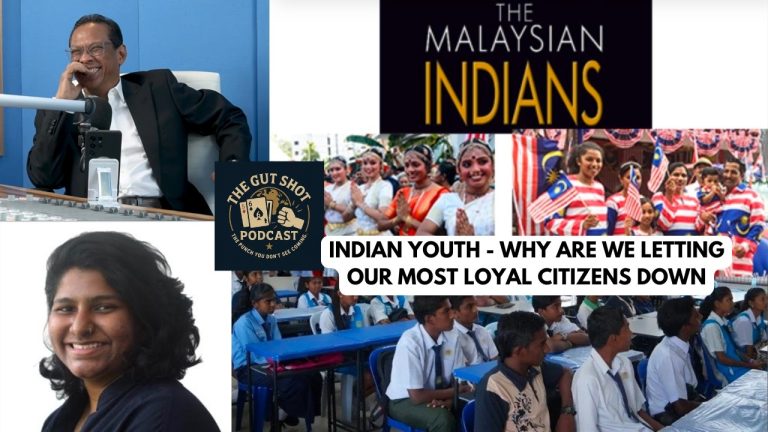
Indian Youth – Why are We Letting Our Most Loyal Citizens Down.
Show Notes & Description
Gutshot takes on the research subject with IMAN researcher Shalini. We peel through the issues raised in the research brief and understanding and maybe provide counter-intuitive perspectives than what the research subjects or prevailing views may bring. A Gutshot conversation indeed.
Research link:
https://imanresearch.com/uploads/IMAN_Brief_Issue1_Mar2026.pdf
Welcome back to The Gut Shot Podcast! In Episode 70, we are pulling no punches and asking a heartbreaking question: Why are we letting our most loyal citizens down?. Today, I sit down with Shalini Muniapan from Iman Research to uncover the raw, unfiltered truth about the lived realities of Malaysian Indian youth. If you think discrimination is a thing of the past, this episode will be a serious wake-up call. We dive straight into an explosive qualitative study revealing how these youths are constantly subjected to systemic hurdles and racial slurs in public spaces, yet fiercely and proudly identify as "Malaysian first".
This isn't your average politically correct talk; it's a gut shot of reality. We break down exactly why the promise of "meritocracy" feels like an absolute myth to Indian youths, who feel they must be "more than excellent" just to get a fair shot while swimming against the tide. We also tackle the darkest corners of this crisis, examining why marginalized youths who fall through the cracks are lured into gangsterism by underworld structures that operate just like MLMs.
But we don't stop there. We explore the unspoken sub-ethnic class hierarchies that trace all the way back to colonial times, the explosive debate around vernacular versus national schools, and why parents are desperately seeking safe spaces away from religiously and racially charged classrooms. Most importantly, I share my intense personal frustration with the political elites who exploit race to cling to power and have gone deafeningly silent on true equality. It is time we stop blaming colonial history and take brutal accountability for the society we've built.
This conversation will challenge you, make your blood boil, and fundamentally change how you view our nation's future. If you care about Malaysia, you simply cannot afford to miss this. Hit play, subscribe, and join the debate!
*(Note: Exact timestamps are estimated placeholders for YouTube upload)*
*00:00* – The Heartbreaking Reality: Identifying as "Malaysian First," But Feeling Left Behind
*08:15* – Why "Meritocracy" is a Complete Myth for Indian Youths
*14:30* – The Underworld MLM: How the System Pushes Vulnerable Kids into Gangsterism
*22:45* – The Hidden Sub-Ethnic Class Divide No One Wants to Talk About
*31:00* – The Schooling Crisis: Why National Schools are Actually Driving Parents Away
*40:20* – Mandarin, English, or Tamil? The Ultimate Languages for Survival and Commerce
*48:50* – Broken Promises & Political Betrayal: Why Are Our "Multi-Racial" Leaders Suddenly Silent?
*55:30* – Stop Blaming the British: Why It’s Time for Brutal Accountability
Jump to chapter 7 chapters
- 0:00 Malaysian Indian Youths and Systemic Discrimination
- 9:18 Colonial Class Hierarchies and Sub-Ethnic Divides
- 12:50 The Meritocracy Myth and Underworld Gang Recruitment
- 22:49 Vernacular Schools as Safe Spaces
- 30:49 Language Pragmatism: English, Malay, and Mandarin
- 34:18 Political Tokenism and Failed Representation
- 43:13 Institutional Racism in Classrooms and Systemic Accountability
Auto-generated from YouTube captions. Timestamps link to the video.
when you say social ills right let's let's let's get it really defined okay I mean let's let's let's you know this is gutshot we go right to the point okay I mean the what kind of social is specifically are we looking at
I'm not going to I mean you cannot uh sugar coat this but you know sugar thanks tourism for for that matter uh uh almost 70 over percentage of uh you know those involved D in gangsterism are Indians.
Okay. Yeah. So that's one of it. Yeah. All right. Uh but we hardly see any mit with Indians. So that's why is that? Okay. That's interesting question because they they Okay, if I want to go back right
welcome to the gutshot podcast. I'm Shamsul Sam your host. We are back today with uh Iman research. Uh with me today is Shalini Munyad. Hello. Hi. Uh I'm Shalini and and thank you so much Samso for having me today.
You're welcome. Um today we're going to dive uh into the Indian community because why Shalini and her team at Iman has done uh uh uh an extensive research on uh Indian youth especially right the brief that I read was basically uh called uh Indian youth and belonging um and uh and a corollery to that are safe spaces for these youth uh So let's uh let's get into an understanding quickly uh on this topic and uh actually we want to have a uh a vibrant uh conversation. Um uh so to start off with shall I ask you this question first? Yeah.
Uh can you give give us a quick snapshot um of the conclusion of the report? what uh what briefly can you say that you found out from the research that was uh done on the Indian youth?
So we were made to understand uh basically that discrimination exist till today. Okay. it it's not something has been managed to you know being pa faced away
and almost all the youths that we spoke to actually reported to us that they have faced some form of discrimination or the other you know uh whether it's rental job uh in in school space or even public space in public spaces they actually you know be subjected to racial slurs and yeah by virtue of that um stigmatized because of you know uh by them being Indian right but all of this did not stop them from loving the country. This is something I I mean my core researcher and myself found that they have undoubted love towards the country like they identify themselves as
Malaysian first and Indian next and not as Malaysian Indian. Okay. Right. Um and that sometimes also leads to some form of confusion in them. Right. Okay.
Because you love your country but you also feel that your country does not love me love yourself back. Right. Because you have this discrimination practices, no equal opportunities and so on so forth. You feel left out. You felt you feel left behind so to speak. And this void is actually capable of being exploited. U by certain people if you know if they want to that's something that we we we fuel
and the other juncture if you look at the political spectrum right I think uh before we started this I just had a conversation with some soul about political leaders uh in terms of politics um the the Indian youth feel that they it's not so much of political apathy but it's actually a a rational withdrawal from the political system itself,
right? Because the system has consistently failed them. See, they they feel that they always put in hope, you know, for a better better world for them, you know, a fair short equal opportunities, you know, they put but, you know, it's not materally realized. So, at the end of the day, they feel yeah, you know, being failed by the political class.
Okay. Right. And they also feel like that the the the what you call the the the current race-based politics does not work. They actually kind of say that you know what we have been having race-based politics for years for you know since independence but you know our life our livelihood has not become better any better right so what's the use then isn't it so they do they do not subscribe to political tokenism so they do not want a minister just because they're Indian they want someone who is able to represent everyone one and be able to represent like you know uplift
you know everyone in entirety and as well as themselves uh by virtue of you know being in leadership. Okay. Can you explain when you did this research
uh in in short how was it done? Was it a quantitative uh survey or uh was it qualitative? what what how many respondents was involved and what kind of geographic and age group are you looking at? Just a quick one.
Yeah. So, this is a qualitative research. Uh so, Iman specializes in uh qualitative research because we actually like to go down and speak to people and do in-depth u sort of have in-depth conversations right like you and me what we're having today uh to understand um you know the issues at the very substance. So we we spoke to over 100 over respondents and um yeah we we went through all of the peninsula. So up north Pinang, Kada, Perles uh down south, Malaka, Joho and Grizz Milan and also east coast you know Tranganu and Clantan for that matter. Y
and we aim to explore I think the question that that we went in with how does Malaysian Indian youth feel in the essence of it uh navigating life in Malaysia. I guess that's that's the core of it. Yeah.
Okay. Before we started actually we were talking about this. I mean we understand that with the Malay majority uh uh and and the um the new economic policy and the whatever that has uh uh succeeded it. Um that part of the um uh discriminatory policies has been felt by other other races. uh and that would include uh the the Indians. But I just quickly looking at it understanding from from where I see it. I have to admit um apart from when I was growing up uh in Sunatani where there's a lot of Indians in primary school and uh in secondary school, right? I mean uh I uh and then
uh my my next longest career in my 30s was uh in my 20s was actually in Sawa. So I don't see much Indian at all. Okay. Right.
Um then when I came back here uh I'm in the business world and in the corporate sector. Uh most of the Indian friends that I have are very much corporate people. you know, lawyers and corporate people, right? And and and doctors.
So, I'm probably have a class divide there. Mhm. Yeah. To be honest with you. Um but um so I'm I'm trying to figure out as well that um uh apart from that race to race do we have uh do we still have I know the through the colonial um back history that uh there are various regional uh importation of our Indian community coming from um those speaking Tamil, those speaking Udu, those speaking Telugu, those speaking uh Hindi and they're coming from different areas of India, right? Um and and that by itself provide a a different uh what do you call almost a tribal uh situation within the Indian
community itself. I don't know how true that is. Can you can you uh the did that come out in your in your study? Was that a hurdle? Is that a an issue uh with the with the youth and the larger community?
See, I wouldn't term it as tribal. Okay. But it's actually subethnic divisions. Okay. Right. So yeah, you were right to point it out to say that you know uh the the colonial British colonial era they brought in uh Indians from different um regions and by virtue of that you know we have different speak uh different mother language speaking Indians here right that also created a kind of a hierarchy within the Indian community. I see
because when when the Malalis and Salonis were brought into to uh to Malaysia, they were given uh the task of administrators. By virtue of that, of course, they had a head start in their life, right? And how this translate in our studies is that we also saw
that uh those of Malalis and Salon origins, they often times end up being the second generation graduates uh in their family. Uh this is as compared to the Tamils and and um Tamils and Telugus where they actually are the first um uh first generation graduates in their families because more often than not their their parents have only completed um you know um is either secondary or even you know some of them primary schools and this division I am sad to say it in some extent to the other it still continues till today and um when you're talking about middle I
mean when you talk about class division the middle class Indians tend to disassociate themselves with the poorer Indians uh because they do not want to be associated or they do they actually actively want to avoid themselves being associated with the negative stigma associated with Indian community because they view that the negative stigma actually comes from the poor Indians. So that's you know there's that kind of division. I wouldn't term it so to speak as racism but this is actually inter ethnic othering like subthnic othering like you know
I see I I understand where you're coming from. Okay, that's interesting. And usually when we have that kind of situation, the same way I find like anything else actually political leaders exploit that um when you have a interdivision uh you know this divide and rule kind of mentality, it's always nice to blame the others uh for politic for for political power and for for wealth grabbing. Okay.
I I'm I'm not uh I I'm sorry. I'm I actually have a very u very low opinion of politics and uh and and humanity as a whole to be honest.
Okay. Apologies. Namaste. Yeah. But uh you know this is what I find and that's why I think our leadership tends to fail and I'm not sure how I read in your report that you know uh one of the thing that J that come out from my from the report is the the point made that meritocracy is a myth that seems to be a a point of uh contention from the youth u and that's basically I I Yes. Uh the way they see that you know marriage itself doesn't seem to be able to overcome their situation. Can you expound on that?
So okay I I like to maybe um you know go back and and uh look at one of the responses that we got from our respondents. Um this one respondent told us this one thing right? Um, as Malaysian Indians, we need to be more than excellent
to to actually succeed to actually be able to uh grab opportunities. Now, you may say to me, oh, that's actually the same with other people too, right? But here's the the caveat here, right?
Yeah. um they feel that even then you know being excellent okay you I'm getting straight A's I'm getting everything all the good degrees CGPA and all that but I'm still being left out and that is a very much heartbreaking situation to begin with
right right and yeah that that's um that's where they they start off and frankly it feels like from what we heard it feels like they are swimming against a tide Mhm.
to try so hard to reach to the shores with odds stacked against them and trying to you know perhaps succeed right in that way and that's where some youths actually fall behind and fall through cracks and that's where you see all the social ills being assoc uh associated with the uh Indian community to begin with. Yeah. when you say social ills, right? Let's let's let's get it really defined, okay? I mean, let's let's let's you know, this is gutshot. We go right to the point, okay? I mean, the what kind of social is specifically are we looking at?
I'm not going to I mean, you cannot uh sugar coat this, but you know, let's not sugar tourism for for that matter. uh uh almost 70 over percentage of uh you know those involved in uh gangsterism are Indians.
Okay. Yeah. So that's one of it. Yeah. All right. Uh but we hardly see any mit with Indians. So that's why is that? Okay. That's interesting question because they they Okay, if I want to go back, right? how
I just want to understand the psychology of it to a certain extent right gangsterism honestly I understand okay before we go to that yeah I I'll I'll I'll just say this hey guys if you want to continue to watch uh to get all these interesting conversation and intellectual uh discussions please subscribe and please have like so that you know the algorithm uh takes you here u and we can continue and and bringing this for you free uh and and bring other people into this guy short conversation so that they can listen to what we have to say. Thank you so much. Yeah, let's do that. Okay.
Okay. So, um okay. Um first there is a community interest right or it's like okay mud trumpets are for basically uh it's built around uh Malaysian and of course gangsterism. I mean
but why does that okay? I'm coming to that. I'm coming to that. I I tend to look at gangsterism as a result of uh poverty and uh and and and actually uh uh lack of jobs. Okay. Or lack of upward mobility.
Yes. Okay. At the lowest level. All right. Um this MP phenomena tend to me to be um youth at a slightly younger age uh that uh that does not have that are trying to trying to have a community and trying to enjoy themselves and they can't find an outlet uh of thrill and somehow or rather they've chosen this as part as as a as a culture
or a subculture you know. So why does that not happen in the Indian community on that part? Okay. So if you look why do you think if you look at gangsterism right uh you have to also look at how it started like you said
they uh in 1960s uh Indians came together and said that you know look um look at how um you know the Chinese are doing you know they are able to go ahead in in in you know in their lives by virtue of you know joining to gangs and they viewed it as a form of wealth creation a form of social mobility like you pointed out uh But eventually that fell out because they also were exploited by the Chinese gangs then and then eventually they created their own gangs. That that's a historical perspective right so now um how gangsters are recruited right um if you go to schools they actually
starts very young so they go to the last class so that's where I came back to you know these youths falling uh through the cracks so if you don't catch them early enough to pull them and actually make them at least you know pass the exams or so on so forth to actually get an opportunity in education and you know furthering their studies or even getting into TV for that matter if not they they will be pride by these existing gang members to say that hey look you know what you're not studying well you're not doing well I mean you're not going to get any anything out of
studying either right so why don't you join us see I'm actually doing very well I I have made a life for myself they tell all the nice stories right so I have a probably flashing car I I I drive a BMW. I I have this. I have that. So they lure the youths in and make recruit. So it's it I mean one of the respondents I think
one of the respondent actually pointed out and said that the gangster gangsterism structure or gang structure today that we have today works like the MLM structure. So you bringing members you get some form of uh upward mobility in the gangs as well
you know sin actually what flashed through my mind is is this I don't know how right or how wrong I am um when I look at the Malay marine pits I think I'm going to do a segment on or with site on the
I have actually no no idea about m I don't know you know why I just thought about it just listening to you okay the Mar subculture has got no upward mobility.
Okay. The Mar subculture is about having zero up here totally. Okay. All right. because you're just hopping on uh either a a bicycle and and and and running without you know running downhill uh at breakneck speed to kill yourself
or you you you're doing it with a motorbike with you know which you have more money at it, right? Because the parents can afford to to pay for that uh for for that motorbike. But when you go down a a subset of society whereby actually you can't even afford a motorbike.
Mhm. Right. Um or you can't even afford a social activity. Mhm. And here comes a certain group of people that provides you an upward mobility possibility like you say whether is in the form of MLM whether form of belonging that actually provides you with cash. right with uh with a monetary return.
Mhm. That's pretty attractive. Yeah. Right. And actually when you talk about it like that, what jumps to me as well, this is not an Indian culture uh or or or uh uh or very much just Indian.
Yeah. Uh I've seen this in Australia. Yes. Uh because uh uh I I am there often. Uh you've got the Lebanese, you've got the uh you know the Middle East uh gangsters over there. You've got uh that primarily deal with vices including smuggling of cigarettes.
Um and if you look at American culture, which also I'm quite familiar with, um the same happens in the uh in the uh in the black ghettos, right? So this is not special to the Indian community. In fact, even in the Malay community actually there is a form of gangster uh gangsterism involved. But you know what just like when you mentioned Chinese they do move up into uh corporate gangsterism or whatever as you can say right everybody move out the value chain so to speak you know
um there are solutions to this. Mhm. This is the thing right so yes there I mean I agree with you in that sense but there's also more uh disadvantaged and disfranchised youths among the Indian community that is what we I guess we are also proposing to capture before you know they go into this direction the direction that's going to contribute
probably to nothing right end of the day because you know as you know they usually end up um I in dying right so it's not a good um outcome outcome for the family for the society for the country as a whole so that is actually a wasted productivity as well
right yeah I mean how do you see that um okay before I go into this I'm going to digress slightly okay sure okay um how effective is the Tamil schools these days in your opinion based on your research church and how many of the Indian percentage of the Indian community actually attends uh the the Tamil schools. Uh we we actually asked a different question, right? Um so what the question that we asked is uh what are the uh you know what are their thoughts on vernacular schools
right and as well as um do do they think that it needs to exist right um so most of the um Indian youths actually answered that they they need Tamil schools to exist
because that's is actually a form of identity a form of uh identity to their mother language for its existence, right? uh barring which if let's say um you know it does not I mean it's being unionized and so so on so forth uh into one national school they're afraid that eventually if let's say you know a politician comes today and tells you that okay let's unionize all the schools all the veracular schools into one and probably do something like Singapore because then we have um you know uh we won't have differences in terms of uh teaching me uh methods and so on so forth right and
promises that you know you will also get um the uh P so second I mean your mother language clauses but they are afraid that this promise would not actually um last until the next election.
The promise of what? The promise that their mother language will still be taught in the national school throughout the end ultimately. So they are afraid that eventually as uh the political tide changes the promise of a politician also will change. So eventually they would not if let's say the the vernacular school is unionized as national school um you know they wouldn't be have the ability to learn tamu and eventually that language would be lost. How many % uh how many% of our I mean we have about about what two almost 3 million uh Indians uh in h in in our country right
how many% is that do you know what is the percentage that attends Tamil school at the at youth level primary right mostly I mean it's only primary we only have sq we don't have
secondary so So what is the percentage? I can't give you the percentage because there's not been um you know looked into but what I can say you uh tell you is that um it's a sizable number that is in Tamil schools and recently there's an uptick
uh of parents actually feeling that they need to send their children to Tamil schools as well and this also because uh from our respondents they actually mentioned that they because they they you know they feel this you know in national schools Indians are being discriminated in terms of ethnicity so they wouldn't be discriminated in terms of schools. So it's a safe space for them. So yeah, that's
well I did quite a quick re uh quick well you know our computer here these days are pretty fun right uh apparently in 2024 there are 529 Tamil primary school
yes approximately uh between 84,000 to 85,000 students uh populate and that's approximately about 50% of uh uh of of t student a sizable number I
I think if you if you were to ask me. Um uh I am um I'm I'm a proponent of a single school system. Uh but but I have a big butt with that.
Okay. Uh my butt is I think I I I'm more in uh in line with what Singapore does, which is have English as the as a as a as a primary language.
As a primary language. um and actually have uh have Bahasa uh Tamil and and um probably Mandarin as a as elective classes.
Um uh I think the problem in uh in the in our uh in in our scholar what do we call that in in English? What do we call it?
National schools. You see how bad I am at at at Bahasa. Sometimes I got to go back to my kadar roots to in order to to talk Basa properly. So in our in in our national schools, right? Um the problem to me what turns off non-Malay students into coming is the is the overemphasis on religion and also race. But mostly re religion around around there the peer pressure uh uh from either teachers or the children because it's it's it's children are children. If uh if the teachers or the surrounding environment that the teachers create uh provided as in your research say safe
spaces for everybody to actually be able to be themselves you know without the interference of uh other uh of a religion not of theirs. Mhm.
I think it would be a lot more safe for their parents or themselves to be able to say, "Okay, I'm in." Mhm. You know what I mean, right? And uh to me, language and culture, we can practice anywhere. Actually, even my child I saw which was surprised for me was that by the time she was 3 years old, why is her English so good? I'm like, what's going on? I never talk really English at home. Actually, we talk Malay at home most of the time.
But her English is so good. And I can tell you why. She watches all the Sesame Street electric company and all this type of thing, right? And I've always believed that language is what you read and what you practice.
Mhm. You don't need classes for for language. Mhm. You can have uh uh what do you call a cultural society that will preserve your culture,
right? And that can happen at any school. Mhm. Whether it's vernacular or not. The problem I find really is actually now we pivot. Mhm. It's actually political leadership.
Mhm. Okay. Both political leadership at national level and also political leadership at society level. society level they use this um to uh to gain power from their own society
okay whether it's Indian politician or Chinese politician Malay politician use it for their power so we use our races to divide and rule and gain power
right I mean if Lee Kuanu can tell his h his 80 90% % Chinese population know Mandarin is not the going to be the language in school. It's going to be English. Why can't our politician do it?
Mhm. That's probably a question you need to ask the politicians, right? Okay. But uh the question the the kind of feeling that I got from interviewing the participant the respondents right there is a fear that their mother tongue will be lost and this applies across uh even you know uh the Telugu people they actually hold the mother tongue very very very strongly because they feel that and I mean okay another question we asked is uh what are the most important languages according to them for for them to succeed in Malaysia.
Yeah. And the very first thing that came up to their mind is Mandarin. I mean uh it was first BM, second is uh English. BM because they they they live in Malaysia by virtue of that. They need to speak uh you know BM converse in BM and all that.
Why Mandarin? That's a question. Yeah. The second the second is English as you know the world language. Third, Mandarin. They they actually associate Mandarin with um you know uh with the language of commerce in Malaysia.
And in order for someone I mean Indians to succeed, they need to know Mandarin to be able to converse to all these business people and actually be you know uh secure businesses. That's what I mean that's what some of them who learn Mandarin as well actually told us and that's also the notion we asked also okay why did your parents thought that Mandarin is important and that's what uh the parents thought as well that for them mandarin appears to be a a language a third language to learn uh you know uh to to advance in terms of business
what do you think personally do you think that's true cuz now you you are you've been what more than more than 10 12 years in the in the in the I mean in the working sector is that true in your opinion
I think to some certain extent it is true I'm not going to say that you see I I'm viewing this from from the perspective because I'm actually here u speaking for them like you know the voice is also coming
who understand that your research speaks for them so we we we are taking the the part of the research so I hear that already I'm asking you personally in your personal experience is that true
to some extent I agree because it can be an ad added advantage. Okay. Right. To to have um additional language and even to me uh learning an additional language is good as well right and um yeah that's so when I was speaking about these three languages right and the fourth language that comes uh for them is actually the mother tongue. So in terms order of priority though they they actually feel they need to learn they need to know that it needs to be passed on to the next generation because if not it risk dying.
Mhm. uh eventually erasia right erasia of the whole complete language altogether in Malaysia but uh they in order of priority Malaysia that's how they prioritize in that terms um you know they they are very much pragmatic right
let me ask you a question then then let's pivot the whole discussion uh because uh uh I see that uh also part of the research mentioned um about uh political leadership,
right? Um, so can you give a bit how they look at the political leadership for the Indian community? I think I I I did talk about it at the beginning of this podcast.
Just just just to pass it a bit more. Yeah. So they they feel that they are not um they are not um giving their end of bargain, right? So there the the for over this couple of I mean uh decades that they have been um you know we have been in a race-based party uh kind of politics the the Indian politicians have not actually uh taken care of the issues of Indians and that is something um that they feel uh the the respondents feel as well and that is why they want to move away from race-based politics and they don't mind actually appointing I mean uh electing a leader
uh that would be of any race but would actually take care of everyone's interest by virtue of also taking care of their interests. Right? So this is the kind of mindset they are in. So that would actually tell you why this comes right because of it's it's it's a constant feeling of let down, despair of broken promises.
That's sad, isn't it? Yes. So I I'm going to just um also insert in this is um beyond the research as well. Um to give MIC credit, right? Um I mean they might have their own uh issues. I I I can do that. But I to just to give u them credit in 1980s um in in 1970s Tansri Manika Basagam actually did an economic conference right by virtue of that conference we came up with a blue book and in that blue book they identified the issues of the Indian community and also the solutions but when it was presented to you know the larger government but it wasn't taken into account. Subsequently they
started having um you know a lot more conferences like that you know suggesting yeah it just went like that and yeah so and eventually how how old how when was the blue book published
uh approximately '7s 80s okay and the problems that we spoke about then we are still speaking about today today yes and also to to hold uh the Malaysian Indian blueprint you know I to give it some credit right Indian blueprint is a very good document that actually tried to address all these issues as well and eventually of course change of political tides and yeah it died down as well so now we are back to kind of square one again and that's why today I'm still speaking about things as you know the findings discrimination all of that that was also the issue then because it's not been addressed
you know here's the here's the personal know snippet uh I used to have I mean I quite identify with people being bullied. Are you are you are you you know uh did were you bullied?
Well when I was very young actually when I was young uh you know you being a small black kid you uh you know I mean the the the my uh go-to nickname that uh was given to me was Kab. So, you know, I I I I I had I had this uh epiphany at the age of 11 that um that I either are going to rebel and um uh what do you call take a very harsh road um or I'm just going to let it go through my left ear and come out the right ear and roll with it, laugh with it, and actually put my head down and work hard.
And actually one day I said, "Well, all you guys got to come and kiss my ring, you know." Okay. Um, so I do identify with uh with uh people who are downthroddened in that way. But I am also a capitalist out of my own experience. I've said this to you before. we this one I think that uh uh the way the free market works and the free the way the private sector work is what actually is going to free um people who are actually uh discriminated against what you need are laws that allows for equal opportunity um I'm not so much uh into the issue of equity because I think equity will take
care of itself as long as you provide the opportunity for everybody to succeed Okay. Um, and in a way I've experienced part of that. Um, and it actually strengthened my uh resolve on on on try to see that this happen. Um, listening to you, I almost feel like, you know, I got I got I got friends coming and say, "Sam, why don't you go and run for parliament or some something like that and say, I'm a businessman, man. I don't know." But I tell you something you know I don't mind to actually if there's anything actually the Indian community actually is quite close to my heart in that way right if
ever I'm going to lead something and say okay I'll do it for the Indian community you know because I think the Indian community has got such great potential uh because u you are not the the religion is not all encompassing in your life. All right? Which makes scientific and technological advancement much easier to absorb for the you know and to spend time on culture. Loss of culture, loss of language is actually the least of my concern.
I believe and I I don't know. I really believe Indian leaders that are telling Indian community that if they don't preserve this, if they don't find a if they don't have this uh and if they don't focus on it, they're going to lose it. To me, they are bunch of scammers.
Mhm. I I'm going to say right, this is the guy shot. Okay? Because in America for example, right, cuz I go back all the time, they have Indians association.
Mhm. They have a Chinese association and all that. And they preserve the Chinese uh guilds or association. Mhm. In the US preserves their culture and practices their culture as a uh that their community go to. Mhm.
Um actually even more uh than mainland China. You know, you know why? Mhm. Because the CCP has basically obliterated that intelligence here
of the old Chinese culture. Okay. I was just in Melbourne a few months back. Okay. All right. And as I was walking down I don't know what street that was. I remember and I was like I I took a I took a video I don't know what there was they were having an Indian uh wedding a full dance out you know right yeah it was so you see I think we shouldn't be afraid of that what we should be focusing on is actually how to uplift the community
right and blank out um all this racism. Of course, you need a voice. Mhm. That actually will tell off the present government or any government that we have had for decades
to can you please shut up on all this stupid racism. Mhm. Okay. And we need to get religion out of uh scholar. Keep religion at home. Keep religion as a private matter. Mhm. I think that is the most important thing because otherwise who wants to why do you want to send your kid to a school and get them either directly or indirectly indoctrinated you know
I mean that's my thought so I I don't know what you think about that I like to kind of please push back if I differ a little bit there uh to say that the you know the reservations that uh Malaysian Indian parents have towards sending kids to SK schools is not actually religion is actually the fact that they're being discriminated there. They are being subjected to racial racial slurs and school in some sense or the other is the grounding anchor for any child for their social socialization process. And in that anchor you are bringing you know you're you're actually
breaking that anchor that very anchor of that child. And that is actually why you know they're pulling out. I absolutely agree with you. Okay. I I don't disagree with you except I'm saying that the source of it
Mhm. you are talking about the symptom I am talking about the source. The source of that slurs and racism is coming from um uh either religiously or racially brainwash teachers and administrator
because why children don't know anything. Mhm. Okay. Children will listen to adults. Mhm. Okay. If the teachers nip it in the butt, if the even if your child was actually is is is being taught racism at home, but if they come to school and the teachers set them right, but in our case, the teachers even uh add to the problem.
You know what I mean? This is what I mean, right? And I'm not saying that we should get rid of veracular schools because that's not the solution at the moment because exactly of what you just said
because we have not found that solution yet. Right. So uh whatever I'm saying right now is not about not having the vernacular school.
I think the vernacular school has served us well because of exactly this problem we have at scholarang. But we have to address the problem as right and then actually then be able to merge everything under a more important thing. You ask me uh the most the most important language that has served me right is English.
Okay. Okay. I've done business everywhere. Um including going to China. Mhm. And I don't need to speak Mandarin. Okay. But the education that I have, the opening of the mind is English.
It's not Malay. And it's not Malay. I keep telling people, right? And people keep saying my sister is a lecturer, was a lecturer in Japanese language.
Okay. Okay. Uhhuh. And she keeps saying to me, she says, "When the Malayu people start putting in comments that, you know, oh look at the Japanese, you know, they don't need uh to hey, she said, you know what she said? Everything in English is republished in Japanese. They have that capacity. We don't. Number one. Number two, their total elite all can speak English
and they go they they they they they go and do business overseas in English. I think in that sense um you know going back to the school's issue, right? I I I I agree with you to say that the problem is not one race against the other. It's actually no one has done anything to stop it.
Right. That is the issue. Yeah. And why do you think that is? I thought DAP is our champion of the multi-racial. I heard nothing about Malaysian Malaysia. Uh since they go into government,
I do not want to spiral into politics, but you know uh it also um could be political will. Yeah. But this is the problem we face. This is the problem. I mean I read your research, right? and everything we are talking about actually brings down it just make my blood boil because nobody seems to care. That's the word that I that's the gist of what I get.
Mhm. Is that nobody seems to care, you know. Yep. I agree. Yeah. And it's about time somebody cares, you know. 8% of our population is a huge number.
Mhm. Right. And that's uh and and a lot of these uh children of ours, youth of ours in the Indian community, they're not going to be able to migrate. Mhm.
I mean, you know, this is their home. I can understand why they feel at home, you know, and I can understand why. There are a lot of things in our culture that are very Indian.
Yeah. Even we Malays or we or our Chinese people, hey, we all go for Roti Chennai, man, right? Everybody, every time my daughter come back from uh overseas, you know, her first stop is uh either village park or raju at PJ,
you know, because that's where she grew up with her chai is Raju. We we also I mean uh since you brought up living Malaysia, right? Right. We also asked uh our respondents whether you know if given a chance given the opportunity would you would you leave Malaysia.
Most of them said no but some of them said yes but it's a condition you know it's more like I will go. Uhhuh. But I will come back. I would die on this land. Some I mean this is quote unquote someone would say this to me. So I find that is the kind of u love and and and the strong of feeling of uh you know associating identity with Malaysia than Malaysian Indian youth have in fact
and that is so sad because why that is so sad because when your political leaders should be colorless should be uh should be not be on race you know I mean uh uh these are the the this our youth is our future as Wney Houston have been saying you know so I think yeah I think this is get this is a very interesting research I I would like I think everybody go to Iman I'll put a link I mean if you can give me the link I'll put it in the this one and when the research the complete research comes let's let's put the link in there I hope you can give True. Of course.
Right. See, the purpose of uh why I'm doing this is actually to bring in to bring in conversations that people don't have in the way and perspective that are very much much more challenging. I don't want to, you know, tiptoe around the issue. You know, I'm just pissed off that let's talk Malaysia. Malaysia, you bloody people got into government and all of a sudden you guys shut up. Why? I'm just so pissed, you know. So, Shality, before we wrap up, do you have anything further you want to add for our audience? Um, is there anything that you see that as a priority as a society that we can
do? I guess um you know some people you know would ask me why do I keep going back into the colonial um colonial you know past why I'm keeping bringing up bringing it up
but the colonial times disadvantage that was made um it did not just stop there it has continued and currently post independence we have deepened it we have continued it one we have also in some way or another deepened it and Indian youths or Indians as a whole as a community continues to be disadvantaged in that spec uh spectre and what they're looking for is um to be seen to belong to actually have a fair shot
okay that's thanks so much I think my only counter to that is I want to stop I personally I personally would like to stop all the colonial talk
because why? I think we are into our sixth decade. You know whatever that we have today uh the culture the societal norms are all our fault already. We have to own it.
We have to take accountability for it. Uh the the leaders that we have are those that we elect. So we are responsible for our own demise or our own success you know and uh sometimes yes um those that are fallen uh into the cracks or those that are at the bottom um are the least capable to actually correct themselves or or help themselves and that is why we need proper leadership. Okay, cuz those, you know, the the fish rods from the top,
the the fish rods from the head. Okay, so that with that in mind, gee, I really feel like, you know, we we're going to have another I I'll I'll have another conversation on the Indian community cuz uh I think it's uh uh it's something that that that breaks my heart. uh because I do believe I agree with you uh the Indian community has such love for the country. Um that is more than almost any other community that I know including the Malays. The Malays seems to have their heart in some Arab world somewhere you know uh and then they think that they are importing it here. Um so okay I better
not go into this rank. All right and close the subject guys. Thank you so much. Please like, let's have more of this conversation. Thank you so much for joining us and thank you Shim for coming.
Thank you Shamsul. Appreciate it so much. Yeah, sure. Thank you. See you all. Bye-bye.
What viewers are saying
57 comments on YouTubeNo comments yet. Be the first to weigh in.
Join the conversation on YouTube ↗