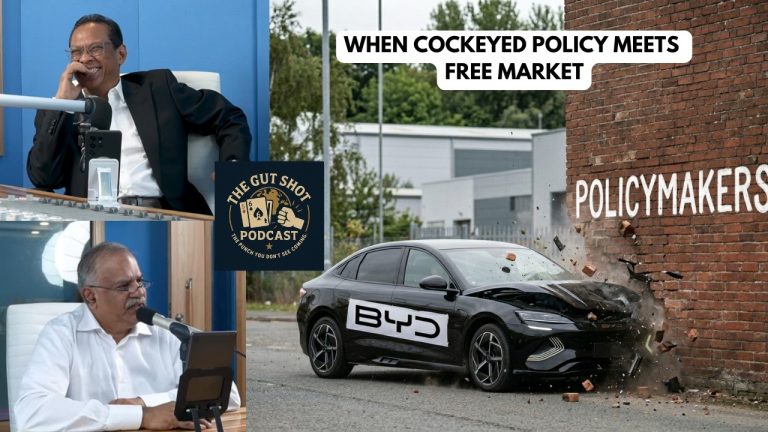
BYD’s Investment Hit a Wall – When Cockeyed Policy Meets Free Market
Show Notes & Description
We analyse the recent report on the potential BYD investment pulling the brakes into their proposed manufacturing facility in Tg. Malim. A minimum selling price and export quotas dictate by policy makers may jeopardise the massive benefits of this investment for the Nation. This is not just an example of policy mis-steps into free-market enterprise but is a remnant of a decades long misguided attempt at building supposed "national" industries that must be protected at all costs – even when our citizens pay a higher price.
Welcome back to The Gut Shot Podcast! In Episode 71, we sit down to expose the uncomfortable truth about Malaysia’s economy that politicians desperately want to keep quiet. Have you ever wondered why you are paying double for a standard mid-range car compared to the rest of the world? We pull back the curtain on the multi-billion ringgit BYD investment that just hit a massive, government-imposed wall in Tanjung Malim.
We dive deep into the absurd conditions placed on foreign investors—like being forced to export 80% of their output and being banned from selling cars locally below RM200,000. Why? All to protect an inefficient "national car" oligopoly that relies so heavily on foreign technology that it isn't even truly national anymore! Through explosive comparisons and hard-hitting economic truths, we break down how cockeyed policies and market interference are draining your pocketbook, stifling local engineering talent, and actively costing our nation thousands of jobs.
We don't just complain; we provide real examples of what actually works. We point to the massive triumphs in our oil, gas, and aerospace industries, showing how true local expertise was built from the ground up without the expensive crutch of a "national" brand. Plus, we explore the looming global economic threat of China’s massive production capacity, and why our current protectionist path is a recipe for absolute disaster.
If you care about your cost of living, your family's future, and the economic direction of our country, you cannot afford to miss this episode. We connect the dots between government price-fixing (remember the chaotic 2023 egg crisis?), lost foreign investments, and why the everyday Malaysian is forced to subsidize corporate billionaires. Hit play, like, and subscribe to join the fight for a free and fair market!
*Episode Chapters:*
*[00:00] – The Billion-Ringgit Secret:* Why BYD’s Mega-Investment is Stalling
*[03:20] – The Great Car Rip-Off:* Why Australians Pay Half the Price for a Toyota
*[07:10] – The "National Car" Illusion:* Who Really Owns Our Auto Industry?
*[11:35] – The Oil & Gas Blueprint:* How to Actually Build World-Class Engineering Talent
*[14:50] – Defending Inefficiency:* The REAL Reason Your Car Costs So Much
*[19:15] – Subsidizing Billionaires:* How 34 Million Malaysians Foot the Bill
*[22:45] – The Incoming Tsunami:* Can We Survive China's Global Export Overcapacity?
*[26:50] – The Egg Crisis Warning:* What Really Happens When Politicians Fix Prices
*[31:10] – The Ultimate Cost to You:* Why Market Chaos Will Cost Them Your Vote
*(Note: As exact audio timestamps were not provided in the transcript source, the timestamps above are estimated chronologically based on the flow of the conversation to perfectly fit your YouTube description format.)*
Jump to chapter 8 chapters
- 0:00 Introduction and BYD's Stalled Investment
- 6:30 Car Price Disparities: Australia vs Malaysia
- 11:42 Debunking the 'National Car' Premise
- 14:44 The Oil & Gas Blueprint for Talent Development
- 20:28 Supply Chain Dynamics and Free Market Competition
- 24:46 Subsidizing Inefficiency at the Consumer's Expense
- 30:18 Job Retrenchments and China's Export Overcapacity
- 35:52 The Egg Crisis and Dangers of Price Fixing
Auto-generated from YouTube captions. Timestamps link to the video.
So, you want to call that a national car? And then, what is this thing called a national car? What is I I don't know. Can you define a national car? What What is a national car? The CEO is a local, must be a Malay or Malaysian. It's not.
Both the CEOs, I think that they are not I don't know about the second car, but I know the the the the Ladies and gentlemen, welcome back to the Got Shot Podcast. I'm back again with Syed Akbar. And today, as promised previously, we're going to talk a bit more on um on critical economic issue facing our nation, and how um this should be handled, um specifically when we talk about uh subsidies and uh cost of living in terms of uh well, probably capital expenditures that are costing a lot to the pocket of our people that our politicians don't want to talk about. So, here we are, and
we'll talk about it. Please like and subscribe. Syed, let's open this subject matter. Maybe um let's go specific, let's say dah, uh before we go into the macro, let's micro it first.
Okay, good morning. Thank you for the intro. Uh this is about There's some news came out about this uh Chinese electric vehicle manufacturer BYD, which is now, I think, the largest electric EV manufacturer in China, if if not the world. They are Their cars are being sold here. So, they're doing they're doing very well. They're doing quite well. And uh their sales last year in Malaysia went up by 68%, I think, over over 60%. 2025 compared to the previous year. So, they're breaking a lot of records. And uh they're thinking of setting up a manufacturing plant here.
Mhm. In Tanjung Malim. Tanjung Malim is our automotive hub in Malaysia. And I think it's a multi-billion ringgit investment and they will begin by bringing in CKD parts and assembling it here, the the normal route. And then they further on down the road they may you know, go into full-scale manufacturing and things like that in Malaysia. But the project has run into a bit of obstacle. Because a couple of things. Yeah. BYD has been told by the government. I'm I'm referring to a news report that came out in the age in the age and also has been reproduced by Free Malaysia Today.
This news report is more than two weeks old, but I think the the facts are still hold. Yeah. Or there might be some changes in the pricing. But nevertheless, there is a restriction imposed on BYD in that they they have to export 80% of their output. And they can only sell 20% of their output in the domestic market. So this puts them in a bit of a quandary because you know, they're investing so much money in in the plant in Tanjung Malim. I'm sure they want to have the freedom to decide, you know, how much they would export and how much they will sell in the domestic market,
at what price they should you know, they should price their cars and all that. But there there is a requirement that they can only sell 20% of their cars in the kind of their output now. From that factory in the Malaysian market, export 80%. The other one is the pricing. The earlier news reports indicates that they cannot sell their cars below 200,000 ringgit per unit, which I thought was a bit crazy. This this figure may have changed. I do not know, but this is what was reported in the in the media about 2 weeks ago. So, these two things basically create major obstacles for BYD as an
investor, as an investor. Because you your production volumes are now being dictated to by by basically the government and the civil servants and the minister, the politicians, people like that. Whether how much you can sell, percentage, how much you can export, how much you can sell domestic, and the pricing, you know, you shall not go below a certain price. Even if it is not 200,000 ringgit, because I do not know this number may have changed. Regardless, the thing is the price is determined by the government, the the rule makers, the regulators, whoever. So, they do not
have the freedom to uh to decide as they want on how on how and where they shall how much they shall produce and where they can sell it and at what at what price. So, this basically bottom line, uh uh which is what I think we're going to discuss today is the free market is not allowed to function on its own. Uh Yeah, rather basic things like pricing of products, pricing of products and services, pricing of manufactured products in the country are determined by, you you civil servants and ministers and politicians and things like that. It is not market-based, so this is the issue. This is the
problem that we have in this country which has been going on for a while. And ultimately, yeah, it affects the inflows of foreign investment, investment inflows into the country because foreign investors I think will be looking at this this BYD project in Tanjung Malim and they would also like to see what is the the outcome of it all for BYD because it has serious repercussions on your return on your investment that you want to invest in the country.
That's Well, my my take on that is actually when you put a a basement price on on what you can sell. That's price fixing by the government, so free market is out of the window. Just for comparison for our audience, if you buy a Toyota Camry, we were talking when I was in Australia, right? I did a little bit more check, a 1.5 L Toyota Corolla.
Corolla? Corolla. I because the other day when I was in Australia, I was I just passed by an Audi. Right? So, some people were saying that okay, why go for a luxury car so to speak. Audi is not luxury car. It's a mid-size It's a mid-range car. Okay? It's only luxury in Malaysia.
Exactly. Yeah. So, let's take a Toyota Corolla, either a hybrid 1.5 L or street 1.5 L depending on the specs. You're talking about Australian dollars between 18,000 to 23,000. So, let's say 18,000 dollars
In ringgit? In ringgit, let's say let's take 20,000 dollars in ringgit times three. So, that's 60,000 ringgit. Times three, huh? Times three, okay? Remember, and this is the other thing that you got Even that is already cheaper than what you are paying here.
What's the price here? Okay. Toyota Corolla Corolla 1.5 uh liter in Malaysia uh is going for the sedan 1.4 liter is 90,600.
60 versus 90, 50% more. So, 30,000 ringgit you've taken out from the pocket of your ordinary rakyat at the very least. But you know what people don't realize as well is actually uh people are paid dollar to dollar. Okay? Um if you are being paid 3,000 ringgit here, actually in Australia you're paid 3,000 dollars for the same type of work, normally. The only difference of the exchange rate is because our economy is much poorer compared to Australia. But really you're paid dollar to dollar. So, effectively if you were to ask me if we were in the same economic situation and
actually by reality what you should be paying for that Toyota Corolla is only 20,000 ringgit. That's the reality of it. So, I for So, basically um
Well, you can't Allow me. You can't Maybe you can't sell at 20,000 ringgit. You maybe you must see what is the cost of production. But the Australian is only paying 60,000 ringgit. Yeah, but you must remember also, huh?
Huh? That is uh I If I can pay 60k ringgit for a Toyota Corolla Now, today Yeah. I'm saving 50% less and paying 90,000 ringgit. Correct. And and and think about this, right? They are They There's no CKD. They're completely built, okay? And the transportation from Japan all in. All in. Freight. You know? So, I would suspect that the price is actually by reality compared to Malaysia at least you down by 10,000
ringgit. Right. Okay. Should be less. Yeah, should be. Yeah. So, I think this price control not just affect on investment. I have a different point of view on overall economics in terms of free market and uh tariffs and and certain protectionism because I do see some uh some headwinds coming to smaller economies. But, where in in um in in in areas or in industries that we have such a small footprint in terms of our domestic economy, right? Relative to what needs to be produced to make it scalable such as motor um uh motor vehicle, right? There's really no reason for us to prop up domestic uh
motor vehicle industry. That has been done for almost four decades, you know, at the expense of our people's pocketbooks and uh uh at the expense of their uh their ability to actually utilize that additional money for their family to be better educated, for their family to eat better, for their family to have uh a better place to stay. Said?
I don't know why these people pick this motor industry for protection. Why not the shoe industry? Exactly. Or the food industry. That those we have the market for it.
Okay, they say we want to build up engineering talent and all that. I beg to differ. Yeah. Okay, the other thing is that now we are protecting our domestic auto industry because Dr. Mahathir We have to go back to Dr. Mahathir.
Yeah, this goes back to upper knee good old Dr. Yeah, we have to go back to Tun Dr. Mahathir. He said we have to develop our our indigenous domestic engineering capacity and things like that. But you see the two major car companies now in the country are the national car companies. One is now It is basically Chinese owned. They've taken over. Although yeah, they have they're not the majority shareholder, but I checked They have 49.9%.
The domestic shareholder, the Malaysian shareholder is 50.1%. Okay, that's a percentage. But the product is a Chinese product. It comes from China. The CEO is Chinese and the technology is Chinese. Now you take the second national car project. Until recently it was controlled by the Japanese. Now I think the the Malaysian shareholders are the larger shareholder. GLC GLC is a significant shareholder, but it's a Japanese product.
Yeah. It is it is it's a Toyota Daihatsu product, you know. So you want to call that a national car? And then what is this thing about a national car? What's the big deal about it? What? I I don't know. Can you define a national car? What what is a national car? The CEO is a local. Must be Malay or Malaysian. It's not. Both the CEOs I think that they are not I don't know about the second car, but I know the the the the the car that is owned by the Chinese company in China. I mean which has a partner the Chinese partner from China. The CEO is from China. Uh the technology
the the the national car the the the first one is now very strongly dependent on the Chinese technology partner. So what exactly is this thing called a national car? Do you wave a flag? Do you put a Malaysian flag on a factory rooftop and then you feel good about it? I don't understand what's going on. But you see the thing is if if I may add that. So this idea of national car, what exactly is a national car? And is To me like definitely it is not. Now one is now very obviously Chinese technology. Very obviously, yeah. The other one is Japanese. So it's like short scenery, you know.
You call it a national car national car, but now after 40 years I think of this national car project it is now owned by I mean technology partner everything the car actually comes from from China. And the second one is a Japanese product. So can we stop on this national car uh punya what do you call it? Paranoia paranoia. It's a paranoia and they're paranoid.
So may may may I may I divert to to other industry so that people can see um how how other industry actually develop expertise in terms of as you said say Dr. Mahathir wants to talk about to develop engineering expertise, right? The oil and gas is a is a very good example. All right? We started out the two main multinationals were owned by uh were basically Exxon Mobil uh which at that time when I started my career was basically uh uh what do you call it? Esso SO EPMI or SO, you know? And then it became ExxonMobil after their merger. I was I started out with Shell,
the Royal Dutch and Shell group of companies. So that was Sarawak Shell and Sabah Shell Corporation. Both 100% owned by multinationals. Okay? Um the only thing that we have is a Malaysianization program where we we expect to see Malaysian expertise being developed. Okay? And after three three decades, I would say not just within those big multinational companies, but also in the really expert specialist organization like Schlumberger who does work for all these oil companies, right? Halliburton. And then we we created uh indigenous, shall we call Malaysian expertise in engineering
um in all these in all aspects of oil and gas. That today we even have Petronas Carigali. Right? And we can go outside the country. A lot of our people actually are working in the Middle East today. Um and those are real engineering expertise. And we didn't even own a national oil company to start off with, nor did we really need to to be honest. Okay? But then the services company start to to build up real services company started to be formed because why? People like ourselves, you know, go from being experts in our specific fields and go into entrepreneurship.
Right? So the oil and gas itself showed a way where actually you can build engineering technical expertise without having a national upper the oil company. In fact, Petronas was basically during the days of Hassan Marican was built as actually the the national it's a statutory body effectively an authority that actually covers the assets of the country that signs all the production sharing contracts with the multinational companies. So that is one sector. Right? Why can't we do that? We could do the same with motor vehicle. Oh, we could build the the companies
could come in, build their factories at the lowest cost and actually build our own engineering expertise. Yeah, because this is what you see one of the excuses given by the minister is that the local automotive manufacturers, the two mainly the two companies, they have invested a lot of money here, billions and billions, fine. If you want to do business, you have to invest. And then there is the the what do you call this? The supply chain. If there is a supply chain inside the country I couldn't believe the numbers that they they say there are hundreds of thousands
of workers in the automotive supply chain, high hundreds, you know, about 700,000. And what value added is the next question I have. know how valid are these figures, I heard. Okay, fine, fine, doesn't matter. You can you can dispute whether it's 700,000 or 900,000 or 400,000.
But doing doing doing wiper wiper blade No, I mean, okay, you you are saying that we have to protect all these jobs. This is a this is a person who doesn't understand business or economics. Because what you're saying is that now this this people BYD, they want to come in. They already know the market condition situation. They know. They know that you know some these these guys are protected and they can sell at a cheaper price. The existing car manufacturers in Malaysia, the two big boys, they are protected. And they can sell at a certain price. Of course they are the cheaper uh Uh
but they feel that BYD feels that they can come in and compete. No, they they they I think they're very confident they can They're very confident. So they're confident of their product, they're confident of their technology. They are confident of saleability of the product and they're confident of doing sufficiently well in this market. Maybe they can sell their product cheaper. That means they compete on price. Or maybe if they cannot compete on price, for the same price they can give you a better product.
Yes, they're a bigger car. So whatever it is, this is BYD's decision. Like when you run your business, you make decisions, you see. Nobody tells you how you should I should price price your product. Or I as a government official tell you Samsul, I think you you should price your product not more than this. Not lower than this or not more than something like that.
They they tell you both like that. that's it. So this BYD wants to come in and do what they want to do best. Now they are being Well, there are some obstacles being put up because of silly arguments like oh, the local car companies they've already invested X amount. They employ so many people. This is not This is I don't know in which This is I don't know what in which economic textbook they learn this, you know. If BYD comes in and they can sell more cars, they can compete and okay, they can compete and put the local boys out of business. Uh The supply chain will switch to BYD.
That's exactly where I was going to go. I'm supplier of tires, uh Yes. I've been selling to the national car companies. Suddenly, their sales drop. They buy less from me, but this new player, BYD, is making more cars. He needs more tires. I'll sell to him.
Well, here's the thing. You know. If BYD is capable of actually producing more cars at cheaper rates, that means that the supply chain will shift. Will shift to them. supply chain will shift. Will be able to to actually have the scale
to take the workers along with them. Yeah, not just take workers with them, actually gain more workers Yeah. because why? They have They can now supply to a bigger production capacity. So, there will be a transition There'll be a transition period. Transition period. Some supply chain Some companies may have to close down, shut down. Some workers may lose their jobs, blah blah blah. But But within a certain amount of time, it'll all swing to the to the new car manufacturer or It could be BYD. It could be ABCD. It could be XYZ. That doesn't It's not relevant, huh? The
thing is the the economy, the market must determine its own level. No, let me let me Now, the Now the minister, the civil servants, the Ministry of International Trade is involved. They are having meetings and discussions with BYD, and they will decide what shall be your export well volume, domestic sales volume, what shall be your selling minimum minimum maximum
that? How do you do that? You You know what? I I want to I just want a quick one, huh, to show you not just that this happened in the oil and gas industry. Think about the aerospace industry. Okay? We don't own a a a national company aircraft manufacturer. Okay? We never said that I'm You know, Dr. Mahathir doesn't get up one day and say
I think please don't give them ideas. Let's see. Okay, we don't own a national aircraft manufacturer. But what has happened similar to what happened in oil and gas, right? We build up a support a support capability of repairing the aircraft, maintaining the aircraft that we have one of the best maintenance and repair in Southeast Asia. Unfortunately, okay, we don't seem to realize that. Singapore realized that and say, "Hey, dangle money, they're all going to Singapore." Okay? So this is our problem. Our problem is our economic policy makers are making these cockeyed decisions, all
right, in terms of interfering with fair market, not understanding how actually jobs are created. And which strategic industries are actually building value. They interfere with the pricing mechanism. Yeah. They want to decide. Ministers, politicians, civil servants want to decide the selling price of goods and services in this country.
Well, because we've been living in a in a patronage system of oligopoly and and monopolies where actually connections provide you with either a GLC or funding from from from from money government link funds and therefore that has to be protected.
And then you see somebody has to pay for all this. There's always a cost to this kind of foolish behavior. The citizens pay for it. We pay for it. You said just now that Toyota Corolla Hybrid is selling for 60,000 ringgit equivalent in Australia and it's about 90,000 ringgit here in Malaysia. That's 30,000 extra, 50% more.
I bet you as I said to lock the freight cost probably probably you can go down 15,000 ringgit. You see the our two I did some just basic research. Our two big car companies the first one their sales last year 2024 25.5 billion these are gigantic giant these are big boys last year estimated about 27 billion 2025. The second one the sales are even higher 2024 their sales were 30 billion and last year estimated 2025 estimated is 31 billion you know these are not small small players these are not SMEs these are huge huge guys and big guys you mean they cannot compete.
So we 34 million Malaysians consumers we are actually subsidizing We are subsidizing the billions that they are making. These billions because we are paying more for our cars because someone who can make a more efficient car BYD who want to sell whatever they want to sell at whatever price they are being discouraged or having obstacles put up so at the end of the day the 34 million Malaysians end up subsidizing these and these are not SMEs this is billions.
Let's let's put it this way I think I think the other part of the equation as well is that if BYD invest these billions and actually they are imposed upon to hire Malaysians that's all I need train them up okay you know then we will build the expertise the core expertise and and if for example the company goes bust because for whatever reason, okay? No Malaysian taxpayer need to actually bail them out.
public money. It's not public money. But and that's exactly the other thing, yeah. On the one hand, we want to be a negara maju, an advanced economy. We want to be high-income nation and all these kind of things, you know? But here, a guy, BYD, yeah. A guy who actually says, "I can be as efficient as I can be. I have new technologies. My engineers have skills, you know? So, I want to try this. I want to invest in your country and build my cars and introduce my new technologies. I basically sell either What do you call this? A bigger, better mousetrap, lah.
Right. So, now they are being Well, there are some obstacles on the way lah to allowing them inside with all these conditions, huh? Basically, what you're saying is that, huh, we are happy with our level of efficiency. We are We are happy with our level of value added. We are happy with the level of high income for our workers, the so-called engineering talent which Dr. Mahathir wanted to develop. We are saying that, "Tak apalah. We are happy with what we have." So, if if you are BYD, you can come in with your super-duper, uh, you know, electric car, one charge
you can go around the world or whatever, lah. Never mind, lah. We we are We are happy with what we have. Meaning that we are not allowing uh, efficiency, yeah, and well, basically, boils down to efficiency, lah, and new technologies and new capabilities from entering our market. And then, we expect our workers to become high-income earners. I mean, to to continuously keep going up the income ladder, lah. You must keep improving, isn't it?
Yeah. Your productivity, your output, your efficiency must keep improving. When you put up obstacles for other players who can who are saying that they can do a better job, you are putting a ceiling on our efficiency in our economy. You're putting a ceiling on what we uh want to achieve as a high-income nation. Basically, we're telling our workers, "Your income stuck at nil."
Yeah. That's what it is. Yeah. Because if a new player comes in, as you said just now, the supply chain will swing to them. They will have to hire local workers, local engineers, local technicians who will have to learn to, you know, make their products efficiently at a higher output rate. So, all this leads to a higher income earning worker because his she's productivity will be will be higher using new technologies and stuff and all that. So, we are putting a curve on that.
Well, let's let's And then we And then we want to create high-income nation. Yeah, that that does not happen that way. Let's let let's just pivot it a bit because I think there is a there's another dimension to this that we I think policy makers are not thinking. Uh in fact, I was speaking to one CEO that was in the manufacturing sector um uh about this uh very recently. Uh by And I'm going to leave it in this way. So, this all interconnected because why? We want to go high income. We hold up an investment that is going to create jobs that should you must impose creations of job that
going to sub you know, that that's going to sub swing supply chain and let the free market works, all right? But, at the same time, here's where pivoting. Um I think uh uh the recent number in March reported by say.com uh is that uh Selangor and KL in March has is is leading in job losses as much as 5,900 um Malaysians that's been retrenched in March alone. Okay? Uh and job losses search 47%. Um in the first quarter of 2026, which is about 24,100 workers being retrenched. So, something is already happening with the economy. Okay? And at this point, you are taking
out something that protects um uh an oligopoly, a two-headed oligopoly. Okay? Uh and and holding back a massive investment, but at the same time, you're also losing jobs. And I think partly we got to look at this because here's the reality about uh economics uh in the in the 21st century and in in a global economic situation today. Uh China, at 1.4 billion people, um with a economic system whereby they are competing among each region, yeah? Their regions are very autonomous. And they actually compete on the basis of GDP for their region or for their city or for their territorial.
Which means uh they have no worries about how their balance sheet going to look like or how their P&L is going to look like. They're looking at actually how many people they can employ and how much can they produce. That is why China right now is uh basically 30% of the production capacity of the world on almost everything. Okay? So, no country on Earth, not even the biggest economy in the world, which is the United States, can actually compete with China in terms of uh scale of production. So, they they are unique cost is extremely low. And that's why we are finding that uh Western Europe, uh
Brazil, and even Brazil uh are looking at anti-dumping measures. I personally went to China to look at solar and um uh solar panels and whatnot. And the price that they're willing to they're they're giving you is uh is basically below cost. Uh because why? They have to They have to ensure their factories to continue working because the the the government cannot afford their people not having jobs. You know what I mean? And in that sense also, what is happening is that they are exporting their overcapacity to the outside world. Right? And this is something that economic policy makers
in Malaysia in and in other countries need to be very aware of. Okay? Because their price is not is not uh uh is not uh going to uh is not is not going to be able to be to be
Have you Yeah. Have you Have you been to Yiwu in China? No, I've not been to Yiwu. I've been to a few cities. I've been to a place called Yiwu, where they have this uh this huge uh it's a trade center, uh where almost every factory in China has got a display room there, you know?
I think policy makers need to look at strategic industries instead, right? Our FMB sector need to be protected. Our uh retail sector need to be protected because otherwise, uh these are we have enough uh money production capacity to cover both domestic and for export. Okay, those are the things that we need to look at. Um that otherwise we will actually be decimated. Our steel industry has already been decimated by Chinese steel. So those are strategic industries that need to be looked at. I don't know how you feel about that, Syed. Um
Nope, I I feel differently. Okay. But but if I can wrap up this thing. Okay, I mean you can uh debate those issues, huh? Yeah. But my main concern is this la, and and I want to give a real real example here. My point is that uh you cannot have the government, the ministers, the politicians, civil servants, huh, determining on the selling price
I agree with that point. because it is not only it is not their job, that one goes without saying. There is no methodology anywhere in the universe. Not on Earth, not on planet Jupiter, not on Pluto, huh.
Not on Tau Ceti. how to determine the selling price. It's up to the market. Yes. So when you don't understand this concept and you start interfering, it causes chaos. And when there is chaos, somebody has to end up paying a higher price. Would you like to guess who that somebody is?
You said it again and again. You said it again and again, it's you and me. me. Yeah. So I'll give you an example, real life example. Remember we had that egg crisis, telur ayam? Aha. Uh it happened in 2023 around there. There was no eggs in the market, huh?
Yeah, yeah. Because eggs was a price control item. Yep. And about the same time we also had issues with the supply of chicken. Chicken also price control item, huh. Uh finally the thing dragged on for a while, you know, and people were all getting upset because there were no eggs in the market, especially. Uh finally they is it by removing the price controls.
Mhm. The kawalan harga price controls on eggs were removed in November 2023. I'm sorry, the chicken meat daging ayam was removed in November 2023 and the eggs I think was a bit later. 2025 I think. Both have been removed I think. And since they removed this price control on eggs and chicken, the problem is solved. There is no more shortage of eggs in the Malaysian market or shortage
Probably egg prices went down as well. About there. No, well, you know, I remember it was like in the 30s and 40s cents. Even now it's about there 30s, 40s, 50 cents. It it it it it it swings. Chicken is now I check with my wife and I was in the market I think it's below 8 ringgit a kilo. So, you know, it used at one time went low to six something then nine again and stuff. It's hanging there. But there is no issue of not enough supply because the market determines it.
Yeah. Not civil servant, not minister, not politician, not somebody. So, this is the basic equation. So, okay, let's go back to the eggs and the chicken. So, finally the government was they were, you know, they were panicking. They didn't know what to do. The reason the egg price had to go up at the time there was a shortage because the price of the chicken feed went up tremendously. There was an increase because of the Ukraine war. The price of chicken feed went up. The costing to produce chicken and eggs went up. But because it is price control item, the egg producers didn't want to
sell it because they'll make losses. So, the supply went down so there was a scarcity of eggs at the time. So, the government was trying to scratch his head and at first it started pointing fingers. Oh, there are people who are hoarding. How do you hoard eggs?
So, all kinds of theories came out. Finally they decided that we can't handle this anymore. They removed the price control on eggs, problem is solved. They remove the price control on chicken, problem is solved. So, I'm glad that there is one less civil servant who's involved in this There's some civil servant lost this part of his job. Maybe he's doing something else now, lah. Something more productive, lah. But at least there's one less civil servant interfering in our lives. So, so they don't understand this concept. You cannot put price fixing You shift the the responsibility for
price pricing products and services in the economy from the market to a civil servant, minister, politician. You screw They screw things up. So, I hope, lah, this the the politicians, I hope who are listening to our podcast that they will learn something that you interfere in a market, you create massive chaos. Exactly what is happening with BYD now. To me, yeah, BYD is going to be a multi-billion ringgit in what? Investment. Uh there's another Chinese car company. I can't remember the name. They're also building a plant in Tanjung Malim. Uh it's a smaller plant. They're going to be assembling
over 2 billion ringgit. It's huge, you know. It's a huge. BYD is going to come in multiple times bigger. They're huge, yeah. You are You are risking this kind of investment because the civil servants and the politicians and the minister wants to decide the selling price of cars to safeguard the existing players, lah. They want to cap the efficiency of our economy. So, that's my That's my closing remark. If uh if if they do not allow market forces to operate, it causes chaos and it and it increase the cost in the economy, you and I pay more. When you and I pay more, we don't vote for them.
Yeah. That's the my bottom line remark, lah. Well, we've already seen that. I mean, the the job losses are already piling up. I have to sustain your inefficiency, you don't expect me to vote for you. And uh people do this. Even people who don't understand what we are saying today, but the average Malaysian feels that he's paying more and more for less and less, and uh that's why they don't vote for these politicians. The politicians do not understand this. With that, I close my
Why? Okay. I mean, before you close it or we close it, I I'm going to take us another episode because I do think that actually uh the complexity of global economics um need to look at beyond just saying that uh I just want to bring Here's the funny part, you know. You got BYD wanting to come in and invest in something that I believe we have no strategic interest whatsoever to actually build a national car or maintain a national car industry, right? But whereas, we also have uh a base economy where um in the words of one um CEO that's been running his company for more than 20 plus years,
you know, and has built even export market, but they have been able to go up the supply chain the I mean, the value chain, right? Uh but for their cheaper version, for example, what he says to me was very simple. My my cost price is the Chinese sales price. Okay? This coming from pure private sector uh companies that has got no government link whatsoever. So, this are very much something that also another part of our economy that needs real um look at because I think the wave is coming for all uh and it has started in the bigger side if you ask me. Our our our durian market has collapsed.
Our steel Our steel industry is no more. Uh we have a Straits of Malacca and uh that actually uh provide uh ship repair and ship building that we are not nurturing. And we have plenty of uh capability to build that sector and we are not doing that. And we're not We're not really protecting that where we can be competitive. So, that's my closing on that and I think that probably is going to take another episode. So, on that score, Syed, shall we wrap it up for the day?
Thank you. Thank you so much. See you all again. Bye-bye.