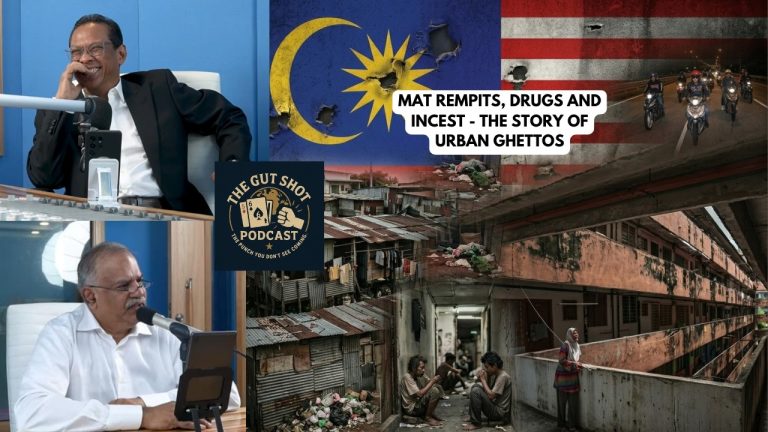
Mat Rempits, Drugs and Incest – The Story of Urban Ghettos
Show Notes & Description
The story of urban ghettos need to be confronted as not merely one of the collapse of the fabric of societal support-system with families crammed into poorly planned low cost housing system. Our politics does not care about its people, it only provide lip-service and championing race and religion as its vote-getting tactics. Everything is about enriching the politics and crony-class.
please subscribe, like and share. we need a more informed and critical thinking public to change the Nation
Welcome back to The Gut Shot Podcast! It’s Shamsul Sam and Syed Akbar here, and Episode 78 is one we’ve been waiting to unpack.
We are pulling absolutely no punches as we dissect a harsh, uncomfortable reality that our society is desperately trying to ignore.
We’ve all seen the viral headlines about Mat Rempits, drug abuse, and deeply disturbing cases of incest—but why are these issues incubating so rapidly within our Malay society and urban areas?
Are we just blaming "rebellious youth," or is there a systemic, structural rot that no one wants to talk about?
In this powerhouse episode, we connect the dots between the stark reality of rural unemployment, the dead-end trap of the gig economy, and the intentional creation of urban ghettos right in our backyards.
When you cram a struggling family of seven into a tiny two-room PPRT flat with zero recreational outlets or community space, what exactly do you expect the youth to do?
We contrast our poorly planned, profit-driven low-cost housing projects with Singapore’s highly successful, meticulously studied public housing model to show you exactly what we are doing wrong.
But it doesn't stop at bad urban planning. We tear into the absolute failure of our political leadership—politicians who are more interested in surviving the next election cycle than creating a solid five-year plan for rural youth.
Furthermore, we expose how the massive influx of over 3 million foreign workers has completely decimated the entry-level job market for our 18-year-olds.
By denying them these foundational roles, we are robbing our youth of the crucial life skills needed to climb the economic ladder, leaving them with a transactional, hopeless view of their futures.
If you care about the future of Malaysia, the widening struggles of the B40 community, and why our youth seem to be giving up, this is a must-watch episode. We aren't just talking about the symptoms; we are exposing the disease. Hit play and join the conversation!
**Video Chapters:**
* 00:00 – The Unspoken Truth: Why Are Mat Rempits Truly Multiplying?
* 03:15 – The Gig Economy Trap & The Hidden Rural Unemployment Crisis
* 08:40 – 7 People, 2 Rooms: How PPRT Flats Accidentally Became Urban Ghettos
* 14:20 – The Singapore Blueprint: What They Did Right (And We Completely Ignored)
* 21:05 – Missing Millions: Corrupt Contracts, Leakages & Taxpayer Realities
* 28:30 – The Anti-Intellectual Pandemic & Escaping Algorithmic Echo Chambers
* 35:45 – Stolen Futures: How 3 Million Foreign Workers Killed "Entry-Level" Jobs
* 42:10 – A Dire Warning: Why Clueless Politicians Will Lose The Next Election
*(Note: As the exact video timestamps were not present in the transcript excerpts, the timestamps above are estimated placeholders formatted perfectly for your YouTube description!)*
Jump to chapter 7 chapters
- 0:00 The Roots of Mat Rempit Culture
- 3:54 How PPR Flats Became Urban Ghettos
- 12:32 Comparing Singapore Housing with Malaysian PPRTs
- 17:40 Rural Flight and the Squeezed Job Market
- 23:16 Anti-Intellectualism and Algorithmic Echo Chambers
- 31:00 Foreign Labor and Lost Entry-Level Jobs
- 33:50 Political Short-Sightedness and Electoral Consequences
Auto-generated from YouTube captions. Timestamps link to the video.
Why do you think that? I mean, obviously, but the the matter of faith is true. I mean, it's it's never ending, which I don't understand until today. I mean, just the other day, I saw a newspaper something like If I'm not mistaken, something like 300 of them will be called out. You know, so it's like um It can't be stopped. I don't understand why it can't be stopped. um And why is it being fostered within the Malay society? But it doesn't really exist in either Chinese society even I mean, not all Chinese are uh Borney you know, I mean, they not that they are no B40. Uh you know,
What's What is so special about our Malay society that it incubates uh the problem of Marang Bet? Welcome back to the Dutch Shop podcast. I'm Shamsul Sam, your host. I'm back with our good old partner Say Atpadi. Good morning. All right. Uh today, actually, we've been fooling around on this topic which is uh uh very much in uh in our mind daily, um which is urban ghettos and rural unemployment. They are all interrelated that uh with uh the problems that we see, the Marang Bet issues, the drugs, uh uh even incest uh cases that has been up in the news. Uh and we sort of like put it together
and say, "Hey, let's talk about this issue and see where the causes are uh within these urban ghettos and uh the unemployment situation uh in rural areas. Can you please kick it off? Yeah. This This uh They're not new phenomena, but still they really key in these set powers society. So, like my deputy on this, I think when you were growing up, we didn't have these these issues. But then again, you and I do have 40 years going and time has passed. So, there really is new issues coming up. And then the uh the unemployment at the rural areas. From what I hear, a lot of young people
in the rural areas have very little chances for employment. So, they're hanging at other places, they don't know what to do. And then even farming, a lot of farms, especially petty peers, you know, they are not being or works because they are under the new generation. Uh neither they move away to towns or they just They're not able to utilize the the agricultural land. So, as a result, which are economic output or economic prospects for them uh it's not as good. And then they move to the towns and cities now. Again, things are not that easy and they have gig
economy and all these kind of stuff. So, each one of these things create its new its own issues. Uh huh. Uh the gig economy is quite new in this country and it will give growth to various issues that are related to the gig economy. A gig economy means you don't have the increased skill sets, you don't have career career path career path, even the income growth is all very limited. So, all this will create its own problems. So, what are we doing to anticipate these problems that will come? Like you see for some years now, we have had these uh young the low-cost housing projects in
the urban areas, PPRT uh to house the people who previously used to live in the squatter areas, who mostly at So, now they've been moved to PPRTs. So, the PPRTs have become urban ghettos now. And they create their own problems. So, what are we doing to anticipate these problems, uh? And uh to to uh do something before all these problems become worse and give birth to other issues. So, with that, we are not focusing enough. W- Why do you think that I mean, uh always see but the the Malay problem issue uh I mean, it's it's never ending, which I don't understand until today. I mean,
just the other day, uh I saw a newspaper something like if I'm not mistaken, it's something like 300 of them will be called out. You know, so it's like um it can't be stopped. I don't understand why it can't be stopped. Um and why is it being fostered uh within the Malay society? But it doesn't really exist in either Chinese society even. I mean, not all Chinese are uh B 40 uh uh uh you know, I mean, they not that they are no B 40. Uh you know, w- what's what is so special about our Malay society that uh it incubates uh the problem of Malay problem? Yeah, I've been uh
they seem to be, you know, some few podcasts ago we discussed Malay problems versus Malaysian problem. The So this uh this seems to be a bit of more of a tutor towards the Malay problem issue, meaning that uh you have to look at it uh specifically, and you have to uh design specific solutions uh to you you cannot have a one-size-fits-all. So you this is a problem that is prevalent among the young Malay youth. So we have to design some programs and focus on it specifically, which will uh which will solve problem for them. Because as you see, the others uh like Chinese and Indians may not be
suffering the same issues uh. So we have to address it specifically. The bottom line is uh we must overcome the problem. The bottom line is the net outcome must be an average across all religion basis. You know, like when you see a young person, uh regardless of their race or religion or whatever, we should be able to have certain expectations from them. You know, they are good citizens, they are loyal by these citizens. Uh they don't get involved in negative activity, yeah. They have uh certain qualities which which we can identify as, you know, common to Malaysians uh um respect for people,
be polite and courteous, and uh you know, in the public sphere, you know, like they don't throw they don't throw trash and litter everywhere, things like that, which most societies have. But uh and they don't get involved in breaking the law or causing social problems uh. So there must be an average kind of a behavior which we must inculcate in all our young people regardless of race so that this is this this is the Malaysian standard that we want to you want to achieve a which is nothing unusual every country has gotten up people who are normal at who can be who are regular citizens of
the country but even in our country if you have some parts of society lagging behind falling behind or having issues and problems that are specific to that then something is not right in in that particular sphere or system or that part of society and we have to address it specifically now if you ignore it if you ignore it a then it will result in stereotype you know stereotype you will go like oh yeah it's those people yeah they have these problems you know that's how stereotypes develop if we close one eye or both eyes and you know sometimes stereotypes can come true
that's the problem right unfortunately that is true but you have to I mean we have to repeat it I mean if if you if you put people if you ask me if you put people in small dense environment and you don't provide an outlet that's one problem if you don't create an outlet for them I mean I've seen this um this dense uh uh flat or uh uh population uh they're very they they don't even have space to uh have games or converge where you actually allow them to get into sports right um which when we were younger you know I mean that because we were a rural I mean, if I was uh I was
raised in Sungai petani. And um the housing the housing development area is you know, it's a cheap housing development area relatively cheap, but you know, we were terrace houses. Uh there were there were football field. Uh there were basketball uh uh uh basketball courts uh for which is very cheap. Which uh you know, basketball okay, if the municipal council set up a basketball court, you just bring a basketball. Or if you have a field, you just bring your football field. Uh you just come to a football field and everybody kick around. Right? Um but the other thing that I find very
funny about the butter pig culture is that they congregate at night. You know, cuz they have nothing else to do. Why at night? You know, you know, this Yeah, yeah, yeah, sorry. So, uh but near why don't they have the time to do things in the evening after school? Um and then by the time they get to night time, they're all tired and they'd rather stay home and go to sleep before they go to school. You know, this uh the urban city counties of 70% of our people are especially flying where it's like KL and you Penang in the go. And you have these uh people live in apartments and flats uh
And then especially those who are displaced displaced from before now they have opportunities to live in these low-cost housing medium-cost housing PPRT for their perumahan perumahan periskin all these uh
so basically very small walls. Especially big families. You can find a family of six people seven people living in a two-room flat. So, this will cause a lot of issues. This will cause cement issues down here down the road. You mentioned incest is not They argue says that the sexual abuse on the because of overcrowding being conditioned. So, what are we doing about it? Uh As you see that they are For example, I did from my own personal knowledge. In this people at this the houses are small and the children grow up they become teenagers. It's in a teenager that is full of energy. They want to
play music. They want to listen to music. They want to have their friends. They just want to talk to friends. Which supply the car they are in their house because houses are crowded. So, they end up leaving the house. They go to downstairs, sit around the motorbikes. And then they may sit on the other two cars motorbikes. They talk. Then they get scolded. Now what they do is they get upset. They take out a little knife and they scratch the motorbike. Things like that. So, that's how it starts baby. It will start from there. So, this is going to increase because
our urban population is increasing. And we will have more people here is low-cost housing that are overcrowded. Not conducive. You see, we have a neighbor in the south Singapore. That's an interesting comparison. They had got released in the 1960s. They started living in flats in the 1960s. Almost everybody is living in flats. So, they have studied They They have spent time and energy study. What would happen to our society if you put them in living in flats and they they have a lot of children grow up. They study all these things constantly. So, for example, they are very strict
about when you live in a flat in Singapore. Even your shoes you cannot leave outside your door. It has to be inside. You cannot put your storage boxes out of the upset in the corridor. They don't allow that. So, they want to maintain the harmony within the flats now. And then last time they had the regular flats and now yeah, they build abundance of flats which are two stories. Two story so yeah, all space outside. And they still within the medium cost category maybe see you. And then they have good recreational facilities around this place. It is like parks, you know, there's bicycle lanes,
spectacular play board free and like that. So they can uh they can let both steam out later. So all this and they're doing they they constantly observe the environment. But it's here we don't. Here a BP RT is a product, it's a contract. Somebody gets a contract to build BP RT flats two or three stories unit factories. Then they're presuming the money and the deliverables they do they do the whichever local authority is in charge. And that's it. So then the people fill up the flats inside and ring there. They park their motor cars and motor bikes all over the place cuz they don't
like that party, you know. Like enough sports facilities or the take for ages. Uh we don't think we don't think through the whole problem. You know our blood thinks through the whole problem. We don't anticipate what's going to happen 10 years here years down the road. Yeah. So this is what is happening here. A lot of these things are happening. And we're not and we're not anticipating where this will go to. I say I I mean also I don't know how much these flats cost and how much they actually should be. Uh I don't know or how much uh what do you call leakages in terms of budgets
uh due to land acquisition for example. You know, because all those um and monopolies like we always talk about in terms of the cement industry, for example, you know, who gets the contract for construction? Because I would probably think that if it was done right, not only would it cost lower, but would it would allow actually a proper planning of having all these recreational spaces. A higher standard of living. Yeah, and it's better for the same price for the same price same amount of amount of money. You really take space money. I will mind. At least we can provide a
higher standard of living for the urban masses. I and I I I get that. I mean, and I I I get sick and I whenever politicians or in parliament they talk about raising taxes um because actually your in in in my assessment our taxes are not being spent well. Um we are being bailing out failed ventures. We have leakages. Even NGO recently in the newspaper. I mean, the can NGO, you know. I don't know where they get this money of 270 or 230 million just gone out the window just like that. You know. Uh apparently it's an Islamic based NGO. You know. I it bothers my mind where that money came from.
So, people are lining their own pockets. Yeah. So, how do you then build comfortable livings living spaces uh for the B40 of our people? You know. And this is not just talking about Malay society, it's also for, you know, our B40 in the Indian and the Chinese community. When the when the money is taken out by the drug lord, yeah. Yeah. So, this is part of the major problem that is causing this. So, you see a last time also, there's a lot of woman who have gone shopping. Rural areas to the urban areas is is is a normal occurrence in any developing country, yeah. Yeah. People go from
everywhere here to the urban area, but job opportunities are the kind of stuff that migration But, we find that this is an issue now. Okay. Malaysia, because the cost of money, you know, renting a room in KL Kuala Lumpur was hundreds of a year per room. It's big, you see. Jobs are limited. So, you have people at the language competing as well. Two or three money of foreign workers were in the country, yeah. Who could deny the entry-level jobs for all these young people from the villages and rural areas. So, when they come to the cities, you have that our young people from the
urban to rural areas are now competing with the Bangladeshis, the Cambodians, and the policy against quality by the millions that they have country. So, the the the net is up is a lot of people now are stuck in the villages and rural areas taking up moves to urban areas. A natural social upper moving up the social ladder the economic ladder is denied because uh the it's more competitive in the urban areas, especially cities like Kuala Lumpur and Delhi. So, they end up being stuck in their villages and small towns after they finish their school and all that. But, there there are not enough
opportunities in the rural areas and small towns for our young people there. Because we have not really developed industrialization outside of our major urban areas. Not enough. We We have So, we have to focus on this. We have to encourage industries, manufacturing, and businesses to locate in the rural areas. Now, we cannot do this by force. We cannot decree We cannot wave magic wand, uh But the government, the policy makers have to think of and they must be creative and put on their thinking cap. You give me incentives, uh incentives, various country incentives
so that our local businessmen, local investors will, you know, finding profitable to open up manufacturing, to open up businesses in the border areas where where they can make money. Because border areas, usually costs are a bit cheaper. You know, your land cost various costs should be cheaper. So, they should They should leverage on this, uh the government and policy makers, and give other incentives so that industries move up into these rural areas so that our young people who are now just swarming around in my in rural areas and as you say, they become like vagrants, ride bicycles, to
3:00 morning. So, at least if there are real opportunities there, you will find more useful avenues to release their energy and to become useful citizens there. So, you see, uh these are problems that are happening now, and they are actually bad. What our policy makers They're not looking at it. They're not appreciating We don't have like five-year plan I really welcome rural unemployment. How we going to overcome this rural unemployment? I'm not used in the couple. No one is talking about Well, you ask me Abby, if we keep electing the same kind of people that actually does not have the
creativity or the capability to uh spearhead this. And then I think uh the previous couple of podcasts ago we had uh uh big Dr. Rusli talking about the education system that uh produces a a a mismatch in terms of uh uh capability and employment uh requirement. Uh that also funnels into the political sector. So, I think we need to find a way to get people uh that are really capable into the political system. If you ask me, if you expect the current political system to produce people who's going to come up with solutions, I don't think you'll have a party, you know. The the politicians
uh in this country, many of them unfortunately, yeah. They fail to realize that uh the job of a politician is to provide the leadership. Yeah. And then you must be able to read your environment of the people in your country, yeah. Uh what is good for them, what is not good for them, where are they headed, where are they coming from, what are the factors affecting them like this one mentioned is uh you know, we were talking about the war in the Middle East, how it affects us because of the huge prices and turn around there. So, we are there to be able to anticipate and
how to handle the situation, negative scenarios, which they are not. So, they are only living up to the next election. Yeah. They they kept doing that. They just they are and now at the day more or less because of the other change in the changing government so many government the last few years and the fact that politics are very highly risky and prohibition. So, a lot of them like all many of them are like let's just see if I can win one seat. Win the election, that's it. You go and talk to them about what do you think about rural unemployment? Do we ever and you call the fight against
poverty and to overcome rural unemployment and this and that, they go like, that's too far down the other side of the issue. Yeah, let me let me add that to concern. Yeah, let me add to that on what I call anti-intellectualism in the in the culture. Uh and also uh the lack of the siloing the the the siloing of of the mindset that does not allow for things to change. But before we do that, I have a short message. We want to commute to create this community of critical thinkers. I know. So, I think let's spread out this type of thinking, uh get people to share uh like and actually if you are not
subscribed yet, subscribe to this channel so that you get episodes like what we do here at Guy Shot and you get more of this kind of content, yeah? So, we're back. Um yeah, I was talking about the siloing of of the mindset. Because you know what? Uh I saw this during when I remember during when Astro first came. Uh prior to that, we already had uh RTM 1 RTM 2 and everybody actually consumed these two channels. So, they it to me it was more democratic in that way. In the sense that there is a cohesion of uh what they were watching. Right? Uh if they want to uh hear news
in Tamil or news in Chinese, there's only certain part of the day they will get. But we all watch the same, you know, Rawhide, uh you know, Mannix and you know, movie of the week, right? But with the advent of of streaming services and also the social media uh the niche not just from uh uh from uh race standpoint it also siloed religion. It also that it was siloed to hobbies or interests, you know? So people are becoming less and less open in the way they see the world. So if from young you are already being taught, "Okay, uh a lot more on afterlife for you.
Okay? Uh you memorize this thing." Um and then you come out to work, you can't even think beyond that particular silo. It's very difficult for you to adapt and go from one job to another. And then you're competing with other races who has or more adaptable. And you're exactly and then when even when uh you look at labor requirement and we are somehow in reaching people go out importing labor. We're killing our own society. And this are actually done at policy level, you know. We we are creating uh society that is very transactional meaning that people work on the job. I'm talking
about younger people uh they work on the job just to put a salary at the end of the month a big check. Uh-huh. They're not really proud of the job that they do. Yeah, they don't take ownership of of whatever it is that they're doing at their workplace. Are they manufacturing something? Are they working in a restaurant? Are they working in a bakery? Are they providing some services? There's no real pride and sense of I want to belong here. It's just like When am I going to get paid? How much do I get paid? What How much leave time do I get? So, it's Yeah, you're right.
Things like that. It's very transactional in terms of the the the the payment per hour of of your time. That's all. They're not so concerned like I want to be able to make this cup of coffee in a barista. I want to be able to make this cup of coffee to the maximum of professional ability. And And if you do that, for sure there will be real economic benefits for the downtown at you can open your own boutique coffee shop if you know how to make a nice cup of coffee. These things work nowadays. Yeah. People be attending it for for coffee, yeah. That's a reality all
over the world. It's That's a reality now. So, but a lot of young people that I want to that I know is like They do not take pride in the work that they do. So, now sometimes they feel that this is a dead-end job, you know, there's no such thing as a dead-end job. A job is a job. Any job that you have, you you can learn skills, you can learn to make a product. You can learn to provide some service, which is useful. That's got economic use. That money is worth money. They don't see that part. So, they tend to focus on you know, what can I get? How many days
leave every day in one year? Things like that. How much time can I have break time for a break or prayer time? Things like that. So, the focus is on me. I I me I I me and me as I'm going to So, this this cocoon that we have created in terms of policy because of of of the country and what the politicians has been uh uh uh what do you call uh have created this cocoon to ensure that they get that elected and stay in position. I kept saying that those days are numbered for the people. And if the people don't make the change, I'll give you one example. I look at very simple. You mentioned about
industry uh outside of uh Klang Valley, for example, and trying to go to East Coast and and whatnot. Take the ECRL. Take the steel uh uh steel factory one time that the Chinese can be and built, okay? Why do not see that as well is actually an economic invasion uh of uh an economic powerhouse that you cannot compete with. All right? Because China, they build the ECRL. Probably 90% of their workers are coming from China. We don't have that type of policies last time uh like in oil and gas as I always mentioned. You know, I think specifically we have a Malaysianization
policy and a technology transfer policy, you know. Right? And we do protect These are strategy industries. And we expect technology transfer. But the easiest thing for the politicians today is that Okay, you bring in money, you bring in investment. I don't know where the you know, some of that money and why it cost so much. Then all of a sudden we found out later come another government somehow they negotiate they can negotiate it down the price. Uh for a few billion and I'm like Okay, what is it really what uh the cost of it? Right, the bottom line. So, even
when you build it they don't have jobs. Our people don't have jobs. line is our people our young people our boys and girls get the short end of the stick. You thought we're Chinese bringing their workers here, Chinese investors. We have 3 million Bangladeshis, Indians, Nepalese in the country. As I said that they have been denying access. They have been competing for entry-level jobs with our 17 18-year-old SPM leavers for decades now. Because SPM leavers you want to get the first job. Yes, entry-level. Maybe you work in a fish arena, a gas station. Maybe you work as a clerk in a some kind
of a wholesale outlet, whatever. My my my daughter used to work as a as either in in in in a department store. At that age at that age that is an entry-level job which is good for 18-year-old 17-year-old because you're learning. You are you are learning to you are learning to okay, this is how this is how I have to work hard. This is what I need to learn on the job. This is how I manage money.
So, I remember after my schooling I was uh 19 my my first job. I mentioned before I was an audit clerk. Uh-huh, county clerk. Uh-huh. And they sent me to a factory. A huge factory, textile factory. And asked me to count all the rolls of textiles by the meter. I spent a couple of weeks there, you know. So, it was an entry-level job but I was like 19 at the time. So, that is uh it's okay. But you that's entry-level job but you so you learn entry-level skills. But today with 3 million Bangladeshis, Indonesians, and Nepalese I don't what else in the country. You
are denying all these entry-level jobs to our own people. Side note, only that, especially in the labor actually, you have to You learn how to deal with customers. You learn how to deal with your bosses and your peers. These are skills that will do you well at the next level of job that you pursue. If you miss getting a job at entry level at that age, at your age of 20, 20, 19, 20, yeah. What do you just say? You miss the promotion to the next level. Cuz you didn't get the experience. Maybe you saying that our our policy makers are not really thinking here what all this
Instead, they share stories even now all these stories about the foreign worker work permits and visas and all that was millions and hundreds of millions of ringgit and you know, this group and that group are involved in this in the providing of visas making money. You're selling out your own country. Yeah. In fact, they are even perpetuating in a sense that I I hear, you know, politicians going out with Rombongan of Madan Pits. You know, I mean, instead of trying to chase the mindset of these people, they actually use that that mindset to promote themselves. So, my
closing remark is the politicians are going to lose the votes. They're going to lose the elections because there's more problems coming up in the country. They're not focusing. They're not focusing on solving the problem. So, the politicians politicians are going to get kicked out. That's my closing remark. Well, I think I think I will leave that closing as it is cuz these are these are points to ponder on how we're going to move as a as as as citizens with policy makers and political leadership that that that that basically rubbishes our society. With that in mind, let's
hopefully you join us back again on the next episode. Thank you so much. Thank you.