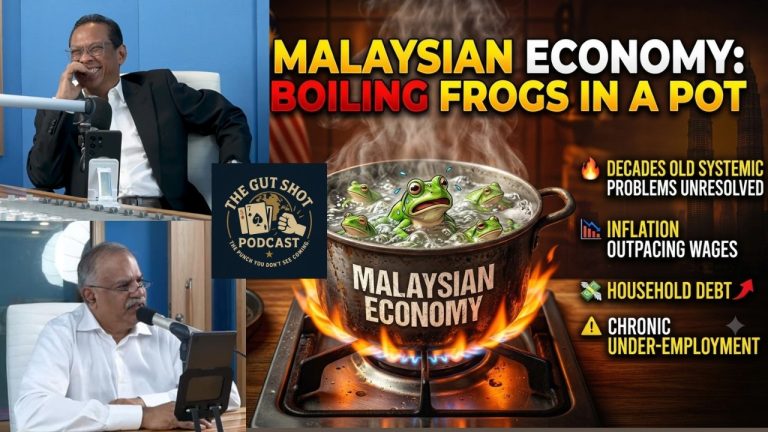
Malaysian Economy – Boiling Frogs in a Pot
Show Notes & Description
We look at the mirage of the 5.4% GDP growth for Q1 2026, unemployment at 2.9%and a headline inflation of 1.4% – 2%, and we go .. whoaa.. stop there. These rosy propaganda masks the truth they won't tell you.
We peel the onion for you to reveal the numbers and facts underneath that will make you cry, of an already structurally diminishing economy no one seemed to know or care to fix. CPI out-pacing wages for years (2019-2024 data accumulation headline CPI at + 9.3% out pacing nominal wages per worker at + 7.2% i.e. a net CPI outpacing wages of 2.1% shows real structural problem in the real economy), real unemployment and under-employment and a domestic household debt-burden higher than Indonesia.
We elobarate you with stories and anecdotes that makes these data human, show you eye-opening point of views no one seems to be willing to confront.
We need a new kind of political leadership. The kind that understands real commerce, structural reforms to society in education and economy.
Yes. We Have A Country to Save
Jump to chapter 8 chapters
- 0:00 The Disconnect Between Politics and Economic Reality
- 2:14 Debunking Rosy GDP and Inflation Numbers
- 4:27 The Data Center Mirage and Missing Multipliers
- 14:50 Stagnant Wages, Foreign Labor, and Policy Failure
- 32:08 Underemployment and the Gig Economy Trap
- 37:45 Household Debt Burden and National Car Protectionism
- 44:42 Distortions in Domestic Trade and Oligopolies
- 49:35 Banking Consolidation and the Proliferation of Ah Longs
Auto-generated from YouTube captions. Timestamps link to the video.
But, you see, the bottom line is, why do you have to do this? Right. So, I want to tell these politicians and people, uh this is the season, uh musim in Malay, musim, uh musim kalah pilihan raya, you know? Since 2018, these people are they they're losing elections, uh and you can rest assured that the next elections, the government is going to go to it's going to change, yeah? It's not going to last. Uh because the people find that it is increasingly difficult to get funding, financing, to get loans and this and that. And the SMEs, which you mentioned, SMEs are having a
particularly tough time, uh. They it's difficult for them to raise funds to expand their businesses. So, bottom line is, uh they don't vote for the whatever ruling government of the day, uh these these problems have been persisting for decades, not just this year or last year, uh and uh the bottom line is, the people are tired and they're not going to be voting for a government or any party or coalition party which cannot change the situation. So, I want to ask these politicians and all these people, who exactly are you working for?
Mhm. Mhm. Do you just want to last one term or less than one term and then get kicked out? Because that's what's going to happen. Uh you're not making things easier for the people. Welcome to The Guts Show Podcast. I'm Shamsul Sam, your host, and here with me today, again, is our partner, Syed Akbar Ali.
Good morning. Uh this this uh on the on the episode today, we are going to be deep diving on the Malaysian economy. Uh and I think that you're going to stay on till the very end because we're going to run through the data and explain and uh decouple uh all the structural reality from the mirage of all the rosy macroeconomic indicators that has been presented to us as Malaysians. Okay? Now, official data present Malaysia's economy as a picture of resilience. If you look at the headline, they celebrate a seemingly robust GDP growth of 5.4% in the first quarter of 2026.
Unemployment rate sits at a decade low 2.9% and a headline inflation rate seemingly contained of around 1.4 to 2%. The aggregate tax statistics actually, here's the funny thing, it masks severe underlying systemic vulnerabilities. In reality, the domestic economy is hollowed out by stagnant real wages, a massive overhang of unproductive household debt,
acute underemployment, and the structural erosion of the ringgit. The rosy macroeconomic indicators are an analytical mirage. They track corporate capital expenditure, such as power foreign direct investment into AI centers rather than actual purchasing power and financial viability of the house household of Malaysians. Now, say Let's Let's Let's Let's tear this apart and see one by one, all right? And I hope those who have not yet be subscribers to this channel, actually please subscribe and if you like what we're going to say, please like it so that you get all our episodes as it drops. Now,
the first thing I want to go through is actually the illusion of the GDP versus what is the actual aggregate in terms of our growth asymmetry. Government, you know, heavily emphasize nominal GDP growth. Yet, when we evaluate composition of the growth, there's a very sharp imbalance. Okay? Now, let's talk about just quick one, yeah? Capital versus labor. All right? A large portion of the current growth is driven by high capital intensive, low low low labor absorbing sectors. I'll give a very big example. Okay? This is a massive investment in artificial intelligence technology, data and data
center, which inflate the fixed investment metric. About 9.3% in the recent quarter alone. And the headline GDP, however, require minimal local labor and post-construction labor itself. They do not trigger a broad wealth multiplier across domestic economy. So, basically, what we are looking at is uh money coming in, okay? Uh whether it is from China or any other uh places. But, when you talk about these data centers, what people don't understand I don't want to I don't want to poopoo down these data centers, but it's a good investment. However, here it is.
The construction itself doesn't require that many people. And most of it, like say, if you got investment coming from China, they're going to import the uh uh the the professional workers. There's a a substantial investment on data centers.
But, the value the financial value is large. It's huge, but but the nature of these data centers, uh um you build this uh uh there's one just being completed right near my house in near near Bangi, but I think that one's across the border in Nilai, I'm not sure. But, uh it's almost done. The building is uh it's a factory building is huge and it's larger and you know they have to make these buildings extra strong the foundation to avoid the vibration.
Right. But the the bulk of the investment goes into the computer Yeah. equipment and the memory capacity they're going to install inside these buildings. Like the data center is basically off off storage site. It's just a data storage site.
Yeah. Yeah. That's it, you know. So the money is in all the computerized equipment and the storage data storage banks they're going to put inside there. So And that box, eh? Mostly are imported items.
Yeah, yeah. going to So you're going to the money come in and then it's going to be paying out to the outside later on. And I have a friend who is in the you know the human resource business and he is doing business with some of the data centers on head hunting.
Mhm. So only the lower level technical staff they ask to get you know local staff. All the senior guys all and then there's not many of them anyway. Uh you know they they they have their own expatriates who come in. Uh
Right. So after that there's really not much to do in a data center. There's very few moving parts. It's all computerized. So you just need a guy with a laptop to check you know to do these systems checks and all that and that's how they run the place. So billions each data center costs billions some of them maybe tens of billions on our ringgit. But the amount of staffing is I mean if you build a steel steel plant for let's say about three or four billion ringgit you probably have a few hundred workers or more than that. You see.
The whole spectrum of workers highly skilled engineers right down to the technicians and the laborers but here the number of workers is not as consonant with the amount of the investment because you don't need as many people. So and the senior staff for the time being I think they'll be bringing in staff from outside.
So the the multiplier effect into the local economy yet to be seen. The ones who will benefit the most in my view local local people players who will benefit the most are the our power utility and water because they use both in huge quantities. What 500 I don't know the numbers. It's quite quite a few tens of 50 or something ultimately will have data centers in the country. I think the profitability of our power utility is going to skyrocket over the next few years. So they will benefit. But and of course water if water is supplied by local authority then they will benefit because the
amount of water use usage is also very high. Yeah, it's a GLC oligopoly. But as far as tickle down effect a multiplier effect into the data economy supply chain all that what supply chain is there in a data center? It's into the local economy. And that's also with labor. I agree. And this is what we want to tell our audience. Okay, we we it's not that we want to rip the government every time we are on this episode. But let me just finish the point. But let's say a foreign investor puts in 5 billion ringgit to set up a data center. That 5 billion goes straight into the calculation of the GDP.
Yes. Exactly. It's just that and not just that that 5 billion or the aggregate billions that goes into the GDP not just the GDP but that is the source of mainly what we are saying the source of why our ringgit has strengthened against the US dollar for example. All right. So, it is very artificial in what we see. Um there is no structural change as far as our basic fundamental economy that drives the nation labor market, that drives the Malaysian supply chain, that drives structurally what is going to propel our economy either in the medium or long term.
It's not going to make a any dent on the 3 million people in the gig economy, uh exactly. It's not that, you know, it's not that because you got all this investment coming in. Therefore, the gig economy will become reduced. The gig economy is basically part-time, uh. You cannot find permanent jobs because there are none available.
Yeah. But, with all these billions coming in data centers, it's not going to affect the gig economy much. So, unless they deliver food to the data center. Well, that's going to be for 15 people, maybe. So, anyway, I mean, that's the first thing we want to point out. And and as I said just now, just to repeat myself, is that it is not the purpose of this uh uh channel to actually keep just bashing uh the government or anybody else for that matter. Uh our job on this uh podcast is actually, yeah, myself and Said, we we take issues and actually we want people to be able to to think and understand
slightly actually deeper than what the shallow things that you are being told uh in either uh the propaganda within the media and whatnot. So, that you understand why when we keep telling people and putting red flags, "Look, our economy is actually a mess." And if you look at this number, for example, the GDP growth that we see, and also the people keep people keep saying about the the the the the ringgit uh increase. It's actually quite small, you know.
I like the I like the people to understand our viewers to understand, yeah. Yeah. Uh how the GDP grows and where it grows, what are the growth sectors in the GDP, yeah. It's not for the government to decide. This is not something that civil servant decides or the the ministers and politicians decide. Uh the problem in our country is that we have this should be decided by the market. By the business people, the people who are involved in business industry, they should decide whether they want to set up a bakery or they want to set up a data center or they
want to open up a steel mill. The market should decide. The the job of government is facilitator. Yeah. Not not to be an obstacle to anybody. But when the government starts getting involved in deciding how the economy should grow and where the growth should come from, ultimately you're you're talking about using taxpayers' funds, but more importantly, yeah, you are you are the function of the market, market discipline, market dynamics, which is self-regulating, self-sustaining. You are you are removing that and putting that very important responsibility in the hands of politicians,
the ministers and the civil servants to make decisions which which should be left to the market. So when when you do that, which is what we've been doing in our country for some time, we have these problems now. Yeah. So this is I think it all falls back to you to all the fundamental issues we've been talking before in previous episodes. What we What we're doing today is actually unmask to you the the layers of the onion so that you understand that actually the core, once you peel the first layer, what you have is actually structurally empty.
The exports is plus 3.9%. Okay? But the what they forgot to mention the growth in the in the export in the in the imports itself is at a faster rate.
It's higher. It's at 7.9%. Yeah. Right? So, the signals actually you you focus on one, but actually you're I mean you score three goals, but the other fellow is scoring six six to seven goals against you.
So, our our export efficiency is slowing down. It's it's not an export ex- Whereas our import uh We are importing more. Import efficiency Correct. So, the the net effect actually okay, we we need more from outside.
Because overall we are less efficient la. We're less productive la. We are less That's the right word. If you We're less productive you export your surplus you produce more you can export. So, if your exports are decreasing it means that you are producing less than three your imports. You're importing more or less efficient la.
So, I mean this is the other factor within the GDP that you peel the layer you know you find out oops, okay, we are just trying to point out this first. We will tell we will we will tell you and repeat to you what we have been saying in previous episodes why this happened in our country.
This what you mentioned just now about wages, you know, the wage wage growth is it's a major indicator when something is not right. Okay, there's growth in the economy the GDP is growing by what 5% or whatever and all that, but wage growth does not seem to be keeping up.
Keeping up, yes. And then you have again you have government intervention civil servants policy makers politicians they come in and wave the magic wand wand and then they decree minimum wage shall be so much know. They just pass a decree and by magic the average wage in the country goes up by the minimum wage. But is it really tied to productivity in the market? Because when you when you in keep increasing the the minimum wage, most certainly it pushes up inflation. You know, the CPI will go up. But the thing is if there's no minimum wage, uh uh uh what is the real wage in the economy?
So it doesn't keep up with the other other figures that we have that I that export figures increasing every year, GDP increasing and all that. But the wage growth is like seems to be stuck. Now I see a few reasons why this is happening. One of them is because a lack of competition in the economy. One, stifled by various policies. It's all follow the government or the governments, let's not pinpoint any one particular government.
when you talk about for decades. Cuz you talked about it before. Like what what you say, it's the it's the it's what the government does in terms of creating policies and environment for the economy. failure policy over the last decades, not just anyone government, all the governments. A failure policy. Uh so the income growth of the people, stagnation in wages, because value added is less. Value added is less, productivity is less because the way the economy is structured. GLCs, monopolies, oligopolies, license permits for everything, uh excessive restrictions, import duties
on certain imported things, like cars for example. And then a huge number of foreign workers in the country. People don't realize that people everybody thinks that oh yeah, we need the foreign workers. Yeah, okay, you may need them, but what this what are there about two three million foreign workers in the country? They are at basic minimum wages and they um They don't We don't The market doesn't incur as much expenses to employ foreign workers as a domestic worker. But what it means is that they are displacing 3 million Malaysians. And they are suppressing the wages.
Yeah. Plus they work long hours and of course they don't have as much freedom or rights as the Malaysian worker. Many of them don't have They don't have EPF and all that, you see. So but they are here.
Yeah. So they are here, they are available, they are willing to work and they push down wages. Right. 3 million people It doesn't matter if they are all road sweepers. 3 million people sweeping the road at the same time at minimum wage or below, they're going to pull down the wages in the country. Definitely. Most absolutely. Yeah.
Yes. Because even the the the road sweeper, for every three or four or five road sweeper, you need one supervisor. Supervisors will have higher pay, isn't it? Oh, you see here goes our silly. But if the supervisor is also a foreign fella
Ah, yeah. If the wages will come down. No, I mean the thing is this. I think if just taking that example if our people own people actually are hired as janitors and whatnot, all right? Uh because they are not artificially put into into a certification where they got a higher degree the a higher certification.
No, the janitors in Japan are Japanese. Yeah. The laborers in Italy, I've seen with my own eyes the the the roadside laborers who fix the road, they're Italians. Correct. You see? So there is the thing. Why does it not happen in Malaysia, right? That's the thing. Because the guys who become janitors can later become supervisors. And then the later supervisors can become managers.
But regardless, the presence of 3 million or more of these workers, foreign workers in the country of absolute certainty suppresses wages in the country. Right. You know, a burn household right now, because we are actually at what we don't realize, the country is now 70% urban. Or approximately so. It is what weighted more urban than rural. Okay. We are basically a service and industrial nation. The wage growth uh is only 2.1%. It outpaces wages to 3 2.1 Wait. 2.1% between 2019 and 2024, this is the accumulation. Headlines is CPI is 9.3%.
The headline CPI Yeah. Headline CPI 9.3% since 2019 to 2024. Just taking the 2024 up to that figure that we have that I have made to research, you know, and it outpaced wages, which is only by 2.1. That That That is by 2.1% only. Just like what you say. That's the wages Does it Does it
The growth in the CPI is surged by 9.3, while wages grew by by 7.2. Okay, so you minus that. Yeah. Yeah. Okay, yeah. So So your nominal wages per worker, right? Uh they they they're looking at about what? 7.2%. That's it.
Mhm. The incremental is very little. Yeah. So your uh bunny uh your you know, or your structural wage wage wage compression, not just because of all these things that we are talking about. Import of foreign worker, oligopolies, monopolies, you know, they doesn't drive the private sector to actually drive the economy to make it higher.
You know, the recently the the factory in Malacca, which was came out in the media, you know, it's a German company. They were They wanted to hire workers. They need they want to hire about 450 workers electronics. Uh And the queue was about 1 or 2 km long. Few thousand people turned up to
Fight three. To apply for 450 jobs, you know. Such a long queue. People are looking for work. They cannot find work. But this factory, it was it was attractive to them because the salary was 3,500 ringgit. And many of the people who came to look for the job, they came started queuing up from very early in the morning. Uh they had cars. They drove cars and they had motorbike and all that. But some of them drove for cars. Uh So, meaning that these people they are uh not exactly desperate. They are looking for higher paying job. Higher paying income. And a lot of them
are qualified. They were even they were even diplomas and degree holders. Because it is it is for in Melaka for Melaka 3,500 ringgit salary a month considered, you know, is something that people reasonable. They Well, people a lot of people queued up to try to get this job. Uh My question is uh What about the SPM people? I don't think there were many SPM holders who can compete with all the others who came in their cars and motorbikes and then to try to get a job in with this German company for 3,500 salary. So, this is the thing. You you find a situation now where even graduates and
diploma holders are interviewing for factory jobs, you know. So, the the regular SPM holders and those who may not even have SPM, they will miss out. They will fall through the cracks because they will not be able to compete with diploma degree holders who are going for factory jobs.
Hm. Yeah, here's the funny thing. I think that goes where we've been saying before. And I think what you just said, um, make me think about one thing. Why are these people able to afford cars? And why are they, uh, or or or other kind of transportation like you, you know, for actually a base, uh, pretty a baseline work, so to speak. Um, what it tells me is that they are generation of fathers, people like us or, you know, 10 years younger than Um, we had actually boosted the economy during our generational, uh, uh, pretty our generation. So, we could afford their parents could afford
to buy them cars. They live with their parents, okay? And they actually, uh, you compared to during our time, when we graduated or we whatever, whether we all my friends who either finish SPM or graduate from, uh, uh, diploma or university, we can't afford cars. Okay, we take buses and we, you know, we walk or we cycle or we, you know, our parents can't buy us even motorcycles.
Right? So, so we actually are forced out to take this, I mean, lower wages jobs, no matter how low it is, and then we work ourselves out. So, what we have what we are seeing is actually the el- elder generation is subsidizing the the life of the youth. And then, once the parents' generation are gone or when they
Ponzi the Ponzi scheme will stop, lah. Yeah, the Ponzi scheme The money runs out. Correct. So, this is what we keep saying why our economy is an has got structural problems.
I uh, I also see that, you know, that this minimum wage policy is also messing up the situation cuz now nowadays we have a sizable number of our young people who go for tertiary qualification. Minimum certificates, diplomas, and degrees, huh? And minimum wage now is 1,007, you know? So, and when jobs are not as many or scarce, they are not as available entry-level graduates, degree holders, diploma holders, when they are vying to get their first job, you know, they the basic minimum wage looks attractive to them, especially outside major urban centers, like Melaka for example,
where your cost of living maybe will be should be less than than let's say Kuala Lumpur or Klang Valley. So, they don't mind starting up at the minimum wage level. But they have certificates, they have diplomas, they have degrees. So, again, the question is what happens to the SPM holders, you see? They get pushed out. So, we are causing this kind of uh distortions in the labor market because of our minimum wage policy. Okay, you cannot abolish the minimum wage policy now, it's there, but we simply have to grow the economy. There's there's no other way. Yeah. Our
entire conversation today can be summed up, you know, in just one thing. We really have to grow the economy. have to fundamentally actually structure and have systems and and and processes and actually policies that uh encourage growth of the economy.
let the economy grow by ourselves. This is what the our policy makers and also I hope our voters will understand. You cannot have the government coming in, oh, we're going to encourage the growth of this sector of the economy, that sector. You don't talk like that. That's a wrong thing to do. That is dangerous.
Yes. one is what creates unemployment 15-20 years down the road. Because you you you're doing this magic wand kind of thing by waving the magic wand. I want to grow this sector of the economy. You cannot. We the government merely facilitates. Get out of the way, remove all those obstacles, and create uh facilitate uh proper situation, good uh economic situation in the country, conditions in the country whereby businessmen and the economy and people on them entrepreneurs on their own will set up new industries, new businesses. They will be able to determine what are
the opportunities in this country in the economy, and then they will take it from there. So, that is the best way to create employment in in the country. Not by the government sitting with some civil servants and uh you know, doing some PowerPoint projection and say, "Oh, we're going to develop this sector or that sector." That one I think maybe 50 years ago when you were really third world economy economy, maybe you could do that. But not now. We are quite advanced.
Let's let's let's let's think of it this way. I think whilst uh I said just now that the the delta between the aggregate uh increase in the uh in the headline CPI versus the nominal wage worker uh is about 2% plus, but which is already, you know, a problem when you keep on going at that scale where the wages does not keep up with the cost of living. Okay, this is what we we we we're talking about. But you know what it reminded me, wise, when you talk about minimum wage at 3,200?
2007 Huh? 2007 2007 Do you know uh my starting salary when I was uh in my second job when uh I joined Shell in 1988? 8 My salary was plus basic salary plus allowance was around if I'm not mistaken not more than 3,400 ringgit. For a graduate of a chemical engineering degree. So, think about that ladies and gentlemen. That is like for almost 40 years ago. So, something is wrong in the structure of our economy when I'm looking for one of the highest paying uh multinational
Entry level engineers now in the private sector is I think it's less than 3,000. There you go. It's about there. It's not very high. So, after 40 years After 40 years. After 40 years, okay, our our our salaries actually has stagnated for the last how many decades?
Yeah. And here we have to we have to comment on another thing lah. The government sector, government civil service as well as the GLCs lah. Now, their salaries are different. They are I would say comparatively quite good salaries lah. GLCs and even in the civil service which doesn't reflect the growth of salaries in the private sector. And we must bear in mind I The private sector is a real economy lah. Because they compete they compete in the open market.
that can I say something? The private sector pays for the civil sectors economy civil sectors But more importantly they they compete and they have to compete in the open market. They they they are real they are the what the tip of the spear. They have to bear all the cost in the economy. They have to be as efficient as possible. So, the private sector is real. The government civil service the GLCs all by decree magic one lah. huh? Like suddenly they decide that we're going to give an extra bonus to civil servants, you know?
And then give them 2 days work from home. So, all these are magic one. Yeah. This is not real economic decision-making or not not really economic behavior. This is magic one behavior. As you say the 2 weeks stay at the 2 days work from the home, 3 days go to the office. This is all This is magic one management of the economy. You cannot go to a steel mill or private sector and say, "Hey Samsul, you are the engineer in charge of production. Never mind, 2 days you work from your home."
This is the steel mill is boiling over. Call what you call your your bid for votes. For votes for the civil service. You know, or you're in a chicken farm you're managing 100,000 chickens collecting the eggs and then the boss is never mind, you can work from home for 2 days a week.
Let's do that. Yeah, the chickens don't stop laying eggs, you know? So, this is what's happening in the in the government sector and the GLCs which does not capture reality in the economy. Well, here so that goes down to um uh the superficial full employment. Okay? Guys, um the government gives out the stats that the unemployment rate is about 2.9%. Okay? Um and that basically qualifies it says, "Hey, we are at full employment." Ta-da!
It doesn't It doesn't include the 3 million gig economy. Not just that, okay? Let's Let's Let's look at the uh at the formal unemployment at 2.9%. They always look at the underemployment because the underemployment is is where the structure comes in and that includes the gig economy, okay? Um and that is considered full employment, you know? All right? Now, uh but there is when you add in the underemployment, you are looking at almost 30 plus 35% plus. People who are actually employed below their level of supposedly capability or certification.
This is This is not just fudging the figures, but obs- obfuscating the the lines the lines, yeah. The what is what is the meaning of full employment? What is the meaning of unemployed? You know, like unemployed is a person who is actively looking for a job or something and he cannot find a job. All these arguments come in, but as you said at the gig economy,
the first thing is it doesn't have fixed working hours. If you don't have fixed working hours, do you How do you consider that full full employment or or employment? And then you don't have You don't You don't not know if you're going to be working tomorrow gig economy, yeah. So, your numbers your your working hours are not fixed. You do not know how many days in a week you're going to work. Also, you see.
Yeah. So, but the three over million people in that in that sector of the economy, they are I mean, what How do they treat them? They are part of the full employment figure? I don't know. They are treated as full employment. So, you see, if you ask me, those people are unemployed.
Yeah. I agree with you 100%. Those people are unemployed. So, out of that So, basically, you think about the our total labor force is 17 million 17 17 17.2 million people. Okay, take out what civil service 1.
700, something. 1.7 million and all that, right? So, you end up maybe about Oh my god. Okay, so structurally structurally, you know, we've got we've got 35% of underemployed people. And we What we What we are talking about uh is um is that these people uh are actually mostly mostly hold tertiary degree, you know. And they are trapped in low-skill, low-paying administrative jobs in the uh in uh in types of their work and also in the food industry. So so I I was just just to give an anecdote, okay? I met up this lady who was actually uh managing a counter at a
fast-food chain that was just that was just open, okay? And I just struck up a conversation with her. She was a chemical engineer by grade by degree. She is in the She was taking my order.
You You're a chemical engineer? I'm a chemical engineer. Do you all smell alike? I mean, how do you know she was a chemical engineer? She told me. Okay, okay. And she She was She was She was even She was above 25 years old. Right? So he Here's the thing. I mean, I know it's one anecdote, but it's just random, right? Okay? And when I talk to like say when I'm in the uh in a Grab, I will always ask the Grab driver, "Okay, uh do you do this full-time?" Most of them they said they are their second job. You know? That's Grab. That's not um the food delivery people or the
dispatch delivery people. Those are not second jobs, you know. Those are full-time. They are actually full-time doing part-time job. I was in uh Tapah uh on my way to Cameron about about 10 days back, yeah.
Right. And uh I think at the traffic light I saw one food delivery guy. Okay. And not the the hundreds and thousands you have in in uh KL, yeah. So in uh Klang Valley, yeah. Meaning that this uh gig economy, yeah? It's a Klang Valley uh phenomenon. And major urban centers
Major urban centers in Penang, Johor. Kuala But when you go outside these places, huh? Uh there is gig economy, but very few. Because uh how many people order food, you know, in small towns like Tapah or whatever?
But but here's here's the problem that we are facing today talking about the structure. Our nation has actually already shifted to an industrial economy, which means that actually from agrarian to actually uh padi uh trading and and and and structure and industrial economy, which means that basically these towns are where the bulk of our people are living. Even when we talk about Kuching or even KK.
Bulk of Malaysians live in the states. Yeah. So They don't live in the Klang Valley, yeah? So is is uh it's it's something that is very concerning that the uh the the the employment in terms of the industrial itself uh are not spread out in the country.
So we need to go and see what's happening in Lahad Datu, in Baling in Kedah, or in Dungun in Kuala Terengganu, you know? Uh we need to go and see all these little towns and far away places and see what's happening with the with the employment of people there.
Okay. I mean okay. Then shall we move to uh another sub topic, which is involved which when we look at uh we look at uh padi the economic situation in the country. Let's look at household debt versus the GDP. Okay? Now Malaysia, we have a household debt to GDP ratio, actually one of the highest in the uh in in in in in in Asia, you know? You know, we we are um the debt to uh GDP ratio, guess how many percent? 85%
85% Yeah, 84. 84.7% round it up lah to about you know 84 85% okay. Then you know it is even higher than than Indonesia. Household debt
So the this is a major another major issue because household debt and I think it largely is credit card debt lah. Huh? You know how many percent? 15% is credit card debt.
15 and then your car car loans and housing loans lah. Yep. So and then you have people who cannot borrow money from all these formal sources they also borrow money from the ah longs huh. So again this this is this is this reflects on the distortions in our economy yeah. Car loans a significant chunk of anyone's monthly income goes towards their car paying the monthly installment maintenance
have always complained about our cost of all these motor vehicles and then they pay tolls. So your cost of living cost of existing lah. Without a car you cannot survive in Malaysia. So the cost of maintaining a car is very high it drains your wealth. It makes you poorer.
say do you know how many how many percent is the household debt percentage of that 85% is actually tied to property and cars. Now we know that property maybe you have a slight inflation slight asset appreciation sometimes but actually in a in a in an economy that is structurally damaged actually what we are seeing is property prices coming down. Okay? So your investment is coming down. But the worst thing is actually motor vehicle uh which depreciates. And both these uh component uh of household debt is 75%. Imagine that.
2/3 more than 2/3. I feel a couple of things can be done to help reduce this amount of debt in the country. The first thing is, which we have discussed in this podcast so many times, we are paying too high prices for our cars simply because the government refuses to give up this insane policy of these high protectionist barriers to protect our domestic car industry. Uh at some point in time uh if they're not efficient, you have to cut the umbilical cord and tell them you have to compete because 34 million Malaysians are being impoverished basically. Yeah, we are
paying more for for cars and motor vehicles because of all these protectionist barriers to help the domestic car industry. And there's not many players. There's only two major ones and both are foreign owned. They're not They're not really Malaysian owned. Uh one is you know, almost the technologies are all from foreign owned. So, I don't know I don't understand this idea of this national car, this obsession with national car identity. We know that it's not it's it's comes from outside the country. Yeah, everybody knows that. But, by maintaining all these protectionist barriers, high import
duties on imported vehicles, high taxes, tax duties, uh and then other other non-tariff barriers are the APs and stuff like that, you know. So, it it increases the price of motor vehicles and people end up paying more monthly monthly uh car housing loan. So, that is on the product side, now. Then you have on the financing side. You know, they had this I think they still have this in 9-year car loan, 9-year car loan. You can get a higher purchase to buy a car for 9 years. This is the worst thing that has been hoisted upon many car buyers. Many people have had
problems and been declared, you know, bankrupt and had their names list blacklisted in the CTOS and all that huh, because of they cannot pay their car loans. Because they find out that a car after 5 years huh, it you know, most well, the average car you may have issues or you want to sell it and buy another car, you know. But people who take 9-year car loans, they find out that after 5 years huh, the amount remaining on their loan still remaining on their loan is much higher than the second-hand value of the car.
Yeah. So, if you want to sell the car, you have to pay off the loan, you must top up. Bro, especially with the way the car industry is today, uh compared to let's say about uh 50 or maybe 20 years ago, actually uh the turnaround of new car uh models uh is less than 4 years. It's probably around 2 years that you got new car models, which means that second-hand value, especially in the EV sector, the minute you buy it, it's obsolete.
Okay. So, so a lot of people get caught in this 9-year car loan huh. Uh I think the Central Bank should do something about it huh, but I I do not know if they will because maybe it's another another one of those political decisions huh. Said, um let's look at this in in in in this point of view. Uh in terms of uh the consumption uh of our all the the the the domestic GDP, uh and uh that is uh the the domestic portion of our GDP, okay? I think structurally there's a there's a problem. Maybe you can elaborate on that part.
You see uh our we are a major exporting nation. We are a major trading power, you know, in the world. We are in the top 20 always as a trading nation. So, we have a strong external trade that helps us, all right? Our external trade is about I'm looking at some This is not the latest figures. I was in excess of 2.8 trillion. Now, maybe now it should be up should be up better by this year. I have this figure of 2.8 trillion of 2024 or 2025 or something like that. Of which exports is over 1.5 trillion and the imports 1.3 trillion 1.4 trillion. That's That's a lot of imports and
exports. External External trade sector is strong. It shows that we are productive. Then you have domestic trade. Domestic trade is consists of This is from Department of Statistics wholesale trade, retail trade, and motor vehicles. Wholesale is about 800 billion. This is 2024 or 2025. Yeah, it's not latest. Retail is about 700 over billion and motor vehicles is about 240 billion. Total is 1.7 1.8 trillion domestic trade. This is where the inefficient in But this is where all the inefficiencies are. The export trade You don't have subsidies in export business.
You cannot go to Japan and you know, and there's no monopolies or you have to compete at the world market. You want to sell your You manufacture furniture, you want to export it to Japan, Europe, whatever. It has to be at world market prices. You have to be competitive. So, efficiencies are there. That's what helps our economy. And that's where it helps the ringgit. Although ringgit has weakened, but it still helps our ringgit. The domestic trade is where all the screw-ups are because of excessive government intervention and ridiculous policies. So, this total domestic trade 1.8 trillion
where motor vehicles, for example, is about 240 billion where people are paying 9-year car loans. We are paying for imported vehicles and we are paying two, three times the world market price because of government intervention, high import taxes and duties, wholesale trade, monopolies in the in the economy, rice monopolies. You want to import so many things is restricted or they are you know, various oligopolies and and monopolies. The it it's all distorted. So, the the domestic trade portion is highly distorted because of ridiculous policies and basically
careless government intervention in the market, unnecessarily often driven by politics and political patronage. The the two cousins, huh?
The two bad boys, huh? So, so we are fortunate because of our history and our development over the last decades, our and our our historical uh you know, the the acumen and the business enterprise that we have in the country for decades, that our external trade, external import-exports are strong. That's what gives us some strength in in our ringgit, huh? Because if you look at domestic trade, it is screwed up.
Well, I mean, I mean, terms of in terms of I I've said it again and maybe I should I should uh remind people because the government keeps saying one of the bright factors, one of the bright spots is actually they they they up and they crow that actually the ringgit has strengthened and all that. But, you know what? Here's here's a here's a reality check. Uh in 1997 or 1998 when the currency exchange crisis happened globally, okay? The Mahathir administration actually pegged the currency at 3.8. That was '97, '98, okay? So, that's 3.8 today against the dollar. Today, we are at about four
plus against the dollar. So, so cumulatively over the decade, we have not improved, if you ask me. You are at the lowest point when you've got a currency crisis. So, today, if you look at it, even when you compare to Singapore, actually, we were trending down but trending to about 3.2, 3.25. Today, maybe is 3.15. All of this fluctuation of minor downward trend, so to speak, is all driven by what we saw what what I said at the earlier part of this episode, which is the data centers investment that are coming in, which will later on go out to pay out for this
that I will see that the trend later, okay? And there's no structural change to the economy. So, that's how I look at it. And we talk about the the domestic business inefficiencies, right? Okay, can you imagine if we let it be regulated and no control over the pricing of all the the cost, you know, we would be far ahead of Korea, but instead today, our people are paying more.
We are stuck. We are we are we are making our people poorer. Yeah. And then you see, we cannot export because we are not competitive. And then let's not We have to We have to talk a little bit about banking. Yeah. It's an oligopoly. Right. So, now it comes to the private sector boosting the private sector.
Your previous guest, Professor Terence, yeah, Yeah. he talked about the banking consolidation. He said that they from over 50 banks, they reduced it to 10. The original idea was to take it down to to six banks. Can you imagine a country of 34 million people, you want to have only six banks, you know.
So this one was decided by who? Eeny, meeny, miny, moe, Tweedle what? Tweedle Dee and Tweedle and Tweedle Dum. That's who decided it. So you see now there's a cost. No, there's a cost. When you reduce the this so-called banking consolidation and you and you remove the entire financial services industry no more and you replace by these few, they call it anchor banks or whatever, there is less choice for the consumer, for 34 million Malaysians, to go and get financial resources, funding for whatever that they want to do in their lives. Buy a car, buy a house, start a
business, start a factory, whatever, the choices are restricted. As a result of which now today, which we have mentioned many times, the ah long industry is at its peak in Malaysia. The ah longs are raking in billions and they're charging the Malaysian people, I don't know, 15, 20, 25% per annum and making people poor, driving people into bankruptcy, because we have this ridiculous ridiculous banking consolidation in this country which is not in any economics textbook. It is purely it it started as a political play. I know some of the thinking that went behind this at that time because at
that time I was You're still with the banks? Not only with the banks, I was with the ruling ruling government ruling party at the time, very friendly with them, so I knew what they were they were talking. They wanted to control the banking and financial system. And the accident the ketuanan policies, they wanted to control at tremendous cost to the to the to the country, to the economy. Today so many people are indebted to the ah longs because they cannot get bank funding, bank financing. The ah longs are here to stay. The ah longs now are major financiers.
And they are impoverishing the people. So we just shackle ourselves. Not just impoverishing the people through wage stagnation, through private sector not being able to grow as such and the SMEs which require this financing if we got more banks.
And the loans don't pay taxes because they're they're illegal. There you go. So the government loses tax revenue. The loans drain the people at 25% 20% interest per year and make people poor. So who gains? Dude, I want to ask the the the government and the politicians who are you trying to help?
Let me Let me Let me tell you what they're looking at actually. Number one, that they control who they're going to send they're going to give them the the the the billion dollar loan or the hundreds of million dollar loan. That's number one. Okay. So guess who knows who. Second, what you see is actually today most of the banks are owned by the financial institutions. The GLCs. Yeah.
So you're looking at, you know, all the major banks. Even the ones that used to be owned like Public Bank and I think what's the other bank? Public and and maybe Hong Leong and all that the Chinese banks. That used to be Chinese owned bank, right? They're supposed to actually reduce their share their the the personal shareholding okay or private shareholding personal shareholding cannot be If I'm not mistaken, it cannot be more than 10%. So they have to reduce it and who can buy all this? Only the GLC can buy. And then what does the GLC have to do? Partly what what
they have to do when you have companies that are not delivering Well, if I may You have to bail out. Shareholding in banks they have they have those percentages. I don't know whether 10 20 whatever. But this chunky shareholdings in banks are subject to approval. Yeah. Yes, the other thing subject to approval. You cannot just you what investment manager to go and buy up 20% of Maybank or 10%. As you need approvals. So, that's how they control it. But you see, the bottom line is why do you have to do this?
Right. So, I want to tell these politicians and people, this is the season and musim in Malay musim. Musim kalah pilihan raya, you know. Since 2018, these people are they they're losing elections and you can rest assured that the next elections, the government is going to go to is going to change, yeah. It's not going to last. Uh because the people find that it is increasingly difficult to get funding, financing, to get loans and this and that. And the SMEs, which you mentioned, SMEs are having a particularly tough time. They it's difficult for them to raise
funds to expand their businesses. So, bottom line is they don't vote for the whatever ruling government of the day. This this follows have been persisting for decades, not just this year or last year. Uh and the bottom line is the people are tired and they're not going to be voting for a government or any government or any party or coalition party which cannot change the situation. So, I want to ask these politicians and all these people, who exactly are you working for?
Mhm. Mhm. Do you just want to last one term or less than one term and get kicked out? Because that's what's going to happen. Uh you're not making things easier for the people. Well, um I just do a quick check. Do you know how many how many banks Singapore has?
A few hundred, I think. Huh? At least 150 commercial banks. Yeah. Singapore. Yeah. Um For a nation of 5 million people, five or six million people. I used to actually when I was still running public companies, um most of my banking was coming from Singapore because they were so innovative in terms of their banking instruments. Uh That they really the bulk of my banking was actually foreign banks.
They had this idea, you know, about 25 years back. We'll become a financial hub for Asia, Islamic banking financial hub for this part of the world, huh? With what? With 10 banks? You see, in Singapore, you mentioned 150 banks. Okay. This is how it works, huh? For 150 banks, you will need 150 CEOs, right? You will need more than double, triple the number of senior managers in these banks. You'll have hundreds You'll have hundreds of board members, you know, board of directors. This is the your financial ecosystem, the financial What do you call this? Your technical skills, huh?
Your your human capital, huh? A very highly high highly skilled, high value-added human capital in in the financial services industry, yeah. So, 150 banks in Singapore would have thousands of senior professionals, CEOs, chairman of the of the bank, directors, and all that, yeah. So, from there, you will have spin-offs, huh? One of the CEOs might set up his own bank, might set up a new some financial institution, or become a stockbroker, investment banker, whatever. That's how things grow.
Yeah. So, they become a financial hub. Yeah. So, here you you have what? 10 anchor banks. And from the 10, you're going to create a financial hub? Yeah. Because And then you have And then you create their own so-called Islamic banking branch or whatever.
You you need You need human beings. Yeah. You need thousands of financial professionals in your banking ecosystem to become a financial hub. Or any kind of hub, for that matter, huh? So, these people are they just bonkers? These policies were decided more than 20 years ago, huh? The banking consolidation took place in the early 2000. But sadly, under Dr. Mahathir, sadly, all those policies are still persisting.
This They've been in the chair. is again It doesn't work. It doesn't work. Again, we come to our team at almost every podcast is that we have the same people with the same mindset. I just heard somebody mention to me that they know one of the favorite so-called Malay leader the is KJ. And he was proposing Bernie that we increase the tax base some more. I mean, this is like a kind of thinking that we are talking about.
Today, today I got no comment on that. That's great. Okay. Well, I'm I'm just making a comment based on that, you know, instead of we have instead of potential leaders that are talking about let's lower the taxes, let lower the the regulation, let's get more banks in, foreign banks in to compete and actually have hundreds of branches around the country. Yeah, foreign banks.
They're probably listening to us now and asking, "Why?" So, but I mean, the the the just the last point I think on the statistics, right? The public sector debt to GDP ratio currently stands at 65.5%. How do you like that? Right? So, there you go. Ladies and gentlemen. So, in conclusion, I think I mean, leadership in terms of economy
There's a lot more money where that came from. Just keep borrowing. Yeah. So, you know, I mean, it is for today, basically, what what what we are doing is telling you the truth. Telling you that behind this data, we just need to go down one layer, and then you'll understand why for us, people who are in the in the private sector economy are telling you actually why the economy in Malaysia currently is already cratering. Okay, we are not making substantive changes to the domestic uh structure that has actually brought uh our economy down and still bringing the economy down today
and it is now cratering. Except except for the data centers, lah. Now, that's the thing. As a conclusion, okay? As a conclusion, the top line GDP that is mentioned at 5.4% is actually insulated uh bunny story because of multi- multinational investment centers in data centers.
The chunky investments. And that supply chain, which is completely divorced from our domestic microeconomy. If there's anything you want to take from this episode that's the conclusion. Okay? So, in that, let's wrap it up. Say it for today.
Okay. All right. Thank you so much for joining us. Join us again on the next episode. I think we'll have more uh and uh hopefully everybody enjoyed this episode and learn from it as well. Thank you so much. Bye-bye.
Thank you.