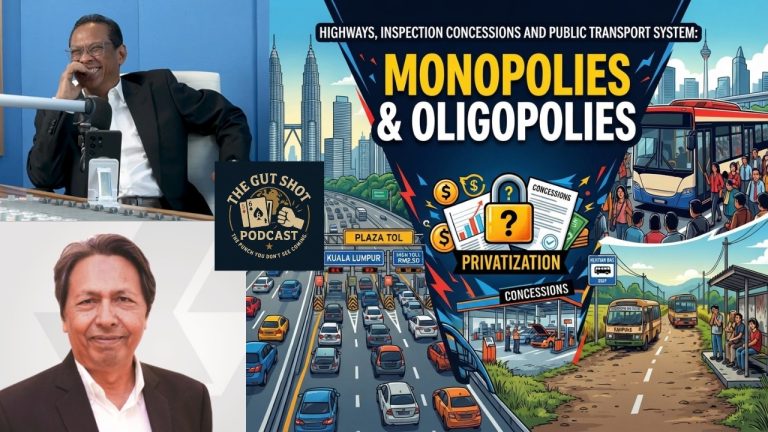
Highways, Inspection and Public Transport System – Monopolies & Oligopolies
Show Notes & Description
We dive deep with Dr Rosli Khan, our pre-eminent expert in the transportation and logistics sector. Why we have no transparency in the sector when it comes to our highways and transportation infrastructure.
Why are the focus in Klang Valley when the rest of the Nation is in desperate need of good connectivity? We talk the economics and politics of privatization of toll road concessions including vehicular inspection, the extinction of what used to be connectivities via small bus companies and other strange/interesting phenomena only in Malaysia.
This episode will open your eyes to some of the things you thought you knew.
We have a country to save.
Jump to chapter 8 chapters
- 0:00 Property Developers and Toll Highways
- 2:38 Origins of Highway Privatization in Malaysia
- 11:20 The Official Secrets Act and Toll Agreements
- 23:06 Ending Toll Concessions and Maintenance Myths
- 33:37 Flaws in National Transport Planning
- 40:30 Monopoly in Mandatory Vehicle Inspections
- 56:04 Decay of Regional Buses and Rise of Rail GLCs
- 1:13:39 Policy Demands for Transparent Transport Infrastructure
Auto-generated from YouTube captions. Timestamps link to the video.
account for the fact that there's a lot of um concession holders who also who are also developers right property developers. So when they propose the concession to the government, right, which they don't reveal, they have got track of land at the back of the highway which they then with the highway been built they develop the land into property development, residential, commercial and so on. And mind you those people who bought properties in those places next to the highway and so on you think that is good but actually you are trapped for the rest of your life because the only way out
is through anywhere is through the highway highway and every time you go up you have to pay to this is the situation in the clan valley in many places I have studied this I have looked at it I say pity these people you know but who who look after them nobody the government don't don't take any interest in some of this development they just simply approve the local authority approve all ladies and gentlemen welcome back to the gutshot podcast in this episode I have back with me uh Dr. Rosley Khan who is the expert in the logistics sector transportation all his career.
Yes Rosley. Yeah. Thank you. It's it's been a long journey. A long journey. Yeah. Thank you for having me back. Well um uh thank you for coming on and u actually these are the this is a issue that uh I we've been wanting to go through with you for uh uh on this uh episode.
Basically we want to look at actually uh the situation with respect to transportation and logistics uh and uh in that I want to start off uh talking about our toll roads. Okay.
Okay. I mean the policies with respect to our toll roads um highways especially um that um you know this transport policy started from the time in the 1980s through the privatization concept and and whatnot.
Right. Um so maybe you could give us a bit of a rundown. Yeah. um on where we see it going because uh whenever we talk about it I'm I'm I'm always stunned and in fact our friend our mutual friend say also mentioned that the toll that has been expired should never have been u renewed
renewed yeah true um can you can we start on this uh highway uh highway uh situation okay sure yeah is it uh in in in those years um the responsibility of building ropes uh lies with the government. Uh we have got um government department who look after road planning uh road network planning and and they are they were responsible for building roads and and also uh dual carriageway at that time uh what we call them uh or expressway uh in later years and now uh everybody referred to them as highways right
so uh but over the years um the allocation the budget allocation, yearly budget allocation that went to road were getting bigger and bigger and um the government at some point realized that um they can't continue spending money on the road um without uh having to reduce um fund for other sectors like health, education and so on. Um so um it came the idea uh it started in the UK uh in the 80s during I'm sure you remember Margaret Tedure in the UK introduced this privatization policy
right whereby um certain sector of the government uh which are not which were not uh effective and efficient at that time uh were privatized. Uh thus came the fragmentatization policy and and uh in the UK uh I think it started with the uh with the ports what they call the doc the dog labor union in UK um where uh a lot of investment were held back because they could not agree with the union at that time in the UK. So in order for the government at the time to break into the the clutches of the labor union uh they introduced this privatization and that policy was copied during Mahade's era
into Malaysia and and the first privatization policy that we u they did was to privatize um a section of Port Clang okay authority at that time Uh so now uh we all know that it is called Northport. Uh they privatized that and of course um it improved uh efficiency, productivity and so on. No doubt at that during that era uh because of the high um inefficiency and and also uh it lacks in new investment to put into the port sector because port sector is very expensive where you have to purchase a lot of equipment, machinery and so on and the government were very poor at managing this.
Mhm. Uh so uh and of course the private sector been commercially driven and so on they were better at at managing those things uh and it works up to a point. Okay.
Until it was um carried over into uh the next sector which is uh the highway building and so on. Um and we started with North Highway.
Mhm. um NSE uh as they call it. Um and uh I think um the concept at that time was to provide an alternative route for people who travel uh intercity travel from north to south. Uh there was an old road which is um um which is called um uh route one in in in Malaysian road network and uh this no sauce highway was designed uh the alignment is more or less parallel to the old road right as an alternative. So the concept was uh you can use the expressway uh if you want a faster journey but you are you have to pay
right the toll was introduced at that time and it's a closed system where you you enter at one point upon exit then you pay yeah and still been practice until now. Um so it's a it's a two-lane highway uh dual carriageway that mean two lane on this side and uh that went on for a long time. Uh the construction was supposed to be 30 years uh three three plus three 3 years for construction and 30 years collection of tone. Um and that 30 years is up.
Yeah. Yeah. is as we all know uh because it was introduced in uh late 80s uh or start operating in the uh 91 I think and uh that ended uh quite some time ago.
Quite some time ago. How long ago? Um I think must be 80 86. So must be 16 14 years. um 201 15 I think. Wow. So we are paying
14. So that has been extended for uh for now more. So they have added yeah they have added on the excuse that uh over the years the the highway need to be expanded. They spend additional money on top of what they spend earlier on. Uh they have created new interchange interchanges at several places and so on. So instead of the government paying them in cash,
right, the government extended the concession period and added maybe in some cases another 11 years, some cases another 15 years and that's how it continue until today.
Well, okay, here's my here's my issue here uh um or or I think something that I think probably a lot of people have in mind. Number one, um I'm a I'm a pretty pro private sector uh driven economy.
Yes. Okay. Sure. Yeah. Uh but when you have a concession of 35 years, let's say, or 33 years if I'm not mistaken, um and the concession period ends,
um we should be able to see it really ending. M okay um that that's one point the second point that from what I understand or what I can see is actually especially the main highway that we're talking about north south highway then
is extended it becomes a monopoly right um and the last thing in terms of a free market system is we should never have a monopoly we don't have uh an anti- monopoly I don't know whether we do actually um how stringently it has been um implemented as far as anti- monopoly uh act is concerned.
Yeah. Uh unlike the United States, right? So that is a problem the way I I see it. The second part is actually um this extension of the toll
period. Yeah. Okay. Yeah, I mean um there are many ways maybe you could expand in the sense that how could the government has just said that's it that toll period is over
because number one the transparency of the award in the first place I think the government provide guarantees uh a guarantee to the
which uh in the private sector I you know that is like you know I I don't understand how you can provide a guarantee on behalf of the private sector.
Of course. Yeah. Yeah. Yeah. I think if the government provide guarantee people like you you and me we can propose to the government. I I take over this highway, you know. I I go to the bank is take the papers to the bank and then the bank will finance you
because if you fall short of the traffic volume or the income and so on, the government will compensate you. Yeah. But okay, but before we uh go any further, I must remind you that this all these two concession agreement are under placed under official secret act. So the contents the contents of the concession agreement cannot be debared.
Wow. Yes. Yes. Yes. You if you bring up any issues that contain inside the uh agreement concession agreement you can be prosecuted. So it's under offic OSA.
So all the all the concession agreement for the highways and for the privatization of any kind is kept under OSA. So uh the context of which you cannot reveal.
What's the logic of that? I don't know. We have to ask your local MP maybe and let them ask a question in the parliament. Why all this concession agreement they you can understand certain certain document that the governments uh execute
must be kept under OSA because it is maybe related to national security. uh some of the defense procurement you know some of the uh yeah items that the government purchase procurement uh on
military equipment or and so on. Yeah, you can understand but to concession which the public has to bear the cost of paying the toll should be transparent. It should be transparent. It it should be made accountable to the public and the public should be able to access those document but the reason being is be because it's an agreement between a government and a corporate sector party. So it's between them so therefore the public has no right to know. So that is the issue that we we have been saying I think you you you can see in the media that uh I'm one of those people who who continued to uh
ask for transparency in the concession agreement you know because um you know uh I I think the I think the citizens the taxpayer has a right to know
how their tax money is being use. Yes. I mean especially on the compensation because uh taxpayers fund are used to to compensate the toll concession companies.
Yeah. Yeah. You know when it comes to um uh festive season when the government made the announcement or they you know they happily announce that oh the next two days all the highways in the country are free. So as if they are the one who uh you know
absorb it absorb the cost of providing a free free highway but it's not. So it's actually paid by the taxpayer through the government the government and the government pay the compensation
compensate pay compensation to the concession concession. Yes. Yes. Yes. So it's it's so coming back to your earlier question um on the on the uh government guarantee right
to to the highway concession holders right uh now in the earlier case uh whenever a party put forward their proposal to the government uh they have got their own terms and condition for the government to accept. One of which is that uh there should not be any other competitor for the highway that they uh propose.
Right. Right. So and then um they do a traffic forecast for that highway uh determining the volume of traffic that is going to use the highway. Mhm. And uh if uh the which the government has to agree on the traffic c traffic cap uh and if they don't achieve that traffic volume the government pay the difference between what is actually the reality of the traffic toll collected and the target that they set because to them uh they have incurred an investment by building the highway for the government because This is uh uh privatization under privatization agreement for
a period of 30 years. So they have to recoup the investment within that 30 years period. So if they're not getting the traffic volume, the government has to top up. Okay. So that it was all carried out on that basis on the understanding that anything that is short of the target the government has to compensate. So this is why going back to your point if that is being the that is the case then at the end of the concession period they must surrender back to the government. So there is no reason why the government should renew that concession because all the benefits that they have proposed
under their terms and condition have been met by the government. Dear viewers, we're going to have a live audience guideshot podcast and Q&A as promised this 8th of August. How is that for promises kept as promises were made? And the topic will be none other than we have a country to save. Now this cut short podcast started a year ago to be a place of unfiltered thoughts delivered in conversations by those among us who had been through the ringer in life. Be it through our upbringing, life experiences whether it be in academia or hands-on career. We wanted to articulate
thoughts no one wants to talk about or dare to. We want to create a place found nowhere else where people get raw authentic conversation. We call a spade a spade. And I wanted to weave into these conversations my personal thoughts on policies and issues domestic and geopolitics, social and economics through my lens as a private sector entrepreneur, business and corporate veteran. The objective was to make people look at issues in a completely different way and in the most possible start terms. I hope we have achieved that. Gunshot has now turned a year old,
exceeding all by expectation with all with well over 11,000 subscribers and a YouTube viewership in excess of 1.3 million views a month. Tik Tok is 10 times that a week. Our subscriber base are increasing exponentially and showing no sign of slowing down. Godshot for lack of better word is now becoming a real voice of influence the voice of you the people. None of it would have happened about without you the viewers and loyal subscribers. So this is a thank you to all of you for spending time with me and my guests spreading the word and growing this channel on a day-to-day basis absolutely
organically from day one with the belief that we have a country to save. I want to reward our loyal subscribers first and as promised before upon exceeding the 10,000 mark to come on the Gutshot podcast on a live experience with a vibrant Q&A. So here it is. If you are a subscriber, send an email to us at hello@theguideshotpodcast.com to book a seat for a live audience podcast on the 8th of August that will start at 200 p.m. We shall confirm the location somewhere in the PJ area in the retain return email. Your attendance is absolutely free of charge. Please check
the description for the detail booking. If you miss in this announcement, please write down and specify your YouTube name for subscriber verification and for us to forward the ticket for confirmation by return email. Unfortunately, the li the seings are going to be limited. So, it will be on a first come first- serve basis. Email us quick. This event will be a great one and fun. I won't do it otherwise. With that, I sincerely apologize in advance should we run out of tickets fast. Hopefully, we will be able to keep growing and able to organize a much larger event in the future. So again,
thank you for all your enthusiastic and sincere support. The comments has been awesome. Hope to see you all on the 8th. We have a country to save. Thank you so much. Um number one I don't get it as a private sector person that actually why that when you propose uh a highway that the government has to top up uh should your proposal uh in effect be wrong
right so that doesn't make sense to me when you go into business you take the risk yeah you take risk you take the risk um that's number one number two uh if you you want to go into that business, you must have the financial capability
to actually uh finance it and raise the financing for it. Yes. Without the government guarantee. Yes. You know, agreed. So these are two very main issues as far as taxpayer are concerned because everything comes with a cost.
Yes. You know. Yes. Um and then the other part is actually um we've created actually igopies and monopolies in certain areas
you know so that doesn't work from a private sector standpoint as well. Yeah. Um I think these are one of the political manifesto that must come from um any political party that wants to get our votes you know can't be paying all these tolls forever
and I think the the I mean the extensions um does not make sense. Can I ask one last part on this and if you want to add a bit more u you can. How would you have proposed let's say after the 33 years because
you've come in with a commitment? Yeah. I mean you've already got all the extra benefit of sovereign guarantee. You've got the benefit of a uh of uh uh compensation um on um
on on shortfalls on any shortfalls. So that makes the the curve of you earning actually yes it's more or less no lose situation there is no investment there's no risk
your rate of return is actually almost immediate you know agreed so uh let's say if we were to propose to the government hey guys let's do let's stop all this toll that has already been concise number one definitely we we must be looking at transparency that that is something the citizens must demand
right. Second I think if I were to ask you uh how to maintain it and stop it stop the toll concession after the end of the period.
Yeah. What would be the the alternative argument on your side on how it should be handled that? Okay. the compared to the narrative that has been told to us on why it was extended.
First thing that they need to do is to declassify all the agreement concession agreement. Okay. is the first step that you must do because it is no point talking about um you know the the the next move the next uh step or the next um um strategy that the government need to do in order to address this issue about the that I call it the ugly side of highways.
Okay. Uh so we cannot move on to that part of the argument or discussion without first declassifying the concession agreement. So the first step that the government need to do is to declassify the agreement right so make it more transparent make it accessible to to everybody to the public and so on then we can take it from there
okay without knowing the contents of the agreement we are shooting in the dark we do not know what's what what exactly it contains what's percentage of increase what what is the rate per per kilometer per car per vehicle and so we do not know we do not know we are shooting in the d So uh and then uh the issue about the at the end of the concession period. Yes, it is very clearly stated in the government policy that they can collect toll up to certain certain date
um that the agreement expire. Yeah. 30 years means 30 years no more no additional day one day no you know no less or no more. Right. Okay. So uh and the government must be prepared to take to take back the highway because it belongs to them. the the land acquisition the government paid for it. Yeah. To to build the highway and so on. Uh the cost of the building and so on has been calculated into the projection everything and so on.
The to concession is designed to uh allow the corporate sector the concession company to recover their investment plus margin of profit everything and so it's already there. So by right after the 30 years concession period the government must take back and there is this issue about maintenance.
Okay. Yeah. Which the government say that oh we have to continue collecting toll in order to maintain the road otherwise who's going to maintain the road. Now when they calculated the the the 30-year concession period, I believe not only the cost of building the highway, but it has also included the cost of maintenance.
Right? So the this this narrative about maintenance does not arise at all because it should be part of the part and parcel of the um initial cost um moving forward. So, so um that that is um that is what we we should be aiming for. Um upon expiry of the concession period, the government must take must take over. Now the the the issue now is that the government keep um awarding new highways.
Mhm. Right. uh the the current concession holder they have got I suppose um the benefit of because they know what they are they are into they know the traffic volume they know the traffic pattern and so on they keep going back to the government and extend whatever that they already have so and most of them are um circulating in the clank because this is the area where traffic volume is very high. So uh all these concession holders they proposed to the government uh from highway at great at the ground level. So now they're proposing elevated highways. You can see
around KL all the elevated highways even not just one layer, triple layer, four layer of highways in the urban areas and they know that despite them spending that amount of money, billions and billions, they can recover because the volume of traffic um that are circulating in Clen is very high. Now I I like to go back one step further. Uh when highway was first introduced in the country when they know that the traffic volume uh did not increase to the level that they anticipated. So the government assisted them by introducing what you call free motoriization policy. Free motoriization
policy mean everybody has got the right to own a car. Okay. So they want everybody to to own cars. Car ownership increased as the result of the highway building program in the country. So the government has to make it cheaper for people to own cars in order for them to use the highways.
I I don't you it is it is mindboggling. Yes. Yeah, it is mindboggling because you introduced the highway. You don't have the same uh volume of traffic that you anticipated. So the government assisted them by introducing this you know introduced I I don't get it because why here goes why I've always been complaining together with say
uh that uh our the taxes and the co the the the taxes tariffs um and the AP situation as well in terms of cost. Yeah. uh and then um the national car policy actually has artificially inflated the cost of car.
So basically it does not make the car cheaper as it is right now. The car the cars I keep saying this I can buy a car uh in North America uh the same kind of car uh
and and pay in ringit Malaysia equivalent cheaper over there compared to here. Right. U US is is not um is a totally free totally free there's no control but here in Malaysia there is some element of control but the element of control is not the same as some other country where the you know you you the road tax here is very cheap the financing cost here is very cheap you know countries offer you two and a half% of interest to purchase
but still it's expensive in terms of the capital expenditure that the the in terms of the capital cost is still very expensive. Not when you are buying a locally made car like or proton.
No, bro. Bro, I think the if you get alternative that comes down, every price will come down, you know. But but you you have got the option of financing it over a long term long long time.
Then then you're just paying the banks. Yes. True. Yeah. Then the bank benefit. The bank benefit from all this. Yeah. Yeah. But we the more people the more cars on the road, the more money. Here here here's my look at things, right?
Yeah. Um I really don't believe that um uh the policy whilst it stated that they want more cars on the road. Yeah. Uh but human being uh or as a economy is supposed to grow even by just the increase in the uh in the number of people working. M you're going to have more people owning cost.
Yes. Okay. So that is a given no matter what. All right. I believe that the car prices that we are paying has been made to seem cheaper uh artificially because we extend the num the amount of years
but actually the capital cost itself is higher than what is supposed to be. Right. If you so if you look at it from the economic perspective you won't be buying any car because it's a depreciating asset
asset you're not gaining from buying car and and we have artificially increased it but going back to the highway situation I think the the the the first thing is I can understand why
uh in essence companies are coming to you know um basically Clang Valley to improve the construction so to speak to to increase the construction of highway is because that's the biggest concentration of motor vehicles.
Vehicles. Yeah. Right. Yes. Um so it's no longer becoming about uh providing an alternative no uh uh transportation for faster uh
journey. No like it's now about purely a commercial decision. Commercial decision. Yes. In which case your to your point it cannot be OA item.
No. Right. Shouldn't should never be an OA item. Everything is based on commercial. Then it shouldn't should not be OSA in the first place. Even in the first place shouldn't be an OA item. It should be this one. There should not be a government guarantee. There should not be a a a top up in terms of compensation because why? If I'm if if I'm going to propose something,
right, then here here's the other thing that I find uh a bit weird. Yeah. Because we still have the JKR. Yes. Yes. And I know some of the JKR engineers.
Okay. They are not dumb people, you know, they are smart people, right? Okay. And statistically they can do the same number of crunching as uh as any private sector people.
Okay. So you could if you want to tender out the concession concession yeah you can right rather than waiting for somebody correct but but this this is the this is one of the key points uh about planning in this country because the the government don't plan the government rely on private sector to propose it to them then they execute it so this is another issue which I want to bring up this this issue good thing that you brought it up and I want to expand it further
right uh on the fact that if you go on purely on commercial basis Uhhuh. All the urban highways, all the highways in the country, they be built only in the urban areas. The rural areas will never get any highways.
Okay? Whereas in terms of planning for the country for the benefit of the people, you need to look at the movement of people, where do they go, which town need to be connected to which town and all that stuff, right? So to to to ease the movement of the people where people want to go. But today if you look at at it today only clan valley get the highways but if you want to go to say kotabaru there's no highway to kotabaru you want to go to tyoman to mering there's no highway to get there so in in other words the whole country is not planned in term of transportation and logistically speaking
uh to ease the movement of the people. So even now the highway between uh Clang Valley and JB right there's only one highway that goes there's only one highway so you don't have the alternative if you want to go to Malaka you want to go to Shban you going to go to Kulwang you have to use only one highway there's no there's no benefit in in having so many highways in the clang valley but when you want to go to JB you get stuck
well that's the thing that that actually you talking about if that's the case that that comes to the the development policy itself with respect to where with respect to actually what do they call it um
uh uh what do you call diversifying our our economic hubs you know so that different states actually will have we'll have uh industrialization as well today as we speak
we live on the west coast of of the country of peninsula if you want to go to east coast you want to take your family for holiday in Tanganu where do you go there's only one highway through Gmba up that's the only highway.
Yeah. What happen if there is a landslide in and actually you are stuck people in the east coast are cut off. So this is the situation that we have not done enough in terms of transport planning and looking at the logistic um the movement of goods and people in the country through a network of facilities infrastructure.
Actually it makes sense to be now listening to you. Yeah. what um why I can understand the frustration and the anger in uh uh from my friends in Sabah and Sra right
that the planning uh in terms of getting more proper road systems over there are not uh conducted properly. No, you know after
it's not a priority. Yeah. Say let's say we have privatization starting in the early 80s right let's say mid 85 maybe right um so we've had almost 50 years
of privatized experience and JKR itself should have the expertise to actually do the the urban planning the planning in terms of roads and whatnot
and come up no longer need to wait for the private sector But basically come up with the requirements requirement for the country and then tender it out. Tender it out. Yes. Yes. That's a good way. I would support that. I would support that.
I'm just thinking from my own oil and gas experience. Right. What Petronas does is actually they figured out basically this block and which field and they tender out the fields.
Right. And there's no guarantee for you whether you're going to get the oil out at a viable cost or not. You have to figure it out. Figure it out at your own risk. At your own risk, at your own cost. And you beat among each other.
Yes. That's right. Yes. They should we should be doing that. Why are we not doing the same for the road system? No. No. I I I agree. We we should be looking at that. Seriously, should be looking at that. We should not wait for the private sector proposal to propose a new highway and uh in urban areas not in some outlying areas you know and then you know the government accept their term and condition they shouldn't they shouldn't be looking at that
that's okay that's not the way to plan the country I know yeah that's not the way to I think this is one of the biggest demand I think I think we have had a change of government over the years that policy privatization policy was coined by Mahade 1.0 is zero
right so beyond mahade uh okay there has been the same party you can can say that they if it is ruled by the same party then you don't change the policy but we have had a succession of new parties coming in and the policy never changed we should be looking at changing the policy right
I I to make it better because now we know that after like you said 50 years of the experience we know the good and the ugly side of things right so we could should keep the good and we should eliminate the ugly side.
Yeah. You know, I know for a fact that there's a lot of um concession holders who also who are also developers, right? Property developers. So when they propose the concession to the government right which they don't reveal they have got track of land at the back of the highway which they then with the highway been built they develop the land into property development residential commercial and so on and mind you those people who bought properties in those places next to the highway and so on you think that is good but actually you are trapped for the rest of your life because the only way out
is through everywhere is through the highway highway and every time you go up you have to pay to this is the situation in the clan valley in many places I have studied this I have looked at it I say pity these people you know but who who look after them nobody the government don't don't take any interest in some of this development they just simply approve the local authority approve all that
we're not going to go there and on the why of I think we let the we let our our audience think for themselves of course but I want to slide into the the soal uh the vehicle sector to a certain extent because your your your
your expertise is very much in in all this transportation and all that and um uh we have another monopoly that is related to that
which is basically the vehicle mandatory vehicle inspection. Oh okay. Okay. I I really want to talk about this one. That is also under privatization agreement. Yeah. Right. Yeah. Which is again underway. Say it. I believe it is also for a single concession.
Yes. To a single concession. That's that's a outright monopoly. If you ask outright monopoly that's an outright monopoly. Yes. And um the objective of having vehicle inspection is for safety reason and to make sure that your vehicle is uh in roadw worthy condition right
uh before you take it out on long journeys and so on. Uh mind you this is uh this is applicable for only commercial vehicles uh buses and lorries and and vans and so on. Uh any vehicle that used for commercial uh revenue. So uh and you have to send your vehicle inspection every 6 month. Yeah. Uh and there's a fee uh to be paid uh for vehicle inspection. Um something that they coin it uh the narrative was that it's a computerized uh inspection system.
Okay. Uh it's not a big deal. see a person going around checking the vehicle and then whatever that they inspect and so on is stick uh into the iPad. It goes into the computer and uh then they print out the cificate with that certificate then only you can go and pay for your uh road tax insurance and so on. right now. Uh it's not a big deal uh in the UK that system has been uh farmed out to any workshop because the work of the workshop is to check on the vehicle. Roadworthiness is best carried out by a mechanic who can test the vehicle, who can look at the vehicle whether they are in good
condition, which part are not working, the brakes, the tires, the lighting system, anything to do with the uh roadiness. So, uh it can be done by any workshop.
So, in in the UK, yes. Um it's not what's the period like uh between inspection. One year. And why did we choose 6 months instead of one year?
Because more money. You pay twice a year. Instead of paying once a year, you pay twice a year. No. Well, okay. All right. Okay. Okay. Yeah. In your opinion, if you were to run the if you were to run the road and transport uh authorities,
what what would you what is the frequency that you would expect that to be done for commercial vehicles? Once a year. Once a year is good enough. Uh because your tire lasts for more than a year.
You change to new tires. when when you take your vehicle for inspection, the first thing that they check is your tire. Tire is very important. All right. Uh in any so they privatize it to as far as they are concerned in the UK, they privatize it to any workshop,
any workshop that qualify. Uh they set the criteria, you got to have this, this this this and so on. You got to have the uh licensed uh mechanic. Uh you got to have all the facilities and so on. So you can take to any workshop. They call it Mote certificate. Uh, Ministry of Transport certificate,
right? So, uh, so but on in our case, we have one concession. One concession. Yeah. OSA. Yeah. OA. Yes. Yes. OA under OA. The contract is also under OSA. They collected I know that they collected millions um every year and and it's throughout the country. Sabasawa Peninsula. Every state they have an office. So that jet job was meant to safeguard the interest of the car owners and users so that when they go on the road they are safe. But as you know Malaysia has got one of the highest accident rates in the world right 7,000 people die every year on the road
and most of them are uh due to due due to failure of the vehicles. Failure to the of the vehicles. Yeah. and driver involve commercial vehicles mainly or what?
Uh a lot of them are actually half of those federal residents are motorcyclist. Okay. Motorcyclist but uh of course we don't inspect motorcycles. Right. Right. And they are free to use the highway in in some other countries. Uh this all these cupai are not allowed allowed on the highway.
Highways. Yeah. Indonesia don't allow Thailand don't allow. India don't allow. I I know America don't allow unless you have a if I'm not mistaken the minimum is like 250cc. Yes. Yeah.
We we allow because I think uh partly political because I think uh from the time when we invent we built the highways and so on. We allow everybody to to use the highway because we want we want mileage or this is government you know project uh to ease the burden of the people and so on and they they don't pay toll motorcyclist don't pay toll right.
Mhm. So uh you know to make people happy and you know uh but not knowing that by doing so you know some of them get involved in accident and so on. uh mean did the government not just recently liberalize it? What what was that decision to uh with respect to the uh with u uh the the the vehicle inspection uh liberalization? I heard something they said that about two years back um ministry of transport said that they want to open up.
They have they No, they haven't. Wow. They haven't. So two years ago already they acknowledge that the monop that there is a monopoly in the monopoly. Yeah. They acknowledge that there is a monopoly in vehicle inspection.
All right. But until today they have not done anything about it. So um the last announcement was that uh five companies were selected uh for a short list. Uhhuh. But they have not started.
They nothing has been signed. Nothing has been given out. So the same people are still doing the inspection. It's a money printing machine. M do you think it will work the same way if we have it like the UK where actually you can go to any workshop certified? Of course, definitely it will work. It will be better for the people. You don't have you don't have to go to one place. You you drive for miles to go to get to a center and then you have to wait for hours, you know, and then you know it cost money. Time cost money. So, uh you're wasting a lot of time every six
month that you have. Imagine if you run a transport company, you have a fleet of 50 60 vehicles and regularly. Let me ask you a quick question because uh if if uh if you talk about uh trucks and uh you know
what would you impose as an expert uh an age would you impose an age limit um on on a vehicle? Uh for commercial vehicle for commercial vehicle.
Yes. Yes. Definitely. Yeah. What would the age limit be? Uh I would say about between 10 to 12 years. Between 10 to 12 years. No more not more than 12 years. Not more than 12 years. Yeah.
So if you think that way um you must have an ROI uh on that vehicle within less than 5 years. Yeah. But the problem in this country is that um a lot of those vehicle don't last up to that uh period of time.
What what 10 years? like 10 years because of the over overloading better. Okay. The other question that I come to about is uh uh at this moment do we have a vehicle uh age limit uh on the road uh with respect to commercial vehicles?
No, we don't. We don't have No, they have it they used to have it for buses. Okay. Uh and taxis, right? uh but I think they have relaxed that rule now uh after appeal from the patan taxi patan lorries and so on. So they they relax that rule. They allow they now is based on the inspection. If you reach a certain age limit, you take it for inspection. If the inspector feel that your vehicle is still in good condition and so on,
you pay the fees. Don't you think can Okay. I I I agree with you that uh you know an age limit is is necessary is needed. I believe that um because after a certain point the breakdown period is actually quite high
quite high. Yeah. Yeah. Yeah. Maintenance cost no matter how Yeah. maintenance cost is high that means that if you want to keep it running to uh uh really your expenditure sometimes is it's really not viable. Yeah.
The only thing that that happens then becomes you just run it uh as an unsafe vehicle to be honest, you know, and somehow or other you still are able to run it because the inspect inspection process has been compromised.
You know, but you can age limit is one of the criteria that you can use but you can also go on the mileage. Yeah. So you go both vehicles because they are their utilization rate is very high.
So you you achieve like 250,000 kilometer within like few years. Can you impose 15 years is that viable for for for you again you have to look at the the mileage situation. If the mileage is low I think some vehicle can last for yeah up to 15 16 years still in good condition.
Okay. Um I'm driving a 11 year old car with a low mileage because I hardly use them. So um you know you you can you can you know if if you have got a service uh
record and so on. I guess I guess here's the two things right because um number one you got to drive the the cost of the vehicle down. Yeah. Right. We we currently actually have I have an artificially high vehicle cost.
Yeah. So you make your ROI on the on the vehicle much uh lower in years. Right. Um and then you democratize the inspection uh economy.
Yes. Right. So you spread out the economy as well. Yeah. Yeah. I I like the idea because it give benefits to a lot of workshop owners and operators. Yeah. to do, you know, to be part of the local community. You know that people go to this workshop to get the certificate of roadiness and so on. And then you pay a small fee for for doing that.
And also in case your car is not uh up to the mark, right? Need to be repaired and so on. The same workshop can offer the quotation. Okay, you can repair with me. This is the cost, the price and so on. Or you can go to next door or any other workshop and so on and repair then bring it back to me. I inspect it again. Then you know if it is in meet all the criteria then you know I issue you certificate
you know this is much simpler more user friendly you know people don't fear about this taking your vehicle to this to be inspected you know so at the moment the this fear factor what does it lead to
under the counter yeah that that's what because fear fear that you your vehicle will not be approved. So I offer you Oh, it's that's the that's that's the uh the integrated
part of all the policies that we make, right? Everything is a domino effect. Yes. Right. The monopoly is is a do gives out to a a domino effect. the amount of uh the the length of time that you need to inspect is a domino effect.
Yeah. Like you say actually the overloading is another piece of is a bigger problem. Yeah. And we are not sometimes you you drive on the highway you can see that it is
clearly overloaded. Overloaded. Yeah. Overloaded. And you just thinking to yourself why is this happening and why is there no enforcement on it? Yeah. You you can't set up a system that is 100% foolproof. You but you have to aim for the maximum.
Yes. But if you set up a system that is only about you know um you know what what Malaysian call system and so on there's a lot of loopholes where people can take advantage of. That's not good. That's not good. Vehicle inspection is like that. So you set up a system where there's so many loopholes. You know, at the end of the day, it doesn't meet the objective of making every vehicles that are found on the road safe in safe condition. You you fail that objective. You know, you still get a high rate of accidents and you know, not just accident, fatal accidents, you know,
because of the failure of the system, you know, to um to safeguard the interest of all the vehicle users and and people on the road and so on. Uh it's not just the vehicle owner that should be responsible, but you know, it's everybody road users should be made responsible for this for the safety to be take effect. But the the policy must be there. The system must be in place but we don't have sad to say.
Wow. Yeah. Time out. Okay. Where do you want to go after this? What what you think is a is uh this one we maybe How how long are we now?
50 minutes. I think we we go not more than 30 minutes more if we want to do otherwise it's way too long. Yeah. Yeah. Um we should touch on public transport.
Touch on public transport. And then we we close it with the larger policy. Yes. Larger policy. Larger policy question. Okay. I'm I'm going to ask you about the larger policy question. Then you
you can go on public transport like rail MRT railway system. Okay. All right. Start back. Yeah. Okay. Uh let's let's let's divert a bit uh at this last point of our conversation. Uh I want to go because if we talk about this, there are plenty of sub issues that we talk about. Um to be honest, one other thing I wanted to talk about is actually the gig economy.
Yeah. Okay. With respect to e-haling and dispatches and whatnot, but let's keep that for another time, right? Yeah. Um but in the same tone, um let's slide into the the public transportation situation.
Okay. Interesting. Yeah. Where where do you where where would you like to start the discussion on the public uh transport situation whether it's the buses, the terminals, the MRTs, LRT, etc. Yeah.
Uh please give your thoughts of what we having now that can be improved or what should actually be done. Yeah. Well actually is it is the role of the government to uh offer uh people and option alternative. Yeah. Apart from car owning and caring. uh you know is well and good that you get to a stage where uh a family can afford to own a car, right? Um because it's it's convenient, it's comfortable and uh is is available um for you 24 hours a day. So which something which public transport system cannot offer. Yeah, public transport system is not always at your doorstep
whenever you want to use it. So it's good to to have that policy where you can own a car but I think we should not push it uh too much in the sense that you know you look at you look around today uh a lot of households has got more than one car. I know people who owns four or five cars and so on you know and even more than 10 cars you know per family which is uh to me is a bit ludicrous. uh when the government of course the government collect money from the more cars there are the more money they collect
right through road tax right and insurance company also love it uh so this uh income from road tax which runs into billions yeah every year uh what do they spend on nobody knows 5 billion collection through JPJ every year. What do they spend on? They give it to the government. What do the government spend on? Is it to go back to the to a system where uh those people who don't have cars are provided with an alternative mode of transport like public transport and so on. uh I believe the government should be looking at planning for a good public system, public transport system in every
I wouldn't say every town and cities but at least every capital of the state you know ranging from Kotakabalu Kuching Alusta Kotabaru Kuwatan at the moment I've I've gone to most of these places without car you cannot move there's no public transport system in any of these ities. Now we keep focusing on Clank Valley because this is this is where the
the money is. Yeah, that where the money is. People, you know, a lot of 7 million people live in Clang Valley. Uh you know, people live and work here and so on. So um we we can't resolve the car issue, you know, even with more highways and so on, we cannot resolve that issue. And we try with a mass rapid transit system, right? But even then the planning for mass rapid transit system is in patches. You you cannot serve every nook and corner of Glen Valley, right? Not with one system. You cannot have MRT going everywhere.
Yeah. But you need to have supporting system. There used to be uh now this is very interesting because this an antithesis of what we discussed earlier on on private sector involvement in transportation right uh in the olden days you have a lot of bus companies operating in cities right uh almost every town that you go I think I'm sure the town that you know
what happened to that yes what happened to that good question what happened to that why because there has there has never been any incentive from the government to increase the the the the provision of public transport in in any towns and cities. They were left, you know, high and dry. In the end, they close shop because there's no in in a lot of places when you recognize that there's a group of society that don't have access to private cars, you have to subsidize that part of the travel pattern. The public public transport is used by the lower rank of the society.
Let let me let let me let me just interject. Yeah. just a short while because now you have made my you have actually uh triggered my memory. Yeah. Okay. Because um
I um I grew up in Suyatani. I remember even uh in my teen years uh I would be if I was studying in uh Alostar uh I was able to take either train or I take a bus more than likely I will take a bus
back toani and then if I want to go back to my grandparents in Pinang I would take a bus take a ferry then take another bus there And and if you were to ask me from each local
Yeah. Yeah. none of them would seem to be economic. Yes. In today's term in today's term. Yeah. Yeah. Right. In today's term and yellow bus in Pinang is very popular. Yeah.
And Yeah. And and and I remember the earlier days of my career when I started out in KL as well. Uh we have the clang bus clang bus. Okay. Clang bus.
The gray and red. Correct. Yes. Yes. Um, did you drive around mini bus or the mini bus? Mini bus. Yeah. Right. Cheap, you know. 50 cent. Right. So, there was
to say that and we had no LRT. No. Right. We have no LRT. There were congestion for sure. Um, but getting to one place to another and there was no u e-haling services. No.
Yeah. And actually if I were to think about it during those time I don't think there were any subsidies to the to the uh to the Yeah. They exist on commercial basis. Yeah. They exist completely on commercial basis.
Yeah. Income from you know uh yeah tickets. Yeah. which which was very little and they were there were many companies in essence basically serving each nuke and cran of the
of the nation. Yes. Yes. Why have they disappeared? Yes. You know interesting. Yeah. And now we have our monopolies again. Yes. Yes. And yet none of it is fulfilling the type of uh
demand that actually we used to have you know. Yeah. Uh in the early years when we had less people less people. Yeah. You know. Yeah. Yeah. So you're right. The the the the planning somehow
has gone haywire. It's gone haywire. It's been to serve. Tell me if my conclusion is wrong. Okay. It seems to serve a monopolistic or oligopolistic uh class of industry or class of players.
Yes. And actually destroying the the entrepreneurship of the nation at the small and medium scale level. Yes. Yes. Yes. You know.
Yes. Yeah. Which also Yes. has a has a connection to the funding issue with the consolidation of the banks. So, so I mean I don't want to bring that and just know but I'm just want our audience to pull all that together and realize
that the policies has not been to serve the citizens. It's to serve the uh the the the monopolistic olig oligopies as uh class of uh of of uh of the commercial interest.
Yeah. In those years what happened was uh bus company identify the route. Okay. I would like to surf between this point and that point. You know, normally it involve a bus stop, a bus station, going to a bus station in the city or in town,
right? And they apply for the permit. This is the fair structure everything and so on and it goes to the uh transport commissioner CBLB at that time and they approve and then you start you know you purchase the bus, you register the bus and so on. But today if you want to do that
ah tell me how do you go about it? I think there's there's a lot of red tape that you need to go through today that make it the whole venture not worthwhile. Well, let's come to the uh problem of overregulation. overregulate overregulated
maybe it's on purpose and also yeah because I think now uh there is this side of the government um the GLC's right which the government very fond of forming them you know I I would call it so many agencies ranging from first they have Awamara spad government body right I I'm sure you never heard of it heard of it
yeah you never heard of it and then you probably you don't know what what's the function of this uh uh land land transport commissioner right um and then you have this uh prasarana prasarana is supposed to plan for public transport in the clang valley
okay Right. Uh they they were tasked to plan for you know all the artists in in town were planned by them. Uh and then you have got MRT COP
that is also a GLC. GLC. Yes. Okay. MRT COP. So they look after not LRT but MRT mass transit. Mass rapid transit. Malaysia rapid transit. So uh and then of course you have got this of course KTM as you know railway which they split it up into now is been managed by RC railway asset corporation doing the planning for railway right so and then you have got um inside the ministry there is Malaysia rail development corporation also okay so you have got like I would There's seven eight agencies doing the planning. I'm not sure whether they talk to each other cuz they seem to be working in
silo. What they planned here doesn't correspond with what been planned elsewhere and so on. So um that's the state of affairs in the country when it comes to planning for public transport. M
so a myriad of and everything seems to be a lot of it seems to be concentrated in Glam Valley. Yeah. In Glen Valley and and and the the mindboggling part is that this they get budget like not in millions they get billions of budget billions if you look at
from the government. From the government yes from the government. So if you I thought I mean I thought GLC's are supposed to be able to generate their own income. No no no not not when it comes to public transport. Uh it seems no the government set the fund they do the planning the government allocate the fund and then they go ahead and build you you are looking at
so that's not a private sector. No not private sector driven. It's government money. All right. 60 billion for MRT1 I think you know another 50 billion for MRT2 and I don't know how much they spend on LRT expansion and now they are looking at LRT in Pinang which is another I think 16 17 billion and so on. So the amount of money that that has been spent is huge. Are are these um uh are this costing transparent to the citizens or or all this uh OSA item again?
Um well I don't know I I've I've never seen the costing of some of this project. Um never get a chance to to see them. Uh I don't think um they even table in parliament. Um
well at the very least I mean you think about it to table it to parliament usually we go on a line item budget right? Yes. Okay. But at least at the municipality or or or a state level allocation if you have
uh a central planning unit. Yeah. let's say a central planning unit whether it's at federal or state level or at municipal level um you should be able to have such things on the on their website
we should be able to access it actually in published uh document yes and the the people should have access to it and then um we have plenty of NOS's or pratuan uh uh uh uh patuan either it is commercial pratuan
or um citizen activist groups that can actually go through it and and criticize or give back feedback right um if those documents are not available nobody's looking at it
no there's no check and balance no but uh you talking about central planning agency yeah which is uh the role uh definitely is needed in in in our is. But then again, um the the contribution that is been made by the central planning agency when it comes to public transport uh is is a lot more um is required you know in terms of travel behavior, travel pattern and so on. you you need to have uh quite a good amount of data uh travel data in order to to plan properly. Uh I believe we don't have that. We don't have we don't have uh none because I think we never
collected travel data in this country. I think nobody does that. Nobody uh you have the you have the toll collectors or the and the toll and all that.
Yes. Yeah. Why was so difficult? Those those are the um for vehicles. Yeah. Three made by vehicles, right? Yeah. So yeah, it's I I'm not sure is you know
and I bet you the the companies that are cons would have the data. Yeah. I I I I it is it is uh bit difficult when when it comes to we have a lot of local authorities right who's supposed to be in the knowledge of this uh travel pattern and behavior and so on the BKL MPJ and NBCSA uh but they seem they don't seem to be in in the know about this travel pattern and travel behavior
so especially when all this uh central agencies you know um the one that plan for MRT, LRT and so on that goes into their territory and so on and you can see the result of it uh what has been offered to the public right after been after they spending so much money
Mhm. uh hundreds of billions and so on. The net effect to the traveling public is that it's not there. So which is a bit sad. I think is is you know that amount of money could be spent better uh if they understand the travel pattern and travel behavior uh for each town and cities in the country today. So let's let's let's end it end this discussion
uh on that note which is the larger policy question in essence right um I think um let's conclude it in in essence we lack transparency we lack the first one yes
yeah we lack comparative procurement Yes. Um rigorous costbenefit analysis. Yes. Yes. Right. We we never carry it out properly. And u well with that transparency is the oversight that comes with it. If you make things transparent then you have either citizen oversight. Yes.
Or regulatory oversight. Regulatory oversight. Yeah. um and and ultimately integration of all this transportation system that we have. Yeah, maybe um I don't know. I just thought about uh I travel a lot. Um one one of the countries that seem to me to have extremely good um uh planning in terms of their transportation and even development of uh townships and all that throughout the country.
You know what which one stands out to me? Australia. Australia. Yes. Yeah. I agree. You agree with that? Yes. Yes. I agree. So if we if if you were to think about that and and in comparison to what we have today
just give your top three or top two doesn't matter to close this um what should we as citizens uh be demanding from um from from as an agenda from
any individual MP or adun yeah or political party. Yeah. In their manifesto. Okay. Uh the I think it is the right of every citizen to have access to public transport. That that is a that's a should be a given. You know uh no matter how remote you live, you decide to live and so on, you must have uh there is there should be a measure uh on how close you are to the public transport facilities, right? So whether you are in Kanga, whether you are in uh Tawa, whether you are in Rompin and so on, you you must have that measure. You know how close you are to public transport facility. Uh because
you cannot assume that uh everybody has got the means to own a car or private vehicle, right? Uh so if you go if you set that agenda uh that mean you you work towards certain objective that you need to achieve um and then uh like you said you rightly pointed out we got to be a central uh planning agency to to to to work towards achieving this objective right uh I don't think um politicians should be involved in the planning of public transport uh because they themselves don't use public transport that much
and you are right they are given also allowance which prevent them from using public transport uh I I I think you know maybe the government should change from giving a tax-free carer driven allowance you know that they get parking parking allowance 5,000 ringgit which I I don't think yeah I don't think they use the parking allowance you have drivers
yeah you have drivers yeah right you're Right. So uh so all these little little things should change you know to to to reflect the ultimate objective of the government in trying to make uh public transport more friendly more um more usable uh and more available throughout the country you know as today I think if you arrive at a function in public transport nobody look at you you know it's a it's a different perception different treble behavior all together.
You know in the UK you go to parliament you know arriving on on the tube in the tube or you arrive on the bus nobody say I didn't know people will you know um Boris Johnson used to cycle to Parliament.
I I used I I remember uh bumping into my ex boss uh in in the H uh on the road as I was walking and he was uh cycling Yes. No big deal, right?
Yeah. But in Malaysia, I mean, I don't know. The the the perception is different, you know. You you have to arrive in a luxury limousine. Well, I mean,
let let's let's close it then in this in this essence. I think as we said, right, uh the tolls that are expired should never be renewed. Yes. Right. Okay.
Uh we should have a central agency um that actually be able to um come out with the tenders for each area that needs connectivity whether it's in
uh in any corner of the of of the nation. Yes. Right. So I think and vehicle inspection should be open up to all the workshops in the country. Excellent excellent point. Yes. that that is a economic
and you don't need you don't need to you don't need a a monopoly and you don't need a 6 months inspection if it's done right once a year is more than good enough more than good enough. Yeah. So at this moment the policy seems to be driven by uh by selected commercial interest rather than a citizendriven interest.
Yeah. So on that note, I think we would like our I hope our our audience has stayed till the very end. It's been very enlightening, very very interesting conversation. Yeah. Thank you so much, Rosie. Next time I think uh we'll have you back again with with so many other issues, so many other issues that we want to go through. Yeah. Okay. Thanks so much for coming.
Thank you. Okay. Thanks for joining us. Uh see you all again. Excellent. Excellent point. Yes, that that is a economic and you don't need you don't need two you don't need a a monopoly and you don't need a 6 months inspection if it's done right once a year is more than good enough
more than good enough. Yeah. So at this moment the policy seems to be driven by uh by selected commercial interest rather than a citizendriven interest.
Yeah. So on that note, I think we would like our I hope our our audience has stayed till the very end. It's been very enlightening, very very interesting conversation. Yeah. Thank you so much, Rosie. Next time I think uh we'll have you back again with with so many other issues, so many other issues that we want to go through. Yeah. Okay. Thanks so much for coming.
Okay. Thanks for joining us. Uh see you all again.