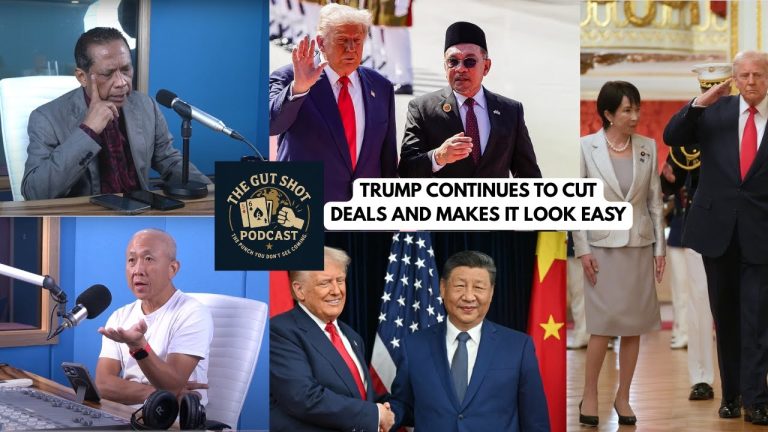
Asia Sales Tour Trump Style: Malaysia, Japan, S Korea, and the Meet with Xi
Show Notes & Description
Extra: Pentagon comes to Asia
We’re Shamsul and Chuang, and you’re listening to The Gut Shot Podcast! You simply cannot miss our deep dive into President Trump’s whirlwind, five-day "Asia Sales Tour" across Malaysia, Japan, and South Korea, culminating in his high-stakes meet with Xi Jinping. This episode offers a masterclass in geopolitical trade craft and diplomacy that the mainstream media is absolutely undercovering.
We kick off by debating whether the visit was a landmark win for America or if it merely complicated Asia’s precarious equilibrium with China. We analyze the unexpected statesmanlike quality Trump brought to the table, a demeanour that impressed us.
Shamsul calls his presence in Kuala Lumpur a masterpiece, noting that his informal gestures, like dancing with the troops, made for good TV and broke the ice. But was this charm, which included talking up Anwar and mentioning the Indonesian president as a friend, simply salesmanship designed to win big trade deals that primarily favour America? Chuang argues that Trump achieved his specific objective of recalibrating the equilibrium with allies, using a businessman’s marketing tactic.
The visit exposed ASEAN’s deep-seated frailties. We discuss how Trump was applauded globally for brokering the Thai-Cambodia dispute (the Kuala Lumpur Accords), raising embarrassing questions about why ASEAN failed to enforce regional peace. Furthermore, we confirm the Pentagon’s persistent presence, with Hegseth still meeting ministers to cement a 10-year military cooperation deal with India and affirm US interest in the South China Sea.
You’ll hear our fierce disagreement on US reliability. Chuang worries about policy volatility and the jarring contrast between a trade truce and Trump’s announcement that America will resume nuclear tests. But Shamsul forcefully advocates that the US offers the stability and shared democratic/capitalist values Asia needs.
He sees American presence as essential to balance against sketchy Chinese “wallet diplomacy” and high tariff barriers. Shamsul insists that doing business with American entrepreneurs is the simplest and most trustworthy way forward.
Finally, we analyze the high-leverage meeting with Xi Jinping, secured at a former US military base in Busan. We call the resulting soybean and one-year rare earth amnesty a strategic genius move because it gives Trump time to decouple US dependence on China.
We conclude with a crucial message for Asian policy makers: BRICS is dead, America is back, and local leaders must urgently put their houses in order, dismantle monopolies, and deregulate the economy to truly benefit from this global reset.
TIMESTAMPS TO WATCH:
• 0:25: Trump’s statesmanlike diplomacy and Malaysia’s optics.
• 4:00: How the visit “recalibrated the equilibrium” in favour of America.
• 6:00: The embarrassing reality of ASEAN's frailties exposed by the Thai-Cambodia peace broker role.
• 9:00: The Pentagon’s persistent military presence (Hexath) countering Chinese assertiveness in the South China Sea.
• 14:00: Why Shamsul argues for American presence to help tear down Malaysia’s artificial economy and monopolies.
• 18:00: Analyzing the high-leverage meeting with Xi Jinping and the strategic genius of the rare earth amnesty.
• 23:00: Were Asian leaders, including Anwar, "starstruck" or appropriately gracious hosts?
• 32:00: Our definitive verdict: BRICS is dead, and what Asia must do now.
We promise this conversation will shift your perspective on global commerce and Asian politics. Hit subscribe and catch the full episode now!
Write up from Shamsul featured in FMT regarding the Global Reset initiated by Trump's America:
https://www.freemalaysiatoday.com/category/opinion/2025/10/28/the-global-reset-of-a-new-american-leadership-2
Many thanks to CITYPlus for their collaboration with The Gutshot Podcast, in whose studio this conversation was recorded. CITYPlus is Malaysia's first Chinese business radio station, dedicated to delivering in-depth analysis on local and international current affairs, markets, and businesses.
Jump to chapter 8 chapters
- 0:00 Trump’s Whirlwind Asia Tour
- 6:33 The Kuala Lumpur Accords and ASEAN's Frailty
- 8:40 Pentagon Moves in the South China Sea
- 15:41 Free Trade vs. Malaysian Monopolies
- 25:18 The High-Stakes Busan Meeting with Xi Jinping
- 33:41 Nuclear Testing and US Policy Reliability
- 49:27 The Death of BRICS and De-Dollarization
- 59:43 Deregulating Malaysia's Domestic Economy
Auto-generated from YouTube captions. Timestamps link to the video.
All right, welcome back to the Gut Chat podcast with uh Shamsul and myself, Chuang. Um we've had the benefit of the president of America, Donald Trump, come through our shores. 5-day whirlwind visit Malaysia, uh Japan, Korea. Uh he's come and stemmed his um you know, his his mark of uh Trumpness in the region, right? Um one side of the cam says it was a fantastic landmark uh win for Trump. There's another cam which says that well it could have been better in some respects obviously right because Trump is a divisive character. Um I know where you're going to stand on this
issue Sam. So maybe you can uh kick us off the discussion with the the KP accords. He was in Malaysia and the trade deals that he uh inked with Malaysia. I thought that actually from the point of view of Malaysia and Malaysians, right? I thought we I thought we pulled off a good show, you know. I was like I was pleasantly surprised to be honest. I don't know how you felt about that.
How how did you read the fact that he allowed Anoa into the beast? I mean I mean obviously that's that's optics, right? But what message do you think he was trying to send? Well, I think I think the message throughout actually if you talk about even overall when I I pieced together all the visits, right?
Um I was actually quite impressed because why? Um and I said so I this so as well that I expect Trump to bring along his um his uh his his his New York uh
braad show braad show, you know. and he tamp it down and he came off very statesmanlike in my opinion. I know I was listening to his opening overture when he was meeting Zinping and he was saying all the nice things, all the right things, right? Which is very unbecoming of Donald Trump.
Oh, President G is an old friend. We go back a long way. He's a great guy. He leads a great country. We're going to do business together for many, many years. And this is Yeah, this has been this trade war that's happening between the two for years, right? And actually if you look at it uh I mean since we start in Koala Lumpo right?
Yeah. You know even his informal gestures of coming down he comes and starts dancing with the troop with the with the dancing troop right the informality of that made for good TV you know
it also broke the ice in some sense. Correct. Correct. And I think uh u uh it did a lot of good for our own prime minister's image as well that he you know that that they shared the right um to the summit um in the base and um I think from that standpoint I felt that actually overall the whole trip uh Trump brought a statesmanlike uh quality that I did not expect actually. So from that standpoint, I thought the diplomacy was like this is not the Trump I was expecting. Okay.
Um and in in in essence uh Kualala Lumpo like you said how the uh how he uh he even how he his opening remarks of everybody you know mentioning of the Indonesian uh president as his friend you know uh talking up Anoir and all that this is a salesman
so let's be very clear he's been very well advised he's he's been well advised of the cultural nuances of Southeast Asia, the importance of face, the importance of mutual admiration, although and we know, right, what he says on the surface may not be what he does and executes and delivers to his American people beyond the superficial, right?
And let's be very clear, he he walked away from this regional visit with a lot of trade deals. Yeah. Which still favored America. Yeah. And a lot of uh investment commitments to America. What it did for us though and I you you will probably disagree but I think he's actually caused a little bit of um uncertainty in the region especially for Anoa especially in Malaysia or for people who have uh or countries who have pivoted slightly more to China in recent years right so now they they've been they've been enamored by the Donald Trump visit right they've been blown away by the whole cavalcade
and and on so on and so forth right and then because now they're like wow Trump is here this the whole show and dance So then does it upset the equilibrium that they've achieved with China in the past? What does it do? So it's been good for America. I don't know about Asia.
Well, that's the truth. You know what I mean, right? I I know. I That is exactly what I thought. I thought he came here with the almost a very specific objective of actually recalibrating as we see it in the previous episode, recalibrating the equilibrium
allies. Yeah. And you know it is so much of a market of a a businessman marketing um uh shall we say uh tactic. Yeah. Right.
Yeah. He knows the audience. Uh he knows the objective. He comes in and he executes. Right. And I think he you know whether you look at it does it upset the apple cut or not?
I think it upsets the apple cut. Yeah. But it basically depends on how one looks at it. Not for him for for us in some sense because well for for Asia it becomes like and this is this is where people been saying is that it's like um you you almost feel ignored in Asia right or in uh Assean region. I mean ASEAN region we're talking about what 680 million people
right consumers right so it's not a small region number one number two um we are also actually the most um in terms of growth I think we have the we we we probably in the Southeast Asia have the the biggest potential in terms of vibrancy of growth in uh uh economically right when you look at the region so for me I was like he's taking back the region uh into the corner of America. So it depends on how one looks at it, right? If you are China, you're looking at it and it and this goes way back and then if you look at Koala Lumpo,
how the and you know to to name it the Koala Lumpo Accords for the Thai Cambodian uh conflict, you're giving face to the host, right? And it's all this diplomacy, the straight craft of diplomacy that has been put forth.
I thought it was a masterpiece, masterpiece for him. So the thing is, he's so well advised and so well prepared and such a a a maverick and performer on the global stage in front of the cameras, right? But you know what? By him coming here, not only does it disrupt the kind of like uneasy equilibrium that China has has achieved with Azan and all its investments, it is wallet diplomacy in recent years, right? Um it's it also exposes Azan's frailties for example, right?
Um Trump gets applauded in the global media for brokering the Thai Cambodia dispute. Not just the global media actually if you don't mind me saying actually I was very surprised uh of the regional media's coverage.
Yes, correct. It was extremely positive. Okay. So he wins local, he wins global hearts. Fine. Fantastic. Great for Trump, right? But it it means at a final granular level who's going to pick up the pieces. What happens with uh for example in terms of um border disputes?
Thai Thailand and Cambodia have been fighting for 500 years. You know, you don't tell me one guy from America comes in and just like peace forever more. No. Right. What happens if there's another um uh in infraction? Who enforces that this that peace accord right um and then um there's other things right? Um other things like for example Tim Oste gets admitted to Azan fine right but um what about the South China Sea? Have who's did America talk about South China Sea? What about enforcement there? Right. So it exposes it exposes I think Azan and Malaysia's allegiances to whether China
or America or both. How does it navigate that? I don't know. This is where I think it's the details which have been left one thing. I think that's I think I think that comes to the last part I wanted to talk about which is Pete Hex is still in Malaysia
right and he's meeting all the military uh uh ministers from Asia. They've signed a 10-year agreement with India for in terms of military cooperation.
Okay. They have brought up the area. He's even told China that they are not relinquishing their uh um uh their interest in Southeast Asia and the South China Sea. Okay. So, and Malaysia ourselves has actually brought up that subject with Hexath.
Yeah. Okay. Um it just came out this uh uh today right on these talks and Southeast As the the dispute. So they're going to meet the Philippines. They're going to meet Thailand right after because they've already met our our uh our defense minister. So Hex has so that's why I say Pentagon has come down here right. So I think the concern that whilst we say about this reccalibration and whether Trump wins to me I think not just Trump wins or America wins it's a win for Asia as well because if you look at it right what has been happening in Southeast Asia actually we've lost
control I mean they they are budging into boats at the Spratley u you know uh which is right next to the Philippines right Those those are Philippine.
Who is they? When you say they China. Okay. China, right? And you know and building um uh building uh installations over there which is actually and claiming that to be their territorial waters. Right? So this is something that whether depending on how one want to look at it but I've always said that you know you want to be banking on this so-cal wallet diplomacy that uh China started with the Barri and uh in Africa and East Asia. You look at the result of that. That's not if you ask me that's not what I want. What I want is actually a trade deal, trading with all parties that
actually makes sense for for for all all parties involved. Okay. I don't want like what happens in Pahang, right? Where they build an in they build a big factory and every installation, hardware and even manpower is imported from China.
I don't want that to happen. Right. And the problem in for example in um uh I believe in the Maldives uh is it the Maldives or is it um uh Sri Lanka I'm sorry Sri Lanka and um and and almost every other country Kenya where they they build infrastructure at the end of the day this infrastructure you it's very easy for you to build infrastructure in third world countries where you are giving away money to to uh uh to build it and then at the end of the day when it cannot um pay for itself, you take control.
So those infrastructure deals with China were sketchy at best. I mean retrospect we we've seen the the suspicion of those deals, right? But for us to say, well, on one hand, you might say that with the US coming back to this part of the world, there's some level of security Yeah, there's there's some some level of security at least in ideologically speaking that they might offer, right? But um you've also got to contend with the fact that I think a lot of governments including Malaysia, they see they they might have viewed this internally at least not in public domain, right? They might have
viewed the US visit as someone great for for headlines, great for media optics, but can you rely on what he's saying? Can can you rely on policy? Do you know what I mean? So there might have been some mitigation of of of the this whole idea that can uh are the statements reliable, right? And wait and you see the narrative that Ano has put out in the local press about the trade deals. He talks about the reversibility of those trade talks which show that they there's a fragility to those
accords. Do you know what I mean? Right. I think and and so people might saying, "Oh yeah, you know, but but can they be relied upon ble har or not?" You know what I'm saying? Well, let's put it this way. I am of this opinion. Um I think in terms of reliability um the only concern that we always have in a democracy is actually change of government and change of policies.
Yeah. Okay. Yeah. Absolutely. Right. And it happens both ways. It happens with uh our governments in Southeast Asia 100%. Right. And it can happen in America as well. Right? So that means all I know is actually the priority changes if that were to happen. Right? Because it's not just us. It's also for them to say okay what happens if actually another government come in. For example, I think one of the reason that um after Japan, you've got a new government now. So you've got um um the first lady prime minister in Japan. the optics were great
and she's uh apparently a protetéé of his one of his good friends which is Shinszo AB who was murdered right so you've got a realignment of and I I really feel that actually he's achieved that recalibration on behalf of America
that's for sure 100% he comes yeah do you agree with me on that part so he's done what is best for America which is his mandate originally anyway right I'm just suggesting suggesting that his advent here has probably stirred the waters, you know, and made things a little bit more murky for us. It's been a it's been a major W for America. That's pretty much done a certainty. But for has it has it been as good for us? I'm not sure. You know, I'm not sure.
Okay. We we probably would dis disagree on this better. Yeah. because I would like to see more American presence in Southeast Asia and in Asia in general. Okay. Um I think they are more reliable in terms of uh they ideologically they are more in in line with us because we are all democracies in one way or another. Um we are capitalists in one way or another. Um doing business with them. Here's the thing that actually people find it maybe um and and where I see and I keep saying this um America has been a free market all along but actually that free market has been taken
advantage of by everybody else when our own economy are not a free market. Yeah. Right. We have high tariff barriers. We have high non-tariff barriers even more.
Okay. So when people say oh uh we are giving away our sovereignity I I saw Mahade saying that I'm almost want to say hey dude no right
mother is irrelevant I know but I mean I'm just giving it an example right okay who are we giving APS to in order to import cars right your buddies
so you know to me when when America comes in and say we've got to have fair trade. I want this trade barrier come down, right? And I'm willing to actually accept us exporting to America with a certain amount of tariff
that is reasonable 19%. Because we uh have our own tariffs, right? But our non-terrorist value are so high that we have monopoly in basic goods even like rice monopoly artificially expensive.
In Malaysia you got monopolies on uh telecoms on national power on defense on uh uh airports. There you go. On just about everything which is of and that is why we are in an we are in the middle income trap.
Yeah. Because it's artificial. It's an artificial economy. Correct. So if America coming down here and bringing down those barriers, I'm all for it, right? So I come from a different perspective. I want to see these barriers down because if I can buy a car, you know, even with a exchange rate three or four times more expensive, uh, cheaper in another country for my daughter, why do I have to pay four times the price here for the same car? It just makes no sense to me. Who is benefiting from all this? you know.
Yeah, I get your point. And um look, I mean, let's just go through the details, right? Right. Um US exports, non-tariff barriers, market access in things like aircraft, LG, semiconductors, coal. We commit to buying American goods about $66 million directly. Um we spend $70 billion in in the US uh over 10 years, right?
Um we've got 19%. 19% is is less than half what China is paying because I think China pays 47 from 57. Correct. Um, we get I get all that, right? I I for me, free trade of goods and services, fantastic, right?
It's just that because I I know how America thinks. They are all about American exceptionalism. One winner takes all everything, right? They I I don't think they can countenance a market or or partners who can play both sides of the game. At some point in time in the future, we've got to decide who we're getting in bed with. I think that's the problem longer term for us in Azan. And we don't think as a blog. We don't think in terms of 13 14 people or states uh countries in one block. We don't think of that. We think very individualistically. We can see that right? We don't even help each
other with border disputes and China. Actually think about I saw the BBC I saw the BBC uh at some point in time in the future Azan and his and his countries in Azan have to decide who are they getting in bed with. Well, if you were to ask me, I would rather be in bed with uh somebody who has the same values as I do, as much as I can. It's as simple as that,
right? And that's you, right? Yeah. It's as simple as that, right? Um but you're not the only person in Malaysia you got there 35 million people if you and that is why I uh if anybody read my column or my opinion piece on FMT, right?
That's a cheap plug there. Hey, there's a cheap plug there, right? You know, which uh uh you know, I I I I What did I What did I uh We'll put the link below. We'll put the link inside. Yeah, we'll put the link inside. Um you know, on on the column itself. Uh you know, I I call it a global reset of a new American leadership, right? And I think that for me personally, I've been doing business um with uh American Associates and I find actually doing business with American the easiest. I can shake hand and the deal is done. Okay. My concern only becomes actually
when I deal with u um uh companies that actually have lawyers running it. M okay right and it's the same everywhere and and it's the same everywhere
right so if you have lawyers running your companies right even in Malaysia it's a very different animal okay so but if you have um uh if you have I mean it's I'm not saying that you know lawyers are bad what I mean what I'm trying to say is that if the company is run just purely on the basis of uh dictate of legalism.
Okay. So you're talking about companies from from Europe or from Asia anywhere. Anywhere. Anywhere. Yeah. Right. Anywhere. Okay. I I'll give you an example actually you know one of the big American I shouldn't say the name I guess. One of the big American oil companies right? I mean, I thought coming from Omega, I thought dealing with them was like uh uh was was was going to be easy. But what I found out was actually I was dealing with lawyers.
And they were not making any decision without their legal people actually making the decision on their behalf. I had the same uh I had the same uh example when I tried to do a deal with a British company.
Uhhuh. had to meet with the lawyers and the way the lawyers structured the contract was We just we left the UK. We didn't do the deal with them in the end. Yeah, it was ridiculous. But you know, but when I deal with companies that are run even though they are corporation but they run by really entrepreneurs, entrepreneur types, right?
Very fast decisions. Very fast decision. Very simple. And I find Americans is the the the simplest to handle and actually the most trustworthy in terms of shake hand, deal is done, buddy. Okay, let's go and have a beer.
Yeah. Right. What is that phrase? U my word is stronger than oak or something. Right. Yeah. Not always. I have I mean the the second to them actually if you ask me from my experience initially the Japanese were very difficult. All right. But I think they have evolved somehow that by the time they uh the first meeting can be tough but by the time they trust you things become so easy.
So that's that's the two if you ask me in terms of I've never done business with Koreans so I can't speak for that. Right. Okay. Um uh you want to deal with uh Chinese companies? um you really better understand that culture and you really better be careful about your IP.
Okay. So that's all I'm going to say. So as far as I look at it right, I think this recalibration and how Trump has uh I mean if if I were to say it to my to our American audience,
I think that was a masterclass of trade craft and diplomacy. Okay. from Koala Lumpo to Busousan in South Korea to Japan, right? I mean, having um the the prime minister of Japan on the USS George Washington was something else,
right? It's a show of strength, right? Oh my god. Right. I mean, you're not I mean, he comes in with all his big guns. Um Treasury Secretary Scott Bess was there. Uh Commerce Secretary Howard Ling was there. Marco Marco Rubio was a secretary of state, right?
And he left behind Hexf. Correct. And Hex is still around. He's he's he's speaking. They're talking about all Now they're talking about all the what your concerns are. And my big concern actually, if you ask me, right, here's the thing that is very interesting.
So, I mean, let's let's wrap up the the the roundabout a bit, right? Okay. So I think he's achieved the purpose for America which I think was sorely undercovered by the mainstream media in America. If you were to ask me
when I look at a mainstream media in America I think because they are so much pro-democrat. Who do you read when you refer to the mainstream media? Uh I if you look at mainstream media, you look at CNN, you look at um you look at uh CNBC, you look at um uh you know even the BBC or or or or you look at CBS and whatnot, it's so downplayed. And even if you look at the analysis, right, they're asking the same question
which is basically uh can we trust the Chinese in terms of whatever they have committed to us. Here's the thing, right? The difference is in the first term of Trump when he did all these deals, he was already on his way out.
Yeah. Right. This he's not even one year he's made this deal. So in so we know for example let's say the the the uh the meeting with Zin Peng in um uh in Busousan, right?
Do you know the optics of that of that meeting? That was that was a military uh uh uh uh it was a military base that used to be owned by an Americans that used to be run by the Americans
right so that is that is and and you know what is so funny my only reference to Busousan is the train that to Busan so no I mean and and he got he got the soybean deal
he got the rare earth deal done exemption it's a one it's a one year amnesty You know what? What what what that's all he needs if he were to ask me because he's already started to decouple the rare earth from China.
It gives him a year to stock up and to to to deep dependent or to reduce dependence on and he's already even before going there before coming to that meeting he's already secured the mineral discussions with Australia
right and other countries. So and and not to mention what they are already doing in America itself. So the whole process you've got leverage already. Here's the thing about Trump that people must understand. This is a businessman president
and he is playing with leverage and the beauty of what I saw was this. He knows he has the leverage and he plays nice and that was why I I was so impressed because he made everybody look good. He got good media coverage from the region. So basically, as you said, you may think that he's muddying the water, but what he's doing is he's already opened up the region back to being Mhm. America friendly. So now you've got to decide who do you want to actually be more reliant on? The guy who's going to protect your shipping lane.
Okay. Or the chap that is going to run over your um your coastal your your coast guard boat, you know, and then ram into each other. You know what? I didn't quite uh that didn't sit comfortably with me.
Sure. Um so whether in Korea or whether in Malaysia or whether in in in China or Japan right um the Asian leaders right were fawning over Donald Trump. I mean he's he said you know he's obviously who he is right.
Yeah. I would have loved I think when I was watching them on TV I would have loved to see how Harry Lee Kwanu would have dealt with Trump when he comes through the region and what kind of state he what kind of posture what kind of like positioning he takes because Harry Lee Kwanu is no run no pushover right nor was Mahava in his pomp. Let's be very clear, those two leaders were truly statesmen. Say what you want about Mahadea, but he he knew how to put Malaysia on the on the global map and he had a an ability to stand up to the most powerful leaders in the
world despite the fact that at the time Malaysia was tiny, Singapore even tinier, right? Um so I I I know this time Trump didn't go to Singapore for whatever reason. I would have just loved to see how Kwani would have put would have addressed or would have just faced Donald Trump and what he would have done. But if you ask me really right, I have to be I have to give credit where credit is due.
Correct. Credit Trump is Trump and he's done a good job. But I thought I thought Ano did it well too if you ask me. He was not fawning. I thought he was man. You did? Yeah.
I thought he was not. I thought it was a reasonable um I thought it was a reasonable um uh what do you call reasonable host uh uh what do you call way of handling things.
Um if you want to talk about phoning sorry my Indonesian friends there was a bit there right? Yes. Okay. So my apologies to my Indonesian friends but uh there was a bit quite of that going on. You you can be very intimidated because he comes in with bells and whistles, all guns blazing, right?
And you're like, "Wow." I mean, you know, but we were the host. Okay. We were the host. We did a good job as a host, right? I don't think we were fawning. We were the host. As you would come to um if if I were to if I go to a Chinese New Year um uh you're gracious like your gracious, right?
We are very gracious people. But if I'm a tan, I'm I'm a big cheese, right? You come in and you're like, "Oh, you know the thing." Yeah. I won't do that. She's But to me, it's very simple. To me, it's very simple. You come to my house for haraya.
Yeah. Okay. You're gracious. I am going to be extremely gracious. But you don't cow out. But you know what? Some people may look at it as cowtowing. Some people may look at it as cowtowing. But I can tell you one thing. We
You pick anything. the pavali Chinese New Year uh or or or haraya. Okay. How we treat our guests. Yeah. Yeah. It can bother to fing you know I can tell you that
on the runway right when when Trump comes off the plane. Dude dude that is official. That always happens. Look they do the same thing for the Brunai Sultan. Yeah. So it's it's it's half a dozen one and six.
They would have done the same thing for the sultan. They would have done the same thing for Modi. Okay. They would have done the same thing for Zin Ping. All right. So I will leave it at that's my opinion. Okay. when you talk about so I I think you know you don't need to be um you don't need to show the other party
that uh you are also somebody that's the part that I like actually you don't have to you know when you talk about Kwanu or whatever I think he's very good at it he doesn't have to you know and even you know but it's always there
had a had a steal about him he had a resolve about him so that's what I said It's it's about being statesmanlike. And I find I I did feel that actually Trump's tour was very statesmanlike.
Okay. Yeah. No, I mean we I mean I think it's quite clear that we are very positive on Trump. I mean I think that's quite clear, right? I am just looking at how we have postured ourselves in front of them. It's a little bit starruck. You know, we are we have been a little bit starruck. And of course, right? Who wouldn't, right? You've got the aircraft carrier, you've got the beast, you got the secret service, you got the treasury secretary, the whole let's put it this way,
you know, you got Real Madrid in town, right? It's like all hell, man. You know, all I can say is this. All I can say is he did his job, right? He did his job. He's well prepared, right? He did his job well. He executed.
And that is something that I I say that the mainstream media does not realize. What he has done is shifted the balance. And now what they're doing is after that okay I would I I I would comment even one thing about the the the meeting with uh with China right he got what he wanted from China actually it's nuts if you think about it if you ask me the even the photo of you look at the video ch
I saw them at the table no just look at the video when they were together I almost felt two things I said is he not feeling well? That's one first thing that I I come to my mind. The second part is actually it doesn't feel like or he doesn't want to be there. M
body language the body language was like she doesn't want to be there right and you know Trump was was being gracious about everything and then when you look at the meeting that they had he was reading he he was practically reading a script
no he was reading a script yeah he was reading a script that's not how normally people do things well what was interesting for me was that whole discussion I think Seven representatives from China side, seven repres I visibly I could see seven, maybe there's more behind the, you know, the thing and then it's public, right? There's reporters there, right?
Right. And then what I've noticed as well, um, because there's a lot of foreign press, I used to be a member of the foreign press and as soon as Trump finishes his speech, the first opportunity the reporters tear into Trump and and ask him about the nuclear test, sees what to do. Yeah. And I found that interesting because what bigger news can there be than a discussion between President Xinping and Prime President Donald Trump, right? And a one-year amnesty on this trade this this whole thing, right?
Yeah. And 47 from 57. I mean, that's big news, right? Financial markets for the press focus on the nuclear tests. I'm like I'm thinking on the one hand you're saying that question by the way. Did you know
a female British reporter? I don't know from where I could probably the Guardian or the BBC maybe. Yeah, maybe. or someone working for the New York Times, I don't know, right? But the thing is, right, so on the one hand, you got you've got this seeming truth between two what two leaders of the greatest country,
the biggest economy in the world. But then on the on the other hand, Donald Trump in another news conference says that he's going to resume nuclear test for the first time in I think 50 years because he needs to keep up with the Indians and the Chinese. Right.
So you've got like Right. So which Donald Trump are we talking about? Are you this one or this one? Which one? So that's what I mean about um US reliability. No, that's what I mean about So Donald Trump is keeping his his enemies guessing, right? It's a it's a classic zunzu out of war kind of tactic, right? You got to keep them on your toes. That's what he's saying. I get it. I get it. Right. But for the rest of the world, you're like, how do we pos how do we position? Do you know what I mean? So he wins, America wins. That's clear. The rest of the world, where do we go? How do we do it?
Obviously, right? What you do, right? Um what do the Indians think now America is going to resume nuclear test you must really look at well I mean if if people are already are doing nuclear tests right to
I understand to make you have no choice you have no choice you got no choice and not just no choice you have to keep up to date with it anyhow right but I like the timing of what when he announced it
correct actually you know when he announced it it was about I think around uh less than an hour before his meeting with Zigin Peng. Exactly. Yes. Architected of course, right?
Is to keep you guessing. Except that is in a way in a way again genius. Again genius because it's I mean his his media strategy his whole diplomacy strategy was on point for sure 100%. For the rest of the world we're like what the
I I'm very easy. This is where I come in in terms of my opinion and that's why I wrote the piece I wrote at FMT is that you must know who is the winner. Okay, I bet on the winning horse. So you see the thing is at the same time right although the financial markets dropped and this is weird right because when you have a trade truce between China and America something which has been boiling over for years right financial markets drop but but
AI names like Nvidia cross three five trillion market cap right you got things like I think got down by a few um I think who which uh not Google was it Microsoft that actually pulled it down one of them
so Meta had a really bad outlook fine meta. Yeah. So, yeah. So, they've been overspend. So, but that's an internal thing, right? But generally generally American tech disruptive tech especially in AI they get the benefit of course right you got these trade deals happening all over the world
and then now you've got this crypto drop uh it's it's priced in. So actually it did rise and then it's coming off now because they're pricing in but again I mean there's so many things. So cryp crypto is really volatile.
You know what? At the end of it, I I really don't look at the stock market as real big indicator on any given day. Okay, the stock market is interesting because it's a forward-looking indicator.
They rise, they fall before the news events happens and the probability markets are fantastic, right? Poly market. Yeah. Yeah. And they're more accurate. I mean, poly market called the US election months in advance, right? Months. Months, months, months. If you watch the mainstream, you like to talk to the mainstream. If you listen to the mainstream media, you would have thought that the whole election was like on tent hoes, right?
Yeah. But the holy market had 75 already done. Yeah. Exactly. Yeah. But I I think I think there goes where actually I think if if you ask me about this recalibration the fact that India signed
uh a 10-year uh military deal uh cooperation with America right in spite of in spite of that tariff on the Russian oil because of the Russian oil importation. Okay, that tells a lot about this recalibration. Okay, you know, Japan is recalibrated. You look at South Korea, one of the biggest concern with respect to South Korea because this u this government is a is more socialist uh leftistleaning government. So that's recalibrated as well. So I I'm looking at it from the point of view that the world needs a strong America to balance the situation. Okay? Because otherwise I
don't want um I I don't want Chinese drilling rig to be parked next to Binulu. Why? Yeah. Why? Why? Because they'll call it their that's their territorial waters. Okay. If they already doing it at the spot, have you have you ever seen the se the the the dash line? Yeah. It's totally ridiculous,
right? It's it's more than halfway through to uh Borneo. Yeah. Yeah. So, you know, this is what we in Southeast Asia is facing. But if America is so engrossed with uh the Gulf, the Gulf States, uh the the Saudi or or or I mean uh Israel, Europe and neglecting this region. Do you think we can protect ourself? I don't think we can with without a seven fleet in there, you can forget about it.
Yeah. Southeast Asia has never been able to protect itself. Exactly. We've been Malaysia's the village bicycle of Azad, right? We've had so many. I think the only one is Thailand. Thailand.
Actually, actually, having said that, right, the Japanese practically cycle their way down from from from Myanmar, from Burma, and they just walked through. Yeah, they just kicked everybody out,
right? And before that there was the Portuguese and before that there was the British and Right. Yeah. So, you know, Yeah. I I mean say what you want. I would rather be in bed with capitalists. Okay. I know how they work. I rather be in bed with the with the democracy. I know how they work. And actually I quite love to see a businessman president working his magic because then I know as a businessman what I'm dealing with. Okay. So the problem I think from for Asian leaders is I wonder whether they really understand because they are all politicians.
Yes, exactly. That's my point. Right. They don't know what to make of this guy and they can't they can't negotiate on equivalent terms. Call me up. What is What is Anoa? Ana is a career politician. Yeah.
What was Najib? Najib is a career politician. There you go. That's where people these people should call the two of us. You know why they won't? Yeah. Because they don't traditionally haven't filled their cabinet with caliber. Right.
Yeah. Right. I mean, very unfortunate, is it? Right. I mean, they they they fill them with with functionaries and and that that is why they're doing he's doing so well in his second term. Look at his cabinet. Yeah. Look at Scott Besson. Look at
individually successful in their own right. And then they come on billionaires are on that cabinet. You know, they've, you know, they built their own companies. Yeah. Yeah. You know, I mean, JD comes from nothing.
So, you know, I was watching this podcast with um Howard Lutnik and who's the other guy that was negotiating Gaza? Uh Steve Kov. Yes, that's right. Right. Yeah. Long form podcast, right? And I was like,
I mean, they be they've been given a free hand to negotiate Gaza, right? Why? Because they can. I mean they negotiators, you know, they've done deals their whole life. I get it. I I love the fact that So I have always been an advocate of leadership. Malaysia has liked to ru a leader for years and years. We don't know whether we're coming or going. But because we live here, right? We I would love for our country and it and its leaders to step up,
right? rather than just take just take to be honest I think this is where I I mean for our whilst we're analyzing it and most of our audience actually comes from North America and the American audience
but for our our for our domestic audience right is actually lessons to be learned rather than correct rather than just eat uh what do you call being spoonfed by the mainstream media
that is very anti-Trump I I what I what what we are discussing we are showing look this is how a cabinet should run you know and they are managing every function
and integrating each function you know I mean how did he stop the war between Thailand and Cambodia I'm not going to trade with you guys if you guys going to fight
he played that card again of course right nobody Nobody would, no politician would have thought that way. Yeah. But do you see I mean beyond those headlines, right? What if there's territorial disputes? See, they didn't address that. Um even Thailand didn't call it a peace deal, right? They they didn't, right?
Well, here's the thing. It's not a peace deal. It's it's it's always better to stop it. In fact, this is what Assad was supposed to do but didn't which is and because we have gotten to become very complacent about it right because you remember the formation of Assean why was Assan formed Assan was formed in order to keep peace in the region
unify the region right open borders that kind of thing very European Union like right it's not we were we were ahead of the European Union we wanted a common market right we We were not talking about common market. The reason ASEAN was formed is actually to ensure that there is no wars between the countries.
And did Azan do that? No, we did. We did for a long while. You remember when Malaysia was formed? Okay. Indonesia invaded. Oh, you're going back a long while now.
Oh, yeah. Yeah. Yeah. Yeah. That was the reason Asean was formed. That is part of the reason ASEAN was formed. But then secondarily, we had disputes between the Philippines and Malaysia because of the Sabah because of and and Mindanao, right?
So that is exactly the reason for ASEAN. But the trade would have been the the cement which fostered the ties between because if you're doing business and prospering together, why dispute? I mean, so that was the ultimate that's why the AEC was formed, right? Etc., etc. But this Trump visit has has exposed Azan's frailties.
But it actually has made it better if you ask me. Okay. Well, those disputes have receded, but there's no discussion about troops withdrawal. There's no discussion about territorial uh boundaries. There's no discussion about um about even being uh uh defined as a peace deal. You know, the Thai Cambodia thing, right? Well, I think I think expecting everything to be done in one go
not realistic is not realistic. So this comes in or hexath comes in and and cements it everything has to be and sometimes the disputes has to be worked out between both parties. It's really not for a third party to come and tell you. That is why actually if you ask
even more embarrassing for a Yan because you've got this guy who hasn't visited for years and years on American has treated this place as a backwater. He comes in and then he he takes all the plaudits. Yeah, because he did it.
Yeah, he did it. So it's embarrassing for Aan. Yeah, it's just embarrassing. Let's just call a spade a spade, right? So maybe we should pull our fingers out and get done. Yeah, right. Well, I mean the then that's why I keep saying and I keep saying about it. I said I you know um having American being interested in the region is very important. You know, it's like um it's like it's like the group CEO of a big bank, right? He's got branches all over the country and then he's got one, let's just call it say Sarak, right? He's he once in every few years he goes to visit his branch
network in Sabah or Sarak like maybe he's got 20 branches there. He's got 2,000 branches but he visits it. He he rarely visits that part once and he he'll come and then everybody's like oh the CEO is here oh they roll out the cupboard and then wow it's like that
but it gets aan is like that to America I think right I don't know I'm I'm I'm hoping not um because I think it's of growing importance yeah because why they've got to balance out what is happening in China cuz like it or not you know I mean no matter how even my negative perception of their economic situation and whatever that is happening within China,
right? Uh China is here to stay. Yeah. Right. And that's going to be that's a big economy and that's an economy that's going to have a lot of influence. Right. And you need to balance that out. And if America wants to ensure that um it has the uh to it wants to keep its currency
as the reserve currency of the world it has to ensure that its primacy is still there and the way to do that is exactly transactions going going and to and actually to be involved in the region and as I said if you take I'm sorry to my African friends now I'm going that way. I'm sorry to my African friends. You know, you guys have a lot of to to sort out.
Long way to go. A long way to go. All right. And even with our the the the the problems that we face in Asia and in in Southeast Asia, um the culture of our people is such that uh we are moving ahead.
Yeah. you know and we are a growth region right and we'll figure it out. Do you remember last year I know I was talking about dolorization he was talking about breaks he was talking about remember that timeline you still talk about it
correct correct so I think you ask me it's going to come to a natural death and whether people agree with me or not it's irrelevant but I am going I am poly marketing it now okay
poly marketing it yes I'm poly marketing it now because why as I said already. Sorry my Indian friends, you are still a basket case. Okay. Sorry Russia, you know, you can't even win a four-week war.
Yeah. Okay. uh and you're already four years in it without uh with only defensive weapons on tiny Ukraine and you you rely to fund your your your your machinery of war through um the uh through the the purchase of your oil from China and India. Okay. So you're a basket case too. All right. and China. I think with what is going on right now, I know a lot of people still think very highly of how the economic growth is going to be blah blah blah. I beg to defer. I think they are in a lot of problem systemic and and actually I I feel bad for the Chinese people for one thing. I think Ding Jaoing
did a great reformation of the Chinese society. Okay. Unfortunately, as it went along, the system when it is a one-state system and GDP pulls everything and one party controls everything. Allocation of capital is very different than in a capitalist society. You don't care because it's not your money.
Yeah. Right. You know, so imagine even in our democracy, some of our governments don't care where they put the money. Yeah. Imagine in a country like that.
Yeah. So the the opacity has always been a concern in China, which is to say you can't rely on the data and that's why that is why they're having this problem right now. Okay. So who is going to be the reserve currency for bricks? So I said I poly market it now please dumb. That's it. That's my that's my call.
What's your call? My call is bricks is dead. Okay. Okay. And America is back and you better get on board. Does does the world need a an alternative currency?
No. The problem is the problem is and I think this is one no you can you can trade in euro. We do trades in euro. Correct. And I mean but in in in narrow circumstances, right? And the thing with Reanimb and all that, right? But the problem is
when America started to weaponize the currency, right? And when they took I think Russia off the swift, right? When they invaded Ukraine, when they started to do that and when they started to weaponize the dollar, that's when people thought to themselves, okay, hang on, this is not cricket. You know, you cannot do that. You shouldn't do that.
You shouldn't you shouldn't you shouldn't invade Ukraine in the first place. Correct. But then there's the reasons you can go back in history, right? The the boundaries and and and and the promises made in the 60s and so on and so forth and with NATO and all that, right? You can see the encroachment. It's true. It's happened, right?
You can go back in history and talk about all those things. I would rather so nothing happens in a in a void that everything is the sum total of what's happened before that. We know that, right? But the thing is when you are trusted with the global reserve currency and you use it for these means when in fact the reason for the invasion was those things and people will argue to their faces turn blue the motivations behind those attacks. I get it right but that's one of the reasons why this whole dolization gathered momentum. It's been happening for years but it just gathered
more steam. It it I I I I kept mentioning that actually the the the the attempt at dolorization has been going on since the 1980s. Correct. And I get why people want to never happen.
I can't I'm saying again it's not just not going to happen. Um and especially with how uh Trump has recalibrated the fundamentals of commerce,
global commerce, I think just wake up. All I'm saying is actually to our uh to our American viewers is basically look at what you've got and actually take advantage of the ad how this administration has recalibrated the world uh on your behalf instead of ju instead of just attacking him especially the mainstream media. Okay. you know.
Yeah. So, the mainstream media, right? I mean, it. I think they've got to take advantage. The entrepreneurs need to take advantage and and actually do the trade as best they can because I want to do trade with them.
Yeah. I I think I think America more than any other country in the world has a perspective and an intelligence and the educational background to understand uh more than most countries in the world. Let's just say let's give them the credit, you know. Yeah. Um to understand the nuances of what's going on. I would like and this is my kind of like narrative to the American audience, right? Um to when they see this content being talked about by two Asians from Asia, right?
Right. Um the impression I would get if I was in America was that is would be that these guys are a pushover, right? They just fall over with their skirts up and and say take me from behind when my president goes to their part of the world. And then it becomes uh uh um it it it it it amplifies American exceptionalism. It gives them even more arrogance, right? Which of course should not be the case because it's it should be more quit proquo.
Do you know what I mean, right? Because you cannot go around and I don't think Donald Trump is like that because I think as a businessman for him it's quit proquo. You got a benefit and I've got a benefit but there has to be one winner and it's America.
And so but it's it's a fine balancing acting fine balance act. is is you can't like like like like like what um Ford was saying right is I mean Henry Ford.
Yeah. Right. He has to pay his people well so that they can buy his cars. Correct. Right. Yeah. So I think this is the ethos that actually people don't understand when they deal with uh I mean of course they are the u they they are um the mindset of being number one is one thing that people do not understand unfortunately I think that culture in that sense people do not understand and they take it wrongly for me be having lived there and being and doing business. Uh
actually, you're an American. I thought you're a Malaysian in this guy. I know. It's like it's it's very simple is that like you know what's the point of doing anything if you're not going to be the best? I think that's the ethos.
Yeah. Right. So, and and and being the but the problem with that is that there has to be a winner and a loser. And if America is the winner, then that makes us the losers. Well, if you look at it, they must be a lousy loser because they must be a lousy winner because why? They they have almost trade deficit with almost every country.
But that's necessary to keep the dollar in circulation. I mean, that's the name of the game. You can't have a trade surplus if you want your dollars in circulation. You should have you should certain places you should have deficit, certain places you should have surplus.
You want your pe your transaction partners to owe you money, right? you know, and you want to owe them money so then you can keep the transactions going. That's the name of the game. That's why you're the global reserve currency. It's it's the lay of the land. That's why you're the US dollar, right? I mean, you you need to have that
not necessary that that inequality. No, you only need to actually have I mean uh a balanced trade if you ask me. That's not but but but at the end of the day at the end of the day because I mean why I say that is because you look at China right they have surplus with everybody
right and that's getting them into trouble too okay so it's very different situations right of course very different situations of course but you know that is a cause of their own problem now
mm M because they have over they have overbuilt things right and they have they have to dump okay because the their own their own uh consumer market is almost non-existent.
Yeah. So this is this is where we are at when we look at this recalibration as we said. I think if I were to put it together what we have seen now I mean we started when last week we talked about before he came to KL
uh with Jason and Jason we were talking to Jason about it so we were making predictions right we were yeah making assumptions about how how and why things will turn out yeah and why he's here in the first place. I think it's not abundantly clear.
Abundantly clear in it. His motivations. Yes. Yeah. And basically what you have like you said for you it's about it buddies the water. Okay. For me it makes it clearer that actually okay I see who's winning.
I see who is actually balancing it right. Okay. and therefore how do I then navigate this balancing rebalancing that has happened. Okay.
Okay. So let's try and throw it forward as all good commentators do. Sure. Okay. So it's like okay so what and what happens next? I guess we don't have too much time but I I guess Yeah. Right. I'm just going to try and Okay. So maybe we'll start with you. Um
and and we'll I mean obviously predicting the future is difficult, right? M um but what does it mean? So what? Right? What happens next? He's got he's a year away from midterms. So he's doing all he can to make sure that he's puts on a good show, right?
I think the rest of the world is in a bit of a mess. Europe is in a mess. China's in a mess, right? Uh we are actually we don't know whether we're coming or going, right? I think in Malaysia and that is the problem that we face. Actually, this is the problem. We are our it's our own undoing,
right? So if I were giving um uh I'm more like giving advice, right? Is to put our house in order, bring our uh our cost of doing business down.
Yeah. Okay. One of the biggest problem that we face actually is not the tariff. It's not the the 19% tariff that is that that has been put upon us. It's actually our own cost of doing business.
Okay. Um we have an overbloated bureaucracy. Uh we have uh overregulation. Okay. And we are adding regulation which actually what Trump is doing in America is actually deregulating. I mean he's got a rule where for every one regulation that you propose you have to bring 10 regulation that you dismantle.
Okay. Okay. Why can't we learn from this? Right? So, we have to have a free market in our own country. We don't have a free market in our own country. We don't allow our entrepreneurs to actually be able to have cheap energy.
Our energy prices must be cheap. We are a net producer and yet our energy prices is high. Why? What I would like to Malaysia to do certainly from entrepreneurs is to be able to compete in the whole in the domestic market without competing with the government.
Exactly. Because the government is everywhere, right? From food manufacturing to energy distribution to telecommunications etc etc to airport infrastructure and so on and so forth. I'm going to say I'm I'm going to technology even this if you're a tech startup you're competing with government tech startups.
Dude, let me tell you this. I'll give a very simple example. Okay, a very simple example that can be controversial. Okay. Why do I need a a halal certificate?
Exactly. Why do I need a halal certificate? You tell me, please. Okay. I grew up in the 70s. Yeah. Okay. What my teachers told me is very simple. As long as you have confidence, it's halal. Okay. What I want to say,
so that is a big industry. Okay. That is a big industry of hala certification is a big industry. It's three billion Muslims around the world. It's it's it's it's it's additional cost of doing business right now. They're not even allowing people to have uh even saying that if they've got no uh no pork or whatever like that. Hey, leave me alone. leave me alone to make my own commercial decisions.
Yeah. I mean, you know, Malaysia now has got this jour Singapore economic zone, right? All right. This they're trying to mirror Shanzen. It's it's going to be the next the Southeast Asia's answer to Shenzhen. Right.
I think I think Malaysia can do a lot of stuff there. I I see no reason why they can't, as you say, deregulate at least that part of the zone, right? and then bring in some of America's biggest companies, whether it's Nvidia or Tesla or or or these hyperscalers like like Meta to invest in that part of the world. I I don't see any reason why, right? And why wouldn't they? I mean, the data usage, the AI, all that can be produced in Malaysia. So I mean I'm just saying
do you know that Indonesia has or uh has already uh made um uh uh what do you call I think uh mandatory uh teaching in English.
Yeah I'm not surprised. Right. It's the lingua frana of the business world. Yeah. And it's the the problem is when you don't have that lingua frana. Okay. It's not about just business word. It's crippling. crippling you when you are growing up because knowledge is written in that language
and look at you right you're a good example you're Malay you're bumra but you speak English you can speak with the British the the the Americans the and actually as I was growing up I I was absorbing all sorts of knowledge because they were so accessible imagine when you don't have that
or you're handicapped you are you are you are imprisoned you you're you're blinkered yeah Okay. So, I I think I need a wrap because I think we w earlier today.
Yeah. What's on the docket for next week? I think I think I think we don't even bother talk because I think between now and then something is going to happen. Yeah.
We got this guy who's on the world stage. It's almost like every day there's something that is happening that impacts every other place in the globe. Yeah. You know, warp speed. Yeah. It's like it's no need. It's going to happen, right?
I You think you'll be talking about nuclear test today? Yeah. It'll be different again next week. Yeah. Yeah. Yeah. You know, so let's keep it at that. I think we'll uh we'll um uh we're going to put my my uh my
the link to your column in there. My column uh on Free Malaysia today. Yeah. Suffice to say, uh America should be happy, but from this whirlwind tour, uh Asians, I think for us, we need to think about our positions in that world. this ever changing world
and let's see whether our policy makers respond. So, thank you for listening to the Gut podcast. Sam, Chong, and myself. Share, like, subscribe, comment. Please, the vast majority of listeners, viewers do not have not subscribed. Please do so.
Yeah, it would help us immeasurably if you do. Thank you. Thank you so much. Bye-bye. Cheers. We at