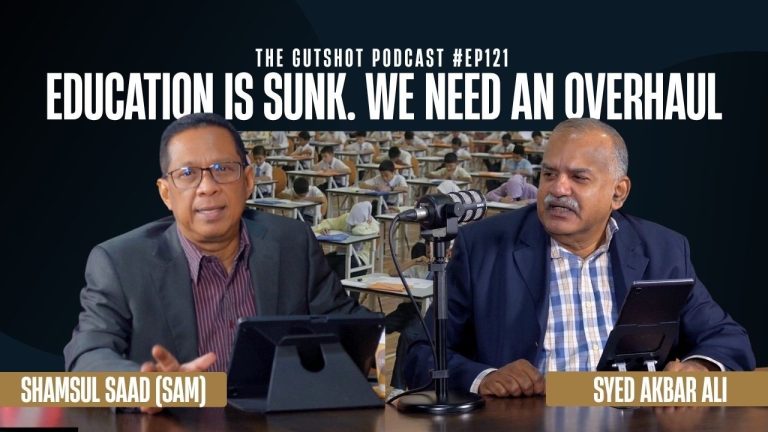
Education is Sunk. PISA 2025. SK is Basically Religious Schools. Overhaul!
Show Notes & Description
The PISA profeciency level on Malaysian students is not just dismal but it follows years of downward trajectory year after year. It is sunk. Our sekolah kebangsaan system has become a religious school system. And yet our MOE is in constant denial, putting lipstick on a pig.
In this episode we dug really deep on our problems. Malaysia's international position in science is 62nd of 91. Only 54% of Malaysian students reached basic Level 2 proficiency in Science when the OECD average is 74%. Only 35% reached Level 2 in Mathematics. Only 0.5% of Malaysian students were top Science performers at Level 5/6.
Malaysia is not merely behind Singapore, China and Japan but even Vietnam. Astro AWANI on 8 September 2026 interviewed Anuar Ahmad (Felo Bersekutu MINDA Universiti Kebangsaan Malaysia) was quoted that almost 96% of school-going children in sekolah kebangsaan are malays and their performance he participation sink below 10% within five years without major intervention in Biology, Physics and Additional Mathematics.
Here is stark data:
Sekolah Kebangsaan — Primary:
Tahap I Mathematics: 96 hours/year, Science: 48 hours/year, Pendidikan Islam: 96 hours/year, Plus 32 hours/year Tasmik.
Tahap II Mathematics: 96 hours/year, Science: 64 hours/year, Pendidikan Islam: 96 hours/year, Plus 32 hours/year Tasmik.
Secondary — Forms 1–3
Mathematics: 3.5 hours/week, Science: 3.5 hours/week. Pendidikan Islam/Moral: 4 hours/week.
Upper secondary: Mathematics: 112 hours, Science: 112 hours, Pendidikan Islam: 96 hours
That is approximately: Mathematics: 3.5 hours/week, Science: 3.5 hours/week, Islamic Education: 3 hours/week. Students also receive additional religious instruction through KAFA, Tasmik, state religious schools or other programmes, which is why an individual child's total religious-learning time can be substantially higher.
We ahould be spending double the time each week for science and math and not more than 1 hour a week for religious related classes.
More worrying is that 2025 Malaysian Education Statistics show that Registered private Maahad Tahfiz 1,067 institutions, 45,675 students, 7,741 teachers
The broader religious-school system 2025 KPM statistics also record: 279 private religious primary schools, 59,457 pupils, 5,159 teachers. 77 private religious secondary schools, 9,974 pupils, 1,262 teachers
And: 317 pondok/madrasah, 21,727 students, 2,394 teachers.
Is this rapidly expanding tahfiz sector is giving students sufficient academic and employment pathways or is it a pipeline for unemployment or non productive STEM and TVET capabilities to navigate the competitive 21st century landscape?
The modern economy increasingly rewards STEM + digital + technical competence. There is only 24 hours in a day. The more time one spend on doing something for expertise do more you become good at it. We are doing that for what matters.
We need to do a PISA Scores for Chinese schools, SK and boarding schools (sekolah asrama penuh) and have those numbers be made public separately for objective comparison.
Compare us with China. Chinese universities are massively restructuring degree offerings away from declining fields and towards AI, engineering and other technology-related disciplines.
The numbers are striking. Between 2021 and 2025: 12,200 undergraduate programmes were revoked or suspended. The cuts have been concentrated particularly in: Arts, Humanities, Foreign languages. 10,200 new programmes were introduced. The expansion has focused on: Artificial intelligence, Digital economy, Smart manufacturing, Big data, Robotics, “Embodied intelligence” plus Other technology fields.
More than 30% of China's university degree programmes underwent adjustment.
In 2025 alone, China's Ministry of Education reported 1,773 undergraduate majors abolished.
China is aggressively reducing university places and programmes in humanities and arts fields while rapidly expanding AI, engineering and technology programmes
The world moves forward. Malaysia is moving backwards. We need serious overhaul.
We Have a Country to Save
Jump to chapter 8 chapters
- 0:00 A Decades-Long Rot in Malaysian Education
- 3:50 Dismal PISA Rankings and STEM Deficits
- 15:55 The Monocultural Reality of Sekolah Kebangsaan
- 21:59 Exam Abolition as Data Concealment
- 24:14 Calls for Disaggregated Performance Data
- 34:03 Classroom Hours: Religion Versus STEM
- 41:33 China's Aggressive Pivot to AI and Tech
- 46:38 Demanding Transparency to Save the Country
Auto-generated from YouTube captions. Timestamps link to the video.
The rubbish is already under the cap until you get to SPF. After 17 years old. Yes. Until you are 17. Then you find out 25% have no basic reading and mathematic skills. Yes. This is what has happened. This is what is happening. Yeah. We already in the disaster. Yes. Right. The Titanic has already hit the iceberg. It has already broken into two. Okay. This is the problem with me education today. That's why you know that is why okay then we come to the second part of ladies and gentlemen welcome back to the gut short podcast. I'm Shamo Sam and with me aka morning.
Well we're going to have a conversation today um that you know got to address this elephant in the room which is our education system. Before I go there, normally I throw it to say to to start the whole thing. Today I'm going to start this ball rolling. All right. And the reason is very simple. Okay. I've been banging on this education for a long time. All right. And the PISA result which is basically PISA is short for uh the program for international student assessment which is carried out by the OECD. Okay. Okay. The organization um of uh economic cooperation and development. Okay. To
measure actually 15 year old students capability at that particular age in time. All right. So that's basically the PISA PISA's uh uh uh main um u uh uh crux of the assessment. However, before we go into Pisa, I want to tell you guys this what we are suffering today in terms of policy making, policy uh uh what do you call administration and implementation of all this in our government in our political system is the result of this education system that has been rotting for at least three decades. All right. We are seeing the result in our civil service in our political
system because those that has gone through this system are the one currently in the political system and also administration and also education. It is a vicious cycle. Okay. It's like that water swirling down the drain and the water is actually muddy and swampy. So ladies and gentlemen, this is why we are in the storm that we are in today. Say so this is our conversation and we are going to that pizza result first. Okay. Um can we talk about it from the point of view of first of all the science, mathematics and reading? Okay. Can you please can can you kick off on that? Yes, sure.
And how our uh positioning is with with that? Well, uh a few years back. Mhm. under previous uh previous administration I think under I think think during the time of Tani Mahidein Yasin as prime minister oh as education minister sorry we we had already been declining in our the annual pizza scores yeah it's not annual it's not annual I think it's bannual I can't remember but anyway our pizza scores were declining so we did the very Malaysian thing we pul we pulled out yes of the pizza thing this happened so about what uh 218 or something I can't remember sometime was 8 years ago but
right now the government has changed the prime minister has changed a few times and this present government has I think has decided to you know put us back into the visa assessment system and over the years uh that we were not participating I think the according to the the results our performance is um is still wanting I think in some aspects it has it has gone a bit deteriorated so for example Example you see our pizzas measure science and mathematics for 15 year olds proficiency proficiency. Yeah. So our we we sit in science now according to this thing uh we science
Malaysia's position is number 62 out of 91 countries our ranking uh so and then there's also scores you know Malaysia's mathematics uh science score uh is was they have a scoring system 419 the score for science 419 and our Our position is 62 out of 91 countries. So now here the top performers. 1 2 3 4 5 6 7 8. I've got the first eight top performers. Want to guess? China, Singapore, Macau, Taiwan, Japan, Korea, Estonia, Hong Kong. You got to be Chinese. So you see China, they their high score, they are the number one. Their score is 597 on science. 597. uh Malaysia was uh 41 419
419 so that's quite a quite a distance quite a gap number two is Singapore they are 560 you know their score so so we are we have a way to catch up it's not getting uh it is not we have not improved as much as we could have or should have and then you also have things like you know there's a OECD average you mentioned OECD just now pizza is part of the part of the OECD it's carried out by OECD Yeah. So, so they say things like only 54% of Malaysian students reach level two proficiency in science. For example, uh 54% the OECD average is 74%. So, the mathematics is is is worse. Only
35% reach level two in mathematics, level two proficiency in mathematics. Malaysians, the OECD average is 65%. M uh and then um only only 0.5% of Malaysian students were top science performers uh at levels five and six as a higher level. The OECD average is uh 7%. So these are the numbers. They're quite uh I mean they're not good now. You can do much better than this. I don't think I I think you're understating it. Say uhoh. Okay. It's not just it's just just not good. It's actually horrible. It's Yeah, it's horrible. We we are not doing as well. Other countries are moving forward, you know,
and they are and this is you don't go and prepare your your students or your your education system so that you will get a good grading in the pizza assessments. That's not how it worksh your education system must be up to up to standard up to markuh and then you will you will do well in all this assessment all the by the international bodies visa pizza this pizza thing is not the only international organization that does assessment on science and mathematics around the world I'm sure there are others but basically if you don't improve your education system or or you
let it slip you're going to go down the slope and this is what is happening uh I think in our scores, in our pizza scores. So you see, Malaysia is not only behind Singapore, China, Japan, but it looks like, you know, the 15 year olds in Malaysia, you're talking about proficiency. You're talking about basic proficiency. So it looks like our our 15y olds and maybe half or more than half of them, they are uh less than proficient. Well, here's the thing. Say, which is a bad thing. Yeah, it it is because why we are competing in a globalized world, right? Not that that
means uh um that means that even if you don't go outside and compete either in business or whatever all right the conditions in order for you to actually manage the country, administer the country, do business in the country, our pipeline of producing this human capital. Okay. Has deteriorated to the point uh you to give the audience uh the um the understanding of what it means when we talk about level two proficiency. You know level two proficiency is basically minimum baseline to for modern life minimum. Okay. So 54% of our pipeline of human capital cannot function in modern life
in terms of their proficiency to navigate. All right. Uh what do you call this basic requirement? If you go up uh to understand uh level level uh level four is at least you should have level four which is a strong proficiency you know then you can compete right. So, so you see uh this is in an age where you mentioned compete that mean our surrounding environment other countries other societies around us the technologies they are developing at light speed just last week a friend of mine who you also know he's a common common friend uh I think I know who you going to talk about
he's also an educationist he knows he knows nothing about music music but he had to compose a song for something that he's doing with his NGO and uh he went into AI he he subscribed to this AI music thing he paid like 48 ringit a month right and he composed a song with a entire band music heavy beat you know rock pop kind of music with lyrics in three languages just composed it and uh and the song is out and he's going to launch it soon. I've listened to it. It sounds like a regular, you know, pop song by a regular pop band. It's all done by one guy sitting at a at a laptop. Meaning that
singers, musicians, composers, people who write song lyrics, they all been put out of work. this friend of mine, you know, of course, okay, he has a PhD, but his his musical ear is like maybe like yours and mine, whatever that is. That's about it. Just just a regular guy. But he was able to compose this whole thing and put a song together with music and everything by just using AI. So you are talking about people who don't have basic proficiency in math, science, reading skills. What's going to happen to them? Yeah, we even the clever ones are being taken out by AI or
replaced by AI and things like that. You we have to learn we have we really have to learn new tricks. We are old dogs have to learn new tricks. What about these people who are like operating at below 50% proficiency in science, math and so many other things. What's going to happen to them? I know this is the thing the the thing is actually these are the one 54% below. What is the other 30%, that's my other question because the top performer is so low on our side already. Okay. Which means that uh our whole education system are either producing majority of people who are not capable
to navigate modern life and then probably a bit more uh that is that that can pass through. Yeah. So we we are in a situation where we are unable to compete as a country because our education system has failed. Our education system has failed. And then uh you see uh pizza is about science and mathematics. Okay. The profic proficiencies are dropping. And then we have issues in the country. There's a shortage of doctors. there's a acute shortage of specialist medical specialist surgeons and other specialist medical specialist is a big problem in the country. Now if your if your your
core foundation your your base population the future scientists and mathematicians and all that are shrinking or their proficiencies are dropping then how are you going to fill up those huge uh uh vacuum that we uh that exists in producing doctors, specialists, engineers, the scientists. No way you know no way. So how we going to achieve how we going to produce that Malaysia Nobel Prize winner 20 years 20 in 20 years last 30 years ago since last 30 years ago I mean it's not going to happen you see we we this will lead to other things we're going to have and then who are you
going to select from this shrinking base of science and math students to enter medical faculty engineering faculty you you are shrinking your your your population your student base science and mass student base who who are the the what do you call this incubators and and and the the feeding the the feed into the the university education system that is shrinking. So how how are we going to populate our universities and academic academics and all that with uh science majors people who study science. I I agree with you on that point that in terms of the skill based requirement
right uh on on the high end uh doctors engineers uh but here's the issue when I look at the numbers all right the thing is who are we going to populate even at middle management in our civil service yeah because because what say hold on because why when you say science and mathematic proficiency. Yeah, it's actually about thinking capacity. Okay, thinking capacity. When you talk about mathematics understanding and this one, no, it'll trickle down the line. It it'll go right down to the technician and the mechanic and the the the wiring fellow and the electrician guy, it'll
trickle down because when the science proficiency just keeps going down, everything else will will be pulled down with it. The average will be pulled down. The average in the country is called the dumbing down process. The dumbing down process. You pull it down. I mean, can you believe this guys? Only 35% only 35% reach level two in mathematics. What are they telling us? That means 75% fail. They don't reach the proficiency. Yeah. Okay. And you you talking about minimal standard to carry out mathemat mathematical uh uh uh capability to function. We are in trouble. All right. But
actually the trouble did not start this year. The trouble has been going on the last three decades. This is just telling you that is why I say I keep telling my friends you know where this trouble started when you put a Sastra graduate as education minister by Dr. Mahade. All right. Okay. Okay. I I want to I want to move on from the Pisa score. Yes, please. Uh about about 10 days ago there was uh some conference about education and this is concerning Bingutra. I mean the conference was organized by Samuira outfield. Yeah. So uh they invited a guy I think his
name is professor Dr. Anoir Ahmed from UKM to present a paper on the on the basically on on the status of education in the country. He did a very good job. I read his uh I read about I I read the reports about what he said and uh it's even more I mean it's it gets sadder. So he okay he spoke about Bumiutra students focus on Bumiutra Malay students. So for example he said that you know in our scholabangan systeman is a government national school system right uh 96% of pupils now are malaying it's almost 100% you know so the enrollment of non malaise in school has it's only about 4% according
to him shrunk less than 5% are nonutras uh and then uh well meaning that it it has become a mono mono monoculture, mono ethnic kind of a situation in skag in a country which is still basically very multicultural. So that itself uh is not it's not a well it's not too good but anyway he says uh there are other issues with scholang you know you have things like crowding overcrowding in classes classes have about 50 pupils per class I mean this has been the case since when I think you and I went to school when I went to school we always had 50 kids in the class you know yeah
it's always since I was in center one probably had about and a standard one you're looking at at least probably 40 I don't know I mean my my memory is not serving me that right and then uh professor Anoa Ana Ahmed he said uh Malaysian teachers spend more time in school than teachers in other countries you know but the actual classroom teaching time is low because of various factors you know there are admin admin administrative issues and then they are outside the classroom duties and things that they attend things like that. So the actual teaching time actual classroom teaching
time is uh quite low. All right. So he I mean he's academic so he gave some some facts and figures. Mhm. Uh he you know he said that because of that the the so the the people who suffer are the students the school kids if there's not enough teaching time in the class so he gave an example of uh in Joho there's a Fela Felda plantation area where out of uh 100 SPM candidates out of 100 now this is his own research research or he got it from somebody Uh this is not official figures but out of 100 SPM candidates according to professor Anoir uh 25 of them could not read and and
calculate properly what you said just now the basic proficiency this SPM level these are 17 year olds who are leaving the school already and they'll be going into the workforce you know 25 that's 25% 25% were in quite bad shape cannot read and write uh uh uh you know properly cannot calculate now I'm asking about the remaining 75% what is their proficiency the 25% are like me totally outlaw of the remaining 75% I guess they'll be the clever ones but maybe I don't know how many% I'm I'm looking those people in between their level of proficiency is not exactly great
so you're looking at people who are basically not equipped to go out and get a just a basic job that requires some reading, writing, technical skills, scientific skills, uh 17 year olds, 18 year olds, uh they at least from this part of the country, they they fall extremely short. The scholangan system falls quite short. So it's not giving our kids the future that they deserve. And then uh the more alarming thing that professor Anoir Ahmed he said is that you know we have the streaming system in Malaysia the science stream and the art stream. Yeah I think it's still still in force in
Malaysia now um in 2010 he says 30% of uh I think he's referring to Bumi kids they were enrolled in the science stream. All right. Now today is only is down to 15%. Wow. 15% of our second scholar Kabanga students are in the science stream. And professor Anoa's projection is that in another 5 years the percentage of students in the science stream will be below 10%. So to me this is u this is disaster bro. Yeah I I can tell this is real disaster. Yeah. Yeah. We we are we are not heading for disaster. We are already in a disaster. And then and then we did really to me
quite ridiculous things like we abolish the exams. We kept abolishing the exams. No more SRP only SPM and there's no more exams in the school system. It's all this what something classroom assessment they don't even have. I heard latest that there's some kind of a exam they have put back for senate for dyat pupils but I I don't know how whether this is something new or permanent or whatever but maybe they're experimenting but bottom line is after we cancel all these exams and cancel everything the UPSR the PMR the school exams and everything I think is the thing is getting worse
no the reason why they cancel this is typical of a society where they think this is where my problem with affirmative action comes about. This is the result of it actually because why you end up um uh what do you call trying to meet a certain quot that actually you cannot meet because why? because you are just chasing the quota to let to let it go and then you your your your capability decline and when that declines you realize that your KPI cannot be met and then what you do you have to actually uh sweep it under the carpet and the way they sweep under the
carpet is actually abolishing the tests. Okay? So when you have no more test, you cannot find the rubbish anymore. The rubbish is already under the cap until you get to SPS 17 years old. Yes. Until you are 17. Then you find out 25% have no basic reading and mathematic skills. Yes. This is what has happened. This what is happening. Yeah. We already in the disaster. Yes. Right. The Titanic has already hit the iceberg. It has already broken into two. Okay. This is the problem with me education today. That's why you know that is why okay then we come to the second part of
professor Ana Ahmed presentation which I found particularly interesting. Now he says correctly you see all these like pizza scores for Malaysia and all that there's something very glaring. This is an average score for all Malaysians. But we know in this country that we have multiple education education uh school systems in the country. You have school, you have uh Chinese school, Tamil school. You have international school which is actually just a camouflage for English school because now we have international school. The students are all Malaysians. So you have private
English school, let's call it and then what else? You have the religious schools, right? Tapis cola tough. Some of them are pure ties that means only this religious classes. Some of them have a mixture of religious education and the regular preparing students for the SPM. They have a mix but uh how many is there? We have five already five different uh uh systems you know and then oh yeah you I you must not forget the uh boarding school system. I consider the boarding school system also a separate system. A separate system because some some of the boarding schools they prepare their
students for you know the O levels and the bakalorat exams and all that not our SPM. So okay we have all these different systems in the country. Uh so uh professor Anoa he raises the right question. The pizza scores for example, it is an average figure for Malaysia. But you know that in Malaysia we have the Malays, you have the Chinese, the Indians. We don't have figures on how are the Malay Bumutra kids doing in their science and math. How are the Chinese kids doing? How are the Indian kids doing? How are the DA the DA and the Iban and the Dun people doing? And he says before in the
70s we had these figures but for the last as you say the last 20 30 years they try not to highlight those things because I think the the fail because it's quite disastrous as well. So like for example when you say the pizza scores Malaysia and we already dropping our pizza scores are poor what 419 for science that is the overall figure for Malaysian the Malaysia anti Malaysian school system. We want to know how the scholabangan is doing the the Malay buutras are doing how the Indians are doing how the dias are doing how the Chinese are doing. We want to know so that we can compare
uh these figures we don't have. So if you go into uh I mean looking at those who perform poorly let's talk about the the Malay bumla. If you go into the Malay Buming Budra community and look at how their performance uh I think the the numbers would be even more horrendous uh dreadful just trying to be so we don't know so so professor Murat professor Ano Ahmed he says Ahmed he says that uh we don't have this this breakdown they don't give it to us they may have it the government may have it but it's not made known but we have to know these figures otherwise how do you repair the situation?
Correct. Because uh it's like you bringing the car uh or or you go to a doctor and you got you got a uh you you have a disease. Uh but the doctor does not cannot do any analysis on your uh putting on on your body. You don't even know where actually your disease is originating from because uh the different school systems in the country they have different levels of proficiency. Uh you take the boarding schools, they're all the smart kids, right? So they will do better. Okay, fine. Because you collect all the smart kids and put them in one school. Uh you have the Chinese school system,
they also they may have I think they have a higher level of proficiency. uh uh there's also uh other scores uh on science uh for Chinese primary school science and math uh where Chinese schools government schools and Tamil schools the highest is Chinese school and then followed closely by the Tamil school and then followed by the government school at one time the Tamil schools were the highest in science and mathematics. Wow. uh yeah I think they still are but this particular gradation puts Chinese schools Tamil schools and uh scholar primary level primary level so uh
meaning that the level of proficiency at these different school systems including scholar including private so-called international schools they're actually just private English schools taffy schools the proficiencies are different so we have to because we have all these systems we no choice. We have to manage what we have. So we have to know what is the achievement or what is the level of competence of the students, the teachers, the entire system in all this across the board. You present just one figure, Malaysia achieved 419 score signs for pizza. Uh to me it doesn't
mean anything. I want to know where does that figure who's behind that that figure because it's not the same throughout the country. So meaning that you know we are in the we are still in the process of nation building and we're building up our country you see from ples to sabah we're going to build up our country uh it it is not happening at a at the same pace or on on a really fully equitable base there are differences between west coast east coast sojung and sabasarawa uh urban area rural area Malay Chinese Indian all these are differences so to be able to to craft the correct kind of
solution to to fix a problem to move all our people forward we need to have all this information which we don't have. So um if you shooting in the dark uh if you're shooting in the dark by just quoting one figure as though it represents everybody equally you know with in equity which is does not here's the problem right you and I are talking on this and giving our concern okay our minister of education instead is is giving excuses all right why uh the pie score 2025. All right. It's not all bad. All right. So, she's putting the lipstick on the pink as as as as what we
we call when we were in university in the US. Let's let's put it this way. Uh the glass the glass is less than halfway down. Uh but so she says it's one quarter full. Yeah. Oh, it's okay. That's a different way of looking at things, you know, and and and and and she can come out and say some more, you know, more to Pisa score that dumb and ranking. All right. Apparently, she says and they uh the teachers tend to be more uh helpful to the students and all that. I tell you what, guys, I tell you something about that. All right. We are also spoon feeding. That is one of the other thing that is
happening in our school system. We are not teaching them to think. We are just spoon feeding because why? They want to show that they can get examination results and the result is not good. Anyway, I am not going to comment about the minister. Okay. So, but you see if I if I can finish your point that you just made. Yeah. Uh they they are parallel universes. Yeah. Or people live in their own reality. Wow. So see they are so they they are parallel statistical universes. My figures show like this, your figures show like that. You know, uh they I mean how much time actually
you cannot you cannot use you cannot use uh two different figures or two ways of asset two figures uh as though they describe the same thing. That's not the conclusion. That's not quite possible with respect to how we should have break broken down the the the data. Uh so as you say she says the glass is half full or one quarter full but you you are saying it's three quart. So so well that's both ways looking at the same thing. But is it the same thing we're looking at? I don't think so. So then let's go to another thing. Why? because and this is why I think when I talk to Chinese parents
it's a typical this one why they don't send their kids as much as possible to scholar that's already you see number one reason I say yeah yeah is actually the prevailance of the religious education and religious inu influence within the school system they want to stay away from that because it takes too much time and therefore when you are teaching the Malay student the Chinese or the Indian student or the non Malay the the non-Muslim student okay is left out okay from what they should be actually learning okay you see we want our kids to progress we want the country to progress
we want the society to be to progress as the major majarak science and technology all those things but doesn't that depend on on what you learn what you study and learn at school so you see for example uh I did some googling in our schooling system tahab satu is I think primary one math is it or mathematics is uh 96 hours per year Right? Science is 48 hours per year. Punitan Islam is 96 hours per year and uh then you have something called tasmik uh it's about 32 hours. So it goes on in secondary forms one to three uh you have uh mathematics 3 and 1/2 hours a week,
science is 3 and 1/2 hours a week and pun Islam is 4 hours per week. All right. Uh upper secondary back to on a yearly basis. Mathematics 112 hours. Science 112 hours on a yearly basis. Benedica and Islam is 96 hours. So you see the religious education is a huge chunk of the time of the time. Now I want to take uh at the same time I want to compare with a student in Singapore, a student in Vietnam. These are the people who are scoring big on the pizza just now. a student in Macau or China or even a student in our Chinese school system in the country that 96 hours
they're not learning religion what are they learning yes 96 hours you know you see you in upper secondary from 4 from 5 112 hours math 112 hours science 96 hours that's about okay about a third study less than a third that third in the other countries and in the Chinese schools and other systems in the country including the inter private international schools in this in Malaysia that 96 hours is spent studying what they have to be studying more of science and math and whatever is relevant for their education. Yeah. So meaning that the scholabangan kids are always onethird behind in
science and math and other what do you call secular subjects the the the the phrase that you know the haram so meaning that if you are running in a race in the Olympics uh everybody else is training and running let's say you know 100 hours they are training and they're going to run this race in the in the 100 meter race in the Olympics Then there comes these people from this uh this for example I'm just using analogy the Islamic system uh they wear sneakers everybody wears sneakers but these guys wear sneaker one sneaker maybe the right leg or the left leg it weighs 5 kilos
you see then you start running so you you you have that thing holding you back you see so everybody else runs you know they have a fair chance equal chance they have training they everybody trains but they're weighed down by anything. But here you're losing 96 well I use the word losing losing 96 hours from studying mathematics and science and other subjects which will get you jobs will make you fit into the economy the real world yes you can pack your bags and go to Australia and look for a job there or you can go to Singapore and work there or become a manager somewhere in UK or
anywhere in the world or even in Malaysia work for a multinational you deny about yourself one/ird of that opportunity you know visa v the next student or child in uh Singapore, China, in a Chinese school in the private international schools in Malaysia uh you you shackle yourself you you wear your running sneakers one of your running sneakers weighs 5 kilo you think about it right actually when you you are taking the uh because it's all about how You use your time. Correct. And you are taking actually that number the top number which is when they older. But I am actually when I
look at that statistics I am looking when they young when they in primary school. Oh it starts there. You're right. Yeah. So when they in primary school as you mentioned just now if 96 plus 32 you're 122. Yeah. Plus the tasmic plus the tasmic you know and other activation even after school hours. So uh youund uh you know 100 plus 20 plus hours is given to religious education. Okay. And you are only 48 hours to science and then another 96 hours uh you know both science and mathematics is lower than religious. Let me finish your point. Students may receive students Islamic studies. Students may
receive additional religious instruction through kafa tasmic state religious schools or other programs. Which is why an individual child's total religious learning time can be substantially higher. There only 24 hours in a day for you to learn skills and knowledge to progress in this life. Okay. What what what you mean is secular subjects but things that will get you uh engaged and involved in the real world in the economy around you in getting jobs in becoming an entrepreneur in creating jobs in in creating technology in uh creating new ventures. So uh you are limiting yourself visav I always
keep repeating visav comparatively to the next person the next child or the next kid in school uh in in in your neighboring country in your in your other school systems inside the country you know so you are continuously at a disadvantage because that much of time they spend learning other things which get them ahead. Yes. So we end up already this pipeline of human resource has been going on for you know 20 to 30 years. Okay. This is why we have the quality of uh governance the quality of policy making at such a terrible level. So I'm not and also teaching because this pipeline
is also producing people who are going to teach. So I'm not going to talk about the ti schools because we're talking about scholangan here these figures about the 96 hours in religious education. This isangan if you go to scholatafi and all that of course the difference uh is going to be a lot wider. It's a it's a different different un different universe by themselves you know. Yeah. But anyway can we close our conversation? Yeah. Uh we have to compare we have to compare ourselves with other countries. Uh uh you see the China Chinese uh China is taking the bull by the
horns. They already ahead. They are number one in the pizza scores. Pisa is run by the OECD and not by China. And they have ranked China as number one in this world. A country with 1.4 4 billion people across mountains there's this as wide as a continent they can be number one in the pizza scores as obviously they're doing something right but the Chinese are not sitting on their laurels or sitting on their backsidesh they are continuously uh changing now for example they are focusing a lot on STEM to the extent that they are converting their university education
system away from the traditional subjects you know humanities everything included they are moving towards STEM so for example I have some numbers here between 2021 2025 this is a new starting in 2021 they uh 12 over 12,000 undergraduate programs in Chinese universities were revoked or suspended they are particularly in the arts humanities foreign languages things like that on the humanities side they They have introduced over 10,000 new programs uh uh in their university system. This that means degree and degree focusing on artificial intelligence, digital
economy, smart manufacturing, big data, robotics, embodied intelligence and all these technology fields. So um apparently about more than 30% of the China's undergraduate degree programs have undergone this adjustments. They are focusing all out on STEM. All right. Uh so there's there's this communication university of China abolished 16 majors including things like you know translation, photography and and things like that. Sichuan University abolished 39 undergraduate MA majors uh in the humanities and and the arts. So um in 2025, China's Ministry of Education reported 1,73
undergraduate degrees were abolished in humanities and arts. They So they are moving away from because they can see the future. Yeah. They they can see what is going to happen in 5 years and 10 years. They're preparing for it. We are moving backward. Now these are university students. These are not form five. I know 25% cannot read and write. These are Chinese universities. They're already the top of the top. The people get university are the cream of the crop there. But still they they are overhauling it. Correct. At the highest state. What did we do? Do you know how many Islamic
universities we have in Malaysia? Say guys, do you guys know how many how many Islamic? There are six. many nam okay nam even one of them is called University Science Islam I don't understand that that's such a that does not make sense to me is it oxymoron yeah there you go so you see uh uh this is what other people not it's not just China a lot of other countries they're they're changing and they're keeping up because the technologies and are evolving so fast artificial intelligence is here it's like unbelievable believable what artificial intelligence going to do in
the next next one year or two years it's like massive. Uh are we preparing our our next generation to keep up with all these changes? Obviously not because our basic education basic skills that should come out of education reading skills, writing skills, basic mathematics skills we're going down. We're going down and uh and we have we are going down is one thing. Uh our own government is not recognizing that that we have a problem and are not proposing any any initiative to actually correct this problem that we face. And then we have this uh this ever ever everlasting or perpetual thing
about the the differences between Malay buming between Chinese and then the Indians you have the the Ebans and then you have the Duns we are not we are not doing things effectively to create uh a real average or or to bring up to bring up averages. In fact, what we're doing is is uh bringing the average down for everybody. For everybody bringing down the aages. Yes. That's what is happening in the country. Yeah. So to map the whole to to to to put a pinch on this guys. All right. you I think we have talked about this in probably more empirical data uh uh conversation than uh
than what we want to talk but then again we got no choice because why the data that we have presented to you guys already show that the Titanic has sunk so I if I may want to close my yeah please let's close it I want I want to appeal to the Malay community because they are so vital. It is so vital that they understand this and the Malay community must start demanding. Uh first of all be honest, be transparent. Show us the real figures. How are the kids really performing? I want to know the passing grade for you know what we discussed before. Yeah. SPM grades. How do you grade the ma
additional mathematics, the science, the chemistry, the biology or whatever are English? What are the passing grades? What are the failing grades? How many points you get a distin distinction kapu? And then how are the are the scholabangan kids performing across races across regions sabasawa east coast of Sanjong west coast urban rural we need all this information you know and I hope the Malay community especially the the opinion leaders among the Malay community the intelligence yeah we really need this information you we have to start pressuring the politicians the the government whoever
who who now keep changing and they don't last more than one term. We have to keep pressuring them to be honest and transparent and give us as much info as possible because only then people like this professor Anoa Ahmed the guy who delivered the paper they will know how to sort it out because they are the they are the content experts they are the experts in education. So if they should know we have enough skills in this country to fix our problems. The thing is the politics and these other vested interests, they are the ones who are the obstacles. They are standing in our way.
If we have all this information, all these things made known and transparent. Our people, we have enough smart people in the country, we will know what to do. So that needs to be done. So I hope uh Malay viewers who are listening, you really have to start this conversation going among the Malay community and start doing the right things, asking the right questions. Yeah. Otherwise there's going to be a there's going to be a major cost. There's going to be hell to pay. Well, hell has already arrived if you ask me. Okay. So to to close the case uh to close the the uh the conversation for
today, hell has already arrived. Okay. Um the climate has actually already changed. Okay. And yet the government that we have is refusing to acknowledge the problem. How do you then solve the problem? The governments that we have had. Yeah. The governments up to today all of them. All of them. All right. So ladies and gentlemen, we really have a country to save. Thank you so much. Thank you.