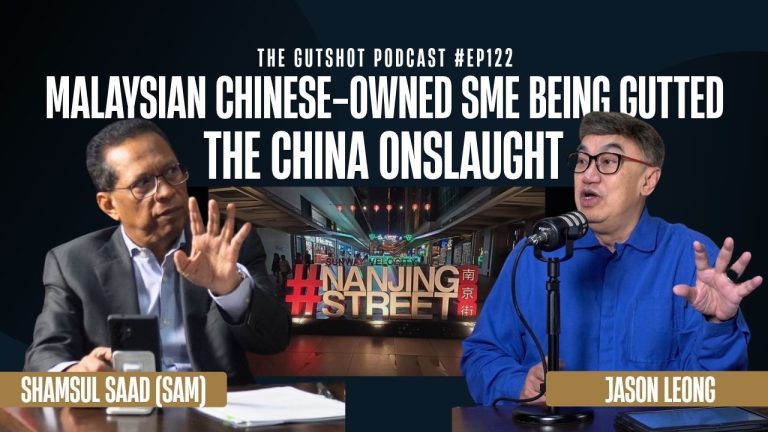
Is Malaysia’s Chinese-Owned SME Being Killed By The China Onslaught?
Show Notes & Description
We're joined again by our geopolitical and economic consultant to governments and corporations, Jason Leong. For weeks we've been discussing signals from the ground. Those signals have now become a five-alarm fire for Malaysia's ethnic Chinese community.
Malaysia's private-sector economy is largely driven by ethnic Chinese businesses. Unlike the GLC/GLIC ecosystem, it has none of the protection that bumiputera monopolies and oligopolies enjoy. Retail, mechanic workshops, construction services and supply chains, F&B and other service businesses are not abstract figures on an economist's spreadsheet. They are livelihoods that have survived for decades, employed workers, paid taxes, supported families and funded the education of the next generation.
Now a wave of imported competition from China, at scale and at cut-throat prices, has reached our shores with devastating effect.
When businesses across very different sectors begin telling the same story at the same time (vanishing margins, slowing customers, rising costs, price competition that cannot be met and a daily struggle to survive), we should not dismiss it as a series of isolated failures or a lack of competitiveness.
In this episode, we unpack the damage to Chinese-driven SMEs in both macro and micro terms, calmly and without sentiment and made some policy recommendations. We examine why, however efficient our supply chains become, resistance on scale alone will be futile: massive state subsidies, fierce internal competition within China that no other country can replicate, and a capital structure built to chase market share at any cost.
The official macro numbers may not have captured this yet. Perhaps no one has measured it properly, or raised the alarm. But the signals are real. By the time everyone agrees there is a crisis, many of these businesses will already be gone. If we fail to recognise the systemic forces behind China's global dominance and act accordingly, we may be witnessing the beginning of the end of a traditional, generations-old Chinese SME ecosystem.
We Have a Country to Save.
Jump to chapter 8 chapters
- 0:00 Introduction: China's Economic Strain and Malaysian SMEs
- 6:22 ACCCIM Data: The Ground-Level SME Crisis
- 11:13 Direct-to-Consumer Platforms and Vanishing Supply Chains
- 17:12 The Structural Scale Disparity and Deflation Export
- 26:06 Loophole Exploitation: The Fall of Local Steel
- 34:55 Commercial Property Displacement in Johor
- 47:05 Policy Remedies: SME Impact Assessments and Tax Amnesty
- 1:08:15 Geopolitical Pivots: Partnering with Japan and Taiwan
Auto-generated from YouTube captions. Timestamps link to the video.
As usual, Malaysia is always the one that is uh sitting nicely in the like frogs in boiling water. You know, we are always behind the curve. You know, our politicians and even some of the ministers are still under the impression uh that China is a very important trade trade partner. Yes, at one time China was the number one trade partner. Yes, that was 2024. If you look at last year's that 25 and 26 that uh China FDI has actually gone down they are now at number four the number one why is that because China no more money they cannot afford to invest anymore you know they
need to feed their own people they are running out of money so the the our own they not collecting the money they've invested in all the bricks uh what do you call the BRRI uh what do you the BRRI investment, the Bandong to Jakarta Puna line is not making money that the Indonesian government has to uh has to rescue it, you know. Yeah, they can't pay but they can't get paid. They can't pay. So, they will probably end up selling the whole line. So, the infrastructure will eventually belong to China. But this are hard assets. It's not cash asset. At the end of the day, hard asset doesn't give you
back your cash. Yeah. You can't get back the cash. So, China's uh BRI strategy is not exactly that that successful because they're not getting that money back. Ladies and gentlemen, welcome to Gutshot. I'm Sam Shamsul, your host. Today with me back is uh my friend Jason Yong, who's basically uh our resident consultant. not just our actually but he consults for the corporate sector and also for the government uh on various issues on geopolitics and economics. Um so welcome Jason. Welcome. Thank you very much for this opportunity and looking forward to this session. A lot of things to say.
Oh excellent. Good. Good. Yeah we have a lot a lot of things to say. Actually we we want to get into this conversation. Um I I'll tell you how how this conversation came about in terms of um uh my discussion with Jason and um and and and what I was thinking when I said to him we need to talk about this. Um I am a member of the Kiwanis, one of the branch of the Kiwanis club and uh being in the private sector right most of uh my colleagues, peers um uh either well the bulk of them are ethnic Chinese nations. Okay. And the Kiwanis we just had a meeting the other
day, right? And uh all of them I would say are basically either retired or are still currently doing umme businesses. So the the the point I'm making is that theme businesses in Malaysia which is private sector driven which is the bulk of our economy is uh driven by our ethnic Chinese community. Okay. Um but there is a big looming problem that we see uh not actually just appearing but has already came to four uh much earlier but currently are gaining very very big momentum. Yes. Um uh which is the invasion of uh uh businesses uh coming from China. Yes. It comes in various forms. I think
we're going to talk about one of the sector that has practically been dismantled um in Malaysia which is the steel manufacturing sector. I think we can we practically don't have a steel manufacturing sector anymore. Yeah. Um the other part that we're looking at are also um mediumscale manufacturing. uh I was with a CEO of one of our uh manufacturers and uh even for export purposes they cannot compete. Um the other part that are uh that we are looking at is the retail sector is about to be gutted out. So is the FnB sector and property sector we feel is going to be crowded out and
going to get more expensive where actually our operators are not going to be able to afford uh properties with respect and these are not specifically um what do you call really the contribution to the GDP at 6% supposedly right our our topline GDP is quoted at 6%. I don't think the people um at the ground level are feeling any improvement in their wages. So there's a very big disconnect between um GDP figure uh FDI figure and actually a hollowing out of our um theme sector. So uh without me going further um Jason I throw it to you. Um can you let us into what you see as the core thesis
from your side? I've done my research on this side. I think you've done your part on this. I'd like to hear your part first. Yeah. As you know uh we we I I think it's important for people to know this is not an anti-China or geopolitical discussion. This is a very much a discussion about the situation that that ourme facing. Yes. Yeah. So get that very clear in your head. Yeah. Because we want to discuss how Malaysianmemes can be protected against this onslaught of competition coming from China. So protecting Malaysian SMMES mean protecting basically 90% ofmemes which are Chinese owned.
So this is going to impact a lot of the Chinese businesses as we know that the Chinese uh community owned uh 90% onwards. Now just start with the data from ACCCM the associated uh chamber of commerce and industry in Malaysia. They did a survey not too long ago and among their members, you know, they have 17 other chambers under them and uh they have over 20,000 businesses under them. It's a huge chamber. Is this like a umbrella body and 82% of their members say that they are feeling the intense competition from China. 82% 82%. That's no joke. That is no joke. So every one of them is
feeling it and uh 42% of them uh 48% of them say uh that the prospects for the future is actually quite dim. They don't think they can withstand uh that kind of onslaught in terms of the competition. So here you are you know if there is nothing much that you can uh you you see the competition coming so we need to have some solutions at least some suggestion of how are you going to combat this competition. Yeah. So whether you can delay it, whether you can overcome the competition or what else that you can do. So this is what our discussion is going to be all about. U Jason
here's my other thing that I thought about in my own um analysis of looking at things. Let's be very honest with ourself. Um we know that government procurement unless you have an Alibaba outfit. Yeah. Okay. You're basically as far as our ethnic as uh Chinese and Indian which is a smaller part of it all rightmemes you're going to you're not participating in government procurement right the GLC GLIC ecosystem is very much a bumutra ecosystem right where the uh uh either there is u uh there is uh you know who connection involved um and um and or you have a a major bumra ecosystem within that
compared to the uh private sectorme business that we are talking about. So your the core ethnic Chineseme business is the one that is truly in danger in terms of survival. Yes. Yes. Yeah. Exactly. Because uh this strikes at the very heart of the economic backbone of this country which ismemes and uh that is also basically the Chinese economic backbone because most of the Chinese families which are either old family money they allmemes. So this is where these are not billionaires. This is what people got to understand. These are not billionaires. These are small medium enterprises.
Yes. So mom and pop kind of shop. Mom and pop kind of shop. Family businesses. Yes. Family businesses. Uh and uh they they are okay. Maybe fairly comfortable but this comfort may now be reduced to a large extent when you have this kind of competition where they are in no position to compete. Oh yeah. I I would say that actually if we take the big industry which is actually uh uh corporation right corporations they are uh they are really few and far between as far as Malaysia is concerned right within the within the private sector itself most of our private sector is u most of our uh
u um big uh big corporates are GLC based Yes. Yeah. So the the the pressure that is coming in that don't have this monopolies or oligopy okay are going to be our traditional uhme ethnic Chinese uh community. Yes. So this is the danger sign we want to tell everybody. Okay. Um and you know here's the funny thing. Let let's just give them just give him because a lot of people seem to think that um when the FMB sector or even the retail sector you know people buy you got corner shops you know that those are going to go with you know with the uh with the pino or the tu
and whatnot. What they don't realize actually all of these are coming straight from China. China direct. Direct. Yeah. Because China is now doing direct to consumer. Number one. Yeah. Number two, they're not paying the taxes. They're not they're not paying the taxes that are contributing towards your uh infrastructure, your welfare system, your healthare system, your education system, your road works. I mean like Pindoo they are doing direct to consumer. That means you order everything online. The factory from China sends it by Korea directly to you. The company Pindooo is basically
headquarters in China. They may have a small operating office in Malaysia but what is there for them to pay tax because all your money your payment the income is made in China. Yeah. So and Pindooo for for for a lot of people who don't understand the the the sheer scale of the economics is that Pindooo has a cash reserve of 50 billion US to fight this. Yeah. Which in Malaysia has that kind of cash reserve and you are no match for them. You see previously our small businesses you are like a importer of certain goods. China man business. You import and then you act as a wholesaler or you
appoint a wholesaler to become your your representative to to do the wholesaling and then from wholesaler sell to retailer retailer then sell to the consumer. The whole range of each of them will make their own money in the in in terms of the they like the middleman. But today all this is wiped out. Wiped out. No more. Yeah. Factory sell to customer and they just change the rules. Last time Pindoo say you must have minimum buy. Now no more. Yeah. You know you can buy one item even though it's 58 they will still cate to you. Yeah. Terru loses about US $30 per ple but
they have got cash to burn. They don't mind losing. You know the other thing that I think people must be I think to put things in frame right I don't think I've done a a bit of analysis see whether you agree with me um I think the only country with a scale that can uh compete with China if they ever get their act together and I doubt they'll ever get their act together because of the diversity diversity of uh uh of that one country which has probably 200 languages is India. Okay. But just to give you the scale of why you will not be able and this is a global problem. I want people to
understand so that take a deep understanding of how we're going to open the layer of this onion until the end of this podcast. Okay? because this is very important to understand one. Okay, remember this. Yeah, according to the department of statistics in Malaysia, okay, our wages is roughly at about 3,167 ringit. Our median wages monthly. Okay. Now, let's look at uh let's look at China. uh median wages China median wage their median neo nationwide is about 3,000 remimi per month that's approximately 425 to430 uh dollar per month okay now
compare that to real median monthly wage in Malaysia that number is 3,000. I give you the higher number. There are different number that are given out by certain economic uh this one approximately even at a low number of 2,100 per month. You know what that is? That is $495 per month. That means okay China is earning less the average worker is paid less money than a Malaysian worker. That's number one guys. Okay. Number two, do you know how many uh uh what is China's uh uh population of worker or gas? How much is the how many is employed workforce in America uh in in in China?
725 million by their own statistics for 2025. Okay. 725 million. Okay. Now European Union and Brazil. Okay. European Union has 221 million. All right. Brazil has 171 million people. Total workforce. I'm talking about total workforce. Okay, those are European Union and Brazil. See how even the European Union and Brazil will never be able to compete on scale. So don't even talk about how efficient the the the the supply chain mechanism that they have. The sheer number of people already allow them to have efficient supply chain. Yes. Okay. Because it's concentrated
in each one city has got enough to produce the same thing with the same supply chain. Okay. Malaysia has a mega 17 million three 17.3 million workforce. How do you compete in terms of scale? There is no competition. You couple that with how much you pay uh your worker compared to ours and we are complaining that our wages are stagnating. Yeah, we are complaining our wages are stagnating, Jason. Yeah. So how much do how do you think the average actually Chinese uh workers are complaining about their wages technity? I bet you a lot more than us. The problem is is we see these gleaming
cities infrastructure we think they're doing great. Yeah. There's a bubble. You want to expound on that? This is the what you call to me. You said the uh the domestic crisis of ex of exporting their deflationary spiral. Yeah. Can you can you explain that so that our viewers I mean beyond the gleaming cities that uh makes very nice for all the tourist website and brochures and all that you travel like 50 kilometers out of that city and then you will see the rail side of China. M so that is just one aspect and the workforce that you were quoted just now 700 million people working uh
we know that the unemployment rate uh China do not publish very reliable statistic and data uh so the unemployment rate can go uh as low as 5% uh to as high as 25%. at the current number it seems like uh they are look they they publish 3.2 to 3.5% I believe 3.2 so 3.2 to 3.4%. And then uh but the published number for youth unemployment is in excess of 15%. Yeah. Right. So but but just thinking about that number alone I give them give their statistic 3.2%. Their statistics of 3.2% uh is is about out of that 700 million uh employed people. When you look at 3.2 you are looking at uh 24.6 million
unemployed people. Yeah. 24.6 6 million unemployed people that is larger by 7 million of our own employed people. How do you compete guys? Please explain to me. It is already very close to our population of 34 million. All right. So 26 million people are unemployed. Th this is where the trouble starts because Chinese factories in China have to keep producing at all the time because their machine and production must continue. They can't stop producing. The moment they stop everything is going to be jamm up. There will be massive unemployment and if massive unemployment
there will be riots in the street. They can't afford to have a social unrest. So they keep producing. So excess capacity no matter what people say is a very real thing in China. Yeah. So if they produce a lot of stuff in China and now they have got 24 million people unemployed without money without income how are these local people going to buy those stuff that they have produced in China? You you you know Yeah. And that is the reason why consumption in China is very low. very low because they don't have the money rich. They don't have money. Uh so all the
goods that have been produced there are basically sent out here. We are now the one the consumers helping to basically take up this excess capacity and it's swamp. That's why the the goods are so cheap because it's it's also the other problem as you said they have to keep on pumping this over capacity. Currently China is producing 30 30% of global production. Okay. And you must understand why this has happened. You know actually people don't get it in a country like ours or a capitalistic country like ours. Okay. Uh where the private sector allocate the uh I'm not
talking about the GLC GLIC system which I spoke with Dr. Paris Gomez. All right. Where we have really truly misallocation of funds. Okay. We're talking about in the private sector. In the private sector itself, you have to allocate money where you can make money. Yes. In China, their main priority is every province, every official in each province or in the mayor of each city must have one of their big one of their the top priority criteria is GDP. Now their GDP target has already been reduced because they cannot meet that 7 to 8% target. They've been reduced to 5%. But you know
what GDP means? If I if I correct Lubang that's GDP the cost of it is GDP. If I come the Lubang that's also GDP and I correct the Lubang again it's also GDP. All right. Okay guys, that is why on our side of the domestic pawn, we said the FDI that comes in for data center that brings this this uh our FDI to 6% GDP growth means nothing to the wages. Yeah, exactly. Because it doesn't translate to the wage and the same is happening in China in a different way. Yes. Uh the definition of GDP is actually quite strange. It's activity. Have you heard uh what Alon M say about GDP? uh
uh recently he said you know he he told a funny story right he said economist A and economist B were walking uh and economist A told economist B say there's a uh there's on the ground I pay you 100 ringit and you eat that and economist B says sure I'll eat the give me 100 ringgit and then they walk further down and economist B saw another pool of you say okay now your turn. I'll pay you 100 ringgit and you eat that Which economist a also add the And then they look at each other and say, "Hey, between the two of us, we just created GDP of 200 ringit." Exactly.
And it's a shitty thing and we be eating But you know on a serious note, I mean on on a serious note, this is this is what uh from a geoeconomic standpoint the whole world is facing. actually because of the over capacity in uh in China they are exporting their over capacity all over the world right and it started with the belt and road initiative okay and all the other third world country which is backfiring at the moment okay because at the end of the day you know guys what's going to happen is this when people start saying okay I get cheap stuff uh I start buying cheap stuff and then
My corner shop closed down. Uh my corner factory closed down. At the end of the day, you don't have the work to get employed to buy those cheap stuff. Yeah. Okay. So, this cycle is going to happen. We are already looking. Let's talk about the uh manufacturing sector first. I think as a big example, our steel manufacturing. Yeah. And that has always been a good example because our steel we used to have a thriving steel industry right uh until we get Alliance steel came and then set up shop in Quantan and then they produce all kind of steel and of course uh and they put up a very high wall right
that you cannot see what is actually happening in there I don't even know how much are being produced there or how much is imported through uh uh the port in Guantan. You see, alliance still had a very good strategy. They studied our laws and they knew that there was a loophole, right? If they had remained in China and produce steel in China and export the steel to Malaysia at a very cheap price, they're caught by our law, the anti-dumping anti- dumping law and then uh that means we can charge uh anti-dumping duties on the steel and the the cost of steel will be very high. So
they will not be competitive. Uh so they decided that they're not going to produce in China. They will come to Malaysia, set up shop here, align steel Malaysia, Sundra and Bhad. Mhm. And then they produce steel here. Mhm. And and then they sell the steel to our local people here. Mhm. It's no longer export exporting or importing of steel. It's locally produced. So they avoid the anti-dumping duties uh act. Here's the question I always have whether the government does its job or not. Yeah. How many people are really employed at Alliance Steel? How much are how many Malaysians are employed at
Alliance Steel at this cost that actually uh killed our steel industry? Yeah. How much are actually manufactured in Malaysia? Um this this is why uh so they they already bypassed they saw the loophole and then uh that's virtually that's why so many of the steel factories eventually had to petition the government uh to try to to uh to go after them but then there was investigation and we don't really hear of what was the ultimate outcome and even my CC you know the the anti- competition uh the competition kind of commission. Uh we we see the my CCC sometimes acting very proactively
against our local people. They went after the the people who were selling flowers in Cameron Highlands. They went after uh some people who were selling insurance. Uh all the locals I don't see my CC going after Pindooo. I don't see u my CC going after the or what whatever. I mean they are also having this kind of anti-competitive uh behavior but maybe if they are out of jurisdiction so therefore there's nothing much you can do but you know what this is not unique to Malaysia you know all the bricks and ascent economies Brazil Indonesia Vietnam all these governments are putting anti-dumping
uh uh anti-dumping duties and tariffs uh p and very strict local content mandate, you know, because they want to prevent the erosion of uh domestic manufacturing ecosystem. Yes, we on the other hand are not waking up to this reality yet. I don't know when we're going to wake up to this reality. Are we? Because once we lose the capacity of the manufacturing, once we lose the capacity of retail or the valuable properties because they got cash. Yeah. Okay. That our ourmemes cannot get don't have or cannot even and then if they got to take they got to take loan from the bank if they can get
approved. Okay. they're going not going to be able to compete and you cannot compete with the supply chain that come direct from China. Yeah. I mean you look at Lin Coffee, you look at uh I know the the what do you call the other China shops that has Yeah. Everything is imported from China. Yes. All the ingredients are imported from China and they have scale because they got they operate so many shops in China. Yeah. And in Malaysia now and uh they are sprouting out like mushrooms here and they occupy all the choice and best locations because they are quite
prepared to pay very high rental. Yes. And they muscle out all the local people. That's why you see some of the nice corner shops. Uh no more. It's all either Lin Cafe uh or Mish and I mean if they're paying uh they're hiking up the rental say by 100%. A Chinese businessman is uh running a copium at the corner shop uh paying a rental of 10,000 and they come and offer the the landlord they say okay we'll offer you 20,000. Of course the landlord will lend it to them and then that's it. You know, you know, just to give people an example of Lin, right? Yeah. Um, Linen was basically kicked out from
the New York Stock Exchange. There you are. All right. And this is actually uh not uh a strange phenomena. The reason is very simple because they are accounting uh not transparent. Okay. This is the difference between how you and I in Malaysia do business. Yeah. Okay. And compared to how in China they do business. Okay. Limin basically went through was kicked out from the New York Stock Exchange uh because of irregularities. Um I think did they go into bankruptcy for a short while? I'm not sure about it. Yeah, I'm not sure. But I know for sure they were kicked out of the stock
exchange. But the thing is this. All right. When they come back, you see how much cash they have that when they come back, they open up in Singapore in multiple locations immediately. Yes. You know, and now they're coming to Malaysia. Right. That is how much firepower they have in terms of money. So I give you an example. I mean if my our audience here um are familiar with uh I mean we we private sector businessmen we play poker a lot okay you know there is a rule you know when you play poker okay even in casino when you play poker all right there is a vining lib
all right Right? If you go to a table, a certain type of table, there's a buying limit of, let's say, $600 to $1,000. Okay? Some small small ones will probably go $300 to $600. Okay? Why? Because they don't want somebody who has $10,000 to come to sit on the table where everybody else has only $300. Exactly. Because you will never win. Okay. Statistically, it's going to be impossible, right? So, what we have here is actually a fight between nations that have about a,000 ringit versus another guy who comes on the table with a billion dollars. you I don't I you don't have to put uh
uh any flower on the painting. All right. Okay. To say that they are so efficient, they are so good. You lose. Period. There's no competition. And then when you lost, you got no more. What happened, Jason? After the after they've conquered the market. Yeah. Your low prices become what? They're low. They will start with low price regime. Muscle out all the local competitors and all the local competitors close shop. When everyone is been eliminated, then their low price regime suddenly will rise and then it will change into a high price regime. So at the end of the day, you got you are
going to be hit with high prices again because now they become like a oligo police. It's a monopoly and a monopoly and they can dictate the price and there you are. So you get hit again and with high prices. So they know the game. So they just they don't mind losing out for in the short term eliminate the competition. It's like a loss because because you have enough cash reserves to sustain to sustain it. Two to three years of making losses. Yes. You know it's the name of the game. Yeah. And they make it back, right? Yeah. And worse still is that now they are
buying up shops instead of renting out shops because to them freehole property is is gold. None of them can own freehole property in communist China because all land in China belongs to the state. Yeah. So Malaysia, we are still so naive. Our landlord regime does not stop uh foreigners from owning freehole land and there you are in Iscanda Putri in Joho. This is already starting with the RTS coming in and then Joho Singapore special economic zone. Certain parts of Icanda putri my friends are telling me the rental and I'm not the rental the sale prices of the property have gone up
from as low as 20% to 200%. So they that means they are looking at the best property in Joho and Joho is a good place to to invest in own property and they are just buying them up and the locals can't compete. This guy you you want to pay a million for it. These guys come in and they say we will pay 2 million for it. uh and they'll just buy it and they can own freehole land. I mean my goodness I mean look at Thailand. Thailand has always never allowed foreign ownership of land, right? The only way you can own land is basically use another tie to buy the land in your
name uh through some kind of trust instrument or maybe you can own strata titles land. But Malaysia, there are so many of them already buying. And you see, even if they don't do well in their business in Malaysia, when they at the end of the day when they sell out all the properties that they have bought and own, they would have made through capital appreciation anyway, you know. So they go home with with with profit anyway. So this is how they are playing the game. Yeah. I think I think why this um people don't get I mean I'm a free market guy. I mean uh but you know capitalism and
free market works only when they are fair uh what do you call there is a fair playing field. Yes. But when there's no fair playing field there's no free market. Actually this is what some people people got to understand. Okay. There is you you've got an asymmetry situation here of gargantuan proportion the in the word of interstellar you know uh and and they and and I mean take for example the other thing um what happens with ourselves is actually look at um look at our our proton and um that's now taken over by Jill. All right, which is very funny to me.
Okay, why are the government um uh for a long time has been protecting this industry and us having to buy expensive cars. Okay. Now, I've always said this. You got to look at strategic industries and say whether do we really need to burden our people. Okay. when we cut produce cost to the number that actually makes it scalable. Okay. And then we put uh taxes to protect this industry. Okay. Now Jill comes in. We're still protecting the industry. Why? I don't get it. Okay. But at the same time you know u you have in China take BYD for example how BYD got so big the subsidy
on BYD is that when they sell their car they already get the subsidy from the government for every car they sell. Yes. Yeah. In fact, you only do have to do a bit of research to understand their balance sheet and their profit and loss accounts. Okay. Yeah. It's not just subsidy from government. They have set up a whole series of the suppliers uh supply chain basically in a sense other smaller government GLC's. Yeah. That supply parts to to to almost more than a year to get paid. Some not in a year, some are probably never going to be paid because that's the understanding. Uh you supply me at
very cheap rate and you will go bus and these companies are allowed to go bus and because owned by the government. Yeah. So they will go bus or or or soal private. They're actually owned by the municipality or something like that. Yes. So BYD's cost of production can be very low because they're getting all these parts virtually sometimes for free. And and you know what what what what we have finally figured out actually if you take the government's uh the the the the government subsidy out of BYD's uh operational cost I mean they their sorry their their profit they will be making losses. Yes.
Yeah. That is why one of the things that are happening in China right now is actually they're selling the company to their uh to their own control companies that has relationship with them and then those cars are sold at zero mileage as secondhand because why the minute they sell it they can claim subsidy. Yes. And it goes into their bottom line. Okay. So we don't have that in Malaysia. How we going to compete? Yes. Oh. So is this a free market? Some some economist uh the more owners economist in China have actually labeled BYD as the next Ever Grande. Yeah.
So Ever Grande as you know that was a property development firm in China and and Country Garden. Yeah. which collapsed and recently they sentenced the the founder to life imprisonment. So BYD just a matter of time if they go at this rate and they're accumulating a lot of uh all kinds of strange numbers in their accounts they're not very transparent. So if the government stops funding them it may just collapse. That will be another major one. So this is how how things are being played. So the their excess capacity the low cost pricing all these at the end of the day
there is there are consequences. So whether or not we will see these consequences will really depend on how much China want to play this game. Now you you know what to be honest I think I mean to be to be very very fair to China let me put it this way because I'm not anti-China guys. All right. I'm just a businessman who see things the way it is. Okay. All right. You see, to be fair to China, the CCP need legitimacy through economic growth. Yeah. As Jason was saying, if the if if their economy collapses, Yeah. their government collapse. Yeah. Exactly. Right. So, they've got no choice but to
keep on producing even if they have to pay very little money. That is why you find I have a friend well I have a couple of friends who went to China and were looking at how their food delivery people were practically dropping almost like dropping like flies trying to deliver. We won't accept such situation in Malaysia. Yeah. You know that kind of servitude slavery is not going to happen in Malaysia but that happens over there. Okay. Because it is so you can call it so competitive or you can call it the situation is so dire. Yes. That they have no choice. Yeah.
You know and what they are doing right now for lack of better word is exporting their problem to the rest of the world. Yes. And if they had their own way and that's what happened in Africa cuz most of the workers the engineers and all that that were involved in the in the belt and road uh initiative including the ports that were you know were taken up a lot of the workers are are directly imported from China. Yes. Yeah. Yeah. This exactly it is. Yeah. So this is how they do even the projects here we know alliance still even the ECRL or the projects which are
given in this in a way undertaken by Chinese contractors a lot of the people the workers are all imported from China itself why right because they have they need their workers to work yes and that causes backlash then to the host country yeah and that's already happening in Africa That happened in Sri Lanka. Yeah. Yeah. So, you know, it's it's uh you know, it's it's going to happen to us, guys. You know, it's just a matter of time as far as I look at it. You may laugh your podo right now. Yeah. But your friend who has a retail shop that has been opening for 20 years that painstakly
uh build up that shop. Okay. uh getting a lot of different uh retail item. Yeah. They mark up a bit. Yeah. But that's the corner shop I want to go to. I mean, seriously speaking, if you think about it, right, that's the cultural ecosystem that we want to still keep in Malaysia, not this faceless um uh uh what do you call this this faceless economy you know at the end of the day it's going to bite your ass that's all I can say for that as far as the market distortion is concerned you know he's an exp I mean Jason let's think about this right if you if you really want to talk about free economy
no border no tar that means I can export your worker from Bangladesh and from Pakistan Yes. How much do you think that will collapse our wages in Malaysia if if if we don't have we are already having a a stagnant wage partly because of this immigration scandal that we have today. Yeah. Imagine if you can import whatever Pakistan and uh and Bangladesh can export to Malaysia. that almost all our people will have to leave for minimum wage. So this is reality ladies and gentlemen. So now if you u let me let let's go to some solutions maybe. Okay sure some solution you're better at it for
now for the sub solution. We'll come back to you uh and while I drink my orito at Plaza Damas okay we'll come back in a short while. Quick time up my dear friends. Our metric shows overwhelming number of our viewers are not yet subscribers. Appreciate very much those who haven't to subscribe and like our episodes. It does not cost a thing but two seconds to hit the subscribe and like button. It helps to spread our content further and build this movement to save the country. Thank you so much. Now back to our episode. Welcome back guys. So once you understand the structural uh issues that
are faced okay uh the high savings and the non-conumption happening in uh in in China and why they exporting their stackflation to uh the rest of the world including small countries like Malaysia and hollowing out our uh our industrial retail FMB whatever you want to name it in the next 10 years. Okay. Okay. So, what solution can we look at? I think if we are talking aboutmemes, well, all of us are very familiar that in any project that you do, you need EIA uh environmental impact assessment. Right. Right. So, why don't we do something like this? Similarly, call it the theme impact assessment.
Okay. So any any business that is coming in from overseas whether it's China or any other country foreign business coming in uh before you even approve it as a and welcome it with open arms and say oh this is FDI wonderful we'll take it every single business proposal FDI proposal coming in from overseas do any AIA do ame impact assessment yeah assessment yeah and then see does it bring benefit to our theme or does it going to destroy our SMMES? So that let's think about it. So this is something. So you think so you think the theme almost like an environment? Yes. That you have to protect.
Yeah. Okay. And whether that investment is going to destroy the environment or actually going to enhance the environment. Yes. Exactly. So if we have that kind of impact assessment then we can decide uh okay whether or not we're going to accept this and approve this investment or beyond that uh we can still accept the uh investment from overseas but let's put some conditions very clear conditions if you are unable to do it on your own now to help ourmemes let the government dictate to you I will tell you what to do okay you put in 1 billion invest investment in Malaysia as a
Chinese manufacturer. Okay. What I want to see is that I will put in all my shar number one uh I need you to have at least five Malaysian theme suppliers in your whole system compulsory. Uh so at least two Malaysian logistic companies that you must use as uh for your factory. uh you must have at least two Malaysian engineering companies, at least one Malaysian uh software IT company. So we put all these conditions in there and these are Malaysian SMMES companies which will benefit from this system. So is Kurang like a vendor development program VDP. Actually, if
you ask me, it reminds me in the early days of the uh of uh of of how we develop our uh our petroleum industry. In our petroleum industry, uh when we set up the PDA 1974 in law, actually we require a Malaysianization program. Yeah. Okay. And that is how we built up the second tier of the uh of the ENTP industry where actually you have to create the uh the the oil and gas services uh ecosystem and it has been very successful not just from that alone but also from uh the multinational itself in terms of uh Malaysianization of uh what do you call uh management and personnel. Yeah.
And to the point now actually a lot of our workers our our professionals are already working overseas because we have created such a strong technical capability in the oil and gas sector. Yeah. You know but um because why? Very simply put, right? If you bring in Helbertton, you bring in uh uh MDM without any condition, you bring in uh Baker Hugh without any uh any uh condition or Exxon Mobile without any condition. I'm going to tell you guys, or Chevron without any condition. I'll tell you guys, zero Mian workers will ever be created. Yeah. Zero. because they bigger than most
mediumsiz nations. Okay, those are American companies who actually in America has only 300 million people at that particular time probably less than 300 million people. This is a this is a country with 700 million working population. Yeah. And we did that with oil and gas. Okay. So which mean which means we have already a tested example a model that was very successful very successful in creating Malaysian technical professionals in the oil and gas industry right so apply the same thing to all kinds of FDI whether it's a belt and road investment from China what apply the
same thing yeah so so when we move from from um competition and FDI into what I call industrial multiplication where you you grow this uh group of people it's going to benefit and this will spill over to help ourmemes really so can I add that Jason because why I'm thinking about things like even data centers yeah right data centers actually to be honest guys there's very little uh uh work actually that is going to happen you get money coming in and money coming out all right import of hardware so why don't we insist that some of the some of the hardares are developed here. Yeah. Exactly.
And and the management engineers and all that and project management actually are basically done by Malaysians. Yeah. Period. Actually, it's not that difficult. You know, I'll tell you or it's not that difficult. But we are not insisting on that. Yeah. Even the construction of data centers, construction industry, I mean we don't need to bring workers or or contractors from China, right? Uh we don't need engineers from China. We have plenty here. Yeah. So impose that as a condition. You want to operate. Okay. This is the price that you need to pay. So localize a lot of things. And
then the latest report that came out, you know, talking about the dry weather and all the haze that's happening, uh, water supply and resources is going to be a strain in Malaysia in future. And there you are. So this comes into mind again, data centers need a lot of water. So are they going to add in additional strain on our water supply? So we don't know until we see all those things happening in in the the days to come. But definitely uh we need to continue to protect our SMMES. Well, we can also um buildme uh maybe what we call superclusters. I mean this this is where all the chamber
of commerce must come together. All right. Because all of them are competing allmemes localmemes are competing with each other. Yeah. We talk about group buy even among our our friends you know. Okay. We buy certain things and then group by 10 of us will buy certain things in b so it's cheaper. So is there a way for localmemes to do group buy uh clusters where you make a procurement through a trusted entity like a Chinese chamber of commerce so that they get some of the terms um better or or maybe go direct and negotiate why must it be pindoo negotiating with the Chinese
factory and then sell stuff direct to consumers you know on that basis actually guys on that basis I I I'm not quite in agreement with you. Okay. Okay. No, it's okay. Here, this is a conversation. We always disagree. Jason said, we don't agree all the time. Yeah. This is what it is. You know, let the freedom of flourish, right? I you know why I I completely don't agree with that? Because I don't care how many, as I said, I don't care how many clusters you you put together. Okay? You can never compete with 700 million population. uh uh scale. No way. Your 17 million
employable people, how many are in retail compared to them? You cannot compete. Okay. And then they are producing not just for Malaysia, they are producing for China and the world because China itself is not consuming. So you cannot compete. Yeah. So if you ask me, my counterargument would be we must really look at um what do you call this direct selling of all these item you know which is to me nothing more than dumping. Y okay we cannot allow this dumping to happen direct to our consumer. Dude, I would rather pay five ringit for a product comp uh uh uh uh or or you know
and instead of two ringit from China because I would rather have the corner shop there earn some money. Yeah, let me put it that way. Okay. Okay. Let me put it that way. I would rather see my fellow Malaysian have work. Okay. even though they even though I have to pay slightly more and that is why for me it's very important that the Malaysian government dismantle monopolies igopoly fer banking system so that our businesses can flourish and deregulate so that our price come down. So there are two things involved here. One is the government itself cannot be killing our own citizen
with their GLC, GLIC ecosystem. Yeah. You know, and artificially raising the cost and then it makes sense prices come down so that at least I don't pay so much to support my fellow Malaysian business. You know what I mean? What you said? Yeah. Buy local support Malaysia, right? So, in fact, you also reminded me on something that happened not too long ago because I was approached by a potential client to help uh set up this uh Hong Kong halal hub in Hong Kong. Right. Hong Kong had just started their own halal certification. Uh-huh. They call themselves the halal Hong Kong
q mark for halal products, right? And uh and in Hong Kong today, they have accredited about 500 to 600 establishments uh restaurants and all that which are now halal. Uh so but they know that Malaysian halal certification is world class, globally accepted. So what they're trying to do is that they trying to use Hong Kong's credit accreditation and producing food products coming from China slept with the Hong Kong halit label and then they sell to the Middle East and the YC countries. Uh so I told them why should I help you to do this? If you want then you set up everything here you
know we will vet we will audit the the entire hala process whether you it can be Chinese manufacturing Chinese product but we have to make sure that it is properly done. Malaysia should have taken more advantage of this halal thingy because we ours is truly well accepted in the Middle East. So many of the Muslim countries in the OIC countries and yet now China as uh the latest is that they have managed to get 1% of the market of the Middle East. They just started oh 1%. If they start with 1% I give them three years they'll have about 30%. Oh there you are. So there you so if
they are going this way what are we doing you know we should be we should compete and they they have the scale you're right you know no way you can fight that scale I I'm I'm seriously sorry as a businessman you cannot fight that scale can can you can you mention a bit I was reading part of your notes on the diminish tax oh the tax angle the diminish tax of course that one is in the US because uh US is stopping all this cheap chip stuff coming in. Uh last time anything that is below US 80 ring uh $80 US basically there's no tax. So you can buy a parcel they break the parcels
uh so they are cleared. So that rule has been removed. So there is a big backlog in the customs office in US. So every item needs to to be taxed. There's some tariff and all that. So maybe well we can have this uh but a lot of our consumers is going to be unhappy and say that you know why is the government making it so difficult for us we are getting cheap products right why why why deprivous of it so that is one area I have an answer to that I have an answer sure very simple answer to that yes suggest yeah it is called this um what do you call um the the answer is
um Uh, cheap goods today. Yeah, no jobs tomorrow. How about that? You can get you get cheap goods today, you got no job to borrow. It's a nice nice wakeup call. Yeah, because why? All right. Even if you are in accounting, if you have no factory to uh no factory, no uh FMB that is owned here, no uh uh retail shop that is owned here, you're not going to do any accounting to any to any companies. Exactly. Especially when the Chinese business running and earning Malaysian money do not need to pay tax here because they are not here physically. They in China, right? So there's no tax
that they are paying and yet they make money. Uh and uh talking about the tax here is this where our Malaysian uh businesses many of them are taxpayers and our tax base is very small and uh the taxpayers are now feeling the strain uh with the e invoice and with everything else you know everything else seems to ESG compliance. Uh that's another scare. Yeah. So, so the the thing is that I've proposed this before because I I I used to be part of the working group for the NEAC. Uh we talking about fiscal responsibility, sustainability and one of the those things that I propose
actually is that we need to do the tax amnesty on a more effective way because the underground economy is huge. Malaysian underground economy is huge. Um basically I estimate it to be about 30% of our GDP. That's the underground economy, the black economy. 30%. What's our GDP today? It's about about um I know it's in US dollar probably in the range about 430 billion. Uh 30 billion. So it's about 2 trillion we get. So two trillion if you're talking about 30%. Yeah. Uh we are talking of close to uh easily uh about 600 million. M 600 million if you do a tax of that 10%
formalizing that uh you can easily gain tax from the underground economy close to about 10 to 15 billion new tax gain and how do we do that provide amnesty there are a lot of people who want to pay tax especially a lot of China men who are some of my friends who are running away to Singapore or casino going to Melbourne casino just that they can put some money there and claim that they have won some money from the casino with the Melbourne casino check and they bring it back and come into they declare declare to the government okay I I won 3 million from the casino so is this is
taxfree that kind of thing you know or buy some lottery ticket and show to the income tax I mean these are all desperate measures that means these People want to pay tax but they try to justify how to pay tax. So if we do a tax amnesty, no question asked. Yeah. How much you want to pay, just come forward, pay, sign an agreement. We will not prosecute you for all your past sins. you know, along with that, I would also urge the government not just to uh look at all these anti-dumping act and subsidies coming out from uh you know um our states uh like in China, you
know, that that has to be leveled up in some way. Okay. uh but also I think it's important that we look at taxes in terms of reducing our individual and corporate tax. I think we have to we have to reook at the way we look at tax you know and and along with the tax amnesty we're going to widen the base actually easily because percentage can go smaller but actually the absolute value becomes higher higher and when you have no question asked and you forgive the sins of the past that is where the Chinese businessmen are afraid because every time they they declare tax
they're afraid that income tax will come and do an audit and then they have to go and pay the past 12 So they say okay if they suggest something accept the installment payment is okay you know and they're happy to pay and the moment they pay they come on into the system as a formalized taxpayer so next day onwards they will not see anymore you know you you've got the database you know how to to go after them already so no need e invoice and all that uh so you can raise the tax uh underground economy money there's additional tax and this will not be a burden on those current taxpayers. In
fact, all the countries that I've studied that did the tax amnesty, the attack amnesty uh program have yielded uh outcomes that is way above their original projection at least 300 to 400%. So sometime they think oh we can raise probably about 10 10 billion out of it but when the actual end of the the the whole tax amnesty period don't do 6 months do two years you know people takes time to to to do the amnesty and there need to be word of mouth being spread uh one China man will tell another China hey I done this already so my text now all clear so this guy will
come so over that 2-year period you're going to see fantastic collection and this is collection with from people who are willingly to pay to you don't suffer the backlash of unhappy people who are being forced to pay income tax. So this is it and your tax base increase there will be more or more people who are coming on the the the the what do you call that the the tax uh uh for formalized market and when people have got money that they have already paid tax you are basically liberating the money. uh now these people can buy car they can buy house openly no problem
I already pay my tax I can buy all these things so it will stimulate the economy so this is very is very important to to to do this and you you're right the the tax rate must come down I mean look at Hong Kong I mean tax rate 16% we are still paying something 24% 24 25 right so 24% right 24% is our highest tax rate yeah right so we can do with lower tax but you will increase your base and you actually it has up more right I think corporate tax rate in Singapore is about what Singapore is still lower than us Hong Kong is probably the lowest yeah right is there any other uh uh suggestion you
think you want to put in for the time being Because I can tell you this subject actually I can go for 3 hours. Yeah. I think we we need to approach it from the geopolitical leverage aspect as well because this this this whole thing what people don't realize or whether people realize it or not u a lot of countries are already taking stern action on it. Yeah. Yeah. We are actually as usual Malaysia is always the one that is uh sitting nicely in the like frogs in boiling water. You know we are always behind the curve. You know our politicians and even some of the
ministers are still under the impression uh that China is a very important trade trade partner. Yes. At one time China was the number one trade partner. Yes, that was 2024. If you look at last year that 25 and 26 that uh China FDI has actually gone down. They are now at number four the number one. Why is that? Because China no more money. They cannot afford to invest anymore. You know they need to feed their own people. They are running out of money. So the the our own not collecting the money they've invested in all the bricks uh uh what do you call the barri investment the bandong to Jakarta
line is not making money that the Indonesian government has to uh has to rescue it you know yeah they can't pay but they can't get paid they can't pay so they will probably end up selling the whole line so the infrastructure will eventually belong to China but this these are hard assets it's not cash asset at the end of the day hard asset doesn't give you back your cash yeah you can't get back the cash so China's uh BRI strategy is not exactly that that successful because they are not getting money back of course they get ports and they get airports and all
that strategic assets maybe for certain ambitions but I don't know because you know guys this remind me I was telling Jason before the podcast It reminds me when when Mahade was telling uh our oil and gas uh uh company to uh invest in third world country because of solidarity with third world country. So go invest in Yaman, in Sudan, in Iran and then we don't see returns. Okay. All right. So I look I I I see so much parallel in this you know well we lost money in Iran you know what you don't have to say huge don't you think we don't lose money in Sudan yeah we lost yes that's exactly so this
is the the the strategy that actually has backfired uh but anyway back to the present the number one FDI now today the first half of 20 26 is actually USA uh 33 billion. Uh number two is actually uh Singapore uh at about 22 billion US uh ringit and uh number three is Japan with 22. So we already got so they've come down fourth after US, Singapore and Japan. Yeah, China now is number four. But you know what at one point you know because they were trying to get uh to get around the tariff situation in US and Canada and the EU. So they were exporting factories for assembly into Southeast
Asia but that line has been closed down altogether as well. Yeah. Yeah. Yeah. So because of the new tariff regime because because they say I mean it's just repackaging. Yes. You know you're just trying to avoid the tariff trans shipment. Yeah. Uh so so here you are now if you look at the geopolitical landscape has changed quite a bit. So if US is number one not going to return guys. Yeah this is the way forward. US Singapore and Japan in fact Singapore as you know is an anthropot right so whatever we sell to export to Singapore Singapore will repackage it add a little bit more
value they will reexport it to America. So the if you add in the Singapore number and the American number, America is actually number one uh in terms of FDI. I would probably look at FDI coming from Japan and Taiwan. Yeah. Right. Yeah. and uh and Japan I think has a lot of potential to offer for our thememes because this is where sometimes our our policy makers don't see it because if we have now number three uh Japan has got what is good in terms of their own uh manufacturing right doing business with Japanese is so much easier and more honorable than doing business with other
people I think you you you will understand you you you know something I think I think what our people need to also understand I think this is a lot I mean we are coming towards the end of it right you know do you know that in their statistics in the in in China statistics do you know who are considered migrant workers migrant workers are workers that are coming from rural areas or another territory to their city those are termed as migrant workers okay We don't call people coming from Tanganu or Kalantan into Koala Lumpur migrant workers. Okay. So imagine that if they think that their
own people are migrants in their categorization of workers, do you think they give a about us? All right. So to my ethnic Chinese friends who are enamored by uh all this you know please look at what is going to happen to our theme which are basically driven by our own Malaysians you know who are of I who are mainly ethnic Chinese origin. Okay. Japan Japanese uh investors have been doing business in Malaysia for a long time. you you know I I have a very simple way of looking at things. If I look at a country and they don't have the capacity in terms of their population,
okay, and they have the technology and they have the uh the technology that I want. Okay. That's the one I want the FDI and investment in because why? They will have to train our people. Yes. Exactly. in order to carry out the work that is of high value added higher value added than what we are currently doing. Yes, it's as simple as that guys. If I see a population that is relatively small to what u to to to the value of what they have to produce, I want the FDI. Yeah. Because I want them they don't have the workers to come and export to us. Exactly. you know it's as simple as that
because the Japanese uh FDI and the Japanese manufacturing has that discipline of quality productivity uh automation and precision manufacturing that kind of discipline that we need to learn from them. If you can pair that uh this they call this the the the what they call that the kaizen the Japanese kaizen philosophy continuous improvement. Uh I think that will be a good valuable kind of education for Malaysianmemes. And the last one I want to mention is Taiwan because Taiwan as you know is an enormous opportunity because they are a small country but we know that
throughout our Malaysian history there have been waves of Taiwanese investors coming into Pinang especially because this is why I I was so boggled by what the prime minister said. I'm just like why why wait into that particular geopolitical minefield? Okay, I'm I'm digressing. Okay, guys, go on. Sorry. Sorry, buddy. Yeah. Okay. There have been several ways. If you go to Pinang, you will see a number of uh uh quite a number of small Taiwanese factories at the FDZAC, the free trade zone in Bas is there. ASE is huge. ASE is one of the biggest uh world largest chip testing uh
and uh packaging industry in Taiwan itself. But the ASE factory in uh Sambrang Pra in Pinang has been there for the past 20 years and they are huge and they basically do uh easily within Pinang itself the the business that they do in terms of the turnover for a year is close to US 1 billion just testing and packaging of uh this is the second tier we are not doing a talking about the TS TSMC chip manufactur ers. These are the testers and Pinang is a good testing place. And there have been many of these Taiwanese companies there employing Malaysian engineers, employing Malaysian staff.
They love Pinang because Pinang is almost like Taiwan, you know, it's an island. Uh, and a lot of people in Pang speak Hoken, which the Taiwanese can speak. You know, it's it's actually not that difficult to bring uh to bring investment. I mean, not just into Taiwan. I was at just like I was at Port Dixon, right? You know, I mean or you can go to uh you know or or even clang for example. Yeah. You know what's it's it's it's mindboggling to me that our our policy makers are really not looking at where do we get the best value Yeah. for our people in terms of upscaling our wages
and and and value added because like you say if they're just doing testing they can do manufacturing. Yeah. A lot there will be a lot of spillover. I mean we we know that the Americans have been there. I mean Pinang has been a major base for Intel chip design, chip testing, packaging and all that. So we are pretty much uh high uh high-end in that sense because uh not only that we even have you remember Silera Sera was a wafer fab in Koulim. Now for a long time it was just losing money languishing and uh finally uh just two or three years ago a Taiwanese company actually part of
Foxcon uh which actually assemble Apple they had a subsidiary they entered into a JV with our Malaysian company called uh DX and they bought us minority testic in Sutter and today Sutterra is making money finally manufacturing uh wafer chips which are uh the bigger size wafer chips uh and and just now you mentioned uh I think uh clang that's logistics I know logistics Taiwan is actually very very huge because evergreen is in penangu uh you even have a evergreen hotel in penang right so evergreen airlines Nice. Evergreen marine, evergreen logistics. They are they are actually the number
two carrier in Taiwan. I think I think sometimes I mean wrapping this up to certain grid. Yeah. Okay. I think sometimes uh people are looking at surface uh surface uh uh what do you call uh at surface value rather than peeling the onion a bit and see what's underneath and what's actual. Maybe I think we coming towards the end of it. Let's wrap it up because we can go 3 hours or deep. Yeah, that's right. So you know I mean the myth is very simple. Can I can I just see whether we can add to this or or whatever. We will try and close this out. You know as a free market advocate I say
you must have uh even playing field. All right. And um and we don't have an even playing field. Uh and we will never have an even playing field because of the systemic situation structural situation of population. uh size and scale. Okay. Um so whilst we say that these cheap imports benefit Malaysian consumers, the reality is at the end of the day, you know, when the market is when the when the market is taken over at the uh you know uh the retail shops are gone, our Chinese uh hardware shops are gone, our light manufacturers are gone, uh our pots and pans uh manufacturers are gone,
our Stockies down the road down the road. Puna stockies are gone. You know, even the KK M is going to be gone. Okay. You know, um one thing we can almost guarantee uh Jason said, the local jobs and the middle class in Malaysia will vanish. All right. Yeah. So, your cheap imports you will have no money to buy, you know. So we can briefly enjoy that $2 item, you know, for as long as uh we have jobs. Yeah. We are already stagnating wages at the moment. That's right. Okay. Unless, you know, something is done. I think we are really looking at, you know, I I love this movie, the uh
invasion of the body snatches. It's an old science fiction movie. This is what I'm going to call this the invasion of China business natures and your economic capacity is going to get hollowed out. Exactly. So last word. I mean last word. Yes. We are open Malaysia is open to all kinds of investment but we are not open for economic surrender so to speak you know so we must protect our own people our ownmemes. So that's why this segment is that we try to provide recommendations. We try to give solutions rather than just criticism. So we have provided as much as we can.
Probably we put in a a paper and send it to whoever. We we've already put in we we've only put in why you are from a systemic standpoint you're in no position to actually even structure a competition. Yeah. So okay. So you need to find a way as you well put how do you protect how we protect and we use our geopolitical leverage the numbers are already there. So we see that China is not the only option available. We have other option. We got US, we got Japan, we got Singapore, we got Taiwan, we got even Korea. So let's use all this uh and uh forge a kind of okay Malaysia,
Taiwanme corridor, you know something like that so that we make take advantage of every opportunities use it because in this time and age if you have the geopolitical leverage we must learn to use it. Don't be captive to one particular nation. Thank you. Okay, with that in mind, we thank Jason again. Thank you, Jason. And uh everybody else, thanks for joining us today. I know it's been a long one and uh a long and windy road. So, uh we'll see you again on next guy shot episode. Thank you so much. Thank you.