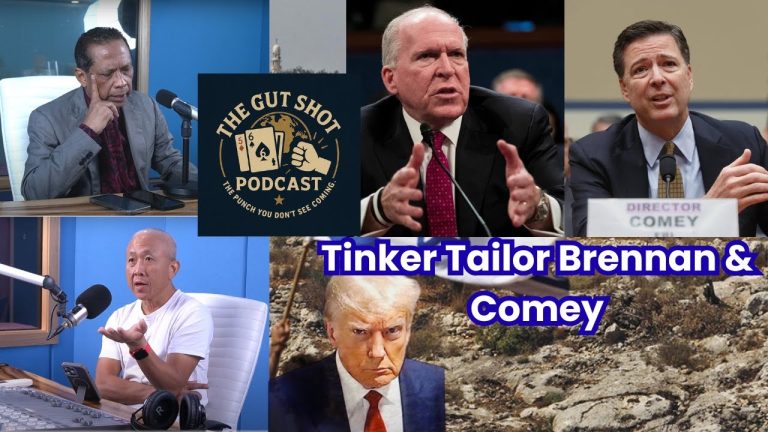
Russiagate – Tinker Tailor Brennan & Comey, Arab League Throws Hamas Under the Bus!
Show Notes & Description
This week on The Gut Shot Podcast Episode 11, we connect the dots on the biggest geopolitical and economic trends shaping 2025. Our hosts provide critical analysis on several developing stories.
Topics Covered in This Episode:
Arab League & Hamas (02:15): We analyze the recent Arab League declaration calling for Hamas to disarm. The hosts discuss its potential as a major step towards regional peace and why it's receiving limited mainstream media attention.
Capitalism vs. Communism (15:30): A fundamental debate on economic systems. Is capitalism inherently aligned with human competition and drive, making it a more practical system than communism?
US-India Trade Relations (28:10): A deep dive into global trade imbalances, focusing on the effectiveness of the Trump administration's tariffs and the current state of the US-India economic partnership.
Innovation: India vs. China (41:00): A comparative look at the two giants. We explore the "brain drain" phenomenon in India versus China's model of state-driven, scalable systems, and what this means for the future of global innovation.
If you're looking for an in-depth discussion that goes beyond the headlines, this episode is for you.
Like, subscribe, and hit the bell icon so you never miss an episode of The Gut Shot Podcast!
#Geopolitics #Economics #Podcast #Hamas #MiddleEast #Capitalism #Communism #TradeWar #India #China #Innovation
Jump to chapter 7 chapters
- 0:00 Arab League Declaration and Hamas Disarmament
- 9:44 Capitalism vs Communism and Human Hierarchy
- 24:16 Corporate Valuations and Income Inequality
- 36:02 US Tariffs and India-Russia Oil Trade
- 40:03 Doing Business in India and Non-Tariff Barriers
- 51:03 Innovation Models: India's Chaos vs China's Scale
- 58:52 Patent Counts, Academic Citations, and Upcoming Plans
Auto-generated from YouTube captions. Timestamps link to the video.
Right, welcome back to the Gutshot podcast again. It is me and Shamsul Sam. All right, good morning. Okay, let's get the ball rolling. Um, I think we've got some stuff in terms of the Middle East. We have not been really looking at the Middle East the last few days and now we've got something which is actually quite earth shattering because conventional media are reporting that Arab states uh want Hamas to down tools actually. Um it seems as if what we've suspected before in terms of um uh the states that have basically uh benefited from the Abrahamic Accords are
now basically saying hey let's take a peaceable approach to the region let's get wealthy together even though it's with the west and let's pursue a path of economic prosperity rather than one of conflict and deprivation. So that's interesting because it's it's basically a bunch of Arab states on one hand saying to another bunch of Arab states on the other hand, guys, let's take the other other road this time. Do you know what I mean? Right.
Yeah. Yeah. I think this is this comes back to our last uh discussion about how the media um uh comes out with a narrative and practically disregard certain developments or coverage when it is actually um monumental but it doesn't quite work to the narrative that they want to propose. In this instance actually what we have which is actually quite a while back. This is like July 25th around that period which is the 22 member um Arab League. uh and the and the the the European Union has backed a declaration and signed uh at a UN conference co-hosted by Saudi Arabia and France,
right, which is to address for a peaceful settlement in the for the question of Palestine and the implementation of the two-state solution. Well, but the most interesting part about that declaration that is signed by all these by the Arab League is basically for Hamas to end its rule in Gaza, for Hamas to actually return all the hostages and to put down their weapons. All right. So this is uh in line and in in in in in essence surrendering to the Palestinian Authority. Okay. So this is actually quite monumental if you ask me. It's um it's for the Arab League to come
together and recognize the uh the the destructive effect of Hamas. Uh and that is the only way for the region to move forward, for the Palestinian people to move forward. And yet if we read uh our mainstream media, we don't see this in the in the media coverage, we even don't see this um among our um our Asian population when they share news um of this nature. So I think this is a part where um it has to be really unpacked and why this is happening. I think site brought up a very uh important point when we had him on the on on the podcast as a guest which is the region very much wants to
move forward from an economic standpoint and not be uh you know um strangle whole by the issue of Palestine. You know, this goes back to the whole ideal that um ultimately what people want is uh consistent and reliable food, shelter,
you know, food on the table, uh the ability to provide for one's family and for one's friends, to have um a reasonable livelihood, um to to make a difference in the world, and uh to go about their lives uh in a comfortable and safe way.
Uh at the end of the day, what you have in the Middle East is exactly the opposite of that. And I think um this reflects I think the mood on the ground as you as we have talked about many times in the past that people are a bit sick of conflict right they're sick of war they're sick of
uh bloodshed bombs in the air explosions I mean the thing is if you live in the region now I mean at at no point in time and except for the present have you seen essentially hypersonic uh rocket ships go from one country to the other over two or three different territories two or three different countries which is essentially what you have between Iran and Israel
and slam into buildings thousands of kilometers away. That's exactly what's happening. It's like the end of the world. It's like Armageddon and imagine if you leave live there, right, Sam? Yeah. I mean, that's hell that's living hell on earth, isn't it?
Yeah. Who the hell wants to live through that, you know, year in year out for decades. I think this is good. How it gets done. Um the reconstruction of Gaza that President Trump has talked about whether with or without uh you know the intervention. I think I think from a headline perspective is good. How it comes about is I don't know. Um but at the base of it as human human beings you and I know what what do we want as human beings right? Seriously
in a heart of hearts. We want just those things. That's it. Good friendships, a loving wife, a comfortable home, food on the table and have a bit of a laugh with our friends. That's it. Well, I think the the the problem basically lies in terms of the fermentation of hatred, the fermentation of war because uh that actually benefit um the the political forces involved. We already said that uh Iran has been funding um this this groups like Hamas, like the Houthis providing basically their proxies to all the to the wars that they are engaging. All right, for purposes of supposedly
domestic support even though their domestic support that they are relying on is probably not even 30%. All right. But to hold on to power and to actually extend their power base beyond uh their borders as well. So the problem I find also is let's say um this narrative of um what is happening in terms of it is very difficult for you to end the war when you have Hamas still holding hostages and still holding weapons. Right. Whilst there are even in Israel um uh a debate in terms of how their prime minister BB Netanyahu actually has been conducting the the campaign,
you know, but at the end of the day, um when you get recently the video that came out uh from Hamas themselves, which are immensely, you know, emanciated um hostages, right, that are stubbing that they have been kept for more than a year. And why? First of all, why do you need hostages in the first place if you were not the aggressor that needs to come out and have uh a shield uh that is going to protect yourself. So if that is if that is not recognized first that actually the whole situation needs to be a disarmament of Hamas and a taking over of the territory
whether it be the Arab League led by Saudi Arabia with Qatar with the other Arab states maybe even Egypt. Okay. and actually to dismantle all the um all the uh the the armaments and the u and the uh what do you call and the terrorists in the group right that's the only way you can rebuild the whole place it almost reminds me of um Malaysia uh when we were uh postc colony postc colonial Malaysia I think re which was when we had the communist insurgency, what did we do? What did the British do to help us to actually curtail uh the communist insurgency? We built camps
which were which were basically called new villages and and whether you like it or not the optics may not be nice which is basically barb wires and controlling the population that are feeding terrorists but that's what happened that's how Malaysia became the only country in the whole world to actually have been able to defeat communism we are the only country in the world that has defeated communism. You know that?
How do you know it's been defeated? Honestly, right? Yeah. Who who's to say that it doesn't still exist in under currents of emotion? Now, that's that's ideology. That that's where we're talking about ideology, right? Ideology you cannot defeat. But at least the communist threat in terms of armed resistance and armed uh uh intention to take over was was actually uh wiped out.
Okay. A little side here, right, Sam? Yeah. What's so bad about communism? That's an interesting segment. Have you thought deeply about communism? Yeah, I have. Um I mean, if you look at it, right, one of the world's biggest problems right now is the inequality, right? Mhm.
The the Are we going to segue to this straight away? That's why I said short segue. Okay. Okay. 5 minutes, right? Hear me, man. Hear me. Right. Yeah, sure. So, one of the biggest problems is is income disparity. Yeah. It's about the gap between the halves and the have, right?
What does communism do in theory on paper, right? Communism dictates that there shall be no difference in in status between one and the other. Right. Go on. Go on. in on paper on paper it's the execution
of that ideal which has fallen short in history but on paper it kind of makes sense and there's some level of inbetweeniness where for example you've got socialism in many of the Scandinavian countries right high taxes you know everybody is kind of like on the same platter right in terms of the way they live but it's good life you know
go on um I look I I don't know right I'm just saying so we I don't understand shut up Siri Okay. Who's talking to her? Anyway, so
that's that's that's a robot for you, right? This way. Yeah. So, anyway, um we talk about how there's um settled narratives and we should question everything, right? Yeah. Well, here we go. Let's let's question the fallacies uh perceived or otherwise of communism. So, here I am, right? We we question ESG. We question DI. We question why Trump is so vilified, etc., etc., etc., Huh? Right.
Let's question why communism is so bad. Is it really that bad? Discuss. Okay. I like this. Okay. Um I am like you. Uh I'm a typical cynic. I'm very skeptical of everything. Right. So I do question. Um my assessment of human nature is that um you cannot change human nature, you know. Um and the problem with um the problem with a theory like communism, it basically assumes that human nature can be changed. that you are basing the the the fact that that there are two issues there. One is from a human behavior standpoint that you are forcing everybody to so-cal
be equal communal which will never happen. Yeah. Okay. That's from that's from from a pure psychological evolutionary standpoint. It is not the nature of human being to um not compete and that also goes with an economic system. In order for you to progress you need competition. Competition means that somebody will win, somebody will lose. Now the question is how much do you win and how much do you lose? That is actually your question with respect to um income disparity for example.
Yeah. All right. But with communism what we have seen throughout history because it has been tested. All right. Whilst one can say on paper and then on implementation it never actually translate what is on paper upon implementation. But that's why but why is that? It's because at the end of the day, somebody will have to make a decision on what is going to be uh the system, the rules, who gets what and at the end of the day there will always be strata. There will always be people who will actually want more. And that is what happened in every system in the world whether it be
theocracy, democracy, uh capitalism or communism. And at the end of the day with communism because it is supposed to be communal but actually at the end of the day it's not. It is actually government. Um it it actually is a government of uh of the ruling class. The ruling class will dictate what the people will have or have not and the ruling class will have more. You think there's no disparity in communism? Look through everything. Look at North Korea. Look at uh even Russia. Look at China, right? even be even during the days of Mao right so effectively theory and implementation will never
come together that's one now why capitalism works that's the second part that I look at it why capitalism works Because it is about human being wanting to own their own freedom and their own property. They're not sharing the property. They work for it and they compete in order to own that property. Okay? So that's the basic of capitalism. So it's it's it's it's trading for ownership of your own property.
Actually Sam, yeah, go ahead. The reason why I said that is because I just want to see what you're going to say. Actually, in truth, in reality, I I am I do believe that um capitalism is the best reflection systemwise
of human nature. And when you look at it from a clinical psychologist standpoint, human beings intrinsically know where they stand in the social pecking order. When you go into a room of strangers for the first time, within the first 30 seconds, you know where you stand in economic terms, in social standing terms, in size terms, in in in in uh interpersonal terms. Hierarchies have always existed and since the beginning of time, right, within a minute of meeting you and within two questions of talking to you, I know how roughly how wealthy you are, how educated you are,
where you live, um where where you stand on matters of importance and I can size you up and I'm sure you are as good at this as well because you met a lot of people and within the first minute I can understand where you generally stand on the pyramid of hierarchies. M
are you near the top or are you near the bottom even from the way you dress right and the way you walk and the way you carry yourself hierarchies have always existed and I think that's why capitalism succeeds because uh capitalism reflects the hierarchies in the system it reflects a difference in in qualities between people have always been born some have been born bigger stronger smarter more hardworking more industrious more ambitious and some less right some weaker some lazier some not so willing, not so not so ambitious.
Yeah. And if you had communism, you're saying that the the taller, stronger, smarter, more hardworking guy is on the same footing as that that weakling who has got no ambition, no drive, no brains, and no initial
and I have to subsidize his life. Exactly. Exactly. Right. So that's why I've got problems with quotas and ratios and uh disproportion or or correcting disproportionalities in the system. Right. I I hate quotas. Right.
Yeah. And a few days ago, someone wrote to me saying that, oh, you know, um, let's just say a particular gender is under reppresented in the political system, right? And they belong to a 30% club. And then she they wanted an interview. I said, no, cuz I don't believe in in in in correcting disproportionalities because that reflects society.
Yeah. And capitalism reflects the difference. So I just said all this to basically get your knickers in a twist. No, I But capitalism works. I mean for sakes it bloody works right it it's um so yeah but but going to income inequality
that that is a different issue altogether and even income equality but it's the same thing for the for someone who who is willing and able to work harder take more risks right put their put their resources and resources could include time right not just capital time right and for those people who make those sacrifices it pays off and can you begrudge Jeff Bezos who is worth I don't know I don't know $150 billion he packed in his job as an investment banker when he was 29 and he said let's roll the dice with Amazon right and he had many many years many years of losses of degradation of being
you know um basically made a fool of and and called an idiot by by Wall Street and nobody bought his stock nobody gave him money and then look he just and ultimately made it pay off right
and for every guy that's Jeff Bezos there's hundred more that that have not succeeded, right? But that's why you got rich and that's why you got poor. So So I think what what I'm trying to say is that communism in that battle. But um should it have been stamped out with such force and such vigor? I don't know. Um was it evil that the Americans said it was? I don't know. But
well, I mean I my my thought about the should I should it have been stamped with such vigor is because um Americans the ideology no not really because
at the time was portrayed right the ideology itself is about domination all right it's a do they need to change society is a revolutionary revolutionary ideology that is willing to sacrifice the lives of others in order for it to take control of society because they feel that capitalism is so bad for the human condition. So it is no different. The way it manifested itself is no different than how a theocracy looks at society that because they believe it is mandate from heaven that they will stamp out uh with blood you know and you know with a with a sickle and hammer in order to actually take
control of society and implement it. That is what happened and therefore the re the the the the reaction to it must be equally strong from the communist perspective but from the western perspective so it's basically a clash of ideals I think which is why it it it escalated into conflict right and that's why you had
well I guess to some extent it doesn't have to be communism it could be Islamism correct so conflicts have always existed throughout history when civilizations and ideals clash, right? It's whe whether it's a faith or whether it's a system of government, right?
Even for sakes, Manchester City, place Manchester United, they get drunk and then they start fighting in the streets. It's tribalism, right? And Sebastian Younger talks about tribalism and all of us are essentially tribal people.
We belong to these teams, whether it's our, oh, I'm from Paneang, you're from Slango. Oh, let's fight. Oh, you're Manetta. I'm Man United. Let's fight in the after having a few beers down the pub. You know that kind of thing. Or you're Beatles and I'm Rolling Stones. Oh, I hate you. You hate me. Do you know what I mean? Right. It's tribalism. So, at the end of the day, what I'm trying to say is uh humans are idiots. I agree with you. No,
seriously. Right. No, no, no. Okay. Now, you you're now you're bringing the science in me. Okay. Now you're bringing the science. They're essentially human beings, right? We are essentially we are essentially a few million years ago apes.
We're still bloody apes man. All right. So genetically okay uh pre-programmed in our DNA the apes are also tribal 100%. Right.
100%. You see the the chimpanzees I mean the way they they bludge into that with great violence is incredible. So we uh actually as we as we evolve culturally okay then what happens is that the mental aspect of it softens the br the brutal part of our brain. Okay. So that is all that that that has been happening. In fact, if you look at it, I think you know, uh, in this day and age, the world has never been, in spite of what people say, if you look at it, the world has never been actually more peaceful than it ever was.
100%. We are living through a golden era right now. Yeah. And I think, you know, for better or for worse, the fact that we've got um three big powers with uh nuclear weapons that can uh annihilate the planet,
nine actually, with nuclear capabilities, you know, I'm just talking about the three big powers, right? Okay. They can annihilate the planet, you know, probably 10 times over. Yeah. It's good enough reason for them not to actually engage in kinetic war directly. Right.
Politics is one of those nine leaders that have had a huge piss up the night before. That's exactly the reason why and then the next day they're like a bit hangry, right? And then they say, "I don't like the way these people look. I'm just going to
and right." Okay. I do want to address this issue since you brought it up. So this segue is going to be slightly longer than 5 minutes, right? income inequality. Okay, come.
Okay, here's my thesis on income inequality in this 21st century. Okay, the problem with the income inequality that we face actually is more at a cor corporate globalist level. Okay. Which is artificial uh increase in capital um uh due to uh the cooperatization of businesses. Okay. and the rewarding of um of senior management through no real um um no real tangible business effort except for the valuation of their stocks at that particular time. Okay. And that's my problem with this part of income in inequality because I
think you have to earn it. You have to earn and build something. Like you say, Bezos built something, right? Trump, for example, built buildings, right? And market them. Okay. the fact that you take over a company and you gan up the stocks and you make more, you make uh hundreds of million plus, you know, uh in stock options. It just makes no sense to me.
Well, why? So maybe because private corporations because of their scale, that's where the return on your economic productivity is, isn't it? Right. If you had a country of individual workers, you know, putting their own weight, whether it's, you know, being a car mechanic or being a panel beater or whatever, your GDP isn't going to be very high. But when you've got corporations that are building businesses at scale, right, and and and amassing the human capabilities of a corporation in in in in in collective terms, then you've got a company which can be valued at, I don't
know, 50, 100, 200 billion US dollars, right? Which is what we're seeing now. And you might conceivably say then those people should be rewarded amply for the effort that they put in. And that's capitalism in its most brazen sense, isn't it? So there's an elements of um contradiction in there from your viewpoint because if you want capitalism to work, you need to amass the abilities of more than one person in a team, right? And that's what corporations are, isn't it?
Okay, that how can you say that? That's fellacious. I mean the the the the the mismatch between a CEO salary and the lowest line worker is something like it's never been higher 45 times or whatever.
Okay, let me get to that point of yours. Right. I mean I I do I I would admit one thing that uh I'm always open to changing my mind. I'm always open to actually looking at things from a different point of view. However, my stand on this is a bit flexible in the sense that I understand your your argument on that. But um as a as somebody who has built businesses and somebody who has actually sat on corporate boards of corporation, what I have noticed is actually the proliferation of the size of the corporation uh and the and the business beyond what actually is uh I would call realistic.
When you have 50 60 times valuation, 70 times valuation, it makes no sense. It's just not sustainable in a realistic standpoint. somebody is making money and more more than anything it's just like uh it's is basically becomes a Ponzi scheme that it's a bubble that is just waiting to crash. I mean let's take for example uh the Disney Corporation. Okay. Um, when was the real last time that they have made um a movie from their purchase of Lucas Film that a movie or a TV series that actually has made money probably a decade ago with Force Awakens.
Okay, as I was mentioning. Okay. And yet the CEO Kathleen Kennedy is still earning tens of million if not more. Mhm. Right. And she's not fired. Well, so the thing is when you look at the business of Disney, right? It trades at 23 and a half times earnings. Okay. Which is not which is not huge, right? It's it's pretty fair, right? But it's not just a movie franchise. It's other things like their theme parks, their cruise ships. No.
Do you know that you can actually take a Disney themed cruise ship from Singapore, right? and have a Disney experience on a cruise ship. Well, that's the reason why I was that was the reason why I media company, right?
I that's the reason basically why I didn't quite take the uh the the example of Bob Iger cuz Bob is sitting at at this at at at at at at the Disney Corporation.
Okay. That's the reason I took the example of Kathleen Kennedy. Okay. Right. cuz that because that you know basically they have not got any returns from their investment in paying George Lucas right now if you even if you look at Iigger's situation right the fact that you made that purchase of just not just Lucasfilm also you made the purchase on the the on uh uh on Pixar and you also fumble on that as well, right? You got to be held accountable.
Well, what do you know what? Right. You've been CEO for every for for say 20 things that a CEO does over the course of of his tenure as CEO. Mhm. Every one of those 20 things is correct. No. No.
Right. Maybe five are wrong, 15 are right. Maybe 10 are wrong, 10 are right. But you your scorecard is the sum total of your decisions over the course of your stewardship. Correct or not? Right. So maybe Kathleen Kennedy drops the ball on this one, but maybe she does the she I I don't really know her career. Okay, I'm just saying. Right. Maybe she's done the company proud in in other ways like steering the ship into theme parks or into
No, she's not involved in media. I I don't know. I don't know. Right. I don't know. So I'm giving one example. Yeah. But but you're you're pointing out the fact that um one of the problems we've done income disparity is the fact that corporations have become so bloated and so profitering at the expense of the normal person and that's unfair. Right. That's essentially what you're saying. Correct.
And and and basically because and is so tied up to the stock price Yeah. that actually it's when the stock price or the valuation of that company or the capitalization of that company is so unrealistic.
Yeah. But it is the sum total of companies like Disney which give America the power it has to control and and to hold sway over its tariff partners because that's the reason why countries like India or Indonesia or or or or the European Union they want to do business in America because America is this magnet of business and and and monetary appeal that no other country in one in one space can command. That's why Donald Trump can go around the world and wave his big shiny orange balls from left to right and say do business with me or off. But that's essentially so so
Disney right it's just a microcosm of the US economy when you look at it right Nvidia and by the way Nvidia more than half of its employees are worth more than $25 million US and this is a recent study done right Nvidia's market cap today $4.4 $4 trillion market cap.
Yeah. What's the is what's the PE on that company? I I don't know. But Nvidia's market value value is more than 70. Okay, let me check. Give me a second. Right. But Nvidia's market value of $4.3 trillion US is bigger than the entire British economy.
Yeah. Is it's it's also bigger than the entire German economy. And the German economy is the biggest one in Europe. Wow. So if you talk about American soft power, it's American economic power. and and I think this is where probably we disagree on where is the source of that power.
Go on. I think the source of that power is actually its capacity to actually produce more than actually valuation. 58 times. So it's pretty generous. But I'm off by about 10 points.
It's not It's not crazy. It's not crazy. Well, it's reasonably crazy if you ask me. I tell you what is crazy. Palanteer is crazy. Palanteer's PE is 597.
Ain't that something? Yeah. So I mean when we look at all this, right? So that's the only thing I would say that my problem with respect to income inequality. Okay.
Okay. Um I don't have an answer to it to be honest with you. Right. I think we got I think we got to live with it. That's I think that's what we got to do. M we got to live with it. Yeah. I think it's at the end of the day is a question of what does the problem also is that board members
uh in such a big corporation are usually beholden to the CEOs if you ask me. Depends on whether the CEO owns 20% of the business or more. Not really right. Not really. Unless the board members have not been nominated independently and they've been nominated by the CEO, then there's a problem. Right. Bought independence. Yeah.
Right. Not that's part of the problem. Yeah. Part of the problem is actually quite a number of those big corporations uh uh uh uh were brought in uh through the influence of the CEOs.
Yeah. Yeah. Especially in this little old country, right? B seats are seen as rewards. Yeah. Especially in I say it shall we not say it, you know. So I think um I think that is the the only part about um uh well that's not the only part but that is a concern with respect to I think runaway capitalism as far as I look at it
right cuz I'm a capitalist at heart. I I I that's how um I think I think the the um the world economy uh has gotten to where it is and getting people out of poverty and getting people into living better has been as a result of capitalism being adopted in the in in most parts of the world. Right? So and and to a certain extent actually uh China adopted a pseudo capitalist society as well
100% you just go to Shanghai see how much money there is there right it's crazy so you know they know what works yeah so I think uh that's a nice segue maybe we look at um what's going on um with the global trade at the moment
50% % 25 plus 25 that's what India told yeah that's what the US told India okay let's start with 25 some some of our some of our audience uh some of big audience are coming from India yeah
so let's let's talk about their part of the world yeah so so the US see a gross imbalance in trade between theelves and India and it started the ball rolling with 25 and now they're saying that because they are essentially buying oil from the Russians and thereby uh enabling Russia to continue its war with the Ukraine essentially helping the war effort.
It is now and because Donald Trump doesn't like it, he's saying, "Well, I'm going to slap another 25% on that and you pay me 50% to do business with me because you are helping the war in in in the Ukraine to so so to me, we've always said this. Donald Trump is not a wararmonger. He's a business person. He doesn't like war. War is bad for business." And
in some sense, he's putting his money where his mouth is. He's given I think 12 days of deadline to to work this through. Um let's see where it goes. Yeah, I think this is where to a certain extent I go back to the question of whether we have a multipolar world or a uniolar world. And at the end of the day, if you were to ask me, just like um any autocracy, if there is an autocracy, you really need a benevolent or as benevolent an autocrat as you can get because if you don't have that in an autocracy, all right, the um the governmental system collapse, okay, and you will have tribal
fightings, you will perfectionalism actually China has shown us that over uh since the days of Mao y right so if you if you come to this with India one thing that I think people need to realize and even uh India need to realize that is a very difficult country to govern you know um
have you been to India I'm sure you have been I have not been to India India No, I have not been to India. India is an assault. Please tell me India is an assault on the senses, right?
At the same time, it's like being on acid ecstasy and a body of whiskey simultaneously. No bro. No Right. Um and it lasts from the minute you land in the airport
till the minute you leave. It's a con a con constant bombardment of your senses of senses. Yeah. And it's amazing. So where have you been in India? Um I did the whole uh Rajasthan route. So Delhi, Agra, uh Jaipur, Jao,
Uda, beautiful part of the world. Northern India, gorgeous, gorgeous part of the world. And in fact, two weeks time I'm going to go to India again to to the Himalayas to ride uh motorcycles. Please do not get hurt because I I
Baham is a lot further away than we think from from where I am. So Mhm. Baham is where um we had well militants essentially attack Indian citizens and of course it's it's again a religious conflict you know between the Hindus and the Muslims and this goes back as far
it's really funny isn't it the Bangl you know they all have the same skin color they from the same ethnic group actually do you know that the isn't that nuts do you know that skin pigmentation the difference between white and yellow and red or whatever it is and brown right is 0.3 micrometers And below that, we're all the same. Same color blood, same bone, same tissue, same
That's how stupid humans are. I know, right? We started this whole thing with humans and their, you know, frailties, right? Yeah. You can't get any more frail than that. And they've been doing it for millennia. So, I mean, going back to our good old India.
Yeah. Right. Um, doing business is in India as an outsider is damn hard. Yeah. Okay. Did you try? Yes, I did. Did you succeed? No. And I've had many friends who have been burned.
Yeah. Okay. Because their non-tariff barriers is extremely high. Their rules and regulation. So this is part of the problem that actually when I look at the tariffs that are being put by uh the Trump administration against the rest of the world actually I feel to a certain extent I almost feel like damn that's they're generous because you really can't quantify non-tariff barriers you know how you going to quantify non-tariff barriers when actually even your own uh stateowned companies doesn't Hey, or halfway through the work they're going to, you know, renegotiate the contract with you.
That's the problem, right? Change change of heart, change your mind at different times of the negotiation process. Right. Right. So when they rule and um you know um certain parts I don't know whether you whether it involves whether you can verify this or not from what I hear that actually you need to have approval to leave the country
India. Yeah. Really? Yeah. Okay. I didn't know that. Yeah. Didn't know that. So um I don't know. I heard that story from John Cle. I think was it John Cle? I know. No. Yeah. Yeah. Yeah. As in as in as in
Montipython. Yeah. I think it was Cle or was it No, no, no, no, no, no. Um, what's it the other guy? The other guy. Um, no. I think it was a standup comedian. No, no, no, no, no. Bill Burr. Bill Burr was telling this story.
Yeah. Wow. Okay. Yeah. So, so but but really doing business in India is extremely tough. That's one. So if you tell me the 25% tariff I'm like okay right and then the question of okay you have a war in Ukraine right and you have a every time I think Steve Wikov goes and have a meeting with Putin the next day he starts bombarding Ukraine I don't know what the hell is going on right in fact I was thinking that we would invite a Ukrainian expert a Russian Ukrainian expert to come on our podcast and uh maybe we'll try and do that while I'm in Washington.
Yeah. Yeah. So, um so u uh I think I think you cannot have that war to keep on being funded. That's the only way you can stop war, right? And who's going to do that if America doesn't have the power? Europe doesn't have the power to stop uh Russia. If America says tomorrow I'm going to walk out, I don't think Europe can uh can support Ukraine, I think Russia will just roll it over.
Look, I don't know. Um, look, at the end of the day, if you need a certain uh resource, right, oil, right? Right. You have to buy from somewhere, right? And uh whether or not you're India or you're China, right? And it's actually your prerogative, right? I need oil for my people to run transport systems in my country. It doesn't matter where I buy it from, right?
Yeah. Um it's my prerogative. Can chi can America exert his influence on India? Yes. Can America exert his influence on China? No. So China still has the autonomy to buy oil from where it wants whether it's from Russia or whether it's from Brunai or Malaysia or whatever.
That's exactly why China does 15% of its trade with America. That's right. I mean I mean the the biggest leverage China has on America is is the rare oil rare rare earth uh production because at the moment I mean the they own 90% of that production capacity
right so I think that part um will probably last for at least four years because u I don't you know nobody lives in a vacuum the Americans going to do something about it and we've got already actually the Pentagon buying into a private company that is actually buying the rare earth.
Well, funny you should mention that because Tim Cook and Donald Trump just signed this big deal announced overnight. So, initially on Apple investment in the US. Yeah. So, it's supposed to be 500 million billion that's with a B by the way and they'veed a $600 billion to build this huge spanking plant I think uh in Kentucky I think it was.
Okay. Um which is of course Trump heartland if you like. Right. Um, but part of the deal is that they're going to be using rare earths for iPhones that are going to be made in America that is completely from America.
Yeah. Where they find those rare earths, I don't know. Okay. Oh, the rare earths are not that rare. Really? So, we need to mine it, right? Yeah. It's only the mining. The problem with the mining is actually for all you people who are so enamored with uh uh green technology. Yeah.
Okay. The most destructive mining is rare earth. Yeah. Okay. To the environment. So, you know, uh stuff your uh your virtue signaling to somewhere else.
Don't get me started on EVs. Okay. Okay. I know. I was about to ask. Actually, actually, I tell you what, I was going to ask that question, but let's leave it to the end cuz I want to I I want to ask that question. Why do you hate Eevee so much? But I'll I'll go to that later. Right. So, let's go back to this situation. It's all about that goes to that uniolar situation where if there is no someone who has the moral authority of some kind whether you like you don't like them or whatever right the the Russian will go through like a meat grinder on Ukraine okay and the
only what what does what what leverage does the American have uh to stop it apart from going inside and providing actually uh its own boots on the ground or um massive uh offensive weaponry to attack Russia itself. sanctions right now. If your uh resource is sanctioned, that means you got to sell it at the cheapest price out in the marketplace. And for India or China for that matter, if I've got the big enough power and I say you can't stop me, I'm going to buy the cheapest resource I can get.
Right? So in between China and India, I think America has more leverage on India compared to China of course. So they're going to do what they think they're capable of doing. So you know to me that's about that's just geopolitics right accept it. I mean ex I mean from the point of view of really a practical human being looking at the business world at global politics at global economy right you got to understand your place in the world you know
hierarchies my friend exactly there we go again yeah where do you start on the pecking order correct number one and number one there's going to be so I mean they can fight with each other number one and number seven number eight right number one every time right
so I think I mean that and that's also the reason why America has very little leverage on uh Brazil itself because Brazil does very little trade with America. So their percentage of export to America compared to their GDP is what like 1.2%.
Yeah. It's not even 2%. Yeah. Right. So everything is about leverage. Exactly. Right. So I don't know where the India discussion is going to be but I do realize one thing that what people don't get is that as a businessman you know what our our our mantra as a businessman or always is when we negotiate
make more money. Nah it's very simple you must allow the counterparty to have an escape clause. Yeah. All right. You cannot push your uh and that's why you know these politicians uh in the mainstream uh keep saying oh Trump is taco you know Trump is uh uh uh will back off he doesn't care all he cares about as a businessman is the bottom line right and if I have to make that phone call instead of waiting for him to make that phone call to me he doesn't care. We businessmen has no ego. All we care about is the bottom line. What is the end goal that I want to achieve? And his
end goal is two things. One is to bring back the supremacy of America. Number two is actually with that supremacy have more trade and less war if at all. So he'll do what's necessary.
Yeah. I mean, uh, he's what? He's been in the job seven months. Fair goal. I mean, he's done reasonable he's done more than a reasonable job. Um, he's done more in seven months than what Biden had done in four years.
Yeah. Yeah. You know, so pay right. Yeah. So there you go about India and tariffs. So we'll we'll see what happens with that right.
I don't know. I I when I was there, India was a mess, man. I don't know what Modi was thinking at the time. He tried to do demonetization. Do you remember the time demonetization? He essentially removed the 500 rupee notes and,000 rupee notes from circulation ostensibly because they were being used for illegal activities
basically overnight smuggling it out. Right. Yeah. Or or basically corrupt politicians. Well, that's what we did with our,000 ringit. Correct. Um yeah, denomination. Exactly. Exactly. But it was crazy and India is just a mess. I mean it's a mess but at the same time it's as you say right chaos and order. Order and chaos they come in equal parts. Right.
And they've got a very bloated bureaucracy huge. That is actually almost uh uh what do you call unwieldy. Yeah. I I I think that is the problem where the difference between India and China.
Yeah. Why I don't think that um I really am pessimistic about in spite of India's uh larger population and overtaking the population of China, I don't think their GDP per capita will uh beat China.
Yeah, they're going in two different directions. And you can say that this India is an example of where democracy has really fallen down because democracy is essentially consensual uh uh um approach to things, right? Everybody's got to agree that it has to be a de democratic process and you've got to get a lot of people, more than half of the people to agree with what you're going to do, right? Try doing that in India. Try making a family decision with your cousins and uncles, right? Forget about it. Right? Whereas in China, you got one idiot at the top saying, "Dance, and everybody dances,
right? Or jump and they'll say, "How high, Mr. C? How high?" Right? Or you shall shall we go into this? Shall we go into this? Because this is it's two different systems, right? Right. I think I think I I think this is a very interesting um uh dynamics in terms of what we think we see on the surface and what actually is happening.
Right? If I if you ask me, I've always said this that it is in chaos that actually you get creativity and invention. All right? You do not get creativity and invention coming out of a static situation or a stable situation.
Are you saying that the Singaporeans are a boring bunch? Um I I got partners who are Singaporeans. So let let let's not insult them. Okay. So um let's let's put it this way. Okay. So here's the thing about India. I think India is more innovative. I think Indians are more innovative. But here's the problem. Because you cannot actually really make money in such a society where the strictures of uh rules and procedure for commerce becomes so um throttling that what happens is that those individuals and those performers actually exit out of the country and where do they end up? in the UK
in America. In America and in the UK. What's that for? Is it the H1B? H H H H H H H H H H H H H H H H HNB1 H H H H H H H H H H H H H H H H H H H H1B HB. Yeah. Yeah. So So I I I I sort of like I I I mean that is what I see the problem with India. Basically the India India is exporting their best talent. Uh India is exporting their innovations. Sounds like a country I know.
And because we are so chaotic, its own country doesn't want them. So they because because we are we are a chaotic country. We are a country that produces creativity actually. 100%. You know, but we export them.
Yeah. Right. Yeah. We lose them. We lose them a lot. Right. Um Yeah. This country almost lost me. Yeah. Yeah. Um uh fortunately or unfortunately you know um yeah somehow or rather I managed. So
shit's calling me. So I think the difference then comes to when we look at uh China on the other hand. Yeah. Right. What you have is actually um a very stable scalable system. All right. They're very good at scaling from the time of the Chinese of of the old ancient dynasties and actually that was transported or adopted within the CCP itself which is the the the CCP um is what in the in the book I wish I can get this uh the the the MIT professor that I ran across. I've written it to him. I I'm trying to see whether he responds or not. Right.
The guy who wrote the book that you're quoting from now. Yeah. Okay. Which is when Asia or Yeah. The rise and fall of Asia of of the east. Okay. Right. So I think it is a very interesting thesis in a sense that he tracked uh the rise and uh uh and why is China so scalable in terms of technology and in terms of economics but at the same time it also hurts the scope of actually innovation. Right? You can have you you you can copy and build and actually build in scope but when you have an autocratic system that everybody has to dance to creativity is stifled. But the periods
when actually the inventions were done in China, when they did gunpowder, when they invented uh paper, when they invented um uh what else? Silk and whatn not are the most unstable period within the dynastic situation. Okay.
Yeah. The what fu was saying in the reagnum, right? M so that those were the amazingly the period whereby Confucianism was not quite the dominant um uh philosophy that is when Dowoism, Buddhism and whatnot were were were uh were joking for places and they had uh they had the waring states Okay. However, when they were more stable and they had under one long dynasties, they were bure bureaucratically extremely well-managed. But the invention stops. A lot of mus um Muslim scholars but Chinese scholars or or let's just say
China sympaths disagree with you. They will so they will say that China has been innovating hand over a fist for millennia. They will say China registered more patents in 2024 and for the last 10 years on an on on an order of magnitude greater than any other country in the world. They can say that right? And who am I to argue with that? I don't know. I I don't know the
I'll argue with that. Right. I'll argue with that. They can say because I've seen the statistics. Yeah. Okay. But you can Yeah. But I'm going to argue with that. But what I would say is that some of the most creative people, some of the most amazing entertainers, authors, musicians, actors, uh whatever have come from turbulent backgrounds. If you look at people like Janice Joplin, um you look at someone like um you know people like them, right? Um Kurt Cobain, etc., they come from broken homes. They come from parents who are like drug addicts or whatever. But they come out and
because they find a release and escape in their art they they can reach heights that no one else can. You can say it's a microcos can I just come back to that statistics. Which one? So the patents
of the patents. Okay. Right. China has uh is the second most patent uh submitted registered. Yeah. Uh compared to the US, right?
So who who registers? Here's the problem. If I'm if I'm not mistaken, I got I got to go back to it. It doesn't matter really because as as easily put this way, they are bigger than Europe.
Okay. Okay. 100%. Right. They're 100%. Their their number of patterns uh compared to uh Europe um they are bigger. Okay.
But they're not even close in terms of citation. Okay. Okay. So, what does that tell you? That tells you that there is quantity but not quality.
China leads globally followed by the US, Japan, South Korea and the European office. But when it comes to citation, but when you come to citation, they are way behind. Okay. So, I don't know enough. I can't say I I don't I don't even know the process because as we talked about statistics
no because citation is very simple citation means that actually your research is worth for it to be looked by your peers in order for them to continue the research elsewhere you know like our like like like and it is because of this like in Malaysia right one of the way for you to get tenor and to actually move up is actually to publish more.
Okay, that's so that's bollocks, right? What are you publishing? But yeah, what are you publishing? Exactly. Right. What are you publishing? So the same is what is also happening in China? There's a lot of publishing because in order for you to go up, you got to publish more.
Correct. So what I'm trying to say is that although you might get citations from your fellow scientists example, right? How many of them will change the world? No, but this is what I'm saying. You can publish. You can publish but if it's worthless nobody's going to look for citation for you.
Correct. So scientist to scientist they don't when they when they invent something they don't necessarily invent with the end point in mind. They invent something to make something faster, better, cheaper for example. But do they have an idea of whether it's going to change the world? For every thousand patents, the one that can change the world, the one that can really move the needle. I don't know. I'm just saying. Right. No. I don't I I know what you're saying, but I don't know the process. No, the process is very see I mean the in in essence is like this
um in in essence is that if your research is being referred to more often than somebody else's and then it's better that means that your research has worthy has worthiness
right the fact that actually in spite of you having published so much more than other people and actually the number of citation from your public from from your published work is so much less it just tells you the same way about actually what is happening
okay so so let to settle this discussion we know lots of Chinese people we know lots of Indian people let's just ask them are you more creative or is he more creative
how how many China men you know other than me right plenty right plenty let's go to I know lots of Indian furs Hey burger, you you creative? Let's think about that. That's a good question, right? That's actually a good question.
I'm more creative than a bloody China man. You know, if you were to ask me, right, as I mean, ask Malaysians, which which is extremely multithnic the way we are. I love that fact.
Right. Yeah. I must say if if I were to be and I'm going to pissed off quite a lot of my friends the Indians are more creative that's because they've had the more thrown to them that the other guys right so the more that he got thrown against you the more creative you got to be right think about Kurt Cobain right think about Janice Jin how how was their life look how amazing they are and then they died at 27 years old
and and and and that's why I guess Most of the of our accountants are Chinese because they want to follow one rule, you know. Yeah. You know, and it goes, you know, it goes uh it goes through this column and move through that column, you know. Yeah.
I mean, yeah. Having said that, I must say I must say they're more c I mean my friends, I find that yeah, the Indians are a lot more creative. To all our Indian friends, buy whiskey. Okay.
Yeah. Yeah. Oh my god. That mean I'm going to get it, man. The next poker session, all my buddies are going to screw my ass. Oh my goodness. Don't say that too loud, bro.
That's a good one. And by the way, this is coffee, not Yep. This is coffee. Okay. Are they sponsoring us? Not yet. No. No, nobody's sponsoring this ludicrous discussion. I know. Um I know that's an interesting point of view, I must say. Yeah. Ah
yeah. Well, there's not much in the news lately. Um the next time we chat, you're going to be in America. Yeah. Okay. The next time we chat, um can you please position yourself in front of an iconic building, Washington Monument, you know, whatever cathedral, whatever. Right. Just, you know,
I'll tell you what I'll do. I'll tell you what I do. I I don't know. I'm going to give I'm I'm I'm going to wear an orange wig. I'm going to I'm I'm I'm going to do this. Um when I'm in Dallas, I think I've been there, but I'll do it for you.
Listen to a podcast from the Cowboy Stadium. Um I've been there. Yeah. I I've been there. Yeah. Uh I I want to go and watch uh a football game, but unfortunately I don't think the game I saw the schedule. The preseason is going to start, but they're not playing when I'm there. Um, uh, that's a possibility, but I was thinking actually to have the podcast from, um, from, uh, uh, what what is that place called? Um, from where Kennedy was shot.
Oh, I can't remember. Uh, Daily Plaza. Yeah. How about that? That would be a bit macab, right? How about that? Right. Well, something a bit more positive, maybe. Why don't you go to uh Comedy Central? Um
New York comedy club. New York. No, that's Dallas, right? Not Austin. Austin is where Joe Rogan is. Yeah, but I'm not going to Austin. It's quite a drive to go down and I'm lazy.
Um Daily Plant. I could go to the I could go to the to to to but I've been there. What's What's Larry Ewing's house called? Huh? Larry Ewing. Oh, I don't know. I don't know.
You know Dallas? I know Dallas. Yeah. Yeah. Yeah. Yeah. You got to be old enough to know. Yeah. Let's see whether I'm in a farm somewhere. But then then it's not then the our audience won't see it. So either Dilly Plaza or uh the cowboy stadium. But the cowboy stadium the most interesting part of the cowboy stadium is if you are inside. Being outside the cowboy stadium in the uh in Dallas in summer is not a pleasant experience. right now. The next week after that, I'll I'll be in DC.
So, I'm thinking about um I will probably zoom in from at least I will from um uh Capitol Hill and um and and definitely the Lincoln Monument.
Yeah. Yeah. I think the Lincoln monument is awesome. Yeah. Yeah. I've never been to where um so that this going to be my first time. Yeah. Yeah. Yeah. Yeah. Yeah. Yeah. So, um um that that that'll be fun. That'll be fun. But Congress is not in session,
so that's a bit of a bummer. You can't doors stop someone. No. Yeah, that's exactly it. Hey, man. Let's have a look. Pull him. I I want to get I I was thinking about getting the uh some somehow bumping into Who's that? Uh Ben Craw, the the rap from Texas, you know,
with a with eye patch. Oh yeah, that'll be fun, right? See see whether See whether I can get that cruise. Well, then get Tom as well. Yeah.
Huh? Tom. Tom. Cruz. Cruz. No, you got to go to LA. If you can't get Tom, get Penelope. Bad joke. Sorry. So, I think uh yeah, let's we'll do that.
We'll do that. Uh we'll we'll we'll do the podcast. Uh we'll we'll we'll we'll do the Zoom um from Dallas and from DC. And then when we get back, I think we've got a few guests lined up.
Yeah. Yeah. Um so, we shall unveil those when the time comes. I think we'll unveil those within when we do the when we do the cast from uh from the states.
Yeah, we'll do the unboxing then. Yeah, there you go. All right, man. Thanks. All right. Okay. Cheers. Well, cheers out of there. Good day. Good night. Bye-bye. All right.