w Andrij Dobriansky. Russia-Ukraine War & Peace: The Trump Triangulation
Show Notes & Description
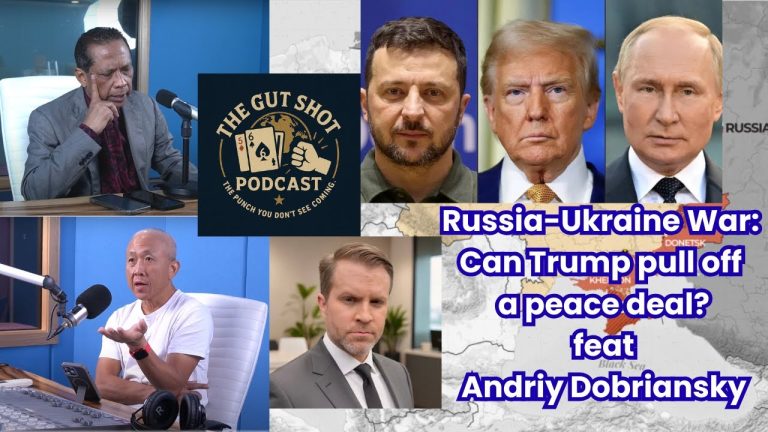
The Gut Shot Podcast Episode 12 is a discussion featuring Andrij Dobriansky, a prominent Ukrainian-American figure with extensive experience in international relations. The conversation primarily revolves around the Russia-Ukraine conflict, particularly focusing on a recent summit in Alaska involving former President Trump, European leaders, and Ukrainian President Zelenskyy. The participants analyse the diplomatic strategies, geopolitical implications, and the financial aspects of the conflict, including arms deals and sanctions. Furthermore, the discussion explores the humanitarian impact of the war, with personal anecdotes illustrating the devastating realities faced by Ukrainians, and considers the broader historical context of conflict in Europe and its potential for global escalation.
Jump to chapter 7 chapters
- 0:00 Assessing the Trump-Putin Alaska Summit
- 10:16 Arms Financing and Security Guarantees
- 18:18 Russian Imperialism and Diplomatic Realities
- 28:25 Global Spillover and Sanctions Enforcement
- 44:12 China's Calculation and Strategic Triangulation
- 54:21 Post-War Reconstruction and Tech Innovation
- 1:12:35 Human Realities, Trauma, and Historical Memory
Auto-generated from YouTube captions. Timestamps link to the video.
Welcome back to the Gutshot podcast. We have the incredible privilege of welcoming Andre Debransky to the pod. Um, obviously uh Andre is the most visible face of Ukrainians in the US. 50 years of experience coordinating global campaigns at the UN. Highly sought after for viewpoints on the Ukraine, Russia, Eastern European culture identity as well as Catholic and Orthodox religious practices. Andre, you've been on the Daily Show with John Stewart, CNN, Fox News, MSNBC, PBS, and now you've got the um honor of being on the Gutshot podcast with Simon and myself. We we are
broadcasting from Kalo Lumpo and Malaysia where as a key country in the region, Southeast Asia. Uh we've got over 600 million people directly or indirectly affected by geopolitical events in Europe and North America. Good to have you with us, Andre. if you can um what what were your viewpoints in in terms of the perspective about what happened in Alaska between you know the European leaders and Trump and Zilinski?
Uh yes first of all thank you guys for having me on. It's always a pleasure to reach new audiences. Um uh this has been a crazy week for me personally just I haven't had a lot of sleep this week uh with that same question that you just posed uh which is what is happening and what has happened. Uh we had the Alaska summit which uh surprisingly came about a week after we heard about it. We heard about it late on a Friday in the United States and then the following Friday the president was already in Alaska. So that's a it's a very short amount of time to put together an international
meeting like this. Uh thankfully it was done on a military base which is a lot less security to deal with. Uh it's already built into the process uh including airspace restrictions. So um the fact that they were able to put that together so quickly is demonstrates that the White House um has a capable team in terms of doing international summits like that on a very short order. What hap the reaction of it was very negative. Uh there weren't weren't that many positives for the Alaska summit. In fact, I did a lot of uh conservative uh commentary on conservative outlets on
Friday and Saturday, and the most positive aspect I heard was that President Trump had a longer red carpet than Putin and and that they were very impressed with the synchronized flyover of Tichu bomber and the four F-35s overhead. Beyond that, there were no good talking points coming out because unfortunately, I don't believe that President Trump's team coordinated enough with the media. Um, I know that they had a splash in the New York Times talking about how the coordination of the uh flyover came out to be. I thought I think they thought that would be much
more spectacular. And in the end, Putin dismissed it with a shrug. Uh, given the fact that he's been to front lines as opposed to President Trump, it's not as impressive to people who uh are around war zones. Um, absolutely spectacular flying. Let's not diminish that in any way. Uh this was a a team of four uh pilots who were circling waiting for two presidential planes to land and then they had to leave their planes and then these so they had a moving time of target moving toot that they had to deliver and cross over. So absolutely spectacular piece of flying. However, um
what it what it gave us in the end for I believe it was about $2 million just for that 90 seconds overhead. Um really didn't do anything once once uh the whole goal was to maybe impress President Putin. Not quite sure. Uh also a flyover like that, we have it in stadiums. We have it at independence events in the United States. That's done as a sign of honor. So, the addition of the flyover as well as an honor guard saluting a man who is a wanted war criminal also brought up questions again because a lot of advanced work wasn't done with the uh press and that really was the big crime
of the event. Not a crime but this I'm just being hyperbolic here. Uh President Trump has had a war with his DC press corp. does not like the the press pool that is assigned to him by the uh by the press in DC. Uh he wants to change it. We've seen it very obviously who he lets into the White House, but he does not his team does not coordinate well with uh White House reporters. And that is a problem when you go overseas. This was a this was this has been talked about by presidential historians over the years. Whenever you have an overseas visit, you want your press corps to work handinand
glove with your administration because the other side is always going to be doing that. And here especially, you have Russia who had several hundred I believe two to 300 visas issued. They requested to two two to 300 visas just for this event for their press and their diplomats. Um so they had an entire team of what I consider to be propagandists. They were being fed lines to distribute to their outlets, but those were the only people that were communicating with people inside the room. So, the Western press, the White House press who traveled to to Alaska did not get a
press conference, didn't didn't get an exclusive like Sean Hannity did or Brett Bayer. They were left the only resource for them to do their reporting were the Russian quote unquote journalists. So, uh, again, the White House messed up not only by didn't not having the correct talking points in advance, but during the entire day, they weren't feeding information, leaking how strong President Trump was, what he was doing right in the room. Yes, the press can manipulate that in ways otherwise, but they were left with zero information, and therefore all they had were the
talking points coming out of these Russian journalists. So, that was a mistake. And in general, that that's the mood I got making my appearances in Europe and in Ukraine on television stations as well as on American television stations. And I generally did mo mostly mostly conservative outlets that day. And you know, I I I did not hear that many positive things. That completely changed on Monday. Uh Monday was a great success story. uh much more communication with the press, many more uh exclusive pictures that are still coming out to this day showing President
Trump in private candidate moments with with leaders. In fact, the the White House social media is putting out more and more pictures and and little snippets of video about how that day went. And that's how you dominate the media. And this is in again the the failure of of Alaska was a failure of media control or dominating the media narrative. And that was culminated with the press conference at the end which wasn't a press conference because there was no questions. But also President Trump just he he was not at his best. President Trump is best when he is full
of energy when he is when he is engaging in people. So questions actually help him because they raise his energy level. He read something and when he's hunched over in reading he's not powerful looking. President Putin read something also, but he for a short guy, he's always puffing out his chest to try to look as tall as everybody else. So, President Trump was low energy, did not engage with anybody, and therefore he ended on a low note. Um, and that's something that they tried to fix in Washington, and I think they did. Unfortunately, the last thing I'll say
is that the president has stepped on all of the victories of Monday where he was being hailed across the world as an incredibly dominant leader, somebody who is working towards the future because he started calling in to different radio shows the following day. So, he called into Fox and Friends. He changed a lot of the rhetoric that came out of the White House on Monday. He also tal called into Mark Levan yesterday, another conservative host, um where he also went on many different tangents and wasn't on message. We know the people who love Trump love that he talks about
anything and everything, but after a major international summit or any major event, you want to have you want to be sticking on your talking points to demonstrate how successful things were. And that's what didn't happen, unfortunately. son.
Yeah. Um I was I didn't have much time. I mean I'm I'm in DC uh uh doing joy joy walking as they say. Right. Yesterday I had a full day of museum um and and keeping the wife happy for for the week after last week's uh neglection. So u I didn't get much uh coverage uh Andre unlike uh when I'm home. Um so when you say he was not on message I I really want to understand what you mean why after Monday he was not on message specifically maybe you can give me a one or two uh examples you you consider that he dropped the ball after Monday. Well, in terms of not being on message, he in
diplomacy, you want to be vague about things and and that makes every more people on board with I mean, same thing in politics. You want to be not too specific. And when he started on Monday talking about no troops on the ground, uh, no, we're not going to do this. No, we're not going to do this. That took away from the unity of saying all the European leaders said we're going to do something on security guarantees. That was the major change in the narrative, the the wakeup call to the world and and Russia itself going, "Oh, okay, America serious. They're going to be doing
something." But when you cut it down by saying, "We're not going to do this. We're not going to do this." All of a sudden, it takes away from the unity message where all the leaders are saying the same things because all the European leaders can say the same thing. Well, we don't want to do this or we're only going to say five guys. We're only going to do That's not the message you want to put. We want to be saying for the entire week, we have security guarantees. You better you better show us a uh an option, Putin. Give give us something because again, up until this point, we
haven't had any concessions made by Putin. Anything showing that he's willing to have a conversation, not least of which is what was underscored at the meeting was there's no there's currently no c ceasefire. And this has been the one thing that President Trump has tried to get since February. This isn't the first time that he spoke with him at in at Alaska. He's had long two, three hour discussions every month since February and the one thing he's been asking for is a ceasefire and Putin has refused to budge.
So, you want to Yeah, there's there's a bit of the sopranos I come in. Yeah. So Andre, there's a bit of the Sopranos about this whole thing because on the the Financial Times um reported on Monday um revealing a document actually which which suggested that Zilinski would buy through European financial aid hundred billion dollars of American weaponry um in return for security guarantees from the from the US. So it's a little bit like you know you're you you've got to pay tit for tat where you're buying American security. Um and so I mean so optics aside I think what I I think we're trying to
understand what this all means from Azan perspective and you know is there like an elements of of financial market wizardry here where um you know obviously the the the whole war machine uh security guarantees you um you know the militia all that is involved. I mean there's a financial element to all this. I mean what are we to read about these developments? I think the financial uh what you're referencing that hundred billion dollar deal paid for with European funds, the weapons going directly to Ukraine. I think that is as we have seen the need for any country in the world to offer some kind
of sweeteners to for to keeping President Trump's attention and willingness to go on with something. We've seen this in every tariff deal where there are sweeteners involved in investments in the United States. that's the only way that there will be a tariff or or a a trade uh agreement signed with a bilateral trade agreement with different countries. So here again I think this is much very similar to the discussion about the minerals deal. This is something that caught the attent this was something that interested President Trump. He wanted it to happen but it was
proposed before President Trump came into office. This is an idea that's been bandied about. But when President Trump came to office, I I think the Ukrainian side and others knew that this is something he would be interested and so it was proposed and he went along with it. Same thing here. President Trump is more interested in anything that he can post as an accomplishment for the American people where he's bringing money in and uh a deal uh where weapons are going to be purchased is much favorable to the United States in his mind as opposed to what we've been doing
which is uh sending depleted stock from our from our warehouses and replenishing that in in the United States. a plan that that uh has been so successful that's it's actually the basis for what President Trump proposed with NATO last month. Uh basically what NATO countries are going to do is the same thing that the United States has been doing which is sending whatever whatever stock they have in their own warehouses already, munitions, uh vehicles, what have you. And then they will they will buy uh with very much less red tape and much much easier to replenish from from American
manufacturers their storehouses. So that that system that was worked out in the previous administration was so successful that Europe that President Trump has basically expanded it to European nations, cutting down red tape, cutting down permissions for exporting to to them. Um and uh and now he's looking for something else on top of that. So, not only is it Europe going to be buying uh is is offered the ability to buy, now they are putting down on paper that they will through Ukraine purchase uh hundred billion dollars, which is again a he needs political
winds to figure out a way to keep this going. M um Chang, can I uh pull back the uh pull back the discussion a bit and take a a bit more macro picture because I understand um Andre's point with respect to the optics and all that, but with Trump normally I put aside the optics because the optics can be quite uh either uh you're going to have a lot of bling or you know um a lot of u a lot distractions so to speak you know so I tend to actually look at what's the bottom line that's going to be achieved if there is right so when I look at this my first thought was actually u he
wanted to get putin into a discussion as soon as he could on a onetoone basis physically I think it's typical um business mentality which is you know uh rather than have all your people work out the detail sales you get on to the decision maker and see whether you can work out uh uh a way forward with the decision maker. So that's that's the way that's the first thing I thought when I I saw the Alaska summit being uh cobble up pretty fast. That's number one. Secondly, I thought that um the interesting part about uh the ceasefire, the mainstream media I think have made a
big deal out of the uh ceasefire not being there and Trump has been saying that he doesn't really need a ceasefire. So that may be a change that um that some has been negative about um but um again I go to the bottom line because what I see in how he handles things is actually it's again it's the typical business pivot of you know whatever that's going to make it work. Now, when I peel back and I I think my thoughts are number one, he's already stated up front, this is not my war. This is Biden's war, right? Uh Andre, am I am I couching it correctly? That's about what he has been saying.
Yeah, I have a couple of responses. So, let's start with the Biden war and we can go back to it, but um this war this war uh the last 6 months of 2024, there were 11,000 pieces of munitions, that's ballistic missiles and bombs dropped on Ukraine. In the first six months of 2025, there are 27,000. Um there are 40% more civilian casualties uh over the last three months. Uh 40% more children specifically as casualties. Uh and last month July was registered by the UN Office on Human Rights as the deadliest month for casualties since May of 2022. So whatever was happening in 2024 and who
was in charge there, it is definitely a hotter war now and the the president who is the president is President Trump. Going on to ceasefire, the conversation in 2024 was not centered around ceasefire. Um that was a Trump initiative. Trump was the one who approached Ukraine and said, "I want a ceasefire now." He cut off military supplies. He cut off military intelligence, target intelligence, which directly led to a loss of Ukrainian territory on Russian land. Um, and he is the one who has been driving ceasefire for five months. It is only in the last couple of weeks that he after especially
since talking to Putin where he dropped the conditions for ceasefire and said we're going to go to a plan after being proposed by Putin. It's frankly a Putin plan to go to a final plan, not President Trump's. Because on the Wednesday before the the two days before the Alaska summit, he had an international call with European leaders. They put down five points that they all agreed to. America with the European leaders and first was ceasefire now. So it Trump has been driving the ceasefire now. That's why it was included in the European demands. It was because that was a Trump issue and he is
the one who changed his mind. So, it's this is one of those things where Trump does announce something and then when he has a radical change from not doing a ceasefire to something else, he's going to get called on it, whether by pundits or or media from time to time.
So, yeah, I absolutely agree with you on that part. John, go ahead. Yeah, gentlemen. I I just like to return the first principles if possible and try and just make it you know um palatable for the lay man and if we can just have a quick examination of why Vladimir Putin did what he did in the first place and what Zalinski is trying to achieve and whether those top three bullet points can actually be met in the in the middle in terms of a compromise and how far are we from those uh that that ven diagram being achieved.
Uh we're still far. We're still far. I think uh Secretary of State Rubio was the most uh calm and level-headed voice after the Alaska summit where he just tried to slow everybody down because President Trump was doing his social media, Steve Witkoff was doing uh media interviews talking about things that he still doesn't understand. And Marco Rubio was just saying we are in the first steps of having a discussion. We are just this was after Alaska. He said, "We're just beginning the conversation. There's no, in Marco Rubio's mind, we're not at the final decision yet. We are
just beginning the conversation and that's frankly what happens in diplomacy. It's a long slog. President Trump likes to talk about the peace agreements that have been signed at the White House. Those have been in the works for months. Uh the uh Rwanda and Congo peace deal. The State Department was working on this for 18 months before President Trump become president. And it was only the final push by President Trump that got it over the line. But still there's a lot of diplomatic work that needs to be done. The the boring work and we're not at the boring work
section of the Ukraine uh uh the attack against Ukraine. There needs to be a lot of work by uh diplomats and negotiators to figure out exactly what we're talking about this thousand miles of demarcation of the front line. What we're talking about in terms of who stays on what side of what border. So in terms of for the lay man to understand you know why why Putin started this Putin does not consider Ukraine to be a people and that is from the top down vertically put down into his population to the extent that we know that Russian soldiers because we have the recordings of their wives
calling them and and saying whatever you do in in Ukraine raping women that's fine by me. They don't consider these people this other nation a people. Um uh we even saw this in Alaska where President Putin was trying to say that well I I may be comfortable with them speaking in their own language in their own country or I may be comfortable with them having their own church in their own country as part of a negotiating point. So in the end it comes down to not not acknowledging Ukraine as its own separate country. His people have also all on Russian television over the last
month have been saying this about the three Baltic countries as well that they're not real countries. they're just an offshoot of our old Russian empire and that uh we should actually have that territory as well. So um it it stems from the fact that uh it stems from the fact that there is there is a long-standing at times throughout Russian history there are some reformers but always the empire side of the of the equation dominates uh whenever whenever whenever that is political politically feasible to use that as an excuse to rally. Uh it's happened several times o over the
centuries but notably here we know that Putin increased the military thoughts of rhetoric when he came into office. He cut down any reformers literally assassinating many people who were doing um reforms in the state parliament of Russia in the early 2000s. And then from then on it's just been military attack against military attack against uh people within the Russian Federation whether they're ethnic chhatchins and and the leveling of Grosni um the attack on Georgia in 2008 across his border. He's he Russia has military troops in eight different conflict zones uh nine
actually nine conflict zones since 2022 um that uh are just you know constantly expanding and there's no reason to think that this won't expand further given the fact that he's now consolidated even the mercenary forces that used to work in um Africa and other places he's consolidated them into the armed forces of Russia and so everything now works directly under a power vertical meaning President peasant Putin is really the the one who dictates where his forces whether they're mercenaries or armed forces of Russia wherever in the world he's controlling that and uh Ukraine will be
a fundamental part of this there is no backing down from the from Ukraine for Putin uh it has been a fundamental strategy and a talking point of his from the very beginning um and so I don't see one I don't see a situation where President Putin beats with President Zalinski he would be in Putin's mind lowering himself to somebody he doesn't recognize. We we had the one meeting in 2019 where he was just President Putin did just didn't know even how to talk to President Silinski. And then um and then furthermore, we are every day that we go further from that Washington summit and
the Alaska summit, we are further we hear less and less interest from Russia about sitting down like President Trump wanted.
No. Um I'm looking at this and um I mean in spite of all that the question actually that comes to my mind is uh what's next because um there are few basic points if you if if I think about it in order for this uh conflict to be resolved regardless because I think um from a Russian standpoint uh Putin will go all the way if he has to.
Right. So we we recognize that fact. Okay. So recognizing that fact that you know they'll they'll they'll put through their people on a meat grinder. Um and and they have enough people to uh to uh to overrun Ukraine.
Maybe there you go. Right. So that's that's one. The second thing is how long do we want this meat grinder to continue? Right. So if you take the head to say that uh the position is this is not my war. This is a war that I want to end. Um then there must be consens consens u uh
concessions concessions by both parties right by both parties to some extent. The problem is really actually um I see that uh that Russia has got the upper hand with respect to territory and and and the power dynamics if you ask me. So then the question becomes how much is Ukraine willing to concede in order to stop the bloodshed and then how do you stop this from happening again which is what you mentioned Andre which is basically the uh security guarantee. Am I am I am I right to to to put this and say these are two main issues as far as I look at it. Uh well there's also
how do you see it there? We've had three international um peace summits organized by Ukraine where uh one had 80 countries one had you know there's there different numbers of people attending every year. There's been a separate summit in the Middle East with Saudi Arabia and other people. What did they see as the future of Ukraine? Because this is not this is not just a Ukraine Russia issue. Um there are a lot of countries that are looking at this. not least China but a lot of countries around the world who are looking at what happens here because we haven't had this in such a way
especially in Europe and and the war in Europe is what caused the United Nations to come into place a lot of international agreements to come into place um that people are looking like if if this can happen in Europe which is where we said it wouldn't happen again which is military takeover um and and annexing of other territory then then the basis of the world order whether it's the UN charter whether it's the Helsinki format uh numerous international agreements are are based on this and and people can talk about China and Taiwan sure but really I I I always go back to a African countries uh
the ambassador of Kenya when Ukraine was invaded in 2022 was like we didn't draw our borders those were the borders that were given to us by the empires who occupied us if we were to start saying that in Africa uh we need to start changing borders based on ethnicities and the right that these are traditionally our people. We would we would send our entire continent down a path of war for over a hundred years and that's the case for many places in the world. So I think the we are so far removed in many places in the world are so far removed especially the wealthier countries are so far
removed from uh world war or uh because many countries have been involved in other wars civil wars and others but I don't think people really understand what it would be like to return to the 19th century where we had uh wars of conquest happening regularly where the seas um you couldn't send your ship overseas without being worried that your your goods or your people will be captured. This is the question when when Donald Trump says that he wants to go back to another era uh where we're not dominated by international agreements but more one-on-one agreements that I worry about because we
haven't had that in over a century and we know that the last time we had that we we came into a system where world powers were divided into blocks and all of a sudden they started you know going at each other. Here we don't have blocks going at each other. We have rogue states. We have China that's a rogue state. We have Iran that's a rogue state. North Korea that's a rogue state. Syria before the current revolution. There are rogue states out there and the world hasn't figured out how to deal with them. There have been sanctions regimes. There have been cutting them
out of different deals. But Russia has never been treated as a pariah in the way that those other countries, North Korea and others, the United States signed an international agreement with Russia during the war. During 2023, they signed an international agreement to continue sending astronauts through Russia to the International Space Station. There's no
The Europeans, sorry, the Europeans are also, I mean, still uh importing energy from Russia. Yeah. Right. That's what I'm saying. It's never been cut off like a pariah, right? Well, well, I mean, you think about it. So is China. Nobody's cutting off really China either.
No, no, not at all. So, so I mean we spoke about uh in previous episode about a resetting of the global uh of or global trade. In essence, this is in in in a way also a resetting of um global geopolitics and and power dynamics, right? That's the way I see it. And um I think each area has to be handled differently. I mean, China, if you ask me, you're looking at at uh merchant uh u merchant commerce, maritime commerce protection that needs to happen because you need the straits of Taiwan and the surrounding area to be peaceful, right? in Europe. So you've got a different
dynamic that then than then and especially when you have a president that is willing to take action then it at least prevents the other party from taking the first unilateral action which is what happened in my opinion. I can you know we can go into this this uh this this argument but I would rather not go down that rabbit hole which is basically I think u in the case of Ukraine it's basically the the the cookie has been to a certain extent baked right now after a decade you know Obama from Obama then Trump and we got a pause and then Biden and then we got another fight right so now what
the question is actually how do we get back and the only way I can see to getting back with respect to Ukraine. Is there going to be how much do you think um um Ukraine is willing to concede with respect to territory? So, I'm I'm really going to uh to the uh to the to the nuts and bolt because I think that the security guarantee if is something that is going to be a prerequisite,
right? So, that's going to be a prerequisite from the Europeans and from the Americans, right? So I think that will have to be in place. But then with that in place, what kind of what kind of territorial concession are they willing to do with Russia?
I think that are they willing to do at all? I think that depends on what kind of concessions Russia is bringing to the table. Uh understanding that there are numerous war crimes to deal with. Are they sending any Russian officers off to the H to be prosecuted for the sexual violence? Are they releasing any of the 20,000 children that are currently u kidnapped in Russia? There was just a website launched last week before the Alaska summit where Russian parents can go online and and and pick the kidnapped Ukrainian child to adopt. So there are things outside of uh land and
war that are also need to be discussed because I mentioned three different international tea summits that happened since 2022. one of the things that were discussed by many nations because all nations need to back this up. It's not just the security agrees by NATO. But all nations need to agree that this is a just peace otherwise you know we have had resolution after resolution at the UN where over 140 countries condemn this and want specific actions happen. So how do we reconcile this? And one of them would be a just peace and the just peace has to do with what is the kind of
justice that is happening. Is President Putin still going to be a war criminal after this? uh is uh we we still have um obviously uh the the nearly 300 people that were shot down over Ukraine that still haven't received justice for the the the killing in 2014. There are so many things that haven't been adjudicated uh that that are also a part of this discussion because we can't just say territory peacekeeping end of discussion. Yes, we have had unjust peace peace in the world but there are so many this has upended so many lives that this doesn't guarantee uh a calm
peace and what we need is not just security guarantees from Europe and concession from Ukraine but we need to have an understanding about uh justice will be happening otherwise you get into uh vigilante murders you get to uh reprisal campaigns of bombings all over the place this is what happens when you don't have a peace.
Well, Chong, you want to you want to butt in? No. I'm I'm blessed. I'm I'm I'm this whole um well, as they call it, the fog of war, right? You know,
you you really have a situation that you're not going to have 100% uh satisfaction from either party if you ask me. And especially if you look at it from the point of view of the Ukrainians, I don't think that will come about if you ask me because you're not going to be able to enter into peace if you still have uh Putin uh being labeled or or being uh designated as a war criminal. That's not going to happen.
Then what happens with the war crimes that were what would you do with the war crimes that were made then? Were you just going to because they've all been filed and recognized. Is somebody going to say please please don't prosecute? Like who who makes that decision?
Well, for for one, the the the international crim uh the international uh court of justice ICJ ICJ court of justice. Yeah. Court of Yeah. The the ICJ is not recognized by by by the US, isn't it? That's one one issue.
It's not that it's not recognized. It wasn't ratified uh by the Congress. So it's not recognized then buddy. Yeah. Yeah. No. Meaning that they won't enforce the the warrants and stuff but that doesn't mean that it's not an international warrant. So
are you know Putin can't fly to over 100 countries. What what changes that? I know. I know. So here's here's the thing. I mean at the end of the day it's either something's got a gift or nothing gives and the meat grinder continues.
Right. And so we we we have heard that Ukraine was ready to give a 30-day unconditional ceasefire. We have heard that Ukraine was ready to sit down. They sat down twice in Istanbul with uh going back and forth and Russia wasn't offering anything. Russia is continuing to, you know, if you're talking about an intractable partner in a business discussion, Russia is continuing to put down the terms that they put down the day they invaded. There are no changes in their terms.
Well, here's the thing. I mean I don't think we can um we can adjudicate the the the peace deal though over here right between us talking about it but but definitely I I see that there are few main principle items for example if you talk about uh you know uh uh uh missing children that will be part of the discussion obviously right yes um
and that that has been part of the discussion that was part when when President Trump says I want you to meet in Istanbul with with President Putin and Silinski got in a plane. President Putin didn't show up. His foreign minister didn't show up. But there were two meetings held in oh sorry three meetings held in Istanbul. And during those meetings, Ukraine put down not the 20,000. They put down a list of 339 children and they asked can you return these children as a first as a as a sign of good faith as a negotiating and then we will do something in return as well.
And Russia wouldn't even hasn't even responded to that request. Yeah. So I think I think we've come a point I don't know I mean I'm looking at it with all the flurry of activities it at least actually to me uh the first time in about in in 4 and 1/2 years that there is seem to be a real push at peace. So I think we'll have to we'll have to see what happened next within the next couple of weeks at least um and and see where this whole thing is going. I think
can can I just can I just add the the the I I agree with you. This is the first time we've seen progress at kind of meetings. But also this can all go away very quickly, just as quickly as it started. Um and you can look back to the fact that nobody talked with North Korea for how many decades. And President Trump did two major summits and at the end of it he just walked away. He said it, you know, North Korea is intractable. We're not moving forward with the deal. Um well I mean just trying to understand the tea leaves and what's going on.
Um look I mean Donald Trump calls European leaders including Kashama um Emanuel Macron Vladim Zilinski Vladimir Putin they all land in Alaska on American territory. They subject themselves to the perceived humility of B2 bombers flying over their heads and it's a show of strength. I mean let's call it that. It's theatrics, right? Um what role does America play in adjudicating a peace treaty between these two waring nations? Because they they came. He called and they came. So they they obviously they they appear to be um of the belief that you know maybe America can do something. And what does
America what can America offer to make both sides come to the peace table? I think that's the key point because I mean for us in AEAN a continued pro conflict in in in the Ukraine does not give us any benefits. I mean obviously we've got increased prices in terms of a lot of goods. Um this latest tariff threats by America on the on India does not bode well for us in this part of the world. We don't want to see more conflict let alone in in our part of the woods. Right. So what can America bring to the table in terms of adjudicating this peace treaty? Well, uh let's let's understand what
what the conflict is uh today. Uh obviously I mentioned at the beginning that we have an increased amount of bombings, more than double in the first six months of 2025 than we did in the last six months of 2024. Um but let's go back to 2022, which is where we are in terms of civilian casualties. um civilian casualties in July in Ukraine are at the level they were in May of 2022, just a few months after the conflict began or the the full-fledged invasion began. And at that point, everybody around the world was reacting in in despair because there's a difference between when Ukraine gets
invaded or another similar country and say what happens in the Sudan or what happens in the Congo. meaning that Ukraine is tied into the international economic system in a much different way than some of these countries. The first the very first thing that the United Nations was pulling their hair out is what to do with all the food that Ukraine ex exports. And that's because a lot of the grain is sent is is purchased in Middle Eastern countries in northern African countries and some South Asian countries as well. and that the fact that Ukraine was invaded. Um uh
obviously no air travel happened. Uh the the the rail travel continued for a bit. Roads were uncertain at the beginning of the war which ones were going to be bombed, which ones were uh going to be potentially uh treacherous for trucks to go through. So all of a sudden we had no idea how the food was getting exported. That's why in the first legislation that the United States passed after the war began to send aid to Ukraine, they actually included international development money for Africa and many Middle East countries for uh increased fertilizer, increased uh farm
development, increased money for them to purchase food. Because what the United States was worried about and many world leaders, this is why they were having meetings at the UN is the domino effect. What happens when a small country in the Middle East or uh or uh northern Africa all of a sudden has a run on its food, prices are skyrocketing, the government can't keep a hold, riots begin and all of a sudden that spills over into another country and another country and another country. So um when we talk about why we need to be aware of this, we need to be aware of what the status
is of the war right now or let's say at the end of 2024 it felt like there was a stalemate developing but Russia is not satisfied with the stalemate and they are actually increasing the production. They've imported 25,000 workers from North Korea to increase their production of the Shahed drone technology they got from Iran. So they want to be able to fire a thousand drones on Ukraine on a regular basis. They want to uh just yesterday they fired on uh a Ukrainian oil depot. Two days ago while the summit was happening in uh the the White House they uh they bombed a Azerbaian oil
depot in Odessa. This is the same country that was involved in the peace deal signed at the White House um and is is a big key to the future of oil and natural gas coming from the Central Asian countries bypassing Russia and going straight to Europe. This is part of the what the White House and and Europe has been working towards and Russia is attacking that not not necessarily Ukraine. Ukraine domestic supply is almost nothing in terms of oil. Uh they are attacking foreign countries oil depots on Ukrainian territory. So this is why when we say why we need to be worried, we're worried
about the spillover effects. We're worried about say when people talk about cutting off Russian oil, well we know what that means. That means the Russ the price of oil around the world goes up. So there are the spillover effects that we want to be able to contain either in a stalemate or into a final resolution whichever works out better for the world.
Is there any sign of a stalemate at this point in time? Because the temperature that I'm getting from both of you discussing this is that we're very very far off from any kind of peace treaty or even kind any kind of talks being. So I I think the real question is what what happens next Andre? What happens next?
What happens what happens what happens next is that Russia has been using um less of its uh mechanized vehicles. They've lost over 20,000 mechanized vehicles, tanks and armored carriers, but they've been using the ones they have in reserve less. And they've been probing the Ukrainian front lines with these salads with just, you know, a group of a platoon of soldiers here, a brigade here, and they're trying to figure out where the where the front line is the weakest. and they haven't been using specifically their military equipment. They have been using that in
reserve until they'll they can build up and scrge up enough because they're looking at, you know, what older the equipment they use to do a bigger push. That is what Ukrainian intelligence sources say. That is what Western intelligence sources say. If that comes to be, who knows? But that is what the teen leaves are telling us that some a bigger push is happening out of Putin. and he's obviously not slowing down as I just mentioned the production of the glide bombs, the the u uh the missile technology as well as the drones. So at this point, Russia is seeing no evidence
that they want to stop this conflict. they are increasing their conscription of people and therefore the only natural response for the west is to uh increase their support of Ukraine either in additional military aid, ratcheting up sanctions against Russia for them to be hurt more because we know that also by the end of the year Russian GDP is supposed to go down to zero um in GDP growth sorry Russian GDP growth has been slowing down. I think it's down to less than 2% uh now from I think at the beginning of 24 they were at 4% or 5% even. So even with the sanctions they
were still growing their GDP. It's going to go down to zero by the end of the year and then it's a question of what happens at that point. But in between now and then there could be a major additional military offensive by Russia.
So So here's my question Andre. Um war is not cheap and the money's going to come from somewhere and if obviously right um if America imposes the sanctions that it wants on India and does what it wants the Indians to pay um if conceivably India stops buying Russian oil um and and China continues to buy Russian oil as it as it can be as it can because obviously China does what China does right um does it then increase tensions between the US and China and and if that happens then what happens after that because I mean we're just trying to think maybe you know
chess- wise four or five steps ahead because if if what you say is true and Russia continues to want to continue want it it its land back um it's it's got to pay for it somehow right and then what happens after that
the chess with China is that China has openly said more than once this summer that they do not want to see Russia lose but much like Biden they and Ukraine they don't they're not saying that they want to see Russia to win. So, it seems like China is happy with things going in exactly the way they're going now. Both Russia and the United States spending money, spending resources and people uh especially on the Russian side, losing people. Russia, China would be happy with less Russian shoulders, rest less Russian resources in terms of money and capital and more reliant on more and
more uh uh resources from from China. This is also a a conversation I've had with some people uh Russia at the beginning had a had had stockpiles of of material. It could be the 20,000 tanks I said that have been destroyed or t and military carrier any mechanized vehicle they've lost 20,000 plus um bombers we know other equipment that they can't replace very quickly but especially the munitions they have been turning more and more to these other states they've been turning to North Korea either manufacturing their drones or purchasing uh shells for their howitzers to attack on artillery 80% of
some of these shahed pieces or their drone pieces are being sourced with chips and other material from China. Uh, United States has called that out directly at the UN Security Council. Um, Iran also still a partner for for aid uh any any weapons, etc. You these countries I just named, you can't just call them up and say, "By the way, North Korea and China, uh, we're going to stop the war. You know, we're ch Russia is already
in bed with with mobsters. They're mobsters. Can I do this then? Can I do this then? I'm I'm going to play very Mavilian in terms of my thought process.
All right. All right. and um and and and and put myself in the in the in the position of um a businessman president who says this is not my war and I want to actually um I got to play this chess which is what is the my bigger chess pieces that I've got to worry about. I got to worry ch I got to be worried about China. I got to be worried about Russia. That's my two biggest problem.
All right, if I were to to to look at it, right? I don't want I don't I don't want to push India into the Russian bed. Okay. So what am I go what what should I do? So if I look at it I said okay um the the Europeans and I I go back to um just just a a quick digression which is in essence I I would feel that this is a European war plus my old uh my predecessors war. uh so what I'm going to see is actually I'm going to stop it no matter what right so that u so that I don't have to impose sanctions on countries like India that is buying Russian oil
right and then I would integrate Russian economy into the global economy whether you whether war criminal or not because all I want to do is actually to to increase the global GDP right so that I can
what can you name some things from the Russian economy that could be integrated though. Oil. Oil. Okay. Oil and gas. Because why? If I have to impose sanctions on India for buying uh uh uh sanctioned oil from Russia,
it's already creating a huge problem in terms of trade, you know, and India is just one. I've got to deal with China and China is going to keep on buying, right? you know so and and then what happens it floods the market later on trans shshipment you know that I can't control right so I would rather see uh a controlled commerce number one number two I would rather take Russia out from uh from a bricks uh economy
okay right so if I were to do that I would go to Zalinsky and say hey buddy you um these are these are the things that you got to concede and these are the things I will help you not I will help you get and and get to the end of this war as quickly as I can. That's the way I see how things are going.
You're not you still are assuming that Russia's going to go with this though. I am assuming I have to take that gamble. So I mean Andre I have to take that gamble, right? Yeah. But but right now there's nothing there's no there's no even hint that Russia is interested in stopping the war or or interested in in coming to any deal. They're they're in their mind they're they are the the dominant one. They're the ones that that have nothing to lose here. Well, if I were in Putin's shoes then, I mean, the way I see I mean, I'm I'm just looking at it, you know, from uh, you know, do I really
want to fight this? if I've already got um the ones that I'm reasonably happy with and I've got to get richer um and more stable economy uh by reintegrating my country into the global market that would be an incentive enough for me to look at it actually rather than get
I agree I agree these are the chess pieces I would think right which mean you know my my my counter point some is I don't I just don't see Russia at this point today or to the end of the year stopping whatever they're doing. Maybe maybe Putin changes his mind. We just haven't seen any indication that Russia is interested in stopping even with the sweeteners you said because
let me ask you a question then. Um since Alaska have there been any more flare-ups? Oh yeah. No, Russia has increased last night was horrible in Ukraine. the the in terms in terms of ballistic missiles. So during Alaska while they were in the room, Russia launched its Russia launched its drone. While Trump was speaking to Putin, Russia launched his drone attacks on Ukraine. While they were in the White House, the European leaders and President Trump went to speak with Putin, he launched his bombers to attack Ukraine. Um all of these things are happening on and and
the Azerian oil depot in Odessa that happened when they were in the White House. This is one of the major deals that Trump is talking about every every day that he made peace between Azarbaian and Armenia and and Russia is attacking the oil resources of Azarbaijan. So this is happening no matter what like we want. You would think we would see something from Putin going I'm going to do some I'm going to stop doing this or I'm going to stop killing children or women or whatever things that upset Trump but in but he's doing the exact opposite for some reason. I don't know. I don't know why.
John, I'm quite concerned obviously, right? It doesn't bode well. Um Oh, you you be humanitarian. You go ahead guy. I mean, you know, obviously, you know, the 60s, they got it right, right? Make make love, not war. But, um, I just, you know, so Andre, I'm looking at the the poly market odds, right? And for for the longest time poly market was actually quite quite quite pessimistic about some kind of resolution. But in the last few weeks a poly market odds have seem to increase in favor of some kind of
Oh, you went muted for a second. Yeah. Why do you think the the odds have increased? I mean you know Alaska because of the summits. Because of the summits because there was actually uh talks happening. That's the you know that's the big difference between the beginning of the year and now. Even Zalinsky coming to the White House and then Zilinsky agreeing agreeing to a 30-day ceasefire that didn't move the markets because there was no summit. There was no conversation. I think Alaska Summit changed that. I think that apart from all the negative said about the media attention on it and how they
the White House could have done a better job controlling the media narrative, I think there was some progress made during that summit. But in the end, um there's no way that it it doesn't seem like they have tied in Putin to any kind of commitment to go further because everything we're seeing and hearing day after day after the Alaska summit is Lavough doesn't want to meet anytime soon with the Ukrainians. Putin doesn't want to meet anytime soon with the Ukrainians. So I agree with you that what Poly Market was reacting was the fact that there was a conversation.
there was actually people talking with each other but it doesn't seem like anything that they discussed was enough to put down on paper to say we are committed to do one two three things in the next three months. So if you are a money market allocator, right? If you're if you're if you're a fund allocator, how would you position your capital um into the last into the end of this year? H how would you if you were bet and I've just met you, Andre, a couple weeks ago, right? If you were betting man, how would you position yourself?
Uh listen, I I've I was saying when when Crimea was invaded that I would still bet on Ukraine and and bet on investment there. So, um I'm always looking at the at the biggest possible pot. And in fact, Washington is going to have a another first of its kind reconstruction summit because there have been international reconstruction summits. But there are a lot of people from the MAGA side of the aisle, America first side of the aisle that are interested if Trump makes peace, what kind of investment opportunities would there be for American companies? A lot of people
don't understand that Ukraine how integrated I mentioned the everybody knows that Ukraine is a bread basket basket and does food but Ukraine was such a big outsourcer for um uh different IT needs. Uh the majority of logistics for Amazon was being run out of a third party in Ukraine for all of Europe. Uh there there are obviously all the startups that happened from Ukrainians that have exploded in Silicon Valley over the years. And then what we're seeing with this drone innovation, um, you know, this is one of the reasons that President Trump is interested in
signing a deal with, uh, Ukraine because it's not just the innovation, it's the testing it in real life environments that the United States is getting the benefit of. What happened with the Patriot missile system, which is the unrivaled defense system for uh shooting down rockets that are being sent at you, the rockets that Iran sent at the bases that America had in the Middle East, they performed better because their computers had been updated with all the rocket attacks that the patriots in Kiev had been doing, shooting down Russian rockets. So, it's about the on the
ground uh real time experience with a lot of these technologies. I was on the ground in Ukraine in 2023 with uh different American delegations. I was there since 2022 on different American delegations and from the very beginning there there have been massive interest in in um you know right now Ukraine has no uh air flights over it. Obviously the entire no domestic kind of flights are going to go and so outside uh firms were interested in developing their drone technology not for military but for delivery service services. So given the fact that it's going to take, let's say
they sign a peace deal today, there's no way that Ukraine can open up its airports for another five or six months in terms of staffing, in terms of security procedures, etc. we might have a a period where what the outside western drone makers were interested in which is right now they are limited to a ceiling I think of 500 uh feet or something in the United States I don't remember but they can they can test their delivery services in a in a in an environment where it's open skies they don't have to worry about crashing into airplanes and uh and go forward so for
me when you're talking about investment my my first thoughts are about what happens in terms of reconstruction because it's not going to be a Marshall plan where there's a big pile of money that we gave to the United States gave to Europe and one of the reasons we gave it to Europe is so that there were no repercussions like listen the United States is going to help you rebuild don't start killing each other you know again uh in terms of which country got worse and best and and in this sense it's going to be much more of an investment opportunity for people because you're
talking about rebuilding a society that has let's say um a lot of coal fire plants or uh uh nuclear plants that are 10 years past their operating license, there's going to be jumping from, you know, let's say 1.0 to 3.0 before even using 2.0 technology. So, um that's where I think a lot of international investment is going to be interested. I'm going to be interested in this Washington DC summit on September 13th and 14th to see what especially uh kind of MAGA interested uh techright people are interested in in investment in Ukraine because the number one thing
that this ties into globally is that the United States is dead set against any Russia uh Chinese investment into Ukraine peace or not. Uh this is something that they've made a red line. In fact, the the minerals deal has specific provisions that you irregardless of minerals or what have you, Ukraine cannot sign a deal with China on certain certain provisions.
Now, I've lost my thought actually. I I had some question. Sorry, I I gave too many things. Sorry. Yeah. In my simplistic little brain, uh in my simplistic little brain, Andre, I've just got this onelegging question, right? Because if you are if if you are right in what you summize about this the longevity of this conflict and if this continues to drag on given the interdependencies right does this conflict escalate?
I think that's the main question. Yeah. And does it go out of control escalation? It's one thing if you're talking about escalating and they go from one village to the next, but what I'm worried about is the food supply being disrupted. I'm I'm worried about uh the conflict exploding in terms of undersea gas lines in the Black Sea. There are many things that could all of a sudden increase prices around the world and then you have the after effect. So this is this is one of the reasons why you want to where were where let's say the theoretical idea that was
sorry proposed by President Trump during or JD Vance like we're just going to when we win we're going to walk away from Ukraine and they're going to have peace. What you don't want is the things to all of a sudden domino effect and go out of control. Let's say Russia just tore into Ukraine and all of a sudden the entire food system goes down uh various other system go. How does that affect a lot of things around the world? And does that embolden Russia to say do more stuff in in the Baltic countries which are also very wedded into the EU uh not just their economy
but you know a lot of different systems. What what does this mean for other conflicts around the world? This this is the domino effect is we you want to contain it right now. Uh we are going in the opposite direction that we were at the end of the Biden administration. As as much as people were complaining, me too, about how Biden was handling this war, we are going in the opposite direction that when we were at the end of 2024. And the Trump administration needs to figure out a way to stop that reversal. Whether that's a swing for the fences, Shamsul, and get that home run and get
the get the peace deal or try to contain Putin again because the warfare has changed. It's not the same kind of warfare that we had at the beginning. So, you need different strategies. You need different weapons. Uh the sanctions we put out at the beginning, they have changed. Russia has figured out ways to work around it. So, we need different if you're going to put sanctions on along with different weapons, you need to coordinate that together. But it's not the same playing field that we had in 2022. So as Mr. Trump said, you need the cards. We started playing poker. Now
we're playing cribage. Like we're playing a different game now. So less we forget the first and second world wars were escalations of sport of sorts from small countries then became, you know, larger conflicts and then and then it's it enveloped the world, right? Although some people say that we actually some kind of third world war by now, it's not become a kinetic one. And I think that's the right obvious um where are the trigger points in your opinion from a macro standpoint that's that might suggest we are escalating
uh you mean to a world war? Uh I think I think we're actually we are I I did not think we were like that in 2023 or 2024 even when Russia was talking about nuclear about threatening nuclear weapons in Ukraine or any European nation that wanted to help Ukraine. I think that we're closer to it now when we're talking about uh you know look what's happening in the Baltic countries Estonia, Latafia, Lithuania. There are three northern countries uh the closest to Moscow and St. Petersburg. You can I've driven across every single one of those countries. It takes two and a half
hours tops. Uh they're much smaller land territory to to occupy. And what's happening is that you have World War II style trenches being dug across the borders to prevent tanks from crossing over. This is happening in 2025 Europe today. Um Russia has been consistently uh putting cyber attacks against all of those countries. Uh there there have been targeted assassinations. Uh there have been um crimes of this happens all over the world actually crimes of uh mayhem where Russia pays local uh uh youth or or low-level criminals to burn warehouses just disrupt things and this
is ends up being tied into uh Russian uh Russian outfits simply in the case of some of these some of these places that they're burning down maybe warehouses that supply humanitarian aid going to Ukraine but they're acting with impunity on on those territories. So um where we are is that Russia seems not scared enough of the west to stop. They are going further in Ukraine. They are using new technology. Again what the world did in response to 2022 is going to have to be different in terms of containing Russia in 25 and 26 if Russia continues to go forward. And for me, I always
describe a world war as something not where a whole bunch of people get into a room and say, "You're team A and you're team B and now we fight." A world war happens when all of a sudden things happen, not in the countries directly related to it, but for me 22 was a worry for a world war when all of a sudden I was worried about the stability of Lebanon if food prices would skyrocket because of Ukraine. Same thing with Morocco and other countries. And all of a sudden you have a you have a domino situation happening across the world where you can't put the stop button no
matter what you do. And that to me is a world war. When things start going in a domino effect and no matter how many countries say we want to get together and stop it, we can't. Uh and that's what uh should be worrying President Trump as well as other world leaders about how to contain Russia so that we don't have any after effects boiling up somewhere else where all of a sudden Russia Ukraine keeps going on. Maybe China, Taiwan, who knows? But maybe something else blows up and all of a sudden everybody's scrambling. Oh, we do not have enough weapons. We don't
have enough soldiers. We don't have enough firefighters. if it's, you know, say a a big volcano blowing up somewhere and all of a sudden the playing field changes again and uh and we can't put the genie back in the bottle.
Samuel, yeah, I don't know. I'm I'm getting u there's a there's a noise in the background. Some construction work, I guess. Not hearing anything. Okay.
Okay, good. Yeah. All right. Um here's the thing. Um, okay. And Andre, based on what you're saying, let me ask you a quick rapid question, what's your what's your feeling right now for this? Because I have a to use your your word,
I think uh what we are seeing is actually a swing for the fences from the Trump administration. Yep. Right. So, if you look at it from that standpoint, um on a scale of 1 to 10, um what would you give uh what would you give the chances for peace? Uh right now I think we are lower than we were at the beginning of 2020 at the beginning of the Trump administration. I think he has swung for the fences and I don't it's still too fresh. The swinging for the fences is too fresh. We don't know whether what happened in the last week will have lasting effects because I
turned to um let's let's talk about North Korea like that that was a big swing for the fence going to North Korea going to the DMZ and then and then um in and going to um Vietnam for the secondary summit that ended with nothing and uh in in fact North Korea's been kind of more recalcitrant over the last couple of years even all the work that happened to it. So, this is what happens with international affairs, especially when you're dealing with a rogue state. Uh Steve Whip was brought into this administration to make deals and he got the worst uh portfolio.
Imagine being a business manager and say you have to make deals with Hamas, Iran, and Russia. You figure out which one you're going to do first. Um and and it's a problem when you're not dealing with I mean this is you you mentioned this earlier Shamsul when when you're like Trump is a business dealer businessman he wants to go in he wants to make a deal and one of the reasons I bring in the war crimes is that you rarely have an instance where you have to you can make a business deal with somebody who maybe is you know not quite up paid on their taxes maybe there's
some shadiness on their business books but an actual war crime thing you know that that person is willing to cross lines that you are not and that's a problem. Um, with all of Trump's bravado, I don't think he's ready to make war crimes around the world. Uh, but the other side is and so what so when you're walking into a room like that, what are you going to use? Because in my opinion, any talk of nuclear is all bravado. There's no I don't see anybody interested in using nuclear weapons. Um, but uh but in the end, what is the next step? How do you how do you convince somebody that you're
strong enough and mighty enough? You know, that flyover was great. Iran was fantastic. We need an Iran for Ukraine. I don't want to bomb. We I don't want to bomb Iran like Trump did. But what Trump did was he changed the equation with Iran, right?
Yeah. We need to Trump need Trump needs an Iran for Ukraine. And I don't know what that is. Um at this stage I agree with you that I don't know what what that is to be honest apart from actually shrinking their G GDP further by doing all these uh secondary sanctions so that there's no trans shshipment
right yeah so when there's no transipment I what do you think I think the oil cap has been pretty good for Russia and I think it probably be more palatable for countries to have an oil price an o a cap on Russian oil as opposed to a full sanction regime I think right now we've put an oil camp. Uh Europe and other countries have agreed to an oil cap of no more than $50 a barrel. I think if we consistently lower that to 45 40 35 meaning Russia gets less and less money.
It's good for the other countries. We still get we still get oil or India and China still gets oil but we progressively pay less and less money to Russia. It's a slower way of doing things. Yeah. I mean that's the whole thing actually at the end of the day whether they got whether this whole swing of the pencil strategy is going to work. I think
we've got I would I I I I'm going to give it maybe um if they're going to have a a a three-party meeting or you know between the US um Ukraine and Russia, I think I I would wait for that and wait and see on that. Um because otherwise um like you say, how much further are you going to do sanctions? I mean, you can do the way you said it. Um, but it's going to take a it's it's going to be a slow process as well, right?
Well, there are already sanctions that Europe has put on institutions that the United States hasn't. United States hasn't updated their sanctions as often as Europe has, which was the reverse under Biden. The United States was always the first one. Now, Europe has surged ahead because because Trump has been waiting with with Putin. Meaning that we have sanctions is whackable. you have to sanction one company and then Russia will put all their business in another one and then they'll, you know, you have to keep going and listing all the companies you want to sanction
because they haven't been done sectorally. All the Russian banks aren't cut off from Swift. Most most banks are cut off from Swift. So there's enough ways to work around the sanctions. Um but um you know there's for me here's an interesting thing. the longer this goes and the the less likely that um uh the less likely that or Putin plays uh I think one thing that Putin does not want to see uh is uh US people visiting Ukraine because this uh the Biden visit was historic, no president in a war zone, blah blah blah. But every time any of Trump's people, his pastor Mark
Burns, Ben Shapiro went there this summer, anytime a mega voice goes there and sees what's happening, they come back and say, "We need to double whatever we're sending." And I think Putin is very worried about that. I've been saying I was on MSNBC in 2019 when the scandal broke uh for uh Trump's call with Zilinski and I and I at that point I was like Trump needs to go to Ukraine right now. Trump would be beloved in Ukraine. Trump is Trump's visit to Poland was is the reason that today he wins Polish vote in the United States by 80%. Uh so Trump would be fantastic in
Ukraine. He would go visit the front. You know how he is in in US military bases. He's he makes jokes. He talks to people. He's very good with talking with veterans. I I think if he were to go to Ukraine, he would be first of all gang busters for all of Europe. PR fantastic. But second of all, if anybody from his cabinet, including him, were to go visit Ukraine, they would come back with a very different opinion about what to do. And this is one of the key criticisms of JD Vance when he confronted Jalinsky in the White House, is that JD Vance hasn't visited that part of the world. He has
no idea of the realities on the ground. If they were to visit, they would have a very different sense about what's happening. And and that's something that Putin does not want to happen. So the longer we wait without a deal, the more likely it is that some more members of the cabinet are going to visit like Scott Bessen who just signed the piece the minerals agreement and now he wants to sign the drone agreement with Ukraine. I think I think Putin does not want members of the cabinet going to Ukraine and seeing how bad it is from all the Russian attacks and how how much more the United States
could be doing. John, I don't know how much more of your time we have. uh Mandre and um I I know you guys have been getting quite granular about the developments in the Ukraine um but I always try and look at it from from the human point of view and from the ordinary person right and I know that you are a sounding board for many people in America about what's happening in Ukraine um when when you when you talk to people on the street or on TV or you know just anybody who's got anything at stake in terms of what's happening what you tell them I mean what you tell them about how
to prepare how to how how to you know fortify themselves against what's happening in that part of the world especially as you as you as you suggest it's not getting any better. Well uh first I I try to have as many frank conversations about what's happening and you know I I MC a lot of charity events um for Ukrainian uh organiz organizations that benefit charitable organizations in Ukraine and sometimes they're at fancy museums sometimes they're hosted by symphonies etc. And I always say, what are you comfortable with me talking about? Can I talk about the rape that's happening?
Can I talk, you know, just to make it very real that we're talking we we we can be talking about something that's very far away. But when we talk about the actual specific realities of people, the people who have lost uh this one woman that I I uh met on one trip to Ukraine, uh we ended up being in the same train car together. She couldn't have been older than 22 years old. um very soft-spoken, but I'm a talker, so I will talk to anybody. And she eventually opened up and she was from Maropol, that city that is an occupied territory where Azaval was. And it was it was the last
area that Russia had to defeat to take over that entire slice of land to to Crimea. And she uh said uh yeah, I'm from Marop. And I said, what do you do now? All I do now is raise money to send to the guys that are going to kill. She specifically said, "Kill Russians, not win the war. Kill Russians." So, she showed me on her phone her house uh that she used to live in where where a rocket went through and destroyed it. If her parents had been in one room and not the other, they would be dead. Um she talks about driving uh when she delivers fresh food to people on the front line and
she's driving on the same road she's driven on for years. But if she were only take to take that right, she would be driving back to her home which is on the other side of the front line and she knows she can never see that because her home for all intents and purposes is gone. So there are 12 cities of 100,000 or less that are completely gone. They they're just level. They just don't exist anymore. That's um these are the realities for people when people said that uh you know uh we just want a land swap. We're talking about a complete change. A lot of this territory like
Crimea will be depopulated. It will be turned into mostly a military uh occupied area with no real economy of its own. Maybe some of that some of those coal mines and coke processing centers will be used to export things to Russia, but it really won't be at the same level of of population and GDP activity that it had before. And for those people, that's a very real life thing. The people who either live there and are somewhere else, the people they they know who died there. U we still don't have a full count of how many people are buried there. We know how
many people died because Ukraine allows UN uh human rights people to document that. But we have other than seeing mass graves on by satellite images, we've never had the anybody confirm how many people are uh have been killed in those occupied territories. So it's talking about the real when you're talking about land swaps from the Russian side is we want territory. From the Ukrainian side is we want the 1.6 children who are living in those occupied territories to have freedom. And uh that's that's a question
you know Chong it's very interesting listening to Andre on this part right you know what thought come to my mind was I for people like ourself or our even our parents right um the thought of war has never it it's such a it's such a concept we've never tasted any such misery in our life you No, John. It's um it's it's um I mean I'm looking at things from a very conceptual standpoint. I'm looking at things from a point of view of okay, I'm here for business. How do I get this business done right so that we can move on? you know and and maybe to a certain extent we lost the appreciation of the
hum human part of it which uh you know I can be very um u I can very be very off-handed when I talk about all these conflicts to be honest because you know to be to be very sincere about it we really have no comprehension of war Jang
well well actually I have a little because my father was born in 1940 and back in the day World War II um the Japanese invaded Malaysia and they they basically you know ran through Paneang and and Chamsu and I s both on both of us are from that part of the world. Um, and the Kempai actually they occupied my old house and they essentially raped local girls and the house that I lived in subsequently in the late '7s was was actually haunted very badly haunted by the souls of the young girls that was raped by the Keatai of the Japanese, you know, uh, secret service in the ' 40s. And and my father
would recall a time when the Japanese used to roam through the streets of Panang in Malaysia and and and my father would hide in the cupboards and they would basically piss themselves through fear because if they were caught and they were suspected of of being spies for the British, they would be beheaded and they were basically heads of beheaded people on on spikes in Paneang. And I mean I mean they talk about these things but you know Sam Sam and I we we've lived through this this golden era of prosperity and and and contentment and abundant food and all these things.
We have no idea what's going on in the Ukraine. I mean we've got no bloody clue, you know. I mean I I think this is a great reason to talk to older people. U so my father lived for the World War II. uh his ninth birthday was the invasion of Poland uh by Germany, the Nazis and the Soviets at the same time. Um so he lived through the three-week bombing of uh of Western Ukraine. Then then it was Eastern Poland. Um he was rounded up by uh Germans uh at the end of their occupation. Um uh so you mentioned uh people occupied houses. So the house that he lived in when the when the
Germans and Nazis invaded uh the the the sorry the the Nazis and the Soviets invaded together because that's how the war started. Uh the Germans helped with the bombing but the Russians the occupied that territory. So everybody had to move one floor up uh because the Soviets took the ground floor. Then the Nazis came and attacked the Soviets and then everybody had to move two floors up because the Nazis wanted two floors. But uh in the end uh when he was uh 11 or 12, he was rounded up by Nazis and uh they they would have these things called Lapanka where they sent trucks around
that they would try to convince boys uh to come with us. We'll give you food and stuff. It'll be like a camp. And so they much like the stolen children today uh they would round up uh boys to work and set up telephone poles as a 12-year-old in Germany. And then he was actually in my father was introduced to a a German family that would have adopted him and make him Aryan. And this is what the basis of the one of the Nuremberg trials after the war was. uh I think it was trial 8 where they were talking about how the Nazis were not only the other things about the final solution and
killing people in death camps but they were also looking at stealing children like happening today in in Russia stealing Ukraine and integrating them into German society by by erasing their history erasing their names uh you know teaching them a new language etc. So you're right that a lot of us don't remember or haven't lived through that time and that's that's that's the question I have every day Shamsul when we're talking about US domestic policy because that's a big question about you know trade we we've lived in a basically free trade in the world for the last 30
years we're entering a new era that a lot of people who are younger haven't done done business in in an era of tariffs etc. So now we're going back to to to a little bit of that. But in terms of of open war, yeah, unless you're talking about specific people who've lived through civil war in their countries or different conflicts that have raged for many years, you can't we can't, you know, forget what's happened in Southeast Asia for decades. Uh many parts of subsaharan Africa had been in open conflict for decades. Um unless you're from those parts of the world,
the wealthy part of the world has been in a very safe place. I think that's the question. When when when people like to very easily complain about why isn't Europe have a big military, I was like because the United States never wanted Europe to have a military again after a thousand years of war on the European continent. We didn't the fact that France is not a military power and that no nobody of a certain age understands France as the country of Napoleon or the country that's occupied many had had had territories just like uh England and and the Spanish uh uh empire had all over
the world. the fact that we don't younger people don't even realize that that France was such an occupying power up until uh Germany vanquished it in World War II that that's not the norm in history. the norm in history that is that many of these European countries are international behemoths of military and financial power and we have just been lucky that for 100 years we have or 80 years we've kept that sleeping tiger or sleeping lion asleep and who knows if we remilitarize Germany and and France what happens
I got really dark didn't I bloody hell man Um, if I can speak on behalf of Sam, I I think we've taken a lot of your time, Andre. Um, and if I if I could, you know, take take, you know, liberties on behalf of Sam and the Gutshot podcast to offer you a lifetime honorary invitation to appear on the Gutshot podcast because I think geopolitical conflict is not going to go anywhere soon. Um, not now, not in the next 5 or 10 years. And we we need lucid well well wellspoken um perspectived driven you know wellress researched individuals like yourself to offer viewpoints um for people like us
in in this part of the world to try and make sense of what's going on and I don't know whether that's that's appropriate Sam because I've spoken on on our behalf to invite Andre on podcast whenever anywhere you know whenever we want to talk. Sam Sam, how about how about this? How about I guarantee you that we're going to do election coverage in 2028 in America and I'll give you everything I can.
We might well be there. We might well be there with you in America. That's a flag. That's an absolute plan, Andre. That's an absolute flag. No, thank you so much. I'm um I I I think it's illuminating as well for me because um I I and you know me, we've been talking for uh quite a few months. And um and I look at the world very much from a businessman standpoint, right? And um and and uh you know I look at conflicts and how it affects uh uh commerce and how I to a certain extent half of me is looking at how do I navigate that to uh to my benefit you know.
So I think this this different perspective is extremely good. I think uh let's do this again on some other topics or continuing on this. Love to. Thanks a lot, Andre. Hey, I wish I could be down in New York, but uh you know, I'm actually
So, uh this weekend is Ukrainian Independence Day on Sunday. So, I'm going to do a flag raising with the mayor of New York on Thursday and then that night I have to fly to Chicago to do independence events in So, I'm not even going to be in in New York for the rest of the week. So, I'm going to do a lot of events in Chicago and probably just a lot of press as I've been doing for Ukraine Independence Day.
Nice. All right, man. Thank you so much. So, shall we thank him so much? Yes, Andre. Thanks a lot. Nice to meet you. Thank you. Thank you for even proposing this. It was a great conversation. I'd love to do it again and good luck with everything you guys are doing.
Thank you. Thank you. Appreciate it. Thank you, buddy. Cheers. Thank you. Bye.