Islamic Economic System – The Before and After. Is it An Illusion?

Show Notes & Description
We unpack the islamic economic system primarily in Malaysia as a 40+ year experiment. Bank Islam was established under the Islamic Banking Act 1983. Malaysia subsequently built a large Islamic-finance ecosystem: banking, takaful, sukuk, Islamic money markets and Shariah-compliant investments. Today Islamic banking represents roughly 47–48% of total financing in Malaysia.
So after more than 40 years of Islamic finance we certainly have the laboratory results to ask the question— what has actually changed? Is this just a captive market cleaved from an existing market or has it grown by creating real economic value?
And if we say that an Islamic economic system produces better economic value and outcomes – as the proponents claim, where is the evidence? Has poverty disappeared or fallen to levels lower than in a conventional economic system?
Has economic inequality decreased? Has household debt decreased or increased?
Has access to affordable housing improved or has it become worse? Has exploitation by financial institutions decreased or increased? Has wealth become more widely distributed? Has productivity increased? Has corruption decreased? Has economic mobility improved? Has the ordinary Malaysian become demonstrably better off because of the Islamic economic system?
In 2024 the Malaysian Islamic money market reached RM5.98 trillion. The question is: If most Islamic financial transactions use Commodity Murabahah, does this mean that the Islamic banks are really sharing business risk and profits — or are they simply using Islamic financing contracts that work much like conventional banks and conventional loans?
That is just an observation/query, it is not suggesting that any of those transactions are legally non-Shariah-compliant. Shariah compliance is one part of the equation. Economic equity and economic performance are another. If we cannot measure the difference, if we cannot mesure the BEFORE and AFTER we cannot honestly claim to attribute the economic result to this or that system. What are the measurables BEFORE vs AFTER? These questions need answers otherwise we may just have created nothing new from something old and dressed it up with bells and whistles to satisfy an eager and captive market of believers.
If something is new and unique it must create real productivity growth and wealth creation that must be exclusive – and not mere illusion.
We Have a Country to Save
Jump to chapter 7 chapters
- 0:00 The Halal Premium Contradiction
- 2:11 The Missing Before-and-After Empirical Data
- 13:12 Islamic vs Conventional: Form Over Substance
- 20:24 The Landmark Abdul Wahab Patail BBA Judgment
- 25:02 Unanswered Socioeconomic Metrics After 40 Years
- 29:22 Prophet Shu'aib's Message on Fair Measures
- 38:54 Cartel Economics and the Captive Muslim Market
Auto-generated from YouTube captions. Timestamps link to the video.
It does not mean that just because it is halal it also has to be cheaper. That was his answer. He actually said that but I went like so there's no follow up. No because I think he was not going anywhere. So it means that he's saying that there is a premium for halal. That's what he's saying. But from what we read you know I got at least according to what say you have to be equitable. You cannot if it's a kilo you got to give a kilo. If it's one meter you got to give one meter. So here he's saying let's say I give you a kilo chicken. This is halal chicken. This is not halal chicken.
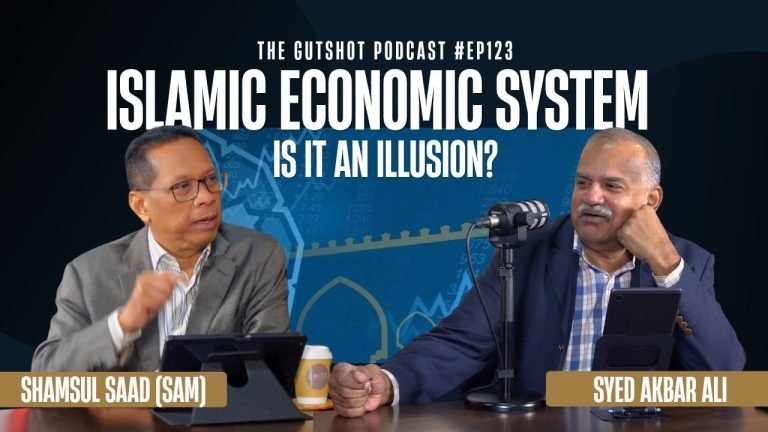
The the non-hal chicken. Let's say 88 a kilo. The halal one is okay with 850 a kilo. There you go. Which exactly contravenes what is said in the in the Quran. Hi guys, welcome back to Gshot podcast. I'm Shams Sam together with Sai Akbar. Today we are going to be conversing on a I think you're going to find this uh different than anywhere else because we're going to address one of your favorite topic say Islamic u banking and financing system. Okay. Islamic economic system. Exactly. All right. So say this is your uh your area of frankling expertise. Okay. you're coming from a banking
background and you quite know this subject matter very very well. Okay. So I will start off this way. say okay you open up and and uh give us a bit of a picture how the banking system um or the economic Islamic economic system as it is seen started and uh where we are now and how does it compare relative to the conventional system. Okay, shoot baby. Okay, good morning. Thank you very much. uh you hit the nail exactly on the head. How does it compare? Mhm. The relative the the relative position. Mhm. So uh uh well the notes that I have is uh because we're in Malaysia and because
we have the data is on the Islamic banking or Islamic financial system. But basically we're talking about an Islamic economic system because over the years over the last decades uh in Malaysia and also in other Islamic countries there has been you know there people have tried to create uh an alternative what what they would think is an alternative system an Islamic based system you be education politics business whatever you know uh banking stuff like that and so we're talking about economic system Islamic economic system huh Um okay the the the main question to ask is
that Islamic economic system regardless of banking, finance, uh trade whatever uh there there needs to be a a before and after which we can measure which is not there. That's the point I'm trying to make which is not there. So for example if uh you know before 1990s Islamic banking was relatively non-existent. I mean yeah it was bank Islam was set up in the early 80s I think but they were one bank and they were limited. They didn't have a huge branch network. 1990s Islamic banking was established in most commercial banks in the country. So that's when the Islamic banking took
off. Huh. So what 1990s uh over the over almost 40 years. So in the last 40 years what are the before and after changes after the introduction of Islamic banking we have to uh uh be able to to measure it. Huh? You see um if we say that uh an Islamic economic system produces better economic outcomes, then we must be able to measure it and show it. Yeah. Uh this is where it's there's a big gap here. uh you can have you can have the existence of a Islamic system economic system but mere existence of the system of Islamic banks in every corner does not immediately translate into
significant or measurable or what you mentioned just now relative improvements or differences in the lives of the people who engage with that Islamic economic system because at the end of the day it's for the people, isn't it? Right? You are a Muslim, you want you have to buy a house, you have to buy a car, you have to be able to buy your groceries to use your credit card, you have to, you know, get some funding from somewhere to set up a business and that's the end that's the whole purpose of of waking up waking up in the morning, isn't it? So, so uh has it become better
with the establishment of an Islamic economic system particularly in Malaysia our our banking system? So, uh this is where it is is the empirical method of measuring it is a bit lacking. I attended uh a seminar some weeks back a few months back at one of the Islamic institutions here and the speaker was uh was a guy uh he was a foreigner a Muslim guy I think it was a Bostonian or something but he went to school here he studied here at the university but now he's in the US uh one of those Muslim Brotherhood u people okay so uh he made the statement that uh you know over the years I think he was
referring to their their work what they've been doing they may not have been able to establish the Islamic state you know the Sharia state uh a Sharia compliant state I mean no a real Islamic state according to their to their ideas right I don't think they include Saudi Arabia in the list because Saudi Arabia is is a theocratic state right Afghanistan is a Islamic theocracy now uh Iran definitely ly and uh but Iran and Shia and maybe like Mauritania I think what he's referring to is their model of what they think what is considered to them as Islamic state okay so he said we may not have
established you know a full-fledged Islamic state but certainly over the decades he says uh they have embedded Islamic principles in the administrations of many uh Muslim countries around the world or rather Muslim countries around the have embedded Islamic principles or whatever into their into their administration and he used Islamic banking in Malaysia as an example. Right. Right. Okay. Okay. So, question time. I asked my famous question the same thing. I asked him uh and then and then he also said that someone had written a book you know some western writers had written a book
saying that Islamic countries have failed and they they show all these various statistics why you have failed blah blah blah things like that so he didn't agree with their criticism so I asked the question uh so where are our before and after numbers if you want to rebut these people who say that you have failed You should be able to show our numbers you know before and after before for example Malaysia before Islamic banking took off early 90s what was the situation of okay the GDP of the country or the per capita of the Muslims in the country assuming that
Muslims would be the ones who benefit the most from Islamic banking system although everyone can benefit but we need the before and after figures we don't we don't have say h couldn't answer. I think he was caught unawares by the question. He never it never crossed his mind. So he did he didn't answer which I thought was quite ridiculous. Now he said uh like basically he said that's not my job. Uh he said that's up to the sociologist and the social scientists to go and develop the indexes and measurements and all that and see uh I I think that's that's not an answer.
If you are proposing something yes you should know the outcome of that thing that you are proposing. Yes. If you're a contractor, you want to tell your client, okay, I can at today's rate, you know, my cost to use about 300 bucks a square foot, you know, to build your your house, Katakana Bangalore, but for 300 square screen a square foot, I'm not going to give you plastic lenolium. I'm going to give you marble tiles or marble or whatever something you you'll have you'll have your justify you have it worked out. You see, okay, if you don't want to pay for this,
you want to go with lenolium tiles, okay, I can do it for 250 ringgit a something like that. Yeah, you must be able to state the outcome and then you must show the product. But here he's saying, "Oh, my job is just I will put it in place. Somebody else going to come out and figure out how to measure it." Okay. That's like a doctor telling you. Okay. All right. This is the pill you have to take and he doesn't even tell you what is going to happen to you after you take the pill. All right. So he says what? Then the doctor says what? The doctor says it's not my job to uh to uh to to see the
outcome of you this. So he's promising an endless journey. Yeah. Because you don't see the end of the journey. Yeah. There's no way to saying okay we're headed towards typing but I don't know how far it is. Typing Malaysia typing inbakistan that kind of stuff. Okay. So they don't have a method of determining we have arrived. Going back to the word that you used just now relative to the compassional system, the haram system, the oppressive system, the one that sucks your blood dry according to them because there's always I'm going back to the word that you use relative the comparison you have
conventional system uh economic system of which Islamic banking is one uh I mean conventional banking is one and then you have the Islamic system of which Islamic banking is the other part. Right? So the Islamic bankers continuously have to show point a finger at the conventional banking and say that uh these are the bad guys. You know it's interest based it oppresses people robs people of their wealth blah blah blah things like that. So we are Islamic and we are not the bad guys. We are the good guys. Fine. This is what you say. This is halal system. Then show us the before
and after. the good that you have done versus the not so good that the people are suffering under the conventional system. You must be able to measure it because that's how you actually initially justify creating the this Islamic economic system because is this supposedly to be better? Show us then what is your measure and I mean what is the empirical data that tells us that this is a better system. You cannot simply say that our our Islamic system works simply because there's a Islamic bank at every corner. Now you know it has to be based on the outcome right
visa v or relative to the the other system that we have in the economy or in the world you see. So you have to be able to show real empirical data to show that these are the improvements that have come in before and after. So that part is uh is missing. I I I think the the the missing part is actually it's not even a a debatable thing anymore. It's basically it's just not there, right? They have justified a system to they have created a system. Basically, the only thing they have right now is uh the other one is halal. This I mean this the other one is harab. this one is halal.
So maybe say that because now they're going by edict right just because I call this the Islamic system okay you have to take because you're a Muslim otherwise you are you don't have to take but no no I mean basically the the whole idea be yeah so now the question is actually I I go to the next question is really since you know the first question is already unanswered which is the the justification for its existence in terms of delivering a better system. Right? Okay. That is not answerable. Okay. So I go to the next point is the Islamic system. Okay. Completely different from the uh
conventional system. What is actually the difference? why it is is Islamic compared to the other one that is not Islamic. Are they any different? So I leave to you to answer that. Yeah. Okay. Let me let me um what is actually different? Huh? The the theory says that let's go back to Islamic banking because that's that's the system that we have here. It says that u Islamic finance supposed to avoid user interest excessive uncertainty what they call gar and then speculation and uh activities that are not uh permissible and they are transactions and they call
see there's there's no loan in Islamic financing banking system you cannot have loan you can only have buying and selling and trade. You see, so you go to a conventional bank to get a housing loan. You don't go to a Islamic bank to get a housing loan. You go and get some, okay, let's call it financing. But the mechanism is uh assetbacked transaction uh if you're trade trade facility risk sharing you know partnership things like that you know like you go to the Islamic bank you want a financing to buy a house the bank will buy the house first from the developer and then they sell to you
it's a it's a tra it's a buy and sell but you pay them deferred payment 25 years does that sound familiar yeah or balance sheets So, so the bank pays off the the developer and then the the bank becomes the owner of the house technically. Then they sell the house to you on a deferred payment. You know, there's a thing. Well, it's like going around the head to touch the nose. Okay. Never mind. Sorry. Yeah. Go on. So, so uh so, so let's say somebody wants to buy a house. Huh? Let's say you want to buy a house 500,000 ring. Conventional banking system, the bank
lends you money, 500,000 a year. It's a loan loan agreement. Straightforward, right? And then every month you pay back principle and interest in a monthly installment. Simple. You pay for what? 20 years, 25 years. That's it. Huh? Islamic banking. The bank purchases the property from the developer. Then it sells to you and then uh then the whole thing is the financing finance the asset through a Sharia contract and then uh then you make you make schedule payments uh and the bank receives a predetermined profit. Right. Right. Right. And now shall we go into the percentages please? It's the same.
It is. It's about the same in Malaysia at least. It's about the same. Yeah. when I was a banker uh you know every morning we would get this uh the rate the rate sheet it'll come from somewhere deep in the bank system they will print this rate sheet what are the interest rates for today the overnight rates uh libball will be mentioned there uh there are the what do you call this the money market um the BA acceptance rate and all that so on the front we have the conventional banking our because you are conventional bankers yeah Yeah. Yeah. You flip it at the back. Yeah.
You have the Islamic figures. They're the same. It's especially the BA, the bankers acceptances, the the discount rates and all that. Exactly the same. So, it's just a change of name. You see? Yeah. Uh so anyways, that's how they did it. Well, I left bank in 1997, but I do not know whether it's just changed since then. Uh the principles can't change cannot change. Hh. Okay. Uh so uh as far as the customer is concerned, as far as the the the consumer is concerned, uh the the economic experience, the experience on your pocket, right, the money uh is pretty much the same, isn't it? Yeah.
In fact, it's it's actually the same same. Uh it's just monthly. What you've done is actually you've you've renamed certain things. Monthly payment. Yeah. Uh financing period, uh credit assessment, collateral. Both banks will take the house under a legal charge and then uh default consequences. If you default, you lose the house. The bank will loan your house. They will auction away the property. Um profit, interest rate, profit or interest rate calculations. These are all similar for the consumer. You know the our experience as the as the consumer as the person who goes and
gets financing to buy a house is the same. So but then you say that this one is hal that one is not halal. So uh it's just nomen nor cleman in the old Soviet Russian nomenclature nomenclature that's the only difference. So if the economic substance is basically identical, how different is the system from an economic point of view? I mean strictly. Yeah. Yeah. You want to talk religion and theology, they have their arguments, but I'm addressing this from from economic point of view. How it affects our the our pocket pocket money in our pocket for the average normal
citizen regardless he's a Muslim or not like because even non-Muslims can take Islamic financing, right? So how is it really that different? You see, um it is a legitimate question. It is about the substance. But here's the thing you just mentioned. Actually, I pick up something when you say the risk is shared. Okay. That's what makes um the transaction Islamic. Am I right or am I wrong? I I mean that is an argument that they make. That's the argument they make, right? That's for some. So to me uh very simple that was debatable right but if you if you give me that
argument the risk is shared like we go into a partnership okay into a business okay and I cannot uh afford it and all of a sudden I I go into default okay you share the ris why do you take my house okay so you should tell them that's right okay so that's my point. Okay. So I uh okay in this discussion I uh very few you will you will hardly hear the Islamic financiers discuss this judgment by the high court of uh Malaya you know Malaysia huh uh going back to 2008 there's a very important case uh it is I call it the justice Abdul waha patile judge justice Abdul waha
patile was a high court judge. He he's passed away. He was the brother of our former AG Tansri Gani Patai Gan. Yeah. So in 2008 there was a very famous case uh about dispute over housing housing housing loan but it was Islamic uh high court in the case of Arab Malaysian Finance versus Taman Jaya High Court Judge Abdul Dr. Abdah examined the there's some there was something called the albai ail financing. So uh he ruled uh he made a ruling that basically overturned this concept of albai ail because he looked at the substance of the transaction you know it's a buy and sell it's a Islamic
financing is a buy it's not a loan there's no there are no loans in Islamic financing they only buy and sell. So he said uh he said no he said the the albai it it was a loan it is a loan and it is not a sale he say it's not a genuine sale the judge said this is really a loan dressed up as a sale you know and the prophet charge made it legally unacceptable under the the Islamic banking act he said because Islamic banking says there's no interest. So which means that he was able to look beyond behind the curtain behind the curtain behind the calculation. So he said no this just it is alone you
have dressed it up and called it something else. So he ruled against it. So he concluded that the BBA arrangement alai betan ajil uh was not a genuine sale but uh uh but a financing transaction uh and held that the profit element rendered by the the facility contrary to the Islamic banking principles. So this created a major major issue. It was quite an explosive issue because at that time BBA was a major Islamic financing uh company um instrument instrument in Islamic banking. Uh so the judges the judgment by justice Abdul Wah it it raised a fundamental question
is this really buying and selling? Yeah. which is the core of Islamic uh banking because Islamic banking does not allow loans cannot loans are haram. You you only buy and sell back you see. So um he said it is just a loan dressed up in the form of a sale. So this is the basically he's he he was able to differentiate the substance from the form from the dressing he said no you it's just dressing the substance is still the same uh when it comes to the actual ringit and sand that means he's looking at it he was looking at it from the consumer point of view it's the same
thing you know just dressed up differently so uh what happened was uh of course they appealed it. They later appealed his decision. I think they they were able to overturn the decision. But more importantly uh what happened was that uh there is a provision under the law under the Islamic banking act and all that for bankara to act as a Sharia advisor over all Islamic banking transactions in the country. That means they can be the point of last uh reference. So they strengthen Bayara's role as the Sharia advisor to Bayara meaning to the entire banking system because they are the
regulatory authority. So ultimately all these issues that are disputed under Islamic uh banking for all these loans and everything they have to defer to the uh Sharia adviser of Bank Nagara. So whatever the Sharia advisor uh decides on a on any matter that shall be deemed as final. Mhm. So, so I think now I don't know whether the BBA is still popular but uh that sort of helped to solve the problem otherwise uh that judgment by justice Abdul Wah could have seriously affected the whole system the whole Islamic banking system you know so I mean with that I mean already we
see how the judgment Look at it and then it becomes the banara advisory shar advisory as being the uh as being the arbiter of what is Islamic or not Islamic that's all if you ask me that is all so uh I'd like to close this uh comments here but ba basically okay you are not just Islamic banking Islamic economic system. You want to introduce Islamic economic system. Okay. How does it affect your GDP before and after your per capita GDP for Muslims especially because it's Islamic Islamic economic system? I would assume you know it would Muslims would be the ones who would
who will be using it most who will be using it or who will be the participants they they should be the ones who are who will be the pioneers now. So how does it affect their their own per capita incomes, GDPs before and after uh poverty rate? How does it how does it improve the poverty rate for Muslims when we before of an Islamic economic system which is different in relation to the the non-Muslim system that you have not only in the country but around in the world you know and then um household debt and then in Malaysia income inequality that's the main thing we are still
struggling with isn't it we're still having does it help all these things uh median income home ownership Singapore has a very high rate of home ownership you know one of the highest in the world including Muslims Malays and Singapore but they didn't have a Islamic banking system but here we are still struggling you see so uh you know cost of borrowing the interest rates versus the profit rates all those things are wealth amount of wealth accumulation so we have now a 40-year track record of Islamic banking in this country. We have enough data or we should have to do comparison
analysis. Only then we will know that you know we are on the right track or that we're hitting the the the target correctly. You see otherwise it's back to what we said earlier. It's a continuous journey. the the the excitement is in the journey and you do not know where is the end of it. Have you come to the end? Does the bus stop and say and the driver says okay we have arrived you all can get down now that does not seem to be happening the excitement is in the journey but not exactly in arriving at the end of the journey. So that part is still is a continuous journey
end of journey not insight. Well I think I think we made our point on on that on on on that particular uh because we have no answer. I have a one question though. I have one very basic question. Yeah. Um are we uh are the consumer actually paying more under the Islamic banking situation? It is possible. Yes, it is possible to conventional. Yeah, this is this has been an issue from the very first days of Islamic banking because some people uh in I don't know know about now because over time our central bank does this tweaking bank they tweak things so that there's like there's parity between
the Islamic and the conventional system but in the early days there were I think there still are there were cases where you know people who take housing loans or financing to buy a house or whatever their monthly installment slightly higher than the the other fellow who takes from a conventional system things like that. There were some cases, not a lot, but I think there were. Uh I remember in the early days of Islamic banking in the '90s, there used to be conferences and seminars and all that uh which I used to attend as a banker and then um so one day one of the speakers
was there's one guy you know no names but he's the the major architect of Islamic banking in the country. Okay. So this guy came to give a talk about Islamic banking. So again question time. I have to ask I have to ask my question and uh I quoted you know there's you know in the Quran there's a prophet called okay so it's very interesting uh I want to just digress a little bit but wherever wherever Nabi is mentioned in the Quran I have this how many times 1 2 3 4 five about four five times you know wherever he's mentioned uh his role as a nab a prophet He always went around telling the people
do not in your way measures and weights do not cheat the people do not uh reduce what is due to the people. That means you take more you give less. Uh it says for means complete ka the measurements 1 m of cloth must be 1 m and the misan misan is timbang weights you know so if it's 1 kilo you got to give 1 kilo don't like give 950 so basically what he's saying he said do not cheat be honest now the sh prophet shu he this is repeated throughout the Quran I got uh surah 785 1184 1185 2618 yeah so it's continuously the same thing give full measure do not cause loss to the people this is in
surah 26 181 so this is seems the focus of nabish and I'm telling you I've attended many many many conferences and things on Islamic bing I've never heard them quote nabish but this is the one guy in the Quran His continuous role is the same message. Do not cheat the people. Weigh justly. There's one. He says, "Do not deprive the people of what is rightfully theirs." Oh yeah. Weigh with a straight balance. Was was you you must weigh with a straight balance. Don't you see? So this seems to be a recurring uh theme in the Nichu which our Islamic economic people I have never seen them quoting this
that's it boils down to that isn't it if you say that you know ours is the better system we are halal we don't we don't oppress the people surely from the people's point of view that can only mean one thing money in the pocket it should be a better system that saves people's money and then there Other things are like for example you should not be oppressive when you know in the when somebody defaults how you handle the I mean the bank if it's if it's a security somebody does not pay the loan okay the bank has to go and uh sell the property and then try to recover their money see the thing
is you're talking like a banker now correct you're talking like a banker but if you go by what is supposed to be Islamic like that and you take the equal risk again I go back to that question why do you why why do you have to confiscate the the this one because then you're not giving full measure. Well, okay. I was a banker. That's you have two kinds of lending in banking. One there's no lending in Islamic economic system. In banking, you have secured and non-secure. Secured means you and me or I don't know about you but me most people the bank will will get the security unless you are a
multi-billionaire or multi-billion or you corporation then you give just no need security. I mean they provide a corporate guarantee. Some there are some companies even in Malaysia. I don't want to mention name. If you go tell them and ask them I want security. They'll just ask you show the door and okay thank you very much for coming. We'll talk to another bank because they have the the standing and the capacity. So but for most loans consumer financing we will take security. But uh but nevertheless nevertheless the main point I'm trying to say is that this is a very this is a
very basic principle. You must be equitable. And the word that you used earlier relative to those guys across the street who you say are the the oppressors you know they charge interest they are impoverishing the community. Oh wow. The language used against conventional banking is very strong very strong you know ch is a common word that is usedh squeezing the people the conventional banking they say but if you are going to charge the same or or more then what's so at that conference the architect of Islamic banking in Malaysia was there I asked him the question you know how come
there are some complaints that it could be more expensive you know for Islamic financing to buy a house buy a car whatever how do you explain explain that because in I I quoted this verse in the Quran where he says you know says be equitable bear. What did he say? So he was shocked just like the other Bosnian guy I asked the question earlier you know I mentioned earlier you know he also shocked and he thought about it he said yeah uh it's like chicken you know right chicken you can buy chicken from a halal vendor which means you know they did the Islamic slaughtering all that or there
could be chicken non-halal chicken by a a non-halal vendor but it's still chicken but nevertheless one is halal and one is haram and you you may have to pay a bit more for the halal chicken uh it it is uh because it is halal it does not mean that just because it is halal it also has to be cheaper that was his answer he actually said that but I went like so there's follow up no because I think he was not going anywhere so it means that he's saying that there is a premium for halal that's what he's saying but from what we read you know I got at least I got into what Nichu is Okay,
you have to be equitable. You cannot if it's a kilo, you got to give a kilo. If it's 1 meter, you got to give 1 meter. So here he's saying, let's say I give you a kilo chicken. This is halal chicken. This is not halal chicken. The the non-hal chicken, let's say a kilo. The halal one is okay with 850 a kilo. There you go. Which exactly contravenes what is said in the in the Quran. fool. So, in fact, actually, I would even take it one step further which is if you're giving me that is not that was not an answer. Yeah. And if you're telling me also that uh be making it Islamic is better
because it's always been sold to us like that. Okay. Then I expect actually the the Islamic economic system is going to be cheaper for the average folks compared to conventional banking. I'm not even asking for equality for for for for equal uh uh equal uh equal product. No, I expect that when I use Islamic banking actually it's going to be cheaper for the consumer. It must be otherwise there's there is no different. It has to be. It has to be otherwise the idea of saying that the other system is oppressive uh has no justification. You you are equally oppressive.
Oppressive means money in the pocket. You cannot go and say no the chicken is halal. So you got to pay more for it. No. Yeah. I don't think that's not what I don't think so. You really have to be cheaper. You have to be better. You have to be cheaper. A better product. Yeah. I mean, okay. If you want to maintain same price, your product must be superior. Yeah. You know, if that guy has got four doors and four tires, you got like, you know, four doors, four tires and air con, everything thrown in or whatever for the same amount of money. Tony, I even go to the point like what
you said about that chicken pa um uh example. Mhm. Okay. One of the things that they tell us is actually if you slaughter the hari, all right, one of the reason is okay. It is less u uh it ensures a quick death for the animal. So it's not cruel. Okay. Yeah. But why why does it become expensive? Exactly. Because the other also also death for the animal is also slaughtered. You can't kill a chicken by No. No. I'm giving at least there is a there is there is a justification for that reasoning. Right. So the Islamic system the justification is it has to be better. So you see I uh
where is the end the journey where is the end of it all 40 years now of Islamic banking we tried to impose so many other things about Islamic economic system whatever where is it going to take us because at the end of the day at the end of there will be end of the journey the end of the journey is when my housing loan is paid up your housing is paid up that's the end of our journey and then our kids will come after us so everybody has their own end uh in their journey interacting with whatever financing system you have in the country. Uh at the end of the day,
people are going to go like uh what is the difference? What is the big deal? I'll tell you where the difference is. Say okay. Once I created a system that actually I impose upon you because I call it Islamic. All right. Then I have gotten you as a captive market. So the end journey is now as a banker of Islamic economics. All right. You can only come to me. That is also part of the equation in Malaysia. Yes. Because in Malaysia banking is a cartel. It's an igopoly. 35 billion population. We only have uh six anchor banks. I think professor Terren Gomez was here.
There are only six anchor banks and all of them have Islamic all of them have Islamic uh their Islamics but whatever the Islamic they also offer Islamic financing and uh plus the other banks in this country who are smaller so it is a very closed system you are right so uh it is it works in Malaysia okay okay in Malaysia uh half the banking now is under Islamic about half half or slightly less the other half is conventional. Um and then uh money market instruments also there's a lot of Islamic going on. So uh they they they are basically the numbers are the same. All right. uh because if the
Islamic financing system was really cheaper and superior to the conventional the 50% conventional would have disappeared by now. Yes. And because tell you bankers know how to calculate if we can make an extra one ringit we would have crossed the railway line or cross the river or you know where the grass is greener. You don't have to tell the bankers how to make money. If the Islamic banking makes more money and all that, people would have completely crossed over. But it's the same for the bankers as well as for the consumers. Uh so um the the real difference is still wanting
Sharia compliance is is just part of the equation. The economic performance is there is no difference. The actual nuts and bolts is no different. The delivery of results. So why is Islamic banking so successful in the country? Because it's illegopoly. It's a cartel. You you cannot you and I cannot walk walk to bank tomorrow and say I want for a license. I want to open a bank. I don't think we're going to get it. It is almost like laboratory condition. Banking in this country is like laboratory condition. closely monitored and inside this you know lab everything all the doors are locked you
got only those who wear the you know the white the suit lab coat is allowed inside you put on your goggles and all that talking about licensing so it's it's almost laboratory condition right so in 30 in a population of 35 million people you only have six anchor banks and a few other banks of course everybody's going to make money isn't it so you can uh you can keep turning out new products Islamic products the consumer does not have much of a choice is it's a cartel. So that's how it survives. But even despite doing that at the end of the day, I don't know how
many decades, four decades have gone by. I think people do realize now what is the before and after? How do you measure it? The real the relative the comparison figures, the comparison analysis between uh an Islamic economic system and one that is not Islamic economic system. I hope they will show real uh empirical data, empirical figures that here here's a situation before and here's a situation after uh and uh you know to show that the after situation is better than the before. of the before. That's important. Well, with that in mind, I think this is always the point of got. We go beyond
the curtain. We go underneath a bit. And what we found is there is no difference. At least at the at at the very least the best you can say is I've got no data to give you. The journey has never arrived. uh the data is one thing that's what I'm trying to say here the data is wanting data and then also again it has created so much of anxiety unnecessary anxiety for people especially for Muslims they they are they think they are looking for something that is better for them and so they are keen on on anything with Islamic label I mean yella is your duty as a Muslim
you Okay. To uh to follow what uh you know your what your religion prescribes for you. But uh it the the benefits have to be real. Yeah. Do not do not go and tell the people you know no you this is I'm going to charge you more for example or no different from the other fellow but uh this is good for you. Yeah. Yeah. So, we're on that note. Yeah. I think we we we we want you to think about this. All right. Are we just creating parallel uh banking system for nothing? Thank you so much. Thank you. Bye.
What viewers are saying
110 comments on YouTubeNo comments yet. Be the first to weigh in.
Join the conversation on YouTube ↗