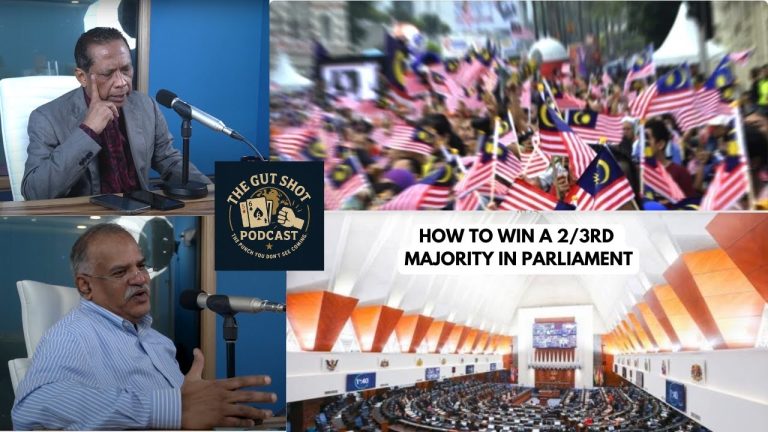
with Syed Akbar Ali. How to Win 2/3rd Majority in Parliament
Show Notes & Description
We dive into what it would take for any political party or coalition to win a decisive voter mandate in the next general elections. We begin with a quick re-cap of the recent Sabah election results and the trends of previous General Elections, since 2008 that has foretold what we see today – a rudderless leadership that does not listen to the public. Its time to set the ship right! A prescription by the people for the people.
Welcome back to The Gut Shot Podcast! In this episode, Syed and I strip away the political noise to answer one burning question: How can any party secure a 2/3rds majority in Parliament?
Spoiler alert: It is not by doing the same thing over and over again while expecting different results. We start by dissecting the recent Sabah state elections, analyzing why the DAP was wiped out and why the ruling coalition underperformed despite holding federal power.
We dig into the real reason voters—especially the Chinese business community—are walking away: it is a rejection of failed national policies, concerns over minority rights, and the economic squeeze. The old "Boogeyman" tactics about PAS taking over just don't work anymore; the electorate is split, and fear-mongering cannot hide economic incompetence.
We don't just complain; we lay out a concrete "Bucket List" of reforms that would actually win votes. We argue for enforcing strict term limits for the Prime Minister to stop political stagnation. We demand the abolition of archaic laws like the Sedition Act because you shouldn't criminalize free speech.
We also expose the uncomfortable economic truths holding Malaysia back: how the banking oligopoly forces the poor to turn to loan sharks, why the minimum wage hike is a dog chasing its tail that fuels inflation, and why the new e-invoicing law is a ticking time bomb for small businesses. Taxes everything, everywhere, all at once.
Finally, we tackle the cost of living crisis, from 40-year toll concessions to the astronomical price of cars. We end with a radical proposal: a "Report Card" system where top civil servants like the IGP and AG must face public hearings to prove they are doing their jobs.
If politicians want to stop getting kicked out of office, they need to watch this.
Timestamps & Chapters
• 00:00 – The Definition of Political Insanity
Intro: We reveal why politicians keep losing power by repeating the same failed strategies.
• 04:15 – The Sabah Verdict: Why DAP Got Wiped Out
Analyzing the election fallout: The ruling coalition's poor performance and why Warisan outshined the national parties.
• 08:50 – The Silent Revolt of the Chinese Voter
It’s not just a Sabah issue. We discuss how business owners and minority communities are voting with their feet against national policies.
• 13:20 – Is the "Green Wave" Just a Boogeyman?
Why the fear-mongering about a religious takeover is a "long shot" designed to scare you, and why it’s no longer working.
• 18:40 – The Downward Trend: From 2/3rds to Hung Parliament
Tracking the historical collapse of the Barisan National and current coalitions from 2008 to today.
• 22:30 – Solution #1: Why PMs Need an Expiry Date
If you can't achieve anything in two terms, get out. The case for strict term limits for all elected officials.
• 25:45 – Stop Treating Citizens Like Criminals
To win back the people, we must abolish the Sedition Act and stop criminalizing freedom of speech and thought.
• 29:10 – The Banking Cartel & The Rise of "Ah Longs"
How bank consolidation created an oligopoly that starves small businesses of credit and fuels the multi-billion ringgit loan shark industry.
• 36:00 – The Uncomfortable Truth About Minimum Wage
Why increasing the minimum wage to RM1,700 without productivity gains is causing unemployment and driving graduates into the gig economy.
• 45:20 – E-Invoicing: The Next Policy Disaster?
Just like GST killed the government in 2018, the new e-invoicing laws are set to crush small businesses and cost the government votes.
• 53:15 – Why You Are Still Paying Too Much for Your Car
Protectionism and EV tariffs are keeping car prices artificially high. We explain why liberalization would win massive support.
• 58:00 – 43 Years of Tolls: When Does It End?
Why are we still paying tolls on roads built in 1982? The never-ending concession agreements that act as a tax on the people.
• 1:04:30 – The "Hotspot" Strategy to Fight Corruption
A proven military strategy that the MACC should use to clean up the police, customs, and local councils.
• 1:09:00 – Holding the Powerful Accountable
Our final proposal: A US-style "Report Card" system where the IGP, AG, and Bank Negara Governor must testify publicly every 6 months.
Many thanks to CITYPlus for their collaboration with The Gutshot Podcast, in whose studio this conversation was recorded. CITYPlus is Malaysia's first Chinese business radio station, dedicated to delivering in-depth analysis on local and international current affairs, markets, and businesses.
Jump to chapter 8 chapters
- 0:00 Introduction and Sabah Election Fallout
- 10:08 Minority Rights and Voter Disaffection
- 21:20 The Failing PAS Boogeyman Strategy
- 34:33 Term Limits and Freedom of Speech
- 43:39 Banking Oligopoly and the Loan Shark Boom
- 59:41 Minimum Wage Failures and E-Invoicing Risks
- 1:28:31 Protectionist Car Tariffs and Toll Concessions
- 1:45:01 Targeted Anti-Corruption and Public Report Cards
Auto-generated from YouTube captions. Timestamps link to the video.
Good day everyone. Welcome back to the Gutshot podcast. Uh I'm Shamsul Sam your host here with my partner the good old famous site Akbali. Thank you. Good morning.
Good morning everybody. So here we go. Today we're going to bring you something interesting which is what we want to tell uh from ourselves and from everybody that we know of that if anybody wants to have twothirds majority in parliament these are the things they ought to do. So that is basically where we're going to uh take you all on this uh discussion today. But before we go there say um let's do a short uh recap of uh what happened uh at the conclusion of the Sabah state election recently. Thank you. Yeah. Today uh we have uh a list uh of things that we would like to share with
uh any politicians if they are interested. If they're not interested, it's up to them. There you go. Oh, but these are list of things that we think is good for us. Yes, for us means the people, the voters, the ordinary guys.
It may not be too good for the politicians, but this is how you win votes. So, before we go into that short list that we have prepared, uh just a little bit of uh uh analysis or discussion on what happened in Sabah a few days ago. Uh before the Sabah polls last Saturday,
our podcast, the previous podcast was recorded on a Friday. Yes. And we we did say that, you know, they are facing uh headwinds. They're facing headwinds. Uh it's going to be a hung situation. We we we alluded to these kind of things and that's what has uh happened actually in Sabah. Uh no one no single party won. The single largest we uh party with 29 seats was GRS not enough to form the government. So they had to patch together a coalition with uh smaller parties and the independents. Uh they formed the government I think with like uh 40 seats 37 is the minimum
they were able to to assemble about 40. So they didn't win a substantial majority by themselves. and um the the ruling coalition members from Putraaya, DAP, PKR and AMNU uh performed very poorly. DAP has been wiped out as we all know.
They contested eight seats in Sabah and they got zero. PR I think they contested in uh 14 seats. They only won one. That is a dismal performance. And that one candidate uh the media says he's what is known as a parachute candidate from GRS. I mean he was previously GRS he came in. So if you if you if you minus that GRS vector basically it was a non-performance total non-performance and uh AMNO or Barisan National they won five I think out of 41 out of 41. So uh very very weak performance by this Malaya Malaya parties.
So the Sabah parties have done very well and not surprisingly Warisan which is a homegrown Sabah party. They won the the highest number of absolute votes more than GRS. They won only 25 uh seats but the number of votes they got was 288,000. uh GRS is number two I think about 286,000 something like that. So in terms of total absolute votes uh secured
Warisan has done better than JRS. So Warisan is a strong party and they have penetrated the urban seats in Sabah by winning them from DAP and by fielding Chinese candidates. So Warisan is uh now a truly multi-racial representation in the Sabah state assembly. They have uh candidates from state assemblymen from you know all the races in Sabah. Now it is also interesting to see the uh the the vote uh tally. Um, Warisan Warisan was able to secure 288,000 votes. Uh, the Pakistan Harapan which is DAP and PKR uh they only got 75,000 votes total which is one quarter.
Wow. Well, slightly less slightly slightly more than a quarter. It's about a quarter of the votes which was won by Warisan. So you can see uh the unpopularity you know 75,000 votes.
That's an interesting assess analysis. It's only about a quarter you know. So that's that is and and this is a declining function. It's not not really going down. And uh okay the day after what has happened in Sabah has anything changed has are they looking forward to anything major and new I don't think so uh because after forming the government GRS after forming the government with UPCO and the independents they already formed the government uh suddenly you found we find that AMNO has now teamed up again with GRS One of the Amno reps has now been given a cabinet position in the Sabah state
government. Now this is uh coming after the famous announcement by AMNO before the elections. They had a media conference where they said we will never cooperate with GRS and everybody thumped the table in that press conference. All the AMO members there were thumping the table that they are breaking off cooperation with GRS. But after the elections were over, they are now back in business. So remember, we discussed this in the earlier podcast. No matter what the outcome, the politicians uh come out on top
like like a cat that always lands on its feet. Uh so there was some protest even in GRS that 12 GRS assemblymen protested but then they solved the problem. uh or it came I mean the problem has been didn't go beyond that the 12 assemblymen were made assistant ministers in the Sabah cabinet
right they got 12 new assistant ministers without portfolio so well whatever worksh so so at the end of the day I think the politicians are happy despite not being able to secure majority win decisive win despite losing at the end of the Hey, the politicians always come out smiling. This is the situation.
Well, they cobbled together um the rul the ruling coalition and they all get back to their cushy little uh seats. I think it's back to business as usual without having to dwell too much on what that means.
But uh they are happy. So um just a final point about this this issue. Uhhuh. uh this uh DAP got wiped out basically they they got they lost all eight seats uh now they are saying that
you know they take full responsibility and then they are saying that they are going to reinvent themselves and all that uh I have a simple question for the DAP have you asked the voters why you didn't vote for me what are you so upset about that you gave us ate zero I mean completely zero and they were they lost you know all the seats they lost why don't you go and ask the voters hey how come you all don't like us anymore instead of saying we're going to reinvent ourselves okay go ahead and reinvent yourselves but I think they should ask the voters what is
it that what is your beef what are you upset about with us I say I heard I think like doing the taste test for Coca-Cola and Pepsi you know do you like A or do you like B and and just tell us in a few words why it's as simple as Was I wrong? Is that you know I mean did did someone someone mentioned that uh somebody in the AP was uh making uh was uh uh was blaming Wisad for their loss. Isn't that that that was an interesting comment I thought instead and and my rebuttal to that is hey look in the mirror you know never blame other people you know we we we are in business you know
putting it putting another way warisan can thank DAP for their victory I mean these are just lame excuses but the question is is this a sabah thing was it a saba phenomenon that made the Malaya parties lose so many seats. The BN uh they they had 14 seats in the previous state government. I think 14 they had 14 dune seats. Now they're down to uh six I think six. So from 14 to six they have lost eight you know.
Yeah. DAP has lost all their eight and PR2 has lost. So they have uh gone down the scale substantially you know they've really lost a lot of support. So is this just a Sabah phenomenon or is there a larger national phenomenon you know things that happen in Malaysia I don't
Malaya and Malaysia is is there a larger unhappiness that's why we asked that question especially the Chinese community the Chinese community yes they are Sabahans but Chinese community are business community they they depend entirely on business for their their survival they are very much in tune with government polic policy, economic policies, how the whole country is moving along and uh the Chinese uh uh people are aware uh what happens in in Putraaya in KL in Samanjong affects them definitely. So they have this larger worldview of of looking at the entire country. I was I was looking
at the some of the social media comments, you know, after the elections and there was one uh there was one uh article that that went viral. Uh I'm quite sure it was written by somebody from Sabah or Sarawa and I I'm quite sure it was a Chinese writer. He or she listed there was no name. He or she listed a bunch of things that they didn't like and why the Chinese have voted with their feet. They did not vote for DAP. his focus was DAP and also uh uh uh and also their support for Warisan. He said, you know, the the Chinese they uh they are aware of everything. They don't make a fuss.
Yeah. They don't kick up, they make a hoo-ha, but when it comes to voting, they show what is it that they don't like, you know. And among the things he mentioned was, you know, the issue of that Hindu temple in Masjid, India that was shifted.
Oh yeah. That 130 year old temple and they had to move it, make way for a mosque, a masjid and all that. Yeah, I don't want to mention names. Uh he mentioned that issue about the 130y old Hindu temple. So Hindu temple and he also mentioned the story about that remember there's one Indian girl a student who asked about one of her friends who scored high in school but was not able to get entry into a medical faculty or something like that. And she was basically told to to you know
Yeah. to to keep quiet and sit down. And the excuse given was that if if uh you know they start messing with the kota system into the entry into into the universities uh the the the pass might take over the Pakistan harapan might lose the elections. But this guy pointed out that uh the kota system is still there and the Pakistan haram has still lost in Sabah I think. So uh it was interesting because the these are these are national issues these issues the Hindu temple is in KL and the Indian girl I think also is is in here. Uh but these points were were were mentioned.
Uh I think Chinese are also worried if you can move a Hindu temple in uh KL it might as you can also move maybe a Chinese temple in the future you know it's how you treat people
or you can move a church out of the way a church or anything so I mean it is minority rights people are people are concerned you know if this is how you treat minority rights then uh you know they're unsure so all this has compounded has is in the back of their minds which has I influence how they voted in Sabah. So uh let's not say that uh everything that happened in Sabah is purely Sabah phenomenon. Not for everybody. I think what happens the entire country uh also influences what happens in Sabah. And uh I would like to revisit this uh uh you know in a little
while. There other things to say. Yep. That's uh I mean you look at it right. So I have um I mean there have been some questions about whether exactly is this totally a Saba phenomena or is this like what we said in our last uh podcast which is whether this is a I mean this is a foretelling of what is coming in the whole of Malaysia comes the next general election. I would say probably my gut tells me it's about 7030 because why se almost 70% is national issue affects everybody 30% yeah I think there is a very much a sentiment of what is sabah for sabahans and uh how they look at it from their
state point of view but the issues that you brought up which is basically uh minority religious rights and uh minority rights. Minority rights period. Yeah.
And and and also um which includes therefore also uh meritocracy in uh relig in in in allocation of uh uh university places uh allocation of work opportunities and economic opportunities. I think these are serious issues that we are all facing throughout throughout the the country irrespective of the state. I think these are the issues and that brings us to I maybe maybe quick quick cap maybe we should look at what happened with our parliamentary seats um you know between 2008 and 2022. I mean there is there is there is a downslide uh the there is a trend there's a solid trend
uh from 2008 we have discussed this previously but let's let's recap 2008 uh was a major watershed in the country because the barisa national which ruled since 1955
uh lost the two-thirds majority they were still in power but they lost the two-thirds majority which they had which they have held ever since so that was a major shift in the political headwinds and in the political landscape of the country and we could see that uh after they lost the two/3s majority they were still going down and no effort was made to do a postmortem or a proper analysis of why they lost the two/3s and there was absolutely no change made in any of the policies which caused them to lose the two/3 majority in 208 as a result of which in uh 2013 the next
election the Barisa national performed uh uh worse they went down slightly there was a new prime minister in between Abdullah Badawi retired and Aji became prime minister so there was a slight uptick uh for AMNO but the BN laws seats 208 they had 140 seats in parliament in 2013 they had 133 seats they lost In 2018, they got kicked out. The Barisa National went from 1404 40 seats in 208 to 79 seats in 2018 when they were kicked out. They lost about half, you know, and it has been downtrend. In 2022, uh the BN was down to 30 seats and uh AMNO AMNO uh they AMNO had uh 79 seats in 208. It went up
to 88 in 2013, but 2018, the year that they were kicked out of power, AMNO had only 54 seats. In 2022, AMNO was down to 26 seats. So you can see the downtrend of both AMNU and Barisa National. Why do I keep hopping about AMU and Barisa National when the government today is not AMU? It's not Barisa National. Well, they're still in power. They're power sharing.
Well, because the policies haven't changed. Not a single dot of a policy has been changed in how the country has been run from 208 from before 208 to 213 22 218 222 nothing has changed until today in the Sabah election sir. So like Einstein was it Einstein who said you you cannot be doing the same thing over and over again which has failed which has failed every time you do it it has failed but you keep doing it hoping that maybe just the next time the outcome will be different
it's a it's a very I think this the very definition of insanity that's it uh that's what is happening no change they lost 208 213 218 2022 and now Sabah Basically the the the Pakistan Harapan the the governing parties have been basically they have been kicked out DAP lost eight seats and they are ruling party they're not they are not varisa national they are Pakistan harapan but they got kicked out because the policies are exactly the same that what you said now the insanity which Einstein defined doing the same thing again and again so they're going to keep
doing the same things again and again and hope that maybe just maybe the next around they'll get a better outcome. I think Einstein will have a different view. But I mean do we see uh from a party politics standpoint then which I really not my game but from a party politics standpoint who's who gains from from a political party who gains after all from all these losses? While the politician politicians seem to be happy you know uh whether they win or they lose they seem to be happy. We have seen this now in Sabah those who have lost now are back in office they have
given cabinet position although they got only one cabinet position it means larger cooperation because they have pledged basically to support the the GRS government. So that means uh total cooperation you know and of course that will mean a lot of benefits plus the federal government is unity government and AMNO sits in the federal government so of course it'll benefit GRS to be to have a partner in Sabah who also sits in the federal government in Putraaya you know so uh it's very comfortable I think they're very comfortable with the situation the question is what about the
the voters in Sabah because uh those 12 GRS uh dunes uh state assemblymen who complained about the entry of AMNO getting back cabinet position. Uh they said that we have short changed the voters who rejected uh AMO who did not vote for AMO but now you gave them a seat in the cabinet. It's like you know you are just like ignoring the the voters's choices you know but uh so what nothing has changed
that sounds very sad yeah very sad so the politicians benefit from the situation I have a question um before we go to uh uh from taking the macro standpoint a quick one Um when we look at um this whole point where uh the government is saying like you know oh if you don't vote for us then you're looking at you know uh party Islam as being the choice that's going to come into power the religious people
the boogeyman yeah so what's your pony what's your take on that particular argument I think it'll remain as a boogeyman it's just a boogeyman because we've discussed this earlier. Uh it is a very long shot for there's only one religious party is passed. It's a very long shot for them to actually uh get power at the federal level. It's going to take it's going to be very difficult because uh the Malay vote the Muslim vote is split. It's highly split and the Muslim vote is about 50 to 60%. You know bumira vote is more than that but not all bumias are Muslims in Sabah and Sawa. Yes.
So the actual Muslim vote is about 50 to 60%. And that vote is split seriously split. So when you're so seriously split you cannot you cannot form one block by yourself. Uh you can it's difficult to form a government without the remaining uh half of the vote which is non-Muslim in this country you know. M.
So I think that's a long shot, but uh that's something that's may or may not happen tomorrow. In the meantime, it's a good boogeyman. Oh, it's a very good boogie. You can use it every day, you know.
Yeah, the boogeyman is coming, you know. Yeah. Uh you see uh I to me there's one more elections which I have to talk about which gives a very a very strong indication of where things are going. 2022 was the last general elections. It was a hung parliament.
Y 2018 the Barisa National got kicked out. Then we had this revolving door of prime ministers Dr. Mahade and Tansi Mahirin and Isma Sabri. It was a revolving door and uh then we came to the 2022 polls. The 22 2022 polls to me are also very decisive because it is the first uh elections where post uh post uh Barisan National post 61 years of Barisan National that the reform government the people who bringing in change would have got their act together they did not. So 2022 was a hung parliament. Nobody won 2022. But to me uh after 2022 there were state elections in six
states. In 2023 about a year after the the 2022 elections there were state elections in ga kalantan tanganu pinango and uh to me this is very telling about policy and and when you don't change policy this what happens. six states they had a total of 245 seats available in the six states amnu won only 20 that's about less than 10%. less than 10%. PKR won 26. That's uh slightly more than 10%.
Slightly more. Yeah. And DAP they won 46. Surprisingly DAP was was the best performer. Uh DAP won 46 seats out of the 245. So that is a very dismal performance for AMO and PR even then 2023 six state elections. So you can say that again these are state elections. So you can say that uh state elections usually focus on state issues but when the when the when the results were so bad for AMO PR and DAP over six states it it's actually national issues the all the people the voters in Malaysia have the same frame of mind they don't like what's going on so that's why uh AMNU
only want 20 seats PKR26 and DAP 46 in the state elections and now they've done worse in the Sabah elections. DAP lost all their seats. PKR won only one and AMU won only five. So you can see the downtrend is continuing from 2022 general election, 2023 elections in six states and now the Sabah election. Next we're having elections in Malaka and one more place. You can see that the the it's a trend. It's a solid trend line downwards downtrend for the ruling the ruling coalition coalition now the the Putraaya coalition now
it was the Barisa national coalition before also on a downtrend they got kicked out the same thing is happening to the coalition now because regardless of who was in power the policies haven't changed which I hope we will discuss now and we we will make some suggestions for them
you know you know I I have a point I I just crossed my mind when as you were talking about it. Uh it sort of remind me because we are a small nation, right? So it sort of remind me this word about people saying all politics are local. The only problem with Malaysia is we are a small country. So if you take the whole state of Florida in America, that is the peninsula Malaysia. And then if you take Sabah and Sawa, that's like Texas, which they always say, you know, we are all all we we are Texans, right? And we are very different and than anybody else.
Clanton is Texas. Okay, there you go. Right. So if you think about it, the local issue so to speak is very much national. There is a sliver of uh of uh of of of uh of of uh state centric issue which is very particular but then the national issue dominates the whole conversation. That's one. The second part is the quality of the candidate may be an another issue that comes together with what we we want to talk next which is actually what I started out when we say to everyone what we're going to talk today is that this whole um doing the same thing over and over again
and expecting the same result is pure insanity. And the people is actually speaking and we want to we we think we should voice out what we what we felt is the real necessity for a real change. And you know, if you want to have power in order to um in order to have the people put you into power, maybe even up to two/3 majority in parliament. These are the things that you have to do instead. Instead, we hope politicians and uh you know people who have aspirations uh are listening. say let's kick that off.
Exactly. I mean uh now they are talking about reinventing and uh you know um soularching and all that the political parties nobody is uh saying we're going to go down to the ground and ask people what is it that you don't like. So for example, if they ask that Indian girl, you know, what is it that you don't like? You know, the Indian girl who complained about the getting her medical seat, her friend getting a medical seat, she would say the same thing. If if a candidate has uh won, you know, has qualified on merits, she he or she deserves to be given uh a place to study
whatever course or subject that they want to study. This is my beef. this is my complaint. What are you going to do about it? So then the parties have to decide, am I going to give you a yes answer or a no answer? It's just it's as simple as that. If you're going to say yes, you're going to win a busload a ton of votes. Not only from the Indian community, I think even many Malay voters, they would they don't like all these discriminatory policies that are now like beyond shelf life. You're going to win a a busload of uh of votes, a shipload of votes. If you ask the the
the temple people, what is it that you don't like about us? They will probably say, look, you're being unfair to us, you know, in in in our temple issue. I wish you had been, you know, more more fair to us, you know, and discuss with us and and and things like that. Come to a more amicable amicable way of resolving things. You know if they had done that then they would also win a busload or shipload of votes from people and from from others too not who those who were not Indians. Remember these things affect all people not just that particular uh community
sometimes people just don't like or all the time people don't like to see other people getting bullied. Yeah. If if you see one guy bullying another guy and then the bully comes to you and says give me a vote. I don't think people will vote for them. You know, people don't like bullies. So these are issues that uh uh they can find out easily by asking the people. I think they know. Then they have to decide do we give do we uh agree to what they are saying uh with what they are saying? Do we agree with their complaints or not? Do we care or not? If you don't care,
you won't get their votes. As simple as that. So how many votes are you are you uh prepared to sacrifice? Because from 208, you don't seem to be winning enough votes to form the governments. 208 I say you means all of them. All regardless of which political party 208 they lost a two-thirds majority. 218 they got kicked out of power. 2022 Hung Parliament. 2023 six states lost. Now in Sabah the results have come out. All the the the the ruling coalition has lost. So uh it is as simple as that. you want the votes, you have to uh uh listen to the voter and say what is it that you
don't like or what is it that you would like me to do for you? What can I do for you? This is the question that they are not asking or delivering. And then of course the boogeyman issues. The boogeyman issues don't work. As uh the the guy said the commenter said in the uh which I mentioned earlier the the boogeyman was that if the quotas for university entry had been have removed then the past boogeyman will come in you know uh if they and and then the the the PH will lose the elections. But the commenter said but you have lost now and the quotas are still in place. So
meaning it doesn't help you. Is it? It makes no difference whatsoever. You're still losing the vote. It doesn't help you. And you're you're telling you're talking about things that are not relevant to the people anymore because they didn't vote for you. You lost. You keep repeating the same things, but you lost the vote.
You know, you make a very fair point in the in in in that nobody really goes to the ground and listen to the voters and their grouses. Nope. They pretend to they pretend to come to see you uh in uh in in in functions and settings that they stage and they talk
but they don't listen and they think that is the best for the birds, the beast, the whales, the elephants, the jungle and maybe for us too.
Yeah. uh and they think uh that's the best the only solution. Well, I have a list here of things that uh which I think if the political parties if they give a hoot, if they don't want to listen to this,
if they give a hoot, if they don't want to listen to this, it's up to them. Yeah. You know what we said last week? Make my day. Make my day. If you don't want to listen to us, you go ahead. Go ahead. Make my day. We'll You'll get kicked out. This is the season of getting kicked out. So here's a little list I of things which I think the the regardless regardless
you give you give us your list. Regardless which political party if they do this I think they can win the election they they can win two/3s maybe they'll be in power for a long time and these are things which we have discussed before which all Malaysians know about. Number one is the term limits you know on the prime minister which we discussed last week I think
term limits put term limits on the prime minister not not more than two terms I would like to rejig the whole thing either make it a shorter term of four years and limit it to two terms or make it just one term of it like six years that's it or like Indonesia I think seven seven years or Philippines just one term you cannot go for two terms
bottom line I mean those are major changes years in the constitution things like that. Uh bottom line is you have to limit the term term limits tenure must be limited. So two terms is a good idea. You you implement that change the law and restrict the tenure of the prime minister, the chief ministers, the mantrias, the members of parliament and the members of the state assemblies. You can only run for election and if you win only two terms after that you are retired. Bye-bye. They all get a pension anyway. Should we talk about the pensions that they get?
So, that's item one, you know, on our on our uh bucket list. Everybody knows this. They have been talking about this too. Yes, we will. Yes, we will. But nothing nothing has moved. This is something that they have to do it ASAP. Uh this is urgent. But I don't know whether they care or as I say.
Well, c can I say this? I think this the way we're going to put this is not whether they care or not. I think this is what voters ought to be demanding. The whole thing need to switch from being what they should be doing to the point that we as voters should demand this from uh from from our elected representative and if they don't do them we shouldn't vote for them. So I think this that's that's my way of thinking but one thing you see I agree with you term limit term limit prime minister two term if you can't achieve in two terms you it eight years if you are on any job for eight years
you're rotting already okay get out I I don't think any CEO should stay more than you know eight eight years we We need we need the term limits because as what is happening in Sabah now they can always engineer the situation such that the cat always lands on its feet even when they lose they can come back into government through coalition through this through that you know all this horse raiding wheeling and dealing and they're back in power and the same guys are there as uh there's a lady called um Hafila she once said you know she's only slightly younger than me I'm 65 five
since she was in school. The same faces are in our politics which is true. We have people in politics in this country who have been around for the last 30, 40, 50 years.
So it's unchanging. You know the the same people are around. So it's high time we put term limits on also members of parliament. I agree. State assemblies. I agree. Because not every member of parliament becomes a cabinet minister or a prime minister. But you don't want to have the same fellow in that place for 10, 20 years and 30 years and so on, we have to put term limits. So I think if someone can do this, if the political parties can take this up as their platform and implement it, they will win votes or at least they will stop losing votes. So with that, number two on my on my uh
wish list or bucket list is what also we discussed last week the uh freedom of speech and freedom of uh thought. You know this we have to abolish things like the sedition act. Uh we have to uh redo the the MCMC act. You know uh we the the outdated things like the printing presses act. All this have to be rejigged or abolished or just rewarded all the way through to free up the space for uh speech, free speech, amend the uh the defamation laws which we spoke about last week,
the liel and slander laws and um I think we should we should not the bottom line is do not criminalize speech. Yeah. I mean if somebody shouts fire inside the movie theater
theater okay that's the wrong thing to do but we already have laws which handle that kind of situation but beyond that we should not criminalize uh freedom of of uh thought speech and thinking worst case worst case make it a a compoundable offense like parking your car on the yellow line you park your car on the yellow line you don't go to jail it's not a criminal act you just go and pay that compound found and don't do it again. So, uh if somebody's if you want to, you know, control for whatever reason thinking and speech, it should not be criminalized. It should be the worst case a demeanor.
No, I I I I go more than you to be honest with you. I mean, I think there's a there's a there's a there's a there must be a high bar for defamation. Okay. And it it then becomes a civil matter. All right? Because why? If you disallow freedom of speech, which is basically freedom for you to um articulate your thoughts, then you basically bar people from making any criticism whatsoever. And you are the one who determines what I am going to say or how I'm going to be able to frame my argument. I I I I I proceed that the whole issue is very much um must be allowed in the public
sphere so that it becomes u it's just become like a trading of uh goods and services. It's a place where you trade ideas. It's a place where you trade opinion. If my opinion is right or if my opinion gets more support, so be it. Why are you scared of it? Right. Argue against it.
So bottom line, bottom line, the people are tired about all these really archaic and old outdated laws and uh this is how you lose votes. If the politicians are concerned at all about whether they win or lose the elections, this is these are among the reasons why you lose votes. If you free up the space and allow freedom of speech and thought and make this again your platform, you are going to win votes and you will or you will stop losing votes. But if you don't make these changes, huh, make my day.
Make my day again. You're going to get kicked out. You're going to get kicked out. You're fed up of all this crap. You know, fellow puts a comment on Facebook and then he's arrested and shows up in court, you know.
H some unknown, I don't know, young guy says something. Okay, he said it, you know. So, arrest him and bring him to court and charge and all kinds of this is rubbish. We're tired about all this rubbish.
It's intimidation. It is basically intimidation of your populace. So if you want to lose elections go ahead please. To no to me another thing said about this whole point about freedom uh going out and making it a platform on your manifesto that we are going to allow people to say whatever they want. That will signal to the voters and to the people that we are brave. We are brave leadership. We we can we can go we can fight on ideas. We are not scared of ideas.
It has to be specific. They must abolish the sedition act. They must abolish or seriously amend that those sections of the MCMC act. The Sharia criminal enactments on this uh religious publications. There are some. And then the printing press acts etc. All this has to either abolish completely. Yeah. or you really have to rewrite it and and hack it down to a tiny tiny what uh uh shadow of what what it it is now. We really don't uh need this and this is what is also costing them both. They don't seem to realize this. If I can say this and you are aware of it, there are
other people who also feel the same way. Yeah. You know, yeah. They don't care. So uh that's two we spoke earlier about the banking system you know
we seriously need uh liberalization and uh not deregulation let's let me let's uh don't get me wrong liberalization and regul and and deregulation are two different things I my ex-banker I always feel that we need tight regulations you need strong regulation monitoring and control but at the same time you need to liberalize the banking system. We have to put back the banking system to what it was before the the consolidation of the banks prior to 2000. You know, we need the finance companies, the credit leasing companies. We need all kinds of uh financial institutions. We need big banks, small
banks. Uh personally, if I have the chance, I like to set up a housing bank, you know, just focusing on housing mortgages. uh they had it in the states. It worked well until uh I mean there's a there's a a strong requirement for this kind of banking. Uh we need to to create a vibrant and uh what do you call this pervasive banking system throughout the country. We definitely need more banks.
Now we are stuck with this few the olig oligopoly kind of banking system. It's it's it's almost like a cartel, you know. Yeah. Your choices are really limited and every other bank offers the same thing because there's so few of them. They they follow each other. That is called cartel behavior. Even though there may not be a cartel, but because there's so few of them, you know, why should one one bank do more than what the other bank is uh is is offering
because the the consumer doesn't have much much choice. Yeah. And we must talk about the the along business. Mhm. Because we have restricted the banking industry since the consolidation in the early 2000s. You find that since then there has been this thisark proliferation proliferation huge growth explosive growth in the lone shark business. The along everywhere you go you can still see their numbers stuck on the the lamp post and all kinds of places. They send you WhatsApp, they send you uh notifications. They drop notes in your mailbox saying that if you
want a quick loan, you can call us here and there. Why are they able to do this? All these things cost money because there's a huge demand for loan sharks for the alone business because the banking system does not provide easy credit to a large sector of our economy. The ordinary people especially the small and medium industries, the ordinary person at home, they are short of cash. They do not have access to uh easy credit or to bank credit which is more structured and more disciplined. So they have no choice. They go to the alone. You can buy a even without a job. If you
have a identification card, you can buy a TV or a refrigerator from some appliance shop and they have a link to the lone sharks. So whatever you buy, you can order a refrigerator. It'll be delivered to your house in a couple of hours and then they are they are linked to these lone sharks who provide financing and then you pay them over the next whatever a year two years or whatever. So the loan sharks are very much integrated into the economy and the lone sharks they are charging about 18% 25% interest a year. So they are impoverishing poor people. Rich people
rarely go to lone sharks. Those who go to lone sharks are the poorer people the so-called B40s. So they're impoverishing the people who are already poor. You pay 18% 25% interest on your lone sharks to loans. And then lone sharks don't pay taxes because they're illegal operators. And the the guesstimate is this industry, the lone shark business in Malaysia is multiple billions of ringit. I knew a guy who is a business consultant who was hired by one of these outfits to plan their operation like a professional banking outfit. They had like office with computers and proper
accounting systems and everything but it was a lone shark business. That is the level of their their sophistication and their presence in the economy. There is a vacuum in the economy which the lone sharks have filled in because the banks are not the banking system has been constrained. Banking has been constrained to this few oligopoly banks you know who I don't know um so the lone sharks have stepped in and the lone sharks it's a multi-billion ringit business and they don't pay taxes. So at both ends we are losing the government is lo losing revenue and the public is
getting poorer. The poor are getting poorer when they borrow money from the lone sharks. You can solve this whole problem by just liberalizing the banking sector. You put it back to what it was in the 1980s and '90s when we had really strong growth rates. The moment the banking consolidation came in in the 2000s, you find that our growth has been sluggish. We're doing this 5% plus minus ever since then. We don't get 8% 9% anymore which we used to have in the 80s and 90s. So uh if you do this, if you if you free up the banking system, liberalize it, let as many banks as let
anyone who has a the capital and the capacity, if they want to run a bank, go ahead or a finance company or a credit leasing company or whatever, just let them do it. They will find their own niche in the in the economy. And who will benefit? The consumer. The consumer will benefit. And I think this will translate into votes. The unhappiness should go down.
I I I think um I think I want to I I want to add on this point. Why for me personally as somebody who started out in small and medium enterprisememes as they call it um why this is so important for uh for a nation uh and why this has never been talked about at all by anyone in our government ever since that consolidation happened. Okay. Number one is because they don't really understand economy the way it should be understood. Uh the people who are running uh our nation and the uh people who are running uh and and making economic policies are all parachuties.
They don't they don't have a clue. They don't have a clue. They don't have a clue. They have never started any businesses in their entire life from the very beginning of how somebody go and sell and buy and sell to consumers and how you need to finance your businesses from small and up. Um secondly we all must understand that the biggest employer in any economy are
exactly exactly okay right it is not the big corporation is not the stupid GLC's okay it is the public the sorry the private sectormemes that are employing 80% of our u our people and that's how you get high uh growth and you get doubledigit growth when you are running it on full cylinder. Okay. But if you don't have access to capital because you've consolidated all this banking system and you've eliminated um regional even um you know I mean local banking system and specialized banking banking u institutions that we used to have. They understand the business on the
ground. They know um the theme that has just started. They go and learn the branch managers learn what your business is. Who are you selling it to today? That no longer exists in Malaysia. They don't know their customers actually and they don't care, right? Because they have this godlike power at HQ.
The right word is God. Yeah, you you use the right word. God. Yeah. They've got this godlike power and they only maybe there are only five or six gods out there. You have to worship them, right? So they really don't care. And I think from a national policy standpoint, I want voters to really understand this is where you get employment. So when you don't create this basic fundamental necessity in order to create employment and then employment that create further growth that's why we are in the state we are in today.
The the average voter they they do not they would not understand that there's an oligopoly in the banking system in this country. I I doubt any of them will know that there was a consolidation of the banking system in 2000. they will not understand all this. What they do understand is that they are poor, life is difficult, they want to get some financing, it's very difficult, they don't qualify most of the time. And then they also do not understand uh they really think that the along the loan shocking business is part of the of the landscape in the country. You know that this is how things are
done. If you can't get a bank loan, you can go and talk to the loan sharks and you'll get a loan from them. They really think that this is this is it. You know, we have there we have no other choices. So, uh the lone sharks benefit from that. People most people they do not know that there's a reason why the lone sharks exist. But having said that, life is difficult for them. When you pay a lone shark, as I said, you are paying 18% 25% interest a year. You're already you're already in the lower income bracket. You're already poor and you become poorer. So people are constantly
suffering trying to make their ends meet. They they always out of pocket. When it comes to the middle of the month, end of the month, they're already out of pocket, you know. So they they cannot analyze like you and me are analyzing now because of the oligopy in the banking system, you know, the the the rise of the lone sharks who are filling up a vacuum and things like that. They they are not able to analyze all this as all
they don't understand why. Yeah. All they know is that my life is difficult. So as long as this thing prolongs that's how long that the politicians are not going to get the votes because people are unhappy people are facing hardship so they will not vote for you they will keep changing their vote which I think is a very good thing to do so uh the but do the politicians care or is this like is it on their priority list where will they put this on the back page or do they even do they even bother about it at all
I've never heard any are they laughing at us now are they laughing at Now, as we're talking about this, are they laughing at us? These guys are idiots. They don't know what they're talking about. Uh this I think this is where the politicians are at. They don't care.
But this is a real issue. People, the ordinary people do not know anything about igopies, oligarchies, whatever. They do not know. All they know is that life is difficult for me. I have to make that payment. I they have to pay through their nose. But what to do? This is how things are in this country.
May I may may I add a bit why they don't know? They don't realize that this particular one issue alone is costing them creation of jobs. Hundreds of thousands of votes.
Yeah. Creation of jobs. It's costing them growth of jobs. It's costing them actually growth of the small businesses that can actually expand because they have access to further loan to grow. Therefore, you get bigger salaries. All right? So all these cascade down and then what happens when all of these are non-existent. You got no jobs. You got uh you got uh no businesses that you can go and find jobs. You get your your salary stagnate and then the government say I'm going to give you a minimum wage. Which is my next point. Exactly. You see uh again these people they don't
the politicians they don't they're blind they're blind they just they cannot connect the dots 2018 Barisa national got kicked out they lost the elections lost political power after 61 years two major things happened before that in 2014 the BN government at that time imposed the GST of 6%. Which killed the economy. It killed the economy. I mean I was running my wife and I were running our family business, our jewelry business. We saw how business went from almost to zero, you know, and uh we were uh you know Mazjid India in K. I remember your shop
is the most popular retailing place in K. The rentals there were very high. In no time at all, shops were closing and the owners, the landlords could not find replacement tenants. That was how bad things became. The famous Maiden supermarket, they were in business for over 60 years. They made their first losses after the GST was imposed. I remember that because I I knew them quite well. They were neighbors. So the GST killed the economy in Nili the previous who's now a foreign minister tomat they call him Tomat isn't itan
they developed nili as industrial and that famous nili nili tiga commercial center you know where you have all these people who sell textiles and carpets and all sorts of things in ni a lot of Malaysian businessmen including our immigrant uh Pakistanis and Pashtun people who are there, they run a lot of businesses. It was very vibrant, you know, until 2014. You know, people used to come by chartered buses from Kada and Joho and places like that. They will come in multiple buses, chartered buses just to shop in Eli Tiga. They'll arrive in the morning, they'll shop the whole
day, then the evenings they go back, they'll go back. That is the kind of business that was going on in Elitiga. It was so successful in similar after 2014 GST that business died and it's it is shut down until today. I live within 1 kilometer of Niliga my present location. So we go there often to uh you know for whatever we need. Uh there are some other shops there. But that place is dead. It died in 2014. That happened in 2014 and they lost the elections in 2018. I'm no BN lost elections two one year before 2014 2013 they imposed the minimum wages. The first minimum wage was set at 900
ringgit when the average uh wages in KL for people who work in shops was around 6 to 700 ringgit at that time. This is 2013. It was a significant jump to 900 ringit. Now, minimum wages um minimum wages always im uh imply a certain rate of unemployment. In the United States, they had minimum wages in 1938. Uh since then there is always they call it a natural rate of unemployment of between 3 to 5%. Because you mentioned are the largest employers of uh workforce
any economy workers any economy and the moment there are minimum wages usually start off as mom and pop you know small businesses father and mother husband and wife will try to start something and they might employ one or two people they they are bare bones you know they are really shoestring operations the moment you have minimum wages they will stop they cannot afford to employ people anymore more it just has to be a husband and wife or maybe father and son or what whatever in a family business so they don't take in as many people so unemployment naturally goes up when they
have minimum wages so when the minimum wages were set at 900 ringgit in Malaysia in 2013 12 years ago the gig economy started slowly because people were were were not getting jobs because small businesses sunundry businesses could just could can't afford to employ uh you know like three workers, five workers. I remember in in my business we used to have like between five to seven staff but after minimum wages we had to cut down because we cannot afford to have so many workers at higher minimum wages. So we lost staff then uh 2013 was minimum wages. The other effect of minimum wages it
sends prices up. There's always inflation because of minimum wages. So when they set the the minimum wage at 900 in 2013, prices jumped, prices moved up. So whatever gains you think you made by giving minimum wages to the workers was it it was lost. It was eroded by the increase in prices. It's like a dog chasing its
tail, you know. It just goes on and on, you know. So 2018 they lost the elections. It didn't help uh the government of the day at the time win elections. despite imposing minimum wages in the country. I'm not saying that you should not have minimum wages. Uh well, I'm not for it. All right, let's be honest. I I don't agree with it. But you should you you should have a mechanism where the market decides that is the and it must be tied to productivity. You can work out some indexing method where the the market the industries can look at the productivity and the indexes. Then they can sit and
agree on what should be minimum wage or whatever. They have a strong input and then you move it from there. It cannot be arbitrary. Some politician who does not know anything about what you said just now even know how to open a business. Huh? Suddenly they make a pronouncement we're going to raise our minimum wages today. Okay. Since then there was 900 ringgit minimum wages in 2013. It is now 1,700 ringit. And a recent statement was made saying that if the economy performs well, we are thinking of raising the minimum wages. This is like waving a magic wand. You
know, so each time you increase the minimum wages, unemployment goes up today. And then the next day, the prices go up up the next day. The minister of human resources, I can't remember his name, he made a statement. He said, "I want to remind the employers, do not use the minimum wages. Now it's 1,700 ringgit as an excuse uh to hire university graduates at at at at this rate,
which means you should pay the university graduates higher than minimum wages. You cannot make a statement like that. It's a nonsensical statement because the reality is now you you the economy's growth is debatable. It's to me it's sluggish. Uh there is unemployment. There is there is unemployment among graduates. We have a gig economy. They're saying about 3 million people are involved in the gig economy. If you ask me my definition of gig gig economy is unemployed people.
A gig economy means unemployed people. They can't find jobs. So you go do this food delivery or whatever. Okay. In some places like in Koala Lumpur busy is the capital of the country. a gig econ a guy delivering food may make enough money to you know to feed himself and his family yeah but what if you are in Batupah or Ara or in Lahadatu can you work in a gig economy and feed yourself and your family there's not much activity going on there so to me a gig economy is just an excuse a different way of saying we have so many of these people who are they're not employed it's not full-time
employment they are basically they are freelancers they are living handto-mouth you I I don't consider them a part of the employed people. No, they're not. So, so this all this is partly also because of minimum wages. Every time you increase the minimum wages, it creates unemployment because not every uh business can afford to employ as many workers when their minimum wages keeps going up. And now at 1,700 ringgit because of the other the existing unemployment in the economy and the fact that university graduates cannot find jobs as easily many of them are willing
to work at minimum wages. That's why the minister made that comment. So when a university graduate is willing to work at 1,700 ringgit, where do you put that school lever, that form five graduate, the SPM lever, what minimum wages are they going to get if the degree holders and diploma holders are willing to work at 1,700 ringgit? So they end up in the gig economy. A lot of graduates are also in the gig economy, delivering food and delivering this and that, delivering parcels at night. So um it's a dog chasing its tail situation this minimum wages you know uh and now somebody
proudly announced that a GLC you know very proudly they said their minimum wage is 3,100 ringit I went I went like I'm sorry I I know where you come I had a laugh at it
you I mean you you are a corporate man you run a business you hire workers minimum wage 3,100 00 ringgit that is above university graduates uh uh salary but that's what they said so proudly you know we are our GLC we are our minimum minimum wage is 3,100 ringgit apparently there's two of them in the country I don't want to mention names why not make it 5,000 you know that's a nice round number I don't think they know what they're talking about
they don't know what they're talking about they absolutely have no idea what they're talking about definitely pushes prices up. So whatever gains you make in the minimum wages, I mean whatever gains you think uh minimum wages bring, it is neutralized by the increase in prices. So 2018 despite 5 years of minimum wage, they lost the elections. 2022 despite the minimum wage going up, it went up. I think after 2018 it went up. Uh it was I think it was 102 or something because 2007 is the latest one. It is fairly recent. Minimum wages went up and 2022 was a hung parliament.
2023 they lost 66 states elections they were wiped out. Minimum wages does not help politically. Uh and does it help the people itself? It's as I said it's debatable and as you said the prices they move up. So it negates all the benefits that you think are there is it's canceled out neutralized by the increase in prices. prices will always go up. I would rather that wage incrementals be very closely tied to productivity to output. That will be that that will not only be more fair, it will avoid inflationary effect.
Let let me put it this way then. I I want to expound on what you say uh in so that it's clear why I think you both you both you and I uh do not agree on minimum wage. I I I I'm absolutely I don't know I can't speak on your behalf but I am totally against minimum wage and I'll tell you why.
There are better ways of computing it. There has to be well here's where I'm coming from. Okay, here's where I'm coming from and that exactly where when you look at economies smallmemes right as you rightly put the first is going to be that machi who opens his uh her her uh her her her nasi warong out there with with her daughter um and and sell it to you and when it grows a bit bigger okay I'll hire another uh assistant okay now even when I started my first business 100,000 ringit paid up capital uh I had three persons including myself and we built that company over over uh a couple
of years to the point where um I had five six and right up to um double digit number of engineers. Now what I always tell and I think this is a reflection of market capitalism and actually how the market works in terms of economic growth and for people to get jobs and eliminate practically a gig economy. Okay. is very is is is actually quite straightforward. Is that when when businesses are allowed to grow without um with the financial support because I had financial support from my branch uh at that particular time and they were very close and try to understand the business I was trying to
build. Okay. Um what what branch? The the the bank the banking branch, right? Okay. So they this was before the consolidation. Before the consolidation. So the branch manager know me personally come to my office understand what I was doing looking at my customer base looking at what and and and understand my business and say I will help you. Literally I remember Mr. done I will help you. He says okay and um and and we built the company slowly right and the salaries of the staff increases
yes it productivity I don't need it was it had nothing to do with uh uh with with a minimum wage okay and the and it's a very simple philosophy I always tell this I mean not every bosses are going to be like me. But I was very uh very recogniz rec I recognize this economic reality. If my staff has become so good but my business cannot catch up in terms of his or her capability that I pay to what she's worth. I tell them, "You should leave me because they can easily find a job that pays them double that I can pay." And I'm not going to be holding them back. I
want them to actually be better at their at what they do, expand their growth and move on from by because as they say the the the the fish has grown bigger than the pond, right? And that's how economies should work. And if you do if you deregulate businesses on how they can grow, you liberalize the banking system and provide them the funding that they can grow. You don't have businesses that have to compete with these oligopies and GLC's that have advantages against us normal business people
taxpayers money and they are using taxpayers money they're getting preferential against you against us citizens against your taxpayers you you pay corporate taxes and they take that money and then fun
and they fund your competitor and compete against you and put you out of business, right? And then they and then they proudly say, uh, I can now pay a minimum wage that is astronomical.
That doesn't make sense from an economic standpoint. And then when they put you out of business, of course, you you don't you don't pay taxes anymore. If you're out of business, then their tax revenue goes down. Yeah. So, they're bas basically shooting themselves uh in the foot. No, they're shooting all of us in the foot. Actually, ladies and gentlemen, what is happening in this country is that we have policy makers who have no iota of understanding of basic economics 101.
You're right. I agree there. And every few years they come up with this new fangled ideas uh that actually has killed their chances at winning the elections. You know the GST killed the Barisa National in 2014 and uh the economy is still recovering from that GST and the minimum wages too. It has caused a lot of chaos and unhappiness in the country the way how it was implemented. And there is another uh uh killer event taking place in our country now. Killer event for the political parties. The e invoice. The e invoice I think is uh it was it is there coming in. It was postponed and but I
think the e- invoice is something that's going to happen. This is another thing that is causing a lot of trouble and problems and difficulties for for businesses. uh you have to uh everything has to be done through this e- invoice uh system meaning all your billings I have a friend who runs an NGO he had to hire extra staff dedicated to the e- invoicing system because if you make a mistake you know it can cost you a a lot of trouble they had to hire the services of an accountant to sit with them and walk them through this system of e- invoicing and how to maintain
records properly, your accounting records. So they had uh basically a accounting a consultant to assist them and to walk them through to how to set up the system in their computer in their office. So this cost money and then you have to you have to stick to it. As I said, he hired uh extra staff just to handle this e in waring and this is an NGO, you know, they're not really a business, but I mean they they have funds in and out
when you Yeah, that's a nonprofit nonprofit organization. But uh can you imagine the difficulties that business are businesses are going to face? Huh? And why why are they did they think up this e invoice thingy and why is the government so bent on implementing the e- invoice is to benefit them. They say because it's going to to improve the tax revenue tax collection because you know the e- invoice it's everything is electronic and uh it'll it'll to it'll really expand or you know reach very deep into the economy and uh collect as much uh tax revenue as possible when you
have e- invoicing because your invoice goes to the income tax department. So it is to benefit the government's tax collection but at whose uh expense expense at whose uh discomfort who has to bear the cost of this maintaining the e- invoicing system in their office in their business in their shops. It is the business people at more cost the higher cost of doing business so that the government thinks that they can increase their revenue collection and then there are penalties if you don't do it right you make a mistake or whatever the the e invoice that the maximum fine
I think is about 20,000 ringit is that right yeah the maximum fine can go up to 20,000 ringit or 6 months jail. So you are a businessman. You're a oil and gas man. You go to work in the morning and you want to, you know, do your oil and gas contracts. So you you you prepared this invoice in your system. You made a mistake. You know, you go to jail.
Not just that, I think I think they want to create um also um just like probably people who while while I still have the thought just like you know thinking you think something wrongly you said something wrongly you wrote something they didn't like you go to jail your thinking is criminalized you're a businessman a businessman a guy who makes things happen who deals in products and services you made a mistake you goof up you go to jail can we then can we I mean since you you are there I think the segue through two things actually which is I think quite link taxation and corruption right okay
I I want to say a bit to taxation first because corruption is a form of taxation if you ask me okay uh it's an illegal form of taxation but I'm going to go to the legal form of taxation first okay you know uh when uh Donald Trump uh passes his so-called big beautiful bill the biggest reason he wanted to pass that is because that allows for the tax cuts that he initially put in his first term. Okay. Now, do you know that uh in the early 20th century, no American paid income taxes, zero income taxes and their economy was growing and grew. They only imposed income tax when world war
because to fund the war. Okay, think about this. I'm the father. I have to uh say my wife doesn't work. I give her uh amount of money for her to go and buy stuff. I pay for the uh for the house. I give money for my kids uh school and their and and and their food. Whatever. I have to pay it within what I earn, right? That's my revenue ladies and gentlemen. That revenue from the government is what they get from taxes. Taxes can come from various forms. Okay? So you are now already taxed on your income you earn. The company that hires you are taxed on their revenue and that revenue
include that revenue and the profit that they earn then goes to your tax to to to your salary and then you pay tax. Okay? Now you get that money, you go and buy stuff, they tax you some more. Every time you buy something, they tax you some more. Okay, we are a net exporter of oil and gas and they tax you some more. My question is very simple. If I was the prime minister of Malaysia, okay, you know what I would do for you guys? I would cut the income tax by 50%. And I guarantee you guys I will see doubledigit growth in Malaysia by next year. Guaranteed. Okay. So I am pissed off with respect to
when people talk about every year the budget and talking about increasing taxes, taxing some more. What does that tell you? That tells you that I as the father have to go and actually take money from somebody else, take money from somebody else, go and do you know and taking money from other people you know because my salary I cannot cover to actually give my wife money to go and buy grocery this one I do not know how to discipline myself. That's what pisses me off when people talk about taxes. We need to rethink what it means to pay taxes. That means your government does not have
the ability to discipline itself to live within its own means. That is a major problem. But exactly the point, huh? And then they tell us what buddy the IGP himself I believe last year mentioned if I'm not mistaken right that the identified leakage of corruption identified is nothing less than around 40 billion annually.
That's a lot of money our money but that is identified. Okay. We we're talking about how to win the elections. That's one way. That's another way. I'm just I'm just saying.
So in 2014 after the GST, they lost the elections. Yeah. So now with the e invoicing, do they expect to win the elections? I don't think so. I don't think so. This is a major earthquake. So I believe that the recent voting in Sabah where the Chinese community uh I want to repeat the Chinese business community Chinese are in business they rejected the the the Malaya parties the ruling coalition they rejected I think these are al these are also the the reasons you know that this e invoicing is coming in is going to make cost of business more diffic higher it's going to make uh
business more difficult for them and it is criminalizing in their business just instead of every morning get up and go to work and do your business. Now potentially if you if you made a mistake in your e invoicing you can be hit with a 20 up to up to 20,000 ringit fine and you can go to jail for 6 months. So going to work okay you goofed up at your work at your invoicing you can go to jail. So these are the kind of of silly legislation
incentivize which causes them the political parties to lose hundreds of thousands of votes. I think the GST in 2014 caused the Barisa National millions of votes or at least hundreds of thousands of votes. We were all totally pissed because businesses we paid for it. We paid for this and the same reason was given that we need the GST to improve to increase the tax base of the government to their benefit at our expense.
At our expense at our expense the same thing is happening now to their benefit at our expense. And now you are saying the IGP said we lost uh 40 billion that is through all the the usual third world kind of leakages and corruption and this and that you know. Yeah. So we are paying for all that. We have to we have to pay for that those what the IGP said, you know, for those basically corrupt behavior. We have to carry the burden on our shoulder. And if you're not willing to to to uh uh carry it uh carry enough burden, we can get hit with fines and jails. We become the bad people.
We become the bad guys. So by doing this, by doing this, these people who are really thick in the head, you know, they're really thick in the head. They feel that I'm going to do this to all of you guys and then you are going to vote for me.
Yeah. They really don't understand basics. So they've lost hundreds of thousands of votes or millions of votes when the GST was imposed. Now this e- invoice is going to cost them votes too. And the Chinese community will be the first ones because they are the ones who are most involved in business. They know how difficult it's going to be for them. So this is going to cost the politicians votes. Do you think they'll care or they listen to what we're talking about? I doubt it because what we said earlier, they do not understand.
Yeah. They do. They do not even understand how to operate a burger stall as you said about hiring people whether the machi and her daughter can afford to hire a worker because of minimum wages. They do not understand all this.
They have no clue. they just bungle along and they expect to win in the elections. Uh I think uh they are living a very short their 10 years are going to be limited anyway. I I I think you are Yeah, I think I think your uh your thesis is I we've been friends a long time. Your thesis has never been wrong together for as long as I know you. Right. And I think the trend, you know, the the trend uh the trend is going to show it. Um and uh they don't realize that actually the the cascading effect, I mean, when they talk about e invoicing, right? The normal folk on the street doesn't
understand. No one understands. They don't understand. But the end result of it is going to be prices go up. Prices go up, less jobs, less uh therefore less wages to be given out. Okay.
More unhappiness. Yeah. Less votes. That's all. It goes like that. You know, the degree is about is about three degrees of freedom. It's all connected. They can't they can't connect the dots. The politicians cannot connect the dots.
Yep. Yep. I'm just thinking to myself, you know what flashed to my mind when you were talking about that? I I across the street from my uh from from my place, there's a there's a burger uh shop, right? Not a burger shop, a burger.
A burger truck. Oh, truck. Okay. Yeah. doing Smashburger, you know, that started out like three three three young kids, you know, and they over the last three years, they've got a truck now, shiny truck that cost them a few uh uh uh 100,000 plus ringit, right? Um they've got like in total almost like five people working. They're doing very well. Imagine 1,700 ringit minimum wage. I'm just thinking to myself, how much is that burger going to cost me? You know, right? So, this is what people in power doesn't realize how they're going to lose our votes.
Yep. Yep. And uh while we are talking about high prices and uh uh things becoming unaffordable, we have to repeat our message on the price of motor vehicles in the country, cars, prices of cars and vans and everything. uh we are still among the highest in the world you know and uh now there's a bit of hoo-ha going on in the country as we speak about the price of electric vehicles because uh there is a there is a a a bottom uh normally you have a ceiling but there is a a a bottom price base price of 100,000 ringgit I think on electric vehicles imported electric vehicles and imported
electric vehicle cannot be sold below that price. So now we have the local EVs are coming in the market. They are priced below 100. So of course they have an advantage but there's a lot of discussion going on because the EVs that are local uh you see the imported EVs even the lower-end ones their mileage is uh you know within the range of of of EVs that are sold internationally I think they go out in excess of 400 kilometers on one charge on one electrical charge. So whether the local EVs can match those imported ones for that price, it's always about price and basically how big
is your engine. If your car is a,000 cc and it costs X whereas a imported car is a,000 uh uh,500cc and it can be sold for the same price. So you're being short changed, isn't it?
Y. So that's the kind of comparison people are making. But all these things can go away if you do not impose these restrictions and taxes and limits on prices of imported EVs and all that. Just like the prices of imported vehic cars and motor petrol-driven cars which which as you know are they are so expensive imported cars are taxed very highly and their price in Malaysia is very much higher compared to the market world market prices. And because imported car prices are elevated artificially, we do not know what is a real market price the real market of local of
locally locally manufactured cars because there's no comparison because the imported cars are taxed so heavily. You do not know what what would be the real price of a locally produced car if there were uh no tax such high uh import duties and taxes on on imported vehicles. There's no comparison. But bottom line is we are paying through our nose. We are paying very high prices for cars and now electric vehicles. So uh this is another issue that has been outstanding for a long time. Now as we mentioned earlier the ordinary people every day when they wake up they do not know all this about
duties on imported vehicles and the EV restrictions. They may not be fully aware. What they do know is that I have to pay X amount every year for my car loan and I have to pay for five years and it's taking up easily um 20% 15 20% of my monthly paycheck and if you're in the B40 group that percentage is higher
and we have not calculated your monthly patrol bill or your electric EV charging bill your monthly tolls your service maintenance we have not factored all that in yet. So easily say about a quarter of your income especially for the the lower and middle middle and low income group goes towards m uh maintaining your motor vehicle and in this country especially in the urban areas without a car life is very difficult extremely difficult. your nearest uh convenience store where you go to buy your loaf of bread or your your half a dozen eggs or whatever is easily more than a kilometer
away. And in this weather 89 90° Fahrenheit and in the rainy season out you you cannot walk in London. Yes, you can walk one mile two miles is enjoyable in New York or Chicago beautiful places to walk. Wind is blowing all the time. It's cool. Not in Malaysia you need a car. So life is difficult because of these silly policies. We want to develop our own local car industry. Therefore we have to put pro is basically protectionist barriers tariffs. Now we are the whole world is aware of tariffs. We put such high tariffs on imported vehicles. High now it's a tariff on electric vehicles
imported. So the price of cars has gone up which makes life difficult. People have been people have been talking about this but somehow the politicians cannot understand if we're talking about how to win the two/3s majority in parliament. If the politicians are listening to us now and tomorrow they decide that we're going to do something about this and drastically cut the import duties and all these charges and levies and APS on on imported vehicles all sorts electric vehicles or petrol-driven or whatever. So that the prices of cars in the country goes down to more reflect world market prices
they will not lose the elections they will win votes but the question is will they listen so this is the thing this these are important issues you know which somehow they don't seem to understand I don't know how much I don't know how much uh uh revenue they get from these all these uh duties on imported vehicles such that the government will go bust without Is that is that what is going to happen? You know if they lower because if you lower the price of cars, economic activity will pick up. There'll be more cars, more transportation, more mobility in the country. When there's more mobility
and transportation cost drop, other economic activity will pick up and that's when if you that's when along with when you cut all these taxes and whatnot. uh and actually close down all the loss making GLC or the unproductive GLC and that get filled up by the private sector that is competitive. You can reduce all this subsidized manpower in your government machinery and your GLC's to go into the private sector. So employment becomes comparative. the taxpayer are not subsidizing um loss making entities and unproductive administrative mechanism you know I mean
you think about it for one civil servant that that for any don't talk about or lossmaking GLC's or uh unproductive GLC's that are subsidized do you know as voters what you are doing you are paying their taxes. Do you know you are also paying their taxes? They're not paying taxes. You are paying their taxes.
That's right. Exactly. So, you are double taxed. Huh? It's uh non-stop uh payment. We just have to keep paying. And uh let's talk about the toll roads cuz we pay for the toll roads.
Let's go. Let's go. I did some I did just did did some uh checking on Google. The first tolls started in 1982. Did you know that? That's 43 years ago, right? The Saraman stretch, you know. 1982. For 43 years, we've been paying tolls and some of the toll concessions have been renewed and extended. They go out until 2050s or something like beyond 2050s, you know. So like you're going to have like close to about what 80 years 100 years of tolls eventually in this country which is insane really insane.
How can you be collecting taxes for 43 years? Say can I ask a question? How can you collect tolls for 43 years? I I want to ask you the question on that toll you mentioned. Did the toll price uh uh reduce?
There have been some there have been some reductions lately. I think there have been some reductions uh but they are politically driven but this reducing tolls has got a catch to it which we do not know fully. Do you know that sometimes during festive occasions like the haraya break and the Christmas holidays, Chinese New Year, they'll announce that for the next three days no toll, right? That's not true. You know, we don't pay.
The government pays. The government pays collect the the toll operator collects compensation. Actually we pay you know because when the government pays it's taxpayer money taxpayers fund. That's why you still go through the toll gate and they still click your your car as you go through the toll gate your your your car is noted the count that's a tally count
and then uh they will claim the from the government. So we don't pay out of our pocket but we pay through the government. There is compensation. There's no free lunch. So they always they get their pound of uh flesh.
Yes. So, so these toll roads have been going on. The question is for how many more years is becoming ridiculous. I don't see financially. I don't see how financially they can justify such a long tenure for the toll collection. Of course, they say that they have added an extra lane, they have done some renovation, built an extra bridge, I do not know, built a new tunnel or whatever. But you have to scrutinize this, you know.
Yeah. Like there was one case in a intracity toll there was some extension done some widening or whatever on a certain stretch only of the highway but the concession was extended for the entire highway
you get what I'm saying so so this is to me is not only debatable is dubious because we really do not know the mechanisms the details are not made known to us but just by looking at the 10 years you know 40 years and extended again and again. It's like it's ridiculous. And the original costing of these highways is a fraction of the some of the debts which have been accumulated since then for other things. They have used the cash flows. They have leverage on the cash flows from these highways to do other things. Okay, maybe to add another lane but also like to
acquire other businesses and things like that. So all that has been paid from the revenue from this uh concessions. So why can't you why can't you bring the concession to an end and make the roads uh toll-free especially since a lot of these toll concessions actually owned by GLC's. GLC's is is government is owned by us the taxpayer.
We we own it or we have control major control over shares over it. It's taxpayer owned. So how does it benefit the taxpayer when the taxpayer owns the companies? That puts a toll on the taxpayer every time we use the toll for for 20 years and 30 years and now 42 years. So it's like never ending. I think it can be brought to a close. You can e if you don't outright abolish the toll, you can substantially reduce it. Okay. If they have debts, they have debts outstanding, whatever, there are ways to re restructure financial engineering. You can ask me, I'm an ex-banker. I know how to do it. There
are hundred ways of doing it. The easiest one is the government issues bonds, you know, high Americans have done it. Highway bonds, much simpler is you put a little tax on fuel, petrol, fuel, a cent, two cents, which President Reagan did. He put a tax of uh 5 cents per gallon in the 80s and the funds were used to repair American highway infrastructure and they had a fixed tenure. He said they will collect it for so many years they collected the money they collected billions because that's you you will collect billions easily and then they used it to refurbish their
highway system and then they that came to an end. So the people accepted it because you could see that there a fixed tenure and it's only a certain cent per gallon in the US. So what I'm trying to say is that there are thousand ways to skin the cat. Bottom line is you you you remove the burden on the consumer on the people who drive on the highway on the voter. You make life easier for the voters. Now you burden them more and then you wonder how come you're losing the elections. Remember the topic for today is actually how to win twothirds majority in parliament.
Conversely, how not to get kicked out. So if they can solve this toll issue which is now is becoming chronic, you know, because it's going on for decades now. It's no more years and decades. The first concessions have all expired. Now it's like because usually concessions go like 20 25 years. They're now into like extensions with with with no end in sight. This is also going to cost them more and more votes. They're not going to win elections anymore as long as they have things like this in the country. You remove this, you abolish this or you substantially slash it down, cut it
down, they may be able to win a bit more votes. So this is another thing that politicians want to want to take a note of. Either you get kicked out or either you help the people or you get kicked out. that the choice is like it's come down to that. That's it.
We actually have I think uh an economic welfare system for the for uh for for for those in power and those connected to be to to to power. It's a welfare system.
Welfare for the rich. Yep. And uh and and and and the normal folks that have to work hard to uh make a living are the one being taxed. Yes. Left, right, and center. being sucked dry.
Yeah, we we are it's a huge burden they have put on the shoulders of ordinary people. Ordinary people, the rich, you know, the the wealthier you become. Your your consumption is about the same as anybody. You're going to you in the morning you're going to have your cup of coffee and your bread or your nasi lama or whatever just like anybody else. But if you're making a few million ringit a year versus a fellow who's barely making minimum wages a month, the percentage of your expenses for sustenance as a proportion of your total income is negligible. It's negligible.
Well, you know, I am not against people being rich. Let me put it that way. Neither am I. Yeah. Because why? And not just that, because why? We need the rich people that make money in the right way.
Correct. To to be able to reinvest that money into businesses that employs people. Without rich people, you can't have jobs and employment and business. You need them.
Yeah. And you need them to also like you just said, we need um you know this money to be pulled to provide regional financing, small business financing to spur growth. So I think um we've come to a point where it it boggles my mind going on this conversation now coming to almost 2 hours. Yeah, it's almost
right that we can go on another hour to be honest with you guys, right? Because there's so much that is um that that could easily be done for uh for governing this um this nation of ours which are full of innovative people really.
Let me let me come to the last uh two points. Let's let's try and wrap this up. Let's wrap this up. Uh corruption, we we cannot have a conversation without talking about corruption. Corruption has to go. Uh but corruption corruption is not disappearing. In fact, some people would argue that corruption is getting worse. Yeah. Uh really corruption has to go. And uh we only have that one outfit, the MACC, which handles uh corruption cases. they are they are uh terribly understaffed you know they don't have enough manpower I was in the MACC for four years as a adviser in one of the
advisory panels they are they are critically understaffed and there are a lot of cases so they are always it's difficult to for them to to to crack all the corruption cases in the country they just it's just too much but I once suggested to them I I wrote a paper and submitted to the MACC which was adopted but then you know so many things happened that was a long time ago governments have changed uh because they are so understaffed one of the ways that they can what I proposed when which was accepted is to use this uh something called a black area versus white area system when we
had the communist insurgency in the country 48 to 60 and later the second insurgency until 1989 9 again our police security forces were short of personnel you know they were understaffed and there was problems over the country. So what they would do is that they would identify hotspots hotspots which have a lot of insurgent activity and then that would be designated black area. So once you got a black area they focus on that. So they'll send in, not only they send in the troops with the guns and machine guns and shooting everybody, but they will also do things like send in the
Ministry of Social Welfare to see how they can help the people there. Ministry of health to help with, you know, health issues, malaria eradication and then send in Ministry of Education will go in and check on the schools that there's no infiltration into the school system, that kind of thing. It was a holistic approach and they would sit on it until that black area became white and sometimes they would put a time frame on it. So this is you focus on hot spots. So if you identify major hot spots in an area and you focus on them and you solve this issue, you find that the the the
overall the overall uh uh the the the weaknesses or the sickness in that area the infection will go down. In the same way, not the entire police department is corrupted. Police statistically receive the greatest number of complaints of corruption against police. We all know this has come out in the press. But not the entire police is uh corrupted. Always in any police district or police area. There's a particular department or a particular um part of the organization that suffers more corruption than others. Um I I I don't like to to to say uh point fingers
but it's always like that. Uh same thing with the the local authority the town councils the city halls the district office majalis dera not the entire town council or majalis dera is corrupted. There may be one or two or three departments that have more problems than others. Usually relating to approvals of property projects in the land office, you know, the transfer and some of those things, those are the departments that may have more trouble than other departments. So if you identify these hot spots in the police department, hot spots in the customs department, not the
entire customs is corrupted. Usually the corruption happens at the entry points to the country you know the ports airports you know around har that's where some problems lie so you focus on the hot spots you devote resources to hot spots identify the hot spots supposing uh in the in a city council or city hall a particular department is identified as being suffering a lot of issues you focus on them you put people there you make changes you You may arrest people or you may transfer people out. Rejig the workflow so that there's less room for you know uh interpretation, misinterpretation. Those
are the things that cause corruption and you focus. So you designate them as hot spots and black areas and then you work on them until they they are white. So this saves a lot of time and manpower and uh it produces results because the moment you you erase one hot spot you can rest assured other smaller hotspots around there will disappear by themselves. So always go for the big guys and get rid of them.
So this is one method I hope they will focus on this again. Do the politicians really want to do this? I don't know. And my final point is this. I think this is like to me this is the most exciting point I want to share. If the politicians want to win two/3s majority, you do this, I think you will win two/3s majority. We need the system of um you know when Donald Trump was there was the assassination attempt against uh President Donald Trump and before the elections where the bullet grace is Pennsylvania
that is Butler Pennsylvania. uh the Congress, United States Congress within days I think they immediately had a congressional hearing a congressional committee they summoned the chief of the secret service a lady and they grilled her because it was a total failure of the security security cordon around uh the candidate. He was a candidate at that time. There was a total failure of the security uh cordon around him which uh which basically they could you know it put him in great danger. They grilled the chief of the secret service this congressional committee and uh it was a
public hearing live telecast. Uh of course she couldn't answer many questions and then she resigned. So uh we need to have something like that in this country. We need a report card system for main players in the country in the government service like you know for example um you know the IGP the IGP is a very important person in this country who can
the inspector general police he can win or lose thousands of votes for the politician they don't realize this you know how the IGP does his job can cost them a lot of votes Either they can win votes or they can lose votes because these are people who are highprofile and and they perform a very important job in the country. the AG, the attorney general, uh the chief justice, the bankara governor, uh the commissioner of the MACC, the anti-corruption commission, the the the DG of immigration. And there are people like this. We should have a system where these people
I like the IGP and the AG and uh the chief even the chief justice they should pre pre present regular report cards on what they're doing to a parliamentary committee. It has to be bipartisan committee. Let's say every six months. There has to be a public hearing. They must present. You see, civil servants cannot be held liable when they do their work. You know, you cannot hold the IGP legally liable, you know, when he performs his professional duties as IGP or the AG or the chief justice. Otherwise, nobody will become the IGP or the or the AG or the chief justice. But there's no harm
in getting them to come and present a report card every 6 months to a parliamentary committee bipartisan which is made known to the public where they can be questioned on their the progress of their work the things that they have done any issues that crop up along the way it is not legally binding on them neither can it be used against them but it's just a report card so I think if it to keep them on their toes
but you know But in the subcommittee uh in in those committee hearings in in America, there's one provision that is uh that you cannot do um for whoever come and testify uh with their so-called report card or when they grilled um lying to the committee is uh uh is is is a is
they can go to jail. Yeah, you go to jail. It's that's a crime. So what what is critical is that so that gives a lot of uh incentive for what is what is critical is that if if you're a a crooked person
I mean someone who works in the government service what you're saying the fellow who goes and lies if you're a crooked person in the police force high official or in the attorney general's chambers or in the in the justice system if you know that every six months you have to go to a parliament mentary committee and present a report card in front of the whole world. I think you will make sure that you keep your nose clean, that you do your job properly, your pencil is sharpened and your rulers are straight. You know, you would not want to go in front of a parliamentary
committee and say something silly and then it comes back and and bites you bite you in the ass in the ass. So you know we need this system uh this this uh this this uh report card system
all these critical people in the country there's not many of them as I say IGP the AG the governor of the central bank I would like to question the if in parliament the governor of the central bank to answer things like where are the interest rates now are they high are they low can you justify you know uh where is the currency now uh you know tell us what what is your what is your monetary policy just to to educate the public
and most important that they can be questioned by uh the elected representatives of the people. Yeah. So just uh you know like in Malay they say you know your your ears can become redu when you when you people question you is to put them uh make them accountable in the course of doing their work every day because these are extremely critical uh positions uh in the system of governance that we have in this country. These are very very important people. the chief justice.
Well, they do that also for cabinet ministers. Cabinet ministers have their cabinet meeting and of course they they answer more frequently to the press. But they are politicians. These are civil servants. Yeah, I I I agree with you. I mean civil servants is one thing
who take orders from the politicians. But the the the in in America actually including you will have the secretary of commerce having to testify uh you know or the secretary of treasury having to testify to Congress
which we don't do. Which we don't do. We don't do. We don't do. Yeah. So if let's say you're a crooked guy, let's talk about crooked guys. You're a crooked guy. You say you're in the police. You're a crooked guy in the police and you're happily being crooked. Do you really want to become the IGP? because you know that every 6 months you must go and be you'll get scrutinized in by a in public by a parliamentary committee. So at the end of the day only the guy who is an honest cop who is professional who keeps his nose clean and who's committed these are the guys
who will go up the system and become the chief and they won't be afraid of going and addressing any committee. They won't be afraid of talking to any parliamentary committee or even having to discuss their work, present the report card in public in front of TV cameras. They will not be afraid. The system will clean itself up.
Right now, we don't have this. We don't have that check and balance. We don't have this. The word is check and balance. Yeah. All right. So, if they do all this, let's give me a clue. I think if they do all this, they can win the elections. They can even win a two-thirds majority. If they do not do all this, my view, this is my my uh view, my personal opinion, but I don't think I'm too far off from what people think. If you ignore all this, uh they're going to be bungling along. These politicians are going to lose more votes at the next election is a Mala election and I think
about late next year or the year after we're going to have our next general election. They're going to get kicked out. The the the catchphrase now is they're going to get kicked out. That's what happened in Sabah a few days ago and this will keep happening because they are not delivering to the people. They seem to be happy with what they are with with where they are. They seem to be benefiting with their situation. Win or lose, they come out landing on their feet and they are happy. Uh but uh the people are not. So either buck up, buckle up, buck up and deliver to the
people or the people will kick you out. On that note, I think u yeah um I think the trend is is there to be seen. Um and we will be we I think the people are are not slowly. I think it's going to be a revolution of the mind with respect to uh the voters because they have access to podcasters like us who are you know who are who are paving the way for the people to think and think differently and not be scared of boogeymans. So on that note, I hope we have a lot more to say and a lot more uh things that we we believe uh the people want to hear and want us to say on their behalf. So let's spread
it, spread this message wide. Uh like, come and subscribe so that you get our our our our series every time it drops. and uh we make this a better country. Thank you so much. I've enjoyed it. I hope you guys too. Say,
thank you. Thank you very much. We'll see you guys again. Bye-bye.
What viewers are saying
26 comments on YouTube