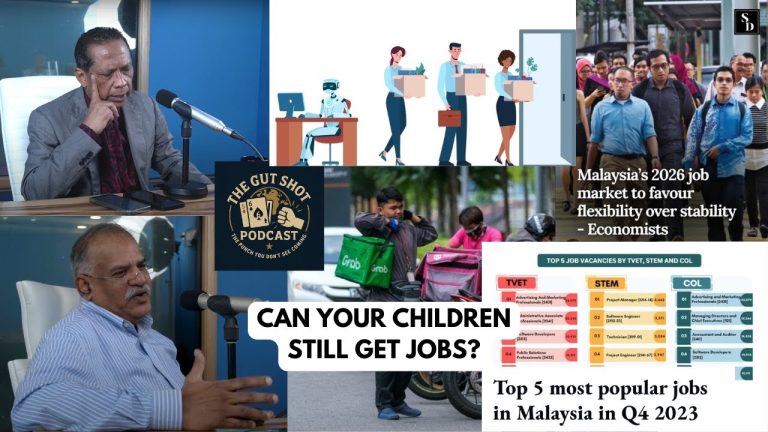
w Syed Akbar: Can Your Children Still Get Jobs? Danger! Hazard Ahead!


Show Notes & Description
Youth unemployment is in excess of 10%. Gig economy at 3 million workers is not a career but a dead-end future. Palm oil plantation industry is not what it is made to be. 79,000 tahfiz students with no SPM credentials in-coming. Bad education system/philosophy and immigrant worker policy is already destroying our youth's future outlook. Data-centers do not create net operational jobs whilst AI will wipe-out swathes of jobs. We discuss issues no one else will.
Welcome back to The Gut Shot Podcast! It’s Syed’s birthday, but we aren't just eating cheesecake—we are serving up the hard truths about the economic storm heading for Malaysia.
Are your children actually employable, or are they walking into an ambush? The statistics are terrifying: youth unemployment is hovering over 10%, and that doesn't even account for the "gig economy" trap.
In this episode, Sam and Syed dissect the "Perfect Storm" facing our workforce. We aren't just talking about the AI revolution wiping out white-collar careers like digital cameras wiped out Kodak.
We are exposing the structural rot at home. From the 79,000 students left behind without SPM certificates to the false promises of billion-dollar data center investments that offer almost no real jobs for locals, we strip away the political spin.
We also dig deep into the uncomfortable realities of race-based economics, revealing the shocking disparity in EPF savings and why 50 years of semiconductor manufacturing in Penang hasn't trickled down to create enough Bumiputera engineers.
Plus, we challenge the addiction to cheap foreign labor that is robbing our youth of crucial entry-level experience.
But it’s not all doom and gloom. We offer concrete solutions based on what actually works—liberalization. We look at how deregulating the airline industry and logistics sector created thousands of jobs and why breaking the banking oligopoly is the key to saving our economy.
If you are tired of the "rosy picture" painted by politicians in ivory towers, this is the reality check you need to watch.
Chapters
• 00:00 – The Coming Job Market Tsunami: Why 10% youth unemployment is just the tip of the iceberg.
• 01:50 – The "Kodak Moment" for Your Career: How AI and technology will wipe out entire industries overnight.
• 04:30 – The Wealth Gap Reality Check: The shocking truth about EPF savings disparities between races in Malaysia.
• 06:15 – The Gig Economy Lie: Why driving a Grab car isn't "employment" and how it masks the real crisis.
• 12:20 – The Lost Generation: 79,000 students without certificates and nowhere to go.
• 14:45 – The Data Center Deception: Why billions in foreign investment won't create the jobs we need.
• 17:55 – Missed Opportunities in Penang: Why 50 years of semiconductors didn't build local supply chains.
• 24:10 – The Foreign Labor Addiction: How importing workers destroys the career ladder for Malaysian youth.
• 33:20 – Immigration & Enforcement: Why are we still flooded with foreign workers despite the "bans"?.
• 42:15 – Palm Oil vs. Tourism: Why we are wasting land on low-yield crops instead of high-value tourism.
• 58:00 – The Proven Fix: How deregulating 3-ton trucks and airlines created massive job growth.
• 1:04:00 – Breaking the Banking Cartel: Why we must end the oligopoly to spark new business loans.
• 1:10:00 – The Political Fallout: Why handouts like BR1M won't save politicians from losing the next election.
Many thanks to CITYPlus for their collaboration with The Gutshot Podcast, in whose studio this conversation was recorded. CITYPlus is Malaysia's first Chinese business radio station, dedicated to delivering in-depth analysis on local and international current affairs, markets, and businesses.
Jump to chapter 9 chapters
- 0:00 The Youth Unemployment Crisis
- 9:55 Disruption from AI and Media Obsolescence
- 16:40 The False Promise of Data Centers
- 20:16 Lessons from Penang's Semiconductor History
- 36:51 Foreign Labor Addiction and Lost Apprenticeships
- 49:55 Rethinking Land: Palm Oil Versus Tourism
- 1:10:32 Deregulating Logistics, Education, and Skies
- 1:17:31 Breaking the Banking Oligopoly
- 1:24:35 Electoral Fallout and Economic Reality
Auto-generated from YouTube captions. Timestamps link to the video.
Welcome back to the Gutshot podcast. I'm Sam. Here with me is our good friend S. Good morning. By the way, happy birthday. Say, thank you. Say's birthday today, gentlemen and ladies. Okay.
He bought me a cheesecake one. Yep. We got some cheesecake here for later. Now, uh we're going to have a very uh interesting uh conversation that I think everybody should be should be listening to and talking about it. We're looking at uh our children, your children, are they going to have jobs in the future, right? Today uh according to the data uh the stat from the statistics department, I believe youth unemployment is hovering around 10 to 10.3%. Right? That's already bad. We're talking about youth between 16 to 24 years old. Um and um that also include uh people who are
already in the gig economy for example which we have said before that is a is a that is a data and job. Now coupled with that uh we have an incoming tsunami which is uh the AI revolution. All right. So I think these are things that uh that is really going to hit us very hard within the near term. Say let's kick off this discussion. Um is uh is uh is our children your children are they going to have jobs in the future?
Thank you. Yeah, this is another tsunami. There's always a tsunami on the way. Uh, I want to I want to go back a little bit in history. Remember when uh digital cameras appeared,
right? I think it was in the maybe '9s or something like that. And then all those camera shops that sell the old camera with film, you know, you send your roll of film to the the camera shop to develop your film. All that business disappeared overnight. You know remember we used to walk into the the our cal camera film processing shops they have that huge machine there
especially Kodak right all that went out of business simply because of digital cameras you know you don't you don't use film anymore before that black and white photography almost disappeared everybody became camera uh color photography but digital cameras wiped out all this camera process you don't have a camera studio or shops anymore processing film Uh so a lot of jobs and careers and businesses were wiped out just because of of technology. Yeah. And then you had the internet again it create a lot of uh turmoil and upheavalss in job market in employment in career because these are
all new technologies. It replaced many many jobs. Now we have AI coming. So this this tsunami that you just mentioned you use the word tsunami. These tsunamis affect all societies all over the world equally. Equally whether you are in Japan, America, Malaysia, when new technologies appear, people are going to be displaced. Now then you also have issues that are specific to our country because we have we already have a lot of issues affecting us, affecting our growth, affecting our economy, affecting our social and economic development. We have a lot of baggage. I
think also affecting uh the quality of the workforce coming into the job market and uh so so on top of the of this technology issues that going to wipe out a lot of jobs and careers and and just you know toss everything around
we also have you issues specific to our country which gives which puts an extra burden of weight for us to catch up with the changes that are already happening you know this so how is it going to affect ush I If I may draw if I may draw uh an example you see right now our labor force the numbers we have about 17 million labor force
which is about half the population which is not bad a lot of our people are actually working uh I have some some breakdown out of the 17 million 10 million are Malay bumra about there these all approximations because they have like a year old figures you have like 4 million Chinese who in the workforce and Indians about 1.4 1.5 or something million and then there's another over a million what is called deemed others which which could be include expatriates and things like that. So we have a 17 million uh workforce and um you know I mean is this Malaysia there
are differences in employment and income and whatever according to your racial identity. I just want to throw in a few other numbers. Uh you know our EPF contributions. EPF meaning people who work in the private sector who are who are uh with less government uh support or backs stop they are more exposed to the vagaries of the market. what really happens in the market you know in the EPF savings
the median savings of uh median median savings of Malay is slightly less than 10,000 ringgit about 9,700 ringgit total savings in EPF you know for the Indians is about uh over 16,000 ringit 16 plus almost 17 for the Chinese is 45,000 over ringit 45,700 something so these are the the major differences and disparities that you can see in the economy and each one of these people by you can see just by their median income mean I mean median savings uh in the EPF there are different levels of earning capacity and different levels of employment and unemployment so just now
when you mentioned unemployment of the youth you mentioned a figure of over 10% y okay that's a that's one figure we also have to see what do you mean by employment. Exactly. You mentioned gig economy. Some people think gig economy is employment. You know, I disagree.
Gig economy actually is not employed at all. You're unemployed. You wait for the phone call and then you know when you when the job happens, you go there's no fixed hours. It's not a formal it's not a formal sector.
Uh so I I consider that as uh informal workforce. Informal that means you you do not know if you're going to be working tomorrow. Uh that is gig economy. So that that figure that you mentioned the 10% youth unemployment. Yes. It includes these people who are in the gig economy and the gig economy as we know in Malaysia now is about over 3 million people. That's a lot. You know
that's a lot. That's a lot. And then you got other people whom you have to consider who maybe don't fit into this this uh figures this 10% youth unemployment gig economy. You have things like the B40 B40 people. Then you have the minimum wage people. The minimum wage people I did some checking up. There's about a million of them in the country now. Minimum wage means they are earning the minimum wage of 1,700 ringgit. This is the lowest rung of the employment salaries under in the employment sector 1,700 ringit. Then you have the B40 group. B40 is uh there's no there's no
clearcut there's no one line uh describing what exactly is a B40 but they are the lowest 40% of the of the economy many of these people are Malay Bumra and there are about 3 million uh households which are considered in the B40 group and since a household may have like three four people per household you're talking about about 10 million people in the B40 group you know in the country. Okay. Are they employed or unemployed? They are they cover all these sectors. The youth unemployment, the minimum wage people, the gig economy. So um employment is one thing but exactly how employed are you?
Do you work full-time? That's the right word. Do you do you work full-time? Do you work all the time? Do you get a full salary income enough to sustain yourself and your family? So all these things we got to look at. So when we go into the details the picture can be quite different from uh what the numbers indicate. You know,
not only that, I I do think that what we have to look at uh for uh Malaysian um looking at u our economic environment is that uh this uh this this this whole scenario just taking on the data alone because the government publishes um unemployment rate at about 3%. which uh you know people would say that's what is considered uh full employment. Um and going by what you just said that's I don't think we're looking at full employment. I think 3%
if you go deeper if you go below the surface all these are debatable. You know because like the government's 3% okay they may have certain criteria and this and that which captures that number but if you go into the details what ex as I said what exactly is employment do you do you consider gig employ e economy employment things like all this debatable you know to me employment means you earn enough money to feed yourself your family send your kids to school if you if you have to pay rental for the house you have to pay for the installment for your car all this you can you can do
and you have left behind to save you're not you're not drowning by the middle of the month. uh to me that is what a real employment should should uh the the kind of uh salary income a real employment a real job should bring to you if you don't make that kind of money then you can debate that employment I I think not just we're looking at that we also looking at at every year we are bringing more people into the workforce and if you are looking at a scenario where you are going to see whole industries or whole sub sector of jobs that is going to disappear right not
just I um not just because of AI but also because of development of industries itself I'll give an example for people um I started my business actually in the broadcast engineering industry I've looked at it and I've seen how it has evolved all right today you mentioned the AI higher uh up the the digital uh the.com uh scenario. But if you look at the broadcast industry itself, the broadcast industry is dead. Okay? With the advent of streaming services, people are getting their information, people are getting their entertainment through streaming. There is no longer a space for terrestrial TV
and the satellite TV. the likes of Astro is going to go like a uh like like the uh pony uh uh you know we we are looking at obsolissence actually because settle because why because even with uh with uh uh the current studio if you look at America what is happening today they are competing with YouTube They're competing with Netflix.
The podcasts are competing with them. The podcasts are competing for news uh for news, for analysis, for media. Correct. Um I So once you look at it, u you are looking at a whole swath of actually industry that is going out of business, you know. So where where where are these people going to be uh getting their jobs?
And we are not professional podcasters, right? We're just doing it for fun. Yeah. But it takes away uh somebody else's uh uh job or somebody else's career in broadcasting because everything whenever someone is listening to us for example it's one less person listening to the to the other broadcast.
Yeah. So uh the options now in uh in broadcasting in media are so huge and humongous that uh traditional uh media is facing a really challenging time. Correct. Very challenging time.
Yeah. So these are the this these are the things and I'm just taking one sub sector of the economy right. Um I I have said uh before as well. Um I think the uh the the uh the oil and gas sector is also going to have to be more lean and mean. All right? Because the oil price are not going to go up anymore. We've got a glut of oil uh in the world for the long term. Let me put it that way. Okay? Which means the pressure is going to be put on even the electronic sector which is actually let's say people talk keep talking about you know um automotive sector in the renewables line
and whatnot. Number one they're not they're going to have a trouble competing with cheap oil. Number two, okay, you know this this uh electric vehicle, you are basically paying uh for uh for a smartphone uh on four wheels that is going to be obsolete every 3 years. So that industry is going to be in such a disruption. So having laid down u this this this these tsunamis of this perfect storms that uh let's call it a perfect storm within the next I I wouldn't say even 5 years I would say within the next 3 years right there is a drastic drastic uh thinking that has to come about we've already
that that involve how we bring up our people the education because these jobs are not going to be there ladies and gentlemen right now on top of that let's add another problem okay I've just read this news that uh approximately 79,000 79,000 taffy students are not going to be able to go to tertiary education because they don't have SPM qualifications uh Oh,
79,000. 79,000. All right. Um, now what's our army? Uh, that's about what's the size of our army? Uh, my friend, our armed forces maybe less than 300,000 200 plus good about there. So, this is about what
or a third of our army uh coming out every year, right? And they cannot go into further education. Yeah. uh they don't have the SPM certificate. Yeah. So they can't they also restricted into many job opportunities from they're restricted from any job opportunities where you need SPM certificate. So what are they going to do? Mhm. And we are manufacturing all these kids. So I in in my opinion I think um I think the government policy makers thought leaders need to stop giving us this rosy picture. I'm sick and tired of that. All right. We don't have a rosy picture. We
actually need to you know take the bull by the horns and say these are the problems. I find that this is what needs to be done which is actually lay out all our problems and face it head on and be it as uncomfortable as it is because you know what with politician they want to tell you all the good story so that you know you say okay I'll vote for you. You know, I think we need to have a change in paradigm, which is I want to hear people talk about this is our problem. This is how we're going to solve it.
We have uh serious issues going forward. Okay. Let's start with the serious issues. Especially for our future generation as you mentioned the the leadership the political leadership is not maybe they not they're not aware of the thing or even if they are aware maybe they do not again they are in a blur. what exactly needs to be done. You have to take the bull uh by the horns and uh we have to take drastic uh measures. You see now the latest in thing that is happening is data centers.
Mhm. Uh the investments are huge. I think over 2023 2024 there was like 46 billion and over 140 billion coming in. You know it's a lot of money. Yeah. Y
uh you have uh Google, Oracle, Microsoft, Amazon, they're building their data centers in the country. But did you know that these uh the investments are in the hundreds of billions, but their employment opportunities are rather limited, you know,
you don't need that much staffing to run a data center. Yeah. Uh if you build a steel mill for 46 billion, which is a huge steel mill, you'll probably need a few thousand workers in basic industry, but not in a data center. You have a multi-billion ringit data center. Maybe you need a couple of hundred uh technicians and workers and so on to manage it because that's what it is. It's just uh you just have to manage the the place and the computers that are running there. Uh they don't do much programming on on the spot. It's just a storage device. It's a huge storage device.
data processing. So although all these investments are coming in in the data centers, the the job creation is not that great uh in my view. And then uh recently I was talking to a friend of mine who is in the human resource business. He does head hunting and stuff like that. I met him downstairs. He has office here. So he was saying that he now the data centers are coming in and they have been they have been hired to recruit staff but they are have been told to recruit staff what they call uh level two or tier two and level two and level three technical staff
you know the technical people diplomas and degrees engineering things like that to help to maintain the place. the tier one the the white color the yeah the the experienced senior staff are they will bring in by themselves most likely they'll be expatriate they will not be Malaysian because we don't have that stuff so you see even there our workforce our contribution to their human capital requirements is tier 2 and tier three well maybe it's a start and from there we should be able to move up but uh again what I'm trying to say is that for the amount of investments coming in uh
It's not going to generate you know thousands upon thousands of uh jobs. You will not find an entirely new workforce known as the data center workforce. There will be but there will not be many bus loads of them. It's it's limited. So again this is this is digital cameras coming in. You know you wipe out uh entire careers industry sectors you wipe out businesses. This is what AI is like. It is the next the next step up in uh computer technology software. So bottom line is it's not going to help that much in generating employment for our thousands who are graduating
including the 79 79,000 ti students who don't have a certificate. You know why you can forget about it. So so what's going to happen to our country in the future? Uh are we going to miss the boat? Yeah. Now I want to I want to go back in history and uh I need a bit of time here just a little bit. Uh you know the the semiconductor manufacturing in Malaysia. We we are a huge player in semiconductors in the world. our our semiconductor values. Uh I have some numbers here like 2022 exports of semiconductors from Malaysia uh 83 over billion US. So times 4 about
320 over billion ringit that's a lot you know 2023 was um 102 billion ringit US dollars over 400 billion US ringit we are huge we are huge in the semiconductor uh industry in the world uh the electronics industry the exports uh it it's a a huge chunk of our GDP about 7% just this semiconductor manufacturing and export about 7% five six to 7% of our GDP and then you have they've been here for a long time the for example the very famous Bay and La Pass free trade zone this the the center the ground zero of semiconductor manufacturing in Malaysia it was set up in early '7s early '7s so
it's been like 50 years now in operation more than 50 years so you we've had like Intel uh Huelet Packer National Semiconductor Hitachi um you know all these people setting up shop in the country for a long time huh and um they created a lot of employment in Bay Laas. I remember I was I went I finished my schooling in Pinang and we lived uh in Glugo which is quite close to Bay Laas just a few miles down the road and we had this hundreds and hundreds of you know this factory buses buskilang transporting these girls you know who come and work in these factories. The girls would have come in
from Pinang, from Kada, from northern part of Perah, you know, as far as ples, even from the east coast to work in this uh semiconductor factories. They were lowest of the rank kind of work workers, manual workers. So that was the contribution of our economy into the semiconductor manufacturing and um well something some good things have happened. Pinang as a whole, Pinang over the last 50 years, Pinang has graduated uh by creating support industries, ancillary industries which uh form part of the supply chain of this semiconductor manufacturing in Pinang. Uh you know in the semiconductor
factories they have the conveyor belts this they are long and thin and they have jigs you know jigs to hold those chips in place and these all expensive. Some of these things have been manufactured in Pinang for some time already for for a while. Uh automation equipment manufactured in Pinang and as a result of which Pinang also exports some of this equipment outside the country. So there has been value added into the economy. Uh but again uh coming to the you know the bumutra factor we have not really produced that many engineers bumutra engineers who are part of this process in balas in
semiconductor design the manufacturing and all that it's very it's very minimal it's always it has always been minimal for the last 50 years and you you hardly find a boar company that is part of the global supply chain in the semiconductor industry So this is where we have foreign investors, new technologies coming in but does it trickle down into our entire economy all the sectors of economy into all all the people that we have because we're talking about employment opportunities. So the bumutra economy has missed out on the semiconductor industry in Bay Laapas
although it's been there more than 50 years is the same thing going to happen now in the AI industry. So you see that is why I quoted the figure earlier. You find that the median income for Malays median median savings I'm sorry median savings of Malaise in the EPF is 9,700 ringgit versus median savings of Chinese is uh 45,000 ringit. So the disparities are still there because we are not taking advantage or we're not able to latch on to this really uh paradigm shifting technologies that move into the country from outside which benefit some people more than others or other people are
able to to benefit more from these changes than other groups. Huh. So this is where the the gaps exist. So we spoke about tsunami just now technological advances which affects everybody all over the world at it at a it impacts everybody but in Malaysia we also have our own issues which we with which we have to deal with these changes and uh although there are positive changes in technology to me every time there's a techn technological advancement it's a positive but the trickle down effects inside our country are not the same. There are differences. This is where we
have not been able to do as much to improve or to equalize opportunities especially employment opportunities for all our uh members of our of our society that 79,000 kids whom you just mentioned the taffy schools who don't have certificate even to go to tertiary education they will not be part of this process. So my my my question to close this point is we know this isn't it? Okay. So, what are we going to do about it?
There you go. Well, I I um I mean we did talk about Malay problem versus Malaysian problems. Okay. But I mean if anybody wants to hear more of that, we got you know almost two hours in part one and part two of that subject matter. But uh it's worth mentioning also um with respect to jobs I think um uh number one why we also sleep up on this because policy makers unfortunately our policy makers are politicians who uh from young um their only job is politicizing. So they have never really worked uh on the factory floor uh build up and see how people actually uh grow and also uh
those that are supporting this decision maker they're living in ivory towers you know they open economic books they've never really done actually building up businesses small or medium scale because then you will you will see actually um people who come from the ground you know uh like what you say when you talk about factory workers why we don't have engineers actually what we see is the feeding up of all these uh people who come from let's call it whether it's factory floor or whether it's administrative they tend to the best ones or the the hardworking ones will also filter out
that is part of career progression Okay. Uh and in my experience, I found that the best people that I get uh in terms of technical. All right. They go for um they don't have the first so-called the top tier uh uh graduation. They're not even engineer. But actually they're better than the engineers because why? They put their effort at the ground, you know. And these are a pool that can only happen if our own people are the ones that are being employed on the ground. What I'm trying to make a point is to everybody is that we have also done one more disservice to the country and our
citizens which is we have imported workers from outside the country at the ground level. I've seen advertisements uh uh that are in that are uh in foreign countries promoting jobs in Malaysia including being able to go back to their own country on uh on a plane ticket uh arrangement for visas etc. So you know these are Malaysian jobs. Okay. So number one we are importing our raw material I call it our raw material of people that is going to be the secondary uh workforce in actually value added roles when you talk about things like an AI data center for example right the
people who go up to the second level are the ones who going to take over from the ex from the experts I guarantee you that that's how it works all right So if you don't have this feeder workers because you have trained your people wrongly, we have actually trained our people wrongly to accept white collar jobs from the very beginning. At day one they get out, we thrash them into universities so-called with weak qualifications and then they don't want to work on the factory floor. Yeah,
they don't want to be involved in uh this uh uh minial jobs but actually has stability. Yeah, but but uh yeah, it's true. I agree with that. But
and we import outsiders. But a lot of these uh foreign direct investments especially in the technology sector, the semiconductor industries in Pinang and elsewhere and now the the data centers in Malaysia, they are driven by foreign investors, multinationals and they are cutting edge competitive. They are completely open to the market. They are very uh lightfooted. They have to adjust and adapt very quickly to changing environments. So they need to hire the most talented, the most uh productive, the most competitive ASAP on the spot.
So they move very fast, you know. So they have their own schedules basically. It's called survival in the market. Uh so uh we need to make sure that we are part of that the way things are done. That's that's a reality in the world. You cannot go and put a bumra kota in the in the semiconductor industry. You know, there's no way. You cannot say we want x% of senior computer engineers must be boing. It doesn't work that way. Uh either you have the talents and the skills or you don't. So, so we need to gear our people up for this kind of competition because uh the moment you
are shielded from competition or or competition does not come to you in the way that it affects the rest of the world then we are going to get left behind. So the world is fast moving is at light speed. We have to train ourselves up to be part of this of the real of the real world. Uh that is what is going to generate jobs. The more competitive we are, there will be more job opportunities available. Competition creates number one, competition creates create creativity because if you want to compete, you got to be creative in any business, in any industry. So uh competition creates uh leads to
creativity which creates new opportunities, new businesses, new jobs, new growth. So if we don't understand this rather basic equation then we're going to get left out. We're going to left out. I'm very well sad that after over 50 years you know we don't have sufficient local participation especially bura participation in uh in the semiconductor industry in in Pinang and elsewhere. We tried Dr. Mahade set up a company called Siltera a very well-known company. I know them very well. A bit too well cuz I used to meet them. Uh they were based in Kulimkada. Uh I think there
ultimately it was sold because uh it was a technical success technical success because they were able to produce the the they slice these ingots and make the silicon this to make the chip wafer to make the the chips. Yeah, that's right. They were able to do it well. Technically they were they were uh very competent but financially it was not it was like other government enterprises you know our national car project technically uh competent I mean the car was able to run the airline company very competent technically fantastic uh service worldass service but financially
disaster because I couldn't sustain in the market because not as competitive so the government had to pump in money keep billing out I'm talking about all these examples that I'm giving uh including the the SEAR I think there was they had to pump money I think ultimately it was sold so we have the technical competency right but what makes the world run is your your ability to make it a financial success that means you must make the mousetrap not only must be good quality it has to be at same cost or cheaper than your next fellow if you make the best mousetrap in the world at the price of a
Rolls-Royce you're not going to be able to sell it, you won't survive in the market. So, these are the things that we we seem to miss. We miss the boat here and it keeps happening constantly. You know, our famous GLC's uh well, they're well known for for using up a lot of uh taxpayers money to keep them alive to do their business and things like that. uh not exactly at the peak of efficiency when compared to let's say a market player a private private uh sector market player. So again we have uh uh competencies technical competencies and all that but can we get it to market under cost or at
cost as the next as the next uh supplier because that's what will make or break your your venture that is what will create unemployment or create jobs. You know this is the equation that sometimes we we miss too all too often in the country but on the bright side there are many ways of skinning this cat which I hope we can uh discuss.
Yeah I think there are many layers when you look at it. I mean uh having been an employer of hundreds of people this is what I learned. Um number one management leadership is very important. Uh if you start putting in people because of their skin color, because of you need them to be uh to uh to ensure that they halal, um you got a problem. Okay? Because if that's your priority, you're not going to get uh the best people that does it. And that doesn't mean that actually uh Malay Muslims can't do it. But the problem is actually the wrong Malay Muslims are being put in
charge. Okay. Uh that's one problem. The other problem because it's then it comes to you know that issue of uh uh who you know rather than what you know right. So if you implement a system or or or if you ensure a system that is um irrespective of race and religion then you will have everyone at the right level competing and for people who think that actually no not for people who think I think the biggest problem is the politicians themselves who think that Malaysia are not capable and therefore they need to be uh given a helping and I beg to seriously defer. All right. Um,
that's one because whatever that then you've got uh you've you you actually from the top already you rot the the fish. The second part I want to go back is actually uh one of the solution I I really believe the the macro solution at the lower level. We need to stop export importing uh foreign labor and I'm talking about foreign labor uh at the lower level. uh I'm not talking about um value added uh uh expatriate expertise that then we can have technology transfer for example like you mentioned data center right you think about it why I do I do not understand why do we have even our FMB sector
you know full of uh uh foreign labor Napal Filipino you know I mean this is just the reason it it may sound like I'm talking about different thing but it actually pervades the whole lower level of employment and that includes actually at the factory worker like in Bayan Laas right when actually our people should be feeling that the problem why and they say oh our people doesn't want to take those jobs our people are lazy to take those jobs. The question I ask is why are they if that is the truth okay that means you have trained them wrongly to not want to take those kind of jobs
if you go and I've have had experience uh looking into um different states in the US for example all right you got Americans who are still doing janitorial jobs who are still doing factory level jobs. They don't import from uh you know from Mexico or whatever. But then you have places like California and whatnot that bring in seasonal labor uh or illegal labor in farm in in farm work. Okay. But then why do you have in Texas for example uh more Americans doing farm work? So, it's all about the will of the uh of politics. How do you get your people to actually
come into the workforce and actually take pride in terms of the work that they produce? I think that culture is missing in our society. taking pride in actually doing a good job no matter how lowly it may seem to other people. I think that is one of the basic thing I see in terms of our society. We need to have one policy first.
Get rid of foreign labor. We have uh the the the the the political the leadership the political leadership over over the last years over decades and over the past so many previous governments and this is like old story
the politicians they they'll always say one thing about this issue of foreign labor excessive foreign workers coming into the country but no matter what they say it doesn't solve the problem. I just solved the problem.
They are still coming in. So the question arises, we should we should ask the immigration fellas. We should ask the immigration authorities. What are you doing? Because the ministers, the cabinet, the leaders of the country, the politicians, they've all said the right things about what you are saying now to curb this inflow of uh foreign workers whether legal or illegal. You know, I mean the total number, but uh the numbers uh are still huge. You know we have millions of these foreign workers in the country. So the people who need to answer this question if you ask me is the immigration
department what are you doing? Why are there so many of these people in the country? Recently there was a issue in the press about this Myanma people foreign traders at a market in Salayang you know.
Yeah. Uh there was an operation done and a few days later operation done to I think to remove these people or to arrest them. I don't know what they did to round them up and then uh they disappeared. A few days later they reappeared again. You see, so this has been going on. This cat and mouse game has been going on for a long time for many years. Why is there no permanent solution?
So say may I say this? Yeah. Go ahead. I mean why can't actually the home ministry say stop all foreign labor? Finish. Okay. That means immigration also cannot approve foreign uh foreign labor coming in.
But you have to enforce it. You know you make a decision like that. I see the enforcement is is really lacking. No, but if the government say we are stopping visa issuance for foreign labor.
So obviously the government's instructions are not being fully heard because otherwise how do you explain that they are still here you know okay and then we have to talk about uh minimum wage.
Yeah we are talking the market dictate what is minimum wage. We are talking about uh will our children have jobs in the future? Yeah. Every foreign worker who comes and works here is actually denying a local Malaysian a young person from some kind of entrylevel jobs in the workplace in the economy because most of these foreign workers are in the basic level jobs, entry- levelvel jobs. Nevertheless, they are denying other Malaysians opportunity at these entry- level jobs. Now, they're everywhere. They are in the shops, behind the cashier. The only thing they have not uh
uh gone yet is behind the counter, in the banks or in government service. Uh but otherwise they are in the supermarket, cashiers, they are in the market, in the plantations, in the factories, everywhere. These are all entry- level jobs for our young kids.
Yeah. Our SPM holders, the 19 years old, 18 years old, just graduated, starting in life. They need this entry levelvel jobs for their learning curve, you know, to gain experience to go on to the next job which they can get a bit higher paying job when they are in the early 20s and things like that.
But this this layer is fully occupied now by the foreign workers. So you're denying our young kids, the 18 19 year olds from getting these entry- level positions because today's discussion we're talking about employment basically job opportunities for our kids. So they lose out. So by the time they're 20 plus they have not gained that 3 four years of entry- level experience which has been taken up by the Bangladeshies, the Indonesians, the Myanmas and the Nepales and the Indians and all like that people those people. So our our local citizens lose out. So they become they don't they
do not learn those job skills at that time in their life at their age when they should be learning these skills so that they can move on to the next higher level uh skill sets jobs you know in their in their career path. So that is being is like permanently being taken away from them. So uh then they end up in the gig economy the 3 million in the gig economy because simply because the foreign workers don't have motorbikes. I think the foreign workers are allowed to have motorbikes. They will take over. They will take over the gig economy. Gig economy.
The gig economy. Yeah. So we are not our planners and our our enforcement people. They're not they don't see all the dots. They cannot connect all these dots you know. So uh this is an ongoing uh uh problem. It is
I'm also wondering whether they are making money people coming in on immigration uh im uh on on work visas. I think the code word is somebody has to benefit. Yep. Without pointing too many fingers but somebody obviously has to benefit otherwise this this thing cannot function cannot happen. You see
so uh that's entry level. We are denying our own young children their chance at entry level uh employment. If you're 18 19 years old it's okay to work as a janitor as you said or some low-level job or you know doing some in the factory or something. You know I started my career my first job was uh you know as a audit cler. I had to go to the factory and count textiles the whole day, you know, yards and yards.
You a degree holder in engineering? Well, later at that time I was like 19 or 20. I was just after my school. I got a job with an accounting firm and they sent me to a factory and I had to just count yards of textiles, you know, for like a month. So, uh I mean you learn a lot at that age. You don't you don't want to be counting textiles and auditing factories when you're 45 years old. But when you're 19 years old, 18 years old, 20 years old, you want to start there. It's your beginning level of your career. I
I mean, it teaches so much in terms of uh Oh, you learn a lot. I learned tremendous that I learned so much about you know factories and textile manufacturing and costing and why I was doing what I was doing uh for accounting purpose, audit purposes is critical. So now all these kinds of jobs this you know manual kind of work is done by the expert foreign foreign workers. the locals don't get a chance to learn all this. So at your at the beginning baby steps in building up your career. Uh others are taking away those opportunities from you. So this has been
going on in the country for a long time. We have to do something about this seriously. Uh it all it all goes down to education and what kind of training we give our kids. Um you know those people who come from other countries they are hungry to work. They are disciplined. They they turn up to work every morning. They come to work and they work hard, you know, and they work without question. They can follow orders and all that. So employers seem to like them. They are they make sense monetarily. It makes economic sense to hire these people because they are here to work and
they are disciplined. So if our young people cannot compete with that with that attitudes toward work, we have to fix it. Yes, we have to fix it. We we have we must make sure that our kids our 19 20 21 year old kids can uh compete better than the Bangladeshies and and the Indians and the Indonesians.
You see say in all kinds of work that comes on when I read uh the other day they want to introduce TV in primary school. I want to laugh my head off. When you are in primary school, you the the cognitive uh uh ability is being formed, the thinking process is being formed. Okay? You want to handle, you want to get them into shops uh into into what we call shops, right? Shop skills and all that, do it after primary. At primary, you want to train them into having certain ethics, okay? certain critical way of looking at things, certain value uh value levels. That's why in Japan for
example, right, they clean their own schools. The children are made to clean their schools. All right, here we don't. Here we have these people in ivory tower coming up with this pie in the sky idea. Sack all of them, please. Okay. These people don't know about what how to uh how to educate our children. I'm just sick and tired of it.
They don't seem to know what they're doing. Yeah. Look, look, look. I started outside. I came back. I keep telling people I came back. My first job was primarily doing sales. Okay. I was doing sales. I had nothing to do with my chemical engineering degree. All right. As close that I got is actually form five chemistry. You know on top of that what do I do when I have to do say I find work I go and clean boilers in palm oil mill don't uh uh a white uh jacket go into the uh into the into the boiler. check all this in all heat sub. You know why? Because I because in our days we were
trained to work hard. Is that so difficult to understand? Educators train our people to work hard, not train our our children to turn around a a a black cube in primary school. You stupid. You see we
I'm getting mad. Okay, I'm really getting mad at this. We uh then we also make um there are major macro issues in the country and structural issues which we have basically shackled ourselves you know which are now really having a huge negative impact on uh job creation. It's not able to create uh as much uh jobs. You see in our country we make a big fuss over land issues. We are we are still considered uh well there's a very large there's a substantial plantation sector in the country agriculture agriculture
we are we used to be the world's largest producer of palm oil but now I think we're ranking number two or number three behind Indonesia. So uh but we make a big fuss over like the oil pump industry. uh but I want to make a comparison uh between let's say the agricultural sector um plantation economy and versus tourism for example in terms of generating employment and generating wealth income and also as uh significant contributors to the GDP of the country. You see if the agricultural sector in uh in Malaysia is about uh it's about less than 9% 9% around there total you know total all
agriculture fishing uh poultry small you know to be honest uh fishing poultry cattle raring uh planting petty uh uh plantations palm oil plantations rubber all it's about it's less than 10 nine 18% some say 8 n of which the palm oil palm plantation is about 2%. But it's got the hu the largest acreage of land. You know we have millions and millions of acres of land planted with oil palms and oil palm is just about 2% of the GDP. Tourism on the other handh tourism okay uh agriculture generates about how much I think it's about 200 over billion
how many% of our GDP uh about 9% Mhm. Malaysian sector well it's about 180 billion the total agricultural uh sector in the country tourism is larger tourism is almost 300 uh billion in 2024 which is uh tourism is 15% of our GDP
that's big Yeah, it's a huge chunk, you know, and tourism doesn't require millions of acres of land. It's not politically charged, which is which uh land is always becomes an issue.
Well, per capita per uh per acreage, you're earning more money. It's more efficient. Yeah. When you when you you know, and then you have to cut the trees to plant the palm oil. Maybe at one point in history it was useful to us. But but palm oil palms oil palm plantation just like rubber last time these are legacy industries which we inherited from the British. The British were colonials. They looked at they had to deal with their economy their financial metrics. So if they thought that they could make an extra ROI return investment in Ghana they'll do it right. Then again also I
said those all all those oil uh uh in those days uh uh the the plantation all require a lot more manpower compared to today you know so that's a different dynamic that again is a is a revolution
it was it was something which the colonials uh thought was profitable for them they couldn't grow tomatoes in Malaysia and take it back to London you see it won't work at that time but palm oil worked fine rubber rubber were fine.
So it was it was their metrics, it was their their situation, their economics, their calculations and then they developed these industries in our country. Is it best suited for us now today?
You see today uh palm oil fresh fruit bunch FFB uh about about 2,000 ringgit a ton you know about there maybe plus minus I'm just approximate don't quote me on that exactly. Uh okay. A kilogram of tomato is today is about 7 8 ringgit. A kilogram. So a ton is uh 7 to 8,000 ringit.
Fresh fruit bunch palm oil is only what 2,000 ringit. Uh I think it'll be it'll be an acre of tomato will produce generate that much more income than an acre than I mean a ton a ton of tomato and a ton of palm oil. And tomato is a food product which we need. Whereas palm oil is a cash product. You need some palm oil to fry over fish and cropolo. But it is basically a cash product which the colonial started in this country to generate cash.
So um then you have this issue of this foreign workers working in the oil pal plantation. The locals don't want to work and all that. Uh could we change some focus a little bit and convert some of this acreage of palm oil into other use where the per kilo or the per ton is much higher than per ton of fresh fruit.
You know to me it's basic you know instead of fighting arguing over land issues over something that that's less than 2% of our total GDP. I'm talking about palm oil. Yeah. And which sells at about 2,000 ringgit per ton. I think tomatoes at 7 to 8,000 tons. Uh ringit per ton is much better. Roses, one rose stock sells now at seven ringit. One rose stock. This one the young people tell me and Valentine's Day is coming. It'll double up. So uh talking about creating job opportunities and return on investment and value added in the economy perhaps we must readjust
the hat on our head and start thinking you know can't we go higher value added oh I I I I hate to come back um I think um you always move upward to the higher value added right that's for sure okay I agree with you on that I I agree that we should look at We should look at as we say um returns per acreage or returns per square foot as as what you know developers would say right. Um but I want to return back to that initial disc initial thought you had about uh the FMB sector the tourism sector which is about what 19
15% of our GDP% of our GDP about 300 billion in total value tourism. Now here's the thing. Um I remember people uh people talk about uh their they talk in a that we are the halal tourist uh uh focal point. I want to tell the policy makers screw that okay because why um what we want is actually high value tourists. Okay high value tourists. Let me tell you, uh, all the, uh, Muslim countries with a lot of money, they don't come to Malaysia. They go to London, uh, they go to New York, uh, they go to France, they go to, uh, Rome. Okay? You know, stop your uh, p stop your bullshitting to the right.
All right? Number one. So if you look at tourist uh uh tourism sector that you put at 19% 15 uh about 15% all right of the GDP
we can put our people to work because why even if AI arrives even today I would rather talk to a human being tourism one human touch okay that is what makes tourism attractive you need to bring up I used to remember I don't know whether it still exists uh ITM has a hotel that they were running that they were training their their their student in terms of of how to uh run a hotel I don't know whether it still exists or not but the fact that you can actually bring interns in and train them up in the hospitality sector why do we import people again it comes down to why do we import people when we
have 10% youth unemployment. Okay. And that is a huge sector as white said was saying you know per square foot it gives you a higher bang for the buck.
Let me I want to I want to wrap up on that that point which we just made. Please do uh as I mean comparing to Central America, you know, the banana republics. Assuming the British had come to Malaya and
and created banana plantations, would we still be planting bananas in the country it seems to be like an accident of history. You know, they came here Hen Reley or whoever brought this rubber trees from Brazil and they and he started growing here and then we became a rubber producer and became a palm oil producer. you know, it's just like accidental occurrences in our history and then we just carry it through. You know, we don't like we can never change the course of our future at all. Uh and well, it's true the Americans use Central America to grow bananas. That's
why they called banana republics. There's a history behind that. But uh you know, they had this thing called palm oil as a golden crop of Malaysia's golden crop. People used to say that when we had the economic slowdown in the 1980s and even in the in the late '9s, the Asian financial crisis, that that we were saved by the golden crop. That's not true. I disagree because at less than 2% of the GDP, that's not much of the economy at all. Our economy did not run on palm oil. We were not saved by palm oil. Less than 2% of the GDP. So these are the kind of u macro
things that we need to reook in our society. um tourism if you have a clean river with clear water flowing no AI can replace that you know
correct uh people will come from all over the world uh just to to enjoy those kinds of things you know today people go to soul in South Korea to look at a at a very it was it was a ditch cuz I've seen it twice an old polluted ditch a drain that used to run through the center of soul. Uh it's it is a river really a filthy polluted river. They cleaned it up and made it super crystal clear water and with benches and trees and plants uh you know on beside it and people can go and sit there and dip their feet in the water. It's a it's a stream. Uh it's a huge tourist attraction in soul you
know. So these are the things we have enough of our rivers. We have green areas. We have beautiful hills in Malaysia. You know, you know, in China when they have these hills, they build this, you know, this glass bottom bridges, you know, the see-through bridge, people climb up there and they want to have a heart attack, you know, because they they get this uh they like to frighten themselves. We have better hills in in in our country which we can develop and do all these things. So if we develop uh tourism you know on a higher more investment in tourism it
will create more jobs opportunities and things like that uh and whatever we want to do uh please let's not use taxpayers money. The government need not spend taxpayers money just free the market. Let the market do what it wants. Clear the way for the market for the industry to sort things out. they will find their own way of how to get things done. You don't need taxpayers money, you know, you don't need government funds, public funds all the time to develop a certain sector of the of the economy. Leave it to the economy to sort things out. Government just facilitate and more
often than not, get out of the way. Remove obstacles and get out of the way and let the economy, let the market, let the private sector develop these things. It will happen because you have to really put on your thinking head and keep an eye on all those jobs that we have lost because of all these unnecessary rules, regulations and choke holes and strangle holes that the s previous so many generations of governments and leaders have put on the country. If you remove all these shackles and let the economy go and find its own level, they will know what to do. you know, don't screw things up with
useless regulations. Do you know that in uh Kala Kubu there is a forest uh reserve there near Kalakubu near the Sunai Chiling Sun to enter that jungle you need a guide. They insist that you you have a guide especially for foreigners which they don't like. People are not going to track there for 9 days. They're probably going to walk in for 1 hour and walk out again after 1 hour. Why do you need a a guide? I mean I mean unless you're talking about going to some places like you know uh Grand Canyon where actually you can get lost and uh die out of thirst.
Well even there you know they they don't make it obligation that you must hire a local guide. But these are the kind of things that they do that which also that kills the tourism. But what I'm trying to say is that the tourism industry, it can create a much higher return on investment than per ton of fresh fruit bunches or per acre of land. You know, uh it can create more opportunities and more jobs. Let's say you have 10 acres of plantation land, oil pump plantation. You convert it into an active act uh what this uh sports resort, you know, with bike riding, mountain biking or
dirt biking or trekking. And you know if there's a nice river there or waterfall all the better. You can create more return on whatever invested in that in that 10 acres than 10 acres of oil palm which only contributes 2% to our GDP and then everything is sensitive over land. You know the land issues again we're going into the racial issues
which we can do do away with do without. Yeah. I I think I I I I want to and excuse me I want plantation agriculture is not food agriculture although oil palm oil is used for frying fish but plantation agriculture is not I would rather you replace plantation agriculture with food agriculture. You grow your tomatoes, you grow your cabbage on land that is now planted with oil palms. You we can feed our people better. You create more jobs. We are importing our food import bill is 70 over billion I think 70 80 billion. Why aren't they thinking about that? The only way you're going to reduce your
food bill 40 million people you the only way you're going to reduce your food import bill and also increase job opportunities in food output is you have to use up the land. You have to you know he has here about using up the land that is up the technical ladder. Okay. Uh this is something because I've been in this business which is shipping. Okay. I don't understand why uh we don't have a policy that is very focused on uh on on port and ship building and ship maintenance uh and ship repair. Okay. Um our whole territorial water is basically the heart of um uh Asian commerce. All right.
But then again, what happened? Most of our ships would rather send their ships to Singapore or Batam uh at a higher price than coming to our shipyard.
Why is that? because one facility are are poorer turnaround of the ship in terms of maintenance are poorer uh is not as well run um and uh don't talk about the regulation. Okay. So these are the things that actually we need to focus on. I think Malaysia um we have the capability to actually uh really be a hub for this. But the problem is then you know we've got like the um the the the uh you know again we get into GLC issues. Okay. Uh I remember in my younger days um when I was in the uh the oil and gas industry very young, Sabah shipyard was one of our best and then uh
my I think it was uh our good old prime minister uh somehow had it uh um uh gone to um somebody that had no idea how to go. You know this is the old days our our our our old PM.
Yeah. You know five prime ministers ago. Yeah. And u and u and and and now shipyard went past we built a couple of shipyards in Pasigang the famous uh I think the Japanese came. I don't know what happened to it now.
So I think I think I think you know the steel industry these are industries the AI is not going to kill you. Okay. These are these are you know the electricians, the plumbing, the uh the welders. Okay. I mean unless you are on an assembly line doing car, you're not going to have robotics handling this type of
No, you need all these people. You you will always need them. Correct. So these are the type of these are the type of industrial output. Even America understands this. That's why they're bringing back their their their steel industry and they're bringing back their ship building industry. Um, you know, we don't want to be importing uh uh steel making factory from uh outside the country that brings their own people and then put a four wall into it and then we don't know whether they importing cheap steel from their place and then kill our own uh uh steel industry. That has what
that is what has happened to our indigenous steel industry. There was a lot of uh steel makers in Malaysia that went under because of this. All right. So foreign investment must be very strategic. Okay. Foreign investment must be those that actually are going to not kill our industry but actually they can compete among each other you know um I think this is the other part that I look at very very clearly I don't understand why our policy makers does not talk about all this
I um you know every day I keep hearing about Mallayu Basa Malaysia Uh uh night. Uh hey dude, I can tell you one thing. I am in full support of Sarawa uh teaching in English. All right. Because then they can converse. They go and do FMB. They deal with tourism. They're welcoming visitors in English.
Anything that makes you more competitive. Correct. You see uh if I may I'd like to talk about uh further further ways of how we can uh ensure job creation in the future for our younger generation. You know these uh changes that are happening in the world today AI the new technologies all they are I mean uh the the countries that are already dealing with them include countries that are uh they have a very liberal open economies. They are highly deregulated. So they have a better chance of dealing with all these shocks and new developments in technology which which impacts them too
which impacts their labor force. So this is where we have shackled ourselves because our economy is very far for from being open uh uh uh liberalized and deregulated. And yet this is where the opportunities lie. You know we have to we have to there are ways where we can ensure job creation for our future generations. If we just open up our market, if we liberalize and deregulate our economy to create jobs, this is possible. I want to give a couple of uh examples. uh you know I want to talk about the transportation sector the private tertiary education private universities
and our airline industry as examples because these are real examples uh some years ago now it's been some years means quite quite I think it was maybe early 2000s I can't remember uh our the trans the transportation people the ministry of transport they dere they liberalized the ownership of uh trucks, lorries. The 3-tonon 3 ton lorries were uh were liberalized like it was not subject to kota anymore. Anybody could buy a three-ton lorry and operate it for whatever purpose and business purpose without needing approvals and things like that which was a situation before. So immediately it
gave birth to a very vibrant and dynamic logistics sector in the country and you know the UPS panel truck the famous the dark chocolate colored which we have in the states those are panel trucks those are about three ton trucks maybe I think American one is slightly heavier
but in Malaysia the a huge bulk of our intracity traffic is is carried on these three ton trucks so when they uh liberalize this sector a lot of people bought these little trucks and started running their logistics businesses and it was a major help to other people like the Amazon fellers, the online retailers and all that who open up their distribution centers throughout the country cuz they need this these small trucks to make quick deliveries. You you don't send it on a 40ft container. You need this little truck. So because the the three ton trucks was was liberalized and deregulated,
they were easily available everywhere. So many uh logistics transport operators were available. So they teamed up with these uh online retailers and they and therefore they could open up their distribution centers wherever they wanted to around the country and delivery is is more efficient which helps their business. It's all about speed. Yeah. So this is where hundreds if not thousands of new jobs have been created in the transportation sector in this three-tonon trucks business and it benefits everybody regardless of whatever race or background because all people operate
these trucks. There are so many people now involved in uh logistics and distribution and uh it created uh new entrepreneurs transportation entrepreneurs some of them have become big. So this is one sector just one sector where when the government de liberalized and deregulated the the industry it took off. The other one which to me is a huge success during which took off uh in late Dr. Mahade early Abdullah Bavi period was private education they totally liberalized the private education. private universities were allowed to set up universities. You know, just fill up a form, which
Abdullahi said, if you want to set up a university, just fill in the form and you can start your university. Before that, it was a huge fight, remember, between MCA and the Chinese and the government about Utar. They couldn't get the permit. It went on for years. But finally, they they deregulated and liberalized private university education. And today Malaysia is a hub for private university education in uh in this part of the world. We have thousands of uh foreign students and local students. We have foreign universities like Nottingham, Curtin, Zaman, Monese and the Indian one,
Manipal Medical. They they all have a campus here and it has not only do we have thousands of foreign students and local students pursuing higher education. It has created thousands of jobs in this sector. It's it is a direct result of liberalizing and deregulating private university education. And you have other colleges too. All private university colleges set up in Malaysia. And also the airline industry. The moment we deregulated and liberalized the airline industry, Malaysia became a powerhouse in uh lowc cost flights at least and uh very successful and our our
private airline industry has generated spin-offs major like you know engineering, maintenance of uh airplanes, the catering, supplying uh food for the airlines, pilot training, air crew training, all these things you know has created thousands of jobs and it also brought in millions of more tourists into the country as well as created uh tourism inside the country especially flying to Sabah and Sarawa. So all this has happened these are example real examples because we we we liberalized and deregulated these important sectors of the economy which created these thousands of new jobs and
opportunities. Imagine if we don't have a private university sector in the country or or we didn't open up our skies for private airlines. Where would all those thousands of jobs uh be? I mean where would all those people go to find jobs if there was not this industry? So every time we liberalize and deregulate a sector, we create massive employment opportunities. We create entire new sectors in the economy. So there's a long way to go in this country where we can do this you know and my favorite example is what we have discussed multiple times before our banking sector
it is an oligopoly it is controlled by the government the biggest banks are GLC banks GLC's are going to have issues simply because they're taxpayer funded you your fallback is on the taxpayer public funds and public funds is limited it depends on what how much budget they allocate in October of every year. That's that's your that's your check. Your paycheck is it comes from there. So you're you're extremely limited and then they restrict the market like bankings and igopy. There only x number of banks. No new bank licenses have been allowed or I think will ever be allowed. We have to
change all this. My view is we've discussed this before. You know the banks because the banking sector is so controlled and restricted. It's an igopoly. Not only are the banks uh laughing all the way to the bank, they're making money at our expense. I have some horror stories about uh how rich banks uh have become from us. Uh horror stories for me for us. Uh but it restricts growth in this sector. If we fully liberalize and deregulate or liberalize, we banking has to be liberalized not deregulated. No, we need regulation in banking. If we liberalize our banking sector, my view
is that you can easily create a few hundred,000 new jobs and top level jobs. Banking is a highly skilled uh uh sector. On on on that note, I think this whole digital banking is a uh so-called uh licenses that are so-called easy to do is not working. And not just is not working, it's going to is it's uh this is this is the hairbrain way our policy makers think. All right. Just give licenses for uh proper banking to open up a regional banking where people can walk up because small businessmen
let them decide. Let them be close to the customer so that they understand how the customer need to grow their businesses. It's not for the government to decide what a bank should be, what it should do, how big or how small it should be. No, it's not for the government to decide. It is for the economy to decide. If somebody wants to do banking or a finance company or a leasing company or a factoring company, let them do it.
Then uh this will have more of this uh of these enterprises, these banking enterprises taking more risk on our own citizens trying to do business. You know, right now the big banks are not taking any risk.
So you have this huge sectors of the economy where we have handcuffed ourselves and there's no not much growth. You know another uh another fact is that uh the actual growth in loans loans the loan growth in our economy is uh not as aggressive is quite stagnant over the last uh few years for some time. There's not much growth in new loans uh in the economy. So people pay off their old loans and then some new loans are is replacement when people pay off the old old loans. Of course there are some new loans. So like but the overall increase in the loan growth in the economy is uh
is not as as uh how it should be. If you want to have real growth in the economy, you must have loan growth because increase in loans means more economic activity on the ground. So all this is not happening. I I my view is because the banking sector is such a control igopoly. So we have this we have spoken about education about the airline industry uh the transportation sector and now banking there are there are so many other sectors of our economy where we have handcuffed and shackled ourselves. Uh this is this is through the franchises, the concession agreements, the monopolies,
the oligopies. Uh you see for example uh the the toll roads the to when are they going to be abolished? Uh they have been going on now for over 40 years and some of them some of them have been extended for tens of years. Why they need to be abolished? Imagine if you if there's no more tolls. If there's no more tolls, there will be massive development of property real estate along these highways without the tolls. If I'm building a factory and there's no toll, let's say between here and Tanya Mallay, I'll be tempted to put my factory in Tanya Mallay where the land land price
could be cheaper, things like that because I don't pay tolls. So I can put my factory a bit further out which means the value of property in that area will ultimately go up. The local people there will get employment. We spread out you know the the spread out the investments and uh and uh economic growth in the country along the highways if there are no tolls just like human settlements grew up along the river. when there's a river, imagine if the old kings and emperors put a toll on the river, I don't think Egypt would have developed along the Nile.
Oh, it's it's also true that actually when new roads are built and uh uh and and it bypasses a certain town, the town dies dies. So the roads are important and the cost of using the road is important. You must make it we've already paid for these things. So if you abolish these tolls you know throughout the country which we've already I I believe more than we have paid more than enough tolls the last 30 40 years it will it is going to boost economic growth along all our highways not just property values will go up but people will start planning new townships you
know new growth centers new factories new industry along the highway this will boost job creation which is what our subject let's not forget our subject today is job creation And the day this is what we're talking about. We are talking about how do we ensure that that we have growth so that we have growth of jobs and also not having uh the jobs that are easily available to train our own youngsters be taken up by uh foreigners. Right? So that becomes also a a a conduit to the next le level of job as they move up their career ladder in whatever industry they they they
choose to go into. I think uh this is uh quite extensive uh as it is uh any last last point you want to make? Yeah, for our I I I just want to reiterate as we wrap up that uh uh there's also a cost to this. Maybe I'll just close it. But in Malaysia for now, looking going forward, we can create or we can secure uh job opportunities for our young generation by removing unnecessary rules and regulations. We have shackled ourselves. We have really put ourselves in a straight jacket. So which other countries do not have. So if we remove these straight jackets and these
handcuffs and shackles that we have and learn to liberalize and deregulate the economy, this will create more job opportunities. Tremendous growth is possible in the country. We just have to get rid of all these unnecessary regulations, rules and all kinds of strict uh which we have in this country for the last I don't know 30 40 over years. The final point if I may close my my uh comments is that it's political uh since 208 the politicians have been having a very tough time 208 the barisa national lost the 2/3 218 they lost power 222 was a hung parliament the the
state elections in the six states in 2023 was a very poor results for the ruling coalition the Saba elections were not as as what they expected said this is not going to change. The polit the results of the polls are not going to change because people are unhappy. People are not their kids cannot get jobs. Life is becoming harder. That B40 is not going to go away. I remember uh Abdullah Bawi was the first prime minister who started handing out cash cash uh aid to the people. We never had cash aid in 22 years of Dr. Mahade. But Abdullah Badawi was the first prime minister who started giving
out cash and I was one of the beneficiaries. They gave a refund I think the road tax I can't remember. And then uh we had brim remember and then well I think I still have 100 ringgit to collect and latest now now latest I've just got 200 200 ringit because I'm a senior citizen. I just got 200. My wife say, "Hey, you got 200, but you got to spend it in the in the supermarket or in the So, you see, uh, all these handouts, handouts are starting because there's not enough jobs and then the definition of job is debatable. Is gig economy a job?" And then you have minimum wage. I mean, if you're if
you're not making enough money, what kind of a job is that? And then people have two jobs. So, this whole idea of employment needs to be it is not it's just not a one-word description in Malaysia. It's it's kind of complicated because we don't have opportunities because opportunities are getting less because we have shackled ourselves. That is why these people are losing the elections. They don't seem to understand. So if this situation does not change, they're not going to win elections. The pol politics now is not a career choice. Last time in the old good
old days, politics could be a career option. You can become a member of parliament for three, four, five, six terms. Oh, they they they they ripped up uh uh pony safe houses and find hundreds of million.
So uh so uh well that all that is coming to an end because uh it's not delivering. It's not delivering. And then younger generation are also getting tired. they can't seem to get enough jobs or do the things that they they they were trained to do in school and university and things like that or the 79,000 kids taffy schools who cannot even get an SPM certificate they're all going to become voters and they're going to look at their neighbors and go like what's wrong with us you see so these are the problems which the the the leadership is allowing to to to accumulate and compound over the last
you know what 30 40 years not leading over 30 40 years So they better start thinking if if you want to survive in politics, if you want to be in power or have any decent career in politics,
you have to start delivering what is good for the people to the people, not to yourself. Wow. On that note, um I think we'll close today's uh discussion uh and our conversation. I hope everybody uh enjoyed that and uh put some real thought into how we move forward as uh as people. Uh and on this uh blessed birthday of yours, thank you so much. Uh let's uh let's uh get more people uh join our gutshot community and uh we build a movement of uh change in the country. Thank you so much.
Thank you and see you again.
What viewers are saying
52 comments on YouTubeNo comments yet. Be the first to weigh in.
Join the conversation on YouTube ↗