Why We Are Accidentally Raising Criminals and Misfits & How to Fix It
Show Notes & Description
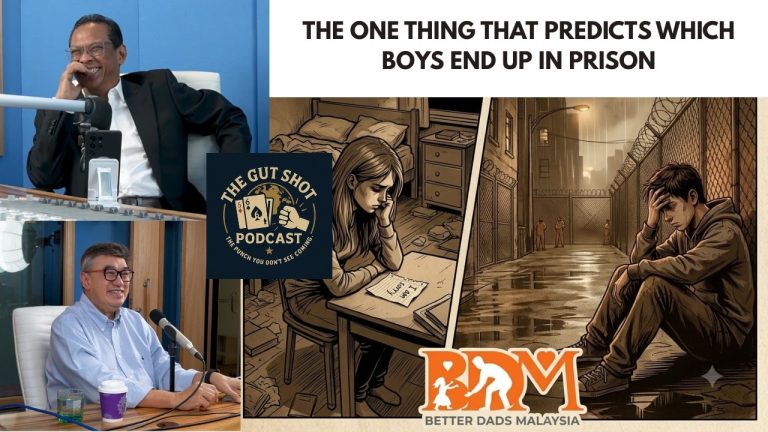
The numbers of youg boys in juvenile detention, male incarceration and male-dominated suicide statistics will horrify you. We talk with Jason Leong who also heads the NGO – Better Dads Malaysia.
We discuss the mental health and upbringing of our children and the critical role that fatherhood plays in it. This is a very insightful and important episode on our every day lives that we take for granted. We all need to get on board and Gut Shot is definitely going to continue on this topic in the future in another format that we hope will help in overcoming this crisis no one seems to be talking about.
Please watch it all. In more ways than one – We Have a Country to Save.
Jump to chapter 8 chapters
- 0:00 Malaysia's Youth Mental Health Crisis
- 2:38 Absent Fathers and Juvenile Delinquency
- 9:52 Youth Suicide and School Pressures
- 16:32 Demographics of Male Suicide
- 21:53 Emotional Absence in T20 Families
- 34:52 Complementary Roles of Mothers and Fathers
- 47:52 Better Dads Malaysia and Men-Only Spaces
- 57:32 Launching Youth Hope and Affirming Children
Auto-generated from YouTube captions. Timestamps link to the video.
over the last five years from 2021 to 2025 uh comes out to the figure this is youth suicide come out to a figure 1,813 youth suicide compared to only 131 youth suicide in Hong Kong
and they live in a more cramp situation. Yeah. Why is that? I was thinking that Hong Kong is more stressful, more competitive, more cram and everything is so more much more intense. But yet they only have 131 student youth suicide in the past 5 years whereas Malaysia is more than 10 times 1,813 youth suicide. So we are basically now not only on uh youth mental health crisis but it's almost like an emergency you know. I mean, Malaysia has shot through the roof and this is uh cuts across both males and females. But uh of course uh every now and then you will hear reports in the
the newspaper about students uh uh committing suicide by jumping down uh from schools or from universities and this also quite prevailent. And the sad thing is that uh I I don't want to come across as being racist but this is a bit racial in the sense that
yeah I was going to ask you anyway that what is the demographic uh sections mean sectionalized from a demographic standpoint.
Ladies and gentlemen, welcome to the Gutshot podcast. I'm Sam Shamsul. Today uh I'm joined with my friend Jason Leong. Jason, how are you? I am really good and happy to be here.
Thank you so much. Uh gentlemen, today and and ladies, uh we're going to take you to something very important in all our personal lives. Uh the mental health and upbringing of our children and the critical role that fatherhood plays in it. uh Jason amongst his other expertise in domestic and geopolitical issues, he is also uh the head of an NGO called Better Debts Malaysia. I'm going to start this way, Jason. Uh let's put the stuck impact of the absence of fathers in families and on children. Maybe we kick off that way. Uh can you elaborate some of the stock statistics?
Certainly. Certainly. Yeah, please. Because uh Better Dads Malaysia um here are some of the very uh cold and clinical facts. Recently the deputy prime minister too made a speech at the national fathering uh national father's day celebration in Putraaya and he said that 95% of the miners who are now in our juvenile homes Montford homes Henry Gurnie 95% of these people actually do not have fathering guidance that means either they have an absentee father at home or They have a father who may be physically present at home but emotionally absent and does not provide
any communication any kind of guidance and uh and this we are talking about our young people in juvenile homes who already committed certain offenses and crimes and then ended up in the juvenile homes. Uh the other statistic is that better Malaysia we do conduct workshops in prisons for incarcerated fathers and over the past five workshops that we did we made uh we took some surveys and one of those question that we asked those incarcerated fathers at our workshop was uh what was his family situation like uh before he kind of committed the crime and entered into uh
you know ended up in jail. Now 70% of those fathers in our workshop said they grew up also without the guidance of a father and they ended up seeking a surrogate father of sorts uh going out into the the community and ended up in uh the influence of some gangster head and tao who kind of acted as a surrogate father who protected them, gave them some money and uh affirmed them and of course gave them instructions uh to go and commit some crime and they ended up in prison. So 70% of these people are saying that it is this and uh when we asked them further so who do you blame
for your predicament today they are now in prison. Mhm. And almost all of them said it is my father's fault my biological father's fault. They did not blame the taiko. They say it's my father's fault because my father was not there for me. He was irresponsible either he was a gambler, alcoholic, he abuses, abused my mom, he bit us and everything else uh that the father should not do he did and uh that's why it drove me to the hands of this tao on uh so I ended up this way but it is my father's fault. So this this is sad because uh at the end of the day we are seeing
men in prison, incarcerated fathers who are saying that uh their background was this and 95% of them say uh that our fathering workshop uh has uh is good and positive and they give good positive feedback and more than 80% of them say that they want to now uh implement and use their fathering skills to improve their life. hopefully uh that they can be reconciled with their families and their children and uh when they are released and hopefully to be reintegrated back into society. If you ask me this number that you I mean this uh situation that we are aware of are based on uh
males whether that be men adults or juveniles that are in detention uh or uh males that are uh parents that are males that are in prison. Okay. Uh I've looked at the current statistics. 90% of male uh uh of inmates 90 90% of inmates between 90 to 94 um are males and they are approximately 76,000 to 79,000 inmates
in Malaysia. In Malaysia. Yes. Right. At the same time when you look at juvenile homes um juvenile homes we have approximately uh around 655 juveniles. I don't know whether your statistics are are different um that are uh that are kept in homes. Yes.
Or or detention centers. Yes. Right. To me that is the tip of the iceberg because those are the ones that are caught by the system. Those are the one that has gone through the ringer of the system.
Yes. What we do not see are those that are are not entrapped by the court system, right? and those that are um that are currently uh in the uh instill within the population but actually um uh in the condition that is for lack of better word uh uh sad or pathetic conditions in which you know it is a serious concerns. For example, what we see in the REIT community, what we see in the Basa uh situation, right? And teens and youth that are hanging around,
right? Without without really a direction. Okay. Now, those are we are talking about males. What about the females? Do you have any um statistical or or analytical uh situation with respect to the lack of fatherhood on female uh children? both lack of uh fathering influence and also parental influence because like you mentioned those who are not in the system I mean those who are not did not commit any crime to be ended up in the juvenile homes but many of them suffer from mental health issues. Uh so the late the surveys have been done by the ministry of health
actually put it that about 13% of our young people young people meaning age 13 to 21 13% of them have suicide ideas or thoughts of
suicidal suicidal suicidal thoughts 13%. And out of that uh the thing is that the they actually have a suicide plan and they attempted suicide. So about 10% of them attempted suicide. Uh and then the actual number of suicide among young people youth suicide
right over the last 5 years from 2021 to 2025 uh comes out to the figure this is youth suicide come out to a figure 1,813 youth suicide compared to only 131 youth suicide in Hong Kong
and they live in a more crap situation. Yeah. Why is that? I was thinking that Hong Kong is more stressful, more competitive, more cram and everything is so more much more intense. But yet they only have 131 student uh youth suicide in the past 5 years whereas Malaysia is more than 10 times 1,813 youth suicide. So we are basically now not only on youth mental health crisis but it's almost like an emergency you know. I mean, Malaysia has shot through the roof and this is uh cuts across both males and females. But uh of course uh every now and then you will hear reports
in the the newspaper about students uh uh committing suicide by jumping down uh from schools or from universities and this also quite prevailent. And the sad thing is that uh I I don't want to come across as being racist but this is a bit racial in the sense.
Yeah. I was going to ask you anyway. Yeah. That what is the demographic uh sections I mean sectionalized from a demographic standpoint. You know I think we have to be very clear. It is not a question of being racist. is a question of understanding like any
marketing market situation to understand the demographic uh implication of all this number. Can you please elaborate? So out of the 1,813 students who have actually committed suicide more than 50% come from Chinese schools or Chinese vernacular school background.
Right? Uh so uh is there something wrong with the Chinese vernacular school system? Right. Uh why more than 50% of Chinese vernacular schools? Okay. Including universities which are basically an extension of the Chinese vernacular schools right some of the more Chinese universities in Malaysia. And not only that because the uh statistics uh survey done by the ministry of health on average the national average is about 27% of our youth are suffering from depression but when it slice it down to the demographics for the Chinese students it is 34%. So it's higher than the national
average. So that means uh again uh this could be another uh pointer as to why the Chinese uh schools or Chinese students are having this is it because the system in the vernacular schools are a little bit over intense too competitive and there's a huge u overemphasis on academic excellence and performance on uh truly it is actually very competitive because students from Chinese vernacular schools. The primary schools uh the,200 Chinese vernacular primary schools they have to compete among themselves to get into about 400 Chinese secondary vernacular schools. So you can see the
bottleneck thousand plus schools trying to get into 400. So many of them will end up essentially back into national school system which is the Tbangsan school. So in form one that is why we have uh removed class class prlehan and uh many of them have issues because when they are back into the national school system the Malay is bad the English is also bad the maths are good okay but when you are very poor in English and Malay and you're back into national school system all the more the stress is there and uh we can see that this has manifested itself recently um The the
most tragic case was that sensational school stabbing case in Bana Utama actually quite near my house uh section uh uh what what do you call that bandama 4 where that boy stabbed a girl 50 times uh and uh just killed her and both of them actually were previously from veracular schools because the boy was in remove class and the girl was in form five and I don't know what issues they have but there's very complicated issue there's one of them there was another case which I investigated in Malca uh the boy was a SPM student the mother was a Chinese vernacular school teacher
primary teacher and there was just the incident was that the boy woke up and stabbed the mother killed the mother stabbed the elder brother and killed him and so he's the middle child and then the youngest brother tried to intervene he was critically injured. So I investigated the case. I went down, I spoke to the IO. So the IO say there is no issue of uh substance abuse, no drugs, no alcohol, no nothing.
It's just mental pressure. Uh he did not rent Amok because he say he bought the knife. He bought the knife one week ago, right? So it's not a case where he just woke up one day and then he cannot take the pressure. He just run in the kitchen and grab a knife and kill the mother. He planned the entire thing. So that means the stress must have gotten into him so much that he was so frustrated, angry, he actually bought a knife and intended to commit the murder.
Just what uh what percentage of uh uh what do you call we you said already you said 50% uh uh in the Chinese cohort. Um what about within the Malay and Indian communities? The next one is the uh the Indian community and then the Malay community. Right. But that is uh we don't have the numbers but we can see the that means the balance 50% or say balance 40 over% is being split out between the other two communities Malay Indian and then Malay. uh even for but we have statistics for men uh the men who commit suicide
right uh every year there are at least uh the last statistic that we had is 1079 uh suicides okay for 2025 in Malaysia so that is the total number for that year that out of that 80% are actually committed by men
right so men are four times more likely to commit suicide than We know that I mean people who read knows this particular statistics and from that statistics of 1,000 over men per year uh when you slice it down to the ethnic groups actually it is uh 52% Chinese men.
Okay. Followed by almost 30% Indian men. Okay. Then about less than 20% Malay men. All right. So you can see it's 50 30 20 kind of thing. So that's the the kind of the demographics. So the demographics for men is almost very consistent and reflective of the demographics for
and would the number uh uh would the the this demographic cut uh slant towards uh uh uh the lower income group or does it not matter? There are they do not slice the data in that way. But what we are seeing is that they they slice it in the age group. So the average age group for men who commit suicide in Malaysia is 50 years old.
Right? So we are talking about 50 years old Chinese. I would have thought that a man at age 50 would have been already at the pinnacle of his career. he will be at the top level of his career.
Sorry, Jason. I think you're wrong in that. Somehow, you know, things do not work out. Well, most of the time what tend to happen from my uh readings and understanding is that um those that reach a uh an age of 50, they lost their job for example.
Okay. It is very difficult for them to uh enter back into the job market. And if they are facing also other pressures like divorce or uh uh and and all these multiple forces that may seem un unsurmountable
you know uh but uh apart from that the other thing I think the statistics um that we should be we should look at also is that uh is is is uh how much of the impact um if if that were to in terms of the absentee we've already touched the absentee of uh of of the male figure in the life of those who went to prison, right? Um we this is a very interesting conversation to start off with because we seem to point a lot of uh the issues when it come to um the juveniles that are on the road so to speak and they tend to be within the Malay community and yet we don't have as many suicidal
tendencies in that community. Um there are a number of factors that came to my mind. I I don't have any research but I'm just you know going through my mind and thinking that probably with less opportunity at the lower income level um and even not just from a job perspective but also from a job opportunity perspective but also from the point of view of education uh continuing education perspective uh the impact on the minority group is much much harder compared to the Malay majority uh community that has a lot more help from the government sector or from the government itself. So that by
itself may also be uh a pressure point on uh on our lower income uh minority communities. How has any of that kind of uh thinking borne out in the research? the research um nobody has really done research in that area but uh based on the anecdotal evidence that we get because we we we conduct a lot of fathering workshops and in our fathering workshop we have the T20 uh the B40 I mean the M40 and the B40 fathers but all all together u I wouldn't want to generalize to say that those fathers who are B40 fathers are not good fathers so
no it's not a question of whether not being good fathers. They have a lot of pressure. Pressure is there. You're the pressure. Yes. I mean, if you're a T20, the pressure is very different from being a B40, you know, let's put it that way.
Pressure differential pressure. True. But the the the fact is that maybe for the T20 men uh and the M40 men, there is less financial pressure and that takes off a big load from their their mind. And therefore maybe they are not so tendency towards the the the suicidal part of it. But the fathering part of it is still bad because the T20 fathers we have noticed that many of them actually equate financial provision as the be all and end all. So long as they bring the money home, they put bread on the table. I've done my job as a good father, responsible father and uh
and they don't go beyond that because many of them are very uh uh competitive and they are very intense, they're very successful in the corporate world but because they put so much effort and time in the corporate world, they neglected that part about the parenting and the fathering. Most of it is in a way outsourced to their wives and they say okay anything that's inside the house you are the woman you are the wife you take care anything outside I take care but that creates a huge disconnect because
you have a you have a vacuum of fatherhood within the family so that means he is present but yet absent present physically absent emotionally because there is no connection so this is where the fathering becomes uh difficult and um and the children lack that father figure in their life
and sometimes this is where the children of those uh T20 fathers end up become more problem child because they don't have the father guidance they may not be out there committing crimes but today the tendency is for them to be hiding in the bedroom online internet on their devices and basically isolating themselves from the entire world. So they are actually very lonely lonely people. We are the most connected generation today but yet we are the most emotionally disconnected generation who are living in isolation. If you ask our young people today many of them are how many friends do you have
real friends? Many of them don't have they have online friends and they're living in the world of their own and that's why they end up with all kinds of dangerous influence online where they seek to get guidance and they end up uh trying to to get guidance from some toxic masculinity influencers people like Andrew Tate Tristan Tate who just been arrested in USA uh and will be extradited to UK for to face about seven or hate rape cases and also sexual trafficking of children using children's indecent images and all that. So these are influences online and uh if our
young people and our parents do not uh watch out on what the children is consuming online, they may tend to consume the wrong kind of stuff and get wrong kind of influence and they end up with toxic masculinity. of the mindset of like thin misogyny. This is one of the reason why the the B4 case happened that boy who stabbed that girl. I mean for a boy to be able to stab a girl somebody for 50 times
that's anger that's that's rage rage he probably living in a wall of his own does he really know what he's doing? I mean for any human being to step three times the blood oozing out you will run away already you scared right but this is like 50 times it's repeated this is according to the police uh statement uh 50 times and uh that means in a sense he based on our study analysis he is probably living in his own world and he has dehumanized the girl uh to a certain extent that he thinks that he's not human anymore you you know, you know something. Okay, I'll
I'll just put a pin on that in the sense that whether it was a female or a male victim, normally the perpetrator um uh in order to to carry out u such a violent crime as in a feat of rage, it doesn't matter whether the victim is female or male. Um it is a matter of actually an internalized rage that is coming out.
Yeah. You know, I mean this is me being a being a being being a big uh uh a big uh fan of uh uh crime uh procedurals. Okay.
Right. You know, I'm a big Dexter fan and the mentalist and whatnot. I know when I was young I I was big on Agata Christie. So
Oh, okay. Yeah. So, but uh you know I mean I really put it more um on on uh on the mental state of that person you know when they go on a rage whether it is male or female victim it is very much um a rage crime. That's that's how I uh uh I have seen it. U the other thing that because we've been so focused in a sense that we are saying that 50% of the demo in each part are basic Chinese, Indian and then the smaller parts are Malay. But other thing that I think as Malaysians we should also be concerned and especially for policy makers. We have a different sort of problem in the
Malay community in a sense that you know this uh farming out of our children to Ashramama and Taffy school Ashramama and and and then the abuses that happen in those places. there is a tendency in the Malay community to cover it up because of shape, you know. So, we don't get into the data. Uh we have a school that went on fire and killed so many children and yet the Malay community redonate to the same school without Eddie really uh demanding accountability on on the uh people who were in charge of it and yet they gave more money for them to rebuild. I mean it's a different
sort of dynamics when we look at it. I think the research if you ask me personally the research is incomplete. The other part of the of the data that concerns me is also the impact it has with the absence of father on the uh on daughters.
Yeah. Right. Uh maybe you want to touch a bit on that. Yeah. I mean for example uh based on our experience a lot when we ask questions like uh to to even to women who influence you the most well when you you grow up so many of them say uh my father maybe you can share about your experience you have a daughter so do you think that what would be your answer do you think that you influence her more or was it the
now you throw it back to Yeah, my my um uh Okay, I'll I'll I'll I'll answer you and then I want to go back to how you see in terms of the uh pane the the general overall, you know, I mean I've been lucky enough uh to my daughter was born in in in Miri Saw and I I felt that was very lucky of us. I I I love the community it uh in Miri. Um and we had a um my wife took very good care of her. We also have a nanny that was a local that actually was a great influence on her when she was very young. So it all becomes at a very young age, right? Um, so we were blessed. So I I don't know
whether I'm a good um I'm a good exampler of of of how to to to to show uh what happened. But the the positive thing is uh we only had one because my because frankly my wife uh had a very difficult uh uh difficult labor and I I decided at that particular point I'm not going to put through my wife through another one of that and uh you know I was satisfied with having the one girl and uh she's been a blessing. Um, and the only thing I think if you ask me when I look at her today, she's more than 30 years old. Um, I can see a lot of my influences as uh uh as as as
as being independent, uh being able to take care of herself, hardworking because even when she was at the age of three, I've already uh built her up and and taught her to to be able to weather the world and the problems of the world uh on her own as an independent person. I've always told her from her from she was three years old that she could do anything she put her mind to it and I'm pretty proud to see that you know she's done that on the basis of you know the dayto-day the mother has been a great uh uh uh a great shaper of uh you know cuz I had no time I was running I was uh
focusing on my career but then again as a father you have to make quality time. Yeah. Yeah. That actually have an influence over how your child is going to look at the world.
Yes. Right. And your examples cuz uh your example, you work hard, your child is going to work hard. Yeah. You read a lot of books. Your child is going to read a lot of books. You're interested in science. You give her u uh what do you call when the first thing she can do? and you're sitting with her and looking at the stars in a you know it's it's a you you embrace a different child
you know and I I I I want to say just this for the record and for for uh reminiscing um the u the old lady that took care of her was so sweet in me that uh my daughter never had a a tent in her life,
you know, because uh because she was brought up to be such a kind person, you know, so I will forever be very grateful to that old lady who was the mother of one of my staff in Miri,
you know. So Miri is very close to my heart. Okay. You know, so I know that's oil man. Yeah. So that's my short story on uh on that. But you know I mean the when we look at when we look at weward children right um and uh that is mostly we we find something lacking in that part whether it's male or female you know especially in this feminist world I call it really feminist control world you know um they seem to they seem to think that uh fatherhood is irrelevant, you know, and I think we could have we could we we uh could no could not be any more wrong, you know, because the father
brings a different dimension to the uh to the child, the mother brings a different dimension to the child and both actually play a com to give a complete child.
Yes. Exactly. You know, because uh that's that's that's my point of view. Yeah. Yeah. Right. Because uh mothering skill and fathering skill are two different skill setings. Just like you take an analogy of you want to grow a plant or make sure that the plant will flower and bloom and blossom. You need both sunlight and water.
Absolutely. So it's a two different two different energy source, isn't it? Yes. So both are needed. So you cannot have just water and the plant will still die without satellite. So that is why the father's influence in a family sometimes is often easily forgotten in the fight for women's li liberation uh and saying that okay women can do everything independent both of the father and mothers should be codependent on each other and they complement each other and one thing I get from your sharing about your daughter just now you say you taught her to be independent
that means you actually taught her to take risk yes And uh because this is where many if you look at most mothers you go to the playground if the daughter or the son start climbing up the tree the mothers will say please come down you fall down.
Yeah. The father will likely say it's okay you can climb dad is here to catch you you fall. Yeah. So it's a two different approach. Two different dynamics. Yeah. Yeah. So, so when the child grows up and he or she knows that I have this security in in dad in my father because if even even if I fail father is here dad has my back
and uh so that grows the confidence and the security in the sense that when they take risk they they know they have that confidence. So this is very important and moreo fathers will also give the children identity. Uh that is very important because most of the time sometimes uh the tendency is to focus too much on achievement. Oh you score 5 a 7 a you got a1 for mathematics you uh you run and you got a gold medal for your sports. Those are achievements. But what fathers should do or parents should do is to focus on the characteristics
like if you need to compliment a child should say that you are kind, you are generous, you are a good person, uh you are very helpful, you're very compassionate, these are character trait traits, achievements will fade away.
No, if you character will stay on forever. If if you ask my sister, right, she would outright tell you her uh our father was her role model. Exactly. Here you are.
Yeah. Yeah. You know, and she's as independent as they come, you know. uh the girl simply I mean she's you know 3 years old uh younger than I am you know but uh you know she's she went did on her own um uh studied in him Japan you know
exactly yeah and u calls her own show however she want to run her her her her her department when she was uh she was teaching uh in the university. So, you know, that's our father actually when we look at it, right? Um and and it's it's very sad that we see this uh I especially I look at society and how society has actually marginalized fatherhood if you were to ask me that uh we don't realize what we are doing to our children.
Yeah. Now um having sort of like said that let's look at the uh youth itself I mean you mentioned a bit already um how much of youth mental health crisis are we looking at? I mean if you look at just the suicide numbers 1,813 youth suicide in 5 years that's a huge number but do remember that the suicide these are official suicide numbers released by the government and that data can only be released by the PDRM the police department because it is only the police department that will decide whether a particular case is suicide or something else,
right? And more often than not, a lot of death, whether it's youth or what, it is often classified by the police as certain death and they don't call it suicide because it's quite difficult to really toinively say that it is suicide. So that means the actual data on suicide youth suicide is actually probably just the tip of the iceberg
and also you know I mean there is a big uh uh what do you call there's a big face saving when it comes to suicide uh and then in the Malay community suicide is a taboo.
Yeah. And you do not want to admit su suicide as being the cause of uh of such cases because uh that is a a major sin to kill oneself right. Um so we are looking probably at the tip of the iceberg.
Yeah it is. Yeah. And it's quite sad because behind every statistics uh it shows that this was a child who once believed that tomorrow would be better but yet he gave up hope and committed suicide. And these are not just numbers. These are empty bedrooms and uh they are grieving parents, unfinished broken dreams. Statistics don't cry. parents do,
you know. Um, let me let me add a bit of a personal anecdote that actually break my heart. Uh, I I'm I'm a very sensitive person when it comes to old people and children, right? What break what breaks my heart every day when I walk um across town or you know I stay in the let's put it this way in in the suburb of Koala Lumpo near nearer your place as well right and you go and you walk the sidewalk or sometimes you are having coffee or you know uh at a cafe or and and and sitting on the sidewalk and You're watching small children selling stuff, you know, uh in plastic bags come to
you. Uh you're looking at old people uh sitting on the sidewalk and selling stuff. I mean I'm and you're asking where are their children? Where are their parents that are looking after this? I mean there's no it's okay when you are working very young it's good. I work very young
uh you know in sunry shop of my grandpa. I keep telling people that, but I was under supervision in a shop, okay? Where my grandpa looks after me, right? It's a very different dynamic rather than someone uh trying to hawk their their their stuff uh in the middle of the street or to somebody on the sidewalk, right? So, um this this is this literally break my heart. You know, sometimes I would just give 50 ringgit to the lady to the old lady or give 20 ringgit to the kid to just go away.
You know, I'm just like it just, you know, this is a part that I I think our government personally are not doing it job really not doing your job. Okay? Because it should not happen in a country like Malaysia. All right? We are not that poor.
Yes. You know, and the second part systemically something is not right. You know, and you know when we look at this, I think we've talked about problems. Um I I want to touch a bit on this problem on our youth. uh with respect to the so-called vernacular school uh more pressure and all this there's also the the the issue I know that there are more pressure in the vernacular school not just to succeed in what they are doing there's so much rotate learning involved okay I mean in China and in Hong Kong the fact that you say that Hong Kong there is less actually shock me
right but if you read uh of news in China the situation where the youth are you know I don't know what the Chinese word is which is laying down they've given up on life
flat yeah laying flat okay like unemployed so they are also facing this kind with the pressure that they are but this kind of pressure are not going away ladies and gentlemen I think the world is going to get uh more and more competitive it is basically how do we cope with the competitive comparative world. You know, you can't lessen the comparative world. You have to be able to actually absorb the comparative world and that's where the role of the parents
and specifically as well the father comes into play. You know, I do feel that actually the the the mother's role is actually the hard the the role to be the heart person if you ask me, you know.
All right. I don't know what your NGO has this one but if you were to ask me my my my wife play the role of the uh the disciplinarian.
Okay. Okay. I play the role of the motivator and the protector and the guy who actually uh is waiting for you when you fall down. Yeah.
Right. U and they and and that's and that too complements uh the character of the person that we brought up you know and and and the the mother is putting a lot of pressure on the child you know right and that's why I tell you guys an anecdote okay my daughter wanted to go after her her graduation in university she wanted to uh Uh she wanted to go with a friend on a on a on a trip to Europe all on their own. Okay. Her own money. Didn't ask the dad, right? The only thing she did was call me up and say, you know, uh I'd like to go with my best friend, which
whom I know, you know, we want to go and you know, for a few weeks to Vienna and whatnot. You know, I'm sorry if I sound a bit snobbish about it. No, I'm not. I'm just telling the truth, right? And uh I just thought about it. Okay, that's a good uh that's a good experience for her. Just know how to take care of yourself, right? Uh and the next thing she did was call her mother. And guess what she told the mother? Uh mama, I'm going to Europe. And uh papa has already said yes. you know so so that was f comply you know what I mean so that's basically the dynamic because if she go
wet to the mom first she will have a 50 list of questions right but the dad is giving her the confidence that okay you can do this I trust you
all right this is one or two things you must be able to do because I told her this make sure that you are You don't go to places you should not be going because I am not capable to be lamn
you know so uh uh I think we've spoken a lot about problem right and I I think this is a serious issue that we are chasing and your NGO is very much involved in this can you please give us a bit of uh uh understanding ing what your NGO is trying to do and what have you guys done.
Um and then we can take it from there for you know I have some thoughts in my mind but go ahead please. Um we were founded and officially launched in 2019 and uh this year we actually celebrate our seventh anniversary. when we were first founded basically we were the only NGO in the whole country uh that focus on the fathers that's why we were known as uh we are known as better debts Malaysia or our official name under the ROS registration is Pubuan Baba Habat Malaysia and uh there are many other NOS's in Malaysia for single mothers abused mothers or all kinds of uh NOS
for women But for men they're not and uh we found that niche and we realized that that is a very important thing. Uh that is why the LPPKN or the national family and population board u director general topangara actually he launched our our movement on uh in in November and we have three objectives. One is to create awareness among fathers men. So we actually lead a national movement for fathers and men. And then the second thing we do is that we equip the men and the fathers. So we conduct seminars, training, workshops, conferences, one-to-one uh interactions for men. Our
workshop, fathering workshop is exclusively only for men. 30 fathers, no wives allowed, no women, uh no ladies and only men. And that's the only way that men can learn properly. I have nothing against parenting workshop. That's why we when we propose our fathering workshop to the ministry and the government, we say try to unbundle the parenting workshop. Parenting workshop we we have attended many 80% of the parenting workshop will be attended by men by women 20% men and the men forced to come because the wife drag them along and they don't actually say anything because they don't want to
commend or they will say things which are politically correct. They don't want to get in trouble with the women and they don't learn. Yeah. So the best thing is for men to learn together and process together. We are not there to judge anyone of them because all of us are fathers and we are all imperfect. We have our own flaws. And when the men come together and share their experiences and their flaws and the mistakes in the collective wisdom of that group of men, they will realize that hey I'm not alone. I have among other mens which are also having that thing and they learn better.
I think the part partly the problem with men is number one there things we cannot talk to our women right. It is the nature of men that we want to be protective and we want to be seen as a strong man strong one
and it is built into our DNA. Yes. Right. Uh so having women in our I mean just like when we are together with our friends who are boys it is really a boy's time right that allows us to be ourselves
right uh sorry that's the truth okay um and then the the other part is actually that's when men really open up and it's also even difficult for men to open up to other men.
Yes. Right. Yes. And it's always bottled up, you know. Uh and I I've seen friends break down in front of you as their friend because they don't open up.
Yeah. And it takes them along such a situation to open up to their closest friend. Exactly. So you've provided that avenue. Yes. And then only you can start to you know have an impact
handle the the problem. Yeah. because it has to be a safe platform. Whatever they shared in the workshop remains there. You know what happens in Vegas remains in Vegas. So there is a confidentiality code and uh men feel safe to share and it is a nonjudgmental kind of platform. Nobody is going to say why are you so poor and all that. All of us are safe. We want to learn together and that is very important because that is the process where many of the men begin to feel their impact. I mean sometimes you say that strong men don't cry but the problem is that the strong men actually
should cry. It is only the silent men that get into trouble because when they keep too silent they all bottle up and they cannot release. That's why it's manifested in all those suicide numbers. Yeah. Uh so it is the brave and courageous man who is brave enough to share and like you say your friends who are close they cry and they reach out for help and that's how they become they grow and become resilient.
It is very difficult. Yeah. I can tell you it is very very difficult. Very difficult. Yeah. Exactly. So this is what we are trying to to break that kind of uh stereotyping and say that the mindset and say that it's okay to share within this group. If you were to ask me right, when a man cries in front of a woman, it is actually a disaster because why you the woman has actually broken down the man uh to pieces. That is what happened. When you see a man cry in front of a woman, it is it it is to me a sign of um of of of the woman actually tearing the man to pieces.
Whether you do it by words or by action, by a emotion, the man is broken. But when a man is with another man, it is very difficult for them to actually express their emotion. What you will get from a man when they are with their other friends even onetoone, we are ribbing each other.
I you know I will call him an Let me put it that way. Okay? And when I call him uh a very bad name or even a racist name, sometime you know you know when I talk like that to my buddies that means I love him.
Yeah. Okay. Women don't get it. When we put down our our our friend that will tell you that that and among friends when we put down each other Yeah.
that means that group are so tight. Yes. Okay. Women do not understand this part. Exactly. The labels don't affect us because of that strong relationship. And
not just the label doesn't affect actually the label make us closer because we know that when he called me that derogatory name, he knows that I am his buddy.
Yeah. Okay. The fact that actually the but the day when he talks to me and tears come out of his eyes he is asking me for help.
Okay. This is the different dynamics that actually uh men and women all should understand about how men interacts. Right. When my friend comes with me with in that situation, I am there to actually make sure that I'm his friend. Whatever help he needs, I'm there for him.
Yes. Okay. So, that comes to I think we've spoken for almost an hour. You know, this is a long conversation. But coming to this I've been thinking uh I think myself and professor Tajjudin Rasdi had had some conversation about how we could help our young people uh in terms of um preparing them for academia and preparing them for a career in life. Right? So we still talking about that. Um but you know just talking about politics and uh policies and issues um at this part of our life we want to do something more you know that that that that we could contribute
to society right and I I love what you are doing. Um I think we should be looking at how we can expand this initiative of yours uh into uh into a bigger reaching out and making more impact to the lives of this is very sad when I hear you talking about you know how young children are impacted by the absence of father either emotionally or physically. Is there anything else? Yeah, there there we'll we'll we'll guys we're going to have more talks on this uh between oursel and we may have some initiative in mind you know but uh do you want to add any other things uh before we end the podcast?
Sure. This is this is so heavy for me buddy. Yeah it is because uh we are taking on something that is very real uh is difficult but somebody has to do it. Uh so it is a journey of thousand steps but every single step matters right. So the the thing is that uh as far as when it comes we you see fathers also need to protect the next generation. Uh our children represents the next generation and our children represents the hope of this country. Uh this is the real hope. If they are messed up and they are already having mental health issues then what is the future of this Malaysia that
we have? because we our next generation. So the legacy and the inheritance that a father should live with the children is actually not wealth, it is worth it, it is the selfworth. That's why the security the confidence part is very important and one of the reason why better death Malaysia is launching uh an digital initiative called youth hope. This will be a digital platform to put all the mental health resources for youth and for parents and for teachers onto a platform and every one of them will have uh direct uh subscription access to it so they can get all the
materials there. So because a lot of our children when they want to seek help they are not asking help from the parents they're only about one in four teenager that will actually talk to the parents about their their problems. They will either talk to the friends or sometime don't even talk to the friends. They will go online and do self-help and ad can be very dangerous because online they can go everywhere. Uh so we'd rather put all the resources in one platform and say you need to go online you go into you folk uh then you can see all the resources are there and
these are already specially curated resources that we have put on and uh it will be launched um towards the end of the year hopefully by the minister in charge of women family and uh community development. So we are also seeking uh sponsorship appeal for youth hope. Uh we are targeting schools, universities, colleges and uh that's the part and for fathers we want to continue to encourage fathers and say your your part of affirming the child is very important because every father or every parent for that matter should at least know how to say the three things
that assure the child. First thing, say I love you. Second thing, point to something positive that he or she has that. You're good in what you do. You're good in this, you're good in that. And then thirdly, I'm proud of you. you know, sorry I I I was going to end this, but you've touched a very interesting point in in in the sense that the the father's role of affirming, you know, uh and and between u between the mother and myself, I mean the mother's job sometimes I think is to uh is to push her to the standards of you know uh doing all that is necessary
to actually raise her skill. skills and her uh uh uh her her achievement. Whereas when it comes to me, I'm about I'm happy how you're doing, you know. It's uh it's it's good, you know. I'm proud of you, you know, and you can do whatever you you you put your mind to it, you know. So it's a it's a ying and yang u uh you know it's it's almost like uh a valve
you know where the pressure that comes from the achievementoriented mother uh is valved out by the dad and she looks at the dad as okay how does he behave how does he work you know and it becomes an emulation type of thing rather than a pressure type of thing.
Yes. You know, exactly. Because that is where you build the connection. Uh and that is something that is really difficult to put a finger on. But you can see the way that your daughter or your son bloom and blossom into that independent, self-confident young lady or young man. That's a reflection of your upbringing and influence as a father because that is where they get that the moment you affirm them they get that confidence. They don't need to go out and seek affirmation from from
elsewhere. Yeah. Elsewhere you know that is something very very important. And then when they when they uh they uh they get into a relationship out a relationship when they are adults. the relationships are healthy.
Yes. Yeah. They will choose the men that has a kind of reflection of the father because they feel secure, they feel confident, they feel loved and they know that their self worth is affirmed by the men and also because of the father's influence.
So with that I want to thank Jason ladies and gentlemen for today. I think I want to take advantage of this. Uh if you guys don't mind, I have a word for my daughter for uh for uh for for for her remembrance on this forever, you know. Uh I think she knows I love her the most and um I mean I'm so proud of having her as my daughter and uh and all her achievement uh and it makes me always think when she was 3 years old and I started to tell her that she can do anything that she wants as long as you put her mind to it and work hard at it. I think she's done that and I could
never be more prouder as a father than I've ever been. She's just the light of my life. Thank you so much. Wonderful. Great. Thank you.