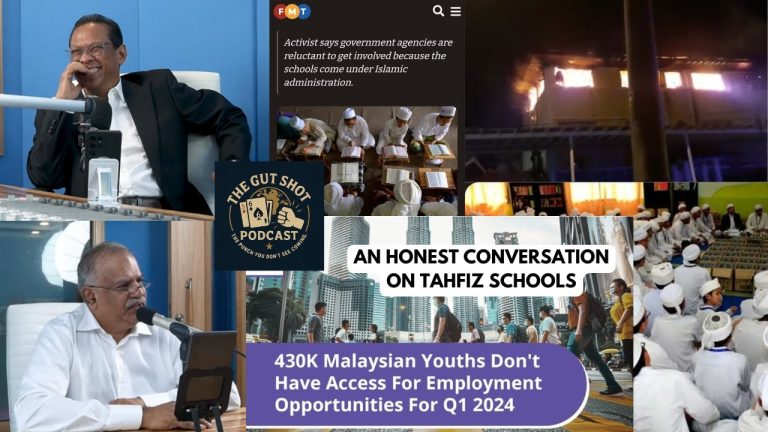
w Syed Akbar. An Honest Conversation On Tahfiz Schools
Show Notes & Description
Let's be really honest. The whys and whats. What are these schools setting up for our children's future. What are the implications for society as a whole. We need a truly honest conversation.
Welcome back to the Gut Shot Podcast. We’ve broken the 3,000 subscriber mark, and today we are celebrating by doing what we do best: having the honest conversations that nobody else dares to have.
In this episode, Syed Akbar and I strip away the political correctness to face a ticking time bomb in our society—the unregulated state of Tahfiz schools.
We are looking at a crisis where 79,000 students annually are exiting the school system without an SPM certificate. That is an entire stadium’s worth of young people entering adulthood with zero recognised qualifications, barred from universities, pilot training, and the civil service.
We dissect how this "log cabin" style of education—often lacking structure, standardised exams, or accredited teachers—is failing to equip Malay youth for the 21st century.
This isn’t just about religion; it’s about economics and survival. We debate the cognitive impact of prioritising rote memorization over critical thinking during a child’s formative years and the dangerous disconnect between learning "miracles" versus learning Newton’s Laws.
The result?
A generation funnelled into the gig economy, where 97% of e-hailing drivers are Malay, lacking the skills to transition when automation takes over.
We also refuse to accept that "it can't be done." We look at the Singaporean Madrasa model, a regulated system that produces engineers and doctors by enforcing a dual curriculum—proving that religious and secular success are not mutually exclusive.
Politicians view these schools as vote banks, but we view them as a liability to our nation’s future if left unchecked. It is time for the community to stop accepting mediocrity and demand a system that actually works.
Timestamps & Chapters
• 00:00 – The 3,000 Subscriber Milestone We celebrate a big win for the community and tease a live event for 10k subs.
• 01:45 – Defining the Tahfiz Ecosystem What actually is a Tahfiz school? We break down the difference between registered and unregistered schools and why this "Malay issue" is actually a Malaysian crisis.
• 04:20 – The 79,000 Student Catastrophe We discuss Tan Sri Alimuddin’s shocking revelation: tens of thousands of students are leaving school with no SPM, no certification, and no safety net.
• 08:15 – The "Log Cabin" Education System From mixed-age classrooms to a total lack of standardised curriculum, we expose why the current Tahfiz structure is centuries behind the modern world.
• 13:30 – Rote Memorization vs. Critical Thinking Are we teaching children how to think or just what to repeat? We argue that missing the "brainwashing" of scientific inquiry in formative years cripples a child's IQ and curiosity.
• 19:50 – The Stem Deficit: Miracles vs. Physics Why teaching science matters. We discuss the cognitive dissonance of learning gravity in the morning and miracles in the afternoon, and why STEM is non-negotiable.
• 25:10 – The Gig Economy Trap The terrifying statistic: 97% of the gig workforce is Malay. How informal education is feeding directly into precarious, low-skill employment.
• 29:40 – The Singapore Solution Proof it can be done. How Singapore limits Madrasas to just 14 highly regulated schools that produce scholars, not just memorizers.
• 34:25 – Safety Hazards & Unqualified Teachers From fire traps to operators without diplomas, we demand that if you run a school, you must be a qualified educator, not just a religious figure.
• 38:50 – Einstein, Relativity & The Future Can a Tahfiz student understand why a plane lands in New York despite the earth's rotation? Why we need to pickle kids' brains with curiosity, not just scripture.
• 42:15 – A Call to the Malay Community Why politicians will never solve this problem for you. It is up to the community to wake up and demand an education system that doesn't leave our children standing still while the world runs past
Many thanks to CITYPlus for their collaboration with The Gutshot Podcast, in whose studio this conversation was recorded. CITYPlus is Malaysia's first Chinese business radio station, dedicated to delivering in-depth analysis on local and international current affairs, markets, and businesses.
Jump to chapter 10 chapters
- 0:00 Introduction and Channel Milestone
- 1:59 Defining the Tahfiz Ecosystem
- 8:40 The 79,000 Student SPM Deficit
- 11:06 The Log Cabin Schooling Model
- 21:21 Critical Thinking vs Rote Memorisation
- 30:50 The STEM Gap and Scientific Inquiry
- 37:22 Political Vote Banks and University Entry
- 46:14 The Gig Economy Trap
- 53:02 The Singapore Madrasa Blueprint
- 58:51 Reforming Tahfiz Oversight and Standards
Auto-generated from YouTube captions. Timestamps link to the video.
Welcome back to the guide short podcast. I am Shamzo Sam your host. Today uh we have back with me my friend say Akbar. Good morning. And we are going to have as usual um at gutshot uh very honest conversation and this is a very honest conversation on the topic of taffy schools. So uh before we begin I would like to uh thank our audience. We have reached uh a mark of uh in we have broke the mark of 3,000 subscribers.
Congrats. Welcome and thank you so much. We also know know that a lot more of you out there are still not subscribed. Please subscribe and get your friends to come together into this gutshot community so that we can have a lot of these honest conversations that doesn't happen anywhere else. Right? So I think maybe we'll give you a teaser. If we we let's target 10,000 subscribers, we plan to do a live event with audience. Let's make that mark and see how fast we can do that before we hit June. Okay guys, so today as mentioned Say and me are going to talk about and have a very
honest conversation with respect to Taffy schools. Taffy schools uh as uh for those who are not aware uh I would say you know we can define it loosely as being this uh um there's uh uh religious schools that are set up uh to mainly focus on the memorization of uh the Quran and uh with that also maybe some other uh religious related subjects. They're not really under the education ministry but uh basically the Islamic uh uh Islamic authorities under the Islamic authorities to a certain extent but they are registered taffy schools and they are unregistered taffy schools. So um
without further ado say why don't I kick it to you. Thank you. And open it up please. Thank you. First of all, I would like to reach out or uh make a comment to our non-Muslim uh view uh viewers, non-Muslim viewersh uh basically it does not well it's a religious issue and education education issue that mainly concerns Malays and Muslims. So it does not really concern non-Muslims. Non-Muslims do not send their children to taffi schools. But there are many issues that have come up in the country pertaining to the tapi education system which I think uh could have a bearing I mean it will have a
bearing on the on the whole country on our society. So it may be worthwhile for the non-Muslims also to have a better understanding of what exactly is a taffy school what the system it belongs to and what are the issues that uh for example we are we would like to talk about today. So uh uh it does concern all of us. So I hope the non-Muslims will also find this uh conversation useful and uh also the our Malay Muslim readers because remember a few podcasts ago we were discussing Malay problems versus Malaysian problems. You know uh there are issues in the taffi system. It is
you can consider it as part of a Malay issue. If we don't want to use the word if you don't want to use the word problem uh it is a Malay issue. uh but because there are so many people involved so and is education it ultimately also becomes a Malaysian uh problem a Malaysian issue. So I would like to start by referring to a a news article
that came out on the 14th of January featuring uh this person Tansri Aliodin Muhammad Dome Tansri Ali Moduin right now he is a pro-chancellor of the uh oopsi university punditan sultan Idris which is based in Malim and uh he also has the distinction of having been uh the director general of education at one point in his career. So this is a very qualified and very accomplished person and he knows a lot about education which is why he's a pro-chancellor of oopsy. So he says he says uh that the taffies and religious school students they risk being sidelined from
mainstream education system. Okay. There are issues with the taffies because the tapi schools as you mentioned they are religious schools. They focus on teaching Quran to the students mostly the the the memorization of uh Quran. Hafi means a person who has memorized the Quran. So ti is uh to memorize the Quran. They focus on recitation and memorization of Quran and uh plus other related uh religious subjects. Uh sadly they do not focus on other subjects which other children learn in school. You know the the normal subjects which we learn in school chemistry, geography,
you know, English language, Malay language. So they do not focus on that. So because of that they are very far removed from our the formal education system. Uh so so arising from this and the history of the taffi school system it has always been in the past in in this country and in most most countries Islamic countries around the world it has always been part of an a more informal education system. It has got no structure. No uh the discipline is uh of course the taffies people will say that they have a structure and a discipline system method of uh learning and
conveying knowledge. Uh but compared to the formal education system we have in most countries what they would say secular system the differences are great. So uh there has been a lot of uh pro uh scientific you know logical evolution of our modern education system. It has evolved over time. Uh Taffi schools follow a system that is more or less like written in stone unchanging traditional methods which have not changed for for centuries basically. Yeah. So which means that they are not up to date with uh this the the today's world especially 21st century which is what uh has led Tansri
Ali and Mohammad Dom to say that uh the Tafi school students risk being sidelined from mainstream education system. uh I just before I finish this point the among the things which he said was that uh okay there are about there about uh,500 religious these kind of religious schools nationwide
1,500,500 I I think the tantri is referring to registered okay those are registered registered means again these are all these are debatable because some ties are registered with the local religious authority because religion is a state matter so the ties may be registered with uh maybe the local religious department or jakim if it's a federal KL whatever but what does that mean do you register a school with the religious department do you register a bank with the the police station I mean what what is the link
I mean the Islamic banks are not uh registered with the religious department it still has to go to bank so all these numbers what is it what does it mean exactly I'm trying to figure that what does it mean when you say registered what does registered mean Right.
Uh okay. So anyway, these are the How many students are we looking at? Uh okay. The religious institutions about,500 they have about I think even the numbers vary about 150,000 uh students total. You also have the unregistered toughies which runs to about another easily double it up. So totally total you have about like almost like 4,000 of these uh institutions throughout the country and they may have anything from over 200 to 300,000 students. Again these numbers are debatable because there's no real exact census but about 300,000 max which is a lot of people. Now out of this number
the the point that this Tansri Ali has raised is that uh there's about 79,000 of the TAI students I think this is annual figure this year the statement he made the statement in in January this year so I suppose this is an annual figure 79,000 who are not who will not be sitting for the they will not be getting a certification you know the SPM certificate
which is our our O levels our school living before you go to university before going to university before life starts that kind of thing they will not be sitting for this SPM examination because they are not part of the SPM system they are in the taffy schools so 79,000 students will not when when they finish their their secondary education they will not have set for their CGL plaran Malaysia SPM so you know you can't get a job in the civil service if you don't have an SPM uh if you don't pass your Bahasa Malaysia SPM you cannot get a job in the civil service you
cannot even apply for a pilot's license you know for pilot training you cannot go on for further study so all this is not in the tapi system the is mostly wrote memorization of Quran and other related subjects they study things like tap some fa they call it uh you know hadith and things like that they study so they are removed from the formal education system So uh
so we're looking at this ecosystem about what um from the age of okay again all these are dubious and debatable in our formal education system the modern education system we in Malaysia we start school at the age of 7 years old now it's being lowered to six or some debate about that uh we start at age of 7 years old what is called standard one primary one or standard one you study for six years
up to standard six and then when you're 13 years old you start form one and you go up to form five where you are 17 years old. This doesn't apply in the taffy school because in the taffy school uh although they do follow more or less you know the same kind of age uh categorization and because if people send their children to a taffy school at the age of seven that would be center one but in taffy school anyone can join the school at any time a 10-year-old kid can join a taffy school for the first time and he has to start at the lowest lowest rank you see. So this is like you
know in in when Abraham Lincoln went to school in the old days they call it a law cabin school you know law cabin with one room and in one room there'll be one teacher and there'll be students who are like 14 years old 9 years old 6 years old all mixed together
so because there is no formal uh intake or formal classification of uh the structuring of the school in the taffy system you find that children of different ages can be in the same class you know. So uh this is uh they go by the stage of the advancement or learning in the tapi uh school not by the age biological age of the child. Although most people would send their children to taffy school just like other parents send their children to the normal school but there are children who will join the taffy school at different different ages in life. So that it's by itself creates uh issues of
you know pedagogy and things like that. So if we have so if you're looking at children at this age um at uh been seven going to 13 and then going probably you're looking at secondary education which would normally finishes around the age of 17 or 18 years old, right? Um that's their whole that's their whole young adult life. That's when if you ask me formative years um when you are six to 13 right this is when your brain is also rapidly developing and being fine-tuned especially I mean if you understand a bit of the biological uh formation of your frontal lobe how you think right
what you think it's this these are very formative us that we are we we are putting them solely on this kind of uh uh well for lack of better word shall we shall shall we call it uh log cabin uh uh system there is very little of stem I think what you're trying to from from what I can understand you're saying there's very little of stem emphasis science technology engineering, mathematics and scientific based education is very extremely lacking in in the tapi system. Of course it's a religious system uh in the you cannot mix science with religion but uh that is uh philosophy that is
where things come from but here we're talking about education uh you can have a system where you can teach both or focus on both I I'd like to talk a little bit about that but but uh before we go there these are the these are the issues that we are facing for example in the taffy system it is informal the the point I'm trying to make is it's informal when we go to like the normal school system, you know, the government schooling system, it is very structured. Uh, you know, most parents, I don't know in Malaysia, we're required by law, but most parents are required to register
their children for school when you Yeah, you are after 6 years old, you register for the following year's intake. It's like, it's like something that is known, everybody does it from Perles to Sabah, you And I remember when we were young, uh, your parents would try to register you to where that would be considered in your area or around your city to be, uh, the better schools.
Yeah. Because the Yeah. The system Yeah. The system exists at that time. It's a structured system. You know I think in our age in the 60s and even 70s even until now
the duty of parents is to just register your child in a government school and make sure your child goes to school every morning. Once your child gets into the passes the school gates a system takes over or the system takes over. There's a structured classroom time. You start school 7:30 in the morning. Each class runs about 40 45 minutes. There are so many periods in a day. There's teachers who come and teach different subjects. There are there are exact same textbooks which we will be using you know over the years. Maybe the covers and the and the writers and the authors
may differ but it's the same material. Everything is has gone through a process of validation, accreditation and most importantly standardization. So that is a formal schooling system which about in any country in the world is about the same. No. uh this is not available to the taffy students. Now this is major you know so now here I'm just talking about the students
uh I'd like to venture a little bit about the the teaching the teaching the teaching see so there is no standardized curriculum in the ti schools because again it is religion so
they they focus a lot on the memorization of the Quran fine uh there's no exam you you I mean you don't take an exam for recitation of the Quran when the when the student reaches a certain age, school leaving age, what 16 or 17 years old, uh he doesn't take a written exam. He his teacher will will examine him, will listen to him reciting. And if if the student can recite the entire Quran, then he's considered he has uh learned the recitation. There's no exam. And then the teacher will also listen to how he pronounces the words. That's it. All right? That's uh that's that's all that
is needed. Plus he will he may study other subjects. So exams are not necessarily a part of the tough system whereas exams are a major part of the formal education system. You must take an exam some point in in time in school. Of course now in Malaysia we we've been doing away with the exams. Now the argument is coming in to put back you know more exams you know the UPSR and all these kind of things. But uh so the the formal education system, the modern education system has got a very structured very well thought out and uh system that is also evolved and adapted
over time but the toughies uh does not you take the teachers you know in in Malaysia like in any other country our education system has evolved for a long time from before independence even when the British were here we've spent spend a lot of effort on teacher training. You know in the in the old days uh our teachers used to be sent to England to be trained. I think when when when I was in school, some of my teachers were were trained in England as teachers in a place called Kirby is famous and then later we moved teacher training to Malaysia and we had various teacher
training colleges and institutes and they too have evolved. One of which the most famous is oopsy of which Tansri Ali Muin which I mentioned just now he's a prochancellor. Oopsie started off as a teacher training uh college and they have a very long history and they produced uh maybe tens and hundreds of thousands of teachers. So they are all part of the formal system you know uh uh uh somebody goes to teacher training uh institute and then or college now university they can take a diploma 2 three years now they can do a degree and they trained teachers and this is the
system that we have to produce teachers and this means accreditation there is a system that is accredited how to produce teachers what is teacher training all about you know how much time they should spend in in college to learn about teaching things like that so that is a system we have had in this country for what since before independence that's more 70 years or more
you don't have that within the you do not have that in the tough eosystem so I'd like our viewers especially our Malay Muslim viewers to understand this you know this is a very informal system that has no standards either in how you structure students in the classroom what age a child of at what age should a child be in at which level of the ti is uh compared to uh uh the normal school. You're talking about the education, the teacher training, the the system of of producing teachers and the teaching system syllabus you know our our in our the normal schools government schools
the schooling system the syllabus is is standardized it's been evolved uh you know accredit accredited and evaluated you do not have a standardized system in the taffy schools so it is a it is really informal. When you send your children to the taffi system, you're really they are not part of a structured a very structured system at all. It's highly debatable. Highly debatable. you know say um I think if we go back to our old youth um we mentioned before I I don't think we have uh our religious class in uh in uh public school um let's say primary school or even secondary
school I think does not even exceed one hour per week if I'm not mistaken it's probably half an hour uh twice in a week uh and then everything else is uh uh is uh towards uh uh our national language uh English, mathematics and science and maybe history right when we started off in uh from the age of seven um to 13 um and uh I think those formative years is for lack of better word that when I look at look back at it that's a brainwashing that I went through right you went through a brainwashing of actually how to think you know um even how to think is uh is something that has to be
trained if you put a child in those formative years before the age of 13 and you just gotch the person with memorization all right they don't think it doesn't train you to be a thinker and you have to be able to challenge uh or or be presented with uh with some with things that going to make your brain curious. I think one of my biggest concern when I hear what you just said is actually then you go further into their next chapter of youth which is in their teenage years 13 going down to 18 you know um and in our times you either take uh the art stream or the
science stream as they call it um but even the art stream these days you're basically commerce driven right in the science stream. I can speak better on the science stream because uh I I know we were by that time of my brainwashing of thinking, right? I I
when you say brainwashing, you you mean it in in a positive Yeah. It's just simply simply how you're taught to to think to organize your thoughts. organize your thought to be uh it is it is part of the I mean somebody said that you give me a child uh you know a a a child I will you know at the end of the day I will produce the kind of man that I want you know or kind of person that that you want you know by that period of time you know and it it is formative years so by the time I hit about uh 13 years whole um there is a curiosity about the world. I'm not internal. We
are not internalized into uh uh into certain books. Actually the English also opens up the world to to us. Uh the the science even for people who don't go into the science stream. The science subject makes you creative makes you look at u the actual world and try to put it together.
The the scientific method correct? Yeah. you know which is you got to test it and then only you believe it right so it has to be it has to be logic based it has to be there must be some evidence you are able to criticize question that's how that's how we learned a lot of things
so we are talking about a pipeline if you look at China for example right now right getting into uh the examination going through the examination in China is actually very very very tough okay um they have examinations and here we Uh maybe I'm I'm digressing slightly. Uh even our education system has stopped testing the students for a while until the last
17 years old, which is I think to me personally is ridiculous because you don't have it's almost like saying that uh I'm not going to have a health test uh for 10 years, you know,
medical checkup, medical checkup for 10 years and then the next thing I know is actually I've got three block arteries, you know. So here we have a situation where kids are going to come out by the time they are 13 they are fully formed in their mind you know you we talk about the Malay problem and the Malaysian problem right there's only certain amount of time in the day you know to teach them to make them uh understand certain things or or and then if they have not enough time to actually structure their thinking or develop their their their mentality by the time they go to the secondary
school it's almost too late you know so here you are your your other subjects are not there even by the time you hit 17 I'm worried about let's say on a yearly basis let's make a simple assumption 50 to 100,000 people like what the uh proellor
the XDG was saying the pro-chancellor was saying 79,000 students will not will not be getting any certificate no SPM certificate what's going to happen to them correct and it actually impacts society as a whole whether it is Malay society or our whole Malaysian society this is a problem
if they don't get basic high school leaving certificate like SPM and they cannot progress uh very far without such certification then uh they are going to become ultimately a burden on society. Uh I mean I can say they will they will populate the B40s and things like that. If you don't if you don't have a good start in life, you're already you're already handicapped crippled
when you can't even get an SPM certificate then you you'll you will be in the lower ranks of the of the working classesh. Ultimately you will depend more on the state to help you out which means um you know a drain on our resources which can be a avoided or could have been avoided if uh they you know they were able to get their SPM certificates and move on to other things you know because they they have just about the same qualification as anybody else but uh this is a problem they don't have this chance because the system they come from is informal system and it's and also it is very
difficult to for to formalize it uh because that's the nature it is religious education uh if I may if I may say you know they there are some toughies uh some of them are sizable but there were very few where they teach both they teach the memorization of the Quran and religious subjects plus they also prepare students to take the SPM they are it's not it's totally absent. There are some of them but not many. Uh a large portion of those tapes that are especially unregistered they don't do this and they are purely religious subjects recitation of Quran but there are very few ties
which are slightly larger most students well organized they prepare students for SPM. There's one school in Tranganu which uh has a dual system of religious education and also preparing students for the SPM. They have done well. they have produced uh top score scorers in the SPM and things like that but that is few and far between. There is also a a government uh run boarding school uh system which created a couple of these religious boarding school uh campuses where they focus on religion and they also prepare students for the SPM the O levels and things like that but uh in
their case here I'm referring to some research done by by uh one lady in uh USIM uh where yeah this is a research church by a lady called Maria she's she was in college university Islamabang Salango where you know uh because you it's a bigger burden on the students when they have to study both the religious subjects recitation memorization of the Quran and also studying for your SPM they had to school from 7:30 in the morning until 4:30 in the evening followed by further classes at night because it's a bigger workload you see and ultimately the focus of the
school was to make sure that they all get through their SPM. So they they focus a lot of time on preparing for the SPM examination. So they pass the SPM but many of them half or more only partially memorized the the Quran. They didn't they were not able to memorize. So uh where does that put them as far as being half students and ti students? you know, you only did half the job, but good for them. They got the SPM certificates. So, as you say, it's it depends on how many hours you have in a day. You only have so many hours in a day. If the rest of the world is
spending that time studying this the things that you talked about studying the math the English the geography the history the science this and all those regular things you know uh within a certain time frame which suits the pedagoguy of the children's
you cannot tell even a 17year-old boy you cannot tell him okay you're going to study 12 hours a day or 10 hours a day it doesn't work that way you need time for rest you you only can you can only absorb so much within one day's study at school uh at you know so we have to keep all this in mind the moment we start experimenting and uh deviating you know too far from this the the the norm the norm then we are we are imposing burdens on the students on the system on the parents on the teachers the whole thing uh so it's it doesn't work very well the other point is which
you are alluding to alluding to is Right. Uh we study we study not only not only do we study science, we also study humanities in school. We study history, geography, art, literature, all these things.
But we study these things in a scientific manner. There's a method of teachers teaching us. There's a method, you know, for acquiring uh knowledge. There's even a method of learning how to to draw and to paint. I remember art class. I thought there's nothing to learn in art class until your teacher shows you how to draw a face or you know all those things. So there's a scientific method but this is also lacking in the religious education. um you know like for example you mentioned when we we go into secondary school we learn things like Newton's laws of motion uh you know all those
things you know the famous action reaction I remember that cool like me all those things when we were 15 16 years old we start learning all these things uh Newton sat under the what apple tree and the apple fell on his head and he understood gravity so these are all scientific principles which we learn and they have a logic to it you can you can appreciate Hey this I like the action reaction because it's true for every action there's the opposite reaction if you push back on your chair now you'll move forward we all know that you see uh so this is all basic physics which we
learn and then you have religious education which talks about miracles for example miracles things happen you know miracles you know things that uh you cannot explain by science science absolutely cannot justify or explain religious miracles there are so many miracles you know so uh so at one end you want the children to to to learn science to think scientifically to absorb things like Newton's the laws of motion physics and all kinds of stuff and then uh in the morning or in the afternoon you learn something else you know which is 180 degrees opposed to what you learn in your science class
there is no laws of motion or Newton's laws of motion in miracles well there is one which is uh which is I want I want I want to finish the point so you see so we are creating this uh what do you call this it's a head-on collision head butting you know uh like two goats butting headsh on one side you learn all the physical principles of science and everything you know Newton's laws of motion blah blah blah on the other side you learn that you don't need all that because miracles can happen you know because they happen that's it you know so uh to me that that can cause
um it's it's a contradiction in in you know in understanding contradiction in how things work in the real world especially when you are taught to believe that both are part of a reality both are real both are truths but one is a religious truth which we have spoken about before one is a religious truth which need not have scientific basis the other one is a scientific truth which must be properly explained with logic and evidence So uh children I I feel that children can get slightly confused if uh
I I think we are looking at about I mean you live only in a scientific world actually to be to be very frank let's put it this way the real world and the real world with I mean the with this if you don't start them young to be curious and to be critical
it's going to be a problem when they get to their teenage years there's only I mean I I I really don't understand because when I uh by the time I got to uh uh by the time I got to um secondary school I'm sure you went through you're you're you're an engineer as well. Um in terms of background we uh we were taught in fact if you ask me yeah we were we were taught we've got good uh teachers that went through a certain uh sec secular system where the way they teach make you think beyond the textbook actually right so that that's that's part and parcel of it and
we are going into the we we are halfway through the 21st century and we are actually um embedding a large portion of our population with lock cabin uh uh education uh education for lack of better word you know to compete with the rest of the world not to mention also to compete with the non-Muslims for work you know at the end of the day you're going to see more disparity I I I really think sometimes you know what I think you when you mentioned 13 years old they go like this. You know what my thought come just now is uh I think children we should have uh IQ test
instituted on all students or all children at the age of 13. You know why? Because IQ test is not about knowledge. IQ test is about your uh ability to think right and it is a standard uh IQ uh uh which is you know what they call intelligent quotient right these are this these are tests that has nothing to do with what you are actually being taught being taught you don't have to memorize anything you go there you you do problem solving right so I think For every children at the years at the age of 13 we should actually test their IQ because why those are how your brain has
formed and you will see where they lack at that particular time. I would be very curious to see IQ test done on all these toughy student at 13 years old. seriously curious say
yeah well we can have IQ tests throughout the the education throughout the whole education system and do comparison uh of course some people will debate the you know the efficacy of IQ test but you could you could do it as a just as an assessment you know it's uh you know I I assume the more uh information and knowledge you as you acquire as a student in a learning in the in a in a learning system
your IQ will will progress. Correct. Cuz you you can think and it's about thinking. It's about thinking. It's not about what is. Yeah. We want to see the ability to think actually, you know. So that's uh that's that's important.
But uh I um that's the thing you know the other issue before I forget that see this tap issue now is also politicized. Yeah, there we go. You got the three Rs, right? So this one is two Rs. It's a race and religion.
Tafi is a Malay Muslim issue. Uh and uh and of course religion is very strong. So the the politicians uh get into the act. As far as the politicians are concerned, they they see this as a vote vote bank. That's it. So wherever the wind is blowing from, that's where they will bend. You know the famous saying in Malay, you know, like the lalang, you know, the langras, you will bend according to the wind.
So uh last year was it? Yeah, last year one of our I don't like mentioning names now but one of our leaders he attended a gathering of the tafy's students you know
right and he told them that uh they will find uh means where these ti students will be accepted at our local universities government universities. I was this was on TV uh on well I saw it in the in uh the news which are broadcast in the in the internet online media uh I saw that you know a lot of the students couldn't grasp what he was trying to say uh which is very sad but to make this kind of promises is also not very fair you know on all parties
first of all the students if they want to go into university they will have to go through a system of restudying and retaking classes and courses to qualify to enter the universities. It's going to take them more time or you can lower the barrier the bar to enter that university. Just call up the government university and say you know whatever it is you must accommodate these students from the tafies who do not have an SPM certificate who don't have formally recognized uh uh education certificates. find a means of getting them into your campus and put them into some study in
course of study you know uh that is going to put a stress on the university uh university university authorities on the university system basically lower the standards you know so the politicians like to make this kind of uh statements which do not really solve the problem maybe create more problems for all for all parties there are ways of making sure that the taffy students go qualify to go to university they have to take the SPM uh papers It's not a very difficult thing to do. You have to focus like I mentioned there are some tapi schools who off who offer both the curriculum the religious
curriculum as well as preparing students to take the SPM and things like that. So we have to we have no choice if they we can get the tapes to go along that path and then you have to be creative in how to get them into this line of thinking. uh please don't say that we need an extra few billion allocation in the education budget you don't need that you don't need that it's just a focus is how you f uh get the toughies to focus and uh it also depends on the parents so I hope that's why I hope the people who are listening to our podcast today uh I hope this well we are speaking English
so uh those people who understand English will be will they might be listening to us but I hope the opinion leaders, I know our policy makers, people who have an influence in society, they will see this as a as a real it is a problem, you know, because when you have 79,000 students who don't have some kind of a SPM certification or anything close and they this is it this is the last year of their schooling and they going those years are not coming back.
What's going to happen to them? According to the professor Tansri, uh the 79,000 for this year, next year will be another 79,000. So you're you're manufacturing all these people with no certification where they going to go. So I hope uh the Malay Muslim community will listen to our discussion and decide to do something about it. This is this to me this is requires some drastic action you know because uh definitely um a problem is being created. uh these people their future is going to be very uh it's going to be impacted and uh severely impacted and uh not not exactly for the better.
There will be one or two of you who will do well. It always happens. There's always an anomaly anomaly. Those are the outliers. Outliers. Yeah. But we don't live in a world where we do policy for outliers. No. No. The large majority will be will fall through the cracks. So I hope uh don't leave it to the politicians. I'm telling you if you leave it to the politicians the country goes to
I mean the problem is actually if you ask the community the society the Malay society has to open their eyes have to buck up and start demanding for the right things to be done otherwise this is to me it's a disaster when I read that figure 79,000 with no no certification at the age of 17 years old that's disaster
you ask me not just from that standpoint but not just on the on on society in terms of burden. But um how are we going how are how are we going to be able to um or or get them to do to have a career uh and especially you know let's quickly put it this way. I think there must be a rethinking from policy makers and politicians about this taffy school period. Let me put it this way because there's only 24 hours in a day of a child's life. Okay? If you're going to get them to uh rotate memorize during our days, right? Um we were uh we we only have so much limited. I still
remember actually during primary school, I think up to primary school, I only went to uh um uh religious tuition, you know, um that was outside of the school system. That's it, you know, just to learn how to read Quran, how to pray, you know. So that um and and then you know it's already tough for me personally. I remember how tough it was to uh to be able to succeed to uh to get good grades for the SPM with that many hours. And I put oh that reminds me my own personal experience. Okay. I was a failing student in form one. No joke, I was a failing student in form
one. I put in hours which is actually I I did schedule from 4:00 a.m. when I got up 4:00 a.m. You know, I was in a boarding school. I don't want to get up at 4:00 a.m. 4:00 a.m. until I sleep at 11:00 p.m. I have all my days mapped out, okay, of studying and actually doing mathematics. I do mathematics an hour in the morning, an hour in the afternoon. I finish all my uh homework by 3:00 3 p.m. after school and then I have revisions of two subjects each side. Okay. And I went from a failing student to a straight A student. And that can only happen because why? I
utilize the maximum of my time. And then what happens after that? I realized that when I went to form one actually I realized something happened. I act sorry when I went to form four by that time when I went to form four um I realized that the technical subject the STEM subjects become very easy you know why I know how I learn how to learn that's a funny thing you know I realized that I I learn how to learn and I understand uh concepts that actually learning new things become so much easier I didn't have to put in that much effort anymore. So if you take that away
from the from the child at that age, how are they going to compete in this 21st century in an AI world? Say I I want to add one thing. Yeah. Um I saw this this uh this this statistics. Okay. Um the e-haling workforce okay in Malaysia is 97.7% Malay Indian make up 1% one point one one about 1% Chinese make up about 4%.
This is a gig economy also. This is the gig economy. This is a gig economy. Yeah. 97% Malays. That is a scary number when you think about it. I guarantee you guys the robo taxis are coming in. Okay, it's it won't be 10 years.
Well, e-haling I mean uh e-haling and this gig economy, it is it is also informal economy. It is not a it's not a formal economy. It is not a formal economy. You don't have a permanent job. No permanent job. No permanent income. No predictable income, no predictable working hours.
The only skill you have is actually driving. Yeah. From from 5 years ago to 5 years later, your skill sets as about the same. You probably know what what how long the traffic light is in Jalan Bangsa or how how long is a red light in uh you know in Bangi that kind of stuff. Other than that, you know, you don't have you don't learn any other skills. And then you have proliferation of uh I I've seen on social media especially Malay social media right um what you're seeing is actually a proliferation of this uh uh uh this uh missionary u what we call paw okay or you know this this this uh
independent missionary um um uh uh teachers so to speak Right? I mean this ecosystem is going to collapse on itself. For me uh as somebody who's who's been looking at economics, I think we are looking at an ecosystem that's going to collapse on itself. That's going to be a that's going to be a trouble uh for the country. You know, I think we have to look at the whole thing and say to ourself really you ask me why do we need this to happen to our country? too late. It's happening, right?
We have to uh we have to deal. So, we need the leadership. We have to deal we have to deal with this. I don't think this uh toughies uh um it's a problem. It's it's more of a problem now in terms of output in terms of output and uh if you have if you produce 79,000 high school levers who have no certification of uh recognized certification that's a disaster. So, it's a problem. But so, we have to deal with it. The taffy schools I think are going to be around for a while. Actually the numbers are increasing. You know
that is a worrying trend if you ask me. There are a couple of things that we need to talk about is uh how do we how do we you know make us still make a silk purse out of the whole thing. And uh we also need to focus a little bit on why uh so many people like to send their kids to the tapi schools. Now among the reasons is of course some parents like their children to memorize the Quran and things like that but they don't realize that they're sacrificing a more uh formal education which gives them a better chance in life. They're willing to forgo that and send them to a taffy
school where they will learn basically memorization of Quran and and related subjects. Huh. And you want to compete with Chinese and also the China. Why do they have this longing for this kind of thing? Because they have certain certain religious issues and all that might be they are relious beliefs which needs to be addressed. The the parents have to be advised you know and also you see the other thing is that taffy schools are many of them provide board and lodging you know.
Wow. Okay. You can send your seven-year-old's child to a taffy school and that's it. It's like going to a boarding school and they're relatively cheap. You know, I have some I have some numbers. A full board and lodging uh taffy school.
Uh it cost anything between about 3,000 4,000 a year to about uh some of the the other higher end is about maybe 7 or 9,000 ringgit a year. Uh this is relatively cheap. You know, you a child can be put in a boarding school. three meals are provided and education well teaching learning is provided and uh for like 3,000 or 4,000 a year that's only a few hundred ringgit a month. So you have uh we've discussed this in our earlier podcast. We have parents where both you know both the parents are working uh they live in an urban environment and they themselves may be uh financially
uh stressed or you know they don't have sufficient income and they they need to work so they don't have time you know to spend on their children. So they send the children to a boarding school or taffy school where you know the children are under the care of the school. So which frees up time and time and energy by you know for the parents to to look for an income to work and get a job and things like that. So there is a reason why the taffi schools there are reasons why the taffi schools are popular and these are among some of the reasons. So we have to look at this also you know
you know I mean when we look at that from that standpoint I mean I know people keep telling telling us in the comments for example we should be talking in Malay to get to the majority of population but we are interested in talking to policy maker to basically when we talk like this we want to convey to the policy maker who understands us very well right and the political leaders that look we've got a problem you guys because um the leaders are the one or the people who who make policies are the one who is going to be able to change society, right? Um normal folks
doesn't change society. Let's put it this way. Normal folks does not change societies. Okay? Talking to the majority talking to the majority frankly does not change our society. Okay? It is the people at the leadership that is going to change a society and make policy changes to society. That's why we speak the way we speak. All right? And even if you we were to dumb this down uh in Malay, we're not going to get it across. Okay? Ladies and gentlemen, please understand why we keep telling you people elect the right political leaders and policy makers to be put in place so
that they make the right decisions for society. You know, I mean, you talk about I I would um Okay. I would like to just uh refer a little bit to Singapore.
Yeah, in Singapore they have uh madrasas which um a higher form of tis madras but they're only 14 and the Singapore government put a cap on it. They do not allow the creation of any more madrasas.
14 for how many? 5 million people. Yeah. And they have they have like 10,000 students I think in this 14 madrasas. Okay. But in their system uh the madrasas are they are highly regulated. The government regulates their madrasa system. They have a standardized uh curriculum for the madrasas where they teach uh religious subjects and also uh normal school subjects. They learn the science, chemistry, physics, biology. Besides the Quran, memorization, all the other religious subjects, you know, the fake, the hadith, the taps and all those things, the usul, akida, all these they
learn uh plus regular school subjects. So they insist on that and they have a centralized examination system for the 14 madrasas in both the religious studies and their normal school studies. and uh the teachers most importantly the teachers in the Madrasa system in Singapore they must have formal qualifications. So there is accreditation and validation across the board of teachers teacher training selection of you know teachers for teacher training uh curriculum for teachers training what the teachers the teachers must be formally educated and then also the the syllabus in the school
itself it is accredited validated it is updated things like that so everything is up to date and uh at par with modern you know education system so that the the students who go to the madrasas in Singapore they get the best of both. So they do that. So because of that the the graduates of the Madrasa system in Singapore they can go on to university and those who study science subjects they can they can become engineers too or they can become uh doctors or whatever they wish to but there is an emphasis on religious education. So Singapore has done this. Well, they can
do this because it's a smaller number, but there's no reason why we cannot do the same thing and they limit the number. If if I may suggest, if I may suggest, we have to be stricter with the taffies. You know, taffies have also been there's a lot of negative news reports, you know, the fires that frequently happen.
Yeah. Uh there was a you know the taffies uh you know because they are they built these schools are built especially out in the states and the towns they don't have proper certification they don't observe building codes and there have been more than one case many cases where fire fire has happened and ch students have died there was one case in 201 17 or something where over 20 students and two teachers died in a fire you know because okay these toughy schools which we mentioned They're like boarding schools. They taking students. Students are crammed into live in live in cramped
living conditions. 10 20 kids per dome room things like that fire hazard. So these fires happen and then there are deaths and things like that. And then there are other cases of abuse and things like that happening in ties in religious schools which you come out in the media. I don't want to go too much into that. But um we we have to focus on on all these uh issues where uh to overcome all these kinds of problems so that the toughies is more mainstream like the other schools in the country the the the the formal education system. um we have to integrate uh integrate the
tough piece closer towards the formal uh school system. And one of the one of the I would suggest for starters all the operators of the T stuffy schools especially in the um outside the government system their operators must have the the teacher training certificate. We must insist on that. If you want to operate a taffy school, you may have studied, you know, religion. You may have graduated from some Middle Eastern country or other local institution. So the guy he's a he's a religious teacher. He's qualified to teach a religion. Fine, that is you're a content expert. You know, you know the
religion, but you they must be we must insist that they also go for a diploma course in teacher teacher training, you know, like the two-year three-ear diploma course where they are trained to become teachers, professional teaching methods, you know. So that uh then the school taffy schools are more in tune or align with uh the normal the scientific method of of teaching. Yeah.
I um of passing knowledge. I I I agree with you about certification about insisting that there must be um uh a proper registration standardiz standardization. Yeah. If you ask me, I'm more I I'm as you well know, I think my style is always about radical changes. All right? I mean, people may seem to think that I'm being idealistic about it. It's not idealistic. It's pragmatic. Pragmatic because I what? Because as a if you are a policy maker and if you're going to pump a 100,000 uh citizens into the job market without uh being able to compete uh with uh other people uh on real jobs, you are
setting your country up for implosion disaster. Yeah. Yeah. So as far as I look at it, my recommendation would be every state should have a limited number of uh of registered uh tough schools if there is any at all. Okay? And it must be actually controlled by education ministry not religious ministry because education is not a religious function. Okay. The fact that you have to the fact that you are teaching a religious subject does not mean it is a religious matter. It is an education matter. All right? The religious ministry or religious authority has no business in teaching.
It is an education function. Think about this. Think about this. I'm I'm sitting here listening to you and I'm getting very depressed. I'm seriously I'll tell you I
if if anybody look at me while he's talking I'm getting depressed by the minute. All right because you think about it I can teach children at 10 to 12 years old I can teach you know if I want to and make them curious about the world. Okay you ask children very simple question like this because they all know we are all living today right? If you take a plane from Koala Lumpo, let's say to New York. All right. Uh via Japan. So that's probably like what 9 and the plane is traveling at 900 kilometer an hour. Cruising speed 900 kilometer an hour. Uh we fly about the same direction as the
earth spinning. And our earth for your information our earth is spinning at 1,600 kilometer per hour plus approximately in excess of that 1,600. You are taking off and you are cruising at 900 kilometer an hour the same direction. I will ask the children very simple. Do you know why? How how is it that you can catch up to the to your destination and arrive in New York when the earth is spinning faster than your plate? explain that you know what I just did just now I just pickled their mind into the uh Einstein's uh theory of relativity I can teach relativity can your teachers in
all this madrasa pick this kind of curiosity this kind of critical thinking into your children or are you going to let your children come out into the pipeline of the workforce and fail in their lives.
So where did you figure out this theory of relativity? You must tell us that's how you read that's how you are because you got you got as I was saying to say it we got brainwashed in when we were young to think critically all right to ask questions and then I started asking this kind of stupid questions right because why I mean I was like I was like how does that work it doesn't make sense to me right it just doesn't make sense my destination is going faster than my plane and yet I arrive there. Why? Okay, they don't teach this. If you are memorizing all your life, this is not
how you think, you know. So guys, AI is coming. It's coming now. Uh the world is getting very small because and the competition is very very intense. Do we really want our children to be unprepared to take on the world? That's the question. Say
yeah. So the you have any uh wrap up to this? Yeah. The the uh everything is relative. Everything is relative. Progress is relative. Wealth is relative. Relative to the guy next door to the person the next person beside you. Uh progress is also always if if you think that you are progressing uh like running in a raceh you think that you are the top of the of the pack and that you are able to win the race then suddenly Hussein bold appears and he just streaks past you you know at whatever 9 seconds per 100 m or whatever that means you you are not you're not
paying attention to the real competition in I don't think it you Imagine you bring three 200 runners. Okay? You have not been running. Your child has not been run being trained to run the track. All right? And then you put your child in between all these runners that has been training to run all their life. You think you guess where he's going to be in a in a 400 m run.
So you end up standing still. That's what Yeah. There you go. You end up standing still. uh relative to Hussein Bolt, for example. So, I think they I think the other fellas are going to lap you, you know,
they're going to come around again. Yeah, they're going to come around again. Uh progress, advancement, wealth, all these achievements, it's all relative. So, you cannot be satisfied at any point in time and say this is it. We have arrived. Cannot
and you certainly should should not do things that make you make you regress. Yeah. Regress. So I think this is what is happening in uh from what we are seeing with this issue of the tapi schools. I cannot forget what the professor
man has said that there 79,000 students who will not have SPM certification that is regressing seriously because that is your your first step your baby step to adulthood your the rest of your life to developing a career so many things you know you are at the threshold the first baby step from crawling you're you're standing up and taking your first baby step that is your 17 years old, you have a high school leaving diploma, SPM, things like that. They this the 79,000 kids will not have it. So, and it looks like this number is going to be there and it might even increase over the
years. So, this is a problem. This is a real problem. You know, 79,000 number is is what you know is bigger than the stadium in Malaysia. So, so uh I think uh we need to focus on this. The Malay community has to focus. It has to be a community issue. Forget about the politicians, they're going to make the problem worse because politicians. I mean, I I know them for a long time. If you go alone to meet the politician,
uh they won't give you the time of day. But if there are 79,000 of you, uh they will, you know, they will start singing and dancing according to your tune because they're looking for votes. So they will say whatever it is that will make you happy and they will make wild promises and you know all kinds of things which doesn't solve which doesn't solve problems because they just want votes. So the politicians I don't think are going to solve this problem. It is a community, the Malay Muslim community has to wake up and talk about these issues frankly and openly and uh start
exerting pressure to get real solutions because uh this this it looks like this is going to be an issue for for a while. That's my point. Okay, ladies and gentlemen, I think we have uh tried to be as honest as we can be in this conversation with respect to the taffy school uh in Malaysia. I think uh if you were to ask me, let me put a cap on this conversation today. I think the situation is unsustainable for the society. uh and uh we must be very uh very realistic and pragmatic uh if we going to be able to have our people succeed in this world. Remember succeed
in this world. On that note, thank you so much. Please join us. Don't forget to subscribe and like and we'll see you again. Take care. Thank you.