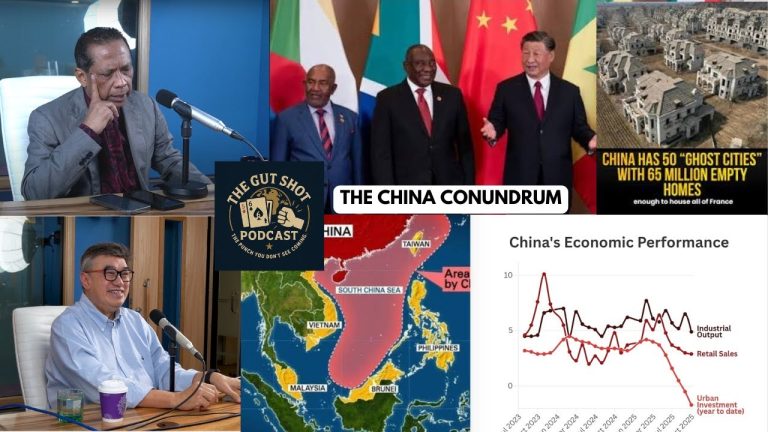
w Jason Leong. The China Conundrum
Show Notes & Description
We deep dive with our geopolitical researcher and specialist on China's positioning as the US seemed to re-set the global order under Trump. We discuss the structural issues within China both economic and political and how it will play out vis-a-viz major players and the region.
Welcome back to The Gut Shot Podcast. In this episode, we strip away the gleaming façade of the "China Miracle" to reveal the uncomfortable economic truths that mainstream narratives often ignore. We aren't just talking about GDP numbers; we are dissecting a system where provincial "warlords" compete to build ghost cities, funded by a massive property bubble that has finally burst. Is China really the economic juggernaut we’ve been told it is, or is it a house of cards built on debt and overcapacity?
We go deep into the structural rot, debunking the myth of mass poverty alleviation by revealing that 600 million Chinese citizens still earn less than 1,000 RMB a month. We explore the "vicious cycle" of Local Government Financing Vehicles (LGFVs) and the $13 trillion shadow banking debt that is kept off the books. From the collapse of industrial hubs like Dongguan to the heartbreaking phenomenon of jobless youths becoming "professional children," the signs of deep stagnation are everywhere.
Crucially, we discuss how this internal failure affects you. As China faces overcapacity, it is "dumping" excess products—from steel to EV batteries—into global markets, crushing local industries in countries like Malaysia. Finally, we contrast this with the surprising resurgence of the US economy and explain why the American political system allows for corrections that authoritarian regimes simply cannot survive. If you want to understand the real geopolitical chessboard and why the "East is rising" narrative is flawed, you cannot afford to miss this conversation.
Timestamps & Chapters
• 00:00 – The Socialist-Capitalist Paradox: Why the Chinese economic structure is unlike anything the world has seen.
• 02:15 – The 600 Million Left Behind: Debunking the "Poverty Alleviation" myth with shocking internal statistics.
• 06:40 – Ghost Towns & Industrial Graveyards: The collapse of Dongguan and the reality of 3,000 closed factories.
• 08:55 – The Warlord Economy: How provincial leaders rig the system with land sales and useless construction to hit GDP targets.
• 11:30 – The Property Ponzi Scheme: Why giants like Evergrande failed and how they trapped the savings of the middle class.
• 16:00 – Global Dumping Ground: How China’s overcapacity in EVs and batteries is destroying foreign markets.
• 19:20 – The Jobless Generation: Why youths are fleeing cities to become "Professional Children" for their parents.
• 23:10 – The $13 Trillion Debt Bomb: Exposing the shadow banking system and off-budget financing vehicles.
• 28:00 – Killing Local Industry: From steel mills to hot pot chains—the real cost of Chinese "investment" in Malaysia.
• 34:50 – The Demographic Cliff: Why a shrinking, aging population spells the end of the manufacturing dominance.
• 42:15 – The Dictator’s Trap: Why Jack Ma was silenced and why authoritarianism kills innovation.
• 45:30 – The American Resurgence: How the US is recalibrating its economy while China stagnates.
Many thanks to CITYPlus for their collaboration with The Gutshot Podcast, in whose studio this conversation was recorded. CITYPlus is Malaysia's first Chinese business radio station, dedicated to delivering in-depth analysis on local and international current affairs, markets, and businesses.
Jump to chapter 7 chapters
- 0:00 Introduction and the China Miracle Myth
- 8:03 Ghost Cities and the Property Bubble
- 20:42 Industrial Overcapacity and Product Dumping
- 30:06 LGFVs and the Shadow Debt Problem
- 37:10 Impact on Malaysian Steel and Retail
- 50:50 Demographic Decline and Aging Workforce
- 58:22 US Resurgence vs Authoritarian Stagnation
Auto-generated from YouTube captions. Timestamps link to the video.
Welcome back ladies and gentlemen to the Gutshot podcast. I'm your host Shamsul Sam. Uh I'm here again with my good friend here Jason Leyong our geopolitics expert. Today uh as promised we are going to deep dive into US China dynamics as of today. Yeah we've had the ASEAN summit uh pass by. We've uh discussed uh previously um the repositioning of American uh focus on the southern hemisphere or or the western hemisphere so to speak and their u very outwardly policy economic policy of uh uh of recalibrating their supply chain for not just strategic industries but also their um their most
important economic supply chain. Yes. Right. So, Jet, um we I think it's uh it's important for people to understand uh where China is at. Um and uh I've been talking about it for a while already in terms of the um the structure of the Chinese uh of China's economy.
It is a bit different than the than the previous U. USSR, right? Um, it is a it is a I would call it a socialist capitalist system.
Yeah. with a company with an with a central authority but a a regionalbased U autonomous autonomous powerhouses uh in each of its city or region run by mayors and territorial chiefs that are that that are competing against each other to increase GDP of particular region. So with that as a as a as an opening. Okay. Um how do you see we have seen that uh as being the success of uh China taking itself out of uh the Mao era where you know I mean poverty is it is one of the biggest success of uh of of of human civilization in terms of taking its
people out of poverty uh since its so-called unification and independence. Where do we see this from your from your point of view today? How how has the uh evolution morphed within the last let's say three decades? Where are we today with China?
Okay. It's interesting that you mentioned how China brought a big number of his people out of poverty. I think let's just start with that. Okay. Uh maybe I need to debunk that kind of like a myth because many people will always quote this and say China's greatest achievement is to bring 800 million of the people out of poverty. Uh it is correct at one point in time but for the past 10 years it may no longer be correct because recently there was uh a statement uh in one people went through the former prime minister who just died uh Likas liang apparently in one of his speeches
uh that have long forgotten actually criticized as the Chinese economy say there is too much structural inequalities in the Chinese economy. And he say he quoted a statistics which quite shocking. He said today 600 million Chinese still earns less than 1,000 rubbing me per month 1,000 yen yan per month which is equivalent to about 500 ringit uh per month and that's below poverty level. What is our our
how many million? Huh? How many million is 600 million? 600 million Chinese uh out of 1.2 say assuming that they have a population of 1.2 to trillion. Uh so half of that population is still living below poverty line uh at only 1,000 yen per uh per month which is like 500 ringgit per month. I mean our poverty line is probably about how much our poverty line in Malaysia 750 800. So I mean how can anybody really believe at 500 reg. So so that was an internal criticism. So if that is the case that means a lot of those people who were brought out of poverty by China once
upon a time may have relapsed back into poverty because of the inherent inequalities in the structural part of the economy of China. The rich are getting super super rich but those who are really poor are also getting very poor because there is no real social security system in China. Uh so everybody has to be dependent on its own savings. Uh so and you you are also right in the sense that the provinces in China are governed by their own provincial governments and uh they have got various warlords who will only take care of their own province uh economically. So they will generate they
will do things they will build infrastructure uh to take care of their own provinces so that their numbers will go up into whatever GDP or so-called economic growth and all that but it is very uneven kind of growth right so that is an area of concern actually for China infrastructure building to boost up the GDP in terms of construction property infrastructure that's the easiest way to go about But does that eventually translate into the rail benefit for the ordinary man in the street? That's another question because uh not every man in the street will be able to benefit from the
construction and from the property boom and property development. It's um this this this I think the structural issues that we talk about um is really spoken out. Um uh I think the the impression uh and the narrative I mean China for for all I mean at 18 plus trillion GDP that's a huge economy.
Yes. Right. And if you talk about uh population of let's say let's take their number their statistical number themselves at 1.4 billion uh pony uh uh uh population right and if you if you take half of that uh let's even say they are not and this is coming from their own u their own leader that uh you know during the the
uh the turmoil s years of uh and and they that they need to do something about it. Yeah. Okay. Uh but since then I think what we have seen is actually more building to the point where um we know that construction was the first of the uh was the first uh bubble that has that burst with respect to over capacity.
Yeah. Yeah. Um I don't know the last I uh uh number I I heard is that the uh amount of housing construction is probably three times the number of the population itself. I don't know how correct I am. Do you have the do you have the uh approximation of that or I mean
I I can tell you about one particular city called Tonguan. Okay. Uh I was quite involved in the Malaysian Tonguan kind of uh relationship. Tonguan is just one of the cities that is further down from Kungcha.
Okay. And uh it was technically a city which was an industrial area. There were close to about 4,000 factories. Malaysian fac Malaysian people were running there. I mean uh to send out factories. Uh there was even a Malaysia Tongwan Association uh and uh a lot of things were buzzing. That was way you know in the late '90s before the uh even 2000 and it was a city when I went there and look at at the peak of it so many factories all over. The last time I went back was at 2011 and 3,000 factories closed down and it technically became like a overnight become like a ghost town or rather ghost
industrial estate. A lot of factories there 3,000 factories. So the whole thing is what year? uh 2010 2011 2010. Yeah. So that was like more than 10 years ago even that. So there is one clear example uh anecdotal though it may be uh but I was there I saw it and uh and Malaysian uh who who invested money setting up factories there all of them got burned. Uh and even now the current Malaysian tonguan association is totally inactive. I'm a member of that. So there is no more trade delegation there no more investment. And it's true right? So this is just about the
factories. What about those uh uh cities which are being built in terms of the condominiums and everywhere else? There are many uh ghost cities, ghost malls even in uh in China. Of course, uh those things are not very popular and may you may not see it on YouTube but they are uh and uh the overbuilding is you see this is actually a very complicated vicious cycle. Why the overbuilding you see? Because it is based on the provincial warlords. How does the provincial warlords uh make money for their S so ses the stateowned enterprises right stateowned entities and the provincial warlords are not
businessmen or innovators or who can build factories and manufacture stuff no the easiest way is that the provincial warlords will sell the land because land belongs to the state right so they will technically sell or lease the land and to who the best person to lease it to or sell to is the property developers, right? So, every property developer in town, that's why they the the ever grande uh the the Huayang and all those uh forest city, garden city or all these big time developers. They were the one who bought the land from the provincial warlords and they enter into some kind
of JV and say maybe it's a 7030 split. So if I build 1,000 units of apartments, 30% goes to the the provincial warlords and uh that is your profit. So and uh in terms of that so that means in terms of the ses they survive and the profit uh on on the balance sheet looks good because they are getting something monetizing from the land and is also good for the developers because the developers themselves will use the land to be mortgage to the banks raise the financing build the buildings so they keep building. So as far as buyers are concerned that is a secondary thing if
we keep building we keep borrowing money and then we keep building and the it is a vicious cycle and you keep on going in one province another province and keep on and on. That is why whenever Grande collapsed
that was the biggest property developer in China the total debt that they had was 300 billion. No way they can pay it. 300 billion is a third of our uh of our federal budget.
Yeah. Right. And that that is not a third I'm sorry I mean 70%. Yeah. So uh that was a debt that they actually collected over time. That is why it's just one developer. Recently another one collapsed called Hayang also hundreds of uh million and billion going on. So this is where uh it gets a bit uh um what do you call that interesting because again China did not uh take the tough measures and say that we will do the tough thing and uh either we allow it to fail or we bail them out. Right? They did neither. It was probably too big to fail because if it allows it to fail then the all the
provincial but he failed. Yeah. All the provincial ses will also fail. Okay. Right. So they can't allow it to fail. But I grant failed. How how do you I mean they allowed it not to be bailed out.
They technically a lot of people saying that they don't have money to bail it out because you can't bail. It's too big the whole it's too big. Right. So they just postpone it you know kick the can further down the road and say that we will try to restructure and and goes on. So as of now nobody really knows uh how much of it has been restructured as and when they can they will restructure and then they so there is no real uh tough decisions made. Nobody wants to make that kind of popular unpopular decision not not seing ping right. Yeah. Jason,
um I u my understanding of uh uh of China political and um political system is uh you know this mandate from heaven, right? Um and uh and and and the legitimacy of the one party rule and the leader is the economics situation on the ground.
Yeah. Okay. you can and and and you can only do that so much and uh until we are I mean especially now after Zen took off the the the term limit for the presidency. Yeah.
Um and the guardrails that were put on by um uh Deng after Mao. All right. So when we talk about construction as one sector of the economy, that's like what 25 30% of the GDP of China,
right? Closer to 30%. Closer to 30% of China's GDP. Um we've got uh uh from what from we all understand the Chinese people mainly puts their saving in into property sector sounds like our people
to a certain extent right I mean we we we believe in ownership of property and ownership of land and we keep you know doing that um to a certain extent but not to the extent that uh the Chinese people has actually embedded it into their economic structure you know so that that means you've got loss of uh loss of savings uh of ordinary people and that may be why who was that you were mentioning the the previous leader who were making the
uh the former prime minister Liisang Lie Kishang Liang Li Kachang Li Kachang I remember yeah Lee Kang So I think I wonder whether that particular um that particular warning whether it went unheeded or was it too late. Uh I'm not sure you know
I think it was probably too late because uh he he could not make the reforms. He's PM but he's still not number one. Right. uh but you you brought a brought up a very interesting point because a very important point a lot of people and analysts will always uh say that China's greatest achievement is this household savings uh household saving rate is very high correct but you are correct in pointing out that those savings have now actually been invested into failed property projects
where are the savings there are no more savings savings. Those savings are all put in because all those guys who have got savings went into speculative investment and they were sold.
Sounds like the property bubble. So it's like wow, you know, uh buy investment, buy a buy a property, you can uh make money out of it and many of them were caught because when there was simply no demand and the property bubble burst, there's no demand, the value dropped
just like Hong Kong. Uh you see the most of them put savings in took a big loan from the bank to cover and pay for the apartment. So the one that get paid is the developer but then the one holding uh uh the the the thing uh that can is is the poor house owner uh and uh with negative equity.
Uh look at the typo fire recently in Hong Kong. How many of them is cursing and swearing because the typo uh housing the four condominiums uh that was on on fire was already negative equity which means uh the property has depreciated so much that if they have taken a $1 million loan to buy the property today the property has depreciated to something like only 700,000 you know and uh you your your outstanding loan with the bank is 1 million and they are still paying to pay for it. they are still paying all right and we're still on top of that now there's a fire so 700,000 may not even
worth it it's going to go down further so this is what is happening in China and we can actually get a glimpse of that at forest city in Joho they did the same thing let's that's where um I mean I I will jump to that later which is what I call exporting the problem the systemic problem in China but uh um but let's I think the situation has accelerated itself with Trump's uh uh being I look at Trump as a catalyst in terms of uh uh expan uh exposing all the problems in uh in developing nations if you ask me
right uh if you don't have your structural uh issues uh structural uh uh and and and and real um economic policies in is to uh to to to be able to deliver to your to your people. Yeah.
Um construction is one. Um we all know that the solar panels that are you know one they are the biggest manufacturer solar solar panel. I'm just taking I'm just taking um sector
by sector as an example because these are red flags when you talk about the renewables u uh the renewable uh sector. Yes. I mean EV and solar panels are are now such an over capacity situation
right um not just in terms of the solar panels that are being dumped it's literally a dumping situation because they have produced and they are not enough buyers in the whole world. Yeah. Yeah. Right. Oh,
you know batteries, the EV batteries, the EV cars. Yeah. They are they do I mean they are they are number one in domestic consumption of their EV EV production
and that cannot even handle their own production today. Yeah. And that's going to be another um this the this these sectors another bubble that is going to c going to uh um uh going to burst.
It is already bursting because China controls 60% of the global capacity uh production of EVs. 60% of not no not EVs EV batteries. So you're talking about EV batteries. You're also talking about the battery energy storage system the best uh that is used for uh power plants and all that. Uh and it's huge huge capacity uh over capacity. Uh I know that for a fact because uh I have got at least two companies who have come to me for advice, Chinese companies, but there's nothing much that I can do for them because uh they are here in Malaysia. They're trying to uh technically do the
dumping uh of the best and the battery energy storage system which is getting quite popular now in Malaysia as you can see people buying batteries for the homes and all that. Uh but they are actually producing uh one of the company that came to me actually is producing it and selling it at the loss. So I said, "How can you do business uh your your production cost is higher than your actual revenue cost?" He said, "We have no choice." Uh if I stop production, I'm going to lay off 10,000 people in China and that's unacceptable. 10,000 people on my factory is going to
go out of job. So let me continue to produce. I maintain the production and operation on my factory. the jobs are secured and I'm taking out whatever has been produced we are just dumping it and we sell whatever money we can take we will roll it back in into the factory and keep going on and we see how long we can continue until such time as far as possible we'll keep those jobs because uh it's a no no I mean unemployment situation in China is already pretty high youth unemployment is already very high right so can you imagine uh that this is going to happen uh in fact the
the CEO I met him only not too long ago about a month ago uh in November uh he said a lot of those people working in China those uh working whether it's white collar or blue collar workers in November they are already making their trip home to the Kong back to the home hometown normally you only see that in January towards the Chinese New Year where everybody will make that uh pilgrimage home, you know, and then the trains, the planes and all the transport is all jam up. But as early as November last month, they were already going home. Why? He said,
why? There are no more jobs in the city. They lost their jobs and they can't afford to pay the rent and they can't afford to keep with the standard of living or the cost of living to survive in the city. So, better to go home now in November rather than wait until January and then go, I might as well go home. uh stay at the hometown uh original home ancestral home and do some simple farming or whatever agriculture they are going back there. So because this is the situation in China now so how many of them will go home and not ever come back we don't know as far as the youth are concerned many
young people have also gone home because there are simply no prospects for them that's why youth unemployment is so high at one time was as high as 24% that the Chinese government decided to stop publicizing the statistics because it is too negative. Uh they actually refuse to publish uh the the youth unemployment. So many of the young people have gone home and become professional sons and professional daughters.
I mean one of the biggest problem I find in analyzing China is data. Uh I think because um the data is state control. Yes. Um and
uh if I hear popular or or YouTube discussions sometimes uh that are outside China uh I get the feel that you know it is too negative or anti-China. So I mean I don't know. Um all I can say is I'm trying to find a balanced outlook and that's why we are talking the way we are talking
you know because I mean I've got friends in China uh who are like like yourself you have connections who are doing business in China.
Yeah. Okay. And they are telling me the same thing. Yeah. This is the difference between what people go and visit. Yes. and people who are actually doing business in China with real connections that they cannot speak out.
Yeah. All right. So, I get this kind of feedback. That's one. And then I gleam through the what I call um I look at red flags anyway. I look at economic uh an economic data set or economic scenario and I compare um I start analyzing in between the lines as they say
you know so if you have an over capacity of uh of construction ses that are uh that are being propped up by state money yes
um because that's where The taxation money goes to Yeah. Yeah. Uh it comes from the banks. Yes. But the banks are also mainly stateowned, you know.
So people don't get this part, you know, which is you need to analyze the back end of all this behind the glimmering shimmer of uh the the cities and the the highspeed rail networks
that are actually most of them not making money. You can only kick the can down the road true long enough before reality bites and the construction sector is the first reality to bite.
Yeah. I believe the uh the renewable sector or the the green sector is the second one to to go down. The infrastructure has already gone down if you ask me.
Yeah. Right. population migration back. You know, they call you know what's funny, Jason? I I I never realized this. They were talking about migrant workers. I said, "Where do you have migrant workers in China?" You know, I didn't realize that when they say and then they explained to me that when they what they call migrant workers are basically those coming from the villages or other regions into the city to work.
Yeah. Right. And these guys are finding no work anymore. Yeah. And in fact, they're returning home. Yeah. You know, so these are flags that that are coming out. Um and and it's exacerbated by how you explain which is u the the people who I mean the the the the regional leaders, the mayor must ensure these people keep on working. the S so SE
these are their KPI by the communist Chinese Chinese the Chinese Communist Party. Yes. Right. In order for them to move forward. Yeah. They get promoted they leave their problem behind. The next guy come along goes through the same cycle
and they have to show the report card that show that they making profit. Right. Yeah. I think you can only you can only show the profit for so long. You're you're running on cash flow. This is where uh there is such a thing called the local government financing vehicle. Okay.
LGFV, local government financing vehicle. Okay. These are the vehicles that have been created. Uhhuh. Uh to finance the SOE. Okay. So they are also very smart. Why do they create this special vehicles to borrow from the banks? because these vehicles actually borrow and they are offbudget agencies. So whatever borrowings from this LGFC local government financing vehicles are all off budget and this is what we call the shadow banking of China which very uh opaque not transparent we don't know how much they have borrowed uh so they have
so it's off the federal budget yes it's off is this is not counted as part of the the the the budget so when they say that will we have a a huge uh what we call that uh revenue uh uh revenue debt uh ratio
debt to revenue ratio a revenue to debt is you see because uh people have tried to calculate that amount uh and they say that the shadow banking debt is as high as US 13 uh trillion trillion not billion US 13 trillion that has gone And these are not reflected in the budget. So if you actually add in the actual public debt plus the quasi public debt owned by the LGF fees plus whatever off budget agencies all these debts actually exceeds 100% of the GDP. So debt to GDP is more than 100%. And u that is a number cannot be official because there's no official agency begin to to to I mean as you say
data from uh China is always very little you can't get very much of it. So World Bank and other IMF they they have been tracking this as much as they can. Uh and this these are numbers which are actually uh very disturbing because these lo local government financing vehicle don't have any more cash flow no viable cash flow because the property market has collapsed so they cannot keep selling the land anymore there's no revenue uh that and even if they do build who's going to buy those apartments right so this is in a situation is a vicious cycle I don't think China is facing a a leang brothers
kind of moment is going to collapse but they will have very serious economic challenges and uh this is actually one of those many economic challenges and like you mentioned that those people who have come out from the rural areas to work in the urban cities have now gone home uh because there are no jobs in the cities uh it's true I mentioned the young people have also gone home living as professional children that means they are actually paid a salary by the mom and So that they will accompany mom and dad to do things uh several hours a day and they get free lodging, they get free
food and they get the salary and allowance uh you know. So I mean mom and dad is happy because they they can they have the children back with them. Uh but the kids what what kind of future do we have this they they don't have much. I mean professional children can you imagine that's a job. Then it goes back to uh um because this is this is such an export oriented um economy uh you don't have much uh you don't have much uh internal consumption and then your internal consumption then becomes um negative because why um your your purchasing power is actually not there.
Yeah. I mean a lot of people I I think I find um are impressed with uh the amount of spending power of tourists so-called you know um that goes out and and and and spend but I always say this imagine that um 10% just just take 10% of a billion people
so you're looking at a 100 billion I mean 100 million people um that has That's kind the kind of spending power of an average middleclass Malaysian that we see go to holidays in Turkey, holidays in China itself, holidays in Japan, right, in Australia and we spend whatever we want to spend, but we we know how to spend, right? and we know how to come back
uh and and and work our small 13 12,000 13,000 US dollar per capita GDP which is what China has. You know, if I were to take that that trillion dollar compared and I say, okay, their GDP is about ours or so.
Yeah. All right. And that's why I I keep saying I I have this red flag in the sense that by right if I see gleaming cities of networks of uh highspeed rails um production of uh of of high tech um EV vehicles you know um solar I expect a society that has a per capita GDP P at least three times higher than what we are looking at.
Yeah. Exactly. All right. So when that does that number does not appear and when they have that causes a pro that that that gives me a red flag. I I want people to understand that part which is why you know we are trying to unpack this in a more uh in-depth manner.
Yeah. Yeah. Yeah. The other thing that becomes a problem then actually you have to export your your dumping is exporting your problem. Yeah. Because you can't afford your people not to have work.
Yes. Right. And then you have to export your workers as well to the bricks country. Yeah. And I thought to me the bricks initiative is an export of the Chinese economic model to other developing countries.
Yeah. More than anything. Yes. Yeah. Know and at the end of the day what you're doing is building capacity of infrastructure that the people in that area cannot afford. Yeah. We have seen those uh the Sri Lanka airport is totally underused. Uh Malaysia also is a victim because uh like you say they are dumping stuff in Malaysia. Steel is one of the main example. Huh? There was gross
over capacity of steel production in China and China steel is so cheap. So they dumb it. So Alliance steel is here and look at all the steel companies in Malaysia. All of them have collapsed, right? Lion Steel, Mega Steel, all the William Cheng steel companies has collapsed. uh Southern Steel and even that the the old steel company what was at uh previously known as what uh the one that was taken over by Maju Holdings.
Oh yeah. Uh Pawaja yeah collapsed. Paja was not uh right was not effective in the first place. TLC plus some with the over capacity and the dumping lin steel. So many of these steel factories cannot compete. So much so that the developers uh I mean the the steel uh owners steel factory owners in Malaysia technically file a petition uh uh with the WTO and say that there was dumping and uh so damage has been done. You see our whole steel factory who does steel factory anymore in Malaysia but Alan steel is still strong standing very strong in quantanu. So that is one uh uh what do you call
that over capacity and now we are seeing now increasingly in all the malls and the uh the the urban cities in Malaysia the export of Chinese restaurants. So Chinese hot pot restaurant they opening out everywhere. Chinese bubble tea uh in the misre and even our luck in coffee and everyone all coming here because those are also in a way over capacity in China. So they are replicating and repeating those chain of restaurants uh in Malaysia and competing with our own Malaysian owned restaurants and some of the Malaysian restaurant owners are complaining and say how can
we compete with this Chinese restaurant because that cheap things are very cheap right even the coffee is cheap even the tea is cheap right so everything they competing so is that going to impact our local hawkers and our local restaurant operators uh mainly the Chinese restaurant operator.
No, I mean let's uh I think I think the I I take more your your your your conclusion on the steel industry in Malaysia because um I remember when Pawaja uh was was uh was was coming up uh and and you know our steel factories the the smaller steel factories and all that I mean they were doing well.
Yeah. Right. And our complaint uh as citizens is that we don't want to see a government bailout. Right. Okay. Of uh some of of a of a white elephant project.
Yeah. Okay. So today now actually we lost the steel industry. Yeah. Because we have uh uh we have imported u a sector uh from a country that overproduces even for the global market.
Yeah. Right. Therefore, what you're looking at is a dumping situation below cost that none of us can compete with. And that's a that that's one sector, right? Um and I I don't see where the policy is going to end or how we're going to to to do it because for example in in Africa, in Sri Lanka and all that um when that comes along with corruption, that's another thing that we have to be worried about because why? It doesn't matter what the citizens are going to suffer to through because that the because the the the people involved are not going to be concerned about what happens down the road
that you know that we have already seen duplicated in um I mean in in in uh in in in in Africa in Sri Lanka you know Pakistan
in Pakistan yeah that's just naming a few right not to mention the uh pane uh the old uh USSR uh uh countries right where where bricks uh bricks uh infrastructure is being built
um Zambia I mean I'm just going on top of my head Kenya you know uh on their railway system I think um this uh but but I think the reckoning is coming if you Ask me the reckoning is coming because why? Because the EU cannot afford to uh to consume anymore of uh cheap products that destroy their own industry.
Yeah. I don't I think South America is going to do the same if not I mean but they are not as big a consumer if you I don't know. I mean if you ask me and I've always said this and this is my criticism of actually uh Mahade's uh south um south cooperation focus
okay south south focus okay we became rich because of our industrialization and uh at that particular time and and then we went and take our money and start investing into you know uh developing u the south countries including doing um oil exploration and whatn not and none of them work out
Sudan for example it's a major terrible calculation right so what happened to all our Sudan those our money you know you you think about it Right? Those are our money. So if people want to understand we have gone through and we are suffering actually we could have been a lot better if the money is invested into our own economy.
Yes. Uh either our own economy or economies that are actually uh providing returns more uh reliable. Yeah. At least the commonwealth economies. I mean they we are investing in those parts of the world where the law is law of the jungle. Uh and we don't even know what law they use. Uh Sudan uh and then after that they had a civil war. Uh and then they had the partition of into two Sudan north and south. Uh the oil is in the in the south. Uh the port is in the north and we dig the oil from the south and then we send it to the north for them to export. uh the north guys will
say uh 1 million barrels you send to me actually there's only 600,000 barrels okay so they siphon off 400,000 barrels what can you do about it because they are already at war uh north and south Sudan uh so we are caught in between in the middle
uh and not just uh uh Sudan uh Myanmar uh so we are basically looking at scale when we look at China what's happening We're looking at at that at scale.
Yeah. At at humongous scale. Yeah. Right. Um but they have successfully actually uh exported around the world. I mean their trade surplus I mean they just reported a trade surplus of 1 trillion.
Yeah. Right. And you have an un youth unemployment uh of such figure. The the disconnect is so high. Yes. you know that I think the the the the frame that is holding up this bubble is going to collapse sooner than later. And the the the biggest problem that you face is always when you have an authoritarian regime is actually when people really start not having employment.
Yeah. Forget about it. Yeah. Yeah. Because at one time there was a huge uh uh apprehension in China that um when when their GDP was like double digit at that time the growth you know 10% 11% 12%. And uh so there was a prevailing thought that China cannot afford to have a GDP that goes below 8%. Now at that point in time that was like 10 20 years ago anything because the the thinking was that if China's GDP were to go below 8%.
There will be social unrest because people will lose the jobs and all that. Uh but somehow uh time has come now. Today GDP in China is about 5%. gone below below even 5% is
based on official numbers right because China's accounting is uh a bit of uh uh uh accounting acrobatics uh even BYD because people are saying if they actually study the balance sheet of BYD the most so-called successful EV companies in the world and uh hailed by China as this is the top company but if you look at the balance sheet of BYD is not sustainable. There's a lot of loans and a lot of debts and the supply chain uh some people have actually gone in and start calculating their the component supply and they say that the numbers don't add up. uh it would appear to be that BYD is
being supplied components from another Chinese companies at really really below bottom cost kind of thing. So if I'm BYD uh I got 10 companies in China. I tell every one of you supposed to supply to me 100 ring$1und dollars but all of you supply to me at 20 Ross. Well, I mean I I think there's another po another portion of the
of the story that that that I want to interject which is u the payment the payment terms you know you're talking about payment terms uh what in excess of you know um almost a year or or or more.
Yeah. Payment term. And so at the end of the way the one carrying the can you imagine if you do that in Malaysia but China you can do it because it's an autocratic system. So the one actually carrying the debt so there's a transfer of all the loss to all these 10 companies who supposed to supply and these are all your vendors and all of them take the the because you can't pay them and you won't pay them even if you pay them you are paying them only 20% of what they actually supply you. Uh so so BYD profit margin and uh numbers and balance sheet will look good uh because
uh the cost is so cheap and those cost is so cheap that is unbelievable. I mean people know manufacturing cars your margin is so much you know so cannot be that kind of super margin right so so there is a way of uh so the that's why I say it's accounting kind of acrobatics they they push it to another entity and these are all entities that will no longer be be if it go
another guy come in and uh and and and try to do the business until they go bus again they go bus soon but by will stand as very profitable and say that so this is it only sustainable in China with that kind of accounting system.
My my my my only question my only question to that is basically how long is that going to be sustainable when actually you are over producing already. So there is a time the a time of reckoning will come where actually you yourself will have to uh uh will have to roll back your capacity
because the demand is not there simply so you know I mean you are 30% I mean globally uh as a manufacturing center or a production center for the whole world
and the world cannot take that kind of uh of you making money off me and I can't make money off you at You know it's just not sustainable business model. That is why when the business model becomes unsustainable that's where dumping comes in. The dumping is at massive very low price at a huge cost to the one who's dumping it. Well, but they dumb it because there's one way to get rid of all their uh products the excess.
So let's look at the demographics then. If you're talking about I mean unemployment. Yeah. Um uh I mean at certain point you know people were saying that they were concerned about at least in um um technology will take take part of the job uh regardless whether whatever because of AI and whatnot. I don't know on that part. I'm like
okay I'm open-minded on that. Yeah. you know so I'm not even going to count on that you know that your population can decrease AI will take over part of the work so you you're you're going to be able to but there are there is a limit to that too but the demographically right when a society becomes two things um industrial um uh urbanized which is China has become and Malaysia has become
countries like ours, countries like Japan already see demographic decline as it is. Yes. And we do not have the uh one child policy for 30 years. Yeah. Or 35 years.
Yeah. Right. So where and that is going to put more cons more constraint on because now you need actually to have internal consumption. Yes.
And you cannot regenerate that internal consumption because savings are gone and then people are going to be you don't have enough people. You don't have enough. Are you really going to have enough people? Can you can where do you see the where do you see the population at at the moment?
How is that number? This is actually quite interesting because uh I've read some analysts and one analyst actually pointed out a tough question. Uhhuh. Because he say now China's one child policy is about more than 50 years ago, 60 years ago. So he said if that's the one child policy, which means what is your population rate? If it's just one child, you need two to be the replacement rate. That means basically you need two child so that your population uh rate is at growing at 1%. That's a simple number calculation,
right? But if you have one child, that means your declining population rate is minus one because you're short of one other child because father two to replace that. But some people tell me that actually um in the rural areas or in some other areas they actually having they they never adhere to the one policy.
Oh probably. So, so that that could be one explanation how China population actually grew because if you have a strictly one child policy, China population would never have grown. Uh because it is that so currently even without the one child policy they have now abolished that policy and they say that now they have more children but it's a bit too late in the day. So because the the the people are also not getting married and even if they do get married the young people don't want to have children. So the current population rate in China is at minus one. So uh that means uh
what's the fertility rate like? Yeah. What's the fertility rate right? Minus one. So which means this is basically is that's population rate. Uh fertility I think fertility is actually minus one. Basically they're saying is that uh uh every every couple they only have one child or maybe less than one so or none
on average or none so double income no kid that kind of thing right and uh so there is a population decline even if there is no no population decline um there is an aging population because by 20 uh 35 apparently uh there will be at least 400 million Chinese who will be age uh 60 and above. So an aging population. So aging population would mean that the health care system would be uh definitely there will be a strain on healthare system and there will be fewer workers. Of course you can have AI workers and robots but there will also be slower growth because the social
spending will be less uh as people age. I don't think they want to spend so much uh they want to take care of themselves. So there is this kind of thing. So if it is a shrinking maybe population shrinking too fast and also aging too early
that's a double whmybby double whmy. So I mean Japan has we can see uh is already an aging society right? So Japan itself is already going through that uh difficult kind of thing but Japan's consumption economy is much better than than China's. Well, I mean when Japan hit their roadblock uh and and uh stagnate uh for a long time,
it was they were already rich. They were like 40,000 USD per capita GDP at that particular time. So that's what I'm saying that that is why when I look at the numbers coming out of China just even officially because I'm taking official numbers.
Yes. Right. Um and so I take it at face value because that's the the only way I we can do right. So if it even if we take the official value number um the the flag to me then becomes you have whether intentionally or unintentionally a devaluation of the yuan
or and and and actually a suppression of wage whether it's direct or indirectly systemic. Yes. you know um and that that is a huge concern for that economy.
Yes. Um I don't know who's going to tell Zin Ping that he needs to reform without getting uh without getting pulled aside and said that you know uh pane that you are uh you know or or I mean come on if you're a billionaire like Jack Mah who built uh you know uh the biggest company in the in in in
Yeah, you know in China gets slapped down. Exactly. You see? So who's going to tell you big that is that is the cultural factor that is also a negative for China because if you look at all the Chinese leaders they are good managers but they are not good leaders. You are not going to have an outstanding leader who can actually help the country to make that quantum leap up uh and get them out of trouble. uh they are all middle managers uh very mediocre managing stuff and keeping that the wheel keep turning and turning so that nothing is broken and they keep doing
that. So for a long time they have been doing the only one that actually made that huge quantum leap was ting uh who actually cleared up all the the excesses of ma did all the reforms uh and then started to put things in the right place and the right track and then that was it. He is probably the greatest ever leader that China ever produced. That was it. Beyond that, there's no more. And good innovative businessman talents like Jackmar
are being shut down. You are too smart, too talented, the the government gets threatened and take away your wealth. Can you imagine? I mean, even you put Alon M there, he's not going to survive and thrive in China. Xi Jinping will also remove him and take away all his money unlike America. Alon M today is like 600 billion.
I mean that okay so here we are at this juncture. Uh we we've we've we've covered quite a bit. Yeah. you know with respect to where where then I think I said before in terms of uh the positioning of uh China and America um and how it's changing the world dynamics right um we have huge exports to China we have huge exports to America so we can't afford either economy to actually go bonkers so to speak
yes Yes. Yeah. Um but at the same time uh you have an imbalance as far as America is concerned in terms of uh their trade and and they're doing something about it.
Yeah. Um and I I I have to say one thing and I I mean some of us may not like it because uh this part of the world we tend to be u we tend to be uh a bit more um tribal in our sense of looking at the you know the western world and all that type of thing but reality bites whether we like it or not.
Yeah. you know so um where do you think uh what what's the what's the end dynamic that we will see happening with this China US competition and how it impacts the the globe
as far as US is concerned I look at the economy and all those things that Trump has done uh it's having a revival basically US is on the way back up uh so much so that uh Trump's is saying that oh I reduce he he has reduced the trade deficit by 500 billion right and then he's saying that he some of the tariffs he's going to announce a refund uh tax refund for a lot of American taxpayers at least about $2,000 uh US so they're going to have a pretty good Christmas pretty good new year and a lot of I think he's also very smart because he's going into 2026 next year
uh Eight terms is coming up. Election is coming up. So the best way is that you do a tax refund and everybody gets money and the gas price in US now I think out of 50 50 states I think 39 states the gas price have gone below three $3. Uh I mean in Trump's time it was like four or five you know. So inflation is at hell at bay. So, US is actually uh basically uh poised to go up further whereas China has already peaked and China challenges is now coming up and uh with all these national security by US and they are being kind of muscled out of the western he hemisphere. So now they have got in
only the the eastern hemisphere and Asia and that also is very competitive. Now there are so many countries in Asia. They're not they're not they I mean they they don't they don't work well with Japan.
Yeah. Yeah. I think the the India and China has got competing interest if you ask me. Yes. It is a very funny relationship. Yeah. It's u I mean they've got uh you've got China backing up Pakistan.
Exactly. Uh so uh so India is not going to be happy. So that is why US saw that opportunity. I mean US is playing both side. They are also in Pakistan. They also in India and they are smart because they are just stirring up all this thing. So that India is like unhappy with China. So they are using uh India as a kind of a proxy battle against China. So they don't have to personally go and fix China. India will do it right. So uh same thing and India's relationship with Russia has always been good. U so that's one way to basically pry and destroy that dragon bear relationship between China
and Russia. I don't know. I mean you ask me I think um I think uh knowing the Russian or or at least as much as I uh u read of uh Russian culture. Okay. Um they're pretty proud people themselves.
Yeah. Yeah. They've had a they've had a huge empire. Uh they were the victims of World War II, you know, right? you know, I think Putin or even even even even after Putin,
I mean, he wants to see a revival of the um of of of the Russian uh um sphere of influence as a superpower. Yes. Right. I don't think he liked the idea that where he is right now where actually he subordinate to uh
China. To China. Yeah. Yeah. Like a junior partner. Absolutely. Right. Yeah, you know, so I I mean I think I think there is a reckoning coming up uh in China. Um and it needs uh the leadership is where is going to happen and I don't know how it's going to happen. Uh, I've read some rumblings. Um, you know, I mean, I thought the fourth platinum was going to be the the at least you can see some some some some movement. Nothing happened really.
So, um, where do we conclude here? Well, China has it, uh, his work cut out for it. There's a lot of problems. They need to do the reforms and they definitely need to make some tough decisions and uh get things going. They can't just keep sweeping it down and kick the caner down the road and then leave it. Uh so this is what they have been doing just managing and making sure that nothing goes broken and goes on and on like you keep asking the question how long is this going to be sustainable? So that's a multi-million dollar question. So they will keep it as
long as possible sustainable so long that they will keep in bound. That's how they they play the game. So until such time things can change. Whereas US is different. US is now on on on the rise. And US is also now talking about creating of a a new kind of Europe. Instead of MAGA, now it's mega.
Make Europe great again. MEGA and uh he has single out four European countries going to be the new Europe you know uh Poland uh uh Italy uh Austria and uh one more what is that that uh I think that one more country four countries
uh so this is quite interesting because I think it could be one way to dismantle the old Europe and Europe I think Trump is not against Europe I think he doesn't like EU view the European nation uh union which actually is very woke and very globalist and all that and causing him a lot of problem. These are the people who are unelected but decided a lot of things about Ukraine and everything else and keep push back. So, so if he can change the whole of Europe, he will change it. And now he even talks about a new what alliance core five C5. Oh well, this is where I this is where I
always tell people I think um the difference in terms of how um uh a a political system allows for a change. It's the same as a company. Elon had this to say about a nation. He said uh the government is uh the ultimate corporation,
right? Yes. you know and um and and it's not it is is is it functions actually or ideologically it has to work in the same way in the sense that when structure really you need a a reformation or a re-engineering or a restructuring America is capable to do that because why every four years you can change the the the the executive uh position
yes and that has a immense impact Yes. On how policies are done and carried out and you can only stay on for two terms. Yes. You know, so there is a natural phenomena
of uh of of restructuring so to speak or reformation. Yeah. But whether you like it or not, the timeline is there. So speed is of the essence. You you don't have all the time in the world to get it done. That's why Trump is working like crazy. Super speed. Everything comes very fast, right? So that is why every day people are looking at what Trump is doing. What is he saying?
Oh I I mean like like when when people say oh China has a I mean uh a 100 year map or a 200 year map. Look guys you know I want change in my lifetime. I want change not just in my lifetime but I want change that improve the lifetime by the time
if I have children they go to school the system is ready for them to when they go out to work yes right yes I don't care about your 100 years yeah it's too long
yeah I mean it's only good for the people in power if you ask me yes perpetuate the whole of power forever there 100 years if possible. Yeah. On that note, I think we will uh we we will call it a a session on this podcast.
Um there are so much more that we want to cover that we'll take it up in uh maybe another segment because so thank you so much. Uh like, subscribe. Let's uh build this community of gutshot and uh of intelligent conversation and critical thinking. Thank you so much.
Thank you. Thanks. Thank you. Bye. Bye.