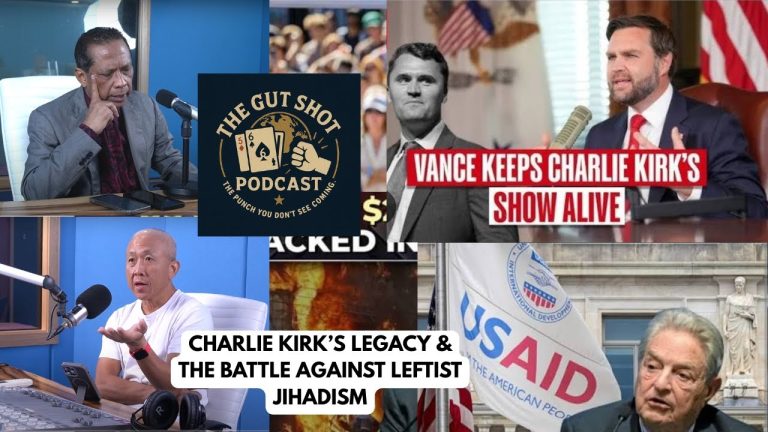
Turning Point: Charlie Kirk’s Legacy & the Battle Against Leftist Jihadism
Show Notes & Description
The Gut Shot Podcast Ep 15: We unpack what was left on the table since our last podcast including the characterization of Charlie Kirk by the left and mainstream media, definition of far right and leftism but never far left, the political and media grifting on identity politics, the lie of white supremacy in the US, entitlement and victimhood propaganda.
The far left ideology today has become mainstream and mirrors Islamist jihadist group action such as BLM and ANTIFA funded by NGOs and big money.
Key Moments:
• [2:40] Hot Take: One of the hosts argues that calling Charlie Kirk "far-right" is a deliberate propaganda tactic by a "leftist propaganda machine" in the mainstream media and academia.
• [7:02] Argument: The hosts define the fundamental divide between American "left" and "right" as a conflict between socialist-leaning policies focused on equity and conservative principles of family values, free-market capitalism, and merit.
• [10:48] Argument: It is argued that Diversity, Equity, and Inclusion (DEI) policies are a rebranded version of Malaysia's failed New Economic Policy, which led to mediocrity and an entitlement mentality.
• [15:23] Unique Insight: One host shares a deeply personal story from his childhood about failing mathematics and making a conscious decision at age 10 to work relentlessly hard to succeed, using it as a case for personal accountability over victimhood.
• [22:36] Hot Take: The hosts contend that the media's narrative about "white privilege" and "white supremacy" is a form of racism designed to "guilt trip" an entire race for its perceived success, drawing a direct parallel to the historical vilification of the Chinese community in Malaysia.
• [24:55] Hot Take: The hosts strongly criticise modern rap and hip-hop culture for glorifying materialism, sexism, and a "gangster culture" of money without effort, contrasting it with the educated and entrepreneurial black musicians of the Motown era.
• [27:21] Argument: DEI policies are damaging to their intended beneficiaries by creating an "imposter syndrome" for every successful person of colour, making them question if their position is due to merit or a diversity quota.
• [37:19] Argument: The hosts identify a critical difference in political rhetoric: the right attacks ideas ("your ideas are dumb"), while the left attacks character ("you're evil, you're Hitler"), which is far more dangerous and incites violence.
• [39:48] Core Argument: The episode's central thesis is presented: the extreme left in America has become mainstream and now operates as a well-funded form of "leftist jihadism", using an ideology similar to religious jihad to justify its cause and willingness to murder for it.
• [53:40] Key Takeaway: The hosts summarise their message for individuals: take personal responsibility, "step up," work hard, and don't believe the victim narrative. For policymakers, the message is to serve the people, not their own pockets.
Jump to chapter 8 chapters
- 0:00 Unpacking Charlie Kirk and Media Bias
- 8:30 Meritocracy vs. Equity and Malaysia's NEP
- 21:10 Personal Accountability Over Victim Mentality
- 29:36 White Privilege, Hip-Hop Culture, and Scapegoating
- 36:12 Imposter Syndrome and the Damage of DEI
- 49:03 Rhetorical Extremism and Leftist Jihadism
- 1:00:31 Reforming Education and Corporate Lessons
- 1:12:30 American Governance and Turning Point's Future
Auto-generated from YouTube captions. Timestamps link to the video.
All right, welcome back to the Gutshot podcast, Sam. Uh, hi. We've had a few days since the uh Charlie assassination essentially and we've had a lot of some time to allow events to percolate in our minds. Um, with the benefit of of those few days and I think we did leave some things unpacked on the table from that last discussion. I think we should get into that as well. Of course, Samra, what do you reckon?
I reckon so. Um I think uh there are also a few things that I think requires a monu one's perspective. Um that's one. Secondly, I think we can go and I want to go actually into uh uh what the future holds uh as a result of this. There's been a number of uh uh uh events. Uh the widow Erica uh made quite an impassion speech. I think JD Vance um was uh hosting uh Charlie's uh podcast uh as well which is uh quite a stunning development in in essence to me. Um if you look at nobody has I mean you don't expect the vice president of the United States to be uh taking that kind of uh
action. Um obviously uh Trump has uh announced a postumous uh award of the medal of freedom uh for Charlie Kirk. But I think let's go back to what you just said. Uh a lot of things be left on the table. Uh I think I want to start actually with one definition. Uh when we were discussing uh Chali um a lot of uh media outlet including yourself when you started off the discuss the description characterized Kirk as a farright activist.
Well that's what the media portrayed him as. Exactly. That's where I think again um this is an issue that I've been I've been saying again and again uh why the mainstream media is mainly um a leftist propaganda machine. Okay, I mean look at it this way. I'm looking at it from um for somebody who has actually like as I said before 40 years association with America, right? And um I went to college. Uh I have long-term friendships. Uh I have uh business associations and I go back there almost every year.
Y um so my understanding of that culture and society is probably more than most over here in Malaysia. uh and then again I think uh it allows me to have a helicopter view of the situation in the US you know and one of the things I've said is that the mainstream media academia um has very much been a left-leaning uh instrument anyway all right but I think within the last decade um the pervasiveness and the the sheer uh leftist ideology within the media and academia has been beyond what I have seen uh before in my adult life actually. Um and so I want to just touch
quickly on that definition of chali being far right. Wait, before we talk about the far right, maybe we can spend some time on the far left because I mean the base proposition here is that the media and the academia especially in the west are are leftist left leaning right first of all what is the meaning of left? What do they believe in and how and why does it serve their purpose? I think first of all
well let's let's let's do it in this manner. Okay. Okay. um you realize something how words carry your um your perception of things.
Okay? Right? When you talk about um academia, you talk about media, we don't call them leftwing. We call them leaning left. Well, in the real world, the media is supposed to be neutral.
Exactly. There's no left, there's no right. You just present both. Not not in today's world. No. Not the case. No. I mean it it if you even if you ask me even during the days of Clinton presidency right it has always leaned as much as it can to the left. However, and and there goes the definition. Maybe I I should answer your question on that.
Right. The easiest way to understand left and right uh at least from the point of view of America is uh leftism has been mainly associated with the Democrat party and the right side of the argument has always been associated with um uh the Republican party conservatism. Okay. So when you talk about conservatism, what you're talking about are um really family values uh fiscal responsibility in terms of economic policy. Okay. Free market capitalism, right?
And that's right. And that's the right. Okay. Okay. And when you talk about uh left uh leading uh uh thought process or ideology, you're talking about mainly um um what do you call uh a more socialist bent in their uh social and economic policies. Okay. Um more towards uh uh welfareism. uh more towards uh shall we call it um a concern for uh for ensuring equity rather than um
wild sounds a bit commun right it does right but obviously one or two you know standard deviations before communism but right it's it's equitable right that's very interesting that actually you know coming from yourself this is the very interesting perspective for Not to say there's anything wrong with communism. I mean, right. Right. I don't know. It's communalism, right? Essentially, right? It's a sharing of power and wealth.
Well, it depends on how one looks at it. Um, I think we fought a war uh we practically fought a war in Malaya against communism, right? And we are probably the only country in the world that have won against communism,
you know. Um, debatable. uh but let's uh I mean that's basically what we claim at least our government claimed that as our history right so I think I mean it's very interesting to me because why you're you are coming from the point of view of you don't have the kind of association or uh of uh American culture or American society or even politics the way I do
no right so It's very interesting for us to compare because why your main diet of then um that understanding comes from the mainstream media mostly I would say
and experience yeah and your experience from that right so um I on the other hand lived it um and I don't know maybe uh even from I was very I was hellbent on actually going to America for my education. I think I was uh very influenced by u by uh by by American literature. You know, I mean the first I remember the first serious book I read uh as a ch as a as a young teenager was the world according to g.
I read that too. You read that too, right? So I mean those kind of things actually not to mention you know the Alfred Hitchcocks and whatnot right but anyway um so let me go back to this whole discussion on uh now that we have defined and you have actually without you realizing it very much uh associate that ideology of leftism just a few steps away from communism you know to a certain extent right?
So this is where the two um the the the the two side of the of the coin uh or or the two side of the partition separates. Now I would say if you ask me the far left would actually be more closer to communism. Okay. uh and and and rabbit socialism, okay? And um implementation of equity policies that they don't realize we have already tested in Malaysia
which is you know so-called DEI. Yeah. You know in Malaysia we have implemented the new economic policy which is based on kota system right and it has been
abused to no end. Abused to no end. and not just abuse. I think even without the abuse uh uh it it it has naturally shown to actually uh uh make the society worse and actually pull the society down towards mediocrity and later on actually uh failing in all aspects.
Yeah. Because of the subsidy mentality and the entitlement uh mentality as well. Exactly. All right. So on the right side of the aisle, you're looking at um where Merit is go is is the one that holds the flag, right? Um where they say that you've got to win on merit base no matter what. Okay, so this is something that um actually um has been quite a lightning rod for the for both sides, you know, between merit and equity. Okay. And also um the other part that has happened within the last 15 years I think is this discussion about redistribution of wealth. Okay. And
redistribution of opportunity. Okay. Um so that I think is a general uh principle of how we can discuss left and right. That's number one. Okay. So you've got an economic policy difference between econom between capitalism and socialism. Um and then we've got the um the social politics or between merit and equity. Well, the problem with with wealth redistribution, it it it means the undoing of the work of capitalism because capitalism rewards those with merit and obviously when you have people who work harder, take more risks and and take on more enterprises on their own, they will
naturally make more money and reap more rewards leaving the rest behind the employee class. Right? The problem is once you have that ineffic that the wealth divide in society then you try and correct the those those imbalances with wealth redistribution you're undoing the work of capitalism. So that's the problem right
here's the thing I think I would like to go that a bit further down the road in terms of the discussion um I think yes I agree with you um and and this is where the problem lies. Uh but okay, I want to go back to actually where we left things on the table with respect to um uh the the chalie. Yeah, with respect to chalie and how the mainstream media has branded him as uh as far right.
Okay. Um I think this is words. Words has very big implication. The usage of words is a very interesting thing that we find in the media. Okay. I've always said this that if you want to see how how propaganda is made, look at the titles and the adjectives used.
Okay? Because you use adjectives to provide enhancement of a point of view. Okay? So when you say for right, you're looking at actually something that is un is unreasonable. Okay? When you say far left, you're also looking at something unreasonable.
Extreme, right? Far extreme. Far extreme, right? Yeah. But here's the thing. You hardly see the mainstream media ever characterizing anyone as far left. I guarantee you, you hardly see anyone being characterized as far left. Okay, here's the thing. Okay. Why then do we go and when we look at the mainstream media today, almost everybody is considered far right. Anybody on the podcast spear that talks with respect to um the the uh the ideas of conservatism, okay, the ideas of capitalism is immediately labeled as far right. Take for example even social issue. Okay. Proabortion, anti-abortion.
All right. Here again is uh is the is is the labeling uh used by media. How does media uh use change the way we look at things? Now you call it pro-choice. Okay. and the other side decides to say pro-life. So that framing of word changes the way you look at things. Okay. Now, if you were to ask our people here in Malaysia, right, I think you will find that more than likely, I think overwhelmingly, we are pro-choice people. we would probably look at um uh abortion as being the last resort. But if you were to put that claim, and I think that's a pretty reasonable position,
but if you were to put that claim in the uh uh in the sphere of American politics, you're immediately labeled for right. Okay. So, I think that is where I go back to Chali. Charlie to me is not even close to far right. He is basically espousing positions that for me as a liberal in Malaysia but then becomes a conservative in America right is deemed far right which I'm like are you guys bonkers what is he what is he for capitalism what is he for merit what is he against DEI what is he against um uh what do you call u Um uh but he is for his Christian faith,
right? Hey, if you're a liberal, right? That's his faith. Okay. So, yeah. And he accepts and if you've seen his talk, he goes to campus and he invites people to talk to him. Okay. He doesn't stop them from talking. And I've seen many a times where actually uh crowds that did not like what uh uh the persons who come in front uh say then he will tell the crowd hey stop let him speak right let him have his say and then I'll have my say so that kind of discussion actually is what I took back as very American values and that American value all of a sudden has become far far right. Are you kidding
me? Okay. So, so here's the thing. So, for people who are defined as far right or people who believe in say capitalist uh principles, right? Yeah. The nature of the free market economy is that it rewards industry.
You're far right. Yes, I am. I I'm It becomes You're far right. 100%. I'm an avowed capitalist, right? I believe in business. I believe in risk. I believe in entrepreneurialism. I believe in uh in in merit and hard work. But the problem is not as Abraham Lincoln once said, not all men are created equal. There are some who are more hardworking. There are some who are more industrious. There's more some who are more risk uh tolerant. Y
and and therefore you've got people like Elon Musk and Mark Zuckerberg who make millions and billions and trillions of dollars. And you have those who are on the factory floors making minimum wage. That is the nature of the free market economy. But the free market economy leaves people behind. That's the problem. It has it has it leaves the tritest of society who are not able to take those risk who don't know these things who are left behind. And that's the problem because the people on the and there are some on the fringe of society on the left who are being left behind.
Well, let me put it this way. And that's the problem. So they take it upon themselves to to to correct the imbalances of the economy and it results in this nihilism. this this this this civilian terrorism which is now gripping America and as as director of FBI Cash Patel said it's not just one thousands of them they're quelling literally thousands of uprisings like this across America
now it's it's it's not true um unfortunately do you not agree that people are being left behind I agree that I agree that um in any system any system okay people will be left behind Yes,
for various reasons. Okay. My uh my my framing of the the issue is that that's a challenge, not a problem. Okay. Of course.
All right. And the reason why it is a challenge is this because you will always have people who are not as industrious. Mh. Okay. Uh are not as hardworking.
All right. Are not willing to put the early hard work and then their fate happens. Yeah. Okay. I put it this way uh and and I I I want to go back and and conclude a quick one. Right. So by any defi definition for me I think the the mainstream media has actually been doing this propaganda of framing um of framing right leaning individuals and and even institutions or or organizations as far right. Okay. We just saw u the UK uh uh protest, right?
And the Guardian uh basically uh reported that police say is 110,000 people. I looked at the video. I guarantee you if there's not more than 1 million on the streets, my eyes are lying to me. Okay? All right. And they characterize that as poor right protest. Okay. Right. See how the media has actually been manipulating the minds of the masses now. And that also then reaches out to um to uh to to to the foreign market outside of America because the mainstream media actually feeds our local news of uh of what is happening in America. So that's the first thing I want to unpack that we
left on the table with respect to the defining of Charlie Kirk or anybody associated with his um with his way of thinking as far right I think it's absolutely ridiculous and absolutely a lie okay so now we talk about just a quick one yeah before I go to the second part which is actually I want to talk about this which is actually the guilting of white America or the guilting of the western white society. Okay, by the far left. Now I'm going to go far I'm going I don't even call it far left. It's a whole left. Okay, but I'm going to come into that later. But I want to answer
your point with respect to uh the the people being left behind. I will just say this in very simple terms. Um I was a Malay boy. I was 11 years old. I think I was 11 or I was 10 years old cuz I jumped one class. So, I can't remember. I was in uh my first year of high school, right? And I failed my math the whole year, my mathematics. I got an F. Okay. I looked into the mirror and I said, "Who the hell is going to want you when you get older?" All right. Which girl is gonna, you know, is gonna give a You're you're you're one, you know, black ugly right? You know, and
you're failing in life. No, absolutely. This was what was in my brain. I was 10 or 11. Okay. I think I was 10 or 11 or maybe younger because it was second year of I mean first year of uh of high school, right? First year of high school is what? um 10 11
right okay and I said that to myself I said I I can't be living like this right so I made a conscious decision that I'm going to work hard okay I put a timet on every hour of my life for the next two years because I needed to get out from the school I was in to go to a better school Right? So I went from a failed grade in mathematics, okay, to being a straight A student.
What I will tell you is there's some right at this vintage now in my mid-50s, right? I see people all around me who don't even have one iota of the same self honesty and self-awareness that they should have been when you were 10 years old.
Wow. I I don't know whether it's a chemical imbalance or some kind of something, right? or or it's the of the way the characters made up, but I tell you this, many many people, I don't know whether even if they're in the majority, they don't have the self.
No, no, it is the majority. They don't have the self-awareness. It is the majority. People think men think they're better drivers than they really are. People think they're better parents than they really are. People think they're more capable in sports than they really are.
Or do you know what I mean? And because they have that exaggeration of their abilities, they don't improve themselves. or or even worse, they don't see it upon themselves. They don't take it they don't have that agency to pull themselves from that morass of despair and get better.
Well, here's and then and then in later years they it manifests you reap what you saw. Correct. But they don't see that. Right? So here's the here's the thing. If I a Malay boy
okay I have I don't have any inkling remember at that age I have no inkling of bumi kota policy I don't know about that okay all I knew was
you got to pull your socks up I got to pull my socks up right okay I'll tell you you would be it is if I were to tell this story right I had a timet I would wake up at 4:30 in the morning Okay, I would start my revision at 4:30 in the morning. Okay, get everything ready. 7:00 I'm going to school,
right? I come back by 3 my homeworks are all done. Okay, and then I would do another re a few revision. I do my mathematics two hours a day. One in the morning and one in the after in the evening. Okay, two years my life. Absolutely. and all of a sudden everybody got shocked that I got straight A and I was one of the top students.
So what I would say is this, you're an anomaly. You are the exception to the rule. Most people would not do that. They would just go not just that because I saw what was happening in my circle of children, okay? And I was a kid, right?
People don't see that. That's and I saw that. I said, "Look, I said, if I were to follow these guys, okay, we're going to have fun now, but later when I fail,
okay, you're going to suffer. They they they're not going to care about me. They don't pay bills. They have to care for myself." Yeah, I understand. Right. So, I have to care for myself. So, this is the problem. You magnify that by one trillion times and you got what's happening in the world today. You've got a system which rewards the hardworking, the risk tolerant, and then you got the rest of the world who are being left behind. that divide is getting wider and wider every year. That's the problem and that's why you are things like this.
Well, here's the thing. I only I think the system what I've learned from our system and what my life has gone through okay is because I said uh even when I went to um university okay um I mean it's again hard work and um and and and again is determination and then even coming out from school um from and and and getting my first job you know I was taking responsibility for practically three jobs, two and a half jobs. You know why
you're vindicated? Because my my mindset was what? You know, if I work one job in one year, I got one year experience. If I take two responsibilities or two and a half or three responsibilities in one year, I get three years experience.
So how many people do you think are like that? I can tell you 95% of human being doesn't think like that. I'll say 98.5. somewhere much higher and that is why you got you've got the wealthified and I just saw a report I think Bank of America or something right
I think the top 20% of people in in America own 75% of wealth well here's the it's the same thing all over the world here's the thing that actually I realized what was very uh uh very instrumental um in in the formative years that we had in the 70s in Malaysia which I think We have failed already because of our DEI policy. Okay. All right. When we were starting out, um we had the right policy in this way. We provided basic education at the strongest level to the people who are actually capable of actually maximizing it. Okay. at you know who are um uh who are not that well off okay
after that you are on your own okay okay if you get well we'll give you scholarship okay we had a wealth to do that okay almost everybody in my school whether it's uh because by that time by the by by my fourth year I was in one of the best schools in the country right and we had Chinese we had Indian we had Malays everybody got scholar ships. I think except for one guy who failed cuz he was a bit of a cuckoo. All right, but let's let's put it this way, right? I think that's the only thing you should do in a uh as a as a main principle in terms of leveling out opportunity. Okay,
number one. Number two, I think the only thing you should be looking at is to not have uh discrimination at the hiring process and for promotional. I don't care whether it's for uh whether you think um uh there is uh u uh what do you call a gap in gender, a gap in um in in race or a gap in religion. I don't give a Okay, at that point merit counts. Okay, and you must provide the opportunity for that merit to be able to rise and not be discriminated against. And therefore, I come to my second point in this in this part which is the guilt tripping of uh uh of white western society.
Okay. I I I think it's bonkers. I think it's bonkers the way the narrative has been uh uh been carried out by the media for for the last at least 15 to 20 years where it slowly started very small and then I see it become an acceptable um an acceptable narrative to say that about uh white supremacy to talk about uh white privilege. Dude, if you are good-looking, you've got good-looking privilege. Do you know that? Okay. If you're a girl, you got good-looking uh you you got a a a woman's privilege. You know, you come home, all right, and you start uh behaving like You're a boy, you're
going to get hit on the head. Okay? If a girl comes home and she's crying, the first thing you know the the the dad is going to do, what happened, baby? you know, rejection. I
I get a boy who comes home crying. I say, "Hey, man up, buddy." Okay. So, I mean, but here's the thing that I find, which is to me, it's actually discrimination. It's actually racism. It's racism when you talk about all these thing and and and and and and um uh what do you call and guilt trip a whole race and define
perceive for their perceived inex for their perceived Yeah. for their perceived success. Yeah. Yeah. For their perceived success. I remember and think about it right. I I go to the black community. Okay. I grew up on on Mottown. I grew up on uh Michael Jackson, Jackson 5. Um uh what do you call uh Billy Ocean? Okay. You know, Diana Ross, they have music. Okay. They look good. And then all of a sudden I find why is it that I mean and and and they were very successful. Um they not just successful from the point of view of uh of of business and their music career.
I'm just taking music as a as a as a uh as an example, right? They not just they built black music empires, but they were ve they they they they were very educated, you know.
Okay. Today, today, I'm sorry, I'm going to finish this. Today, what do we have? We have rappers, you know, and we have uh uh this uh this this uh what do you call this? This um uh I that's why I hate the rap culture. I hate the um um the hip-hop culture. Why? It glorifies materialism. It glorifies sexism. It glorifies um what do you call uh it it uh uh uh womanizing, you know?
You know why I don't hate it? Because I can't understand half of what they're saying because they're mumbling all the time, you know. And and and and there is just no there is no art to it. Okay. What I see is basically a glorification of gangster culture. Okay. A glorification of money without effort.
Okay. So what you're suggesting is that you culture you have you're you're basically seeing scapegoating of a class of successful people based on their race but actually it's because their their victimization is because of their own.
Do you know what that mirrors? Their own deficiencies. Is it do you know? Yeah. Exactly. Right. Do you know what that mirrors in our own society? I know. Okay. Okay. I'm I'm going to say it. I'm going to say it. Okay. That is exactly how the Chinese community was vilified in Malaysia as long as 40 years ago.
Maybe more. I remember I remember before I went and I'm This is going to be very I don't I don't give a I'm going to say it what I went through. Okay. I remember going to uh was invited by the University of Malaya.
Okay. Under Birro Tata Nagara. I'm sorry for our American audience. That's a government uh agency, okay? and we were brought in and you know the funny part is that I've got my I got some of those who are come who are getting scholarships to go to overseas as well Chinese and Indian students in there you know and what were they teach what were they giving lectures on Malay supremacy okay we cannot lose the Malays supremacy. Okay, we cannot lose our country to the Chinese. I'm not joking. I'm 17 years old and this is what they're telling me. And you know what I did after the first uh session?
Uh I said I was ill. I never went to another session again. Yeah. I just I was like I was so I was literally so sick of it.
Yeah. Right. So I just stayed in my dorm, okay? Because I just couldn't stare. I was I was like, "What the hell is going on?" Right? So they were brainwashing from we were 17, 16 years old. All right? So how do you expect that's how actually the mainstream media in America has brainwashed in academia and in the media about white supremacy. Okay. The same way we vilify Chinese here. Okay. So for me when I go to America and I come back and I see this to me I'm like oh I've seen this before. Okay. When I look at DEI oh I've seen that before. Right. I was mentioning to somebody I've got to
say this. Okay. I I I tell you Charlie said this and it was used as a derogatory example uh for him when he said that um you know this DEI thing actually it is bad for the blacks you see something like I'm paraphrasing right if I go into a plane and I see a a black pilot okay it makes me wonder whether he's there on DEI whether he's really qualified or not
right okay it detracts from the ability yeah and I 100% agree with him. Okay? Because you know what actually I I thought about the first days after uh my company went corporate. So we were listed and I or or we were going to be listed I think and I think I was chairing the or it was was it the second the the second company that we were listing Petra Energy. Um um I remember I was the one chairing it because uh you need the board or or or the the the the a key management to be to chair and all that, right? And I think I was the only Malay in the whole room of 20 people of consultants,
investment bankers and whatnot, right? And the first thing you that come through my mind is an imposttor syndrome, right? I was thinking this am I a fraud? Okay. And I mean and I was looking at everybody looking at me and I'm thinking to myself,
does he deserve to be here? Does he deserve to be here? Is he there as the token Malay? So for every successful person of color in America, they're going to suffer this imposter syndrome. Exactly.
For every person of You don't know, right? You don't know. So the only thing that actually for me what made me feel better after after half an hour of in there was I was commanding the whole session right you step up
which because you know but here's the thing but here's the absolute truth okay you get there if in Malaysia where we have been implementing our version of DEI for the last 40 years okay it's been an utter failure clear. Okay. Our government link companies which is DEI field. All right. Has been either a monopoly that are not producing the the the the uh uh the productivity or the returns issued or having to be bailed out every year. Okay. If we don't have this I tell you our per capita GDP minimum I think is $40,000 US easy minimum. All right. So I go back to the issue of
you know the vilification of Charlie as being far right for exposing such views. It's utter nonsense. And not just that I hate when they talk about white supremacy. I hate when they talk about um uh what do you call uh uh uh uh uh you know not uh uh the the the the uh it's it's too white. Dude, the society is majority white people.
The only way this plays out is that the disenfranchised and the people who are left behind step up. Yeah, they have that's the only that's the only way this plays out. They have to actually make a reckoning for themselves, look in the mirror and say, "Where did I go wrong?" Especially in America.
But the problem is, Sam, as history has shown, if they don't step up, well, and then they get poisoned by influential leaders who then lead the world into war.
That's what history has shown us. Well, let's put it this way. As Do you agree or not? No. But you you think it's called populism. Yeah. No. No. But but but here's I think where the experiment of America is extremely successful. I will say this now. Okay. Why? Because since independence, okay, who has fought the war to free the slaves? The white people. Okay. Who actually freed the slaves first in terms of worldwide?
Tell me. I don't know. The British Empire. Okay. They allocated a huge sum of their GDP to fight the slave trade. Isn't that DEI?
Wasn't that DI? That's not DEI. That's basically what I call right because why slave trade actually if you if you to and I keep saying this, right? How far back do you want to go? Slaves are one of the first property that actually uh was owned by human beings. Okay? From the days of probably you know the Neanderthalss and whatnot. All right? Because why? If you can enslave cows, you can enslave the other tribes. All right? Egypt, they had slaves. The Israelites were their is one of their biggest slaves. Okay. The whole Arab empire, the whole Islamic empire was built on slavery.
So let's let's talk about what happens after Charlie, right? I mean, let's talk about what comes next, right? Okay. Okay. Now, wow. I've been too impatient. So you put No, that's good. No, that's good. That's good. No, that's good. No, that's good. So, so now we have um some of the days leading up to where we are now, right?
Cash Patel, director of FBI has talked about how there's a whole movement, not just one. So, basically um the perpetrator did not work in isolation. He worked with a reportedly a whole bunch of other people. It was it's it was a network, okay, of people involved, right? So that that shows there this ground swell of dissent who are coming from that side of the equation who are not happy with the way things are. Does it get better? Does it get worse? I I to me because of the system and the imbalances that it results in I I I don't I'm not I'm not confident that it dissipates is what I'm saying.
I think I think this is the difference between your point of view and mine. Okay. Okay. I think you think it gets better. I think I think you're looking at it from a prism of empathy. Okay. I do think so. Okay. I you know you can you can counter me. Okay.
I on the other hand try to take a very uh cold uh surgical look at the issues involved. Okay. And I have no You and I have a very high element of self honesty and self-awareness.
Yeah. Many people don't. Yeah. But you have they will see they will see this as just another marker for them to step up the descent. Well, I I mean I'm I'm going to explain why I see um your point of view as being more empathetic
uh in terms of perspective compared to mine. Okay. Okay. Uh because because just the way you frame it. Yeah. And the way you come to the issue. Okay. All right.
I don't. Okay. Um I already look at things and I said because all I look at is I said as you pointed out and you agree with me on this one that's why it's interesting is because you said people are not self-aware of their own uh their own cause for their own situation. Okay. And that goes at individual level and individuals also form societies.
All right. the conglomeration of individual uh thought process um becomes that society's thought process. Okay. So that's where for example where I see the failure of today's uh black community for example. Okay. And also in our position the failures in our Malay society. Okay. Now when I look at ideology and that's where the mindset comes in and this is where I think the problem and the reckoning will come come going into the future. Um you see the the thing is politicians uh leaders um are basically grifters.
Well they're beauty contestants right? They will say the most popular things to get the most number of votes. There you go. Stay in power. Right. Right. Now the thing that is very very rare indeed. Okay. is that you will have leaders who self-sacrifice.
Yeah. Leaders who actually uh put the people u above their own personal interest. Yes. Okay. What I would love to see in Malaysia, let me just have a segue here, right, is for a very very um uh capable Malay leader to tell the masses like you can do it, you can succeed. You have strength, you have brains, you have ability. You need to work hard and with that you can lift your whole people.
What we have seen in the past is people just playing the same old insecurities. That's the problem I have. But these things this messaging can work in America as well. Well, you know what I to be honest with you. I mean I'm I'm just going to say this. I've done that bluntly in my in in my leadership positions in my companies.
Does it not work? It works. Yeah. It works very well. That's right. Yes. But There's nothing more inspirational than to say this is the journey we can get there. The problem is this. The problem is when leaders go up by a DEI,
okay, then they're preserving the status. Then they have to preserve the status quo. And also if you have a weak argument in terms of your ideology, you have to keep on hopping on identity politics. You have to keep on hopping on being the victim and playing the class war welfare, racial warfare, tribal warfare,
okay, religious warfare. Okay, this is uh the history of humankind. It's not uh it's not alone in America. It's not alone. It's it's we are not immune in Asia either. Okay. Uh everywhere. Correct.
Okay. And I think the the what we what we see and this is where I I find actually I I go back to your your point of view of empath empathy. You straight away jump to this inequity. Right. But never mind.
I don't say it's inequitable. I just say those have worked harder than others and this results in this divide. Yeah. And that can that has proven history has shown to be problematic. And and and the problem the the challenge then becomes is actually um you will have a subset of you have a group of uh political grifters who are going to take advantage of that. Okay. And it happens both on the right and on the left. Okay. I'm not going to um I'm not uh going to absorb one or the other. However, this is the problem and this is a real problem that actually me from the
outside looking in I I've seen what has happened today. The grifting from the left has become so lucrative, right? And it's become lucrative not just from the point of view of money but also power right that it becomes a very strong motivating factor for them to promote their DEI for them to promote their ESG.
Yeah. For them to promote um uh the ideology that there is such a thing as white supremacy. Well, there's nothing more intoxicating to the masses than to have an equalization of wealth and power. Right. That's exactly what you you're saying the left provide. we will come in and help you uh get rid of the
risk. That's the difference. On the right side, they're saying work harder. Yes. Okay. I'm giving you opportunity. Okay. All you need to do is put your back against the wall and work. Right. But on the on the left, what they're going to say is what they're going to say is
no. The system is rigged against you. Yes. Okay. Therefore, there's no choice but for us to destroy the system and and and and actually uh rob Peter to pay Paul
and in extreme cases Charlie happens. Yes. Right. So, and that's the thing what I have seen also I mean is the usage of words. Okay. Freedom of speech is very interesting. I am an absolutist when it comes to freedom of speech. But I've said I I don't know whether I've said in the last episode the difference between how the left and the right talk is very wide right now. And I've seen this evolution in the left which is this. Okay. The right is going to tell you, okay, your ideas are dumb. You're stupid. You're going to your your concepts, your philosophy, your socialism is going to destroy the
economy. That's a threat to our own democracy. From that point of view, you know, okay, even if I say you're an idiot, compare this if I tell you, okay, you're evil, you're Hitler, you're Nazi, okay, you're a fascist. Guess which one will get you killed.
Number two. There you go. So this particular rhetoric is not in the fringes you know this rhetoric is in the mainstream media in the political discussion in the left okay and then it is also funded by money when you look at how US aid has been used to fund NOS's you know what they're doing hey that's no different that what we are doing you know do you know how birata nagara is being funded by our government.
Taxpayer money. And yet they are fueling this kind of vile racism in college campuses. I can attest to that 40 years ago, 45 years ago. Right? Imagine that is happening in America in the left at on the left. All right? So I said there is no symmetry in terms of what is happening between the right and the left side of it. The left the the the the extreme left has moved to become mainstream and they are very well funded. So when they are very well funded because why the mainstream media is owned by them academia tenant professors the whole liberal arts colleges
is actually you know is run by the nom chskis of the world you know I think that guy is an idiot but hey if you talk to other people if you listen to this they I mean they put him on the pedestal right you know I I I don't know where Krugman goes from. When I was reading his his uh monetary economic uh book and then he veers into politics, I think the guy's gone cuckoo, you know. So the thing is the thing is you've got a movement of ideology of leftism that has moved from the extreme to 20 to 30%. Think about this, right? If 20 to 30% truly believe in this extreme ideology that pe people
on the right are Hitler's, Nazis, fascist, they are they need to be wiped out. Okay? Not just shut down, but wiped out. Okay? Now, I'm going to tell you this. I've seen this game. I've seen this before.
You know what what I call it? This is jihadism. Yeah. Okay. This is where when I look at the left wing of American politics, what you've what they have created is actually an Islamist rhetoric of the left. Okay? And people are willing to murder for this. All right? Why? Because it is a jihad. It's a fight for a cause. It's it's a subjugation of the of the people who does not have the belief that you have. Okay. It's no different than the jihad polic the jihad ideology that brought down 911 the twin towers.
You see don't Yeah. So I I totally agree. BLM, okay, riots burn cities and they are funded by the left, okay, openly, you know, openly. Can you imagine if we have uh an Islamic school that burns down uh buildings? Okay. Uh if anything perceived to have happened, what would we call that? We would call it terrorism. But somehow or rather in the mainstream media, BLM uh goes for a uh for a a night of riot and burning of of townships. Okay. It's like, oh, it's a protest. It's a riot for protest.
Yeah. Yeah. Antifa. You know what Antifa stands for? Antifascism. Anti-fascism. Right. Who funds them? Mainstream left. Sleepy Joe. Okay. Sleepy.
So, so there you go. That's why I completely look at it and I said, I've seen this before. Let's just say let's say it doesn't end well, Sam. I I don't see how this
Oh, I think it will end. How How do you think it ends? Well, this is this is the thing that actually play the the the the martrdom of Charlie Kirk is just going to and I I know some people even on the middle has been talking about it um and and and saying that you know uh u you know they don't want to see that this be politicized so to speak.
Yeah. But I'm sorry to say that it is a a political situation. Okay. When you have jihadist being funded, I call it leftist jihadists. Okay. When you have jihadis being funded by big money, okay, and they were being funded through government dole, okay, through us a prior, okay, uh Soros Foundation,
okay, imagine what we say when um people were saying Kata was uh funding Hamas. It's the same thing. It's the same bloody thing. Okay.
So, shut it down. So, so back to the same. So, you have to shut it down. How? You have to shut down those foundations. Okay. You have to the first thing they did and that's why they got so much push back with the shutting down of US aid because that was basically money laundering for the left.
Okay. Okay. So, you shut down the institutions. What about the people? All of them, the many millions of them who are being left behind. Right. That's a different story. Yeah, that is a different narrative. That's a different narrative. That is not
They will still be pissed off. Here's the here's the here's the thing. The problem is this. The fermentation of of of of uh of this kind in a rich country. Yeah. In a rich country, right? Okay. Is because of the political ideology.
Correct. But but nonetheless, the result is the same. There's going to be some who are doing really well in the minority. The difference is and the majority will feel like I'm being left behind. If you ask me the difference is this. The system in America is able to handle it. There are few things that are broken. I will tell you that
Congress is broken. Okay? until and unless you have a situation where Congress is is uh is filled up more with people who are willing to do uh uh good for the people instead of you know always raising money for election. Okay, because it's a 2-year cycle.
You know, their term is only 2 years. So, they're raising money non-stop, you know. Okay, so basically, you know, 80% of Congress is a bunch of grifters. All right. I'm sorry to say. Okay.
Same as here. Well, there you go. Right. So and then and then you have a so but from a systemic standpoint in America does the the opportunity available for you to move up the ladder through marriage is very high.
If you tell me you can't do it in America you're a lazy You're a lazy Yeah. Okay. The only thing that you have to do then is actually to make sure because when you take hund billions of dollars
from the treasury to feed illegal immigrants, right? I mean, what the hell is that, right? What the hell is that, right? Yeah. Why can't you take those billions, stop the flow of illegals, right? Because that is other count's problem, you know?
Right. It's just like us. Hey, you want to talk about us, right? Malaysia, you you want to make you want to make the equivalency. If it's like that, we should take all the Bangladeshi we can open the border, get all the Pakistanis, get all the Indonesians we can. Why? Because we are rich relative to them. We are rich,
right? But then what happens to our own people? So the same the same thinking is being implemented by the Trump administration in America. So so okay let's talk about what comes next. So what comes next I see is this and I want I really want them to clamp down on all these this this this this uh uh NOS's these foundations that are actually fermenting uh uh BLMs uh Antifa
so so they are pro these institutions are liquidity providers capital providers to the disenfranchised masses correct right Okay. Not the disenfranchised masses. I'm sorry. I'm going to tell you what
choice of it's g to the money goes to the to the grifting political elites. The money goes to the grifting political leaders both at regional and at state level and at national levels. Okay. And also the activism that goes along with it. Okay. And they justify it through empathy. The same way jihad is justified through empathy.
Understand? Correct. Okay. So if you remove that whole edifice, so those layers, right? The people who feel hard done by the masses, they still exist though. That's when the narrative changes. That's when you ensure that proper education is provided. You see what is happening in in in America, right? Why are schools talking about gay pride uh having trans week having you know all these things those are not teaching anything right? Yeah,
those are not teaching anything though what they are doing to me you know well you know you know what it is to me it's no different than we embedding more religious classes in school
right what I want to see in school is more math more physics more biology financial literacy Yes. Right. How to start a business, right? Technical skills.
Yes. Yeah. So if you provide that kind of cultural thinking into the children, right? You won't have them going to college, you know, talking about um um how do I they will be looking they would be looking at how do I up
themselves and giving them a better position in the hierarchy. Okay. Correct. Okay. So I remember I remember say what you want right? Malcolm X got it right. Who shot Malcolm X?
Who shot MLK? It's it it's basically the left. It's not the right side of the equation. You know Malcolm X was asking the blacks to actually build businesses of their own.
Step up. be accountable to yourself. But today the Democratic Party is the whites are suppressing you. Dude, in America, if you cannot make it, you're a idiot and lazy bastard. Okay, that's all I'm going to say. All right. I mean, if I can make it in this country, all right, where actually if you want to talk about the way there's been talked about, right, from a political standpoint, the Chinese have a strangle hold over the economy. Okay, my first job, I was working for a China man. I was earning like what uh 800 ringit maybe that is at that particular time 3.3.
So that's probably about 100 bucks a month. That was my first job, you know, as a salesman and a field engineer. Then I went and worked for a multinational. I worked for Shell. My bosses were all whites. I was getting promotion every other year. I was so highf flying. There's no reason. I thought I should not leave the company. I'm I was so happy. I bought a house in in that place. I was waiting for a crossosting. I got bored. because it was not enough challenge that I said I need to I call up my dad I said I need to go and do business I think this is not challenging enough
every year I get up higher I look at the same stake the state just got bigger that's all that's exactly how I characterize it right I went out start doing business you know sold my house made a few hundred 000 out of it. That's my capital. My seat capital. I mean, what the hell, man?
Step up. And you know what? My first business that I started, actually, my biggest competitors were all Singaporeans. I beat their butt off. Yeah. What did I do? Very simple. I paired up with the German company. Okay. And I did a joint venture and we recruited mostly Sawakians and Sabahanss. All right? because they work harder, you know. I was like I was laughing at myself when I when we were talking with my German partner at that time. I was like, you know, and we were the only company at that time that was doing broadcast engineering design in Malaysia. The only one,
you know, I should tell you a story as well, much smaller in scale, but um in the late 90s, I started a com with my two friends from Panang and a fourth partner. He was the one who provided the capital. Right. Right. Uh we had um a fasttrack MBA through the annals of entrepreneurialism all the way from fundraising all the way from from doing a startup in a kitchen in Bangsa in a house in Bangsa
to getting a penthouse office in Jalan Raja Chulan in Kale with 50 people okay we did the whole fundraising thing went to Singapore did a seat fund everything right um in the last legs of our business because we flamed out we spent all our money we flamed out and I was the last uh partner standing because I needed the salary so I was the last guy there manning the fort two other stuff and then we had about 200,000 left in the bank from our initial funding of a couple million dollars right and my team was the biggest I had a content team I like about 30 people or something uh I
Chinese guys Indian guys Malay guys I I really shouldn't say this because it's it's very it will great well it it will rank a lot of people yeah yeah um the demographic mix of my 20 odd people under me directly was roughly about 30% % 30% 30% right
I'll tell you this and this was a true story the Chinese guys that were under me when I all I read them yeah I I I one by one I I said look we've got to close the business I've got to terminate your you know your this one and I remember one guy he he's I can't remember I can't say his name he was this early 40s started crying Malay guy right I've got two kids you're in school I got a mortgage he started cry it broke my heart it broke my heart
to to to have to to terminate this skyline right But of the 20 odd people under me, right, the Chinese guys within days of my terminating them started their own shops,
started their own business, hit the ground running. They had skills to sell. Indian guys within days if not weeks of my terminating them, got jobs within the first one, two months,
hit the ground running. The third group waited for a few months, waited, waited, waited and then took the case to industrial court. and sued me and my company for unfair dismissal, termination for unfair dis unlawful dismissal. Cleaned out the company accounts of the 200,000.
What does that tell you? You see, here's here's the thing. I mean, true story. I don't want to piss anybody, right? I think this is where culture comes to play because if you've been fed um that everybody is victimizing you all the time. Uh if you've been fed that and and this is being turned into the mainstream media on the left side. I almost want to start doing um the same thing which is call uh anybody on the left side to be uh far left. But you know I I don't I don't want to be uh that kind of a jihadist,
right? You know um the the the the thing is it's all about culture, right? And I think what I find actually when u when I was managing companies even the companies that I took over uh which was uh in a way um uh turn it around uh what in US is chapter 11 right um that company I had to close down
uh uh divisions um and subsidiaries is okay. Um, you know, when you have leadership uh the way it ought to be, can you imagine? I closed down I think probably I let go of 80 people in one subsidiary.
All right. Not a single one sudas and that was in the east coast which means that majority interesting are malays. Yeah. How did you how did how did I manage how did you cushion your form? How do I question the for obviously we had to follow the uh
payout the payout right we did have to do that there's no choice about that but see we didn't have that we didn't have but none of them they just wanted a financial cushion so that's the only route for them was via going through that route for for us
but none of them I mean they could have taken even that right but not a single one of them actually really complained because they understood because I don't know whether I mean I'm not sure but I I think they believed in me you know and that's very important
it could have helped that you were of the same color and stripe well it's I met I went with my COO who is a Chinese lady who is today my CEO okay but the boss was too.
Yeah. So maybe that that cushioned the blow plus the fact that you had financial cushions for them which we didn't have. It was just a pure termination. I remember um when we were in when was I when I when we built and and um I was running um Padana Petroleum. I mean we had to go through uh and turn around after the 2008 financial crisis, right? So everybody was you know having their uh salaries cut as well
right? It's a question of how you've been managing all these people. The problem is actually in the left is that they've been feeding entitlement. They've been feeding a mindset where they are the victim and actually the system is rigged to actually victimize you and um uh the white people are taking things that you deserve. I mean, you couldn't believe the rhetoric. I I can't believe thinking about it from when I was in college compared to when that I come out here. Imagine this, right? I used to watch uh MSNBC, CNN, uh Meet the Press uh religiously because I love the American politics.
Okay. Um and in fact, one of my favorite journalists, Mark Halperan, actually was introduced to me by watching uh Morning Joe on MSNBC. But come around 2016, around that particular period, I just found that it was just too much. the leftism and the the the the far right and the rhetoric and the deilifying of um uh um um the right side of the political ideology and people were just too vile and too um and the the victim mentality that is being for uh being being thrown out was so reminiscent of what we had here, you that it just I I had to vomit and I couldn't watch anymore.
Okay. So, so there's so for for me there's two key takeaways from this discussion. Okay. Yeah. One key takeaway for the individual person. Yeah. And one key takeaway for the policy makers. The key takeaway for me as an individual is to don't believe the that people are spewing to you.
You have every ability to work hard, do well for yourself, step up and succeed. That's the message I think. Yeah. Yeah, right. That's the message for the policy makers. The key takeaway is this, right?
Do what's best for your people, not what's best for your pocket. Easy easy to say, right? Shut down the nonsense and do and function as how you're supposed to function in the first place, which is to put the people first.
You you know, you know why I that's for me the two key takeaways. Whether or not it can be done, I I don't know. Here's here's the thing that makes America very lucky. I do think they had one part that is extremely lucky um which is um which actually is because you can have all the resources in the world
of course. Okay. Of course. And still fail. Look at Venezuela. Right. Right. Yeah. Um they were very lucky because when they were fighting for independence from the British the mostly I would say mostly the people who step up in terms of leadership the founding fathers were actually brilliant people.
Yeah. The original constitution was a work of art. Yeah. not just brilliant people but they had um they've gone through that particular hardship where you know because it's a frontier place right so all these guys actually whether they own slaves or they don't own slaves right which is common in those days right and and and and and for the for for the left to keep on saying oh hey dude the whole world owns slaves. Okay.
So, um but those guys, you know, started out actually they have to scrap and and make something of themselves and they saw that in terms of and they don't want to have um an imperial government. Okay. So I think their constitution the way they have actually crafted their governance uh is self-correcting and that is why I have a lot of optimism about uh the American system and um whenever I see a situation that looks for most countries to be almost um uh what do you call un unsalvable eligible in America. The system allows them to kick the president out in two terms. All right? You can um
I mean the the the app and flow from each side, okay, um will determine that if things gets worse, they will rise up and actually just vote you out. Okay? and and and and their their political system also because there is a separation of church and state irrespective whether you are um whether you are devout Christian or whatever right you don't bring that into um the chambers of politics
unlike some countries right so when you you divorce yourself from um I've always said this about about um about political ideology. You know, racism for example is easy to uh wipe out. But when you put in a religious religion into the political system, okay, um there is no reasoning to it.
Yeah. It's irrational. Yeah. Because religion itself is irrational. Yeah. Yeah. So I think whilst whilst Charlie was a was a staunch Christian and he does uh uh espouse those values you know in his tour
that he's doing it as a private citizen right um and he is promoting values that actually are reasonable to me those are reasoned values and he puts them out as reason. So, but the problem with the left is to is is that has happened today is um they will shut you out. Um they don't want you to even appear. They don't even want you to even have a say. Okay.
So, and uh at the end of the day, you can talk about you can talk about uh the left and the right both have their extremes. Yes, I agree. Both have their extremes. But the problem is the extreme on the left has gone mainstream. That's the problem. The problem is when you believe that actually jihad is acceptable and it is funded. That is what is happening with the left. Okay. So I think the corrective future in America is fortunate in a sense that that's why I say it's a self-correcting system because the establishment both Republican and the Democrat were holding
power for so long and then appears somebody like Trump who actually says I am going to dismantle both this deep state institutions and that's why he was so hated and vilified actually by both sides in 2016. But today, you know, in 2025 basically the you might as well rebrand Republican party to mug.
Yeah. Right. Because that's where it's going. And I think if you ask me, I say, you know, if you have a cult, then Trump will be there forever. But Trump is not going to be there forever. Yeah.
Yeah. And here's the thing. I think this is got has put JD Vance in pole position, right? I don't think anybody is coming close to him in the Republican party now. At one time, people were talking about also looking at Marco Rubio, but with with with Chali uh being shot this way, I think, you know, that just elevate JD, who is a good friend of his. Yeah,
right. It's I can see the the road the road map already and you are looking at turning point. I think they are going to get turning point is going to be a wing uh of the Republican party. That's how I see it happening. Okay.
Interesting. Yeah. Um the only thing that uh I am not sure is actually who's going to take up the leadership. Um because I mean in terms of rhetoric it could well be Mrs. Kirk. You don't know.
Yeah, I was surprised actually at how well she speaks. Um I mean and uh I you know what the other person that actually was one of the key uh founders of uh of turning
he was the co-founder not not the main founder. Yeah. I not know what Yeah. There was other founders. You know who who who who who else that I enjoy? I mean um I do know that sometimes she goes on a bit of a tangent. Uh Candace Owen Candace Owen is one bright lady. Um
I've been watching her articulate. Yeah. Yeah. Uh but leadership of such an organization um does not just to be the spokesperson or the orator or the debater. um it's also running the organization and actually having the ideas and the strategy. So that part is yet to be seen.
You know, I mean I I I I've said it in the last uh discussion. I saw the evolution of Vbec. All right. When he first started the um when he first started to run for presidency, damn, he was a bit swami, you know. He was uh he was a bit of a I mean he was he was too sleek for my taste as well. He was bright. I gave him he was bright.
Investment banker, right? Okay. So, but then as it went on, I saw his evolution of how u his sleekness got toned down, right? So, um I I do not but then he's running for the governorship. Um I Yeah, I'm not I would be surprised if Erica took up the mental. Uh but I can see that that turning point actually becoming a wing of whether unofficial or official of what the MAGA party is.
Oh, it will serve them well because they've got what how many hundred thousand people around America, right? Yeah. Yeah. And they talk to the campuses and that's where you get the future leaders, isn't it? Right. Yeah. And uh I mean you you I mean he's 31, you know. Can you imagine? Right. 31 actually. You know that's funny. That's funny. That's when I started my first business.
Yeah. Roughly. No, I was actually 27 when I did mine. 28. Yeah. No, that's another thing, right? We were talking about we we gone become now you know I mean when we look back right what did each of us have as entrepreneurs?
Um we took risk at a very young age right? Um and uh and and and not being afraid of actually self-funding. It it was scary, I must say.
Well, when you're young, you're fearless, right? And you've got nothing to lose, right? In some sense, no kids, no mortgage, you know, no car loans, and you roll the dice. I mean, that's Well, I already had a kid. Uh
Oh, you did have a kid. Yeah. Yeah, I already had a kid. But I was like I I was like, you know, I I was I the only thing I told my dad was actually I said, you know, and here's the thing about me and America. I told my dad actually if I fail uh in this business, I'm going to sell everything and I'm going to move back to America.
Actually, America is an amazing place. If you are willing to work hard, you can do so well. Yeah. Yeah. And even a moderate amount of success, it's an amazing life. Yeah. You know, no, I mean the the the the if I I love I mean I go I I look at my friend who's I mean who's my friend now? He's he's coming to uh 78 I think. I went and visited him in Dallas. Um uh and and he he he founded the company. He came back from the Vietnam War. Um uh he was he was actually uh he was terminated in his job.
Yeah. And he was in his 20s and he decided to believe in what his uh technical knowledge was, you know, and he slog all the way to build what he had
in Dallas, right? and um has got nothing to do with your skin color, man. Yeah. You know, has got go and tell I mean I I love uh this thing about if you really want to know um there are uh people like uh Michael Jordan, right? Look, look at I mean the philosophy of Jordan and um and and and and um uh Tiger, right? Those two guys really work. I mean, they got talent.
Okay. Not enough. Talent is not enough. They knew it. And they work their ass offri anybody. Exactly. Yeah. Yeah. All these guys. So, so you know, I mean, and the fact that you look at both of them, none, both of them never talked about being a victim.
None of them talked about, "Dude, if you want to do a DEI, you know, why don't you DEI the NBA or the NFL? No, you don't want to talk about it. You have Yeah, you have. Where are the white guys?"
Yeah. Look, I mean, when you I want to see I I I want to see a Chinese wide receiver, man. Not tall enough. Hey, dude, I don't care. Equity, you know, we don't have enough Chinese wide receiver or for that matter, you know, I I want to see an Indian quarterback,
you know, not skilled enough, you know. So, it's all about commitment. It's all about culture. So if you if you if you have been brainwashed in in in uh in school in your society in university in the media that you are the victim
and you believe that you will be the victim all your life. Yep. Absolutely. Take accountability. Be the agent of your own success. That's it. Yeah. And if you can't make it in America, you can't make it anywhere.
Yeah. On that note, thank you so much. Thank you, brother. I think that was a very powerful narrative. Thank you. Subscribe for all that stuff. Yeah. Thank you. Yep. Yep. Please um comment, email us,
tell us what you think. Yeah. Tell us what you think. You know, uh we got so much to cover. I hope I think Yeah. Um, I think maybe next week we can cover uh uh uh a lot more on uh um on on on uh what's moving on in terms of trade as well.
Yeah. You know, I I we've been on hiatus on on that issue. Yeah. Because of this. In fact, today in fact, today the Federal Reserve should cut interest rates and we should see again that's another discussion as one whole two hours. But yeah. Okay. We'll leave that for next time.
Okay. Thank you so much. Thank you. Bye. Bye.