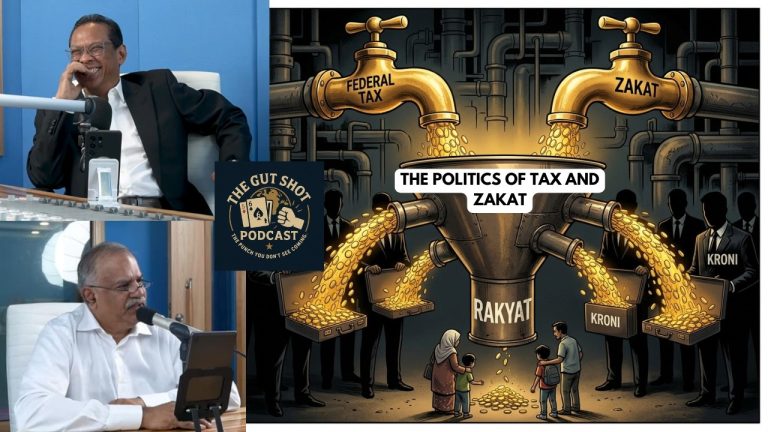
The Politics of Tax and Zakat
Show Notes & Description
How the citizenry gets ripped-off by a political patronage-influenced allocation of tax funds. A debateable tax administration system interlinking state-based zakat and federal taxes. Its all there and no politician wants to talk about it.
Are you tired of feeling like your hard-earned ringgit is disappearing into a black hole of empty political promises? Welcome to Episode 76 of The Gut Shot Podcast! Before we dive in, we want to express our deepest gratitude to our 5,500+ loyal subscribers for supporting us on this incredible journey. In this explosive episode, Syed Akbar and I pull back the curtain on the deepest, most systemic financial injustices happening right under our noses: the hidden politics of taxation and Zakat in Malaysia.
We hold nothing back as we expose how our national tax system has been weaponized over decades for political patronage and creating an artificial corporate class, rather than genuine nation-building. Have you heard about the shocking RM230 million Zakat fraud in a northern state that was quietly outsourced to an NGO? We break down exactly how this parallel, state-run taxation system operates without the rigorous SOPs of the federal Inland Revenue Board, creating massive loopholes and constitutional grey areas since Zakat is federally tax-deductible.
If that doesn't make your blood boil, we also dissect the treasury's plans to slash RM3 billion from healthcare and RM2.4 billion from education to cope with rising national subsidy costs. Yet, at the very same time, certain politicians are lobbying to spend tens of millions of taxpayers' funds on a "National Tahfiz Council" purely as a gimmick to try and buy back the Malay Muslim votes they have already lost. It is the ultimate betrayal: the elites "privatizing profits and socializing losses," leaving 34 million everyday Malaysians to foot the bill while connected corporate mafias dodge taxes.
But we don't just point out the problems—we offer real, radical solutions. What if we cut massive fuel subsidies, but in return, completely abolished all highway tolls and dropped Malaysia's artificially bloated car prices down to actual world market levels?
You cannot afford to miss this eye-opening conversation. It will completely change how you view your payslip and the government's budget. Hit play, get informed, and let's demand an end to paying more for less!
**Chapters:**
* **00:00** – A Massive Milestone: Thank You to Our 5,500+ Subscribers!
* **02:15** – The Dark Reality of Malaysia's Tax System & Political Patronage
* **08:40** – The RM230 Million Zakat Scandal They Tried to Hide
* **14:30** – The Constitutional Loophole: State Zakat vs. Federal Taxes
* **20:10** – Privatizing Profits, Socializing Losses: The Corporate Bailout Trap
* **26:45** – Slashing Healthcare by RM3 Billion for a "Tahfiz Council"?!
* **34:20** – Why the Old Playbook of Buying Votes is Failing Politicians
* **41:15** – The Radical Fix: Abolish Subsidies, Eliminate Tolls, and Slash Car Prices
* **48:50** – The Ultimate Conclusion: Why Lowering Taxes Will Actually Save Our Economy
*(Note: Timestamps are estimated for video description purposes based on the flow of the conversation.)*
Jump to chapter 8 chapters
- 0:00 Outsourced Zakat and Systemic Failures
- 3:46 Affirmative Action and Political Patronage
- 12:05 Socialist Safety Nets for the Corporate Class
- 15:12 State Zakat vs. Federal Income Tax
- 24:05 Privatizing Profits and Socializing Corporate Losses
- 33:35 The National Tahfiz Council Political Gambit
- 39:32 Cutting Healthcare and Education Budgets
- 48:21 Deregulating Fuel Subsidies, Tolls, and Cars
Auto-generated from YouTube captions. Timestamps link to the video.
So, lately, lately, we have had some issues with zakat. Some scandalous kind of things that came out in the media, I think in the state in the north. I don't know whether we should mention the name of the state or not. Mhm. But the substantial was about 230 million
million fraud. Uh yes. So, it was a very strange case because the the this zakat administration, when I say administration, the collection, how it is uh the money is spent and is managed or was sort of outsourced, you know, to a to somebody else, huh? To an NGO. Okay, I'm not going to mention name. It was it was outsourced to an NGO. Yeah.
So, I think this this happened in that state because we do not know if other states do this kind of things or or not. It's like our Inland Revenue Board outsourcing the collection of uh All that of tax
to somebody, you know, tax. In the old days, they call it the tax farms, huh? In old days means in old Europe, the the kings could could could authorize a tax farm. They allow some lord or somebody in one area to collect taxes on behalf of the king. So, what the guy will do is he'll collect if out of every 100, he'll keep like 70 and give the king 30, something like that, you know? And this is where wars used to happen because people started stealing the tax money. But Welcome to Guy Shot. I am Shamsul Sam. Today, uh I'm with Said. How are you, Said? Morning. Fine. Thank you. Um
Before I and Said start our discussion today, I would like to express our immense gratitude and appreciation to you, our loyal viewers. Guy Shot has passed in excess of 5,500 subscribers as of today. And in 10 months of Guy Shot, we are now at episode 75. Thanks to your support, sharing, and liking the episodes we have been producing. On top of that, you guys has filled the comment section with great commentaries, feedback, and support. And yeah, we read them all, though it's very difficult to respond to everyone. We try. I cannot express enough how grateful we feel. The efforts and time
we take to contribute in our this small way for a better nation feels worth it. So, let's continue spreading the word to others, bring more viewers, likes, and allow us to build a guide short community where we have truthful, sincere, intelligent, and critical conversations like nowhere else. So, again, thank you. Right now, let's go to our topic today, Sayed. Uh, we're going to talk about taxes. I think this is a very important topic. Um, there is a saying, there is only two certainties in life, taxes and death. Malaysians, I think, need to rethink how we trust uh, our government and how we
trust how that trust can be used or how that trust can be misused. And that involves money that we collect in terms of our taxes. We have 60 years of track record of our governance. Uh, and we have seen those that has been in power on both sides of the aisle over these six decades. Now, you ask yourself this question, if they were your employees, your staff, which effectively they are, our servants. The question we should be asking is, first, do we trust them with our money? On that note, I want to give uh, the the the the platform to my good friend Sayed to start us off.
Thank you. Thank you. Well, we are not uh, tax accountants. So, we're not going to leave give a on how to fill up your income tax uh, returns, huh? But, I think our discussion here today is very relevant. It's about the politics of taxation. Because in our country, in most countries, but especially in our country, uh it taxation is inextricably involved with politics. Mhm. And um So, today we'll have some real examples uh which came out in the news, which I will share with our viewers. But, um
I mean, for a long time, huh? Uh okay, we've had we've we have this affirmative action policy, yeah? Uh this was called under different various names, huh? But, we all know it as the new economic policy, Dasar Ekonomi Baru. It was formulated in uh 1970. And uh to me, lah, to me, well, the new economic policy was formulated after the ruling coalition at the time, which was at the time known as the Alliance, later became known as Barisan Nasional. And also closely identified with UMNO, the party which ruled the country from '57 until 2018. Uh they enacted this new economic
policy, affirmative action. Basically, in my view, it was a political gimmick. Because of the results of the elections in 1969, where they didn't perform They performed poorly, yeah? So, it was a knee-jerk reaction, where they crafted up the new economic policy. Uh well, it's ostensibly to help the Malays and Bumiputeras, the Malay Muslims and Bumiputeras in the country, to come up the economic ladder. Um Okay, there was a real need, huh? The affirmative action policies affirmative action is really needed in this country. there's no denying that. Now, but when you mix it up with politics or
the the politics of uh party politics, uh then of course it takes a very uh political uh flavor and it's colored by by party politics, lah. Hm? So, uh taxation, of course, is uh the only way for government to raise funds to fund to fund any projects or any policies. So, of course, uh taxation was a key component in making or the main component in making the new economic policy successful. Uh but the new economic policy, as I said, was very politicized and in my view it was a gimmick of the ruling party at the time. So, this is where uh what happened was in the administration
and the usage of tax funds, in all those years, uh it was shaped by uh ethnic and religious uh politics, uh uh of the political parties. You know, it's for the it's for their benefit, too. It's not really exactly for the benefit of the people, there was a there was a overriding overriding objective of the policy makers that by uh implementing such policies, use of tax funds, that well, that it would benefit the Malay Muslims and the country as a whole, but it would also enhance their survivability in politics, now. Hm? So, that was that is has been the beginning and also the still continuing
uh politicization of taxation in this country. It's still going on. So, can we um I I I I take that in uh in in my own words, I would summarize it in the sense that the uh, taxation policy and which include uh, not just collection, but also the allocation of the taxation money and how it's being utilized is more a function of uh, uh, political patronage uh, system colored by political uh, consideration rather than nation-building as a whole. Yeah, I would summarize it in that manner.
Yeah, uh, spot on. And uh, along the way, along the way, political patronage has has become like uh, the hand-in-glove, is it? Or the part and parcel of the new economic policy or the affirmative action policies by the government, uh. Uh, especially when affirmative action went from just helping underprivileged or poor uh, Malays and Bumiputeras to also help the emerging corporate classes, Bumiputera and Malay corporate classes, uh. So, affirmative action went all the way, not just from helping the poor, but even to helping the rich. So long as they were Bumiputera and Muslim and Malay, uh.
Uh, so you find that even Bumiputera corporates always had a leg up, they had access to various assistance. Basically meaning taxpayers' funds. Funds, yeah. so and of course in the political patronage system which we have in this country, um, it is not illegal, uh, but political patronage in our country is not illegal. There are We don't have any laws that outlaw political patronage. So, uh, definitely over time uh, a nexus, uh, or an axis developed whereby the recipients or the beneficiaries of political patronage uh also help the political political parties the ruling parties, you see. So,
it was like you scratch my back and I'll scratch yours. So, uh behind all this was uh taxpayer funds. Because without uh public funds taxpayer funds, political patronage will not work. So, you find that a lot of resources uh tax collection taxpayers funds will not only went to let's say underprivileged and poorer Malays and Bumiputeras, but it also went towards supporting uh an emerging corporate class. Even listed companies where Bumiputera could have access to uh various uh assistance uh in a direct or indirect uh monetary assistance, subsidies, and things like that, which all of it has to
be paid for by somebody, and that somebody is uh taxpayers funds. So, this has been going on for some time in the country. And uh now since we have 34 million people, you know, we have to see whether uh is this like has this have these policies outlived their usefulness in that there's not enough money, hm, you know. Right. I find that say this topic itself actually I I've been struggling in two things. One is uh on the basis of the uh collection or or or the um uh the amount of taxes that are imposed on the citizens itself. Right? Which is a very much a a strictly monetary policy
uh I mean a fiscal policy uh perspective. Uh the second part is what you just mentioned, which I mean which itself is about the allocation or misallocation of funds um that are from these collected monies. Whether it comes from income uh personal income tax or corporate income tax, these are actually money entrusted to the government. Um and then how is cash distributed? Right? Um even creation of GLCs um bailing out of GLCs coming out of uh uh uh or even company, right? Um the use of taxpayer funds. The setting up of uh state economic development corporations, for example,
statutory corporations. Um in state, sometimes we forgot the the these are supposed to these actually is what you call included in terms of the corporate class, so to speak. The creation of an artificial corporate class. You know? That in more times than not either they are monopolizing the business and therefore are inefficient uh inefficient capitalistic capitalistic system is actually a socialist system. If you ask me, there is a there's a two system uh in terms of tax revenue and tax allocation. We have a huge socialist system that relies on um patronage. And then there is the capital
system that is driven by the private sector that the social system pick up from. You know? It's a very weird system. So it's a So it's it's a double whammy, la. Yeah. Where to kick them off in business, this corporate this corporate businesses, uh using taxpayers' funds or assisted by taxpayers' funds. And then on top of that, okay, so that's already the first round of using public funds, yeah, money. And then as you said, they're given uh monopolies and licenses and this and that.
Mhm. Where they're able to basically make excess profits or, you know, because the market is restricted or closed off to other players, yeah. Right. So again, they get the chance to uh basically uh well, take out substantial amount of money from the public, the consumer uh without as much competition or or if they're monopolies, then without any competition. So front and back, the people pay. Cuz you know, public tax taxpayers' money comes from the public. And then when the public is also forced to buy the products from these companies set up with taxpayers' money, like the
GLCs, again, you know, it's public funds. So the public is basically screwed front and back. Mhm. You know, that's what is happening. The the other point that I've been maybe we need to uh put up up front is also there's a two there's a there's a parallel tax system going on. Uh one is the federal um and the state tax taxes um that is uh uh that covers every citizen of uh Malaysia. Then there is the uh zakat system, which is a taxation um on the on on Muslim. Um and uh for every ringgit, if I'm not mistaken, for every ringgit that is uh that a Muslim pays to zakat, they can
deduct that out of their uh taxation, their federal taxation uh obligations. Um however, the usage of the the of of uh uh of uh zakat uh is mainly for uh Muslim uh usage. Okay, there are there
Can you elaborate on this? Uh there are serious issues like with the zakat, yeah. Now, uh we are not debating zakat itself. Yeah, zakat is part of the religion and you know, it's it's one of the things that you can uphold in the religion. But let's talk about the administration of Zakat in our country. We cannot talk about Zakat administration in Islam as a whole. That's a very wide subject. But we can speak about our country. Correct. So in our country, all religious affairs come under the purview, the jurisdiction of the state. State. Religion is a state
matter. We do not have such a thing as a federalized system governing religion, Islamic affairs. There's none. Religion has always in the constitution is under the state and under the jurisdiction of the state rulers, the nine Malay rulers and the other four states who have chief ministers and things. So it is a state matter. So Zakat being a religious matter would also come under state. It is actually a state matter. So because of that, you know, the collection of Zakat, the application of Zakat, how to administer Zakat, differ because from state to state because there is no standard SOP.
Whereas our income tax and corporate taxes is under the responsibility of the LHDN, the Lembaga Hasil Dalam Negeri or the Inland Inland Revenue Board. Our income tax people, they are federal. They collect income taxes from the whole country and then their tax collections go into the the general ledger or something with the treasury, yeah. So that is government revenue. But Zakat collections are collected at the state under state authority and also administered by the state. So lately, lately we have had some issues with Zakat. Some scandalous kind of things that came
out in the media, I think in the state in the north. I don't know whether we should mention the name of the state or not. But it was substantial. It was about 230 million ringgit So it was a very strange case because the the this zakat administration, when I say administration, the collection, how it is uh the money is spent and is managed all was sort of outsourced, you know, to a to somebody else, huh? To an NGO. Okay, I'm not going to mention name. It was it was outsourced to an NGO. Yeah. So I think this this happened in that state because we do not know if other states
do this kind of things or not, huh? It's like our Inland Revenue Board outsourcing the collection of of All that of tax to somebody, you know, tax in the old days they call it the tax farms, huh? In old days means in old Europe, the the kings could could could authorize a tax farm. They allow some lord or somebody in one area to collect taxes on behalf of the king. So what the guy will do is he'll collect if out of every 100, he'll keep like 70 and give the king 30, something like that, you know? And this is where wars used to happen because people started stealing the tax money.
But this thing happened in this state where they outsourced the collection of zakat, the administration of zakat, I'm sorry, yeah. Uh to this NGO and then there were issues cropped up about, you know, some wrongdoing and this and that and so it was The funny thing is is the number is not small, huh? It's huge.
200 plus million ringgit, huh? So So again, this raises issues, huh? Because zakat is under state, under purview of the state, huh? Of course, when things go wrong the federal authorities have to get involved. The MACC, the police or whoever has the enforcement authority then so we have to use federal funds now to sort out the mess created by at the state level, you know? Now the other thing is what you mentioned just now that zakat collection is tax deductible. Mhm. It means if you pay one digit of zakat to your state Remember zakat the Yeah, yeah, state. Yeah. But you can deduct then the
remainder from your federal income tax. Yeah. So now we are like there's a back door linkage between uh the federal uh control federal federal uh regulations and state authority over uh zakat. You know, when when zakat it should be entirely under the state because Islam is under state. But then the zakat payment to the state is deductible from federal income tax. So how does that How that is To me that that has to be debated, huh? Right. See, I don't know you brought a good point. I think that's a good I mean, I wonder whether there's a constitutional issue that's involved
Exactly is the point here, you see. So because the state is benefiting from your zakat payment and the federal government and the federal income tax revenue is deducted by that amount. Yeah. So uh how do you uh How do you What Where does that sit as per the constitution? This is what I am curious, huh? Okay, so there issues with the administration of zakat, huh? There are no SOPs, you know, uh throughout the country. Different states have different uh ways of handling their zakat. And and there's They don't have income tax department kind of structure in the state to to
administer zakat. I'm sure at various levels they must have They must have something, but we do not know what is the degree of professionalism, the degree of following accounting standards, things like that. You know, we do not know. Whereas we know that our income tax boys uh pretty pretty sharp in their job. They have They've been doing it for a long time, and income tax collection is, you know, follows set procedures, you know. You can take them to court, you can you can challenge, things like that, you know. Uh so, it is well set up for a long time. But, the same
I do not know about the the the efficacy and the efficiency of the zakat administration at the state level. So, because zakat is a state matter, is religion Islam is a state matter. Uh and if it is not properly uh administered, I think things like this will happen again. This is not the first time that we're hearing negative reports about misuse of zakat funds, you know. Many years ago, I think more than 20 years ago, in the south, uh the people who collected zakat used the money to buy vehicles for their department. Uh you know, quite nice, expensive four-wheel four-wheel drive, because it
came out in the media. It became controversial, you know. That that people were saying that this is not the proper use of zakat money. So, these kind of things can happen uh because zakat is a state matter. Mhm. Mhm. So, I mean, I the other part about it as well is actually then is a question of uh um of of if if I as a Muslim, I pay zakat, uh it goes to Muslim Affairs. I don't pay uh the equal amount that a non-Muslim is paying on the federal level. It's the tax deductible.
Tax deductible my side, right? Uh but, the pool of the tax money, okay, from the federal side, or even the state taxes, right? All for the usage of all citizens, including the Muslim itself. But, nobody else has any uh right to touch. No, no, nobody outside of the of the non-Muslim uh authorities are able to or non-Muslim uh non-Muslims don't have access Don't have access to the to the zakat funds. I think there's a there's there's a concern there from I mean from a from from a fairness standpoint. Yeah. Uh
we also use federal money uh for Muslim affairs. I mean the I believe if I'm not mistaken JAKIM I think we fund annually 2 billion a year. Right? So, why don't they use zakat money for that? So, so uh to to tie it back to our discussion today, politicization of taxpayers' funds la. Yeah. Uh so, a lot of these a lot of taxpayers' funds uh used by well, basically politicians la. To for programs which also benefit them. It's for their survival, you know. Uh for example, I mentioned the new economic policy and things like that.
Mhm. Uh it is um there is a there is a saying, isn't it? Uh privatizing the profits and socializing the costs. You know, there's a saying, yeah? Privatizing the profits and socializing the costs or privatizing the uh profits and socializing the losses if there are any la. This refers to privatization projects, GLCs, and things like that. You know, when when government privatizes uh uh government run businesses or government-run uh uh institutions, yeah, which are involved in business. What we call privatization in Malaysia, it has happened, yeah? And then uh okay, so uh
then they go ahead and they start operating. When they make money, when they make profits, like the GLCs, they keep the profits to themselves. But when they make losses, you mention God, they are bailed out using taxpayers money. So, that is then you socialize the the the losses, the costs. When things go wrong, we go back taxpayers funds to fix it. When things go right, they keep the profits. So, this is like similar thing is happening where, you know, you use the funds only to benefit a certain community, but not everyone. Uh, you have you have 34 million Malaysians
who are well, let's say all we call them taxpayers, not 34 million public. Uh, they pay taxes, but uh, the taxes that they pay, uh, part of it is taken specifically to to assist one community. I'm talking about the affirmative action. So, already that is like uh, you are like uh, I do I keep thing keeping the the profits to yourself. Yeah. And I'm not sure whether I would even say that for benefit of affirmative action or whatever for one community. I think it's more for a class of people. I would call it class of people. And it's not the elite class. It started off okay. It started
off, you know, affirmative action, but now it has come to what you are saying. The the classes, the elite is the the the connected, the one cable connections. And and when you think about it from that standpoint, I can't say it. We think it from that standpoint. This is why I want people to start to rethink how we view tax, how we view taxation, and really to question the tax itself. So, so I want to say two things that are connected. One is the recent proposal for a Tahfiz Council. And before that, let me say that this this kind of policy making does not work anymore because
uh since 2008 okay when Barisan Nasional and UMNO lost a 2/3 majority it it was solid proof that they had lost the confidence of the Malay Muslim voter. And 2018 they were kicked out of power. They lost the elections in 2018. So despite doing all these policies which I mean I'm talking from the we view of the political parties, the ruling coalition at the time, which used these policies taxpayer funded affirmative action to get the votes of the Malay Muslim voter. Since 2008 this thing has stopped being useful to them. It doesn't work anymore. 2018 they were kicked out of
power. They lost the elections, you know, and 2022 was a even worse showing. No nobody could secure majority, meaning that it doesn't channeling this kind of taxpayers money selectively to help certain certain groups, eh. Well, that's what they said, huh. It doesn't it doesn't win them elections anymore. And in the in the in the in the last elections at the across the six states, you know, we had the six state elections in 2023, I think. Um for example like UMNO, they they state state seats, eh. They fielded candidates in like 119 seats or something. Yeah, uh 119 seats. You know, 108 108 seats
they contested, they only won 19. So it doesn't work anymore. But you you know, here's the very interesting part. Actually we are talking uh from this angle where taxes should be fair for everybody. Right? Um I look at it uh uh even I mean one of the things that hurt me a lot is because understanding business and and who contributes to the government in terms of its coffers, right? It's mainly actually um uh uh uh the richer people in the population whether we like it or not. The point. Exactly. Exactly.
the bulk of the of the of the um um of the tax are contributed by richer people and also richer uh capitalized uh capitalist corporations.
So, this this skewed this skewed uh uh collection and application of tax taxes taxpayers' money, doesn't help these our political parties anymore. As I said, they've lost power. You you it's discrimination. You collect taxes of 34 million people and then you use a portion of it to benefit one group of people who you think will be your voters. So, first of all, you of course the 34 million people will not like that too much, especially those who are non-Malays non-Bumiputeras. So, you lose their vote. I'm I'm speaking strictly from a political party and and
going to the polls from point of view. So, as a as a politician as a strategist, you're going to lose. You're going to lose this the larger 34 million voters. I mean, let's counting everybody together because you are taking their taxes and then you are you are using that money to benefit a particular group, the Malay Muslim voter, who also doesn't vote for you anymore.
Yeah. So, now they have lost both sides of the equation. Right. Let's Let's take the other side as well. Okay, if you take DAP and PKR which claims to be a multiracial uh, parties, okay? The discussion of unfairness on taxation that we are having today, I have not heard a single word from any one of the politician. Not a single word. But the people feel it. You can disguise yourself under any name, under any initial. You can claim that your party stands for this, that, whatever. Doesn't matter. You can even say that, you know, you're a party that will every year
you'll conquer conquer Mount Everest twice. What you can say anything you want. But the bottom line is when there's when the when injustice is, uh, felt by the public, uh, then you you cannot argue with the public. You cannot tell the public, "No, no, there's no injustice. You are you are just being, uh, over sensitive or emotional." You cannot say that. An injustice is an injustice. So, so bottom line is what I'm trying to say is that they have lost the the vote of the majority Malaysians, all all Malaysians, uh. Now they also lost the the vote of the Malay Muslim voters. So, what
exactly are they headed Well, they they're headed now they think that they can play a class warfare in this sense that if you listen to some of the way the politicians uh, or in the government have been talking about taxation. What they are talking about is say, "Let's tax more the rich. Let's tax more the rich." Here's the thing that I think our viewers need to realize, uh, those guys who actually, uh, getting patronage, they're getting bailout. They Some of the the people who are I think you hit the nail exactly on the head. Who benefits?
Yeah, somebody benefits. The people the people who are, uh, the the the people who when we read in the newspaper, those are that we read in the newspaper when they are frauds and they are breaches and whatnot and MACC come after them, your corporate mafia stories, right?
I think the right word is the few. Right. The people don't pay taxes, uh. Uh, the few, uh. Now people Those people you can see they are rich. The They got But they don't pay any taxes for whatsoever because they don't even They don't even They don't even show their their upper knee their their their tax returns doesn't is not even there.
I I mean I we have to go into their tax returns to verify that. But I I Yeah, I I agree. They are clever at uh But what I don't What I I'm getting at is this. One to to assuage the citizens, what they have done now is that is create an another class warfare. Okay? When before they were saying, "Oh, these races of people are earning a lot more than you all. We have to give affirmative action." Now they find that that doesn't work. Now they have to assuage also because they cannot talk about this unfairness among the community. So now they say, "Oh, we got to tax more
people who are richer and whatnot." Let me wrap up on the the Tahfiz Council. I'm going to add one more point what you just said before I forget on my favorite topic cars and tolls. Okay, recently again uh the main the political party that I mentioned earlier, they had their 80th anniversary gathering their anniversary. So they had a gathering. All their supporters came. And in in their political party uh gathering and assembly they sort of passed a resolution that uh the government should set up we should set up that uh or they want to set up a national Tahfiz Council.
I really do not know what this is all about. I tried to understand it, you know, it um uh If anybody's interested, please go and research on your own. It didn't make sense to me. Uh So but anyway, they want to set up a national Tahfiz Council. And the president of the party, because he's also a member of the government, uh he's in the cabinet. He said he would take it to the cabinet meeting to discuss this thing. I think the recent cabinet was Today is Friday. Uh 2 days ago. So, here it is a clear-cut asset It is a It's a It's a annual gathering assembly of a political party.
Of course, a political party will put up uh whatever resolutions which helps their politics. Win votes, huh? So, he says we should propose a Peace Council. And then he's going to take it to the government, to the cabinet, and get it try to get it approved. I do not know where it has gone since then. But the thing is, this thing costs money. Yeah. Although no exact figures were officially mentioned, but you know, in Malaysia uh there's nothing available for 10 million and 20 million ringgit, it's always now you got to go very far up north, you know? Yeah. Uh big
numbers, you see? So, again, they're looking at taxpayers' money. I I having access to taxpayers' funds to do this Peace Council thing, which because it is uh an usul, it is something that's proposed by a political party, definitely will benefit them in terms of what what they think they will get votes from their supporters, the Malay Muslim supporters. But the fact is, the reality is now uh it doesn't work because they have lost the support of the Malay Muslim voter. The Malay Muslim vote now is really split up. It's between various parties in the country. Nobody can
command a majority of the Malay Muslim vote. But these people are still trying to dangle the bait, using taxpayers' funds, uh obviously to get the Malay Muslim vote. It is a political party. It is This proposal came up at the at the meeting at the at the annual meeting of the political party that we should set up a National Peace Council. And most obviously using uh public funds, taxpayers' money. Which only goes to a certain portion of our society, but the taxes are collected from all 34 million people. So, here you are you again you are making 34 million people not very
happy with this thing. And the people who is your target, they also don't care too much about it. They don't vote for you anymore. So, but somebody has to benefit because money is involved. That's the few that you eventually end up talking about. Now, here's the problem as well. I think I think at the end of the day the conclusion we want the our audience to see is actually is misallocation of capital. Whether it's in I mean as in this case what we're talking about is is tax funds need to be disciplined. The way it needs to be disciplined in my opinion. This is my pet uh my pet uh
peeve so to speak my my pet issue. Like your pet issue just now. I have my pet issue. Which is I think the government I think one thing about the economy is that you got to make the economy more efficient. Uh in the sense that it has to grow more and it has to be allocated to actually things that are really productive. If you go and give it to the office council for example like what you mentioned, maybe a few tens of or hundred billion ringgit, we don't know. All right? Is that a productive activity? Is that going to create our GDP? So, there here's the question that I I want to
pose to our audience. I think if you look at it just compare our corporate tax rate compared to Singapore tax rate. Personal income tax rate compared to um Singapore. How they manage and how ours is managed. If you want to to have more economic activity number one I would say the first thing we should looking at is actually cutting income taxes and corporate taxes on a flat basis on on on everyone. Second part if you ask me is actually a um if if you talk about subsidies, every subsidy that you talk about whether it's uh whether it's diesel subsidy or even subsidy for green and green EV or
whatever is actually a negative tax. Okay? And all it becomes actually an allocation of taxpayer fund, you know, to that industry. So, whether that is a productive thing for the country is something you have to question. So, the the the the the question the the question that we all have to start re-looking at is is this. It's not to re- I I don't want to I don't want us to look at every end of the year the fiscal budget allocation. Yes, we look at that. Okay? Opex, how much uh and all that, but the government should be able to use more money to the right places
with lower percentage rate of taxation. This is what I want to propose. You see yeah, uh recently just recently the news came out that the Treasury or Ministry of Finance has proposed cuts in the government's budget for this year, the budget that was approved last year. The It has been reported they are want they want to cut about 10 billion ringgit in operational expenditure uh because costs have gone up that the So, where you cut going to cut from?
that the fuel costs have gone up because of the of the Iran war and things like that, uh. So, uh the subsidies have gone up because the fuel price has gone up. For example, RON 95, we're maintaining at 1.99, but the market is really about 4 ringgit a liter. Have they mentioned also then how much are they making from the sale of the 100 100 plus dollars a year? for of our oil? The the the cost of subsidies I think for all subsidies is going to they say that it's may rise to over 50 50 over billion. What about the revenue from the from the oil sales?
So so nobody wants to talk about So the the subsidy cost is going up which means the government has to bear bigger burden. And uh maybe have to borrow more whatever. So the the the suggestion is that we cut uh treasury says let's cut this year's budget by about 10 billion and where are the cuts being done uh your question uh? The cuts is health care 3.06 billion. Higher education 2.4 billion. And then there'll be also be some freezes on hiring civil servants and then postpone postponement of non-essential events and things like that lah. Uh So they're targeting a few others lah.
Uh there are also cuts to the Ministry of Home Affairs, Ministry of Defense and things like that. It totals up to about 10 billion. But health is getting cut 3 billion and education is 2.4 billion. Uh then why do you want to spend money on the staff is cancelled? Is it No this is where the the point I'm making is when you cut like this everybody has to bear the cut from Perlis to Sabah. Uh the Malays, Chinese, Indians, Dayaks, Kadazans, Ibans, Orang Aslis. Everybody bears the cuts all right equal because you're cutting education, you're cutting health right? And then you want to
create Tahfiz Council specifically obviously lah. Those people will vote for you lah. That's your hope. That's your theory. That's I mean that's your hope lah your your desire your deep down desire by spending money on the Tahfiz Council that you know but other people might vote for you, you know. Of course, you camouflage it with other things. Oh, you want to create better Muslims, good Muslims. Okay, those are things you can say, but you know that you're a political party and you're only doing this for your benefit. So, so here you are basically cutting 3 billion, 2
billion health and education from the whole country, 34 million people, but you want to set up something specific which will which will benefit mostly you, lah. Do you think the DAP will benefit from a stuffy's council? I I doubt it, lah. But so you see again, it is like privatizing the profits. You I mean, assuming taxation is is revenue, lah. It's revenue for the government, ah. You take it and use it for purposes that may benefit you politically at the polls more, but then you you get 34 million people to bear the cost, yeah. This is what they're doing, you know. Now, okay, it
doesn't work anymore, number one. It doesn't work because they've lost the elections, they've lost power. The the Malay Muslim voter doesn't vote for them anymore, so I don't know why they still keep doing this, ah. You you certainly aggravate the 34 million other Malaysians more. Uh but what it does is that what you said just now, where is the GDP? Okay, you spend the money. You know, it's frankly, yeah, I wouldn't mind if they take the money like you were talking about zakat funds and all that, instead of instead of 230 million zakat money being squandered, siphoned out,
you know, whatever they did, now, whatever happened, ah. If that 230 million was used to set up some fantastic new industry, you know, you are in order again. People might we can let generates which generates ROI of more than 10% and therefore boost the GDP of the economy, go ahead. Then I would say, let's all pay zakat because it's efficient. But the question that you raised, where is the GDP coming from where is the GDP? Yeah. I mean, are you generating growth to the country which benefits the entire country or or even benefits your target group? It is not happening. Why are we
But, I have to finish my point. But, somebody has to benefit. Yeah. It's money. Yeah. 230 million is a lot of money. Why can't we benefit the all our citizens with better hospitals, so more hospitals, more than more doctors. So, now somebody has to benefit. This is money. This is real money, yeah. 230 million, a billion here, a billion there, all this using taxpayers' funds. It is not going to the the bulk of the people feel that, you know, it's not coming to them enough. The target group, the affirmative action is also not working too well. But, who is somebody has to benefit?
Somebody's getting the money. Somebody's getting it. Yeah. So, this is where I want to repeat what the Sultan of Selangor said. Ah. Just recently, isn't it? Yeah. He said Quoted somebody She quoted Truman. Yeah. He said, "If your politicians are all I mean, not exactly words, huh? If your politicians are all very wealthy people, rich people, there's something is seriously not right with with your system, huh? It comes down to that. Mhm. You see? Yeah, so the question is do they care? Well, let's put it this way. From the from what we've seen, we can very much uh
make an assumption on that part. You know. Um I think uh I think they're beyond caring at the moment and I I think we as citizens need to really uh need to re-look at our our trust, need to re-look at actually how we are viewing and not not take them, you know, at face value. We are we are we are being taken for a ride.
We are taken for a ride. Yeah. So, I can only appeal to our fellow Malaysians, uh to the voters, yeah? Yeah. Uh you really have to open your ears and open your eyes, yeah, and assess things uh rationally, yeah? And uh we are being taken for a ride. Say, uh can I just say one thing, uh way I mean like it's very simple, you know, when they say, yeah, you know, uh oil price 100 bucks, man, okay, go up, they have to I mean the subsidies go up, man. Their revenue also go up, you know. Right? It's just the other side of the balance sheet, actually. Okay? It's it's just a it's just a yeah,
penny it's just a paperwork type of thing. Whereas the real money, yeah, that we should be talking about, that real money that we we talking about is what Syed has been saying about allocation, where it should go, is it to a productive activity? Where the and and actually if I really want to grow the economy, I want to cut the tax so that the economy is higher so that I got more absolute return even from a smaller percentage, then I get more disciplined in terms of hey, I want to build more hospitals, I want to hire we got uh we have a shortage of uh uh of of doctors. And we cannot place
them. It's messed up and we have more than enough medical schools in the country, private and government. The number of seats available place them. Uh I mean the number of seats we have, the number of medical faculties in the country, government and private is humongous, yeah? We have a lot of capacity, yeah? And then we have shortages. What's going on? Yeah. So, I mean at this stage, yeah, can I wrap this up? I just want to wrap up one point into my links house, yeah? Yeah. You see, yeah, now we have this issue with the high fuel price because of Iran situation, yeah? Mhm. So, uh I think uh
it's about 100 US per barrel, but from from from the way I look at it and from what is happening and the way things are going, there will be a leveling off, a stabilization in the in the world oil prices and I hope it happens soon, yeah? But you see, yeah, uh so the issue now in the country is this cutting the budget all that because of the increase in the fuel price in the country. So here we have subsidized petrol RON95. We are we maintain at 1.99, whereas the real market price should be about about 4 ringgit around there. I'm not sure. Okay, I I have a which I think is a better suggestion.
Let's remove the subsidies for fuel. Huh? Don't do it overnight. Don't do it cold turkey, but have a fixed program to reduce the subsidy on fuel little by little and then until and it's completely taken out. Meaning that if the world market price or I mean the market price for petrol in Malaysia is going to be 4 ringgit a liter, then so be it. 4 ringgit a liter. But so let the public bear the full market price. Exactly what we did with when we removed the price control on eggs and chicken. Remember we spoke about this earlier.
Then let the free market decide. decide. Yeah. When the price come down, let them compete. And people get used to it. But there is something else you have to do. You have to compensate the people. Remove the tolls. We've been paying tolls now. The earliest toll was collected in this country, I mean the the highway that we have in 1984 is 41 years. Abolish the tolls or drastically cut the tolls. The other thing is what we discussed earlier, the high price of cars in this country because of government policy. High taxation. Import duties, import taxes, the various
taxes and then APs or whatever, but basically mostly mostly the duties and levies which has bloated the selling price of cars. I think the example we quoted in the previous broadcast was a Toyota. Mhm. Which is selling for a 60,000 ringgit in Australia, but the same car sells here for about 90,000 ringgit, more 50%. So if we allow imported motor vehicles to be sold in this country at world market prices we don't want any special price yeah just normal market prices that it will save the public a ton of money then the public will not feel as much of a pinch in their pockets if to pay
full price for 1 L of petrol if there are no more tolls you know today to come here so I had paid 250 just to come here Intra City tolls if there are no more tolls and our motor vehicle prices reflect world market prices lower then it won't be so difficult on our pocket to suffer petrol prices also at market rate if it's going to be 4 ringgit a liter 4 ringgit a liter what to do most a lot of countries are I mean you have to you have to face up to the reality of what is the market price Don't go turkey remove all subsidies but do it gradually over a over a period of
time but ultimately remove you have to remove something you have to remove all the just like we remove the subsidy the price control on chicken and eggs you know the same thing we have to go through the economy and remove all the subsidies so that the government doesn't have to say weird things like our subsidies are going to cost us 58 our billion therefore From our hospitals 3 billion in our hospitals and 2.4 billion in education that is insane that is what you should not do you know you if you apply policy taxation in the in Not in not exactly you don't use things
like in the right way just do it as as how the market dictates it everything will be fine well if you do it in which the way the market dictates it right if that's the way you're going to do it all right the the The is also in your government expenditure you have to be efficient in terms of your allocation. You got to put money where it is required. And you don't you don't put money where that is not productive. We've already spoken what is productive and what's not productive. So, to me, my main principle is very simple. It's very it's like this. If you give your children
if you all you give your kid $50 a week, you know, 50 ringgit a week, okay? And don't tell and and let him money buy whatever he wants to buy, you know, he'll stuff himself with candy and get fat. All right? But, you know, it's going to make his health worse. But, if you give him 10 10 ringgit and then you tell him, "Okay, now you have to figure out exactly where to put this 10 ringgit." All right? He'll probably know how to use that 10 ringgit and maybe open up a lemonade stand and start selling lemonade. You know, this is where actually I think we should be demanding our government to
actually bring down the tax rates so that we can generate more economic activity and actually in the absolute term we make more money in terms of revenue. And then also then maybe they will start to be to feel the pinch of I better make sure that there's no corruption so that I don't have leakage from my taxation income that I can collect. I mean, this is the kind of thinking that need to be in our citizens' mind when we demand from our politician. Can you use less money for more or not? Can you ensure that there's no leakage of the money I give you or not? I mean, that's my closing thoughts.
Kalau you not about It should be why pay more for less. Yes. Thank you so much. For today, that's taxation for you and the politics of taxation. Uh, thank you. Thank you.