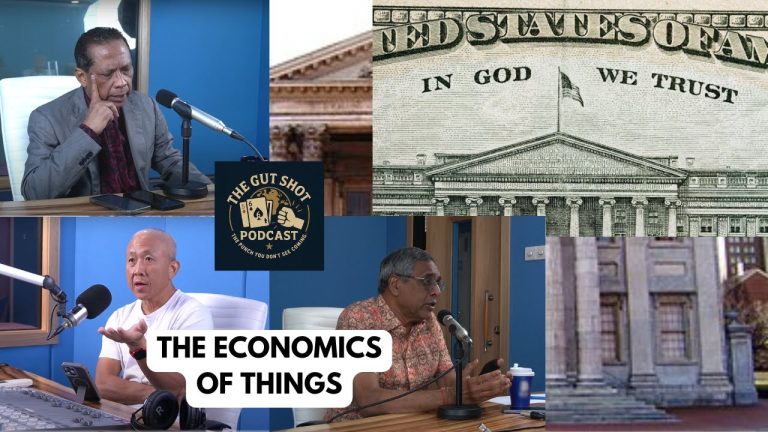
The Economics of Things. feat Ravindran Navaratnam
Show Notes & Description
Our guest for this episode, Ravindran Navaratnam, is a corporate and financial restructuring specialist. This is for something completely different. Its a wide range talk of economics and comparisons of economies including the US, UK, and the EU. The historical success of the American economy and why – the impact of its foundational institutions. What's up with the Federal Reserve and others including the CDC and the Judiciary. We talk inflation, monetary policies and CPI. The final days of ESG and the need for cheap Energy.
From our perspective as the hosts of The Gut Shot Podcast, our 17th episode was a fascinating and robust discussion with our guest, Dr Ravi Navaratnam. He joined us to share his personal views as a corporate figure interested in economics, clarifying that he was not speaking on behalf of the Malaysian Economic Association or his firm. Our goal was to understand how global geopolitics and major macroeconomic developments are affecting Malaysia and Southeast Asia, starting with the impact of Trump's economic policies.
The conversation quickly evolved into a dynamic debate covering a wide range of interconnected topics. We explored the short-term and long-term consequences of current US policies, the critical role of strong institutions for economic prosperity, and the potential restructuring of American institutions like the Federal Reserve.
A significant portion of our discussion involved a spirited debate on the nature of inflation, its calculation, and its impact on monetary policy, with differing views on whether the standard metrics truly reflect the economic reality for the average person. We also touched upon deregulation, trade tariffs, the importance of low-cost energy, and had a lively exchange about the validity of ESG (Environmental, Social, and Governance) principles and vaccine science.
Ultimately, the conversation circled back to what these global shifts mean for businesses and countries like Malaysia. We agreed that adaptability is key to survival and potential growth in this changing landscape. The discussion highlighted that while the short-term effects of global policies can be disruptive, they may force economies like ours to become more efficient and competitive.
Interesting Segments of the Discussion:
Here are timestamps for some of the key moments and debates in our conversation:
• [00:03:08] – Dr Navaratnam discusses the Nobel Prize-winning research that proves strong institutions are a prerequisite for a country to become rich, and questions how the US might be dismantling its own.
• [00:09:47] – One of the hosts challenges the view that US institutions are being dismantled, arguing instead that they are undergoing a necessary "restructuring" to correct politicisation, citing the Federal Reserve and the Justice Department as examples.
• [00:15:28] – The debate intensifies over the policies of the CDC and pharmaceutical companies, with a host sharing a personal story of reversing diabetes by going against standard dietary advice, arguing that these institutions have been captured by lobbyists.
• [00:21:40] – A detailed and contentious debate begins on how inflation is calculated, with one host arguing the "basket of goods" is a flawed and "fallacious" metric for setting monetary policy, while Dr Navaratnam and the other host defend its use as a necessary relative measure.
• [00:32:00] – Dr Navaratnam strongly agrees with Donald Trump's past criticisms of Germany's energy and immigration policies, sparking a discussion on national reform and the legacy of leaders like Margaret Thatcher.
• [00:37:37] – The conversation turns to ESG, with Dr Navaratnam quoting an expert who claimed "ESG has had its day," leading to a discussion on the importance of cheap energy for national prosperity and questioning climate change policies.
• [00:55:08] – The hosts and guest explore why the US remains the most innovative country, debating the roles of meritocracy, immigrant culture, and strong foundational institutions that enable success.
• [01:09:07] – The discussion concludes by summarising the potential impacts: short-term benefits for the US domestic economy but long-term challenges for the world, which must adapt quickly to survive and potentially thrive.
Many thanks to CITYPlus for their collaboration with The Gutshot Podcast, in whose studio this conversation was recorded. CITYPlus is Malaysia's first Chinese business radio station, dedicated to delivering in-depth analysis on local and international current affairs, markets, and businesses.
Jump to chapter 8 chapters
- 0:00 Global Macro Shifts and Institutional Economics
- 9:57 Politicisation Versus Institutional Restructuring in the US
- 19:52 Debating Inflation Metrics and Monetary Policy
- 29:50 Deregulation, Tariffs, and Supply Chain Realignment
- 37:48 The Demise of ESG and the Need for Cheap Energy
- 52:10 GDP Dynamics, Productivity, and the AI Revolution
- 1:09:07 Labor Policy, Immigration, and Human Capital Retention
- 1:19:10 Final Takeaways on National Adaptability and Economic Survival
Auto-generated from YouTube captions. Timestamps link to the video.
Well, good morning. Uh, good morning. Welcome back to the Gutshot podcast. U bit of a change from the norm. We as mentioned we have a guest today and his uh name is uh Ravi Navaratam or rather Dr. Ravi Navaratam, corporate man and uh I think why we're talking to talking to you today uh Ravi is because of your position in the the Malaysian corporate sector. Uh you head up the Malaysian Economic Association. So it it matters because what happens around the world affects Malaysia as an externally traded nation and uh we we are here I guess to seek your views as to how global
geopolitics and big macro developments are affecting Malaysia and in fact uh business in in Southeast Asia. So welcome to the show Ravi and of course uh thank you for joining Sam and myself this morning. I think we can start the discussion with your views in the last 6 months maybe in terms of how the Trump uh economic policies have affected the rest of the world and especially as aan in terms of the tariffs and just you know headline uh a summary of what where where you think the world is going.
Okay, first things first um I am I mean let me be just clear um that I'm actually not speaking for the Malaysian Economic Association. from the vice president or even for my firm H3 but I'm happy to share my views as a as a person which is really interested in economics um it's my views um and how I see things um as a corporate person we also do certain things uh in in in dealing with them there are things which are short-term
and there are things which are long term okay so short-term things um you know uh is of course I mean some of it is very basic economic theory Right? If there's high risk, yeah, um you will actually expect u you know uh slow down because it's harder to invest risk risk you know induced risk. when there's so many shifts in policy then what we're used to changes right so we can see a lot of running around uh you know trying to respond basics also comes around this right so the countries that will survive and if Malaysia is going to survive is the ones who can adapt well so you can
see very quickly how people have adapted to how they deal with Donald Trump now you can see how President Zilinski in his first meeting and how he's changed going forward yeah a lot of it is you know pandering to uh uh President Trump's needs. So that seems to work and UK is probably very good at that. Uh they you know the pro all the countries now are rolling out the the red carpet when it comes around trying to get deals etc and so on. So if you look at it so short term uh you know if there was a trajectory for growth it would slow down. We would expect some slowing down
from this tra doesn't mean it's a recession right that's the first thing you got to understand. Now then then there's a a issue around long-term how does these things affect long-term uh things right now I can imagine uh even from the president's view that there are things that they feel strongly about and they rightfully how they perceive things how they make sense of the world could be different from how we make sense of based on our history and so there's a lot of science around this and research guy called Wyak had done a lot of research around this and how we make sense of the
But what I do know is when you actually start dismantling institutions and the research that obviously uh Ismagloo did and they won the Nobel Prize in 2022 uh it actually tells you when you break down institutions u this one so there's a very good debate around the world are rich countries rich because they have good institutions or do rich countries have good institutions this is very important uh question which which way is the causality of this thing And uh the research finally did show it very very well and that's why they won the Nobel Prize for it is that actually you become
rich by having good institutions. Now how much is the United States beginning to destroy its institutions? Yeah. And how how could it affect it? So you could do many many studies on on this and there are probably you know uh you can do a lot of economic research around it. And some of the things that you could do around that is so is it you know a lot of things say oh you know is it communism versus democracies or whatever it is you can have democracy but you can have lousy institutions right and that means this and sometimes
well we've seen a lot of that but more but there are more obviously authoritarian governments with worse institutions than democratic countries. Yeah. So they're generally deal. So you can see countries like the US right uh previously and they actually have you know even like Malaysia for today right what's what's happened you know forget the criminal part of the legal system right forget the criminal part yeah of the legal system but the commercial part is uh judiciary right it's really uh just related to the uh to the judiciary right judiciary has improved
tremendously yeah especially with the previous chief justice and there was a lot of concerns about the judiciary here but if you and I as a businessman Shamsul you know very well if we have a dispute okay other than breaking people's legs which we don't hopefully don't get around involved in that we all want to go around to go to court and have our day 99% of the time we just shake hands we know each other we do business but that's there are times the contracts go wrong we have to go to court at least today we all believe we can go to court in Malaysia be even the
the most powerful people for a commercial case the hearing can go in your we'll go you know you get a fair hearing in on and that's tremendously important uh for doing business right and so again a lot of things and life's a lot easier if you know the rules right so the tariff is today 20% and it's 25% and 30% it's it's just difficult right so when when and a lot of the things and I was just before the show we actually I just mentioned to you I had I had the distinct privilege of working with uh you know Richard Reeden uh when Malaysia wrote its first financial services plan
way back in 1997 He was the securities commission chairman and he was in the old man Bush uh uh cabinet administration as well. Yeah, he was in the cabinet. So anyway, and one of the things that he shared with me at length is you know he said you know unlike everybody thinks America's laser fair is a fair and no they do a lot of planning. I mean just if you imagine if you just looked at watch that uh movie on on Oppenheimer you see just the amount of planning and how America can pull resources together to get things done. So even when again in a lot of the research again when they
did Obama care uh there's a lot of thinking a lot of econometric studies before policies even now that's one of the problems we we probably lack in emerging markets we probably have leaders who don't know about it
or and probably we don't even have technical people uh which don't know enough to actually advise the leaders what to do so a lot of um you know policy is uh driven by gut feelings but that's the right show for it I suppose.
Yeah. uh and you know um you know hubris what I think it is I believe this to do with and one of the things that Malaysian economic association is very involved in trying to get people to start thinking about is let's let's uh start doing things more around in you know uh uh on based on evidence yeah uh proper analysis research policy which is driven by evidence so you're coming back where we think it is going um in the short term it's a slowdown and if you probably look at seven years down the road if this continues we probably might say you know oh what a missed
opportunity it's been uh because of all this thing so in the short term yeah of course US is now benefiting from uh tariffs and the budget is being reduced or at least they got more money into the government coffers uh but that does that mean uh is going to be good for the long term perhaps not perhaps
when you say long term um are you talking about America specifically or you're talking about global I would say the globe as well Because uh one is like it or not, America is still the largest economy in the world,
right? Yeah. Um you know when you look at you know the other day somebody said oh China is going to start exporting to Brazil and and Africa. Okay. Yeah. The exports have increased but has anybody sat back and look at those countries? Do they have a trade deficit? It's one thing to sell to America with a trade deficit because I'm quite happy to take US dollars. What am I going to take from Brazil? What am I going to take from Nigeria? Exactly.
Yeah. What am I going I've been saying that too. Yeah. So again, you know, so once these countries get into the dual problem of our uh budget and trade deficit, you know, what are you going to export to these countries? So for us, all of us like it or not, we're all happy with American dollars. Yeah. America runs a big deficit, but we're still happy to hold it, right? uh and or for that matter what we call monetary sovereigns uh maybe UK sterling yens euros uh we're probably happy sing dollars and to an extent for us we are fortunate people are happy enough to hold ringit uh
Singapore for example monetary authority of Singapore one of their largest holdings is Malaysian ringit right so yeah one of our highest you used to be I don't know if it still is but it used to be right they why would they hold it when they no because a lot of their trade no they can they can trade a lot of the trade buying things stuff go with Malaysia so Okay.
So, it's an important currency to them and I think central banks in Southeast Asia probably hold it. I'm not sure. Uh but you know it's uh it's been a reasonably good currency over a long period of time. We've got a good central bank. So again when you talk about institutions and you talk about how important institutions are we have good institutions I know some of us have reservations on what we're going to say but you know we have EPF till today. You know I don't take out my EPF money. I'm confident enough that 6% return is very very safe. Yeah. uh we have good
institutions in central bank um you know um some of the things more recent with one or two of the institutions have been more tricky but you know may I jump a bit uh since you're talking about the institution and the the short-term impact on the institutions uh let's let's let's focus on the American institution uh changes that Trump administration is doing
right I am of the view that um the institutional changes uh that is being carried out is actually a necessity. Um it's a shortterm um it's a shortterm uh for a lack of better word for for opposition you would call mayhem but I think if I were to look at it I would call it a restructuring of uh of uh broken institutions with respect to how much um political how much politicization that has happened within um the last maybe two decades. That's my point of view from looking at uh I mean uh how even the justice department especially uh in uh after 2016 after his election right
that uh went after uh Trump um which was never happened before in the history of America where law was used to go after a political opponent in that manner. Um also I think I think um there's a lot of um um so I think to me it's a restructuring of the institution itself to be more proactive to business. So I don't know I mean I
I'll probably I mean look uh it's too big a subject for any of us to know in detail right they're just too big it's not but if I were to raise concerns and there's enough reason to worry Uhhuh. I would say one is the Federal Reserve.
Okay. All right. And what's being going on there? That's what what what what do you think is going on there? No, because it's always been so far the most of the thinking today is the uh monetary policy should be independent of government. Okay. Monetary policy should be independent of government. That means I don't get a boost on cutting interest rates and run inflation out just because I need to time it with certain election uh ideals. And that's been a big big thing uh for the longest term and the countries which have had separation of the monetary institution the monetary
policy by the independent central bank have done well. So that's that's pretty clear. So now if you're saying we're running at inflation at a certain percentage and no I need growth to happen because I just think so. Um that one of course there was a lot of concerns. Markets did move. Yeah. Um and you know you got to let the you know it's it's one thing to say you know I say it's 25 plus 25 and so far in fact if you look at the nom new nominees came in it's not off a lot right but suddenly if you're saying oh we're going to cut 200 basis points then of course you'll
get concerned right yeah so again how much has been played up and how much it is even this the new people coming in how far is it going to shift um it's not going to dis I mean there's an old story of vulkar when he had the high rates uh and I Um uh Ronald recalled Ronald Reagan and Ronald Reagan said you know he said come to the White House and said no no I'm coming I'm independent yeah and Reagan then went to see him but brought the constitution with him and said you know who really has the power but I think the laws have changed um on that and the congress you know can change laws uh but
as it stands that would be one of the areas to be concerned the other one would be on the drugs on testing of drugs and and how you make decisions on drugs unks. Okay, that would be a concern if you're dismantling uh stuff that's been there for a while. Uh and if there are, you know, um it's done more on, you know, not properly done scientific studies. At least that's one side of the concerns. Uh that would be two real areas that, you know, it affects everybody.
Okay. And I I would be duty concerned. now is uh you know is is is you know everybody had too much of a right to you know to be processed on immigration and could get away with nonsense or whatever it is or you know um too much of it and too much this one possibly yeah again it's beyond my pay grade I wouldn't be able to tell you that uh and you know uh there are obviously people who are supportive of what's going on on the borders and so on or some will say how it's being done is an issue uh et so different different things or trade yeah um how do you how you deal with your uh
you know uh you know long long institutions in terms of uh all the bread and wood institutions I probably also probably agree they're all bureaucracies and not as effective as they should be and probably needed uh u good u you know shock to the system yeah
uh so a lot of the probably a lot of the bread and woods uh institutions probably need to be reooked at around 80 years right I I I so they probably need some re re overhaul anyway Yeah, I think we've we've done actually personally we know each other. I mean uh we've done two restructurings together of corporations and uh you know my mind sometimes come to the about the point of where you're coming from on on the restructuring side. That's where I'm coming from when I look at it. I think certain things that has been informed from the mainstream media gives that kind of impression
um to a lot of people about uh about what was before and what is now right in my opinion for example what I saw was the Federal Reserve was very much trying to help Biden in the last election you know I mean we've got at that one point that the highest inflation rate that was at 9% you Um, and then you have a situation where u actually at this point I'm I'm I'm sort of puzzled and maybe you can help me uh put this together. U you've got an you've got uh fat rate at about at at at more than 4% what 4.2 and
four and a half% 4% yeah four and a half four to 4.25. Yeah. Gone. Yeah. Right. So now they've cut by 25 basis points. So that's we looking at now 4.25. M right when you look at Europe and you look at Singapore it's way lower and their economy uh I mean actually you look at Singapore economy they're doing very well. Yeah. So it's you start asking yourself then actually was it not politicized before? So that's the first thing when I look at the Federal Reserve. The second part is uh and and whether then this is I've sort of been I mean I don't know how you felt about it
uh Ravi but I've been I've been extremely impressed by Scott Basset and how he has been articulating their policies. The second part of it is for example when you talk about uh judiciary uh and what was that you were talking about judiciary as a second part or
No talking about drugs. Oh, drugs. Yeah, there you go. About about about drugs. So, you're talking about the CDC and the the the farmer. I actually co woke me up, you know, right?
CO truly woke me up about what I saw to me at least and that is because you got stuck in the house for two years, right? And being the the the the the you know how how I am being partly an organic chemist type of thinking, right? I just did not get the policy that was being implemented. I was not happy about having my uh myself to be vaccinated and and having to to sign off a waiver uh from the pharmaceutical companies uh when uh when I know for certain I'm the guinea pig um then you know when I look at what was happening with respect because I was having diabetes
right and actually I did my own research um and instead of following um the uh the standard American diet that's taken out by the by uh by Health and Human Services over maybe four decades.
I basically went the other way around and I reversed completely my diabetes. I don't even have to take any prescription drugs anymore and my obesity is gone. I lost 25 kilo in eight months. I've never felt healthier. M so I think those two inst those especially when you talk about drugs right I think those that institution to me has been captured by uh the farmer uh the farmer lobby you know I I I just got back from the states uh last month right it just reminded one thing to me you know when I watch uh when I watch a football commercial no sorry when I watch a football game
um out four commercials there's going to be one big commercial by the pharmaceutical company so the pharma lobby is immense you know and I think that place need a total cleanup so the third part that you keep so this these are the things that I think I feel that it's uh it's it's a it's a shortterm restructuring but then after that we'll have to see how the long-term play out so I don't know I mean that's Okay, if I ask you a simple question, what's the inflation rate in Europe?
What is that? What's the inflation rate in Europe? I am not that much of a followup on the inflation. So when we look at the So you talked about the the European rates and inflation is well below 2% in Europe. Yeah. So therefore the European Central Bank can cut the interest rates. That's for sure. Right. All right. That's the first thing. Right. So again, we must be understanding policies and a little bit.
In the first place, how do you formulate inflation? Sorry. How well how do you formulate inflation? Inflation is a basket of goods. Yeah. And and that basket the formulation can Why is their inflation rate so low? Because the demand is low and they probably the money supply is probably as much not as much and the the demand factors are probably a lot lower because America is in a boom. Now one of the reasons that again which is being said around whether this one or not, you see Donald Trump had already expanded the money supply. We know this from monetary policy, right? he's expanded the this
one with the co Biden came in of course with a you know the usual Democrat um mandate or spend and of course you know infrastructure in America has is today pretty good to US airport it's awful compared to any Apple around the world right so there was obviously money needed to be spent on infrastructure but it was a wrong timing to spend so you money supply huge amount then further supply and you know your your deficit went up to 7% of course you're going to have inflation right and then of because they all thought it would, you know, they I mean rightfully or wrongfully, uh the Fed thought it
would come down quicker than it is because it was a shock and come down quicker. It didn't. What do you mean inflation? Inflation would come down. Okay. So, they actually had to further increase it. Um so, I mean, you know, we can all speculate unless we have proof that, you know, the Fed was directly involved in having covert conversations with the Biden administration did things, which I I would hardly believe because there's no evidence of that. And then when you come to Singapore, you actually Singapore is one of the most unusual countries in the world. Gokenui did this
many many years ago. Singapore controls inflation by currency, not by interest rates. That's a very different model. It's the only country in the world which I that I know of which actually does that. Right. And also inflation is very very low in Singapore. So actually
inflation is low in Singapore. Yeah, it is low. Yeah, it is. And when you talk about the numbers, when you talk about numbers, look, you can say whatever you like about inflation, right? You're comparing last year with this year. Whether the the basket is good or bad, that's for a debate for another day, right? But you're comp there's it's not absolute numbers, you know, it's a relative number. It's a relative number. So that's why when you say, oh, what's a basket? It's all it's a meaning it's a meaningless discussion, right?
Well, yeah. So the the way governments calculate uh inflation is is in itself open to intense scrutiny, right? Because No, it's not. It's because what you put in the basket, right? If you talk to any ordinary Singaporean with an average uh household income, they would tell you that prices have gone through the roof.
Okay? And then there's a lot more thinking today around that than it was just and then the Philips curve from the 1970s, right? It does not wage and inflation anymore, right? There's a lot of behavioral science. So now suddenly people think inflation is very high in America. Why? Because Trump put tariff on coffee. All right? And that has a direct relationship because you're buying coffee all the time. So it's in your mind, right? So there's a lot things are which is behavioral and there's a lot of things which are
So that's the inherent problem with inflation, right? No, no, no. The numbers method is perfectly fine. At least in my in my mind, right? And you know and you keep changing the basket. Now is it the average Mr. Malaysian which buys these goods? I don't know. Right. But it if you look from one quarter to another quarter, it tells us something. It tells us something from this year to last year that it definitely tells us, right? But what's what's in the basket?
It doesn't matter. The absolute rate. No, it does. It does matter. No, it absolutely doesn't matter. The absolute rate doesn't matter. It's it's a guesstimate of what people are buying, right? And that basket is is facious. It's it's it's it doesn't represent the real In fact, I would say that inflation is one.
How do you know it doesn't represent? Well, your inflation and my inflation is different, right? Yeah. But country can't run on your inflation, my inflation. Correct. It has to have a it has to have a means of what's right for general population.
Wow. I do. So you're trying to capture the a whole country's What would you suggest otherwise? Well, let's put it without going into this. No, no, no, no. What would you suggest otherwise? No, this is a good question, right? The thing is
the the policy makers, for example, the central banks of the world, right? They they hinge a lot of their of their decision- making on key numbers and one of those key numbers is inflation. When that uh core component of number is is is open to question in terms of its computation then by correlation if you're if you got rubbish going in you might have rubbish coming out and that's why maybe sometimes people say oh uh interest rate policy uh is is off the mark right to to me and and I would say that between you the three of us in this room and of of course wing as well all
of us have got different inflation numbers because you buy different you buy different things I buy different things I just have to beg to disagree agree with you. That's how I move on. Right? Because for me um you know we have one uh OPR rate and we have one inflation rate unless we can have 50 million economics of each one person. That's not possible. Right? So let's uh
I I I think I I tend to agree with uh with with Rabi on this one because why on the absoluteness of a of an inflation basket, right? It is very difficult for you to put on everybody. So what you do is you average or you you sort of like average. What I'm saying is that
and then you look at the difference between one SCP between one year to another and that's where you look at whether inflation rate goes up or inflation rate goes down. So I think yeah I think without going to the rabbit hole of this
okay can I just give you where you're probably right and give you some dis you've actually you've got actually a good point and I'll share with you look at Magnagarash report this year it's very well done on that very very point you're talking about. Okay. Bangar and Malaysia.
Yeah. Have you read the report every year? I read it every year. It's a very good report. It's very very well done. It's very well written, right? And one of the most important things is okay if you talk about inflation, right? And there's a methodology. It's a huge methodology and how it's done, right? And there's something called a deflator as well inside. So this phone goes up in value, but where they calculate the inflation, it may have not gone up because they say in theory it's got more capacity. It can works faster. So it's considered actually coming cheaper. So
there's a deflator in it. All right. So one of the simple questions if I asked you the other one which you want to talk about is per capita income. Yeah. Per capita income. You know that doesn't happen if I won't mention I've got on on the podcast I wouldn't mention names but you know we have some names of some super billionaires. If all the money went to him and none of us got the money Mr. X the super billionaire on average the per capita income has increased but none of us got richer. Right.
Agreed. That's the problem with India's economy if you ask me. I don't know India or whichever country. But I mean definitely when I look at um at India's number just let me finish this this point I'm trying to make. Okay. So per capita income has gone up and inflation's going down
and this is the point you're really making. We should all be feeling richer. Correct. No. But we don't. No. Well, the point I was really making is the it is inherently troublesome for policy makers, for example, those dictating monetary policy to hinge their decision on on several key numbers. One of which is inflation and inflation is inherently to me fellacious because the basket itself doesn't reflect it cannot really truly reflect.
Okay. And let me come and let me finish on this one. So you'll see why it's it's relevant to what you were just saying. Okay. So in theory we should all be better and and that that this one is because of that relative number it's got a this one and and I will come back to this a little bit more later on on why there is there's rational inflation and and and and and policy rate. Yeah. So one of the things that um we know is that look so what Bank Nagara actually did. Yeah. They then looked at they looked at B40 median income.
Okay. So B40 is the bottom 40. Yeah. B40 is median income. And you can look at the graph in the central bank is very well done. B40 income is just stagnating or hardly growing. Nowhere near the average per capita income. The second point is they looked at the things which are important to inflation. Food, transportation and security and that one is going a lot faster. Like it or not, this this phone is part of inflation also. We do buy it. Yeah, you can't say it's not. And it has probably a deflator and it brings down the number, right? And they actually looked at it. That's why people are
worse off now because the average at the B40 level the median is not going up because it's not influenced by some super rich guy getting a lot of money and the c the thing which so they're actually aware of it but on the other hand if you look at the policy we can go back 40 50 years the basic inflation number and and like I said there's a lot more science around inflation now uh than it was just than the mere Phillips curve and interest and wages right which is the two um two main issues that you know the central banks have and and no I'm by no means would claim to be a
central banker or you know on this one but are the two main mandates to make sure that we have employment and low inflation that's the mandate right where does 2% come from that was a number they came up from no one you know it's just been there right 2% but on average over years and years of data we've learned that to be
pretty okay people are generally okay kind of number and similarly you know and they look at interest rates and this one they can see as they as they tune the interest rates up inflation does come down And and it's not like the late ' 80s where you know Walker had to go up almost 17 18% right uh to get this and it affected all over the world if you remember in the old days we used to have finance companies simulation you went to supreme finance you could get 13% interest right yeah you could get it right so there there is these things these are not this is not natural sciences
where which is V is equal to IR when I learned engineering it's been V is equal to IR forever well let let me pull it back let me let me pull it back to uh to the talk of I mean we we've touched the institutional changes to a certain extent and how I look at it and how you look at it.
Right. Um but let me pull it back to uh the u the the macroeconomics of um on on just a touch on inflation before I close it. I think one of the biggest thing that Trump did was to to um to deregulate because he's he's looking at three three aspects right trade um uh bring down taxes and bringing down the regulation and that allowed actually also uh further drilling to happen and uh production to happen which allows for fuel for for energy prices to come down.
Okay. um in in that regards then it comes to the AIF talks that we are talking about to me is also a rebalancing of trade um and here comes the long and the short impact of it as you rightly put um for the American economy is still the largest economy that no you know people want to export to
oh happy to have US dollars happy to have US it's a reserve currency yeah which means that which which means that for those who are um who are fighting um for that market they have to be competitive and they have to swallow some of the uh some of the uh import rates. If you ask me for example, I did brought this up. I thought it was quite quite interesting that Indonesia, Thailand, Malaysia, Philippines um uh that were doing uh and Indonesia that say for example textiles and and whatnot are all approximately the same tariff rates. So you guys fight among each other,
right? Um and that actually in essence why energy and actually also the other part of uh of importation into US in spite of the uh tariff rates uh did not spike the inflation the way it's been talked about that it would even cause a recession. remember when he was talking about tariff in the uh in the early parts then this then the other part is so in the longer term actually the world has got to adjust and what I found is actually we were talking before you know about middle income trap um uh the so-cal middle income trap or developing countries or what they call resource uh
the the the curse of resource uh resource country I I think what the tariffs has actually uh shown is if if you cannot adjust like what you just said just now, right? Quick enough to it and the only adjustment you have to do which is quick enough is to make your your economy more efficient, more productive and actually the biggest part of it is you got to cut out all the corruption as much as you can. The biggest problem with developing country to me is basically corruption because corruption takes away treasury from productive economic activity. What do you say to that?
Okay. I think one of the things that you you got spot on and we should be talking a little more. Right. And I think the one thing I I must uh I won't say coal uh you know beautiful coal but you know I would say on on energy and what he talked about Germany and the United Nations I think I would probably agree heavily with Donald Trump. Um please elaborate on that excessive immigration.
Okay. Yeah. Ex which doesn't gel with the culture of Germany doesn't make sense. And same with the UK to that extent. France as well. Yeah. And UK which I know pretty much better. UK you're very familiar. Yeah. Maybe you can expand on that as well. And you know look in terms of you know doing reform and all you know I I went to university in in in in a time when Mrs. Thatcher was prime minister
and it's politically totally incorrect to say you're a supporter of Mrs. Thatcher. It's totally incorrect. Yeah. You know it probably throw eggs at you and so forth, right? They probably still say that today. But you know UK had after Mrs. such a left and whatever labor and you know Tony Blair can say that 17 years of uninterrupted growth. Can you imagine for a developed country to achieve that and that's you know that's reform done it one of the things that about Mr.
and she she did disrupt a lot didn't she did she got rid of the coal mines and things like a lot of it was actually done right and there was probably restructuring of the UK economy to a great extent and you know uh allowing businesses to thrive and all so it's not new Ronald Reagan also did that to a great extent but I also think there's another side of the coin to that since the late 80s and when Ronald Reagan and Mr. came in the pendulums probably swung too far to the side of the wealthy. Actually, there's probably a greater role and importance for government and social care.
Why are you condemning us? Yeah. Why are you condemning the two of us? I don't know him. So, I'm so actually I have a very good the CIB head of research. He had a lovely story. He told me he's back at Berkeley now, right? He said his dad he's from a well to do American family. Dad was in a country club, right? and and you know and they obviously probably Californians probably a bit left in their ways and thinking right and he said dad was playing golf in the usual country coming one rich guy comes and kind of why are we giving all this money to all these poor folk you know they just you know
they'll get fat and they're lazy bums they're good for nothing why we paying taxes right and he said you know what it's called and if you want to look further just look at kmandu last last few weeks yeah Jakata
you're talking or Nepal. Yeah, but you know, don't don't presume it doesn't exist elsewhere. Don't presume. No, no, no. I I I think and in the wealthiest countries, don't presume, right? UK had a little bit of shock, but the tank time up put it down very quickly this time, right? So, it is and this is some of the things that, you know, policy makers need to think, right? Is not good enough for me to be okay. And I'm a you know, I'm you know, those days I used to be a big follower of Milton Friedman, right? And the right to choose. I used to watch his his program every day when I was in
school, right? uh every week when it was shown and you know Hong Kong being the you know the epitome of uh this one but the one thing I want to come back is give me a little bit of time sure on the environment and oil and gas and that one I would I'd like to just share with you and you know we both are heavily involved in in working with these companies right
so um so you know and for me to take a different view and I know there I was in Singapore I used to work for Seagate in Singapore and and one of the things that you know there used to be debates and I hadn't been to Hong Hong Kong and of course there was a lot of debate about Singapore and Hong Kong and you know Singapore where the government and you know Liuanu is a very efficient socialist actually that's what he is an extremely efficient socialist pragmatist right so you know he did a lot of things like you know yeah UK had uh government housing yeah but it was rented
said no right we'll have HDB you own it you look after it whereas if you rent it you don't give a about it right so a lot of things are done around that so they got very good health system school system so It's actually very efficient socialism actually it worked there right um so there's a lot of debate going on in sing in Singapore when I was there which one is better Hong Kong or Singapore my first trip was to Hong Kong was in 1994 and was and Hong Kong airport was at Kiteak still as the plane and it was never a direct uh landing right it it actually had to make a 90°
turn and as it made the 90°ree turn you could actually look into the apartments in Hong Kong for me the debate was over. Singapore is the right way to go. It's never Hong Kong and you know Lee Kaien and everybody being super rich. No,
I do think though I mean going back to your point Singapore may be boring. You know that part I could accept, right? But and Hong Kong is a lot more alive. But but average Joe in Singapore is far better looked after than in Hong Kong in my view. That's my personal view. Right.
Yeah. I I mean I I tend to agree with you on that. Um I mean but let's put that aside and that's that's a the one which is I think be really interesting. I think that's the one uh people really need to be talking about. I think you know like I think uh someone wrote the other day and I I look at I won't mention his name but very very knowledgeable man which I tremendously he said ESG has it had its day and I think
can I can I give a clap? Someone else said it. I'm quoting somebody else. Yeah I'm quoting somebody else. Right. Um yes he has had his day and if you look thank you thank you
and I just looked at some research working with someone in Warrick Business School on the North Sea and the ridiculous why did he say that why did he say that you know elaborate you know I mean particularly it's it's got to do I'm probably going to give away the name so I don't want to talk too much about it but when we talked about the Nazi oil right
right and and Donald Trump talked about it yes he did in the and it's it is one of the large basins in the world. Yeah. Who else has a super basin? Oh, probably Guyana right now.
No, Malaysia and Tranganu. We should be going for it. I've been I've been saying this the last four years. Full steam ahead. Yeah. Four years. How do we get that oil out? Yeah. How do we get the gas out? Yeah.
So, and and I agree with Donald Trump on this. Countries that do well have cheap energy. M generally speaking, I mean Singapore is accepted as a very small island. No, Singapore is fueled by uh money laundered all over the all over the region. That's what it is.
Okay. I wish you good luck when you ch airport next time. Yeah. Um uh but other than that, a lot of countries, you know, Germany did well because you got that cheap gas from Russia, right? Uh you know, and you know, a lot of countries, okay, Japan may be the exceptions in the but they were highly innovative. Yeah. Yeah, they import oil but high value but they also have good hydroelectric. Yeah, you never forget that Japan has when we learn geography in those days, Japan has good hydroelectric power, right? And of course nuclear and so forth, right?
Yeah. So, and even France has nuclear power. So, when Germany gave up its nuclear power plants is is really bad. Yeah, it's really bad. Right. France as well. No, France keys actually gone to third generation nuclear power plant. They're the most advanced.
But uh but I mean they went a lot on uh I mean all this Western Europe went a lot. Germany is the one you're talking about, but France is the exception. And of the three countries you've got third generation uh nuclear power plants US, France, China.
Okay. So this is this is um you know uh lowcost energy. So that one is absolutely true, right? And as a country we are blessed with cheap energy. Yeah, we are blessed with cheap energy, right? uh how we use it to our advantage is it um whether it's going to be all about um dataware data centers or what I'm not sure but again you know there is an huge need for power and we are we are blessed with cheap energy and we should take advantage of it yeah so um you know when they talked about you UK and what 70 odd% taxes for who I mean you're on the oil and gas industry we are there who makes that
kind of money to reinvest these laws came when oil was $140 or whatever, you know, per barrel in the Ukraine war. That's all passed. It's all passed. Yeah. Yeah. So, I think again it goes
so this is where you think some of the things that you shock. Yeah. It is possible even when you talk about carbon carbon you know coal again I'm not at the cutting edge of the science but I do know there are some things going on in carbon capture right. So whether or not these these things are going to be as dirty as they used to be who knows right. Yeah. So uh if there are cheaper ways to do it using new technologies you know don't make it like a religion you can't see anything else you know it's my way or the highway be open to new ideas yeah so if Donald Trump says coal is possible
with with new technology who knows there may be coal beautiful coal who knows I don't know but there must you know but somebody's but you don't say no coal is a never you can't say it's never yeah the way I I I've I've seen the the the left side of the political equation in in America and also and and with that the Democratic party is their whole ideology or their whole political system uh political opposition seems to be uh anything Trump says uh is something they have to go against. But here's the thing. I mean, even when I mean, I've talked about ESG for a long
time. So, I'm quite happy to hear that particular statement from you. It's not me. I'm recording somebody else. You're recording somebody else. Okay, fair enough. The fact that you would repeat that. I'm Okay, that's an interesting development. The second part is actually when you look at um um when you look at this uh this this this this whole idea of uh um what do you call I mean unorthodox thinking about science so to speak right just take about science in itself a lot of things that are your side is in physics
right um I I I I personally also of uh physics. The problem is I do see in the in the theoretical physics business actually the money the the the research goes where the money goes because that's popular. If you go into an unpopular thinking you don't or or as you rightly put when you say oh being a teacher uh uh a teacher supporter is politically incorrect. At least in university of course she had enough support she was four elections right so you can't quite say that
I mean it has come to a point where actually if you if you if you say if you question the last time that's why I say co opens my mind up because the minute you ask questions about certain policies related to covid you got you got labeled as a uh vaccine denier when you start questioning about um the science of of climate change, you become a climate change denier, you there's no room to question and that's not how science works.
Sure. That's the problem. I see. I think there was a guy uh who actually spoke a physicist which actually spoke on this very recently, Nobel Prize winner I think on questioning some of that data. Right. Yeah. Yeah. But on on on vaccines, I think the evidence is pretty strong. um you know uh the the fastest
that's based on the mainstream saying no no I mean again yeah but you can't vac no can you say at that time you I mean you can go and do your own research and forget the even just the the you know the random trials that she did yeah which showed that the data was you know that you'll get less chance of getting COVID if you decide just look at the countries which initiated the vaccine first from the countries that took it slower right definitely you can see the number clearly drop in the UK uh one of first countries to put the vaccines through and good vaccine not just some
vaccines in China are less effective when they put the good vaccines in the numbers coming off that's you know it's called a difference in difference method you can definitely see it yeah there's no question about it so I wouldn't go into a debate on whether the vaccines work
go into I wouldn't go into a debate but I think because I I I I may have another variable because always where you look at science right you look at all the variables and there's another variable called her immunity which is a very real thing when we talk about change in the one month or two months or the 6 months it didn't change right so when the vaccine came you could definitely see a change and when they did this this one there was no her immunity when they did the uh the testing of 30,000 people
how do we know that you can you show her immunity I'll tell you what I said can you prove her immunity that's a speculation I can say maybe god came down and made all these people you know safe from vaccine just as much as you can't prove it I can't prove it
there you go no but whereas the science on the other hand on the difference a difference approach and the randomized control trial there's a science behind it. Yeah. And it's proven that simple. Okay. We'll we'll we'll agree to disagree on that part.
Okay. Okay. Uh and and unfortunately Yeah, that's fine. You you can't convince everybody with science, right? Well, you know, I I'm I'm I'm really not a believer nowadays of what you call the science because I what I found is actually in my own personal experience is that that's not how science work. It doesn't work with the science. It's about science is basically even if you prove one one thing wrong or one variable wrong, there goes the science.
No, you got to ask yourselves, right? I mean, there's a whole process to this, right? They did the I mean, you if you think about fraud and things like corruption and all to to fraud make this fraudulent, you know, you know, you know how complicated it'll get. You need to get the doctors in cahoots, the patients, 30,000 patients in co. You have so many people to cheat, you know, to actually make the randomized control trial be cheated. Then you have to publish it and then you got to put it in papers and it goes through reviews. I mean, you know, just think the like, you
know, which is more plausible of the two. That's all. Well, it's a for me it's a simple question. It's a pretty The answer is pretty straightforward. I I'll I I'll have an example. The only thing is I don't want to go into the rabbit hole of it, right?
Okay. But that's all I'm saying. which is more plausible. Yeah, that's all. Anyway, let's go back to our our our theme of what we were going to what No, but this is this is a critical thing. You see, if we're going to take views on, you know, what is completely not plausible just because I think it is. That's fine. Every it's a democracy. It's a freedom of speech. That's fine.
But when we're driving policy, Yeah. when we're making major decisions at government, I'm no longer involved government or in a government agency or anything like that. Uh but where we can ride and like you said correctly influence not isn't the point he made is that that that basket's not good you know it's not good it's not the policy makers don't know but you got to ask what are the better alternatives because because when you make a suggestion and say something's no good we also must have what can we do better
okay and I I always remember this um uh on the day of the 2018 general elections right you know we we've always been saying okay uh even in America America in most of these elections, right? It's not the government I like to have. Yeah. Uh in in Malaysia, it used to be AMNO or anything but AMNO, right? In UK used to be Tory or Labor. In America is Democrat or Republican. In India, it's Congress or BJP, whatever it was. Yeah. It's not I want this super government. It's at best we only have a choice of two generally speaking or you probably some of the European countries come
ungovernable because it's two small fragmented governments right so for us or for America people rightfully or wrongfully thought of the two choices they had yeah Donald Trump is duly elected that's it
and and in his four-year term he has the right within the laws that are in the United States to do what he wants of course he doesn't can't get reelected Uh but you know how he performs there's a feedback mechanism if it doesn't go well yeah by by midterm he'll lose he probably will lose uh the Congress and be harder to get things done and then when it comes to the Republicans trying to put a new candidate out there at the next uh presidential election uh and if things really do go start going bad and we can speculate where it's going to go and of course we make investment
decisions and and things based on that. For me at least I think right rightfully or wrongfully uh the two countries with stronger institutions in Southeast Asia and ASEAN is supposed to be going best two is Malaysia and Singapore.
Yeah I agree with you Malaysia and Singapore full stop. Yeah, no need to look at all the other countries. Just if you're foreign investor in America, super good. If you're super you can afford your you're very expensive labor cost is very very low portion of your deal and you want to send your school kids to the most expensive school. You want to have the best the most expensive hospitals blah blah fly Singapore lines first class put in Singapore. We want to do more pragmatic business, cheaper, your own personal is open.
Yeah, Lumpo is open. You can still fly Asia to the rest of Asia. May not have, you know, uh you can still go to good international schools, not as expensive as Singapore. Still good to hospitals. Your family can live in much nicer apartments. Crime, yeah, go not as low as Singapore, but probably a lot better than most a lot better than most international cities in the world. Yeah.
Yeah. Anyway, I mean uh going back to to that then actually the I mean they made an announcement of the GDP who's um I think uh Treasury did an announcement today uh today or last night according to their time
which was a bit um too high for for for my initial uh uh thought. I thought that 2025 the projection will be looking at around 3%. And then it should ramp up by 2026 to uh I I wouldn't it wouldn't surprise me at 3.8 you know but at this stage they've gone up to from they've gone up from 3.2 to a revision of 3.8%. Right. So going on on that basis, Ravi, what do you think where do you think is really heading uh whether this year or next year? I thought that with with uh with uh with the especially with the reigning of uh uh government spending in America and also the
um uh the cutting up of u uh with the deregulation also involve actually getting rid of a lot of the civil service, right? That that the GDP would be um would be not as robust uh this year. Um why is the number like that?
Okay. So what is GDP? What's the formula? Basically income plus debt. No no no that's not a formula. C plus G + I + X minus M. Right. You you learn this first. You know that's how you calculate it, right? Okay. All right. So okay. So the question is and a lot of that earnings right comes from. Okay. A couple of things that you know we are in unusual times. Okay. And that's why it's very hard to predict.
That's why I want to hear you. Okay. It's unusual times, right? So, who's making the big eye income? The magic seven are doing it, isn't it? Yeah. Nvidia's profits are going through the roof. So, if Nvidia's profit is going through the roof and Jensen Hong is getting richer, doesn't mean American Joe is getting richer. Same same thing we talked about earlier. All right. So, it's possible this one. But if you really got you lost your government job, it's going to be tough going. So normally employment and reduction employment would have ended up in lower lower consumption, right?
So again, like I said, this one is consumption is part of a of and then the other thing no consumption in shares and there's a wealth effect, right? I will never spend I'm you know a bloody you know salonist bugger and I'll never spend money until I actually have realized profits but you know people will look at brokerage statement and say last week I was had 4 million now it's 10 I go and spend man you know I'm super rich I got 10 million tomorrow stock market crash I got no money but you know so people asked me got your portfolio in your office I said no until I got realized g
we're not talking about spending money you know so different people but vast majority uh and I've been in America will look at this statement and spend right so consumption is up because of that. So like I said unusual periods and you're right when you talk about sciences you know different factors can correlate and this is the problem with social sciences in economics is social science right it cannot be perfect right it can never be perfect right um and it's even even uh physics right and Newton's laws once the the thing is so small it doesn't work once it's too big
of gravity it doesn't work and once you travel near the speed of light it doesn't work but is Newtonian physics good enough to get us to the moon and back yeah absolutely absolutely But social science you know we get 30 to 40% correlation we consider good good result already 25 enough
25 is enough so when you how do you think how so when you say when you you got a different thing on the health I think when they get you know up to the 90% and all I was super happy with the results already
so what do you think about so where do you think the trajectory is coming because why I mean you don't want to have you want to see your consumer market up. Yeah. Um and then you want to see your export exporting uh capability
in America's case if I comes down itself it's a growth because it's X minus M right imports right so if if the imports is already reducing that means it's growth to the GDP
is the if the import is already reducing yeah growth because XUS M what that's the formula that's how import is reducing probably but then it'll eventually show up in lesser consumption later. So quarters down the road you'll see lesser cons. Then there's a lot of things on how stock is calculated is beyond my pay pay grade and you know people were buying stock earlier because of the you know the tariffs like I said this period very hard to predict anything and you know honestly if I ask you a simple question right um you know capitalist market or or or you know controlled economy
totality control economy which is better you're talking about generally speaking generally speaking Between what? Between capital capitalist e market market economy.
I go capitalist all the way. Market econom versus a control economy. I go market economy. You know maybe you know just got the richer countries are just maybe they all you know Christian values and that's been a lot of the studies saying maybe got to do with that not nothing to do with the market economy. How do you know? Maybe they're all in the temperate climates which better temperature they can work better less less their climates are better less disasters. How do you know? I think I mean of course is then we come to a philosophy right
no you can do an experiment it would be absolutely an unethical experiment but mankind did an experiment okay it's called North Korea and South Korea same people same geography same everything you look at a satellite photo today from 1948 and now the difference between North Korea and South Korea is night and day
so it is possible but in this case we will not we don't have a you can do this good econom atic science now that you can create counterfactuals right you can create counterfactuals using uh modeling techniques in computers but unless you can have another parallel universe where Kamla Harris had won the elections yeah and then we compare the results who's ready to say right
I think you know then you can definitely say because at this point the economy was like that and and Donald Trump came president in this universe and in the parallel universe Kamala Harris came president we could probably tell That's the only way you can be certain, right? Yeah.
Well, I I think I think you you you touch on something that uh something which I'm quite more in agreement when you talk about institutions, right? having having the right institution uh and uh uh that that actually because the institutions are the one that in essence regulate that socal free economy.
Yeah. Right. Because you can't really have a free economy properly without um without guard rails and without uh guarding institutions. Correct. Right. Yeah,
I mean you look at I look at China and what I see is actually um it is basically the only gut rails they have is basically the CCP. So if the CCP uh does something um that is uh that institutionalize certain policies
Yeah. and changes it tomorrow. Yeah. the whole economy can just Okay. And this is this is probably where you hit it in the nail, right? And and people get confused about I'm very lucky that I've had the chance of talking to support KIA and I've read all these books, right? and and you know look at you know why you know to an extent we are brother you know brothers Abangghad, Malaysia and Singapore right and why did Singapore probably raise ahead where their economy is bigger than ours and they have a per capita income five times of ours right why
and a lot of it has got to do with commonality of purpose and they actually pull in one direction whereas we are still divided in this country for a lot of reasons and you know and this one so even in America actually uh when you look at Paul Collier's book one of the interesting things I read was there was a period time you know things which kept commonality or purpose was if simple things like the Rotary clubs things you know they all had a direction today it seems terribly divided I don't know if it's going to uh hammer hamper them going forward uh but in China
whatever it is in the last you know after Dengia's opening there definitely clear purpose that they want to get wealthy and everybody's on board yeah everybody's on board now going forward who knows right who knows so if you know and that's It comes down to family, company, country, society. If you're all pulling in the same direction and for the good, generally things get done.
If now there's going to be fractures um and you know, like I said, you have GDP growth, but you know, if you talk about economy, right, I mean, we're all old enough to remember the internet and and I I was came to the same conclusion of this, right? Of course, there's much smarter guy called Bill Gates who said, "I have never seen anything change as fast as this AI is changing the world." Internet doesn't even come close. Yeah. The fact is chasing. So, America is at the cutting edge of the AI boom, right? So, they whether you know who is president probably that growth would
have just taken off anyway because we at that inflection point. It's taking off. Yeah. And that's going to go on for some time now, right? So it's basically data centers being built forget there the foundaries and the chips and so on uh programming etc. And you ask me if I ask myself this is my two cents and and then we believe this and we actually doing this in business right I think for and just to diverge from this global topic come back to Malaysia a little bit and what what does it mean for us as a country that's where we started it and where is it happening that boom in the
AI business whether it's going to come from China or America who's debate but it's probably America more but we are users of the service so today I've spent on the latest version of uh Microsoft uh which has copilot has chd five on it, right? And we can go into our data and we can pull out all our 20 years of data and really make use of it. Yeah. And that's something that you know uh is coming good from what the US done in the innovation that comes from US which spread spreads the wealth to the rest of the world. Right. It does. Yeah. Innovation whether you're the poorest
country in the world or what the richest or the internet benefited every country in the world to an extent some more than the others. Uh and and Malaysia for me we excel in services. We actually excel in services. Talk about healthcare, schools, private school, private institutions. Our banks are second probably to just the Singapore banks. Our airlines are also probably second or probably low cost. We probably very good. We run very good airports. We run very good ports. Uh we talk about Kasum Grab, we job street, we are actually very very good at services. And for us,
if we can use technology a lot better, we will do well out of services. And that's that's probably where we have, you know, uh our policy makers need to be encouraging. this one. So a lot of small companies like us and running around today I think with my staff I can do four times more than what I could do just a year ago and some said only four times actually guy and he said only four times. Yeah. So you know I think there's a lot of good stuff's going to happen you know like many things in the world this is not like you said it's not co it's not a second world war. Yeah. uh climate
change I think you know there may be more extreme climate but you know no one's going to cut their gas house emissions that's ridiculous unless really it becomes very desperate so like it or not you know there's going to be no need for you can't build uh wooden houses in California going forward if there's a forest fire you have to build brick houses that's it you know you adapt that's it right or
I've already said that that actually the whole the whole solution from humankind throughout the whole civiliz ization is we adapt. That's right. We you know uh and I mean I mean think about the the the emission standards that we had in our cars right from the early from the well from I was young so late 60s early 70s
to what we have today. It's it's it's of course the car still can't fly but you know we're not too far away from that right. We got we got drones which are probably they want to launch drone taxi in Tai China I heard or whatever it is. Yeah. Not too far away. Self-driving cars are not too far away. Yeah.
Yeah. So a lot of this boom will continue again institutions. Why is America the most innovative country in the world? There's something right about it, right? The ability to bring people in etc. Because a lot of the rich people are the children of immigrants. Immigrants by nature in my view is is very hard for the the native to challenge immigrant is because it's not that you know a particular Chinese person is better than a local Southeast Asian right but the the you know the population of 1 billion a while the fellow is willing to get up his genes is somebody who is willing to
get up get out from his kong or his village get on a boat however risky it is to cross over the South China Sea or the Pacific to go to America he's willing to do so his gene pool is completely There's also this this this this
but the fellow in China would stay back probably the same gene pool as a Southeast Asian fellow. No different. Well, I I find that actually the um the uh the culture is is such that there is an individualistic culture of meritocracy within the American uh society and therefore the ginpool
that you know like everywhere else what I see is 10% of the population is the only one that actually truly drives the economy more in America. Correct. I thought so. So I mean if you've got 10% of your gene pool doing that part of a job from your in from from your own society and then you add another 5% or even 3% of immigrant pool into that system.
Yeah. Good ones. Yeah. Damn. Which is what Donald's trying to create. So yeah, who do we bring in? That's more than sufficient because what you need is the rest of the 80% just doing the job or doing services or whatever, right? I mean that that that is the nature of all society if you ask me.
Uh yes and no. There's a part of this the part of the elite society that matters. But there's also a part which we now know from you know there's enough studies which shows this that if if average of the society is better educated in fact somebody was talking to me about India now right there's now a huge divide between north and south right in India
and if you look at places like Tamanadu versus Bihar the level of education is completely different and one is obviously you know already richer than some of the Malaysian states for example Tamad is rich our poorer states right and so getting the average education up is also I'm sure you agree Right? That's why we all send our kids to get better education and so on. So there's a part of that. And how do you get you know the you know that super smart? Yeah. And even if you have a super smart like you know like um um uh what uh Bshire Heatherway's um uh what's
no what's a richest what's the investor? Um uh Buffett Warren Buffett said right if he was born in Bangladesh he'd never be rich but there's something right about America that made him rich. Right. there's you know there's rule of law there's institutions there's opportunity given to him there's a a very very good capital market that you could you know which he could invest in etc so yeah there's a lot of things that you know allows uh that society to do well so you start dismantling it yeah uh no one is saying he's doing that I'm not saying that uh but if you are ever doing it
then then you will see a slowdown you won't grow as fast as you could have I I saw what I saw was if you were to ask me prior when when uh I think I paid more attention uh uh around probably 2018 because I um I think things were slowing down with the COVID and all that. So why it allowed me uh a lot more attention to pay to to look at the outside world and uh and to me what I saw was actually if the policies of the policies of the Democratic party what to me what I saw was it's not go it's really not pro business it was it was taxing um it was spending and that was um and and
also um I think the immigration part was a big issue, right? That boxed down society. It is a cost on society that you don't need. And that's what happened with Europe. And I mean, actually, if you listen to Trump's speech the other day uh at the UN, wow, he was that blunt on UK and and and and Germany. Yeah. And and to a certain extent France. I mean you've been you you've been to what's the what's the percentage like nowadays? I mean with respect to imig immigration or this asylum uh percentage but you know when you talk about reform and you you think about it and institutions right that's
critical I mean immigration I mean like it or not I mean you know if you ever go back to the period of 1930s right and there's also we must also be mindful you know people are also looking for scapegoats right there's many factors involved Right. So, immigrants can easily come um you know
it can easily come um also um you know something that people start talking about and you know start persecuting and so forth. So this this this part of it you have to be uh fairly careful. Um there's so much conspiracy theory uh let's not the poor take the vaccines so they come they get ill and therefore we can control them. you know that's I mean but now now again so when we don't have proof of this then we can start talking like this you know that's why I say I don't want to get involved in those kind of discussions right but what we do know is right if you can attract talent Singapore has
you California has well you can't do here's you're right so you can do that let's put it this way Singapore will never allow illegal immigration they are very very strict
yeah but it's 16 by 25 they will allow a legal immigrant. And you in order for you to become a legal immigrant, you've got to prove either from what's your worth monetarily or actually talentwise
or even if you come in to into the labor pool, there is a system that they have in order for you to take over the jobs. But when you have free flow of immigrants,
it's a different story. And then and it's the same same issue we face in this country, right? Exactly. So I mean, you know, someone tells me, "Oh, you know, people are lazy." I mean, you try driving a Grab, my friend, on a motorbike. Go try. How hard do those bad fellas work?
Yeah. Okay. Don't tell us Malaysians are lazy. That's stupid talking. Yeah. That's stupid talk, right? Let's be clear about it. Stupid talk. But you can't ask Malaysians to go and live in a house at 30 people in filthy conditions. 15 sleep one half of the day and another 15 sleep another half of the day.
Yeah. The Pakistanis can do that. So you know that's not fair, right? So if so if if I want to just hire somebody because it's cheaper and they're willing to live in a standard that is not
which is not aligned to what we expect of standard living in Malaysia and employers are getting away with it. That's nonsense, right? So like what they're doing there is you pay a large levy to come in if this one. So if you know Mr. A Mr. you know this one from uh this one is truly clever and can do five times the work then he shouldn't have a problem paying you know double the salary of what he is paying as a levy to the government. Yeah. And then you know that that manages the economy so that we have people who can do it. And if you continue to have cheap labor then what's
in you know what's the incentive to automate the palm oil? You basically suppress wages. Yeah, you suppress wages. So again, so there must be a point. But every time we try to do that and then some bloody lobbying goes on and so don't say lobby in oh I can't make money because there's no for this one. Okay, fine. You don't shock the system now. Fair enough. You tell maybe the policy should be okay. 3 years we're going to okay we'll give you like this one but I want to see what's your investment in innovation to reduce labor in in in certain areas. Yeah. Actually, here's the funny part, which
is the things that I saw the Democrat do and how the result of the of of what they were doing actually so mirrors what I see the problems that we face here including immigration where actually the money is being made because of these illegal immigrations. Right? So, you know, that's that's what I see. I mean um even when you talk about um extremist ideology for example right where does it start? It starts in school. It starts in uh and then it goes through academia right up to the tertiary education, you know. I mean, it's probably more um more real for me uh because because I'm
in that culture, right? Um and I see the same thing. I I wouldn't send my kid for a liberal arts education in in the United States anymore because I think it's a it's an ideological uh uh dumpster fire, right? That that's my opinion.
But at least you have the right to choose and that's that's what it's all about. That's exactly that's what it's about, right? So I think it's probably have to run shortly but um u you know I think we talked a lot of things um around this and it comes back to the bottom issue right for businesses and you started the conversation around you know what does it mean for businesses yeah
and where does it make for policy makers I think in the end of the day it's it's there is a balance right perhaps you know they are doing you know this thing now appeals in America you know to be read to more right because you say 20 of uh being very left is not not working. Yeah. Um and they want to shift it. But I also say there's another point side of the coin on the you know since the 1980s has a pendulum shifted too much for the wealthy and there could be backlash on that. All things are possible.
Maybe this is the backlash to it. It can be the backlash can be many ways right? I mean some would say you know because Obama became president there was a huge backlash uh because of race issues. I mean I have not done a study but again there's many many this one right um uh thoughts on this and like I said unfortunately unless you can find me alternative universe where I can put Kamla Harris as president we can't come to a conclusive answer what was what did Donald Trump do right or wrong
well I I I I say I I mean conclusive I said you know absolutely of course we'll have views and you know opinions and professional opinions I think I think the result of it will probably see concl inclusively like anything else we do in business right you know you can start implementing your policy in business today your result is going to be two years down the road to be honest where you can say absolutely I'm on I absolutely I'm seeing the result you probably can see you're on the right track within the first
but you know Donald Trump did nothing about the AI it came long before him he's got nothing to do with it and so and that could just generate America's wealth without without anything right so you can't say even one The thing that really surprised me and I said I was a big Mrs. Statcher fan, right? And then all the
probably got a lot of eggs on your face. No, no, I didn't at all. But you know, I just kept kept a low profile and had one good friend which we talked about, you know, the good things she was doing and that was about it, right? Even till today you talk about it. um you know people say bad but actually I have an open mind because one of the things that they all you know um um condemned about uh the Labor government and James Callahan and people like that um until I listened to the history podcast on economic history and actually the reason why you know the UK had run into a
deficit of course there are other problems that are probably true was actually before 1970 actually could buy uh oil in in sterling we I didn't never knew that right and of course with the inflationary problem and then the Arabs refused to buy take sterling it's huge disadvantage the other thing is actually uh one of the reasons why UK ran into a huge deficit they didn't have uh ability to produce oil so they had to import a lot of machinery and plant and equipment to get the Nazi going apparently right so Mr. touchc prime minister and the Nazi oil bmed.
Boom. how much is it her policy and how much is it Nazi oil boom right unless you actually there are ways and techniques now to take out you know you know uh to back out all these factors and somebody can do the study and back out the effect of AI it's possible to study and then you can see it really these policies really work or not and it'll probably be a debate you know uh years and years later it won't be immediate yeah
on on that balance I would say how much is it AI how much is it deregulation plus tariffs plus lowering of taxes Yeah. So that's you know. Okay. So the lowering of taxes depends at which period of time. If it was very high and you started bringing it down possible like Ronald Reagan did possible. Yeah. Is possible obviously
which he did in his first term. Yeah. And Mrs. Tatcher did as well. So that's possible. Deregulation you don't even have to go so far. You just come to Malaysia. Mate when the economy crashed in the late 80s. Absolutely. And you know the all the sacred cows could be done but he did it very cleverly. Yeah. Call it FTZ. doesn't have to follow uh you know any policies and and what happened we had a super boom in the '90s
in fact I think one of the biggest boom that you that the EU may have if only they could they could dismantle all the the regulations that the the that Brussels has put on okay so there's a great experiment there right
the experiment is UK broke away and are they going to do so well in the next 10 to 20 years now of course they got a labor government and some would say very anti-deak state on as prime minister they probably would be in a much better position but the good thing is UK has institutions and what's democracy is all about is the right to change government without violence so come another three years
yeah if this this continuation of business unfriendly policies continues they're going to be out they're going to be out and the new guy comes and takes advantage they're not
stuck with uh the and you know with, you know, the the bureaucracy, you should see UK grow much much faster than the rest of Europe. Great experiment, right? Because there's a hard cut off point and we'll see how it goes.
I have a gut feeling probably uh probably e the the the EU is going to react faster than the UK for some reason. I don't know.
You've been pretty quiet. I've been a keen observer and uh uh consumer of the the two opinions here. Uh what I'm what I'm struggling to understand is what what what is the point um that you know essentially we started the discussion on um I think institutions
and what I think we're trying to understand whether America is in the right direction right and so I think we we're down to the last few minutes of your time here. So in summation, what is your I started where I started, right? Which is basically
in the short term, uh, at least for the US domestic economy, it might be better. They might see things that they're going to be happier about. In the long term, it's going to be challenging for the rest of us. In the rest of the world, in the short term, we are being shocked.
We are on the receiving end. Y and we have to run faster. But probably we might benefit from it. Who knows? Um um you know I've always had issues on on you know somehow some certificates are given out in Malaysia and and you know they they made us to say you know allow that and that's that's been good. Um so we'll have to adapt harder. Yeah. And we might be the bigger beneficiary. Who knows?
Well if we adapt hard if we if if we are forced to adapt we being forced in certain if we are forced to adapt and we are able to adapt you know we might be the beneficiary. we we we would definitely be the beneficiary that that's why I mean that's my advocacy of it. Yeah. So, so you like I said where we started in the short term that's going to happen. Long-term generally the science is or the research shows that you know getting rid of good institutions is not a good idea. I don't think that's a very hard design whether which institutions good and bad there
are question marks right uh you know um you know like the United Nations and all and what's going on but you know it's the only forum where you can go and discuss a problem right? Yeah. Yeah. You're getting rid of it is not problem. I I don't think it's I don't think the the the idea is to read itself of the United Nations. They they are again it always comes back to this about institutions. It's you you can have good institutions but um lousy uh lousy content.
Just on the last word on immigration, let me just one last thing on that. Right. You know, you guys got to like you said corruption and incision, right? You definitely need to close the doors. That's my thing. You shouldn't. It should make it very difficult for people to come. But what the developed world, the US and things like and you talk about adapting is to make it better for those countries to not send people out. That's why you didn't have a whole rush of people from the Western Europe, you know, after the Second World War. Devastation cannot be worse than that. Yeah.
But nobody ran away because America put the money in and they turned around Western Europe and to extent even parts of Eastern Europe after the P. So again you know that that rule and that game you you still have to play it but play it properly to create what was done success and you know it can be done successfully.
Well the fact that we are losing people that tells a lot as well. No you know for those who if I'm in Sudan I I you know whatever needs to done I don't want to get on a boat and go to England. No, I mean you think about it right. I mean as you rightly put outside of Singapore and uh and Malaysia we if you look at a south look at Southeast Asia
we are the two best economies and and and effective economies right and yet we are having brain drain you know I mean they don't go on some parts like Indonesia coming over here but they fly on
but this is one of the biggest challenges for this because it's a lot easier to get out of the countries now and go somewhere else because there there are global agencies You can do AI. I can sit in Bali and work for Google who's nothing stopping me, you know. Yeah. So, a lot of people are, you know, just going to the
Wow. But physically people are leaving. Yeah. There are Yeah. And it must be Middle East. Yeah. Okay. Thank you. All right, sir. Thank you for your time. That was the most uh enlightening.
Yeah. Yeah. I do. I do. It's it's nice to talk to my friend here who's very knowledgeable and it's a very it's we we we only opinions. Yeah, only opinions that's all about opinions, you know.
Thanks Ravi app the opportunity both of y'all. Thank you very much. Bye. Okay. Bye. Thanks guys.