Religious Education vs Scientific Education – The Great Divide
Show Notes & Description
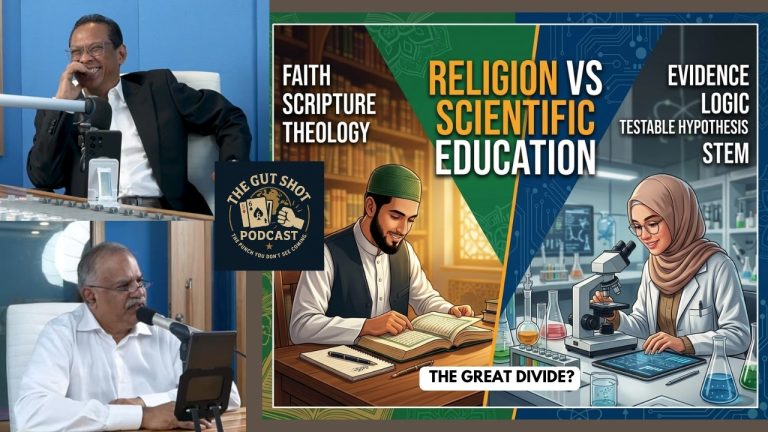
Gutshot discusses the great divide between religious education and evidence based scientific education. Malaysia has seen a sea-change in the education system, both formal and informal, ever since Dr Mahathir’s islamisation of governance. Nothing affects the future of a Nation and its society more than the education system and the environment around it. Since the mid 1980s, religion and religion focused public education has replaced what used to be a scientific, evidence based education that drove our industrialization drive since Merdeka.
Gutshot dissects between these two education curriculums and the outcomes from each. The choice is ours to make and to act on it.
We Have A Country to Save
Jump to chapter 7 chapters
- 0:00 Empirical Truth Versus Faith
- 4:31 Historical Clashes Between Science and Dogma
- 11:54 Academic Skepticism Versus Religious Conformity
- 18:13 China's Strategic Pivot to STEM
- 22:30 Grade Inflation and PISA Realities
- 27:49 The Evolution Taboo in Malaysian Schools
- 31:31 Protecting Scientific Inquiry for the Future
Auto-generated from YouTube captions. Timestamps link to the video.
No, to me, here's the go sir. Here's here goes. Let me see it. Hold on. Hold on. Here goes. Here goes. All right. Here goes. Okay, I I pick these three books out of that I I My books are so many, I can just pick. Um Here here goes. It's not that you don't have to accept. I'm sorry. I disagree with say or despite. Okay? You have to accept because it is science. All right? How you accept is another matter. How you reconcile between your religious belief and scientific fact, I leave it up to you. I don't care. All right? Because that is your faith. Okay? But
ladies and gentlemen, welcome to the Gut Shot Podcast. I'm here with me today, my good friend Syed Akbar Ali. Good morning. And we have a very interesting topic for you all for our conversation. Uh we'd like you to join, subscribe, like, as always. Uh we're going to talk about religious education versus scientific education in Malaysia. Now, there are two different standards of truth. Scientific knowledge is based on observation, experimentation, reproducibility, and false falsifiability. Religious knowledge is generally based on scripture, revelation, tradition, and faith.
Scientific claims are expected to be supported by empirical evidence and may be revised if new evidence emerges. So, that's how I want to frame this conversation to start off with. Reason and logic. And what else do we see? Sayed, with that opening, can you enlighten the audience on your thoughts and opinion uh on this subject matter of between religious education and scientific education? And then I'll I'll jump in with that
Thank you. Thank you. It's all about how we think, how we arrange our thought process. So, um you know, uh interesting interestingly, there is one verse in the Quran which has always I find it very uh uh it is I mean uh it makes you think, huh? It says in Arabic, "Nahatu burhanakum in kuntum sadiqeen." Which means, "Bring your evidence if you speak the truth." It basically it means evidence-based.
Right. Whatever you want to see, please show your evidence. So, we find that this is like the main difference now between religious education and scientific or science-based education. Science-based education is entirely evidence-based. You have to bring your proofs. Hatu burhanakum in kuntum sadiqeen. You have to show your proof.
So, are you saying that what you just described? Yeah, in essence, even the Quran is saying learn how to do science. Oh, yeah. The Quran is Quran has quite a few very logical and scientific statements like this, "I you show your evidence, huh?"
Yeah. So, this this is um So, now we have to look a bit into history because religion, as you described just now, religion is um based on scripture, you know, faith, things like that. So, uh you cannot we discussed this a few podcasts ago, the earlier podcast. You have this thing called religious truth versus scientific truth. Religious truth is you must accept it on faith. You know, you don't question. Scientific truth, you have to be able to prove it, bring evidence and things like that. So, you know, in religion, you know, there's a there's a saying that is often repeated, you can't use
logic and reason to to explain everything about religion. That is a obvious statement Well, it's called faith for a reason. It's faith, you see. Yeah. So, we find that let's look at history. Let's go back to a bit a little bit in Europe, Europe Middle Ages. Copernicus and the famous Galileo.
Mhm. Copernicus, I believe Nicholas Copernicus, was he a Dutchman? Probably the iron name. So, he he he was the earliest He lived in the 16th century. So, he would that time was the the reformation, you know, where the Protestantism was on
Was coming up. Yeah. challenging the authority of the Catholic Church, things like that. So, Copernicus was the first guy who said that the um the Earth is not the center
of the universe. The sun The sun is at the center and the Earth and the planets they orbit around the sun. He said that. So, nothing happened to Copernicus, but after Copernicus died, Galileo Galileo came. Galileo was born after Copernicus. Galileo was an Italian, Galileo Galilei. He's the guy who invented the telescope.
Yeah. And started observing the stars and the planets and things like that. And Galileo said it out loud that the Earth moves around the sun. Mhm.
And for which he was put under house arrest for the rest of his life. So, Galileo paid the price. He was put on the house arrest by the church, huh? Now Copernicus was not arrested by the church because of couple of things. Copernicus himself was a church official. He was a high He was a ranking religious figure in the church.
Right. And also his work his on the on the movement of the planets, the sun, the earth, and all that was published in the year that he died. So there was not enough time to send him to jail and things like that. So
Copernicus was lucky. Galileo was not so fortunate. Right. But this is in the 16th century, yeah? After that Well, this was the the the the beginning of the ascendant ascendancy of scientific thinking in Europe. So that was 500 years ago. So since then the Europeans have, you know, gone on to Well, they've gone to the moon. They have reached the stars. They're so advanced today. The most advanced society now.
May May I inject one thing? Just a quick one. You see why that is actually the in my opinion and a lot of scientific opinion, that is the start of what we call modern science. Prior to that, we don't call it science. Okay? Prior to that, it was basically uh philosophical knowledge. Okay? The reason is because the science requires you to come up with a hypothesis. Okay? Test the hypothesis and have the hypo and and then have it to be repeated and hence become a law or a theory. Okay? So that is science. Continue, my friend.
So so yes, and also the tools the scientific tools were started to be available uh from the from the 15th, 16th centuries onward. The the of the telescope. Leeuwenhoek invented the microscope and so many other things you know which did not exist before. So they were able to satisfy that that that verse that I recited just now, they were able to show proof.
Right. So after that there was no turning back. Every time a new scientist, a new thinker came up in the West, he he knew that you had to show evidence. What you just said, you come out with a hypothesis then you have to prove it, you have to repeat it, you have to you have really provide evidence for it. So after that they were unstoppable. The West, the Europe and the Westerners were unstoppable because they had established a methodology. Show your evidence. Evidence based. For whatever you say, you show your evidence. So this spread throughout the entire spectrum of knowledge.
Be it scientific knowledge, be it the humanities, be it the arts, be it anything. The Europeans left on to the scientific method. Now unfortunately the other parts the world, human civilization, which missed the boat. And one of them is our Islamic civilization because we have not reached the level of openness, thinking, questioning, critical thinking as what the Europeans have done, the West has done. But there's a cost, there's a cost for the West in terms of well, I wouldn't say it's a cost. It depends on the cost to whom. They they a lot of things happened along
the way including they realized that religion is something which you really have to keep inside your heart. Because it's faith, faith based. If you want to bring it forward and try to impute religion, you try to embed religion in for example your temporal living, all your daily things that you do in life, then you would you may have issues because faith-based faith-based you may not be able to show evidence uh scientific evidence for everything that you believe. So, this may create uh issues in the real world, especially a world after the 15th century, you
know, the age of discovery started about that time when the Westerners sailed around the world, started colonizing the rest of the world. But, it also it also means that different cultures met and there was, you know, exchange of cross-cultural uh uh exchange of information, knowledge, whatever, whereby your beliefs could be questioned, your beliefs could be challenged by other people, you see. So,
Well, you talk about um Copernicus, what happens to uh he's uh he's uh he's escaped by death, and then uh Galileo who couldn't escape But, actually, you know what? In the Islamic world, it was not that far different as well. If uh if people really read the history, um Ibn Sina, our uh what do you call it? Our you know, uh Malay Muslim uh community tends to actually bring up the name of Ibn Sina, right? But, you know what? He was practically declared a heretic uh by uh Imam Ghazali. You know, Imam Ghazali wrote um in his uh uh in his book, The Incoherence of the Philosophers.
All right? Um and practically identified Ibn Sina uh in it and um and effectively making them heretics. So, with that single, because he was so powerful, and without with that kind of thinking actually the uh progress of the scientific way of philosophizing and then following through maybe stopped everything.
I uh I I there's two examples I want to site. Mhm. Both of which I I mean I observed it personally. Uh the first one was when I was studying in the university in the in the US. Um uh this was in industrial engineering class.
Fact. So the professor was uh lecturing to us. Uh Mhm. Then one day what he did was suddenly he stopped the lecture. And he slammed his book shut, you know. Really? And then he said um he he he asked all of us. He said uh "Hey, how do you know what I'm telling you is the truth?"
Okay. Isn't there isn't there anyone among you here who's going to challenge me? Uh-huh. So we were all like maybe I What what class was that? Industrial engineering. Okay. So uh Professor James Green, Emeritus. Okay.
So um he said, "How do you know I'm speaking the truth, you know?" I think maybe he saw some people dozing off so he wanted to wake us up. But the point was made that, you know, you you don't just accept things even if a professor says it.
Right. Don't just accept it blindly. Be be bold and Question it. and challenge and question, is it? Right. So that's what he said. That's what that's what the professor was trying to tell us because this is the Western method, the modern method.
Mhm. Scientific method, you know. You hear something, you if you think that it can be challenged, you challenge. The second example is um I I know of a friend. He was at the time a researcher in Islamic doing Islamic research at one of the Islamic institutes we have here in uh in uh in KL. And uh he used to this institute that he was involved in, they publish articles, uh they publish uh I think a magazine, they publish books, they host uh conferences on Islamic issues, huh? And uh he used to write on uh banking and finance, you know? Banking and finance. And he was uh from
knowing him, he was critical of certain issues regarding Islamic uh banking and finance. And he used to write articles which were published in their magazine, huh? So, he had some issues with his head of department. You know, before they publish anything, it has to be approved by their head. So, he wrote a couple of articles at one time where he was uh questioning certain uh concepts in Islamic banking. So, the head called him and told him that uh uh you're a bit stepping out of line, you know? We cannot We cannot go along this line of uh inquiry. It's controversial. It's going to
attract negative attention, huh? So, basically, he was telling him that to tow the line, you know? Don't uh question the status quo. Don't question what has already been accepted. So, that sadly uh sadly, that has been the approach uh of academic inquiry, yeah? Or the academic method within in religious circles, you know? It is It is all learning and research and whatever scholarly work is designed towards conformity. Conformity to maintaining the status quo. So, for example, uh let's say if you're a Shia, you know, Shia. Of course, in Malaysia, Shias are
We don't accept the Shias, but let's say you're a Shia in Shia land, huh? You're a researcher, you know, you write papers, you write books and this and that. The whole thing will be designed towards maintaining the status quo of the Shia religion. And the same thing goes for, let's say, the other well-known uh up-and-coming group uh at least in the Middle East, the Salafists. The Salafists, they have their brand of how they look at religion. Again, they also have their scholars, researchers, writers, and things like that who write their books and do the research and things like that to
maintain their status quo. Well, basically, what you're telling me is is very simple from a scientific standpoint. How will How we What you know what we call this? We call this uh you have an outcome and then what you do is actually you tailor the out uh you tailor the research or the
to suit the outcome. argument to suit the outcome. So, so the they they whatever they do, whatever so-called research or academic learning that they do Mhm. is designed to preserve the status quo. Yes.
So, my question is can you call this uh learning? Is this an academic method? That's not learning. That's basically So, you can't challenge, you see? You cannot uh if you challenge it or if or if you or if you disagree, or even if you bring your proofs and evidence or your your logical arguments, huh?
Right. Uh the outcome is you will be not accepted as belonging to that the that school or that That that that that ideology or ideology whatever section, huh?
The right word is that school of thought. That's it. Yeah. So, so either you're in or you're out. Yeah. You you it's not like in science or engineering where, let's say, uh you know, the plane's been flying forward at 600 mph and suddenly you come and say, "Look, I I've designed a new engine that can take you to 800 mph." and everybody goes like, "Okay, let's do it."
Yeah, let's try it out. Let's try it out. Oh, that guy tried it out. Let me let's let's see whether we can Let's see whether your plane crashes or your your plane can take off and fly at at at the speed is he. So, that's scientific method. Whereas religious method, religious education, it is it is designed the purpose is to maintain the status quo. So, whatever new thinking that you can have in religious learning, again, it is designed to maintain the status quo. You cannot go and say, "Oh, I've got evidence now. Let's change the way we uphold our religion." You can't do
that. So, this is a difference. Okay. If you guys like to continue this conversation, enjoy the conversation that we have, uh please subscribe so we can keep getting this uh podcast for free for you guys, and keep liking so that we can we can spread our intelligent conversation to all the thinkers in Malaysia. We have a country to save, ladies and gentlemen. All right. So, coming back, um say, can you continue, please?
Yeah, so okay, so let's talk about China a little bit now, huh? Right. The Chinese are going places, and the Chinese have begun to realize that there are only 24 hours in a day. Right. All right? I think they realize that and they appreciate that more and more. Time is short, huh? So, the Chinese have realized that they are they are an economy or they are a society, and not just the Chinese economy, the society, the entire Chinese society now in China, 1.4 billion people, huh? They are shifting towards almost 100% science-based, science and technology-based, huh? So, the latest
news coming out of China is that uh Oh, they're producing like 4 million STEM students STEM graduates every year. Yeah, I have some figures. Over the last about 4 years, beginning 2021, I think, huh? Chinese universities, public universities, they have revoked or suspended, huh? Over 12,000 undergraduate degree programs. They've abolished it. What what are these programs? huh? They are in the arts, humanities, languages, and even management. They've just abolished it. They said, "No, we don't want to do this anymore." So, what what have they replaced it with?
They have introduced over 10,000 new programs, degree courses in the public university system, which focuses on artificial intelligence, robotics, engineering, technology-related STEM. So, they're not wasting time. They say, "We really don't have time, and we we we just cannot afford to be the luxury of learning things that do not contribute directly to our our our economic well-being and progress." They're going all out STEM. It doesn't mean that they don't learn history, or they don't learn humanities. But, they don't see the immediate degree beyond some fundamentals. They don't
award degree level. That means I mean, they you can still study history. I suppose if you're an engineering student in China, they will still ask you to learn about Chinese history, some coursework, but not an entire curriculum on history and so whatever. So, they're focusing on science-based STEM education. I I think this is important. I think this is important for people to understand. So, we are talking about what? Humanities, management, what else? Foreign languages, literature, arts. All they are they are not awarding degrees in in quite number. You don't go and do a four-year degree
on humanities. You still learn it. I think they do coursework, but they're focusing the degree they're awarding of degrees on STEM subjects. It doesn't surprise us that actually in the period that we are talking about, I think when did Mao Zedong step down from when did Deng take over? Deng take over in the
late 70s late 70s, which means that we were already stand sending students out and having English educated curriculum with science based as late as early as as early as the let's say late 60s to 70s we were very strong in it. And they were still struggling with the
cultural revolution and the Great Leap Forward of Mao Zedong. And today they have come They have left They have left us in the dust. They have come forward quite a distance. So, now their policy direction education in China is they call it strategic priority. So, education is the strategic priority. And they focus on technology, emerging technologies, science, engineering, AI, digital, all these kind of things because they really they are obsessed that there's not enough time.
You know Yeah, we've been saying this a lot There's no enough time in the for the young people, our children in the schools, our children our university kids. There's just not enough time. You have to maximize your time learning things that is going to directly benefit you.
Right. So, philosophies and ideologies and fancy arguments aren't going to make your coffee taste any better, you know. Yeah. Okay. Well, You know you know what? I I I want to say something about some of the criticism we get because of our episode on UEC and Tafiz. Okay? One of them is actually we get a few that says, "Oh, Tafiz schools are producing very good students in STEM as well. Blah blah blah." You know, my this one got 10 A's. Okay. I'll just going to say this though on this part. All right? First of all, Malaysian examination system is severely inflated in grading.
I tell you, I don't trust your A1. Okay? Compared to the time when me and Syed were going. How can you get bunches of A1 and your PISA ranking is below even Vietnam? Okay? Why not? Second part is this. Yes, in any situation there are anomalies which we call what what do you call aberration to the situation, special cases where the person learn harder or smarter than others. But in the overall scheme of things when policy are made the result is what just said says, which is you only have a certain amount of time. Therefore, what will impact is actually the general population of the
student, not the outliers. Okay? So, that's what I want to make point on. By the way, um there is a saying that keep on popping up um in Malaysian religious discourse. All right? Um the word is let me put it in Malayula. And then we we we we say this see see see my English or this All right? Basically, what they are saying is that you cannot use your you cannot use your thinking um in the matters of religion. Unfortunately for me
Logic, you can't use logic and reason. Yeah, but the problem is this. This are coming from the clerical class. But, when I read the Quran, every other surah, if I remember, it has this word that comes out. If you are thinking. So, the Quran is telling you to think. Why are instead the clerical class saying, "We should not be thinking."
The the usage in the Quran is uh sometimes in the negative uh form. La ta'qilun, don't you think? Why don't you think? Right?
So, it is challenging you. Afa la ta'qilun, why don't you do you not think? the teachers are saying, "Don't think." Uh Anyway, I I may digress, say continue with your your points.
the the the thing now is that um we it's it's all a matter of a question of time. How much time do we have? How much time do we invest uh in our children's education? It is it is not just sufficient uh that we build schools and do we have teachers. It is how do you spend the time teaching them and what do you teach them? So, if you're going to spend if you only have x many hours in a day to go to school for our children uh and for university students uh and how those hours, few hours that you spend learning in the classrooms, what do you learn? Is it going to get you a job? Is it
going to increase your productivity? Is it going to be able uh is it going to help you uh compete uh not just with your colleagues, your immediate colleagues, and uh your neighbors, but with the with other societies around us and other communities around us, other countries around us uh China is one, uh Vietnam. These are the countries that are up and coming, which are our immediate neighbors, you know? So, the more competitive other countries become, it's going to impact us. Uh if we are less competitive than them, that means we are going to depend on them more.
So, we're probably going to end up selling maids to them. We will have to buy if we cannot make if we cannot increase our productivity, our output, our technology, we will have to buy more things from them, which is true now. We buy so many products from China, you know, and all these countries, huh? When you buy more from others than what you sell to them, the value of your currency will fall. No, that's a fact.
Oh, here here's the other thing. I mean, going back to the fundamentals of it. So, it's all it it all depends on how did you spend your time when you were young? What did we teach our kids in the limited amount of time that they have to study and learn in the school, the education system?
You see, what actually do we teach actually in our education system? How how much of the science are they are they teaching? I mean, biology biology, I mean, physics, the way we used to learn um in my days I remember even in form three or form four I was already learning uh evolutionary biology. Um do they do that anymore?
No, I don't think we have that much of uh evolution in our secondary school system. Not not I think it's way below what other other countries or societies may teach biology uh evolution, huh?
Why? There is a taboo against uh teaching evolution. Evolutionary theory, at least in Malaysia. It's not that they don't teach. I think they have They try to limit it? the form six syllabus.
Not everybody goes to form six. No, they do teach uh uh evolutionary biology at the form six level, but you are right, not many people go to form six, huh? Yeah. The the form ones or form fives, the real secondary school education, uh the the exposure to evolution uh evolution, the study of the theory of evolution is uh I mean, I think it's limited, yeah? It's limited.
Well, I mean, ladies and gentlemen I mean, you don't have to accept the theory, but what is more important is the the argument. No, to me, here's it goes, huh? Here it goes. Let me see, yeah. Hold on. Here it goes. Here it goes. All right. Here it goes. Okay.
I I pick these three books out of that. I I My books are so many, I can just pick. Um Here Here it goes. It's not that you don't have to accept. I'm sorry. I disagree with say it or despite, okay? You have to accept because it is science. All right? How you accept is another matter. How you reconcile between your religious belief and scientific fact, I leave it up to you. I don't care. All right? Because that is your faith. Okay? But, if you want to understand why evolution is true and why it has not been able to be dispelled, it's very simple. I'll tell you because
we have today the most concrete evidence of evolutionary biology. You know why what it's called? It's called in our deep ancestry, okay? It's called genetics. All right? We can trace the genetic evidence of our uh ascendancy from the current Homo sapien that we are right up all the way to when our ancestors were fishes coming out of the ocean. Okay? Why do the science say the cousins that we have are like uh what do you call bonobos and chimpanzees? We can trace the genetic makeup of each population.
That's why we know the out-of-Africa uh movement of humanity is very clear where the first Homo sapien appeared. So, how you guys want to reconcile with religion is up to you because that's faith. But science is science, and without you understanding this, how you going to make next step?
Okay. I Okay, that's evolution theory. Yeah. There are So, let's move on to something else. There are some views. I mean, there are many views. There are some views in that. But what I would what I interested in is a is a method, the scientific method. How How you argue your point, how you present your argument, how you present your evidence, and how you summarize the whole thing based on evidence. And most more importantly, that the space has to be created. Yeah? The space has to be created, and the the environment environment has to be made conducive for people to
challenge to talk, to challenge, to discuss, to present their case, to present their evidence. Yeah. You don't persecute or prosecute people for trying for wanting to present the evidence, to argue a case.
So, Because that that is a initial building block for the advancement of any society. You must allow people to say what they want to say, to think what they want to think. And if somebody is trying to prove point, let them present the evidence.
I goes to the point, the same thing, right? And you cannot you cannot come to your conclusion before they have presented their case. Yeah. And and you cannot shut them down before they can present their case. So so this is a this is a problem when you do not allow people to think freely and to present evidence, huh? Or you people present evidence and you deny it. So that will cause problems.
Say even The advancement of the society will be affected. Yeah. I agree. You know. Absolutely. So this is it. So if So now we're in the 21st century, you know. This is the age of the Jacksons, you know, the Jacksons cartoon.
The stats the Is it the Jacksons that is the statsons or Jacksons? You know, when we were when I was like 6 years old, huh? I know. I know. That was 60 years ago, huh? Remember the Jacksons cartoon, huh? They fly around in this little Everybody's got their own personal flying saucer. Things like that, huh? And they said this is the future.
We are actually living it. They are already building drones that can carry people around. Yeah, flying taxis now all over the world, huh? People can have their own personal private flying cars and this and that, like the Jacksons, huh? So if you want to you want to reach that level of civilization and go beyond that, you really have to be able to think freely, you know, evidence-based learning, STEM education. That is only way forward. Otherwise, uh as you said, we're going to export maids to other countries.
Yeah. If you can't think. Well, I I don't we export maids or we end up exporting terrorists. Uh inevitable that those are inevitable inevitable. Okay. With that in mind,
All right. I think we call it a day, right? I would like to thank everybody very much for joining us in our conversation today. Hopefully it helps. Um thanks, Aid.
Thank in our conversation today. Hopefully it helps. Um, thanks eight. Thank you.