Our Energy Economy, Skills and Challenges
Show Notes & Description
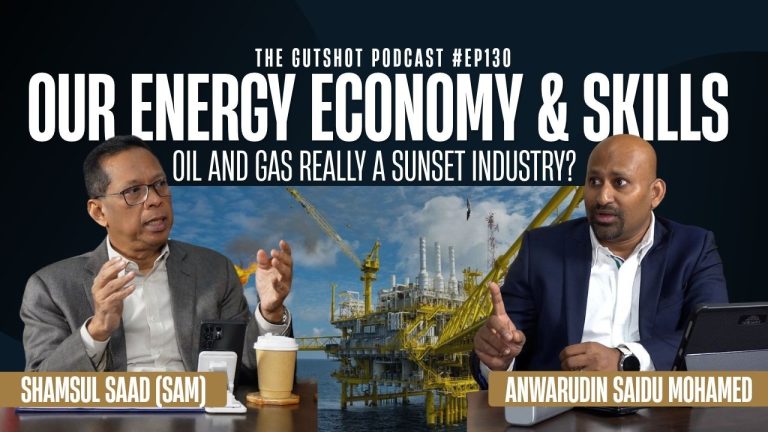
Is oil and gas really a sunset industry? Sam sits down with Anwardin Saidu, a 20-year oil and gas veteran and former Honorary Secretary of MOGSC (Malaysian Oil & Gas Services Council), for a frank talk between two generations of industry practitioners about Malaysia’s energy economy, the people who power it, and the policy choices holding it back.
They start with how Malaysia’s petroleum story really began and why the industry is a “molecule supplier,” not just a fuel supplier. Then they get into the numbers: the roughly 200,000 workers in the sector, why their productivity is about ten times the national average, and how much of government revenue the oil and gas ecosystem supports. They compare Malaysia with Norway, which has similar resources, workforce and history but four times the revenue and a services sector that exports more than half its output. What went wrong, and what would it take to double the OGSE sector’s value?
The second half covers skills and money. Topics include why trained TVET workers leave for abroad or the gig economy, what’s suppressing wages, why Malaysia spends far more per student than Vietnam or Thailand but scores lower in PISA, HRD Corp’s investment losses, and what CPTPP means for local industry.
Chapters
02:10 Malaysia’s oil history
10:20 Jobs and revenue
22:50 The Norway benchmark
37:10 Is oil a sunset industry?
50:25 TVET and wages
1:07:55 Education spending
1:10:30 HRD Corp and CPTPP
Transcript coming soon
We are actively editing and verifying the timestamped transcript for this episode. Watch the full episode above or subscribe to receive transcripts when they drop.
Show Notes
Is oil and gas really a sunset industry? Sam sits down with Anwardin Saidu, a 20-year oil and gas veteran and former Honorary Secretary of MOGSC (Malaysian Oil & Gas Services Council), for a frank talk between two generations of industry practitioners about Malaysia’s energy economy, the people who power it, and the policy choices holding it back.
They start with how Malaysia’s petroleum story really began and why the industry is a “molecule supplier,” not just a fuel supplier. Then they get into the numbers: the roughly 200,000 workers in the sector, why their productivity is about ten times the national average, and how much of government revenue the oil and gas ecosystem supports. They compare Malaysia with Norway, which has similar resources, workforce and history but four times the revenue and a services sector that exports more than half its output. What went wrong, and what would it take to double the OGSE sector’s value?
The second half covers skills and money. Topics include why trained TVET workers leave for abroad or the gig economy, what’s suppressing wages, why Malaysia spends far more per student than Vietnam or Thailand but scores lower in PISA, HRD Corp’s investment losses, and what CPTPP means for local industry.
Chapters
02:10 Malaysia’s oil history
10:20 Jobs and revenue
22:50 The Norway benchmark
37:10 Is oil a sunset industry?
50:25 TVET and wages
1:07:55 Education spending
1:10:30 HRD Corp and CPTPP