Malaysian Economy & Sovereignity – Maritime Stability in the South China Sea
Show Notes & Description
Gutshot welcomes, direct from Washington DC into our office, Brent Sadler, Senior Research Fellow for Naval Warfare at The Heritage Foundation. A US Naval Academy graduate in systems engineering and robotics with minor in Japanese. Also graduate of Keio University, Masters at Jochi University and the United Nations University. Master of science from National War College. He established the Navy Asia Pacific Advisory Group to the Chief of Naval Operations. Pacific Command from 2012-2015.
We talk of his experience in the Navy including his tour on nuclear submarines and his fascinating personal connection to South East Asia. His experience as the U.S. Naval Attaché in Kuala Lumpur where it shaped his views of current regional maritime and geo-economic conditions, with the Malacca Straits and the South China Sea being our personal backyard.
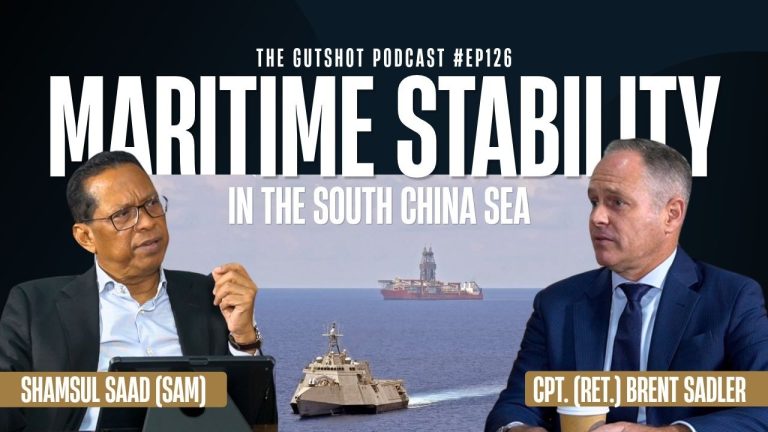
This is a one of a kind conversation. Personal yet technical. Geopolitical yet domestic. We venture into maritime operations and policies, Malaysia's Exclusive Economic Zone (200 nautical miles from our coastal base-line) which impacts our oil & gas and economic interests and the US 7th Fleet forward projection presence in our area of the world. The story of the Petronas chartered drill/survey ship West Capella for work in our EEZ is a fascinating one we talk about (see thumbnail photo).
My interest has always been a Malaysia First policy. Not some far flung areas we have no business getting involved with. Understanding how to manage the geo-positioning of our economy for our Bangsa Malaysia. I wish our leaders has got their priorities right but unfortunately that is not how they operate.
We Have a Country to Save
Jump to chapter 9 chapters
- 0:00 Reviving Maritime and Shipbuilding Industries
- 1:08 Introducing Captain Brent Sadler
- 4:00 Life and Discipline Inside Nuclear Submarines
- 12:35 Growing Up in Asia and Strategic Lessons
- 23:53 Malaysia-US Economic Ties and Global Shipping
- 37:10 Naval Statecraft and Offshore Power Projection
- 42:06 Petronas, Energy Security, and Supply Chains
- 1:01:46 The True Cost of Protecting Global Waters
- 1:09:04 The West Capella Incident in Malaysia's EEZ
Auto-generated from YouTube captions. Timestamps link to the video.
Actually, we could utilize it heavily here. Oh, yeah. Um, so I do a lot of work on this and one of my big passion projects right now for the last five or six years is the revival revival of America's maritime industry. So, shipping, shipbuilding, and navy, Coast Guard. And it you know, President Trump has spoken several times on this issue very forcefully. And Congress, both the Democrats and Republicans are all lockstep in in you know, it's been a national unifying event because they all see it as a national necessity to revive this industry. I think Malaysia, too,
for similar reasons. But, no other industry shipbuilding, no other industry generates as many jobs. And I'm not talking like low-level, low-skilled. It has a lot of that, but it also it requires a lot of very highly skilled like welders, robotics maintainers cuz the welding, but it also needs a lot of naval architects. So, you need a lot of people and you generate a lot of capital. It's it's the full spectrum top of the food chain, bottom of the food chain. It's just like the oil and gas industry. Ladies and gentlemen, welcome back to Got Shot. I'm Shamsul Sam.
And we have a very special guest direct from Washington, D.C. uh Mr. Brett Sadler or Captain, shall I say? Brent is fine. Brett is fine. Okay. Say hi to our guest uh to our audience, Brett. Selamat pagi everyone. It's great to be back in Malaysia. There you go. All right. Uh Brett is a senior research fellow of uh Naval Warfare and Advanced Technology, Allison Center for National Security uh at the Heritage Foundation in Washington, D.C. So, you've just arrived last night from what I heard. Yes, but I was in India for the before that talked to my old friends there in
New Delhi for a few days on maritime security stuff. So, I'm a I'm an old hand in all over Asia. I know. I love it. Yeah, yeah, yeah. That's right. So, let me give you guys uh a a bit of background. You know, as a mere chemical engineer from the University of Florida, you guys have no idea how jaw-dropping his credentials and accomplishments are. Let me Let me just get uh to some of it, yeah. He's a US Naval Academy honors graduate in systems engineering and robotics with a minor in Japanese. Uh Keio University masters at Sophia University and the United Nations University as well.
He also has a masters of science from the National War College. And in 2011, he established the Navy Asia Pacific Advisory Group reporting directly to the Chief of Naval Operations Pacific Command from 2012 to 2015. I can go on and on, Brett. Okay? Uh but you know, enough of it. You guys is Yeah. Uh you guys can check it yourself. And you're just bonkers, Cap. All righty. So So, guys, if you know your Tom Clancy, you know, Brett might as well be Jack Ryan uh but with a with solid tours on on on nuclear submarines. Right? Okay. Enough of being a geek, yeah, Brett. You know?
Um well, so again, welcome to Gadget Shot. Yes. Thank you. There is no other place in Malaysia, you know, where people get the kind of conversations that we do at Gadget Shot. Yeah. It is conversational. Um and we take things um into areas people don't want to. You know? Okay. So, I I just just just for a for the for the for the geeky me a bit, la. Now, I I know the technical obsession that take that it takes to run those systems on the nuclear subs and all that where you're involved. What actually is it like living, operating, and then commanding in this steel tube, you know, uh
hundreds of feet underwater, off-grid, I don't know how long. Failure is not an option. How how how How does that work? Uh well, technical competency. Yeah, please. to be the So, it's not it's not who you are or who you know, it's what you know. So, everyone from the very junior enlisted sailor to the commanding officer of the submarine are all judged by their technical competencies. Right. The ability to operate a torpedo tube, the ability to operate safely a nuclear power plant, the tactical skills to be able to find and then defeat an enemy at sea. These is what matters. Right.
Because that when you're on a submarine, you are always seconds away from death. Uh the pressure on the submarine not very deep is enough to kill you fairly quickly within a split second. So, a mistake made by anyone can kill everyone. So, that that kind of egalitarian kind of society of 120 150 of your closest shipmates and friends is very important. But, uh the way you survive for months Months, I bet, yeah. Uh is to stay very busy. Very very busy. And your days are in 18-hour cycles cuz it's 6 hours watch, 6 hours of sleep, 6 hours of preparation for the next watch
site. And it just repeats and repeats and repeats. It's kind of like the movie Groundhog Day. It it's Cuz it can get into That's a That's a weird analogy. If you see like Groundhog Day, but then just imagine, you know, that happening inside like your closet. And close all the doors, all the curtains, and turn on fluorescent lights. And every day you wake up to that that first scene, and that's all you get. Wow. Okay. I mean, I I remember watching one of the uh one YouTube video on basically living in the summary. I think the cap the the commander the commander is that? Yeah.
The commander. He's like he's like a nuclear engineer or something. Mhm. Yeah, all the officers are nuclear. So in addition to all the other academic-y stuff, those are more fun stuff, but uh in the nuclear submarine force, you have to be certified as a nuclear engineer. Uh so we all go to school for about 18 months learning the theory but then the practice the operation of a nuclear power plant inside a submarine. So everyone is a nuclear all the officers are nuclear engineers. Okay, guys. And I thought fluid dynamics was tough enough. All right. I mean what do what do you
what then is I let's let's let's give the audience a bit. What is the most nerdy mind-blowing piece of submarine tech that you can dis- disclose, you know, that average civilian has no clue exists? The fact that you can put in the space of maybe this room right here Mhm. uh a nuclear power plant that's able to power a small city. That's what you have on a submarine. That's that's the scale and the compressed the density of the energy is that massive. And by the way, can generate that energy for 20 years. You don't have to refuel it. How many megawatts is it likely?
So in my first boat it was uh it was like upwards of 50 megawatts. Holy cow. So these power plants are not And it goes on and on you know what I'm saying is yeah. 20 years? It's a matter of you mean you don't have to refuel it very it's a function of how how hard you drive the submarine. So if you really go flank speed all the time, you're you're going to use up the nuclear fuel a little faster, but it's in years. So there is a there is but it's just the density. The thing is in a small space all of this energy and it's not the other thing is it's not going to blow up. Right.
Worst case it just overheats and you have a meltdown and which is horrible. It's never happened on in the US nuclear military cuz there's aircraft carriers. We had cruisers that were nuclear powered for a while and then of course all our submarines are nuclear powered. We've never had that issue. But Fukushima was a meltdown. It's a meltdown. So it doesn't blow up. It's the in the hydrogen explosion there was different but the nuclear the way it's designed it's it's not explosive. That's the other key thing. A lot of people that are not familiar and I'm in my current work I'm doing a
lot of trying to get nuclear power in the commercial civilian shipping cuz it has a lot of use. Green energy the best renewable quite by the way no carbon but you can also have high energy very high density and long life for these propulsion plants and you don't have to worry about fuel prices as a shipping operator. Yeah yeah yeah. I I I did that as a shipping operator. Which I saw I want to talk more. Yeah the fuel prices can really make a bigger day. Especially lately. Yeah. Yeah. And I was I was running probably the biggest engine was what? 12,000 horsepower that's about all a
Rolls-Royce by the way. Anyway um So last last last quick one on this on this dirty trick um How long was the longest time you've ever actually been submerged? Submerged Continuously? Continuously 98 days but at sea about 105. That's my bogey. That's like the Groundhog Day. Exactly. Exactly. Now okay let's move it a bit more. I think I mean I think there's some connections between ourselves from what I understand you're from Virginia. Yes. Yeah. Which part of Virginia? Uh Northern Virginia, a little place called Springfield. Okay, I know. I was at Washington DC last year. Oh.
I was at my first time in DC. I wanted to go to across to Virginia, go past the Potomac River, right? My wife was lazy, so that didn't happen. out. I know. I got to go again cuz my best buddy was living in Georgetown. So, I stayed with my buddy for a couple of days. Well, Georgetown's a fun place, so I can understand why your wife didn't want She was having too much fun in all the stores there on M Street. I know. Oh. Oh, I had I had the best fun because I I took a photo and went up the Exorcist steps. Yes. Yeah. I I'm I'm a movie nerd as well. Oh god. Well, also down along
you have the the Watergate nearby, the very famous Watergate. Go to the roof, the best view in the entire city. I went up there. That's the best view. Yes. I did with my buddy. listeners, if they ever get to DC, go and have Go there to the rooftop of the Watergate Hotel. Right. Exactly. It was It's fantastic. And then we walked across to the Kennedy Center. Yes. Yeah. It was gorgeous. Oh, yes. Yeah. And by the way, come in late in the afternoon, have some cheap oyster on buffet. Yes. You know. Well, you can't you have When you're in Virginia and Maryland, you have to have crabs.
I did that as well. Oh, the crab cakes or crab cakes or crab cakes. Yeah, I know. Okay. I mean, so There's one thing you're you're in the Navy. I had a buddy who was in college with me, still my best friend in Las Vegas. That's why I keep going to Vegas. So, and then um You know, there's one thing about studying in America, that one thing I find remarkable. And frankly, shaped a big part of how I view leadership. Okay? Uh this American culture of military service. And there's this notion of national sacrifice. I think this is very lacking in our society in especially here in Malaysia.
Um I can't say too much about Southeast Asia, but I feel the same way. Um What that there is this institutional ethos in the American psyche that I find about doing national service, going into the military. You know? Um What pulled you into the this path as a young man? You served as a naval attaché here as well in Kuala Lumpur, right? Yes. Yeah. So, how did that sense of duty translate when you step foot in this part of the world? Can you just bring from that youth and how that gets you here? Yeah, I mean, the simplest part is that I Well, as a kid growing up in Asia, I grew up in Guam
Oh, did you? in the '80s, and I went to high school in Japan, graduated in 1989. Uh had a front row seat when uh Ferdinand Marcos and Imelda Marcos left, they flew through Guam. I was there. Okay. we saw them come through, so part of history. And then again, I had friends at the Tiananmen Square, they were they missed the high school graduation because they got caught up in all of that. Right. Uh you could still go and tour when they went before everything went went sideways. You were in Guam? I was in in Japan at that time. At that time you were in Japan, okay.
'86 I was in Guam, uh and I was just getting ready to leave when Ferdinand Marcos came through. Right. Uh he came and stopped through Anderson Air Force Base, is somewhat historic. Okay. Uh and then I went to Japan shortly after that. Right. finished up my high school time there, but one event in particular in 1985 really galvanized for me Right. uh my life's mission. And it it if you know this, and I've it's in my books Right. in the preface I kind of I hint at this I talk about it more in my second book directly. In 1985, uh there was uh Deng Xiaoping's open door policy. Right.
It was still just no one no one was quite sure and the Chinese were still trying to figure out how to bring capitalism into a communist government. Right. Uh and they were still sorting it out. Right. And I went to I went to Hong Kong and we went across the border and we went into southern China. We spent day and a half uh inside mainland China. And it was like going to a police state. Uh everyone was still in the same like Mao it was the summer Mao suit so it was all white. Uh there was PLA officers and people were very very clearly that there was control, political control.
But at a point in time uh after a couple interesting tense moments where we were our handlers uh kind of got a little antsy with us. Right. A young man he looked to me like in his late teens but he was probably in his 20s came up to me looking to make sure no one saw him and he came up and he shook my hand as he was blocking view and he whispered in my ear said I love America and then walked off. And it wasn't what he said to me, it was how he approached me and how like he wanted to make that point at great risk. It was clear. And at that moment it was clear that how
we engaged our partners, our allies I mean this is the time of the tiger economies, you know, Malaysia was a rising like Asian tiger, Taiwan was and China was not quite there, far from becoming the economy that it is today. And it was clear that if we didn't get it right together that we would be on a path to conflict. And sadly, uh it's we're kind of more in the path of conflict because of collective decisions. But I hold a lot of blame actually in Beijing which we can talk about. Uh but my life's mission is to try to make sure that we all all act for our own national interest,
but in a way that we prevent an unnecessary major war in the region. And that's been I mean that when the Navy Asia Pacific Advisory Group that I formed back in the day, it was to take a very hard realist approach to the world. Because I what I learned that as a defense attache in these many weeks of sleeplessness Right. uh is that when we speak explicitly and clearly to each other, sometimes it's best done privately. Yeah. But when we speak very clearly about what our interests are, not ideological or principles, but we talk about hard reality, tangible things.
Right. Better results are more likely. Yeah. Yeah. I find that uh it's very interesting how that Did Was your family uh in the military as well? Uh Just Just out of curiosity, usually that tends to run in the family as well. This ethos. Yeah. My My grandfather was in the Navy in World War in the Pacific. Right. Uh my mother's side of the family too, uh grandfather there was also He was uh on my mother's side was Army. Right. And was enlisted, you know, mechanic. My grandfather was a naval architect, shipbuilder, ship repair. Right. All through from 1944 to the end of World War II. Right.
Uh but he, like me, he was a naval attache in Manila. Right. My father went to high school in Manila. Uh-huh. So there's a lot of exposure so there's my god fathers from the Philippines. Right. Um there's a lot of connect My stepmother is Okinawan Japanese. Okay. So there's a lot of Asia in my upbringing. Right. And so the military uh it was always I think something I was interested in. Uh-huh. But after that 1985 in as like what can a poor American with not a lot of political family powerful family, how can I best bring to bear what I'm seeing in my experience to effect. All right.
And a military career was the path to do that the most. Eventually, I thought I was going to go run for politics be a politician. Maybe you should. I almost did. I almost did, but my dear friend Hung Cao, who's now the Secretary of the Navy, he decided to make a run for first the seat that I was looking for. So, I went into support mode. We're both Virginians. I see. But, Hung Cao is a I've known we've known each other for 30 years. Uh-huh. Uh and uh he tells a story another one like me 19 his 1985 was when he was very young. Uh-huh. And they had to flee Vietnam. His
family's from Vietnam. His father If they'd stayed, they would not be alive today. Got you. That's interesting. Mhm. Well, I I mean, it's a it's as I said, uh but it's a very different uh upbringing. Um I come from uh from uh farming and uh small farming uh on my mother's side and uh uh small business on my father's side. And I was uh very much into uh science. Uh I'd consider myself one of the top chemistry student in my school, and I loved ki- I I just fell in love with organic organic chemistry. Ooh, that's a hard one. I love it. Yeah. It's just like, you know, it's like I I mean, they
once the teacher to- put down the Le Chatelier's principle, Mhm. I was like, that's poetry. I I just can't explain it, you know? So, it's And and and when I made my decision to take engineering, I said, um um I'm going to America. I went there in 1980. Um I was accepted into LSU on a Friday, and on Sunday I on Monday I got my entry into Florida. And I said, "I'm going to be a Gator." Oh, yeah. So, that was the story for me, anyhow. Yes. So, I mean, the So, a chemical engineer, I never thought that I would be going into business and running, you know, a fleet of 20 plus
ships. Yeah, I mean, it's uh It's been It's That's That's a very Never thought I mean, no one Mhm. in my family ever would have thought about military service. Yeah, I know. Well, I think your question about, you know, here in Malaysia concern about national service national service. There's lots of forms. Military is, I think, the highest because I mean, that's you're putting your life on the line for the defense of your country. In the United States, it's the defense of our Constitution. Mhm. Uh which is the core document that guides our government and our society.
The US is consti- the US Constitution. Um So, there's that. And I think when I was here as a defense attaché and just there's a lot of pride. I can sense it already just on the street being back in Kuala Lumpur. I would I travel more the country if I had more time, but I sense that there is a there is a lot there. In the United States, if you ask the same, most Americans would have the same feeling that there's not enough, you know, young folks willing to you know, to serve their country. There's a lot of pride. It just has to be triggered. Yeah. think you're seeing I mean, President
Trump's comments about America first. It's a Malaysia first that makes total sense and that's how you operate. India first. It Every country is, you know, they follow their national interest. But when you stand up for what you believe in and you stand and you make it clear what that is and what your national interest, we all get along a lot better, I think. Well, I I mean, I made it very clear. You weren't here when I why when when I was doing my monologue segment, I said, "I'm Malaysia first." You know? Yes. Yeah. So, I mean, um so, let's let's let's move on to a
a little bit less personal. When we look at this US engagement in Southeast Asia since you are very much, you know, this is this is your sphere of knowledge, you know. Southeast Asia through the modern security lens, whether it's Philippines you know or even Malaysia I think Philippines has gotten the brunt of it in terms of incursions. But you know this this this this relationship that we have with America I mean the it's just not Let's let's not go there first. My my my apologies. Let's not go there first. Let's look at the bilateral relationship that we have with America. Right? I
think Philippines, as I said just now, Philippines was a you know, after the World War II, America was in the Philippines, but for me, I mean, we had thousands of students going to America. I mean, and and as I said, I still have very strong relationships. I have business associates in Dallas that are very close to me for more than 8 years now. And you know, higher education So, you know, I I'm looking at going over and attending a game at a swap very soon. You know, I hope they can make me happy. So, the American experience do shape me as a person. Right? And one
thing I find doing business with America Mhm. is actually it's it there is integrity with handshake. People don't realize this. Um but I've been doing business quite a long time. Yeah. Uh 40 years of over the private sector. So how do you see Washington's view in terms of the importance of this side of the sphere because we tend to think that um you know, apart from your concern of China um and that also I'm not really really sure just how far how much it balances out compared to the the the the the concern you guys have or your interest in the Middle East. Yeah.
Can can you maybe give us a bit of a picture? Where does the Where how do you guys look at this region? Well, let me start with Malaysia and and then I'll put everything in kind of context cuz you can kind of lose sight if you're focusing on all of the the fur ball of activity going on around the world. But the United States and Malaysia have a really close relationship that it's below the the government level. I mean you go back to the late '70s and the '80s. I mean a lot of what was fueling the tiger economy back then in the '80s was a lot of American IT investment which is here
now. And I think most Malaysians assume that these these these firms that are here, most of them in Penang, are actually Malaysian when they're really been here for decades and they're American enterprises. So there has been a significant capital investment in Malaysia. It's still here. It's still resident. Bro, I still remember when I was in high school I I saw Intel, I saw AMD. Yes. Yeah. So this there's still a there's a lot of room to grow. We we talk about, you know, sectors where I think there's a lot of opportunity. Yeah. Uh and it's beyond the the IT and
it's it's in heavy industry, but it's also in uh energy as well. But Well, energy we should I was uh uh my first job when I came back from Gainesville. Yes. Uh my uh one of my principal was uh was Exxon Chemical. Yes. Yeah, I was selling Exxon Chemicals. You're using your your passion in organic chemistry in Right. I I was doing uh field work at the platforms testing specialty chemicals. Specifically, I still I still remember I was the first one to sell to uh uh Petronas Refinery for their diesel uh uh uh uh pour point depressant. Hey, a history from Shamsul. Yeah. Go on.
But we should talk about that sector specifically, especially these days with the prices and global uh security most of it refining. But um Malaysian assets have a have a very substantial economic relationship. And every a lot of times it's frustrating because a lot of folks on both in the United States and Malaysia only think about the current, like what's the new investment from like China versus everyone else, or what's the trade today. And they miss the fact that there's a sizable economic presence driving it's like the baseline here in Malaysia that's tied outside of China.
And when you add all together, you find that most of Malaysia's economic prosperity and its future is not tied to Beijing. It's actually tied to a lot of other, you know, very liberal economies uh in the classic sense, you know, free markets and open trade. Yeah. And then the United States is one of the big players there. It needs to be a bigger player. And I and and I think that's partly both sides of the Pacific could do more for that. Um so, there's a lot of common interest that I think are driving Malaysian and United States closer and closer together. One is uh energy
extraction in the South China Sea, which we need to think of maybe a better name for that body of water, but Malaysia, and I'm very familiar with an incident in 2020, the West Capella incident. Okay. Uh Petronas needs for upstream energy, they need to go to the offshore to keep the the resources, the money flowing for the Malaysian economy. Um where the United States Malaysia have a common interest is freedom of navigation. Right. That's what I was talking about in New Delhi. It's what I'll be talking about here in KL. Um but that's one. And a focus on the economic interest.
Right, which is really the real big issue here. Mhm. Uh the other is access to markets and trade. Right. And that's I think a very common It can be IT, it can be rare earths, it can be energy, but it's We have a common interest of having easy access, free shipping all over the world to get to our markets. A lot of Malaysian trade, it's the near abroad, so to speak. It's Australia, Singapore, Japan, United States. Uh but that relies on a security at sea. So, we we both have very deep interest on that. Uh now the fur ball of the globe today, United States is finding itself um
in a situation where it has to re-strengthen itself to maintain deterrence. It It right now the world's in a in a transition phase, so it can appear increasingly violent, and that's decades of a very pacific, very peaceful world, but there was forces trying to change change things, and we're getting to the culminating point to where global orders are are starting to fray or shift. And how it comes out the other end of that can either come out peacefully or by combat. Hopefully not by combat. That's my life's mission is to prevent that. We don't know what's
going to come out the other side, but we are in a transition, so Venezuela, uh that was a government that was supporting a lot of violence on American streets, long overdue. Uh it's unraveled a lot of illicit networks. Then the Iran Iranian conflict, not to make a statement pro or against, but uh the Iranian regime has a lot of American blood on its hand. And so this set that point aside and focus in on the the the trade in issues that are shocking global shipping, that also is an an an is also a threat to China. So this is all kind of like how does this play out to deter that
major war? Because for decades now the Chinese have been invested in trying to centralize trade, shipping, and the Middle East oil to them. And this actually kind of is a shock to them. It undercuts their confidence, and that's a good thing because it was looking like they were on a path to war in the near future. It looks like the brakes have been pumped. And I think that's when you look at all of the violence that's going on the world, and it's changing. It's not something the United States sought necessarily, but it's a necessary outcome of this transitioning world dynamic. And
hopefully it with things are playing out, we we don't have a major war. There's wars going on, but major war would be one in Asia. Well, I I I look at it um I think I I've I've got this long arc of uh philosophy with respect to history. I'm I'm I'm more with Steven Pinker when he says that, you know, this is probably the uh the least violent uh uh time in human civilization. Yes. Yeah. I think people lose sight of that. Yeah. Um that's number one. Second point is I think for any nation uh and if I was if if I was running Malaysia, I go with Malaysia first, and I'll
ensure that actually my interests are taken care of. Mhm. Uh so that, you know, I can uh trade fairly, I can extract my resources fairly. Um now the problem with Malaysia is because we are a small economy and a small nation. But, we are central uh to the region. You know, we've got the Straits of Malacca on one side and the South China Sea on the other side, right? So, I find that actually from a Malaysian standpoint, we are not taking full advantage of the geopolitical leverage that we have. Yeah. Um and that's something for me politically, I think we can do. But, going back to that,
you know, um so, historically, I mean, if you ask me, therefore, if I were to say the Seventh Fleet is here, Mhm. right? We sort of take a take take it for granted for all the decades where the Seventh Fleet was around. Um and people can say whatever they want to say about Vietnam, for example, or the Korean War, for example, right? I mean, the blood that went into um keeping communism from coming over, uh people just don't realize how that has uh bloomed into what we see today as a safe area from coming from Thailand to Malaysia, Singapore, and Indonesia,
right? So, that's that's my side of it, but we are now in the 21st century. Yeah. And um how how does this ensuring this shipping lane uh commerce keep going on Yeah. without entangling American interests or American naval projection in this side of the world, Mhm. um with with China, how are you going to keep this peace? Because China sees this as part of their their their their hemisphere, or their sphere of influence, whereas uh the American interest has been here all the time. Um you know, for lack of better word, this is what has kept when Mao Zedong was
taking over, and then and then we got Deng Xiaoping that uh capital that that put free market economy into China, uh and made it what it is, the power that it is today, right? I built my ships in China. So, you know, to me, how do I how how do we how do we should we see from a Malaysian perspective that we don't have a a conflict between these two big powers whilst we're trying to grow our economy in a peaceful manner? Well, I got lots on this. So, please go. Oh, so for Malaysia I I've talked Malaysia I always kind of get a little anxious cuz Malaysia is not a small country.
It actually has big heart, but it also has a massive geography. And this is where Malaysia should take more strategic advantage of its location, and you have natural resources, you have access to the Pacific, you have access to the to Asia, you have access to the Indian Ocean, and you have an amazing geography. You're gifted with geography. But, it's a big country in all of that. And part of a larger culture across Southeast Asia, too. So, Malaysia is a part of a much bigger regional dynamic diaspora, so to speak. Okay. So, there's that. The other thing, just a
real quick point on history. When I was talking about we're entering a violent period because we're in transition, the world after the Soviet Union collapsed, the ideological frozen Cold War, where you had communism on one side and capitalism free market on the other side, when that all came falling down between the Berlin Wall in 1989, November of 1989, till the the the violent purge in the Duma in 1992, you know, by that time the world had transitioned. The world was extremely violent. The the the local violence like intra state like inside you had the war in
Bosnia-Herzegovina and Yugoslavia fractured apart, the Balkans, Romania. There were conflicts in Africa. All of these communist societies as they started to break free and they started transition, the level of violence and human and this is what I learned when I was at the UN University in 2005 and 6 is that the the levels of violence were very high. But then that by the end of the '90s that settled down as we got into a new post-Cold War era. Some call it Pax Americana as like the old Pax Roman peace, but it was more than America. It was a West, a collective
West, which I consider Malaysia is a part of. Free markets, free society, free trade. It was the collective victory of all of that and the world shifted to it. The world is shifting again. I don't know to what to. I don't think the Chinese Communist Party knows to what to. Um but they are certainly pursuing a Chinese Communist Party first agenda for quite a long time. Which rightly so they should. Exactly. And it's easy to understand that. Right. Everything comes into clear. I don't listen to rhetoric and and all the niceties of of the words. I'm an engineer. Yeah.
So I'm like, okay, what's the real what's really going on? Right. Um so that's an important I think last night and a lesson that I give to American senior political both our members of Congress as well as you know, friends that were in the last administration, the Biden administration and the current one and the President Trump is the shadow puppets. Uh if you're not if you're look at the Indonesian shadow puppet, if you're looking Right, right. the way I'm cooling it. If you're looking at the puppeteer, you're missing the show. Okay. And that's that's a that's a common
mistake in the West, but specifically in Washington, D.C. It's like, you need to be looking at not only the puppeteer, but really looking at the shadow. What's the intended influence that of the rhetoric? And that's something that was missed, and I think uh that sometimes we talk past each other. Right. In in D.C. and in Southeast Asia, but set that aside. Mhm. The question about how do we in Seventh Fleet's role uh if you go back to 2023, there was a there's a concept, and I I actually was trying I was still working on it. Started to call it naval statecraft.
It's a new form of American statecraft. It's in many ways going It's a back to the future, kind of like that old movie, uh dusting up old ideas, but modernizing them. And it's it's maritime statecraft was the term that the Biden administration called it. The Trump administration is actually implementing it on steroids right now across the world. And a navy or a maritime, you know, form of of execution of national power for a country like the United States, which has global interest and citizens every all over the world, it's offshore. You're not interested in
putting troops or physical presence inside someone's country to influence them or to shape their You're not You're not getting into their soup, so to speak. When you're offshore, you have an influence, and you allow whatever your targeted, you know, if it's a partner country you or if it's a foe, you allow them to adapt in a way that's their own. So, it's not as imposing, but at the same time, it does have the ability to exert to in, you know, project power so that you can make sure that an America First perspective, that American lives and American livelihood is
protected or at least represented. So, it's an offshore less threatening, less intrusive and so you won't America's voice is heard, but it's not necessarily seen on the streets uh of a target country. That's I think the way that we come together at the same time that we pursue our national interest offshore. Mhm. And Seventh Fleet's, of course. I mean, I was a flag lieutenant, it's like a personal assistant to the admiral. Mhm. It's some very interesting times in 1999 and 2001. The EP-3 incident, we can talk about that. Uh the USS Cole attack in Aden. The ship was a Seventh had transited
through, or at least for a time was a part of Seventh Fleet. Mhm. Uh so, very historic, uh very deeply connected to Seventh Fleet. Uh but hopefully we'll have another numbered fleet in the region. Uh First Fleet is my hope. But we can talk about that perhaps more. Yeah. Yeah. Now, give it to me. Yeah. Give it to me. So, for because uh Yeah. I'm I'm going to go into something I'm going to slide into something with respect to Malaysia's national security, Mhm. its security on the economic and in our uh economics. I'm an all-in yes-man. Um maybe some people may not like it,
but I I think our gas economy is underperforming. Mhm. Um and we should be actually exploiting that a lot. So, I'm looking at how do I get our industrial capacity and outside FDI Yeah. to from from various country, you know, be America, be China, be Japan to come in um and exploit this Yes. and and create another uh growth uh you know, driver. But I mean, then that requires to have calm at the seas where we are talking about. So, please go on there. I'll I'll love that. So, this is where our moment in time is now. There's a window of time to actually get the capital investments and get the
partnerships. And this is where I think Malaysia and the United States have a are very well matched. So, and I want to come back to the story of the West Capella 20. Um but when it comes to offshore oil res- upstream for Petronas, you got to move further and further into the ocean. And that's going to get that's getting increasingly in conflict with Beijing, China. And so, you have to have, you know, some kind of pushback. There is going to be pushback in order to exercise your own, you know, sovereignty your own sovereignty in your waters, your economic rights.
Um because it's beyond the 12-mi territorial sea, it's into the economic zone. Yes. But that's where your resources are. Um and Beijing's not going to actually be a partner on that cuz they view that as theirs. So, there's There's a There's There's There's an inevitable friction between Kuala Lumpur and Beijing that has to be confronted. And that has to be done in a way that makes sense. But a partner with like the United States in developing the oil and energy resources, the shipping, the shipbuilding, there's a common interest there. One is the United States needs to sustain
freedom of seas in in this part of the world. It's a national security issue for the United States. Less so for trade for the United States. But it's certainly a a core national interest of the United States that that there is not a conflict in Asia and having a deterrence in South China Sea is where that plays in a big way. It's a decisive theater in this global great game that's being played out between Washington and Beijing right now. The economics of it, and you're right, Petronas has been underperforming. I I was looking at the records to make sure I had the most recent this morning.
I think the year-on-year it's like it's been shrinking output by like about 9.5, 9.8% uh in production. And the world right now needs two things. One, it needs crude oil, it needs LNG, but it also needs refining capacity. This is a place where Malaysia as a regional could be increased like refining capacity would be great. That takes 5 to 10 years. Well, here's the problem. I think I mean as an oil man, I've got almost 40 years of experience in this in my life. 8 years I was with Shell for your information. I I was in Miri, Sarawak. Yeah. I was dealing with you know, some of the
bigger projects at that time were one of my projects like St. Joseph and you know, Yeah, Bayan D35. But we are going further and further through into our economic economic zone. Yes. Right? And I think the Petronas that we have today is not the Petronas that I grew up with. I probably call myself the second generation. The first generation of the oil and gas people that was uh that built up Petronas. Uh you know, they were giants. You know, I highly respect them. Um the second generations are those that uh that build the services industry including myself. Uh we were pioneers of
the service industry. You know? And uh I am not I I I don't hold myself back at all when I when I want to say things. Yes. You know? Um I don't I don't think Petronas has been well run for the last uh 15 years. And um and and I think this whole issue that Malaysia have uh within uh Petronas, the federal government, and the Sarawak state government, and the Sabah state government are very poorly handled. Right? And that also limit our exploitation and our increasing the exploitable reserves. Mhm. Right? So, that's just my point of view, but I I hope you know, and and that's where uh
we do we shouldn't be spending money on arms. We we are we shouldn't be in the arm race. We should not be involved in geopolitical situation. That is something that, you know, I want to see a peaceful Southeast Asia between the United States and China so that we can all do business. Well, I would say uh the world is becoming a much more risky place. So, Malaysia first, I think, needs to have a strong I I would push back a little bit and say I think Malaysia deserves and needs to have a stronger military for the for their own for their to be considered to
be taken seriously out at sea. I mean, I would preference your navy and your coast guard. Right? Okay. So, I mean, but but but it shouldn't be done it should be done from a protecting Malaysia and Malaysia's economic interest here. Not not a not a deployable force. Um of course, participation in UN peacekeeping operations has been commendable. Most notably, our our relationships Malaysian and the US in Somalia back in the early '90s. The a lot of Americans have are alive today because of that. Um there's a That Mogadishu thing. Yes. Um which we honored when I was here
at the embassy years ago. We made sure to honor that on a very important anniversary. But um when it comes to the economics and the the the energy right now, what we're finding out, and I heard this in India, it was why I was in one of the reasons I was in New Delhi last week for the Sangha Monsoon maritime conference was the Indian government made made it very clear and many other countries, European as well as Asian, African, Latin American to a lesser extent, resiliency. Economic supply chain resiliency. And that involves diversification not only of your sources of key inputs or
imports, but also your customers, your exports. And this is where Malaysia with the potential to grow your energy market cuz the demand is only going up for refined products as well as the crude and the not and LNG. India needs more sources. She should look to the east and place that she should look is probably Malaysia if capacities can step up. Uh that's good for the United States, by the way. Why is that? So, the global market of energy is extremely interconnected. And this is something that's missed on a lot of folks cuz all politics is local and the debates right now in in in the
United States about higher gas prices. And it's hard to understand because we are a massive producer of crude and LNG, one of the world's largest, and we have huge reserves. It's a question that's a function of refinement. But it's also global supply and demand. The US energy market, as Malaysia's is too, we're all interconnected. So, when Russia's market gets taken offline because of its invasion of Ukraine and sanctions that supply goes down, which has to be made up by other places, and that takes time. So, you get price and it's all over the world. And the American going
to the gas station sees gas prices go up 20, 30 cents a gallon, which you know, that's That's going to be a that's going to be a problem for the midterms. This is a concern. I don't I I give it it's not it's not as bad. We live for years. If you go and you do the PP you go and you adjust for inflation from 2012 to 15 under President Obama, it was orchestrated to try to incentivize green or electric vehicles. The gas prices were much more elevated. It's like $5 gas. If you just adjust it to yeah, yeah, yeah. So, Americans have been frustrated with high gas prices before. I just don't see
it tipping the point for the elections. Yeah, it's an irritant. It's something to be concerned with cuz there's inflationary pressures. But, the key thing, the point is there is a demand for more and more refined petroleum products cuz the world's economy is growing. So, buying into refining capacity, buying into more development of offshore resources is in a is in I think both Malaysians' national interest, but it's also in the United States because the more production, there'll be a the more supply, the prices will start to come down. And in the near term, I'm not sure there's many
solutions. There's new fields in Latin America. Guyana comes to mind. Venezuela is starting to get back, but her production was because of underinvestment for a couple decades. So, you're getting a spike up in production immediately, but it's going to take to get it back to where it was 20 years ago. It's going to take significant infrastructure investments. So, the new sources of refining, the new sources of production of crude and LNG, it's you got to look to where there already is the infrastructure in place and you can start to get marginal increases. Malaysia has Oh, yeah. I've
I've looked at the numbers. I've We we have the infrastructure. We have the legal framework. Yes. We have the We have uh um the political stability with respect to how democracy is run, you know? I mean, we have our complaints, but uh you know, but uh relative to the other uh the other countries, uh probably um the ones that are less uh have less friction than us is probably Singapore. Other than that, I don't think anybody else is uh equal uh in terms of uh stability of uh political system. Yeah. Yeah. So, and having the resources and the location. I would drill it down to something very
specific and not not a function of governance, which is important. Okay. And it's it's uh honoring contract law. When you sign Yeah, yeah, yeah. a contract, and this is where there's problem and there's a different way of doing business Right. with Beijing. Right. Uh because a contract is considered a starting point, not the end point. So, things the terms are always need to be enforced. It It actually doesn't do well for business relationships. And the business environment has really deteriorated because of this. Well, but but Yeah. Malaysia and the United States
have a common historical appreciation of contract law. Mhm. And I think that when you talk about trust, this is this this is the core of it, I think. Yeah. Well, I I mean, I'm I'll I'm leaving for the States, hopefully if things work out because uh I'm trying to fit in. I'm trying to fit in between uh uh before Thanksgiving. As you know, nothing happens in Thanksgiv- in Thanksgiving. And then between the midterms and Thanksgiving, you know? So, it is a bit of a cracker. I don't want to be going to the States when winter starts, you know? That's another problem. Yeah. Um
so, I'm I'm a bit of a mess uh because uh I'm looking at a couple of investments in the States itself. Yes. Because of exactly that. I know the market. Yep. I know the ease of doing business over there and how between America uh my interest here and how I uh execute in uh in the States, it's so seamless and I understand the culture. That helps me a lot. Uh on the other hand, I've been to China and uh and it scares the hell out of me. Um uh so to me, I've always been a proponent of actually bringing bringing their capital to Malaysia. Yeah. Um and actually utilizing uh Chinese
capital for Malaysian industry. Mhm. So that's my That's That's my take on on commerce uh with respect to China. Then when I look at In- India, you know, I've I've done business uh sending my ships to Vietnam, to Thailand, Indonesia, Brunei, um uh and and I I was un- unwilling to do it in India. Yeah. Because because I I I I was worried about getting paid. Yeah. Well, come to you see where I'm going with this. There's a common There's a contractual So there's a contract with the India, too. They have a familiar contractual history. Um But the the bureaucracy is just so
thick. The paper raj, yes. Yeah, I was saying myself. It's so thick. Whereas I have partnerships with uh with my associates in Dallas, and we are doing business in Saudi Arabia. Well, this is where leverage comes in. Yeah, so if you have a product that's in high demand, energy, Yeah. they will come on the terms that are favorable for you. And this is so this is one The other one I'd love to I'd love to see you get back into shipping and ship build and preferably ship building. Because when I was here, uh your chief of navy, Commodore Zaman, uh one of the very influential for me was
the my experience on this and and I begin it goes back to when I grew up in Japan and as a high school kid I would walk by these dry docks around the waterfront in Yokosuka, Japan and these this is where the Imperial Japanese Navy had its beginnings. Modern Navy. These dry docks were built by the French. There was one there was some facilities built by the British. They were basically doing what we're trying to do now in the United States called the Finland model. It's also what Khairul Azman was trying to do with the offshore vessels like a corvettes. Yeah, yeah.
Build the hull in China, bring it to Malaysian outfit it here. It didn't quite work as planned but the idea is and this is where I think there's an opportunity for Malaysia as well as take if you want to become increase more of the local maritime industry. And there's a need for it for offshore oil of course for growth there but also for naval and coast guard. And and even for even for merchant marine. Yes, absolutely merchant marine. Yeah. Hence and again the United States needs needs friends in the region that they can come and get repairs. But it's another story too. I was trying to
Well, I I think I think that is an area that I'm particularly interested in. Yes. I the company that um that that I took out what was uh what was in America we call chapter 11, right? And it's currently run by my ex-CEO. He was currently my our CEO. Uh I still own shares in that company and um I want to see them be very very successful in ship repair and ship even go into ship building. Yes. Yeah. Um and I think we have the the the the sad part about the Malaysian ship building or ship repair industry is actually it's been it's been devoured by um uh what I call cover but losing concerns,
which is GLCs. Yes. You know? And our skilled people are uh a lot now running away in Singapore and in uh the Middle East, which Yeah. which uh you know, which actually we could utilize it heavily here. Oh, yeah. Um so, I do a lot of work on this one of my big passion projects right now for the last 5 or 6 years is the revival revival of America's maritime industry. So, shipping, shipbuilding, and navy, Coast Guard. And it you know, President Trump has spoken several times on this issue very forcefully. And Congress, both the Democrats and Republicans are all
lockstep in in you know, it's been a national unifying event because they all see it as a national necessity to revive this industry. I think Malaysia, too, for similar reasons. But no other industry shipbuilding no other industry generates as many jobs. And I'm not talking like low-level, low-skilled. It has a lot of that, but it also had requires a lot of very highly skilled like welders, robotics maintainers cuz the welding, but it also needs a lot of naval architects. So, you need a lot of people and you generate a lot of capital. It's It's the full spectrum top of the food chain, bottom
of the food chain. It's just like the oil and gas industry. It's an it's it's it's it's an ec- it's it's its own economic sphere by itself that has its own logistics. It then the spillover effect is massive. Yeah. And it ties into other like there's a lot of shared So, for construction, if you've got people that are running the wires inside of the high-rises here in KL or elevators or they're doing work on Now, cement is not so much, but port infrastructure, definitely for Yeah. for the civil engineering piece, but there's a lot of transferral technologies Exactly.
and skills. So, if you're if you want to move into shipbuilding and you are running wire electrician, you can also do the same thing on ships. Naval architects, that's a different one. That's that requires a very dedicated effort. But for every one maritime industrial job, you generate three to four associated industrial jobs or market jobs. Either support like housing, the restaurants, the the errands. And I use this in a case study for Charleston, South Carolina, which is a beautiful natural harbor, has been a big-time naval shipbuilding in the past. It's currently got a lot of like new
ports there for container handling. But they're in the case of trying to make a political argument for more capital. But capital in the United States is not the issue anymore. That was the first step of this revival. We're talking from Let's just talk about our allies that are and I saw them in India, too, very active. Japan's got about 500 billion US dollars that it's trying to invest in the United States. But that means it has a lot of capital to play. Right on. A lot of that's going to go into shipbuilding. Uh South Korea has very explicitly been on a global hunt for where it can
invest because they're hungry for market share. Come here. Yeah. Yeah, they want to you should I wouldn't be surprised Talk to me. Yes. I would not be surprised. But the world right now is uh in the maritime industrial space, the the supply and demand is mismatched. Yeah, yeah, yeah. So, the need for more shipping is is surpassing the the the ability to produce. We need new builders. Being in the being in the marine industry for about since 2002 2000 2000 Yeah, around 2002, then uh my company at that time called Petra Perdona uh in back from outside. We were doing
construction work offshore. Yeah. And then um we ventured into offshore marine. Okay? So, I've seen the cycle. Yes. And I understand why the cycle is such. But that's why the difference between businessman, real blue-collar businessman is being able to see things before they happen. Yes. Right? And that's the thing that I've been advocating for Malaysia is our leadership needs to be somebody who comes from the business sector who can understand how things need to be projected instead of looking at it like a bean counter. Yeah. You have to think you have to
think several steps so back 5 years ago I had lots of conversations with many of the investors that are now in the United States. Right. With billions of dollars. There was just a new port, the most recent was down in the Brownsville Right. down in in southern part of Texas. Right. Um about a $7 billion deal. And then Baltimore Harbor is another one. That's the most recent. President Trump actually went there for the announcement. It's a government and private equity co-development. There's no foreign money in that one cuz that's a very naval It's a very naval type thing. Yeah.
But there is renewed interest in the sector. There's a need for it. The macro trend So 5 years ago I started like advocate telling people like look at the macro trends here. The demand for new shipping is going to go up. If you're hungry, you need to start buying the shipyards. And one in particular is Philadelphia Shipyard bought by Hanjin Heavy Industries, a company back in December of 2024. If they had actually acted on the time that we were having the beginning of these conver- By the way, they weren't the only ones and I don't work for anyone for money.
I'm I'm just an engineer trying to solve problems. So I was talking with other countries and other companies at the same time about similar opportunities all over the country in the United States. If they had actually acted when before the trend started to pick up, they would have got the that port at 1/10 the cost. Mhm. So, but they do do do diligence does have you know, if you're willing to take a little bit of risk. better than how we do business here. We are always about 10 years behind the curve, you know? And that's what I'm trying to change. Anyway, I mean, I just before we
sort of end this conversation, um I I I've just been wondering, I mean, it's almost 80 years 80 years, I think, um in American naval power Yeah. has actually underwritten the peace, you know, for you know, for for for uh for what we see today uh for international commerce. Now, my research shows that your operational cost is about 74 billion a year, approximately. Yeah, it's going That's actually needs to go up by another 10%. And your deployed asset is about a trillion. In value, yes. In value. Yeah. Um and we in the uh the rest of the world has practically taken this
uh this protection for granted. And um and and and this is very invisible in the bedrock of the global economy, the modern global economy, for the last God, I think probably if we think about even before Malaysia uh was Malaya and uh independence, mhm, right? Um and this has been going on. My My My question to put a pin on this is that uh how long can this continue? Is this sustainable for the US and its taxpayers? So, the short answer is no. Um Congress, both parties have realized this. And that as soon as I retired, I started arguing for this, and people thought I
was crazy. But now we've got budgets that are going up and up and up, and even under the the Democratic administration, that was always submitting smaller defense budgets. Congress always vetoed it. Both Democrat and Republican vetoed President Biden's defense budgets and gave him more money. The majority of that extra money always went to shipbuilding. So, there's a there is this this kind of consensus that's been building for years. And we've actually in the I think not only the world, but the United States, American citizens, have taken for granted that ships just sail across the sea
unopposed. Um, there So, I'll give you a little This is a good time for the history side of it. And I do want to talk about the West Capella incident cuz that's very pertinent to Malaysia and the US relationship and what's happening today. Everyone in the world, including our enemies, took advantage took for granted that a ship would get from south from anyone's port, even friend or foe, and it would be unmolested and have unfettered easy access anywhere in the world. Well, a couple of things have changed. Uh, the US Navy is not the predominant naval power everywhere.
Uh, there are places where it's challenged both from like the Houthis with launching cruise missiles and drones offshore and a very high risk just got attacked. They just got attacked again. And when it comes to shipping, just to focus on the shipping piece of it, cruise missiles and drone technology have empowered coastal states at key choke points. The Iranians controlling, you know, they don't really control in real terms, but they do threaten and have had a global impact on shipping and the energy markets at the Straits of Hormuz. It's cruise missile
technology and drone technology that has proliferated and are being used. And part of that is the experiences in the Black Sea in the Russian-Ukraine War started in 2022. It's accelerated this and changed the reality. But the United States Navy has has kind of like the bill payer. Uh, and I did the math. It it it did equivalent from if you froze budgets and you just let them grow with inflation versus what the actual budgets were for the US Navy. That's just flat 1989. The the month, you know, when the Berlin Wall fell. The Navy's peace dividend to the world, really to the US budget was
1.4 trillion dollars. Now, that's infrastructure. That's Those are things that are heavy and hard to replace. And that's why it's hard for the US Navy to build ships as fast as it needed and to maintain itself like it needs to. Our allies like the Japanese have realized this and have started to build more and more because they know they need to. The South Koreans have also building more of their big quietly about 10 years ago increasing their defense spending preferentially on their navies for the earlier reasons I gave. But they're not the only ones. The Europeans
are now only just now waking up cuz war is on their doorstep from the Russians. And now they're starting to take for real. But what they do is less navy more army and missile. But the shipping is at threat all over the world. So that's a cost now on the global economy. It's you have a shipping that's not going where is it the cheapest? It's where is it the safe safest. And so going around the Cape of Good Hope instead of going through Bab al-Mandab or getting new partners, investing into Angola or Guyana or Malaysia to develop more energy production and refinement. That's
expensive. The world the free world is actually confronting a capital crisis where it has to invest globally to grow out new supply chains that are based on not cost efficiencies but on cost resiliency or access to resource resiliency. This was very clearly embraced last week in New Delhi in New Delhi. It was is heartening to hear. But that means we We a bill in front of us, a very large bill. As the world adjusts. Yeah. I'm I'm I'm I'm going to burst your bubble a bit in that. Please do. It is It is gut check, yeah. I'm going to burst your bubble in that. And I I mean, it's nothing
you know, nothing negative personal with my Indian friends in New Delhi, but uh the problem with India is actually the the bureaucratic mess. Yeah. How unwieldy their state system is. Yeah. Um and that is going to be almost uh I I really don't know how uh Modi is going to solve that because they have like 200 languages. Mhm. You know, and that's why I am very pessimistic that that that India could ever catch up to uh where China is in spite of its population. Yeah. Yeah. So, to me I see this is where um a country like Malaysia is better positioned uh than anyone else. Yeah.
If we If only our government and our leadership has got the brains to actually uh Yeah. implement policies that make sense. Yeah. You know. So, I don't see India I see India as a customer more than more than an investor necessarily. Well, I don't see them in the as an investor. Yeah. Um I I think when you say a customer Mhm. um uh it's a very difficult customer. Yes. Right? They need to do better. Right. So, for us in Malaysia, we are an easy customer. We are an easy partner. Mhm. We uh as you well said, I mean, we go by the rule of law. Uh our contract uh is uh I mean, it's a
contracts are transparent. Mhm. So, that's the edge that we have and we are right in the middle of uh where the the the the growth area is. If I can Please. I do want to touch on the West Capella because Oh, yeah. Will you be interested? Can you please This one, it's in my first book a little bit, but it's also my second book which Right. And I and I'm and I'm actually talking a little bit more about it. So, I I knew the people that were involved. I This happened in the spring. Actually, it started in late 2019, but it processed through the spring of and the summer of
2020. An incident that involved Malaysia, the United States, and China. Right. played out I think as a precursor of how to do things right. Okay. And it really was made naval statecraft in action. Right. Which is this is the thing I've been working on since my experiences in 2010. And even here in Malaysia. Uh-huh. Um So, the West Capella incident, uh it was a vessel that was chartered as a non-Malaysian survey vessel chartered by Petronas Malaysia to go do survey operations in Malaysia's exclusive economic waters, its EEZ, to go look at for new sources and to to validate reserves. Okay.
Needs the you know, in order to What year was this? This was late So, the the contracting was late 2019. Okay. Uh so, the West Capella, I think it was a Portuguese ship and a mixed crew, of course. All these ships are mixed crew. But, it she was started doing survey ops out of Philippines and headed to Malaysia and the Chinese started harassing it. Uh into Malaysian EEZ. Now, 2020, uh is also when Taiwan has its national election. Tsai Ing-wen uh was up for I think re-election at that point. So, this is an event on you can put on a calendar and you know that there's going
to be high tensions. So, the US Navy was in large force here in the region. And it was to deter an aggression cuz we saw this the third Taiwan crisis in 1996 to 7 where Beijing was not happy with the elections in Taipei. So, they did missile launches. They threatened all kinds of military actions against Taiwan and we sent two carrier strike groups to say cool it down. Peaceful resolution of your dispute is in US interest. Knock it off. Beijing's never forgiven or forgotten that. And so, we always are on a on a we up our presence to make sure to keep things cool around those elections. So,
we had a large naval presence. It wasn't here to enforce anyone else's economic interest or national security interest. It was about deterring Beijing from doing something untoward as Taiwan was electing. Well, West Capella is being harassed. The US Navy is nearby. The Chinese nowhere nearby. And the admiral at the time of 7th Fleet was asked, "Why are you nearby Malaysia's, you know, you know, this vessel West Capella which there was some awareness, but it was last year." Uh it was me it was a media event. Media event in March, April of 2020. And it was I believe it was in Japan or
it might have been in Singapore. Right. Uh and and his response and I had been the flag lieutenant for 7th Fleet and I had been the Chief of Naval Operations personal staff. So, when I say this and I when I heard his statement, I about fell out of my chair because it's not something we had ever said. And it wasn't really our reason for being. And his quote was effectively uh we are in the region not just to protect our own national interests, but also to assure the economic interest of our partners and allies in the region. And it was that economic piece that got everyone's attention
because that's the bottom line for Malaysia. It's the bottom line for Vietnam, bottom line for Philippines. It's like this contest over control of the the seabed and natural resources in the South China Sea, it's about economic vitality and independence. And so, when the US Navy became a part of that it became very much a common national interest. And so the US Navy was still hanging around because by the way the elections in Taiwan are in January. January 2020 the inauguration is the end of May. So we were still around. Well things start to heat up the Chinese
turn the heat up on the West Capella the intimidation there really was no coordination no planning for any of this but the US Navy sent like would send a a littoral combat ship. Uh it's a smaller one of our our naval vessels to kind of go down and kind of be visible around the West Capella to take an ever increasing presence around to kind of keep things cool between what the Chinese were doing to try to keep the the West Capella to do survey operations for Petronas in Malaysia. Let me ask you just just just I'm trying to yeah I'm trying to put the geo the the the geographical location Yeah.
of West Capella because I think I left the marine industry in 2015. Mhm. Um so I've been out of it by 2019. Yeah. Um uh where was it off of the coast of? So when this went down and I'm and I'm I What is the field is called West Capella? No no the ship. The ship. The ship that Petronas chartered was uh The Portuguese ship. It was a Portuguese ship but it had a mixed crew and it was going and surveying. So she came So that's a geological survey ship. It's a geological survey and it was doing test drilling. Aha. So it came down from Manila and the Chinese immediately picked up on it and
started harassing it as as it moved. he harass it? Uh they basically get in front of its track you know where the ship is going they get in front of it and they force it to maneuver. What kind of ships were they? Chinese coast coast guard. Coast guard by the way what was happening with the shoal at the Philippines? By this time it was a common pattern of behavior by the but it's also the fishing fleet the maritime militia. So the maritime militia are like reserves they're paramilitary that are paid by the Chinese Communist Party, the the the PAP, which is like a police force, but
is also paid supported by the People's Liberation Army, and they are kind of like on a fishing boat, but they have secure communications, weapons, and so they harass, they So where where was that was where was So that was off coast of which part of Malaysia? So in March of 2020, she was that West Capella survey vessel. She would have been off of Sabah. Up in the north of Sabah. Yeah, that your your your block How many fall how many kilometer off offshore? Well, I can't recall that one off hand. Um but if I'm in my mind I was looking at the tracks in the map, must be guess 60 miles, maybe.
Must be guess. It was guess. It was guess so she was doing survey. It was it was it was upstream looking to prove not reserves trying to do more proofing. But then she was working her way south and all the way and again, the US Navy was kind of in the area. Right. Um because came through the through uh where was it the time? The fleet came through the Balintang Straits and kind of hung out in the northern part of South China Sea and then ships were sent down to kind of take a look because clearly there was things were starting to get out of hand. And um the the issue is the admiral says we're
here also for the economic rights enforcing this this global legal This is This is where I think I mean to to to close out the the discussion, I think this is where I again go on the point because a country we are not Japan, we are not South Korea yet, which I think we ought to be if you were to ask me. Um uh but we need to focus on our own um domestic and coastal Yes. uh uh protection uh including I think one of the our biggest problem in Malaysia is actually uh illegal immigration. Then I think need uh probably we don't have a national guard. So, I mean we we
probably have to use If you were to ask me today, I would probably use the military to clear the country of illegal immigration. That is how bad things are. Mhm. You know? Um and and it it has affected our economic performance. So, but therefore, that's why I say we shouldn't be in an arms race. That's where I think at the end of the day uh the cooperation, not just from uh commercial standpoint, but also from um uh marine protection standpoint, needs to be closely done with all our allies. Yes. And, you know, have uh have all parties understand that this region must be
remain must remain peaceful. Mhm. And the sovereignty of, uh you know, what we have uh is recognized. Because we need to exploit these guys. Our gas is uh is one of the most I can tell you one thing, Bretton, uh if I ever get to office, um the the the gas uh the gas uh industry Yes. is one of my main um my main driver of economic growth. Yes. Yeah. So, I think and on that note, do you have any uh last points for our viewers? Well, thank you again for having me back in Malaysia. It's been far too long. Uh Malaysia's near to my heart going back to my high school years when I wanted to
come to the first Model UN, which part the then Prime Minister Mahathir was establishing and unfortunately I couldn't get away from was too hard to do at the time, but um a strong Malaysia, economically, but also in in its own national security, is good for America as well, but it's also I think good for Malaysia because you have a lot you have rich reserves, rich economy, rich culture, and um definitely I think we have a lot of common interests. So again, I see it just walking the streets of KL. Thank you so much for coming along. Absolutely. We'll see each other again, hopefully in DC. Yes.
Look at you. guys. Look at you in Virginia. All righty. See you guys.