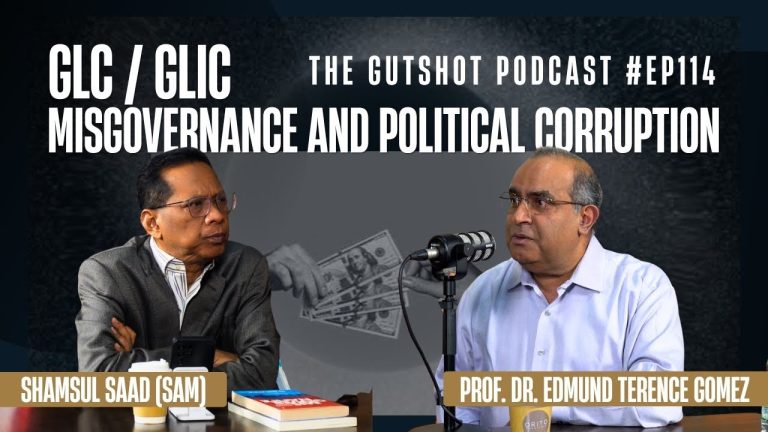
GLC/GLIC Eco-System: Mis-Governance and Political Corruption
Show Notes & Description
We have with us again Emeritus Professor of Political Economy, my friend Dr Terence Gomez, the pre-eminent expert on Malaysia's political economy. We set aside racial considerations in our analysis to focus on the institutional issues: abuse of power, accountability, and misgovernance. The LTH RCI is merely the latest in a long list of systemic failures within this GLC/GLIC eco-system–one that has now crept into the private sector, as revealed by the "corporate mafia" scandal.
In this eye-opening episode, Dr Gomez traces the roots of systemic misgovernance and the missed opportunities of our leaders–past and present, in both government and opposition–and their failure to right these wrongs. He also explains why.
Malaysians need to hear this courageous, precise, and detailed thesis from Prof Terence Gomez. It is nothing short of essential viewing for anyone seeking to understand why we are trapped in a politically created economic disaster–an eco-system with a real and profound impact on our lives and livelihoods.
We Have a Country to Save.
Jump to chapter 10 chapters
- 0:00 Mapping GLC Patronage and Broken Reform Pledges
- 3:33 The Structure of Minister of Finance Incorporated
- 7:11 Tabung Haji's Mandate Shift and 1997 Bailouts
- 14:03 GLICs as Corporate Conglomerates vs Pure Investors
- 19:08 The Concentration of Finance Power Post-2008
- 34:15 The 2018 Transition and the Ministry of Economic Affairs
- 43:57 Sheraton Move, Political Survival, and Withheld RCIs
- 53:27 The Reluctance to Enact Political Financing Laws
- 1:09:00 Corporate Mafia Scandals and Regulatory Capture
- 1:17:47 Pathways to True Independent Institutional Oversight
Auto-generated from YouTube captions. Timestamps link to the video.
Honestly, Sam, this is what happened. They read the book. We were working on our second report. More detail. I went to I went to see them.
Uh-huh. And when I saw them, they asked, they said, "No power coins, just give us if you want to give us notes." So, I gave them the diagrams. So, when I gave them the diagrams, Dime Xodin was very taken up by my diagrams. Okay,
seriously, this is the truth. Yeah, she was very taken up by all these diagrams. She was not happy. Then not long later, I got in the same day another call. Tuna needs it now. They are preparing a report. It's going to come out in 100 days. We can't wait. They going to come out with a report. They promised the rocky in 100 days they will come out the report. All right. and we can play a role in helping them shape the reforms properly. We have the information. So we gave it to them.
Mhm. So we gave them the the as you said only to realize later the report never came out. Remember that report never got published. I don't know what what happened with all that information but what I do know is there was a major revamp of all the GLC's within the ministries and a new ministry called ministry of economic affairs was created and Azin Ali was put there and a lot of important GLC's were taken out of the control of the minister of finance who was at the time nameing and transferred into the hands of minister of economic affairs and the minister of
economic affairs was appointed to be to the board of Kazana where it should have been the minister of finance Slim Gorning it was instead Azbin and a lot of changes were happening here and shifting of the GLC's within the ministries which are all important ministries. Now the point here is this too has began to see the GLC ecosystem as a tool which they can use to consolidate power. Welcome back to the guy short podcast. I'm Shamso Sam your host and today uh we would like to welcome again Professor Terren Gomez. How are you sir?
Thank you. Professor Terren has been here before as you all know and he's our preeeminent economist with respect to especially our GLC and GLIC ecosystem. Right. So we're going to continue the probably in essence uh this is a continuation of our previous podcast but with the with what has been happening with uh uh the GLIC ecosystem and the GLC ecosystem with this uh rci on tabonghaji. Yeah. Uh Terren, can we start there and then we go back to probably so that people realize this is not a new thing.
Yeah. And it has been going on for a long time. And we until such u systemic measures are taken to unravel the the guardian kn that we have that that that you are going to uh expand on. Um we're going to keep on seeing such things happening. So I think uh I I go to you Terrence immediately and uh for you to start off and then we we we we delve into it. Thank you Sam.
Okay. When the rci report on tabaji came out and when I read it I was extremely shocked because the recommendations by the rci are not new. They're not novel. In fact we have spoken about the exact same recommendations 10 years ago. And I'd like to bring here to the attention of your
okay read of our viewers viewers. This is uh Terren's uh book minister of finance incorporated ownership and control of corporate Malaysia. When was this published Terren?
2017. 2017. Okay. Now this was in effect published 10 years ago. Right. Now in 2017 at that time the big the order the big issue of the day was 1MDB.
Mhm. And since all the focus was on 1MDB and 1 MDB is just one GLC which was basically unknown until the whole scandal exploded. We realized that the public should know about the GLC ecosystem as a whole.
Right. And in in fact they should also know what is know more about what is known as the GLIC's the government linked investment companies. Yes. And that's Kazana, PNB, EPF, KW,
LP, LT and Ahaji, right? And this book was just about the seven GLIC's because they sit at the apex of the GLC ecosystem. Right? Now the at the apex of the eu ecosystem is a company called ironically enough minister of finance incorporated. The title of the book
right is actually the title of the company which sits at the apex of the GLC ecosystem. It's a holding company created in 1957 when we gained independence so that the government could park all the assets that the British had under one company.
Right? And it's been there since 1957. Yeah. There's no board of directors. It's directly under the control of one man the minister of finance and this min this ministry of finance incorporated controls the seven GIC's directly under so in effect the minister of finance has a lot of power through this one holding company called minister of finance incorporated and that includes tabaji now that's basically just to show you the architecture the infrastructure that we're dealing with that is very important
wow guys I I'm I'm almost gaping in my mouth cuz I didn't realize it's 1957. Yes. I didn't realize that there's no board but there is basically under the minister of finance and that itself shows there's a fundamental flaw with that.
Exactly. Straight away the point I'm going to make in my discussion with you Sam is on the theme of public governance. Right. In fact, the title of the other book which I brought today
is misgovernance the grand corruption in Malaysia by professor Terren Gomez. So guys this is not uh trying to plug the book but you know this is something that has been written this was published when
last year. Last year okay now the reason I'm putting this book here look at the title misgovernance right the whole team behind this book was about abuse of the public governance system. Now while minister of finance incorporated gave the structure what we didn't do enough of was to talk about how the governance system really operates and how it's abused and that's what we went into in the second book. Okay,
now you know the history, right? You know the team. Now let's talk about Tabonghaji. Okay, the key point I want to make in this dialogue with you is that these institutions were created for public good. Let's take tabonghaji. Tabonghaji was created in the 1960s by professor who was
as a mechanism to allow the poor to save funds with government support to allow them to go and perform hajj the hajj. Yeah. It was institutionalized in 1969 as the lambagati. Now when it was done the idea was people will put their savings in the tamongaji. The funds there will be invested properly and then those funds those savings will be used with government giving additional income additional funds to allow people especially the poor to go and do their hutch. A very novel idea but something fundamental changed later in this system. The finance minister
suddenly decided or the executive arm of government decided they are now going to intervene in this process which is supposed to be between the savers and the investment board who will then invest and make sure that everything is done properly and they can go and perform the Hajj why is the minister interfering in this process and that's basically what happened when that's why I use the term misgovernance. Now when did we first see it? Now let's really get into the history. Okay,
this is where it becomes interesting. Okay, in 1997 1998 we had a political crisis. We had the Asian financial crisis first which then led to the political crisis and the ouster of Ano Ibrahim at that time minister of finance.
Mhm. When he was ousted from office, Dan took over and then later dime left. Not long later dime left and a chap called no Muhammad Yakob took over. Now the point of that story is that when the 1997 financial crisis occurred, the government had to reationalize many of the assets, many of the GLC's that had been privatized. And suddenly in 1998, the government after reationalizing all these companies, basically bailing them out.
Yes. Was now sitting on a whole bunch of companies and many of them were under uh uh duress, you know, in distress. So they had to be revamped and so they set up this Danahhata uh to to revamp all these companies. Now the person who was eventually put in charge was this chap called no Muhammad Yakob who became special economic adviser to Mahhat. At that time Mahhat decided that he was going to be finance minister. After dime left he decided un we were shook the prime minister is taking on the role of the finance minister. This is unexpected. How can he do this? But
that's what he did and he put normalyakoup to take charge of the revamping of the GLC ecosystem that had now been enlarged with the reationalization of all these privatized companies. And now Muhammad Yokop went to see Mahati and said Tabonghaji is in trouble. We got to help Tabonghaji. Very interesting point because way back in 2025 years ago they realized already Tabonghaji was being abused and had to be revamp revamped. Now I'll move the story forward. They did it. Abdullah takes over a few years later and Abdullah introduces the GLC transformation plan, a 10-year GLC
transformation plan. And in that 10-year GLC transformation plan, basically focusing on the GLIC's, he also focused on Tabonghaji and he realized Tabonghaji had to be revamped. They went into a number of recommendations and among the recommendations was professionalize the management, keep the politicians out. If you look at the GLC transformation plan, it was a very good plan and many of the recommendations there were the recommendations which we see repeated again in the RCI report. So what happened between that period when they first started doing the GLC transformation plan? This is 2005
and today why didn't they implement what they were supposed to do? Well, let me get this right. 97 they had a crisis and then even uh subsequent to that straight away they already saw that tabaji need to be re revamped which they did
and um and then we take over. Yes. And again it had to be revamped. Yes. So that first revamp that first revamp in 97 must have uh must must have its roots in terms of the problem prior to 97 crisis.
That is the point. Okay. These things were happening prior to the financial crisis. So I started with what happened when Tam was first formed which was in the n uh 1960s
right and what it was supposed to do and it was doing it very well and what happened subsequently yes and the point here is if tabuli was now in trouble in 1997 that means during that period during Mahhati's administration and when Anoa too was finance minister things were already going wrong with Tabong
okay now not much of all this has been exposed right but it has been mentioned I mentioned it in my book in minister of finance incorporated okay this whole story that I'm telling you is in that book okay about how no mama Jakob went to see Mahati and told him we got to do something we got to this is tabul
this is poor people's savings to go and do the hajj we have to do something which Mahhati duly did he let no more money could handle it okay but it was not enough the severity of the problem was that now they had to revamp not just Tabonghaji but the entire GLC ecosystem because now they were sitting on a major corporate empire with the reationalization of all these companies and we're sitting with EPF which is savings funds to a pension fund we're sitting with PNB which is an investment fund a lot of money went into PNB we were sitting with on Kazana which is a strate strategic uh sovereign
wealth fund which had a lot of taxpayers money there too we were sitting on LT which is the which is the fund for the military armed forces. Then we sitting also with KW. KOP is the pension fund for those in the civil service.
Right? And all of them were flushed with funds and all of them were investing in the corporate sector. Right? Now I want to make one fundamental point. Okay? Let's look at Tabul and let's look at LTA the fund for the armed forces investment uh armed forces pension and compare them with say EPF and compare them with say uh PNB okay let's just compare them yeah why I want to show functionality what are they supposed to do
right now if you look at EPF and P&B what do they do they have a lot of funds right and they just go and invest in companies they they they go investment fund equity market. Yeah. They're investment funds.
That's all they do. They don't own and control the business group a conglomerate and they don't go and maneuver shares here and there. Right. That's one way of functioning. Right. Then we have Tabong and I want to bring into the mix LT.
Okay. Tabong had a whole conglomerate under it. It functioned like a business group as you can see in the report. We also had a huge conglomerate involved in hotels, in plantations, in oil and gas. And then we have LT. Yeah. And they controlled Boston. Yeah. And Boston had a huge corporate empire under it.
Right. Now the question here that then arose why is it that a pension fund and a savings fund for for people to go and do the Hajj is functioning like a corporate empire right with a huge business group that is not their business
right they were not set up to become a corporate enterprise and major industries going down many levels they were involved in so many companies they control banks Mhm. Mhm. Tabonghaji control a bank bank Islam LT controlled Afining Bank. What is this?
Mhm. M you are basically a highly diversified group. Y is that your role? And unfortunately under the GLC transformation plan under Abdullah they decided it's okay carry on do it. And I think that's when the first fundamental mistake was done. Why? Because these people when they were running the group, were they really running it like a properly managed, professionally managed uh corporate empire? All the evidence indicates no.
In fact, why do I say that with such confidence? Because both these groups have been mired in scandals for a long time. LT has been mired in defense scandals for a long time and that's covered in my book on misgovernance. Tabonghaji has been perpetually mired in scandals. Now what does this say? When we had the government transformation plan which we all welcomed under Abdullah
and we thought now Abdullah is going to professionalize the GLC ecosystem and especially the GLIC and he said politicians stay out. It's there among the recommendations and if you look and this was to our surprise when we did it when we did this book Minister of Finance Incorporated when we looked at publicly listed companies we realized that it is true the number of AMO politicians sitting as directors in publicly listed companies diminished significantly
yes after the GLC transformation plan was introduced there was a serious attempt to professionalize the management right but here's the thing. Mhm. I told you we have an apex right in an infrastructure at the top. Yes. At the GIC levels, yes, they may have changed it. At the publicly listed companies, they may have list changed it. But when we come down to the lower levels, the subsidiaries of the publicly listed companies or the and the associate companies and it can go down and down and down and that's where the nonsense is. And if you look at the Tabong Hajir RCI
where they they said where the nonsense was going on and the 14 companies that they were looking at were not at the top levels they were looking at companies somewhere down there third level fourth level which was out of the public eye
and that's where a lot of this manipulation of of uh you know wrongdoings were occurring and wheeling and dealing and shady deals apparently according to were occurring ing. So the structure was changed to keep the top looking clean, at least in the public eye, but they did not go down to the lower levels and clean up the system. Now here's where things get even more interesting. Najib then takes over. Remember Abdullah was only there for one term. Najib comes in and Najib looks at the system and he says, "We are now confronted with a global financial crisis 2008. We have to do something.
You're in deep recession. And he says two important things. I want to clean up the GLC ecosystem. I want to introduce privatization in a big way. He talked about privatization. He created Pandu.
Yeah, I remember that. Pomandu was supposed to go and look at this GLC ecosystem and look at how we can revamp it. And at that time the person in charge of Pandu, Idris Jala, Idris Jala correctly said we must clean up this thing. And they were he put as we expected privatization on the board and Najip even said the era of big government is finished. He said that one year later he stopped saying it. One year later if you look at the Pomando reports they stopped discussing privatization. Why?
Why? Because when he looked at the GLC ecosystem and he saw that he was sitting on this huge corporate empire, he began to think to himself, why should I take this all this this huge volume of economic power out which is now vested in my hands because I'm also the prime minister and finance minister. Why should I take it and go and transfer it into the hands of the private sector, private individuals? At thereins this attempt to reform stopped. If you look at the recommendations made by Pomandu, Pomandu to my mind did a lot of good work. They really went in and they
looked at the system. They looked at education and other things too. But they also looked at the GLC ecosystem and they had an enormous number of recommendations. The point here is this. Mahhat when he was prime minister and finance minister knew changes had to be made and changes began to be made. Abdullah was there and he knew changes had to be made and he introduced the GLC transformation which is continuing under under Najib and then Najib becomes prime minister and finance minister the global financial crisis and recognize the things have been done and
Pandu comes in and says make more make more changes. We had so many opportunities to make changes and changes were made. So why is it that today we still have Yeah. Excuse me. Why do we still have this problem? Yeah,
because there's one fundamental change they didn't make, right? The evolution of power, decision making power. Who had the ultimate decision making power?
Finance minister. The finance, remember I told you the structure. The finance minister controls the GLS. The GLC's control the listed companies which control a lot of companies. It's a huge empire. Yeah. But ultimately one man the finance minister can decide. And that's why it was very important for the prime minister to remain as finance minister. That's why Abdullah when he took over didn't immediately say come on prime minister cannot be finance minister. Abdullah because he was at that time a weak prime minister and he knew that he had to consolidate his position was not
going to give up the post of finance minister because he was probably advised don't do it. Najip when he came in realized that he had to do it but then when he saw what he was sitting on backtracked and said I'm not going to do it because in 2009 remember not only did we have a global financial crisis what did we have for the first time for the first time in 2008 Barisa National lost its two-thirds majority and had lost control of five state governments suddenly Barisa National AMNO was facing a lot of problems and when you're facing a lot of problems in a deeply monetized
economic system and political system as we discussed in the last discussion we had what do you do you don't give away your control over institutions can give you access to a lot of money
yes and therein lies the story of 1MDB which is a separate story yeah which we won't go get into but you saw how he created 1 MDB and used 1MDB as a mechanism to get a lot of money out of the public sector transferred it abroad with that came back into Naidup's personal account ostensibly as a donation which then was used in the 2013 general election to win back the support that they had lost in 2008. You see the system.
Yeah. Now you know why they don't want to change it. We are talking now we have the architecture the structure. I have now described to you the system and and even today I mean the really the prime minister is still the finance minister
is that's why Anoa yes Ibraim as opposition leader said repeatedly repeatedly he said it the prime minister cannot be the finance minister that is a major structural reform we must introduce when the reform Rafamasi takes power. It's in the manifesto. And the first thing he did when he became prime minister was to appoint himself as finance minister. Why? Anoa was now in charge of a government which was a coalition not of his making and he was now you know it was a hung parliament. He was now overseeing a very fractured political system. And in a very fractured political system, what do
you need in this highly monetized political system that we have? We need access to money. So let's go back. Yeah. Najip created Pandu. A lot of reforms could have been introduced.
Not done. It was not done. Tabhaji remained under the control of politicians. Tabhaji poor people were still investing. It's a cash cow. Money was always coming in. and you could use that money for your own vested interests. And subsequently he then went and the story of Felder the creation of FGV Felder global ventures the IPO or initial public offering yeah
which was the second largest in the world when it was done and FGV was created and Tabonghaji became a shareholder of FGV and suddenly FGV was admired in all kinds of controversy and FTV's stock price fell and today they even calling for RCI on Felder. The Fel Felder settlers lost out from
the forcible creation of I would say for because a lot of Felder settlers were not happy with the creation of FGB2 because it took out decision-m control from them and put it in the hands of a small group of board of directors who ultimately were under the control of the finance minister. Right
now here let's get into the recommendations right professionalization of the management. Even here in the RCI report he said professionalized the management. How many times are there? It's nonsense. We said it in this book. You can it looks good on paper. You have professionalized the management. All these people look like they're professionals. You know they've got the requisite qualifications so on and so forth. But the prime minister come finance minister will appoint the chairman of the board. In this case it was an amno politician in the case of Tabukaji. The prime minister and the
chairman together can decide what to do and then the chairman all he has to do is to instruct the professionalized management to do what you have to been instructed to do. And will they go against the chairman?
No way. And ultimately they also know who is giving the orders. Yeah. Here. So this idea of the professionalized management will solve all our problems is nonsense. That's I like the professionalization of the management. I really am behind it. But I'm more interested in the power control system that we are talking about here.
Yeah. So just two people the finance minister and the chairman of the board can dictate what they want and the management will have to do it. for all intents and purposes for most of the time the professional management is managing it professionally but they do get occasions when the chairman will tell I want this done I want that done and they'll have to do it and that's when you begin to see some certain deals going through which under normal circumstances you would think a professional management would not have gone and made such investments because they don't look like they will pan out
the way they should pan Well, I do you don't mind me saying one thing on this matter because I mean from my experience of corporate culture in the private sector right um whether it is private sector or GLC or even civil service uh any organization u will follow how the leader at the top uh manages or instructs the decision.
Yes. because that creates the culture of that organization and it falls right through. You may have professional managers but if um the decision making at the very top is not professional um and it is beyond repro is not beyond reproach the same will happen at the so-called professional level that is what I have I I see
yes but the point here that I'm making is where does decision making control lie you know we are talking here about ownership and control ownership is actually ultimately still with the government.
Yeah, that's why it's under the minister of finance incorporated, the holding company alg powers. Now we know the ownership. Now let's talk control. Who decides? So for all intents and purposes, the finance minister is not keeping an close eye on what is happening and watching what's happening. He's not really into all this, you know. Uh the chairman also I don't think is keeping a very close eye on all this. But where he is thinking is if a deal comes across and so let's take the for example the allegations of investing in the plantation sector there have been a lot
of allegations of Najib's apparent close ties with some people in Indonesia Eagle Heights he has you know it's well published right who decided why did he go into it and that became a controversy there was the discussion on uh Tamong Haji's investment in TRX buying TRX the alleged reason was it was to help bail out 1M MDB and Mahhat at the time outside government had already said don't do it. So as you can see I'm talking about not everyday running of the company. I'm talking about deals that come across on and off.
Yeah this on and off is is is billion dollar sizes though. That's where the problem emerged. That's where the misgovernance the mismanagement public governance on one hand
Mhm. and mismanagement on the other hand. So when you put this combination together you get this and this is why we really look have to look at the system the architecture of the GLC ecosystem and ask more serious questions where does the power lie who decides how do we now we know where the power really lies it's at the apex with the finance minister with the executive arm of government we have to delink the executive arm of government from the running of these GLIC's and we've been seeing this for a very long time. We said it as far back as 2017. This book, Minister of Finance
Incorporated, when it came out 2017 was given to Mahhat. Mahhati, what did he say? I didn't do it. He didn't do it. But I was sent a photograph and told your book has been given to Mahhati. He has a copy of the book. I normally keep an arms relationship from from power from power leans. I so here why am I bringing this up? In 2017 at that time the crisis that everyone was talking about which was in the public domain was 1 MDB
right and Mahhat correctly said 1 MDB is a GLC and the GLC system is completely abused and what we have created his words what we have created is a monster. He called the GLC a monster. So he knew that reforms had to be instituted. Now we come to okay Najib has gone. Mahhat gets elected as prime minister and Mahhat and dine his economic adviser and they have a committee of eminent people which was created was instructed to look into the reforms that were required including the reforms of the GLC ecosystem. I know this for a fact because I was personally called and said get ready to
look into how we can revamp this based on your book. I said I am ready and then the C called me in for an interview to discuss this book. Dime was chairing it.
Okay. And to discuss also my new research. I told him you've read the book. Let's not discuss the book. Let's talk about my further research where I looked at the cabinet and I said the ministries each ministry has control of a lot of GLC's under them like even in the case of Tabangi is control by the minister of religious affairs. So each ministry was controlling different uh GLC's and I said you know we have to revamp this whole system and I gave them all the charts that we had drawn and I said look at this look how huge huge the system is excuse me I was expecting a major reform
it didn't happen instead what happened was they took that information and they began to use it to serve your own vested first and I wrote an article on this called uh if Najib's famous title was cash is king.
I wrote an article in the star which is called which is titled patronage is king. Patronage is king question mark. Why? Yeah. Because when they saw that GLC ecosystem that I had mapped out very well for them actually for the public which they took. Now when they saw it they realized one very important thing. This GLC ecosystem can be used to consolidate power.
Yeah. You you gave them the treasure map. Honestly Sam this is what happened. They read the book. We were working on our second report more detail. I went to I went to see them.
Uhhuh. And when I saw them, they asked, they said, "No power coins, just give us if you want to give us notes." So I gave them the diagrams. So when I get them the diagrams, D Xodin was very taken up by my diagrams.
Okay. Seriously? Yeah. This is the truth. Yeah. He was very taken up by all these diagrams. And then when I went back his secretary called me and he said Tundime would like to have a soft copy so that we can look at his diagrams carefully. So I said please tell tun that. I said wait for the report. She was not happy. Then not long later I got in the same day another call. Tun needs it now. We are preparing a report. is going to come out in 100 days. We can't wait. So I said okay let me think about it. So I went to meet my team. I had a team of students. I told them they've asked us
this. I prefer we wait make sure everything is done properly. We publish it. Let them wait. But it is true. We are going to come out in a report. They promised the rocky in 100 days they will come out the report. All right. and we can play a role in helping them shape the reforms properly. We have the information. So we gave it to them.
Mhm. So we gave them the the as you said only to realize later the report never came out. Now remember that report never got published. I don't know what what happened with all that information but what I do know is there was a major revamp of all the GLC's within the ministries and a new ministry called ministry of economic affairs was created and Azin Ali was put there and a lot of important GLC's were taken out of the control of the minister of finance who was at the time Nimoning and transferred into the hands of minister of economic affairs and the minister of
economic affairs was appointed to be to the board of Kazana where it should have been the minister of finance and Slim Garning it was instead Azin and a lot of changes were happening here and shifting of the GLC's within the ministries which are all important ministries. Now the point here is this. They too has began to see the GLC ecosystem as a tool which they can use to consolidate power and they were also why was Azin Ali put there as minister of economic affairs because there were power maneuverings going on among elites for the transition which was supposed to come because
Mahhat said he'll only be in power for two years remember. Yeah. Uh so a lot of things are going on. Why am I telling you this story? I'm telling you this Sam because I want to put the GLC ecosystem and Tabukhaji and the others at the heart of our political system and how politicians instead of being responsible in terms of they govern them, employ them for their own political interest too. not so much as to make money but to use that system to further empower themselves. Now the GLC ecosystem, let's just take for example the Ministry of Rural Development. Even in our last podcast,
we talked about it. They have statutory bodies which go down to the grassroots. Now here and this happened. I was at a conference in Australia in Canbor A&U where we were discussing the elections and the reforms and one rep one person from came and he spoke and he said you know we have taken over the GLC ecosystem we know it has to be revamped but we're not going to do it yet we are going to use it because we know they have penetrated the grassroots we're going to use it to increase our support in the grassroots areas Why? Because Basatu has no support in the Malay heartland states.
And after we have consolidated our support, then we will reform it. And the people at the conference erupted. What are you telling us? You promise reform. And you're telling us you're not going to change it until you consolid consolidate your power and you actually come here and justify it. This is this is a a a conference in Australia
public conference. A lot of Malaysian experts were there, experts from Malaysia as well as from outside academics and they were pick what was that guy thinking was like all this is verifiable. It happened in the public domain.
Many people were sitting there. All right. He exposed what they were going to do. Now, the reason I'm accounting this story to you is because I want to stress this point. Politicians should know better. They were put in power to change things, but once they get into power, they embrace it for themselves. And you
they can't help themselves because it's all about power. Once you get in, consolidate your power base. Now, let's move on further, right? and show you how interesting the story gets.
Okay, hold on a second. Okay, we'll return in short while. If you guys like to continue this conversation, enjoy the conversation that we have, uh please subscribe so we can keep getting this uh podcast for free for you guys and keep liking so that we can uh we can uh we can spread uh our intelligent conversation to all the thinkers in Malaysia. We have a country to save it is.
So let's come back to where I stopped. Yeah. Mahhati has come to power and Mahhati suddenly realizes that there's a big problem with Tabonghaji. Remember when he took over Tabonghaji was already in a mess.
Yeah. They had to revamp it. So that was that was so he got that mess when Anoir was the finance minister before Najib falls. Oh we're talking at the point
I'm talking the where we left off was 2018. Okay let's go. Yeah we left off at 2018 when the C was formed to look into all these things. Right. Right. Right. Right. Well before I go back to Mahat let me just finish the story on the C. Right.
One of the things we discussed in the C was major reforms of the GLIC's. Right. And one of the things we discussed which I thought they would institute was they looked at the GLIC's and they said we have a KW and we have LTE both of them are pension funds why don't we merge them and I said yes
makes sense we should merge them I am a major advocate of that and I said we should also look at tabong khaji and sitting there too was zeti whose father had set up tabaji and she had a lot of concerns about tabong technology too. So there was a lot of discussion at that time in 2018 about another major reform of the entire GLC ecosystem specifically here also on the GLICS including tabaji kop and ltat which they needed to do it never happened
now I'll leave that aside so as you can see in 2018 a lot of things were happening in terms of the maneuverings of the GLC's under the control of different ministries and then also of the GLIS there was a lot of discuss USS on this. Why? Because of 1 MDV and 1MDB showed how bad the system can get if a executive arm of government intervenes in the GLC ecosystem.
Right? But what was also then exposed was at that time Tabong in 2018 was in very serious crisis and to save Tabonghaji they created a special purpose vehicle called UGSB. Yep. Now this special purpose vehicle took over the bad
uh the bad ass assets if you like of these companies and issued bonds in return. Why? They had to do something about tabaji. They had to bail them out.
Fine. They acted on it. But the point here is Mahati at that time also should have realized that when I left office we were talking about this. When I left office in 2003 and the period from 1998 to 2003 no more was talking about these things we have to re revamp it. Nothing much has changed. In fact the situation has gotten worse. Yeah.
So, one would think for a man who called the GLC ecosystem now a monster would dive in and change the whole thing. After all, he created a system and he also know how to revamp that system. He he ruined that system. Actually, he was doing a lot of good things initially. He ruined it. They didn't do it. They left. They they were left. They left things as they were. And they of course moved to try and save Tamong Now the defining moment was 2020. In 2020 we had a coup if you like
the sheran move. We talked about it. Yeah. We had a good laugh about the so-called cool the sheran move. But that was a defining moment in what way? You see you see it as a defining moment
from a let's talk about it from a political aspect. Yeah. In 2018 when Pakistan came to power they had a majority in parliament and when they wanted to form the government the coalition decided that the prime minister will be Mahat Muhammad and they put his name forward to the king. The king said no I want one aiza and the pakatan leaders got together and they talked about it and they went back to the king and they said no we have decided it's going to be Mahhat and the king could not do anything about it
right and Mahhat became prime minister in 2020 I call that a defining moment because a fundamental change occurred. Nobody really had the majority.
Mhm. And who was going to be the prime minister? And you'll remember there was a period we were all wondering who's going to be the next prime minister and all the parliamentariums had to go in with go to the palace and there was a discussion and ultimately the king decided who was going to be the prime minister. Someone outside the state was deciding who was going to be the prime minister. It was not being decided among parliamentarians or parties that had been elected into government. That was a monumental change.
Yeah. Now what that meant was with the political conflict and the fracture that occurred a vacuum had been created. Who was going to occupy that space in that vacuum? Politicians were all over the place and that's when an out someone outside the political system was now deciding who should be prime minister and that's how Buhid became prime minister. Now when Muhidin became prime minister, this became very interesting too in terms of uh the dynamics
of politics now. Yeah, it was the making of a cabinet which was not really very comfortable at that time. Basatu and pass were together. Amno was there. ANO had nine ministers but you know who was not there? Zahed I'm no president Zahed was not there in cabinet and Zahed was libid and Zahed was not there because according to Muidin rightly so Zahed has got all these allegations of corruption against him I think it's not proper that he should be a minister very good statement by Muidin but Zahed was not happy and in the end there was conflict between Zahed and Muhidin and Zahed even told
ministers to resign from cabinet ABNO ministers was so it was not ANO ministers who were there were also under lot of problems and to pacify them Mohin made is Sabri deputy prime minister but things were not stable now my reading is this is my reading I may be wrong
at that time Muin decided that he's going to have an RCI on Tabonghaji yes it was Muhidin who introduced the idea of the rci on khaji.
Okay. at a time when he was facing a lot of conflict from so this is the rci that he yes it was by muhidin look at the date look at look at the timeline okay but eventually what happens is muhidin falls
right and Ismile Sabri suddenly is the new prime minister and Ismile Sabri carries on with the implementation of the rci the committee is formed and they get the report done and they submit the report just months before the before the 2022 election.
Mhm. Is Sabri is sitting on the RC report which was handed over to the king but before anything could be done. Elections were called and now we have a new government and Anoa Ibrahim comes to office and Ana inherits the RCI report for reform min prime minister what's the first thing Anoa should do he should release the RCI report
yeah that was not that was done and the argument was apparently that there may be a run on the oh that that was the argument in 2018 and oh there was The argument also given recently when it was released.
Yes. Yeah. So the point here, my argument is look as we can see in the ash report the allegations are very serious particularly against sitting amno ministers who were at that time responsible for the crisis that uh tabaji is in. This is all occurring primarily during najib's time. they have to take responsibility for this and that included people like Zahed too who was at the time in Najib's cabinet. Now here why didn't Anoa release the report then
and I must say not only did he appoint himself as finance minister he appointed Zahed as deputy prime minister something which even muidin didn't do what's going on here now people will say we had no choice we had to have stability in the government so that's why we couldn't release the report and eventually when the report was released. When was it released?
Just during the the Greece state election when they when suddenly it appeared that Amno was turning against Ano Ibrahim. Yeah. Now what let's step back. What do you make of all this? At the heart of it is a major institution Tabonghaji which has been abused and needed to be revamped and the nation had to be told what was being done exposed first what they did and then revamped and hold those who did those wrongdoings bring them to account. Correct?
Yeah. Nothing of the sort happened. Instead instead it appears to me appears to me. Yes, my interpretation I'd like to stress that it became a tool for politicians in their political maneuverings to stay in power.
I I I was just going to say that you just repeated it. It's the Sam that's the only logical conclusion you can draw. So they abuse these institutions. They even get the reports out, but they don't release it until they think, okay, now is the right time. when they do introduce it, it's because it's an opportunity time to keep in check dissenting voices against them. Yeah,
this has to stop. Yeah. Come on. This is why, as I said, this is a discussion on public governance, misgovernance, abuse of that authority vested in them to govern properly. And this is why you started this conversation with the uh with the theme being public misgovernance that we need to address.
Which is why I also wrote this book misgovernance. Yeah. And I worked with my team of young researchers in CO. We wonderful wonderful people worked very hard because we knew when we looked at this this is not turning out right. This was the government who promised us reform.
We are now two years into this government and where are all the reforms? Yeah. In fact, if I may, we were thinking we're seeing more of the same. And people who should have been held to account are sitting in cabinet. People who were mired in deep corruption and this government is saying they're going to tackle corruption are sitting in the cabinet. So, how can we take this seriously? And now it's come to bear.
It's been exposed. Yeah. And there's only one. That's right. I I mean, you know, I think we know where the theme is going. That's only one. Now, what about LTA,
the Boston scandal, and the scandal involving the LCS, the ships, the combat ships. Yeah. Now we heard when this report RCI report was released, we heard that there should also be an RCI on Felder.
Felda, there you are. This is only one. Yes, there's so many more. I wouldn't be surprised if every single one of them should have an RCI on them. K-W K-W now is having problems. K-wop was also brought into the mix in 1MDB in terms of giving them remember.
Mhm. So if you look at each of these institutions, they seem to have been brought into this political business nexus, this abuse of uh of the whole system to serve the interest of politicians either for personal means, corruption which was exposed, kleptocracy was the new term that emerged, but also for the financing of politics. Mhm.
Which is why today we cannot we just cannot get anyone to move on the introduction of a political financing act which we must have. Now I can tell you in 2009 when uh the Basan National lost its two/3s majority one of the first things we did was we went to the opposition and we told them here is our recommendations for a political financing act. Introduce it stop this polit money politics. They didn't even the opposition at that time said no. Why?
Why? Because one they had control of the panang state government DAP. Okay. And two they had control of Seleno state government PKR and they now suddenly had a lot of people sitting in parliament and they said for the first time we too are getting a lot of money from the private sector. Why would we want to introduce political financing act? How are you going to take on the Barisan National if you do this? Amno. I said, "If you don't draw a line here now, you will never ever have more money anyway from AMO. So, please just get on with it." They didn't do it.
Now, here's where it gets even more interesting. Najib promised that he will introduce a political financing act even then when he came to power. Command was working on it
and we took our recommendations and we went to see the minister in the prime minister's department. The law minister gave him the recommendations. He looked at it. This is after we met the opposition who said no to us. Really in shock. Then we took it to see the minister. He looked at it. I'm no man. He looked at it. Then he looked at us and said, "What do you want with this?" So I said, "Najip wants to introduce reforms of political financing. We have done the work for you. Just take it and implement it." And he said to me and the team from Transparency International, we
did the work. He said to us openly, "We are not going to do this because if we do this, I'm no lose power. I am not stupid. How how honest can you get?"
Yeah. At least at least they were true. They were very true. They said it openly because that's exactly what would have happened. But here's the irony of not the irony of that statement,
right? The irony is that by not doing it, it eventually led to 1 MDB. Yes. And it was because of 1 MDB, they lost the power. So if they had acted on this in 2009, we wouldn't be sitting here having this discussion on 1 MDB or the Tabonghaji and all the abuse that was going on. You you know one thing I just maybe this is a bit of an aside right for our audience especially I think one of the problem that uh voters or the electorate the citizen when they hear us talking like this okay they do get I mean the they do get the gist of what you're saying but on the ground it's as if it has no
impact on their bread and butter issues. However, what they forgot is actually this amount of leakages that is taken out from the I mean basically you taking out liquidity from the capital system in the in in the economy.
That's right. Right. And therefore that liquidity which would have generated uh higher wages uh lower costs you know actually are impacting the bread and butter except they don't see it directly. That's the only thing I want as an aside for audiences to take. They don't realize that this mega issues or this complex economics that we are talking about has real
effect. That's why the that's why% that's why the tabaji issue was very important because it would have had a direct impact on the lives of many people and that's why this is really causing a lot of problems on the ground exactly as you said when people feel it personally that's when they ask the question why is what does this mean about my savings with tamaji why is it that money which I thought was going into an institution which will look after my money properly is investing it in dubious deals. Haram. So if I may, I'll just finish this point.
Who do we turn to to really discuss this and debate it especially in parliament so that people can hear about it? Parliament. The opposition. But when the you went to the opposition and they don't even want to do it.
I'm just trying to put into the frame political system. Correct. to address your point. Sure. Now, an opposition normally should stand up and speak about these issues. When the Tabong Khani AI was released, interestingly enough, many of the opposition members themselves walked out. Pass walked out. Now, when you think about it, why did pass walk out? Because if pass speaks about this, a lot of people will listen, you know,
because we're talking about Tabonghaji, right? and pass is a party that says that they are very concerned about Islam and Islamic governance. So one would think they will take this very seriously. past walk out. Why did pass walk out? And then you go back and you look at the history. Pass was in the government at the time when the RCI was introduced with Mohein. Pass was in the government when the RCI was completed. Surely the past members knew about the RCI report before the change of government in 2022. Why didn't pass also discuss these issues then? Now the reason I'm putting
that on the table is to show the complicity of all parties in this mess that we are now confronted with. It doesn't matter now whether you're in opposition or in government. It doesn't matter whether you're Madani or you're on the other side of the aisle of parliament. At one point or another you were in government and you were in government also and you were privy to this information. So you cannot claim you didn't know. In fact, I would turn around and tell pass. Why didn't you act on this then?
Now that's now why we have a serious crisis today and that's why people also on the ground are not informed. I have written these books and how many people have read the book you know and how do we in civil society or academics even if we appear on the shows talk about it
how does the message really reach down to the ground does the media cover these things the newspapers didn't cover my book on misgovernance I think it's an important book which talks about serious mis newspapers didn't cover it
I wonder whether even I mean even when the rci came out right the discussion on the RCI was very much about uh the recommendation so to speak as if to as if to move on rather than actually making people accountable. You must have accountability and there was the impression I get of the coverage is that no accountability are being demanded.
The issue here about the RCI is they didn't show exactly who are the key actors who are involved. Now one key actor who cannot run away from all this is none other than the chairman of uh of Tabong AJ at the time as is the former Baling MP.
He is repeatedly in the news. Why he was the chairman and you're also looking at who are the other ANOU members who were sitting on the board of Tabuki. They have a lot to account for. Now these were people where you can put a face to the crisis but the wrongdoings that were occurred or the 14 odd enterprises which they said there are ser there serious concerns about it are companies where they didn't give us the details. We don't know who the directors were. We don't know exactly what are the actual events that transpired in the decision-m process that led to the making of these
investments. right now. That's why the police and the MECC have to come in and go down to the ground and do a proper investigation of all these things and then name the culprits to be fair to the committee that wrote the report. That was not their work to go into it and it's very hard to get information to get this kind of information
and that was not what they were asked to do. They were asked to look at what was the crisis about and how do you solve the crisis and to be fair to them they did a decent job there too. But the actual culprit that's why they kept saying they use the term sak where is the sakini remember you
who did it you're not naming it but this is where now we need an independent police we need an independent MACC to go down to the ground we don't want selective prosecution and this is our concern do we have an independent MECC who we can be sure will do a proper investigation and then charge these people. Do we have Sam an independent AG who when the file if it's given to him and it's done independently and he looks at a file will independently assess who can or should be prosecuted. I'm only putting this on the table because these are normal questions. Every person who's concerned about the
whole legal process has been questioning for a long time and we still haven't seen the implementation separation of powers for AG and OP. What we've seen so far is all the the dropping of charges on uh DNAA of Zahed.
Yeah. So which has been now being called into question by none other than the power council and they've taken it to court to say no this is not proper. Yeah. So you can see there's a lot of push back to decisions taking taken by the executive arm of government which seems to be having also appears to be having a not control over the AG's office. This is why we the issue here about Asia and it's a godsend in that sense. What it is exposed is is forced us to ask an important question about where does power lie where does decision making power really lie? Who is
ultimately responsible? I go back to my history which I just presented. Mahaki was prime minister and didn't really act on this matter way back in the 199 late 1990s. Abdullah was aware of these things too. He was prime minister. He brought about the reforms but didn't really go after the people who had already created a mess in Tabonghaji at that time. Nobody was held to account at that time. Najib comes to power and takes this problem to new heights. Mahhat comes back to power and doesn't really expose this doesn't charge anyone about this about this crisis that they
were in. They tried to solve it through UGSB. Fine. But when Anoa comes to power why didn't he act? Now there were many occasions when we could have held people to account for wrongdoings involving Tabong Khaji and the other GLICS. It didn't happen. In fact, how many people who were in power during that long time and Amno was in power. How many people and a lot of wrongdoings were exposed are sitting in jail today?
One. Only one man from AMNO a senior leader is sitting in jail for wrongdoings involving the abuse of the GIC's or JLC's and that is Najip for 1 MDB but over the past since the 1980s we had had so many problems involving GLC's going back to the time of the BF bang in the 1980s.
Yeah. And since then we have had Babaja steel. We had uh you know we had uh a whole range of them. Remember the cowgate scandal. Yeah. Under Abdullah. Oh that those god where where are all those people who were exposed for corruption then?
Where why has no one been prosecuted? What about the the LTT scandal and the scorpion scandal? Now, now you are talking about Okay. Sorry. Yeah. The scorpion scandal is just
we can go on and it's all listed here in the book. All these scandals, we've got about 100 scandals listed here. So, so how far I mean now that we are into this 2026 and uh and and and this uh reform government so to speak. I don't know whether it's reform or reformati uh as they would say today. Um where do we how much has this uh mixed of GLC GLIC quagmire has bleed into even private sector? Uh that's a very good question Sam because you know I've been speaking about the GLC ecosystem as something within the public sector
right but GLC's are actually very much in the private sector that's thing people don't realize and if you look at the RCI report in Tabhaji right
they also talk about GLC's companies owned by the government which are involved in joint ventures with not only domestic firms but even foreign firms so they're very much part of the corporate sector. Yeah.
And they're very much involved not only in domestic ventures but also foreign ventures. And if you see the RCI many of the foreign ventures where you remember the plantation company in Indonesia and it's not the first time we've seen this we already discussed it earlier other things there were there were also investments in Philippines which were also brought into question just that's just the plantation sector. Then let's look at the hotel sector. And if you read the RCR report, we're talking about hotels in Saudi Arabia, investment in which are also seen to be gone gone wrong.
These are not new at all. That is Sam that is the point. This is not new. Yeah, it's been going on as I said for 25 years at least that we know of. We don't know what happened pre previous to that. What happened in the 1990s? Not enough investigation was done into that period about the jails because at that time most of the focus was on privatization. Now we were just looking at that but we do know from the period from 2000 to 2025 a lot of things were happening with the reationalization and the revamp of the whole GLC ecosystem and we knew this was still going on. So I mean if just before
I before we move to I mean you were mentioning before we started the podcast um I mean the evolution that now this term of corporate mafia.
Yeah. I mean what's going on there? Now I'm glad you brought this up because I want to show you now the complexity of corruption. All that we have spoken about today in this discussion this morning is about what's happening in the GLC ecosystem. What I call the political GLC complex. When we talk about the corporate mafia, that's a completely different thing,
right? That's happening in the private sector. Now, the corporate mafia story is very interesting because it also shows at the heart of the corporate mafia story is none other than politicians. So we have we see here suddenly in the corporate mafia story although there's a lot of wheeling and dealing involving private business figures. We also see the hand of politicians and then we also see here you will find a few GLC's also mentioned in the corporate mafia story. But what is also fundamentally different about the corporate mafia story is the central role played allegedly by MACC.
And MAC, you read the Bloomberg report, they alleged that MACC was a key enabler of allowing dubious corporate figures to take over legitimate firms. So we need not necessarily get into the corporate mafia story because that's a big story that needs to be dealt with in its own right. But the point here is this just as there's political interference in the GLC ecosystem which is huge and is a key play in the corporate sector simultaneously in the when we look at the corporate mafia story which involves privately listed firms there seems to be a lot of political interference and key figures
involved there too but one central figure both in the corporate mafia story as well as in the jail's ecosystem is none none other than the prime minister himself finance minister Ibrahim he's been mentioned there by by by association because of fahash and Ishak is who are closely associated to him now the issue of proximity comes into play here does proximity indicate illegality no it doesn't but it raises red flags and so how does the prime minister ensure credibility and protect his name do what people have been asking for. Please give us an RCI on the corporate
mafia and let's get this all right. Sort out all these problems. Immediately the prime minister will have credibility. So I pose a question here now. Why is there a delay on the corporate mafia story which as we have seen can have serious implications in terms of not just foreign investors coming in they'll be worried but what about domestic investors who put in a lot of money create a company only to find well-connected business figures coming in forcing them out and taking over their companies. How does that inspire investor confidence? So we have a serious problem here about political
interference trust in governance. Yeah, trust in our institutions, trust in MACC, trust even in the executive arm of government to protect our interest when we invest in the economy. And here this is important because we're looking here at the finance minister who happens to be the prime minister and he's been named by connections by proximity in this whole crisis that we are. If we if we if we look at it, I mean uh going from the whole ecosystem we just spoke about the I mean this this web this entangled web of everything.
Yeah. Right. I mean the crux of it goes right up to where you want to dislodge political interference in the that's political interference is one thing right but polit political influencing is another thing then you've got an ecosystem that actually for me at least from a from a private person standpoint I I want to see a complete uh disinteg agment of government in business because why that's at the end of the day if you have a a a GLIC for example right it is nothing more than an a a an equity fund
right so don't get involved in the business you just go and you know I mean take over equ uh buy and sell equity invest into that now let's not run ahead too far
right there's a difference between government and business, right? And the executive arm of government, right, controlling business, two different things. When the executive arm of government suddenly gets deeply involved in business and dictating how things should happen, then you have a real serious problem on your hands.
That's the first thing that shouldn't be anywhere in the scene, right? Governments in, you know, governments intervene in business. That's the first thing that's easy to That is the first one that is not even addressed.
Easy to do. Yeah. Can do it quickly but no political will on the part of any parties I just mentioned any party to do it whether they are in opposition or they in government nobody wants to do it. And Sam let me remind you parties major parties including pass uh PBB in Sarowak DAP PKR AMNU all of them have power at the state level all of them have control over state government all the parties I mentioned
right and some of them in opposition some of them are part of the Madani government now here's the thing every state has a GLC ecosystem similar to what we're seeing at the federal level what we just discussed exactly we have only discussed federal level what's happening at the state level
yes so if I I'm talking about all this is happening at the federal level I'm thinking to myself okay is this also happening at the state level yes it is because we came out with a report on this at the state level and we said this is just as bad at the state level
so all the parties are implicated in misgovernance here that is the point so we have a serious problem here about how do we restructure all this that's the first now the second point and this is really fundamental Mah told us we've created a monster. He's right. If you read my book on Minister of Finance Incorporated, we actually map it out. And when we look at it, we've got a whole range of companies. So many institutions, public and private, statutory bodies. In you, if you look at all these institutions, they all employ people. M
we talking about how many hundreds of thousands of people are employed in this GLC ecosystem. Now you go and revamp it and close it all down. Do you know how many people will be unemployed? Can you imagine the social implications of all this?
Yeah. And it is not their fault. Most people don't even know they working for a GLC at the company level in the statutory bodies. Yes. They know they're working for for for the government. Fine. But the point here is this. When you do a major revamp and you want to shut down all these companies, even statuto's own companies, it's going to have a major impact on the lives of many people. This is a problem, monumentally serious problem. How are we what are we going to do with all those people who will suddenly be out of a job, no livelihood? That's how that's the scale and scope of
the problem that we are now grappling with here that these politicians and I blame Amno in particular have created and we have not moved at all and to revamp this that's why I'm very angry going back to 2018 we had a chance in 2018 the necessary institutional committees were formed they discussed it the report never got released nothing was done 8 years on we are in even further mess that we are in 2018.
Let's let's let's let's do a quick uh recap of if that if if you were the finance minister, you know, let's let's look at it just theoretically, right? What would be the or not the finance? Let's say if you have the power, you're the prime minister, okay? What would be your first act?
I don't need to be prime minister or finance minister. All I need now is one thing. Let the government be responsible and form an independent committee to really do a proper in-depth assessment of the entire GLC ecosystem. We don't even know what it looks like in its entirety. That's the first thing we need to do to map this out properly to see how vast this is. Second, we need to go into the companies and look at what they're doing. Not all of them are not are loss making. Many of them we've done the study we've seen many of them are profitm too. So let's look at the system
and let's gauge the good from the bad. Second I brought up this team of functionality. What are they supposed to do? Are they doing what they are supposed to do or have they gone on to do other things which they not supposed to do? Let's get that right too. There's so much work to be done. The first thing you do is form this independent committee of the relevant experts independent of the executive arm of government accountable okay to parliament they have to be accountable to somebody get this done put it out there in the public domain and then media must always have access to them so
that they know what is happening wouldn't be the prudent thing for uh a prime minister to say okay I'm not going to be the finance minister I am going to set up this committee not under me. Okay. Because why? The first thing is to to cut the cord of that thought political influence.
You know, Sam, is that logical or am I am I being too idealistic? Not idealistic at all. That is a necessity and the finance minister cannot be prime minister. Should be should make it very clear is never to happen again. That's the first thing.
The second thing, why did I say it must be independent? Yeah, because we can have a general election tomorrow. Yeah, somebody else will come. And I don't care who is in government as I said that should continue.
Yes, I said that because I feel when I look at the system now, it doesn't matter now who comes to power. All of them seem to have been in one way or the other implicated in this. So leave the politicians out of it.
Yeah, you can have your general elections, you can form government, go ahead. But I'm an independent committee and I will carry on my work regardless who is in government. Why am I where where where would that committee report to?
Uh that's why as I said it have to be parliament or we have to look at that how can we create an independent committee which is that's why I said the media must have always have access to it. They must give uh reports. There's also a problem with the media under with with MCMC act that uh there is a chilling effect. I recognize all the institutional impediments that we have now,
right? I recognize all the legislative impediments that we have now. But all I'm saying is now we need to have a truly independent committee which is independent of the politicians to get this going. Let's sit down now and think this through. How are we going to do it? This is the discussion we should really be having.
I didn't come here prepared to answer that question to think this through now. Exactly. Actually, when we were talking before this podcast, right, after our first our first uh disc uh sit down, you know, we sort of had had three themes that we wanted to go through, right? And this is just probably this is the the the the second sequel, you know, this such a long and winding road as the Beatles would say. No, the the point here, the more you get into it, the more you realize how dire the situation is. You really now
the recommendation I'm making now today is the first time I'm actually talking about it, right? About an independent committee which is totally independent of the political arm of government. Why? Because as I said, they're all implicated.
Now, we have to think this through. Yes. Carefully. Don't off the cuff now suddenly make some recommendations. Let's think this through. Okay, we need it. Let's sit down and let's talk about it. How do we do this properly? The accounting the count reporting mechanism
so that irrespective of what government comes to power it will continue functioning and it will be the the recommendation or the conclusion or implemented and accountability is taken.
Yes. Yeah. And I think uh this government anoa there are still a lot of good people in this government you know. I I don't I'm not going to paint everyone at the same brush. I think they have been disciplined. They've been disciplined enough now after the Saba election and then the uh Jeho election and then more recently the neg I think now now they realize you see when a government is weak that's when they're most responsive. Let's look at the Ismile subbring government. That was a very weak government and they had to show that they were performing. And during the
Ismile sub government, what did we get? We got the UND18 act, remember? Which they've been fighting for for a long time. Yeah. Which I I was not much in favor of, but it's okay.
I was. Then we had the party anti-arty hopping act. Remember that too? which was something which is fundamental which we needed and I know this for a fact because I was quite involved in the drafting of the act two the political financing act which we helped draft civil society members got together and drafted it with the bar council bar council did a lot of good work there was given to government they were working on it and then the government fell now the lesson we can take away from there is this the government is most responsive and it's most weak I agree with you
and today the government is weak and they are now showing a willingness to be responsive and the more we have podcasts like this and discussion and expose them and tell them we know exactly what you did we have lost trust in you we have to regain our trust get these things done you know so put the pressure on them yeah no I I've always been a advocate of small government not trusting the government I don't trust any politicians to be honest You know cuz as you said I mean the my fellow our mutual friends say Akuba says what if uh where the DAP hat and uh and and look
where the past head nothing will change you know so I I mean maybe I'm too cynical but uh I think the system is such that that's why we are having this problem because everybody sees the treasure map when they get to power they don't want to it's like golem you know my precious
Sam if I may yeah you know we have had political change without change and what do I mean by that in 2018 when AMNO fell for the first time AMNO lost power it was a epocal moment in Malaysian history but since then we have had numerous Prime Ministers. All the prime ministers we have had since then were from AMNU at one point or another India history. Change without change. All of them have brought the kind of dirty money politics that we see in AMNO. The political business nexuses that we saw created in AMNO from the 1980s especially. They seem to have brought it and
continued with it in governance post 2018. Who after all led the government in 2018 when Amno fell? None other than Mahhat and Daim Zenin who created this political business nexus system and took it to new heights. Who took after them? Mohiden who was part of that Wasan team in 1993 that played money politics which allowed Anoa to become to become deputy prime minister and then subsequently you know finance minister deputy prime minister. Now after that Ismile Sabri again from Amno closely associated with Najib and after that an Ibrahim the politicians have been in power the
politicians we have seen who was around in the 1980s 40 years on they are still around. So I would take a different view. What we need is to get rid of all these old fogies, these old people who created a vehical system that is so deeply monetized and corrupted. Get them out and bring in a new breed of politicians and a more accountable political system. A public government system is transparent. Bring all those things into play and we can get this country back on track. But this country is being ruined by all these politicians who will just refuse to go away and let a new
generation take over. Yeah. I mean you're a professor of economics actually at the end of the day right you know and and the the the um I mean what we are seeing I always said this um I believe that Malaysia if we will run correctly today we should be looking at a per capita GDP of nothing less than 35 to 40,000 US
yes I agree easily. Yeah easily at the level of South Korea. I agree. Yeah. And the reason why we don't have that is exactly what you've just elaborated because it's in every nook and cranny that uh you know of our economy. So I mean I'm I'm with you with respect to moving you know moving all this old you know and and bringing in completely new people you know. I think um may may I suggest we you know you wrap it up with your last words uh for this segment and then uh maybe we'll we'll we'll have another session and on uh on moving forward
that we've really thought through as you said the my last words are these history teaches us a lot of things and the most important thing we have learned here today is we have not learned from history. Now enough is enough. All right. I call on the prime minister Ano Ibrahim to be truly accountable to the nation. Get a proper investigation done of the uh allegations which were made in the RCI report. That's one. And second, you have to act on the corporate mafia issue. It's a major controversy. is going to it's a real dampener on investor confidence get that done too
and make sure it's truly independent and the third thing which I think is fundamental two major reforms MCC must be made a truly account you know loan autonomous
and you have no choice now you have to introduce a proper political financing act now what I'm asking of the prime minister these three things can be done very quickly it should be done if you really want to clean up the dire state of corruption in this country. And I say this to him because he said it when he came to government. I will make sure that my government cleans up corruption in this country. And 3 years on it's we are in a far worse situation than we were last year. This is a serious indictment of his governance. But he still has time to clean up Malaysia. Let's see whether
that happens because uh the writing is on the wall and if uh if if you don't do these fundamental changes I think the you know the broom will come out. Uh let me be very clear on this.
Yeah. Don't underestimate the rocky. Yeah. You saw in 2018 how they punished Najib. Yeah. Let's go further back. Look, in 2004 when Abdullah ran for power, he said, "I will clean up this government. I'll be a prime minister to all Malaysians." And so on and so forth, he didn't deliver. He was punished in 2004. Uh in 2008, the next election 2008.
Yeah. Now 2018, they punished Najib for corruption. And since then, now we have a hung parliament. The message is being sent to all politicians. We are totally dissolution with all of you. You're not governing properly.
They keep sending the message across to the politicians. It's time you clean up your act. Be responsible. You've been put in power to govern properly. And if you don't do it, you will be punished by the electorate. There you go, ladies and gentlemen. That's Professor Terren Edmund Terren Gomez for you. Yeah. And it's very enjoyable as always. Thank you so much. Glad you enjoyed it.
I do. All I do. I always do. All I know is I'm very angry. You know what? I we we we have a final so-called of this trilogy that we should do. Uh see you all again. Thank you so much.