EXPOSED! SHOCKING 15% SECRET OF THE UNSUSTAINABILITY OF THE MALAY ECONOMIC ECOSYSTEM
Show Notes & Description
Uncowed and unbowed. We nees to say the truth all tge time.
The bumiputra driven economic policies since the NEP, or to be honest, the Malay economic eco-system that is driven by government spending and GLC/GLIC economy is unsustainable. We dissect its nature and implications. How government and its extensions of fiscal spending was structured to create, in TDM's own term, the Malay billionaire – they got cratered by just one financial crisis in 1997/98 as a reflection of the unsustainability of this economic eco-system. The Malay-middle class is still by and large trapped within this vulnerable eco-system.
It is time to transition towards an overall integrated Malaysian economic eco-systems that brings sustainability to all. Why don't our politicians do this?
We Have a Country to Save
Jump to chapter 8 chapters
- 0:00 Fragility of the State-Driven Economy
- 0:51 Evaluating Fifty Years of NEP Procurement
- 8:10 Oil Capitalism and Middle-Class Vulnerability
- 11:14 Affirmative Action Versus Open Competition
- 14:06 The Arithmetic of Government Fiscal Limits
- 20:12 Billionaire Cronyism Versus SME Development
- 29:53 Ballooning Emoluments and Debt Service Constraints
- 34:26 Reforming GLCs and Transitioning to Free Enterprise
Auto-generated from YouTube captions. Timestamps link to the video.
If they If they are self-sustaining, they can be easily wiped out. Easily wiped out. Actually, it reminds me of how happened. Oh Oh, yeah. I I'm about to go there. Which is actually what happened when the financial crisis
1999 2000 Correct. All the Malaysian billionaires disappeared. Gone. Gone. Gone. And suddenly numbers of middle class Yeah. So, I think um people need to realize also that Ladies and gentlemen, welcome back to The Gadget Show podcast. I'm Shamsul Sam, your host, and we have Syed Akbar today.
Morning. Today, we're going to talk about procurement, specifically government procurement, right? Syed, um as usual, shall we do shall you do the opening for us, and then we uh uh pretty chit-chat about it?
Thank you. Thank you. With our audience. Mhm. Thank you. Right. Well, uh We uh today we want to talk about basically the Bumiputera economy, yeah. Our Bumiputera economy, and uh government procurement, government budget, yeah. Fiscal policy, yeah. I mean, since the new economic policy Dasar Ekonomi Baru, now for over 50 years uh the government procurement is at the core, yeah, at the center of bringing up the Bumiputera economy. Uh one former Prime Minister, at the time he was Deputy Prime Minister, he said that uh it is a government's uh It's a government strategy, yeah, that
uh they will depend almost entirely on uh government procurement to bring up the Bumiputera economy. Mhm. Well, so now we have to we have to look at where the Bumiputera economy is after, you know, like five decades, more than 50 years of uh the New Economic Policy, which uh began in 1970 or 71, 70, yeah. Uh There have been some uh some successes. There have been improvements. There is a sizable Putra middle class now. But are we happy with with the status of the economic development of the Bumi Putras? Huh? One The main thing that that pops up immediately immediately is that the
entire structure of the Bumi Putra economic system now after so many so many decades of the new economic policy is that it is not sustainable without continuous infusion of government procurement, government spending. You see? Even the Bumi Putra middle class, which is quite sizable now, a lot of it is dependent either directly or indirectly on working for the civil service, working for the GLCs, doing business with the government, doing business with the GLCs. It all boils down back to government. Huh? So, what I'm really saying is that it all boils down to public funds, taxpayers' money.
So, the taxpayers' funds is what has sustained whatever successes we have achieved in bringing out the Bumi Putra economy for the last 50 years or a sizable portion of it. Without the continuous support and availability of taxpayers' funds, public funds, and I want my money. Huh? The Bumi Putra economy will be seriously and significantly impacted negatively. So, meaning that we have not created a self-sustaining, competitive, and you know, to to be able to stand on its own feet. We've not been able to achieve that despite our 50 years of doing this. So, So, uh if you want to say that there are
successes, okay, you can do you can say that success by counting now Malay people are going with trust living in a big houses. This part of the city KL where the elite live. There's so many Malays living there, stuff like that. You could count those kind of things, you know, ownership of assets, things like that. Yeah, they are
personal uh earnings. Uh does it match with the per capita GDP or how far above per capita GDP are their earnings they have achieved, things like that. The more important question is, is that self-sustaining? Can they do it on their own tomorrow? Or if there is no uh government procurement
of infusion into the economy. And they sustain. I I think that is a question that that I think they cannot, all right? So, this is uh you know, there's saying in in Malay, "Telur di hujung tanduk."
Yeah. That's a kind of a very Uh it's a unstable You're you're at a at the knife edge. It's a very unstable existence, you know? Meaning that we have not really uh moved the Bumiputeras forward using government procurement. It's a all giving a man a fish a day versus teaching him how to fish and eat for the rest of his life, that kind of situation. So, uh the philosophy, uh is seriously flawed. They want to keep the Malay Bumiputeras on continuous drips, you know, drips to IV, yeah?
Mhm. Without a serious program to wean uh Malays Bumiputeras or make them stand on their own and compete with the rest of the world such that they graduate and do not need assistance anymore. That part has not been achieved. And the way the things are going in this country, especially the politics and the politicians, and the Malay politicians, it's like they don't want to achieve that. They prefer to keep the Malay people the way we would trust under their control, and then they will hand out political patronage. You don't worry, you vote for me, I'll take care of you. That kind of thing.
I agree with you, and not just that, because it does uh putting the ecosystem uh from uh financial standpoint um uh also feeds uh the uh feeds into the power structure that the the uh the political people have. So, um it's a self-sustaining for them, right? Unfortunately, like what you say, uh I agree with you. I look at it as I mean, from the first time I think we both started our career approximately the same time uh after university, and working our way uh up the the the the private sector. What I see is that here's the here's the success, uh maybe as as you you put it again. Yes, there's
a sizable middle class of Bumiputeras. Okay, we'll give that as a as a as a point of success. All right. Um yes, there is a there is an ecosystem of uh patronage, of uh drip dripping the IV within this ecosystem that can only be sustained by continuous government infusion into that ecosystem. That's where the problem lies. Okay? Um we have an economy, we talk about the economic data, and and how uh vulnerable, not just vulnerable, how systemic it is in terms of problems that we have not resolved, and I don't think it will be resolved with the current set of people.
So, if we have we we are in this situation, then um definitely this middle class can collapse the minute the infusion really drastically drop.
If they If they are not self-sustaining, they can be easily wiped out. Easily wiped out. Actually, it reminds me of how happened. Oh, yeah. I I'm about to go there. I'm about to go there. Yeah.
Which is actually what happened when the financial crisis 99, 2000. Correct. All the Malay billionaires disappeared. Gone. Gone. Gone. And side all numbers of middle class. Yeah. So, I think um people need to realize also that uh a big chunk of that is coming from oil money.
Okay? Uh-oh. Uh-oh. All right? Okay? And that oil uh that oil capitalism is um is is is going to shrink, and it's going to keep on shrinking because because it's not just affecting Malaysia, it's the whole globe. All right? The price of oil cannot be high all the time anymore. Not just high, I think you have to be extremely competitive. And that means that the revenue from the uh from the oil sector is going to come down for the government regardless, no matter how much more barrels you find. Okay? Whether it's domestic or international. Now, having said all that,
actually, I want to touch on this that if you were to ask me, say all right? You've actually trained at least la Let's put it this way. Maybe they're not competitive up to a uh 90%. All right? But the ecosystem has produced a certain amount of technical ability, okay? We just finished the World Cup. Here's what I'm going to say, all right? The USA has never had a good football team or football culture. Okay? But if I look at the how the team is playing, I would say they're relatively competitive at the second layer. Okay? They can reach uh what the the knockout stage.
They have improved. Uh but they in in in that segment. improved. So, if you were to give If I were to to to make that analogy, my analogy is this. The Bumiputra technical capabilities in terms of commerce is actually there already. Okay? And it's time to graduate the whole ecosystem.
Cut them loose. Correct. And compete. Okay? Because why? The demographics is undeniable. You cannot run a company totally without non-Bumi without Bumiputras. Okay? You will need a sizable Bumiputra in your workforce. And actually, there are reasonable uh capable capable Bumiputras out there for you to transition our uh GLC and GLIC ecosystem and government ecosystem into a real private sector ecosystem. That That are the Here's That's my economic theory in terms of If you are running this economy, what would I do as a president? I would transition this economy already.
The I think we cannot do away with the government procurement uh using government procurement to assist the Bumiputras. Basically, what I'm saying is the affirmative action must stay. I I I I know you don't agree that with that fully, but I'm a very strong advocate of affirmative action for Malays and Bumiputeras. We needed it for a for a while, but it does not mean that they should not compete. The two are different things. Uh unfortunately, now I'm I'm preempting some of the points that I had that I have. Unfortunately, you have affirmative action. You have
using government procurement to bring up the Bumiputeras, which is good. But at the same time, they seal them off from competing. That is like uh uh putting you up on a pedestal, right? We are set a pedestal, and then putting a rope around your neck from the ceiling, you know?
Mhm. Uh you make one mistake You make one mistake, you swing. That's what is happening. That rope around the neck is is sealing off the Bumiputeras Malays from competing. You know, affirmative action is good. You have to give them a leg up so that they can go out to the market and and begin start their career, you know, affirmative action means in education, funding, and pre-level business, uh seed capital, you know, all those things, uh give it to them. If they're farmers, help them, assist them in, you know, improving their farms' output, stuff like that, good.
But it has to come to a stop. There must be a limit to that, and then you must strongly enc- encourage them through the price mechanism, uh to go out and compete. So So now, not only uh does the government provide various things under affirmative action to assist Bumiputeras, uh but through government procurement and whatnot, they also determine the outcome. You see? By by by shielding Malays Bumiputeras from competition, uh through things through silly things like a monopoly licenses, oligopoly licenses, franchises, you know, where they are the sole supplier and things
like that, uh quotas, things like that. Meaning that they don't really have to compete with the real world outside. So, forever they're going to be uh they call it the tongkat the tongkat uh attitude, lah. They're going to be on crutches forever, lah. IV forever. This is the part that is This is the rope around the neck. This one has to be removed. You must give assistance for affirmative action for Bumiputera Malays to get started in life. At a certain point, they have to compete. If you don't compete, it's it's going to be extremely difficult. You see, uh let's talk some figures now, lah.
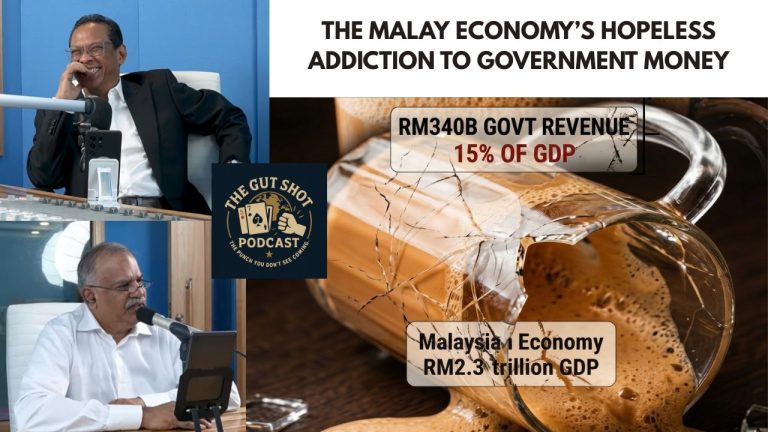
Okay. Our GDP, now they say it's about 2.3 trillion ringgit, you know. Uh okay, lah. I'm just accepting your figure. I'm not going to dispute it. Uh it I think it comes from the government. Uh the government budget, uh 2026 was 421 billion, of which only about 340 billion is from government revenue. The remaining 80 billion they have to borrow. Uh out of the 340, about 32 billion is oil oil money, dividends, and whatnot now from our oil money, lah. So, uh the real budget is actually 340 billion because the the remaining 80 you borrow. Total budget was 421, but you borrowed
80. You You actually You don't balance your budget if you You cannot go beyond 340 billion. That is about on a on a economy of 2.3 trillion, A divided by B, yeah. You're talking about 17% implied taxation rate in the economy, lah. So, that's all you have, lah, okay, to play with, huh. So, so, um if you if you include the entire budget, it's about 20% of the GDP, lah, huh. So, you have over 17 million Malays and if we're throwing all the Bumiputeras, Sabah, Sarawak, you might go up maybe to over to say over 20 million people, huh? You're going to move these people
forward based on 20% or less of an implied taxation on a GDP of 2.3 trillion. Mana boleh? Yes. Meaning that even if you know what the bang for the buck, the biggest bang for the buck. You use bang You spend half 421 billion in your government budget. Let's say a sizable chunk of it goes for Bumiputera procurement. I mean uh government procurement which favors Bumiputeras, huh? You get the maximum bang for the buck, lah. Ringgit for ringgit, lah. You can only get 421 billion worth of economic benefit for Bumiputeras. But not all the entire budget goes to the Bumiputeras. Only a portion.
Uh the actual Bumiputera policy is like MARA, FELDA, all these people, all. I think it adds up. I have some numbers. I think it's about 20 billion or less about then it's less, huh? So, there's not enough funds. What I'm trying to say is there's not enough funds and resources, capital in government procurement to bring up about 20 million people in the country versus 34 million total population where the GDP is 2.3 trillion. You are You're always stuck in the corner with your little 20% there. You're not going to make it. So, this is what the politic The politics boys do not understand. I call
them boys, lah. They don't understand, you know. They don't understand this simple arithmetic. You're You know, like like you make a You make a glass of teh tarik, you know, right? Uh let's say it's a big one, lah. So, at the top, you know, it's a very good teh tarik. You got all this the the the foam floating at the top. That is your government budget. That is your 421 billion. Below that is the 2.3 trillion. How are you going to You're going to take a golden spoon and mix the tea up really nicely and from that froth you're going to generate another GDP, the whole
entire economy of the country. It's not going to work. It's only always remain only the froth portion that the little bit. If you want to help the Bumiputras, you got to get them into that 2.3 trillion GDP without government assistance. They have to be part and parcel of everything. You have to push them forward and then you grow the the GDP from 2.3 trillion go up to 2.5 to go go up to my my magic number is 1 trillion US dollars. Then we join the what club There's a club in the 2020. Indonesia joined the club. The GDP is more than trillion US dollars. We should target
economy is sucks. We should aim for the trillion dollar US Well, for our for for our population, that would be amazing. Amazing. Yeah.
Then the Bumiputras Malays will be part of the entire 2.3 trillion. That means that they don't need government. They'll be part of it. So, what we got we have to aim for, which they are not. They are not. We know why they they are not. We know why they are not because the politicians prefer the Bumiputra to be sucking on the teeth.
to be dumb and barefooted barefooted and dumb like the natives and the whole colonial policy keep the natives dumb and barefooted. This is this is what I mean when I actually I did say this elsewhere in in in somebody's podcast. This is what the politician mean when they talk about Ketuanan Melayu policy. Basically, they are the Tuan and you are the one that the Tuan is giving to you. But you But then, you know, that's what they mean by Ketuanan. They So, you keep propping them up as Tuan so that they can feed you these breadcrumbs. I think this part our Bumiputra community need to really
understand why we will never catch up. That's right. That's right. Yeah. So, um uh if you look at that number, say Mhm. as we said, that number is too small to grow, and therefore, that's why we are seeing actually a lot more um uh uh what do you call such a large number of uh you know, Bumiputra Malay community within the uh uh the gig economy, you know? Because of exactly what we just been talking about. It translates directly on the ground.
Correct. Yeah. And the wage suppression, it translates directly on the ground because that small ecosystem cannot grow. That's right.
There you go. Right? So, we are in the private sector, we are long enough in the private sector, and we see the non-Bumiputra business sector grows. You know? You see
You you see uh uh you see and then uh like during Dr. Mahathir's time, he wanted to create billionaires, you know, Bumiputra billionaires. Yeah. Again, you're talking about using uh your budget, right?
Right. Your your uh government procurement, uh to So, it's limited. You know, it's limited. If it's 421 billion now, when Dr. Mahathir was PM 1.0, I think it was maybe half the amount, you know? So, your your your your amount is so limited. I can't recall, but it was maybe uh 200 billion around there, and you want to create Bumiputra billionaires. If you remove a billion from your government procurement to feed to help the Bumiputras, and you use it to create one billionaire, that's 1 billion less. You only have so much money, you know? Uh a billion satu billion is made up of
1,000 million, uh. So, one billionaire is the same as 1,000 millionaires, right? So, this is exactly why I also see that there's not enough Putra SMEs. Because if you take 1 billion, which is 1,000 million, and you give it to 1,000 Putra SMEs, 1 million each, right? So, you get 1,000 SMEs at 1 million each. That's That's a lot of money, you know, even in today's economy. It's a lot of money. Instead, you take that and you give it to one fellow to make you because you want to be a billionaire.
So, now then that's easier to fund your your your political party. So, you see So, we have denied 1,000 Malay Putra's who can develop as SMEs with 1 million capital, which is a lot. I started my first business with my wife with 25,000 ringgit.
This was in late '80s. 25,000 ringgit our our jewelry business. We started with 25,000 ringgit. 1 million ringgit is a lot, but a billion can create 1,000 Malay Putra SME entrepreneurs. Instead, you give it to one fellow and made him a billionaire in in a situation where you are limited by the government procurement budget, your your annual budget. Yeah. So, you know, during our our budget meetings last time, one of the finance ministers used to begin his speech, you know, he'll he'll quote this a verse from the Quran, you know. It says What is it? It says "Kaila yakuna
dulatan baina al-aghniya'i minkum." It means um "Do not let the wealth circulate among the few among the rich among you." This This a famous ayat which our that finance minister used to recite every time they, you know, the the budget speech. This is sort of 59 verse 7, do not let the wealth uh circulate among the rich among you, the the few among you. So, if you take a billion and you want to create one billionaire, you are you're doing exactly what the the Quran is telling you should not do. Okay, if it is your own money, it's okay. If you are What's the guy's name? The motorbike
fellow, Boon Siew, is it? Boon Siew. Uh Boon Siew or the people in the thing islands, huh? Uh if they have a billion, bring it and they will feel like I feel like flying a kite today, go ahead. It's your money. You see? But, this is taxpayers' funds. This is public funds. Number one, number two is it's extremely limited. The implied taxation in the economy is below 20%. I'm talking about government tax collection versus GDP, huh? It's about below 20%. That's all you have to play with. And then, you take this and you you I gay is a four-letter word, huh?
Okay. You distribute it and you give a billion to this guy, that's a billion less for like maybe a thousand people at a million a thousand SMEs at a million ringgit each. An SME does not need a million ringgit of capital. You give them 500,000 ringgit, it's more than enough. More than enough, even today. So, you can create 2,000 SMEs, Malay Bumiputera, using a billion instead of creating one billionaire. But, that's what we have been doing. And then, you give the billionaire licenses, monopolies, huh? Rice import monopolies. Or restrictions, quotas, whatever, so that he can sustain himself.
Does a billionaire require that much of further uh what do you call this? Protections? To do what? To maintain his wealth, which was taken from public funds in the first place. So, these are the flawed policies which have not changed in this country for uh ages, huh? For now going on to over 50 years, and it looks like no one is going to change it. So, the bottom line I'm going to say we are dragging. I don't want to bore
No, no, no. I I go I don't want to bore you. I I have a The The what I'm trying to say is that the Bumiputra affirmative action policies, which are based on government procurement, are very limited in their success, and I don't consider them successful because the moment these um government procurement is removed or it disappears for whatever purpose, the entire house of cards collapses. It happened in 1997 and 98 and during the financial crisis when our ringgit collapsed, we had at the time like four or five Malay Bumiputra billionaires, you know? They disappeared. Only I think one guy
survived. He's still around. The rest all disappeared. Many Bumiputra corporates went bust. You know that famous Dana Harta? Yeah, yeah. Yeah, it I mean a lot of companies were taken over by Dana Harta. A lot of them were Bumiputra corporates, huh, taken over, you know? So, one major economic crisis, '97, '98, and they all get wiped out. The same thing happened in the '80s. We also had the economic uh major economic uh recession in the somewhere in the mid-'80s. And I know personally know people Bumiputras were in business who lost their business, huh, because the government couldn't pay
at that time. They lost their business. They went bust, huh. So, because the entire Bumiputra ecosystem is sustained by continuous government support, any unseen or uh uh what do you call this? Unpredictable events that that happen is going to wipe them out. And you mentioned oil that he had. I wrote a blog recently. I just threw in a number. I suspect the oil industry is going to disappear in another 10 years. And the reason is is of all the the green legislation or EV something is having its impact on oil consumption. But it's the Chinese who going to break the market. The Chinese are now
developing this thorium nuclear reactor molten salt reactor and they are really advanced. If that thing comes on stream which it will it will because they already have one running up and running. It's it's seriously going to affect the consumption of fuel of fossil fuel. You can you can set up the thorium reactor quite easy quite cheap. Not as toxic not as radioactive no need cooling no need water to cool the signal and they're going to put it all over the place and I think they will do it even if the Chinese consumption of fossil which is plateau Chinese China consumes what 16%
of all the oil in the world. Even if the fuel drop 5% that's it the oil industry will collapse. And and that that is that is one of those events that may happen. And since we are also our government is so much dependent on our oil earnings you know imagine if if there's a serious dent in our oil earnings it's going to impact us very badly. It's going to impact the Thai economy very badly. So they're not thinking.
Well I've been telling people for a few years already that actually regardless of any new innovation whether the green revolution truly happen or not I think the price of oil uh
It's going to be impacted. it's going to come down um you know and the only shock events are like if there's a war in the Middle East right but it's not going to go forever. Yeah but there are still shocks there are still shocks I mean the the now the issue in the Middle East has uneditable but it's coming to a resolution but the price of oil is still going down.
Yeah. So I I this whole dependency of it that is why I mean, if you are at the leadership level at a I mean, you have to plan right now for Malaysia where actually your whole Bumiputera ecosystem that we've been talking here need to transition into a proper private sector and dismantle all this um artificial um IV in infused um Bumiputera ecosystem. We can need to transfer them out into the private. We need to have actually a more Malaysianized um what do you call it economic system whereby because the money, yeah, the the the capital is in the private sector which is a non-Bumiputera and it
is It is unlimited. Right. It is beyond the sky. If you go into the private sector, if you go into the real GDP, it the sky is a limit. So, they This is where my This is where my problem problem with the so-called way that we are doing affirmative action. We are using affirmative action
to prevent the Bumiputeras from getting into the free market. Correct. This is it. This is You see We should now ready to transition the economy already. Okay, couple of more numbers here. Out of the budget of 421 billion of which 80 billion is borrowed, uh You see, the civil servant salaries and their pensions, uh uh It was I didn't bring my glasses today. Civil servant salaries and pensions is 146 billion. Almost 35% of the budget, you know. That's a huge chunk of change, you know.
Mhm. Almost 35% of budget is to pay salaries and pensions to civil servants, you know. So, that's so much of the budget, uh is Opex. The people are dependent it.
Yeah. On direct salary and pension payment, 35% of the budget. And then, government debt now is about 1.3 trillion. And these people are crowing very happy, "Oh, we only like 60% of GDP, less than 70% of GDP." But, the interest payment on this 1.3 trillion is another 54 billion a year. So, if you look at this as uh where it sucks up it takes up government so much of government budget, lah. 54 billion to pay interest, 100 and almost 150 billion to pay salaries and pensions, that's about 200 billion ringgit, which is um you know, which is used up, which if it was it
uh it is not it is not cannot be deployed for other other usage for development, for example, so because our opex is so high, salaries and pensions, and then debt servicing, you know.
Yeah. So, we are restricting our ability for the government budget to really move the economy forward. We are using it basically for opex pay salaries and service debt. And the debt is increasing, so we're becoming like the typical, you know, the the third world debt trap
that the countries in Africa and South America used to suffer last time, you know. The government keeps borrowing and borrowing, and then the interest payment alone on the borrowings becomes a huge chunk. You have not yet spoken about principal repayment, huh?
Yeah. You're just talking about interest, so you find that more and more of your budget has to be used up just to service the interest to the bankers. If there's a sudden shock in the world economy or in your local domestic economy, then the government revenue is constrained, and you cannot service that interest. Then you start going haywire, you start cutting here, cutting there, and services and all that. So, it is downhill from there. So, we don't have enough money.
If you guys like to continue this conversation, enjoy the conversation that we have, uh please subscribe so we can keep getting this uh podcast for free for you guys, and keep liking so that we can uh we can uh we can spread uh our intelligent conversation to all the thinkers in Malaysia. We have a country to save, ladies and gents.
Say it based on our previous episode on economic uh on the economy itself, I call it we are frogs in a boiling pot. Okay? And actually the the the the And you don't realize you're getting cooked like
Yeah, you don't realize you're getting cooked, and not just that, actually your pot is about to tip. Okay? You know? And uh and you're going to be cooked alive very soon, you know? And this is what I'm trying to tell people, uh this is what we are we we are giving the warning already now because we have to have a policy that actually says, "We have a crisis situation that needs to be that needs restructuring today." The before we enter chapter 11 or BN17. Okay? We are there already, you know? Okay? And the the the issue now, if you ask me, is the Bumi Putra ecosystem need to be
transitioned out. I don't like the word affirmative action because of exactly what you just said, which is you are predetermining the result. No, we don't need to predetermine the result, but we we need to give them an entry-level assistance.
That's the thing. assistance that the at the mezzanine level Yeah, but that is where I'm coming from, which is actually if you and I were doing policy on economy, okay, we would be looking at how to transition our economy from such a heavy reliance on the GLC and the GLIC pumping into the Bumi Putra ecosystem and having that transition and integrate within the non-Bumi Putra sector so it becomes a Malaysian economic sector in total. Don't have to worry anymore about racial quotas at the end of the day.
I'm not totally against the GLCs, you know, it's just that a GLC already has endless funds at their disposal. Just call the Treasury. It's all with public funds, it's all with taxpayers' money. So the GLC doesn't have to worry about it. Where am I going to get the next loan from the bank? No need. Which I know you do. You have to borrow money from the banks. So you have to worry about who's going to lend you money to expand your business. GLC, no. Just pick up the phone. Call the Minister of Finance. I need I need a billion. I need a few billion. I need 500 million. That's it, you get it.
Yeah, the corporate guarantee is from the government. Recently that that another pension fund lost 200 million in some fraud in Indonesia. So they are a different cup of tea altogether, you know. So so the GLCs already have so much advantages, huh? You should let them compete. You do not give the GLC a monopoly license or an oligopoly license or give them quotas. No need. You're already GLC, you have unlimited funds at your disposal. Government's behind you. Go out and compete.
Well, here's So then you will create new wealth. You will create new competitive behavior. You will create more creativity in the economy, yeah? Then it'll be self-sustaining. You have to tell the GLCs, you achieve this after a certain amount of time, you meet certain of these, you know, ratios and indexes, you you are sent alone. We're not going to fund you anymore. Go out and compete. So, the GLC becomes an incubator for Bumiputera competitiveness in the economy, which is not happening. The GLC got free money, free capital, endless capital. Monopolies, with licenses, quotas, franchises.
Uh they run the toll roads. for 40 years, now it's extended. endless Uh the other impact that it happened, it actually stifle our total national economy. That is the other part that that is that is because that has a tremendous impact.
Because the politicians benefit from this kind of situation. Uh the the reason why they like to do to do these kind of simple things because they can't think. They have no ideas. They basically they're duds.
Right. So, ladies and gentlemen, at this stage, I think we've probably, you know, we've we've we've compassed it enough. It's not working. The Bumiputera affirmative action based on the government procurement Uh whatever success that has been achieved, it is uh you know
It plateaus already. The the French word is f a u x and it's a faux, what they call it a faux. That means it's not real. It's a it's a fake thing. The moment there's an earthquake in the world economy or the domestic economy, there's some kind of shock, they get wiped out.
We need a we need a transition plan today. We need to implement such a plan today. I think, you know, government is easy now. Very easy. I I would suggest the Well, we don't really depend on the economic planning unit anymore. But, you know, we are both for higher. I think we can do an economic planning for the transition of the Bumiputera ecosystem to make it a totally integrated with the national ecosystem. I would say we can do it again. All right, but then but then you know, nobody gets a cut out of it. All right. Ladies and gentlemen, thank you so much. Thank you everybody for joining us.
See you in the next episode. Bye. Thank you.