Club of Doom Revisited – Collapsing Islamic Countries
Show Notes & Description
In 2006, Syed Akbar published his best-seller "Malaysia and the Club of Doom: The Collapse of the Islamic Countries". Today we re-visit the countries and our own on this prognosis. Do you know where you're going to? Do you like the way that life is telling you? Do you know? Come join us in conversations no politicians or media wants to have. Only on Gutshot.
Almost 20 years ago, Syed Akbar Ali wrote a bestseller predicting the collapse of Islamic nations. The Najib administration banned it. Today, we revisit Malaysia and the Club of Doom to see if his prophecies came true—and the reality is more terrifying than we imagined.
In this explosive episode of The Gut Shot Podcast, we strip away the political correctness to investigate why 57 Islamic countries are consistently lagging in the "Third World" while nations like Vietnam and South Korea skyrocket past them.
We dissect the tribalism tearing the Middle East apart, the economic humiliation of the Muslim world, and the dangerous rise of Salafism right here in Malaysia.
Why do Muslims thrive in secular "Kafir" countries like the US and Singapore but suffer under religious governance at home? Why are absolute monarchies in the Middle East ticking time bombs?
We don’t just discuss the problems; we look for the "vaccine" Malaysia needs to avoid joining the Club of Doom. Stop being sheep to politicians—join the community of thinking people.
Timestamps:
• 00:00 – The Banned Prophecy: Why the government tried to silence The Club of Doom 20 years ago.
• 02:15 – The Post-Colonial Failure: Why independence led to dictatorships, not freedom, for Islamic nations.
• 07:30 – Democracy or Delusion? Why Malaysia is the "last man standing" and the dark truth about Turkey’s politics.
• 09:45 – The Sectarian Nightmare: How radical ideologies are seeping into mainstream governance.
• 13:10 – Tribalism Over Logic: Why clan identity and family names determine life or death in the Middle East.
• 18:20 – The "Blame Game" Exposed: Why failing nations scream "It’s the Jews/West" instead of fixing their own economies.
• 21:00 – The Salafi Wave in Malaysia: Are we importing a culture war that will destroy our moderate heritage?.
• 23:45 – The "Kafir" Paradox: Why Muslims are safer, happier, and more successful in non-Islamic countries.
• 26:00 – Economic Humiliation: The shocking GDP comparison between Pakistan and Vietnam.
• 30:50 – From Empire to Irrelevance: How the Islamic world missed the Industrial Revolution and is now missing the AI Revolution.
• 35:20 – Future Forecast: Why Egypt is collapsing and Iran might actually have the brightest future.
• 42:10 – The Jurassic Park Monarchies: Why the Saudi and Arab absolute monarchies are destined to crash.
• 48:00 – The Final Warning: How we must "vaccinate" Malaysia to stop the slide into the Club of Doom
Many thanks to CITYPlus for their collaboration with The Gutshot Podcast, in whose studio this conversation was recorded. CITYPlus is Malaysia's first Chinese business radio station, dedicated to delivering in-depth analysis on local and international current affairs, markets, and businesses.
Jump to chapter 8 chapters
- 0:00 Revisiting the Club of Doom
- 7:31 Democracy Deficit in Islamic States
- 15:23 Tribalism and Sectarian Conflict
- 28:54 The Secular Rule of Law Advantage
- 31:43 Economic Comparisons: Pakistan Versus Vietnam
- 41:47 Missed Revolutions: Industry and AI
- 50:50 Vaccinating Malaysia Against Religious Politics
- 53:52 Fragility of Absolute Monarchies
Auto-generated from YouTube captions. Timestamps link to the video.
Welcome everybody. Welcome to Gutshot where we have conversations and perspectives that you don't hear anywhere else. So I'm here today Shamsul Sam your uh host uh with uh my partner and friend Saraka.
Good morning. Today we're going to talk about what we've been thinking uh is uh we're going to talk about this uh uh this book and we're going to re revisit this book that was published by site almost two decade ago. That book was called Malaysia and the club of doom. Am I right? That's that's the exact title right that was 2006.
Yes. The collapse of the Islamic countries. The collapse of the Islamic countries was the subtitle. Yeah, correct. Okay. So, we're going to we're going to revisit this uh the book in light of the two decades that has passed and uh and and where are these collapsing and uh collapse countries, Islamic countries to be specific. um and what is going on now here uh with the perspective of our nation and where we are going why this subject is important because uh I don't know we can debate this whether we are in the trench yet but in my opinion we are definitely sliding
towards a point of no return and so where do we go from here? So ladies and gentlemen, for those who are who like who who uh who are not yet subscribed, please do subscribe so that you get uh uh you get uh uh updates and uh videos as soon as we drop them. And let's build a community of thinking people that are not sheeps to politicians that will really think and change the country. We know policy makers are looking at our podcast because we've seen some of the uh points that are being made. All right, guys. So, don't worry. We're getting there. Say, let's start uh with
uh with with with this book of yours and um let's get it rolling. Okay. Thank you. Um I wrote that book in uh 206 just a bit of background and then uh it sold it sold very well. It was a bestseller at that time. And then uh 10 years later in 2016 the book was banned by the Najib administration. Uh by that time it was no more in print.
Uhhuh. And uh most of the bookshops didn't did not even have it on sale because books normally sell for about 2 3 years and after that you know they stopped selling. So I was 10 years on and then they banned the book. It is still banned until today. I didn't bother um to appeal appeal or whatever because when they banned it they didn't ask me they didn't call me anything. Anyway uh the book uh is uh still valid. I wrote it 20 years ago and the things that I said uh in the book about the collapse of the Islamic countries uh has not only um turned out to be well it has
happened it's quite true but the situation now is actually getting worse. M uh you see if I can just retrace some history of Islamic countries and let's not forget we are discussing this here today because we are also an Islamic country and we have a majority Islamic society
so these points are relevant you know uh after the second world war uh last century 20th century uh the the colonial empires gave independence or lost their colonial possessions. So nearly all the countries that were formerly under the colonial colonials became independent and many of them Islamic countries in Africa, Asia a lot of them. So the 20th century after second world war until end of 20th century was when all these uh countries had become independent selfdetermining and then they started they were on their own uh already they started having troubles problems and none of them
really moved forward not they tried there were stops and starts but it was a continuous series of dictatorships and the monarchies getting overthrown some monarchies have prevailed and then um they never moved into a really fully modern system of uh government, a modern system of uh civilization. They were still pretty much stuck in old traditional ways of thinking and uh then they also have the religious um what do you call this their uh religious uh their their inheritance, their history. uh a lot of them went into experimental phases you know some of them tried to
become socialist communist uh some of them tried uh the capitalist system and all that and then quite a few uh sort of tried went back into reviving you know the old Islamic kind of uh ruling uh Islamic kind of system of government some of them want to be want to be Islamic republics quite a Those who did not fully declare to be Islamic, they still started imputing a lot of religious you know ideologies in their system of governance, administration, in society, in so many things uh which until today has not really helped them. They have not progressed as well as other
countries in the world. And today by measures uh uh fair and even measures like GDP gross domestic product per capita GDP growth uh per capita GDP uh and GDP growth they are far behind far behind the rest of the world. So in fact there's something called the organization of Islamic countries. It's got 57 membersh. They occupy the lower ranks of the the third world and and the poorer countries and it's been there forever. And then among the 57, you also have the 22 Arab countries, the League of Arab States. They're also in pretty bad shape except for the few oil
producers. The oil producers, they are wealthy by by the well by the coincidence that they have oil in their countries. So they produce the oil. But uh even the oil wealth has not benefited them uh fully because there's always the elites and the powerful and the wealthy who control you know the bulk of the resources and uh the majority have not benefited as much. So you you have poor people even in Saudi Arabia. Uh so to make a long story short, they have not fared very well in the 20th century. And now coming into the 21st century, you find that most countries in the world,
uh I'm talking about all countries, South America, even Africa, they are moving on to the next stage in their development. I'm talking about the former third world countries, former colonial countries, colonial territories. Now pretty much all countries in the world are uh quite well set in the dem in the uh democratic system of government. You anywhere everywhere in the world we have elections even in previous areas like South America. Um uh there are no dictatorships in South America except Cuba. If you want to call Cuba dictatorship, Venezuela, I I I I that's debatable. But most
countries are on a democratic path. They have regular elections. This is South South America, even Africa and uh throughout Asia. The only exception are the Islamic countries. Among the Islamic countries uh other than Malaysia and maybe Turkey, Turkey is debatable because Erdogan has jailed the opposition leader. The number one rival to Erdogan is a guy called Ikram Imamoglu has been jailed last year.
Uh he's a very popular guy. So Erdogan jailed him and this is one year has gone by. This man is still in jail pre-trial detention. He has not been brought to trial yet and he's still in the detention. So
so he's been in remand for for more than a year a year now. And then Erdogan has jailed over 200 journalists in the last 5 years. Catch and release. He'll jail them for a while. release them. So whether Turkey is really a full-fledged democracy is debatable. So that leaves us Malaysia, we are the maybe the single uh functioning democracy in the Islamic countries.
Uh but you know, everything has to be carefully managed and if you don't take care of your garden, even the your roses will be eaten up by the weeds, you know. So we got to be careful. So uh but uh other than that none of the Islamic countries in today's world are really democratic. They are at various stages of autocracy or dictatorship. And then you also have monarchies, absolute monarchies among the Islamic countries. What does this mean? This means trouble, serious trouble. And my view is that the Islamic countries have actually collapsed in many ways. They collapse. Uh Somalia has
broken up into Somali land. And the Somalia people didn't even know. They just woke up one day and their neighbors in Somali land which is actually a part of Somalia. They said we are now independent and nothing could be done about it. Sudan has broken up into South Sudan and Sudan and now even South Sudan is collapsing. Uh the these are the things that are going on.
The the Jaman is a disaster and now the two biggest disasters that are developing is Iran and Pakistan. Iran is in serious trouble. Uh the Ayatla regime is in trouble. The troubles the the protests have not really uh subsided. In fact uh I checked last night there were massive fires and protests in Thran starting again despite so many thousands of Iranians having been shot over the night over January 8th and January 9th. January 8th and 9th is being remembered as the day of the great massacre in Iran. But it hasn't stopped the protest. I think the uh the ayatollas uh on
borrowed time and Pakistan recently had this huge flare up in Baluchistan which again has not simmered down. This problem is not it's just starting. It's not it's not going away. So uh I see the situation getting uh worse in the Islamic countries. uh also because of this other than the politics you also have this radicalization of huge sectors of the society. Radicalization means they radical radical Islamic ideology which affects not just the radicals and those outliers but also mainstream thinking uh it creeps into government administration. So the the total sum of
this game is that they cannot function. So you're saying that let me let me get this thesis that you put forward is that the radicaliz the the radical Islamic uh mindset actually has what happened in those country basically the radical the radicalism the extremism seeped into mainstream society and mainstream governance that that that basically
because uh because actually there are there is no radical Islam you know there's only Islam uh radical is to what to what extent or to what degree
uh somebody wants to implement their belief system. You see uh it is in the Sharia that the adulteress must be stoned to death. It's part of the law. Uh and then uh cutting the hands of the thief is in the Sharia. So if a country implements these laws, let's take Afghanistan, then we call them ultras and extremists and radicals. But there are other countries which do not implement. We don't implement this in Malaysia. But we have public caning in Malaysia in Tranganu. We've had public caning of a lady who
was caught for something. I think Tranganu and I don't know which Clantan implemented Tranganu and also in Ache in Sumatra. So uh whether Malaysia or Afghanistan or wherever the religious authorities or the religious thinking accepts all this as part of the Sharia, it's the only difference is the degree whether they implement it or not.
So in Malaysia, we don't stone the adulterers to death. But if you ask any of the religious authorities, what what is your view on stoning adulterers to death? They will say it is part of the Sharia. So it becomes radical only when they implement it. So in Afghanistan the Taliban implements it. So we go like wo these people are radical. You know they're ultras and they're crazies. In Malaysia we don't. But nevertheless the beliefs are the same. The beliefs do not change because this is accepted as is what is written in the Sharia. So
uh the difference is by degree is the ideology is the same. Uh so this is this is the situation. Uh uh what does it all add up to? It all adds up to they cannot perform. The Islamic countries that I just mentioned all these like Sudan, Libya, Yemen which we are discussing Pakistan they cannot perform. They cannot deliver the progress and the social advancement to their people in an everchanging world in a fiercely competitive world. in an age where technology rules and decides everything. Everything now is determined by technology. You have technology, you
have a chance. You don't you don't have technology, you you're out. You're you're back to the stone age. uh also scientific thinking, modern progressive thinking in this modern world. If you're not part of the at the cutting edge at at the forefront of modern thinking, progressive thinking, uh then you you're going to remain in the in the cave inside the cave. You will belong in the cave or up on the trees. So there is a continuing inability of the Islamic societies around the world uh to not to be able to catch up with uh re real uh what is the reality of life modern life
in the 21st century. They're getting further left behind and then when they're getting left behind they are stuck among themselves and they start bickering with each other over things that they do know which is religion uh their social social norms you know their traditions which have never changed over the last centuries they keep bickering and fighting among themselves tribalism is like the trademark of Islamic societies tribalism tribal behavior
that's an interesting identification by your identification by your race, identification by your language, identification by your religion, your clan, identification by your clan, identification by your family name,
this is like trademark in Islamic societies until today, especially in the Middle East. In the Middle East, it's not enough to be a Muslim. your neighbors are all Muslims but what tribe you come from uh you may have differences in the language dialect and uh your family name all this can determine life or death in places like Somalia uh it is it is almost 100% if you read the book by Ayan Hi Ali she wrote a book called infidel uh where she gives a very vivid description of Somalia in the 80s and it's still this true until Today basically one village to another village
it is a different clan and that's it. If the guys cross over the fence and come over to this side from that side it could be trouble. It's like North Korea and South Korea and this is norm this is norm for for many Islamic uh countries. So uh
I I have a question actually. Yeah. Um why is that so? Why does that become a feature of Islamic countries? I think um one is the heritage. The heritage what they have inherited from from long time ago. Um but why why why only in Islam? I mean, let's put it this way, right? Um, the West, if you look at Europe, you know, they branch out into different um different Christian sects, right? But hardly anybody talk about um what sect you are from, what clan you are from. In fact, if you look at liberal uh European, I mean this massive problem of immigration that has befallen
them um seem to come from their suicidal empathy of uh accepting people of completely different cultural ideology um which is coming from Islamic countries and cannot assimilate within their modern culture. So why does why does it not happen in Christianity Christian majority countries? I think the Christians had the same uh problem but they overcame it through the the reformation, the Renaissance and all that about what 500 600 years ago where they learn to question their religious beliefs and they began to separate religion from uh state uh religion from their daily activities. separate
religion from education from uh the economy in so many things especially in the administration of the uh state. So separation of state and uh religion in Europe over the last few hundred years maybe going back 500 years has helped them to ignore these religious issues among themselves because in those days they used to fight and kill each other over Catholicism and Protestantism and even willing
I think they went to war for almost a hundred years. The United States of America was founded because of I mean by pilgrim fathers the the the immigrants from Europe who came in the Mayflower ship and all the famous story
where the pilgrim fathers landed in uh Boston or somewhere in the east coast because they were escaping religious persecution in Europe. Yeah. So the found the foundation of America from the western European uh uh migration into America was was triggered by religious uh atrocities going on in Europe. So religion was always a wacko thing for a long time. But the western people have learned to overcome it. They have learned to separate the religion from state. I think it's not only state side I think we look what when my experience has been that um actually even in public discourse
uh that means in the public arena it is like look don't impose religion on anyone um and that governance is one aspect but also in in in normal day-to-day life
they have taken out religion from their equation which has helped them a lot. Yeah. Now back to the Islamic countries including ush this has not happened yet. So when you have uh petty issues we were talking about tribalism remember and clanism.
When you have petty issues like tribalism, clanish behavior and all these kind of things which can create on their own can create uh differences and frictions and things like that. It is compounded when you have religion thrown in. So you can you can say that and for example you have situations where Islamic countries Islamic societies the society is determined by race and language and a particular sect of Islam.
So versus their neighbors who may be of a different uh language or even same language but of a different sect. So uh there may be differences in their clan identity, tribal identity, racial and lang language identity. It is compounded by sectarian differences or differences of view over religion. And always the religious aspect uh dominates over everything else. I'll give you an example. Recently in Pakistan last week there was a bombing you know.
Yeah. A Shia mosque was bombed. This happens quite often. Oh, you must say Shia. Shia moss. It happens quite often in Pakistan. The Shia moss are bombed on Friday by extremist Sunni people. Sunni extreme milit militants. So this time the a bomb went off and 31 people died and about 100 of people were injured. Now this is from news media because the videos came out. You know, after the bomb exploded, the people gathered and uh some of the people were shouting Shia kafir.
Oh my god. People who have just been killed and injured. The others gathered around and shouted Shia kafir. Shia kafir like you deserve to die, you know. So, so this is the kind of hatred you have they have where the the little diff they are the same people. They are the same exactly the same people. The Shia people in Pakistan and the Sunnis are the same. They are from the same racial background. They speak the same language. They dress the same skin color. They wear the same language, same dress. Everything is the same. The only difference is the the sect is different.
Shia. So for that they can they can stand there and basically celebrate that a bunch of Shia have been killed. So the religious difference always overshadows and wipes out any other human decency. and uh your empathy you know towards other human beings like it can be wiped out just by one fact alone religious differences. So this has been the the bane of Islamic societies for a very long time and is getting worse. If I were to say that the seeds of this kind of mindset is uh is embedded within our uh own uh uh religious authority by their um by I I just read recently
about um some bedding of uh or or or considered non-Islamic sex um uh uh that uh that is considered does not conform to what is the um the endorsed beliefs of Islam in Malaysia, right? Whereas, you know, it it always boggles my mind that when I was in uh I was in school and going to religious classes, one of the most famous uh uh line in the Quran was uh to you your religion to to I mean to me mine, right? So, but somehow or rather we we've gone past that, you know, and and I can understand why this uh and and when you have uh
uh an ideology of jihad that puts in um not just internal uh struggle but also the ensuring that you are the champion of the religion, you want to protect the religion, you want to uh evangelize on the behalf of the religion. Just like we have this uh malaf uh uh what do you call cuckoo uh uh religious preachers from uh you know that converts you know and and goes around non-stop um stirring stirring stirring things up. That's we we are just going into that road you know.
Yeah. There are there are some dangers in our country which are beginning to reflect what has already happened in the other Islamic countries. Let me uh since we are discussing club of doom. Yes.
Let's try to forecast what could happen. Well, it it may or may not happen. But uh you see in Malaysia our religion is uh quite uh plain vanilla orthodox. Malaysia is largely Sunni
and the Sunnis 99% are Shafi. What is called the Shafi sect? It is one of the four sects in Sunni Islam. Shafi, Maliki, Hamali and uh Hanafi. Yeah. One more four. Yeah. So uh in Malaysia it is Shafi but uh lately the last more than 20 years now 30 years you find that there is increase in the number of people who now identify themselves as uh salafi salafi it's a it's also part of Sunni Islam but they are a bit more I would say um they're different in certain ways that how they think and what they believe in and uh more
is that the one that originates from Saudi? Saudi is Salafi but uh it does not originate from Saudi per se but Salafism is uh goes back they say it goes back to from the early periods of Islam. Uh they here they are more they are pronounced in the things that they don't do. There are many things they do not do which the orthodox uh shafi people do in their ritualistic obs observation of the religion. It's always like that. It's always a differences in the rituals and in the practices of religion. Right?
But what is happening is that uh the salafi presence is getting uh louder and they are there are more of them in the country. They are they are gaining popularity. Now my view is I'm not opposed to uh either Salapis or or any other sect you know because people will believe what they want to believe.
Yeah. If you want to argue about it and debate about it until the cows come home you will not you may not resolve the issue. But this this factor is increasing in Malaysia. And although the discourse sometimes can be quite uh quite loud you know uh the tone is quite loud but it it has not degenerated into anything you know there's no violence there's no uh widespread hatreds and stuff that we have we see in the other Islamic countries like in Pakistan for example we don't have that but if you don't check it
yes it will it could lead to somewhere which we don't want to go. But how do you check it? You you you cannot lock up people. That's that's stone age. You cannot say, "Oh, I don't agree with you. You don't fit in the orthodoxy. So, I'm going to arrest you and
put you in a re-education camp. That sounds like pausy." It doesn't It doesn't work. It doesn't work. My suggestion is it's very simple. There are very peaceful Islamic societies around the world which do extremely well. They are maybe they outperform the Chinese and Japanese and the Americans and these are Islamic societies in the kafir countries. You you look at the Muslims in the west. You look at Muslims in Singapore. You look at Muslims in America. There are Shia, there are Sunnis. There are Kadanis. There are Salafies. And they all neighbors. They all live together
peacefully. Because in America, both of us lived in America. You misbehave, they throw you in jail. They don't care what is your sect. They don't care whether you're a Sharpie or Sunni or a Shia, whatever in America, uh you you do what you want to do. The moment you throw your stone at your neighbor's mosque, which is a Shia moss or a Sunni moss, the shariff's car will pull up and they'll drag you away and throw you in jail. The same thing in Singapore. In Singapore, they do not ban any sect. Singapore, they allow Shia and Sunnis and Salafi and Kadanis. They're all in
Singapore. The Singapore government doesn't care. You you just stay out of each other's hair. You step out of line will throw you in jail. So in these countries, the Muslims learn to respect each other. In the kafir countries, in kafir countries, Muslims respect each other, the different sects. And in fact in the states during the haraya eid we all get together to play football the main attraction haraya in America when we were students is the great football game of the Eid Eid of the Eid celebration where everybody will come the Shia the Sunnis the Kadyanis
whoever and we all play football and we'll have a roast lamb for lunch and after we all go home happy this only happens in cafir countries they go back to the Islamic countries they start punching and shooting each other so uh that's why I'm saying we we should not ban or you know uh take prosecute and persecute people on because of religious beliefs we should not criminalize religious beliefs and I hope
our listeners here in Malaysia to this podcast which you said we discuss things that other people don't discuss I hope our listeners will pay attention If you don't pay attention to your neighborhood, you're going to lose it.
And the track record for Islamic societies is extremely bad. Confirm. This is not this is not a hypothesis. This is proven. Yeah. Extremely bad.
Let's put it this way. I I'm I'm very much uh I'm very much into the economics of things, right? Do you know what's the per capita GDP of Pakistan?
I have it but it's bad. It's about 1,700. That's about 1,500. Yeah. Yeah. At most 1,700 USD per capita. Um and let's uh uh compare that to Vietnam. What do you think Vietnam's per capita GDP is?
I have no idea. I mean, I think it's quite quite quite high. I mean, do a quick Google search. Vietnam is now going to be number one in ASEAN pretty soon. Vietnam is about $4,700 to $5,000 US and to think about it
and they're going up. They are going up and they practically just uh their their war I think if you you mentioned per capita GDP.
Yeah. Uh yes. But GDP as a whole, Vietnam is in excess of 500 billion US and I think they will hit they will become the trillion dollar club you know in another decade or so they might they might hit the trillion dollar club.
There are very few trillion dollar GDP economies in the world. Very few and uh Vietnam is going to be one of them. Yeah fact we we mentioned that right? I mean the reason I I say that you think why I I make a comparison with Vietnam and Pakistan um Pakistan got their independence way ahead of us right and uh and they are dirt poor Indonesia Indonesia is about 4,000 US uh GDP per capita right um the re and and I mean the the the I'm trying to be as as comparing Apple to Apple because there are population differences, right? So, I I I I like to actually make a comparison
on per capita. Ours is between 13 to 14,000 US uh per capita and we've been stuck in that particular mode for a long while now, right? Uh around between 12 to 14. Um and that's a trap people have been talking about. So you're looking at even um even uh so I mean Vietnam has just got out from their war around actually if you really think about it give them a bit uh
75 1975 19 Yeah. So how is it you know and you look at the other countries in Africa right um that got their independence why like you say all these so-called club of doom I think the I think um um uh the Middle Eastern countries if not for oil that were um that that were then u ed by the western countries. Damn, I don't know where they would be, you know. Um I mean they are already they are already um in u uh uh so rich right now and they still have issues between kata and Saudi you know UAE um as well and that is you remember when
the World Cup was supposed to happen and how uh uh Qatar was almost going to or so. And then you've got Iran tribal tribal jealousies.
I know. And then you've got Iran. Um and and I think I think if you were to ask me, I know the other problem with this tribal thinking is you always blame the other guys. And in the in the in the scheme of things when I notice about about uh these Islamic countries they are always blaming the Jews and the western powers. Okay. The the Jews is not even more than the than than the population of Singapore.
That is just uh uh deflection by their political leaders for their own uh failures. M it's as simple as that. If there were no Jews, they would maybe blame the uh Eskimos. If there were no Eskimos, they would blame the penguins. They will blame somebody.
Well, we we we started off blaming the Chinese in Malaysia. It's uh it is it is actually a camouflage to cover up their own failures. That's what that's all it is. All this constantly blaming other people for their problems. No, you it is you who have failed. I mean like as you said in in less than 50 years 1975 was the end of the Vietnam war. So that's what 25 50 years. So and Vietnam is now unstoppable economic power. They got 100 million people. Don't forget they are an unstoppable economic power.
South Korea it was even worse than us. South Korea, Taiwan, Singapore you know they all organized themselves and now they're moving forward. And moving forward means there are people on the ground. The average Vietnamese today lives a far more life. He he enjoys a much higher standard of living than his parents and grandparents. And they can see an even better standard of living for their children for their children who are maybe not yet born. And so every every generation seems to be improving and advancing and keeping moving forward which is what an advanced society is.
You can you can never say the same for the any of the Islamic countries. Even those who are doing well today the Islamic countries they might collapse tomorrow you know you know I mean let going back to the theme of today which is basically the club of doom which is uh you know what you call the club of doom. Let's look I I mean I I it just crossed my mind something about Turkey, right? Um Turkey per capita GDP right now is hovering about $18,000 US perm.
It's quite high. La pamlas reebu. Oh, okay. 18,000. Well, I mean I I I want to put this uh to people. Number one, Turkey is basically has been trying to get into uh the European Union, right? They consider themselves to be a European country. All right? But okay, you can argue about that that they are in between Europe and Asia. So, but here's the thing that people forgot. Turkey is the remnant of the Ottoman Empire. Okay? which is actually also uh the last remaining vestage of the huge Islamic empire.
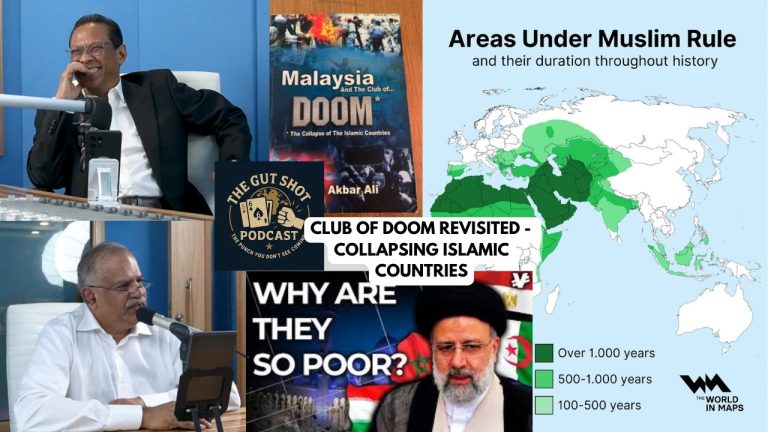
It ended in 1924. All right. The Ottoman Empire. Yeah. Think about this, right? Think about this. Okay. the Islamic Empire at its height. If you guys before uh you guys come in and you see the thumbnail, all right, for this particular uh podcast, you will see the areas of where this uh Islamic majority countries are, right? And if you look at it, the vast majority, I would say more than 90% of that particular green um uh highlighted area or basically the Islamic Empire. If I would argue that the Islamic Empire is the largest colonial empire uh that first existed on earth. Okay. It
stretches from south of Europe to north to mid Africa right off to uh to the Arabs and right on to the north part of India. Okay. And also going into uh East Asia and China. Okay. So you've got this huge empire that existed for more than a thousand years. They were the pinnacle of human civilization so to speak at that particular time. They were the original colonial power. Don't forget that they were the original slave traders of the world. Okay? Whether we want to do to to to admit it or not, the biggest slave traders in the world, right, was this empire. Okay? Now today
you're looking at Turkey supposedly one of the most modern which is the remnant of that empire at only $18,000 just about $4,000 US to be honest if we get our I I keep telling this to people if we get our act together we should actually hit easy 30,000 if not 40,000 with our economy easy guys because we got so much resources Right? So we have a problem and that's the question that we pose. Is this part of the problem that do we face? Right? Turkey compared to Europe. Right? Europe was nowhere near an empire when actually the the the Islamic empire is at its height. They had to fight in
Vienna to stop the the uh uh the expansion of the Islamic Empire into Europe. And yet 17th century, correct? The last attempt. Exactly. So at that and yet today, Europe, you know, the European powers still far exceed all the Islamic uh countries that actually were part part of that empire. the the Islamic countries they missed out on the scientific revolution they missed out on the industrial revolution. So until Kamal Ataturk overthrew the Ottoman Empire and and put an end to the Ottoman caliphate 1924 I think uh Turkey had regressed quite badly in terms of
their technical advancement. They were they were not an industrial uh they were not even beginning to be an industrial economy or a manufacturing economy until after uh Kamal Kamal Ataturk and even after Atatur Turkey well they bought whatever technology they needed. They bought weapons from the west and things like that. They didn't expand their industrial capacity so much. So as a result of which the Turks, the Ottomans lost so much of their territories. They remember as you mentioned they ruled Egypt, they ruled over the area that is known as Saudi Arabia today. They ruled over Syria. All
these were under the Ottoman rule and they lost everything. So uh the demise of uh the Ottoman caliphate uh because of their failure to grasp onto modern uh technological uh development. This was their undoing. And now in the 21st uh century uh we find that Islamic countries are again they're losing out on the new technologies that are happening now you know the the the communications technologies the computer technologies now artificial intelligence naming one Islamic country which is which produces software or generates computing power one there's none at An age where
everything is so much dependent on computers, computing software and now artificial intelligence. AI AI is really taking the world by like a storm. Uh the Islamic countries have almost no part to play in it other than being users of the technology. They don't generate. So those who generate AI and all this AI software and AI related uh economic uh activity and economic output their GDP is going to go to the sky. But if you are a if you're a society that does not generate is not part of the process is not in the supply chain of AI for example your GDP is not going
to go up but your population is increasing. You mentioned uh Pakistan, they've got over 250 million people, you know, of which about 20% are Shia. That's about 50 million people. That's a lot of moss to blow up, you know. Huh. Huh. You see, that's where they're headed. Uh Egypt, population of overund 20 million people. Their GDP is uh what's Egypt? GDP around about $3,000 US per capita but 120 million people. Unemployment is 7 8%. Youth unemployment is skyhigh. These are average figures. And youth unemployment those between what 15 18 to 25 30 years that this
considered youth the unemployment rates are higher usually in the double digits you know. So, uh, Egypt is going to collapse. I'm making a forecast here. You're making a forecast. Egypt is going to collapse. What do you think of Iran?
Okay. Iran, surprisingly, to me, Iran and Turkey are the two Islamic countries with the brightest future. I have a different view here. They are the two Islamic countries with the brightest future if they get rid of their leadership. Turkey has to be rid of Mr. Erdogan who has not really benefited the country as much. You know, Turkish currency has collapsed. Their economy is not in really great shape. So, Mr. Erdogan plays a lot of wag the dog. He sends his soldiers to Azarbaijan and army and to fight wars and things like that, you know, to deflect people's
attention. He launches naval ships and they grab the headlines. But your currency is like now I think is not worth the paper. It is printed on in a Turkish LRA. Uh the other one is Iran. Okay. The similarity between Iran and Turkey to their credit. Both these societies Iran and Turkey they have educated their people. They have a very high level of technical education among their people. Iran actually produces more engineers per capita than any other country I think in the world ahead of China. Iran they are really focused on technical education because they want to make missiles.
They want to make missiles and nuclear bombs. I don't know what else they want to do. They are not really too focused on creating the most efficient washing machine that you can buy for like 45 ring 50 cents. So they're not focused on what they want to do with their technical expertise. But if there is a regime change in Iran and a more democratic system of government comes in place, one is that it's more more focus on economic advancement, social advancement, then you find that the human capital that already exists in Iran, they they've got over 90 over million people
who are well educated and their women are highly educated. Like in most modern countries, the women go to university, they go to school, they can work, they they are part of the of the workforce of the economic workforce. So Iran has an extremely good chance of ticking off to the sky. If they just change their focus away from religion into more useful, productive activities, they are poised to take off. They are in the same position that Vietnam was. Vietnam, you know, the socialist communist countries, the first thing they do is eradicate illiteracy. everybody must be able to
read and then they educate their their people. It happens in Vietnam, in China, Russia, you know. So Iran has this and also Turkey but the leadership is confused. I I think you you're you're I I I tend to agree with you because uh I think Turkey what Atuk did um I mean by the way a lot of uh fundamentalist uh Muslim people uh uh really hate atuk actually um because uh they think he brought in secularism into Turkey but actually that is bas that is what made Turkey um at least reasonably successful. full continuing the um after the fall of the Ottoman Empire, right? Um and u
and I think I agree with you with Iran as well. Iran has a old tradition. They are they are they are the Persian Empire, right? And in fact, a lot of the so-cal golden age um uh
Islamic golden age so-cal Yeah. It comes from Persia. These are basically Persian people who were not interested in um um uh in being uh being in that religious inclination but actually are more interested in uh in the science of things. you know uh a lot of the names that we that is left in history of that particular golden age are all Persians you know um so I agree with you that those are the intrinsically in their society that uh has the potential to be unleashed. I think this is the part that I that that that our policy maker need to really wake up to
you know um and see where we are headed how we are actually uh putting our the minds of uh our society because 50% of our people are Muslims at least if I'm not mistaken. So where goes that 50%. There goes the whole society and nation.
If I if I may wrap up a couple of points. Sure. The for us Malaysia. So there are there are threats on the horizon from the rise of uh differing opinions among Muslims sectarian beliefs especially the Salafism versus the orthodoxy. So these differences are going to increase right. So we cannot we cannot just as I said we cannot prosecute persecute or throw them in jail for having different views. We have to manage it. And the way to manage it to manage this differences is that to allow everybody their space to say to to believe what they want to believe, whatever sectarian belief they want to
believe, but without infringing upon the space and the uh what do you call it the rights of the next person beside you, the next Muslim beside you. So you do not cross over to your neighbor's house to correct his understanding of uh Islam. You know you have to leave learn to leave your neighbors alone. So as I said this is what happens in non-Islamic countries which have sizable Muslim populations Singapore, Australia, America, wherever Muslims learn to live in peace with each other because they know that the law will not allow them to interfere in their their fellow Muslims
uh you know belief. So we have to do that in this country. We have to separate uh religion from state administration, state affairs. the state, the government has to get out of religion. Religion belongs in each individual persons inside their houses, inside their heart. You don't go and put religion uh you know in front of uh enforcement vehicle or some kind of as you mentioned just now what rehabilitation center rehabilitation camps.
No, that's wrong. You don't do that. You don't do that. People want to believe, let them believe. But people must know that you have to respect your neighbors. If you don't, you go to jail. So that's why Muslims of all sects live very peacefully in non-Islamic countries. Singapore is a very great example and other western countries and so on. Muslims live in peace with each other because they know if they misbehave, they get thrown in jail. But in other Islamic countries including Malaysia, the the state authorities tend to take sides. They want to interfere in
religion. The politicians want to use religion to their benefit to get votes. the the typical disastrous toxic the witches brew you know which which is pre present in all Islamic countries is a witch's brew the moment the politicians get involved in religion that's the end of the world has come because they will exploit religion to get votes
so the more hatred if if hatred works so shall hatred be be and it is so this is the the major threat I'd just like to say a couple the things about Islamic countries because I I think they are facing major major
threats. You have absolute monarchies in the Middle East. Morocco, let's count them. Saudi Arabia, UAE, Jordan, UAE, Oman, Qatar, Kuwait, all these kind of people. Okay, you have these absolute monarchies now. uh these people the long-term prognosis for them is disaster because when you do not have an orderly method of changing leadership changing power handing over power to another generation transition of leadership a democratic system that's what I'm trying to say here then what is your mode of uh changing leadership changing power it's either at the end of a gun or they chop
off the guy's head and put it on a silver platter or something or father to son or then the the brothers the brother might might what arrange a kurita which happens in Arab countries palace school palace cool uh things like that so they do not have a modern scientific uh acceptable and established system of trans of
trans transition of power and leadership which the rest of the world seems to have in place including the autocortocratic countries they seem to have a better method of trans transition in leadership and power change change in leadership political leadership without having to burn the country down. So these countries, these absolute monarchies from Morocco to Saudi Arabia, Jordan and Kuwait and all these places uh there is going to be a reckoning because this is a 21st century. Even Donald Duck is beyond shelf life, you know. Uh so ideas like monarchies and
absolute monarchies are like Jurassic Park, the stone age, you know, it just doesn't fit today. say that 13 year olds, 14 year olds around the world, they are on the same wavelength because of this uh smartphones and Twitter and X and whatever the whole world is on the same wavelength. So when they see that people all around the world are having a a fiesta, you know, in Malay we call it pesta
uh in campaigning for elections, you know, with politicians everywhere, elections come around on a regular scheduled basis and uh an election in any country is like it's a it's a big thing, you know, so everybody gets involved and then you go and cast your vote. You are part of the process. This is now the norm all around the world. But you have so many countries in the Middle East where young people have no idea what is a vote. What is it like to get up one day and say we're going out to vote to pick our future leaders? This is an alien concept to them or at least
to the to the leadership. But in this age of uh instant communication and AI now coming up so fast uh it is a disaster if these countries do not change and evolve into a fully democratic system because a day will come when someone in these countries is going to get up and say that's it we've had enough of this and uh that's when they will find out that there is no orderly accepted method of changing leadership transitioning power and things like that. So I foresee disaster, absolute disaster for all these absolute monarchies in the Middle East because there must be a day of reckoning where
this system has to go and is replaced by a democratic system. This is like as as sure as the sun will rise in the east tomorrow. This will happen because it has happened all over the world. So if these uh mostly Arab countries do not realize this, then there's going to be more disaster in the Islamic world, how does it relate to ush? Uh I think what happens in the Middle East has a significant impact on the thinking of many Muslims around the world. What happens in Saudi Arabia because Saudi Arabia is home to uh you know the holy places of Mecca and Medina. If there is turmoil in Saudi
Arabia and let's say Saudi Arabia, Saudi Arabia now is no more the exemplary Islamic country because you know they've allowed music and rock concerts and I believe they even have nightclubs and whatever in Saudi Arabia which many people are saying that they have sort of uh they have uh deviated from the true Islamic path which they were on last time under Wahhabism. Uh what if there is a revolution in Saudi Arabia, excuse me, and um a more radical, you know, Salafi uh group takes over Saudi Arabia and reverts back, you know, whiplash, reverts back to what they were before. So that is
going to have repercussion throughout the Islamic world, you know. Uh so these are dangers that are on the horizon which for us in Malaysia is beyond our control. to to an extent. The only way for us to avoid the spillover effects, the the wash from the waves that the from the tsunamis that may come out of the Middle East is to make sure that we are prepared to overcome all this. Meaning that we we have to change our wavelength, our thinking so that when things go wrong in the Middle East, it doesn't affect our people. Our people don't get washed away by the same
tsunamis. you know, we are able to look at it objectively and think objectively and ignore it because that's what we should do. We should ignore these people. So, it is important. They're not us.
Yeah. So, but these are the dangers on the horizon. I see that major crashes happening in the absolute monarchies in the Middle East and uh Egypt will have its day. Oh yeah,
Egypt is in serious uh trouble in my view. Pakistan is already on fire. I I I'm sure you're aware of the things going on. I think I think Pakistan is on the way to to a failed state. They're having massive problems in Pakistan. That Baluchistan problem is not going to go away.
So this is a situation of the Islamic countries. And if I were to write the book again now, it'll be worse. It'll be worse than what I said before. I I think on on on that note um I do hope that actually if you ask me uh I have a better hope but I don't know really from an economic standpoint where they are going in terms of uh finding uh another sector to actually build apart from the oil and gas that they have now in Saudi. But I do see MBS trying to vaccinate its people from the tribalism of religion. Uh and I think only an autocrat or a authoritarianism that he's implementing. But then the
problem becomes at what point does he build a transition uh way uh so that when he gets older or he doesn't you know um that there is a s there is a system that is more uh scientific in place and democratic in place that are able to to continue whatever the revolution he is currently uh uh implementing. But with respect to Malaysia, I think my word is to just close it uh from where you were at, I think our government, our policy leaders must really rethink what they are doing right now because right now all they are doing is actually playing religion in order to get votes,
you know, and that religion is wrapped up in the racial demographic that we have. The unfortunate coincidences. Yes, which we have in this country. Correct. These are coincidences but unfortunate and we have them.
And I think that I think that we have to push our government uh whether we change people or or whether we change policy makers whatever we do I think this country need to be vaccinated. Okay. We need to be vaccinated vaccinated from this disease called the club of doom. With that, ladies and gentlemen, thank you so much for uh joining us on this episode. Join us on the next one where we're going to talk about um Malaysia really needs to have a new economic policy and break away from what we have in the past. Thank you so much. Join us soon. All right.
Thank you. Thank you.