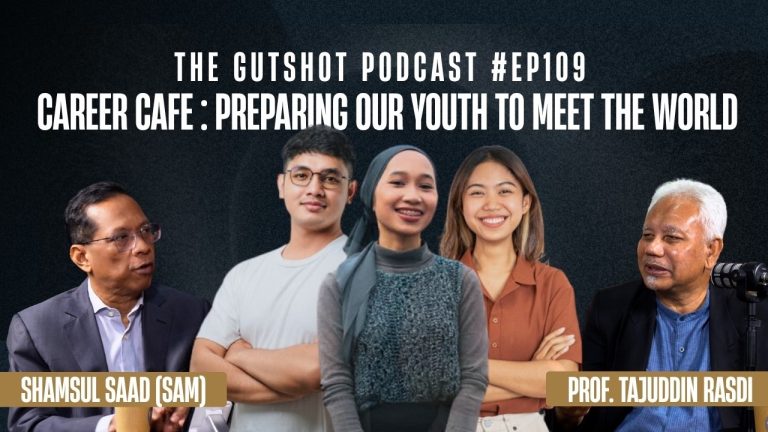
Career Cafe – Preparing Our Youth to Meet the World
Show Notes & Description
This episode was taped just a day prior to my detention by police on the trumped up police report of sedition etc. What an irony. Here was I talking with Prof Tajuddin on how we should try to uplift B40 youths which are in most part Malay youths. Our plan is to start a seminar-like program for youths to prepare themselves and their mindset, and what to do whilst in secondary school or then finishing after. And how to approach either tertiary or early career for future success. Youths are typically unprepared for what awaits them in and after school and at the start of their career. We believe our decades of experience both in academia and in working and business will provide them a guide and a pathway towards upward mobility. We want to just not give them tools to succeed but inspire and motivate them towards goals they never imagined they could.
Unlike these warped up individuals and their syncophants and the politicians that uses their authority like Gestapos to remain in power, we truly want to see a successful future young Malaysian society. We don't care for your race or religion. We want a useful productive society that can uplift themselves from the entrapment of extremist and racist ideology or racial discrimination that will not allow you to free yourselves to succeed in the real world.
Come with us and listen, and tell us if our plan can succeed or its just a futile idealistic dream.
We Have a Country to Save.
Jump to chapter 8 chapters
- 0:00 Questioning University for All
- 1:20 Introducing Career Cafe
- 7:47 Office Gossip and Independent Judgment
- 10:25 Early Career Grit and Continuous Learning
- 16:41 Reforming Secondary Education for Real-World Work
- 22:38 TVET, Artisanal Trades, and Broad Perspectives
- 27:32 Mentorship Format and Youth Outreach
- 39:07 Merdeka of the Mind
Auto-generated from YouTube captions. Timestamps link to the video.
You know, guys, university is not for everybody. In fact, university is not for most people. Well, that's a very interesting suggestion. Oh, yeah. Because most private university wants people because of the money.
Money. All right. But you say things like that, that's a very very interesting perspective. Say not everybody deserve it. Not just not anybody deserve it, not everybody should go to university. Yeah, because I I saw in one television in a YouTube about this Japanese young people
Mhm. who went to what what was the a school for farm farming. It's a farming school. Interesting. And so they they and the curriculum is about, you know, a little bit in class, but mostly in the kandang, milking the cows, taking care of the cows, and even, you know, slaughtering the cows.
Yeah. And and and putting out the Wagyu meat and and and stuff like that. Yeah. So these people are already prepped for a certain industry. Yeah. And they're probably be going to be doing very well. Mhm. You know, other than the office workers who's gone to the university and and having a different kind of job.
Mhm. So so the point here is that there are different kinds of work and there are different kinds of careers and there are different kinds of what we call making a living. Yeah. So so it one should not be the one should not be look at this is less this is more.
Welcome to the Got Short Podcast. I'm Shamsul Sam. Um today with me, our illustrious Professor Tajuddin Rasdi. Hi, Taj. Hey. How you doing? Okay? I'm good. I'm good. Today we're going to do a bit something different for everybody, can?
Yeah. Yeah. Um Tired of talking politics, lah. Correct, lah. Yeah. Yeah. I think we are tired to a certain extent of uh uh being accused. Well, not really being tired of accused. Who cares about being accused? Basically, we don't want to keep on criticizing or seem to be criticizing, okay, our community and and the problems that we face. Instead, today actually what we want to do, whether when we talk in English right now or we talk in Bahasa as we go along, you know, we really don't care. If you follow us, you know lah. We really don't care. So, what we want to actually tell you all is
that we have a plan. We think what is needed um for our nation and our uh Malay Muslim society especially and the B40 in particular. Um is that we need to find ways in which we can uplift them in terms of education, all right? And in that sense, myself and Professor Tajuddin has uh been brainstorming and we think we are going to embark upon something that we call uh a career cafe. The career cafe uh let me this way. It's our methodology in which we think uh combining our academia and uh uh
experience. real life experiences and my uh uh experiences and uh what I have gone through uh in corporate sector, in multinationals and in running businesses, how we can actually provide an uplifting uh environment and actually mentorship uh to our B40 community especially to the Malays. M40 bersama
So, uh Taj, uh let me start with you in what you think that we should be doing, you know? Let's tell our audience and hopefully, you know, we we we we put out uh what we want to embark upon and what we think, not just what we embark upon. Maybe with this it will also inspire others on what is possible. Touch. Shoot.
Okay. Thank you very much, Sam. This is kind of a nice change. Hey. Hey. Rather than as I said, talk to politics and also talking in in Bahasa. I I love the the fact about talking to I don't get to practice it with my family. None of them speak the the Bahasa Uh so, with the Career Cafe, the idea is simply that anything good about ourselves, and also anything good about our family or our nation, it actually boils down to each and every one of us. You know, you can say, "Oh, it's the Prime Minister's fault. Prime Minister's fault. Or this person's fault." Ultimately, it also goes back into how
did you or how did you respond to the situation? So, with regards to the Career Cafe, that was the idea, in order for us to look at the young people, because the young people are not like us. You know, we're not saying that we are better, but we grew up in a different environment.
We grew up in a different era. Era, where, you know, we didn't really have that much. Okay. So, we didn't really have anything for that matter. Okay. So, but here, our children, they have something we we cannot blame them for certain way that they react. I have five children. Uh you know, all of them are working, and I hear all their complaints, and I say, "What is this? You know, we never we never complained when we were we were working, you know?" But then, what's happening here? So, so I thought it'd be a good idea for our children as well as for others, not only for Malays, I
think. And not only for B40, I would desperately disagree. This is the M40, you know, even this whatever T20 was at the guy. I've I've seen all, you know, all various ranges of of these people. So, I'm going to Go ahead. Go ahead. Go ahead. Yeah. Correct. Right. Don't blame other people for your own predicament. Yeah.
Yeah, that's that's the wonderful statement by the Malays. Mhm. Uh just before 1:00 something like that.
Right. And all they would sit down in the lounge and they would talk. And so, sometimes I would join them, but most of the time I don't. Because I find a lot of their conversations are either you know, about things like cars or or or other matters which I'm not interested in. And then also there's this gossip about, you know, who is doing what in the office and all that. So, I I found myself to thinking, you know, should I should I listen to these people and you know, when you come into a work then people will say, "Hey, you careful of this manager. No, that
manager is like this like this." So, you Okay, that's a it's a it's a nice way for them to to say that. But, I would like you to consider making your own judgment when you interact with that person. Because if you actually go and trust this person, then you will already have a preconceived way of of dealing with that. If you're going to get not in my house or whatever it is, so what? Get not in my house or whatever it is. You know, don't try to live your life avoiding not getting in my house or something like that.
Yeah. You know, no, follow whatever rules there are. But, if you think that you could venture into something that others are not doing because you're honestly thinking about the company as well as your own consideration. That's fine. You can not try to get in my house.
Yeah. You can not try to get in my house. Take the risk. Yeah, because because it's not really a risk if you're actually thinking about it, right? Yeah. If you're acting like, you know, without thinking now that that that is a risk. I don't define risk as a as something that dangerous or anything like we don't know whether it's a danger or not. But, if you calculated it, you know, should I say this thing and can have I phrased it correctly, you know, So, should I say something? So, that's that's my take and of course you don't get many friends. Yeah.
Yeah. Well, I mean here's the thing that I think what we are going to do I mean it's not just for people who are starting out in their career. Yeah, they're in the middle. But we are also looking at I want to do also part of it where we talk to to to well, it's not really children basically by youth. Leaving high school. Right? And thinking about career. Where are they going? How are they going to prepare themselves for the next part of their life? They could finish SPM and actually go straight to work. They could go get diploma. They could go TVET. They could go
what do you call into tertiary education and then career. So, these are part of the part of the other portion we we want we we also want to look at. And we are working on this modular curriculum so to speak, you know? But I want to before I go there, I want to sambut what you just said. Okay? About starting out in career. I think one of the things to to remember to to to tell young people is actually especially the early part of your career, put your head down. And just work hard. Work hard, learn. I mean I always tell people learn learn learn. Don't don't worry about the money.
You know? Don't worry about the money. I mean the you you you you try to live as comfortable as you can because why? You want to work 10 times harder than the next fella.
At least for the next two years. Yeah. You know? Because you want to learn. You put your head down. don't rock the boat, you know, because you don't know anything yet. You don't know anything yet. Just learn what you have to do. And on top of that, if you want to learn more, um, the best way to do that is actually to offer yourself, volunteer for work that is not within your scope of of of your job. You know, I remember when I was when I first worked even my first job and my second job in in Shell, both both positions I held prior, I actually took on two persons position
at one position salary, right? I mean, the boss was happy because they don't have to pay me double, right? You know, but the point is very simple. Money you can earn. It will come later, but time you cannot.
Experience too. Yeah. That is experience. That's the investment. There There you go. So, what you have is actually a 2-year or a 3-year experience rolled up in 1 year. It's a very conscious decision on my part, I think. Uh, a lot of that, I mean, whilst we are talking like this, we are uh, we are trying to explain. But, you know, one of the things that's important when you talk to young people is actually motivating them. Um, and actually leading them towards all these that we want to tell them. And that can only be done by inspiration. So, we need to inspire, and
that's why we come up with this career cafe concept, right? So, I think that is the the thing about uh, you know, not rocking the boat and deliver and deliver, especially your first 2 years, you know? Uh because it will set the foundation for you, you know?
And never mind about some people saying, "Well, you're doing two work. You should be earning more." It's okay. No, yeah, I agree. Because you said you have to learn and then if you are doing more, then your CV becomes more. I've heard some lecturers complaining, "Oh, I have this class. I have that class. I've been given this class." I said, "Yeah. Well, so what's the problem? You know, I have these classes and other people have less classes." I said, "If you have more classes, then you are more valuable."
Mhm. You know, uh you are more valuable because if somebody were going to fire somebody, they're not going to fire you. You're heading having five classes, you know? Correct. They'll probably fire the other guy. Yeah, the fellows who has less. You know? You should be worried if you get less classes. All right? So, that's number one. Number two, when you leave this university, you got more on your CV for you to offer the the the other place. So, as you say, hunker down.
Yeah, hunker down. That's the right word. Yeah. Just deliver and deliver for the next 2 years at least. Yeah. Can I Can I take us back actually a bit for what we intend for our potential school leavers first? I think before we go to the career side, this is for the youth that we are thinking about. You know, what I see is actually I've been going around um talking to uh kids taking uh about to take SPM. Uh they're thinking about what to do next. Uh there were some smart kids looking at TVET uh in spite of, you know, how I look at uh I think their potential, which is excellent as far as
I'm concerned because really, you know, I always tell these young people um whatever that you learn in school is not what you're going to end up doing almost 80% of the time. That is as as as as much as I can say. You can maybe start uh probably 50% of the time in the career you've chosen within the subject, but actually by the third year or something like that, your career all of a sudden will move towards somewhere that uh actually is more valuable to you. You have no idea, you know. So, I what I told them is that you have to expand your horizon in terms of your learning, right?
And that is why I've always been a big proponent of STEM education. Because once you understand STEM education, it allows your process uh way of thinking and um and being critical-minded. That's that's one. And the second part I always always always tell young people, you need access to knowledge, and that comes from your fluidity and fluency in English.
Let let me interject on your your uh statement just now, which is a very interesting interesting I didn't I didn't think I was going to talk about this because uh we already set on certain things to talk about. But since you brought it up,
he said uh Sam said something very important. He said, "In your school, you're not going to find anything that the school prepare you when you go outside. Yes. Whether you're going to be a rider for Grab or whatever, or whether you're going to work at a at a factory, or whether you're going to work at an office as a office boy, whatever, or a clerk,
Mhm. you know, the school does not Or even as a lawyer. Yeah. The school actually does not prepare. Now, the question here is, again, as a man of education, why is that so? Mhm. Why isn't the education having uh known that you can start work at 18, all right, and and contribute to society in whatever manner that you are, you are contributing. Be dignified on yourself like that, right?
Right. Why are the school not preparing? Why are they still with ilmu alam, ilmu sejarah, ilmu science, all these discipline? Right. So, why isn't there a chunk of that education spent on putting them into some kind of subject matter where they almost will come into the real world? At the moment, the education seems to prepare you know you know what education seems to be prepared? They seem to be prepared everybody must go university. It's all discipline oriented and the assumption is that you're going to only find work after your your degree. But as you say, we have TVET.
Yeah. You know, we have other ways that you can work first. Yeah. You know, and then go out. You can compare somebody who goes to the the university and those who go out to work and then you can see the the track or the trajectory. It's almost the same or even this guy is much better because they have their you know the and and not having to pay this 100,000 ringgit things that they they had to acquire.
Mhm. So, education to me the the the the conclusion is that the education the SPM cannot occur. I already said that it's expired long time ago. We have to change about 40% of them to make some sort of preparation for work with regard to experience and all that. And the university is also going to change. It's not going to be on campus all the time. It's going to be on the job, off, you know, things like that.
Internships. Yeah, things like that. So, so so those things are what we're looking at into the future. Mhm. I think that I mean this is very important because Uh what people don't get is uh continuous learning.
Yeah. Right? Uh and continuous learning starts at school. When I look at uh when I look at geography actually or when I look at sejarah or history. Okay? Actually, what I learned from school is very little compared to what I learned outside of school.
Mhm. Um because I have uh I have the fluency of uh grasp of the English language. I read a lot of uh of of novels about far away places, history about far at about far away places. And also about our domestic uh history. Now, what you do when you do that is actually you are provided with number one, different perspectives of uh the condition of life. You are trained to actually look at different things and um Orang kata Melayu kata kupas.
Mhm. Kupas dan banding. You know? Uh then you don't take for granted what people teach you. Mhm. You think for yourself. Okay? And these are the things that actually they don't teach you in school, they don't teach you in university, they don't even teach you when you're working.
Mhm. You know? This is what they call, you know, the things they don't teach in Harvard Business School. Mhm. Right? Now, um I think every single person I what I look at it you do architecture.
Mhm. Right? In order for you to do architecture, you must understand physics. Mhm. Right? That's a that's a STEM education. Right? Uh but you also need to understand history.
Mhm. And you need to mix that for your creativity in terms of what you want to design. So you guys see your dot, right? The education part uh start at a very young age. And actually that will provide you with the um with the character that starts you out when you are about to leave high school, when you are about 16 years old. You know? The problem with us is we think everybody deserve a place in university. Sorry. I think that is one of the worst thing that has happened in Malaysian uh education system. We have made university as a right for everybody to
be in, especially for Malays. Somehow or rather la prof, okay? You know? That to the even that even when we stop uh qualified people from coming in because they are not of the same brown skin, right? So, you know guys, university is not for everybody. In fact, university is not for most people.
Well, that's a very interesting suggestion. Because most private university wants people because of the Money! All right. But you say things like that, that's a very very interesting perspective. You say not everybody deserve it.
Not just not everybody deserve it, not everybody should go to university. Yeah? If you think about it, if if I were to go by my experience, I would say only 20% of school leavers should enter university.
Yeah, because I I saw in one television in the YouTube about this Japanese young people who went to what was the a school for farm farming farming school and the curriculum is about you know a little bit in class but mostly in the milking the cows taking care of the cows and even you know slaughtering the cows and and and putting out the Wagyu meat and and and stuff like that so these people are already prepped for a certain industry and they're probably going to be doing very well you know other than the office workers who's gone to the university and and
having a different kind of job so so the point here is that there are different kinds of work and there are different kinds of careers and there are different kinds of we call making a living so so it one should not be the one should not be look at this is less this is more if you are mechanic if you are in overseas please pray not to have your car or something
it's going to be hell touch I tell you something I learned but I I did my own mechanic job all right I do the oil change now we can't do that with all these electronics right but I used to do the oil change myself because we can't afford to go to the mechanic so you got to learn you know
they are more expensive than the doctors sometimes exactly you know and and and talking about that even actually our coffee is sponsored by Orito at Plaza Damas 3 you know by a young man you know who went to university and decided to open a coffee shop and I like this because this is the best coffee I've had you know at least in town I'm not joking guys if you are in Plaza Damas go to Orito all right anyway this is interesting this is how you know people have different ways no matter they started out in school differently, but their entrepreneurship, the way they think,
because of how they are shaped in the way to think. Yeah. Okay? They don't follow like what professor telling before, they do not follow not just during during kerja, but also when they were in school, they learn not to follow. Okay? Then they learn how to actually see things in a wide perspective. They get information in a wide perspective. That was how my life was. And I bet you touch, you were the same.
Yes. Huh? Yeah, I I I I spoke to I mean, I speak to a lot of so-called academics. Right. You know, uh it's just because of society's labeling, you know, of degrees and PhDs and all that. I've you know, I I'm an academic. I know. So, when I say things about promotion and things like that, so they would complain about this KPI and that KPI. So, you say, "Why do you let the KPI uh uh uh uh uh bog you down?"
Yeah. You know? You know what's happening to you? You are making a prison of the walls of the university. Why are you doing that? Yeah. Okay? Do you know who's the most What is the most or who is the most important thing in the university? It's the academic. And some people say it's student. I'll tell our student. You know, there's nobody. So, the point here is that if you are the most important and not the vice chancellor, uh then you should carry your head high. You should determine your own KPI. You should actually think for yourself where you are heading. If you don't do that, then
somebody else will definitely do it for you. And somebody else will create a criteria you are important or you are not important. But the point here it has always been within your own jurisdiction and your own I said the ball in your court not to let wherever you work limit you.
Yeah. Really you think about it, right? I think this episode we want to address this episode to um not just the young people but also this episode to the parents of young people. This is why we are doing this episode.
And what we think we can create because why? Inspirational people uh are not easy to find. Um and with all humility I think touch um you have trained a lot of um a lot of young people.
Mhm. Um myself in my career of 40 years I have trained a lot of young people in in their in life Mhm. uh in their work and one of the proudest thing that I think I take uh in terms of how I look at success in my life is actually the number of uh employees and staff that I have actually raised their value and how they could make their family have a better life. I think that is where I come from. You know? Um and I think this is where we want to do this career cafe. What we probably will do is um uh it's a motivational uh camp so to speak that we want to do on a regular basis.
Um I think we have the space for it. Maybe what we are thinking about is 15 20 people to 20 at one go for any session. Um and then you know um we have a certain plan on how we want to go about it. Uh
I mean you can come as an individual uh for yourself or we we could have companies who thinks that some of the people needs to be trained in a certain way. We will have different modules for different age group, you know, and um and what we think is uh uh we will we will we will roll this out. We will roll this out. So so you see yourself also talking to a group of Buddha form five Buddha form six. Yes. From that level, yes. Correct. And yeah, and to the because you know why? I I've been asked to to also because I'm I'm a fellow at the Institute of Corporate Directors. Okay.
Um and what I find is actually I'm a bit reluctant to mentor uh older uh personnel older executives that are going for C-suites. So they they call it, all right? Going to going to on boards or on direct because why? Really the character has been set. You know? So whatever I'm telling you probably will hold for about 2 weeks. And then the the real person takes over anyway. You really don't have much impact. That's number one. Number two, probably what will happen is that okay, they they get excited for a while for a short while as I said, 2 weeks of excitement or actually 2 weeks
and actually a session paid for by their company, you know? But actually the leadership of the company never change. What's the purpose? So I would rather uh take younger people who are just blooming in their career, who is about to enter their career. School leavers, school children that are going into SPM. Right? That are about to see how their life are going to turn out within school and going beyond school. These are the people that are going to impact our society at the end of the day. Okay? And at the same time when they go home, they talk to their parents. And maybe they can change the
minds of the parents. You know? And and and these are the things that I I I I I did uh I went about I don't know whether I told this story. I went about uh and uh had a discussion with a group of students who were about to take their SPM. It was very enlightening. Uh and how much that you inspire them just be talking because why? A lot of them been told that you know, oh kita kena martabatkan bahasa Malaysia. Okay, bahasa Melayu. Right? Um and I told them, "Guys, put that aside. You pa you tahu bahasa. Sebenarnya memba bahasa ni uh I did not become very good in English.
Look at my English. I still have that Kedah slang. You know, 5 years in America doesn't change my slang lah. You know? And um I um I learn from
have a lot of Kelantanese English. Oh, I do. I do. I do. I do. I do. Gerun. But let's put it this way. I didn't even need to go to class actually. When I started writing by form one uh I was writing essays that stunned the teachers, you know? Because why? Because I read a lot.
I I was published in form one. You were published in form one. Utusan Pelajar. There you go. Oh, I I remember that. Yeah, three articles in form one. Put some pleasure. Fan letters from girls, you know.
Oh god. So, what I want to tell what what what we need to inspire. Here's the Here's the thing. That is the motivating factor of the of the purpose of this career cafe is to inspire and to show them the right way that are not taught in classes, in colleges, and in any work situation.
Now, just in case I just to interject a little bit. Please. Just in case that people are saying, "What the hell are these two people talking about? They're talking politics 95% of the time. Now they want to shift to careers." Right. Well, I I mean, if you have someone like what you say, number one, this person can grow.
Yeah. Number one, this person can have an independent thought. Number number three, that this person can actually, you know, not imprison themselves within certain cocoon of whatever have been placed upon the whether by an office or by a political party. Now, this is the thing that what we're going to say. If you can make it in a career
Yeah. our country will be on a better better on a better trajectory. Yeah. The problem here is that there's a group of people listening to some politician saying, "Kita nak Empire Melayu Islam and this is the only way to save ourselves."
Yeah. You know, why listening to these people? Why you let them put this prison around you? Right. You know, you don't because they are talking nonsense. All right, they are talking about how they can come into power and take whatever for themselves.
Yeah. And so so so so if you can if you can work within what we have been saying, then you can have a wonderful career regardless of what's happening outside. Yeah.
But, hopefully what we like to do is that that can change, bring the change that we want of our country, in our community, that comes along. And and and and really people wondering whether it is it's something that will take a full time for ourselves. It won't. I can tell you. The way we have it planned, it won't. And and and the thing is even if we did do three
change of thought saja. That's right. You know? Yeah. And you do what what what I You don't have to travel anywhere. Yeah. In In fact, to be honest with you, I mean brainstorming to a certain extent, you know, we've been brainstorming on this for a while a while, you know? I mean Think about this, yeah. We could be going around the country later once we have got a critical mass, okay? And the funding to allow us to go about doing that. We could be going around the country and doing motivational and inspirational talks to every corner that we feel like, you know, should be that don't have the
opportunity, you know? And do like Tony Robbins style, okay? And and I think we can make a difference, right? I think this is where we we are coming from, you know? And we're going to roll this out. We're going to let We We are letting you know that there is a plan for this. And we want you to actually be able to start thinking about it and seeing how you can support this particular initiative, okay? Whether it comes from a corporate side or whether it comes from personal contributions, you know? I don't I don't need a salary to do this job. Okay. So, I think but we need to be able to do this
properly and I think that this is not being carried out the way it should be. Otherwise, we won't be in the trouble that we are today, you know. Um, and and the the youth I look at some of the uh, clips um, especially circulating among the Malay youth. You know. Uh, either from bebas ataupun from this fat source talking about sejadah or some of this professor kangkung, you know. And it breaks my heart for the children. It breaks my heart for the youth. Cuz um, they are not just misleading them, but they're taking them down the road of
them. Trapping them, yeah. Uh, taking them down the road of destruction, if you ask me. And they're not going to be able to compete. So, what we will do after we can do this uh, uh, physic the physical version, we can take these versions and we can put this out in the in in in YouTube, in TikTok, in Instagram, you know. And it also becomes a a mass media exercise on our part. No touch.
Yeah. Yeah. Um, I hope that um, this uh, noble effort, hopefully lah yeah, you know, is going to get support. We will come out very soon with uh, with the with with how the program is going to be lined up. Now, Touch, you have anything else you want to add?
Uh just that this is a new adventure. Mhm. Actually, it's something that I have been thinking a lot. Some people say after pension, I was like when am I going to retire? I mean We never retire. You know, in the one first I've never worked a day in my life because every every time
every day I I what is defined as work is something that actually comes from my being. Right. so I've never look at work as work or holiday as holiday or work day as work day. Yeah. It's all seamless to me.
Yeah. Unless you get sick, then that's a different thing. Yeah. Okay. So, it's a it's a new it's a it's adventure that I have been thinking about a lot time in terms of what what we consider motivational. Right.
We could probably say sharing the experience Yes. rather than the the word of motivational. Mhm. And then I I think the other word is actually inspiring. Yeah. Yeah. Yeah. So, that uh uh as I said, we we move along. We know our objective is to create the better person, the better human being, the better community member, or the better community leader.
Not just that, a young thinking uh inform citizen that will become your electorate. Yeah. And grow and grow. Never never stagnant.
stagnant to think one way. Right. To think only this way. To only honor one person. Yeah. You know, one person of my own race, one person of my own religion. Yeah. Nonsense. Okay. So, grow. If you do not have this as a young person, I'm sorry for you.
Yeah. You know, you you already trap yourself. Uh Before you even start Before you even started. Yeah. You know, some some people are saying that some political party have won election. Hey, come on, man. They already surrendered before they even went into the election. Okay?
Because they think that they have to go on to another person's right. But you could actually have a different way of looking at things. And this is where you chart your own your own path.
Yeah. Yeah. Your own fate, your own course, your own destiny. Yes. I think that I mean to to add to that before we close today. I like I mean uh uh this this this uh idea, not just an idea. Actually, we have already uh formed up some plans on it and we are going to uh provide you with details. Uh but um the thing is this. Um I think um I think we want to provide uh role models that are different than what is uh currently seen. Um most of our um role models in Malaysia are either politician or um uh what you call uh or entertainers. Okay? Um we want to show that there is a
different role model in terms of how hard work can lead to success. Um in terms of how being able to be open-minded and questioning and actually knowing about the rest of the world and how it functions. Okay? Will make you see beyond the beyond the borders of Malaysia. Right? So, I think as it is touch, uh we've made our our intention and debut of uh of what we intend to do. Um I would like to thank you. Okay? For uh for coming on and uh and discussing this with our audience. We hope you
You good that uh we're starting in the Merdeka month. That's nice. This is the Merdeka Yes. Actually, this is the Merdeka of the mind. Yeah. That is what we want to do is to provide the independence in your mind in the minds of our youth and the youth going to their career. How do you build that? That is the other part that we will go through and I think we have the treasure trove of experience that would be wasteful if we keep it to ourselves. Right? With that, I thank you very much for joining us today. I'll see you again on the next episode. See you all. Thank you so much. Thank you.