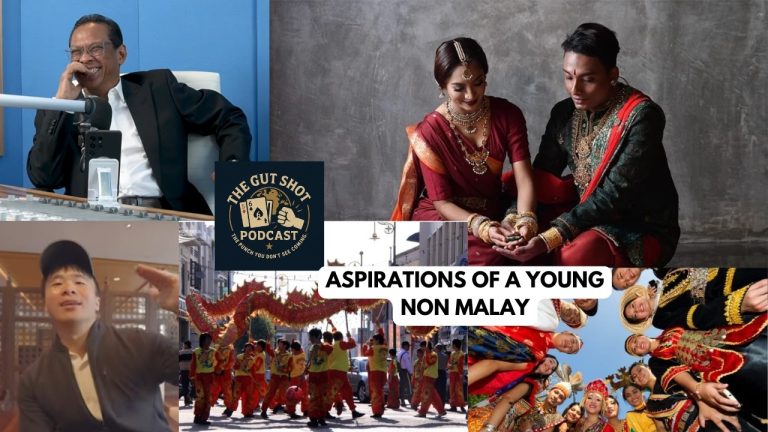
Aspirations of Young Non Malays
Show Notes & Description
Gutshot engage in conversation with popular podcaster/commentator, Victor Tan, on the aspirations of non Malay Malaysians. We want policy-makers and our viewers to hear these aspirations of the virtually unheard important segment of our youth in the din of our Malay-dominated political noise. No-holds bar, Gutshot is the place to be for conversations heard no where else.
link to Victor's podcast:
https://youtube.com/@VictorTan?si=OfOy8K5sYF7UY2AI
And also link to Victor's book: https://victor-tan.com/one-date-two-destinies-a-book-release/
Welcome to another hard-hitting episode of The Gut Shot Podcast! We are the place for conversations that simply don't happen anywhere else
. Today, we are joined by the brilliant Victor Tan—an entrepreneur, popular podcaster, and University of Chicago economics graduate—to dive deep into a topic that many skirt around: the aspirations and realities of young non-Malays in Malaysia
.
Are non-Malays truly treated as second-class citizens? We ask Victor point-blank, and his honest answer might completely shock you
. Despite what you hear at family dinners or see on toxic social media threads, Victor shares how his lived experience—including securing a massive government scholarship—shatters the common victimhood narrative
.
We also get real about Malaysia’s economic trajectory. We compare our stagnation to the meteoric rise of nations like Singapore, China, and South Korea, and we both agree that our current governance earns an absolute failing grade
. Is our education system setting us up for failure by prioritizing "Jati Diri" (identity) over global economic competitiveness
? We debate whether survival and success ultimately come down to pure economics
.
If you are tired of the divisive political chatter and want to understand the true state of social cohesion in Malaysia, this episode is absolutely mandatory viewing. Victor exposes how politicians gaslight the public for power, creating imaginary enemies to stoke fear and gain influence
. It is time for the thinking people of Malaysia to wake up, stop falling into a pattern of hopelessness, and take action
. Stop letting the algorithm dictate your reality—it's time to "touch grass" and start building our nation's future
.
Watch the full episode now to understand why there is still hope, and why the youth must keep fighting for the nation
.
(Note: Please adjust the placeholder timestamps below to match your final video edit)
[00:00] – The Unspoken Truth: Are Non-Malays Second-Class Citizens?
[05:30] – The Million-Ringgit Government Scholarship That Defied the Odds
[12:15] – Reality vs. Social Media: Why You Need to "Touch Grass"
[18:45] – The Economic Reality Check: Why Malaysia is Failing Globally
[25:00] – The "Jati Diri" Trap: Why English and Economics Matter More Than Identity
[32:20] – How Politicians Gaslight the Nation for Power
[38:10] – Singapore’s Secret Weapon: The Management of Diversity
[45:00] – A Call to Action: Why Thinking Malaysians Must Fight Back
Jump to chapter 8 chapters
- 0:00 The Unspoken Truth: Are Non-Malays Second-Class Citizens?
- 5:30 The Million-Ringgit Government Scholarship That Defied the Odds
- 12:15 Reality vs. Social Media: Why You Need to "Touch Grass"
- 18:45 The Economic Reality Check: Why Malaysia is Failing Globally
- 25:00 The "Jati Diri" Trap: Why English and Economics Matter More Than Identity
- 32:20 How Politicians Gaslight the Nation for Power
- 38:10 Singapore’s Secret Weapon: The Management of Diversity
- 45:00 A Call to Action: Why Thinking Malaysians Must Fight Back
Auto-generated from YouTube captions. Timestamps link to the video.
Welcome back to the GotShot Podcast. I'm Shamsul, your host Sam. Uh I have today a very interesting guest that we're hosting. It's uh Victor Tan, our popular podcaster and commentator uh in Malaysia. Thank you so much for having me uh Sam. And I think that you may be overselling me a little bit, but I'm very happy to be here and it's an honor to be on the GotShot Podcast. Okay. As you all well know, we are a place where um what we want as as our brand of GotShot says that uh we have conversations that doesn't happen anywhere else. So, today basically what we want to delve is into um
the non-Malay youth and their aspirations. And that's why I'm having our 30-plus-year-old young 30 uh Victor Tan who Some people might say, "Old man." at this point. Uh well, compared to me you're not. So, I mean, Victor, just a quick background, Victor is a graduate of economics from University of Chicago. He has uh his podcast as you uh some of you may know. We'll have a link to that podcast uh in the in in this video. Also, um Victor has his own business um which is involved in uh education. Mhm. Um so, the guy is very much um you know, an entrepreneur. Uh
And uh so, without further ado, I I want to get straight into this conversation. Uh My first question to you before we we start this is uh Malaysia with its uh with its constitutional background and uh procedures and rules uh this has been this this this this kind of topic uh has been skirted around a lot. But, I I to ask you a point-blank question. As an ethnic Malay Chinese uh non-Malay, um do you feel you are a second-class citizen? Does Does that feeling ever come to you? The answer to that question is
Let's be honest. Yeah, of course. Yeah. The answer to the question is and like you can even try my eye movements like my other side of the screen right here. The answer is no. The question and let me repeat it is do I feel like as a non-Malay that I am discriminated against or and this is your exact wording, do I feel like a second-class citizen in Malaysia? The answer is no.
Okay. So, there are a couple of like different reasons why this is the case, but I'd start by saying that when we think about discrimination, right? So, objectively speaking, like I've not experienced what you would call like discrimination in my own personal life. I'm not saying that other people, right, have not faced that sort of discrimination. So, as said earlier, I graduated from the University of Chicago and why did that happen? I came from a family that was relatively poor. My father passed away when I was 6 years old and I have had multiple siblings
basically going off for education like elsewhere here and there. And statistically speaking, you know, as somebody who is like Malaysian Chinese, you know, like maybe, you know, throughout the course of your years, right, like in the Chinese New Year dinners and can I speak in Hokkien?
Like maybe like the relatives would then say, "You know, those people they will discriminate against you one ah. All those government project ah I tell you they will never give to your one ah. Hiya, see all those scholarships, they will give to all of the kids out there who are not your skin color. You I you have to work hard in order to get what you want, but yet I'm here. I'm the beneficiary of a scholarship. It was worth like over a million rupiah. I got to go to university. I had education. Like if you say that it's discrimination or being treated like a
second class citizen in that regard, right? And that's only like one of a whole like laundry list of different things, then the answer is no. Like was I discriminated against because of my skin color in that scholarship selection process? No. But also, right? I mean, if you go on social media and like I talk about this a lot, right? Like it's very obvious that you are going to see, for example, things that can be interpreted as discrimination. For example, you have racist comments. And there are so many different racist comments that have been like normalized
here, there, and everywhere. I'm sure that some of you out there have heard like pipe C. And uh what else do you have? Like Cina Buta, Pendatang, and then like you have Oh gosh, like There There are like so many more. I don't know, like wow. But anyway, like the point being that there are a lot of Indian There are three words on Indians as as well. Yeah. Like there is someone like Keling, yeah. And then like in relation to that one kid who is Now we are not sure whether he's like Christian or he's Muslim. Okay. Perhaps you remember that situation right there, Ryan Sohmer.
Well, so yeah. There are lots of like these derogatory statements out there, but if we think about it, right? Like is the presence of those derogatory statements really sufficient, right? For us to conclude that there is discrimination or being treated like a second class citizen by people? Mhm. I think that you need more for that. Now, on the other hand, if you say that discrimination or being treated like a second class citizen could be like, for example, your certain policies, right? Which some people justify by referring to say Article 153 or might say other
parts of the constitution. So then, I would say that there are various ways of interpreting like what being treated like a second class citizen happened to be. I can see why some people might feel that they have been treated like second class citizens maybe because they submitted a tender for a project but they didn't get it. But in my personal experience and thinking about the overall context, I think it's hard for me to conclude that I personally, in my own experience, have actually been treated as a second class citizen. Now, the title of this podcast, I believe it's the aspirations
of non-Malays, right, Zam? Yeah. Yeah. So then, Non-Malay youth, basically. Non-Malay. So we're going to go to that. I just want to set the table. Because um I mean from from uh that's your life experience,
Mhm. um on um on my side, I never thought about this when I was younger because when you are younger, I mean even when I was about your 30s, right? What you are doing is actually you go to college after your uh after secondary school.
Mhm. You go to you you're going to college and your mind is working on actually surviving college and getting out of it, right? Um and then you come back, you're search you're searching for a job. Um if and I came back in '86 when uh it was a full-blown recession. So survival or or you know, trying to manage through that is uh uh is your priority. So politics or social condition are never in um my radar. Mhm. Okay? I think listening to you and how you talk about it, it doesn't surprise me because um you've gone through you've got a scholarship. You came back and
and and basically you got to get your life in order, right? I think that usually lasts for maybe 10 15 years of your life, right? Um But what happened for me personally is when I look back um we were in we were in an elite school in secondary school. Um none of my non-Malay classmates actually had a scholarship to go overseas. Right? Whereas I did and some of them I would say better than me. I I wouldn't be surprised. I can't remember practically but a few of them I'm pretty sure you know, at least three or four of them were better than me, right? So actually when you told me that you got
a scholarship, I was quite impressed by that and I think I I don't know who But when I look back at my even my my career, I look at that and I think to myself I said, you know, I felt a bit sad for my company for my non-Malay classmates. I said, "What why can't they be given the same opportunity as I did, right?" And I'm it's not out of idealism. To me, I guess when I was growing up I was brought up by my dad who's a school teacher. Right? In you know, he town of Sungai Petani. I live there too. You're calling my town.
How dare you? Okay, okay, okay. So so both our towns both our towns. Both our towns. Okay. So there's some great things about Sungai Petani. Okay, guys. So I mean going to that then I I that that's my my perception and I've been working and I I have seen the working environment the money the business environment especially because I was in money I was doing relatively I would say big businesses or or businesses that actually have potential to really grow quite large as I was in the electronics industry I was in the palm oil industry in my earlier days and then I was in oil and gas right? So,
those things were very very stark for me personally to see and how you build companies and how you want to get married into your companies, you know, irrespective of the conditions that are being put. Um and I I had to go through through that. I'll I'll I'll touch that later. But, um you're currently running your own business, you're doing podcast, you have very little I I would think that you have very little interaction with the government sector. So, when you say interaction with the government sector I would say no, I do not really like interact very
much with the government sector but I do know like people who work in like different industries. Right. Probably the industry that I interact with the very most is the CFC. Okay. Cuz I report my own videos like once in a while we can talk about that. Okay. But, yeah, if you say like, you know, like do I go up to YB let's say Ngak Kor Ming or like well to Johari Ghani, do I have conversations with them? Do I work with their staff and that kind of thing? So, like the answer to that would be no. Mhm. Yeah. No, on my part as well actually I've never really um dealt on the political level cuz I I
just don't like the politics of things, right? Wow. But you're doing this podcast though. No, no. I mean I'm talking policies. All right. Right? I mean the we are looking I look at policies, I look at issues. I really don't interested in the politicians per se because I the way I you know, I I don't want to go too much into it right now. I want my our guests to our our viewers to hear from you. Where do you see um your now that you know, you are 30 plus 33 or something like that, right? Victor um where do you see the nation is going and how do you look at it from your standpoint? What's your
aspirations? As a young man and I think you seem to be don't have the attitude of I want to go somewhere outside of this country. You want to put your roots down here. That's what that's my my impression, right? So, please tell. How how do you see where we are going? What are your your concerns and what is it that you see moving forward that you you aspire that as a society we we develop into. Yeah. Please. Thank you for the questions and I think that's a very broad question, but at the same time where we going? Well, in the terms what would be like the first
immediate question, right? So then like when you say where are we going? So that you could subdivide that like question into like multiple sub questions. You can imagine like where are we going economically, for example?
Let's go there first. Sure. Okay. Let's go there first. So, recently, because of our efforts as a nation to solve the national semiconductor strategy, like there's an ETR, there's a whole lot of like different things right there. I can see that Malaysia is a country with a lot of ambitions to kind of like renew itself while at the same time sort of like pushing the things that it has sort of like been going on with. Now, whether or not those efforts are going to succeed is not a historically determined question. So, like with semiconductors, for example, some people say that like we
can't like really move to the upper value part of the value chain, so to speak. But, at the same time, it's sort of like, well, a push, I think, on the part of like our regulators to actually make sure that that can happen. At the same time, I think like when we think about where Malaysia is going, so like there will always be that concern, right, of like equality or rather equity, sort of like between the, shall we say, races. It's been a going concern that has persisted like from the very time of the operation of the NOC and also the, well, NEP, amongst other
things. So, I think that that's going to be going on except like different ways, shapes, or forms. Do I think that Malaysia is going to make a gigantic transition towards, for example, becoming like a super high-tech like world-shaping economic power, like develop R&D hubs and resources, and a whole bunch of other things? I think, like objectively speaking, given the fact of squabbling that we are seeing in Malaysia to the point that you can't even pass a bill to limit the Prime Minister's term to two terms right there. And also like the going concerns, right? We're not going to see that for
at least like maybe like 10 years. But in terms of like other things, like for example, well, the value of our ringgit, I think that that can be something that well, we capitalize on to the extent that we can actually get people to be interested in living in Malaysia and actually demanding our currency for the foreseeable future, but as a shall we say small open economy, I think that's what the term is. I think that we do have to kind of like rely upon like external partners here and there. So then in a sense, I feel that our actions dependent on those of a certain Donald
J. Trump at the moment and also like the United States and also some of our other partners who are locked in a sort of open or maybe not even open, but like apparent geopolitical contest. And even now with things that are happening in the Middle East as well, I can imagine that there are going to be difficulties in the near term. But in the long term, so then to sort of like answer the question about the economy right there, I think that we are going to likely develop and continue I guess like building I guess like our ability to work with other countries, but we that
in Malaysia there's a problem, right? Kita kena ukur baju badan sendiri. So I think that if we are able to do that while at the same time maintaining the social stability or the cohesion that forms the value proposition for why is that people want to live in or invest in Malaysia in the first place, then we are able to see that sort of track. But I don't expect a sort of like exposure exponential growth. Let me And in the This is Sorry. This is my my uh my comparison actually. Um Singapore um Singapore has you know, uh taken leaps and bounds compared to us economically. South Korea
was at war when we were uh already developing. And they have surpassed us way way be uh past us. Mhm. If you look at uh education, um PISA scores, um even Vietnam are doing better than us. Mhm. Right? Yep. Um so, I think um I'm coming from the point of view of uh probably a more macro uh standpoint. Um And uh but I mean, the this is where uh the issues that got brought up when we talk about and I talk about it um that is of concern for, you know, maybe older people like me.
Uh um um Well, they're very real for like younger people as well. Like even if they don't know it. Yeah, yeah, but I I I do I'm I'm beginning to come to a certain realization Yeah. that actually uh uh your journey in uh in your uh in your career uh and your life is at where I was Mhm. you know, um where you're looking at you know, the the life at the moment. Mhm. I think the the the the the interesting part is actually when I look at what you have done is um is you've pulled on your bootstraps, so to speak, as they you know Mhm. I as they say. Uh and you're not waiting for the
government for help. No. Probably not. Yeah. Correct. I mean, there was a time when I came back from the US, right? Then I was like thinking like, "Okay, so like are they going to call me at some point?" And I think that we talked about this like briefly before the podcast, but like again, right? So, if you're going to spend like I don't know, like a million ringgit for example on a person's education, or well, if we put that in like just basic like real world time math terms right there, imagine that basically you are well, working for like let's say 3,000 ringgit per month, right? And then
basically, you multiply that by 12 months, then basically the total amount of time that you need in order for you to get the 36k is like 12 months. But then like if you take for example like 1 million ringgit and then you divide that by like the amount of money that the average Malaysian, let's say that's like 3,000 like per year, 3,000 per month kind of thing, then like that's like easily about like multiple decades of a person's like salary right there. So then again, so it's like really just weird right there. Well, but the fact that actually you came back and straight
away work for yourself, right? And don't go around and say, you know, I'm waiting to be called out or you know, why am I not getting a job, right? It's just a different mindset, I think compared to if you I mean, you came from a not a wealthy family, right? Neither did I. And you know, I came back '86 as I said, recession and you sort of have to say, "No, I got to do something Survive. Survive, right? Survive, bro. Survive. Yeah. Yeah, that's right. So, I mean, this is the this is the thing that we uh I I think in the discourse in the in the in the social discourse, political discourse
that I find very troubling. Um But I do always tell people that the social media is not real life. Oh, it's definitely not. Yeah, the social media is not real life. People who engage in on social media is a very small minority. Absolutely. Yeah. Mhm. Most people has got work to do, has got to feed their family, got to find work, right? Those people that engages on social media and and create all this brouhaha and even the you know and and even the politicians, you know, to me the politicians are a very minor you know and yet because they hog the power and the limelight Mhm. uh
So they create all this this this narrative, right? And this is where I I think I'm in a part from economics for me economics is uh I don't know. When I was your age short term, I was looking at yeah, I'm going to go like this. I've got another plan to go, you know, within 6-7 years what I'm going to do. I am actually personally I'm quite troubled looking at the macro. If I was a young guy like you Oh, yeah, for sure. Yeah, I I don't know how you feel about it. I'm I mean for me personally, if I told myself I've said this countless time, if I was starting out today Mhm.
I'm not very positive about my prospects in terms of actually being an entrepreneur. Mhm. The margin of the not just the margin of error, but the margin of profitability and the opportunity available is not as much as you as as what it was during my days.
That's true. Yeah? You feel that? I would find it hard to compare to another generation cuz like, you know, you were in uh previous generation. But, if you're talking about like right now, right? So, I guess partly it does depend on like the specific market that you happen to be in. Like, if you are competing with like people who are like vastly richer and like vastly more influential, that kind of thing right there, in different industries, then as a small player, then you might find it very difficult to actually like survive, right? People always constantly trying to like
undercut like people here and there. If you as a random person want to start the next like 99 Speedmart kind of thing, like you have to be aware that like there's already a 99 Speedmart in the market to compete with, something that wasn't there before. But, I say that there's still opportunities out there. And when it comes to like those opportunities, it's not like everybody is going to like just automatically find them. Like, this is not a fairy tale. Like, it's real life. Like, you have to find a way for you to actually survive, right? But, I guess like what I can say
is that like it is possible for you to find. And like the question of whether you can actually find it or not is not one of those like fairy tale stories out there. Like, "Oh, you know, like I will make you feel better. Like, you are going to go out there and you are going to solve like thrive no matter what at the end of this like beloved, wonderful, amazing fairy tale." Like, no, there's no such thing. But, to tell the audience right now that, "Hey, you know, like it's all going to be like super truly amazing." That kind of thing out there, I think it's to deprive them of the
realization, right, that you on the other end right there, like whatever it is that you are, so that like your life is in your hands, and it's up to you to like take that for yourself. Like you're already spending time right now like listening to this podcast till you feel somehow that there's something of value that's being exchanged here. So, then when you think about like say was it more easy in like another generation, that kind of thing, that could be theoretically true. But then the question then is, you know, like should that really shape the way that like you
behave or live or otherwise kind of thing? So, in your case and so like you're not you're not starting out like right now. So, like in that sense, well, maybe this is just like food for people who are starting out now. So, then like all I can say is fight. Yeah. Ever drink? Um Please. Go ahead. ARE YOU SURE? YEAH. OKAY. WAIT. What do I care? I mean like cuz like you know like personal life kind of thing. So? So, you know, I have this trouble about people saying, you know, you better I mean you know, people say you drink LAH, YOU KNOW, PEOPLE SAY YOU eat lah. I What the
hell do I care? So, I just don't understand this whole preoccupation. You know, the funny thing is that I actually know that you don't care because we kind of talked about this earlier. I just wanted to see your reaction. Great. So, I mean the let's let's let's let's just move to another part of that subject, right? What about social cohesion? How do you see? What's your What's your feeling about uh Malaysian social cohesion? There's so much chatter of uh and and divisive talk coming from Oh, yeah. uh politicians and uh and and and so-called uh religious influencers and
and whatnot. What's What's your feeling moving forward uh as a society in in Malaysia? Sure. Please. So, let me hear you out. Sure. Let me talk about that on two different levels. One of them is social media. One of that is like in my personal life. Yeah. So, then I don't know like I'll let you have like first pick like what do you think like should come first? Social media or like personal life? Personal life obviously.
Personal life. Yeah. I have great relationships with like the Malay people like in my like immediate like neighborhood like vicinity kind of thing. There's like one guy like who is my neighbor. His name is Anwar, right? So every single morning like when he's washing his car, I just go up to him and be all like, "That was me. I'm a cheater." Like that kind of thing. So like yeah, I don't know if like that's like cheating for the audio or whatever have you right there. Then like when I go to the gym, then like I see like I don't want to name names or anything like that, but like I literally
just go up to like my favorite Mina and I'm like, "Mina, I'm a cheater." kind of thing. Then we go for like high fives kind of thing right here and there and everywhere. So then like in terms of like weddings, I mean like my best friend from childhood is getting married in April. So then we're going for that wedding. And I also went for like another friend who's also Malay. Like his wedding was sometime like last year right over there and like we get along like perfectly fine. Like there's no like indication of like the kind of like things that we see on like social media here and there.
Like you could say that maybe it's because like you know we're not like in a bubble that kind of thing right there. So like you don't have like disputes over like things that might seem like they are kind of like well, remeh temeh if we use like Malay to sort of like describe them. Because like we have that experience of like growing up together, living together, experiencing life together. Like sometimes even like you know in high school, right? Like it's not like you know the differences don't exist. Lee Kuan Yew whom I might talk about a little bit later on once
described the differences between individuals of different faiths, of different civilizational shall we say like heritages as being primeval differences which I fully and totally accept. And when you are in that environment, you kind of like you know like clash in like certain ways kind of thing and then like maybe even sometimes like you mock one another, but you can still become friends along the way. So, personally speaking, I have not had experiences that I would say are bad. But, social media is another story.
Yeah, yeah. For sure. People I think I took kind of that that that whole issue short on the social media. I I mean, I I think there's there's a disease running out there. Basically, is that you are just whatever you want to say, you just say, and you get the worst part of society and the best part of society sometimes. That actually participate in the in social media. Oh, absolutely. And they are and it's like you have a mask, and that mask allows them to say whatever they want to say.
Oh, yeah, for sure. Yeah, for sure. That's why for me, personally, actually uh whenever I'm on social media, I'm never under a pseudonym or whatever. I am what you see. Right. You know, because I want to be able to stand by whatever I say, right? Of my conviction. Absolutely. You know. So, I um let's let's do a conversation now. Uh rather than I mean, doing the exposition from yourself.
Sure. Okay? So, we've seen this. I mean, my concern uh for us moving forward, right? Is we've already seen in in in my parlance as a businessman, right? If you're competing uh competing industry, competing companies, Singapore, Thailand, Indonesia, Japan, South Korea, China, right? China was nowhere when we were developing already. Absolutely. Right? Mhm. Um and they have actually surpassed us. South Korea has surpassed us. China has surpassed us. Singapore has surpassed us. Just to name three? Mhm. Right? Different sizes. Mhm. Okay? To me, when I look at that, that is an F. Mhm.
Right? And I think in what sense? Like agree with you? Schizophrenia. Ah, okay. Got it. It's a failure of governance. Ah. It's a failure of competitiveness. Mhm. Right? Fall back to where you and I are Mhm. in how we look at our life. Yeah, we have been right relatively successful. Mhm. Personally. Mhm. Right? But from a societal standpoint or a national standpoint, I give it a failing grade. I would agree. Do you agree with that? 100%.
Right. Now, let's look at moving forward. Mhm. Okay? I don't see um principal policies Mhm. that is going to take us from what I call this stagnation. Mhm. One from an educational standpoint because you need education to build a society over a generation a period of at least one and a half generation. Mhm. Okay? You can you can destroy a society in 2 minutes. Mhm. But to build it, you need one to two generations.
Absolutely. Yeah. Right? Mhm. Second part. So, education is something that I'm very very concerned about. We got too many universities that are useless. Mhm. Okay? So, we have misallocation of funds. We are teaching our children uh subjects and also in a language that actually make them less competitive. Because you like it or not, the lingua franca of business and the global trade for the moment, for at least another 100 years in my opinion, Mhm. it's not going to even be Mandarin. Mhm. It's still English. Yeah. Okay? So, this is where I see moving forward. If I look at your this one,
but then if the bulk of our society, and I look at which is 50% approximately 50% actually it's less than 50% Malays because Bumiputeras is different, eh? Okay? You've got the Sabahans and the Sarawakians, the you know, Iban, Kadazan, and whatnot, right? Okay? And this is where my concern come from and what part of what I talk about on Guy Shiro. Yeah, of course. And I don't see the politicians step what you call in baseball stepping up to the plate. Yeah. That's that's all the major concern. On the education front, I think I can expand a little bit right here.
Please, please. So, then now the point that you made about like the English language earlier, right? Might be something that a person then responds to by saying "But language is not just about economy. Maruah jati diri. Maruah jati diri." That kind of thing. And like they will then say a whole range of things like that. I know because I engage in those kind of conversations like that. It is on that basis that people say that you need to educate people like in the Malay language because they want their alleged jati diri to basically just come out, you know? What is jati diri, by the way?
When you say about English? Okay, jati diri. Like what do you mean? It's so difficult. Is it character? Fine. It's not It's not character. But it's In fact, I made a video about this like about how I hate the term jati diri, that kind of thing. I I This is the first time you heard the first time you heard this in I've heard this, yeah. That's how old I am. You're so lucky. Okay. Jati diri basically means Okay, look. If you then What has that got to do with Is it What What What What does that have to do What does it mean by that actually? What does Jati Diri means? Give me the best
English translation you can give. Sure. You can call it Identity? Identity, yeah. Like the will to preserve your identity. Okay, stop there. Sure. All right, stop there. And this is This is why my problem is with the current discourse and how it's been uh even taught in schools or how the our education system has in this one, if you call it,
right? Cuz I don't give a All right? Because why? Uh we compete with the world. We don't compete, absolutely, in Malaysia. All right? At the end of the day, at the end of the day, whatever we do is impacting us, is coming from the world. It is. We are such a small country. We make Right? Okay? So, I mean So, when you look at it, your your power base as a individual and then collectively as a society is how strong is your character. What is your character? It's got nothing to do with your ethnicity, it's got nothing to do with your religion, it's got nothing to do with the history of your
grandfather or or ancestors. I've always emphasized this part. Those are not going to be helpful to you at all. Yeah? It doesn't. Okay? The problem with Malaysia is because a lot of Malaysians doesn't go outside the country and live outside the country, especially live outside the country and understand how the world works. Mhm. Right?
Right. So, they are typically Mhm. kata tempurung. That is true, but I want to challenge you on one point. Please do. I love challenges. Yeah, so now earlier I mentioned this idea, right? About how like not everything is about economy kind of thing. So, then like Can I Can I Then I I I'm going to answer you straight away. Yes. Okay? Everything is about economy. Everything is about the economy.
Everything is about economy. Well, allocation of scarce resources to meet the infinite wants of man. Man, even you personally, everything is about economy. Mhm. Okay?
Because why? I need to put food on my table. Absolutely. Right? Yes. It's economy. True, but I will counter that by saying that everything in some way involves my economy or money, but at the same time, right? Like there are lots of different people in the world out there making livings like through in lots of different things. LIKE PEOPLE IT'S ECONOMY, YOUNG MAN. THAT IS TRUE, but
described economy. Well, when you say like economy, so then like you can make a living in like lots of different ways, but you may also have other things that like do not impede you from making a living. Like for example, right? Okay. Let's say for example that I want to become someone who really, really loves Malay literature, Malay history, that kind of thing. I believe that for example, I believe in Solehah Yaacob enough to go like to her hotel and then pay her 600 ringgit for two days of gas. I think I mean, I'm sorry for like two days of historical education. I listen
to the podcast and then basically, oh, you doubt that. Oh, no, Solehah Yaacob here in this other Solehah Malayu Solehah Yaacob sesat, tapi you doubt yang sebenarnya
Well, here's the thing. Here's the thing. Yeah. Allocation of time resource Mhm. Okay? It's all economics, right? If you choose to spend You only have 24 hours in a day.
That's true. Right? If you just choose to spend six of that hours listening to nonsense Mhm. Right? Okay? You're not going to generate Yeah. the same amount of economic returns as the next person who spend that six hours doing something productive. Okay? You can do Mhm. You can spend your time in gym and build your muscles. Sure. Right? Unless at the end of the day that time spent in the gym is going to generate an income. Okay? With an eventuality of generating an income. Okay. Okay? Okay. All right? And it doesn't impede on You know. At the end of the day, the bottom line
is still economics. What's the return on investment of your time and resources? Mhm. That's what I mean when I say everything is all economics. Okay? Whether it's an individual level or societal level.
Okay. Okay? Sure. So, that's my my point of view. All right. All right. So, when I I wish that I get a politician to come on this got show podcast, right? And debate to me about this jati diri thing. Okay.
I I Yeah, the problem is actually I don't think they will come because Um I'm going to smoke them. You know? Right, right. They The the thing is uh I think I mean here here we are two generation I think one generation apart at least, right? You are Yeah, yeah, you are about the same about slightly younger than my daughter.
So, we um I think uh what is your opinion about youth I about about I mean, you talk in your podcast a lot on the politics on some issues on politics and like All right, you you do it in a satirical way, okay? Uh yeah, okay. Sarcasm. Right? Um Subscribe to the cat show podcast and also subscribe to the video.
So, um the question I have is then um why do you have so much interest in that? Mhm. Since uh you uh Why? Just tell me why do you have so much interest in all this when actually you are putting a lot of effort and uh um on building your own business and and whatnot. Yeah. Why why why does this part of your life interest you? Why do you have to commentate on this and spend time on this? It's almost like an instinct, Rosak. I mean, I always had this instinct to want to understand the world a little bit more like day after day, right? So, then like my personality is just that like I tend to
look at things, right? And I want to like understand them a lot more like in different ways, right? Like I look at news stories and like immediately I start seeing like patterns here and there, which made me think to myself, well, why don't we look at this more in detail? And then when I do that, then I'm like, okay, well, that naturally allows me to form a narrative. So, then why don't I share that with the audience? So, then it was probably like sometime well in 2024, right? That like I was like interviewing people for well public speaking lessons which is my podcast
where I started out basically interviewing like students from like Harvard, Yale, Stanford, all of that stuff right there. Partly in an effort to like grow my educational business. Then I got the chance to interview Sadat Dr. Ong Kian Ming. And then like from there then it just like kind of like went into like meeting like different people here and there. So from like Dr. Ong then it turned into KJ then like to like a range of like other people as well. And then that transitioned into my interest in politics and just realizing that hey, you know like you have like all these
experts out there who are for example giving answers on different things. But maybe they don't know all the answers and like probably certainly they don't know all the answers. So then why don't I like try to publicize this instinct that is inside me at the moment to make sense of the world. And in so doing then learn kill two birds with one stone. And then if people happen to resonate with my views or they can add on to my views then we can build something more comprehensive together. So if if I if you were to state in a nutshell, what is your aspiration as a uh bunny as somebody
like yourself, right? Or or your uh peers, right? For the country. Mhm. Malaysia, I want you to stop getting gaslighted. This is my genuine honest wish. I hope that you will stop getting gaslighted. You know I guess I think it's
Yeah. You know I guess I At least I I I get that that okay young young expression. You know like since like we are like on this podcast and like you have the ability to look things up right here. We are going to go right here. I'll give you a sample right here. I'm going to look up gaslighting on Google which by the way like you can as well like that in your home and here it reads psychological manipulation and emotional abuse where a perpetrator makes someone question their own memory, perception, reality, or sanity. Malaysia, I hate it when you get gaslighted, when you start
yapping day in and day out about how, "Oh, like you are being persecuted." Do you know that on social media you have all these like myths and rumors and stories about how people are getting persecuted. "Oh, if you happen to be Malay, do you know that all these people out there who are like Chinese or Indian are trying to like steal your lunch. They are trying to like destroy your entire world." My goodness, I see that all of the time and like trust me, like it's not just like people who happen to be of Malay descent who are like immune to this. On my podcast, I have literally
talked about, well, people who are DAP walauuts. I have talked about people who are penunggang agama. Not only like from past, but also like Christians. Do you know that there have been like liberal people who have come up and then tried to like advertise like things here, there, and everywhere, right? To the point and like in such a way, right, that reflects, right, that they have I'm sorry to say this, like as a content creator who like basically like shares videos out there, but like these people do not touch grass. Like are you familiar with the term like touch grass?
Yeah. They are not in touch with reality. This is a video. I know like it sounds like almost hypocritical to be like saying this while like a podcast online, but really, some of you really need to go out there and touch grass. Like actually experience the reality of your country. But the reason I'm also saying this is because I acknowledge that social media influences the reality that we are in. Like the attitudes that we have, like through the algorithm are filtered. To the point that you do have like certain things like this. I don't know. You saw this on my channel, but look, there's a
post on the Facebook group Tanah Malaya, which recently was blocked by MCMC. It's a group that was created by Tamim Dahri. Do you know who Tamim Dahri is? I have no idea. Okay. So, you might know about like the whole Quill Haram like drama at the moment, whereby like a whole bunch of people are doing things like taking up that holes, having protested in the holy land of Sogo, and then like basically like going up and then like giving speeches, Syahril Matie, uh untok uh apa like SG's writing. Yeah, yeah, that's all thing. Yeah, yeah. Okay. So, like the one of the prime movers of that group is
a guy named Tamim Dahri, and basically he created a group called Tanah Malaya. This is not a post by him like personally, but it's by this woman named Aurora Noor, okay? Now, the post itself has 8,600 likes, 1,200 comments, 468 shares. Now, the question then is, if you have that much that many people out there in real life who are sharing that kind of thing out there, does it affect the real world? It's not even 0.05%. It's not 0.05% of the population, but if you have like people like sharing things basically on a large scale, right? Then like you have to ask yourself the
question, right? Like is there in any way, any shape or form, a way that social media can affect reality in some small way, shape or form, right? Like as a form of mass scale psychology thing.
it? I would think that it does in some small ways, and even if you don't like acknowledge that it can affect reality right there, then well, I mean, we're doing a podcast for a reason, right? Like we want somebody on the other end to hear what we are saying, perhaps. It's the same with this particular podcast as well. And it's the same for what this lady said who said, "Okay, done tukar dari klate ke Shah Ali. Rus mengundi next PRU."
Okay. So, what's your what's your what's your conclusion with respect to this? I think that people are just like unnecessarily, right? Like creating hatred and gaslighting themselves into thinking that there are imaginary enemies out there in Malaysia. Okay. Let's do this. I think um I think um I think that comes down to what why uh Gays of the Gays exist. Mhm. Um is because we're not into gaslighting people. Mhm. We're into telling people uh uh showing people there's a there's a reality that needs to be talked about. Mhm. Um and to me, politicians at this point are
more like social influencers. True. Their behavior is more like social influencers. They're actually all concerned about uh their likes and hits and therefore they can stay at that particular position that gains them uh Mhm. They gains gains them wealth. That's that's my my reading of things.
Yeah, absolutely, right. Yeah. At the same time though, something to note, right, is that you can only become popular if what you're saying somehow resonates with people. And why do they manage to actually like resonate with the people? It's because at the outset, right, like if let's say that you want a big fire to burn, right? So, then perhaps there must be conditions for the fire to burn in the first place. The three requirements for a fire to burn are heat, fuel, and oxygen, right? So then like a politician somehow if we were to analogize for example your popularity or success that
you can receive in life to the development of a fire, right? So then like the politician is not going to be able to start a fire unless like there's some sort of like base like willpower for certain things to you know like the inflame.
Well, this is this is where I think this is where um uh my uh my thoughts on this with respect to how we need to change and how we can change things within the country. Which is um actually start a movement of ideas and a way of thinking that is um um that are for the people who can think critically because you really can't you really cannot talk to people who are easily emotionally baited.
Okay? And the majority of people are easily emotionally baited. Absolutely. Yeah. And the change must start from people who think. And the people who think and sometimes people say am I talking to the converted? Right? But my question is this, the converted are not doing something. That's what By converted what exactly do you mean? Meaning that the people who think in a critical way. Okay? All right? They are able to think beyond that are being you know by race, religion, right? Um actually not taking action into their own hands. They are falling into a pattern of hopelessness and also
actually depending on the on the same gaslighting from the same people. Okay? So, that's you know, that's in a nutshell how I look at it. In any case, I think would you like to have some final word before we wrap up and on on your thoughts that you you would like to convey to our audience? Sure. Yeah. So, thank you for that opportunity, Sam. I think that when you want to avoid gaslighting, I think that there are few things that are very important, right? And I think that the first of these would definitely be like self-awareness, right? Am I at this point in time, for example,
looking at all the things that I need in order to make my decisions about like people, about the things that are happening out there in the world, whether they are social policies or whether they are well, geopolitical concerns? And when I respond, right? Am I doing so, for example, in emotion purely or am I actually really thinking things through? That's like one of the things that is going to be important. Another thing that I want to emphasize is also that when you go through this process, it's important also to like find good sources. One of them would be history. And
if you're going to be going out there listening to a particular person and just say that like this person is like the bearer of truth and they are going to tell us everything that we need for our journey to be that kind of thing, I think that that's dangerous because like it leads you into a condition of dependence. And people should be able to like not only like listen to things that like they find are possible. Like right now, for example, like you're listening to what I'm saying, right? Like maybe you're like, "Oh, okay, like what he's saying makes sense, right?" But I would
prefer for you to like verify. But also looking to the legacies of like people and like different things, right? Can also be valuable as we kind of understand how people have resolved these problems like across societies. You know, like those stories have kind of like played out because like as Sam has mentioned and that I completely agree with. So, Malaysia is like a society that is like small. It's influenced by like the actions of like bigger players here and there. And you cannot budget balance and be and like be able to be willing to learn and various other things of that nature.
On another note, and here is where I do shill a little bit. So, I did write a book about history a while ago, and I think that this is a legacy that is worth understanding because of the natural experiment that it kind of like proposes out there. In Syed Akbar Ali's book, I know that he's your podcast buddy. So, like he wrote about the dual cases of India and Pakistan as a natural experiment. Now, there is another natural experiment that is I think quite So, like if you are interested in like the history of this region and various other things, so you may look at the history of Malaysia and
Singapore. And that is encapsulated partly in this book right here, which perhaps we can link in the bio a little bit later on. It's called One Day, Two Destinies: Lee Kuan Yew and the Birth of Malaysia and Singapore. The reason it's called this is because well, on this particular date, September 16th, right? So, Malaysia as an entity was born and Singapore was basically included into what was then called Malaysia at the exact same time. Now, the countries have separated and essentially they have got on very different courses and there's a lot to actually like talk about on that
front, right? But if you go into the history and the reasons as to why they separated and how eventually their trajectories changed, right? You can almost see that Singapore was a place, right, where there was this valuation of rationalism, of progress, of being able to measure what matters, what is actually common to human beings. And in the acknowledgement, right, of the fact that there are primeval differences, but at the same time, right, that does not preclude the well, ability of a society to actually function. And it was the Singaporean politician or previous politician uh
Calvin Cheng, in fact, who observed in a Facebook status one day, and I completely agree, "Diversity is not an inherent advantage. The management of diversity is Singapore's advantage." And I hope that in some way, by looking at the examples, not necessarily those that are far away, but also those that are near to us, that we can be able to learn in full humility, without the sense of ego, arrogance, or otherwise, right, that perhaps there are better ways of like going about our life. That's I think that's historically determined. Malaysia is an evolving project, and we
are currently doing this as part and parcel of a movement onwards, right, that recruits every single one of you. The situation is not easy, but again, right, I will say what I said at the outset when asked about the economy, you have to fight, because that's your option, right there. You can choose that you want to migrate, fine, that's totally up to you. But to the extent that you look at Malaysia, you look at your national flag, the star and also the moon, the stripes on the Jalur Gemilang, right there. If somehow you feel that Malaysia is a project that is
worth upholding in some way, shape, or form, then I will say that you have to carry your burden, right, in some sense, everybody is responsible for that. But the question that you might ask yourself is, "Do I really have that capacity?" And I think that more of you out there will have that capacity to a greater extent than you may have known, thought, or otherwise imagined or conceptualized from yourselves. So, yeah, well, thank you for having me on this podcast and for the opportunity as well to share these thoughts. Yeah, thanks for coming on. It's I think I take
one one one one part of what you just said, which is can we carry the burden? Because why? I think I've always said this, I think my disappointment and actually my aspiration, looking at what is possible. Malaysia is very much possible to punch way above its weight. And we don't do that because we have been putting people who are not capable. And it starts with us, the thinking people. The audience that we have at that show are really thinking people. You can see it from the comment section, you know. And I think this is where we need to go as a nation, which is the thinking people need to
make the change. However it is, it's not about who is in the ethnic groups of that thinking population. So, on that note for now, thank you so much, Victor. Thank you, guys. Please subscribe and we'll see you again on the next podcast. Thank you. Thank you so much. It was an honor. All right.