A Malaysian Tradition – Accountability Zero
Show Notes & Description
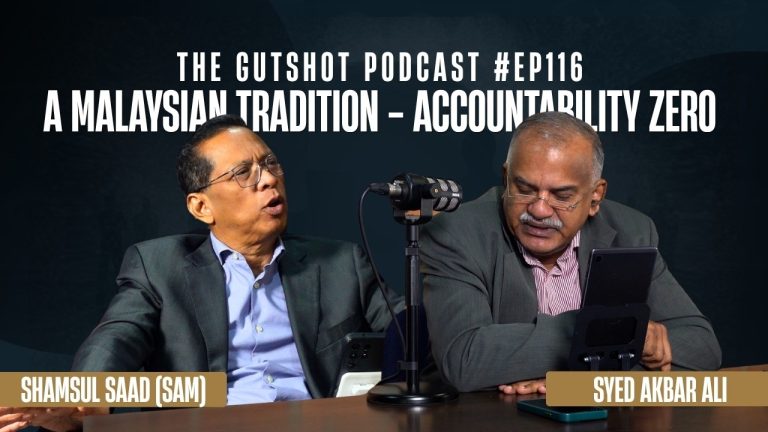
Ep 116 w Syed Akbar: Zero Accountability – A Malaysian Tradition
This week on Gutshot, the conversation moves into something more fundamental.. We will talk about a norm that has almost become an accepted culture in Malaysian – Zero Accountability. By people who are in charge, by people who sould be responsible – no matter what the screw up, mess or scandal.
This is a pattern that shows up again and again in Malaysia — Zero accountability, regardless of who's in charge or what has gone wrong. We will examine this closely, looking at how it plays out across multiple issues (aka problems and wrongdoings), scandals and everyday mess ups. And why public apathy or "this is not my problem" has become the safe passage for the people who should be held responsible or liable when things fail disastrously.
We trace where this culture comes from, why it's tolerated, and what it costs us over time — not just in politics, but in health, work and personal damages, where the avoidance of ownership (aka Zero Accountability) have become halal excuses for not solving problems. Accountability has become such a rare commodity. How do we change this? Or do we want to change at all? Murders, disappearences, our children exposed to sexual molest in schools, food poisoning at an industrial scale and at increasing frequency. And yet no carpet is small enough to sweep it under. Just cover everything up.
Let's dive into the topic because We Have a Country to Save.
Jump to chapter 7 chapters
- 0:00 A Malaysian Tradition of Zero Accountability
- 4:18 Negligence and Abuse in the School System
- 11:10 Fatal Food Poisoning Outbreaks and Manslaughter
- 17:22 Institutional Cover-Ups and the Tidak Apa Mindset
- 20:15 Public Tragedies Swept Under SOP Excuses
- 30:25 The RM36M Taxpayer Cost of Pastor Koh's Case
- 38:58 Fixing the System and Demanding Restitution
Auto-generated from YouTube captions. Timestamps link to the video.
There a lot of cases. So you see this is not a case where the teacher I mean teachers also make mistakes. For example, teachers punting class they don't come to class or teacher might be abusive to a child or something like that. Okay fine. Uh those things happen but this is more or less rape sodomy. We haven't even talked about in the religious uh religious schools yet. This is this is serious crime. You know even the allegation of these kind of things has to be taken very uh you have to take take it seriously because children are involved. Ladies and gentlemen, welcome back to
the guide short podcast. Uh today Sai and I is going to discuss another Malaysian tradition something that binds our political class across every divide which is lack of accountability but it's just not the political class. So I think you're going to find this very interesting. Every year like clockwork, the auditor general and even our media rolls out reports detailing billions of ringit down the drain, overbudget projects, inflated procurement and dodgy deals. And what happens? There will be a few headlines and everybody moves on. Now we've got uh a few thesis out here and a few
commentary that I think we want to share with you guys. say um let's uh let's start the ball rolling um on your side. I think this perspective that we've been talking about u the one that uh we want to mention I think this is going to be very interesting. Okay. Shall you start brother? Good morning. Yeah. Uh well there are there are two parts uh to this discussion. uh one of the big things that you mentioned the losses in billions every year the auditor general's report basically this has got through with governance and uh the people in power uh I also want to
flag other issues uh we're talking about accountability right or rather the lack of accountability accountability so I'd like to I'd like to quote some real examples of things that have happened in the country um criminal cases uh wrongdoings in our school system you know like children being subjected to molest and things like that you know and uh what has happened or has not happened after that how we handle such cases now yes so uh it it boils down to a lack of uh accountability insufficient so here I'm giving a public perspective right uh this is But I consider myself an
ordinary person. You're an ordinary person. Ordinary. We all politician. How how we perceive things. Yeah. And uh whether how we perceive things matters or not. I think for a long time uh how we perceive things, how the public perceives things did not matter. Nobody cared until uh they started losing elections in 2000, 208. And form accountability and 2022. Yeah. I mean ultimately for the politicians the elections are the final test of accountability. You mess up the people will not vote for you. But strangely despite having lost elections are losing elections. Now is the season
of for all politicians losing power. They get kicked out. Uh the accountability is still not there. Like they don't seem to care. So what the public says how what how the public perceives things uh it just like pouring water on the duck's back you know uh so there are certain issues I'd like to highlight which is from the past actually but there's still an overhang I'll give you an example I let's go to the example right yeah I like this um you know I like this cases which involve people directly let's talk about the schooling the school system and the all too frequent cases where our
school children are getting abused uh including they suffer more less and all kinds of negative things in the school and how the schools handle these things. The latest case just recently there was a girl she was 11 years old. She is a heart patient or she was cuz she died. Uh she was a heart patient. I think she's 11 years old and the school knows she's a heart patient and she had I mean the school had been informed. They have medical letters from the doctor stuff like that. So she she should not participate or she could not participate in physical activities and things like
this is not a child reported like 2 days ago. This this is a child who was really not well and yet there was a teacher who basically made her run in the their you know their their athletic activities or sports activities and she collapsed and then she was taken to the hospital. She was in hospital for a few days and then she she passed away. Yeah. So uh then what happens uh uh then we hear that uh the teacher has been transferred. Yeah. Uh that's it. Uh so what other action are we going to take? Then they'll go like uh we'll have a committee to investigate. I don't know
what they will do. But to me these kind of things all requires immediate and more uh you have to be more uh the action has to be more relevant and uh what we say in Malay sap with what has happened a life has been lost and uh to if you ask me this is it's not just negligence it is you know negligence you have gross negligence you also have criminal negligence So these are the kinds of things you're looking at and the action should be uh commensurate. The action taken against the teacher should be commensurate with what has happened. The child has died you know and this can even be called
manslaughter. You know man oh I was just about to go there. Manslaughter is causing somebody's death without any any bad any bad intention but it is still manslaughter. So but what happens they get transferred. So you have other cases. I' I've got a whole stream of cases of transfers of transfers. Uh you see uh school teacher molest students langu a school teacher accused of molesting was transferred after it was discovered students have been molested. Uh the teacher in question was first sent to a district education office while being investigated. Uh then police
subsequently determined there was no case. teacher was transferred to another school to continue working. So okay maybe the teacher was cleared of this charge but you see sometimes if you don't have when police investigate they may not be able to find evidence which is which can be presented in the court you know what the lawyers call cogent evidence it's not enough to to bring the fellow to court you know the case but it doesn't mean that you know that this case is above suspicion so when when something like that happen what is what is the our SOP in our education system to handle cases like
this because if you transfer them from here to there uh because there was not enough evidence for whatever happened in one place. Let me let me say it then then he might just do the same thing over again. You send me a an example also of a primary school teacher in Masai Joho accused of engaging in sexual act with the people. He returned to teaching duties despite multiple reports over the case and reported to the police as well, education authority, public complaints bureau since a year before and then the teacher was reassigned temporarily before later returning to active teaching duties.
So, so this is like an ongoing story. There a lot of cases. So you see this is not a case where the teacher I mean teachers also make mistakes for example teachers punting class they don't come to class or teacher might be abusive to a child or something like that okay fine uh those things happen but this is more or less rape sodomy we haven't even talked about in the religious uh religious schools yet this is this is serious crime you know even the allegation of these kind of things has to be taken very uh you have to take take it seriously because children are involved.
Okay. Say I have I have uh I have a theory why this happened. Okay. But I want to hear from you first. Why do you think this keep on happening? It's like you know uh it's like sweeping it under the carpet type of thing and then hopefully people forget about it. And the problem is just moving around the problem from one school to another. Why do you I the way the way I look at it. This is the the exactly what you say sweeping things under the carpet and the people in the hierarchy of responsibility you know in the school the government whatever I mean this is
an embarrassing thing isn't it one of your colleagues or one of your teachers suddenly is misbehaving I mean committing crimes against children so of course nobody wants to acknowledge that this thing has happened under their watch so they try to maybe you know hopefully like close their eyes or and hope that maybe people forget and things will go away. That is a that that is attitude that is a problem. I think this attitude has to be we have to get rid of this kind of thinking and and uh force those in uh in authority those who have the responsibility to be accountable.
You must take the bull by the horns when things go wrong. But in our country, in our society, there is like continuous non-stop. Uh no, I'm not I I am I'm not at fault. It's not my fault. It's the other person's fault. Or even if it's my fault, I will never acknowledge it. This this is the attitude that we have. So this is this is an example. There are many other cases in these schools, you know, and uh I I have other examples, you know. For example, the other one is food poisoning. Okay, go ahead. But it's uh it's sometimes it is like an epidemic proportion. Every once in a while you
hear of food poisoning cases in the country especially in the uh schools like scholar Asama and some of the sometimes it happens in higher institutions of learning where where students end up eating food that is tainted food poisoning and uh they get sick and and and it it also has caused uh death. Uh there was a case some some time ago long time ago when I first met you I think about 20 years ago in Kada you know there was a wedding and the caterer had prepared food which had gone bad and 10 people died you know so no one was held accountable not a single
person was arrested or as we discussed just now charged with manslaughter 10 people is a it's a massacre 10 people died imagine Imagine, okay, I have no intention to kill somebody. I drive a car. I I I know I had a case on one of my companies before a staff was driving a car. He had no intention to kill uh the mo the the the the police outrider, okay, that actually slid down and he could not avoid and he was charged for with manslaughter. I mean, that's the right way. If you cause if you cause death you know I it doesn't matter wherever even food poisoning or whatever if a human life
has been lost that is serious. Yeah and the reason was because they uh they find that certain way in which he was driving is negligent. Okay. So that's a question like what you so the word is negligent there must be negligence somewhere. So shouldn't someone be held accountable for doing for acting negligently which caused somebody else to die? Well there are two issues here say first I would consider what is the cultural issue involved or the systemic problem involved within the society and within the uh administrative authority that does not take action for accountability.
That's one. Okay. The second part is um is about um why uh after that why does this continue you know and keep on going on and never taken to task. I have this theory tell me whether you think you agree or disagree. Okay. It reminded me when you tell me the story about uh sexual abuse. Okay. in schools. Actually, it very much reminded me this the the the the case when um uh there was a huge scandal in the Catholic diosis in America uh where the priests were abusing. They faced up to it. Yeah. But it took a long time. It took a long time. It took it took decades.
I think it took centuries. But they faced up to it. It took at least in modern times actually it took decades until the until one of the newspaper actually really broke the story and did a vet investigation and they found that they found that nobody wants to talk about it. Okay. And I think when I look at the similarity, what I find is soiety right in we have this uh we have this uh tradition of Okay. This word Yeah. uh or in the in the word is do not in the the the have a saying for this don't let your side down. Yeah. But this is more like you you are not supposed to make your race or
which will embarrass you embarrass your whatever your own kind your own kind. So that that could be part of it but uh we have to overcome all this because uh this is uh because if you don't if you don't take action serious action you don't hold people accountable it will continue you see I want to you also transfer the problem from one place to another place that's all I I want to go back to the food poisoning I did some research on this there it it goes back years you know it goes back as early as from 2015 to to This year 2020, last year 2025, every year you know you have a case
somebody dies of uh food poisoning. Uh 2015 in Sabah, one woman died after eating nasi lama and noodles. And then the next year, Batugaja in Perah, one woman died, 102 people treated after uh suspected insecticide contamination. 2018 Balina, two people died after eating contaminated Laka. And it goes on 2020 one woman died 99 were were admitted and treated. So it is it continues you know because there is no major action taken against people for negligence when things like this happen. I'm talking about the people who prepare the food. I mean food is a huge
industry. We have to eat three times a day you know. So obviously uh it is okay if they serve food that is unhygienic and causes uh sickness and death because ultimately uh they I I do not know if these people even paid any compensation. They don't suffer any negative effect of their basically their negligence. So uh now this is this is part of the of the larger attitude of tida in the country which what is what you are saying which is part of that uh let's not embarrass you know our our own kind things like that's one thing that's not embarrassing it's not and it's not it's not well to
be fair it is not unique to any one race or one religion I agree with you you know it is just that there's this attitude of that you know something like that. So they sweep things under the carpet and then and then they they are institutional actors. One of the institutional actors does something wrong instead of you know bringing out the case and exposing it and repairing the situation. They all gather around and help it out to cover it up. Otherwise our institution our institution will get embarrassed you know. No otherwise our institution will get a bad name.
A bad name. Okay, I as the head of the institution is probably going to get demoted or something like that, you know. Um, so everybody becomes part and parcel of the cover up. It's very bad. And uh the problem is I at the end of the day it's our fault because we don't kick up uh fast. the Malaysian public, they might make noise for a day or two. After that, things are back to normal. We don't there's no follow through. We don't really kick up a fuss. So, when things like this happen, people also are aware that, you know, give it a couple of days, it'll blow over. That kind of
thing. You know, the Malaysian public, you know, our society as a whole, we do not we don't demonstrate in the streets if 10 people died, you know, at a at a kanduri. Nobody goes and protests you know uh it's not it's not our culture but it's serious you know when you cause this kind of death or this kind of damage to people it's very it's very serious but say don't you think that actually um uh our own laws I mean talk about we have enough laws we have no no what I mean is that the laws that we have we did the other episode when we talk about laws that silence us. Okay, there are laws that
you know gatherings you cannot have more than what five people. All right, and then you have to have police permit. You have to and then if you say something or do something, you may end up with a sedition actuh placed on you. So it actually has a chilling effect on society. people are overall people are frightened to speak. Yeah. Then you see I have a few of other cases um where we do not well as a member of the public we do not know really what happened after this disastrous events uh took place. For example, do you remember a few years back somebody drowned? There was heavy rain.
And there was some flooding and somebody drowned. Bomba. Somebody drowned. Yes. And then the Bomba people went to to retrieve the body and they all died and six Bomba rescue personnel got into the water, you know, holding on to ropes and whatever and the six of them drowned and apparently according it was a they were instructed against their own again against their own company advice to their super super company superiors. that that was a dangerous thing to do. And then it was reported in the media. I mean media report I I I'm just referring to what is in the media report. A media
report is not a forensic report. But in the media it was reported somebody saying they followed SOP. Yeah. Standard operating procedure. That means it's okay. We follow the SOP. Six die. Never mind. Uh and then uh what happened after that? Was there any did someone I I suppose there must have been some compensation paid to the families of the six people who died but surely bring them back it doesn't bring them back but you see to make sure that such things do not happen you have to take accountability accountability punitive action somebody messed up you see uh said when I heard about that
particular case uh I said the guy has already died Okay. You cannot you you I the situation was still dangerous. What are you doing sending people down there in a dangerous situation still when the flood could is going to stop anyway? They they uh there was somebody messed up very badly. Yeah. But that's what I'm trying to say here. There's no accountability. What was done? Was there any disciplinary action taken? Was there we heard nothing about it. Was was someone transferred out? Did they transfer somebody out? What happened? So we do not take sufficient action when
disasters like this happen. So it it overall it reflects this tida attitude in the entire society. We've already we've talked about the school the school uh cases in schools. We've talked about people dying because of food poisoning and then the six bomba people died. Now it seems like very pervasive you know nothing happens. You you know I I I just thought about something if you don't mind. I I I brought this up 3 years ago when it happened. I think it was 3 years ago or four years ago when it happened. There was a private jet that came down like a rock. Okay. Uh yeah, I remember that case.
You remember that case? Somebody Yeah. Well-known people, some well-known so-cal right. And then the civil aviation uh so said that you know investigation is going to be carried out. We will tell the public. Nobody has heard anything about it. Okay. And every day, you know what my wife's favorite uh hobby is? When I come home, she's watching all these airline disasters for the YouTube video, right? You know, and every airline disaster is so meticulously publicized in terms of investigation. This one zero. Why? Okay. So, let's move on. Yeah. I have I have I have two more two more examples.
I remember this because uh what happened was uh basically negligence. uh there was uh there was a construction site in KL it's along Jalan Bangsa now now the project has been completed for a while I mean it's a successful project it's a successful project now you know uh very well done but during the construction phase there was a pedestrian bridge which was built as part of this project and the pedestrian bridge collapsed collapsed and I think four people died you know four workers died again no one was held accountable you know for what happened you know I uh it is a private company
but uh later it came out in the media that the reason for the collapse it was a pedestrian bridge under construction and uh you know there are vertical columns to hold up the bridge so then you have the horizontal beam the horizontal beam set on the edge of the the top of the vertical column. You understand? So, so it crumble you know by right there should have been it should have gone all the way through and like set perpendicular you know above the beam. So there were there some people call it a design error but it was under construction. It was well there was there obviously there was
some negligence there. the the lip the edge of the the thing cracked or crumbled and bottom line is at the end of the day the thing fell down and killed more people again who was held accountable was there anyone you know charged with negligent behavior or you know I'm sure they must have paid some compensation to the workers who died but as you said earlier the guy's already dead you see compensation does not bring him back to life uh there was negligence obviously but We as you say just now what happened after that? Did we hear anything? And then there was another caseuh this was also
some years ago there was a dam somewhere. Mhm. And uh one day because of heavy rain, the dam suddenly released water, you know, through the floodgates, right? Because the water level was high, right? They suddenly released the floodgate, opened the floodgate and water went rushing downream. Mhm. And it drowned some people in that area, some orangasti actually. Again, I think the number was about four people died downstream. So uh this was very very uh irresponsible behavior because I mean you're operating a dam. Mhm. You'll have all the figures and charts
and data and statistics isn't it? If the water level is so high and you open the floodgates, you will know how much volume of water is going to go down that that river downstream. Surely you must have a a mechanism to warn people downstream or you know if there's so much water coming for sure you will know that there's orangasi village or people living by the river you should know it's your business you're operating the dam but it caused people to dieh this was a really negligent behavior again I'm sure they must have paid some compensation or something for the people who died
but more importantly know was anyone someone held accountable uh legally liable for this kind of behavior which caused uh people to lose their lives. Again we have not heard any we that's it we have not heard anything about this case beyond that line you know and uh sadly also in our country uh well ordinary people they they do not we are not in the habit of suing others you know for wrongdoing. The suing culture is not part of our culture. And of course, we have ordinary people. They may not have access to, you know, to lawyers and they may not have the capacity to engage lawyers to to uh sue
for the losses they have suffered. So ultimately these things just like go away. They disappear. Until the next disaster happens. It's it's actually mindboggling to hear all these cases to be honest. I'm I'm like um it's be it's a it's a culture of not accepting uh that there is a problem. It's a culture of not uh demanding accountability or uh pushing through to ensure that accountability is is uh is is is implemented or or or happens. you know, it runs through um the government agencies involved, the people who are actually um implementing this
guilt. There must be guard rails in the institutions, right? Whether it's education system, whether it's health ministry, when you talk about um when you talk about food poisoning issues, okay? And then when you talk about um uh civil safety, these are all institutional props, institutional uh issues and society. The boys gather together uh to uh to prevent uh one of their own from you know suffering our solution too much negative attention. No, we the people the people and the public has to learn to exert um you have to demand for uh restitution uh not not retribution uh
restitution making things right and then we must insist that there must be action taken uh especially when human life is is is uh concerned people lose their lives or suffer serious injury uh there must be action taken it must be punitive action. Somebody has to pay for it. Somebody must be held accountable, responsible and he found that you know they have been you know their conduct has caused this kind of uh deaths and injury they must there must be punitive action. I mean according to the law we have enough laws for all this action must be taken. You see then the other
thing is that okay there's a cost on this to the families and the people who have lost who lose lives or who lose their limbs arms and legs or whatever because of other people's negligence. Then you also have the cost on the taxpayer you know on earth you know so the the the the case now that is still current and running at 10,000 ringit a day is the pastor co case you know the pastor co case and am and some other mention this at least three or four times it it still has not been resolved so you see in uh pastor co he disappeared on 13th February 207 so what
over 9 years already. Yeah. And uh I think the family sued, isn't it? The family sued um I don't know who the well the government and uh the family won an action in the high court uh last year 5th November 2025. The high court held that the police and government were liable for Pastor Co's disappearance. So the court ordered that the family be paid 10,000 ringit per day. Yeah. Yeah. Uh beginning from the day he disappeared 13th February 2017. And this must be paid until his whereabouts are disclosed are found. Yeah. And then they've also the court also awarded 1 million ringgit general
damages and 1 million ringit exemplary damages. So this one I did some calculation through Google. Mhm. From 13th February 2017 uh until today, today is 4th September 2026. Uh there are 3,491 days have gone by. So 3,491 days times 10,000 ringit is 34,910,000 ringit of public funds. We have to pay the family, you I mean this is what the court has ordered. Uh and then you must add the 2 million in general general and exemplary damages. So total is 36.91 million as of today. By end of today another 10,000 ringit tomorrow. I here's the here's the interesting part
actually I thought they went on the government went on appeal and they so the government the government appealed the thing. So they obtained a stay of execution only from the high court. Mhm. They did not the the ruling was not overturned. They just uh the government obtained a state of execution meaning that they don't have to pay the cash straight away to the family. It is still being calculated and I think the funds are being kept in the amaraya or something like that. Is it like on escrow or something like that? Something like that. So, uh, the the government is still liable to
pay the 10,000 ringgit per day, but they did not pay out pay out yet until the the appeal or the thing is fully resolved. No, I think they're still appealing it. So, but the the the higher court did not overturn the award. The award is still there. So you see now this public funds now we have to pay you know the public is money and taxpayers money is is required to pay off these damages. M uh I mean if the government has been held negligible they have to pay but they're paying using taxpayers funds right now the thing is has anyone been held accountable for the disappearance of pastor co I
mean if you if you're paying so many millions of compensation surely you can be able to identify who was responsible for this thing happening you get what I'm saying or not so so that is a portion That is the part that is glaring. So the disappearance is there, the money compensation is there, the in between one step is missing. Who are the people who are who are responsible or held accountable for this? Somebody must be held accountable otherwise how come we end up you know we the public funds and the government is liable now for so much of damages. say I um I have very high respect for our
uh our PDRM to be honest you know in terms of their capability it's actually it's actually untrue if people think our PDRM are not good at what they do right I mean uh we found out we found out uh who murdered Alatuna you know so if you tell me with CCTV V in in broad daylight that the PDRM or the government cannot assertain what truly happened. It's very hard for me to believe. So um I'm making a you know it's a it is it's an opinion of mine you know and uh I think it's it's a it's a stain on the uh on the moral
obligation of our society that we don't hold our government accountable government of the day. We don't hold the people involved in this we hold do not hold them accountable. Yeah. You see if let's say let's talk about within the government system the civil service the uniform services whatever um when something goes wrong something is done wrongly and it causes damage death injury whatever there should be disciplinary action there should be reprimand suspension demotion or removal dismissal has any of this In all the cases that we have mentioned for example the
I mean it doesn't we don't see this not to my knowledge to your knowledge no the first thing if you ask me right any company if you are a private company and there is an allegation of wrongdoing first thing that happens is actually you are suspended okay whilst an investigation takes place right you're suspended with pay you and until the invest in investigation is completed. Okay. None of that seem to happen. Does that include criminal acts? Um that includes criminal acts. Yeah. I would can I just borrow that idea? I would say that for example like teachers or other other government servants,
civil servants, they are involved in in something criminal like uh like um moles cases or cases that cause death, they should be suspended without pay if you ask me. Well, I mean I until the investigation is complete, I think. Then if they're clear, they can get their salary back. Back dated. Backdated. Otherwise, uh that's it. Well, I I I I do have this uh this this strong opinion about innocent until proven guilty. Um so I'm not too much into the idea of suspension um uh without pay but in the private sector I mean we do suspend people with pay and then when we do the investigation and
then we hold our our uh what do you call our domestic inquiry and that that domestic inquiry we try to get the domestic inquiry as fast as we can because as they say um uh what do they say justice delay is justice denied denied. Right? So you do the your domestic equity and you either have that person dismissed or you retain the person. Now if that's a criminal case then you hand it over to the to the cops. So so for the the civil service and when you handle it over to courts that's when actually the pay is suspended. So for the civil servants and those who are in the government services
uh it's a comfort isn't it you know that okay I have screwed up what's going to happen to you uh if I have screwed up but the government if there's any compensation to be paid the government will take care of it and then um I may or may not get some action taken there most likely not no action taken against me so life just goes on you know there is no SOP of taking serious action against the the the the person uh the individual the against a person directly who was who caused a negligence or who caused that event to take place where people suffered loss of life and things like that
so uh we don't fix the system it keeps recurring and going around again and again the SOPs are to me they are weak like they say is I don't think the SOP is weak I have a gut feeling the SOP is not weak. I have a gut feeling the system is there. You know, we have always had good laws, good procedures, but it doesn't get implemented. It boils down to leadership of the people who wants to implement it or the leadership decides that it is better for me to cover up so that it doesn't damage the institution or my reputation. I think that's the problem. And I I mean there were cases where the
teacher picked up uh like say the students uh pencil box or or pen and threw it against the wall or threw it out the door for whatever reason. These kind of cases happen but molest and rape and all these kind of things are serious you know. Yeah. I don't think you just like, oh okay, let's transfer the teacher to another school. Uh, that is wrong. It should be immediate suspension until the whole thing is fully cleared. Yeah. You know, you don't transfer the teacher to another school. And I mean, what if the guy is a real predator? Obviously, he's going to do it again.
So um the the culture of accountability, the count the the culture of not only being held accountable but more importantly and the culture of us holding wrongdoers accountable that part is lacking. It is we and the people who don't push for this too hard. We are kind of tapala that kind of thing you know that's attitude. So that's why these things happen again and again and recurring you know because we the society as a whole we don't we don't seem to treat it uh as as something that requires urgency or that it is it is something that is you know major you know the Malay word is we do not we
we take it lightly this is our problem. So I I hope uh you know what you know what I mean before we end this I have this thought actually right let's say let's say this uh this incident happened in some ad constituency all right your job as the uh uh the state assembly man is to be responsible for your constituent and your constituency. Okay, I would put it that the people who are elected representative of that area must be the one who take that to to task and actually the people in that constituent should demand that he take he or she take it to task. Yeah. The elected reps should play a
major part. This happens in the in the US people the the congressman you know. Yeah. And and they have town halls. Yeah. They always are very much in touch with their people. Yeah. So if someone's child dies, you know, in school or gets raped, it's a big deal. It's a big deal. Yeah. The whole community is is uh they organize their resources, you know, and they assemble their people and the town halls and like that and they demand for action to be taken. We need that here. We need that culture. Of course, here the other issue is uh what is a race and religion of the victim. Oh my god.
All those things come in. It's a factor. So Malaysians need to overcome all that. We have to rise beyond that and uh when something goes wrong, we should all of us should stand up and speak with one voice, you know, and ask for restitution, you know, punishing people who have done wrong, that kind of thing. to talk about that culture actually I mean there's also the culture of actually the constituent writing and sending emails and calling their their representative you know about all this kind of issue and then when the town hall comes they get bombarded
this is it is important to mobilize the people we have to raise uh the awareness has to be be increased we have to become more aware of what needs to be done but more importantly Uh I hope the Malaysian public should understand that we have to move things. Don't expect the politicians to demand of them. We have to demand we have to put it down these this these issues have to be resolved you know. So we need answers for this. Oh, take as the last point. I want to make this point because why I every time you touch this issue of amad uh pastor co I I mean I I I it breaks my
heart until today to think about you know how Indra Gandhi has been treated with respect to her children. It is just it if you tell me that our police cannot locate I think that that that says a lot about uh the incapability of our our our police force which I don't think they incapable they are very capable when these cases happened it was a different government so the people who were in opposition at that time some of them did make statements about these cases now the government has changed whatever to those voices, you know. So, I think on on that note,
um I I think you said the right thing. We wrap it up in a sense that, you know, our people need to put our uh our elected rep accountable to bring these issues up, you know, and and mobilize um and demand for accountability. We should keep the conversation going and the public should should uh make it an issue. Don't let these things just go by and get forgotten after one week or two weeks. We have to keep these things alive until we get real answers and real action is taken. Okay. Thank you so much. Okay. Thank you. Uh hope to see you all again. Take care. Bye.