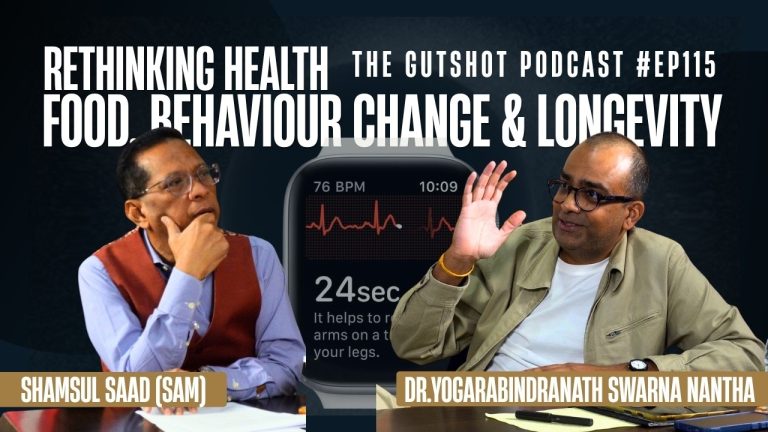
Rethinking Health – The Full Circle of Food, Behaviour Change & Longevity,
Show Notes & Description
I have been waiting to have this conversation — a conversation that could launch a revolution in how healthcare is seen in Malaysia.
We are a country in deep health crisis, with obesity, pre-diabetes and diabetes leading the way towards cardiovascular disease and other major illnesses.
Dr Yogarabindranath Swarna Nantha (Dr Rabin) is a seasoned general practitioner, scientist, innovator and thought leader in primary care, with more than two decades of experience spanning preventive health, clinical medicine, health-systems leadership and digital transformation. He led the development of the clinical algorithm handbook Screen, Diagnose, Manage and Monitor, published by Springer Nature in 2025.
Dr Rabin presents a compelling case for systematically navigating our daily lives by implementing targeted wellness initiatives based on healthier lifestyle choices as a way to promote health, prevent disease and support longevity.
The key is behavioural change — unlocking personalized modifications that provide the simplest and most sustainable pathways towards wellness and better health.
And he has the perfect example: my own experience of achieving remission of diabetes and significant improvement in high blood pressure within just seven months, with those improvements sustained for more than five years without prescription medication, at the age of 62. I have never felt better than I did at 45.
Gutshot with the Rabin's Full Circle Wellness is intent on making a difference in the lives of Malaysians — and, in fact, hopefully humanity.
We know what we have can help, especially middle-aged and older people. We believe this approach can offer a powerful new way of thinking about health, wellness and longevity.
This is a mission.
We Have a Country to Save.
Jump to chapter 8 chapters
- 0:00 Malaysia's Silent Non-Communicable Disease Epidemic
- 8:22 Sam's Personal Diabetes Reversal Story
- 21:22 Fasting, Ketosis, and the Science of Satiety
- 35:56 Chemistry Over Calories: Rethinking Insulin Resistance
- 43:51 Tragic Toll on Malaysia's Younger Generation
- 49:47 Preventive Medicine Versus Symptomatic Treatment
- 59:07 Introducing the Full Circle Wellness Framework
- 1:10:27 Collaborating for Public Health Transformation
Auto-generated from YouTube captions. Timestamps link to the video.
Uh we just lost a 27year-old young cousin of mine. I was devastated, right? She was the youngest cousin in the whole family.
Mhm. Okay. And uh kidney failure, right? Yeah. Yeah. 27 years old, guys. M and I've been seeing this more and more uh when I visited hospitals.
Yep. You know, so this is an epidemic. It is. It is. You know, I don't know why they talking about COVID, you know, the last bloody uh 20 23 years or whatever it is, right? I feel like dumping Dr. Fouchi into the into a well, right? You know,
without further ado, ladies and gentlemen, our special guest here. This is going to be a mouthful, guys. So, let me read this. Dr. Yogara swarn Dr. Rabin. Shall I call you Dr. Rabin?
Yes, please do. Okay. Or Rabin, whichever you like. Just just call me Rabin. Just call me. Okay. Whichever we we feel comfortable. Yeah. Okay. Um let's uh let's start this conversation in this way. Um I think doc I think one of the biggest uh thing that um uh when I read the medical literature and I personally went through that
um is the the the the rapid rise of uh obesity and diabetes type two in our population. In fact we are one of the highest in the world. Um maybe we get our viewers to understand just what we are facing. How what's our population uh like in terms of uh infe uh this uh disease that is uh infecting our population currently.
Okay. If we were to speak, I think when when when we are talking about diabetes and obesity, especially if you're talking about diabetes, it encompasses a set of other diseases as well, right? So these diseases as a whole, they're called non-communicable diseases because they are inseparable from from the many different metabolic processes. Let's call this a metabolic disease of some sort.
Okay. So when we are talking about diabetes alone Uhhuh. uh which gives a very good idea about what all these metabolic diseases are. Mhm. So if you're talking about diabetes, the state of uh affairs when it comes to diabetes in Malaysia is quite appalling to be to be honest. Um the trends have if you look at the prevailance or when we say prevailance the trends the roughly these are these are certain statistics that we used to see what are the trends in society when it comes to statistics. So what we have been seeing since 200 I wouldn't say from just 2011
for for for I think if you if you look at historical data there's always been a rise in terms of diabetes and it has always be cl been climbing. So to just give you a little uh snapshot of what what we have looked up here,
if you're looking at 2011, the prevailance for diabetes uh stood at 11.2%. Okay. And this has been steadily growing throughout the years right up to 2019 it was already 18.3.
Okay. So mind you these these are very subtle movements in terms of numbers but they if you look at these numbers in terms of percentage and also look at the number of people living in the population is quite staggering in terms of
yeah because we have a growth of population as well. Exactly. Okay. So the percentage do not reflect absolute numbers. Correct. So the absolute numbers might skyrocket. So what are we looking at at 20 in 2025? 2025 um purported we we are gathering these data. Let's just for for for for context for for all all the audience uh there has been a a program where the the government has been collecting and observing uh metabolic diseases and non-communicable diseases and this is called the national uh health and mobility survey or to to and acronym that's usually used is NHMS.
Okay. So the years that this survey has been going on has been uh 2011, 2015, 2019, 2023 and the trend in 2025 as we can see there there was a it shows that is now at 39.1% but with one cave caveat.
Okay. So the caveat it seems that the 39.1% seems to been um calculated from a set of people above 60. So if you if you if you see that that is 36.1 then you'll be asking me the question why the sudden jump from before and there such a huge jump. Could it just be because we are looking at uh people above the age of 60 compared to the previous um the previous studies that were done which was a broad
right a broad estimation but I I I I would I think the the most easiest way to to understand this whether it's real or not uh if you look at the statistics for OBC though remember at the beginning of our talk I mentioned that these are all these diseases metabolic.
So if you have people having obesity by default they should also have uh I mean if they have obesity they should have diabetes diabetes. So that data for 2025 stands at let me just quickly look here obesity alone uh it stands at 21.8 8 which has been is is is higher than usual
right so I think the 38.9% that has has been mentioned before although it comes from a subset of people with living above the age of 60 but the obvious obviously trend seem to suggest that it's just the tip of the iceberg probably in the populations even higher
okay we wouldn't know having said that let me just let me pull you a statistic that I personally have come up with. Okay. Okay. That uh for 2024 adults 20 to 79
um where we have an estimated 4.75 million. So I'm going to give it's basically absolute number. Yep. 4.75 million people with diabetes. Um that rep between that represents about 21%.
Yep. Okay. Uh on prevailance, we are the fifth highest in the western Pacific region. Exactly. Yeah. Um another statistics that is uh actually more alarming.
Is that uh half of Malaysian adults with diabetes don't know they have it. Yep. Uh and they we and uh they estimate that um approximately up to 2.4 4 million uh are un undiagnosed. Uh so 50.4% are undiagnosed which is extremely alarming.
Yeah. Absolutely. Um so let's get into before let's get into the crux of it. I I want to tell you my own journey. Yep. Please. Yes. Yes. And then maybe we can frame it um with what your research has found and what um is the uh intended uh objective of why we're having this program today. Okay. Uh ladies and gentlemen, hold on a second. Quick time. My dear friends, our metric shows overwhelming number of our viewers are not yet subscribers. appreciate very much those who haven't to subscribe and like our episodes. It does not cost a thing but two seconds to hit the subscribe and like button. It
helps to spread our content further and build this movement to save the country. Thank you so much. Now, back to our episode. Okay, we're back. Um I'm just going to have my Orito coffee. Let's go do let's do with this. Um you know what doc uh about 5 years ago I think approximately 5 years ago um around COVID time just before that I was probably hovering more than uh 92 kilogram for my height of you know I'm a short fellow I know not that high okay so I was a big part what what we what in in in in university in America they call it a tab lot.
All right. So I was I was a really big guys. I was 90 plus and I figured out approximately around actually that time as well that um so I've been like that for a while. uh I had pre-diabetes for quite some time obviously right but I realized I already had symptom of diabetes okay you know the symptoms of diabetes right your skin has got problems
that are very difficult to uh you know um and um uh that that are very difficult to cure right and uh uh the itchiness that causes uh uh redness and also uh then tear apart and then it gets very difficult to heal. Right? So I did some research me being the scient that I am you know uh I dwelt into quite a lot of research into this uh and I I I made a choice once I have understood this disease that um I said hey this can be reversed you know and I I made a personal choice of actually um cutting all my sugar cont sugar content um whether it's from food or from um
uh what do you call this uh bhat you know fruits uh I cut all my carbs because as a chemical as a chemist uh carbs are just simple glucose you know what most people don't understand is actually um table sugar is actually uh fructose, you know, which comes from um sugar cane, you know, but but they don't realize that glucose has got uh is actually not uh not sweet because cups are not sweet.
Yeah. So, I decided to to go on a you know on on a cold turkey and you know what happened in about uh my friends were telling me I didn't realize it. I was just trying to reverse the diabetes
and uh trying to uh uh tackle this disease because I was scared. My dad uh had my late dad had kidney failure right um and had to go on diis. I'm so and I am scared of needles right. So then in 3 months actually my friends were saying to me I was losing weight. So in 3 months actually I lost 17 kilo right. All in all um by the time I finished my whole regime in 8 months probably 7 to 8 months I think I lost about 25 kilo. So I'm currently um maintaining for the last 5 years um about at about 65 uh kilograms. Um and I've been able to maintain it and sustain it just on uh
application of this and I did one thing the variable was I only changed my food or diet. I did not do any exercise whatsoever because as a scientist my thinking is I will cut I will change one variable and one variable only. Right? So now I'm trying to do a bit more exercise in terms of muscle beating. But you know what I found out and my friends told me I said when uh in my fourth or fifth month
you're doing uh the keto diet they call it right. Okay. I was like what the hell is that? Okay. So I didn't even know it. So basically when you talk about metabolic disease
right that's basically it because uh metabolic has got something to do with basically how our body take uh the intake of food
um and generate energy and convert it into energy that's metabolism am I right yep yep that's you're you're right in some in some ways so that's that's my story now um I mean it's My question is to you
then from your experience where where do you think we should be going um you know and in terms of I guess the kind of food that we have today uh the kind of food that our culture presents itself even before even in the early days
right um where do we go from here that you see um how we should take for our viewers to see where the problem lies and uh what steps are necessary. I I leave it to you.
Yeah. To to tell this story. I know I I I want to insert a personal thing so that we have a we we have a reality based conversation. Correct. Yeah. So I think Sam first of all thank you very much for sharing your your own experience and I think there's a lot of meaningful things that can be drawn from from your own experience. After all lived experience uh is exactly what you're looking for in in in in you're not trying to box everyone into a single template but you also need to understand what is the life experience like in your case what worked for you.
Yeah that is I think extremely important. So I think thank you very much for sharing and then it gives it gives uh not only me me but also um the audience a little bit more context as to what we're discussing.
I was just about to say context. Yeah. Yeah. It gives the context right because people will be wondering is this actually real and you are the case study here. I I'm I'm basically the case study. In fact actually just to end that story
uh I've stopped all um uh all prescription drugs. Uh, I'm not on statin. My BP has has been uh has been as healthy as I've ever been uh without taking any prescription D
compared to even taking prescription D. Yeah. My BP is like, you know, 120 over 70 plus. Yep. Yep. Yeah. Which I've never seen before. Yep.
You know. Yep. Um my blood work is great. Yeah. U there is a caveat to that which I'll come to later but you know I do steog for my this one and for my uh to to thoroughly check whether there's any blockages and what not.
Yep. I'm perfectly fine and I've been on this for a long time. Correct. Yeah. which is basically I've replaced all the carbs with proteinbased animal protein with loads of fats and a lot of eggs.
Yeah. Yeah. I I think in your situation it's very interesting to see a few things here. I've been jotting down feverishly what you have been saying because there a lot of interesting gems in what you have said a lot of interesting things as to why this worked for you.
Yeah. Um I think the the one the the single most important thing that we we we need to talk here is about how subtle the symptoms of diabetes can be. It's so subtle for and for the most part people just ignore it because probably they could attribute that to anything that is uh that can be very too subtle for them to even pay much attention. like in your case you actually took
got that awareness to like oh maybe there's some kind of itchiness maybe it could be it it could be nothing but at the very least I mean if you looked at your the way you live and you thought that diet would work I think the willingness to to to look at yourself honestly and what can be done for yourself I think that's a very very interesting perspective and then that made you have this conscious effort of trying to eliminate certain things that were probably overburdening your body in your case food.
Yeah. Yeah. So food as you said um refined sugar right refined sugar is something that is like you getting an overdose of sugar is literally I think in some cases right if you if you were to take normal sugars like calories don't really taste that sweet right um refined sugars basically like receiving an overdose of sugar in fact if you actually look at the I think we we we will talk about this I think in a bit but but just to to tell you something about this. If you were to look at statistics that has been done in Malaysia, uh there was something in the past before even this
um NHMS study that we are talking about, right? Many I think it was way back then probably in the early 2010s if I'm not mistaken. Uh the the government actually ran a very interesting uh survey. It's called the Malaysian Adult Nutritional Survey. Was so interesting. So interesting only because it highlights what exactly Malaysian people the average Malaysian people that been that has been out there what have they been eating how many glasses of tare and you you know for sure that in tare you have a lot of condensed milk in that in itself is refined sugar. So they actually painted
a very green picture from that point onwards, right? And uh it shows how the Malaysian society has been literally drinking and taking in a lot of refined sugar without them knowing or unknowingly uh thinking that it's not refined. It's not white sugar, but it's actually refined sugar. So I think that is something that we'll talk about in a bit. Um and in your case you mentioned also that you use food and then when you eliminated certain types of food in from your diet and then you experienced uh some amount I would say it's I wouldn't say the the weight loss that you
experience is um uh an extreme an extreme version of what people should should should experience but it did allow you to lose weight in a very staggered manner. It wasn't extreme
throughout the month, right? Yeah. Throughout each month, you were But it was quite quick relatively speaking. Absolutely. Yeah. And without exercise. Yes. That's that's the interesting thing here, right? Yeah. That even without exercise.
Yeah. Uh by just as you said, I I I find it fascinating when you said like you you want to look at one variable and see if it works. So if you took just imagine in yourself, you just took the food variable into consideration.
Yeah. and you worked it to the bones and then what you found out your diet actually is not not not in a way very extreme. It it can many people can actually do it is sustainable somewhat and probably that actually you intervened I I would I would dare say that probably why it worked for you in all honesty was because you were you actually intervened at the very most opportune time. In some people when they have crossed the rubicon crossed the threshold into pronounced diabetes
right what happens is that the body tries to adapt you know body is like a living machine right right so when the body adapts and when you have as you mentioned like people have to go for diialysis diialysis
oh that's gone that's what I find out if once you have to go to diialysis you can't do this anymore yeah exactly because I think we should enter way before that. Yeah. So in your case probably your body was still amanable to change.
Yeah. And then you acted accordingly and it did work. You know the funny part is um I forgot to tell to to mention one thing. I did that also in conjunction with uh intermittent fasting.
Yep. Okay. And prolonged fasting because I read this paper on autophagy. Yeah. By this Nobel Prize winner from Japan. Ah okay. Okay. This is very funny. I don't understand why the medical profession does not talk about all this
in large. Yeah. Okay. Because this is this Nobel winner uh from Japan. This is like at least 10 years plus ago. Yeah. You know. Yeah. Um and I I noticed what happened is this
when I I will lose weight I lose weight mostly because number one I'm not adding any more um uh any more fat into visceral fat into my system
right because I'm not taking this processed uh sugar this refined sugar this refined carb this all these carbs and sugar I cut out completely um and my body based on that autophagy paper goes into ketosis.
Yep. Yep. And when I don't eat Y I can go, you know, do I can go Yep. 3 days without eating. Okay. Okay. Y I'm not joking.
Yeah. And I've done that a few times. I've done two days without eating on regular basis. Y and you know what? I don't get brain fog. I don't get tired. I get more energy than I have ever had energy when I was 45.
Okay. And I'm currently 62 years old. Correct. All right. Correct. So the the the the effect is so pronounced that I have uh uh I have recommended this and it has been tried by my uh my cousins, my friend
and the and the funny thing is it is replicated. Yep. You know if I don't want to lose weight and I just want to maintain this weight I I don't do intermittent fasting. Yeah. I just eat but I only eat the type of things I eat.
Okay. So I have I have not had nasi l for 5 years. Okay. I have not had migoring for 5 years. Yeah. Okay. You know those kind of thing out the window. I go to I go to Kuri. I look for uh kaming. Uh so you know I mean from this and what you study
y I've been wanting to have somebody like you for a long time until we met cuz I want to talk about this and I don't want to talk you know without having somebody who is actually perfectly situated y
and actually you are studying this and you want to do something about this and we want to do something about this together. Yeah. Yeah. So I get the heart of this the the issue here is uh when you mentioned right you you you you you looked up about how diets work for you and then in conjunction with food modification it worked for you. The fascinating part is you mentioned that at some point when you when you're done with losing weight you switch to a mode where you kind of uh pursued something called weight maintenance.
Yes. Exactly. That's the right word. Yeah. Yeah. So it's like this is actually the the the usual way how we would want patients to lose weight because we know that if we subject them to in in my my daily consultations as well when we get patients who have morbid obesity or they have really bad obesity and they have poor sugar control when we look at their diet what we would propose is something similar to what you're doing but even out of consultation.
Right? So what we would propose to them is something called low caloric diet. Okay, low caloric diet. What this entails is basically looking at the the your entire diet in a week or in a month and then we get the dietician to sit down and see how we can uh objectively bring down and and make your diet in such in such a way that it allows you to lose weight.
So in some sense you have been doing that on your own. Okay. But even in uh like I I like the the the fact that you you there was a transition from weight loss to to weight maintenance in in in the ways that you managed your your your weight because that is the continue. Um weight loss for for the most part I think we should not do it too long that it as you mentioned it was burning off the fat in your body ketosis. Right.
Right. Yeah. So you we have lot of fat stores and we we we can lose a lot of amount of because that's the that's that's an energy source. Exactly. Yeah. But we don't want it to go beyond some point where it starts eating up your muscles. Right.
Correct. But that's what you did. You stopped at the point where probably uh you felt that your fat reserves have depleted somewhat. Have defleed a lot. A lot. Yes. that that explains the the weight loss and that also would explain why you had some amount of um loss of appetite to a degree. You would didn't want to eat that much. You can go on for days without eating as you mentioned. Was that for
Yes. There's the interesting part about that. It is not a loss of appetite. Yeah. I don't find it as a loss of appetite. Why is it then? I find that uh what happened was actually when I started getting into ketosis.
Yeah. Which took me approximately 3 to 4 days after I went cold turkey. Yep. Right. Um, I find that let's say I have my three eggs and salad and which consists of avocado, tomato and u uh and and green salad and maybe pepper bell, right?
I could go the whole day without eating actually. Yeah. Yeah. I And you know what? I was sorry. Sorry. I I just carry on carry on. I I just tell the the experience for you and our viewers, right?
Yeah. The first time that happened to me, I was puzzled because I felt full. It's not loss of appetite. Exactly. I felt full. Y um and I felt full until midnight.
Y and uh I was telling my wife, I said, "What's wrong with me?" Right. You know, why am I not hungry? Okay. you know, y and I mean I started out like, you know, two meals a day,
right? But then I transition. I could do one meal a day and I'm I'm fine, you know? And I don't it's not loss of appetite. It's basically I'm I'm feeling full. Just don't feel like eating because you're full.
Correct. You know, I I read that there is a hormone that is a satiety hormone. Correct. Correct. Okay. Yes. Exactly. uh that the the the the animal fats, the natural fat that we eat
induces that hormone. Yeah. You know, so if that is true, then that makes sense to me. Y why I don't have any desire because I'm full. How do you eat when you're full? Correct. I I think you you you actually hit the nail on the head because you you actually mentioned the very word that I wanted to bring up,
right? Satiety. Okay. Satiety. So let's speak a little bit about satiety. So I need to rephrase the way I actually uh told you that you you probably has loss of appetite. That is it has a con very pathological connotation to it isn't it? So I think the word that we we we should agree on to use from this point onwards in your case is satiety.
Yeah. So and you mentioned that there are certain hormones these hormones there are two basic hormones that regulates this. This is they are called grein and leptin. Yeah. And leptin.
I read off leptin. Yeah. So, so these are I don't know. Yeah. Klinin grein was I think uh you can actually you can actually take your bloods and evaluate for all this leptin.
So what has happened is by virtue of changing your diet in in some ways you have actually regulated the way the body perceives societ uh satiety. So you have you have hit the reset button in terms of satiety in your body. So you have you you basically hit the brakes in terms of um being more susceptible to taking sugar or any other thing that your body doesn't require. So in the midst of that the body is just trying to recalibrate recompose the way it should eat actually. Uh so it was in some way some ways a rewiring of your satiety center in your head.
Okay. Uh which involves your gran and leptin. Mhm. Um so it's a reset in arguably a reset where you could you took total ownership of your weight. Oh yeah. I took total own that's absolutely the right way to uh to describe.
Yeah. Yeah. You took ownership and then you also know how to shift gears. That was the most fascinating. I feel like is that is the most fascinating part because you you okay if I wanted to lose weight okay I'll put it on you know I didn't talk to any doctors about this you know
yeah yeah I I understand I think probably you're tapped in into what your body wants in some ways and also you were you I I feel that I'm a science guy exactly you know knowledge in some ways um not not only knowledge I suppose the having knowledge doesn't mean that you accept knowledge
in your case I think being coming from a very science background and then you know knowledge you operationalize the knowledge and then you wanted to try out does this work for you. Yeah. And in in your experience in your own lift experience it worked for you
and you said that it when you did replicate this uh this this this small little uh research clinical trial on others. Yes. Yeah. It works. uh one one issue the only my only qu my only qu would be to know when you should transition from weight loss to weight maintenance. I think that that is the okay that is the area that uh I think the gray area here you know because it has to be sustainable. Okay, I tell you how I made it sustainable.
Okay, for me personally and I teach this I also teach this to my uh my cousin and my friend. Yeah, I look at I the first thing I ask them is what are the things they like to eat in terms of raw ingredients.
Okay. Do you like meat? Do you like seafood? Do you like eggs? Do you like what do you like? Right. I say modify your food. Okay. To in to actually just focus on this kind of food.
Yep. Okay. And I love butter. So I cook everything in butter and olive oil because I want to take out the processed uh oils. Yep. Okay. Because from what I read that is also an inflammatory problem that that hits your uh pony arteries. Yep.
Okay. So, you know, and I don't worry about cholesterol whatsoever. So, I'm going to put it out there. Okay. But for sustainability, I realized that I need to find out what exactly I love
that I could incorporate into my diet. So, I like my steaks, I like my eggs, I like my uh butter, cooking with butter. Uh so, I overloaded on everything like that. And when I want to have a uh a change uh in in eating out of steak, I will go for lamb or uh seafood.
Yep. Okay. So, ingredient wise. Yep. Right. Then you cook however you want to cook without sugar and and all that. Right. Uh and carbs. Yep. Then the other thing about sus uh being able to so now I'm replacing what I used to love that was I call it poisoning me okay
the nasi lama the tetare the migoring okay the um you know the ku mu you know even you know I used to drink orange juice every morning
oh that's hazardous exactly And I thought it was healthy. You know what I mean? Right. That was my And even to the point where actually I love uh uh I I I I love fresh milk.
Okay. Um so I would drink fresh milk a lot since I was this is something I got from when I was in college in US. Right. But then when I started there were no sugar the I I went you know full coffee put butter in the coffee and drink.
Yep. Right. Because I want that satiety. Yeah. Okay. Um so I find that is what makes it first of all sustainable uh in terms of losing the weight.
Y okay. But then to maintain it it's very easy to me. Y to maintain it um I just keep eating. If I feel like eating three times, I eat three times. If I want to eat four times, I eat four times. But I eat the thing that that to me is healthy.
Yeah. Right. And my weight does not go up. Yeah. I think in some ways it doesn't go down. It doesn't go up. But it doesn't go up. It doesn't go up. So it's m maintain at a plateau. Yes. It's maintain at a plateau. The thing is it your your satiety is very well controlled because inadvertently if you looked at your diet you're using like healthy unprocessed uh fat which also contains healthy calories
in some ways but it's not overdose of calories but it gives you small doses of caloric butter has calories in it but it's it's not the processed and the dense calories that you that you if you might want that you might find in other uh products that has very high uh refined sugar content. So you are getting some background calories. You are getting it. Um but it's it is not really the dense and how to say that concentrated sugar going into your body.
Doc doc um my research here comes I I I don't want to sound like this because I'm I'm not a but I I I know my chemistry.
Yeah. Right. Go ahead. Um I always ask people this question after I've learned all this right this whole calorie in calorie out I say it doesn't work because why I say one 100 calorie of sugar and 100 calorie of salad
produces two different if they are not the same exactly exactly okay so I mean I looked at it and I I learned about ketosis I learned about autophagy
okay my mantra becomes it's not calorie Calorie in, calorie out. It's chemistry in, chemistry out. Wow. That's a very new paradigm, right? But it's not nothing. Yes. Yes.
Yeah. Because you're talking hormones. Yeah. Right. And I realized something about uh my study of uh of uh uh uh diabetes.
Okay. It's not about high blood sugar. Okay. Uh to me high blood sugar is only a marker. Yeah. Right. Yeah. The problem is insulin and insulin resistance that affect our metabolism.
Yep. Y Okay. Now I love that you you know because the body need to have a very fine uh uh level of insulin to operate on your body and you don't want these high spikes. Yeah.
Okay. So and I real uh and and what I found out is actually when insulin is high one effect is that it will store fat. Okay. The other effect is that when it's in that high level of insulin it actually uh uh it actually does not allow for ketosis to happen and therefore there's no autophagy and therefore there is no losing of fat. M
I don't care how much you run okay and and you can only run so much there's only so much calorie you're going to burn in 200 in in 4 hours correct whereas I changed this
you know the biochemistry completely uh p uh revolutionized absolutely I I the way you describe uh how insulin works in the body is spot on probably you this is the best way any lay person should should should should know and understand how insulin works. So what you mentioned here was basically um insulin is just a signal. Yeah, it's just a signal of a far wider inflammatory process that's happening in the body and which is it is true and I also like the fact that you mentioned that the insulin trend should not fluctuate too widely actually insulin the very reason why people develop
diabetes could can be actually traced back to this one phenomenon alone actually yeah yeah yeah it is just multiple rapid fluctuation from from highs and lows that eventually burns out whatever insulin eyelets you have in your pancreas because you're you're pushing the pancreas into overdrive.
So, if we can just bring down the level of fluctuations that happen uh in terms of uh insulin in in your body. In other words, we are trying to defeat insulin resistance,
right? We're trying to defeat insulin resistance. But the body after sometimes when it has as I mentioned earlier when when it tries to fight this battle eventually and ultimately the body will change and when this happens as you said we develop insulin resistance. When we develop insulin resistance no matter what you do to your body the biochemistry has changed. So the body has adapted. So that's when um when insulin in by nature should help the person um becomes an issue as well. So your probably if you are diabetic and you have insulin resistance for sure the
amount of insulin that's required gets more you need more insulin. Exactly. You need more to fight the adaptation process and that's that's where actually when you check your blood bucker
Yeah. your glucose level is very high, right? Because the insulin produced by your body uh is even though it's high is insufficient to bring down the the blood sugar.
Yep. And then when you are diabetic, they give you insulin injection some more. So you just cram more insulin that destroys your your your your cells. You know, you get more insulin resistant.
Correct. You know the thing here is you know so it's actually I found it when I when I read the research I found it that that it is like the the the the uh the cure
actually make the patient worse rather than actually curing the patient. Y it's killing the patient. Yeah. And um and yet the markers are down and you're you're sort of like um prolonging the life based on the marker and then it's going to hit a point where everything fails.
Yeah. You see the thing is uh I think most doctors have have good intentions. I believe I I I I I believe. Oh, absolutely. But that's what they taught in in the in medical school.
Exactly. It's it's I I I I would not go any further and say some kind of propaganda. But the thing is they taught to help patients in a very narrow context within the the realm of medicine. Uh and I think they they mean well, but then again uh the road of hell is uh
it's always grave with good intentions. Yeah. Good intention. too much of a good thing like insulin once the body has repaired itself and uh has adapted no matter how much of a good thing which insulin is you pump in it turns out to be bad so I think this is what has happened once the body has adapted right you keep on pushing things into it insulin let's give them more but it does bring the sugar down but insulin in itself has
but you don't pro you don't solve the problem you don't you don't you're just bringing the marker down exactly this this is the reason why remember at the at the very beginning of this this this podcast we spoke about obesity.
Yeah. Imagine like in your case if you don't bring down the the insulin resistance when you have metabolic problems like obesity the primary problem is that there's insulin resistance. So if you do not bring down your weight there's no hope for the insulin to penetrate
there you go anywhere. There you go ladies and gentlemen that's a perfect perfect way to encapsulate it. Exactly. So this but this is this is ultimately the truth. In fact, if you you're talking about trends, if I'm not mistaken, I think many years ago when they did a survey as to see how many uh what is the rate of obesity in in Asia, I believe that Malaysia was uh in at least in the third place. They were rated the third place amongst the most obese people in Asia. Well, in fact, in fact, statistics has pointed out that actually the the rate of obesity has increased among younger
people already. Yeah. And it's affecting uh uh our younger generation in Malaysia significantly. Yeah. You know, I tell you what, I'm sorry um I bring this up
uh to my that because it affected our family member um uh and and it's uh I I apologize, but I think this is a real tragedy for us
in my in my clan. Uh we just lost a 27year-old young cousin of mine. I was devastated, right? She was the youngest cousin in the whole family.
Okay. And uh kidney failure, right? Yeah. Yeah. 27 years old, guys. M and I've been seeing this more and more uh when I visited hospitals.
Yep. You know, so this is an epidemic. It is. It is. you know, I don't know why they talking about co, you know, the last bloody uh 20 23 years or whatever it is, right? I feel like dumping Dr. Fouchi into the into a well,
right? You know, you see the thing is co is something that is very acute, you know? It came it came with the bang. Yeah. But let let's not go and digress into that. I have another I have an I have a theory into that but that that that that's beside the point.
Yeah. Let's return back to where we are where speaking of which you see like diabetes and many other diseases is always running in the background as compared to as co is like like very famous because it happened with with the bank but in the background even before covid diabetes was actually slowly turning and it was doing its rounds in the society and it's been there perpetually.
Yeah. So I think in some ways people do not understand the the gravity of the issue because somewhat we become accustomed to it. Oh I have diabetes. Oh you have diabetes too. Oh yes let's welcome to the club you know and I think in some ways it became I think it's trivialized. I wouldn't want I think that's a very hard very harsh word to use but I think it's like
accepted. Accepted. Yes that's a better word. Accepted. So in in in coming back to what you mentioned about your uh your relative uh relative who uh recently passed passed uh because of um the comp I I I am assuming
it's a complication as a result of kidney failure. Yeah. Kidney failure diabetes with uh because she was on diialysis 27 years old. Yeah. Yeah. Yeah. the the thing there are many the I think probably honestly you know it makes me angry with the medical profession.
Yeah. Yeah. I I I I I think a lot of people deserve an answer as to why this this this is happening in society and if you can see even the health burden of the society if you look at only non-communicable diseases is really really really uh enormous. So and it's also happening as you mentioned 27 year old um person and these are people coming from the productive age group.
Mhm. They they are the prime drivers of the economy. Can you imagine that if you get your diabetes in late 20s that means your pre-diabetic probably in your uh in in 19 when you are 19 or 20 years old
optimistically? Yes. probably you know probably earlier but then probably even earlier and and that and bearing in mind we do not know whether it was type one or type two
no it's type two so if it's type two then it's like wow very early extremely early um but then again I I I do see in my own consultation I had I had a lady who was just in a in a in a 50s she was justif 50 50 53 recently in my in my practice She came in with uh with amputated limbs.
Oh my god. And then she just uh she just underwent diialysis because he had something checking out of her neck which was used to dialize patients. So it is happening. I am not very surprised it's happening at a very younger generation and and it's really unheard of in the past where these trends are are escalating. So and yes if you if you see in our society childhood obesity is another issue
that has been also escalating. Okay. Um maybe at this juncture um I want to pivot a bit in terms of how do we how do we handle the this crisis and actually uh re rework the society because why my experience in trying to get my friends to uh to to to adjust their dietary habit it's not easy. Y
okay it's it's not easy u I know I'm probably uh very single-minded in the way I think uh and I've got the scientific knowledge to actually break down all the detailed chemistry
that I can convince myself not everybody okay I would say 99% of people uh are you know are not chemistry nerds yeah you know I can still remember Lash Shaklia's principle
okay so you know so um you know it is uh it is very difficult I find uh and they are used to certain habits uh it is very difficult for them to drop
something completely that fast the way I did okay um so it's a question how do we because and and I find that western medicine
uh if I'm wrong say so okay um my conclusion of western medicine is the philosophy is basically uh treat the symptom okay it's not treating the root cause
y okay uh that probably comes from you know uh the tradition of uh the first you know surgical surgery was was the was surgery or or you know was the first breakthrough.
Y right. So surgery is always uh the last resort. Yep. Correct. But that became the tradition. I may be wrong but my thoughts are
we need to attack this problem. Mhm. Uh at it root at its root cause. Yep. And the root cause is not is we know it's dietary.
We know it's metabolism you know but there's another portion of it which I'm which make me very interested to talk to you about which is behavioral modification.
Yeah. And that is the toughest thing that uh people need to undergo because we form our habits very early in life. Y um our parents tell us not to finish. Make sure you finish every grain of rice on the plate.
Yeah. I at least my time because uh you know my grandma still went through Japanese occupation, right? Yeah. So you have some thoughts of this that we talked about.
Yeah. Yeah. Yeah. About uh changing the lens on how we look at things. Yeah. And uh you know the hijacking of the body by the food environment. Yeah.
And therefore how do we uh how can we help the public and that's where we are at as well. So can you elaborate on that? I'll shut up for a while. I know I I I can I find I I think in going back going back to your case because you are literally the case study here. Um you mentioned
I I become the lab rat. Yeah. Yeah. But I think in in some ways you can actually learn a lot from from individual and especially from from from my own background and when when when we do interviews with people who have these these uh who are who are living with diabetes every single individual has a story to to tell and from that microcosm we can actually extrapolate a lot of different ideas and which may may hold very true. So I think when you when you said that um medicine treats just symptoms and uh it's just symptomatic treatment. I think it was born out of urgency. When
you have a problem like in surgery when you have a problem append when you have appendicitis like let's go in cut it remove it. Um I think medicine had its noble ideal but I think right now uh in the last few decades I there's been a growing need for preventive medicine and that's where I come from. My own discipline family medicine general practice uh has always been championing this. But when we talk about that's that's the two extremes in in in in in the continuum of medicine. You have one which is like symptomatic treatment. You have you have pain, take penol. You you
you you have menstrual pain, take ibuprofen for for example. It does away with the pain. But what's the underlying root cause? That's where we need to talk about preventive medicine and how we can prevent problems from happening even before they become symptomatic. So I think when when it comes to that as you mentioned it involves a lot of behavioral change. We are talking about something about human beings. human beings it's very difficult to have this human experience and being able to change our ways we are so entrenched in the way we were conditioned like you
mentioned my parents were the same I I can't leave the table until I empty my plate let alone wash wash the plate in the sink but at least you need to empty your plate and there should not be one grain of rice left on your plate and we are conditioned in some ways to believe that certain things that we do in our diet uh will remain the same throughout our lives. Maybe when we when we were young, our metabolic needs were different. Then when as we grow the metabolic need changes, maybe your job doesn't require you to take so much uh calories or too much food. So the heart
of this problem is always behavioral change. And I think many it when it when you speak about behavior, every single person is different. We come from different backgrounds, different thing. The idea here how to how to probably get people to change their behavior. That should be the the the idea that we need to pursue here and how to classify how to uh tell people. It's not everyone knows that behavior change is important but the the point here is not about just knowing behavior change. It's about knowing what dimensions that that exist within you that needs to be fixed. And
people have so many things to do out there if they're busy with their work. But if you cannot show them what areas or hot spots that they have in their life that if you do change this uh most likely it will amount to some kind of objective change in your if you're a person with living with diabetes maybe you may see changes in your HBA1C levels which shows the trend of insulin or glucose in your body. So I think the to get people interested it's always about mindset. I think that's where we need to start. What is your mindset? Are you really ready for change? Do you want to
change right now? Are you going to be committed to the change like in yourself being the case study once again? You were single-minded only because science open the floodgates for you. Oh maybe I'm a psychopath.
Oh no. Yes. I don't think so. If the the the the thing here is you allowed science to be your vehicle for change, the bridge. Yeah. Yeah. Yeah. The bridge, right?
I was making a joke. Yeah. Yeah. I I understand. So, you allowed it to be the bridge. So, my question to you is what how do we build the bridge for others? Yeah. Cuz not everybody has that knowledge bridge.
Yeah. But we have to but we have to find ways to um compartmentalize certain aspects of their life and give it back to them. Yeah. So we are too busy. I I'm sure a lot of people are trying to make ends meet and now with the the the the oil issue we have uh the oil prices uh skyrocketing and life can become hard in terms of inflation. Oh, I mean uh Yeah, but you know what I I want to tell people the way I'm eating it sounds like expensive,
but actually it's so cheap compared to the way people are eating today. Yeah. Yeah. Yeah. I I mean uh it's uh it's it's uh it's less ingredients.
Yeah. You know, and you can get really cheap meat, you know, or cheap chicken. Yeah. you know, uh, and you probably cut your your food beef by a third.
Yeah. The the the thing is not about how much it cost, but what you select. What you select. Yes. Yes. It's what you select. It's basically what you select and what is available. How do you change this behavior that has been ingrained
uh in society and in the individual because the Malay food is all sweet, right? Yeah, I can't believe even before I started this
uh I mean I was shocked that you know everything in Malay food got sugar you know and then not to mention the amount of uh uh processed oil that they use
that um then we have uh loads of rice, you know. So I I think what you are mentioning here is about the food environment itself and what in in what ways food environment alone has a huge impact on society. So we have to go back to what's nearest to the machi. So for example, if the if there's there there's only fast food restaurants near someone, there is an appeal to probably get the easiest fix rather than cooking at home. So that that in in itself is a huge topic.
Yeah. But cooking at home is cheaper. Absolutely. I think that is uh very easy. It's easy to cook at home and just make something very healthy because you are in control of what you cook. Yeah. Uh so again it comes back to to to not only mindset but everything that happens around your reality. M
now um you uh I want to get to the point where actually you guys are working on and you yourself is working on that uh Gutshot is very interested in in terms of you know what we talk about in terms of collaborating. Yeah.
Right. M which is which is to change the mindset of you know and you've got uh you've got a you've got a whole scheme and program
to look at this because every individual is different. Yeah. Yeah. And you've got to analyze this part and provide them with a template. Yeah. Right. Can you elaborate on that? So yeah, I think uh based on on what we have been working throughout I think the past one decade or maybe one decade and a half uh much of my published work is about understanding especially people living with chronic diseases. Uh what I think in an essence in a in a nutshell is about understanding why you do the things that you should not do even knowing full well that you should not. I
think that is the primary question. So what we have discovered was a whole plethora of understanding as to basically is the compendium of exactly how people behave when it comes to chronic diseases and we have condensed that into ways that um we can find the hot spots.
Mhm. and tell you okay look you have if you fix this probably uh there there could be a chance that you might improve in terms of probably your HBA1C levels or so once you're done see the thing is in your case you were single-mindedly knew which part of your life you need to intervene that's exactly what we're doing for maybe for another person it's not just food not so much food maybe it's other aspects of his life maybe he does not like to go to the clinic because the the doctors are not very compassionate or try to understand them. Maybe that's one one facet of their
problem or probably they have diabetes from a different spectrum where they they are genuinely upset because complications can make people upset. Oh yeah. Oh yeah. Yeah. So diabetes is almost synonymous with lowgrade depression. I think
I I've seen that it is they have there there's a lot of scientific evidence for that. So we need the what we are working on basically compiles the profile of someone and then gives them back like a mirror. Look here here's an opportunity for you to take ownership of your of your disease. Would you want to do it? So if you did do it, we can even track and see whether it does uh show any incremental changes in your if you're diabetic. Yes, you have you there's some kind of changes in your diabetes control. So that in a nutshell is what we are working on. So yeah, it's
an interesting project. It's been past 15 years. When do you think um you're going to be able to roll out this uh program? Because why? Yeah. For me personally, I I guess I'm at the end of this spectrum. I mean there's two ends of the spectrum. One is actually a person I would say a person who
don't know anything. Yeah. Right. Yeah, probably suffering the disease and just listening to whatever the current medical intervention that is provided to them and and just going through the motion of it.
Yep. Yeah. Uh until they end up in the ER. Okay. Yeah. Um then there's me at this end of the spectrum where I took control or accountability of
uh where I was understand the process. Yep. and actually took charge and do something about it on my own. Yeah. Okay. So, we've got this two spectrum.
Okay. So, from what I understand it is that your program is actually uh taking from this end right up to here. But even here,
yeah, even at my extreme, I can tell you one thing. Yeah. All right. Uh sometimes when I get stressed because of work or whatever
uh you know the stress pleasure thing. Yeah. Right. Yeah. That's when actually I start eating eating more. Yeah. But the good thing is I eat healthy stuff
that that allow me to maintain. I can eat until late at night my Yeah. You know but you know what I will eat? I will eat uh more than likely I will I will uh I will do my sunny side up at midnight.
So I don't really care, right? Because it's not going to gain me weight. Yeah. All right. Or actually add to my disease or any uh kind of disease. Yep. Right. Y
um so but then again, you know, that's the spectrum. Yeah. Okay. So you're going to you're going to well we have to understand this behavioral and as you said come up with a template for each and each each individual.
Correct. It can be on both sides. You can come from the other side of the continuum or on on on the the the diabetes side of the continuum. Doesn't matter which part. Intervention can happen at any point. So doc, we've been talking about this quite a while, you know, in terms of how to bring this to the general public in terms of uh both your uh your thesis on the uh on on on handling individual behavioral issues, right? Their psyche
and providing them with a template in order for them to implement a change in their lifestyle, right? and achieve the health and wellness result that they need in order to have longevity and good health. Longevity alone without good health is wasteful,
right? So uh please tell our audience what what have you got in mind in terms of what you have already uh uh worked out in your in your uh uh in your program?
Okay. Okay. Okay. Can can you elaborate uh can you you know because there's a solution to this. Yeah. that you that you guys have come up with which is very proprietary. But regardless what's important is to get the public into a program that is going to get them healthy.
Correct. Yeah. So please Yeah. So let's just imagine from a perspective of a patient say for example you are you're coming in and you you approach any clinic or anyone can even approach approach us for that matter. I'm going to just take you into like a simulation of what will happen if you if you were to approach us. So first you will walk into a clinic or you come to us. You will have an access to to to to categorization of what you are and what you're having in terms of whether it's diabetes, whether it's obesity. You'll have an option. You will need to answer a few few questions and at the
end of the question depending on which side of the continuum you are at you'll be given a report card. Okay. And that report card is like a ticket. Okay. So when you get that report card will tell you which what is your gradient? Where are you at? And these are all actionable um indicators within your in in in your report card. It could show you, oh, these are my hot spots. My behavior is X value or my the my food environment for the example is it's not really healthy. So the report card will give you a gradient as to as to what it is which could help either the doctor to
solve it or even give you back ownership. For example, if it's food environment is the primary cause of your your HBA1C levels, then you should work on it. So the entire mechanism actually allows for total patient ownership somewhat and as you mentioned behavioral change, right?
Mhm. It it basically transfers the the ownership to the patient somewhat in collaboration with the doctor depending on which side of the continuum you are at. Okay. So in a nutshell that's exactly what the the
the program that you have been that you want to roll out the system. Yes. The system does that. Yeah. I mean your your program basically uh you've set up is a full circle wellness. That's what you call it.
Yes. Yeah. Yes. Um but you you know what I key it to? I kid it to um some people can go into a gym, right? And then and decide that they themselves they know already
uh the type of exercises they want to do at the end of the spectrum and how long they going to do it and for uh for in order to achieve what result. Yep. And then there's the other end of the spectrum. this guy comes into the gym,
you know, he don't know anything, right? And there's also a part of the spectrum where actually uh so this guy will need an advice from a trainer.
Okay. Now the question is whether he can implement the trainer's advice. Then there are people probably some can without the trainer. Yeah. But some will need a trainer with them.
Exactly. The analogy of a doctor. Yeah. Of what you are providing. Exactly. Right. Which is the trainer then is the guy that is helping him implement all the gym work that he needs to do.
Precisely. Right. So this is your program. Yeah. Basically, but in the space of behavioral Mhm. And the food environment. Yeah. Yeah. Yeah. Am I right? Yeah.
Yeah. Exactly. That encompasses most of the things that that that actually the system can provide a patient with. And and you've developed the software for this. Yeah. I've developed it and currently it'll be rolled out in stages,
right? Yeah. In stages. And of course, uh in in in due course, we will we will we will allow I think the only fair thing to do is to help help the society. uh because I see a very good opportunity in trying to miticate mitigate the types of non-communicable diseases and this may be one way of actually helping patient to regain the ownership and at least at the very least stop the disease before it happens or if you are on the other side of the spectrum at least reverse it so there is a potential for this and I think in in in due course we'll you'll probably roll this out
will revolutionize it actually the due course lowering it out is not going to be that long ladies and gentlemen. Okay? Because I and Dr. Raven has been talking about collaborating on this. I think our demographics actually are more uh quite uh when we look at our audience demographic
um they are in the meats uh and tend to be quite uh uh a thinking lot. M so it helps to start it within that kind of demographics.
Yeah, absolutely. And then and then slowly promote it out, you know, um and uh we're going to we're going to come back to you um with more details.
Mhm. uh doc as we as uh as we come to as we progress in terms of how we want to uh roll out yeah uh this this particular initiative I think I think for the first time actually for me personally u we met up you know I was like this is exactly what I've been waiting for
because I I' I've had this personal experience that I have implemented on a number of uh other uh close individuals and I've seen it worked.
Yeah. Right. But I do find that the most difficult part is actually uh the behavioral part or changing the behavior. Yeah. Uh and the psyche for them for certain for most of the people to implement.
Yeah. they probably they need to know what what actually irks them but they do not know and it also helps that then you know coming from me um I don't have the doctor and the you know the the the the range of what you have here you know PhD FRCGP MR MBA MBBS I don't have that that particular quotes all behind my name
you know uh But you've brought a legitimacy to this and you've also brought one of the most interesting part is is a is a is is a model to uh to curate
uh the treatment so to speak. Yeah. Yeah. That's that's exactly how to curate and how to how to give it back to them and mirror is something like a mirror. Yeah. So yeah, I think uh is there anything else you want to add uh before we wrap up?
I I think this is a very interesting opportunity and I think from from from all the things that we've been working working on in the past probably two decades I think it's come to this point
where it's culminated in the development of something that can be shared with with the with the society and probably for the greater good. M. So we never know. We never know. So yeah.
Well, for me, I guess being a trained engineer, uh my uh my mindset is always this, right? Build the damn thing, right? And then, you know,
Yeah. Get it done. Yeah. I see it. Okay. Job done. You know what I mean? Yeah, I I'm a very very that may be the reason why I was able to do what I did, you know. Um, so I want to
thank you for coming today. And I guys, this is not going to be the first uh or the last time uh we're going to be having this discussion because uh we are planning on something and we will roll out to you with Dr. Rabin um in as far in you know as good a time as we think we'll will will be able to contribute.
Yeah. and have uh have this change that will be revolutionizing um all these problems that we see today when it comes to the obesity problem the the the uh metabolic uh diseases that we have which include you know diabetes.
Yeah. Right. So thank you so much doc. Yeah. Thank you very much for having me. Yeah. It's very I I I I I I think this would be my first time on any podcast for that for that matter. So yeah, thank you for having me. It's a pleasure.
Thank you so much. See you all again. Bye.