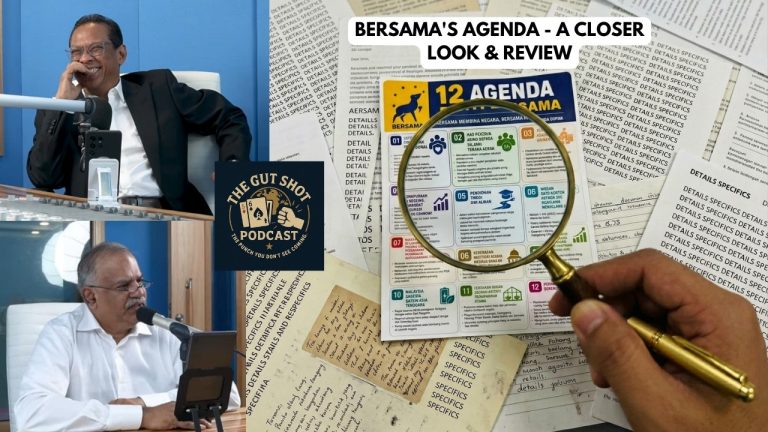
BERSAMA’s Agenda – A Closer Look & Review
Show Notes & Description
We review the 12 point BERSAMA AGENDA – as always with no fear or favor. Nothing gets our juices flowing when a party provide their objectives out to the public – credit where credit is due. Gutshot, however, takes a looking glass scrutiny on details and specificity of the agenda. We ask the how, the why and the really, that is what you really want? This also tests the new party and its leaders' ability to withstand scrutiny, critique and reaction to valid and informed opinions. Come along with us – We Have A Country to Save
Welcome to another explosive episode of The Gut Shot Podcast! We are Sham and Syed, and after 40 years of building multinational companies, navigating the banking sector, and surviving the Malaysian economy, we are done sugar-coating the truth. In Episode 85, we bring our real-world business experience to the table to critically review the new political party BERSAMA and their 12-point manifesto.
Are their promises of social welfare, capping foreign labor, and new generation housing the cure this nation needs, or just more recycled political lip service?. We break down exactly why attempting to control housing prices will crash the market, how the banking oligopoly is actively suffocating small businesses and driving them to loan sharks, and why the proposed "Anti-Alibaba Act" is a massive distraction from the real rent-seeking cronies bleeding our economy dry.
We also expose the systemic rot within our public universities, explaining why they absolutely do not deserve autonomy, and we sound the alarm on the deadly shortage of medical specialists putting your life at risk today. If you are tired of politicians playing games and want raw, actionable economic solutions from veterans who have actually built real wealth, you cannot afford to miss this episode. We even reveal how Malaysia can easily hit a 7% economic growth rate by fully utilizing our 42 trillion cubic feet of natural gas reserves instead of making empty promises. Subscribe, hit like, and join the thinkers of Malaysia—we have a country to save.
Chapters:
– 00:00 The State Election Chess Game: What Politicians Are Hiding
– 09:30 BERSAMA’s Manifesto: Real Reform or Just Lip Service?
– 12:15 The Free Money Trap: Why Cash Handouts Will Bankrupt Us
– 16:40 The Foreign Worker Illusion: The Symptom of a Low-Tech Economy
– 24:10 Stealing Childhoods: The Hidden Danger in Government Preschools
– 30:00 Crushing Small Business: How Banking Monopolies Bleed You Dry
– 37:20 The Anti-Alibaba Distraction: Exposing REAL Political Cronies
– 40:45 A Broken System: Why Public Universities Do NOT Deserve Autonomy
– 47:30 The Deadly Doctor Shortage: Why Our Medical System is Failing
– 54:10 5% Growth is an Insult: Unleashing Malaysia's 7% Economy
– 1:00:30 The Housing Price Control Lie: The Real Reason You Can't Afford a Home
Jump to chapter 9 chapters
- 0:00 State Assembly Dissolutions and Coalition Maneuvers
- 12:56 Reviewing BERSAMA's 12-Point Agenda
- 20:18 The Foreign Labor Cap and Economic Realities
- 29:16 Preschool Expansion and Systemic Education Flaws
- 37:55 SME Financing Bottlenecks and the Banking Oligopoly
- 47:15 Rent-Seeking Beyond the Anti-Alibaba Act
- 50:48 Public University Autonomy and the Medical Specialist Crisis
- 1:09:06 Unleashing 7% Growth Through Energy and Deregulation
- 1:17:27 The Illusion of Housing Price Controls
Auto-generated from YouTube captions. Timestamps link to the video.
Rafi I mean sorry I I I I I'm going to call you straight out like this. Okay. You have people like ourselves, Malay like ourselves, you know, um we've gone through this system whereby actually we were very much for even though I was uh pi uh Malay uh stream I was very much English educated uh I've had a huge long experience 40 years of multinational uh small business um uh building my own companies, building two public listed companies. Okay. I have built businesses and built workers. Sad has been in banking. Okay. He has been in business. People like us are telling you
this is what the country needs. Okay? We have real experience about what works. All right? And we are begging you people, please listen. Good morning, ladies and gentlemen. Welcome back to the Gutshot podcast. I'm Sham Show Sam. I'm back here with my good old friend Seakbali.
Good morning. Well, ladies and gentlemen, it's going be it has been a very exciting week for us. Uh we have the des dissolution of the Joho State Assembly. U and together with that also if I'm not mistaken though I'm not too sure whether that is conf confirmed
Milan is also dissolved right so both state assemblies has been resolved has been dissolved and I think we're going to talk a bit on that and also um I think this uh uh this new party uh which is u uh headed by Rafi Ramli uh has come out with their manifesto and we want to go through that manifesto and probably give some constructive criticism to this pledging party. Hopefully it will give them some help and uh and we don't know what's going to happen and um hopefully we'll see some good changes to the nation. Say, let's uh start off with what the hell is happening with Joho and uh u
Milan, can you please uh open the gambit for us? Yeah. Joho, the Joho state assembly has been dissolved 1st of June and the the latest is Negri Samilad. Uh was it yesterday I think?
Uhhuh. And then uh there is some speculation that uh Malaka might follow. Yeah, I've been hearing that rumor. Is that is that confirmed? It's just speculation. So far so far no confirmation.
Okay. I checked this morning. There's uh no confirmation but it's not too farfetched. They might uh because they also due for their state election. The tenure is ending or they all next year. Uh but so far ngree and uh Joho have dissolved. So now we have to await the date of the elections which should be within 60 days of the dissolution
right. So okay my view set because on what's his name on Gazi the mantra yes uh quite a popular guy you know ka on hist gazi uh I'm know most likely they will retain Joho the last time they uh let me just give the numbers here uh which is why we went to school I'm no Yeah, out of 56 seats uh the last elections 2022 before that AMO had 33 sec 33 state seats and uh the single largest block in the state assembly. Yeah.
So they really don't need a coalition. They're okay. Number two is surprisingly DAP they want 10 seats in Joho, you know, right? PR only want one. Now this critical throughout this conversation we're going to refer to the Pikaro imbalance. All right.
In Joho and also in Malaka. Okay. This has some uh this has a huge impact on why these things are happening now in my humble opinion. Huh? I I don't understand why dissolve the state assembly for Jaw. Is the term up?
The term is till next year. There is there is some debate why you know. Okay, we'll go into that. It's all tied up. I think they are testing their popularity or taking advantage of what they feel is a right opportune time for
AMNO to get the best results or retain the status quo, you know. Okay. Maybe they afraid that things might get not be not as good after this, you know.
Okay. So anyway, the the term ends in next year. Okay. Yeah. So anyway, you've got AMO with 33 seats and then DAP has 10, PK only has one seat and uh MCA has four, MIC has three, BATU has three seats and Muda has one. So really you're looking at AMO single largest block 33 seats and then you number two is DAP is just one.
That does seem like it's going to be pretty much status quo. So it's going to be status quo. So there's nothing really I don't think there's anything really much to talk about. Yeah. about what's going to happen in Joho election as far as uh making predictions.
Yeah. So ladies and gentlemen, might as well we move on from Joho. But but unless there's something that you you want to do the main thing is uh this is like a precursor to the general election. I think the Amno guys want to test the ground test and I also think they want to test the popularity of their partner PKR. This is this is a
that's that is a very sneaky move. I would that's a sneaky move. Yeah, I think they want to gauge the popularity of PKR because AMNO has announced that they will go it alone in this Joho election, which means they'll be going against PKR.
PR they're going to feel candidates in all 56 state seats. AMO, right? So they're going to go headto-head with PR. That's going to be an in. So can you imagine during the campaigning you have to campaign against each other and then you're member of the coalition.
Yeah. So depending on how PR performs and PR has only one seat. Yeah, that's right. Yeah, pick only one seat in Joho. So, uh I think I'm know it's not not gauging their strength. They will they will they will retain Joho. They are gauging the popularity of PKR.
Okay. So whether whether and that will determine how far they want to work with PKR in the general election. Let's move on to uh Negri is a bit more interesting. Negri is a toss up actually. But let me just check out Milanria is Amin Harun who is a PKR man. All right. Now uh the thing is in uh 36 seats 36 state seats. Okay. Barisa national amnu has the the largest chunk. BN has 14. Amno has 14 seats. Uh priata national has five. Pakata harapan has 17 seats. So Pakistan Harapan has three more seats than Bisa National in in Milan but out of these 17 seats DAP has 11
and PR has only five. So again PR although PKR is MRA in Milan and PH together as a whole PH coalition has got 17 seats more than BN but on an individual party basis Malay party capturing Malay votes AMNO has 14 whereas PKR has only five. So again here it is going to be a test of the popularity of PKR really whether they can retain these five seats or whether they can is it going to increase or decrease but I mean PR when I see rather they also put themselves forward as a party representing Malay Malay rights but I'm know has got 14 um they would most likely
retain gain or maybe plus minus one or two but the test will be on PKR DAP might uh gain plus minus one or two they're not really done that badg is is quite an interesting uh state I mean is doing quite okay the issue the issue now inree is you know there's I don't want to go too much in list because one of those are things there's a tussle about this royalty
oh yeah I all I want to say about that I was royalty. So there's a there's a controversy about the royalty issue. The thing is uh there's accusation that the this the political parties AMO and PK are taking advantage of the situation.
Yeah. Which opinion they shouldn't be getting involved in the royalty business that should be the 14 AMO state uh repar they withdrew support for the PRA the guy with five seats. Yeah,
PK I'm talking about PK. So what's his name? So that's why basically he has lost support of the 14 people in his own coalition. So they're going into this uh into this uh bi-election state election. The issue now is they're both pointing fingers at each other that uh you know that they're not fully defending the the ruler you know the palace. Huh? They're both like there are a lot of there a lot of accusations and cross accusations going going going around. The bottom line is what will the voters in agree similan say especially the Malay voters? Will they uh say that
AMO uh is taking advantage of the royalty issue for their own benefit or will they say that AMNO is uh actually defending the the royalty? Well, there's also the question of whether why why would the MRI bas get involved with the with the issue of the royalty itself and the same the same questions will apply for PTR
who is the MRI Basar right who's so how will the will the people read this tussle because other than that there is not much else going on in
well the other part that actually I that would warrant state budget. Here's the other interesting part that I think um what I've been listening on the ground and also from the research that after uh discussing research uh briefings from uh imman research for example right I think there's a lot of apathy within the Indian community and there's a lot of dissatisfaction within the Chinese community itself so I think narran is going to be a test market for all parties all of them including the AP
and PKR. Yeah. So, um I think that will be a bell weather for the whole country. I got my gut tells me that agree it will be interesting. Yes, it will be interesting. Well, before we um before we put a lid on that and then we continue on uh because I find that the Bama uh issuance of uh the manifesto and the bright shining new party that has come on you know um I want to go through that. So uh in between that I think if you guys like to continue this conversation enjoy the conversation that we have uh please subscribe so we can keep getting this uh podcast for free
for you guys and keep liking so that we can uh we can u we can spread uh our intelligent conversation to all the thinkers in Malaysia. We have a country to save. Ladies and gentlemen, say we go back to where we are at. Um shall we go into um one of the the new uh parties that we are looking at?
Party Basama. Party Basama, right? Uh I was very interested when I look at the uh the manifesto that was issued out by party is a 12point I would call it a 12point uh manifesto in essence or 12point agenda they didn't really call it a manifesto they call it a 12 agenda or party basama right and uh as usual with me I you know one thing I like is actually at least they make an effort effort to do a manifesto. uh I don't want to see obviously uh like what happened with uh previously the pony mahade is saying it's only a manifesto you got to hold on to whatever that you put on right
you know um but you know one by one when I look at it do you mind if we go through one by one of them yeah let's do it let's take this opportunity so that we uh inform um the the public on how we should look at political party agenda maybe uh Pashama itself can get some ideas from what we are talking about you know because what we want is actually um something good for the nation you know what we're doing um the first one that they came up with is actually uh systemongan social which is basically social welfare um uh uh or needs for all that's basically the to be precise. Now what my
my question is I know it's pretty um uh it's it's it's written in in simple language but what I would expect is actually a little bit more detail and specity because I think uh we being businessman you are being a banker and also a businessman uh ourself all our entire life you know everything is in the detail the devil is in the detail as they call Right. So when you talk about social welfare, one of the things I ask is how much are you going to be uh uh budgeting for all these social welfare programs?
Spot on. Right. Um I I I really want to see a a stoppage of all this that has been done by PKR or the PH government uh about throwing money out to civil servants come every haraya or every occasion they can think of you know just to fish for votes you know I I think we should end all those kind of situation. Um and then what do we mean by liar? who is uh who comes into this particular uh category that we should then be looking at how will get how will we get their money the money uh for socialism and how do we ensure that there are no discrimination I think these are very pertinent
questions that we should be asking and such specificity must come out from party basama what's your opinion I mean specificity.
Okay. Right. Yeah. The specific specificity is important. Yeah. First of all, it's uh it's uh they they have mentioned automatic monthly assistance for eligible.
How much? They have to they have to specify that and then the eligibility. Okay. Uh this this thing has been going on for quite a few government administrations. Under remember Najib Raza we had Bream and then Tan Mahin we had Btoan Prihatin.
Yeah. Under we had the Kwara Malaysia Malaysia. Now the present government has got they call it Rahma and S and all that isn't it? Mhm.
So this is cash handouts cash outs. So it's been it's been happening. Uh well I must say that the the people who are needy you know the the B40 classes a lot of other people too they are grateful for whatever they can get and it does help the people uh you know the even the SAR thing I think they they get a monthly dispersement like it's a small amount but people are happy when they get it because money is money. But as you said, you know, you you're you're you're juggling here, isn't it? On one side, you want to cut down government deficit, you want to cut down borrowing, you want
to have a more healthy budget. But all these things cost money. And where is the money going to come from? Huh? Uh government revenue is subject to oil prices. Government revenue is limited. And then the borrowings are increasing. Every year there's the government borrows. So you you have to juggle this thing and uh I as you said I would rather that we try to wean our society away from this kind of cash handouts by moving the economy give people jobs. Well, it's the moving the economy is one thing. I do understand the need for social security. But then what we should
have is actually a blanket social security system that actually takes care of people that fall through the cracks. Yeah. But can we afford that? You see that's the thing we all these are luxuries. You know
you you know what say we can afford that if we do everything right in a sense that all the economy is integrated. I I I want to go through each and every one of them because why you can't achieve one without achieving all the others as well.
So but I do agree with you. This is a whole argument but no no I the point I want I want I'd like the Bama people to know is that as they are new party right this is this is basically your manifesto right
so your point number one is something already been done what is the difference b prehat whatever what is the difference what is it that you are going to tell to the people look I'm the new party basama vote for me because my number one item on the agenda is this thing giving out cash and I'm going to be ABC D better than the previous guy. You have to make it known.
Otherwise, if I'm a voter, well, if I'm going to get money, I'm I'm getting money now. I'm getting cash assistance now. And what is your cash assistance? Correct. So, at the end of the day, it's going to boil down to that. Who can give more freebies?
To me, this is not good. This is to to me it's a question of actually putting forward a social security system that is uh that that has a proper infrastructure to it that is connected to how the economy as a whole is going to be run rather than giving freebies per se. That's what it's coming down to giving out freebies like the famous country for this polit India you know some of the because I do listen to this Indian guys discussing some of the things their politicians promise and cash handout is that is quite
we need to stop cash hand out so this is what is happening I hope that the I hope that basama has got a proper uh proper system budgeted and actually integrated with the whole economic system. So let me move on that. Yeah. Okay. Let me move on to the second part which is the um which uh you know in in short they are they they they are they are putting a limit to 5% of the workforce to be uh coming from foreign um uh foreign workers. uh 5% of our total workers. The question I have is actually um what is our current worker uh statistics uh today? Um and how are you
are we going to achieve from the current statistics that we have today? Um I believe I think if I'm not mistaken site can can we double check this number? Um I believe that we have approximately 17 17 million uh working population.
Yeah, the foreign workers is about the 2 million plus most um most optimistic low number is about 2 million plus but the realistic is much higher than that. You know nobody
okay the 2 million plus is like official figures but few people that take that as being very accurate. Correct. You're talking easily about you maybe 3 million 4 million people. So as a percentage of workforce percentage of workforce you divide that by the 17 million workforce. This is quite a big number you know I think what about 12 15% of the workforce you know.
So he wants to cap it to 5%. Uh okay this all noble noble issues which should be done. It's not that I I don't disagree, but you do this by uh cutting down the the influx of foreign workers is one and also you got to make it conducive for Malaysians and and the local uh workforce to fill up all these jobs which are not occupied by the foreign workers. Mhm.
So that would would imply uh wages, higher wages, productivity, better working conditions, things like that which will uh which will be conducive for our local people to take up the jobs now being done by the foreigners. But it has to come with sub substantial increases in productivity. The reason why foreign workers are so popular because they are low cost but the productivity is high. Our local workers cannot compete with the foreigners.
Well, I I I have another thing. So So the person you're looking at here is not the foreign workers, not the local workers. You're looking at the employers, the the the people who run businesses and factories in the country.
You ask me personally, right? I mean, if you talk about 2.14 million uh legal migrant workers uh from about 17 million workforce, that is between 12 to 13%. That is a number then you want to cut that down to less than half. My question would be that I would like to see from versama is how are you going to achieve that? Okay.
The point exactly if I if I may just continue on there and that that alone we probably are looking at in excess of 2 million workers that are not documented. I I I thought that this this particular point we're going to cut workers to what 5% of the workforce blah blah like you know the notes I I made a note here did they copy this from New Times old old news times or old star paper cuz we've been saying this for for decades every other government has said we will pledge we will reduce the number of foreign workers you know we reduce reduce nothing it keeps going up so you see
saying These things is one thing but are you aware of the needs of the economy? The the the employers are crucial here. The plantations, the factories, the businesses, they need these workers. Now why are they starving for foreign workers when we have a 34 million population? So there are other factors there. Perhaps we focus on our our what do you call this? The demand side the demand for foreign workers. the demand for workers. You know, our employers, our industries, our factories, they need workers. Why are they hiring so many foreign workers? So, because of
productivity and because of the labor cost. So, if you want the local workers to to replace the foreign workers, a strange thing to say, yeah, our productivity has to be better. Well, here here here's my my take on it and this is where I come to the point of view that actually our economy is so integrated in terms of the uh in terms of our education system. Now, if you put an education system where we we push everybody into a university where they are all air conditioned or they all in turb uh or you've got uh 400,000 of them uh each year in turbans and uh reading ties uh in uh in schoolyards
uh u we are not going to end up with productive workers. No. So it is education. Yeah. The the the more foreign workers that we have in the country, it is evidence of a low output, low technology, low productivity economy. That's what we are.
You know, I was where where these half semi literate or illiterate most of them are illiterate. No, you know, you can come here and find a job. And there again, we also talk about uh uh proficiency in English, right? When I go to a when I go to a restaurant um a middle uh a middle to high-end restaurant, almost all the workers are foreign. Why? Because there are two things that I find when I talk to the uh employers or to the chef or whatever is that one, they are more reliable. Number two, they can speak very good English.
They can speak English. Yeah. And they have not all the Bangladeshies but the other the restaurant workers as from India and and even if if they don't speak English at at the other time is that they don't get attitude problem where actually these people are going to disappear from not coming to work. Okay. Now I think that's a question that we have to ask our own society. How are we going to tackle that? So these are this is the result of the policy decisions that have gone wrong over the last 40 50 years you know so we have to the solution the foreign worker is a symptom
the large numbers of foreign worker is a symptom of the failure of our policy as you said we have shifted away from going value added we have shifted away from English all these are it adds value we have shifted away from STEM science education more on engineering and we have shifted away from all that. So as a result of which we depend on practically these people are illiterate, uneducated these foreign workers and they don't know anything but they fit into our economy.
Yeah. You know because we are a low tech low value economy. Exactly. We are low tech low value economy. The other thing I I mean I I had an anecdote I want to share with our audience. I mean I was this is not the first time this has happened to me. It has happened to me a couple of times. I was in a grab. Uh because I mean I'm a lazy driver. So when I don't have my driver around, I'll get a grab and then what happens is actually I I I start talking to the grab drivers, right? And most of them these are not their full-time work. What they this is their second job. Okay. And just the
other night I was talking to the I was talking to this young man who was uh in his late 30s. Late 30s. Yeah. Okay. He speaks reasonably well uh Malay. He can speak he can speak English. Okay. Um, and he says to me, he works uh as a civil servant and he intends to take uh an early retirement at his 40 and find another job because he's dissatisfied with the job uh that he's in right now. But you can see that they have um an inclination to actually do better for themselves. So why is it that we are in this predicament? We have to ask and actually have a a a formulation
that is that is integrated not just talking about um foreign worker but it is integrated to how our education system works, how the importation of all this uh uh foreign worker comes in, how this foreign worker overstay, what kind of incentives we provide to our employers um and also the the you know these are all things that has to be put out in detail. So I think I will move on from that second manifesto item to the third item that I saw in the manifesto which is education rightly so since we were talking about education just now so they're talking about uh early education
for four to 5 years old universal early education for five year old children you know uh with the objective of uh of of two-prong objective uh to increase the quality of the uh education and to reduce the cost of um uh uh uh of young families. Um and they expect that they can do that within a period of 10 years building the infrastructure and the um and the education um what do you call the education workforce. Now I have a suggestion to Brasamama. Okay. I have a suggestion to Brasamo. I started my education uh pre-education at 5 years old. All right. 5 years old. Not not not not
uh um uh not four. I don't need four years old. I mean our small children need to actually learn. we uh learn to actually um mix around with people around in their community. I think it's more important that actually our young family have a better environment for them to live in where they mix around, have be able to play games and actually learn how to communicate. That's number one. Number two, this cost no this this doesn't cost any more further money than actually building affordable uh uh what do you call living environment. The second part actually you know um and this is not unknown
our children my my child uh my friends children most of them learn from TV free guys especially now with YouTube okay you can get a lot of information learning English learning Spanish learning French, every language. In fact, you know, I was shocked that I came home one day when my daughter was 4 years old. She was speaking fluent English. And I was wondering to my wife, I was saying, "What the hell is happened?" I never taught her English. I mean, we do talk, we we talk more Malay. In fact, at that time, I was living in Miri. So, a lot of our dialect was Saran dialect, you know.
And uh she was like and then I I noticed something. She was watching a lot of Sesame Street. So don't need no need free school. I just watch Sesame Street. What? Sesame Street,
right? My my uh my view is this. You see, I think a lot of people across the board, we're not really happy with our education system. We're not, you know, with the primary school education, the government school system, the schoolabanga. We're not happy. A lot of people are not are not happy. That's why private schools are doing so well,
international schools and then even as the we discussed earlier Chinese schools 100,000 Malay students haven't been enrolled in Chinese schools because people are generally not so happy with the quality of education in government schools. So if you're going to increase this uh education to the four and 5 year old preschool, are we going to be creating more of this poor quality education?
Yeah. So instead of giving them a head start, we uh start messing with their with their lives at an earlier age. And then the other the other thing is that you know uh we have to be careful. There are many social issues here urbanization and so on. It will be sad if preschools run by the government uh become dumping grounds. So parents will go and dump their kids and then pick them up in the evening, afternoon or whatever, you know.
Uh because this is a very critical age, very young age. I know. And I has I see pre-education that are so religiously wrapped. We got young children. So So doesn't even
So I even have prechool ties. Oh my god. That's what I mean. This is what these are things we have. These are what I'm so scared about. You have to ponder. So, so because this age group four to 5 years old
a varied the pedagogy and they're so innocent so young I personally we did not send my kids we we at that age we took care of them uh so only when they went to school they were because that's that's normal normal pedagogy you join other kids in school but earlier than that they are still very very they're infantile four to five years old so you got to be careful where you send them there are of course there's preschool school, private preschool, all that. But they are catered specifically, they have good programs and you know so they they are well well regarded. We have to be careful. We know
don't just because you know this is a new party you want to attract votes. You province this kind of programs and then you go ahead and you do it because when you do this you got to be careful what's going to be the impact.
We we also need to have a look I mean I want to I want to put a lid on this situation right now. I I want to warn that look there are better ways to do this when actually uh what children at that age need is actually a good environment for them to grow up in to be able to play to be able to communicate with their with other children to be able to learn languages you know they don't really need to be in school except you know what has happened like what we've been saying before which is preschool become a dumping ground for children.
I would rather the parents pick their own uh what do you call this preschool education for their children to you know they can send their kids to whichever preschool or child care center that they have around the neighborhood and the government can give them some kind of aid financial aid
to send your children to preschool especially for the B40 and the lower classes. This is targeted at the B40 and the lower classes so that their children also get earlier preschool education. So let them do the choosing and but they can give them some financial assistance you know to pay for this. But to create a blanket like a government school system you know and you have uh uh pre preschool education for all children under the government's care. I don't trust the government success rate to too much. It has not been a good uh our experience
has not been well. I mean in fact if I would rather I pick the preschool for my children. you you know what I would rather have is actually I remember what was very successful during the 60s and the '7s uh actually those uh very well-meaning and very good uh communicators that come to the all the comps and tell and and actually explain to the uh family how we should be bringing up our children in a good environment. Um I think that has been that has done very well for our community during those period. So moving on uh I think this is our favorite subject which is uh uh getting rid of rent
seeking uh and actually um to leave the theme what they call here the PK PKS uh yes the small and medium scale industry uh as a as a as a as a
um uh as the backbone of the economy. We've always said the SMMES are the backbone of economy. Unfortunately, it has all been neglected, right? And take it or not, for the last 40 decades, especially the consolidation of the banking system um and the oligopoly that we have today of our banking system and the rise of the uh uh of the loan shocking business.
Okay. Uh this is the this is the major reason why uh our SMMES are stuck in a rut. And unfortunately uh to my uh uh uh to uh our fellow citizens that are now you know um that are now helming Basama. Um I am saying that if you want reformation in this area okay if you are looking at uh increasing the uh portion of GDP byme by 50% as what they have stated here okay u and to to have 60% of the workforce to come from theme I don't even look at the 60% workforce to come from theme it will come by itself the first thing that has to come is this. We know thatme actually approximately 39%
of our GDP. Okay. So you're looking at 10%. My question is you want to increase that 10%. How long are you going to take to do that 10%? Not more than 5 years before the next election. Ladies and gentlemen, my dear leaders at Bersama, if Shamshaw was to run this particular program, if me and Sai has been talking about this for the last few months, I can guarantee you I can raise the GDP contribution of the theme 5%. said year on year. Okay. By simply doing this, I will liberalize the funding mechanism in the country. I will have branches and new licenses issued for banking system at
all regional and all regional and all all states and all the regions and branches everywhere around the country. I will eliminate this oligopoly that that has happened to the country that does not cater formemes. Okay. Our priorities are all wrong. All right. And I think this is what you need to enhance in your particular uh manifesto. Okay. Increase the banking system, the funding system. Liberalize it so that they are near to their customer. So that the branch managers can give out loans and not wait for their second layer or third layer or headquarters to provide them with the
ability to provide loans to small micro and medium scale businesses. the can you please uh add to what I have just said the the thememes now are close to 40% of the GDP and it is to the great credit and resilience of these thememes because they struggle you know
they that they are able to achieve a huge chunk of our economy 40% mostly on their own and uh you're right the single biggest factor that is holding them back from reaching 50% 60% of our GDP DP or higher is the lack of banking and financial facilities. In my view from talking to people who I know who are inmemes, people who are in who are engaged in business, the alons, the money lenders are a substantial source of funding formemes
because the banking system doesn't reach out to them. As you said, banking is an oligopoly. Big banks igopoly, GLC's mostly and they look at their KPIs. they have their targets to achieve and uh if they can do big loans, corporate loans or chunky loansh bigger for the
it's easier for them bigger for the bank uh they call it what do you call it's it's it's it's the biggest bang for their buck so it is easier for them to achieve their targets and the KPIs so fer comes I need 500,000 I need 300,000 I need 1 million
you're not going to have lunch with the local branch manager Yeah, not likely. Not like the guy who needs 50 million or 100 million. So the single so they have no choice. A lot of them end up going to the alons and the alons they end up paying them 20 25% a year and alones don't pay income tax or any kind of tax to the government and they get taken they they get taken for a ride by their loans. So the guy sweats blood and tears and then he does his business themes and a chunk of it goes to settle the loan with their alons. Many of them run into financial difficulty because of they
have to borrow from their loans because they have no choice. Well, the KPI that are provided to the banking system that we have today, right? The branch manager doesn't know you. So, they don't they have to call the regional uh the regional office that tackles for uh that tackles for certain value and their KPI is so stringent they don't take any risk whatsoever.
Yeah. Let me let me let me just give an example. When I started my business in 1999, okay, my first business 1999 uh say I started a 100,000 rig business. Okay. I opened a bank account at uh RHB in Bangsa. Okay. I am forever grateful to Mr. who actually learned my business, learned about me, how I do my business and literally helped me with credit facilities and banking facilities. I grew my business from 100,000 to quite a few million to 10 of million. Okay? And that was literally helped by the branch manager out of his
own good heart and his KPI to see the success of his business of the business that become his clients. Th those were the those days as soon as the consolidation of the bank happened. So now coming back to this agenda here where they have put this building upmemes to a bigger portion of the GDP of the country. It's not going to happen. So I mean for the benefit of Bama so that a couple years down the road people don't do not accuse you of just paying lip service. Are you serious about doing this or not? If you're serious about doing this we have to liberalize the banking system.
banking and financial services. I'm I'm using the word banking and financial because in the old days we differentiate between a bank and other financial services. Other financial services you have like a leasing factoring it's all financial services which may or may not be be interesting to the banks but it is needed by the by the businesses by the economy. So it got to be banking and financial services must be made available down to every town and even the Kong you know
so only thenmemes will have easy access to credit the the otherise the smaller credits which they need the loans only then they can move on and and go up to 50% 60% of the economy otherwise this is otherwise lip service I'm telling Bama and Rafi this will just become lip service you're not going to go anywhere you cannot wave the magic wand and say we're going to increase the 50% 60%. It doesn't work that way. There is no credit facilities for the SMMES because the banking system is an oligopoly.
Okay, let me talk about then we move on to the sixth item because they've got 12 items here. I'm trying to make it as fast as well. We still have to cover the Alibaba act. Can I do that? Uh yeah, but I I want to quickly can I do number six which is the NISB doctor.
No, hold on. The Alibaba egg is part of the Where's the Alibaba? The same same topic. Number number 430 eliminate rent seeking and elimin Oh yeah go ahead anti Alibaba you see my apologies okay they want to basama suggested an anti- Alibaba act okay first of all very quickly we'll get to this very quickly Alibaba only affects usually government procurement contracts
the Alibaba problem which has been here for the since the new economic policy was started is government contracts government projects which are given to Bingutras class then they outsource it or sell it down to the non-boomies that's called Alibaba contract Alibaba so that only involves government government procurement
is is restricted by the government's annual budget which last year is 121 billion but our GDP of the country is slightly over two trillion so this is only a portion of our our economy there are larger rent seeking behavior in our economy which will not be covered by the Alibaba act including what you just said the GLC's for example rent seeking behavior isn't a AP isn't a banking oligopy rent seeeking behavior
it is a rent seeeking what about the monopolies granted by the government yeah the you want to bring brass rice import monopoly APS APS you remember we spoke about the BYD electric vehicle a few podcast right that's rent seeking you're purposely increasing the duties on EVs and various restrictions to protect the local coal producers that's rent seeking behavior
say I so so this is outside the Alibaba act but to me that costs more to the economy and and makes more people poorer than you know this Alibaba thing going on in in government procurement
no no but I so we have to be more it has to be a wider net right you you want to get to get rid of rent seeking brother you want to talk about wider net on this let me add to that point actually you know I Add to that point this even this new ruling that says that if any company wants to buy asset okay of more than 20 million
50% and the 50% right it has to be 50% rentse seeeking behavior these are rent seeking behavior not just rent seeking behavior from that point insistence that public listed company or public companies uh or companies that you know that they have to be shut compliant These are rent seeking behavior.
So, okay. To the Islamic banking sector which gets its own money from all sorts of industry that has nothing to do with Sharia compliance. Okay. So, getting rid of uh getting rid of grandking behavior is a good initiative. I agree with the suggestion by sama. But uh do not
how do we do that? Do not restrict this thing to just this Alibaba contract. Alibaba contract is only government small portion in government procurement. There are larger Alibabas walking around I mean rent seeeking behavior.
Uh there are larger players in in the rent seeeking market and that has to be addressed. We most of these rent seeking if you were to ask me are all political cronies. Yeah. Spot on the political patronage.
Yeah. Is the whole political patronage system. Now um shall I continue and try and make it as uh uh as comprehensive? I want this to be very comprehensive.
Next is dual track higher education. Um yeah the dual track higher education. Um I think I want to put it um in in in conjunction with the sixth item on their manifesto which is the NIS which is the uh ratio of uh one doctor to 300 uh 300 people uh by by 2030. Okay, because this is very much integrated. Number one, here's my point and here comes again. Please, Basama, let's have specificity within your particular manifesto. Okay, your agenda must have a a secondary document that actually details out how you going to achieve all these things, right? If you look at
or higher education uh by two uh two streams, let me put it this way. Okay. Um what they are trying to say is that there is a streaming for degrees and there's a streaming for diplomas. Okay. um where uh in a in a few years of university uh that they will be ready for the job market, right? Um and also um the capacity for uh courses uh according to the needs of the nation and the request of the students. All right. and and the last thing they put in there as the fifth item on the agenda is autonomy for public university in accordance to market demand. Okay, let me let me
please I mean with all due respect to Bashama here comes the public universities that we have currently in Malaysia does not deserve to be um uh uh to be uh given autonomy. Let me repeat that public universities in Malaysia does not deserve to have autonomy. You know why? Because they are practically run by people who are not capable. All right? You have created the governments of the previous governments that we have for the last 40 decades have actually used the universities as a system of patronage, rent seeking, putting people who are incapable, escalating
uh uh uh uh what do you call having inflation in grading, putting quota in to get more malaise in vote bank. Vote bank huh vote bank for vote bank suppressing the entrance of non-malise let me repeat that our system has suppressed non-mallays from entering public universities okay even when they are meritorious to get into the universities I'm disgusted okay I'm seriously disgusted because I have peers who gra who who graduated high school with me who are equally and sometimes even better that cannot get scholarships to go to university overseas and end up in the least that they want.
So we have a system that has actually broken. So before we give them any autonomy, we need to actually revamp the teaching mechanism, the KPIs, the grading system so that it is up to par, the language of instruction, the getting rid of university professors who come up with u who come up with mythologies as becoming courses course material. s our public universities are a shambble. So before even we talk about giving them autonomy, I think we need a complete revamping of not just the university system but also the education ministry, the administrative of the education
system so that we are no longer discriminating against people regardless of race and religion. so that people who have married enter. We should have a system whereby not everybody need to go to universities. We we had a good system in ITM where they had diploma and they can go out into the working uh environment and if they feel like it stay on with their diploma and keep on working or continue uh for higher education.
My uh we need more we need more TV uh requirements. So I tell you instead of talking about uh uh a a doy uh a a doubleprong uh higher education. What we need is a wholesale revamping and restructuring of our whole education system from primary, secondary and tertiary. get rid of all the religious uh uh influences in the education system within the country because it is destroying the education of our people and the progressiveness of Malaysia as a country. there. I've said it. Say it.
Yeah. I mean I share your your views. Uh my I just I'll just be brief. You know when you want when you when you are sick and you want to see you need to see a doctor to improve to uh treat you for medical treatment, you don't look at the race and religion of the doctor. You want the best doctor.
Yeah. Similarly, when you want to send your children for education, Yes. You don't look at the race and religion of the teacher. You want the best teacher because education and health are really, you know, very important. You cannot, you just have to go beyond this race and religion kind of thing. But this thing that they suggesting here, this dual track higher education, alternative roots in universities with uh employment several years of employment, employment and work experience as qualification to enter university. uh second pathway based on work experience
for diploma level qualifications. Um I this you have to be careful about this. This is a bit dicey to me because uh will they have yeah
remember in fact we have we we don't even teach world history anymore. I'm referring to UEC is and they said that they they need the Basam Lu and Sajara candidates. So will these people in the dual track will they also be required to have the jara and basamu? So what I'm trying to say is that uh I think we have an excellent model of education. the model the the the business model like other countries you go to school at the age of six and seven years old you have it you get 11 years of education at the end of 11 years you get some kind of a high school you get a
certificate here we have the SPM and all that and then you you progress to the next level so you have a high school certificate is good enough to me and we have to focus on strengthening that and improving that and
we have to go back where we became that's it now we are creating these new ideas and new new things. We do not know how well this will work out and these all risky things and you know I I have my serious doubts about this.
So again the for a new party who are promising these kind of things uh I would advise uh the Bama folks to put a bit more thought into all this before you before you come out in public. Rafi, I mean sorry I I I I I'm going to I'm going to call you straight out like this. Okay. You have people like ourselves, Malay like ourselves, you know, um we've gone through this system whereby actually we were very much for even though I was uh pi uh Malay uh stream I was very much English educated uh I've had a huge long experience 40 years of multinational uh small business um
uh building my own companies, building two public listed companies. Okay. I have built businesses and built workers. Sad has been in banking. Okay. He has been in business. People like us are telling you this is what the country needs. Okay? We have real experience about what works. All right? And we are begging you people, please listen,
bro. We are we are we we only halfway through. Can we We are only halfway through. Can we jump to number nine? Okay. Let's let's jump to uh you want to jump to number nine. Annual economic growth of 5%.
Okay. Annual economic growth. We we we're going to jump. We're going to jump. We can take the seven and eight later because why the pizza for example it comes together. If you did do your your your your examinations right you don't have all this inflation grade things will take care by itself. You know institutional uh independence we've talked that in other podcast we don't have to go into that anymore. Let's talk about this paneuman economy which is economic growth uh targeted at 5% uh with uh with fair wages to all. Okay,
you can tie in the doctor's telling. Yeah. And the tie in of the doctors. Come on. Tie in of the doctors. Very simple. Why don't we just create I mean let's put it this way. We have a budget. Okay. Increase the budget by about 30 or 30%. Okay. Build more hospitals. Get the land free from the states. Why are the states charging um uh for land? Okay. Why do we have rent seeking on all the construction? Do an open tender. Okay. Stop all these hospitals uh uh these private hospitals and uh uh uh uh uh uh health tourism industry. This health tourism industry Yeah. is a is is
is a very unproductive and and and and and defeist to the population of Malaysia. Okay. You're taking away resources. I can tell you what you can combine if they so intend to do that. We build hospitals with you guys from the private sector. We'll give you free land and you states all please you know don't make money from the land that you own. Everything become a freehole. Okay. And then say we're talking about we're talking about uh internship and housemanship. just bring all these students that are you know that you are not allowed because their skin color is not the same
is not as brown as you would like. The the issue is quite uh serious in the medical sector. Yeah. The government health health service uh there is a shortage of doctors and worse than that there is a serious shortage of specialists. Yeah. See I mean like in any profession you you're a junior then you become senior doctors you know they in the government service they join as housemen then they become medical officers then they have to go through qualification only to do their masters which is a very limited program you know extremely limited program this masters
for doctors after that you become a specialist uh you know and then so there is a really huge shortage of specialists in the country you know like brain surgeons all there's one guy for the northern region, one guy for the southern region, things like that. You know, they go by numbers of one here, one there, you know, and then you got other other specialists like you know this liver surgery or they're very few. We don't have enough and then the person becomes a specialist, they leave because the system is not conducive to retaining our specialist. So, so then the
housemanship there was a problem last time people not able to get enough housemanship slots and all that but actually they are. So, so if you mess up the housemanship uh slots, you're going to mess up the medical officers.
Everything becomes you mess up the medical officer slots, you're not going to get enough specialist. Well, between medical officer and specialist, you have to do your masters, you know. So, every step of the way, uh it has to be smooth. But we really have to increase the number of doctors in the country. Just some figures.
Our public universities, they they produce about thousand medical graduates a year. I I did some Google search. The private medical schools are doing better 1,0006 to 2,000 graduates and then we have about 700 graduates from foreign universities who graduate every year and come back. So a year it's about 3,000 plus 3,0008 medical graduates for a country of 34 million. It's not enough. So we really have to ramp up these figures. So these people making you know this useless arguments you know about this that Indian girl got 10 A's 11 A not able to get medical seat
all that and that is silly if you can buy a submarine for I don't know how many billion how many billion does it take to increase the number of medical seats in the government university from a thousand let's say you make it a 105 what how many aircraft carriers is going you cost a submarine is going to cost we need the doctors because now in hospitals, the lack of doctors, lack of specialists especially is really costing our citizens even their lives, you know.
Yeah. If you don't get treatment in time, if you're a cancer patient, if you don't get treatment in time, you know how quickly cancer can spread and kill people, you know. So, we are putting our citizens at risk because we cannot manage these little numbers here.
Come on. Thousand graduates a year, why can't you increase it? Yeah, you know. So, so, so if I may, if I may, then uh uh the other thing is that there are enough positions in the hospitals. This I got this from some research. We got about 12,200 positions for housemen in the government hospitals of which only half are occupied. 6,500. The remaining 5,700 vacant. We don't have enough doctors. And then uh uh the people who who enter housemanship each year 2023 3,200 something 2024 3,200 2025 3,294 this is not enough I think you have to double triple these figures otherwise you know
from housemanship you become medical officer from medical officer you become specialist those numbers will not they're not going to increase if you have small numbers like this and there's something else going on this one is I have observed and I've spoken to a a senior medical professor and also he was a professor and also a doctor in one of the teaching universities here. He told me that of his students of course now in any faculty anywhere not in Malaysia anywhere in the world girls are the majority even in medical school and in Malaysia he said unfortunately a
substantial portion of girls medical graduates especially Malays after they graduate become doctors they come in and stay at home they lose them he say he said they become home minister so a lot of uh female graduates Malays they after they graduate and get married and stuff like that they opt out of being a doctor. So we lose doctors there too. Bottom line is we are not managing our our getting people who are doctors who qualified or do as doctors into the housemanship program into medical officer and especially into specialist that specialist part is extremely
important that requires a master's qualification. We're not focus that is a bottleneck. We're not focusing on that. Yeah. I I think I think I think when we look at the economy as a whole I mean in order to induce uh you know all this uh pony uh uh not having all this brain drain as well uh into the private sector. We have to look at the economy as a overall and how we pay our doctors uh how uh uh u how this private uh private institution need to be cailed seriously need to be cailed
without paying attention. Yeah. And then if I may just wrap up on the economy thing among the things that Basama Rafi has said is that they want to target an annual economic growth rate of at least 5%. Yeah. Can I remind them we already achieved 5.1 5.2 our 2024 25 2024 is 5.1 and 2024 is 5 2025 is 5.2 and our physios in government why you why are you promising a lower rate of growth uh bro I mean you already got 5.1 5.2 True. And now you want to promise a minimum 5%. Shouldn't it be the other way? You should promise something like, you know, like 6%, you know, something higher.
No, no. I I I can tell you one thing. Uh I can promise 7%. Okay. I can easily promise 7% minimum for Malaysia uh GDP growth year on year. But provided we take all these bitter pills about rancing. We take all these bitter pills about not bitter pills actually it's actually quite a good pill where we actually uh deregulate and and and increase uh the the capability of banks to expand and uh uh be available formemes. Um also um I would really propose and I think this is something that we have never heard in this country which is I would propose that we start stopping taxing
more our people and actually reduce the taxation of our people to 50%. Okay, you will have your tax base wider and you have absolute bigger tax base. The other thing that you should remember also within your manifesto is this idea about having a green uh uh a green uh hub in Malaysia. Please note one thing, you have a supply chain problem. Uh when we come to uh the green technology, everything is basically produced cheaply in China. Okay? They are dumping all their product to all over the world and you're going to be stuck with a supply chain issue. Number one. Number two, you
you are so basically you're talking about forex coming out of the country. The second part that you're looking at is actually your greed is not there. Okay. The third part that you got to think about as well is actually how much more subsidies are you need is needed to make it comparative if at all. Now the interesting part about our economy which I find absolutely saddening is actually um our economy has instead u instead of of of focusing on on on all this uh what we should be looking at is that we have probably one of the biggest gas reserves in the world. If I'm not mistaken,
it is in excess of four three. Let me let me let me check my number. Let me let me check uh my my number on this. I think it is in excess of 4 trillion uh cubic feet um of gas. Why don't we maximize that gas capability? We have 40 years of experience in in in the in the oil and gas industry. All right. This is
if I may if please you know this wanting to become the battery and energy exporter of Southeast Asia. Okay. We just got to be careful. I think uh a long time ago you know we signed this long-term gas supply contract with uh Japan. M
so at that time you know we had excess gas a lot of excess gas so it was a good thing to sign the long-term supply contract with the Japanese the Tokyo Shibawa electric company if I remember right
so we supply gas but now our economy has also developed we also need our resources so we got to be careful that um we're not locked into this long-term supply contracts where our our land our resources our hydro power and so on uh we are locked in long-term supply contracts to benefit other countries. We have to be careful about this.
We we need to benefit our own nation. Yeah. Because nobody nobody is going to sign energy energy supply contract for 3 years or 5 years. No, they will probably want 15 years, 20 years and so there. So to you know for supply contracts huh so that will lock us in. So be very careful about this. I just want to remind the people sorry say the you know the Singapore water supply contract 50 years 99 years so don't get stuck in that kind of a of a situation I would rather as you said we take care of our economy first
no let me make a correction my number was slightly off by a uh by a factor of 10 actually we have 42 trillion cubic feet of proven gas reserves in the nation okay we should 100% % exploit as much as we can because I can guarantee you we will find even more you know why do we use imported uh uh uh when our own solar for example okay you know half of the day is not going to have sun and then you're going to have to import batteries some more and then you're going to have uh you know when it is slightly cloudy or raining you're probably going to get maybe 30% productivity
you know I mean let's let's be realistic let's look at what is available let's look at the technology that we have already developed within our own people instead of exporting our people to middle east you know and they are working in the middle east and all that we can actually make use of our own people increase our industry and our GDP
increase our manufacturing exactly use our gas other resources to increase our manufacturing and then you sell our products to other countries. Yeah. And you must remember one thing as well that actually uh by uh by remember something about agriculture. Okay. I I would like to remind something about agriculture. Agriculture is the most uh inefficient use of land uh for productivity there is. like it or not. Okay. So, we need to move up the value chain in terms of science and technology. All right. Even with look at what is happening with Thailand. China just wall up them. The
durian prices are now down the dumps crashing. Yeah. Crashing. I don't know how long palm oil will be able to sustain itself, you know, because why? You must also be ahead of the curve. Let me explain to you a bit about uh bane the the health trend that is happening that nobody seems to be talking about. Wheat, grain, rice, all are going to be not a healthy product at the end of the day. Okay? Because people are cutting down on sugar and carbohydrates. All right. And also with that including high sugar content in fruits. All right. In 10 years time we will find that the
market for all these product are going to shrink. So rethink that particular policy and look at how we can upgrade ourselves to become a great ship building nation, a great electronics nation, a great oil and gas nation. By the way, what is our carbon contribution to the whole global uh to the to the whole global discussion? We are not even 1%. Why are we so worked up? You know, the the industrialist world, industrialized world don't care. China is China is building coal power plants like nobody's business. So, I leave it at that for for the time being. In a sense, you know, we are coming to
the end of uh our hopefully our constructive criticism generation housing. Yes. So, I think this is a very important thing. I'm glad bas come up with this about new generation housing which actually myself and say has been talking about urban ghettos can you please
I just they have mentioned this new generation housing so they mentioned about industrialized building system these are basically prefab houses now okay fine these are good ideas but I mean these things these ideas have been around for some time uh we have had prefab housing in the country even now there are some projects are prefab But you know construction is you have to ask the accountants at the end of the day do the dollars and cents a ringit and cent does it add up or not? Because prefab you got to you got to manufacture it somewhere else then you have to
transport it to the site know. So you got a lot of logistics cost at the end of the day it must be profitable. If it is always profitable the entire construction industry would have shifted to prefab a long time ago. Uh the fact that it has not because you know the it's not always cost effective. So we got to be you have to be careful about that. But I want to I want to uh just point out something a statement here that they have made in their Bama has made in their in their 12point agenda. This is the English version. Better control of housing prices for middle
income and lower income groups. To me this kind of statement is a very highly uh risky statement. Remember we spoke about this in earlier podcast that uh politicians this this are political party manifesto. Politicians, civil servants, cabinet ministers, they decide on the selling prices, the pricing of goods and services in our economy. And this is what this this statement says. It says better control of housing prices for middle income and low income groups. That's why these things don't work. When civil servants, politicians, ministers, political party manifestos, you try to
put a finger or try to control this. They use the word better control of prices of products and services. In this case, houses. It doesn't work that way. It cannot. You have to leave it to the market to decide. Housing prices, you can make things easier. Housing prices depend so much on the value of land. I I know it because I'm in this business. Your land price goes up, your housing price will go up. And land price, nothing in this world can control the price of land. And traditionally, land prices have always gone up uh unless someone discovered some toxic uranium in your backyard.
So you see it it it is very difficult to control these prices. What you can do is make things easier. Land is a state matter. So the government has to work with the states. We we may have to make changes or encourage states to adopt changes in national land code land usage. My suggestion is for residential land you know the approvals the conversion all that make it standardized throughout the country. Make it just fill up one form and get it done. Leaseole land let them convert to freehole for residential. These things make will make it smoother when when the transactions
the the conversion the change of name to kama all this is easier then the prices will come down and please don't make uh uh don't make uh what do you call uh non uh boommy uh land to be boommy land just because it's purchased by a bum putra
okay all these things don't add value they don't add value I mean they add more difficulty And in fact actually if I were uh looking at the capital market or or the cap uh or or capital economics as it is today I don't think there's any value to Malay reserve land. Okay. In fact if you were to ask me the way to for you to reduce all the cost involved in housing is actually to look at corruption in land transactions to look at corruption in how land has
the corruption thrives because of all these layers. Correct. Every time there is one one set of approval needed, that's where the corruption comes. Not not only that, also in building materials, the the the the licensing of how you build materials. Uh the the the the regulation involved. Uh we need to have more people being able to build materials and lower cost. uh we need to have this goes through the whole supply chain that are actually full of rent seekers. So this this uh to make houses I mean you cannot control the price of houses. I'm telling you the house prices
will go up. That's it. But to to make it as affordable as possible more by the market at that time uh just make the entire transaction as easy and smooth as possible. You know last time to get an approval to build a househ there are like seven eight different uh parts of approval process. Yeah.
Uh the the the the first when you move in into the land the land clearing you need approval you need the the building uh approval then you need the development approval you need and then the parade the par the series all these are separate approvals until one day they they they became smarter and they say okay we'll give you a one-stop center so that you only submit once and then they will have their seven different department meetings together you know and they approve it and then it worked for a couple of years then that one disapp period went back to the old
system. You have to go individually to seven different departments and each time you go to different department there is a there is a possibility of uh of corruption you know. Yeah. So these are the issues. So, so the issue of uh controlling prices of housing you you cannot wave a magic wand but you have to go behind into the back room of the approval process which is
PBT the district office city hall majaran whatever whoever is in charge and straighten out the sops so that things are smooth if you can make it online you know then you speed things up and reduce the opportunity for corruption and delays. You then you have a better chance of controlling the the prices of houses. You know, you can't control, but at least you you don't you you can make it easier, make things easy. Let let me let me finish this conversation we have today and I hope that this uh uh all this ideas and input are taken constructively by everybody especially by the party basama
um because we want to see a greater nation. The last thing that I want to say about uh housing is I think we need to look into how to make our housing to be a mixed development between so that all the races are able to live together and once to live together because facilities are provided for all the races to mix. You have your m your masid. You have your temples. You have your churches. You have your uh you have uh your playgrounds. You have schools that are actually of good quality where all the races want to be able to be together. This is what Malaysia needs. I think to that with
that said, let's end this podcast today. It's been a long one and I hope this has been very beneficial for everyone. Uh we've tried our best to make it as positive as possible. Thank you so much say for everything. The input has been great. Thank you.
Yeah. And I hope our audience stay right to the very end. Thank you.
What viewers are saying
137 comments on YouTubeNo comments yet. Be the first to weigh in.
Join the conversation on YouTube ↗