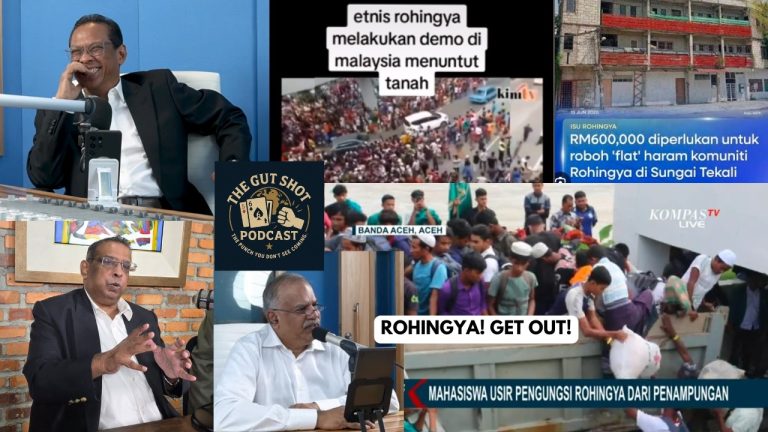
Rohingya! Get Out!
Show Notes & Description
We deep dive with lawyer and ex-Johor DAP chief Norman Fernandez on the decade-long Rohingya problem. This is a Gutshot no-holds-barred conversation. Norman's background and personal experience with the Rohingya issue is a must listen. You will not want to miss a single minute of this episode.
Join us. We have a country to save.
Welcome back to The Gut Shot Podcast! It’s Shamsul Sam and Syed Akbar Ali here, and this week we are bringing you a conversation that will leave you absolutely furious. It is time to stop sweeping our national problems under the carpet. We sat down with our long-time friend and brilliant legal mind, Norman Fernandez, to uncover the ugly, hidden truths behind the Rohingya crisis in Malaysia.
This isn't just a humanitarian refugee issue anymore—it is a booming, multi-billion Ringgit human trafficking enterprise operating right under our noses. Did you know that cartels are charging up to RM15,000 per head to smuggle illegal economic migrants into our borders?. In this explosive episode, Norman breaks down the shocking history of how the initial sympathy in countries like Indonesia quickly turned into outright rejection due to extreme entitlement and social friction.
We dive deep into the sickening reality of the Wang Kelian mass graves, the terrifying truth about local Kampungs being completely overtaken by foreigners, and the incredibly sophisticated (yet bafflingly simple) navigation tactics smugglers have used to bypass our maritime security for decades. We also ask the tough questions: Why are we giving a foreign entity like the UNHCR the power to operate like a government within our sovereign nation?. If you care about the future, security, and sovereignty of Malaysia, you cannot afford to miss this episode. The time for blind sympathy is over; the time for political accountability is now.
Watch the full breakdown below:
– 00:00 The Uncomfortable Truth We Keep Sweeping Under the Carpet
– 05:15 What Indonesia Learned (And Why They Finally Had Enough)
– 11:30 The Real Reason They Fled Myanmar (It's Not What You Think)
– 16:45 The RM15,000 Human Trafficking Cartel Blueprint
– 22:10 Wang Kelian: The Mass Graves The Authorities Ignored
– 28:00 Why Malaysia? The Dangerous Lie of Being a Welcoming Country
– 34:20 The Shocking Way 300 Foreigners Took Over a Local Kampung
– 41:15 Smuggler Secrets: How Cartels Bypass Our Maritime Borders
– 47:30 Why It's Time to Kick the UNHCR Out of Malaysia
– 55:00 The Final Warning: Vote Them Out or Lose Our Country
Jump to chapter 8 chapters
- 0:00 The Looming Rohingya Crisis
- 5:36 Lessons from Aceh's Experience
- 11:48 Origins and Citizenship in Myanmar
- 16:27 The RM15,000 Human Trafficking Enterprise
- 29:15 Rising Local Backlash and Political Paralysis
- 37:29 Demographic Shifts in Local Kampungs
- 51:43 Shutting Down the UNHCR Office
- 59:37 Restoring Border Sovereignty and Political Accountability
Auto-generated from YouTube captions. Timestamps link to the video.
But there's one something something unique happened. There were recently there was a video of Rohingya children singing Negaraku. Okay? Now, many many family you know some some Malaysians they can't even sing Negaraku. Now we have the Rohingya children who are able to sing Negaraku. Okay? But I said you have a look at the message this children you know five year old and six year old singing Negaraku. Now, Negaraku tanah tumpah darahku. Okay? What they're saying is true. This has become their country. Now, and in a matter of time they will demand that I rightly should be here.
Welcome back to the Got Shot Podcast. I'm Shamsul Sam. Back here with my long time partner and friend Syed Akbar Ali and today Syed, we have a very special guest I'd like you to introduce Mr. Norman Fernandez.
Okay. Thank you. Thank you. Welcome everybody. Today we have our guest here. So that Norman Fernandez he is a lawyer from Johor well known as also a commenter and writer. I met Norm 13 years ago. 13 years 13. And we've been friends since. We communicate almost every day through the WhatsApp and he contributes articles. I carry his opinions in my blog. So today Norman is here and we're going to discuss this issue of Rohingyas of which he has plenty of personal knowledge and experience.
Good. Very good. Very good. Yeah. Thank you very much for helping me and um um I hope I can share a little Please do. what I know and also to hope that what can be done that uh this is a the Rohingya problem for very long. It has been happening. Uh issues and all, but what we have in typical very often in Malaysian way, we sweep it under the carpet. You know, and now it has become and becoming big issue. I'm also I I'm also have a little advantage because I've actually
I've seen gone to Indonesia and also saw the changes how the society there with regard to have changed how they the acceptance and the rejection of the Rohingyas in in Indonesia and particularly Aceh and in Indonesia, what we are talking about is just about about 3,000 Rohingyas.
Right. That's the around the maximum population. In fact, if you add all the other refugees and all it is maybe about 11 to 12,000. You know, unlike here
in Indonesia. Huh? In Indonesia. Yeah, in Indonesia. You know? In Malaysia, how many Malaysia You see, the problem with Malaysia is this. No one has the actual statistic. So, every There is figures bandied about by the government, the police.
So, the 200,000? The 200,000 in Malaysia is a total refugee population. In Malaysia, they may be from other other refugees from other countries and all. But, specifically with Rohingyas the figures bandied about is about 126,000. Perhaps this is registered numbers, but I I believe there's a huge number of unregistered Rohingyas. So, these unregistered Rohingyas and all, this is what makes makes it I believe it's about 200,000. We are reaching there and We must remember that in when the Rohingyas first started arriving in the mid '70s there was a time when the population was
maybe about 5,000, 10,000. Now we have reached figure almost 200,000, but they have been coming to Malaysia in different different waves from 1975, then the second wave came in 1983 on after the the enactment of the citizen act in in Myanmar.
So, so '70s to now, la. Is there a comparison to what happened in Indonesia? Was there acceptance Yes. and allowing them in. And then now it is changing. What what happened?
Yes. Now, what you see most of the Rohingyas when they arrived in Indonesia, they came they arrived at in Aceh. Now, when the Rohingyas first arrived in Aceh, the villagers even before informing the authorities, they rushed waded the waters, brought the Rohingya from the boats, putting them on their shoulders, bringing giving water and food immediately, then bringing them to their homes, giving them a good bath, warm food, clothes. So, they were the Rohingya the Acehnese were very receptive, particularly for the reason because for what they went through. They have gone through. So, that was
what then they were very receptive, very warm, and the typical Acehnese culture. Then what had happened is that they were first placed in the villages and all. Later the Acehnese found difficult their problems with the Rohingya simply because the Acehnese the Rohingyas became what I used the word is big-headed. That means they thought they are a people entitled. You have to recognize them recognize them that what they went through. So, they couldn't they did not adapt. Then they saw the various social problems brought by the by the Rohingya. Firstly firstly is the cleanliness.
They couldn't understand how this community can live with the with the in unclean atmosphere. Secondly the refuse the refusal to adapt to the culture to the surrounding. And that is what has made now in Aceh from where they had the sympathy and solidarity for the Rohingyas. Now what has happened is that they have taken one step. Pengusiran Okay? Which means basically getting rid of them. Actually probably a harsher word would be to get lost.
Okay. Get lost. All right. How you how they are going to be removed that they don't want to know. So what we have now is that they are moved from villages, chased out from villages. And we have and in Aceh it has come to an extent where they have the authorities had to move the Rohingya refugees from Aceh
to to Pekanbaru. So Pekanbaru is now feared to become the Indonesia's Cox's Bazar. You know? Pekanbaru is in Riau. Yes. What what do you mean by Cox's
Cox's Bazar is the refugee camp in in Bangladesh. Bangladesh. Which which houses almost about 2,000 2 million Rohingyas. There's a place called Cox's Bazar Bangladesh.
So okay. There are there Cox's want to keep them inside there. The Bangladeshis do not allow the Rohingyas to go into Bangladesh. They put them in one place. So basically the people are in something like enclosed camp encampment.
Cox's Bazar. When you go there are there are refugee camps like the Kutupalong refugee camp. So in unlike here both in Indonesia and Bangladesh they are kept in refugee camps just like what we used to do in Pulau Bidong or Sungai Besi transit camp with the Vietnamese. So that is the difference with here here.
Rohingyas are excuse me. Rohingyas are actually Bangladeshis. Bangladeshis. They speak Bangladeshi language but it's a dialect. And they kept this one I got it from Bangladeshi people. The cultural capital of the Rohingyas are their linguistic capital. Rohingyas is a place called Chittagong.
Chittagong I have no Chittagong is a famous port in the Bangladesh. The Chittagong famous Chittagong port. Chittagong is the cultural center for the Rohingya people. They speak the same dialect. Then what why do they why
Because they are not citizens. They come from Myanmar. Politics and all that. So they isolate them in this Cox's Bazar. But in the in the May I ask about the origin of this migration out from Myanmar of the Rohingyas actually. Because you said the Cox's Bazar is in where
Bangladesh. In Bangladesh. So where they are of their ancestral origin which is Bangladesh itself. But they are Bangladeshi people. Bengali people. Even from their ancestral home they are being kept isolated. In Myanmar basically something must have happened. Yes. Right? Can you give me a quick quick one because I'm completely not um, and and hope and maybe some of our audience need to really understand a slight background of uh why they became this refugee community.
Right. You see, first of all um many people think that the Rohingyas are the only uh Muslim ethnic group in Myanmar. All right.
Okay? In fact, if you uh we would do read a little further um in Myanmar there are of course Rohingyas, okay? Then you have the uh another ethnic group called the Pantis, okay? Which is mixed of Burmese and Chinese Muslims. Then you have the uh Zerbadis, which are mixed of Burmese and Indian Muslims.
I mean there are many Muslims in Myanmar. yeah. Then there is there is actually then there is also another group, okay? Uh people are surprised to hear that there is also a group called the Pashus. The Pashus are actually Malay ancestry.
Muslims also? Muslims. So these other Muslims do not have as much problems in Myanmar. Uh well, you see in in after the 1983 um enactment of the citizenship act um the uh Zerbadis, the Pantis, the other ethnic groups, but you know uh they have very limited recognition because uh Myanmar is a country whereby citizens are categorized. They are full citizen associate you know? So, they have their these kind of categories.
Now, so they also got Bumiputra and non-Bumiputra, lah. Um well, in some way you can talk about it. Uh but, there is one ethnic group uh uh uh Muslims. They are the uh they are the Kamans. Now, the Kamans are fully recognized as one of the other 135 ethnic groups. So, the only one who are recognized is the the um Kaman.
They are ethnic They are Malay. Yeah, Kamans. And uh Uh they are as I said, that they they come from a region of uh region of um Arakan, okay? Uh now, the state of Arakan, but they have escaped it simply because in Arakan state, even before the Buddhist uh Arakanese and the uh Rohingya Arakanese were were also in conflict. There was uh already uh uh
history ethnic So, there's a history between the Muslim groups themselves. No, the Rohingyas. The Rohingyas? Rohingyas Rohingya Arakan Rohingyas. Uh-huh. Okay? And the Buddhist uh Arakanese in the Arakan state. So, there was
They come from there was ethnic uh conflict going on. So, then they began to come out, they began to leave leave uh first they began to leave uh during the '70s in small numbers, then we saw them leaving after the after the 1983's uh whereby uh citizenship act uh declared them stateless. Because as you say, they are rules go to Bangladesh, they are known as uh they are considered Bengalis.
The the the what's the name the lady in uh Myanmar? Aung San Suu Kyi. Aung San Suu Kyi refers to them as Bengalis. Yeah, I see. She uses the word Bengali. Let's go back to the history. Let's go back if I may if I may divert the thing a little bit. So, just now you said that the Rohingyas are now not so welcome.
Yeah, Aceh. So, if today's the cartels the cartels involved in moving the Rohingyas around Southeast Asia. So, the cartels today given a choice, would they send the Rohingyas to Aceh or send them to other part of the world?
Hold on a second. Before you answer that question, let me take a break. Um and uh be back. We have a message for you. If you guys like to continue this conversation, enjoy the conversation that we have, uh please subscribe so we can keep getting this uh podcast for free for you guys and keep liking so that we can uh we can spread our intelligent conversation to all the thinkers in Malaysia. We have a country to save, ladies and gentlemen. Thank you so much for the patience. Now, we want to talk about the cartels, okay? Let's go to the cartels and that has been moving around this uh society of
people. Why is it Where do they want to put these people and what is happening? People they're being they're being brought here. Yeah, actually this uh human trafficking cartel uh human trafficking is really a lucrative business. Now, even as a as a lawyer um and then you know, uh they uh human traffickers charge between 5,000 to 15,000 per head.
Per head, you know? Huh? Yes. And they're prepared to pay, you know? And and now they many Rohingyas uh can pay to these human traffickers and they it's simply because they are here, they're working, they have money. Okay, so even to bring in brides Oh, if bringing brides the human traffickers can do. So, does that make it instead of a refugee situation, what we see is actually an economic migration?
Yes. Um that is based on money availability that allows cartel also to actually profit from this business arrangement. Yeah, 200,000 Rohingyas multiplied by 15,000 ringgit. That's billions, isn't it? And they can import even their brides to get married here. So, I think the Rohingyas are going to be here for a while.
Because then why is our why is there um no enforcement or what are other options that you see? I think there are many fingers in the cookie jar.
There's so many fingers in the pie and this is this as I said, human trafficking is a really lucrative business. You know? So, and
And has it involved actors on this also? Uh we can we can we can just give an example of the uh one Korean Yeah, the one Korean massacre. Okay? Massacre about uh there were there were 28 camps in that area. Although uh
What do you When you say 28 camps, how many people does that represent? You see, uh the last uh when we saw is that about uh about 135 mass graves.
Oh my god. Okay? Uh about 100 nine skeletons were found. So, but the fact is this. These human traffickers could um make 28 uh over 28 camps.
Yeah, what 28 Yeah. Over 100, uh, human bodies discovered in And, uh, uh, it's surprising that nobody knew. And And this, uh, this this is not something, uh, it was in, uh, bigger state. This was in the police. You know. And, uh, you mean to say the authorities
Don't know about I know I wouldn't say that nobody knew it. Nobody wanted to say Of course. Yeah, I mean, here is the thing that Because the Royal Commission of Inquiry, one of the comments they made was uh, the authorities, it seems that the the authorities knew about it or there was a over- overlooked or oversight. So
Yeah, you know, in fact, when, uh, there is secretly when the police first found the then the In fact, the the the camps were even the first demolish. Okay, that was 2015. Yes. Look at how my teeth is gritting with anger, okay? And I just cool down while the other has stopped.
That was 2015. Uh, this is 11 years ago. Uh, it was not 200,000 Rohingyas at the time. No, and it was would have been lesser. So, now it's 200,000 Rohingyas. So, what's going on? I guess that no more mass graves in the one clear. But the numbers are increasing. And and and, uh, definitely, as you say, the Rohingyas are paying up to 15,000
You need to come here? Yes. So, money is bringing them here now. You don't need to go and hide in the in the jungle in Wang Kelian, you know, those No. So so they're coming in directly. If you really look at it, sorry, um, you know, no one if if I think about this, right? And I think about all the uh, either Middle East, Pakistani, Bangladeshi workers and all that that are in the country and overstaying um, are also part and parcel of this cartel
Yes. and partly the reason why the Rohingyas issue has come to the fore seem to me to be more because of the same situation that they had in Aceh. Which is the the the the culture assimilation and uh or the culture differences is so stark. Right? Not that the Pakistanis or the Bangladeshis are not that stark, but this is even starker even and the entitlement is so such as such that um that it has caused a real friction with the local community. Am I Am Is my assessment correct?
I I agree what you're you're saying. The the we have to also find out why are they want Why are the Rohingyas they want to come to Malaysia instead of going to
Indonesia? Indonesia. Uh in fact, in Indonesia, those in the camps and all are able In fact, they are put in camps and then you find about There was one camp where about 400 plus Rohingyas escaped. How could How did they escape? Again, trafficker's money is is human traffickers are at work and those uh Rohingyas in Indonesia, they also want to come to Malaysia. It's simply because Malaysia has shown to be a very welcoming country.
Of course, money makes everything welcome. Yes. Yes, so that is It's money. That is the word welcoming has been related to money. They I mean the It's money. so-called used of coreligionist is actually irrelevant. It's all about money.
Yes. They have humanity humanitarian all these things. All these are Yesterday Just money. uh two soldiers two soldiers were charged uh and they were trafficking uh uh Rohingya.
They brought them in through the Padang Yes. Padang Besar. You know, you think about it, right? I was checking Pulau Bidong. We had about uh we we we we held them in Pulau Bidong.
Yes. From 1975 Vietnamese refugees to 2005. Yes. You know? And we had a specific area and they have to go somewhere else after. You know? That means uh that cartel did not exist or very very minimal if any.
Yeah, because they were they were put the thing so they can't move, yeah, you know? So, but when you when when they hear uh you know you see the those people were coming from Bangladesh now. Mhm. Okay? See, initially the Rohingyas uh escaped from uh were forcefully evicted and escaped from uh Myanmar.
Mhm. Okay? We can understand that. Go to Bangladesh, huh? So, they went to Bangladesh. But those uh Rohingyas who are in Bangladesh, who are coming here, these are no longer escaping from persecution. They are coming here because of the economic uh opportunities here.
Yeah. Now, are there Bangladeshis who come to Malaysia as Rohingya? Oh, yes. Many Many of the uh There are many times Bangladeshis are coming uh coming together. I have met uh Bangladeshi uh laborers, huh? Years ago, they had that that UNHCR.
Yeah. Yes. And the guy told me he paid 300 ringgit. Yes. Wow. That That card is for Rohingyas. But this guy is a Bangladeshi fellow. You know, I I don't is happening. That is also happening. I I don't know which minister I saw made the statement that actually, you know, where are we going to throw them? They are you know, they crossed the sea to to be here. I mean, what kind of are you talking about?
Yeah. You see uh He has a one coin. You see, the thing is we have a situation like this. We have about let's say now we put it we take the figure of 200,000. Although it's 136,000, but with the with the registered illegals it it Rohingyas it should be around that region.
Unregistered unregistered illegals. Yeah, okay. Okay. Now, the problem is this. None of the 57 OIC Muslim countries is willing to give resettlement. Okay, we have one. First issue. Number two, we have the the Western countries. They are very cool not to taking Rohingyas.
Very selective. They know How do you select them? Yes, they are having even their own problem with their own Muslim immigrants coming from North Africa and whatnot. You have problems, so you don't have. Okay? Then what is there left? Okay?
Yeah. Now, there's another thing and these Rohingyas because their network has grown big and there are there's a support group and all. Okay? So, what they have been been the message sent to them is this. Now, you cannot be forces. Okay? Because Myanmar come what may, they are not going to take you in because you're considered stateless. And they have a strong power breaker in in China. Okay? So, whatever it is, China will back them up and okay. Now, what the Rohingyas have found and also as you from the from what has been read to them is that there is something called the principle
of reformant. An international principle repatriation. That means these Rohingyas who are here if they have a family and children okay? Then they cannot be sent back to the country of origin. Although we are not signatories to the refugee convention, but we are signatories to various children child convention convention related to children. So because you have that then you have no choice you have to have them.
Are we not then actually encouraging human trafficking? Yes. Right? So here's my question. Okay, maybe I should get to this actually. Um as a legal person who has had so much experience in this issue what would your solution be?
See I would we have to take step by step, okay? There would from 1975 to 19 I think 2000 sorry when it came when the finally the last Rohingya left, okay? Because UNHCR was able to resettle about 240,000. Resettle other countries.
Rohingya No, no. The the Vietnamese you are talking Vietnamese. But the Americans and also the West was sympathetic towards the Vietnamese. They created the problem. But this Rohingyas is not the same issue. Yeah.
So and then we had another 10,000 our problem either. Yes, at least the Vietnamese you can say the European French or Americans were part and parcel of the war in Vietnam. We were never in any war with Myanmar. What the hell are we taking them for?
Based on his point, based on based on what he just said, I want to steer the conversation a bit like, okay, in Malaysia, uh we are all voters, la. Yeah. Uh Malay voters, Chinese voters, Indian voters, all of we are voters, la. How many of these voters want the Rohingyas to stay here or welcome me? Or conversely, do the voting population in Malaysia, do they want to see the Rohingyas out? This one is for the politician.
No. You see, while there's a while what is Dr. Subramaniam this while there's a pushback, uh especially in Malaysia, is very seasonal. You know, going against the Rohingyas, you know, is uh during the time of COVID. No, so there was a backlash against them. Okay? The present backlash at this started uh during the Hari Raya when the Rohingyas
Slaughtered the cows. did the Yes, slaughtered the cows. What happened? Uh sorry, I I'm out of the picture there. Uh-oh. Well, the during the you see, there were videos of the Rohingyas who were doing the sacrificial ritual
Right. of slaughtering the cow cows uh The mess that they made. in in open area by the side of roads. Some like my God. Okay? Now, that was one. Uh but what really angered everybody is that the the feces and the blood and all were then thrown into the drain. That really raised the ire.
And also the number of cows quite a bit. Yes, you know? So, but we are so while there's a pushback, while there's a pushback by people, there's also many groups who still uh remain sympathetic. You know, because that thing with Malaysia is this many Muslims consider them as Saudara Seeman. Okay? So, this this thing is is the one that still brings that sympathy out. Okay? Now, um I believe the time is come that this uh Rohingya issue should become an election issue.
I think it is already. The vote the voters should now demand uh what the government going to and they should make this one is a the other day we had uh after the the there was a banner placed in Marang. In Marang?
Terengganu. Yeah, in Terengganu. Uh demanding them to leave. What I What I notice is that now lately in social media, podcast, YouTube videos, TikTok, a lot of these videos are coming out and anti-Rohingya. People are angry and Malay people are producing it. People Malay people are making statements that they're against the Rohingya. The recent one was that girl. She made a very
effective TikTok video. Yes. She spoke very well and she explained that the issue of Rohingya is problem to the Rohingyas and all that. Uh so, the the welcome mat has now worn worn out the dealer. Among the Malays, among the Malays, you find that among Chinese and Indians maybe not so much. There there was one China Chinese man who also showed that the Rohingyas have been causing issues of
But, there's also there's also a reason why we notice this because uh the Chinese and the Indians, sorry to say, it is not and they are also in agreement that they they Rohingyas should be resettled. But what they are fearful and afraid to see is this, they don't want this issue Rohingyas being Muslim that later turned out turned out turn and made that the non-Muslim Indians and Chinese are now anti-Muslim.
Yeah, yeah, that's the issue. think I think you are right. That's a really I think your religion can if the politicians are skilled the rascals can So I mean our our non-Muslim population are actually scared of saying anything because it will make them look
Yeah, but but that would have been more relevant it would been more relevant I think maybe 10 15 years ago. Now from what I see Malay population is really unhappy about this Rohingya issue. That's why I say you look at the videos coming out in the social media a lot.
But why is our own opening minister uh defending the the situation? So exactly so the the reason the thing is the more important thing now is the way I look at it the inflow has to be stopped.
Yes. Okay, we have the 120,000 200,000 Rohingyas here. Okay, fine. We have to deal with that. You cannot push them into the sea tomorrow but the inflow has to be stopped. What Mahathir wanted to shoot the Vietnamese boat?
Once you stop the inflow then you can you know these things can be sorted out by UNHCR or whatever. But the problem is the inflow is not stopping because the money is involved. It's too much money involved. So all this talk about Islamic
Yeah. It's all Put it come on to see all this money. We should be money. Yeah. In fact, we should be ready. First of all, um the the voyage from Bangladesh
When you are there Malaysia, okay? The seas are perfect for travel during the months of November to April. Right. Okay? So, right for we should be uh extra careful. You know, we have to have our SS ready making sure and all.
But, we are extra careless now. Yeah. Yeah. I That's the season to be extra careless, right? That is where the problem is. November to April is extra careless. But, they get, you know, as I say, um they are able to come in. But,
Well, I I think at the end of the day, it has become a political issue for Malay Malay people, Malay voters. They are they are worried. They are hurt. They've had enough. They're fed up. So, uh whether the politicians have enough common sense inside there or that or not lah.
The the politicians should read one of the message uh by one commentator who said that it does not matter whether it is BN, UMNO, PAS, or which your party, okay? Which party that can now go to step forward and provide uh a solution to say as well, "We will vote that party." That is why it's all of a sudden you see politicians, MPs, uh ADUNs are suddenly walking in their constituency and looking to see, "Oh, there are Rohingya here." So, now suddenly they are showing concern. Election is just around the corner. Surely they would have known after the election they were off.
Yeah, burning lah. It's all Yeah. It's all so It's all Just keep I I I I would be looking at at anybody running and telling me exactly this is how this this whole Rohingya population is going to be phased out from the country. That's number one. The second thing I would be wanting to hear from them is how am I going to transition out all the illegal immigrants in the country, okay? And then also legal immigrants who actually we can slowly replace with our own people that are properly trained to be able to do the jobs that are taken by these immigrants. Because actually they
they it is able to be done. But we have no political will to and there are too many too much money involved. So if we did the podcast that we just that that we just published about we called it illegals and cronies. Okay? I think that spelled it out very very loudly. In this instance actually we are focusing on the Rohingya because we got no choice.
example. Yeah, please. Okay. You see there is one Malay kampong in Johor Bahru called Kampong Teluk Serdang. Right. Okay? Initially a few Rohingya families came in. As usual, you know, our own people rent out the homes to them and all, okay? But this then this Indian initially they were about 10 to 15 families. All of this. Now there are 300 Rohingyas overtaken the original Malaysians there in the kampong. Now the Malaysian in that kampong is now 200. Okay?
Rohingyas are 300. Yes. Okay? Okay. In the kampong, okay? You mean to say nobody knew the the policy not know. They all know, but this is not leadership. It's better to play the three hour race card. You know, then then doing this and in uh
Yeah, but they play the three hour race card for money. Yes. It At the end of the you correct me uh you rightly pointed out everything boils down to money money. Yeah. You know, so uh as in many cases
So they they the point that I keep repeating in our previous podcast They socialize the problem. Yes. Right? But the money they privatize. Yeah, of course. And the cartels Yeah, the cartels or whatever.
That That seems to be the modus operandi. Oh, it's throughout Malaysia. That is our national philosophy, you know. The The money is privatized and all the problems that you raise It's socialized. Socialized. Like what Norman is there having a lot in Kampung uh Kampung Tualang Setia after the flood in there. That's what it So the the local people bear the problems and the
How how long have you been following this How long have you been actually tracking this issue of the Rohingya? Actually it started First uh my first interest came because I was defending uh traffic car. You know, that was maybe 20 maybe about 25 years ago.
Wow, that long. And uh at that time they were bringing these illegals illegals from uh from uh Indonesia uh from Batam to uh Tanjung Selapa. Okay? Now, from Batam to Tanjung Selapa is only about 20 20 minutes by the uh fast boat. Okay? Then I I went I asked him uh this was maybe about 20 25 years ago. How do you all coming? Okay, bringing the Oh, we come late at night. Of course, they leave late and then they dock. And how do you know? Do you have a GPS to GPS to show you're reaching water? They said, "No. What we What we do is that we put battery-operated TV
on the boat. Okay? So, as the as the battery as as a boat leaves, you won't see the TV. You won't see any of our programs or test patterns or anything like that. Okay? As you get into the As you get into the Malaysian waters, then the test patterns appear.
Oh, wow. TV or something. Now, this test pattern is indication we are already in Malaysian waters. Now, they are so good We We only see the test pattern, the various colors. Okay? But, they know which color is should be reach a particular brightness.
Yes. Okay? When you reach that brightness, then you can unlock the the this uh So, thanks to RT, yeah. You see No, no, no, no, no. Say, say. That's scientific. You know? So, but of course, now it has gone We can do high-tech GPS So, the moment the boat leaves Bangladesh. And remember, many of these boats have food and water. Food is already there. And there are there are They also use these satellite phones. You know? So, that is linked linked by all There's a link starting from Bangladesh all the way to Malaysia.
so so we have established that actually they are cartels that are doing human trafficking in Malaysia. In fact, actually I read, if I'm not mistaken, the United States has put us on a watch list of of of of a country as a human trafficking country, right? So, that is not very good for us from an economic standpoint. Uh the other thing that I looked at is actually then um uh can you elaborate more? We did have a few examples. Why what other parts that are so different about this Rohingya community? I know, for example, I mean, they have even demanded that Selayang be given to them.
Well, that was a It was I think that Yeah, it came out in some of the It came out tabloids, lah. But it is it is I mean, to me, the entitlement mentality of demanding uh uh an area for them. It's like, you know, that is just so disgusting.
But I mean, I don't understand what kind of mentality this population have or this society have. But they are um what ex- what other examples or things that has actually happened that has made it so untenable even to the uh Malay community that originally seems to say, "Okay, they are our coreligionists." What has made it so apart from those one or two examples you mentioned?
Yeah. You see, what is systemic about it? think uh the main uh thing this uh when we talk about these problems is we are we are not since it got short and we talk openly and we have honest conversation, we we rightly do, is simply because uh in Malaysia we have refugees from many other countries in fact even from Myanmar we have the Karen the chins refugees in Malaysia but they are able to live within the community follow laws okay and follow the norms of this local population but the problem with the Rohingyas is that they are not willing to do
why if from my thing I think after doing some research I think it it is a characteristic of them it's a characteristic characteristic of them you know that this entire you see that's why you will notice in fact before coming living Johor Bahru here um near the ETS you know KTM you know and now it's extremely convenient to come here by by train I saw an Indonesian lady a cleaner okay she could be whether legal or illegal I'm not really sure but she is working working as super there was a there was a rainfall and she's sweeping the place now at the corner okay there sits
a Rohingya woman okay she's there begging so there's this thing entitlement we are Rohingyas we are helpless so you must help That is where the thing in the become a community that is entitled and and we have another thing this you have many sub-groups and all are helping them. You in fact in Johor they they are also and they also just in like many other state they also given
My my point is you know, one client 2015 and then the mosque raids became a who-ha, Royal Commission of Inquiry and all that. Now you're saying it's about 200,000 Rohingya years. My question is for how many more years is this going to go on? All right now it's the public awareness is very high. But it seems like the people who are in charge do not seem to
Yeah. I commend the Indonesian minister Yeah. I think you sent me the video where the Indonesian minister made a statement I mean it's a minister's official statement where she is saying that you know, we have to handle the situation and we I mean they're not they're not happy with the Rohingya's coming in. The society also that's not happy. So they are they are basically they are saying no. Yeah, minister Indonesian minister we don't see that here from our leadership. One client was 2015 year from before that. I What I'm saying that from all previous governments huh
nobody has really said that this is a problem. Rather that they are more welcoming. Yeah. But now it is becoming a problem with the people Yeah. in Malaysia as now especially I notice Malay people Malays because you mentioned correctly you know this is it's I got my say Iman and all that. All that is has been one thing really. Now there's more more awareness. One guy in Penang who starts with who starts with who goes around raising awareness about what is really so it is it is coming to that point now. But the question is for how much for how much longer are these the influx are
going to continue unabated without any can you stop them? Because the problem is getting worse. I don't see that. I don't see that getting better. Because they have become now second, third, fourth generations here. You know, so you see I I give a
Well yeah, we don't have what what do they call it? Jus soli? Sorry? Where actually the children that are born here are automatic jus soli, automatic citizen. No.
So No. So we don't it doesn't come into our problem. That's right. But there is one something something unique happened. There were recently there was a video of Rohingya children singing Negaraku. Okay? Now many people many family you know some some Malaysians they can't even sing Negaraku. Now we have the Rohingya children who are able to sing Negaraku. Okay? But I said you have a look at the message these children You know five year old or six year old singing Negaraku. Now Negaraku tanah tumpahnya darahku. Okay? What they are saying is true. This has become their country. Now and in a
matter of in a matter of time they will demand that I rightly should be here. No. Here's my opinion of that. okay? Anybody who tells me that Malaysian of any race, okay? Unless the person is probably 80 years old, non-Malay who has, you know, about who who who was, you know, right after before Merdeka or or right after Merdeka, cannot sing Negaraku is a liar. Are you okay? Let me let me put it that way.
is something It's it's It's all propaganda. Number one. Number two, this whole Rohingya children singing Negaraku is also a propaganda. Okay? It is to to so-called talk the This tend to come from entitled community who wants to get something from you. Okay? I, as a businessman, I've experienced a lot of scammers like this. All right? This is a scam tactic. Okay? So, I don't really care.
I'm perplexed by what you said just now. The Rohingyas are now importing their women to get married to you. Yeah, right, huh? So, that that is a different level of operations of Oh, yeah.
You're not a refugee anymore if you can import your bride from your kampung to come here and get married to you. I don't understand why they cannot put the Rohingyas all in a Probidong. You see, generally
Sorry, I I I I really have to ask this I tell you the answer to the question is 15,000 satu kepala. It's not many. That's your answer? 15,000 satu kepala, huh? You can Google It states Sometime ago, I wrote an article which was published in Sinar Harian.
Mhm. You know, it caused a it was a full page article uh where I said uh Sudha Sun Pai Mas untuk Malaysia wakafkan satu pula. Okay? Satu pula. But actually to
For the Rohingya. Actually to just to see the South uh I put the word wakafkan. Hmm. That set of uh I stopped uh saw me and said, "How can I recognize uh my Who is there? Who is this crazy guy? And all the things." Okay? But the time has come to do two things. This is my idea. First of all, we have to instruct uh UNHCR office to shut down.
Shut down is I I said I I agree. I agree. Secondly, we should tell UNHCR since the government is now doing the registering program, UNHCR can no longer do registration. And this is a foreign entity. You know, we are a independent
We are a sovereign country. country. And we are we have been giving this task of registering. Huh. And the And the issue that UNHCR has got. And this UNHCR Let me I just come back later to the to the the registration. So, they should be called and then in announce no more recognition of any UNHCR card. Okay?
Well, uh the question The question is why why are we tolerating all this? You know, I agree with you. We are a sovereign nation. We issue our own identity card. We issue our own passport. Okay? Who the hell is UNHCR to de- to to to to ask us to do anything? As far as I'm concerned, ladies and gentlemen, you hearing it guy short, I want the UNHCR building office close down. Get the hell out of our country.
In fact, you don't need to pass law. Yeah. You did they they They're out. So, what in fact the the the next parliament sitting is coming. Yeah. Just issue a statement. We are we are with effect of 1st August, we are shutting down. We will take over.
Yeah. The government will take over and and you have you have she not done much in the 18 years in the 18 years from 2003 or for the 18 years 2003 to 2021, UNHCR, who is meant to be resettling, they only managed to resettle 8,312 Rohingyas.
Because the their resettling was here. Yes. So, now now Rohingya this UNHCR is as though a government within a government. Yeah. And to look after the Rohingyas.
No, the the problem as always I say that coming when I talk about always, yeah, government link companies or uh what do you call which in this essence it's a global link company under the UN bureaucracy, okay, where actually they sit comfortably getting a lot of money that justifies their existence.
Exactly, they're clever because they don't have to spend the If they want to resettle the Rohingyas in other countries, they have to spend their money, they have their manpower, UNHCR. Yeah.
But they see here Malaysia is so relaxed, they they issue the UNHCR card and the Rohingyas go out and and just I mean they find their own way here. So, it saves the UNHCR so much money and effort of resettling this people. So, because we are so accommodative
Yeah, because we got no balls. So so the UNHCR says let them settle here. Yeah. Yeah. If you lose them from here, they lose their money. that UNHCR card You see what's lost is is a very powerful card. You see like for example we carry we carry identity card. Okay? Our fingerprints are with with the registration department. They're Rohingya here. They carry this card. Your fingerprints are not not in uh with the the the the
They are they are at a higher level than us citizens. And just recently in fact in fact about about 3 days ago I was talking to a Rohingya about this about this registration program that's going on. They remain fearful of the Malaysian registration. If Malaysia were to give after registration give them a card, they are frightened that there may be a tracking.
We can track them like can track them. Like like our my class I see how is it that we are being tracked by our own government but we are not tracking So because we are Malaysians.
Yeah. So because we are not paying 50,000 yes for the cartel. Yes. And they are still comfortable with the UNHCR card. So you can So what what should the government should do? As you said we have to close the hostels to close the and that can be done by just a statement. You don't have to have a meeting
The prime minister can issue an executive order. It's very simple. You know? So I think now going forward we have to the people
We have to kick them out. have to have to It's that is just uh mantra and very often what he said when to kick out it happened. Okay, so now what the people should do is that this should be now an election issue. Okay, we will vote doesn't matter who it is whether it is passed by Anwar Ibrahim or DAP or whoever. Whoever says they will kick them out we will vote for that. We have to go for that. Yeah. I think I I think I will take City Council's word for it. The way she says it. Can I put another twist to it? I will say I will say that don't vote for the these politicians who still
allow the Rohingyas to come in. As I said earlier they are already here. We have to sort them out. We have to sort them out. I'm talking about those who are not here yet. Those who are floating in the sea now in where from Bangladesh to here. They should not be allowed to come in. And there are remember 2 million people want to come to Malaysia. So don't vote for the politicians who allow them to keep coming in. That's it. The ones already here we have to sort it out. We have to sort it out. That one sort it out sort it out. Right? But those who if you still allow them to
keep coming in don't vote for this. But at the end of the day if you look at it right the Rohingya has become actually a flashpoint. But actually the whole issue is bigger than that. It's money. Yeah. It's the cartel of human trafficking in Malaysia that is including all sorts of people coming from all over the place. Right? It's only because recently the Rohingya situation has become untenable for the Malays. Malays. Malays. Malays. Malays. Yeah. mean let's be real about this. Right? I mean it's it's again a question of corruption. Yeah.
Yeah. Right? I'm a it's it's again a question of corruption. You know? And it's it's whether we can see our government or the government that we are going to elect
The politicians. The politicians that we elect All of them. Yeah. Not just any parties. All of them are all of them are responsible. Yeah. Are responsible. That's one of Yeah. Over the last I don't know what 20, 25 years or kicked the hell out of all of them. All of them are responsible.
Yeah. I think is there any uh final final I think I want to say Now, we have one 2 million. I put the figure 2 million of Rohingyas in Bangladesh who find who already want to come here because Malaysia is a promised land. Okay? Now, as I as I say, we must find a way to stop them coming. Okay? Now, how do you Why they are coming here? Because they know Malaysia uh Rohingyas are not in camps in Malaysia. They can move about. So, what we should do after demanding the UNHCR office to be shut down is that to to put all of these Rohingyas into a into camps or in in an island.
That will also send a message. If you come here you're going to be put in another island in another camp. So, that will also make them But that won't be worth 15,000 a year. Yes. But when you
Imagine, huh? You said just now, huh? 300 Rohingyas have taken over Kampung Serdang. Yeah. If 2 million come in, they can take over state. Yeah. And none of these Rohingyas are are wanting to stay in Jinjang or Hartamas or Mont Kiara. Okay? They are looking Kampung Kuala Serdang, Kampung Pintu Baru. You know, these are the places where they can stay. And in And what is amazing is that in Kampung Belintang Baru, the local villagers eight rented out about 88 houses to them.
In I saw the YouTube video of that Malay man in Alor Star, not in Kampung Hulu, somewhere Alor Star. Uh that Kampung, I forgot the name of the Kampung, they the Malay people were living there for a long time. Then the the the state authorities asked them to leave, all right, because it's state land. Then all the houses were the Kampung houses were demolished, but new houses were built. They said this is like resettlement, low-cost housing, whatever. And then the Rohingyas moved in. So now that that Kampung somewhere near Alor Star, according to the YouTube video, is populated by Rohingyas.
So we kicked our people our own citizens The local people were moved to low-cost flats, and some were given compensation, 17,000 ringgit, and they moved away. Yes, they moved away. That was the reason the money coming from the Rohingyas trafficking is a lot more.
So you see here than moving the people who are state land, you know. Yeah. It is there's no title free hold title, it's state land. Meaning the development of the state land was using state funds. Yeah. Right? And then you house the Rohingyas. I wonder who they pay the rent to. Is there monthly receipt for the rental? And then they built those low-cost flats to move those Kampung people there, also state
Why is the MACC not checking on also state funds. That base money here. MACC So checking on this uh somebody is making money one three rounds, you know. Yeah. No, I mean where where is the MACC not checking on this?
This is a YouTube video, like the guy I Check la. In fact, uh just to since they brought out All Star. Of course, we know Bukit Mertajam is almost is become a like a district for the Rohingyas, okay?
Right. And Dr. Mahathir himself once said in the Rohingyas in Kedah because they have a long lineage and presence there. They are actually known as Melayu Islam Kedah.
Also, in that case in that particular instance, Dr. Mahathir did not fail the Melayu lah. So Okay. So So, why was he crying? Yeah. So, he said so we are basically trying to be sympathetic. So, to say that well, they have So, they are actually considered Melayu Islam Kedah.
Mhm. You know? This is I'm Can I say this, Tiong? You're really making me depressed lah. You know, this is I have really different activities, but this is something I took as an interest in 20 around 2014. You know, I started that, you know? And we can read up because I think but also something unique I've been to Myanmar.
Yeah, yeah. Um Uh the what something unique I I made an accessory is this the there are 135 ethnic groups in Myanmar. Right.
Okay. But the the Myanmar junta I think finds problem with everybody. With every ethnic group they have some problem. You know?
Well, that's pretty fair. I mean, okay. I mean, a country has a problem today, but but it's not our problem. Yeah, it's not our problem. It's not our We have our own problems, isn't it? I say I really don't give a about their problem. our own problem. That is why the Arab countries The 150 I'm sorry, the 57 OIC countries are also not bothered because well, they are in Malaysia. They can they can earn a living. They can walk around. They have this
your problem. They have their own you know, when they when they get married, they have their own Imam. They have their thing. Everything. They're basically uh a country by themselves in Malaysia.
I keep saying to people we are run by stupid people. Okay? By stupid, but they make money though. Yeah. You know? So, I think you know, I think my my my view is this whole Rohingya thing. Like like all the other other illegal foreigners or those who are here, whatever. Including the Bangladeshis, it's all money. It's it's huge amounts of money, bro. 15,000 ringgit.
All you need All you need to do is There are a lot of them. There's billions. Yeah. So, ladies and gentlemen, we've heard quite long and uh co- well, complex. Really, it's not that complex since well, we have
talking about complex. It's not complex. It's all about money. It's actually human trafficking that is going on in our own country. For decades. Yes. So, Norman, thank you so much for coming along.
Precious mind. Yeah. I wish you do this again. Of course, we should. Yeah. Thank you so much. Gentlemen, ladies, we are pleased to have Norman Fernandez today. Said, thank you so much again. Thank you.
We'll see you guys again.
What viewers are saying
200 comments on YouTubeNo comments yet. Be the first to weigh in.
Join the conversation on YouTube ↗